VALN / s4v2-shigellosis — Shigella4V2 (S4V2) for the prevention of shigellosis
Program analysis ·
bpiq_drug_id18578 · prepared 2026-08 · USD · framework v5.6.1 · Coverage: CLEAREDCompany context, financials, ownership, options and the full pipeline:
../company.md.How to read this. Written for a reader who has not studied pharmacology or finance. Terms specific to this program are in the Glossary below; general terms are defined once in
framework/04-glossary.md. Tags:[VERIFIED — source]/[UNVERIFIED]/[WEB ESTIMATE — source, date].
Glossary
| Term | Plain-language meaning |
|---|---|
| Shigellosis | A severe bacterial gut infection caused by Shigella bacteria. It produces watery diarrhoea, and often dysentery — diarrhoea with visible blood — together with fever and stomach cramps. Swallowing as few as 10 to 100 bacteria is enough to cause it. |
| Dysentery | Diarrhoea containing visible blood or mucus. It signals that the bacteria have physically invaded and damaged the wall of the large bowel, rather than just irritating it. |
| Shigella serotype | Shigella bacteria come in variants distinguished by the sugar coat on their outer surface. The four that matter most worldwide are S. sonnei, and S. flexneri types 2a, 3a and 6. A vaccine has to cover each one separately, which is why S4V2 contains four components. |
| O-antigen | The repeating sugar chain that forms the outermost layer of the Shigella cell wall. It is the part the immune system can recognise from outside the bacterium, and it is what defines a serotype. It is also the active ingredient of S4V2. |
| Lipopolysaccharide (LPS) | The full molecule of which the O-antigen is the outer part: a sugar chain anchored to a fatty core in the bacterial membrane. “Anti-LPS IgG” in this document means antibody directed at the O-antigen sugar. |
| Conjugate vaccine | A vaccine that chemically joins a bacterial sugar to a protein. Sugars alone provoke only a weak, short-lived antibody response and work poorly in infants; attaching a protein recruits helper T-cells and turns the response into a strong, long-lasting one with immune memory. |
| Bioconjugate vaccine | A conjugate vaccine where the sugar-to-protein join is made inside a living E. coli cell by an enzyme (an oligosaccharyltransferase called PglB) rather than by chemistry in a vat. The bacterium builds the finished vaccine molecule itself. This is the platform S4V2 is built on, and its claimed advantages are a single production step, a uniform product, and preservation of the sugar’s natural shape. |
| Exotoxin A / EPA | The carrier protein used in S4V2. It is a detoxified version of a toxin from the bacterium Pseudomonas aeruginosa, chosen because it carries engineered attachment sites for the enzyme to join sugars to. |
| Tetravalent | Containing four components. S4V2 carries the O-antigens of all four major serotypes above. |
| Alhydrogel | An aluminium-salt adjuvant — an ingredient added to a vaccine to make the immune response stronger. S4V2 is given with it. |
| Controlled human infection model (CHIM), or “challenge study” | A trial in which healthy adult volunteers are deliberately given a live dose of the disease-causing bacterium under close medical supervision in hospital, after being vaccinated or given placebo. It measures protection directly, in months, instead of waiting years for natural infections in a field trial. It is the fastest possible efficacy readout and it is the design of this program’s key trial. |
| S. sonnei 53G | The specific laboratory strain of Shigella sonnei used as the challenge organism in this trial, given at a dose of 1,500 colony-forming units. |
| Colony-forming unit (CFU) | A count of live bacteria — one unit is one bacterium capable of multiplying into a visible colony. |
| S4V vs S4V2 | S4V is the first-generation tetravalent bioconjugate, tested in a Phase 1/2 dose-finding study in Kenya. S4V2 is the second generation and is the candidate in both current trials. What specifically was changed between them has not been publicly disclosed. |
| Flexyn2a | The single-serotype (S. flexneri 2a only) bioconjugate built on the same platform by the same group, and taken through a challenge study in 2016–2021. It is the closest precedent that exists for this program, and it missed its primary endpoint. |
| altSonflex1-2-3 | The leading competitor: a four-serotype Shigella vaccine on a different platform (GMMA — bubbles of bacterial outer membrane rather than purified sugars), developed by the GSK Vaccines Institute for Global Health and now licensed to Bharat Biotech. |
| LimmaTech Biologics AG | The Swiss company that owns the bioconjugate platform, in-licensed S4V from GSK in 2023, runs both current Phase 2 trials as sponsor, and licensed worldwide rights to Valneva in 2024. |
| Geometric mean titre (GMT) | The average antibody level in a group, computed on a multiplying rather than an adding scale, because antibody levels span orders of magnitude. Higher is better. |
| Seroresponse | The proportion of vaccinated people whose antibody level rises by at least a pre-set multiple — usually four-fold — from before vaccination. Higher is better. |
Executive summary
- What it is (one sentence): S4V2 is an injected vaccine that carries the sugar coats of the four most common Shigella types, each stitched onto a carrier protein inside a living E. coli cell, intended to prevent shigellosis — a bacterial diarrhoea that kills roughly 600,000 people a year and for which no vaccine has ever been licensed anywhere.
- The event and when (as disclosed): The first Phase 2 results, guided as “Mid-2026” and not to any day or month. The pivotal piece is a controlled human infection study (NCT06615375) in which vaccinated and placebo volunteers were deliberately infected with live Shigella sonnei. That trial’s registry primary-completion date, 2026-04-14, has already passed, and nothing had been announced as of 2026-08-11. This analysis places the readout window at 2026-08-13 to 2026-12-31, opening on the company’s scheduled half-year results date.
- The main reason it could work: Bioconjugation reliably produces functional, bacteria-killing antibodies against each Shigella sugar coat, and in the one previous challenge study on this platform the level of that antibody was statistically associated with protection. This trial additionally selects its dose in a first step before committing to the efficacy comparison in the second, which the earlier study did not do.
- The main risk: The direct precedent failed. Flexyn2a — the same platform, the same carrier protein, the same challenge model, run by the same academic network — reduced shigellosis by 30.2% and missed statistical significance (p=0.11). S4V2 must roughly double that effect on a study of similar size, against the same permissive endpoint definition that counts every moderate case.
- What it means for the stock: Little, in either direction. Valneva is a revenue-generating vaccine company whose share price is set by its Lyme disease program, not by this one. The shares trade at 7.3% of their 52-week range after falling 37% in a single session on the Lyme Phase 3 result, so a Shigella disappointment removes an option the market is barely paying for, and a Shigella success is capped by an unfunded Phase 3 and a contractual warrant strike. The expected value is $5.36 against a $5.30 spot, and its sign flips inside the probability band.
0. Program-tier coverage — CLEARED
Company-tier coverage is in ../company.md C.0.
| Tool | State | Note / verbatim error |
|---|---|---|
CT.gov search_trials + get_trial_details on this program’s pivotal NCT | CALLED | search_trials on the intervention returned exactly two trials, both sponsored by LimmaTech Biologics AG: NCT06615375 (Phase 2b challenge, ACTIVE_NOT_RECRUITING) and NCT06523231 (Phase 2 infant, COMPLETED). get_trial_details called on both, first attempt each. has_results false on both. |
PubMed search_articles + get_article_metadata on every hit (≤15) | CALLED | Six hits, which is under the 15-record threshold, so get_article_metadata was called on all six in one batch. The set is the complete indexed literature on this platform’s Shigella program: two Flexyn2a challenge papers, the Flexyn2a Phase 1, the bioconjugation characterisation paper, the quadrivalent rabbit cross-reactivity study and a platform review. |
Open Targets search_entities | BLOCKED | Verbatim: Rate limit exceeded for client: global. Three attempts — immediate retry, then a retry after a pause — all returned the identical string. This is the standing global throttle 02-connectors.md records. What is therefore unverified: nothing material. Open Targets indexes human genes and human disease associations; the target here is a bacterial surface sugar, which Open Targets does not carry a validation score for. The block costs this analysis nothing it could have used, and that is stated rather than assumed. |
ChEMBL compound_search | CALLED | Two searches, “Shigella4V” and “S4V2”, both returning count: 0. A legitimate empty: ChEMBL indexes small molecules and some biologics by structure, and a polysaccharide-protein bioconjugate has no small-molecule entry. The call confirms there is no ChEMBL record and says nothing about off-target binding. |
| web_search ×4: peak sales · competitive · exclusivity + royalty · analyst | CALLED | Four searches plus follow-up page fetches, all first attempt: (1) Shigella vaccine market size for traveller/military and LMIC populations; (2) the competitive pipeline (altSonflex1-2-3, ShigETEC, Invaplex, Inventprise, Zhifei); (3) the LimmaTech licence terms, the GSK in-licence beneath it, and Fast Track; (4) published analyst targets on VALN. |
CT.gov search_investigators (KOL sources, not a mandatory row) | CALLED | Condition-level search over 50 shigellosis trials returned 26 named investigators — none of them on either S4V2 trial. See A.5b. |
Verdict: CLEARED. Every mandatory program-tier row was called. One row is BLOCKED — Open
Targets, on the standing global rate limit — and the claim it would have supported is named above
and is not one this analysis rests on. No row reads NOT CALLED.
A. Scientific & clinical assessment
A.1 Mechanism of action and scientific rationale
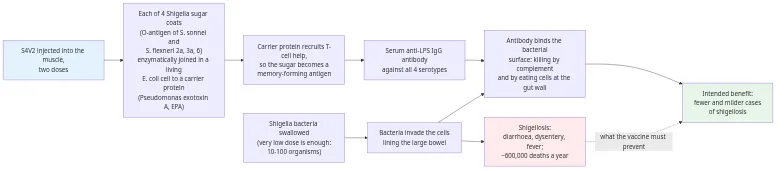
What the drug is. S4V2 is an injected vaccine, given as two shots into the muscle, mixed with an
aluminium adjuvant called Alhydrogel [VERIFIED — ClinicalTrials.gov NCT06615375 and NCT06523231, read 2026-08-11]. Its active ingredients are the outer sugar coats — the O-antigens — of four kinds
of Shigella bacteria: S. sonnei, and S. flexneri types 2a, 3a and 6
[VERIFIED — LimmaTech/Valneva releases; ClinicalTrials.gov NCT06615375 immunogenicity endpoints, which measure IgG against exactly those four].
How it works. A bare bacterial sugar is a poor vaccine. The immune system can make antibody
against it, but the response is weak, fades quickly and barely works in infants, because sugars do
not recruit helper T-cells. The standard fix, used for decades in vaccines against meningitis and
pneumococcus, is to chemically staple the sugar to a protein. S4V2’s platform does the stapling a
different way: an engineered E. coli cell is given the genes to build the Shigella sugar chain,
the genes for a carrier protein (a detoxified Pseudomonas aeruginosa exotoxin A, “EPA”), and the
gene for an enzyme (PglB) that joins the two together inside the living cell
[VERIFIED — Ravenscroft et al., *Glycobiology* 2019, [DOI 10.1093/glycob/cwz044](https://doi.org/10.1093/glycob/cwz044), via PubMed]. The bacterium
manufactures the finished vaccine molecule itself. The claimed advantages over chemical conjugation
are a single production step, a uniform single-molecule product that is easier to characterise, and
preservation of the sugar’s natural shape.
Once injected, the carrier protein recruits T-cell help, and the immune system makes serum antibody — specifically IgG — against each of the four sugar coats. That antibody is meant to reach the gut wall and bind Shigella on contact, where it kills the bacteria in two ways: by triggering the complement system, a cascade of blood proteins that punches holes in bacterial membranes, and by tagging the bacteria to be eaten by immune cells.
How well the target is validated. Better than the field’s track record suggests, and not fully.
Three things are established. First, anti-LPS antibody is the right thing to raise: in the
Flexyn2a challenge study, the level of S. flexneri 2a LPS-specific serum IgG was statistically
associated with protection from disease (p=0.0016) and with a lower disease-severity score (p=0.002)
[VERIFIED — Talaat et al., *EBioMedicine* 2021, [DOI 10.1016/j.ebiom.2021.103310](https://doi.org/10.1016/j.ebiom.2021.103310)]. Second, the
antibodies the platform raises are functional, not merely present: rabbit serum raised against
the quadrivalent bioconjugate bound and killed 22 of 41 vaccine-targeted Shigella isolates
collected in Kenya, and cross-reacted with three serotypes the vaccine does not target
[VERIFIED — Odundo et al., *mSphere* 2022, [DOI 10.1128/msphere.01020-21](https://doi.org/10.1128/msphere.01020-21)]. Third, the platform
induces gut-homing antibody-secreting cells, meaning the response reaches the tissue where infection
happens [VERIFIED — Clarkson et al., *EBioMedicine* 2021, [DOI 10.1016/j.ebiom.2021.103308](https://doi.org/10.1016/j.ebiom.2021.103308)].
What is not established is the step that matters commercially: that raising this antibody prevents enough disease to clear a statistical bar. The one time it was tested, it did not — see A.2.
The exact scientific step the next readout must prove. That two doses of S4V2 produce enough
functional anti-S. sonnei antibody to significantly reduce the number of volunteers who develop
shigellosis after being deliberately swallowed 1,500 live S. sonnei 53G bacteria, compared with
volunteers who received placebo [VERIFIED — NCT06615375 primary outcome].
The honest scientific risk. Three specific things, in order of weight.
- The predecessor failed on this exact question. Flexyn2a cut shigellosis by 30.2% and the result was not statistically significant. Everything about S4V2’s mechanism that could be called validated was equally true of Flexyn2a.
- A tetravalent vaccine is being tested against one serotype. The challenge organism is S. sonnei only. Whatever S4V2 does against S. flexneri 2a, 3a and 6 is untested by this trial and will remain untested until a field study. A positive result proves one quarter of the product.
- Spreading antigen across four components may weaken each one. A tetravalent vaccine at a
given total dose delivers less of each sugar than a monovalent at the same total. Whether S4V2’s
selected dose delivers as much S. sonnei O-antigen as Flexyn2a delivered of S. flexneri 2a is
not disclosed
[UNVERIFIED — the dose levels in NCT06615375 are described only as "high dose" and "low dose"; no microgram figures are public].
A.2 Clinical development plan, timeline, feasibility, resourcing
Trials
| Trial | Sponsor / whose drug | Design (arms, blinding, n) | Population | Status / key result | Link |
|---|---|---|---|---|---|
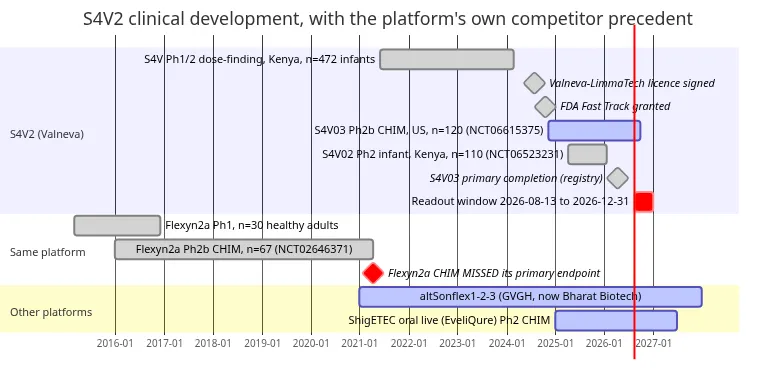
| S4V03 (NCT06615375) — the pivotal readout | LimmaTech Biologics AG, with Emory University, Johns Hopkins Bloomberg School of Public Health and Cincinnati Children’s Hospital Medical Center as collaborators. Valneva’s licensed asset | Phase 2b controlled human infection study. Randomised, double-blind, placebo-controlled, parallel-group, multicentre, n=120 across 3 US sites, in two steps. Step 1: one injection of S4V2 high dose, S4V2 low dose or placebo (phosphate-buffered saline) at 2:2:1, with a second injection about 6 months later. Step 2: the dose selected after Step 1 versus placebo at 1:1, two injections 28 days apart, then deliberate infection one month after the second with 1,500 CFU of virulent S. sonnei strain 53G | Healthy, Shigella-naive adults aged 18–50. Excluded at entry: serum IgG to S. sonnei LPS ≥2,500, prior Shigella vaccination or ingestion, HLA-B27 positivity, irritable bowel syndrome, inflammatory bowel disease, planned travel to endemic countries. Step 2 entrants must pass a comprehension test at 70% or better | ACTIVE_NOT_RECRUITING. Started 2024-11-12. Registry primary completion 2026-04-14 — already passed. Registry study completion 2026-09. has_results false as of 2026-08-11 | NCT06615375 |
| S4V02 (NCT06523231) — the supporting infant study | LimmaTech Biologics AG, with the Kenya Medical Research Institute; supported by Gates Foundation funding | Phase 2, randomised, controlled, blinded, n=110, single site. Two S4V2 dose levels versus a control vaccine (MenACWY, a meningococcal vaccine used as an active comparator so that the blind holds and the control group still benefits). Two-dose schedule, aluminium-adjuvanted | Healthy full-term infants aged 9 months (±1 month) resident in Siaya County, Kenya. Excluded: known Shigella exposure, immunosuppression, weight-for-age Z-score below −3 | COMPLETED. Started 2025-04-07, primary completion 2025-08-27, study completion 2026-01-22. has_results false as of 2026-08-11 — the data exist and have not been published | NCT06523231 |
| S4V Phase 1/2 dose-finding — prior generation | LimmaTech Biologics AG (as GSK’s partner at the time) | Randomised, double-blind, dose-finding, age-descending: Part 1 in adults, then children aged 2–5, then infants; Part 2 in n=472 nine-month-old infants across four dose levels with or without adjuvant, two intramuscular injections | Adults, children and infants in Kenya | Positive interim reported 2024-02-22: “a statistically significant increase in serum IgG levels was obtained after either the first or the second injection, depending on the dose and formulation used”; “well tolerated with the majority of local and systemic reactions … mild in intensity”; no vaccine-related serious adverse events | [VERIFIED — LimmaTech release via BioSpace, 2024-02-22, read 2026-08-11] |
| Flexyn2a Phase 2b challenge (NCT02646371) — the precedent, not this drug | Johns Hopkins Bloomberg School of Public Health, with LimmaTech, Walter Reed Army Institute of Research and the Naval Medical Research Center. LimmaTech’s monovalent S. flexneri 2a bioconjugate, not S4V2 | Randomised, double-blind, placebo-controlled. n=67 enrolled (34 vaccine, 33 placebo); 59 challenged (30 vaccine, 29 placebo) with 1,500 CFU of S. flexneri 2a strain 2457T, four weeks after the second of two 10 µg doses given four weeks apart | Healthy adults | MISSED its primary endpoint. 30.2% reduction in shigellosis, 13/30 versus 18/29, p=0.11, 95% CI −15 to 62.6. Hit several severity secondaries: 51.7% against moderate/severe diarrhoea or dysentery with fever or severe enteric symptoms (p=0.015); 72.4% against more severe diarrhoea (p=0.07); 51.7% fewer needing early antibiotics (p=0.01); lower severity score among those who did get ill (p=0.002) | [VERIFIED — Talaat et al., *EBioMedicine* 2021, [DOI 10.1016/j.ebiom.2021.103310](https://doi.org/10.1016/j.ebiom.2021.103310)] |
| Flexyn2a Phase 1 (NCT02388009) — the precedent’s safety study | Naval Medical Research Center with LimmaTech and WRAIR. Not this drug | Single-blind, randomised, staggered. n=30: 12 vaccine, 12 vaccine plus aluminium adjuvant, 6 placebo. Two injections four weeks apart, 10 µg | Healthy adults | Well tolerated with or without adjuvant. Statistically significant LPS-specific antibody at every post-immunisation time point; antibodies were functional in a bactericidal assay | [VERIFIED — Riddle et al., *Clin Vaccine Immunol* 2016, [DOI 10.1128/CVI.00224-16](https://doi.org/10.1128/CVI.00224-16)] |
What the primary endpoint actually counts. A challenged participant is scored as having
shigellosis if they have severe diarrhoea; or moderate diarrhoea plus either fever, or at
least one at-least-moderate constitutional or gut symptom, or two or more vomiting episodes in 24
hours; or dysentery plus any of those same three
[VERIFIED — NCT06615375 primary outcome description]. This is a broad definition that catches
moderate illness, not only severe illness. It is the same broad definition Flexyn2a missed on while
winning on the narrower severe-disease measures, and that is the single most important design fact
in this document.
Feasibility matrix
| Factor | High probability | Medium probability | Low probability | This asset (assessment) | Source |
|---|---|---|---|---|---|
| Recruitment feasibility | >50 sites, 3:1 patient:site | 20–50 sites, established investigators | <20 sites, novel sites | High, despite only three sites. The row’s thresholds are written for an outpatient field trial and do not transfer to a challenge study, which by design uses a handful of specialist inpatient units. The three sites — Emory’s Hope Clinic, the Johns Hopkins Center for Immunization Research and Cincinnati Children’s — are the established US challenge network, and Johns Hopkins ran the Flexyn2a challenge on the same platform. Enrolment is finished: the trial reads ACTIVE_NOT_RECRUITING | [VERIFIED — NCT06615375 locations and status] |
| Endpoint clarity | Regulatory precedent exists | Novel endpoint with FDA alignment | Unvalidated surrogate | Medium. The endpoint is precise, pre-specified and precedented within the challenge literature — Flexyn2a used essentially the same definition. But no Shigella vaccine has ever been licensed anywhere, so no endpoint in this disease has regulatory precedent for approval, and a challenge result is supportive evidence for a Phase 3, never a substitute | [VERIFIED — NCT06615375; NCT02646371 via DOI 10.1016/j.ebiom.2021.103310] |
| Trial-design robustness | Pivotal Phase III with SPA | Adaptive with interim analysis | Single-arm, no control | Medium. Randomised, double-blind, placebo-controlled, with a genuine adaptive feature: Step 1 confirms the dose before Step 2 commits to the efficacy comparison. It is not pivotal and carries no special protocol assessment | [VERIFIED — NCT06615375 detailed description] |
| Operational / execution | Enrolment complete, standard timeline | Some timeline risk | Enrolment behind | Medium. Enrolment is complete and the registry primary-completion date of 2026-04-14 has passed, so the data exist. Against that, guidance for these results has slipped twice — from H2 2025, to December 2025, to Mid-2026 — and “Mid-2026” had run out by the day this analysis was written with nothing announced | [VERIFIED — NCT06615375; BPIQ note field and the company's own dated releases, see Readout] |
Resourcing sufficiency. For this readout, entirely sufficient, and the reason is structural
rather than financial: LimmaTech sponsors and pays for both Phase 2 trials, and Valneva assumes
development only afterwards [VERIFIED — Valneva/LimmaTech partnership release, 2024-08-01]. The
infant study additionally carries Gates Foundation support. Valneva’s cost to reach this decision
point is therefore close to nothing beyond the €10 million upfront it has already paid.
The resourcing question that matters is the next one. If the results are positive, Valneva takes
on all further development, chemistry-manufacturing-and-controls work, regulatory activity and
worldwide commercialisation. A Shigella Phase 3 is a field efficacy trial in infants in
low- and middle-income countries — thousands of participants over years. Valneva does not disclose a
budget for it, has just cut 10–15% of its workforce and 25–35% of its operating expenses, and holds
about $164M of cash against $215M of debt (see ../company.md C.3). A positive
result creates a funding problem rather than solving one, and the realistic route is a partner, a
public-health funder such as Gavi, CEPI or the Gates Foundation, or both.
A.3 Target label, target product profile, strategic questions, designations
A.3a Target label. Active immunisation for the prevention of shigellosis caused by Shigella sonnei and Shigella flexneri serotypes 2a, 3a and 6 — with two distinct populations in view: infants in endemic low- and middle-income countries, and adult travellers and military personnel from high-income countries.
A.3b Target product profile
| Attribute | Standard of care & key competitor(s) — data | S4V2 target profile (goal) | Supporting evidence (+ link) |
|---|---|---|---|
| Indication / target label | There is no standard of care to displace: no Shigella vaccine has ever been licensed, anywhere, in 60 years of attempts. Prevention today is hand hygiene, clean water and food safety. Key competitor: altSonflex1-2-3 (GSK Vaccines Institute for Global Health, licensed to Bharat Biotech, which now leads Phase 3), also four-serotype, on the GMMA outer-membrane-vesicle platform | Four serotypes covering roughly the dominant global burden, in both infants and adults | [VERIFIED — Martin & Alaimo, *Vaccines* 2022, [DOI 10.3390/vaccines10020212](https://doi.org/10.3390/vaccines10020212)]; [WEB ESTIMATE — GSK release on the Bharat Biotech licence, read 2026-08-11] |
| Efficacy (endpoints, regimen) | Flexyn2a, same platform, monovalent: 30.2% against shigellosis, p=0.11 — missed; 51.7% against moderate-to-severe disease, p=0.015. Two doses four weeks apart | A statistically significant reduction in shigellosis after challenge; then, at Phase 3, protection against natural infection in infants. Two doses 28 days apart | [VERIFIED — [DOI 10.1016/j.ebiom.2021.103310](https://doi.org/10.1016/j.ebiom.2021.103310)] |
| Safety / tolerability | Flexyn2a Phase 1: well tolerated, no safety signal. S4V (first generation) in 472 infants: mostly mild reactions, no vaccine-related serious adverse events | Tolerability good enough for routine infant immunisation alongside existing schedule vaccines | [VERIFIED — [DOI 10.1128/CVI.00224-16](https://doi.org/10.1128/CVI.00224-16)]; [VERIFIED — LimmaTech interim release, 2024-02-22] |
| Biomarker / companion diagnostic | Serum anti-LPS IgG per serotype. In Flexyn2a it was statistically associated with protection (p=0.0016) — an immune correlate candidate, not a validated one | Confirm or establish an antibody threshold that predicts protection. NCT06615375 has three dedicated secondary endpoints doing exactly this | [VERIFIED — NCT06615375 secondary outcomes; [DOI 10.1016/j.ebiom.2021.103310](https://doi.org/10.1016/j.ebiom.2021.103310)] |
| Formulation / administration | Intramuscular injection, aluminium-adjuvanted, two doses. Competitor ShigETEC (EveliQure) is oral, which is easier to deliver at scale | Two intramuscular doses, ideally co-administered with existing infant schedule vaccines | [VERIFIED — NCT06615375 and NCT06523231] |
| Payer value | Two distinct buyers. LMIC infant programmes buy through Gavi-style tiered pricing at low unit prices and high volume; traveller and military markets buy at commercial prices and low volume | Priced to work in both channels. Valneva states the global opportunity is “in excess of $500 million annually” | [VERIFIED — Valneva Q1 2026 results release, 2026-05-13] |
A.3c Strategic Go/No-Go questions. The relevant set is Pre-Phase-III: both Phase 2 trials are run and the decision in front of the company is whether to take S4V2 into registrational development.
| Group | Question | Answer (tagged) |
|---|---|---|
| Target | Target revalidated as in prior phases? | Partly. Anti-LPS IgG remains the right target and the platform reliably raises functional antibody against it [VERIFIED — [DOI 10.1128/msphere.01020-21](https://doi.org/10.1128/msphere.01020-21)]. The step from antibody to disease prevention is precisely what the pending readout tests and what has never been demonstrated for this platform [VERIFIED — [DOI 10.1016/j.ebiom.2021.103310](https://doi.org/10.1016/j.ebiom.2021.103310)] |
| Dose & Drug | Exposure–response for the intended commercial regimen and route(s)? | Being established inside this trial. Step 1 exists to confirm the dose before Step 2 tests it. The actual dose levels are not public [UNVERIFIED — NCT06615375 states only "high dose" and "low dose"] |
| Dose & Drug | Commercial formulation available or feasible? | Yes, and manufacturing is already scaled for Phase 2. AGC Biologics’ Heidelberg site supplies drug substance for the Phase 2 studies [VERIFIED — AGC Biologics release, 2025-07-29, via the company press feed]. Bioconjugation is a single fermentation-and-purification step, which is the platform’s stated manufacturing advantage [VERIFIED — [DOI 10.1093/glycob/cwz044](https://doi.org/10.1093/glycob/cwz044)] |
| Dose & Drug | Dose range compatible with clinical and non-clinical safety? | Yes on the evidence so far. 472 nine-month-old infants across four dose levels with and without adjuvant, no vaccine-related serious adverse events [VERIFIED — LimmaTech interim release, 2024-02-22] |
| Dose & Drug | Therapeutic window given the clinical response? | Not a limiting question here. Reactogenicity has been mild across every study; the constraint on this program is efficacy, not tolerability [VERIFIED — the two safety sources above] |
| Dose & Drug | Intrinsic and extrinsic factors influencing exposure and patient response? | Partly known. Pre-existing anti-LPS antibody is the recognised confounder, which is why NCT06615375 excludes anyone with S. sonnei LPS IgG ≥2,500 and why the infant study runs in an endemic setting where background exposure is normal [VERIFIED — NCT06615375 exclusion criterion 15] |
| Patient | Proof of concept and positive benefit/risk in the intended population? Combination evidence? | This is the open question. No efficacy result exists for S4V2 in any population. The closest evidence is a related monovalent construct that missed. No combination is proposed [VERIFIED — NCT06615375 has_results false; [DOI 10.1016/j.ebiom.2021.103310](https://doi.org/10.1016/j.ebiom.2021.103310)] |
| Patient | Phase III design and outcome criteria — accepted, compelling, competitive for market access? | Not designed, not disclosed, not funded. No Phase 3 protocol is registered under either sponsor [VERIFIED — CT.gov search on the intervention returned exactly two trials] |
| Patient | Rationale for the patient population(s)? | Strong and evidenced. 62.3 million of up to 165 million annual infections occur in children under five, so infants are where the burden and the mortality sit; travellers and military personnel are the commercially-priced channel [VERIFIED — Valneva/LimmaTech release, 2025-04-09] |
| Patient | Likelihood of the expected outcome? | Modelled at 32%, band 20–47%, for the challenge study’s primary endpoint. Reasoning in the Locked prediction [UNVERIFIED — modelled] |
| Patient | Companion-diagnostic strategy, including pricing and market? | Not applicable. A prophylactic vaccine given to whole birth cohorts needs no patient-selection test |
A.3d Regulatory designations.
- FDA Fast Track designation, granted 2024-10-16 to Shigella4V for the prevention of shigellosis
[VERIFIED — Valneva/LimmaTech release, 2024-10-16, via the company press feed]. What it grants: more frequent written and in-person contact with the FDA during development, eligibility to submit a marketing application in pieces as they are completed (rolling review) rather than all at once, and eligibility to be considered for priority review later. It grants no evidentiary relief — the data still have to be there. - No breakthrough therapy designation, no orphan designation, and no WHO prequalification pathway
entry has been announced
[VERIFIED — absence checked against the 265-item company press feed and the four web searches, 2026-08-11].
A.4 Target product profile valuation matrix
| Stakeholder | Value driver | Minimum threshold | Competitive | Premium | Benchmark / source |
|---|---|---|---|---|---|
| Patient / caregiver | Avoiding a severe, sometimes bloody diarrhoeal illness — and, in a small child in a low-income setting, avoiding death and the growth faltering that follows repeated infection | Any reproducible reduction in moderate-to-severe disease | Roughly 50%+ protection against moderate-to-severe shigellosis, lasting at least one year | 70%+ protection across all four serotypes, durable for several years, deliverable within the routine infant schedule | [VERIFIED — burden figures from the Valneva/LimmaTech release, 2025-04-09: up to 165M infections a year, 62.3M in under-fives, ~600,000 deaths, second leading cause of diarrhoeal death] |
| Regulator | Evidence that a vaccine prevents a disease with no other preventive product and rising drug resistance | Adequate safety in infants plus a plausible immune correlate | Statistically significant efficacy in a challenge study plus consistent immunogenicity across serotypes | Field efficacy in the endemic infant population | [VERIFIED — FDA Fast Track granted 2024-10-16, which is itself the regulator's statement that this is a serious condition with unmet need] |
| Payer / HTA | Two different buyers with two different tests. LMIC programmes: cost per death and per disability-adjusted life-year averted at a low unit price. Traveller/military: cost per illness averted at a commercial price | Cost-effectiveness at Gavi-style tiered pricing | Cost-effectiveness at commercial pricing in the traveller channel as well | Both channels supported by one product and one manufacturing process | [WEB ESTIMATE — PATH market assessment for traveller and military populations, and Gavi's own *Shigella* vaccine profile, read 2026-08-11] |
| Provider | Fits an existing delivery occasion without adding visits | Injectable, aluminium-adjuvanted, two doses | Co-administrable with existing infant schedule vaccines | A single dose, or an oral formulation | [VERIFIED — NCT06523231 gives S4V2 as two doses at 9 months of age against a MenACWY comparator, which is itself a schedule-compatibility test] |
The calibration examples the framework offers here — roughly $150–300M of peak-sales potential per incremental month of overall survival in oncology, and 15–25% price premiums for oral over injectable formulations — are oncology and small-molecule reference points. Neither transfers to a prophylactic vaccine sold partly at tiered public-health prices, and neither is used as an input below.
A.5 Evidence quality and endpoints
| Criterion | Score (High / Medium / Low) | Basis (one line) | Link |
|---|---|---|---|
| Target validation | Medium | The O-antigen is unambiguously the right surface target and antibody against it is functional and associated with protection, but no Shigella vaccine has ever been licensed and the antibody-to-protection step has never been demonstrated to significance on this platform | DOI 10.1016/j.ebiom.2021.103310 |
| Mechanism clarity | High | The mechanism is chemically and immunologically explicit end to end — which sugars, which carrier, which enzyme, which antibody, which killing mechanism — and characterised in a peer-reviewed structural paper | DOI 10.1093/glycob/cwz044 |
| Biomarker availability | Medium | Serum anti-LPS IgG per serotype is measurable, routine, and a candidate correlate of protection with a published statistical association; it is not a validated or regulator-accepted threshold | DOI 10.1016/j.ebiom.2021.103308 |
| Publication quality (peer-reviewed? independent authors?) | Medium | The platform literature is genuinely peer-reviewed in credible journals (EBioMedicine, Glycobiology, mSphere, Clin Vaccine Immunol) and includes a published negative primary result, which is a mark of integrity. But every one of the six indexed papers carries LimmaTech authors, and the co-authors are US military and Johns Hopkins collaborators on those same sponsored studies — the evidence base is not independent of the sponsor. Neither S4V2 Phase 2 trial has published anything: has_results is false on both | PubMed, 6 of 6 records read 2026-08-11 |
| Clinical / expert sentiment | — | Moved to A.5b, below. | — |
Endpoints
| Endpoint (full name) | What it measures | Scale / range | Better direction | MCID / note |
|---|---|---|---|---|
| Number of challenged participants with shigellosis, Day 56 to Day 65 (NCT06615375 primary) | How many volunteers actually fell ill after being deliberately infected, vaccinees versus placebo. “Shigellosis” is met by: severe diarrhoea; or moderate diarrhoea plus [fever or ≥1 at-least-moderate constitutional/gut symptom or ≥2 vomiting episodes in 24h]; or dysentery plus any of those three | A count, converted to a percentage of each arm. Roughly 0–100% of participants | Lower in the vaccine arm | No established minimal clinically important difference exists — there is no licensed Shigella vaccine to set one against. The practical bar is statistical significance at conventional two-sided 0.05. For scale: Flexyn2a produced 43.3% versus 62.1% (a 30.2% relative reduction) and did not clear it |
| Number with moderate-to-severe shigellosis (secondary) | The same count restricted to more serious illness: moderate or severe diarrhoea, or dysentery, plus fever or a severe symptom or ≥3 vomiting episodes in 24h | Count / percentage | Lower | This is the endpoint family Flexyn2a did win on (51.7%, p=0.015). If S4V2 repeats that pattern — missing the broad primary, winning the severe secondary — the trial reads as a scientific near-miss and a commercial ambiguity |
| Geometric mean titres of anti-S. sonnei LPS IgG in serum (secondary) | The average antibody level against the challenge organism’s sugar coat, on a multiplying scale | Titre, orders of magnitude | Higher | No accepted protective threshold exists. Three further secondary endpoints exist purely to establish or confirm one |
| Anti-S. flexneri 2a, 3a and 6 LPS IgG GMTs (secondary) | The same measurement for the three serotypes not challenged in this study | Titre | Higher | The only evidence this trial will produce about three quarters of the product |
| Change in serum IgG at 1 month after dose 2 (NCT06523231 co-primary) | Whether 9-month-old infants make antibody against all four serotypes, reported as geometric mean titres and as the ratio to baseline | Titre and fold-ratio | Higher | The infant study is the dose-selection and safety study for a future Phase 3, not an efficacy study. A four-fold rise is the conventional seroresponse definition and is a listed secondary endpoint |
| Solicited and unsolicited adverse events, and serious adverse events (NCT06523231 co-primary) | Safety and tolerability in infants over 7 days, 28 days and up to 9 months | Counts, by severity | Lower | The gating safety question for routine infant use |
A.5b Key opinion leaders.
Panel as of. 2026-08-11.
Investigators
No investigators are recorded, and that is a finding rather than an omission. ClinicalTrials.gov
discloses no overall official and no site contact on either S4V2 trial — every contact field on all
three US challenge-study locations and on the single Kenyan infant-study site is null. A separate
condition-level search_investigators call across 50 shigellosis trials returned 26 named
investigators, and not one of them is attached to NCT06615375 or NCT06523231; they belong to
other sponsors’ trials. There is therefore no person this analysis can name as an investigator on
this program’s pivotal trial without inventing the attachment, which rule 40 forbids.
| Name | Role / affiliation | Trial (NCT) | Conflicts (party, kind, disclosed in, as of) | Conflicts checked (source, date) | Source | Tag |
|---|---|---|---|---|---|---|
| — | — | — | — | — | — | — |
Independent voices
Also empty, and for a reason worth stating plainly: in this field there are no independent voices. The complete indexed literature on this platform is six papers, and all six carry LimmaTech authors. The academic names that recur — Kawsar R. Talaat and David Sack at Johns Hopkins, Robert W. Kaminski and Kristen A. Clarkson at the Walter Reed Army Institute of Research, Mark S. Riddle and Chad K. Porter at the Naval Medical Research Center, Andrew J. Pollard at Oxford, Neil Ravenscroft at Cape Town — are every one of them co-authors with LimmaTech employees on the sponsor’s own studies, so none of them can be recorded here as independent. One of them carries a competitor relationship on top: Kawsar R. Talaat is the first author of the Flexyn2a challenge paper and is separately listed on ClinicalTrials.gov as the contact for EveliQure’s competing ShigETEC Phase 2 challenge study (NCT07049159) at the same Johns Hopkins Center for Immunization Research that is a listed S4V2 site. That is a real, checkable, dual relationship, and it is recorded here in prose because she is not an investigator on this program’s own trial and so has no row in the table above. This is exactly the case rule 40 anticipates — “in a small indication there commonly are none” — and the honest answer is an empty table with the search behind it on record, not a name promoted past what the evidence supports.
| Name | Affiliation | View (close enough to quote) | As of | Conflicts checked (source, date) | Source | Tag |
|---|---|---|---|---|---|---|
| — | — | — | — | — | — | — |
Judgement
| Endpoint supported | Basis (one or two sentences) | Tag |
|---|---|---|
| UNKNOWN | No independent voice could be assembled at all: every named expert in the indexed literature is a co-author with the sponsor, so there is no panel to judge the endpoint from and reporting one would be inventing it. What can be said without a panel is said elsewhere in this document and rests on data rather than opinion — the endpoint definition is precise and pre-specified (A.5), and the one prior test of essentially the same definition on this platform missed it (A.2). | UNVERIFIED — judgement |
Dissent
Empty, correctly: “UNKNOWN” is not a claim anyone can dissent from.
| Name | View (close enough to quote) | Source |
|---|---|---|
| — | — | — |
B. Commercial assessment
B.0 Current treatment algorithm
There is no treatment algorithm to slot into, because there is no preventive product at all. What happens to a person at risk of shigellosis today, in order:
- Prevention is environmental. Clean water, sanitation, hand hygiene and food safety. This is the entire preventive arsenal and it is exactly the arsenal that is unavailable in the settings where the disease kills.
- A case is often not diagnosed to the organism. Most childhood diarrhoea in endemic settings is treated on symptoms without a stool culture, so the specific bacterium is frequently never identified.
- Illness is treated with rehydration, oral or intravenous, which addresses the fluid loss and not the infection.
- Antibiotics are given for dysentery or severe disease — typically ciprofloxacin or
azithromycin. This is the step that is failing. Multidrug-resistant Shigella is now common
enough that the World Health Organization lists a Shigella vaccine as a development priority,
and antibiotic resistance is the reason the unmet need is growing rather than shrinking
[VERIFIED — Valneva/LimmaTech release, 2025-04-09; WHO Product Development for Vaccines Advisory Committee *Shigella* session materials, read 2026-08-11]. - Travellers get advice, not protection. DUKORAL — which Valneva itself sells — protects against cholera and against travellers’ diarrhoea caused by one type of E. coli. It does nothing against Shigella.
Where S4V2 fits. At step 1, as an entirely new preventive step that does not exist today. It displaces nothing and competes with no product. That is what makes the unmet need so high — and it also means there is no established market, no reimbursement precedent and no comparator price.
B.1 Competitive landscape and positioning
| Metric | High value | Medium value | Low value | This asset (assessment) | Source |
|---|---|---|---|---|---|
| Mechanism differentiation | First-in-class or novel target | Next-generation improvement | Me-too | High on class, medium within it. Any licensed Shigella vaccine would be first-in-class outright. Within the field, bioconjugation is a genuinely distinct manufacturing route from the competitor’s GMMA outer-membrane platform, and both are aimed at the same four serotypes. So: first-in-class disease, differentiated-but-not-unique approach | [VERIFIED — [DOI 10.3390/vaccines10020212](https://doi.org/10.3390/vaccines10020212)] |
| Development-timeline advantage | >12 months ahead | Within 6–12 months | Lagging >12 months | Lagging. Valneva calls S4V2 “the world’s most clinically advanced tetravalent bioconjugate vaccine candidate against shigellosis” — note the qualifier “bioconjugate”. altSonflex1-2-3 is on a different platform and Bharat Biotech now leads its Phase 3, while S4V2 has no Phase 3 registered, designed or funded | [VERIFIED — Valneva Q1 2026 release for the claim]; [WEB ESTIMATE — GSK/Bharat Biotech licence coverage, read 2026-08-11] |
| Clinical proof-of-concept evidence | Positive Phase IIb (n>100) | Phase IIa signals (n=20–50) | Preclinical only | Pending, and the honest score today is Low-to-Medium. The n=120 Phase 2b that would earn a “High” is precisely the unread event. What exists now is immunogenicity and safety across 472 infants on the prior-generation construct, plus a negative efficacy precedent on the sibling monovalent | [VERIFIED — LimmaTech interim release 2024-02-22; [DOI 10.1016/j.ebiom.2021.103310](https://doi.org/10.1016/j.ebiom.2021.103310)] |
| IP protection | Composition-of-matter, long-dated | Method-of-use | Pending or none | Not established this sweep, and recorded as such rather than assumed. The chain of rights is clear — GSK developed the platform, LimmaTech in-licensed S4V from GSK in July 2023, Valneva took an exclusive worldwide licence in August 2024 — but no patent number, claim type or expiry date was found. Bioconjugation platform patents from the 2010s would run to roughly the late 2020s or early 2030s, which is early relative to a plausible 2032+ launch | [UNVERIFIED — the licence chain is verified from the LimmaTech and Valneva releases; the patent estate itself was not confirmed] |
Where this asset wins, and the single fact the thesis rests on.
The competitive field is small and every entrant is pre-approval. The named programs are:
- altSonflex1-2-3 — GSK Vaccines Institute for Global Health, licensed to Bharat Biotech,
which now leads Phase 3, regulatory work and manufacturing. GMMA platform (bubbles shed from the
bacterial outer membrane rather than purified sugars), four serotypes. The one to beat, on
timeline and on manufacturing cost at LMIC volumes
[WEB ESTIMATE — GSK release on the Bharat Biotech licence, read 2026-08-11]. - ShigETEC — EveliQure Biotechnologies. An oral, live-attenuated S. flexneri 2a engineered
to also express a toxin fusion from enterotoxigenic E. coli, so one product could cover two
causes of travellers’ diarrhoea. Phase 2 challenge study registered at Johns Hopkins
[VERIFIED — ClinicalTrials.gov NCT07049159, read 2026-08-11]. - Invaplex AR-Detox — Walter Reed Army Institute of Research, trials in the Netherlands and
Zambia
[VERIFIED — ClinicalTrials.gov NCT05961059]. - IVT Shigella-04 — Inventprise, first-in-human dose escalation
[VERIFIED — ClinicalTrials.gov NCT07205926]. - A bivalent S. flexneri 2a–S. sonnei conjugate — Zhifei Biological, in an efficacy,
immunogenicity and safety trial in Chinese children aged 6 months to 5 years across nine provincial
CDC sites
[VERIFIED — ClinicalTrials.gov NCT05156528]. Two serotypes rather than four, and aimed at a domestic market, but it is a real conjugate efficacy study running now.
S4V2 wins on breadth plus infant data: four serotypes, and safety and immunogenicity already generated in 472 nine-month-old infants in the exact endemic setting a Phase 3 would run in. It loses on stage and sponsorship weight: its nearest four-serotype competitor is in Phase 3 with one of the world’s largest vaccine manufacturers behind it, while S4V2’s Phase 3 is unregistered and unfunded.
The single fact the thesis rests on: that the pending challenge study shows a statistically significant reduction in shigellosis — not a numerical one. The precedent on this exact platform produced a numerical reduction and missed, and a numerical reduction is worth very little to a company that then has to fund a Phase 3 off the result.
The framework’s calibration example here — oncology first-movers in novel mechanisms showing roughly 3.2× higher peak-sales potential at about 1.8× higher development risk — is an oncology reference point and is not applied to a prophylactic vaccine.
B.2 Addressable market
Launch markets. Two, with completely different economics. (1) Endemic low- and middle-income countries, delivered through infant immunisation programmes, most plausibly with Gavi support: very high volume, very low price per dose. (2) Travellers and military personnel from high-income countries, sold through travel clinics and defence procurement: low volume, commercial price. This is the channel Valneva is already built for — it sells IXIARO and DUKORAL into exactly it, and it supplies the US Department of Defense.
| Component | How it is estimated | Premium threshold | This asset (assessment) | Source |
|---|---|---|---|---|
| Drug-treated patients | Epidemiology × diagnosis rate × treatment rate | >100,000 (US/EU5/Japan) | Far above the threshold on epidemiology, and the threshold is the wrong test. Up to 165 million infections a year, 62.3 million in children under five, roughly 600,000 deaths — the second leading cause of diarrhoeal death. The vaccinated population would be birth cohorts, not diagnosed cases: a single Gavi-eligible birth cohort is tens of millions of infants a year. The binding constraint is price and procurement, never patient numbers | [VERIFIED — Valneva/LimmaTech release, 2025-04-09] |
| Market exclusivity | Patent term + regulatory exclusivity | >10 years combined | Not established. No patent number or expiry was found this sweep (B.1). US biologic exclusivity would give 12 years from a US licensure that is at best a decade away, and much of the volume would sit in markets where that exclusivity does not apply | [UNVERIFIED] |
| Reimbursement precedent | Approvals in ≥2 major markets | Positive NICE/CADTH guidance | None exists, in either direction. No Shigella vaccine has ever been licensed anywhere, so there is no reimbursement precedent to point at and none to be blocked by | [VERIFIED — [DOI 10.3390/vaccines10020212](https://doi.org/10.3390/vaccines10020212)] |
| Patient-journey impact | Fewer hospital days, less caregiver burden | >30% quality-of-life gain | High and well characterised, though not quantified as a percentage here. Preventing severe childhood diarrhoea avoids hospital admission, avoids antibiotic exposure in a resistance crisis, and avoids the growth faltering that repeated enteric infection causes. No study quantifies a quality-of-life percentage for this candidate, and none is invented | [VERIFIED — burden framing from the same release]; [UNVERIFIED — no quality-of-life quantification exists for S4V2] |
B.3 Value and feasibility
B.3a Expected peak sales.
The honest starting point is that a defensible bottom-up build is not available, and the reason is specific rather than a shrug. A bottom-up build needs eligible patients × annual net price × peak penetration. The eligible population is enormous and knowable. The price is not: no Shigella vaccine has ever been sold anywhere, so there is no realised price for this product, no comparator price for this disease, and the two channels would carry prices differing by more than an order of magnitude — a Gavi-tiered infant dose against a commercial travel-clinic dose. Inventing a blended price would put a fabricated number at the centre of every scenario below.
What exists instead is one anchor from the sponsor itself: Valneva states that “the global market
opportunity for a vaccine against Shigella is estimated to exceed $500 million annually”
[VERIFIED — Valneva Q1 2026 results release, 2026-05-13, and the 2024-08-01 partnership release, which uses the same figure]. That is a company statement about the whole market, not about S4V2’s
share of it, and it is treated as the mid-point of the band below rather than as S4V2’s revenue.
The scenarios below are therefore built top-down from that single stated market figure and a share assumption, and the method is named so the reader can discount it accordingly. Every figure is conditional on approval, assumes a launch no earlier than 2032, and excludes the low-double-digit royalty owed to LimmaTech, any milestone payments, and any public-health funding contribution.
| Scenario | Assumptions (patients × price × share) | Estimate (USD/year at peak) | Basis / tag |
|---|---|---|---|
| Low | The company’s $500M market figure proves optimistic at Gavi-tiered pricing, and S4V2 shares the market with altSonflex1-2-3, which reaches Phase 3 first with Bharat Biotech’s manufacturing cost base. Traveller and military volumes only, roughly 25% of a $300M realised market | ≈ $75M | [UNVERIFIED — modelled from the company's own market figure discounted, plus a share assumption; no price input is verified] |
| Base | The $500M market figure is roughly right, S4V2 takes about 40% of it as one of two four-serotype products, with Valneva strongest in the traveller and military channel it already sells into | ≈ $200M | [UNVERIFIED — modelled; the $500M market figure is [VERIFIED — Valneva Q1 2026 release], the 40% share is not] |
| High | Antimicrobial resistance drives faster Gavi adoption than the base case, S4V2 reaches the market at or before altSonflex1-2-3, and takes about 60% of a market that grows past $800M | ≈ $500M | [UNVERIFIED — modelled; the market-growth and share assumptions are not verified] |
Which input is not defensible, named explicitly: the net price per dose, in both channels. It is the reason these are top-down figures with a stated method rather than a bottom-up build, and it is the input to demand from the company at the first opportunity.
B.3b Feasibility
| Question | Answer (tagged) |
|---|---|
| Expected net present value (eNPV) | No point estimate (rule 10). A range with its assumptions: conditional on this challenge study succeeding, and assuming 35–55% probability of Phase 3 success, ~85% approval given a positive Phase 3, $250–450M of Phase 3 and launch cost largely borne by a partner or public funder, a 2032 launch, low-double-digit royalties to LimmaTech and a 12% discount rate, the base case is worth roughly $60–200M today. Applying the 32% modelled probability for the pending readout gives an unconditional ~$20–65M against a derived enterprise value of about $554M (../company.md C.4). Every input except the enterprise value is [UNVERIFIED — modelled] |
| Capital to the next decision point | Effectively nil. LimmaTech sponsors and funds both Phase 2 trials; the infant study additionally carries Gates Foundation support. Valneva’s cost to reach this readout beyond the €10M upfront already paid is close to zero [VERIFIED — Valneva/LimmaTech partnership release, 2024-08-01; Valneva/LimmaTech infant-study release, 2025-04-09] |
| Capital to approval, and the funding plan | $250–450M+ over roughly six years, and there is no disclosed plan. A Shigella Phase 3 is a field efficacy trial in infants in endemic countries. Valneva has just cut 10–15% of its workforce and 25–35% of its operating expenses and holds about $164M of cash against $215M of debt (../company.md C.3). The realistic routes are a partner, a public-health funder (Gavi, CEPI, the Gates Foundation), or both [UNVERIFIED — modelled cost; the company financials are [VERIFIED]] |
| Launch capability — alone, or must partner? | Split by channel. In the traveller and military channel Valneva can launch alone: it already sells IXIARO and DUKORAL there and supplies the US Department of Defense. In the LMIC infant channel it cannot — that needs WHO prequalification, Gavi procurement and a low-cost manufacturing base, none of which Valneva has [VERIFIED — Valneva company description and product portfolio, BPIQ fetch_company_info; Q1 2026 release on DoD delivery schedules] |
| Commercialisation rights — retained, split, or out-licensed? | Retained worldwide, with a royalty stack above them. Valneva holds an exclusive worldwide licence to develop, manufacture and commercialise, and owes LimmaTech low double-digit royalties on sales plus regulatory, development and sales milestones, on top of the €10M upfront paid in 2024. LimmaTech in turn in-licensed S4V from GSK in July 2023, so a further upstream obligation may sit above that; its terms are not disclosed [VERIFIED — Valneva/LimmaTech partnership release, 2024-08-01, for the Valneva–LimmaTech terms]; [UNVERIFIED — the GSK-to-LimmaTech terms] |
B.4 Product-development risk
Framing questions.
- Does the development plan support the target product profile claims? For the S. sonnei component, yes: the challenge study directly tests protection against that serotype in humans. For the other three serotypes, no — the plan generates antibody levels for S. flexneri 2a, 3a and 6 and no protection data at all, so three quarters of the tetravalent claim rests on the assumption that an antibody level which predicts protection against S. sonnei also predicts it against the others. For the infant target label, the plan supports safety and dose selection only.
- Will the identified risks affect the target product profile? Yes, and the mechanism is direct: the primary endpoint counts every moderate case, so a vaccine that reliably prevents severe disease but not moderate disease misses the primary while still being a clinically valuable product. That exact outcome happened to Flexyn2a. It would leave the profile intact scientifically and damaged commercially and financially, because the Phase 3 has to be funded off the headline.
- If a risk cannot be mitigated, is the asset still differentiated from competitors? Partly. Four serotypes plus infant safety data in an endemic setting remains a real differentiator against everything except altSonflex1-2-3. Against altSonflex1-2-3 specifically, an ambiguous efficacy result leaves S4V2 behind on stage, behind on sponsor scale, and without a manufacturing cost argument.
| Category | Time risk | Quality risk | Cost risk | Note |
|---|---|---|---|---|
| Project management | Medium | Guidance for this readout has slipped twice, from H2 2025 to December 2025 to Mid-2026, and “Mid-2026” had elapsed by 2026-08-11 with nothing announced. Trial conduct itself sits with LimmaTech, not Valneva | ||
| Research | High | The core scientific claim — that raising anti-LPS antibody prevents shigellosis to statistical significance — is unproven on this platform and failed once | ||
| IP | Medium | Medium | No patent number, claim type or expiry confirmed this sweep. Platform patents from the mid-2010s would be at or near expiry by a 2032 launch, leaving protection resting on regulatory exclusivity | |
| Legal | Medium | A two-step royalty chain — Valneva to LimmaTech at low double digits, LimmaTech to GSK on undisclosed terms — sits above every dollar of revenue | ||
| DMPK (how the body absorbs, distributes and clears a drug) | No risk found. Not a meaningful category for an intramuscular vaccine, whose pharmacology is measured as antibody response rather than drug exposure | |||
| Safety pharmacology | No risk found in the disclosed record | |||
| Toxicology | No risk found in the disclosed record. Preclinical work supported dosing in 472 infants | |||
| Drug safety (clinical) | Low | The best-evidenced part of the program. 472 nine-month-old infants across four dose levels with and without adjuvant produced mostly mild reactions and no vaccine-related serious adverse events; the Flexyn2a Phase 1 was well tolerated. A new safety signal in the challenge study would be a near-veto event, but nothing in the record predicts one | ||
| Biomarker | Medium | Medium | Anti-LPS IgG is a candidate correlate of protection, not a validated one. If the challenge study fails to confirm a threshold, the three untested serotypes have no bridge to protection at all | |
| Clinical pharmacology | Medium | The dose levels are undisclosed, and whether the per-serotype antigen dose in a tetravalent matches what the monovalent Flexyn2a delivered cannot be checked | ||
| Clinical (efficacy) | High | High | High | The dominant risk, near-veto. The same platform’s only prior efficacy test missed this endpoint at p=0.11, and the primary here counts every moderate case |
| Clinical operations | Low | Enrolment is complete, the registry primary-completion date has passed, and the sites are the established US challenge network | ||
| CMC / manufacturing | Low | Medium | Drug substance for both Phase 2 studies is supplied by AGC Biologics’ Heidelberg site, so Phase 2 scale is proven. Commercial-scale cost at Gavi price points against a GMMA competitor is unproven | |
| Regulatory | Medium | High | No Shigella vaccine has ever been licensed anywhere, so the registration path is not established for anyone. Fast Track helps with process, not with evidence. A challenge study cannot support approval by itself | |
| Global evidence & value | Medium | Medium | Two buyers with two price points and no precedent transaction in either. Health-economic value in the LMIC channel depends on Gavi’s assessment, which cannot begin without Phase 3 data | |
| Commercial | Medium | High | Valneva can sell into the traveller and military channel today and cannot reach the LMIC channel without WHO prequalification, Gavi procurement and a low-cost manufacturing base. The larger half of the opportunity requires a partner it has not announced |
Readout
Sources
| Kind | Where it comes from | What it is worth | Value (or null) | Tag | Note |
|---|---|---|---|---|---|
bpiq | fetch_company_drugs — catalyst_date 2026-08-15, catalyst_date_text “Mid-2026” | The current single source. Synthesized from period text, so alone it is a ceiling, not an estimate | 2026-05/2026-08 | VERIFIED — BPIQ fetch_company_drugs, read 2026-08-11 | catalyst_date 2026-08-15 is the period-end placeholder BPIQ synthesizes for “Mid-2026” (rule 23), not a disclosed day. The disclosed unit is a mid-year period, and it has essentially elapsed |
ctgov | CT.gov get_trial_details NCT06615375 — primary_completion_date | Independent of the company’s own messaging, and it moves when the trial moves | 2026-04-14 | VERIFIED — ClinicalTrials.gov NCT06615375, read 2026-08-11 | A day-precision registry date that has already passed. Primary completion, not topline: the last challenged participant’s inpatient observation period ended on this date. Registry study completion is 2026-09. has_results false. The sibling infant study NCT06523231 completed on 2026-01-22 and has also published nothing |
company | fetch_company_press_releases and the Q1 2026 results release | The company’s own most recent dated wording. Mandatory here because the catalyst is inside twelve months | 2026-05/2026-08 | VERIFIED — Valneva Q1 2026 results release, 2026-05-13 | Verbatim: “Two clinical trials of S4V2 … are ongoing. First Phase 2 results are expected mid-2026.” And: “Subject to positive results for both trials, Valneva will assume responsibility for all further development.” The 265-item press feed to 2026-08-08 carries no S4V2 item since 2026-01-15, so the data had not been disclosed as of the lock date |
congress | data/congresses.json | Answers “where will they say it” | null | VERIFIED — absence checked, 2026-08-11 | data/congresses.json holds four meetings, all in multiple sclerosis, oncology, Alzheimer’s and hepatology — none in vaccines or infectious disease, so no row could match on any basis. Separately, no company statement names any congress as the venue for these results; Valneva attended the 26th World Vaccine Congress in March 2026, which is already past. Matching on therapeutic area alone is a guess, and a guess is not a source |
modelled | Trial arithmetic — see below | The only estimate independent of anyone’s guidance | 2026-06/2026-08 | UNVERIFIED — modelled, default lag | The modelled window’s own front and back edges have both nearly elapsed, which is itself the finding: on registry arithmetic these data should already be in hand |
The modelled estimate. The registry’s primary completion date for NCT06615375 is 2026-04-14.
Adding the stated default lag of two to four months for database lock, unblinding and topline
analysis (rule 34) gives 2026-06-14 to 2026-08-14.
data/benchmarks/readout-lag.json holds no observations at all, so this uses the stated default and
is tagged [UNVERIFIED — modelled, default lag] rather than benchmarked. The arithmetic is stated so
it can be argued with: the input is a day-precision registry field, the lag is a framework default,
and the output brackets today.
Window
| Earliest | Likeliest | Latest | Precision | Confidence |
|---|---|---|---|---|
| 2026-08-13 | 2026-09-30 | 2026-12-31 | PERIOD | LOW |
Basis. Every source agrees the data should be available around now, and the company has not released them, so the question this window answers is not “when will the trial finish” but “how far past its own guidance has this slipped”. Earliest is 2026-08-13, the company’s scheduled first-half 2026 results date — announced on 2026-07-22, two days after this analysis was locked, and the first confirmed disclosure vehicle in front of the readout. Likeliest is 2026-09-30: Valneva announces trial data in dedicated releases rather than inside results statements (the VALOR topline on 2026-03-23 is the pattern), the company’s own framing puts the development decision in “H2 2026”, and two prior slips argue against expecting the front edge. Latest is 2026-12-31, the end of the H2 window the development decision is guided into; a slip past that would break the framing the company has used all year. Precision is PERIOD because no source names a day or a month for the readout itself — “Mid-2026” is a half-year, and the one day-precision date in the source table is a registry completion date, not an announcement date. Confidence is LOW, not medium: the guidance has slipped twice, the current guidance has already expired unfulfilled, and there is no scheduled announcement date to anchor on.
Disagreement. CONSISTENT. All four dated sources point at mid-2026: BPIQ’s “Mid-2026”, the
company’s “expected mid-2026”, the registry’s 2026-04-14 primary completion, and the modelled
2026-06/2026-08. None contradicts another. The tension in this program is not between sources — it is
between every source and the calendar, and that is a slippage finding rather than a disagreement,
recorded below and in confidence rather than here.
Date slippage. Two slips across six dated statements.
| As of | Guidance text |
|---|---|
| 2025-04-09 | ”Results of the study … are expected in the second half of 2025” (Valneva/LimmaTech infant-study first-vaccination release) |
| 2025-11-20 | ”Two Ph2 trials ongoing (infant and Ph2b CHIM); further development contingent on positive results” — the H2 2025 date is dropped without replacement (slip 1) |
| 2025-12-17 | ”Valneva Eyes December Shigella Trial Results” (secondary press; the article is paywalled past the opening line, so the December framing is recorded as reported and not as a company statement) |
| 2026-02-19 | ”First Ph2 S4V2 data to guide program; development decision anticipated in H2 2026” — the December expectation has gone and the decision moves to H2 2026 (slip 2) |
| 2026-03-18 | ”Two Ph2 trials ongoing; first Ph2 results expected Mid-2026 with development decision in H2 2026” |
| 2026-05-13 | ”Two Ph2 S4V2 trials ongoing; first Ph2 results still expected Mid-2026; Valneva to assume development if positive” — a reiteration, not a slip |
Six statements produce five transitions, of which two are genuine slips and three are reiterations or narrowings. The 2026-05-13 statement is the most recent guidance of any kind, and it is now almost three months old.
Attribution
Status.
| Status | Means |
|---|---|
CLEAN | conflicts is empty — nothing else has_catalyst on this ticker’s pipeline lands within the window. |
Computed, not authored: lib/clustering.mjs’s attributionFor was run over this ticker’s full
pipeline and this program’s own readout.window, for bpiq_drug_id 18578, and returned
{"status": "CLEAN", "conflicts": []}.
Conflicts
| bpiq_drug_id | Label | Date | Analysed? | Gap (days) | Confirmed? |
|---|---|---|---|---|---|
| — | — | — | — | — | — |
Note. Not required for CLEAN, and one is given anyway because this particular CLEAN is
weaker than it looks and a reader should not take it at face value. This ticker’s pipeline carries
two has_catalyst: true rows: this program, and VLA15 (bpiq_drug_id 13398, the Lyme disease
vaccine). VLA15’s catalyst_date is null and its catalyst_date_text is “TBA”, and
lib/clustering.mjs derives no date range from a row with no date, so VLA15 is dropped from the
comparison before any gap is measured. The computation is behaving exactly as designed — it refuses
to fabricate a window — but the consequence is that CLEAN here means “no other dated catalyst
is near this one”, not “nothing else can move the stock in this window”. Pfizer is expected to file
Lyme regulatory submissions during 2026, and Valneva’s own half-year results land on 2026-08-13, the
first day of this readout window. The stock-direction call below is written on that basis rather
than on a bare CLEAN.
Market and timing for this event
- Plain takeaway. The market is not waiting for this. Valneva trades at 7.3% of its 52-week range after losing 37% in a single session on its dominant asset’s Phase 3 result, the readout has no options market to price it, and the guidance window has already run out without an announcement. Whatever this readout is worth scientifically, the equity is currently paying very little for it — which caps the downside of a miss and is the main reason a positive surprise has room to move.
- Months to this catalyst. 0.1 months to
readout.window.earliest(2026-08-13) from the 2026-08-11 lock, 1.6 months to the likeliest (2026-09-30) and 4.7 months to the latest (2026-12-31). Said plainly:readout.precisionis PERIOD, so this is a four-and-a-half-month window whose front edge is two days away, not a date. The window opens immediately because the guidance period has already elapsed, not because a date has been announced. - Expected move around this event. Not readable from an options chain, because this ticker has
no options chain at all —
../company.mdC.6 records zero listed expiries and zero listed strikes, confirmed by two independent sources. The bracket used instead comes from this ticker’s own reactions in../company.mdC.7: single-digit percentage moves for everything that is not the Lyme program or the revenue base, against −37% and −19% for those two. A bracket of roughly 5% to 25% in absolute terms is the honest read for a non-dominant Phase 2 readout on this equity, and it is a bracket, not a point estimate. - Nearest comparable past reaction. 2025-11-26, +9.15% close-to-close on the VLA15 Phase 2 final booster results. It is the closest analogue available because it is a Phase 2 clinical readout on a partnered asset, and it is an imperfect one in two ways: it concerned the dominant program rather than a secondary one, which argues the S4V2 reaction should be smaller; and it landed on a day that also carried a restructuring announcement, so 9.15% is a net figure. The two larger moves in C.7 — the Lyme Phase 3 at −37% and the FDA suspension at −19% — are not comparable: one is the dominant asset, the other is the revenue base.
- Materiality. Meaningful, not dominant, as recorded in
../company.mdC.2. Valneva’s stated global market for a Shigella vaccine is “in excess of $500 million annually”, against a company selling €135–150M of product a year whose share price is set by a Lyme vaccine partnered with Pfizer. The stock-direction call below is consistent with that: a genuine event, and not the equity’s main determinant. - Date slippage. Two slips (see Readout, above): H2 2025 → December 2025 → Mid-2026, with “Mid-2026” itself now elapsed. That is the single most decision-relevant timing fact in this document.
Spot. $5.30 per ADS, read 2026-08-11 — the 2026-08-10 close in data/prices/VALN.json,
matched by BPIQ’s last_price and by Yahoo’s quote on the same day. Cited from
../company.md C.1 and C.4.
Scenario prices
| Scenario | Low | High | Anchors (each named and tagged) | Basis |
|---|---|---|---|---|
| Positive | $5.80 | $7.00 | (1) This ticker’s own largest recorded positive catalyst move, +9.15% on 2025-11-26, applied to spot = $5.78 [VERIFIED — ../company.md C.7]. (2) The April 2026 reserved-offering clearing price, €2.33 per ordinary share = $5.38 per ADS-equivalent — where eight named specialist funds were willing to buy three months ago [VERIFIED — ../company.md C.3]. (3) The attached warrants’ strike, €2.96 per ordinary share = $6.83 per ADS, a dilution mechanism over roughly 7.9M ADS-equivalents [VERIFIED — ../company.md C.3]. (4) 52-week high $12.25 [VERIFIED — ../company.md C.4, derived from data/prices/VALN.json]. (5) Published analyst targets spanning Goldman Sachs $4.90 (Sell, 2026-04-22) to HC Wainwright $18.00, consensus around $12–13 [WEB ESTIMATE — MarketBeat and stockanalysis.com aggregator pages, read 2026-08-11] | The low is the ticker’s own best-ever catalyst reaction applied to spot, rounded up marginally: this is a secondary asset, and +9% is what a good Phase 2 datapoint has actually been worth on this equity. The high sits just above the €2.96 warrant strike in ADS terms ($6.83), where a real contractual dilution mechanism becomes live and caps a rally — though note the warrants trigger on a Lyme approval, so this is a valuation anchor rather than a mechanical one for this event. The range deliberately does not reach the 52-week high or the analyst consensus, because both were set with the Lyme program’s pre-March-2026 expectations inside them and a Shigella Phase 2 does not restore that |
| Miss | $4.60 | $5.15 | (1) 52-week low $4.75 [VERIFIED — ../company.md C.4, derived from data/prices/VALN.json]. (2) The April 2026 reserved-offering clearing price of $5.38 per ADS-equivalent — struck after the Lyme collapse and before this readout, so it is a recent institutional valuation that did not price a Shigella success [VERIFIED — ../company.md C.3]. (3) Goldman Sachs $4.90 price objective, Sell, 2026-04-22 [WEB ESTIMATE — MarketBeat/Benzinga aggregation, read 2026-08-11]. (4) This ticker’s own worst recorded catalyst move, −37.11% on 2026-03-23, applied to spot = $3.33 — recorded as the bound the range deliberately does not reach, because that move was on the dominant asset [VERIFIED — ../company.md C.7] | The high is just below spot: the market is barely paying for this option today, so removing it costs little. The low sits under the 52-week low and just under Goldman’s target, reflecting a new low on a stock already at 7.3% of its range. The range is deliberately narrow, and the −37% precedent is named as the reason it is narrow rather than as a bound inside it: that magnitude belongs to the dominant asset, and applying it to a secondary Phase 2 would be borrowing the wrong precedent |
Expected value. $5.36, +1.2% against spot $5.30. Method: the 32% modelled probability
applied to the midpoint of each range — 0.32 × $6.40 + 0.68 × $4.875 = $5.36. The sign flips inside
the probability band: at the 20% lower bound the expected value is $5.18 (−2.3%), and at the 47%
upper bound it is $5.59 (+5.5%). This is arithmetic, not advice, and it is not a price target. It is
also the arithmetic reason the stock-direction call below is no-edge rather than a direction.
Run-up
A run-up call is written here, and the honest headline is that there is no run-up left to trade.
Rule 39 withholds a run-up call only when date_confidence floors at zero, which happens when
readout.precision is UNKNOWN. This program’s precision is PERIOD, so the driver scores 15 and
the rule does not fire. The call is therefore recorded rather than withheld — but the window opens
two days after the entry date, so every field below describes a trade that has effectively no
room to run, and saying so is the point of recording it.
Entry and exit
| Entry date | Entry price | Entry basis | Exit rule |
|---|---|---|---|
| 2026-08-11 | $5.30 | The prediction’s own lock date and spot — the first day this window judgement exists to trade against. It is also, unusually, almost the last: readout.window.earliest is 2026-08-13 | T-1 trading days before readout.window.earliest |
Why T-1 and not T-5. lib/runup.mjs’s exit rules are T-5, T-2 and T-1 trading days before
readout.window.earliest. With earliest at 2026-08-13, T-5 resolves to 2026-08-06 and T-2 to
2026-08-11 — both at or before the entry date, which would define an exit that happens before the
position is opened. T-1 resolves to 2026-08-12, one trading day after entry, and is the only one of
the three that is coherent at all. It is chosen for that reason and not because a one-day hold is a
strategy.
exit is recorded as null on the prediction, correctly: resolveExit returns null because the
committed price cache ends 2026-08-10, before the window opens, so there is not yet enough history to
resolve the rule against. It becomes resolvable once the cache extends past 2026-08-13.
Predicted move and peak
| Low | High | Estimated date | Basis | |
|---|---|---|---|---|
| Predicted move, entry to exit | −2% | +6% | — | One trading day, 2026-08-11 to 2026-08-12, on a Nasdaq line averaging about $152,000 of daily dollar volume (../company.md C.4). No scheduled disclosure falls inside it; the half-year results land the following morning, so the only plausible source of movement is positioning ahead of them. A band this narrow is not a forecast of calm, it is a statement that one day is all the rule leaves |
| Predicted peak, from entry | +1% | +35% | 2026-09 | Wide on purpose, because the measurement horizon for a realised peak runs forward from entry through the latest available bar and therefore contains the event itself, not just the one-day hold. If the readout misses (68% modelled), the peak is a small print of a few percent around the half-year results. If it hits (32%), the peak is the readout day itself, which the positive scenario puts at $5.80–$7.00, or +9% to +32% from entry. The estimated month is 2026-09 because that is readout.window.likeliest, and the peak most likely prints on the announcement day — there being no pre-event window to run up in |
Priority score drivers
Five of the seven are lib/runup.mjs’s scoreDriver output, transcribed rather than hand-computed;
unmet_need and value_uplift are the analyst’s own reading of this document, passed through the
same function. Two drivers read in the opposite direction from the other five, and each says so in
its own Basis cell.
| Driver | Reads | Score (0–100) | Basis |
|---|---|---|---|
| Unmet-need relevance | README A.4 and B.0 — judgement, no formula | 92 | About as high as this driver goes. No preventive product exists at all — B.0’s treatment algorithm has no step to displace, only clean water, rehydration and failing antibiotics. Up to 165 million infections a year, 62.3 million in under-fives, roughly 600,000 deaths, the second leading cause of diarrhoeal death, and rising multidrug resistance means the need is growing (A.4). Not 100 because a competitor on another platform is already in Phase 3, so the need will not necessarily be met by this product |
| Value-uplift potential | README B.3a peak sales vs. enterprise value, C.2 materiality — judgement, no formula | 40 | Base-case peak sales of about $200M/yr (B.3a) against a derived enterprise value of about $554M (../company.md C.4) — a ratio well below 1, and the peak figure is top-down from the company’s own market statement with an unverified price input. Materiality in C.2 is meaningful, not dominant. A positive result re-rates this equity by a percentage, not by a multiple, which is what separates this from a single-asset biotech |
| Probability of a positive outcome | This record’s own outcome_prediction.probability_pct — computed | 32 | outcome_prediction.probability_pct = 32 |
| Date confidence | readout.precision + readout.confidence — computed; the gate the other six hang off | 15 | readout.precision=PERIOD, readout.confidence=LOW. Below lib/runup.mjs’s untradeable threshold of 30, so the combined score is capped at 15 outright as well as multiplied by 0.15. This is what sinks the score, and correctly: a four-and-a-half-month window with no announced date is not something an entry and an exit can be timed against |
| Squeeze mechanics | Float, short interest as % of float, average dollar volume — computed | 38 | float 189771237 shares, short_float_pct 0.22, average dollar volume 152232 — thinner liquidity and a tighter, more-shorted float amplify a positive surprise. Read this score with a stated caveat: the $152,232 average dollar volume is the Nasdaq ADS line only, and Valneva’s primary market is Euronext Paris, so the thin-liquidity component is inflated by looking at a minority venue. Short interest is genuinely negligible at about 0.17% of ADS-equivalents (FINRA, 2026-07-15 settlement), which is what holds the score down. There is no squeeze setup here |
| Priced-in-ness | 52-week position, drift since the last catalyst, ownership crowding, analyst-target dispersion — computed; a HIGH score means room LEFT to run, not how far the stock has already run | 93 | price 5.3 sits at 7% of its 52-week range (low 4.75, high 12.25, as of 2026-08-11) — closer to the 52-week low — room left to run. Direction check, stated rather than assumed: 93 means the move is not priced in and there is room left, which pushes the program up, the same direction as the other attractive drivers. It is the highest score in this table and it is earned — the stock is 12% off its low after a 37% single-day fall. Only the 52-week-position leg of the four the driver names is computed; drift, ownership crowding and target dispersion are not |
| Financing and clustering risk | Runway against the catalyst, attribution.status / attribution.conflicts — computed; the one NEGATIVE driver, a HIGH score means HIGH risk and sinks the total | 10 | runway_vs_catalyst=OK is the larger of the two independent risks (financing). Direction check, stated rather than assumed: this driver reads backwards from the other six — a high score means high risk and pushes the score down, so 10 is a good result. Financing risk is genuinely low: Valneva raised €37M in cash three months ago, holds about $164M, sells €135–150M of product a year and has cut opex 25–35% (../company.md C.3). Clustering contributes 0 because attribution.status is CLEAN — with the caveat that the Attribution section above records why that CLEAN is weaker than it appears |
Priority score. Computed by lib/runup.mjs’s priorityScore over the seven drivers above, never
hand-computed. The unrounded value is 9.97; the stored score is the rounded integer.
Priority score 10 · formula_version 1.0.0
Settlement. Left null at lock time. Settled only on an explicit user request, from a confirmed primary source, against the committed price cache — never on this document’s own initiative.
Verdict
What I would do. Watch — and specifically, watch the 2026-08-13 half-year results, not the stock.
Why. The science is a genuine coin-flip weighted against, and the share price is not the way to express a view on it. The direct precedent for this readout — the same bioconjugate platform, the same challenge model, the same academic network, the same broad endpoint definition — cut shigellosis by 30.2% and missed significance at p=0.11, and S4V2 has to roughly double that on a study of similar size. Against that, the trial selects its dose before committing to the efficacy comparison, the antibody it raises was statistically associated with protection last time, and the disease has no vaccine at all after sixty years of trying, so a win would be a genuine first. But the equity does not pay for that view cleanly: Valneva is a revenue-generating vaccine company whose price is set by a Lyme vaccine partnered with Pfizer, this program is meaningful rather than dominant, the expected value is $5.36 against a $5.30 spot with the sign flipping inside the probability band, and there is no options market to express a defined-risk view instead. The timing is the last strike against acting: the guided window has already elapsed, so the run-up — the one part of this setup that would normally be tradeable — is over before the position could be opened.
What would change this. Upward: a disclosure that the challenge study met its primary endpoint with a vaccine efficacy above roughly 50%, together with a named Phase 3 funding partner or public-health funder. Efficacy alone converts an unfunded Phase 2 asset into an unfunded Phase 3 asset, which is why the funding half is not optional. Downward: a Flexyn2a repeat — a numerical reduction that misses the primary while winning the severe-disease secondaries — which would leave the company arguing for an expensive Phase 3 off a failed headline, or a further silent slip past 2026-12-31, which would suggest the data are not being announced because of what they say.
What to watch.
- 2026-08-13 — Valneva’s first-half 2026 results, confirmed and scheduled (announced 2026-07-22). The single most informative date in front of this program. Three things to read: whether the S4V2 data are disclosed or the guidance is restated again; whether “Mid-2026” becomes a third slip with a new date attached; and whether the development-decision language (“subject to positive results for both trials, Valneva will assume responsibility for all further development”) changes at all.
- Any date — a dedicated S4V2 press release. This is how Valneva announces trial data, including
the VALOR Lyme topline. Its absence since 2026-01-15 is why this analysis places
likeliestafter the guided period rather than inside it. - Any date — results posted to ClinicalTrials.gov for NCT06615375 or NCT06523231. Both currently
read
has_results: false; the infant study completed on 2026-01-22 and has still published nothing. - 2026, no date given — Pfizer’s Lyme disease regulatory submissions. Not this program, and the
most likely thing to swamp its reaction. It is also the trigger that makes the €2.96 warrants
exercisable (
../company.mdC.3). The Attribution section explains why the clustering computation cannot see it. - Any date — a Phase 3 partner, or a Gavi, CEPI or Gates Foundation commitment. The readout answers whether the vaccine works. This answers whether it gets made.
- Throughout — altSonflex1-2-3 news flow from Bharat Biotech. A four-serotype competitor reaching Phase 3 endpoints first compresses S4V2’s commercial case whichever way this readout goes.
Locked prediction
- Outcome-direction (will the readout succeed on its primary endpoint?): miss — probability
32%, band 20–47%
[UNVERIFIED — modelled]. The reasoning: the single most informative input is that the same platform’s only prior efficacy test, Flexyn2a, produced a 30.2% reduction in shigellosis at p=0.11 against essentially this endpoint definition, in a challenge study of similar size run by the same academic network. To clear significance with roughly 35 participants per arm against a placebo attack rate near 60%, S4V2 needs vaccine efficacy of roughly 50% or better — close to double what its predecessor delivered. Three things hold the probability well above the floor: this trial confirms its dose in Step 1 before committing Step 2 to the efficacy comparison, which Flexyn2a did not do; anti-LPS IgG was statistically associated with protection in that same failed study (p=0.0016), so the mechanism has a real correlate to build on; and a second-generation construct exists precisely because the first generation underperformed, with an expensive 120-participant challenge study committed on the strength of it. Three things hold it below a coin flip: the permissive primary counts every moderate case, which is the definition Flexyn2a missed while winning the severe-disease secondaries; a tetravalent spreads antigen across four components at undisclosed per-serotype doses; and sixty years have produced no licensed Shigella vaccine from anyone. No third party has published a probability on this event; the nearest external markers are analyst price targets on the whole company, which span Goldman Sachs $4.90 to HC Wainwright $18.00 and say nothing about this endpoint. - Stock-direction (which way do the shares move?): no-edge — confidence low — window
2026-08-11 to 2027-01-31, basis: the program’s own readout window (earliest 2026-08-13, latest
2026-12-31, PERIOD precision) plus four weeks for the reaction and any follow-on news to settle.
Timing reads
readout.window, never the BPIQ period-end placeholder (rule 23). Materiality is meaningful, not dominant, per../company.mdC.2, and this call is consistent with it: a $500M-a-year stated market opportunity, a decade from launch, inside a company whose price is set by a Pfizer-partnered Lyme vaccine.no-edgeagrees with the expected value rather than contradicting it — $5.36 against a $5.30 spot is +1.2%, and the sign flips to −2.3% at the bottom of the probability band and +5.5% at the top. Attribution isCLEANbut should not be read as clean: the pipeline’s otherhas_catalystrow, VLA15, carries no date at all, so the clustering computation drops it before measuring anything, and Pfizer’s Lyme submissions plus the 2026-08-13 half-year results both sit inside this window. That is a further reason forno-edgeand for low confidence. - Scenario prices: positive $5.80–$7.00 · miss $4.60–$5.15
- Expected value: $5.36, +1.2% against spot $5.30 (read 2026-08-11)
- Run-up: entry $5.30 on 2026-08-11, exit rule T-1 trading days before
readout.window.earliest— predicted move −2% to +6%, predicted peak +1% to +35% around 2026-09 — priority score 10,formula_version1.0.0. Recorded rather than withheld: rule 39 fires only onUNKNOWNprecision and this program’s isPERIOD. The call describes a one trading day hold, becausereadout.window.earliestis two days after the lock date and T-5 and T-2 both resolve at or before entry. There is no tradeable run-up window left. - Settles on the first public disclosure of Phase 2b results from the S4V2 controlled human infection study, NCT06615375. Positive means that disclosure reports a statistically significant reduction, at conventional two-sided significance as pre-specified in the trial’s own statistical analysis plan, in the number of challenged participants meeting the trial’s pre-specified shigellosis definition — severe diarrhoea; or moderate diarrhoea plus fever, one at-least-moderate constitutional or enteric symptom, or two or more vomiting episodes in 24 hours; or dysentery plus any of those — among S4V2 recipients versus placebo, during the inpatient period Day 56 to Day 65 after challenge with 1,500 CFU of S. sonnei 53G. Anything else is a miss, including a numerical reduction that does not reach significance, and including significance reached only on a secondary endpoint such as moderate-to-severe shigellosis or early antibiotic use — which is precisely the Flexyn2a outcome. A first disclosure covering only the infant study NCT06523231, which has no efficacy endpoint, does not settle this prediction; settlement waits for the challenge study’s efficacy result. Source: Valneva’s or LimmaTech’s own press release, or a peer-reviewed publication or conference presentation of the S4V03 results, cross-checked against the ClinicalTrials.gov record for NCT06615375.
- Locked: yes · Settled: no
Program data-quality flags
- Open Targets
search_entitiesis BLOCKED, verbatimRate limit exceeded for client: global, across three attempts under the retry policy — the standing global throttle. Its practical cost here is nil and is stated rather than assumed: Open Targets scores human gene–disease associations, and this program’s target is a bacterial surface polysaccharide, for which it holds no validation evidence. - ChEMBL returns no record for either “Shigella4V” or “S4V2” (
count: 0on both). A legitimate empty for a polysaccharide-protein bioconjugate, which has no small-molecule entry. Molecular identity and off-target profile are therefore unaddressed by that connector, and the mechanism description in A.1 rests on the peer-reviewed structural characterisation instead. - Neither S4V2 trial discloses a single investigator. All three US challenge-study locations and the one Kenyan infant-study site carry null contact fields, and no overall official is named on either record. The A.5b investigator table is therefore empty, with the search recorded.
- No independent expert voice exists in this literature. All six indexed PubMed records carry
LimmaTech authors, and every recurring academic name is a co-author on a sponsor-run study. A.5b
records this as an empty independent-voices table with an
UNKNOWNjudgement rather than promoting a conflicted name into the independent column. - One named expert holds a dual relationship. Kawsar R. Talaat is first author of the Flexyn2a challenge paper with LimmaTech co-authors and is separately listed on ClinicalTrials.gov as the contact for EveliQure’s competing ShigETEC Phase 2 challenge study (NCT07049159), at the same Johns Hopkins Center for Immunization Research that is a listed S4V2 site. Recorded in A.5b prose because she is not an investigator on this program’s own trial and so has no table row.
- The registry primary-completion date has passed with no disclosure. NCT06615375’s
primary_completion_dateis 2026-04-14 andhas_resultsremains false; NCT06523231 completed on 2026-01-22 and also has no posted results. The company press feed carries no S4V2 item since 2026-01-15. This is the central timing fact of this analysis and it is a finding, not a gap. - The S4V2 dose levels are not public. NCT06615375 describes them only as “high dose” and “low dose”, with no microgram figures, so the per-serotype antigen dose cannot be compared against Flexyn2a’s 10 µg monovalent. A.1’s third scientific risk rests on that gap and says so.
- What changed between S4V and S4V2 has never been disclosed. Both the registry and every
company release describe S4V2 only as “the second generation”. Any claim that the second
generation is more immunogenic than the first is therefore an inference, and it is tagged
[UNVERIFIED]wherever it appears. - The peak-sales scenarios in B.3a are top-down, not bottom-up, because no net price per dose is defensible for either channel. The band is anchored on the company’s own “in excess of $500 million annually” market statement plus a share assumption, and the method is named in B.3a rather than presented as a build.
- The IP position could not be established. No patent number, claim type or expiry date was found for the S4V2 composition or for the underlying bioconjugation platform. The licence chain — GSK to LimmaTech in July 2023, LimmaTech to Valneva in August 2024 — is verified; the estate protecting it is not, and the GSK-to-LimmaTech financial terms are undisclosed, so the full royalty stack above Valneva’s revenue is unknown.
- The “December 2025” entry in the slip sequence comes from a paywalled secondary article (RTTNews, 2025-12-17), whose text ends after its opening line. It is recorded as reported rather than as a company statement, and the slip count of two does not depend on it: the two slips are the dropped H2 2025 date and the move to a Mid-2026 / H2 2026 framing.
attribution.statusisCLEANfor a mechanical reason. VLA15 (bpiq_drug_id13398) carrieshas_catalyst: truewith a nullcatalyst_date, solib/clustering.mjsderives no window for it and drops it before any gap is measured.CLEANhere means “no other dated catalyst is near this one”, and the Attribution section and the stock-direction call both say so rather than presenting the status at face value.