OLMA / palazestrant-er-positive-mbc — Palazestrant (OP-1250) for estrogen-receptor-positive, HER2-negative advanced or metastatic breast cancer, second and third line
Program analysis ·
bpiq_drug_id15137 · prepared 2026-08 (refresh of 2026-08-04) · USD · framework v5.6.1 · Coverage: CLEAREDCompany context, financials, ownership, options and the full pipeline:
../company.md.How to read this. Written for a reader who has not studied pharmacology or finance. Terms specific to this program are in the Glossary below; general terms are defined once in
framework/04-glossary.md. Tags:[VERIFIED — source]/[UNVERIFIED]/[WEB ESTIMATE — source, date].
Glossary
| Term | Plain-language meaning |
|---|---|
| Estrogen receptor (ER) | A protein inside breast-cell nuclei. When the hormone estrogen binds to it, it switches on genes that make cells grow and divide. About 70% of breast cancers depend on it. |
| ER-positive (ER+) | A tumour whose cells carry the estrogen receptor and grow because of it. |
| HER2-negative (HER2−) | A tumour that does not over-produce a second growth protein called human epidermal growth factor receptor 2. HER2-positive tumours are treated with a completely different class of drug. |
| Endocrine therapy (ET) | Any treatment that works by cutting off estrogen signalling. The backbone of ER+ breast-cancer treatment. |
| Aromatase inhibitor (AI) | An endocrine therapy that stops the body making estrogen. Letrozole, anastrozole and exemestane are the three used here. Tablets. |
| Selective estrogen receptor modulator (SERM) | A drug that blocks the estrogen receptor in the breast but can switch it partly on elsewhere, for example in the uterus. Tamoxifen is the classic example. |
| Selective estrogen receptor degrader (SERD) | A drug that blocks the receptor and also destroys it. Fulvestrant was the first; several oral ones now exist. |
| Fulvestrant | The original SERD, approved in 2002. It works, but must be given as two large intramuscular injections each visit, which caps the deliverable dose. The most common comparator arm in this disease. |
| Complete estrogen receptor antagonist (CERAN) | Olema’s own term for what palazestrant is: a molecule claiming to shut off both of the receptor’s two switches, not just one. See AF1 and AF2. |
| AF1 and AF2 | The estrogen receptor has two separate regions that can switch on gene transcription, activation function 1 and 2. Existing SERDs block AF2 and leave AF1 able to work. Palazestrant’s central claim is that it blocks both. |
ESR1 | The gene that carries the instructions for building the estrogen receptor. |
ESR1 mutation (ESR1-mut) | An acquired mutation, usually developed on an aromatase inhibitor, that leaves the receptor stuck “on” without needing estrogen. Up to about half of patients on an aromatase inhibitor develop one. |
ESR1 wild-type / mutation-not-detected (ESR1-mut-nd) | A patient whose tumour has no detectable ESR1 mutation. This is the harder half to treat with an endocrine drug, and where every oral SERD tested as a single agent has so far failed. |
| CDK4/6 inhibitor | A tablet that blocks two enzymes cancer cells use to divide. With endocrine therapy it is the standard first treatment. Palbociclib, ribociclib and abemaciclib are approved. |
| Atirmociclib | Pfizer’s next-generation CDK4-only inhibitor, paired with palazestrant in an early-stage trial. |
| Everolimus | A tablet blocking the growth switch mTOR, used with endocrine therapy after resistance develops. |
| Alpelisib | A tablet blocking PI3K-alpha, for tumours with a PIK3CA mutation. |
| KAT6 | An enzyme that tags the proteins DNA is wrapped around, changing which genes are readable. Olema’s second molecule, OP-3136, blocks it. Nothing to do with the estrogen receptor. |
| Blinded independent committee review (BICR) | Independent radiologists reading every scan without knowing the treatment assignment — the mitigation for an open-label trial. |
| Circulating tumour DNA (ctDNA) | Tumour DNA fragments in the blood. A ctDNA blood test is how OPERA-01 decides ESR1 mutation status. |
| Visceral disease | Cancer spread to internal organs such as liver or lungs; worse outlook; one of the three randomisation stratification factors. |
| ECOG performance status | A 0-to-5 scale of daily functioning. OPERA-01 takes 0 and 1 only. |
| OPERA-01 | The trial this analysis is about: palazestrant alone versus standard endocrine therapy after progression on endocrine therapy plus a CDK4/6 inhibitor. Enrollment completed; topline guided Q1 2027. |
| OPERA-02 | The other Phase 3: palazestrant plus ribociclib versus letrozole plus ribociclib, first line, 1,000 patients, topline ~2028. |
| Elacestrant (Orserdu) | Menarini/Stemline’s oral SERD, first of the class approved (January 2023), ESR1-mutant patients only. |
| Imlunestrant (Inluriyo) | Eli Lilly’s oral SERD, approved September 2025, ESR1-mutant patients only. |
| Vepdegestrant (Veppanu) | Arvinas/Pfizer’s PROTAC estrogen-receptor degrader, approved May 2026, ESR1-mutant patients only. |
| Giredestrant | Roche’s oral SERD and the most important competitor. Two FDA applications pending with decisions due 2026-11-30 (adjuvant, Priority Review) and 2026-12-18 (+everolimus, ESR1-mutant advanced). Its trial results moved Olema’s share price twice, in both directions. |
| Camizestrant | AstraZeneca’s oral SERD. Its SERENA-6 application drew an April 2026 advisory committee that did not reach a majority in favour, and its FDA decision date was extended. |
Executive summary
- What it is (one sentence): A once-daily tablet that blocks the estrogen receptor at both of
its two switches and destroys it, designed to keep working in breast cancers that have stopped
responding to standard hormone treatment — whether or not they carry the
ESR1mutation that usually explains that resistance. - The event and when (as disclosed): Topline results from OPERA-01, the 510-patient Phase 3
trial of palazestrant alone against standard endocrine therapy. On 2026-08-10 Olema completed
enrollment and moved the topline guidance from “fall 2026” to “the first quarter of 2027”
[VERIFIED — Q2 2026 results release]. That is a quarter, not a day; BPIQ stores2027-03-31as a placeholder. The shares fell 12.6% on the news. - The main reason it could work: The drug blocks a second switch on the receptor (AF1) that
every approved competitor leaves alone — the exact mechanistic argument for working in the
ESR1wild-type patients where the competitors do not. Its own Phase 1/2 data are consistent: in the 49 second-/third-line patients, median progression-free survival was 7.2 months overall and 7.3 months inESR1-mutant patients, so the wild-type patients did about as well[VERIFIED — PubMed, Future Oncol 2026, DOI 10.1080/14796694.2025.2608863]. - The main risk: OPERA-01 has two primary endpoints and both must be met, one per
ESR1stratum. The mutant half has four precedents in its favour. The wild-type half has none — every oral single-agent endocrine drug tested there has failed, which is why elacestrant, imlunestrant and vepdegestrant all carry mutant-only labels. The thesis rests on ~26 wild-type patients in an uncontrolled Phase 1/2 subset, and the registrational dose (90 mg) sits below the dose (120 mg) that generated every published efficacy figure. - What it means for the stock: At $10.43 the shares sit 17.6% up a 52-week range of
$4.91–$36.26, having now fallen 71% from a high printed on a competitor’s data and another 12.6%
on their own one-quarter delay
[VERIFIED — ../company.md C.4, C.7]. The de-rated setup of the 2026-08-04 analysis is intact and slightly deeper: no dilution mechanism fires on the event, short interest has risen five consecutive settlements to 18.2% of shares outstanding, and the modelled expected value sits above spot across the whole probability band. The costs of the slip are five to eight months of waiting, a first crack in a previously clean execution record, and two Roche FDA decisions landing in the middle of the run-up window.
0. Program-tier coverage — CLEARED
Company-tier coverage is in ../company.md C.0.
| Tool | State | Note / verbatim error |
|---|---|---|
CT.gov search_trials + get_trial_details on this program’s pivotal NCT | CALLED | search_trials on intervention “palazestrant OR OP-1250” returned 6 trials, total 6 — the complete set, unchanged. get_trial_details on NCT06016738 (OPERA-01): full record. The registry has not caught up with the company: status still RECRUITING, primary completion still 2026-06-30 (passed), while the sponsor announced completed enrollment and Q1 2027 topline on 2026-08-10. |
PubMed search_articles + get_article_metadata on every hit (if ≤15) | CALLED | 4 hits, total 4 — the same four publications as 2026-08-04 (the OPERA-01 design paper now carries its own PMID 41461598). Metadata retrieved on all four; full text re-retrieved for the design paper (PMC12802986). No new publication; the evidence base did not move. |
Open Targets search_entities | CALLED | Unblocked this sweep — the standing global throttle documented in 02-connectors.md did not fire. ESR1 resolves to target ENSG00000091831 and the disease strings resolve to MONDO breast-cancer entities. This closes the one gap the 2026-08-04 sweep carried; the target-validation read in A.5 no longer rests on clinical/regulatory validation alone. |
ChEMBL compound_search (selectivity only) | CALLED | One exact match, CHEMBL5314475 PALAZESTRANT, max_phase 3, structure and properties unchanged. |
| web_search ×4: peak sales · competitive · exclusivity + royalty · analyst | CALLED | All four run. Peak sales: GlobalData $1.3bn in 2031; Stifel ”>$3B” — both [WEB ESTIMATE]. Competitive: giredestrant FDA decisions due 2026-11-30 and 2026-12-18; camizestrant ODAC failure and PDUFA extension. Exclusivity/royalty: the Aurigene royalty attaches to OP-3136, not palazestrant; still no patent number or expiry for palazestrant anywhere — the absence is reported as an absence in B.2. Analyst: post-slip cuts (HC Wainwright $38→$36, Citigroup to $59, TradingView-tracked cuts to ~$40) with consensus ~$36–42 against a $10.43 spot. |
A. Scientific & clinical assessment
A.1 Mechanism of action and scientific rationale
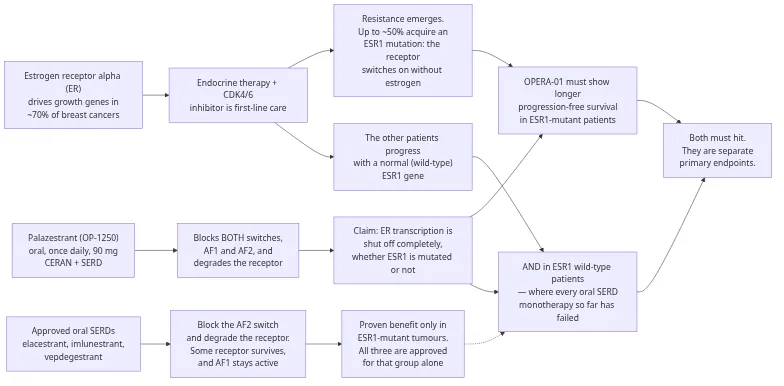
About 70% of breast cancers are ER-positive: their cells carry the estrogen receptor, and when
estrogen binds it, it switches on the genes that make the cell grow
[VERIFIED — PubMed, Future Oncol 2026, DOI 10.1080/14796694.2025.2608863]. The whole treatment
strategy is to interrupt that signal, and three ways exist: aromatase inhibitors stop the body
making estrogen; SERMs such as tamoxifen sit in the receptor and block estrogen from binding;
SERDs both block the receptor and cause the cell to destroy it.
Each has a specific weakness [VERIFIED — same source]. Aromatase inhibitors drive the tumour to
acquire ESR1 mutations, after which the receptor is permanently on and no longer needs estrogen.
SERMs partly switch the receptor on in other organs. And the only approved SERD that works as
a single agent, fulvestrant, has such poor drug-like properties that it must be injected into
muscle, capping the deliverable dose.
Palazestrant is a once-daily tablet that is both a SERD and what Olema calls a complete estrogen
receptor antagonist (CERAN). The estrogen receptor has two separate transcription switches, AF1
and AF2. Existing SERDs block AF2 and degrade some receptor, but leave AF1 able to work, and
laboratory work shows residual receptor protein survives their treatment [VERIFIED — same source]. Palazestrant is designed to block both AF1 and AF2 as well as degrading the
receptor, so whatever receptor survives is also silenced — complete shutdown of ER-driven
transcription regardless of ESR1 status.
How well the target is validated. As well as any target in oncology. The estrogen receptor has
been drugged successfully since the 1970s, with four oral agents approved or filed between January
2023 and June 2026 [VERIFIED — FDA approval announcements; Roche NDA acceptances]. This sweep
adds the independent genetics check the last one could not run: Open Targets resolves ESR1
(ENSG00000091831) and the ER+ breast-cancer disease entities cleanly [VERIFIED — Open Targets search_entities 2026-08-12]. Nobody doubts the target; what is doubted is the population claim.
The exact scientific step the next readout must prove. Not that blocking the estrogen receptor
helps — that is settled. OPERA-01 must prove that the AF1-plus-AF2 mechanism converts into a
measured progression-free survival benefit in patients whose tumours have no ESR1 mutation,
on top of a benefit in mutant patients. Both are separate primary endpoints and both must be met.
That is precisely where the class has failed. Imlunestrant’s EMBER-3 produced benefit confined to
ESR1-mutant patients (median PFS 5.5 vs 3.8 months, hazard ratio 0.62, 95% CI 0.46–0.82) and was
approved for them alone [WEB ESTIMATE — EMBER-3 as reported at SABCS 2024/2025]. Vepdegestrant’s
VERITAC-2 likewise; approved 2026-05-01 for mutant patients only [VERIFIED — FDA]. Elacestrant’s
label has been mutant-only since January 2023 [VERIFIED — FDA]. The OPERA-01 design paper says it
outright: “recent reports indicate that the clinical benefit in ER+, HER2– ABC may be limited to
patients with ESR1-mutated tumors, rather than the entire patient population” [VERIFIED — PubMed, DOI 10.1080/14796694.2025.2608863].
The honest scientific risk. The mechanistic argument is good but preclinical, and the clinical
evidence for the wild-type claim is a subgroup of roughly 26 patients inside a single-arm study.
In the 49 second-/third-line patients, median PFS was 7.2 months overall and 7.3 months in the 23
ESR1-mutant patients [VERIFIED — same source] — nearly identical figures, so the wild-type
patients must have done about as well. That is the single most encouraging number in this
analysis, and also the thinnest. Nothing published since 2026-08-04 has added to it. A further
caution from the company’s own combination data: in the ribociclib arm’s prior-CDK4/6 group,
wild-type patients did worse than mutant ones (9.2 vs 13.8 months median PFS) [VERIFIED — same source].
A.2 Clinical development plan, timeline, feasibility, resourcing
Trials
| Trial | Sponsor / whose drug | Design (arms, blinding, n) | Population | Status / key result | Link |
|---|---|---|---|---|---|
| OPERA-01 (NCT06016738) | Olema Oncology; palazestrant is Olema’s own | Phase 3, international, multicentre, randomised, open-label, active-controlled, two parts. Part 1 randomised ~120 patients 1:1:1 to palazestrant 90 mg, 120 mg, or investigator’s choice of standard endocrine therapy. Part 2 randomises ~390 patients 1:1 to palazestrant 90 mg or standard therapy (fulvestrant 500 mg or letrozole, anastrozole or exemestane). 510 enrolled, 470 in the primary analysis. 233 sites, ~41 US, 26 countries. | Adults with inoperable locally advanced or metastatic ER+/HER2− breast cancer, progressed after endocrine therapy plus a CDK4/6 inhibitor, at most one further endocrine monotherapy line; ECOG 0–1; no prior metastatic chemotherapy; no prior elacestrant or investigational ER-directed therapy. Stratified on ESR1 ctDNA status, prior lines (1 vs 2), visceral disease. | Enrollment completed, announced 2026-08-10; topline guided Q1 2027 [VERIFIED — Q2 2026 release]. CT.gov still reads RECRUITING with primary completion 2026-06-30 — stale on both counts (see Readout). Registrational dose 90 mg per the independent data monitoring committee. | NCT06016738 · design paper |
| OP-1250-001 (NCT04505826) | Olema; palazestrant | Phase 1/2 first-in-human, open-label, single-arm dose escalation/expansion. 153 enrolled per CT.gov, 146 treated per the paper. 19 sites. 30–300 mg once daily. | ER+/HER2− MBC, ≥1 prior endocrine line, ≤2 prior chemotherapy regimens. Of 86 at the recommended dose: 97% prior CDK4/6i, 76% ≥2 prior lines, 48% ESR1-mutant. | COMPLETED 2024-07-30. No DLT to 300 mg; 120 mg selected as RP2D. mPFS 4.8 months overall (95% CI 3.5–7.1), 5.6 months ESR1-mut; CBR 46%/59%. Second-/third-line subset: 7.2 / 7.3 months. Nausea 62.8%, vomiting 29.1%, fatigue 25.6%; grade ≥3 transient neutropenia 10.5%. | NCT04505826 · Breast Cancer Res 2025 |
| OP-1250-002 (NCT05266105) | Olema; palazestrant + Pfizer’s palbociclib | Phase 1, open-label, single-arm, n=60, 8 sites. | Advanced/metastatic HR+/HER2− breast cancer. | ACTIVE_NOT_RECRUITING; primary completion 2026-03; no new data or timing in four consecutive quarterly releases. | NCT05266105 |
| OP-1250-003 (NCT05508906) | Olema; palazestrant + ribociclib, alpelisib, everolimus, or atirmociclib | Phase 1b/2, open-label, multi-arm, n=190, 16 sites. | Advanced/metastatic ER+/HER2− breast cancer incl. prior CDK4/6i. | RECRUITING; primary completion 2027-12-31. Ribociclib arm: mPFS 15.5 months all, 12.2 prior-CDK4/6i; within that, 9.2 wild-type vs 13.8 mutant. The atirmociclib arm completed enrollment per the 2026-08-10 note. | NCT05508906 |
| OPERA-02 (NCT07085767) | Olema; palazestrant + ribociclib | Phase 3, randomised, double-blind, n=1,000, 167 sites. | First-line ER+/HER2− advanced breast cancer. | RECRUITING since 2025-11-03; enrolment “advanced” per the Q2 release; primary completion 2028-12. | NCT07085767 |
| OP-3136-001 (NCT06784193) | Olema; OP-3136 ± fulvestrant or palazestrant | Phase 1 first-in-human, open-label, n=180, 8 sites. | ER+/HER2− MBC, NSCLC, mCRPC. | RECRUITING; primary completion 2027-05-30. ASCO 2026-05-30 initial data: no DLT to 45 mg, 3 PRs among 19 evaluable. | NCT06784193 |
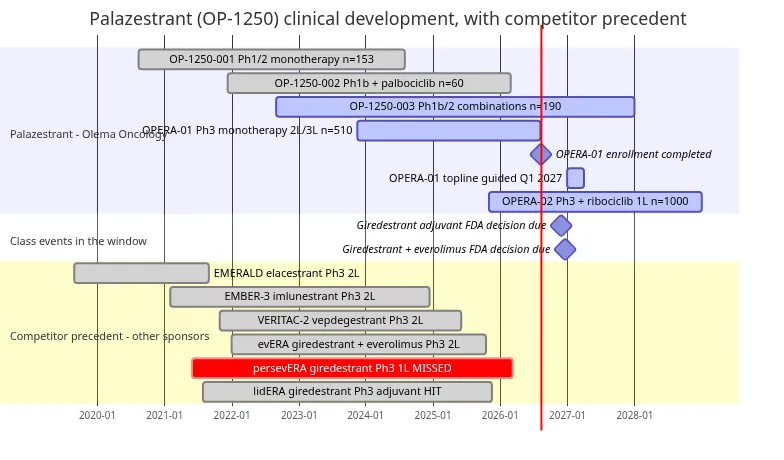
Dates: first and last patient in, database lock, topline. Enrolment began 2023-11-16
[VERIFIED — CT.gov]. Enrollment completion was announced 2026-08-10 — the first hard gate on
the trial’s arithmetic ever disclosed — but the completion date itself was not stated, and
database lock has still never been disclosed [VERIFIED — Q2 2026 release; absent from CT.gov and all four PubMed records]. The topline is now guided “first quarter of 2027”.
Date cross-check (rule 24). Three sources, reported as three:
| Source | What it says | Read |
|---|---|---|
BPIQ catalyst_date_text | ”Q1 2027”, stored against catalyst_date 2027-03-31 | The stored date is a synthesized quarter-end placeholder (rule 23). |
| Company, 2026-08-10 | ”Completed enrollment in the pivotal Phase 3 OPERA-01 trial”; “top-line data are now expected in the first quarter of 2027” | The freshest and best-grounded source: issued alongside a concrete gating event (enrollment completion). |
| ClinicalTrials.gov NCT06016738 | Primary completion 2026-06-30 (passed), status RECRUITING, overall completion 2027-09-30 | Stale on its face. The record still shows recruiting six-plus weeks after the last-visible sweep flagged the same thing, and now directly contradicts the sponsor’s own enrollment-completion disclosure. The 2026-08-04 analysis read this two-way (“either the registry is stale or the fall topline is at risk”); the Q2 release resolved it — both were true. The registry entry remains unmaintained and its dates carry no current information. |
Date slippage. The guidance tightened twice, was reiterated once, and has now slipped
once — the first slip on record: “Topline data in 2026” (2025-05-13) → “on track for OPERA-01
topline data in H2 2026” (2025-11-10) → “on track for topline data in fall 2026” (2026-03-16) →
reiterated (2026-05-12) → “expected in the first quarter of 2027” (2026-08-10). The first four
entries are carried from the BPIQ note field as read on 2026-08-04; the feed has since replaced
that history with only the newest entry (../company.md C.8) [VERIFIED — BPIQ note field read 2026-08-04 and 2026-08-12; Q2 2026 release]. One slip in fifteen months is still a good record,
but the 2026-08-04 analysis leaned on “never slipped” as an execution signal, and that sentence is
no longer true.
Feasibility matrix
| Factor | High probability | Medium probability | Low probability | This asset (assessment) | Source |
|---|---|---|---|---|---|
| Recruitment feasibility | >50 sites, 3:1 patient:site | 20–50 sites, established investigators | <20 sites, novel sites | High, and now proven. 233 sites for 510 patients across 26 countries — and enrollment is complete. The 2.2:1 patient-to-site ratio soft spot is now moot. | CT.gov; Q2 2026 release |
| Endpoint clarity | Regulatory precedent exists | Novel endpoint with FDA alignment | Unvalidated surrogate | High. BICR progression-free survival, split by ESR1 stratum — the exact endpoint and split on which three competitors were approved. | FDA approvals for elacestrant, imlunestrant, vepdegestrant |
| Trial-design robustness | Pivotal Phase III with SPA | Adaptive with interim analysis | Single-arm, no control | Medium. Randomised, active-controlled, 510 patients, IDMC in place. Two weaknesses stand: open-label (mitigated by BICR), and no Special Protocol Assessment disclosed anywhere. | CT.gov; DOI 10.1080/14796694.2025.2608863 |
| Operational / execution | Enrollment complete, standard timeline | Some timeline risk | Enrollment behind | Medium-high, upgraded from medium-with-a-caveat. Enrollment is complete — the biggest open operational question of the prior analysis is answered. Against that: the answer arrived one quarter later than guided (the first slip), and the registry record is unmaintained. | Q2 2026 release; CT.gov |
Resourcing sufficiency. Comfortable through the readout. $461.1M at 2026-06-30 against
$14.7–22.4M a month on the three burn readings gives 22–31 months of runway
[VERIFIED and modelled — ../company.md C.3]; the Q1 2027 topline needs no new money. Burn is
still rising (Q2 R&D $57.8M vs $43.9M a year earlier) with OPERA-02 mid-enrolment. Expect a
discretionary raise into strength — the November 2025 offering at $19.00 and the newly surfaced H1
2026 ATM sales at ~$24.5 average are the twice-demonstrated pattern [VERIFIED — ../company.md C.3].
A.3 Target label, target product profile, strategic questions, designations
A.3a Target label. Palazestrant as a single agent, once daily by mouth, for adults with
ER+/HER2− locally advanced or metastatic breast cancer progressed after one or two prior lines of
endocrine therapy for advanced disease including a CDK4/6 inhibitor — regardless of ESR1
mutation status. That last clause is the entire commercial argument.
A.3b Target product profile
| Attribute | Standard of care & key competitor(s) — data | Palazestrant target profile (goal) | Supporting evidence (+ link) |
|---|---|---|---|
| Indication / target label | Fulvestrant or an AI, unrestricted by ESR1 status but modest (3.8-month control-arm median PFS in EMBER-3). Elacestrant (2023-01), imlunestrant (2025-09-25), vepdegestrant (2026-05-01) all ESR1-mutant-only. | All-comers second-/third-line label, roughly double any approved oral competitor’s eligible population. | FDA vepdegestrant approval · FDA imlunestrant approval |
| Efficacy (endpoints, regimen) | Imlunestrant monotherapy, ESR1-mut: mPFS 5.5 vs 3.8 months, HR 0.62. No meaningful monotherapy benefit overall. Giredestrant+everolimus (evERA): risk cut 44% all-comers / 62% mutant — a combination. | Statistically significant PFS benefit in both strata as a single agent, 90 mg once daily. Phase 1/2 second-/third-line median 7.2 months. | EMBER-3, Ann Oncol 2025 · Roche evERA 2025-10-18 · DOI 10.1186/s13058-025-02049-y |
| Safety / tolerability | Fulvestrant: injection-site burden. Oral competitors: mainly gastrointestinal. | Mostly grade 1–2: nausea 62.8%, vomiting 29.1%, fatigue 25.6%; grade 3+ transient neutropenia 10.5%; discontinuation ≤6%. 62.8% nausea is high for a chronic daily tablet and is the clearest tolerability liability. | DOI 10.1186/s13058-025-02049-y |
| Biomarker / companion diagnostic | ESR1 ctDNA testing routine and guideline-written; all three oral competitors require it to select patients. | A deliberate non-requirement: testing stratifies randomisation, it does not select. A win means no diagnostic gate on prescription. | CT.gov stratification; DOI 10.1080/14796694.2025.2608863 |
| Formulation / administration | Fulvestrant: two intramuscular injections per visit. Competitors: oral. | Oral once daily, 90 mg. Differentiated only against fulvestrant on route. Preclinical brain penetrance (brain:plasma >1) — untested in humans, not an OPERA-01 endpoint. | DOI 10.1158/1535-7163.MCT-23-0351 |
| Payer value | Delaying chemotherapy/ADCs is the accepted class value story. | Same story on twice the population, no diagnostic gate. Weakness: no head-to-head against any oral competitor exists or is planned. | DOI 10.1080/14796694.2025.2608863 |
A.3c Strategic Go/No-Go questions. The next decision is registration, so the pre-Phase-III / registration set applies.
| Group | Question | Answer (tagged) |
|---|---|---|
| Target | Target revalidated as in prior phases? | Yes, repeatedly and by other people’s money; and this sweep adds the independent genetics check (Open Targets resolves ESR1 and the disease cleanly). [VERIFIED — FDA approvals; Roche releases; Open Targets 2026-08-12] |
| Dose & Drug | Exposure–response for the intended commercial regimen and route? | Partially — the standing weakness. 120 mg gave CBR 46% vs 19% at 60 mg; OPERA-01 Part 2 runs at 90 mg on the IDMC’s recommendation; steady-state levels at 60 and 120 mg sat above the modelled complete-inhibition threshold, which is the argument 90 mg suffices. No published efficacy at 90 mg. [VERIFIED — DOI 10.1186/s13058-025-02049-y; DOI 10.1080/14796694.2025.2608863] |
| Dose & Drug | Commercial formulation available or feasible? | Yes: conventional oral small molecule (MW 449.61, one Lipinski violation), supplied to two global Phase 3s. [VERIFIED — ChEMBL CHEMBL5314475; CT.gov] |
| Dose & Drug | Dose range compatible with clinical and non-clinical safety? | Yes, >3-fold margin: no DLT to 300 mg against a 90 mg registrational dose. [VERIFIED — DOI 10.1186/s13058-025-02049-y] |
| Dose & Drug | Therapeutic window given the clinical response? | Wide on safety, narrow on evidence: the lower edge is inferred from pharmacokinetics, not measured. [UNVERIFIED — inferred] |
| Dose & Drug | Intrinsic and extrinsic factors influencing exposure and response? | Not established in this sweep: no published food-effect, interaction or organ-impairment data. Eligibility excludes GI disorders affecting absorption, implying a known sensitivity. [UNVERIFIED] |
| Patient | Proof of concept and positive benefit/risk in the intended population? Combination evidence? | Yes overall, thin in the half that matters: 7.2/7.3-month medians in the 49-patient subset imply comparable wild-type performance on ~26 uncontrolled patients. Combination evidence is stronger but cuts against the wild-type claim: 9.2 wild-type vs 13.8 mutant months in the prior-CDK4/6i ribociclib-arm group. [VERIFIED — DOI 10.1080/14796694.2025.2608863] |
| Patient | Phase III design and outcome criteria — accepted, compelling, competitive? | Accepted and competitive; compelling only if both endpoints hit. Open-label is the structural criticism, part-answered by BICR. [VERIFIED — CT.gov; design paper] |
| Patient | Rationale for the patient population(s)? | Sound: guidelines advise further endocrine options before chemotherapy; patients needing chemotherapy now are excluded. [VERIFIED — CT.gov eligibility; design paper] |
| Patient | Likelihood of the expected outcome? | See the Locked prediction: 40% that both co-primary endpoints hit, band 30–52%. [UNVERIFIED — modelled] |
| Patient | Companion-diagnostic strategy, including pricing and market? | Deliberately none: ctDNA testing stratifies rather than selects, so success produces an ungated all-comers label using tests already routine. [VERIFIED — CT.gov stratification] |
A.3d Regulatory designations.
- FDA Fast Track designation for palazestrant in ER+/HER2− metastatic breast cancer progressed
after ≥1 endocrine line including a CDK4/6 inhibitor; granted July 2022, restated April 2026
[VERIFIED — press feed; BPIQ note as read 2026-08-04]. What it grants: more frequent FDA contact and eligibility for rolling review; it does not shorten the review clock or lower the evidence bar. - No Breakthrough Therapy, no Orphan Drug, no Priority Review voucher found anywhere in this sweep
[VERIFIED — absent from the 287-item press feed, all four PubMed records, all six CT.gov records].
A.4 Target product profile valuation matrix
| Stakeholder | Value driver | Minimum threshold | Competitive | Premium | Benchmark / source |
|---|---|---|---|---|---|
| Patient / caregiver | More time before chemotherapy or an ADC, without losing quality of life | PFS at least as good as fulvestrant/AI, no new toxicity | Benefit like imlunestrant’s in mutant patients (5.5 vs 3.8 months, HR 0.62) | That benefit in wild-type patients too, so no patient is told the drug is not for them | EMBER-3; palazestrant Phase 1/2 (DOI 10.1186/s13058-025-02049-y) |
| Regulator | Statistical significance on pre-specified endpoints with acceptable safety | One co-primary met, safety no worse than control | Both co-primaries met at conventional significance | Both met with HR ≤~0.62 plus a supportive OS trend | The three approvals in this exact setting |
| Payer / HTA | Cost of delaying chemotherapy/ADC vs drug cost | Non-inferior to existing endocrine options at comparable price | Equivalent to imlunestrant/elacestrant in mutant patients at comparable price | All-comers label with no diagnostic gate | Elacestrant US list price — still internally contradictory across sources (>10× spread, neither net); see B.3a [WEB ESTIMATE — retail pricing sources; conflict unresolved] |
| Provider | Prescribing and monitoring simplicity | Oral drug, no new monitoring | Oral once daily replacing IM fulvestrant | Oral once daily and no wait for an ESR1 result | CT.gov dosing; competitor labels |
Calibration examples, not asset claims: in oncology each incremental month of overall survival is worth roughly $150–300M in peak-sales potential; oral formulations command roughly 15–25% price premiums over injectables.
A.5 Evidence quality and endpoints
| Criterion | Score (High / Medium / Low) | Basis (one line) | Link |
|---|---|---|---|
| Target validation | High | Drugged successfully for five decades; four oral agents approved or filed 2023–2026; and this sweep’s Open Targets call resolves ESR1 and the disease entities, closing the genetics gap the 2026-08-04 sweep had to substitute around. | FDA announcements; Open Targets search_entities 2026-08-12 |
| Mechanism clarity | High | The AF1-plus-AF2 claim is specific and tested head-to-head against fulvestrant and elacestrant in company-run models with Loyola and University of Chicago co-authors. | DOI 10.1158/1535-7163.MCT-23-0351 · DOI 10.1021/acsomega.4c11023 |
| Biomarker availability | High | ESR1 ctDNA testing is routine, guideline-recommended, and run centrally in the trial. | CT.gov NCT06016738 |
| Publication quality (peer-reviewed? independent authors?) | Medium | All four PubMed records are peer-reviewed with genuinely mixed author lists — but every one has Olema employees as co-authors, and no publication on this molecule exists without Olema involvement. No independent replication of the AF1 claim. Unchanged since 2026-08-04: the evidence base did not move. | DOI 10.1186/s13058-025-02049-y · DOI 10.1080/14796694.2025.2608863 |
| Clinical / expert sentiment | — | Moved to A.5b, below. | — |
Endpoints
| Endpoint (full name) | What it measures | Scale / range | Better direction | MCID / note |
|---|---|---|---|---|
PFS by blinded independent committee review, ESR1-mutation-detected patients — co-primary | Time from randomisation to first documented progression or death, scans read blind | Months; median with 95% CI, and hazard ratio vs control | Longer; HR below 1.0 favours palazestrant | No formal MCID for PFS in this setting; the working benchmark is imlunestrant’s 5.5 vs 3.8 months, HR 0.62 — enough for approval. |
PFS by BICR, ESR1-mutation-not-detected patients — co-primary | The same measure, other stratum | Same | Same | No drug has ever met this endpoint as an oral single agent. The only reference is palazestrant’s own uncontrolled ~7-month subset figure against a ~3.8-month control expectation. |
| Overall survival, per stratum — key secondary | Time to death from any cause | Months; median and HR | Longer | Not expected mature at topline; CT.gov estimates up to 4 years vs 2 for PFS. |
| Locally assessed PFS, ORR, CBR, DoR — secondary | Supporting measures (glossary) | — | — | Reported by both independent and investigator assessment, letting the open-label bias be measured directly. |
| EQ-5D-5L, EORTC QLQ-C30, PRO-CTCAE — patient-reported outcomes | Standardised quality-of-life and side-effect questionnaires | Instrument-specific | Higher QoL, fewer symptoms | Already shaped the design once: cited by the IDMC in choosing 90 mg. |
| AE incidence, dose reduction, discontinuation over 16 weeks — Part 1 primaries | Safety during dose selection | Counts | Fewer | Complete; not what the Q1 2027 topline is about. |
A.5b Key opinion leaders.
Panel as of. 2026-08-12.
CT.gov names no investigators for OPERA-01: search_investigators returns only anonymous
“Research Coordinator” contacts on the combination study, and the OPERA-01 record itself lists
every one of its 233 sites as an unnamed “Clinical Trial Site” with no overall officials
[VERIFIED — CT.gov search_investigators and get_trial_details 2026-08-12]. The investigator
panel below is therefore the design paper’s academic authorship — the trial’s steering
investigators — which is a sponsor-selected subset by construction. No named independent voice
on this program’s endpoint was found this sweep (see below), so the independent-voices table is
empty and the judgement is written accordingly.
Investigators
| Name | Role / affiliation | Trial (NCT) | Conflicts (party, kind, disclosed in, as of) | Conflicts checked (source, date) | Source | Tag |
|---|---|---|---|---|---|---|
| Barbara Pistilli | Design author / steering investigator; Gustave Roussy, Villejuif | NCT06016738 | — (none beyond trial authorship established this sweep) | PubMed get_full_text_article PMC12802986, 2026-08-12 — the returned full text carries no conflict-of-interest section, so no disclosure beyond authorship itself could be read | PubMed 41461598 author list | VERIFIED — PubMed, DOI 10.1080/14796694.2025.2608863 |
| Heather McArthur | Design author / steering investigator; UT Southwestern, Dallas | NCT06016738 | — (same) | Same check, same limit; also quoted describing the mechanism in trade press (OncLive), a sponsor-aligned context | PubMed 41461598; OncLive | VERIFIED — PubMed, same DOI |
| Peter Schmid | Design author / steering investigator; Barts Cancer Institute, London | NCT06016738 | — (same) | Same check, same limit | PubMed 41461598 | VERIFIED — PubMed, same DOI |
| Jane Meisel | Design author / steering investigator; Winship, Emory — also a Phase 1/2 author | NCT06016738; NCT04505826 | — (same) | Same check, same limit | PubMed 41461598; 40598566 | VERIFIED — PubMed, same DOIs |
| Meritxell Bellet Ezquerra | Design author / steering investigator; Vall d’Hebron, Barcelona | NCT06016738 | — (same) | Same check, same limit | PubMed 41461598 | VERIFIED — PubMed, same DOI |
| Lucia Del Mastro | Design author / steering investigator; San Martino, Genova | NCT06016738 | — (same) | Same check, same limit | PubMed 41461598 | VERIFIED — PubMed, same DOI |
| Joohyuk Sohn | Design author / steering investigator; Yonsei Cancer Center, Seoul | NCT06016738 | — (same) | Same check, same limit | PubMed 41461598 | VERIFIED — PubMed, same DOI |
| Arlene Chan | Design author / steering investigator; Curtin University / Hollywood Private Hospital, WA | NCT06016738 | — (same) | Same check, same limit | PubMed 41461598 | VERIFIED — PubMed, same DOI |
(Two further authors, Lianqing Zheng and Elisabeth de Kermadec, are Olema employees and are recorded here as sponsor-side rather than investigators.)
Independent voices
No named independent voice found. The searches made: PubMed (all four records carry Olema co-authors, so none yields an independent commentator), a targeted web search for named commentary on the OPERA-01 wild-type endpoint (returned only sponsor-aligned trade-press quotes from design authors), and the trade press around the 2026-08-11 slip (analyst commentary, not clinical). The nearest thing to independent sentiment remains a survey of 20 breast-cancer research leaders reported at SABCS treating the approved oral SERDs as broadly interchangeable — unattributable to any named person, so it cannot be a row here.
| Name | Affiliation | View (close enough to quote) | As of | Conflicts checked (source, date) | Source | Tag |
|---|
Judgement
| Endpoint supported | Basis (one or two sentences) | Tag |
|---|---|---|
| UNKNOWN | The only named voices found are the trial’s own steering investigators, who authored the endpoint and support it by construction; no independent named voice on the wild-type co-primary was located, and the one piece of independent sentiment (an unattributable 20-leader SABCS survey treating oral SERDs as interchangeable) cannot carry a panel on its own. Too thin to judge, and saying so is the honest answer. | UNVERIFIED — judgement |
Dissent
| Name | View (close enough to quote) | Source |
|---|
B. Commercial assessment
B.0 Current treatment algorithm
What a patient with ER+/HER2− advanced breast cancer receives today, and where palazestrant would
fit [VERIFIED — DOI 10.1080/14796694.2025.2608863, citing NCCN and ASCO guidelines]:
- First line. Endocrine therapy — usually an aromatase inhibitor — plus a CDK4/6 inhibitor. Works for a long time; almost everyone eventually progresses.
- At progression, a blood test. ctDNA is tested for an
ESR1mutation; up to about half of patients on an aromatase inhibitor have acquired one. - Second line,
ESR1-mutant. Elacestrant, imlunestrant or vepdegestrant, or fulvestrant, or another aromatase inhibitor. - Second line,
ESR1wild-type. Fulvestrant or a different AI, possibly with everolimus or (ifPIK3CA-mutant) alpelisib. None of the three approved oral drugs is licensed here. This is the gap. - Later lines. Chemotherapy or an antibody-drug conjugate — considerably more toxic; steps 3 and 4 exist to delay this point.
Where palazestrant would fit. Steps 3 and 4, aiming at both. In step 3 it would be a fourth entrant with a mechanistic story. In step 4 it would be the first oral single agent with a licence. Step 4 is where the value is, and step 4 is the endpoint that has never been met.
B.1 Competitive landscape and positioning
| Metric | High value | Medium value | Low value | This asset (assessment) | Source |
|---|---|---|---|---|---|
| Mechanism differentiation | First-in-class or novel target | Next-generation improvement | Me-too | Medium, arguably medium-high. Not first-in-class on a fifty-year-old target, but AF1-plus-AF2 blockade is a specific, testable next-generation improvement; a wild-type win would make it first-in-class for that population. | ChEMBL CHEMBL5314475; DOI 10.1158/1535-7163.MCT-23-0351 |
| Development-timeline advantage | >12 months ahead | Within 6–12 months | Lagging >12 months | Low. Palazestrant is last, and the slip widened the gap. Elacestrant approved 2023-01, imlunestrant 2025-09, vepdegestrant 2026-05. Giredestrant has FDA decisions due 2026-11-30 (adjuvant) and 2026-12-18 (+everolimus) — both likely before OPERA-01 topline now. Camizestrant’s SERENA-6 stumbled at ODAC (April 2026, no majority in favour; PDUFA extended), the one competitive setback in the window. | FDA/Roche/AstraZeneca releases 2026 |
| Clinical proof-of-concept evidence | Positive Phase IIb (n>100) | Phase IIa signals (n=20–50) | Preclinical only | Medium. 146–153-patient Phase 1/2 with peer-reviewed medians, but single-arm, and the matching second-/third-line subset is 49 patients. Unchanged since 2026-08-04. | DOI 10.1186/s13058-025-02049-y |
| IP protection | Composition-of-matter, long-dated | Method-of-use | Pending or none | Unresolved and reported as unresolved. Still no patent number, expiry or licence found for palazestrant. This sweep adds one clarification: the Aurigene royalty (mid-single to low-double digits) attaches to the OP-3136 collaboration, not to palazestrant, which appears royalty-free as far as any source shows. | Absence in web_search; Aurigene agreement terms (10-Q/K coverage) |
Where this asset wins, and the single fact the thesis rests on. Unchanged: palazestrant wins
in exactly one place — ESR1 wild-type patients in the second and third line, where it would have
no oral competition, because every approved oral is mutant-only and giredestrant’s positive
second-line trial used a combination. The single fact: in the 49 second-/third-line Phase 1/2
patients, mPFS was 7.2 months overall and 7.3 months in the 23 mutant patients, so the ~26
wild-type patients must have done about as well [VERIFIED — DOI 10.1080/14796694.2025.2608863].
That is the only clinical evidence in existence that this drug behaves differently from its
competitors in the population that matters, and it is 26 uncontrolled patients.
The competitive fact that cuts both ways, sharpened. This stock trades as an oral-SERD-class
proxy (../company.md C.7), and the class’s next two catalysts belong to Roche, inside this
program’s own pre-readout window: giredestrant’s adjuvant decision by 2026-11-30 and its
+everolimus decision by 2026-12-18. An approval re-rates the class up (the lidERA readout was
worth +130% to OLMA); a surprise rejection de-rates it. Neither says anything about palazestrant’s
wild-type endpoint.
Calibration example, not an asset claim: oncology first-movers in novel mechanisms have shown roughly 3.2× higher peak-sales potential but about 1.8× higher development risk.
B.2 Addressable market
Launch markets. The United States first, on a Fast Track designation and an FDA-agreed dose;
the 26-country, 233-site footprint is built for multi-region filing [VERIFIED — CT.gov].
| Component | How it is estimated | Premium threshold | This asset (assessment) | Source |
|---|---|---|---|---|
| Drug-treated patients | Epidemiology × diagnosis rate × treatment rate | >100,000 (US/EU5/Japan) | Meets the threshold across US/EU5/Japan; not US alone. 2.3M diagnoses worldwide (2022), ~70% ER+/HER2−, ~5% metastatic at diagnosis, ~30% of treated early-stage eventually metastatic → roughly 18,000–30,000 US patients/year reaching OPERA-01-like eligibility. | Percentages [VERIFIED — DOI 10.1080/14796694.2025.2608863]; the US case count they are applied to remains unverified, so the derived range is [UNVERIFIED — modelled] |
| Market exclusivity | Patent term + regulatory exclusivity | >10 years combined | Cannot be assessed. No patent number or expiry found; NCE 5-year exclusivity and composition-of-matter into the early 2040s are inference, not evidence. Recorded as a gap. | [UNVERIFIED]; discovery paper DOI 10.1021/acsomega.4c11023 |
| Reimbursement precedent | Approvals in ≥2 major markets | Positive NICE/CADTH guidance | Strong precedent for the class: three FDA approvals in this exact line since January 2023. No palazestrant assessment exists anywhere because it is unapproved. | FDA announcements |
| Patient-journey impact | Fewer hospital days, less caregiver burden | >30% quality-of-life gain | Real but unquantified. Tablet replaces injections; delay of chemotherapy avoids its toxicity; the trial collects three PRO instruments so a number will exist at readout. 62.8% nausea cuts against the story. | CT.gov outcomes; DOI 10.1186/s13058-025-02049-y |
B.3 Value and feasibility
B.3a Expected peak sales. United States only, conditional on approval, before ex-US revenue and before the larger first-line opportunity OPERA-02 addresses. Inputs unchanged from 2026-08-04 — nothing in this sweep moved them.
| Scenario | Assumptions (patients × price × share) | Estimate (USD/year at peak) | Basis / tag |
|---|---|---|---|
| Low | 18,000 × $100,000 × 15% | ~$270M | Mutant-only label or weak all-comers effect; fourth entrant, discount pricing. [UNVERIFIED — modelled] |
| Base | 22,000 × $130,000 × 25% | ~$715M | All-comers label, HR 0.65–0.75; wins wild-type by default. [UNVERIFIED — modelled] |
| High | 30,000 × $180,000 × 40% | ~$2.16B | All-comers label, HR near 0.60 both strata, premium price on the absent diagnostic gate. [UNVERIFIED — modelled] |
Which inputs are not defensible, named individually. Unchanged: patients (the US incidence
figure under the verified percentage chain was not verified) and price (the only anchor,
elacestrant’s US list price, still shows a more-than-tenfold spread between sources — ~$26,105 per
30-day supply vs ~$2,500 per cycle — neither a net price) [WEB ESTIMATE — retail pricing sources; conflict unresolved]. Share is modelled from B.1.
Cross-check against published third-party figures. GlobalData’s model now circulates as
“$1.3bn in 2031” [WEB ESTIMATE — clinicaltrialsarena/GlobalData, 2026] alongside the earlier
$686M-by-2036 page the 2026-08-04 analysis used; Stifel initiated in February 2026 calling peak
sales “exceeding $3 billion” [WEB ESTIMATE — Stifel initiation coverage, 2026-02]. The base case
above sits below all of these; the spread between them (2×–4×) is a measure of how unpriced this
asset’s label breadth is, not a reason to raise the base.
These figures are conditional on approval and exclude: ex-US revenue; the OPERA-02 first-line opportunity; OP-3136; partnership economics.
B.3b Feasibility
| Question | Answer (tagged) |
|---|---|
| Expected net present value (eNPV) | No single figure (rule 10: probability of success and peak sales are both unverified). The frame: ~$620M of recomputed enterprise value on 101.09M economic shares [modelled — ../company.md C.4] against a US-only base-case peak of ~$715M/year conditional on approval — the market pays below one times unrisked US base-case peak revenue, with a 1,000-patient first-line Phase 3 and an early second molecule included. Cheaper on this metric than at the 2026-08-04 sweep ($715M EV then). The reason it is cheap is the wild-type endpoint risk plus, now, a demonstrated willingness to slip. |
| Capital to the next decision point | Essentially nothing incremental: ~$435M modelled cash against five to eight months at $14.7–22.4M/month. [modelled — ../company.md C.3] |
| Capital to approval, and the funding plan | Not funded to approval or launch. Cash reaches ~2028 on current burn, but burn is rising, OPERA-02 runs to ~2028, and an NDA, review and launch build sit beyond it. The funding plan is the March 2026 shelf and the ATM: Olema has now raised into strength twice ($218.5M at $19.00 in November 2025; $41.9M via ATM at ~$24.5 average in H1 2026). [VERIFIED — ../company.md C.3] |
| Launch capability — alone, or must partner? | Cannot launch alone as things stand: no sales force, $0 revenue, and the CFO/COO seat still held by the CEO on an interim basis since January 2026 with no permanent appointment through 2026-08-12. The seven-year HQ lease and the deal-maker board addition (April 2026) still read as building rather than selling. [VERIFIED — press feed] |
| Commercialisation rights — retained, split, or out-licensed? | Retained in full, as far as any source shows. The Novartis, Pfizer and Bayer arrangements are clinical-trial-and-supply collaborations; the Aurigene royalty attaches to OP-3136, not palazestrant. [VERIFIED — press feed; Aurigene agreement coverage] |
B.4 Product-development risk
Framing questions.
- Does the development plan support the target product profile claims? Yes, precisely: two
co-primary endpoints, one per
ESR1stratum, randomisation stratified on the same variable, tested centrally on blood. The design does not hedge — if only the mutant endpoint hits, the company’s own trial refutes the profile’s central claim. - Will the identified risks affect the target product profile? Two will: the 90 mg registrational dose attacks the efficacy claim (no published efficacy at that dose), and 62.8% nausea attacks the tolerability claim in a chronic daily tablet.
- If a risk cannot be mitigated, is the asset still differentiated? Only in one scenario. A wild-type failure leaves a fourth mutant-only oral, three-plus years late, with no head-to-head data. There is no fallback differentiation; the mechanism claim and the commercial case are the same claim.
| Category | Time risk | Quality risk | Cost risk | Note |
|---|---|---|---|---|
| Project management | Medium | CFO/COO seat still interim since January 2026, now with the readout eight months out at most. No permanent replacement announced through 2026-08-12. | ||
| Research | Medium | Every publication on the AF1 mechanism has Olema authors; no independent replication. Unchanged. | ||
| IP | Medium | Medium | Still no patent number, expiry or freedom-to-operate statement located. A gap, not a defect. | |
| Legal | Low | Nothing new in the feed beyond the routine plaintiff-firm release of March 2026. | ||
| DMPK | Medium | Steady-state exposure above the modelled inhibition threshold established; food effect, interactions and organ impairment still unpublished. | ||
| Safety pharmacology | Low | Bradycardia 9%, photopsia 5%, all grade 1, no dose changes. | ||
| Toxicology | Low | No DLT to 300 mg; >3-fold margin over the 90 mg dose. | ||
| Drug safety (clinical) | Medium | Low | No treatment-related death and no manufacturing hold — no near-veto factor. The liability remains chronic tolerability: 62.8% nausea in a drug competing against a well-tolerated injection. | |
| Biomarker | Low | Low | Routine ctDNA testing, used to stratify not select. | |
| Clinical pharmacology | High | The registrational dose is 90 mg; every published efficacy figure is at 120 mg, across an interval where CBR fell 46%→19% between 120 and 60 mg. The IDMC’s unblinded Part 1 data are not public; the risk is real and unquantifiable from outside. Unchanged. | ||
| Clinical (efficacy) | High | The binary risk, asymmetric between endpoints: four precedents for the mutant half, none for the wild-type half, ~26 uncontrolled supporting patients. Unchanged. | ||
| Clinical operations | Low | Low | Materially improved: enrollment is complete. The residual operational risk is the ordinary one of database lock and analysis inside the guided quarter — and the registry record being unmaintained means CT.gov offers no early warning if that slips too. | |
| CMC / manufacturing | Low | Low | Conventional small molecule supplied to two global Phase 3s. | |
| Regulatory | Low | Fast Track held; dose agreed with FDA; endpoint and split match three approvals; ~41 US sites. | ||
| Global evidence & value | High | No head-to-head vs any oral competitor exists or is planned; payers get cross-trial comparison only. The all-comers claim is the answer, and it only exists if the wild-type endpoint hits. | ||
| Commercial | High | High | Last of five to market in the mutant segment; no sales force; no permanent CFO; launch needs capital the company does not have and capability it has never shown. The slip also hands giredestrant two FDA decisions of head start it did not have at the prior sweep. |
Readout
Sources
| Kind | Where it comes from | What it is worth | Value (or null) | Tag | Note |
|---|---|---|---|---|---|
bpiq | fetch_company_drugs — catalyst_date, catalyst_date_text | The current single source. Synthesized from period text, so alone it is a ceiling, not an estimate. | 2027-03-31 (“Q1 2027”) | VERIFIED — BPIQ fetch_company_drugs, read 2026-08-12 | Quarter-end placeholder, not a disclosed day. The row’s note (“08/10/26: OPERA-01 enrollment completed; topline data now expected Q1 2027”) replaced the field’s earlier 15-month history — see slippage below. |
ctgov | CT.gov get_trial_details — primary_completion_date | Normally independent of company messaging — but this record is demonstrably unmaintained. | 2026-06-30 | VERIFIED — CT.gov NCT06016738, read 2026-08-12 | Stale on its face: the date has passed, the status still reads RECRUITING, and the sponsor announced completed enrollment on 2026-08-10 without the record moving. Recorded as read; given no weight in the window. Overall completion 2027-09-30. |
company | fetch_company_press_releases / Q2 2026 results | The company’s own most recent dated wording — mandatory, catalyst inside twelve months. | 2027-01-01/2027-03-31 (“first quarter of 2027”) | VERIFIED — Olema Q2 2026 results release, 2026-08-10 (read via BioSpace mirror after globenewswire timeouts) | Issued together with the enrollment-completion announcement, so it is guidance anchored to a completed gating event rather than a hope. Two days old at this sweep. |
congress | data/congresses.json, only when the company has said it intends to present there | Answers “where will they say it.” | null | VERIFIED — data/congresses.json checked 2026-08-12; no statement of intent found | Every Olema topline in the press feed arrives by press release; no company statement ties OPERA-01 topline to any meeting, and the calendar holds no Q1 2027 oncology congress row. Matching on venue habit would be a guess, not a source. |
modelled | Trial arithmetic — see below | The only estimate independent of anyone’s guidance — but this one rests on a stale input. | 2026-09-30/2026-11-30 | UNVERIFIED — modelled, default lag, stale input | Registry primary_completion_date 2026-06-30 + rule 34’s default two-to-four-month lag = 2026-08-30/2026-10-30 (taken at month end: through 2026-11). It points before the company’s fresh guidance because its input predates the enrollment-completion disclosure and the registry has not been updated. Recorded for honesty; given no weight in the window. data/benchmarks/readout-lag.json holds no comparable observation. |
The modelled estimate. Registry primary completion (2026-06-30) plus the rule 34 default of two to four months to database lock and analysis gives late August to late October 2026 — a range the company’s own fresh Q1 2027 guidance has already overtaken. The arithmetic is recorded so it can be argued with; its input is stale, which is the argument against it.
Window
| Earliest | Likeliest | Latest | Precision | Confidence |
|---|---|---|---|---|
| 2027-01-01 | 2027-02-15 | 2027-06-30 | PERIOD | MEDIUM |
Basis. Earliest is the guided quarter’s open: the guidance is two days old, issued alongside the enrollment-completion announcement, and a company that has just pushed a date out does not then beat it by weeks. Likeliest is mid-quarter, because an event-driven dual-primary PFS analysis plus lock and cleaning tends to consume most of a guided quarter, and this management has shown it guides to windows it only just holds. Latest absorbs one further quarter of slip, because the record now contains exactly one slip of exactly one quarter and nothing rules out a second. Precision is PERIOD — a quarter is named, no month, no day. Confidence is MEDIUM: the guidance is fresh and anchored to a completed gating event (enrollment), but the same company’s previous window was reiterated four times and still slipped, and the registry offers no independent check.
Disagreement. UNRESOLVED — but asymmetrically. The registry (primary completion 2026-06-30, still RECRUITING) and the modelled estimate built on it point earlier than, and contradict, the company’s Q1 2027 guidance. The registry record is demonstrably unmaintained: its status field contradicts the sponsor’s own enrollment-completion announcement of 2026-08-10, which is the stronger evidence. Neither is averaged; both are recorded; the window is built on the company source and says so (rule 24).
Date slippage.
| As of | Guidance text |
|---|---|
| 2025-05-13 | ”Topline data in 2026” |
| 2025-11-10 | ”on track for OPERA-01 topline data in H2 2026” |
| 2026-03-16 | ”on track for topline data in fall 2026” |
| 2026-05-12 | ”remains on track for topline data in fall 2026” (unchanged) |
| 2026-08-10 | ”top-line data are now expected in the first quarter of 2027” — the first slip: one quarter |
Five statements, four transitions: two tightenings, one reiteration, one slip (count: 1). The
first four entries are carried from the BPIQ note field as read at the 2026-08-04 sweep; the
feed has since replaced that history (../company.md C.8).
Attribution
Status. CLEAN — as computed by lib/clustering.mjs’s attributionFor over this ticker’s
pipeline for bpiq_drug_id 15137, run 2026-08-12.
| Status | Means |
|---|---|
CLEAN | conflicts is empty — nothing else has_catalyst on this ticker’s pipeline lands within the window. |
Conflicts
| bpiq_drug_id | Label | Date | Analysed? | Gap (days) | Confirmed? |
|---|
Row 15137 is the only has_catalyst: true row of the eight, so the conflict set is empty by
construction — nothing else on Olema’s own pipeline can land inside the window. The two Roche FDA
decisions of 2026-11-30 and 2026-12-18 are not attribution conflicts (they are another
company’s catalysts, outside the computation’s scope, which spans this ticker’s pipeline only),
but they are named in the stock call and the run-up basis because this equity demonstrably trades
on them (../company.md C.7).
Note. (blank — status is CLEAN)
Market and timing for this event
- Plain takeaway. The de-rated setup of the 2026-08-04 analysis got more extreme: the shares
now sit at $10.43 — 17.6% of a 52-week range running $4.91 to $36.26 — after falling 71% from a
competitor-made high and then another 12.6% on their own one-quarter slip
[VERIFIED — ../company.md C.4, C.7]. No dilution mechanism fires on the event, short interest has risen five consecutive settlements to 18.2% of shares outstanding, and the event itself moved five months further away. What is priced in is scepticism about the wild-type endpoint plus, now, a timing discount; what is not priced in is either side of the readout. - Months to this catalyst. About 4.7 months to
readout.window.earliest(2027-01-01), seven to the likeliest mid-quarter landing. Precision is PERIOD — a quarter is named, no month, no day — so every timing statement here inherits that coarseness. - Expected move around this event. A bracket of roughly 35% to 75%, not a point.
../company.mdC.6: the January 2027 $10 straddle prices ~51% at the mid on readable IV (~0.96–1.20), but at-the-money depth is negligible, spreads exceed the mid, and — structurally — no listed expiry spans the guided window, so the chain cannot cleanly price the event at all. - Nearest comparable past reaction. Still none that fits. The 2025-11-18 giredestrant class
re-rating (+130% to +197%) and the 2026-03-09 persevERA de-rating (−33.4% over four weeks) are
the plausible-magnitude brackets, both made of Roche’s data. The newest calibration point is
Olema’s own: −12.6% on a one-quarter timing slip with no efficacy content (2026-08-11). Olema
has still never reported a registrational efficacy result
[VERIFIED — ../company.md C.7]. - Materiality. Dominant, per
../company.mdC.2 — the only pipeline row with a disclosed catalyst, the sole registrational readout, and a 12.6% one-day repricing on a pure timing change proves the equity hangs on it. The stock call below is consistent with that (rule 27). OPERA-02 (topline ~2028) and OP-3136 stop it being fully binary. - Date slippage. One slip (of one quarter) after two tightenings and a reiteration — see Readout. The 2026-08-04 analysis’s “fifteen months of unmoved guidance” argument is retired.
Spot. $10.43, the 2026-08-11 close, read 2026-08-12 from BPIQ
(../company.md C.4). The committed price cache’s own bar for 2026-08-11 carries a null close
(C.8), so the cache’s last non-null close is the pre-slip $11.94 of 2026-08-10; every figure below
uses $10.43 and says so.
Scenario prices
| Scenario | Low | High | Anchors (each named and tagged) | Basis |
|---|---|---|---|---|
| Positive | $15.50 | $32.00 | • 52-week high $36.259 [VERIFIED — ../company.md C.4, cache-derived]• This ticker’s own largest recorded reaction, +130% (2025-11-18 giredestrant class re-rating), applied to the $10.43 spot gives $23.99 [VERIFIED — ../company.md C.7]• Published analyst targets after the slip: HC Wainwright $36, Citigroup $59, TradingView-tracked cuts to ~$40, LifeSci $24 — consensus ~$36–42 [WEB ESTIMATE — MarketBeat, stockanalysis.com, gurufocus, press feed, 2026-08-11/12]• Options-implied move of ~51% at the January 2027 mid-straddle, giving $15.75 — used to set the floor only: liquidity confidence is LOW and the expiry covers just the window’s first two weeks [VERIFIED as a bracket only — ../company.md C.6] | The floor sits at the options-implied move because the settlement definition counts any two-sided significance in both strata as positive, including a commercially weak wild-type hazard ratio, and because a raise off the shelf or ATM within weeks of good news is the company’s demonstrated pattern. The ceiling sits below the prior analysis’s $34: reclaiming the competitor-made high now also requires recovering a demonstrated execution discount, and at $32 the 101.09M economic shares carry $3.23B of capitalisation, ~4× the US-only base-case peak — rich enough. Analyst targets sit at or above the ceiling and are named as an anchor rather than adopted. |
| Miss | $4.50 | $8.50 | • Cash per economic share at a Q1 2027 readout, ~$3.10 (~$315M after six-plus more months at $14.7–22.4M/month, over 101.09M economic shares) [UNVERIFIED — modelled from ../company.md C.3, C.4]• 52-week low $4.91 [VERIFIED — ../company.md C.4, cache-derived]• Named precedent: Roche’s persevERA miss de-rated the class −33.4% over four weeks, applied to $10.43 gives $6.95 [VERIFIED — ../company.md C.7]• No dilution mechanism fires on this event — the 13.59M pre-funded warrants are at $0.0001 and already counted as economic shares — named as an anchor that is deliberately absent [VERIFIED — Q2 2026 10-Q; ../company.md C.4] | Wide on purpose because “miss” spans two outcomes. The top is the ESR1-mutant-only result — a fourth-to-market label in a crowded segment, close to what today’s post-slip price already assumes; the persevERA precedent lands at $6.95, inside it. The bottom is both endpoints failing, removing the monotherapy label and damaging OPERA-02 by association: the shares would test the 52-week low of $4.91. The range does not extend to the ~$3.10 cash line because OPERA-02 and OP-3136 survive a monotherapy miss. |
Excluded anchors, named rather than omitted. A dilution mechanism that fires on the event: none exists (miss row). This ticker’s own past readout on its own registrational data: none exists; the largest own-data move in the catalyst feed remains +11.57% on an IND clearance, and the newest own-news print (−12.6%) was a timing slip, not data.
Expected value. 40% applied to the midpoint of each range: 0.40 × $23.75 + 0.60 × $6.50 = $13.40, which is +28.5% against the $10.43 spot. Arithmetic, not advice, not a price target. The sign does not flip inside the band: at 30% the expected value is $11.68 (+11.9%); at 52% it is $15.47 (+48.3%). As at the prior sweep, that stability is a consequence of how far the shares have fallen, not of confidence in the trial — and it survived a 12.6% further fall with the probability unchanged.
Run-up
Entry and exit
| Entry date | Entry price | Entry basis | Exit rule |
|---|---|---|---|
| 2026-08-12 | $10.43 | The prediction’s own lock date, at the first post-slip close — a capitulation print 17.6% up the 52-week range, with the event 4.7 months from the window’s earliest edge. readout.precision is PERIOD, so no finer entry timing exists to wait for; entering on the slip is entering after the disclosed bad news rather than before it. (Price from BPIQ; the cache’s 2026-08-11 bar is a null close — see data-quality flags.) | T-5 trading days before readout.window.earliest |
Predicted move and peak
| Low | High | Estimated date | Basis | |
|---|---|---|---|---|
| Predicted move, entry to exit | −10% | +30% | — | The exit lands ~2026-12-23, so this band is a four-and-a-half-month hold through two class-moving Roche FDA decisions (2026-11-30 adjuvant, 2026-12-18 +everolimus) and a probable year-end positioning drift into a Q1 event. The upside case: class approval halo plus 18.2%-of-shares short interest rebuilding into the readout from a depressed base. The downside case: a giredestrant surprise rejection de-rates the class, or the market simply leaves a dead-money quarter alone; −10 covers drift and one more guidance wobble, not a data event (none is due from Olema itself before exit). |
| Predicted peak, from entry | +10% | +40% | 2026-12 / 2027-01 | The peak is expected where positioning pressure and the class calendar stack: after the giredestrant decisions (if positive) and in the final weeks before the window opens, when event money must be in. The top end is roughly the persevERA-magnitude class move run in reverse off a depressed base with a fifth of the register short; it does not require any Olema disclosure at all, which is exactly how this stock’s largest moves have always happened. date_est is a month-pair while readout.precision is PERIOD — indicative, not disclosed. |
Priority score drivers
| Driver | Reads | Score (0–100) | Basis |
|---|---|---|---|
| Unmet-need relevance | program README A.4 and B.0 — judgement, no formula | 45 | Second/third-line ER+/HER2− MBC is a served population with several endocrine options and three approved orals in the mutant half; the genuine gap is ESR1 wild-type — roughly half the population, no oral single agent licensed, the alternative being intramuscular fulvestrant. A real gap inside an otherwise served market. |
| Value-uplift potential | README B.3a peak sales vs. enterprise value, C.2 materiality — judgement, no formula | 60 | US-only base-case peak ~$715M/year conditional on approval against ~$620M recomputed EV on 101.09M economic shares; materiality DOMINANT; no contractual dilution fires on the event, so the uplift is uncapped — damped only by the likely discretionary post-readout raise. |
| Probability of a positive outcome | This record’s own outcome_prediction.probability_pct — computed | 40 | outcome_prediction.probability_pct = 40 |
| Date confidence | readout.precision + readout.confidence — computed; the gate the other six hang off (rule 39) | 20 | readout.precision=PERIOD, readout.confidence=MEDIUM |
| Squeeze mechanics | Float, short interest as % of float, average dollar volume — computed | 62 | float 64200000 shares, short_float_pct 23.8, average dollar volume 13166790 — thinner liquidity and a tighter, more-shorted float amplify a positive surprise |
| Priced-in-ness | 52-week position, drift since the last catalyst, ownership crowding, analyst-target dispersion — computed; a HIGH score means room LEFT to run, not how far the stock has already run | 82 | price 10.43 sits at 18% of its 52-week range (low 4.91, high 36.259, as of 2026-08-11) — closer to the 52-week low — room left to run |
| Financing and clustering risk | Runway against the catalyst, attribution.status / attribution.conflicts — computed; the one NEGATIVE driver, a HIGH score means HIGH risk and sinks the total | 10 | runway_vs_catalyst=OK is the larger of the two independent risks (financing) |
Priority score 13 · formula_version 1.0.0
(Computed by lib/runup.mjs priorityScore. The PERIOD-precision date gates the strong
underlying setup down hard — the six other drivers combine to a base of ~65 before the
date-confidence gate multiplies it by 0.2 and the sub-threshold ceiling applies. That is the
formula doing its job: a quarter is not a tradeable date.)
Settlement. Left null at lock time, per 05-prediction-protocol.md § Run-up settlement. The
exit rule cannot yet resolve to a date: the committed cache ends 2026-08-11, before the window
opens (lib/runup.mjs resolveExit returns null).
Verdict
What I would do. Buy, small — same call as 2026-08-04, at a 9% better price and a five-month longer wait, sized for a real chance of losing half.
Why. Nothing about the science moved: the AF1-plus-AF2 differentiation, the unhedged two-endpoint design, and the 26-uncontrolled-patient thinness of the wild-type evidence are all exactly where they were. What moved is the price (−12.6% on a timing slip with zero efficacy content), the calendar (topline Q1 2027, enrollment now complete — the largest operational uncertainty resolved in the trial’s favour), and the execution record (first slip after fifteen clean months — a real cost, priced the day it happened). At $10.43 the market pays ~$620M of enterprise value for an asset whose US-only base-case peak is ~$715M a year conditional on approval, with no dilution trigger on the event, short interest rising five straight settlements to 18.2% of shares outstanding, and a modelled expected value above spot at every point in the probability band. The slip also created a specific new risk this document did not carry before: five months of dead money through two Roche FDA decisions that can re-rate the class in either direction before Olema says a word.
What would change this. To watch: a second timing slip in the Q3 2026 results (~November), a CT.gov update pushing primary completion past Q1 2027, or a run back above roughly $18 before the readout (which would remove the asymmetry). To a larger position: pre-topline evidence that 90 mg reproduces 120 mg exposure and activity, a commercial partnership for the second-line launch, or a giredestrant adjuvant approval by 2026-11-30 that re-rates the class while OLMA still trades under ~$13.
What to watch.
- 2026-08-12 to ~2026-11: whether CT.gov NCT06016738 is finally updated (status to ACTIVE_NOT_RECRUITING, a new primary completion date). The record has been stale for months; a fresh primary-completion date would be the first independent check on the Q1 2027 guidance.
- By 2026-11-30: the FDA decision on giredestrant adjuvant (Priority Review) — the largest class event before topline; this stock moved +130% on the same drug’s adjuvant data.
- By 2026-12-18: the FDA decision on giredestrant + everolimus in
ESR1-mutant advanced disease — a second-line-adjacent class event. - ~2026-11 (Q3 2026 results): whether “first quarter of 2027” survives its first reiteration. One slip is a record; two is a pattern.
- Any time: a first disclosure of database lock, which would let the Q1 2027 guidance be checked arithmetically; and any ATM activity visible in the Q3 10-Q — Olema sold $41.9M of stock quietly in H1 2026 and would plausibly do it again into any pre-readout strength.
- At the announcement, in order: (1) did the
ESR1wild-type co-primary reach significance — the whole thesis; (2) hazard ratios per stratum against imlunestrant’s 0.62 mutant benchmark; (3) discontinuation and nausea at 90 mg against the 62.8% seen at 120 mg. - Within days of a positive announcement: an equity raise off the March 2026 shelf or the ATM.
Locked prediction
- Outcome-direction (will the readout succeed on its primary endpoint?): uncertain, leaning
miss — probability 40%, band 30–52%
[UNVERIFIED — modelled]. The probability that both co-primary endpoints reach statistical significance, unchanged from the superseded 2026-08-04 call because nothing in this sweep bears on trial odds: no new clinical data published, the slip is a timing event, and enrollment completion (mildly positive: the trial is fully powered as designed, with no futility action reported) roughly offsets the negative signal-value of guidance slipping at the first hard gate. It still decomposes into ~75–80% for the mutant endpoint (four precedents) and ~45% for the wild-type endpoint (no precedent, ~26 uncontrolled supporting patients), positively correlated through the shared effect size; 90 mg dose risk and the open-label design are reflected in it. No third party publishes a probability on this event; post-slip analyst targets of ~$36–59 against a $10.43 spot imply materially more optimism than 40% and are named rather than adopted. - Stock-direction (which way do the shares move?): up — confidence low — window
2026-08-12 to 2027-05-15, basis: the guided Q1 2027 topline window (to 2027-03-31) plus
about six weeks for the reaction to settle; no listed option expiry spans the window (C.6).
Materiality is dominant per
../company.mdC.2 and the call is consistent with it. Attribution is CLEAN within this ticker’s own pipeline, but the window contains two giredestrant FDA decisions (2026-11-30, 2026-12-18) on which this class-proxy equity demonstrably moves; the direction call owns that exposure rather than assuming a quiet window. Called up despite a below-even outcome probability because the asymmetry sits in the price: 17.6% of the 52-week range, a fresh −12.6% timing discount, no dilution trigger, 18.2% of shares short and rising, and an expected value above spot across the whole band. Confidence is low because a single unprecedented endpoint decides it, the company has never reported a registrational result, and the execution record just took its first crack. - Scenario prices: positive $15.50–$32.00 · miss $4.50–$8.50
- Expected value: $13.40, +28.5% against spot $10.43 (arithmetic, not advice)
- Run-up: entry $10.43 on 2026-08-12, exit rule T-5 trading days before
readout.window.earliest — predicted move −10% to +30%, predicted peak +10% to +40%
around 2026-12/2027-01 — priority score 13,
formula_version1.0.0 (the PERIOD-precision date gates an otherwise strong setup; see Run-up above) - Settles on the first public disclosure of OPERA-01 (NCT06016738) topline results. Positive
is defined as: blinded-independent-committee-review-assessed progression-free survival showing
a statistically significant improvement for palazestrant over standard-of-care endocrine therapy
in both pre-specified co-primary populations — patients with a detected
ESR1mutation and patients with no detectedESR1mutation — each at conventional two-sided significance as pre-specified in the trial’s own analysis plan. Anything else is a miss, including the case where only theESR1-mutation-detected endpoint is met. Settled from Olema’s own press release or a peer-reviewed or conference presentation of the topline data, cross-checked against the ClinicalTrials.gov record. - Locked: yes · Settled: no
Program data-quality flags
catalyst_date2027-03-31is a synthesized quarter-end placeholder generated from “Q1 2027” (rule 23). Never a scheduled date; all timing readsreadout.window.- The ClinicalTrials.gov record for NCT06016738 is demonstrably unmaintained. Status RECRUITING and primary completion 2026-06-30 both contradict the sponsor’s own 2026-08-10 enrollment-completion announcement. The 2026-08-04 analysis reported this as a two-way unresolved conflict; the Q2 release resolved which reading was true (both: the registry was stale and the fall topline was at risk). The registry currently offers no independent check on the Q1 2027 guidance, which is itself a finding.
- The BPIQ
notefield was replaced, not appended: the 15-month guidance history the prior sweep read from it is gone from the feed. The slip sequence above carries its first four entries from the 2026-08-04 record, tagged as such. - The committed price cache’s 2026-08-11 bar has a null close with real volume — the −12.6% slip-reaction session itself. Spot, the run-up entry and the 52-week position in this document use BPIQ’s $10.43 and say so; cache-derived figures resolve to the pre-slip $11.94 until the bar self-heals on the next fetch.
- Database lock has never been disclosed; enrollment completion was announced without a date. The Q1 2027 guidance still cannot be checked against the trial’s own arithmetic from outside.
- The modelled readout estimate rests on a stale registry input and points before the company’s own guidance; it is recorded with its arithmetic and given no weight in the window (Readout).
- Open Targets was CALLED successfully this sweep — the standing global throttle documented in
02-connectors.mddid not fire — closing the one coverage gap the 2026-08-04 analysis carried. - The registrational dose (90 mg) differs from the dose behind every published efficacy figure (120 mg); the IDMC’s unblinded Part 1 data are not public. Unchanged.
- Every publication on this molecule has Olema employees as co-authors; no independent replication of the AF1 claim. Unchanged — the PubMed hit set did not move between sweeps.
- The elacestrant price anchor remains internally contradictory (>10× spread, neither figure a net price); B.3a’s $100,000–$180,000 is a judgement bracket, not a traced figure.
- The US patient count under B.3a remains unverified; the 18,000–30,000 range is modelled and all three peak-sales scenarios inherit it.
- No patent number, expiry, licence or royalty for palazestrant was found; the Aurigene royalty attaches to OP-3136. Market exclusivity stays recorded as unassessable.
- The BPIQ historical-catalyst feed omits the events that moved this stock most — both Roche moves and now the 2026-08-11 slip reaction. Any timing read built on it alone would be wrong.
- GlobeNewswire timed out on three fetch attempts for the Q2 release; it was read in full from a BioSpace mirror and cross-checked against the 10-Q, which agrees on every overlapping figure.