CGEM / zipalertinib-1l-egfr-ex20ins-nsclc — Zipalertinib for previously untreated, locally advanced or metastatic non-squamous non-small cell lung cancer with an EGFR exon 20 insertion mutation (first line)
Program analysis ·
bpiq_drug_id17466 · prepared 2026-08 (refresh of the 2026-08-05 analysis) · USD · framework v5.6.0 · Coverage: CLEAREDCompany context, financials, ownership, options and the full pipeline:
../company.md.How to read this. Written for a reader who has not studied pharmacology or finance. Terms specific to this program are in the Glossary below; general terms are defined once in
framework/04-glossary.md. Tags:[VERIFIED — source]/[UNVERIFIED]/[WEB ESTIMATE — source, date].
Glossary
| Term | Plain-language meaning |
|---|---|
| EGFR (epidermal growth factor receptor) | A protein on the cell surface that tells the cell to grow when a growth factor docks onto it. Mutations can lock it “on”. |
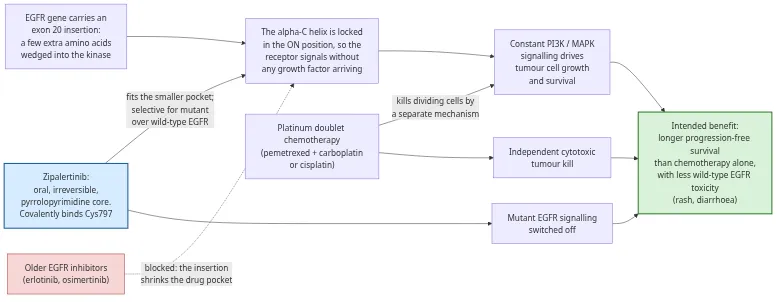
| Exon 20 insertion (ex20ins) | A mutation that wedges a few extra amino acids into the EGFR kinase domain, jamming it in the active position. It also narrows the drug pocket, which is why ordinary EGFR tablets fail against it. |
| Near-loop / far-loop insertion | Where within exon 20 the extra amino acids sit. In laboratory tests zipalertinib inhibits near-loop insertions more potently than far-loop ones; the same distinction was decisive for a failed competitor drug (poziotinib). |
| Zipalertinib (CLN-081 / TAS-6417) | An oral, irreversible small-molecule EGFR inhibitor shaped to fit the narrowed ex20ins drug pocket, selective for mutant over normal EGFR. |
| REZILIENT1 | Cullinan’s Phase 1/2, single-arm trial of zipalertinib in previously treated ex20ins patients — the dataset behind the pending second-line approval application. |
| REZILIENT3 | Taiho’s Phase 3 randomised trial of zipalertinib plus chemotherapy versus chemotherapy alone in untreated ex20ins patients — the trial this event is about. |
| PAPILLON | Johnson & Johnson’s Phase 3 of amivantamab plus chemotherapy versus chemotherapy alone in the same population — the exact design precedent, and it succeeded. |
| Amivantamab (Rybrevant) | An infused antibody hitting EGFR and MET at once; with chemotherapy it is the approved United States first-line standard for ex20ins disease since March 2024. |
| PFS (progression-free survival) | How long a patient lives without the tumour growing. REZILIENT3’s primary efficacy endpoint, measured by independent reviewers who do not know the treatment assignment (BICR). |
| BICR (blinded independent central review) | Scans are judged centrally by reviewers blinded to treatment — stricter than the treating doctor’s own read, and it removes open-label bias from the PFS number. |
| ORR (objective response rate) | The share of patients whose tumours shrink by a pre-set amount. |
| DoR (duration of response) | How long a tumour response lasts once it happens. |
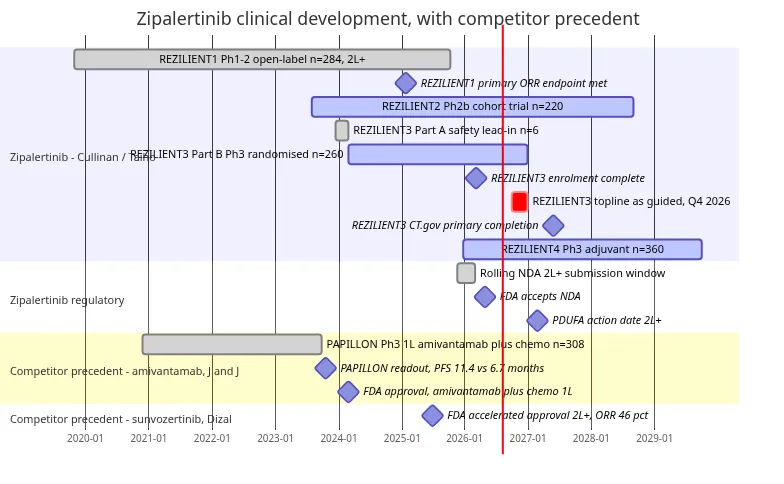
| PDUFA date | The deadline by which the FDA must decide on a drug application. Zipalertinib’s second-line application has one: 2027-02-27 (a different BPIQ row, id 16438). |
| ECOG performance status | A 0–5 scale of how able a patient is to carry on daily activity; 0–1 means fully or nearly fully active. Defined here because the trial restricts entry to 0–1. |
Executive summary
- What it is (one sentence): An oral tablet designed to shut off a lung-cancer-driving EGFR mutation that ordinary EGFR tablets cannot reach, tested on top of chemotherapy in previously untreated patients.
- The event and when (as disclosed): Top-line REZILIENT3 Part B results — progression-free survival by blinded independent central review — “expected by the end of 2026” per Taiho via Cullinan’s Q2 2026 release (2026-08-06), reiterating the same guidance for the third time. ClinicalTrials.gov still lists primary completion five months later (2027-05-27); the disagreement is reported in the Readout section, not resolved.
- The main reason it could work: The identical experiment already succeeded — PAPILLON, same mutation, same line, same control arm, same endpoint, hazard ratio 0.395 — and zipalertinib carries a peer-reviewed, centrally reviewed 35.2% response rate from a harder, pretreated population, against a control arm (chemotherapy alone) worth only 6–7 months of PFS.
- The main risk: For the readout, an effect size below PAPILLON’s: zipalertinib hits one target where amivantamab hits two, the trial appears not to stratify by insertion location (which sank poziotinib’s far-loop patients), and the statistical assumptions are not public. For the trade, attribution: three autoimmune readouts on this ticker land in the same or the preceding quarter and have historically moved the stock harder than any zipalertinib event.
- What it means for the stock: A meaningful-but-not-dominant program (see
../company.mdC.2): a win is worth roughly 15–30% of enterprise value on the modelling here, and the shares already sit within 8% of their 52-week high with a ~23%-of-float short base. The direction call is up, at low confidence, inside a window contaminated by the company’s own other catalysts.
0. Program-tier coverage — CLEARED
Company-tier coverage is in ../company.md C.0. The catalyst is a trial data
readout, so the conditional regulatory tier in 02-connectors.md does not bind this sweep.
| Tool | State | Note / verbatim error |
|---|---|---|
CT.gov search_trials + get_trial_details (NCT05973773) | CALLED | 6 registered zipalertinib trials, all re-read 2026-08-10. NCT05973773: ACTIVE_NOT_RECRUITING, n=285, 130 sites, 23 countries, has_results false, primary completion 2027-05-27 — unchanged and still identical to the overall completion date while every outcome time frame reads “approximately 5 years”: the registry’s date fields remain internally inconsistent. |
CT.gov search_investigators | CALLED | 50 trials analysed for the KOL block. NCT05973773 itself lists no overall officials and no site investigators — Taiho does not populate them — which is itself the finding. The one registry-named zipalertinib investigator is Arjan Gower, MD (UCLA), principal investigator of the investigator-initiated NCT07229339. Trial investigators are therefore identified from the trial’s own publications (A.5b). |
PubMed search_articles + get_article_metadata | CALLED | 27 records (unchanged count from 2026-08-05); metadata retrieved on 14, above the 10 of the previous sweep. The 13 unopened records are older and no claim rests on pre-2024 literature not directly read. Nothing new on REZILIENT3 itself: the only additions to the literature since the last sweep are an analytical-chemistry methods paper (DOI 10.1002/bmc.70228) and nothing else. |
Open Targets search_entities | BLOCKED | Verbatim Rate limit exceeded for client: global on four attempts (initial, immediate retry, retry after several minutes of intervening work, and a narrowed single-ID attempt). The standing platform throttle documented in 02-connectors.md. Claim left unverified: independent genetics-based validation of the EGFR–lung-cancer association. Mitigation: three approved drugs against this exact mutation and independent academic crystallography (DOI 10.1073/pnas.2417144121) carry the target-validation claim instead. |
ChEMBL compound_search | CALLED | CHEMBL4650281 unchanged: max_phase 3, zero Rule-of-Five violations, 396 Da, single stereoisomer. The route flags remain wrong (oral: false for a twice-daily tablet) and remain unused. No bioactivity or selectivity data returned; selectivity claims rest on PubMed. |
| web_search ×4 (peak sales · competitive · exclusivity + royalty · analyst) | CALLED | Peak sales: still no zipalertinib-specific forecast exists — aggregate “EGFR market” reports found and again not passed through (rule 6). Competitive: FURVENT (furmonertinib Phase 3, 1L, n≈375) confirmed ongoing. Exclusivity: composition-of-matter 2034 confirmed; the FY2023 annual report says six patent families where the FY2024 10-K summary said seven — reported, not reconciled. Analyst: 12 analysts, median $30, range $23–$39, consensus Strong Buy [WEB ESTIMATE — stockanalysis.com, 2026-08-10]. |
| optional EDGAR full-text search (“zipalertinib”) | CALLED | 67 hits; every recent hit is Cullinan’s own filings (Taiho is a private Japanese company and not an SEC filer). No competitor or partner filing mentions the drug. |
optional Europe PMC search | CALLED | 111 hits; two 2026 reviews beyond PubMed’s zipalertinib set (a May 2026 treatment-landscape review and a PACC-mutations review), neither adding primary data or an attributable view on this endpoint. |
A. Scientific & clinical assessment
A.1 Mechanism of action and scientific rationale
Zipalertinib is an oral, irreversible (covalent) small-molecule inhibitor of EGFR built on a pyrrolopyrimidine core. An EGFR exon 20 insertion wedges a few extra amino acids into the kinase domain, jamming the alpha-C helix in its active orientation so the receptor signals continuously without any growth factor. The same jam narrows the drug-binding pocket, which is why first-, second- and third-generation EGFR tablets do not work against it. Zipalertinib is shaped to fit the narrowed pocket and carries an acrylamide warhead that bonds permanently to cysteine 797, and it is selective for mutant over wild-type EGFR, which keeps the dose-limiting rash and diarrhoea low [VERIFIED — PubMed: PNAS crystallography, DOI 10.1073/pnas.2417144121; Cancers 2026 review, DOI 10.3390/cancers18020323]. In REZILIENT3 it is added to platinum doublet chemotherapy (pemetrexed plus carboplatin or cisplatin), which kills dividing cells by an entirely separate mechanism.
Target validation is strong by the standard that matters: three drugs against this exact mutation are already approved (amivantamab first-line, sunvozertinib and now-withdrawn mobocertinib second-line), and independent academic crystallography at Dana-Farber/Harvard shows TAS6417 (zipalertinib) inhibits the two commonest insertion variants, insASV and insSVD, in a mutant-selective manner [VERIFIED — DOI 10.1073/pnas.2417144121]. The step the readout must prove is narrower than the biology: that adding zipalertinib to chemotherapy delays progression longer than chemotherapy alone, in a randomised trial, under blinded central review.
The honest scientific risk is the effect size, through one specific mechanism: in vitro, zipalertinib inhibits near-loop insertions more potently than far-loop ones, and that distinction was decisive for poziotinib (PFS 11.1 months near-loop versus 3.5 far-loop) [VERIFIED — Nat Commun, DOI 10.1038/s41467-025-61817-8]. The REZILIENT3 registry record shows no stratification by insertion location. A far-loop-heavy randomisation imbalance, or a genuinely weaker far-loop effect, is the specific way this trial comes in below PAPILLON — and it is the main reason the probability band below is 23 points wide. Zipalertinib is also inactive against C797S, the mutation that removes its covalent anchor [VERIFIED — DOI 10.3390/cancers18020323] — a resistance question, not a readout question.
A.2 Clinical development plan, timeline, feasibility, resourcing
Trials
| Trial | Sponsor / whose drug | Design (arms, blinding, n) | Population | Status / key result | Link |
|---|---|---|---|---|---|
| REZILIENT1 (NCT04036682) | Cullinan Therapeutics — the drug is Taiho’s asset with Cullinan holding the 50% US profit share | Phase 1/2, open-label, single-arm, no control; 284 registered, 244 treated at 100 mg twice daily, 176 in the primary efficacy population; 64 sites | Locally advanced/metastatic ex20ins NSCLC after platinum chemotherapy, with or without prior ex20ins-targeted therapy | ACTIVE_NOT_RECRUITING; confirmed ORR 35.2% (95% CI 28.2–42.8), median DoR 8.8 months by central review at the 2024-12-10 cutoff; CNS ORR 30.9% (n=68); grade ≥3 treatment-related: anaemia 7%, pneumonitis 2.5%, rash 2.5% | NCT04036682; DOI 10.1200/JCO-25-00763 |
| REZILIENT3 (NCT05973773) | Taiho Oncology — not Cullinan | Phase 3, randomised 1:1, controlled, open-label, global; Part A safety lead-in (n=6, rolling-6) then Part B ~260 randomised; 285 registered total, 130 sites, 23 countries | Previously untreated, locally advanced or metastatic non-squamous ex20ins NSCLC, ECOG 0–1, treated stable brain metastases allowed; prior ex20ins-targeted therapy of any kind excluded | ACTIVE_NOT_RECRUITING; enrolment complete (reported 2026-03-10); Part A cleared 100 mg twice daily with full chemotherapy and no high-grade zipalertinib-related diarrhoea or rash (ESMO 2024, abstract 670P — six patients); has_results false | NCT05973773; protocol paper DOI 10.1080/14796694.2025.2457294 |
| REZILIENT2 (NCT05967689) | Taiho | Phase 2b, open-label cohort trial, n=220 | ex20ins plus uncommon single/compound EGFR mutations | RECRUITING, primary completion 2028-08-31. No read-across to this event. | NCT05967689 |
| REZILIENT4 (NCT07128199) | Taiho | Phase 3, randomised, double-blind, placebo-controlled, n=360 | Adjuvant, stage IB–IIIA resected NSCLC with uncommon EGFR mutations | ACTIVE_NOT_RECRUITING, started 2025-12-22, primary completion 2029-10-01. The largest long-term opportunity; irrelevant to this event; the only properly blinded trial in the programme. | NCT07128199 |
| NCT07229339 | Jonsson Comprehensive Cancer Center (investigator-initiated) | Phase 2, n=16 | Resectable NSCLC, ex20ins/uncommon mutations | NOT_YET_RECRUITING, starts 2027-06-01. Academic-interest signal only. | NCT07229339 |
| NCT07601399 | Taiho | Expanded access | Post-platinum ex20ins NSCLC | AVAILABLE. Signals confidence in the pending second-line approval and pre-positions prescribers. | NCT07601399 |
REZILIENT3 design detail that bears on the readout. Primary endpoints are PFS by BICR (the
efficacy event) and the rate/severity of treatment-emergent adverse events, with Part A’s
dose-limiting-toxicity endpoint already cleared. Eleven secondary endpoints include ORR, DoR,
intracranial response measures, overall survival (Part B), and three patient-reported instruments —
which are unblinded in an open-label trial and therefore soft; central review protects the PFS
number specifically. Control-arm patients may cross over to zipalertinib monotherapy after
BICR-confirmed progression: ethically correct and analytically unhelpful, because it dilutes any
overall-survival difference — OS should not be expected to carry the result. An independent data
monitoring committee watches interim safety. Key exclusions: any prior ex20ins-targeted therapy,
any history of interstitial lung disease or pneumonitis of any grade, QTcF above 470 ms, strong or
moderate CYP3A4 inducers/inhibitors within 7 days [VERIFIED — CT.gov get_trial_details,
2026-08-10].
The statistical assumptions are not public. The assumed hazard ratio, the target event count that triggers the analysis, the alpha allocation across the co-primary endpoints, whether an interim efficacy analysis exists, and whether randomisation is stratified by insertion location were not found in the registry, the protocol paper, or any search — re-checked this sweep. The stratification question most affects the modelled probability and remains unanswered [UNVERIFIED — absence across all sources].
Feasibility matrix
| Factor | High probability | Medium probability | Low probability | This asset (assessment) | Source |
|---|---|---|---|---|---|
| Recruitment feasibility | >50 sites, 3:1 patient:site | 20–50 sites, established investigators | <20 sites, novel sites | High — 130 sites, 23 countries, 285 enrolled, enrolment complete on the guided date | CT.gov; Cullinan releases 2026-03-10 / 2026-08-06 [VERIFIED] |
| Endpoint clarity | Regulatory precedent exists | Novel endpoint with FDA alignment | Unvalidated surrogate | High — PFS by BICR against platinum doublet is the exact endpoint PAPILLON won approval on | PAPILLON precedent [VERIFIED — DOI 10.3390/ijms27093714] |
| Trial-design robustness | Pivotal Phase III with SPA | Adaptive with interim analysis | Single-arm, no control | Medium — randomised controlled Phase 3, but open-label, no disclosed SPA, statistical assumptions not public | CT.gov [VERIFIED]; SPA absence [UNVERIFIED] |
| Operational / execution | Enrollment complete, standard timeline | Some timeline risk | Enrollment behind | High — enrolment complete since February 2026; readout guidance repeated three times without moving | Q2 2026 release [VERIFIED] |
Resourcing sufficiency. Effectively a non-issue: the trial is fully enrolled and Taiho carries
the operational load; development costs are shared 50/50. Cullinan holds $356.0M against a $12.74M
monthly burn (../company.md C.3) — runway past the readout by roughly two years.
A.3 Target label, target product profile, strategic questions, designations
A.3a Target label. First-line treatment of locally advanced or metastatic non-squamous NSCLC with a documented EGFR exon 20 insertion mutation, in combination with pemetrexed and a platinum agent.
A.3b Target product profile
| Attribute | Standard of care & key competitor(s) — data | Zipalertinib target profile (goal) | Supporting evidence (+ link) |
|---|---|---|---|
| Indication / target label | Amivantamab + carboplatin/pemetrexed, US 1L standard since 2024-03 (PAPILLON: PFS 11.4 vs 6.7 months, HR 0.395, ORR 73% vs 47%) | Same 1L slot, oral agent + the same chemotherapy backbone | PAPILLON figures [VERIFIED — DOI 10.3390/ijms27093714]; REZILIENT3 design [VERIFIED — CT.gov] |
| Efficacy (endpoints, regimen) | Chemo alone: ORR 19–47%, median PFS 6–7 months (the control arm) | PFS by BICR superior to chemo alone; ideally an effect approaching PAPILLON’s | REZILIENT1 ORR 35.2% in a harder pretreated population [VERIFIED — DOI 10.1200/JCO-25-00763] |
| Safety / tolerability | Amivantamab: infusion reactions in the majority on first exposure, rash, paronychia, venous thromboembolism risk | Low rates of classic wild-type EGFR toxicity; no infusion burden. Grade ≥3 pneumonitis 2.5% is the number to watch | REZILIENT1 safety table [VERIFIED — DOI 10.1200/JCO-25-00763] |
| Biomarker / companion diagnostic | ex20ins detection requires next-generation sequencing; older PCR panels miss many insertions | Same requirement — no proprietary diagnostic | Field reviews [VERIFIED — DOI 10.3390/ijms27093714] |
| Formulation / administration | Intravenous infusion (amivantamab); oral competitors (sunvozertinib 2L; furmonertinib in Phase 3) | 100 mg tablet twice daily | CT.gov; ESMO 2024 abstract 670P [VERIFIED] |
| Payer value | Infusion-chair time and reaction management embedded in the standard | Oral convenience, fewer clinic resources; but no head-to-head against the funded standard | Structural — see B.1 [UNVERIFIED — assessment] |
A.3c Strategic Go/No-Go questions (pre-Phase-III / registration set, as the asset sits at a Phase 3 readout):
| Group | Question | Answer (tagged) |
|---|---|---|
| Target | Target revalidated as in prior phases? | Yes — three approved drugs against the same mutation and independent crystallography [VERIFIED — DOI 10.1073/pnas.2417144121]. |
| Dose & Drug | Exposure–response for the intended commercial regimen and route(s)? | 100 mg twice daily oral, carried unchanged from REZILIENT1 into the combination after Part A cleared it [VERIFIED — ESMO 2024 670P; denominator six patients]. |
| Dose & Drug | Commercial formulation available or feasible? | Yes — a conventional small-molecule tablet, zero Rule-of-Five violations [VERIFIED — ChEMBL]. |
| Dose & Drug | Dose range compatible with clinical and non-clinical safety? | Yes at 100 mg BID monotherapy (grade ≥3 TRAEs modest); combination safety rests on six Part A patients [VERIFIED / small-n caveat]. |
| Dose & Drug | Therapeutic window given the clinical response? | Mutant-selectivity spares wild-type EGFR, keeping rash/diarrhoea low relative to pan-EGFR agents [VERIFIED — DOI 10.1073/pnas.2417144121]. |
| Dose & Drug | Intrinsic and extrinsic factors influencing exposure and patient response? | CYP3A4 interactions managed by protocol exclusion; insertion location (near- vs far-loop) is the known response modifier and is unaddressed in the design [VERIFIED — DOI 10.1038/s41467-025-61817-8]. |
| Patient | Proof of concept and positive benefit/risk in the intended population? Combination evidence? | Monotherapy PoC is strong but in a different line; combination evidence is Part A’s six patients. The randomised 1L answer is exactly what this readout supplies [VERIFIED with the gap stated]. |
| Patient | Phase III design and outcome criteria — accepted, compelling, competitive for market access? | Accepted by regulators (PAPILLON precedent); not competitive for market access — the comparator is no longer the US standard (see B.1) [VERIFIED — structural]. |
| Patient | Rationale for the patient population(s)? | Clear — untreated ex20ins non-squamous NSCLC, the population where the unmet need concentrated before 2024. |
| Patient | Likelihood of the expected outcome? | Modelled 78% (band 65–88) — see the Locked prediction [UNVERIFIED — modelled]. |
| Patient | Companion-diagnostic strategy, including pricing and market? | None proprietary; relies on standard NGS testing, whose incomplete penetration shrinks the addressable pool for the whole class [VERIFIED — field reviews]. |
A.3d Regulatory designations.
- Breakthrough Therapy designation (FDA, zipalertinib): grants intensive FDA guidance on trial design, senior agency engagement, and rolling/priority review eligibility. Awarded on preliminary evidence of substantial improvement over available therapy [WEB ESTIMATE — company 10-K summary and NDA press materials; the filing itself was not opened].
- No orphan designation, and none expected: lung cancer is far too common and the ex20ins subset has not been carved out [VERIFIED as a negative search across the press feed and web searches].
- No Special Protocol Assessment disclosed for REZILIENT3 [UNVERIFIED — absence of evidence].
A.4 Target product profile valuation matrix
| Stakeholder | Value driver | Minimum threshold | Competitive | Premium | Benchmark / source |
|---|---|---|---|---|---|
| Patient / caregiver | Oral dosing, no infusion reactions, low rash/diarrhoea; activity in brain metastases | Non-inferior tolerability to chemo alone | Fewer grade ≥3 events than amivantamab combination | Better QoL instruments (unblinded — soft) | REZILIENT1 safety [VERIFIED]; open-label caveat |
| Regulator | PFS by BICR vs accepted comparator | Statistically significant PFS gain | HR meaningfully below 1 with consistent subgroups | HR approaching PAPILLON’s 0.395 | PAPILLON [VERIFIED — DOI 10.3390/ijms27093714] |
| Payer / HTA | Evidence vs the funded standard | Superiority over chemo alone | Indirect parity with amivantamab combination | Head-to-head vs amivantamab — does not exist and is not planned | Structural gap — B.1 [VERIFIED] |
| Provider | Chair time, reaction management, monitoring burden | Manageable pneumonitis signal | Oral start without infusion capacity | Community-setting adoption beyond academic centres | Tolerability profile [VERIFIED]; adoption [UNVERIFIED] |
Calibration examples, not asset claims: in oncology each incremental month of overall survival is worth roughly $150–300M in peak-sales potential; oral formulations command roughly 15–25% price premiums over injectables.
A.5 Evidence quality and endpoints
| Criterion | Score (High / Medium / Low) | Basis (one line) | Link |
|---|---|---|---|
| Target validation | High | Three approved drugs against the same mutation; independent crystallography; Open Targets cross-check BLOCKED, so no genetics-based score is asserted | DOI 10.1073/pnas.2417144121 |
| Mechanism clarity | High | Covalent Cys797 binding, mutant-selective pocket fit, solved co-crystal structures | Same |
| Biomarker availability | Medium | ex20ins is detectable but only by sequencing; diagnosis rate is an unquantified drag on the whole class | DOI 10.3390/ijms27093714 |
| Publication quality (peer-reviewed? independent authors?) | High | Pivotal REZILIENT1 dataset is in J Clin Oncol with independent first/senior authors, and it drew a published critique and reply — independent scrutiny in the literature of record | DOI 10.1200/JCO-25-00763; DOI 10.1200/JCO-25-01501 |
| Clinical / expert sentiment | — | Moved to A.5b, below. | — |
Endpoints
| Endpoint (full name) | What it measures | Scale / range | Better direction | MCID / note |
|---|---|---|---|---|
| Progression-free survival (PFS) by blinded independent central review | Time from randomisation until the tumour grows (per RECIST 1.1, centrally read) or death | Months; medians in this disease run 6–7 (chemo) to 11.4 (amivantamab+chemo) | Longer | No formal MCID; regulators accepted PAPILLON’s +4.7 months / HR 0.395. The event. |
| Rate and severity of treatment-emergent adverse events | Safety, graded by NCI CTCAE v5.0 | Grade 1–5 | Fewer/lower | Co-primary; pneumonitis is the class near-veto |
| Objective response rate (ORR) | Share of patients with ≥30% tumour shrinkage, confirmed | 0–100% | Higher | Secondary; chemo alone runs 19–47% |
| Duration of response (DoR) | How long responses last | Months | Longer | Secondary |
| Intracranial ORR / DoR / “iDCR” | Response measures in brain metastases | As above | Higher/longer | The registry’s “intracranial duration of complete response (iDCR)” label uses an abbreviation that conventionally means disease control rate — reported as the registry states it |
| Overall survival (OS) | Time until death | Months | Longer | Secondary, Part B; structurally diluted by the optional crossover |
| EQ-5D-3L, EORTC QLQ-C30, NSCLC-SAQ | Patient-reported quality of life and symptoms | Instrument-specific | Instrument-specific | Unblinded in an open-label trial — soft |
A.5b Key opinion leaders
Panel as of. 2026-08-10 — the date the CT.gov search_investigators and PubMed searches below
were run.
Investigators
The REZILIENT3 registry record lists no overall officials and no named site investigators, so the paid-by-trial panel below is identified from the programme’s own publications, where authorship on the trial’s dataset is the relationship. Being paid by the trial is a relationship with the sponsor by construction; Conflicts is for relationships beyond that one. No conflicts search below reached a journal disclosure appendix — PubMed metadata does not carry them and the full-text appendices were not opened this sweep — and per rule 40 the column records that limit rather than certifying a clean record.
| Name | Role / affiliation | Trial (NCT) | Conflicts (party, kind, disclosed in, as of) | Conflicts checked (source, date) | Source | Tag |
|---|---|---|---|---|---|---|
| Zofia Piotrowska, MD, MHS | First author, REZILIENT1 pivotal publication; Massachusetts General Hospital | NCT04036682 | Not established beyond the trial relationship — the J Clin Oncol disclosure appendix was not opened | PubMed get_article_metadata, 2026-08-10 (metadata carries no COI section) | DOI 10.1200/JCO-25-00763 | VERIFIED — authorship; conflicts UNVERIFIED |
| Helena A. Yu, MD | Senior author, REZILIENT1 pivotal publication and reply to critique; Memorial Sloan Kettering | NCT04036682 | Not established beyond the trial relationship — same limit | PubMed get_article_metadata, 2026-08-10 | DOI 10.1200/JCO-25-00763; DOI 10.1200/JCO-25-02185 | VERIFIED — authorship; conflicts UNVERIFIED |
| John V. Heymach, MD, PhD | First author, REZILIENT3 protocol paper; MD Anderson | NCT05973773 | Also senior author of the poziotinib/ZENITH20 near-vs-far-loop paper with Spectrum and Takeda co-authors — a competitor-adjacent research relationship, disclosed by the authorship itself | PubMed get_article_metadata, 2026-08-10 | DOI 10.1080/14796694.2025.2457294; DOI 10.1038/s41467-025-61817-8 | VERIFIED — authorship; conflicts UNVERIFIED beyond authorship |
| Arjan Gower, MD | Principal investigator, investigator-initiated Phase 2; UCLA / Jonsson Comprehensive Cancer Center | NCT07229339 | None found in the registry record | CT.gov search_investigators, 2026-08-10 | NCT07229339 | VERIFIED — registry |
Independent voices
| Name | Affiliation | View (close enough to quote) | As of | Conflicts checked (source, date) | Source | Tag |
|---|---|---|---|---|---|---|
| Wenjian Yao, MD (and five co-authors) | Henan Provincial People’s Hospital, China | ”Blind Spots in REZILIENT-1: Does Post-Platinum Zipalertinib Address Needs in EGFR ex20ins+ NSCLC?” — a published letter questioning whether the second-line dataset answers the clinically relevant questions | 2025-12-17 | PubMed get_article_metadata, 2026-08-10 — no sponsor affiliation in the author list; the letter’s own COI statement was not in metadata and full text was not opened | DOI 10.1200/JCO-25-01501 | VERIFIED — publication; independence UNVERIFIED beyond affiliation check |
| Wolfram C. M. Dempke, MD (and two co-authors) | LMU Munich | The relative impact of monotherapies versus chemotherapy combinations in this mutation “currently still lacks robust evidence”; results from the ongoing trials “are eagerly awaited” | 2026-01-20 | PubMed get_article_metadata, 2026-08-10 — no sponsor affiliation in the author list; full-text COI not opened | DOI 10.3390/cancers18020323 | VERIFIED — publication; independence UNVERIFIED beyond affiliation check |
| Daniel Rosas, MD / Luis Raez, MD | Memorial Cancer Institute, Florida | Field review placing zipalertinib among “emerging therapies… with promising results in early-phase trials” behind approved amivantamab and sunvozertinib | 2026-04-22 | PubMed get_article_metadata, 2026-08-10 — same limit | DOI 10.3390/ijms27093714 | VERIFIED — publication; independence UNVERIFIED beyond affiliation check |
Judgement
| Endpoint supported | Basis (one or two sentences) | Tag |
|---|---|---|
| SUPPORTIVE_CONTESTED | PFS by blinded central review against platinum doublet is the exact endpoint and comparator the FDA already accepted when PAPILLON won this indication, and no independent voice disputes the endpoint’s validity. The contest is about its relevance: named voices in the literature of record question whether beating chemotherapy alone answers the question that matters now that amivantamab holds first line, and whether the combination-versus-monotherapy choice has robust evidence behind it. | UNVERIFIED — judgement |
Dissent
| Name | View (close enough to quote) | Source |
|---|---|---|
| Wenjian Yao, MD, et al. | The REZILIENT programme has “blind spots” — the post-platinum dataset may not address the real needs of ex20ins patients | DOI 10.1200/JCO-25-01501 |
| Wolfram C. M. Dempke, MD, et al. | Monotherapy-versus-combination impact in this mutation “currently still lacks robust evidence” to change the therapeutic landscape | DOI 10.3390/cancers18020323 |
B. Commercial assessment
B.0 Current treatment algorithm
- Diagnosis and molecular testing. A real filter: exon 20 insertions are structurally diverse and older PCR panels miss many of them, while next-generation sequencing finds them. An undetected patient never enters this algorithm and is lost to every drug in the class equally.
- First line, United States, since March 2024: amivantamab plus carboplatin and pemetrexed. Works well and is hard on patients — infusion reactions on first exposure in the majority, rash, paronychia, raised clot risk.
- First line where amivantamab is unavailable or not tolerated: platinum doublet chemotherapy alone. ORR 19–47%, PFS 6–7 months. This is REZILIENT3’s control arm.
- Second line and later: sunvozertinib (oral, US accelerated approval 2025, ORR 46%, DoR 11.1 months), or zipalertinib once approved — the pending 2027-02-27 decision covers exactly this slot.
- After that: further chemotherapy, clinical trials, or supportive care.
Zipalertinib-plus-chemotherapy would compete for step 2, directly against amivantamab plus chemotherapy. It opens no new line of therapy and creates no new patient pool — these patients already exist and are already treated. Its case is substitution on the strength of being a tablet rather than a drip.
B.1 Competitive landscape and positioning
| Metric | High value | Medium value | Low value | This asset (assessment) | Source |
|---|---|---|---|---|---|
| Mechanism differentiation | First-in-class or novel target | Next-generation improvement | Me-too | Medium — a next-generation mutant-selective TKI, fourth or fifth into the indication | Field reviews [VERIFIED] |
| Development-timeline advantage | >12 months ahead | Within 6–12 months | Lagging >12 months | Low — amivantamab approved 1L ~2.7 years before this readout; sunvozertinib approved 2L 2025; furmonertinib’s FURVENT Phase 3 (n≈375, 1L) is enrolling behind it | FURVENT TPS [WEB ESTIMATE, 2026-08-10] |
| Clinical proof-of-concept evidence | Positive Phase IIb (n>100) | Phase IIa signals (n=20–50) | Preclinical only | High — REZILIENT1 n=244 treated, centrally reviewed, peer-reviewed | DOI 10.1200/JCO-25-00763 [VERIFIED] |
| IP protection | Composition-of-matter, long-dated | Method-of-use | Pending or none | Medium-Low — composition of matter to 2034 only, in-licensed rather than owned | Company filings summary [WEB ESTIMATE] |
Where this asset wins, and the single fact the thesis rests on. Every competing first-line option in the United States involves a drip; zipalertinib is a tablet with low rates of the classic EGFR toxicities, in a disease where patients take treatment until it stops working. The structural problem is equally plain: REZILIENT3 compares against chemotherapy alone (step 3) while competing for the amivantamab slot (step 2). When the trial began enrolling in December 2023 chemotherapy alone was the standard; PAPILLON’s approval three months later moved the goalposts mid-trial. Regulators accept the comparator and in many countries chemotherapy alone remains the practical standard, but a statistically successful trial can be commercially ambiguous, and no head-to-head against amivantamab is running or planned. A 2026 peer-reviewed review states it plainly: the relative impact of monotherapies versus chemotherapy combinations in this mutation “currently still lacks robust evidence” [VERIFIED — DOI 10.3390/cancers18020323]. Against sunvozertinib and furmonertinib, both oral, the route-of-administration differentiation largely disappears.
B.2 Addressable market
| Component | How it is estimated | Premium threshold | This asset (assessment) | Source |
|---|---|---|---|---|
| Drug-treated patients | Epidemiology × diagnosis rate × treatment rate | >100,000 (US/EU5/Japan) | Far below threshold: roughly 1,500–3,000 US first-line patients per year (see B.3a); ex-US patients are irrelevant to Cullinan’s economics | Published epidemiology ranges [UNVERIFIED — modelled; the 4–12% of EGFR-mutated share and 15–50% EGFR frequency ranges do not support a point estimate] |
| Market exclusivity | Patent term + regulatory exclusivity | >10 years combined | Below threshold — composition of matter 2034 (~6 years post a 2028 launch), plus 5-year NCE exclusivity from first approval; PTE undisclosed | Annual-report summaries [WEB ESTIMATE — the FY2023 report says six patent families, the FY2024 summary said seven; reported, not reconciled] |
| Reimbursement precedent | Approvals in ≥2 major markets | Positive NICE/CADTH guidance | Precedent exists for the class (amivantamab, sunvozertinib approvals), but HTA bodies will ask for a comparison against the funded standard that does not exist | Structural [VERIFIED] |
| Patient-journey impact | Fewer hospital days, less caregiver burden | >30% quality-of-life gain | Real but unquantified: oral start removes infusion-chair time; QoL instruments in the trial are unblinded | Trial design [VERIFIED]; magnitude [UNVERIFIED] |
B.3 Value and feasibility
B.3a Expected peak sales. Built bottom-up because no analyst forecast specific to zipalertinib exists — re-verified this sweep; aggregate “EGFR inhibitor market” reports were found and again not passed through (rule 6). All scenarios are conditional on REZILIENT3 succeeding and first-line approval following, cover the United States only (Cullinan has no other economics), exclude the separate second-line opportunity (bpiq_drug_id 16438), and exclude the milestone payments, counted separately in B.3b.
| Scenario | Assumptions (patients × price × share) | Estimate (USD/year at peak) | Basis / tag |
|---|---|---|---|
| Low | 1,500 eligible US 1L patients × 25% peak share × $200,000 net × 1.0 years on therapy | US brand sales ≈ $75M; Cullinan share ≈ $21M | Amivantamab holds first line on its randomised win; zipalertinib takes only infusion-averse patients; diagnosis rate stagnant [UNVERIFIED — modelled] |
| Base | 2,200 × 40% × $220,000 × 1.15 years | US brand sales ≈ $223M; Cullinan share ≈ $61M | Positive REZILIENT3 with clearly better tolerability, parity pricing, oral convenience winning a substantial minority [UNVERIFIED — modelled] |
| High | 3,000 × 55% × $250,000 × 1.3 years | US brand sales ≈ $536M; Cullinan share ≈ $147M | Near-PAPILLON efficacy plus clearly better tolerability, oral majority, improved sequencing-based diagnosis [UNVERIFIED — modelled] |
The Cullinan share applies 50% of an assumed 50–60% pre-tax margin to brand sales; neither party discloses a margin, so that conversion is the least verifiable input [UNVERIFIED — modelled]. The least defensible operating input is the peak share: it depends on a cross-trial tolerability comparison no trial will run, and the 25–55% spread is the honest width of that uncertainty.
B.3b Feasibility
| Question | Answer (tagged) |
|---|---|
| Expected net present value (eNPV) | No point estimate (rule 10). Conditional on a positive readout and first-line approval: a 12% discount rate on the peak range above, 2028–2029 launch, three-year ramp, revenue ending at the 2034 composition-of-matter expiry, gives roughly $70M–$480M present value (base ≈ $195M), plus the up-to-$100M first-line milestone discounted at ≈ $80M — conditional total ≈ $150M–$560M, base ≈ $275M. Applying the modelled 78% readout probability and an assumed 85–90% approval-given-success gives an unconditional ≈ $100M–$380M, base ≈ $190M — roughly 12–33% of the $804.3M recomputed enterprise value (../company.md C.4). Every input [UNVERIFIED — modelled]. |
| Capital to the next decision point | Effectively nil — the trial is enrolled, dosed and paid for; follow-up and analysis remain. Costs shared 50/50 with Taiho as operational sponsor. [VERIFIED — trial status; cost share per Q2 2026 release] |
| Capital to approval, and the funding plan | Modest and already funded: a first-line supplemental filing builds on REZILIENT3 itself. Cullinan holds $356.0M against $12.74M monthly burn (../company.md C.3). [VERIFIED] |
| Launch capability — alone, or must partner? | Already settled: Taiho Oncology is the sponsor with an established US oncology commercial presence; Cullinan’s role is financial. [VERIFIED — co-development agreement] |
| Commercialisation rights — retained, split, or out-licensed? | Out-licensed with a 50% US pre-tax profit share retained; $30M second-line and up to $100M first-line approval milestones; nothing ex-US. [VERIFIED — Q2 2026 release] |
B.4 Product-development risk
Framing questions.
- Does the development plan support the target product profile claims? Mostly. The randomised Phase 3 supports the efficacy-versus-chemotherapy claim and the safety claim; nothing in the plan supports the claim that matters commercially — superiority or parity against amivantamab — because no such comparison exists or is planned.
- Will the identified risks affect the target product profile? The near-loop/far-loop sensitivity question can shrink the effect size that the profile’s efficacy row promises; the pneumonitis exclusion means the trial population is systematically healthier-lunged than the real-world population the label would cover.
- If a risk cannot be mitigated, is the asset still differentiated from competitors? Against infused amivantamab, yes — oral dosing and tolerability survive any plausible readout short of a miss. Against oral sunvozertinib and furmonertinib, no — the differentiation is the data, and the data are not head-to-head.
| Category | Time risk | Quality risk | Cost risk | Note |
|---|---|---|---|---|
| Project management | Low | Low | Low | Taiho runs the trial; enrolment completed on guidance. |
| Research | — | Medium | — | Near-loop/far-loop differential sensitivity unaddressed by stratification (as far as any public source shows). |
| IP | — | Medium | — | Composition of matter 2034, in-licensed; PTE undisclosed. The binding constraint on value, not on the readout. |
| Legal | — | Low | — | Nothing found. |
| DMPK | — | Low | — | Conventional small molecule; CYP3A4 interactions protocol-managed. |
| Safety pharmacology | — | Low | — | QTcF exclusion at 470 ms suggests routine caution, no signal found. |
| Toxicology | — | Low | — | Nothing found beyond clinical events. |
| Drug safety (clinical) | — | Medium-High | — | The class near-veto: grade ≥3 pneumonitis 2.5% in REZILIENT1; trial excludes any ILD/pneumonitis history, so the trial population under-represents the real-world lung-risk profile. Combination adds anaemia (7% grade ≥3 on monotherapy) and myelosuppression. Part A’s clean combination read rests on six patients. |
| Biomarker | — | Medium | — | Diagnosis depends on NGS penetration; no companion diagnostic advantage. |
| Clinical pharmacology | — | Low | — | 100 mg BID carried through unchanged. |
| Clinical (efficacy) | — | High | — | The readout risk itself: effect size below PAPILLON via single-target mechanism, BICR strictness, or insertion-location mix. Statistical assumptions not public. |
| Clinical operations | Low | Low | Low | 130 sites, enrolment done. |
| CMC / manufacturing | — | Low | — | Conventional tablet. |
| Regulatory | Low | Medium | — | Comparator accepted; but a first-line filing inherits any second-line CRL risk at the 2027-02-27 PDUFA (shared dataset and manufacturing). |
| Global evidence & value | — | High | — | HTA bodies will ask for a comparison against the funded standard; there is none. Cross-trial tolerability arguments are routinely discounted. |
| Commercial | — | High | — | Fourth or fifth entrant; the oral differentiation is being competed away by other orals. |
Readout
Sources
| Kind | Where it comes from | What it is worth | Value (or null) | Tag | Note |
|---|---|---|---|---|---|
bpiq | fetch_company_drugs — catalyst_date, catalyst_date_text | The current single source. Synthesized from period text, so alone it is a ceiling, not an estimate. | 2026-12-31 (text “Q4 2026”) | VERIFIED — BPIQ fetch_company_drugs, 2026-08-10 | Period-end placeholder, not a disclosed day (rule 23). The row’s own note (2026-08-06) reads “REZILIENT3 enrollment complete; top-line results expected by end of 2026.” |
ctgov | CT.gov get_trial_details — primary_completion_date | Independent of the company’s messaging, and it moves when the trial moves. | 2027-05-27 | VERIFIED — CT.gov NCT05973773, read 2026-08-10 | Unchanged since before the 2026-08-05 analysis. Primary completion and overall completion are the same date for a trial whose outcome time frames all read “approximately 5 years” — internally inconsistent, so the field appears unmaintained. Also structurally later than an event-driven top-line: a PFS analysis triggers on event count, which can complete well before the last patient’s last visit. |
company | fetch_company_press_releases — Q2 2026 results | The company’s and partner’s most recent dated wording, and where the slip sequence below comes from. | 2026-10-01/2026-12-31 (text “Taiho expects to obtain top-line results by the end of 2026”) | VERIFIED — Cullinan Q2 2026 release, 2026-08-06, via the press feed re-read 2026-08-10 | Mandatory (catalyst inside twelve months). Third consecutive identical guidance: 2026-03-10 “by Q4 2026”, 2026-05-07 “by end of 2026”, 2026-08-06 “by the end of 2026”. Guided by Taiho, the sponsor — Cullinan neither controls nor announces the readout. |
congress | data/congresses.json | Answers “where will they say it.” | null | — | ESMO 2026 (2026-10-23/27) sits inside the guided window and Taiho has presented zipalertinib data at ESMO before (2025-10-12, brain-metastases data), but no source says REZILIENT3 top-line will be presented there — and REZILIENT1’s own top-line came by press release (2025-01-29), not at a meeting. Matching on venue habit alone would be a guess, not a source (02-connectors.md § Data limits). |
modelled | Trial arithmetic — see below | The only estimate independent of anyone’s guidance. | 2027-07/2027-09 | UNVERIFIED — modelled, default lag | Registry arithmetic only, and it inherits the registry field’s own unreliability — see below. |
The modelled estimate. The registry’s primary_completion_date (2027-05-27) plus rule 34’s
stated default of two to four months to database lock and analysis gives 2027-07 to 2027-09.
data/benchmarks/readout-lag.json holds no comparable observation, so the default applies and the
tag says so. This arithmetic keys on the one field this sweep judges unmaintained (see the ctgov
row), and REZILIENT3’s top-line is an event-driven PFS analysis that can trigger well before
primary completion — no event count is public, so no independent event-side arithmetic is possible.
The modelled row therefore bounds the late tail rather than centring the estimate, and the window
below leans on the thrice-repeated guidance instead.
Window
| Earliest | Likeliest | Latest | Precision | Confidence |
|---|---|---|---|---|
| 2026-10-01 | 2026-11-30 | 2027-03-31 | PERIOD | MEDIUM |
Basis. Earliest is the opening of the guided quarter — the March guidance said “by Q4 2026”, so nothing supports a Q3 release. Likeliest sits late in the guided window because the guidance is deadline-shaped (“by the end of 2026”, stated three times without narrowing), and an event-driven analysis run by a partner who guides to a deadline tends to land near it rather than early in it. Latest allows one quarter of slip beyond the deadline: the registry’s 2027-05-27 primary completion is judged unmaintained, but the plainer reading — that the readout slips into 2027 — is not excluded, and one quarter is the typical size of a first slip. Precision is PERIOD because no source names a month; confidence is MEDIUM because the guidance has been repeated identically three times with zero slips and enrolment completed on schedule, but it is a partner’s deadline rather than a disclosed date, and the registry points later.
Disagreement. UNRESOLVED. Company/partner guidance (three statements, 2026-03-10 through 2026-08-06) says by end of 2026; ClinicalTrials.gov primary completion says 2027-05-27, five months after the guided window closes. Reported, never averaged, never resolved by picking one (rule 24). The likeliest reconciliation — Taiho guides to a pre-specified event-driven analysis while the registry tracks (and neglects) the last-visit field — is an [UNVERIFIED] inference.
Date slippage. Zero slips on the readout guidance. Zero is a finding, with a caveat: the guidance is only five months old, so a clean record here is weaker evidence than one spanning years. (The programme’s enrolment guidance was also met: “complete enrollment by H1 2026” guided 2025-08-07, reported complete 2026-03-10.)
| As of | Guidance text |
|---|---|
| 2026-03-10 | ”Taiho expects top-line results by Q4 2026” |
| 2026-05-07 | ”Taiho continues to expect top-line results by end of 2026” |
| 2026-08-06 | ”Taiho expects to obtain top-line results by the end of 2026” |
Attribution
Status. CONTAMINATED
Computed 2026-08-10 with lib/clustering.mjs’s attributionFor over this ticker’s pipeline for
bpiq_drug_id 17466, CATALYST_CLUSTER_MIN_MONTHS = 6, using this document’s own readout window
for this program’s range; transcribed, not estimated.
Conflicts
| bpiq_drug_id | Label | Date | Analysed? | Gap (days) | Confirmed? |
|---|---|---|---|---|---|
| 16438 | Zipalertinib | 2027-02-27 | No | 0 | Yes |
| 18188 | CLN-978 (CD19xCD3) | 2026-12-31 | No | 0 | No |
| 18907 | CLN-978 (CD19xCD3) | 2026-12-31 | No | 0 | No |
| 18971 | CLN-978 (CD19xCD3) | 2026-09-30 | No | 0 | No |
| 19423 | Velinotamig (BCMAxCD3) (T Cell Engager) | 2026-12-31 | No | 0 | No |
Note. Required because the status is CONTAMINATED. The confirmed conflict is this drug’s own second-line PDUFA (2027-02-27, an exact disclosed day) landing inside this window’s latest edge — and it is the smaller problem, because the stock-call window below deliberately closes on 2027-01-31, before it. The larger, unconfirmed-but-real problem is the four T cell engager readouts sharing the window: CLN-978 rheumatoid arthritis (Q3 2026, immediately before), CLN-978 lupus and Sjögren’s and velinotamig lupus (all Q4 2026, simultaneous) — one more simultaneous readout than the 2026-08-05 analysis faced, velinotamig having joined the catalyst list since. Company.md C.7 shows the engager programs move this stock harder than any zipalertinib event (+14.23%, +18.87% against +5% to +13%), and C.2 marks two of them dominant against this program’s meaningful. Any share move inside this window is therefore presumptively attributable to the autoimmune franchise first, and the scenario ranges below cannot be read as this event’s isolated effect. The stock-direction call carries this caveat explicitly.
Market and timing for this event
- Plain takeaway. The stock sits within 8% of its 52-week high, up roughly 3× from the October 2025 low, with ~23% of the float sold short and four data readouts due on the ticker in one quarter. The market is positioned for the autoimmune programs; this readout is the cheaper, better-understood event riding in the same window.
- Months to this catalyst. About 2 to 5 from 2026-08-10 against the readout window (earliest 2026-10-01, likeliest 2026-11-30) — a PERIOD-precision window, so entry/exit timing carries a quarter’s worth of slack, not a date.
- Expected move around this event. Not readable from the chain:
../company.mdC.6 records the December 2026 expiry (the right one — it expires before the 2027-02-27 PDUFA) carrying 1,673 contracts of open interest against zero traded on the read date, with near-money spreads wider than their own mids. Bracket from the ticker’s own reaction function instead: roughly +8% to +20% on a clear positive, −10% to −25% on a miss, from C.7’s zipalertinib rows (+5.04% to +12.85% on efficacy wins at lower bases) widened for the larger base and the short interest. - Nearest comparable past reaction. C.7’s 2025-01-29 row: REZILIENT1 met its primary ORR endpoint, +12.85% intraday, clean attribution. Comparable: same drug, same disease, an efficacy result on a primary endpoint. Not comparable: the shares were ~$5.50 then (a third of today’s), REZILIENT1 was single-arm while this is randomised and competitive, and the autoimmune programs had not yet become the reason people own the stock. Most sobering row: the NDA acceptance, −4.40%.
- Materiality. “Meaningful, not dominant” per
../company.mdC.2 — a win is worth roughly 12–33% of enterprise value on B.3b’s modelling, capped by the 50% US-only economics, the stale comparator, and two dominant-materiality CLN-978 rows in the same pipeline table. The stock call below is sized to that, per rule 27. - Date slippage. Zero slips across three statements (Readout, above); guidance five months old.
Spot. $18.03, read 2026-08-10 intraday (../company.md C.4; up 1.67% on the
day, four days after the Q2 2026 results).
Scenario prices
| Scenario | Low | High | Anchors (each named and tagged) | Basis |
|---|---|---|---|---|
| Positive | 19.50 | 24.00 | (1) This ticker’s own past catalyst move: REZILIENT1’s primary-endpoint win, +12.85% intraday, is $20.35 from $18.03 [VERIFIED — ../company.md C.7]. (2) The 52-week high $19.43, 7.2% above spot [VERIFIED — ../company.md C.4, derived from the price cache]. (3) Published analyst targets: 12 analysts, median $30, range $23–$39 [WEB ESTIMATE — stockanalysis.com, 2026-08-10]. | The low end clears the 52-week high, which a positive Phase 3 should do. The high end sits at the bottom of the analyst range and well below the median deliberately: the median embeds the autoimmune programs and the second-line approval, so this event alone should not carry the shares there. Upside stays capped by the fact the analysis turns on — a win against chemotherapy alone leaves the amivantamab question unanswered — and by this ticker’s record of shrugging at zipalertinib news. |
| Miss | 13.50 | 16.25 | (1) Pre-run-up price levels from the committed cache: $14.21 close 2026-03-31, $10.35 close 2025-12-31 [VERIFIED — data/prices/CGEM.json via lib/prices.mjs]. (2) Cash per economic share: $356.0M over ~66.4M economic shares ≈ $5.36 — a measured floor far below any scenario [VERIFIED — ../company.md C.5, EDGAR XBRL counts]. (3) This ticker’s worst intraday reaction to its own news, −8.30% on 2026-06-10 [VERIFIED — ../company.md C.7]. | A miss removes the first-line opportunity and the up-to-$100M milestone and shadows the 2027-02-27 second-line decision — roughly 12–33% of enterprise value on B.3b — so −10% to −25% is proportionate. The floor sits at the March 2026 price level rather than anywhere near cash, because a REZILIENT3 miss touches neither the $356.0M of cash nor the CLN-978/velinotamig programs the shareholder base is actually paying for. |
Expected value. 0.78 × $21.75 (positive midpoint) + 0.22 × $14.875 (miss midpoint) = $20.24, +12.2% against spot $18.03. Probability applied to the midpoint of each range. Arithmetic, not advice, and not a price target.
Run-up
Entry and exit
| Entry date | Entry price | Entry basis | Exit rule |
|---|---|---|---|
| 2026-08-10 | 18.03 | The prediction’s own lock date and spot. The window’s earliest edge is seven weeks away, and the position has to exist before the window opens (rule 35’s logic applied to entry). Entering here means entering at 87–90% of the 52-week range, after a ~3× move off the October 2025 low — which is what the priced_in driver’s 13 says. | T-5 trading days before readout.window.earliest (2026-10-01) |
Predicted move and peak
| Low | High | Estimated date | Basis | |
|---|---|---|---|---|
| Predicted move, entry to exit | −10% | +18% | — | The exit lands ~2026-09-24, inside Q3 — which is also the guided window for CLN-978 rheumatoid arthritis data (dominant materiality, C.2). The band is therefore mostly a bet on that event and on positioning into the quadruple-readout quarter, not on REZILIENT3-specific drift: this ticker’s C.7 record shows zipalertinib anticipation has never visibly moved it. Negative tail: the June Immunology Day showed this base sells autoimmune news −8.3% on the day; a soft RA update inside the holding period does the same to this position. |
| Predicted peak, from entry | 0% | +28% | 2026-09 | If a peak prints before exit it comes from the CLN-978 RA readout landing positive in September, layering a squeeze (23% of float short, 15 days to cover) onto a crowded specialist base. The low end is 0 because a run-up that never happens is a live case: the stock has already tripled, the priced_in driver reads 13/100, and the market may fade into the readout cluster exactly as it did into Immunology Day. date_est is a month while readout.precision is PERIOD — indicative, not disclosed. |
Priority score drivers
Five of the seven transcribed from lib/runup.mjs’s scoreDriver (computed 2026-08-10); the two
judgement drivers read from this document.
| Driver | Reads | Score (0–100) | Basis |
|---|---|---|---|
| Unmet-need relevance | A.4, B.0 — judgement | 55 | First-line ex20ins NSCLC already has an effective approved standard (amivantamab + chemo, HR 0.395), so the residual need zipalertinib answers is real but incremental: oral dosing, tolerability, brain-metastasis activity. Not the no-option population the top of this scale describes. |
| Value-uplift potential | B.3a vs EV, C.2 materiality — judgement | 35 | Cullinan share of modelled US peak sales $21–147M/yr (base $61M) against a recomputed $804.3M enterprise value; conditional value ≈ 12–33% of EV; C.2 materiality “meaningful, not dominant”, capped by 50% US-only economics and 2034 patent expiry. |
| Probability of a positive outcome | This record’s probability_pct — computed | 78 | outcome_prediction.probability_pct = 78 |
| Date confidence | readout.precision + confidence — computed; the gate | 20 | readout.precision=PERIOD, readout.confidence=MEDIUM |
| Squeeze mechanics | Float, short %, dollar volume — computed | 68 | float 44000000 shares, short_float_pct 23.06, average dollar volume 11500000 — thinner liquidity and a tighter, more-shorted float amplify a positive surprise. (Float = 64.35M filed shares minus the eight 13F holders’ 20.3M; short % from FINRA ÷ float; dollar volume from FINRA ADV 675,823 × ~$17.) |
| Priced-in-ness | 52-week position — computed; HIGH = room LEFT to run | 13 | price 17.61 sits at 87% of its 52-week range (low 5.68, high 19.43, as of 2026-08-10) — closer to the 52-week high — less room left to run. A LOW score here means the move is largely already priced. |
| Financing and clustering risk | Runway vs catalyst, attribution — computed; the one NEGATIVE driver, HIGH = HIGH risk, sinks the total | 100 | attribution.status=CONTAMINATED is the larger of the two independent risks (clustering); runway_vs_catalyst=OK contributes nothing. A high score here pushes the priority DOWN, opposite to the other six. |
Priority score. Priority score 8 · formula_version 1.0.0 — from lib/runup.mjs’s
priorityScore, never hand-computed. The PERIOD-precision gate (0.20×) and the maxed clustering
risk sink an otherwise decent base: this is the formula saying “the readout is probably good and
the trade around it is bad”, which is also this document’s prose conclusion.
Settlement. Left null at lock time; settled only on an explicit user request against the
committed price cache, per 05-prediction-protocol.md § Run-up settlement.
Verdict
What I would do. Watch. Unchanged from 2026-08-05, with the trade now slightly worse than the science.
Why. A positive REZILIENT3 remains the most likely single outcome by a wide margin: the identical experiment succeeded emphatically (PAPILLON, HR 0.395), zipalertinib carries a peer-reviewed 35.2% centrally reviewed response rate from a harder population, the control arm is chemotherapy alone, and the partner has now repeated “top-line by end of 2026” three times without moving. But everything that made this a poor trade five days ago got incrementally stronger this sweep: velinotamig’s lupus data joined the same quarter (four readouts in Q4 now, plus CLN-978 rheumatoid arthritis in Q3), the shares sit 7% below the 52-week high after a 3× run, and the filed share count shows the preferred quietly converting into the strength. Cullinan keeps only half of United States profits and nothing elsewhere on a drug whose composition-of-matter patent expires in 2034; the trial beats a comparator that stopped being the US standard in March 2024; and this ticker’s own record prices zipalertinib news at +5% to +13% on wins and −4% on regulatory progress while paying +14% to +19% for the T cell engager story.
What would change this. Upward: disclosure of REZILIENT3’s statistical assumptions (hazard ratio, event count, stratification by insertion location), which would turn the central efficacy risk into arithmetic; or Taiho narrowing “by end of 2026” to a month. Downward: the guidance moving for the first time; ClinicalTrials.gov moving primary completion beyond 2027-05-27; a pneumonitis signal anywhere in the programme; or a complete response letter at the 2027-02-27 second-line decision, which reads directly across to a first-line filing built on the same dataset.
What to watch.
- Q3 2026 (by 2026-09-30): CLN-978 rheumatoid arthritis multi-dose data (id 18971) — lands before this readout and resets the price level it is measured against; also the registrational CLN-049 Phase 2 start (id 13562).
- Any date from 2026-10-01: the REZILIENT3 top-line itself, from Taiho rather than Cullinan. Read the hazard ratio and median PFS against PAPILLON’s 0.395 / 11.4 months before reading the p-value.
- Q4 2026: CLN-978 lupus (18188) and Sjögren’s (18907) data, and velinotamig lupus data (19423) — the three simultaneous contaminants of this window’s attribution.
- ~2026-11-06 (next quarterly release): whether “by end of 2026” survives a fourth statement; the first cash print after this analysis; whether the ClinicalTrials.gov primary completion date moves.
- FINRA settlements (semi-monthly): whether the 16% short base builds or covers into the quarter.
- 2027-02-27: the second-line PDUFA (id 16438) — outside this prediction’s window by design.
Locked prediction
- Outcome-direction (will REZILIENT3 Part B meet its primary PFS endpoint?): positive —
probability 78%, band 65–88%
[UNVERIFIED — modelled]. Above the ~35–40% Phase 3 oncology base rate for four verified reasons (exact successful precedent in the same design; centrally reviewed 35.2% ORR from a harder population; a chemotherapy-alone comparator worth 6–7 months PFS; full enrolment with the dose cleared) and held below ~90 by three unresolved hazards (single-target mechanism vs PAPILLON’s dual; BICR strictness; no public statistical assumptions, including insertion-location stratification). - Stock-direction (which way do the shares move?): up — confidence low — window
2026-10-01 to 2027-01-31, basis: the guided readout window plus one month to absorb it,
closing before the 2027-02-27 PDUFA so this call is not scored on that event. Materiality per
../company.mdC.2 is meaningful-not-dominant, and attribution is CONTAMINATED (four same-window catalysts) — the direction is retained rather than declined to no-edge because it agrees with the expected value, but any move inside the window may not be attributable to this event. - Scenario prices: positive $19.50–$24.00 · miss $13.50–$16.25 (anchors in the table above).
- Expected value: $20.24, +12.2% against spot $18.03 (2026-08-10). Arithmetic, not advice.
- Run-up: entry $18.03 on 2026-08-10, exit rule T-5 trading days before
readout.window.earliest (2026-10-01) — predicted move −10% to +18%, predicted peak 0% to
+28% around 2026-09 — priority score 8,
formula_version1.0.0. - Settles on: Taiho and/or Cullinan report REZILIENT3 (NCT05973773) Part B met its primary endpoint of progression-free survival by blinded independent central review, with a statistically significant improvement for zipalertinib plus chemotherapy over chemotherapy alone. A release stating the endpoint was not met, or futility, settles as a miss. A delay is not a miss on the outcome side; the stock side settles on its window regardless.
- Locked: yes · Settled: no
Program data-quality flags
- Open Targets
search_entitiesBLOCKED, verbatimRate limit exceeded for client: global, four attempts. No independent genetics-based target validation obtained; mitigated by three approved drugs against the mutation and independent crystallography. - The catalyst date still disagrees between sources by five months (guidance “by end of 2026” vs registry primary completion 2027-05-27) and is reported rather than reconciled (rule 24). The registry’s primary-completion and overall-completion dates remain identical, against outcome time frames of “approximately 5 years” — internally inconsistent, so the registry field is treated as unmaintained and the modelled readout estimate that keys on it as a late bound only.
has_resultsis false on NCT05973773; no REZILIENT3 efficacy data exist. Everything quantitative about zipalertinib comes from REZILIENT1 — a different trial, in a different line, with no control arm.- REZILIENT3’s statistical assumptions are not public: assumed hazard ratio, target event count, alpha allocation, interim analysis existence, and stratification by insertion location were again not found. The stratification question most affects the modelled probability.
- REZILIENT3 is open-label; central review protects the PFS endpoint specifically, the three quality-of-life instruments are unblinded and soft, and the optional crossover structurally dilutes overall survival.
- Part A’s combination-safety conclusion rests on six patients.
- PubMed returned 27 records (>15), metadata retrieved on 14; the 13 unopened are older and no claim rests on pre-2024 literature not directly read.
- ChEMBL route flags remain wrong (
oral: falsefor an oral drug) and remain unused; ChEMBL returns no bioactivity data, so selectivity claims rest on PubMed. - The patent estate and Breakthrough Therapy designation remain a WEB ESTIMATE from annual-report summaries; the filings were not opened, and the family count differs between report years (six vs seven) — reported, not reconciled.
- PAPILLON, sunvozertinib and furmonertinib figures come from peer-reviewed reviews and web search, not the primary trial publications.
- No zipalertinib-specific analyst peak-sales forecast exists; every B.3a figure is modelled bottom-up, and aggregate “EGFR market” forecasts were deliberately not passed through (rule 6).
- The 50–60% pre-tax margin converting brand sales to Cullinan revenue is assumed, not disclosed — the least verifiable input in section B.
- The REZILIENT3 registry lists no overall officials or site investigators, so the KOL investigators table is built from trial publications; no conflicts search reached a journal disclosure appendix, and the tables say so rather than certify clean records (rule 40).
- Company-level flags live in
../company.mdC.8 — most consequentially this sweep: the BPIQ 13F quarter-labelling bug, the changed composition of the BPIQ cash field, and the stale market-cap share count corrected from EDGAR XBRL.