ABOS / sabirnetug-alzheimers — sabirnetug (ACU193) for early Alzheimer’s disease
Program analysis ·
bpiq_drug_id14145 · prepared 2026-08 · USD · framework v5.5.0 · Coverage: CLEAREDCompany context, financials, ownership, options and the full pipeline:
../company.md.How to read this. Written for a reader who has not studied pharmacology or finance. Terms specific to this program are in the Glossary below; general terms are defined once in
framework/04-glossary.md. Tags:[VERIFIED — source]/[UNVERIFIED]/[WEB ESTIMATE — source, date].
Glossary
| Term | Plain-language meaning |
|---|---|
| Amyloid-beta (Aβ) | A protein fragment made normally in the brain. In Alzheimer’s disease it builds up instead of being cleared away. |
| Amyloid-beta oligomer (AβO) | A small soluble clump of a few amyloid-beta molecules, floating freely rather than stuck down. This is what sabirnetug is built to grab. |
| Amyloid plaque | A large hardened deposit of amyloid-beta, visible on a brain scan. This is what the two approved drugs are built to clear. |
| Monomer | A single, unclumped amyloid-beta molecule. Harmless, and abundant, so an antibody that binds monomers wastes most of its dose. |
| Monoclonal antibody | A laboratory-made protein designed to stick to one specific target. Given by drip into a vein or by injection under the skin. |
| IgG1 / IgG2 | Two subclasses of antibody. IgG1 recruits more of the immune system’s clean-up machinery (“effector function”); IgG2 recruits less. Sabirnetug is IgG2; both approved competitors are IgG1. Less immune recruitment is the argument for less brain swelling. |
| ARIA-E / ARIA-H | Amyloid-related imaging abnormalities. ARIA-E is fluid swelling in the brain; ARIA-H is small bleeds. Both are seen on MRI scans, both are the defining side effect of this drug class, and both are usually silent but occasionally dangerous. |
| Cerebral amyloid angiopathy (CAA) | Amyloid deposited in the walls of brain blood vessels. An antibody that binds it there is the leading explanation for why ARIA happens. |
| iADRS | Integrated Alzheimer’s Disease Rating Scale. The primary endpoint of this trial. Defined in full in A.5. |
| CDR-SB | Clinical Dementia Rating — Sum of Boxes. A secondary endpoint here and the primary endpoint lecanemab won on. Defined in A.5. |
| Centiloid | The standard unit for how much amyloid plaque a brain scan shows. 0 is a clean scan; roughly 100 is a typical Alzheimer’s brain. Lower is better. |
| ApoE4 | A common gene variant. Carrying two copies raises Alzheimer’s risk and, importantly here, sharply raises the risk of ARIA on this drug class. |
| pTau217 | A protein measurable in blood that indicates Alzheimer’s pathology. Acumen used it as a screening filter to avoid unnecessary brain scans. |
| Target engagement | Direct proof that the drug reached its target and bound it — here, measured as drug-bound oligomer in spinal fluid. |
| ENHANZE / rHuPH20 | Halozyme’s enzyme technology that lets a large antibody be injected under the skin instead of dripped into a vein. |
| Enhanced Brain Delivery (EBD) | Acumen’s preclinical programme, licensed from JCR Pharmaceuticals, that attaches an antibody to a carrier which ferries it across the blood–brain barrier. Not sabirnetug and not part of this readout. |
| INTERCEPT-AD | The completed Phase 1 trial of sabirnetug. Defined in A.2. |
| ALTITUDE-AD | The Phase 2 trial whose result is this catalyst. Defined in A.2. |
| CTAD | Clinical Trials on Alzheimer’s Disease, an annual congress. CTAD 2026 runs 2026-11-16 to 2026-11-19 in Boston. Acumen has presented there in past years; no company statement names it for this topline (see Readout). |
Executive summary
- What it is (one sentence): A laboratory-made IgG2 antibody that binds small soluble clumps of
amyloid-beta more than 650 times more tightly than it binds single molecules, and binds hardened
amyloid plaque only weakly
[VERIFIED — J Prev Alzheimers Dis 2025, DOI 10.1016/j.tjpad.2024.100005]. - The event and when (as disclosed): ALTITUDE-AD Phase 2 topline, guided “Late 2026” — a
half-year, not a day. ClinicalTrials.gov records primary completion as 2026-10, which is
consistent with a Late 2026 topline rather than in conflict with it. This document’s own readout
window is 2026-11-15 to 2027-01-31, likeliest mid-December 2026 (see Readout)
[VERIFIED — BPIQ fetch_company_drugs 2026-08-07; ClinicalTrials.gov NCT06335173, read 2026-08-07]. - The main reason it could work: The trial is the right size for the endpoint. Donanemab’s own
Phase 2 hit the same primary measure at n=257; ALTITUDE-AD has 542 patients across three arms.
Phase 1 showed dose-dependent proof the drug reaches its target in spinal fluid, movement in six
separate disease markers, and zero cases of brain swelling or bleeding in the six patients
carrying two copies of the highest-risk gene variant — the group that most often has to stop the
approved drugs
[VERIFIED — INTERCEPT-AD, DOIs 10.1016/j.tjpad.2024.100005 and 10.1016/j.tjpad.2025.100082]. - The main risk: The property that plausibly makes it safer is the same one that makes it clear
less plaque, and the two drugs that have ever worked in this class are the two that cleared a lot
of plaque. The oligomer hypothesis has never been validated in a well-powered human trial by
anyone
[VERIFIED — literature; the clinical consequence is UNVERIFIED and is exactly what this readout tests]. - What it means for the stock: A genuinely binary event on a company with roughly $103M of
recomputed enterprise value that has already told its auditors there is substantial doubt it can
continue as a going concern
[VERIFIED — [../company.md](/analysis/ABOS) C.3 and C.4]. The modelled expected value sits about 44% above spot, and the modal outcome is still a loss of about three-quarters of the position.
0. Program-tier coverage — CLEARED
| Tool | State | Note / verbatim error |
|---|---|---|
CT.gov search_trials + get_trial_details | CALLED | search_trials on the intervention returned 3 trials, all Acumen-sponsored. get_trial_details on NCT06335173 returned the full protocol: 542 patients, 68 sites, 1 primary and 32 secondary outcome measures, full eligibility criteria, primary completion 2026-10 (unchanged since 2026-08-04). has_results is false, as expected before topline. The record discloses no overall officials and no site investigators — every location’s contact field is null; see A.5b. |
PubMed search_articles + get_article_metadata | CALLED | 15 hits, all 15 retrieved (the ≤15 threshold in 02-connectors.md is met exactly). Full text additionally retrieved for the INTERCEPT-AD main paper (PMC12184067) and the Trials qualitative paper (PMC13130801) for the conflict-of-interest statements A.5b needs. |
Open Targets search_entities | CALLED | First attempt succeeded this sweep (both prior sweeps needed the retry): APP → ENSG00000142192 and Alzheimer disease → MONDO_0004975. A follow-up query_open_targets_graphql for the quantitative association score was BLOCKED — see the flags below. |
ChEMBL compound_search | CALLED | One record, CHEMBL5314772, SABIRNETUG, molecule type Antibody, max phase 2, USAN 2024, INN 128. Limit of this check: ChEMBL returns no molecular properties, no structure and no bioactivity for a biologic, so it confirms molecular identity and development stage and says nothing about off-target binding. Selectivity comes from the literature instead. |
| web_search ×4 (peak sales · competitive · exclusivity and royalty · analyst) | CALLED | Four separate searches on 2026-08-07, each recorded in the relevant section below with its source and date, plus one additional search on the congress question (Readout). |
One follow-up call beyond the mandatory list was BLOCKED and is recorded here because it changes what can be asserted, not what the verdict is:
| Follow-up | State | Verbatim error |
|---|---|---|
Open Targets query_open_targets_graphql — the APP↔Alzheimer’s genetic association score | BLOCKED | Rate limit exceeded for client: global, across three attempts (immediate retry, then a retry after ~30 seconds of other work). The quantitative strength of the genetic link between the amyloid precursor protein gene and Alzheimer’s disease is therefore [UNVERIFIED]. The existence of both entities in Open Targets is verified by the mandatory call above. The same follow-up was BLOCKED in both prior sweeps of this program. |
Company-tier coverage is in ../company.md C.0.
A. Scientific & clinical assessment
A.1 Mechanism of action and scientific rationale
What the drug is. Sabirnetug, also called ACU193, is a humanised monoclonal antibody — a
laboratory-made protein engineered to stick to one specific target and given by drip into a vein. Its
target is the soluble clumps of amyloid-beta that float in the fluid around brain cells, not the
hardened plaques that show up on a scan [VERIFIED — J Prev Alzheimers Dis 2025, DOI 10.1016/j.tjpad.2024.100005].
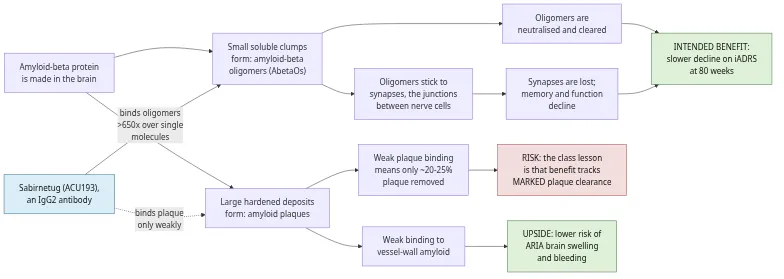
How it works. Amyloid-beta is made normally in the brain. In Alzheimer’s disease it accumulates,
and it does so in two forms: small soluble clumps called oligomers, and large hardened deposits
called plaques. The scientific case for sabirnetug is that the oligomers, not the plaques, are what
actually damages the brain — they stick to synapses, the junctions where nerve cells communicate,
and destroy them. Sabirnetug was raised against those clumps specifically and binds them more than
650 times more tightly than it binds single unclumped amyloid molecules, of which the brain
contains far more [VERIFIED — same source]. It also binds plaque relatively weakly, which is the
whole argument and the whole risk at once.
How well the target is validated. Amyloid-beta as a target is validated at the level of the
protein: two antibodies against it, lecanemab and donanemab, are approved and do slow decline
[VERIFIED — Clarity AD (van Dyck et al., NEJM 2023) and TRAILBLAZER-ALZ 2 (Sims et al., JAMA 2023) headline results, taken as published and not re-derived from the primary papers in this sweep]. Open
Targets confirms that both the amyloid precursor protein gene (ENSG00000142192) and Alzheimer’s
disease (MONDO_0004975) exist as curated entities in its platform [VERIFIED — Open Targets search_entities, 2026-08-07]; the quantitative genetic association score could not be
retrieved because the follow-up query was rate-limited across three attempts, so the strength of
that link is [UNVERIFIED] here rather than asserted.
The oligomer hypothesis specifically has never been validated in a well-powered human trial by
anyone. That is not a criticism of the science; it is the exact reason this readout exists. One
piece of competitor-sponsored context is worth naming: a 2025 study from ProMIS Neurosciences (whose
own PMN310 is an earlier-stage oligomer-selective antibody) reported that the antibodies which
slowed decline in the clinic — lecanemab, aducanumab, donanemab — withstand monomer competition when
binding brain-derived oligomers, while the failed pan-amyloid antibodies do not, and grouped ACU193
with the resistant set [VERIFIED that the paper says this — Alzheimers Dement (N Y) 2025, DOI 10.1002/trc2.70184; UNVERIFIED as independent support, because its senior authors are ProMIS employees and PMN310 competes with sabirnetug].
The exact scientific step this readout must prove. That neutralising soluble oligomers, without clearing most of the plaque, slows cognitive and functional decline by enough to reach statistical significance on the iADRS scale over 80 weeks. Every other question — safety, dose, formulation, commercial positioning — is downstream of that single result.
The honest scientific risk, stated plainly. The two anti-amyloid antibodies that have worked are
the two that cleared a lot of plaque. The ones that cleared little — gantenerumab, solanezumab,
crenezumab, bapineuzumab — all failed on clinical endpoints. In Phase 1, sabirnetug produced roughly
25% and 20% plaque reduction over three months at 60 mg/kg every four weeks and 25 mg/kg every two
weeks respectively — in Centiloid terms, −18.2 and −18.3 Centiloids (p=0.01 in both cohorts)
[VERIFIED — INTERCEPT-AD, DOI 10.1016/j.tjpad.2024.100005, full text read 2026-08-07]. Whether
that rate continued over 80 weeks and reached the levels that the two winners achieved is not known,
because no long-duration plaque data for this drug exists. It could extrapolate to substantial
clearance or it could plateau. Both readings are available from the same fact, and anyone claiming
certainty in either direction is guessing.
The shared-mechanism tension. An ex vivo study in mouse brain tissue found that lecanemab labels
more cortical plaque and more cerebellar blood-vessel amyloid than sabirnetug, and encompasses a
larger fraction of the total amyloid signal [VERIFIED — Alzheimer's & Dementia 2026, DOI 10.1002/alz.71509]. It is not independent: four of its six authors — Cline, Jerecic, Johnson
and Siemers — are Acumen employees; only the first author and the senior author, Grenon and Lemere,
are at Brigham and Women’s Hospital and Harvard [VERIFIED — PubMed author affiliations]. The
finding still cuts both ways, which is why it is worth reporting: less vessel-wall binding is the
mechanistic argument for less brain swelling, and less plaque binding is the mechanistic argument
for less plaque clearance. The bull case and the bear case share one property.
The IgG2 point. Sabirnetug is an IgG2 antibody. Both approved competitors are IgG1. IgG1
antibodies recruit more of the immune system’s clean-up machinery, and that recruitment is the
leading explanation for why brain swelling happens on this class. Acumen’s chief medical officer
named this as the second thing the company will look at in the topline data after efficacy
[VERIFIED — Acumen Q1 2026 earnings call, 2026-05-12]. It is a second, independent mechanistic
reason to expect a better safety profile, and it does not depend on the plaque-binding argument.
One cautionary Phase 1 detail belongs beside it: all five ARIA-E cases in INTERCEPT-AD occurred in
women, and 21% of participants who received at least one 60 mg/kg dose experienced ARIA — small
numbers, but not a flawless record [VERIFIED — INTERCEPT-AD full text, read 2026-08-07].
A.2 Clinical development plan, timeline, feasibility, resourcing
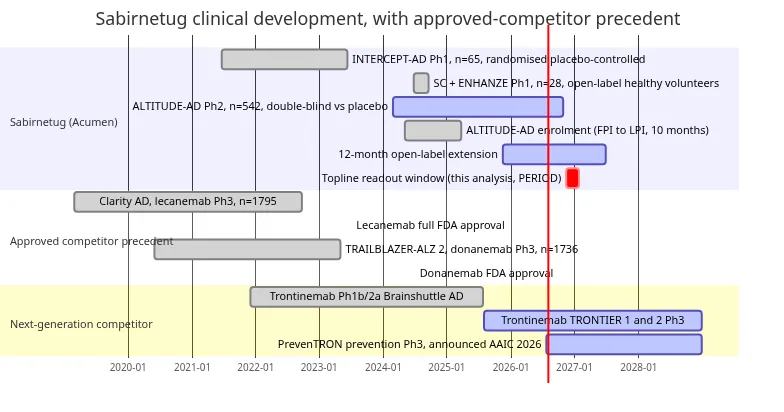
Known milestone dates for ALTITUDE-AD: first patient in 2024-05-08; last patient in
2025-03-26, giving a 10-month enrolment, completed ahead of the company’s own schedule; first
participant dosed in the 12-month open-label extension 2025-11-17; primary completion
2026-10; topline guided Late 2026 [VERIFIED — BPIQ fetch_company_drugs note field 2026-08-07; ClinicalTrials.gov NCT06335173; company releases]. Database lock is not disclosed. The
gap between a 2026-10 primary completion and a Late 2026 topline is a normal database-lock and
analysis lag, not a disagreement between sources — the full timing judgement is in Readout, below.
Trials
| Trial | Sponsor / whose drug | Design (arms, blinding, n) | Population | Status / key result | Link |
|---|---|---|---|---|---|
| INTERCEPT-AD — Phase 1 | Acumen Pharmaceuticals; Acumen’s own drug | Randomised, double-blind, placebo-controlled, single- and multiple-ascending-dose. n=65 (48 received sabirnetug). Single doses of 2, 10, 25 and 60 mg/kg; multiple doses of 10 or 60 mg/kg every four weeks, or 25 mg/kg every two weeks. 17 sites listed on the registry; the publication says 15 study centres. | Mild cognitive impairment or mild dementia due to Alzheimer’s disease, aged 55–90, MMSE 18–30, amyloid-PET-positive | Completed 2023-06-12. Generally well tolerated. Treatment-emergent adverse events in 56.3% on drug against 42.9% on placebo, with about 29% in each group judged drug-related. Brain swelling (ARIA-E) in 5 of 48 patients given sabirnetug (10.4%), one mildly symptomatic after a single 60 mg/kg dose; all five were women; 21% of participants given at least one 60 mg/kg dose experienced ARIA. 0 of 6 ApoE4 homozygotes developed either ARIA-E or ARIA-H. Infusion reactions 6.3% against 0.0%. Exposure dose-proportional in blood and spinal fluid; target engagement dose- and exposure-dependent, approaching saturation at the top two regimens. Plaque reduction over three months about 25% (60 mg/kg Q4W, −18.2 Centiloids, p=0.01) and 20% (25 mg/kg Q2W, −18.3 Centiloids, p=0.01). | NCT04931459 · DOI 10.1016/j.tjpad.2024.100005 |
| INTERCEPT-AD biomarker analysis — same trial, separate publication | Acumen; Acumen’s drug. Independent laboratories at Amsterdam UMC and ADx NeuroSciences co-authored. | Pre-dose and post-dose spinal fluid and plasma from the same 65 patients | Same | Spinal-fluid pTau181 fell at 60 mg/kg Q4W (p=0.049); VAMP2, a synapse protein, fell at all doses (p≤0.041); neurogranin fell at 60 mg/kg Q4W (p=0.037); the Aβ42/Aβ40 ratio trended upward with dose. Changes in the Aβ ratio and in neurogranin correlated with measured target engagement (p≤0.01), and falls in total tau, VAMP2 and neurogranin correlated with exposure duration (p≤0.007). Plasma pTau181, pTau217, GFAP and NfL all trended lower. | DOI 10.1016/j.tjpad.2025.100082 |
| INTERCEPT-AD exit-interview study — same trial, qualitative sub-study | Acumen; Acumen’s drug. Site investigator Diana Kerwin (Kerwin Medical Center) co-authored. | Semi-structured exit interviews with 28 participant/study-partner pairs (43% of the trial population) | Same | Published 2026-03-23, new to this refresh. Motivations for joining were personal benefit and altruism; the reported burdens were travel, time, and cognitive testing — described as more taxing than lumbar punctures. Relevant here mainly as trial-conduct evidence and as a named-investigator source for A.5b. | DOI 10.1186/s13063-026-09656-w |
| Subcutaneous Phase 1 with ENHANZE | Acumen; Acumen’s drug plus Halozyme’s rHuPH20 enzyme | Open-label, no placebo. n=28. Single intravenous dose against multiple under-the-skin doses. | Healthy volunteers, not patients | Completed 2024-09-17; topline announced 2025-03-19, the largest single-day gain in the company’s recorded history at +19.38%. This is bpiq_drug_id 17765 in the pipeline table, not this program. | NCT06511570 |
| ALTITUDE-AD — Phase 2. This is the catalyst. | Acumen Pharmaceuticals; Acumen’s own drug. No collaborators listed. | Randomised, double-blind, placebo-controlled. Three arms: sabirnetug 35 mg/kg, sabirnetug 50 mg/kg, and placebo, all given by drip every four weeks. n=542, at 68 sites across the United States, Canada, Germany, Spain and the United Kingdom. | Age 50–90. Mild cognitive impairment due to Alzheimer’s or probable Alzheimer’s by NIA-AA criteria; MMSE 22–30; CDR global score 0.5 or 1.0; amyloid confirmed by brain scan or spinal fluid. Excluded at entry: any existing ARIA-E, more than four ARIA-H, or superficial siderosis. | ACTIVE_NOT_RECRUITING. Primary completion 2026-10, unchanged. has_results false. One primary and 32 secondary outcome measures. | NCT06335173 |
| Phase 2 open-label extension | Acumen; Acumen’s drug | 12 months, open-label, everyone receives sabirnetug 35 mg/kg every four weeks. n not disclosed. | ALTITUDE-AD completers | First participant dosed 2025-11-17. Management said on 2026-05-12 that patients are “transitioning smoothly” and the conversion rate is high. Not separately registered on ClinicalTrials.gov under this sponsor — see the data-quality flags. | company release 2025-11-17 |
Feasibility matrix
| Factor | High probability | Medium probability | Low probability | This asset (assessment) | Source |
|---|---|---|---|---|---|
| Recruitment feasibility | >50 sites, 3:1 patient:site | 20–50 sites, established investigators | <20 sites, novel sites | High. 68 sites for 542 patients is 8:1, and enrolment finished in 10 months, ahead of the company’s own plan. The pTau217 blood screen cut the rate of wasted brain scans from about 60% to under 20%, which is why. Recruitment risk is behind this trial, not ahead of it. | [VERIFIED — ClinicalTrials.gov NCT06335173; Acumen Q1 2026 earnings call 2026-05-12] |
| Endpoint clarity | Regulatory precedent exists | Novel endpoint with FDA alignment | Unvalidated surrogate | High. iADRS is the endpoint donanemab won its Phase 2 and Phase 3 on, and it is accepted by the FDA in this population. There is no endpoint-novelty risk here. Whether class-typical effect sizes on it are clinically meaningful is a separate, live dispute — see A.5b. | [VERIFIED — ClinicalTrials.gov; TRAILBLAZER-ALZ 2 as published] |
| Trial-design robustness | Pivotal Phase III with SPA | Adaptive with interim analysis | Single-arm, no control | Medium. Double-blind, placebo-controlled, two active doses, 18-month endpoint — a good design. It is not a Phase 3, there is no Special Protocol Assessment, and no interim analysis is disclosed. The company describes it as “well-powered to detect a statistically significant difference”; the assumed effect size behind that is not disclosed, which is the one thing a reader cannot check. | [VERIFIED — ClinicalTrials.gov; Acumen Q1 2026 earnings call; the powering assumption is UNVERIFIED] |
| Operational / execution | Enrollment complete, standard timeline | Some timeline risk | Enrollment behind | High. Enrolment complete 17 months ago, guidance of “Late 2026” issued 2025-08-12 and reiterated unchanged on 2026-03-17, 2026-03-26, 2026-05-12, 2026-07-07 and 2026-07-15. Zero date slips. | [VERIFIED — BPIQ fetch_company_drugs note field, 2026-08-07] |
Resourcing sufficiency. Cash, burn, the term loan and the going-concern conclusion are in
../company.md C.3. The position for this program specifically is that the trial
itself is fully paid for — enrolment closed in March 2025, the last patient’s 80-week visit falls
in 2026, and quarterly research spending has already fallen from $25.3M to $16.5M year on year as
the trial wound down. What the company cannot fund is what comes next. Its own stated runway ends in
early 2027, a Phase 3 anti-amyloid programme costs several hundred million dollars, and the March
2026 placement was earmarked for the preclinical brain-delivery portfolio rather than for
sabirnetug. This readout is therefore not a step towards a funded Phase 3; it is the event that
determines on what terms the money to run one can be raised at all.
A.3 Target label, target product profile, strategic questions, designations
A.3a Target label. Early symptomatic Alzheimer’s disease — adults aged 50 to 90 with mild
cognitive impairment or mild dementia due to Alzheimer’s disease, with amyloid pathology confirmed by
brain scan or spinal fluid [VERIFIED — ClinicalTrials.gov NCT06335173].
A.3b Target product profile
| Attribute | Standard of care & key competitor(s) — data | Sabirnetug target profile (goal) | Supporting evidence (+ link) |
|---|---|---|---|
| Indication / target label | Lecanemab (Leqembi) and donanemab (Kisunla) are both approved for early symptomatic Alzheimer’s disease with confirmed amyloid. Symptomatic drugs (donepezil, memantine) treat symptoms only. | The same label. Acumen’s chief executive confirmed on 2026-05-12 that early Alzheimer’s remains the registration population and that a preclinical (pre-symptomatic) population is a future opportunity for the brain-delivery programme, not for sabirnetug. | [VERIFIED — Acumen Q1 2026 earnings call 2026-05-12] |
| Efficacy (endpoints, regimen) | Donanemab: 35% slowing on iADRS and 29% on CDR-SB at 18 months, n=1736. Lecanemab: 27% slowing on CDR-SB at 18 months, n=1795. | Management’s own stated bar for a “clear win” is “at least 30% or more slowing, which is sort of the upper range observed for the current approved agents.” Regimen: 35 or 50 mg/kg by drip every four weeks; primary endpoint iADRS change from baseline at Week 80. | [VERIFIED — Acumen Q1 2026 earnings call 2026-05-12; competitor figures from Clarity AD and TRAILBLAZER-ALZ 2 as published, not re-derived this sweep] |
| Safety / tolerability | Lecanemab ARIA-E 12.6%. Donanemab ARIA-E 24%, with three deaths attributed to ARIA. Both are IgG1. Both carry boxed warnings and require repeated MRI monitoring. | Materially lower ARIA, on two independent mechanistic arguments: weak binding to vessel-wall amyloid, and the IgG2 subclass with its reduced immune-effector recruitment. Phase 1 evidence: ARIA-E in 5 of 48 (10.4%), one mildly symptomatic, and 0 of 6 ApoE4 homozygotes — but all five cases were women and 21% of those given a 60 mg/kg dose had ARIA. The Phase 1 numbers are small and at different doses, so they are supportive rather than conclusive. | [VERIFIED — INTERCEPT-AD, DOI 10.1016/j.tjpad.2024.100005; competitor rates as published] |
| Biomarker / companion diagnostic | Amyloid confirmation by PET scan or spinal fluid is required before either approved drug is prescribed. | The same requirement, but Acumen has demonstrated a cheaper front end: the pTau217 blood test used as a pre-screen cut the rate of negative confirmatory scans from about 60% to under 20%. That is a real cost and access argument at launch, not just a trial-conduct one. | [VERIFIED — Acumen Q1 2026 earnings call 2026-05-12] |
| Formulation / administration | Both approved drugs are intravenous. Lecanemab has a subcutaneous maintenance option; remternetug (Lilly, Phase 3) is subcutaneous from the start. | Intravenous every four weeks for registration, with a subcutaneous form using Halozyme’s ENHANZE enzyme already through a healthy-volunteer Phase 1. Management said the Phase 2 dose data will determine how the subcutaneous form enters a Phase 3 programme. | [VERIFIED — NCT06511570; Acumen Q1 2026 earnings call 2026-05-12] |
| Payer value | Lecanemab lists at about $26,500 a year; donanemab at about $32,000. Real-world uptake has been far slower than forecast: Leqembi’s global sales were $168M in Q1 2026, up 74% year on year, with Eisai guiding roughly $905M for fiscal 2026 — about three years after full approval. | Sabirnetug would launch around 2030–2031 as a third or fourth entrant. Its payer argument cannot be price — it has to be fewer MRI scans, fewer treatment discontinuations, and eligibility for the ApoE4-homozygous patients who are hardest to treat on the existing drugs. | [WEB ESTIMATE — class pricing and Leqembi Q1 2026 sales as reported by Precision Medicine Online and Fierce Pharma, read 2026-08-07] |
A.3c Strategic Go/No-Go questions. The next decision for this asset is whether to run a Phase 3, so the pre-Phase-III set applies.
Pre-Phase-III (Go-to-Phase-III / registration):
| Group | Question | Answer (tagged) |
|---|---|---|
| Target | Target revalidated as in prior phases? | Partly. Amyloid-beta as a protein is revalidated by two approvals. The specific oligomer form has never been revalidated in a controlled efficacy trial by anyone, and ALTITUDE-AD is the first attempt. [VERIFIED — two approved anti-amyloid antibodies; UNVERIFIED — the oligomer-specific claim] |
| Dose & Drug | Exposure–response for the intended commercial regimen and route(s)? | Partly established. Phase 1 showed dose-proportional exposure in blood and spinal fluid and dose- and exposure-dependent target engagement approaching saturation at the top two regimens. But the two Phase 2 doses (35 and 50 mg/kg) were chosen to bracket the range of oligomer clearance measured in Phase 1, not to maximise plaque clearance, and the top Phase 2 dose sits below the 60 mg/kg Phase 1 dose that produced the ~25% three-month plaque reduction. That is a deliberate bet on the mechanism, and it is the single design choice a bear should press on. [VERIFIED — INTERCEPT-AD; Acumen Q1 2026 earnings call 2026-05-12] |
| Dose & Drug | Commercial formulation available or feasible? | Yes, and it is the strongest non-efficacy asset. Intravenous is the registration form; a subcutaneous form using ENHANZE has completed a healthy-volunteer Phase 1. [VERIFIED — NCT06511570] |
| Dose & Drug | Dose range compatible with clinical and non-clinical safety? | Yes on the evidence available. No dose-limiting toxicity was reported in Phase 1 up to 60 mg/kg, above both Phase 2 doses. [VERIFIED — INTERCEPT-AD] |
| Dose & Drug | Therapeutic window given the clinical response? | Unknown, and this is the crux. The window is wide on safety and unmeasured on efficacy, because no controlled efficacy data for this drug exists at any dose. [UNVERIFIED — pending this readout] |
| Dose & Drug | Intrinsic and extrinsic factors influencing exposure and patient response? | ApoE4 genotype is the one that matters and it is captured: consent to genotyping is an entry requirement, and ARIA rates by genotype are a pre-specified secondary. Body weight 30–160 kg is an entry criterion and dosing is per kilogram. [VERIFIED — ClinicalTrials.gov NCT06335173] |
| Patient | Proof of concept and positive benefit/risk in the intended population? Combination evidence? | Not yet — that is what this trial is for. Phase 1 gave target engagement and biomarker movement in the intended population but was not powered for clinical benefit. No combination programme exists. [VERIFIED — INTERCEPT-AD; UNVERIFIED — clinical proof of concept] |
| Patient | Phase III design and outcome criteria — accepted, compelling, competitive for market access? | The endpoint is accepted (iADRS, donanemab’s own registration endpoint). Whether it is competitive depends entirely on the number: management’s stated bar is ≥30% slowing, which is at the top of what the approved drugs achieved. A statistically significant 15% would be a technical pass and a commercial problem. [VERIFIED — Acumen Q1 2026 earnings call 2026-05-12] |
| Patient | Rationale for the patient population(s)? | Strong and conventional. Early symptomatic, amyloid-confirmed disease is where every anti-amyloid benefit has been demonstrated, and treating later has never worked. [VERIFIED — class literature] |
| Patient | Likelihood of the expected outcome? | Modelled at 35%, band 25–48%, for the pre-registered definition below. Reasoning is in the locked prediction. [UNVERIFIED — modelled] |
| Patient | Companion-diagnostic strategy, including pricing and market? | Amyloid confirmation is already standard of care for the class, so no new companion diagnostic is needed. The pTau217 blood pre-screen is a cost-reduction strategy rather than a companion diagnostic, and Acumen does not own it. [VERIFIED — ClinicalTrials.gov; Acumen Q1 2026 earnings call] |
A.3d Regulatory designations.
- FDA Fast Track, granted 2022-10-24 for Alzheimer’s disease. It grants more frequent written
and in-person interaction with the FDA and eligibility for rolling review, meaning sections of a
marketing application can be submitted as they are finished rather than all at once. It does not
lower the evidence bar and it is not an approval pathway
[VERIFIED — company announcement 2022-10-24, re-confirmed against the press feed 2026-08-07]. - No Breakthrough Therapy, Orphan Drug or Accelerated Approval designation is disclosed for
sabirnetug
[VERIFIED — no such designation appears in any 2024–2026 company release in the 207-item press feed].
A.4 Target product profile valuation matrix
| Stakeholder | Value driver | Minimum threshold | Competitive | Premium | Benchmark / source |
|---|---|---|---|---|---|
| Patient / caregiver | Slower loss of the ability to live independently, with fewer MRI scans and less fear of a brain bleed | Any statistically significant slowing on iADRS at 80 weeks | ~30% slowing, matching the best of the approved drugs, plus a visibly lower ARIA rate | ≥30% slowing and ARIA-E clearly below lecanemab’s 12.6%, and usable in ApoE4 homozygotes who are currently hardest to treat | [VERIFIED — Clarity AD and TRAILBLAZER-ALZ 2 as published; ARIA rates as reported] |
| Regulator | Replicated, clinically meaningful benefit on an accepted endpoint with an acceptable safety profile | A statistically significant Phase 2 result on iADRS, which alone is not sufficient for approval | The same result reproduced in an adequately powered Phase 3 | A Phase 3 win with an ARIA profile that supports a lighter monitoring burden than the boxed warnings the class carries today | [VERIFIED — FDA has approved two drugs in this class on 18-month Phase 3 data] |
| Payer / HTA | Cost per year of independence preserved, including the cost of infusion visits and MRI monitoring | Non-inferior clinical benefit at a lower total cost of care than the $26,500–$32,000 list prices | Comparable benefit plus subcutaneous dosing, which removes infusion-suite cost | Better benefit, subcutaneous dosing and fewer monitoring MRIs — the only realistic route to a price premium for a fourth entrant | [WEB ESTIMATE — class list pricing, read 2026-08-07] |
| Provider | Whether the drug can actually be delivered with existing infrastructure | Fits the infusion and MRI capacity that already limits the class | Subcutaneous administration, removing the infusion-chair constraint | Subcutaneous and a reduced MRI schedule, which is what would let community neurology treat these patients at all | [VERIFIED — Acumen Q1 2026 earnings call, in which management and the Bank of America analyst both identified infrastructure as the class's rate limiter] |
Calibration examples, not asset claims: in oncology each incremental month of overall survival is worth roughly $150–300M in peak-sales potential; oral formulations command roughly 15–25% price premiums over injectables. Neither transfers directly to Alzheimer’s disease, where the binding constraint has been delivery infrastructure rather than price.
A.5 Evidence quality and endpoints
| Criterion | Score (High / Medium / Low) | Basis (one line) | Link |
|---|---|---|---|
| Target validation | Medium-High | Amyloid-beta is validated by two approvals; the oligomer-selective sub-hypothesis is not validated by anyone, and the quantitative genetic association could not be retrieved because the Open Targets follow-up query was rate-limited across three attempts. | Open Targets APP |
| Mechanism clarity | High | The mechanism is precisely specified, the selectivity ratio is measured (>650-fold), and target engagement was demonstrated in human spinal fluid in a dose- and exposure-dependent way, approaching saturation at the top two Phase 1 regimens. | DOI 10.1016/j.tjpad.2024.100005 |
| Biomarker availability | High | Amyloid PET in Centiloids, spinal-fluid target engagement, pTau181, pTau217, VAMP2, neurogranin, total tau, GFAP and NfL are all measured, and all are pre-specified secondaries in the Phase 2. | DOI 10.1016/j.tjpad.2025.100082 |
| Publication quality (peer-reviewed? independent authors?) | Medium-High | The pivotal Phase 1 is peer-reviewed and carries genuinely independent senior co-authors: Honig (Columbia), Salloway (Butler/Brown) and Sperling (Harvard). Three qualifications: an erratum was published on both the main paper and the biomarker paper in mid-2025; the ex vivo lecanemab comparison is Acumen-co-authored rather than independent; and the main paper’s own declaration of competing interests reads “None”, which understates the relationships A.5b documents. Fifteen PubMed records exist in total. | DOI 10.1016/j.tjpad.2025.100213 · DOI 10.1016/j.tjpad.2025.100217 |
| Clinical / expert sentiment | — | Moved to A.5b, below. | — |
Endpoints
| Endpoint (full name) | What it measures | Scale / range | Better direction | MCID / note |
|---|---|---|---|---|
| Integrated Alzheimer’s Disease Rating Scale (iADRS) — the primary endpoint | A single combined score for thinking and for the ability to do everyday tasks. It is built by adding the two scales immediately below. Measured as change from the start of treatment to Week 80. | 0 to 144. Lower is worse. | Less decline (a smaller fall) is better | No minimal clinically important difference is formally established for the composite. The practical benchmark is relative: donanemab slowed decline on this exact scale by 35% at 18 months, and Acumen’s own stated bar for a clear win is ≥30%. [VERIFIED — ClinicalTrials.gov NCT06335173; Acumen Q1 2026 earnings call] |
| Alzheimer’s Disease Assessment Scale — Cognitive Subscale, 13 items (ADAS-Cog13) | Thinking ability, tested directly by a rater: orientation, memory for words, language, praxis, delayed recall and digit cancellation. | 0 to 85. Higher is worse. | Lower is better | One of the two components of iADRS. [VERIFIED — ClinicalTrials.gov] |
| Alzheimer’s Disease Cooperative Study — instrumental Activities of Daily Living (ADCS-iADL) | Whether the patient can still do the complex things needed to live alone: shopping, keeping appointments, travelling, cooking, reading and writing. Answered by the study partner about the last four weeks. | 0 to 59. Lower is worse. | Higher is better | The other component of iADRS, and the one that carries the everyday meaning. Notably, it is also the scale on which the 2026 Cochrane review measured the class’s largest benefit (A.5b). [VERIFIED — ClinicalTrials.gov; Cochrane CD016297] |
| Clinical Dementia Rating — Sum of Boxes (CDR-SB) | Severity across six domains — memory, orientation, judgement, community affairs, home and hobbies, personal care — each scored 0 to 3 and summed. | 0 to 18. Higher is worse. | Lower is better | A secondary here, and the primary endpoint lecanemab won on (27% slowing). Management confirmed it will be reported in the topline. A change of roughly 1 to 2 points is often described as clinically meaningful in mild disease, but that figure is contested. [VERIFIED — ClinicalTrials.gov; the MCID figure is UNVERIFIED] |
| Mini-Mental State Examination (MMSE) | A short standard test of orientation, memory, attention, language and praxis. Also the entry gate: 22–30 required. | 0 to 30. Lower is worse. | Higher is better | Secondary. [VERIFIED — ClinicalTrials.gov] |
| Amyloid plaque load by PET scan, in Centiloids | How much hardened amyloid is in the brain, on a standardised scale. | 0 is a clean scan; roughly 100 is a typical Alzheimer’s brain. | Lower is better | Measured to Week 76. The most informative secondary in the whole readout, because it is what settles whether sabirnetug’s plaque clearance extrapolated from Phase 1’s ~20–25% over three months into the range the two approved drugs reach, or plateaued. [VERIFIED — ClinicalTrials.gov] |
| Target engagement: sabirnetug–AβO complex in spinal fluid | Direct proof that the drug reached the oligomers and bound them. | Concentration; no fixed scale | Higher is better | Measured to Week 76. This is the mechanism’s own witness: if efficacy fails while engagement succeeds, the oligomer hypothesis is refuted rather than the drug. [VERIFIED — ClinicalTrials.gov] |
| ARIA-E and ARIA-H on MRI | Number of patients with brain swelling (E) or small bleeds (H). | Counts of participants | Fewer is better | The safety endpoint the whole differentiation argument rests on. Benchmarks: lecanemab 12.6% ARIA-E, donanemab 24%. [VERIFIED — ClinicalTrials.gov; competitor rates as published] |
| Time-saved analysis on iADRS, ADCS-iADL, ADAS-Cog13, CDR-SB and MMSE | How many months of decline the drug postpones, rather than the size of the difference | Months | More is better | Five separate pre-specified secondaries. Useful for the payer argument and easily misused in a press release, so read the primary first. [VERIFIED — ClinicalTrials.gov] |
A.5b Key opinion leaders.
The CT.gov record for ALTITUDE-AD discloses no overall officials and no site investigators — every one of the 68 locations carries a null contact field — so the investigators below are named from the program’s own peer-reviewed publications instead, with the trial each name is verifiably attached to stated per row. Independent voices were found through PubMed and checked against both connectors for undisclosed relationships. Every attributed view carries a name, a date, a source and a conflict disclosure, or it is not recorded (rule 40); nothing here is collapsed into a sentiment score (rule 41).
Panel as of. 2026-08-07 — the date the investigator and independent-voice searches below were run.
Investigators
Being paid by the trial is a relationship with the sponsor by construction; the Conflicts column is for relationships beyond that one. A caveat that applies to every row: the INTERCEPT-AD paper’s own declaration of competing interests reads “None” despite four Acumen-employee authors, so this journal’s disclosure practice is thin, and an empty conflicts cell below records only that the named searches found nothing — never that nothing exists.
| Name | Role / affiliation | Trial (NCT) | Conflicts (party, kind, disclosed in, as of) | Conflicts checked (source, date) | Source | Tag |
|---|---|---|---|---|---|---|
| Lawrence S. Honig | Site investigator and academic co-author; Columbia University Irving Medical Center | INTERCEPT-AD (NCT04931459) | Eisai (lecanemab) — first author of the Eisai-sponsored Clarity AD Phase 3 safety analysis, co-authored with ten Eisai employees; disclosed in the author list and affiliations of DOI 10.1186/s13195-024-01507-7; as of 2024-07-10 | PubMed author search “Honig LS AND lecanemab”, 2026-08-07 (3 records); INTERCEPT-AD paper’s own COI section (reads “None”), read 2026-08-07 | PubMed, DOI 10.1016/j.tjpad.2024.100005 author list | [VERIFIED — PubMed 2026-08-07] |
| Stephen Salloway | Site investigator and academic co-author; Butler Hospital and Brown University | INTERCEPT-AD (NCT04931459) | Biogen (aducanumab; lecanemab co-marketer) — co-author, with four Biogen employees, of the aducanumab post-mortem neuropathology study; disclosed in the author list and affiliations of DOI 10.1007/s00401-026-03037-y; as of 2026-06-16 | PubMed author search “Salloway S AND (lecanemab OR donanemab OR aducanumab), 2024–2026”, 2026-08-07 (10 records); INTERCEPT-AD paper’s own COI section (reads “None”), read 2026-08-07 | PubMed, DOI 10.1016/j.tjpad.2024.100005 author list | [VERIFIED — PubMed 2026-08-07] |
| Reisa A. Sperling | Site investigator and academic co-author; Brigham and Women’s Hospital / Harvard Medical School | INTERCEPT-AD (NCT04931459) | Eisai (lecanemab) — co-author, with two Eisai employees, of the AHEAD preclinical-AD lecanemab trial screening analysis; disclosed in the author list and affiliations of DOI 10.1002/dad2.70164; as of 2025-08-22. Also a co-author of the Clarity AD safety analysis above. | PubMed author search “Sperling RA AND lecanemab AND (AHEAD OR prevention)”, 2026-08-07 (2 records); INTERCEPT-AD paper’s own COI section (reads “None”), read 2026-08-07 | PubMed, DOI 10.1016/j.tjpad.2024.100005 author list | [VERIFIED — PubMed 2026-08-07] |
| Kimball Johnson | Site investigator; CenExel iResearch, Atlanta, GA — CenExel iResearch (Decatur, GA) is also a listed ALTITUDE-AD site | INTERCEPT-AD (NCT04931459); his site appears on NCT06335173 with no named investigator | None found beyond the trial relationship | INTERCEPT-AD paper’s own COI section (reads “None”), read 2026-08-07; PubMed search on the program’s 15 records, 2026-08-07 — no competitor co-authorship found | PubMed, DOI 10.1016/j.tjpad.2024.100005 author list; CT.gov NCT06335173 locations | [VERIFIED — PubMed and CT.gov 2026-08-07] |
| Diana Kerwin | Site investigator; Kerwin Medical Center, Dallas, TX — a listed ALTITUDE-AD site | INTERCEPT-AD exit-interview study (NCT04931459); her center appears on NCT06335173 with no named investigator | None found beyond the trial relationship | The Trials paper’s full text was retrieved via PMC13130801 on 2026-08-07 but came back without its Declarations section, so its COI statement was not retrievable through this connector; PubMed search on her name among the program’s records, 2026-08-07 — no competitor co-authorship found | PubMed, DOI 10.1186/s13063-026-09656-w author list; CT.gov NCT06335173 locations | [VERIFIED — PubMed and CT.gov 2026-08-07; the unretrievable COI section is a stated limit] |
Independent voices
Named commentators on this program’s endpoint question who are not investigators on its trials and
hold no disclosed relationship with the sponsor. In program.json every voice carries an explicit
"conflicts": [] alongside the checks shown here.
| Name | Affiliation | View (close enough to quote) | As of | Conflicts checked (source, date) | Source | Tag |
|---|---|---|---|---|---|---|
| Francesco Nonino (first author; senior author Edo Richard, Radboud UMC) | Unit of Epidemiology and Statistics, IRCCS Istituto delle Scienze Neurologiche di Bologna | The 2026 Cochrane review of nine anti-amyloid antibodies (17 RCTs, n=20,342): the effect on cognitive function and dementia severity at 18 months “is trivial, while on functional ability, it is small at best”; the antibodies increase ARIA; “successful removal of amyloid from the brain does not seem to be associated with clinically meaningful effects”; future research “should focus on other mechanisms of action”. Notably, the largest measured benefit was on ADCS-iADL (SMD 0.21) — the functional half of this trial’s own primary composite. | 2026-04-16 | The review’s own funding statement (Regione Emilia-Romagna and Italian Ministry of Health — public funders, no industry money) and Cochrane’s conflict-of-interest policy for drug reviews, read via PubMed 2026-08-07; no Acumen or competitor relationship found for the author group | PubMed, DOI 10.1002/14651858.CD016297 | [VERIFIED — PubMed 2026-08-07] |
| Robert Howard | Division of Psychiatry, University College London | BMJ editorial, sole author: “Lecanemab’s benefits are too small and uncertain” — the class’s flagship result does not clear the bar of clinical meaningfulness. A consistent published position across the class (see also the framework he co-authored for appraising anti-amyloid immunotherapies, DOI 10.1093/braincomms/fcad175). | 2024-09-19 | PubMed author search “Howard R AND (donanemab OR lecanemab)”, 2026-08-07 — no industry co-authorship found in the returned records; the BMJ editorial’s own competing-interest declaration was not retrievable through PubMed (BMJ is not in PMC), a stated limit of this check | PubMed, DOI 10.1136/bmj.q2044 | [VERIFIED — PubMed 2026-08-07; the unretrievable BMJ declaration is a stated limit] |
Judgement
| Endpoint supported | Basis (one or two sentences) | Tag |
|---|---|---|
| MIXED | The instrument itself is undisputed — iADRS is FDA-accepted and donanemab won a Phase 2 and a Phase 3 on it, and even the skeptical Cochrane analysis found its functional component (ADCS-iADL) carrying the class’s largest measured benefit. What the assembled independent voices dispute is whether class-typical effect sizes on these scales are clinically meaningful at all — a dispute management’s own ≥30%-slowing “clear win” bar implicitly concedes, since it defines success at the top of the approved range rather than at bare statistical significance. | [UNVERIFIED — judgement] |
Dissent
Empty — the judgement above is MIXED, not SUPPORTIVE_CONTESTED, and the two skeptical voices are already recorded in full in the Independent voices table rather than repeated here.
| Name | View (close enough to quote) | Source |
|---|
B. Commercial assessment
B.0 Current treatment algorithm
A patient in the United States today who is losing their memory follows roughly this path.
- Symptoms and first assessment. A primary-care doctor or a neurologist administers a short cognitive test such as the MMSE. This establishes that there is impairment; it does not establish the cause.
- Confirming that it is Alzheimer’s. Before any anti-amyloid drug can be prescribed, amyloid has
to be confirmed by a PET brain scan or a spinal tap. Increasingly a pTau217 blood test is used
first to decide who is worth scanning. This step is a real access barrier: it costs money, it needs
specialist equipment, and in Acumen’s own Phase 1 experience about 60% of scans ordered without a
blood pre-screen came back negative
[VERIFIED — Acumen Q1 2026 earnings call]. - Symptom-relief drugs. Cholinesterase inhibitors such as donepezil and, in more advanced disease, memantine. These make symptoms a little better for a while. They do not change the disease. They remain the treatment most patients actually receive.
- Disease-modifying anti-amyloid antibodies. For patients with confirmed amyloid and early disease only: lecanemab (Leqembi) by drip every two weeks, or donanemab (Kisunla) by drip every four weeks. Both slow decline modestly. Both require repeated MRI monitoring for brain swelling, both carry boxed warnings, and both need an infusion suite. This last requirement is the class’s binding constraint, and it is why realised sales are a fraction of what was forecast.
- Later disease. Once dementia is moderate or severe, no anti-amyloid drug is indicated. Care is supportive.
Where sabirnetug would fit. Exactly at step 4, as a direct alternative to lecanemab and donanemab, in the same confirmed-amyloid early-disease population. It does not open a new line of therapy and it does not create a new patient pool. It would have to displace one of two incumbents that will by then have four to six years of real-world use, and its argument for doing so is a better balance of benefit and risk plus, eventually, an injection instead of a drip. There is one specific sub-population where displacement would be easiest: patients carrying two copies of ApoE4, who face the highest ARIA risk on the existing drugs and where sabirnetug’s Phase 1 recorded zero events in six patients.
B.1 Competitive landscape and positioning
| Metric | High value | Medium value | Low value | This asset (assessment) | Source |
|---|---|---|---|---|---|
| Mechanism differentiation | First-in-class or novel target | Next-generation improvement | Me-too | High. It is the only clinical-stage antibody built for selectivity to soluble oligomers over both monomers and plaque, and it is the only IgG2 in a class of IgG1s. This is a genuinely different bet within a validated protein target, not a me-too. | [VERIFIED — DOI 10.1016/j.tjpad.2024.100005; Acumen Q1 2026 earnings call] |
| Development-timeline advantage | >12 months ahead | Within 6–12 months | Lagging >12 months | Low. Three to four years behind both approved drugs, and behind Roche’s trontinemab, which is already in Phase 3 and, as of AAIC 2026, expanding into prevention. Sabirnetug has not started a Phase 3 and cannot fund one. On timing it is last. | [VERIFIED — approval dates; WEB ESTIMATE — Roche TRONTIER and PrevenTRON coverage, read 2026-08-07] |
| Clinical proof-of-concept evidence | Positive Phase IIb (n>100) | Phase IIa signals (n=20–50) | Preclinical only | Medium. No efficacy signal of any kind exists — that is the readout. What exists is a 65-patient Phase 1 with demonstrated target engagement, six biomarkers moving the right way with p-values between 0.007 and 0.049, and a clean ARIA record in the highest-risk genotype. That is more than a Phase 2a signal and less than proof of concept. | [VERIFIED — INTERCEPT-AD and its biomarker publication] |
| IP protection | Composition-of-matter, long-dated | Method-of-use | Pending or none | Medium. Composition-of-matter and method-of-use patents are issued in 19 countries, which is the strong form. The weakness is the date: they run to July 2031, with possible term extension of three to five years. The practical protection at a 2030–2031 launch would come mainly from the 12 years of US biologic exclusivity that starts at approval, not from the patents. | [WEB ESTIMATE — Acumen corporate deck filed with the SEC, read 2026-08-07] |
Where this asset wins, and the single fact the thesis rests on.
It wins on one axis only: the possibility of comparable or better efficacy with materially less brain swelling, in a class where brain swelling is the reason most eligible patients never get treated. Everything else is a disadvantage. It is last to market, it is unfunded past early 2027, it has no commercial organisation, and its patents expire the year it would launch.
The single fact the thesis rests on is this: soluble oligomers, not plaques, are what damage the brain. If that is true, sabirnetug should produce class-leading efficacy at a fraction of the plaque clearance and a fraction of the ARIA. If it is false, sabirnetug is an antibody that clears less plaque than the drugs that work, and the Phase 2 will show it.
The competitor that matters most is not lecanemab. It is trontinemab (Roche). Trontinemab
uses a transferrin-receptor shuttle to carry an anti-amyloid antibody across the blood–brain
barrier, and its Phase 1b/2a produced 91–92% of patients turning amyloid-PET-negative at 28
weeks on the 3.6 mg/kg dose, with ARIA-E under 5%, one case mildly symptomatic — figures Roche
reiterated at AAIC 2026 alongside evidence of clearance even in deep brain regions. It is in the
Phase 3 TRONTIER 1 and 2 trials (~1,600 patients across 18 countries, started 2025), and new since
the previous version of this analysis, Roche announced PrevenTRON at AAIC 2026 — a Phase 3
trial of trontinemab in cognitively unimpaired people at high risk, extending the programme into
prevention [WEB ESTIMATE — NeurologyLive, Clinical Trials Arena and Roche releases, read 2026-08-07]. That combination — near-total plaque clearance and very low ARIA, now with a
prevention franchise being built on top — is the outcome sabirnetug is arguing for by a completely
different route, and Roche is three years ahead with a large balance sheet behind it. A sabirnetug
result of, say, 25% slowing with 5% ARIA would be a scientific triumph and would still have to be
sold against that.
Note also that Acumen’s own brain-delivery programme (bpiq_drug_id 20579 and 20578) uses the same
transferrin-receptor idea, licensed from JCR. Management’s stated differentiation is that no
competitor is shuttling an oligomer-selective cargo across the barrier [VERIFIED — Acumen Q1 2026 earnings call]. That is true and it is also several years and one funded IND away.
Calibration example, not an asset claim: oncology first-movers in novel mechanisms have shown roughly 3.2× higher peak-sales potential but about 1.8× higher development risk. Sabirnetug is a first-mover on mechanism and a laggard on time, which is the least commercially favourable of the four possible combinations.
B.2 Addressable market
Launch markets would be the United States first, then the European Union, the United Kingdom, Canada and Japan — the same markets where the approved drugs are sold and where infusion and MRI infrastructure exists.
| Component | How it is estimated | Premium threshold | This asset (assessment) | Source |
|---|---|---|---|---|
| Drug-treated patients | Epidemiology × diagnosis rate × treatment rate | >100,000 (US/EU5/Japan) | The epidemiology is large and the treated population is not, and the gap is the whole commercial story. About 6.9M Americans aged 65 and over have Alzheimer’s dementia, rising to about 8.5M by 2030. Early symptomatic, amyloid-confirmed patients are a subset of that. But the number actually on an anti-amyloid drug is far smaller: Leqembi’s $168M of global Q1 2026 sales at roughly $26,500 a year implies on the order of 25,000 patients worldwide on treatment at any time, three years after full approval, with Eisai guiding ~$905M for fiscal 2026. Building a forecast off the epidemiology rather than off that figure is how this market has been over-forecast for four years. | [WEB ESTIMATE — Alzheimer's Association 2024 figures; Leqembi Q1 2026 sales and Eisai FY2026 guidance as reported, read 2026-08-07] |
| Market exclusivity | Patent term + regulatory exclusivity | >10 years combined | Marginal on patents, adequate on regulatory exclusivity. Composition-of-matter and method-of-use patents to July 2031, plus three to five years of possible term extension, against a launch no earlier than 2030. The 12 years of US biologic exclusivity running from approval is what would actually protect the product. | [WEB ESTIMATE — Acumen corporate deck filed with the SEC, read 2026-08-07] |
| Reimbursement precedent | Approvals in ≥2 major markets | Positive NICE/CADTH guidance | Precedent exists and it is not encouraging. Both approved drugs are reimbursed in the US under CMS coverage-with-evidence conditions and both have faced restrictive or negative assessments in Europe. The April 2026 Cochrane review (A.5b) hands every payer that wants one a reason to say no. A fourth entrant inherits that environment. No sabirnetug-specific assessment exists. | [UNVERIFIED — no HTA source for sabirnetug specifically; class precedent widely reported; Cochrane CD016297 VERIFIED via PubMed] |
| Patient-journey impact | Fewer hospital days, less caregiver burden | >30% quality-of-life gain | Directly measured, and not yet known. ALTITUDE-AD pre-specifies the Zarit Burden Interview (caregiver burden, 0–88), Resource Utilization in Dementia (formal and informal care costs), EQ-5D-5L and QoL-AD as secondaries. These are the endpoints a payer argument is built from, and they will be in the dataset. | [VERIFIED — ClinicalTrials.gov NCT06335173] |
B.3 Value and feasibility
B.3a Expected peak sales. Built bottom-up from the class’s realised revenue rather than from the epidemiology, because the class has spent four years missing epidemiology-based forecasts. All figures are annual net revenue at peak, conditional on approval, assume a 2030–2031 launch as a third or fourth entrant, and exclude the Enhanced Brain Delivery portfolio, any pre-symptomatic expansion, and any milestone or partnership income.
| Scenario | Assumptions (patients × price × share) | Estimate (USD/year at peak) | Basis / tag |
|---|---|---|---|
| Low | ~12,000 patients on drug globally × ~$25,000 net. Sabirnetug is approved but shows no meaningful edge on either efficacy or ARIA, arrives fourth, and the class stays infrastructure-constrained at roughly today’s size. | ~$0.3B | [UNVERIFIED — modelled. Anchored on Leqembi's ~25,000 implied patients today; sabirnetug takes roughly a third of a class that has not grown much.] |
| Base | ~40,000 patients × ~$25,000 net. Sabirnetug delivers roughly 30% slowing with clearly lower ARIA, a subcutaneous form arrives within two years of launch, and the class reaches 150,000–200,000 patients globally by 2032 as blood-based diagnosis and subcutaneous dosing relieve the bottleneck. Sabirnetug takes about 20%. | ~$1.0B | [UNVERIFIED — modelled. Every input is unverified; the class-growth assumption is the one most likely to be wrong, and it is the one the whole case rests on.] |
| High | ~100,000 patients × ~$25,000 net. Best-in-class on both efficacy and ARIA, subcutaneous, becomes the preferred first anti-amyloid antibody, and treatment moves into community neurology. | ~$2.5B | [UNVERIFIED — modelled. Requires the class bottleneck to break AND sabirnetug to win on both axes AND the July 2031 patent horizon not to matter, which is three things going right at once.] |
For context rather than as an input: third-party forecasts put Leqembi and Kisunla at roughly
$2.9B and $2.3B of global sales by 2033 (GlobalData), and remternetug at ~$0.9B by 2033
[WEB ESTIMATE — GlobalData via Clinical Trials Arena, read 2026-08-07]. Those are forecasts for
the market leaders. They are not passed through into the table above, because the same
forecasting approach has been consistently high against realised sales, and rule 6 says a broken
third-party figure is rejected rather than relayed.
B.3b Feasibility
| Question | Answer (tagged) |
|---|---|
| Expected net present value (eNPV) | No point estimate, per rule 10, because the probability of Phase 3 success and the peak-sales figures are both unverified. A labelled range: taking the ~$1.0B base peak, assuming a further 35–50% probability of Phase 3 success and roughly 90% approval given a positive Phase 3, $600–900M of Phase 3 and launch cost, a 2031 launch and a 12% discount rate, the value conditional on this Phase 2 succeeding is on the order of $250–700M in today’s money. Applying the 35% modelled probability of the Phase 2 succeeding brings the unconditional figure to roughly $90–250M, against a recomputed enterprise value of about $103M (../company.md C.4). The stock is priced in the lower half of that range. Every input in the calculation is [UNVERIFIED — modelled] and the range is wide because it deserves to be. |
| Capital to the next decision point | Effectively nil. The trial is enrolled, dosed and paid for; the readout window opens in roughly three months; and quarterly research spending has already fallen from $25.3M to $16.5M as the trial wound down. [VERIFIED — [../company.md](/analysis/ABOS) C.3] |
| Capital to approval, and the funding plan | $600–900M, and there is no plan. A registrational anti-amyloid programme is a multi-year, multi-hundred-million-dollar undertaking against $128.4M of cash at 2026-03-31, $31.6M of debt amortising monthly since 2026-07-01, and a company-stated runway ending in early 2027 with an explicit going-concern conclusion. The realistic routes are a large equity raise into a positive result, a partnership, or a sale of the company. [VERIFIED — [../company.md](/analysis/ABOS) C.3] |
| Launch capability — alone, or must partner? | Must partner, without qualification. A company of this size cannot build an Alzheimer’s infusion sales organisation across five markets. [VERIFIED — company profile and financial position] |
| Commercialisation rights — retained, split, or out-licensed? | Fully retained, and — the single best commercial fact about this asset — royalty-free. Sabirnetug is licensed from Merck on an exclusive, perpetual, irrevocable, worldwide, royalty-free basis, acquired in 2011 when Merck redirected its Alzheimer’s efforts. A partner or acquirer would therefore take 100% of the economics on the intravenous form with no upstream royalty stack, which is unusual and materially raises what one could pay. Two carve-outs, one of which is resolved since the previous version: the Halozyme ENHANZE agreement covers the subcutaneous formulation and carries single-digit royalties on net sales of ENHANZE-formulated product (confirmed from the 2023-11-05 agreement announcement), and the JCR Pharmaceuticals agreement (option exercised 2026-06-17) carries milestones and royalties but applies to the Enhanced Brain Delivery programme only, not to sabirnetug; the JCR royalty rate remains unconfirmed. [VERIFIED — Halozyme-Acumen agreement announcement 2023-11-05, read 2026-08-07; Acumen SEC filings on the Merck licence; JCR option exercise announced 2026-06-17; UNVERIFIED — the JCR royalty rate] |
B.4 Product-development risk
Framing questions.
- Does the development plan support the target product profile claims? For the efficacy claim, yes: ALTITUDE-AD is the right design on the right endpoint in the right population. For the safety claim, only partly. The profile’s central promise is materially lower ARIA, and a 542-patient trial with roughly 360 patients on drug can show a large difference against the competitors’ published rates but cannot establish a precise rate, and cannot say anything reliable about the ApoE4-homozygous subgroup where the promise is most valuable — that subgroup will contain perhaps 30 to 60 patients across both active arms.
- Will the identified risks affect the target product profile? Yes, one of them decisively. If plaque clearance at 80 weeks turns out to be modest and efficacy is weak, the profile collapses to “safer but doesn’t work”, which has no commercial value. The plaque-PET secondary is what will tell you which world you are in, and it will be in the same press release as the primary.
- If a risk cannot be mitigated, is the asset still differentiated from competitors? Only if efficacy holds. A safety-only differentiation does not survive contact with trontinemab, which already shows ARIA-E under 5% alongside near-total plaque clearance — and is now extending into prevention with PrevenTRON.
| Category | Time risk | Quality risk | Cost risk | Note |
|---|---|---|---|---|
| Project management | Low | Low | Low | Enrolment finished ahead of schedule in 10 months; guidance reiterated six times over twelve months without a single slip. Execution is the strongest thing about this company. |
| Research | High | The oligomer hypothesis is unvalidated in humans. This is the near-veto risk and it is binary. | ||
| IP | Medium | Composition-of-matter and method-of-use in 19 countries is strong in form; expiry in July 2031 against a 2030–2031 launch is weak in date. Protection at launch would rest on the 12-year biologic exclusivity. | ||
| Legal | Low | No litigation appears in the 207-item press feed. A plaintiff-firm “investigation” release of the kind common in this sector does not appear either. | ||
| DMPK | Low | Low | Exposure was dose-proportional in blood and spinal fluid across a 30-fold dose range in Phase 1, and both Phase 2 doses sit inside the range tested. | |
| Safety pharmacology | Low | Low | No dose-limiting toxicity reported to 60 mg/kg, above both Phase 2 doses. | |
| Toxicology | Low | Low | Nothing disclosed that would constrain the programme. The related brain-delivery candidates specifically reported no haematological signals in monkeys, which is the toxicity that has troubled transferrin-receptor shuttles elsewhere. | |
| Drug safety (clinical) | Medium | Medium | ARIA is the class liability. Phase 1 gave 5 of 48 with ARIA-E (all five women, one mildly symptomatic; 21% of those given a 60 mg/kg dose), and 0 of 6 ApoE4 homozygotes. Those are small numbers at doses that bracket the Phase 2 regimens, and a symptomatic ARIA cluster or a death in ALTITUDE-AD would be a near-veto event regardless of how the efficacy reads. | |
| Biomarker | Low | Low | Amyloid PET, spinal-fluid target engagement and a full fluid-biomarker panel are all pre-specified. The measurement infrastructure is not a risk here. | |
| Clinical pharmacology | Medium | The two Phase 2 doses were chosen to bracket oligomer clearance, and the higher of them sits below the Phase 1 dose that produced the ~25% three-month plaque reduction. If the mechanism turns out to work through plaque after all, the trial may be under-dosed for the thing that matters. | ||
| Clinical (efficacy) | High | The dominant risk. A 542-patient trial reading out on an 18-month cognitive endpoint, testing a mechanism nobody has validated, in a disease with a long record of well-designed failures. | ||
| Clinical operations | Low | Low | Low | 68 sites, 8:1 patient-to-site, enrolment complete since March 2025, high open-label-extension conversion. |
| CMC / manufacturing | Medium | An IgG2 antibody at commercial scale is routine, but no commercial-scale manufacturing arrangement is disclosed and a company at this cash level has not built one. A partner would supply it. | ||
| Regulatory | Medium | Fast Track helps with process, not with evidence. A single Phase 2 cannot support approval; a Phase 3 is required and is unfunded. | ||
| Global evidence & value | Medium | Caregiver-burden, resource-use and quality-of-life endpoints are all pre-specified, which is the right preparation. But European assessments of the approved drugs have been restrictive, the 2026 Cochrane review sharpens that skepticism, and a fourth entrant inherits both. | ||
| Commercial | High | High | No sales organisation, no partner announced, last to market, launching against two incumbents and a better-funded next-generation competitor now expanding into prevention, into a class whose realised sales are a fraction of forecast. |
Readout
Sources
| Kind | Where it comes from | What it is worth | Value (or null) | Tag | Note |
|---|---|---|---|---|---|
bpiq | fetch_company_drugs — catalyst_date, catalyst_date_text | The current single source. Synthesized from period text on most rows, so alone it is a ceiling, not an estimate. | 2026-07/2026-12 | [VERIFIED — BPIQ fetch_company_drugs, read 2026-08-07] | catalyst_date_text “Late 2026”; catalyst_date 2026-12-31 is the period-end placeholder, not a day (rule 23). “Late” narrows the half-year informally, but the disclosed unit is the half. |
ctgov | CT.gov get_trial_details — primary_completion_date | Independent of the company’s own messaging, month-precision, and it moves when the trial moves. | 2026-10 | [VERIFIED — ClinicalTrials.gov NCT06335173, read 2026-08-07] | Primary completion, not topline: the last Week-80 assessment lands inside October 2026. Unchanged across all three sweeps of this program. has_results false. |
company | fetch_company_press_releases | The company’s own most recent dated wording. Also where the slip sequence below comes from. | 2026-07/2026-12 | [VERIFIED — press feed via BPIQ note, 2026-07-15] | ”Topline still expected Late 2026”, most recently reiterated 2026-07-15 (AAIC release), the sixth consecutive reiteration since 2025-08-12. The 2026-08-12 Q2 report is the next scheduled restatement. |
congress | data/congresses.json | Answers “where will they say it.” | null | [VERIFIED — absence checked, 2026-08-07] | CTAD 2026 (Boston, 2026-11-16 to 2026-11-19) sits inside this window and Acumen has presented at CTAD in each of the last three years — but no company or investigator statement names CTAD 2026 for this topline, in the 207-item press feed or in a targeted web search. Matching on therapeutic area alone is a guess, and a guess is not a source. Left null on purpose; re-check after the 2026-08-12 call. |
modelled | Trial arithmetic — see below | The only estimate independent of anyone’s guidance. | 2026-12/2027-02 | [UNVERIFIED — modelled, default lag] | Registry primary completion 2026-10 plus the stated default lag of two to four months to database lock, unblinding and analysis. data/benchmarks/readout-lag.json holds no comparable observation yet, so the default applies (rule 34). |
The modelled estimate. Primary completion 2026-10 (registry), plus two to four months for database lock and topline analysis, gives 2026-12 to 2027-02. The company’s own guidance sits at the front of that range, which is consistent with a sponsor that finished enrolment early and has never moved a date: a database lock soon after the last Week-80 visit and a fast topline is the pattern its execution record supports.
Window
| Earliest | Likeliest | Latest | Precision | Confidence |
|---|---|---|---|---|
| 2026-11-15 | 2026-12-15 | 2027-01-31 | PERIOD | MEDIUM |
Basis. The last Week-80 assessments fall inside October 2026 (ctgov); the fastest credible database-lock-to-topline turnaround puts the earliest plausible announcement in mid-November 2026. Likeliest is mid-December: inside the guided “Late 2026”, consistent with primary completion plus roughly two months, and consistent with six unbroken reiterations of the same guidance. Latest is end-January 2027: a few weeks of ordinary analysis slippage past the guided year-end is retained despite the clean guidance record, but the modelled default’s February tail is discounted because this sponsor finished enrolment ahead of schedule and has held one date for a year. Precision is PERIOD because no source names a day or a month for the topline itself — “Late 2026” is a half-year, and the 2026-10 month belongs to the completion date, not the announcement. Confidence is MEDIUM: the sources agree and the guidance record is excellent, but the window rests on an undisclosed database-lock lag.
Disagreement. CONSISTENT — bpiq, company and ctgov all describe the same sequence (October completion, announcement in the following one to three months), and the modelled estimate overlaps the guided period. No source contradicts another; the modelled tail extending past “Late 2026” is lag uncertainty, not a conflicting disclosure.
Date slippage. Zero slips across six dated statements — the guidance has never moved.
| As of | Guidance text |
|---|---|
| 2025-08-12 | ”Topline data in late 2026” |
| 2026-03-17 | ”ALTITUDE-AD enrolled 542; topline results expected Late 2026 (NCT06335173)“ |
| 2026-03-26 | ”ALTITUDE-AD topline remains expected Late 2026” |
| 2026-05-12 | ”ALTITUDE-AD topline results for early AD remain expected in Late 2026” |
| 2026-07-07 | ”Topline still Late 2026” |
| 2026-07-15 | ”Topline still expected Late 2026” |
Attribution
Status. CLEAN — computed by lib/clustering.mjs’s attributionFor over every has_catalyst
row on this ticker’s pipeline, for bpiq_drug_id 14145, on 2026-08-07. ABOS carries exactly one
has_catalyst: true row — this one — so the conflict set is empty by computation, not by
assumption. The other three pipeline rows (17765, 20579, 20578) all carry has_catalyst: false and
are excluded before the comparison begins, exactly as the computation defines. This block is stated
even though it is empty because “nothing else lands in this window” is a finding the reader needs
written down, not inferred from silence (rule 36).
Conflicts
Empty — exactly as attributionFor returned it.
| bpiq_drug_id | Label | Date | Analysed? | Gap (days) | Confirmed? |
|---|
Note. Blank — status is CLEAN.
Market and timing for this event
- Plain takeaway. A binary Phase 2 readout whose window opens in roughly three months, on a
company with roughly $103M of recomputed enterprise value that has already declared substantial
doubt about its ability to continue as a going concern. The largest holder owns 29.1% with a board
seat and is under water on every tranche it has ever bought. No insider has ever bought a share in
the open market. See
../company.mdC.3, C.4 and C.5. - Months to this catalyst. 3.3 months to
readout.window.earliest(2026-11-15) from 2026-08-07, and 5.8 months to the window’s latest edge (2027-01-31). The disclosed date is still a half-year (“Late 2026”), so the window above is this document’s own judgement, at PERIOD precision — say so plainly: no source names a day. | - Expected move around this event. The options chain cannot price it and cannot bracket it.
../company.mdC.6 records three strikes in existence ($2.50, $5.00, $7.50) on a $2.28 stock, meaning there is no at-the-money option at any expiry; 153 contracts of open interest across the whole December 2026 expiry; and floor-pinned put volatilities. No figure is quoted from it. The move is built from the scenario anchors below instead. The one new positioning signal is 340 contracts of January 2027 call volume today — the first visible options interest spanning the readout window. - Nearest comparable past reaction. There is none. Every one of the six measured reactions
in
../company.mdC.7 is a conference presentation, an enrolment milestone or a dosing announcement, and they span −12.60% to +19.38%. The closest analogue is 2025-03-19 (+19.38%), a real human topline — but of a formulation study in 28 healthy volunteers, not a controlled efficacy result. Acumen has never reported a controlled efficacy result in its life. The most useful thing C.7 says about this event is the newest row: on 2026-07-15 the stock fell 12.60% on cleanly positive preclinical news, which is the market saying it will price nothing but ALTITUDE-AD. - Materiality. Dominant, per
../company.mdC.2. It is the only pipeline row withhas_catalyst: true, the only one that has ever produced human efficacy data, and the only one that can support a filing this decade. The stock-direction call below is consistent with that: both scenario ranges are multiples or fractions of spot, not adjustments to it. Attribution is CLEAN (above), so the move around this window belongs to this program alone. - Date slippage. Zero. Six consecutive reiterations of “Late 2026” across twelve months, with no revision (Readout, above). It says nothing about whether the trial will work; it says the company has known when the data arrive for a year and has not had to move it.
Spot. $2.28, read on 2026-08-07, cited from ../company.md C.4. That
is 45.2% of the way up a 52-week range of $1.19 to $3.60, and 86% below the $16.00 flotation price
of July 2021.
Scenario prices
| Scenario | Low | High | Anchors (each named and tagged) | Basis |
|---|---|---|---|---|
| Positive | $4.50 | $11.00 | 52-week high $3.60 [VERIFIED — ../company.md C.4, derived from the price cache] · published analyst targets: Bank of America $8.00 Buy, reiterated 2026-06-12, and aggregator consensus $6.67–$7.34 across up to 12 analysts [WEB ESTIMATE — ChartMill and WallStreetZen aggregator pages read 2026-08-07; the two aggregators disagree on the count and the level, so the spread is quoted rather than one figure] · this ticker’s own largest recorded catalyst move, +19.38% on 2025-03-19, applied to spot = $2.72 [VERIFIED — ../company.md C.7] · a dilution mechanism that fires on the event: a going-concern declaration and a runway ending early 2027 mean a positive result is followed within weeks by an equity raise, alongside an undrawn $20.0M K2 tranche and a lender warrant over 730,769 shares struck at $1.95 [VERIFIED — ../company.md C.3] | Wide on purpose, because “positive” spans two very different results. The low is the technical pass: statistical significance with, say, 15% slowing — a fourth-to-market label nobody needs that still leaves an unfunded Phase 3. That sits 25% above the 52-week high and just above the bottom of the published analyst range, about right for a result that changes the survival question but not the commercial one. The high is management’s own definition of a clear win, ≥30% slowing with clean ARIA, set above the highest published analyst target on the reasoning that those targets were set before the data. At $11.00 the 72.23M shares carry a $795M capitalisation, roughly $730M of enterprise value, or about 0.7× the modelled $1.0B base-case peak — a normal multiple for a de-risked Phase 2 asset that still needs a partner. The dilution anchor is what keeps the top at under 5× rather than higher: whatever the result, this company sells equity into it. |
| Miss | $0.55 | $1.20 | Cash per share at the readout: modelled gross cash of about $50M at mid-December 2026 (from $128.4M at 2026-03-31, less 8.4 months of operating burn at $8.08M and about $10M of term-loan principal since amortisation began 2026-07-01), less roughly $21M of remaining term loan, is about $29M of net cash, or $0.40 per share on 72.23M shares [UNVERIFIED — modelled from ../company.md C.3] · 52-week low $1.19 [VERIFIED — ../company.md C.4] · this ticker’s own worst recorded catalyst move, −12.60% on 2026-07-15, applied to spot = $1.99 [VERIFIED — ../company.md C.7] · a dilution mechanism that fires on the event: a miss leaves a company with substantial doubt about going concern, a term loan amortising monthly to a 2027-11-01 maturity, and no funded programme — a financing from no position of strength, or a wind-down [VERIFIED — ../company.md C.3] | Wide on purpose, because “miss” also spans two results. The high is the soft miss: the primary fails significance but the drug shows a dose-response and a clean ARIA profile that keeps the mechanism alive and keeps the brain-delivery portfolio credible. That lands at the 52-week low of $1.19, printed in January 2026 when the trial was still fully alive; the −12.60% precedent move from a nominally good news day sits above it at $1.99 as the ceiling this range deliberately does not reach. The low is the hard miss: no separation at either dose, the oligomer hypothesis is refuted, and the company trades at roughly 1.4× its $29M of modelled net cash. It does not go to the cash line because the royalty-free Merck licence and two nominated brain-delivery candidates have residual value to somebody; it does not stay above $1.20 because a single-asset company whose asset has failed does not hold its old lows. |
Expected value. Applying the 35% modelled probability below to the midpoint of each range: 0.35 × $7.75 + 0.65 × $0.875 = $3.28, which is +43.9% against the $2.28 spot. The sign does not flip anywhere inside the probability band: at 25% it is $2.59 (+13.7%) and at 48% it is $4.18 (+83.1%). This is arithmetic, not advice, and it is not a price target. It is also not a recommendation to own the position at any particular size: an expected value 44% above spot sits alongside a 65% probability of losing roughly three-quarters of the money, and those two facts have to be held together.
Run-up
Entry and exit
| Entry date | Entry price | Entry basis | Exit rule |
|---|---|---|---|
| 2026-08-07 | $2.28 | The prediction’s own lock date and spot — the first day this window judgement exists to trade against, 3.3 months before the window opens. | T-5 trading days before readout.window.earliest |
The exit rule resolves against the committed price cache. Today it resolves to nothing: the cache’s
last bar is 2026-08-05 and the window opens 2026-11-15, so lib/runup.mjs’s resolveExit returns
null for every rule — the correct answer, recorded as exit: null on the prediction, to be
resolved once the cache reaches the window.
Predicted move and peak
| Low | High | Estimated date | Basis | |
|---|---|---|---|---|
| Predicted move, entry to exit | +5% | +40% | — | The ticker’s own baseline: between January and early April 2026 the closes ran $1.72 → $3.37 (+96%) into this same catalyst with no data at all, then gave half back. A second anticipation leg from $2.28 (45% of the range) toward but not through the 52-week high brackets +5% to +40% ($2.39–$3.19). Held below the H1 precedent because the 10.83M-share resale overhang now exists, the market just sold a good-news day 12.6%, and a pre-readout financing (the stated downside trigger in the Verdict) would cap any run. |
| Predicted peak, from entry | +20% | +75% | 2026-11 | The peak is expected late in the run, as the window opens and CTAD (2026-11-16/19) concentrates attention — the same pattern as the no-news H1 2026 run, whose +96% close-to-close top is the ceiling this band deliberately does not reach. +20% to +75% is $2.74–$3.99, the top sitting just above the 52-week high. The peak can print and fade before the exit; it need not sit inside the move band. |
Priority score drivers
| Driver | Reads | Score (0–100) | Basis |
|---|---|---|---|
| Unmet-need relevance | program README A.4 and B.0 — judgement, no formula | 70 | Early symptomatic AD: ~6.9M US patients and rising, but only ~25,000 worldwide actually on an anti-amyloid drug three years after full approval (A.4, B.0) — the disease is huge, the treated population is small, and the residual need (lower ARIA, ApoE4 homozygotes, less monitoring) is exactly what this asset targets. Not scored higher because two approved disease-modifying drugs do exist and reach the same label. |
| Value-uplift potential | B.3a peak sales vs. enterprise value, C.2 materiality — judgement, no formula | 85 | Base-case peak sales ~$1.0B/yr (B.3a) against a recomputed enterprise value of roughly $0.1B (company.md C.4); materiality dominant per C.2 — the readout is close to the whole equity, so a positive result re-rates the company by multiples rather than percent. |
| Probability of a positive outcome | This record’s own outcome_prediction.probability_pct — computed | 35 | outcome_prediction.probability_pct = 35 |
| Date confidence | readout.precision + readout.confidence — computed; the gate the other six hang off (rule 39) | 20 | readout.precision=PERIOD, readout.confidence=MEDIUM. Below the untradeable threshold (30), so the whole priority score is capped at 15 regardless of the other six drivers — the formula’s own statement that a half-year window is nearly untradeable, not a judgement overridden here. |
| Squeeze mechanics | Float, short interest as % of float, average dollar volume — computed | 63 | float 43000000 shares, short_float_pct 7.62, average dollar volume 1103434 — thinner liquidity and a tighter, more-shorted float amplify a positive surprise. (Float is modelled: 72.23M shares outstanding less RA Capital 20.99M, ADAR1 2.16M, Ikarian 1.05M and ~6.8% insider holdings; short-float units unconfirmed per 02-connectors.md; average dollar volume computed from data/prices/ABOS.json, last 60 trading days.) |
| Priced-in-ness | 52-week position, drift since the last catalyst, ownership crowding, analyst-target dispersion — computed; a HIGH score means room LEFT to run, not how far the stock has already run | 55 | price 2.28 sits at 45% of its 52-week range (low 1.19, high 3.60, as of 2026-08-07) — closer to the 52-week low — room left to run. Only the 52-week-position leg is computed; drift since the last catalyst (−12.6% day was three weeks ago), ownership crowding (33.5% in three funds) and analyst-target dispersion ($4.00–$10.00) are read alongside rather than scored. |
| Financing and clustering risk | Runway against the catalyst, attribution.status / attribution.conflicts — computed; the one NEGATIVE driver, a HIGH score means HIGH risk and sinks the total | 55 | runway_vs_catalyst=TIGHT is the larger of the two independent risks (financing). Cash reaches the event but ends within roughly a quarter of it, under a declared going-concern doubt — the raise is the risk, not the calendar. Clustering contributes nothing: attribution.status=CLEAN. |
Priority score. priority_score from lib/runup.mjs’s priorityScore, never hand-computed.
Priority score 11 · formula_version 1.0.0
Settlement. Left null at lock time. Settled only on an explicit user request, from a confirmed
primary source, against the committed price cache.
See 05-prediction-protocol.md § Run-up settlement.
Verdict
What I would do. Watch — and if you take a position at all, size it as a lottery ticket rather than as an investment.
Why. The expected value is meaningfully above spot and it stays above spot across the whole probability band, because the downside is bounded near $0.55 by modelled net cash plus a royalty-free Merck licence while the upside is a multiple. But the modal outcome is a miss, the miss costs about three-quarters of the position, and the company has already told its auditors there is substantial doubt it can continue as a going concern — which means even the good outcome arrives attached to an equity raise. The trial itself is well run: enrolment finished ahead of schedule, guidance has been reiterated six times over twelve months without a single slip, and the endpoint is the one donanemab won on at a smaller Phase 2 size. What is unproven is the science. Nobody has ever shown that neutralising soluble oligomers slows Alzheimer’s disease, and the property that makes this antibody plausibly safer is the same property that makes it clear less plaque. Since the last version of this analysis the external environment has hardened slightly against it: the April 2026 Cochrane review says the class’s effects are not clinically meaningful, and Roche extended trontinemab into a prevention Phase 3 at AAIC — neither changes the trial’s own odds, both compress what a merely-adequate result would be worth.
What would change this. One specific observable in each direction. Upward: 18-month amyloid-PET Centiloid data disclosed in or before the topline showing plaque reduction in the range the two approved drugs achieve. That would move sabirnetug out of the “modest clearance” bucket that every failed anti-amyloid antibody occupies and into the bucket both winners occupy, and it would justify a probability well above 35%. Downward: an equity raise announced before the readout. That would reset the miss-case floor on a larger share count and would signal that management does not believe it can raise on the data.
What to watch.
- 2026-08-12 — Q2 2026 results, now a scheduled date (announced 2026-08-05). Read three things: the cash balance against the modelled ~$91–95M, whether “into early 2027” changes, and whether the topline guidance narrows from “Late 2026” to a month or a venue.
- Any date — an 8-K, a shelf registration or an at-the-market facility. This is the single most informative filing that could appear before the readout, per the verdict above.
- 2026-10 — the ClinicalTrials.gov primary completion date for NCT06335173. If it moves, the clean twelve-month guidance record breaks and the readout window shifts with it.
- 2026-11-16 to 2026-11-19 — CTAD 2026, Boston. A plausible venue for the topline or a pre-topline disclosure — Acumen has presented at CTAD in each of the last three years — but no company statement names it, so it is a watch item and deliberately not a readout source.
- Throughout — Roche’s TRONTIER 1 and 2 and PrevenTRON news flow on trontinemab. A strong trontinemab result compresses sabirnetug’s commercial case even if ALTITUDE-AD succeeds.
Locked prediction
- Outcome-direction (will the readout succeed on its primary endpoint?): miss — probability
35%, band 25–48%
[UNVERIFIED — modelled]. This is the probability that the settlement definition below is met: statistical significance on the iADRS primary in at least one active dose arm. It is below a coin flip for three reasons that compound. The oligomer hypothesis has never been validated in a well-powered human trial, so this is a first-in-class mechanism test rather than a repeat of something that has worked. Phase 1 plaque clearance of roughly 20–25% over three months is in the range that every failed anti-amyloid antibody occupied, and the Phase 2 doses were chosen for oligomer engagement rather than plaque clearance, with the top dose below the Phase 1 dose that produced those figures. And Alzheimer’s disease has a long record of well-designed, well-executed trials that failed. Set against that, three things keep the number from being lower: donanemab’s own Phase 2 hit this exact endpoint at n=257 against ALTITUDE-AD’s 542, so the trial is not underpowered by class standards; target engagement and six fluid biomarkers moved in the right direction in Phase 1 with p-values between 0.007 and 0.049; and execution has been faultless with zero date slips over twelve months. No third party has published a probability on this event. The nearest external markers are aggregator analyst consensus targets of $6.67–$7.34 against a $2.28 spot and Bank of America’s $8.00 Buy, all of which imply materially more optimism than 35%. They are named here rather than adopted. Unchanged from the superseded 2026-08-04 record: nothing that landed since — the Cochrane review, PrevenTRON — bears on the primary endpoint’s statistical odds. - Stock-direction (which way do the shares move?): up — confidence low — window
2026-08-07 to 2027-02-28, basis: the readout window above (earliest 2026-11-15, latest
2027-01-31), plus four weeks for the reaction and any follow-on financing to settle. Called
despite a below-even outcome probability, because the asymmetry is in the price rather than in
the trial: the downside is bounded near $0.55 by modelled net cash plus a royalty-free Merck
licence and two nominated brain-delivery candidates, the upside is a multiple, the expected value
stays above spot at every point in the probability band, and the 29.1% holder with a board seat
is anchored at $3.30 and cannot be a seller into weakness. Materiality is dominant per
../company.mdC.2 — the only one of four pipeline rows with a disclosed catalyst — and attribution is CLEAN, so the move in this window belongs to this program alone. Confidence is low and not medium for three reasons: the company has declared substantial doubt about going concern, so a dilutive raise sits between the investor and the upside in both scenarios;../company.mdC.7 contains no precedent for how this equity trades on an efficacy result, because it has never had one; and a 65% probability of a roughly 75% loss is not a comfortable long at any size that matters. - Scenario prices: positive $4.50–$11.00 · miss $0.55–$1.20
- Expected value: $3.28, +43.9% against spot $2.28 (arithmetic, not advice)
- Run-up: entry $2.28 on 2026-08-07, exit rule T-5 trading days before
readout.window.earliest — predicted move +5–40%, predicted peak +20–75% around 2026-11 —
priority score 11,
formula_version1.0.0. The score is capped by its own date-confidence gate: a PERIOD-precision window prices as nearly untradeable, whatever the other six drivers say.exitis null at lock — the price cache ends 2026-08-05 and the window opens 2026-11-15, soresolveExitcorrectly returns nothing yet. - Settles on the first public disclosure of ALTITUDE-AD (NCT06335173) topline results. Positive definition: the topline reports a statistically significant slowing of decline for sabirnetug versus placebo on the pre-specified primary endpoint — change from baseline in the integrated Alzheimer’s Disease Rating Scale (iADRS) at Week 80 — in at least one of the two active dose arms (35 mg/kg or 50 mg/kg every four weeks), at conventional two-sided significance as pre-specified in the trial’s own statistical analysis plan. Anything else is a miss, including a numerical slowing that does not reach significance, and including a result that reaches significance only on a secondary endpoint such as CDR-SB. Source: Acumen’s own press release, or a peer-reviewed publication or conference presentation of the ALTITUDE-AD topline, cross-checked against the ClinicalTrials.gov record for NCT06335173.
- Locked: yes · Settled: no
Program data-quality flags
- The Open Targets follow-up association query remains BLOCKED across three attempts this sweep
(immediate retry, then a retry after ~30 seconds), verbatim
Rate limit exceeded for client: global— the third consecutive sweep of this program to record it. The mandatorysearch_entitiescall succeeded on the first attempt this time. The quantitative strength of the APP–Alzheimer’s genetic association is[UNVERIFIED]in this document rather than asserted at a number. - ChEMBL returns no usable selectivity data for a biologic.
CHEMBL5314772carries no molecular properties, no structure and no bioactivity records, because sabirnetug is an antibody. The call confirms identity and development stage only. The >650-fold selectivity figure is the company’s own measurement reported in a peer-reviewed paper rather than an independent replication. - The INTERCEPT-AD paper’s declaration of competing interests reads “None” despite four Acumen-employee authors and academic co-authors with documented competitor-trial relationships (A.5b). The journal’s disclosure practice is thin, and every empty conflicts cell in A.5b inherits that limit.
- PMC full text strips back matter.
get_full_text_articleon PMC13130801 (the Trials qualitative paper) returned the body without its Declarations section, so that paper’s own COI statement was not retrievable through this connector. Recorded in the A.5b conflicts-checked column rather than papered over. - CT.gov discloses no investigators for NCT06335173. No overall official and no site contact is named on any of the 68 locations. The A.5b investigator table is built from the program’s peer-reviewed publications instead, and says per row which trial each name is verifiably attached to.
- The ex vivo lecanemab comparison is not independent. Four of the six authors of DOI 10.1002/alz.71509 are Acumen employees. Carried forward from the previous version, where this correction was first made.
- Errata exist on both key publications. DOI 10.1016/j.tjpad.2025.100213 (2025-05-30) corrects
the main INTERCEPT-AD paper, and DOI 10.1016/j.tjpad.2025.100217 (2025-06-06) corrects the
biomarker paper. Neither erratum’s content was retrievable in this sweep either, so what was
corrected is
[UNVERIFIED]. The figures quoted here are from the original papers, whose full text was read directly this sweep. - INTERCEPT-AD site count disagrees between sources. ClinicalTrials.gov lists 17 locations; the publication says 15 study centres. Both are reported; neither is picked.
- The Phase 2 open-label extension is not separately registered on ClinicalTrials.gov under this sponsor. The sponsor’s registry footprint is exactly three trials (NCT04931459, NCT06511570, NCT06335173) and none is the extension, whose first patient was dosed 2025-11-17. Either it runs as an arm inside NCT06335173 without a separate record, or it is unregistered. Still unresolved.
- Competitor efficacy and ARIA figures are taken as published rather than re-derived. The 35% and 29% for donanemab, the 27% for lecanemab, and the 12.6% and 24% ARIA-E rates are the widely reported headline results of TRAILBLAZER-ALZ 2 and Clarity AD. The primary publications were not opened in this sweep, and that is the limit of the check.
- The JCR royalty rate could not be confirmed (the agreement covers the Enhanced Brain Delivery programme only, not sabirnetug). The Halozyme ENHANZE royalty — single-digit on net sales of the subcutaneous form — was confirmed this sweep from the 2023-11-05 agreement announcement, resolving a gap the previous version declared.
- Aggregator analyst-target figures disagree with each other (ChartMill: 12 analysts, $7.34; a second aggregator: $6.67 consensus; WallStreetZen: $8.00). The spread is quoted in the scenario anchors rather than one figure being picked.
- Company-level flags for ABOS are in
../company.mdC.8.