ZNTL / azenosertib-cyclin-e1-proc — azenosertib (ZN-c3) for Cyclin E1-positive platinum-resistant ovarian cancer
Program analysis ·
bpiq_drug_id17802 · prepared 2026-08 · USD · framework v5.6.1 · Coverage: CLEAREDCompany context, financials, ownership, options and the full pipeline:
../company.md.How to read this. Written for a reader who has not studied pharmacology or finance. Terms specific to this program are in the Glossary below; general terms are defined once in
framework/04-glossary.md. Tags:[VERIFIED — source]/[UNVERIFIED]/[WEB ESTIMATE — source, date].
Glossary
| Term | Plain-language meaning |
|---|---|
| Azenosertib (ZN-c3) | The drug analysed here. A tablet taken once a day that blocks a protein called WEE1. |
| WEE1 | A protein that acts as a brake on cell division. It pauses division so a cell can repair its DNA before splitting. |
| Cyclin E1 (gene CCNE1) | A protein that pushes cells to divide. Tumours that make too much of it divide under strain and come to depend on the WEE1 brake to survive. |
| Platinum-resistant ovarian cancer (PROC) | Ovarian cancer that has stopped responding to platinum chemotherapy. The hardest stage of the disease to treat. |
| High-grade serous ovarian cancer (HGSOC) | The commonest and most aggressive form of ovarian cancer, and the only form these trials enrol. |
| Immunohistochemistry (IHC) | A laboratory stain applied to a slice of tumour tissue that shows how much of a given protein is present. This is how Cyclin E1 status is measured here. |
| Myelosuppression | Suppression of the bone marrow, so the body makes fewer blood cells. It causes low white cells (infection risk), low platelets (bleeding risk) and anaemia. |
| Sepsis | A life-threatening reaction to infection. Two patients on azenosertib died of presumed sepsis in 2024. |
| 400 mg QD 5:2 | The chosen dose and schedule: 400 milligrams once a day, five days on and two days off, to let blood counts recover. |
| Type D meeting | A short, narrowly scoped meeting format with the United States Food and Drug Administration (FDA), used to settle a small number of specific questions. Zentalis used one in 2026 to align on its accelerated-approval strategy. |
| CA-125 | A protein measured in blood that tracks ovarian-cancer activity. |
| GCIG criteria | An agreed international rule for judging a CA-125 response: a confirmed fall of at least half. |
| Folate receptor alpha (FRα) | The tumour marker the competitor drug Elahere targets. A different marker from Cyclin E1. |
| Elahere (mirvetuximab soravtansine) | The approved competitor in this disease. An infused antibody-drug conjugate for FRα-high patients. |
| Antibody-drug conjugate (ADC) | An antibody that carries a chemotherapy payload directly to tumour cells. Elahere is one. |
| Adavosertib (AZD1775) | The earlier, less selective WEE1 blocker, dropped by AstraZeneca in 2022. |
| Recurium IP Holdings | The company Zentalis licensed azenosertib’s intellectual property from. It is owed milestones, a royalty and sublicensing payments. |
| DENALI / ASPENOVA / MUIR / TETON | Zentalis’s own trials of azenosertib. DENALI is the pivotal one; the others are defined where they first appear. |
Executive summary
- What it is. Azenosertib is a once-daily tablet that blocks WEE1, a brake on cell division. Blocking that brake kills tumours that make too much of a protein called Cyclin E1, because those tumours are already dividing under strain and need the brake to survive. About half of platinum-resistant ovarian cancers are in this group, and they have no targeted drug today.
[VERIFIED — CT.gov NCT05128825; NPJ Precision Oncology 2025, DOI 10.1038/s41698-024-00787-4] - The event and when. The pivotal trial, DENALI Part 2, reports its integrated topline in the first half of 2027. That is new: on 2026-08-06 the company moved the date from “year-end 2026” — guidance it had repeated unchanged seven times over fifteen months — “to allow for data maturation post full enrollment”. The shares fell about 16% on the change. Before the topline, the company presents survival data from the earlier part of the same trial at a cancer conference on 23 October 2026.
[VERIFIED — Q2 2026 results release 2026-08-06; BPIQ drug row 17802; company release 2026-07-17] - The main reason it could work. The earlier part of the same trial used the same 400 mg dose and produced a 31.3% response rate in Cyclin E1-positive patients. The company compared 400 mg against 300 mg in a prespecified interim look, picked 400 mg, started a Phase 3, and paid a $7.0 million milestone to do so. In 2026 the FDA reviewed the strategy in a Type D meeting, had no objection to the dose, and acknowledged the study population has the potential to support an accelerated approval. The FDA has already approved a different drug in this exact disease on this exact kind of trial.
[VERIFIED — SGO 2025 via OncLive; company releases 2026-04-09 and 2026-08-06; Zentalis Form 10-K] - The main risk. The 31.3% figure came from a patient group picked out after the results were in. Such subgroups usually weaken when tested properly, and the integrated readout now folds in a cohort of even more heavily pre-treated patients. Separately, the drug’s main side effect is low blood counts, which caused two deaths from infection and a temporary FDA halt in 2024. And the balance-sheet cushion has thinned: the readout moved six months further out while a quarter of cash burned.
[VERIFIED — OncLive; company releases; ../company.md C.3] - What it means for the stock. The shares de-rated 16% on the slip and now sit at $4.16, near the middle of their 52-week range. The business is valued at roughly $124 million of enterprise value against a base case of several hundred million dollars a year in sales if the drug is approved. We lean positive on the trial result at 55% and call the shares up with low confidence over the readout window.
0. Program-tier coverage — CLEARED
| Tool | State | Note / verbatim error |
|---|---|---|
CT.gov search_trials + get_trial_details on the pivotal NCT | CALLED | get_trial_details on NCT05128825 (DENALI) and NCT07546500 (ASPENOVA), both read 2026-08-12 |
PubMed search_articles + get_article_metadata | CALLED | 17 hits for “azenosertib OR ZN-c3”, the same count as the 2026-08-04 sweep. Metadata retrieved for all 17. One hit is an unrelated 2014 physical-chemistry paper matching on the string “ZN-c3”, so 16 are relevant. Still no peer-reviewed DENALI clinical data |
Open Targets search_entities | BLOCKED | Verbatim: Rate limit exceeded for client: global. Four attempts across the sweep, following the 02-connectors.md retry policy; this is the documented standing platform block. Consequence: the human genetic evidence linking CCNE1 and WEE1 to ovarian cancer is not independently confirmed here, and rests on published papers instead. Every such claim in A.1 and A.5 is tagged to its paper rather than to a genetics database |
ChEMBL compound_search | CALLED | CHEMBL5095036. Selectivity and molecular properties returned; the same two field errors as before are noted in the data-quality flags |
| web_search ×4 (peak sales · competitive · exclusivity and royalty · analyst) | CALLED | Five searches run: the four mandatory topics plus the post-slip analyst reaction |
The regulatory tier is not called: this program’s catalyst is a trial readout, not a PDUFA date or
advisory committee (02-connectors.md § Regulatory tier). Company-tier coverage for ZNTL is in
../company.md C.0. The full record is in data/coverage.json.
A. Scientific & clinical assessment
A.1 Mechanism of action and scientific rationale
Some ovarian tumours make far too much of a protein called Cyclin E1. Cyclin E1 pushes cells to divide. When a cell is pushed to divide faster than it can copy its DNA safely, the DNA gets damaged. Scientists call that state replication stress.
A cell under that kind of strain survives by using a brake. The brake is a protein called WEE1. WEE1 pauses cell division so the cell can repair its DNA before splitting.
Azenosertib blocks WEE1. The brake comes off. The tumour cell is forced to divide before it has
repaired its DNA, and it tears itself apart — a process called mitotic catastrophe. Healthy cells
are not under the same strain, so they are affected far less. This is called synthetic lethality:
the tumour’s strain and the drug are each survivable on their own, but lethal together. [VERIFIED — NPJ Precision Oncology 2025, DOI 10.1038/s41698-024-00787-4; Molecular Cancer Therapeutics 2025, DOI 10.1158/1535-7163.MCT-24-1194]

How well is the target validated? The Cyclin E1–WEE1 relationship is well supported in
laboratory models across many independent groups, and the specific claim that Cyclin E1 and its
partner CDK2 define the vulnerability was published in a peer-reviewed journal before DENALI Part 2
began [VERIFIED — DOI 10.1038/s41698-024-00787-4]. A 2025 peer-reviewed paper co-authored by the
company characterises azenosertib’s potency and selectivity across a panel of solid tumours
[VERIFIED — DOI 10.1158/1535-7163.MCT-24-1194]. Independent groups have published WEE1-blocking
work in breast cancer, Ewing sarcoma, lung cancer and colorectal organoids, and an independent 2023
systematic review of the class found that alterations in TP53 and CCNE1 were the leading
candidate predictors of response [VERIFIED — DOIs 10.3390/ijms26125701, 10.1186/s12885-025-13691-2, 10.1016/j.xcrm.2024.101578, 10.1021/acs.jmedchem.4c02541, 10.1016/j.ctrv.2023.102531].
The limit of that check. All of it is laboratory and preclinical work, plus a peer-reviewed
description of the molecule. Not one line of DENALI clinical data has been published in a
peer-reviewed journal. Everything clinical below comes from conference presentations and company
press releases. Independent human-genetics confirmation was again not obtainable, because Open
Targets is blocked. [VERIFIED — PubMed, 17 hits, all inspected]
The exact scientific step the next readout must prove. That selecting patients for Cyclin E1
in advance, using the company’s own staining test, produces a response rate clearly above what
chemotherapy achieves. Everything else — the mechanism, the selectivity, the dose — is already
established well enough. This one step is not. [UNVERIFIED — pending DENALI Part 2]
The honest scientific risk. Blocking WEE1 also removes the brake from healthy bone-marrow
cells, which are among the fastest-dividing cells in the body. Low blood counts are therefore not a
side effect that better chemistry can design away: they are the mechanism working where it is not
wanted. The five-days-on, two-days-off schedule exists to manage exactly that. [VERIFIED — company releases; the interpretation is UNVERIFIED]
A.2 Clinical development plan, timeline, feasibility, resourcing
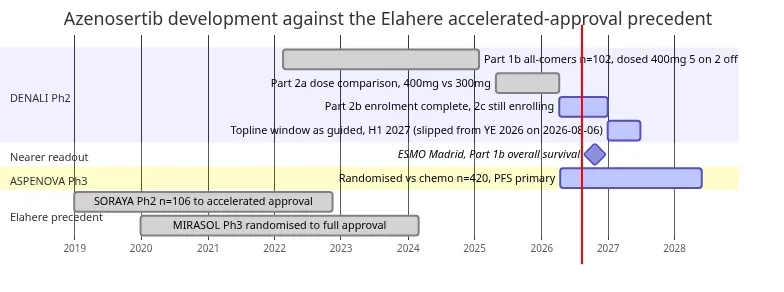
Trials
| Trial | Sponsor / whose drug | Design (arms, blinding, n) | Population | Status / key result | Link |
|---|---|---|---|---|---|
| DENALI Part 1b | K-Group Beta, a wholly owned Zentalis subsidiary / azenosertib | Single-arm, open-label, no blinding, n=102. Patients not pre-selected by Cyclin E1. All dosed at 400 mg QD 5:2 | Platinum-resistant high-grade serous ovarian, fallopian tube or primary peritoneal cancer | Response rate in the Cyclin E1-positive subgroup: 34.9% (95% confidence interval 21.0–50.9%) in the 43 patients with measurable disease, 31.3% (95% CI 18.7–46.3%) in all 48. Responses lasted a median of 6.3 months and time to progression was a median of 4.1 months. In all patients regardless of marker, the response rate was 18.6%. Overall-survival data from this cohort reads out at ESMO on 2026-10-23 | OncLive, SGO 2025 |
| DENALI Part 2 (pivotal) | Same | Single-arm, open-label, n=310 across three sub-parts. Patients are pre-selected for Cyclin E1 by a central laboratory using the company’s own stain. Part 2a compared 400 mg with 300 mg; Part 2b enrols about 70 patients at the chosen dose; Part 2c takes patients who have had a weekly taxane, with one to four prior lines | Cyclin E1-positive PROC, one to three prior treatment lines (four if prior Elahere; four in Part 2c) | Parts 2a and 2b enrolment complete; Part 2c enrolling as of 2026-08-06. The registry still lists the study as RECRUITING with primary completion 2026-12-01. The company guides an integrated topline in H1 2027, “to allow for data maturation post full enrollment” | NCT05128825 |
| ASPENOVA (confirmatory) | Same, with the European Network of Gynaecological Oncological Trial Groups (ENGOT) and the GOG Foundation | Randomised, open-label, n=420, azenosertib against the investigator’s choice of single-agent chemotherapy. Primary endpoint is progression-free survival; overall survival is secondary | Cyclin E1-positive PROC, same prior-treatment rules | First patient dosed 2026-04-17. 60 sites listed, 7 recruiting as of 2026-08-12, up from 4 of 58 at the previous sweep. Primary completion 2028-05-31. Already running before the pivotal result, which is what removes the usual risk of an early approval being withdrawn | NCT07546500 |
| MUIR (supporting) | Same / azenosertib with chemotherapy or bevacizumab | Phase 1b, open-label, n=172 | Ovarian, peritoneal or fallopian tube cancer | Azenosertib plus paclitaxel produced a 39.1% response rate with a median progression-free survival of 7.3 months in PROC, presented at ASCO on 2026-06-01. A bevacizumab maintenance arm is enrolling | NCT04516447 |
| TETON (shelved) | Same / azenosertib | Phase 2, open-label, n=92 | Recurrent uterine serous carcinoma | Completed 2025-10-22. The company has said further development here is limited to partnering or future capital allocation | NCT04814108 |
| SORAYA (competitor precedent) | ImmunoGen, now AbbVie / mirvetuximab (Elahere) | Single-arm, n=106 | FRα-high PROC | Won accelerated approval on response rate and its duration in November 2022. This is the template DENALI Part 2 follows | FDA |
| MIRASOL (competitor precedent) | AbbVie / mirvetuximab | Randomised against chemotherapy | FRα-high PROC | Confirmed the benefit: response rate 42% against 16% on chemotherapy, median overall survival 16.5 against 12.7 months. Converted to full approval in March 2024 | NEJM |
Every Zentalis trial above is sponsored by K-Group, Beta, Inc., a wholly owned subsidiary. The 16%
chemotherapy figure used as the benchmark throughout this document is the MIRASOL control arm, which
is the best available number for what single-agent chemotherapy achieves in this exact population.
[VERIFIED — NEJM; FDA]
Feasibility matrix
| Factor | High probability | Medium probability | Low probability | This asset (assessment) | Source |
|---|---|---|---|---|---|
| Recruitment feasibility | >50 sites, 3:1 patient:site | 20–50 sites, established investigators | <20 sites, novel sites | High. 92 sites in nine countries for 310 patients, run through the Gynecologic Oncology Group network (identifier GOG-3066), the established route into US gynaecological-cancer centres | CT.gov [VERIFIED] |
| Endpoint clarity | Regulatory precedent exists | Novel endpoint with FDA alignment | Unvalidated surrogate | High. Response rate by RECIST v1.1 won Elahere an accelerated approval in this identical setting, and the FDA reviewed this program’s accelerated-approval strategy in a Type D meeting without objection to the dose | FDA; company release 2026-08-06 [VERIFIED] |
| Trial-design robustness | Pivotal Phase III with special protocol assessment | Adaptive with interim analysis | Single-arm, no control | Low–Medium. Single-arm, judged against a historical chemotherapy benchmark of about 16%. Mitigated, but not fixed, by the randomised confirmatory trial already dosing | CT.gov [VERIFIED] |
| Operational / execution | Enrolment complete, standard timeline | Some timeline risk | Enrolment behind | Low–Medium, and the risk the previous version flagged has now materialised. The topline slipped six months on 2026-08-06. Parts 2a and 2b are enrolled; Part 2c is still enrolling and the integrated readout waits on it | CT.gov, company release 2026-08-06 [VERIFIED] |
The timing question the previous version raised is now answered, in the direction it feared.
The previous analysis noted that the registry’s measurement window — “up to approximately 12 months
from the enrolment of the last subject” — was, taken literally, incompatible with a full 310-patient
topline in December 2026, and guessed the year-end topline would have to be Part 2b alone. The
company resolved the tension the other way: it kept the integrated readout and moved the date. The
2026-08-06 release confirms Parts 2a and 2b enrolment complete, Part 2c still enrolling, and an
integrated topline in H1 2027 “to allow for data maturation post full enrollment”. Two consequences
follow. The readout will be larger and more mature than a December 2026 Part 2b-only readout
would have been — more patients, longer follow-up, more confirmed responses and durability. And it
now includes Part 2c, patients with one to four prior lines including a weekly taxane, a more
heavily pre-treated group that plausibly dilutes the headline response rate. [VERIFIED — CT.gov NCT05128825; company release 2026-08-06; the dilution point is UNVERIFIED judgement]
Resourcing sufficiency. The company can still reach the readout, but the cushion the previous
version called its most favourable fact has thinned. Cash of $174.6M at 2026-06-30 covers
operations into late 2027 by the company’s own statement, against a readout window ending
2027-06-30 — a few months of margin where there used to be nearly a year. Projected cash at the
likeliest readout is about $63M. What it cannot fund alone is unchanged: completing a 420-patient
Phase 3 and launching a cancer drug cost far more than it holds, so a partnership or a raise follows
a good result — and may now precede it. See ../company.md C.3. [VERIFIED — Q2 2026 results; UNVERIFIED — the projections]
A.3 Target label, target product profile, strategic questions, designations
A.3a Target label. Adults with Cyclin E1-positive, platinum-resistant high-grade serous
epithelial ovarian, fallopian tube or primary peritoneal cancer, who have had one to three prior
lines of therapy (up to four with prior Elahere or in the taxane-experienced cohort), treated with a
single oral agent. [VERIFIED — CT.gov NCT05128825 eligibility criteria]
A.3b Target product profile
| Attribute | Standard of care & key competitor(s) — data | Azenosertib target profile (goal) | Supporting evidence (+ link) |
|---|---|---|---|
| Indication / target label | Platinum-resistant ovarian cancer, later lines. Elahere serves only FRα-high patients, about 35–40% of cases | Serve the Cyclin E1-positive group, about 50% of cases, which has no targeted option today | Company biomarker data; Elahere label [VERIFIED — SGO 2025; FDA] [WEB ESTIMATE — FRα share] |
| Efficacy (endpoints, regimen) | Single-agent chemotherapy shrinks tumours in about 16% of patients. Elahere reaches 42% in FRα-high patients | A response rate of about 30% or better in Cyclin E1-positive patients, lasting around six months | Part 1b: 31.3% in all Cyclin E1-positive patients, 34.9% in those with measurable disease, lasting 6.3 months — but not pre-selected. See A.5 [VERIFIED — SGO 2025] |
| Safety / tolerability | Chemotherapy: low blood counts, nerve damage, hair loss. Elahere: eye problems, including blurred vision and corneal damage | Keep low blood counts manageable on the 5-on/2-off schedule and avoid the severe infections seen in 2024 | Two deaths from presumed sepsis led to a partial FDA halt on 2024-06-18, lifted 2024-09-16. At the chosen 400 mg dose the interim analysis reported comparable safety to 300 mg, fewer discontinuations and no treatment-related deaths; the FDA subsequently had no objection to continued study of the dose [VERIFIED — company releases 2026-04-09 and 2026-08-06] |
| Biomarker / companion diagnostic | Elahere uses an FRα stain, a different marker | A Cyclin E1 stain identifying the roughly half of patients most likely to respond | The cut-off is proprietary. The DENALI registry calls it an “investigational clinical trial assay”; the ASPENOVA registry calls it a “clinically validated cyclin E1 IHC investigational, in vitro diagnostic assay”. The wording was upgraded between the two trials, but no regulatory approval of the test exists [VERIFIED — CT.gov, both records; UNVERIFIED — approval status] |
| Formulation / administration | Chemotherapy and Elahere are both infused in a clinic | A tablet taken at home, 400 mg once daily, five days on and two off | [VERIFIED — company release 2026-04-09] |
| Payer value | Chemotherapy is inexpensive and generic. Elahere costs roughly $182,000 per patient per year in the United States | Justify a targeted price by treating only likely responders and removing infusion visits | Elahere is reimbursed in the US, EU, UK, Canada and Singapore, and did $690M of global sales in 2025, which sets the payer precedent for this disease [WEB ESTIMATE — AbbVie/GlobalData 2026; CADTH] |
A.3c Strategic Go/No-Go questions — Pre-Phase-III (path to registration). Dose-finding is complete and the confirmatory Phase 3 is dosing, so the registration set applies.
| Group | Question | Answer (tagged) |
|---|---|---|
| Target | Target revalidated as in prior phases? | Yes. Cyclin E1 remains the selection marker, the pivotal trial pre-selects on it, and the hypothesis was published in a peer-reviewed journal before Part 2 opened [VERIFIED — DOI 10.1038/s41698-024-00787-4] |
| Dose & Drug | Exposure–response for the intended commercial regimen and route? | 400 mg once daily, 5 on / 2 off, chosen on a prespecified interim analysis against 300 mg, and reviewed by the FDA in a Type D meeting with no objection. The underlying exposure–response data are not public [VERIFIED — company releases 2026-04-09, 2026-08-06; UNVERIFIED for detail] |
| Dose & Drug | Commercial formulation available or feasible? | Yes. An oral tablet, already used in every trial. ChEMBL records one Lipinski rule-of-five violation and a drug-likeness score of 0.35, unremarkable for an oncology kinase inhibitor [VERIFIED — ChEMBL CHEMBL5095036] |
| Dose & Drug | Dose range compatible with clinical and non-clinical safety? | At 400 mg the interim analysis reported no treatment-related deaths and fewer discontinuations than 300 mg. Higher continuous exposure in 2024 was linked to two deaths from presumed sepsis [VERIFIED — company releases] |
| Dose & Drug | Therapeutic window given the clinical response? | Probably workable. The intermittent schedule exists precisely to create one, the 400 mg interim look supports it, and the FDA raised no objection. Full public safety tables at the pivotal dose do not exist [UNVERIFIED] |
| Dose & Drug | Intrinsic and extrinsic factors influencing exposure and response? | Not disclosed in detail. The trial excludes strong and moderate CYP3A inhibitors and inducers and P-glycoprotein inhibitors for at least 14 days before dosing, which tells you the drug is metabolised through CYP3A and is a P-gp substrate [VERIFIED — CT.gov exclusion criteria] |
| Patient | Proof of concept and positive benefit/risk in the intended population? Combination evidence? | Not proven prospectively; Part 2 is the test. Combination evidence has strengthened: MUIR showed a 39.1% response rate and 7.3-month median progression-free survival with paclitaxel, and the National Cancer Institute runs a Phase 1 of azenosertib with trastuzumab deruxtecan, so the antibody-drug-conjugate combination is clinical rather than only preclinical [VERIFIED — company release 2026-05-21; ASCO 2026; NCT06364410] |
| Patient | Phase III design and outcome criteria — accepted, compelling, competitive? | Yes. ASPENOVA is randomised against chemotherapy with progression-free survival as the primary endpoint and overall survival as a secondary, runs through the ENGOT and GOG networks, and the company states the design is FDA-aligned [VERIFIED — CT.gov; company release 2026-03-26] |
| Patient | Rationale for the patient population? | Cyclin E1-positive patients have no targeted option and are biologically the most likely to respond [VERIFIED — published literature] |
| Patient | Likelihood of the expected outcome? | Modelled at 55%, band 42–68%. See the locked prediction [UNVERIFIED — modelled] |
| Patient | Companion-diagnostic strategy, including pricing and market? | A Cyclin E1 stain selects every Part 2 and ASPENOVA patient and the company describes assay validation as ongoing in both trials. The cut-off is proprietary, no regulatory approval exists, and pricing plans are not disclosed [VERIFIED — CT.gov; UNVERIFIED — approval and pricing] |
A.3d Regulatory designations.
- FDA Fast Track, granted for Cyclin E1-positive platinum-resistant ovarian cancer. It grants
more frequent FDA meetings, eligibility for rolling review of a marketing application, and
eligibility for priority review. The BPIQ changelog dates the grant to 2026-04-21; a separate
source used in an earlier version of this analysis dated it to January 2025. The conflict is
flagged, not resolved
[VERIFIED — BPIQ note; UNVERIFIED — date] - FDA Type D meeting held on the accelerated-approval strategy (disclosed 2026-08-06). Not a
designation, but the closest thing to one this program gained since the last analysis: the FDA
had no objection to the 400 mg dose and “acknowledged the DENALI Part 2 study population,
including the 2c cohort, has the potential to support an accelerated approval pathway, subject to
the strength of the data and the landscape of approved agents at the time of regulatory action”
[VERIFIED — Q2 2026 results release]. The landscape caveat is new, and it is a real condition: an accelerated approval requires an unmet need, and the FDA is reserving the right to judge that need as of 2027–2028, not today - No Breakthrough Therapy, orphan or priority-review designation was found for this programme
in any source read during this sweep. ChEMBL records
orphan: 0[VERIFIED — ChEMBL; absence of evidence in the press feed]
A.4 Target product profile valuation matrix
| Stakeholder | Value driver | Minimum threshold | Competitive | Premium | Benchmark / source |
|---|---|---|---|---|---|
| Patient / caregiver | Tumour shrinkage that lasts, without an infusion chair | Clearly above chemotherapy’s ~16% | ~30% or better, lasting ~6 months | Near Elahere’s 42%, plus a tablet taken at home instead of an infusion | Chemo 16%; Elahere 42% [VERIFIED — NEJM/FDA] |
| Regulator | A convincing single-arm result in a pre-selected population | Response rate plus duration in pre-selected patients, with a confirmatory trial already running | Consistent, durable responses and side effects that can be monitored | Clean mitigation of the blood-count risk plus an approvable patient-selection test | SORAYA (n=106) precedent; FDA Type D acknowledgement [VERIFIED — FDA; company release 2026-08-06] |
| Payer / HTA | Value for money against generic chemotherapy | A clear benefit over single-agent chemotherapy | A price near the antibody-drug-conjugate class (Elahere about $182k a year) | Oral dosing removes infusion cost; the test confines use to likely responders | Elahere pricing and $690M of 2025 sales [WEB ESTIMATE — AbbVie/GlobalData 2026] |
| Provider | Manageable in an ordinary clinic | Side effects that can be watched with routine blood tests | Once-daily oral dosing, no chair time, no eye monitoring | Materially fewer serious infections than the 2024 experience | Elahere requires ophthalmic monitoring; azenosertib requires blood-count monitoring [VERIFIED — labels and company releases] |
Calibration examples, not claims about this asset: in oncology each incremental month of overall survival is worth roughly $150–300M of peak-sales potential, and oral formulations command roughly 15–25% price premiums over injectables.
A.5 Evidence quality and endpoints
| Criterion | Score | Basis (one line) | Link |
|---|---|---|---|
| Target validation | High | The Cyclin E1 / WEE1 relationship is supported across many independent laboratory groups and was published before the pivotal trial opened. Independent human genetic confirmation was again not obtainable — Open Targets is blocked | DOI |
| Mechanism clarity | High | A peer-reviewed selectivity paper exists. Azenosertib avoids the eight off-target kinases that made adavosertib intolerable | DOI |
| Biomarker availability | Medium | The marker predicted response in Part 1b, the assay language was upgraded to “clinically validated” between DENALI and ASPENOVA, and independent reviewers name CCNE1 among the class’s best response predictors. But the cut-off is proprietary, it was chosen after the fact, and the test carries no regulatory approval | CT.gov, both records; DOI 10.1016/j.ctrv.2023.102531 |
| Publication quality (peer-reviewed? independent authors?) | Medium | 17 PubMed hits, and the base includes genuinely independent work from Dutch, German, Japanese, Australian and Chinese groups. But no DENALI clinical data has been peer-reviewed at all — every clinical number here is from a conference or a press release | PubMed |
| Clinical / expert sentiment | — | Moved to A.5b, below. | — |
The central caveat, restated because it is still the whole question. DENALI Part 1b enrolled patients regardless of Cyclin E1 status. The 31.3% figure came from analysing the Cyclin E1-positive patients after the results were in, in a group of 48 people whose 95% confidence interval runs from 18.7% to 46.3% — wide enough to contain both a clear success and a clear failure. Two things weigh in its favour: the Cyclin E1 hypothesis was published in advance and validated in the laboratory, and Part 1b used the same 400 mg dose that Part 2 uses, so the comparison is dose-matched rather than extrapolated. Against it: subgroups found after the fact usually shrink when tested prospectively, there is no rule that says by how much, and the integrated readout now folds in the more heavily pre-treated Part 2c cohort.
[VERIFIED facts — SGO 2025, company releases; the shrinkage and dilution risks are UNVERIFIED judgement]
Endpoints
| Endpoint (full name) | What it measures | Scale / range | Better direction | MCID / note |
|---|---|---|---|---|
| Objective response rate (ORR), by RECIST version 1.1 | The share of patients whose measurable tumours shrink by at least 30% in total diameter, confirmed on a later scan | 0–100% | Higher | The primary endpoint. No formal minimal clinically important difference is defined for single-arm oncology trials. The working benchmark is the ~16% MIRASOL chemotherapy control arm; Elahere won accelerated approval at about 32% in SORAYA |
| Duration of response (DOR) | How long shrinkage lasts, from first documented response to progression or death | Months | Longer | Part 1b Cyclin E1-positive: median 6.3 months (95% CI 2.7 – not evaluable). A key secondary, because the FDA weighs durability heavily in single-arm accelerated approvals — and the stated reason for the delay is precisely to let this endpoint mature |
| Progression-free survival (PFS) | Time from first dose until the cancer grows again or the patient dies | Months | Longer | Secondary in DENALI; primary in ASPENOVA. Part 1b Cyclin E1-positive: median 4.1 months (95% CI 2.8–6.8) |
| Clinical benefit rate (CBR) | The share with shrinkage, or with disease that stays stable for at least 16 weeks before growing | 0–100% | Higher | Secondary |
| CA-125 response, by GCIG criteria | A confirmed fall of at least 50% in the CA-125 blood marker | Fall, as a percentage | A larger fall | Supportive only. Not an approvable endpoint on its own |
| Treatment-emergent adverse events | The count of patients experiencing any new or worsening medical problem while on treatment | Count | Fewer | Secondary, and in practice the endpoint that could sink the programme regardless of the response rate |
A.5b Key opinion leaders.
The pivotal registry names no overall officials and lists a single site contact, so the investigator panel below is built from the clinical co-authors of the company’s own biomarker publication who hold trial-site affiliations, not from a registry roster. PubMed metadata carries no conflict-of-interest field, so every conflicts-checked entry records where the search was actually made, never a certified absence.
Panel as of. 2026-08-12.
Investigators
| Name | Role / affiliation | Trial (NCT) | Conflicts (party, kind, disclosed in, as of) | Conflicts checked (source, date) | Source | Tag |
|---|---|---|---|---|---|---|
| Fiona Simpkins | Clinical co-author of the sponsor’s biomarker paper; Ovarian Cancer Research Center, University of Pennsylvania — a recruiting DENALI site | NCT05128825 | Sponsor — co-author of the sponsor-led biomarker publication, disclosed in the NPJ Precision Oncology 2025 author block, as of 2025-01-04 | PubMed get_article_metadata PMID 39755818, 2026-08-12 — metadata carries no conflict-of-interest field; the author block itself is the disclosure read | PubMed, DOI 10.1038/s41698-024-00787-4 | VERIFIED — PubMed author record; any formal DENALI role beyond co-authorship is UNVERIFIED |
| Cara A. Mathews | Clinical co-author; Program in Women’s Oncology, Women & Infants Hospital / Brown University | NCT05128825 | Sponsor — co-author of the sponsor-led biomarker publication, disclosed in the NPJ Precision Oncology 2025 author block, as of 2025-01-04 | PubMed get_article_metadata PMID 39755818, 2026-08-12 — no conflict-of-interest field in metadata | PubMed, DOI 10.1038/s41698-024-00787-4 | VERIFIED — PubMed author record |
| Funda Meric-Bernstam | Clinical co-author; Investigational Cancer Therapeutics, MD Anderson Cancer Center — a recruiting DENALI site | NCT05128825 | Sponsor — co-author of the sponsor-led biomarker publication, disclosed in the NPJ Precision Oncology 2025 author block, as of 2025-01-04 | PubMed get_article_metadata PMID 39755818, 2026-08-12 — no conflict-of-interest field in metadata | PubMed, DOI 10.1038/s41698-024-00787-4 | VERIFIED — PubMed author record |
Independent voices
| Name | Affiliation | View (close enough to quote) | As of | Conflicts checked (source, date) | Source | Tag |
|---|---|---|---|---|---|---|
| Tim Schutte | Amsterdam UMC / Netherlands Cancer Institute | First author of the class’s systematic review: WEE1-inhibitor response rates in gynaecological cancers ran 23–43%; bone-marrow suppression was the commonest toxicity; “mainly alterations in cell cycle regulator genes TP53 and CCNE1 were potential predictors of response,” and “biomarker-driven patient selection might be essential to increase the response rates” | 2023-03-03 | PubMed get_article_metadata PMID 36893690, 2026-08-12 — no conflict-of-interest field in metadata; all-Netherlands academic affiliations; no sponsor relationship found | PubMed, DOI 10.1016/j.ctrv.2023.102531 | VERIFIED — published analysis; independence UNVERIFIED beyond the searches named |
| Nianguang Li (corresponding author, with Xin Xue) | Nanjing University of Chinese Medicine | 2026 mechanism review: WEE1 “is the fastest progressing member in clinical research” with azenosertib among the lead agents, but “because toxicity and resistance persist with existing agents, research is moving toward newer strategies such as protein degradation” | 2026-05-25 | PubMed get_article_metadata PMID 42186170, 2026-08-12 — no conflict-of-interest field in metadata; all-China academic affiliations; no sponsor relationship found | PubMed, DOI 10.1002/med.70057 | VERIFIED — published analysis; independence UNVERIFIED beyond the searches named |
Judgement
| Endpoint supported | Basis (one or two sentences) | Tag |
|---|---|---|
| SUPPORTIVE | The independent literature supports exactly the bet this program makes: CCNE1 is named among the class’s best response predictors and biomarker selection is called potentially essential, which is the DENALI Part 2 design. The support is for the approach, not the result — no independent voice has commented on DENALI data itself, because none has been published — and the class’s bone-marrow toxicity is consistently named as its limiting problem. | UNVERIFIED — judgement |
Dissent
No named voice disagreeing with the endpoint approach was found in this sweep. The table is left empty rather than filled with an invented disagreement.
| Name | View (close enough to quote) | Source |
|---|
B. Commercial assessment
B.0 Current treatment algorithm
- First line. Surgery, then platinum-based chemotherapy (carboplatin with paclitaxel), often
with bevacizumab. Many patients then take a PARP-inhibitor tablet as maintenance.
[VERIFIED — standard of care, reflected in the DENALI eligibility criteria] - When platinum stops working (the platinum-resistant setting, later lines). Single-agent
chemotherapy — pegylated liposomal doxorubicin, paclitaxel, topotecan or gemcitabine — sometimes
with bevacizumab. Tumours shrink in only about 16% of patients.
[VERIFIED — MIRASOL control arm] - The one targeted option today. Elahere, an infused antibody-drug conjugate, for the roughly
35–40% of patients whose tumours are FRα-high. It did $690 million of global sales in 2025.
[WEB ESTIMATE — AbbVie/GlobalData 2026]
Where azenosertib would fit. As a new oral option in the platinum-resistant setting for the
roughly 50% of patients who are Cyclin E1-positive. It targets a different marker from Elahere, so
the two mostly serve different patients, with some overlap — and the DENALI and ASPENOVA protocols
both require prior Elahere where a patient was eligible for it, which positions azenosertib
explicitly after Elahere rather than against it. That makes the drug additive to the current
standard rather than a substitute for it, and it means the Cyclin E1-positive population it reaches
in practice is largely one that has already exhausted the targeted option. The FDA’s new “landscape
of approved agents at the time of regulatory action” caveat makes this positioning double-edged:
the unmet need it serves must still exist in 2027–2028. [VERIFIED — CT.gov eligibility criteria, both trials; company release 2026-08-06]
B.1 Competitive landscape and positioning
| Metric | High value | Medium value | Low value | This asset (assessment) | Source |
|---|---|---|---|---|---|
| Mechanism differentiation | First-in-class or novel target | Next-generation improvement | Me-too | High. The first WEE1 blocker likely to reach approval. The class’s first attempt, AstraZeneca’s adavosertib, was dropped in 2022; its continued-access study was terminated with three patients enrolled | CT.gov NCT04949425 [VERIFIED] |
| Development-timeline advantage | >12 months ahead | Within 6–12 months | Lagging >12 months | High, though the six-month slip spends some of it. Debiopharm’s Debio 0123 monotherapy Phase 1 is TERMINATED; the compound continues only in combination and in glioblastoma. Aprea’s APR-1051 is in Phase 1, positioning on selectivity (lower PLK1/2/3 inhibition), with early partial responses in PPP2R1A-altered endometrial cancer — not ovarian. Impact’s IMP7068 (potrasertib) is in Phase 1. Nothing behind azenosertib is past Phase 1 in this indication | CT.gov NCT05109975; [WEB ESTIMATE — BioWorld ASCO 2026, BioPharm International, labiotech 2026] |
| Clinical proof-of-concept evidence | Positive Phase IIb (n>100) | Phase IIa signals (n=20–50) | Preclinical only | Medium-High. Part 1b enrolled 102 with a positive 48-patient subgroup at the same dose now used, plus a 39.1% response rate and 7.3-month median PFS with paclitaxel in MUIR. None of it prospective for the marker | SGO 2025; ASCO 2026 [VERIFIED] |
| IP protection | Composition-of-matter, long-dated | Method-of-use | Pending or none | High. Issued patents covering the WEE1 programme including azenosertib are stated to expire between 2038 and 2046, before any extensions | Zentalis Form 10-K [VERIFIED] |
Where it wins. Azenosertib is the only WEE1 blocker close to approval, and the field behind it remains all Phase 1, chasing narrower genomic niches. It serves a group that is about half of platinum-resistant ovarian cancer and has no targeted option once Elahere is exhausted.
The single fact the thesis rests on is unchanged: whether the Cyclin E1 result holds when patients are selected in advance. Everything else — the head start, the patent life, the FDA alignment, the running confirmatory trial — is downstream of that one number.
Calibration note, not a claim about this asset: oncology first-movers in novel mechanisms have historically shown roughly 3.2× higher peak-sales potential but about 1.8× higher development risk.
B.2 Addressable market
Launch markets: the United States, the top five European markets and Japan. Zentalis has no commercial infrastructure in any of them and has only begun hiring commercial staff.
| Component | How it is estimated | Premium threshold | This asset (assessment) | Source |
|---|---|---|---|---|
| Drug-treated patients | Patients treated for platinum-resistant ovarian cancer × the Cyclin E1-positive share | >100,000 (US/EU5/Japan) | About 5,000–6,000 a year across the launch markets, derived by scaling Elahere’s realised revenue back to a patient count and adjusting for the larger marker share. Far below the threshold: this is a specialist market, not a mass one | Derived from the Elahere anchor; [WEB ESTIMATE + modelled] |
| Market exclusivity | Patent term + regulatory exclusivity | >10 years combined | Comfortably above the threshold. Issued patents run to between 2038 and 2046 before extensions, plus five years of US new-chemical-entity exclusivity from approval | Zentalis Form 10-K [VERIFIED] |
| Reimbursement precedent | Approvals in ≥2 major markets | Positive NICE/CADTH guidance | None for this drug, which is not approved. Elahere is reimbursed in the US, EU, UK, Canada and Singapore, which establishes that payers will fund a targeted agent in this disease | AbbVie releases; CADTH [WEB ESTIMATE] |
| Patient-journey impact | Fewer hospital days, less caregiver burden | >30% quality-of-life gain | A daily tablet removes infusion visits and, unlike Elahere, requires no eye monitoring. No formal quality-of-life data has been reported. ASPENOVA collects three patient-reported instruments, so the evidence is coming but is roughly two years away | CT.gov NCT07546500 [VERIFIED — instruments; UNVERIFIED — outcome] |
B.3 Value and feasibility
B.3a Expected peak sales. These figures assume the drug is approved — they are not reduced for the chance the trial fails — and they are before anything owed to Recurium.
The honest way to build this is top-down from a verified comparator, because the bottom-up route
needs an epidemiology figure that could not be re-verified. Elahere did $690 million of global
sales in 2025, serving the FRα-high 35–40% of platinum-resistant ovarian cancer as the only
targeted option [WEB ESTIMATE — AbbVie/GlobalData, 2026]. Cyclin E1-positive is about 50% of the
same disease, so the addressable pool is roughly 1.3× larger. Everything below scales that
anchor.
| Scenario | Assumptions (patients × price × share) | Estimate (USD/year at peak) | Basis / tag |
|---|---|---|---|
| Low | ~5,000 Cyclin E1-positive patients treated a year in the launch markets; ~20% peak share; ~$120,000 net per patient-course; slow uptake against entrenched chemotherapy and pricing pressure | ~$200–300M | Bottom-up, cross-checked against the Elahere anchor [MODELLED; inputs WEB ESTIMATE] |
| Base | ~5,500 patients; ~40% peak share; ~$140,000–160,000 net per patient-course. Roughly two-thirds of Elahere-like penetration on a 1.3× larger pool | ~$450–700M | Anchored to Elahere’s $690M on a smaller marker group [WEB ESTIMATE — public record; MODELLED] |
| High | ~6,000 patients; ~60% peak share; premium pricing sustained; plus combination use in the MUIR-type paclitaxel and bevacizumab regimens and possible expansion into uterine serous carcinoma | ~$1.0–1.4B | Matching or exceeding Elahere-like penetration on the larger pool. Mizuho’s initiation models ~$1.5B of peak worldwide unrisked sales, at or just above this case [MODELLED; WEB ESTIMATE — Mizuho via Investing.com, 2026-07-17] |
The weakest input is the patient count, and it is named rather than smoothed over. The build leans on the Elahere revenue anchor, which is a single verifiable number, and treats the patient count as a derived quantity rather than an input.
Reconciliation with the sell side. Mizuho models roughly $1.5B of unrisked peak sales
(2026-07-17, initiation at Outperform, $8 target). Jefferies’ published risk-adjusted ~$417M at a
50% probability of success implies an unrisked ~$834M, the top of the base range. Morgan Stanley’s
$511M sits inside it. The build above is therefore consistent with published estimates once their
risk adjustment is undone. [WEB ESTIMATE — Mizuho, Jefferies, Morgan Stanley via Investing.com and stocktitan, 2026]
B.3b Feasibility
| Question | Answer (tagged) |
|---|---|
| Expected net present value (eNPV) | A bracket, not a figure, and it is arithmetic rather than a valuation. Base-case peak sales of $450–700M, times an approval probability of 38–48% (my 55% readout probability multiplied by a 70–85% chance of converting a positive readout into an approval — the new FDA landscape caveat argues for the lower end of that conversion), gives risk-adjusted peak sales of roughly $170–340M a year. At a 3–5× revenue multiple, discounted six to seven years back at 11%, that is a present value of roughly $250M–$900M, before anything owed to Recurium. The company’s recomputed enterprise value is about $124M, per ../company.md C.4. Four of the inputs are unverified — the conversion probability, the multiple, the discount rate and the launch year — so this is a bracket to be argued with, not a target [UNVERIFIED — modelled] |
| Capital to the next decision point | Sufficient, with a thinned margin. See ../company.md C.3: cash covers the guided H1 2027 window into late 2027, a few months past its latest edge — down from nearly a year of cushion at the previous analysis |
| Capital to approval, and the funding plan | Not sufficient. Completing a 420-patient Phase 3 across many countries and launching a cancer drug cost materially more than the company holds. A partnership or a raise follows a good result, and may now precede it — an S-3 shelf is on file [VERIFIED — EDGAR; ../company.md C.3] |
| Launch capability — alone, or must partner? | It cannot launch in Europe or Japan alone. A US launch with a small specialist salesforce into gynaecological-oncology centres is conceivable given the concentrated prescriber base, and the May 2026 commercial hires point that way [UNVERIFIED — judgement] |
| Commercialisation rights — retained, split, or out-licensed? | Retained, but taxed. Zentalis owes Recurium development and regulatory milestones of up to $44.5M per licensed product across the first two approved indications, of which $7.0M was triggered by the start of ASPENOVA and paid in Q2 2026; a royalty on net sales reported as a mid- to high-single-digit percentage in the search read this sweep, though an earlier filing description read “low to mid” — the conflict stays flagged; and sublicensing payments on consideration received from a sublicensee, percentage not established |
A correction carried forward from the previous version, still in force. An early version of this analysis asserted that Recurium takes 20% of any sublicensing income. The 20% figure in Zentalis’s filings runs the other way: it is an obligation on Zentera, the Chinese joint venture, to pay Zentalis 20% of sublicensing income it receives. What Zentalis owes Recurium is described only as sublicense fees on consideration received, with no percentage established.
[VERIFIED — the Zentera 20% term and the existence of a Recurium sublicensing obligation; UNVERIFIED — the Recurium percentage]
B.4 Product-development risk
Framing questions.
- Does the development plan support the target product profile claims? Mostly. The pivotal trial pre-selects Cyclin E1-positive patients and measures response rate, which matches both the commercial goal and the approval precedent, and the FDA has now reviewed the strategy without objection. Two gaps: it has no comparison group, and it collects no quality-of-life data, so the “better patient experience than an infusion” claim will have no evidence behind it until ASPENOVA reports.
- Will the identified risks affect the target product profile? Yes, two of them directly. The blood-count risk threatens the “manageable side effects” claim that justifies a tablet over chemotherapy. The unapproved companion test threatens the “treat only likely responders” claim that justifies the price.
- If a risk cannot be mitigated, is the asset still differentiated? If severe infections returned at the pivotal dose, being oral and targeted would not compensate and the programme would very likely stop. Safety is the make-or-break risk, and it is the only one on this page that can end the company.
| Category | Time risk | Quality risk | Cost risk | Note |
|---|---|---|---|---|
| Project management | Realised: the topline slipped six months on 2026-08-06 | The first slip on this row after seven unchanged reiterations. The stated reason — data maturation post full enrollment — is benign, but a second slip would not read that way | ||
| Research | The subgroup result may weaken when patients are pre-selected, and the integrated readout adds the heavier-pretreated 2c cohort | The main scientific risk, and the whole thesis | ||
| IP | Royalty and milestones to Recurium; sublicensing percentage unknown | Patent life to 2038–2046 [VERIFIED] | ||
| Legal | The Fast Track grant date conflicts between sources. Minor | |||
| DMPK | Metabolised via CYP3A and a P-glycoprotein substrate, so drug–drug interactions must be managed | Inferred from the trial exclusion criteria, not from published pharmacokinetics [VERIFIED — CT.gov] | ||
| Safety pharmacology | Low blood counts are intrinsic to the mechanism, not an off-target effect | See drug safety | ||
| Toxicology | Nothing beyond the known class effect was found | |||
| Drug safety (clinical) | Delay if a serious event recurs | Two deaths from presumed sepsis; partial FDA halt 2024-06-18, lifted 2024-09-16 | The single largest risk, and a near-veto factor. At 400 mg the interim analysis reported no treatment-related deaths and the FDA raised no objection to the dose, which is reassuring but remains an interim look [VERIFIED] | |
| Biomarker | Diagnostic approval could lag the drug | Proprietary cut-off; test not approved | Test development and validation cost | The FDA could accept the efficacy and still gate the label on the diagnostic |
| Clinical pharmacology | Exposure–response detail is not public | [UNVERIFIED] | ||
| Clinical (efficacy) | Single-arm against a historical benchmark; the subgroup was chosen after the fact | The main efficacy risk | ||
| Clinical operations | Part 2c is still enrolling and the integrated readout waits on it | A further 2c enrolment lag is the mechanism by which H1 2027 could slip again | ||
| CMC / manufacturing | An oral tablet from a small molecule. Routine | |||
| Regulatory | The FDA’s accelerated-approval acknowledgement is conditional on “the landscape of approved agents at the time of regulatory action” | New this sweep, and double-edged: alignment gained, but the agency reserved the right to judge unmet need as of 2027–2028 | ||
| Global evidence & value | No health-economic or quality-of-life data yet | ASPENOVA collects three patient-reported instruments; results are roughly two years out | ||
| Commercial | Elahere is entrenched and the protocols place azenosertib after it | The cost of building a salesforce from nothing; and the runway now barely outlasts the readout | No commercial infrastructure exists; hiring began in May 2026 |
Readout
Sources
| Kind | Where it comes from | What it is worth | Value (or null) | Tag | Note |
|---|---|---|---|---|---|
bpiq | fetch_company_drugs — catalyst_date, catalyst_date_text | The current single source. Synthesized from period text on most rows, so alone it is a ceiling, not an estimate. | 2027-06-30 (text “H1 2027”) | VERIFIED — BPIQ fetch_company_drugs 2026-08-12 | Period-end placeholder for “H1 2027”, not a disclosed day (rule 23). The row’s note, dated 08/06/26: “DENALI FDA aligned; ESMO OS update upcoming; Part 2 topline now H1 2027” |
ctgov | CT.gov get_trial_details — primary_completion_date | Independent of the company’s own messaging, month-precision, and it moves when the trial moves. | 2026-12-01 | VERIFIED — CT.gov get_trial_details NCT05128825, read 2026-08-12 | Now sits five to seven months ahead of the company’s own guidance. The field predates the 2026-08-06 slip and has not been updated; study status is still RECRUITING and the completion date reads 2027-06-30. Watch this field — its next edit is the registry catching up with the slip, or contradicting it |
company | fetch_company_press_releases | The company’s own most recent dated wording. Also where the slip sequence below comes from. | 2027-01-01/2027-06-30 (text: “The Company expects to provide a topline readout in 1H 2027 to allow for data maturation post full enrollment”) | VERIFIED — Q2 2026 results release, 2026-08-06 | Mandatory — the catalyst is inside twelve months of the window’s earliest edge. Parts 2a and 2b enrolment complete; Part 2c enrolling |
congress | data/congresses.json, only when the company has said it intends to present there (02-connectors.md § Data limits) | Answers “where will they say it.” | null | VERIFIED — data/congresses.json checked 2026-08-12; no company statement ties the Part 2 topline to any congress | The company HAS named ESMO 2026 (2026-10-23, Madrid) — but for DENALI Part 1b overall survival, a different readout from the Part 2 topline this prediction settles on. That event is a watch item inside the run-up period, not a source for this window |
modelled | Trial arithmetic — see below | The only estimate independent of anyone’s guidance. | 2027-02/2027-04 | UNVERIFIED — modelled, default lag | Agrees with the company’s half-year from independent inputs, pointing at its earlier-middle part |
The modelled estimate. The registry’s primary completion date (2026-12-01) plus the rule-34
default lag of two to four months to database lock, analysis and topline gives February to April
2027. data/benchmarks/readout-lag.json holds no comparable entry, so the stated default applies
and the tag says so. The registry date predates the slip, so this arithmetic leans on a field that
may itself move; if primary completion slips toward the registry’s 2027-06-30 study-completion
date, the estimate slides right with it.
Window
| Earliest | Likeliest | Latest | Precision | Confidence |
|---|---|---|---|---|
| 2027-01-01 | 2027-04-15 | 2027-06-30 | PERIOD | MEDIUM |
Basis. The company’s fresh guidance (2026-08-06) names the half-year outright, and the modelled arithmetic — stale registry primary completion plus the default lag — lands inside it, pointing at its earlier-middle part. Likeliest is placed mid-window, slightly past the modelled range, because the stated reason for the delay is data maturation and companies deliver more often in the back half of a freshly guided window than the front. Precision is PERIOD because a half-year is all any source names. Confidence is MEDIUM rather than HIGH because this guidance is six days old and is the row’s first slip — and Part 2c, which the integrated readout waits on, is still enrolling.
Disagreement. UNRESOLVED. The registry’s primary completion date (2026-12-01) points five to seven months earlier than the company’s “1H 2027” and BPIQ’s placeholder. The likeliest explanation is that the registry has simply not yet been edited to reflect the 2026-08-06 guidance — it still lists the study as recruiting — but that is an explanation, not a resolution, and the sources are reported as they stand rather than averaged (rule 24).
Date slippage.
| As of | Guidance text |
|---|---|
| 2025-04-28 | ”topline data by YE 2026” |
| 2025-11-10 | ”expected by YE 2026” |
| 2026-01-06 | ”topline Part 2 data YE 2026” |
| 2026-03-26 | ”remain expected … YE 2026” |
| 2026-04-09 | ”topline YE 2026” |
| 2026-05-05 | ”expected Year-End 2026” |
| 2026-05-12 | ”topline YE 2026” |
| 2026-08-06 | ”Part 2 topline now H1 2027” |
One slip. Eight dated statements, seven transitions, of which six are reiterations and one — the
last — is a six-month push. This row was the negative control in the connector documentation for
fifteen months, and it is no longer. [VERIFIED — BPIQ note field; company releases]
Attribution
Status. CLEAN — computed by lib/clustering.mjs’s attributionFor over every
has_catalyst row on this ticker’s pipeline, 2026-08-12.
| Status | Means |
|---|---|
CLEAN | conflicts is empty — nothing else has_catalyst on this ticker’s pipeline lands within the window. |
Conflicts
Empty — row 17802 is the only has_catalyst: true row among ZNTL’s twelve. Every other azenosertib
row reads TBA with no catalyst, and the five discontinued rows carry none.
| bpiq_drug_id | Label | Date | Analysed? | Gap (days) | Confirmed? |
|---|
Note. Blank — status is CLEAN. The one adjacent event worth naming anyway, because it is the same program rather than a different row: the ESMO presentation of DENALI Part 1b overall survival on 2026-10-23 sits inside the run-up period (not the readout window) and can move the stock on this program’s own news months before the topline. That is a within-program event, not an attribution conflict, and the run-up section below treats it as such.
Market and timing for this event
- Plain takeaway. The stock just gave back a fifth of its run on the six-month slip, so the market has already re-priced the delay but not the science. The business is valued at roughly $124M of enterprise value against a base case worth several hundred million a year if approved. The event is now far enough away that the trade and the readout are separable: a run-up into the window, then the binary.
- Months to this catalyst. About 4.7 months to the window’s earliest edge (2027-01-01) and
about eight to the likeliest date (2027-04-15), from
readout.windowabove — never from the BPIQ placeholder (rule 23). The date is a half-year, not a day. A nearer, smaller event falls first: overall survival data from DENALI Part 1b at ESMO in Madrid on 23 October 2026, which is a disclosed day. - Expected move around this event. Not usable as a number, and worse than before.
../company.mdC.6 records that the last listed options expiry (2027-01-15) covers only the first two weeks of the readout window, and the near-spot quotes bracket anywhere from 16% to 178%. Report the bracket, never a point estimate. What C.7 does establish is that this stock is capable of 35–50% single-day moves on news. - Nearest comparable past reaction. The 2026-04-09 dose selection in
../company.mdC.7, +46.4% intraday. It is the closest analogue available and it is still not close: a dose decision on an interim look is a smaller event than a pivotal topline. The newest data point runs the other way — a −16% de-rating over three sessions on the timeline slip — and calibrates what pure timing news costs this stock. - Materiality. Dominant, per
../company.mdC.2. It is the only ZNTL row with a disclosed catalyst, sitting against five discontinued programmes and six dormant ones. The stock-direction call below is made consistent with that: a dominant-materiality program means the readout moves the whole equity, not a segment of it (rule 27). - Date slippage. One slip — see Readout above. The seven-times-repeated year-end guidance broke on 2026-08-06.
Spot. $4.16, read on 2026-08-12, cited from ../company.md C.4. The
committed price cache’s last bar is 2026-08-05 ($4.95, pre-slip); the spot is the connector’s live
quote.
Scenario prices
| Scenario | Low | High | Anchors (each named and tagged) | Basis |
|---|---|---|---|---|
| Positive | $6.50 | $10.00 | 1. 52-week high $6.95 [VERIFIED — data/prices/ZNTL.json via lib/prices.mjs range52w asOf 2026-08-12, via ../company.md C.4]. 2. This ticker’s own +46.4% move on the 2026-04-09 dose selection, which applied to a $4.16 spot gives $6.09 [VERIFIED — BPIQ fetch_company_historical_catalysts, via ../company.md C.7]. 3. Analyst targets: Mizuho $8.00 (Outperform, initiated 2026-07-17), Guggenheim $10.00 (2026-04-10), H.C. Wainwright $10.00 (2026-05-22), Oppenheimer $9.00 (2026-05-13) [WEB ESTIMATE — Investing.com / Moomoo, 2026] | The floor sits between the ticker’s own repeat of its best clean move ($6.09) and the 52-week high ($6.95): a clean positive pivotal topline is a larger event than a dose selection and should at minimum approach the high. The ceiling is the highest published targets, which two firms hold independently. |
| Miss | $1.00 | $2.30 | 1. 52-week low $1.212 [VERIFIED — price cache, via ../company.md C.4]. 2. Cash per share at the likeliest readout, $0.88 — $62.9M of projected cash over 71.672M filed shares [UNVERIFIED — modelled from the verified cash and burn in ../company.md C.3 and C.4]. 3. The December 2025 10%-owner block purchase at $1.20, the price at which a large holder took a 6.46M-share block when the market gave the programme no credit [VERIFIED — BPIQ fetch_company_insider_transactions]. 4. Officer disposal prices $2.39–$2.55 in February 2026, marking where the stock traded before the dose selection [VERIFIED — same feed] | On a clear miss the market marks a single-asset oncology company toward cash, and cash per share at the readout is now below the 52-week low — which is why the floor sits slightly under it. The top of the range allows for an ambiguous miss — a response rate in the low twenties that the company still argues for — which would leave the shares near their pre-dose-selection level. |
Expected value. Applying the 55% probability below to the midpoint of each range — $8.25 on a positive and $1.65 on a miss — gives $5.28, which is +26.9% against the $4.16 spot. This is arithmetic, not advice, and it is not a price target. The figure is higher than the superseded lock’s +17.6% for a mechanical reason worth stating: the shares fell 14% while the scenario midpoints moved much less, so the same probability now buys more asymmetry.
Run-up
Entry and exit
| Entry date | Entry price | Entry basis | Exit rule |
|---|---|---|---|
| 2026-08-12 | $4.16 | The prediction’s own lock date; the price is the connector’s 2026-08-12 quote (the committed cache’s newer bars end 2026-08-05, pre-slip, at $4.95, so the live quote is the honest entry). 4.7 months before readout.window.earliest, so the position exists before the window opens — and before the 2026-10-23 ESMO overall-survival presentation that sits inside the holding period | T-5 trading days before readout.window.earliest (2027-01-01) |
Predicted move and peak
| Low | High | Estimated date | Basis | |
|---|---|---|---|---|
| Predicted move, entry to exit | 0% | 35% | — | The entry follows a −16% de-rating on pure timing news with the science untouched, which is the setup run-ups recover from; the ESMO OS presentation (2026-10-23) is a real intermediate catalyst inside the span; and this name ran hard into its last two disclosed events. The floor is 0 because a weak OS presentation or a financing would cap the drift |
| Predicted peak, from entry | 10% | 50% | 2026-12 | The peak should print between the ESMO presentation and the window opening, as positioning concentrates — near the exit itself, or on the ESMO day if the OS data surprises. Estimated to a month while readout.precision is PERIOD |
Priority score drivers
| Driver | Reads | Score (0–100) | Basis |
|---|---|---|---|
| Unmet-need relevance | program README A.4 and B.0 — judgement, no formula | 75 | Cyclin E1-positive PROC has no targeted option, chemotherapy manages a 16% response rate, and the protocols position azenosertib after Elahere where the population has exhausted the only targeted drug. Docked from higher because Elahere already serves the adjacent 35–40% and the FDA’s landscape caveat says the need will be re-judged at decision time |
| Value-uplift potential | Program README B.3a peak sales vs. enterprise value, C.2 materiality — judgement, no formula | 80 | Base-case peak sales of $450–700M against a recomputed enterprise value of ~$124M, on a dominant-materiality program: the whole equity re-rates on this one readout |
| Probability of a positive outcome | This record’s own outcome_prediction.probability_pct — computed | 55 | outcome_prediction.probability_pct = 55 |
| Date confidence | readout.precision + readout.confidence — computed; the gate the other six hang off (rule 39) | 20 | readout.precision=PERIOD, readout.confidence=MEDIUM |
| Squeeze mechanics | Float, short interest as % of float, average dollar volume — computed | 48 | float 71671914 shares, short_float_pct 7.78, average dollar volume 5622818 — thinner liquidity and a tighter, more-shorted float amplify a positive surprise |
| Priced-in-ness | 52-week position — computed; a HIGH score means room LEFT to run, not how far the stock has already run | 49 | price 4.16 sits at 51% of its 52-week range (low 1.212, high 6.95, as of 2026-08-12) — closer to the 52-week high — less room left to run. Read as “room left”: the slip knocked the shares back to mid-range, leaving roughly half the range above |
| Financing and clustering risk | Runway against the catalyst, attribution.status / attribution.conflicts — computed; the one NEGATIVE driver, a HIGH score means HIGH risk and sinks the total | 55 | runway_vs_catalyst=TIGHT is the larger of the two independent risks (financing). Attribution is CLEAN, so the whole score is the financing side: cash outlasts the window’s latest edge by only a few months and an S-3 shelf is on file |
Priority score. Priority score 12 · formula_version 1.0.0 — from lib/runup.mjs’s
priorityScore over the seven rows above. The PERIOD-precision window caps the score through the
date-confidence gate, exactly as designed: a dated topline announcement is the single trigger that
would re-score this program sharply upward.
Settlement. Left null at lock time. Settled only on an explicit user request, from a confirmed
primary source, against the committed price cache — see 05-prediction-protocol.md § Run-up
settlement.
Verdict
What I would do. Watch. The de-rated price is more interesting than the old one, but two things changed against the thesis — the runway cushion and the timeline — and one changed for it, the FDA alignment.
Why. The scientific case is intact and marginally strengthened: the FDA reviewed the accelerated-approval strategy without objecting to the dose, MUIR added a 39% combination response rate, and the integrated readout will be larger and more mature than the year-end version would have been. The market case is more balanced than it looks. Against: the first slip after fifteen months of unchanged guidance, an integrated readout that folds in a harder cohort, a runway that now outlasts the window by months rather than a year, and a landscape caveat from the FDA that Elahere’s entrenchment could deepen by 2027. For: a 16% de-rating on timing news alone, an enterprise value near a quarter of one base-case year of sales, and a disclosed intermediate catalyst (ESMO overall survival, 2026-10-23) inside the run-up period. The honest position is a modest positive lean on the science, held at low confidence on the shares, sized for a total loss.
What would change this. A DENALI Part 2 response rate in the low twenties or below, or any new report of treatment-related deaths or a clinical hold, ends the thesis outright. A weak overall- survival showing at ESMO two-plus months before the topline would be a genuine warning shot. On the other side: a strong ESMO OS median, a pre-readout partnership, or a dated topline announcement — which would also re-score the run-up call sharply upward through the date-confidence gate. A raise before the readout would confirm the financing risk this version elevates.
What to watch.
- 2026-08-14 (days away). 13F filings holding 2026-06-30 positions: whether the five disclosed
funds added into the event. No 13F visibility past 2026-03-31 exists today, per the corrected
label reading in
../company.mdC.5. - 2026-10-23. ESMO in Madrid: overall survival from DENALI Part 1b, as a rapid oral presentation. Survival data from a single-arm trial cannot prove benefit, but a median clearly above what chemotherapy achieves would strengthen the case, and a weak one would be a warning with the topline still months away.
- Semi-monthly. FINRA short-interest settlements: the short build peaked at 6.15M shares mid-July and covered 9% into 2026-07-31 — before the slip. Whether shorts rebuild into the window is a positioning read the BPIQ field cannot give.
- Q3 2026 results (around November). Cash, the runway wording, any Part 2c enrolment-completion statement — the single operational fact the H1 2027 date now rests on — and whether “1H 2027” is repeated, narrowed, or slips again.
- Any time. The DENALI registry record: its primary completion date still reads 2026-12-01, pre-slip. Its next edit either confirms the new guidance or contradicts it.
- The readout itself. Read the confidence interval, not the point estimate, and read which cohorts the headline number pools. A 30% response rate in the 2a+2b population and a 30% rate diluted across 2c are different filings.
Locked prediction
- Outcome-direction (will the readout succeed on its primary endpoint?): positive —
probability 55%, band 42–68%
[UNVERIFIED — modelled]. Reasoning: the dose-matched Part 1b result (31.3% in 48 Cyclin E1-positive patients at the same 400 mg dose), a prespecified interim analysis the company acted on by starting a Phase 3 and paying a $7.0M milestone, an FDA Type D review with no objection to the dose and an acknowledged accelerated-approval pathway, a direct precedent (SORAYA) in the identical setting, and a maturer dataset than the superseded call anticipated. Against: the Part 1b subgroup was retrospective with a 95% CI of 18.7–46.3%, prospective replication usually shrinks such estimates, and the integrated readout folds in the heavier-pretreated Part 2c cohort. Three points below the superseded 58%: the 2c dilution risk and the FDA’s landscape caveat on the filing-intent half of the settlement definition slightly outweigh the alignment gained. Jefferies publishes 50% for the programme; this sits above it because the settlement bar below is a readout bar, not an approval bar. The band spans 50 because a single-arm readout is genuinely bimodal; the point is what is scored. - Stock-direction (which way do the shares move?): up — confidence low — window
2027-01-01 to 2027-07-31, basis: the guided H1 2027 readout window (equal to
readout.windowearliest to latest), extended one month to absorb a topline that lands in early July. Materiality is dominant per../company.mdC.2, so the readout moves the whole equity, and attribution is CLEAN, so the move is attributable to this event alone. Confidence is low rather than the direction being absent: the outcome view is only 55%, no insider has bought above $2.28 against a $4.16 spot, the runway is tight enough that a financing could land inside the window, and the options market cannot even span the event. - Scenario prices: positive $6.50–$10.00 · miss $1.00–$2.30
- Expected value: $5.28, +26.9% against spot $4.16 (arithmetic, not advice)
- Run-up: entry $4.16 on 2026-08-12, exit rule T-5 trading days before
readout.window.earliest (2027-01-01) — predicted move 0–35%, predicted peak 10–50%
around 2026-12 — priority score 12,
formula_version1.0.0 - Settles on the public release of DENALI Part 2 integrated topline results, guided to H1 2027. Positive is defined as: the confirmed objective response rate by RECIST v1.1 in the Cyclin E1-positive primary analysis population, as the company headlines it in the topline release, is 25% or higher, and Zentalis states in the same release that it intends to proceed to an accelerated-approval submission (or that it has FDA agreement to do so). Anything else — a lower response rate, a release that reports the number without a filing intention, or a release that discloses a new clinical hold or new treatment-related deaths — settles as a miss. Primary source: the Zentalis press release and the corresponding SEC Form 8-K.
- Locked: yes · Settled: no — recorded in
../../../data/predictions.jsonasZNTL-17802-2026-08-12, supersedingZNTL-17802-2026-08-04.
Program data-quality flags
- Open Targets is blocked (
Rate limit exceeded for client: global, four attempts), so the human genetic evidence for CCNE1 and WEE1 in ovarian cancer is not independently confirmed here. Every target-validation claim is tagged to a published paper instead. - The registry’s primary completion date (2026-12-01) predates the 2026-08-06 slip and now points five to seven months earlier than the company’s own guidance. Recorded as an UNRESOLVED disagreement in the Readout section rather than resolved by assumption.
- ChEMBL records
oral: falsefor CHEMBL5095036, contradicting every trial record, andmax_phase: 2, lagging the Phase 3 ASPENOVA study. Both are connector errors and neither is used. - The Recurium royalty rate is reported inconsistently across filing descriptions — “mid- to high-single digit percentage” in the description read this sweep, “low to mid-single digit” in an earlier one. Flagged, not resolved, and not averaged.
- The Recurium sublicensing percentage is not established. The 20% figure carried by an early version of this analysis is a Zentera-to-Zentalis obligation in the filings. See B.3b.
- The FDA Fast Track grant date conflicts between sources (2026-04-21 per the BPIQ changelog against January 2025 previously). Flagged, not resolved.
- No DENALI clinical data has been published in a peer-reviewed journal. Every clinical figure in this document comes from a conference presentation or a company press release, read through secondary coverage rather than from the primary abstract.
- PubMed returned 17 hits against the 15-article threshold. All 17 were retrieved; one is an unrelated 2014 physical-chemistry paper matching on the string “ZN-c3”.
- PubMed metadata carries no conflict-of-interest field, so the A.5b conflicts-checked entries record where each search was performed, never a certified absence of conflicts.
- Peak-sales inputs are third-party estimates and assume approval. They exclude everything owed to Recurium.
- The committed price cache ends 2026-08-05, the session before the slip, so the entry price and the −16% reaction read from the connector’s live quote rather than committed daily bars.
- Company-level flags for ZNTL are in
../company.mdC.8.