TYRA / dabogratinib-ir-nmibc — Dabogratinib (TYRA-300) for low-grade, intermediate-risk non-muscle invasive bladder cancer
Program analysis ·
bpiq_drug_id18677 · prepared 2026-08 · USD · framework v5.5.0 · Coverage: CLEAREDCompany context, financials, ownership, options and the full pipeline:
../company.md.How to read this. Written for a reader who has not studied pharmacology or finance. Terms specific to this program are in the Glossary below; general terms are defined once in
framework/04-glossary.md. Tags:[VERIFIED — source]/[UNVERIFIED]/[WEB ESTIMATE — source, date].
Glossary
| Term | Plain-language meaning |
|---|---|
| Non-muscle invasive bladder cancer (NMIBC) | Bladder cancer still confined to the bladder’s inner lining, not grown into the muscle wall. Rarely fatal in its low-grade form, but it recurs constantly. |
| Low-grade, intermediate-risk (LG-IR) | Slow-growing tumor cells (low grade), in patients whose tumor number, size or recurrence history puts them at middling risk of coming back (intermediate risk, per American Urological Association 2024 criteria). |
| TURBT | Transurethral resection of bladder tumor: the standard surgery, scraping tumors off the bladder lining through the urethra under anesthesia. LG-IR patients typically face it again and again. |
| Marker lesion | A small tumor (here 3–12 mm) deliberately left in place after surgery so a drug’s ability to erase it can be measured directly. |
| Complete response (CR) at 3 months | The primary endpoint: no visible tumor left at the 3-month check. Higher is better. The approved benchmark in this exact population is 78% (UGN-102). |
| Chemoablation | Using a drug, rather than surgery, to make visible tumors disappear. |
| FGFR3 | Fibroblast growth factor receptor 3, a growth-signal switch on the cell surface. Mutations or fusions lock it on in ~70% of IR NMIBC, making tumors grow. |
| FGFR3-selective / isoform-selective | Hitting only FGFR3 while sparing its relatives FGFR1, FGFR2 and FGFR4 — the design idea that separates dabogratinib from older “pan-FGFR” drugs. |
| Gatekeeper mutation (V555M) | A resistance mutation that blocks older FGFR drugs from binding. Dabogratinib was designed to work despite it. |
| Hyperphosphatemia | Too much phosphate in the blood — the signature side effect of blocking FGFR1, affecting >70% of patients on the pan-FGFR drug erdafitinib. A selective FGFR3 drug should largely avoid it. |
| Intravesical | Delivered directly into the bladder through a catheter, in a clinic. The route used by all current NMIBC drug therapy; dabogratinib’s difference is being an at-home pill. |
| UGN-102 (Zusduri) | UroGen’s mitomycin gel, instilled into the bladder. FDA-approved 2025-06-12 as the first drug ever for recurrent LG-IR NMIBC: 78% CR at 3 months. The bar dabogratinib is measured against. |
| TAR-210 | Johnson & Johnson’s pretzel-shaped bladder implant that slowly releases erdafitinib inside the bladder. ~90% CR in FGFR-altered patients in early data; Phase 3 (MoonRISe-1) finishing enrollment. The FGFR-targeted competitor. |
| SURF302 | This program’s trial: Phase 2, open-label, ~90 FGFR3-altered LG-IR NMIBC patients, oral dabogratinib 50 mg or 60 mg once daily, CR at 3 months primary. |
Executive summary
- What it is (one sentence): An oral, once-daily pill designed to block only FGFR3 — the growth switch mutated in ~70% of intermediate-risk NMIBC — attempting to dissolve bladder tumors that today are removed surgically, over and over.
- The event and when (as disclosed): Initial SURF302 data — safety on >40 patients, efficacy
(3-month complete response) on >20 — guided to “September 2026”
[VERIFIED — Q2 2026 release, 2026-08-04]. The guidance has slipped twice, from 1H 2026 to August to September. - The main reason it could work: The biology is validated end to end: the same drug produced a 54.5% response rate in far harder-to-treat metastatic disease, an FGFR-targeted competitor (TAR-210, locally delivered erdafitinib) produced ~90% CR in this exact population, and low-grade papillary tumors are the most FGFR3-dependent tumors known.
- The main risk: Expectations, not biology. The approved bar is 78% CR; the FGFR-selected bar is ~90%; the stock has re-rated 2.7× on anticipation; and the only efficacy disclosure in this company’s history — data management called positive — dropped the stock 23% in a day. A CR rate in the 50s or 60s is simultaneously a scientific success and a probable stock miss.
- What it means for the stock: No edge on direction. The expected value sits ~6% above spot and the sign flips inside the probability band. The window is also contaminated: TYRA-200’s Q4 2026 readout can land inside it, so a late move is not attributable to SURF302 alone.
0. Program-tier coverage — CLEARED
Company-tier coverage is in ../company.md C.0.
| Tool | State | Note / verbatim error |
|---|---|---|
CT.gov search_trials + get_trial_details on NCT06995677 | CALLED | 5 trials returned for the intervention; full record pulled for SURF302 (NCT06995677): design, n=90, 47 locations, endpoint definitions, eligibility, primary completion 2028-02. has_results false. No investigator or contact is named on any location — see the KOL block and data-quality flags. |
PubMed search_articles + get_article_metadata on every hit | CALLED | 5 of 5 records retrieved (≤15 rule). Two are Tyra-authored (discovery paper, preclinical+case-report paper), one Tyra+academic (achondroplasia models), two independent of Tyra (a field review; a competitor’s medicinal-chemistry paper). get_full_text_article on PMC13060625 returned the paper without its Declarations section — a connector limit recorded in the KOL conflict checks. |
Open Targets search_entities | CALLED | First attempt returned verbatim Rate limit exceeded for client: global; immediate retry succeeded per the retry policy. FGFR3 resolves to target ENSG00000068078. “Non-muscle invasive bladder cancer” returned no disease entity — the platform indexes the parent disease only. |
ChEMBL compound_search | CALLED | Legitimately empty: 0 compounds under “dabogratinib”, “TYRA-300” and “TYRA300” across three calls. The molecule is not yet in ChEMBL v34, so no independent selectivity data exist through this connector; identity and selectivity rest on the peer-reviewed discovery paper (data-quality flags). |
| web_search ×4 (peak sales · competitive · exclusivity/royalty · analyst) | CALLED | Peak sales: no public per-indication figure found — analysts raised NMIBC peak-sales models without publishing numbers; B.3a is built as a labelled model. Competitive: UGN-102 approval and ENVISION figures, TAR-210/MoonRISe-1 status. Exclusivity: issued US patent 12,264,149 referenced by an aggregator; no royalty or license found — wholly-owned per the company’s own filings coverage. Analyst: consensus $46.90–$51.97, targets $42–$59.62. |
A. Scientific & clinical assessment
A.1 Mechanism of action and scientific rationale
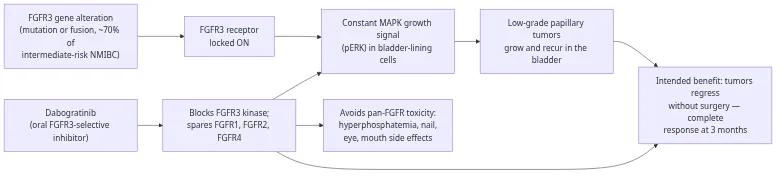
Dabogratinib is a small-molecule pill taken once a day. It blocks FGFR3 — fibroblast growth factor
receptor 3 — a protein switch on the surface of bladder-lining cells. In roughly 70% of
intermediate-risk NMIBC the FGFR3 gene carries a mutation (most often S249C, or Y373C — together
about 80% of the mutations seen) or a fusion that welds the switch permanently on, driving the
constant regrowth of low-grade papillary tumors [VERIFIED — Mol Cancer Ther 2026, DOI 10.1158/1535-7163.MCT-25-0652].
The design point is what dabogratinib does not hit. Older “pan-FGFR” drugs such as erdafitinib
block FGFR1, 2, 3 and 4 together, and the off-target hits cause the side effects that limit them:
blocking FGFR1 in the kidney raises blood phosphate in more than 70% of erdafitinib patients, and
mouth sores, nail damage, eye problems and diarrhea led to dose interruptions in 68% and permanent
discontinuation in 21% in metastatic use [VERIFIED — same paper, citing the erdafitinib label trial]. Dabogratinib is 63-fold selective for FGFR3 over FGFR1, 19-fold over FGFR2 and 55-fold
over FGFR4 in cellular assays, and was built to keep working against the V555M “gatekeeper”
resistance mutation that defeats the pan-FGFR class [VERIFIED — J Med Chem 2024, DOI 10.1021/acs.jmedchem.4c01531 — the company's own discovery paper; no independent replication exists, see data-quality flags].
The step the September readout must prove is chemoablation: that swallowing this pill makes
visible low-grade bladder tumors disappear, measured as complete response at 3 months on a marker
lesion deliberately left after surgery. Evidence it might: in the SURF301 trial the same molecule
produced 6 confirmed partial responses in 11 evaluable patients (54.5%) with metastatic
FGFR3-altered urothelial carcinoma at doses ≥90 mg — a much harder setting than a superficial
low-grade tumor — with responses lasting 7.4 to 12.6 months in the published cases and no
treatment-related grade ≥3 events in those three patients [VERIFIED — DOI 10.1158/1535-7163.MCT-25-0652]. And J&J’s TAR-210, which bathes the bladder in erdafitinib from
an implanted device, produced ~90% CR in FGFR-altered NMIBC — direct proof that FGFR inhibition
ablates these tumors [WEB ESTIMATE — UroToday/OncLive conference coverage, read 2026-08-07].
The honest scientific risk: SURF302 uses lower doses (50 and 60 mg) than the ≥90 mg that produced the mUC responses, betting that superficial disease needs less drug; systemic oral exposure must reach the bladder lining at tumor-killing levels without the local concentrations an intravesical device achieves; and open-label small-n CR rates are noisy. None of these is a mechanism doubt. All of them are bar-clearing doubts.
A.2 Clinical development plan, timeline, feasibility, resourcing
Trials
| Trial | Sponsor / whose drug | Design (arms, blinding, n) | Population | Status / key result | Link |
|---|---|---|---|---|---|
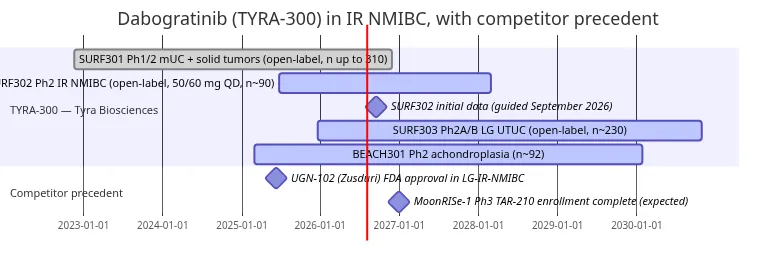
| SURF302 (this catalyst) | Tyra Biosciences / dabogratinib | Phase 2, open-label, no control; dabogratinib 50 mg QD and 60 mg QD arms plus an unopened “dose TBD” arm on the registry; n≈90; marker-lesion design (3–12 mm residual tumor left after TURBT); primary CR at 3 months | FGFR3-altered low-grade intermediate-risk NMIBC (AUA 2024 criteria), Ta/T1 low grade, no BCG within 1 year, no prior FGFR inhibitor | Recruiting; first patient 2025-06-27; >40 enrolled by 2026-08-04; initial data guided September 2026; registry primary completion 2028-02 | NCT06995677 |
| SURF301 | Tyra / dabogratinib | Phase 1/2, open-label, dose escalation/expansion, 10–120 mg QD and 40/50 mg BID, n up to 310 | FGFR3-altered advanced/metastatic urothelial carcinoma and solid tumors, previously treated | Active, not recruiting; 6/11 (54.5%) confirmed PR at ≥90 mg QD (2024-10-25 disclosure); three published durable case responses; primary completion 2026-11 | NCT05544552 |
| SURF303 | Tyra / dabogratinib | Phase 2A/B, open-label, 60 mg / 80 mg / TBD, n≈230 | Low-grade upper tract urothelial carcinoma | Recruiting since 2025-12-22; initial results guided 2027 | NCT07265947 |
| BEACH301 | Tyra / dabogratinib | Phase 2, dose-escalation/expansion, 0.125–0.50 mg/kg, n≈92 | Children with achondroplasia, open growth plates | Recruiting; first child dosed 2025-08-21; fifth dose level opened; safety-sentinel data guided end of Q1 2027 | NCT06842355 |
| ENVISION (competitor precedent) | UroGen / UGN-102 (mitomycin gel) | Phase 3, single-arm, n=240 | Recurrent LG-IR NMIBC (not FGFR-selected) | 78% CR at 3 months (n=223 evaluable); 79% of responders still in response at 12 months; FDA approval 2025-06-12 | FDA announcement |
| MoonRISe-1 (competitor) | Johnson & Johnson / TAR-210 (intravesical erdafitinib-releasing system) | Phase 3, randomized vs intravesical chemotherapy, n=540 | FGFR-altered IR NMIBC — the same biomarker-selected population as SURF302 | Enrolling ahead of schedule, completion expected by end of 2026; first-in-human 12-week CR ~90%, 9-month DOR 89% | NCT06319820 |
Feasibility matrix
| Factor | High probability | Medium probability | Low probability | This asset (assessment) | Source |
|---|---|---|---|---|---|
| Recruitment feasibility | >50 sites, 3:1 patient:site | 20–50 sites, established investigators | <20 sites, novel sites | Medium-High. 47 listed sites (46 recruiting, 1 withdrawn) across the US, Australia, Italy and Spain, largely community urology networks — the right channel for this disease. >40 of ~90 enrolled in 13 months. | [VERIFIED — CT.gov NCT06995677; Q2 2026 release] |
| Endpoint clarity | Regulatory precedent exists | Novel endpoint with FDA alignment | Unvalidated surrogate | High. The FDA approved UGN-102 in this exact population on single-arm 3-month CR plus duration (2025-06-12). The endpoint is de-risked as a registration currency. | [VERIFIED — FDA approval announcement] |
| Trial-design robustness | Pivotal Phase III with SPA | Adaptive with interim analysis | Single-arm, no control | Low-Medium. Single-arm, open-label, no control — the matrix’s low band — but the approved precedent in this population is itself a single-arm 3-month CR trial, which blunts the usual objection. Small interim n (>20 efficacy-evaluable) makes the September number noisy. | [VERIFIED — CT.gov; FDA precedent] |
| Operational / execution | Enrollment complete, standard timeline | Some timeline risk | Enrollment behind | Medium. Guidance slipped twice (1H 2026 → August → September), one month each time; enrollment itself is proceeding and the trial added a KU Medical Center partnership 2026-05-04. | [VERIFIED — release sequence in Readout, below] |
Resourcing sufficiency. Not a constraint. Cash of $353.9M runs into 2H 2028, roughly two years
past this catalyst, all three Phase 2 trials are funded, and R&D spend is scaling (+61% year over
year) rather than being rationed. See ../company.md C.3 [VERIFIED — Q2 2026 release].
A.3 Target label, target product profile, strategic questions, designations
A.3a Target label. Oral treatment of FGFR3-altered low-grade, intermediate-risk non-muscle invasive bladder cancer in adults — a biomarker-defined slice (~70%) of the recurrent LG-IR-NMIBC population.
A.3b Target product profile
| Attribute | Standard of care & key competitor(s) — data | Dabogratinib target profile (goal) | Supporting evidence (+ link) |
|---|---|---|---|
| Indication / target label | Repeated TURBT surgery; UGN-102 (approved 2025-06-12) for recurrent LG-IR NMIBC, unselected; TAR-210 in Phase 3 for FGFR-altered IR NMIBC | FGFR3-altered LG-IR NMIBC, oral | [VERIFIED — FDA; CT.gov NCT06995677] |
| Efficacy (endpoints, regimen) | UGN-102: 78% CR at 3 months, 79% of responders in response at 12 months, six weekly instillations; TAR-210: ~90% 12-week CR (early data), device swapped quarterly | CR at 3 months at or near the intravesical bar, from a once-daily pill; durability to follow | [VERIFIED — FDA/ENVISION; WEB ESTIMATE — TAR-210 conference coverage] |
| Safety / tolerability | UGN-102: local irritative symptoms; TAR-210: local tract symptoms; erdafitinib (oral pan-FGFR): >70% hyperphosphatemia, 21% discontinuation — the cautionary tale | Systemic but FGFR3-selective: low-grade class effects, minimal hyperphosphatemia; SURF301 at higher doses saw no grade ≥3 TRAEs in the published cases | [VERIFIED — DOI 10.1158/1535-7163.MCT-25-0652] |
| Biomarker / companion diagnostic | TAR-210 requires FGFR alteration testing; UGN-102 needs none | Requires documented FGFR3 mutation/fusion — testing infrastructure in community urology is the adoption gate | [VERIFIED — NCT06995677 inclusion criteria] |
| Formulation / administration | All current options are surgical or catheter-delivered in office | The only at-home oral option in the population — the entire convenience thesis | [VERIFIED — trial designs] |
| Payer value | Zusduri course pricing established (figure not verified this sweep); TURBT costs ~$15–30k per episode [UNVERIFIED] | Price against avoided surgeries and office visits; no verified pricing input obtained this sweep | [UNVERIFIED — see B.3a] |
A.3c Strategic Go/No-Go questions. (Pre-Phase-III set — the next decision is whether SURF302 supports a registration path.)
| Group | Question | Answer (tagged) |
|---|---|---|
| Target | Target revalidated as in prior phases? | Yes. FGFR3 is genetically validated in this exact tumor type (~70% alteration rate), Open Targets resolves it cleanly (ENSG00000068078), and two independent drug classes (pan-FGFR, device-delivered erdafitinib) have ablated FGFR-altered NMIBC. [VERIFIED — DOI 10.1158/1535-7163.MCT-25-0652; Open Targets 2026-08-07; WEB ESTIMATE — TAR-210 coverage] |
| Dose & Drug | Exposure–response for the intended commercial regimen and route(s)? | Partial. mUC responses came at ≥90 mg QD; SURF302 runs 50/60 mg QD on the bet that superficial disease needs less. This is the trial’s core dose question, unanswered until September. [VERIFIED — trial records] |
| Dose & Drug | Commercial formulation available or feasible? | Yes — tablet; a dedicated Phase 1 (NCT06006702) bridged capsule to tablet and food effect. [VERIFIED — CT.gov] |
| Dose & Drug | Dose range compatible with clinical and non-clinical safety? | Likely. Doses through 100 mg QD cleared in SURF301; 50/60 mg sits well inside that. Phosphate and ocular exclusions in SURF302 show the class risks are being managed, not assumed away. [VERIFIED — DOI 10.1158/1535-7163.MCT-25-0652; NCT06995677 criteria] |
| Dose & Drug | Therapeutic window given the clinical response? | Unknown at the NMIBC doses — exactly what the September data answer. [UNVERIFIED] |
| Dose & Drug | Intrinsic and extrinsic factors influencing exposure? | Managed: CYP3A4 strong inhibitors/inducers excluded; fasted dosing per SURF301 protocol; QTcF >470 ms excluded. [VERIFIED — trial records] |
| Patient | Proof of concept and positive benefit/risk in the intended population? | Not yet in NMIBC — the mUC PoC (54.5% PR) is in a harder population with the same biology. September is the first in-population look. [VERIFIED — DOI 10.1158/1535-7163.MCT-25-0652] |
| Patient | Phase III design and outcome criteria — accepted, compelling, competitive? | The registration currency (single-arm 3-month CR + duration) is FDA-accepted per the UGN-102 approval. Competitive bar is the open question: 78% unselected, ~90% FGFR-selected. [VERIFIED — FDA; WEB ESTIMATE — TAR-210] |
| Patient | Rationale for the patient population(s)? | Strong: FGFR3 alteration enriches for the very tumors most likely to respond, and LG-IR is the segment where avoiding repeat surgery matters most and BCG is not standard. [VERIFIED — AUA-criteria eligibility; mechanism papers] |
| Patient | Likelihood of the expected outcome? | Modelled 55% against this document’s ≥60% CR settlement bar — see the Locked prediction. [UNVERIFIED — modelled] |
| Patient | Companion-diagnostic strategy, including pricing and market? | Undisclosed. Trial accepts documented FGFR3 mutation/fusion by local testing; no CDx partner named in any release swept. [VERIFIED — absence in press feed] |
A.3d Regulatory designations. None found for dabogratinib in NMIBC — no Fast Track,
Breakthrough or Orphan designation appears in the 236-item press feed or the trial record. (The
achondroplasia program’s designations, if any, belong to that program, not this one.)
[UNVERIFIED — absence asserted from the swept sources only]
A.4 Target product profile valuation matrix
| Stakeholder | Value driver | Minimum threshold | Competitive | Premium | Benchmark / source |
|---|---|---|---|---|---|
| Patient / caregiver | Avoiding repeated surgery under anesthesia; at-home pill vs office catheter courses | CR meaningfully above watchful waiting | CR near UGN-102’s 78% with better convenience | CR ≥80% with 12-month durability — surgery-sparing for most | ENVISION 78% CR / 79% 12-mo durability [VERIFIED — FDA] |
| Regulator | Single-arm CR + duration in LG-IR NMIBC is an approved currency | Replicable CR with acceptable safety | Consistent CR across doses, clean phosphate/ocular profile | Randomized superiority vs intravesical chemo (MoonRISe-1’s design) | UGN-102 approval 2025-06-12 [VERIFIED] |
| Payer / HTA | Price against avoided TURBTs and instillation courses | Cost-neutral vs surgical episodes | Below combined surgery+instillation cost with adherence evidence | Durable CR shifting patients off the surgical treadmill | No verified pricing input this sweep [UNVERIFIED] |
| Provider | Urologists lose procedure revenue on an oral — adoption friction is real; biomarker testing adds workflow | FGFR3 testing deliverable in community urology | Reflex urine/tissue FGFR3 testing established | Oral becomes guideline-preferred in FGFR3+ patients | Analyst channel commentary [WEB ESTIMATE — Guggenheim "NMIBC Revolution", read 2026-08-07] |
A.5 Evidence quality and endpoints
| Criterion | Score (High / Medium / Low) | Basis (one line) | Link |
|---|---|---|---|
| Target validation | High | ~70% FGFR3 alteration rate in the exact population; two other FGFR-directed modalities ablate these tumors. | DOI 10.1158/1535-7163.MCT-25-0652 |
| Mechanism clarity | High | Kinase inhibition with published structures, selectivity ratios and dose-dependent pERK knockdown including gatekeeper-mutant lines. | DOI 10.1021/acs.jmedchem.4c01531 |
| Biomarker availability | Medium | FGFR3 mutation/fusion testing exists but is not routine in community urology; it is both the selection tool and the adoption gate. | NCT06995677 criteria |
| Publication quality (peer-reviewed? independent authors?) | Medium | Two of five PubMed records are wholly Tyra-authored; the field review (independent) treats TYRA-300 as a credible class member; no independent clinical data exist yet. | DOI 10.1016/j.tips.2025.09.004 |
| Clinical / expert sentiment | — | Moved to A.5b, below. | — |
Endpoints
| Endpoint (full name) | What it measures | Scale / range | Better direction | MCID / note |
|---|---|---|---|---|
| Complete response (CR) rate at 3 months | Share of patients with no visible tumor at cystoscopy 3 months after starting treatment, marker-lesion design | 0–100% | Higher | No formal MCID; the approved benchmark in this population is 78% (UGN-102/ENVISION), and FGFR-selected TAR-210 printed ~90% in early data. This document’s settlement bar is ≥60% (Locked prediction). |
| Duration of response (DOR) | How long a complete response lasts, responders only | Months (trial follows to 24) | Longer | UGN-102: 79% of responders still in response at 12 months — the durability bar. |
| Recurrence-free survival at 12/24 months | Share of responders without recurrence at fixed timepoints | 0–100% | Higher | Secondary; not part of the September interim. |
| Progression-free survival (PFS) | Time until disease worsens (e.g., grade/stage progression) or death | Months | Longer | Low-grade disease progresses rarely; safety-oriented secondary. |
| Incidence and severity of adverse events | Safety, CTCAE-graded | Counts by grade | Fewer/lower | The differentiation claim: minimal hyperphosphatemia vs erdafitinib’s >70%. |
A.5b Key opinion leaders.
CT.gov names no overall official and no investigator on any of SURF302’s 47 locations, so the investigator panel below is built from the program’s peer-reviewed clinical publication (SURF301), whose named academic authors are trial investigators at their sites. No independent voice on this program’s endpoint was verified this sweep — that is a recorded absence, not an unexamined one; the searches are listed per row and in the program data-quality flags.
Panel as of. 2026-08-07.
Investigators
| Name | Role / affiliation | Trial (NCT) | Conflicts (party, kind, disclosed in, as of) | Conflicts checked (source, date) | Source | Tag |
|---|---|---|---|---|---|---|
| Yohann Loriot | SURF301 investigator and academic co-author; Institut Gustave Roussy, Université Paris-Saclay, Villejuif | NCT05544552 | Johnson & Johnson (erdafitinib / TAR-210, the direct FGFR competitor): first author of the J&J-run NORSE Phase 2 of erdafitinib ± cetrelimab, co-authored with seven J&J employees; disclosed in the author list and affiliations, DOI 10.1200/JCO-25-00826; as of 2026-01-15 | PubMed search_articles “Loriot Y[Author] AND erdafitinib”, 2026-08-07 — 29 records, competitor relationship confirmed; the dabogratinib paper’s own Declarations section was not returned by PMC full text (PMC13060625), recorded as a limit | PubMed, author list of DOI 10.1158/1535-7163.MCT-25-0652 | VERIFIED — PubMed 2026-08-07 |
| Valentina Boni | SURF301 investigator and academic co-author; NEXT Oncology, Hospital Universitario Quirónsalud Madrid | NCT05544552 | Debiopharm (Debio 1347, an FGFR1–3 inhibitor, discontinued after FUZE): co-author of the FUZE basket trial with six Debiopharm employees; disclosed in the author list and affiliations, DOI 10.1158/1078-0432.CCR-24-0012; as of 2024-10-15 | PubMed search_articles “Boni V[Author] AND (erdafitinib OR FGFR OR bladder cancer)”, 2026-08-07 — 4 records reviewed; PMC13060625 Declarations section not returned, recorded as a limit | PubMed, author list of DOI 10.1158/1535-7163.MCT-25-0652 | VERIFIED — PubMed 2026-08-07 |
Independent voices
No independent voice is recorded. The searches run (PubMed on the program’s five records; web search of conference coverage) surfaced named commentators only in competitor-trial contexts — e.g., TAR-210 investigators — who are not independent of the competing sponsor, and recording a conflicted voice as independent is the contradiction the schema forbids.
| Name | Affiliation | View (close enough to quote) | As of | Conflicts checked (source, date) | Source | Tag |
|---|
Judgement
| Endpoint supported | Basis (one or two sentences) | Tag |
|---|---|---|
| UNKNOWN | No independent voice could be verified this sweep, so the panel is too thin to judge. The endpoint’s regulatory standing is a separate, documented fact (FDA approved UGN-102 on single-arm 3-month CR in this population — A.5 Endpoints), but that is precedent, not an assembled expert view. | UNVERIFIED — judgement |
Dissent
| Name | View (close enough to quote) | Source |
|---|
B. Commercial assessment
B.0 Current treatment algorithm
- A bladder tumor is found (usually after blood in the urine) and removed by TURBT — surgery through the urethra under anesthesia. Pathology grades it: low-grade Ta/T1, intermediate risk per AUA 2024 criteria if it recurred within a year, is >3 cm, or is multifocal.
- Today the LG-IR patient then enters surveillance: cystoscopy every few months, and another TURBT every time tumors regrow — which for intermediate-risk disease is the expected course. A single dose of intravesical chemotherapy after surgery reduces early recurrence; BCG (the immune-stimulating bladder infusion) is standard for high-risk, not this population.
- Since 2025-06-12 there is one approved drug alternative to repeat surgery: UGN-102 (Zusduri), a
mitomycin gel instilled through a catheter in six weekly office visits — 78% CR at 3 months
[VERIFIED — FDA]. - Where dabogratinib would fit: in the ~70% of these patients whose tumors carry an FGFR3 alteration, as the first at-home oral option — displacing repeat TURBT and competing directly with UGN-102 and, if approved, TAR-210 for the “treat instead of operate” slot. It adds a biomarker-testing step that neither surgery nor UGN-102 requires.
B.1 Competitive landscape and positioning
| Metric | High value | Medium value | Low value | This asset (assessment) | Source |
|---|---|---|---|---|---|
| Mechanism differentiation | First-in-class or novel target | Next-generation improvement | Me-too | Medium-High. First oral FGFR3-selective agent in NMIBC; the target is shared with TAR-210 (locally delivered pan-FGFR) and Lilly’s earlier LOXO-435 sits in the same selective class. Differentiation is route (oral) plus selectivity, not target novelty. | DOI 10.1016/j.tips.2025.09.004 [VERIFIED] |
| Development-timeline advantage | >12 months ahead | Within 6–12 months | Lagging >12 months | Lagging. UGN-102 is approved; MoonRISe-1 (TAR-210) finishes enrollment around end-2026 while SURF302’s own primary completion is 2028-02. Dabogratinib is realistically third to market in its own biomarker niche. | FDA; UroToday [VERIFIED / WEB ESTIMATE] |
| Clinical proof-of-concept evidence | Positive Phase IIb (n>100) | Phase IIa signals (n=20–50) | Preclinical only | Medium. 54.5% PR in n=11 FGFR3-altered mUC plus consistent xenograft regressions; nothing yet in NMIBC itself. | DOI 10.1158/1535-7163.MCT-25-0652 [VERIFIED] |
| IP protection | Composition-of-matter, long-dated | Method-of-use | Pending or none | Medium-High (thinly sourced). US 12,264,149 issued plus pending families per a patent aggregator; wholly owned, no royalty or license found in any swept source. Not verified against the patent register this sweep. | [WEB ESTIMATE — Synapse/Patsnap, read 2026-08-07] |
Where this asset wins: the ~70% FGFR3-altered slice of a population that hates its current treatment, with the only option that requires neither operating room nor catheter. The single fact the thesis rests on: oral, systemic dabogratinib at 50–60 mg must ablate superficial tumors roughly as well as drugs delivered directly into the bladder. If September’s CR rate is near the intravesical bar, the convenience story writes itself; if it is materially below, “oral” stops being an advantage and becomes the explanation.
B.2 Addressable market
| Component | How it is estimated | Premium threshold | This asset (assessment) | Source |
|---|---|---|---|---|
| Drug-treated patients | US recurrent LG-IR-NMIBC pool × ~70% FGFR3-altered × testing penetration | >100,000 (US/EU5/Japan) | Below the premium bar and not precisely quantifiable from verified sources this sweep: bladder cancer is common (~80k+ US diagnoses/yr [WEB ESTIMATE]), NMIBC is ~75% of it, but the recurrent LG-IR, FGFR3-tested slice is a fraction no swept source pins down. Tens of thousands US, not hundreds. | [UNVERIFIED — structure verified, size not] |
| Market exclusivity | Issued composition-of-matter (US 12,264,149) + NCE exclusivity on approval | >10 years combined | Plausibly met — a 2024–25-vintage patent estate plus 5-year NCE runs well past 2035 — but the estate was not read directly this sweep. | [WEB ESTIMATE — patent aggregator] |
| Reimbursement precedent | Approvals in ≥2 major markets | Positive NICE/CADTH guidance | UGN-102’s US approval establishes the indication is reimbursable; no ex-US precedent yet for any drug in LG-IR-NMIBC. | [VERIFIED — FDA] |
| Patient-journey impact | Fewer surgeries, no anesthesia, no catheter visits | >30% quality-of-life gain | Strong qualitatively — replacing recurring surgery with a pill — but no QoL instrument data exist for dabogratinib yet. | [UNVERIFIED] |
B.3 Value and feasibility
B.3a Expected peak sales. Built bottom-up as a labelled model; no verified epidemiology or pricing input was obtained this sweep, so every scenario is a model, conditional on approval in IR NMIBC (roughly 2029+ given primary completion 2028-02), US-only, this indication only — excluding UTUC, achondroplasia, and ex-US.
| Scenario | Assumptions (patients × price × share) | Estimate (USD/year at peak) | Basis / tag |
|---|---|---|---|
| Low | ~5,000 treated US patients × ~$30k/course-year — FGFR3 testing stays rare in community urology, TAR-210 wins the FGFR-tested segment | ~$150M | [UNVERIFIED — modelled] |
| Base | ~15,000 × ~$40k — reflex FGFR3 testing takes hold, oral splits the biomarker-positive segment with TAR-210, price anchored between course-based intravesical therapy and oral oncology norms | ~$600M | [UNVERIFIED — modelled] |
| High | ~25,000 × ~$60k — CR lands ≥75%, durable, oral becomes preferred first drug therapy in FGFR3+ LG-IR; management’s “blockbuster” framing realised | ~$1.5B | [UNVERIFIED — modelled; the "3×3 blockbuster" label is the company's own] |
The inputs that are not defensible today, named per rule 30/9: the treated-population size
(no verified epidemiology of the recurrent, tested, FGFR3+ slice), the price (no verified Zusduri
course price obtained, no dabogratinib pricing signal), and TAR-210’s share split. Sell-side
raised NMIBC peak-sales models in 2026 without publishing figures [WEB ESTIMATE — Investing.com Oppenheimer note, read 2026-08-07].
B.3b Feasibility
| Question | Answer (tagged) |
|---|---|
| Expected net present value (eNPV) | No point estimate (rule 10). Directionally: a base case of ~$600M peak at ~30% probability-to-approval from here, launch 2029–2030, standard oncology margins and 12% discount gives an NMIBC-leg value in the low-to-mid hundreds of millions against a recomputed enterprise value of ~$1,425M that also carries UTUC, achondroplasia, TYRA-200 and the platform. Every input [UNVERIFIED — modelled]. |
| Capital to the next decision point | Effectively nil incremental — SURF302 is funded within the stated 2H 2028 runway (../company.md C.3). |
| Capital to approval, and the funding plan | A registration path (larger single-arm or randomized cohort, filing) plausibly $150–300M [UNVERIFIED — modelled]; the $250M refreshed ATM (C.3) is the visible plan — sell equity into data strength. |
| Launch capability — alone, or must partner? | Community urology is a concentrated, reachable audience; a solo US launch is credible for a company this capitalised, but no commercial build exists yet. [UNVERIFIED] |
| Commercialisation rights — retained, split, or out-licensed? | Fully retained; wholly-owned, in-house molecule; no royalty or license obligation found in any swept source. [VERIFIED as absence in swept sources — 10-K not opened] |
B.4 Product-development risk
Framing questions.
- Does the development plan support the target product profile claims? Mostly. The open-label marker-lesion Phase 2 directly measures the claim that matters (chemoablation CR). What it cannot support is the comparative convenience-at-parity claim — that needs the CR number to land near the intravesical bar.
- Will the identified risks affect the target product profile? The dose-selection risk does: if 50/60 mg underperforms because ≥90 mg was the active dose, the profile’s tolerability claim collides with its efficacy claim, since higher doses brought dose reductions in SURF301 cases.
- If a risk cannot be mitigated, is the asset still differentiated? Yes in one direction only: even a middling-CR oral remains the only at-home option — but payers and urologists have two higher-CR local options, so differentiation without competitive efficacy is a niche, not a franchise.
| Category | Time risk | Quality risk | Cost risk | Note |
|---|---|---|---|---|
| Project management | Low | — | — | Three Phase 2 trials run in parallel on ample cash. |
| Research | — | Low | — | Mechanism and selectivity published with structures. |
| IP | — | Low-Medium | — | Issued US composition-of-matter per aggregator; not read directly. |
| Legal | — | — | — | None found. |
| DMPK | — | Medium | — | Systemic exposure must reach urothelium at ablative levels at 50/60 mg — the central pharmacology bet. CYP3A4 interaction management already in protocol. |
| Safety pharmacology | — | Low-Medium | — | QTcF exclusion in protocol suggests routine caution, no signal disclosed. |
| Toxicology | — | Low | — | Doses through 100 mg QD cleared in humans. |
| Drug safety (clinical) | — | Medium | — | Class ocular (central serous retinopathy screening in protocol), phosphate, nail/skin effects; SURF301 published cases show G2 events forcing dose reductions at 90–120 mg — watch the 50/60 mg discontinuation rate in September. |
| Biomarker | Medium | Medium | — | FGFR3 testing is the enrollment funnel and the commercial funnel; slow testing = slow everything. |
| Clinical pharmacology | — | Medium | — | Dose bet, as above. |
| Clinical (efficacy) | — | High | — | The bar: 78% unselected (approved), ~90% FGFR-selected (device). An open-label >20-patient interim CR in the 50s–60s is scientifically fine and commercially wounding. |
| Clinical operations | Medium | — | — | Two one-month guidance slips; 46 recruiting sites mitigate. |
| CMC / manufacturing | — | Low | — | Small-molecule tablet, bridged formulation. |
| Regulatory | — | Low-Medium | — | Endpoint precedent set by UGN-102; no designations found (A.3d). |
| Global evidence & value | — | Medium | — | No ex-US precedent in the indication; payer case rests on surgery displacement. |
| Commercial | — | Medium-High | — | Third to market behind an approved incumbent and a Phase 3 device from J&J; provider economics favor procedures over pills. |
Readout
Sources
| Kind | Where it comes from | What it is worth | Value (or null) | Tag | Note |
|---|---|---|---|---|---|
bpiq | fetch_company_drugs — catalyst_date, catalyst_date_text | The current single source. | 2026-09 | VERIFIED — BPIQ fetch_company_drugs, read 2026-08-07 | catalyst_date 2026-09-30 is the month-end placeholder for “September 2026” (rule 23); the text names a month, so this is a MONTH-precision source, not a day. Note field: “SURF302 initial data expected September 2026; more than 40 patients enrolled” (08/04/26). |
ctgov | CT.gov get_trial_details — primary_completion_date | Independent of company messaging — but it dates a different milestone. | 2028-02 | VERIFIED — ClinicalTrials.gov NCT06995677, read 2026-08-07 | Primary completion dates the full trial (last patient’s 3-month assessment), not the guided interim. It bounds the program, it does not date this catalyst; no conflict with the September interim. has_results false. |
company | fetch_company_press_releases / Q2 2026 release | The company’s own most recent dated wording. | 2026-09 | VERIFIED — Q2 2026 release, 2026-08-04 (PRNewswire 302842952) | ”Initial results from the SURF302 study … in September 2026”: safety >40 patients, efficacy >20, aggregate across both QD doses. Third dated statement in a twice-slipped sequence — see slips. |
congress | data/congresses.json + press feed + web check | Answers “where will they say it.” | null | VERIFIED — absence checked, 2026-08-07 | No company statement names any meeting for this readout. ESMO 2026 (Madrid, 2026-10-23/27, data/congresses.json) sits after the guided month; a September disclosure implies a standalone release. Matching on therapeutic area alone is a guess, and a guess is not a source. |
modelled | Trial arithmetic — see below | The only estimate independent of guidance. | 2026-09/2026-11 | UNVERIFIED — modelled | See method. Guided date sits at the front of the modelled range. |
The modelled estimate. This catalyst is an interim the company controls, so there is no
registry anchor to add a lag to; the arithmetic is enrollment-driven instead. More than 40
patients were enrolled by 2026-08-04 with first patient dosed 2025-06-27; every patient dosed by
June 2026 has a 3-month CR assessment by September 2026, so an efficacy-evaluable set of >20 is
mechanically available in September, and a cut-plus-cleaning allowance of zero to two months puts
the plausible disclosure range at September to November 2026. data/benchmarks/readout-lag.json
holds no comparable interim-disclosure observation, and the default primary-completion lag of rule
34 does not apply to a company-controlled interim — stated rather than misapplied.
Window
| Earliest | Likeliest | Latest | Precision | Confidence |
|---|---|---|---|---|
| 2026-09-01 | 2026-09-15 | 2026-10-31 | MONTH | MEDIUM |
Basis. The company names a month, twice re-guided, so the window opens on that month’s first day. Likeliest mid-September: the September options positioning (C.6) and the “September marks an important milestone” framing in the Q2 release read as a date the company intends to hit, and an interim it controls needs no long lag. Latest end-October: each of the two prior slips was exactly one month (1H 2026 → August → September), so one more identical slip is retained as the conservative edge. Precision is MONTH because “September 2026” names a month and no source names a day. Confidence is MEDIUM, not HIGH, because the same guidance has already moved twice in two quarters.
Disagreement. CONSISTENT. bpiq mirrors the company’s wording; the modelled range contains it; ctgov dates a different milestone (full primary completion, 2028-02) and therefore neither confirms nor contradicts the interim date.
Date slippage. Two slips in four dated statements.
| As of | Guidance text |
|---|---|
| 2025-06-30 | ”Initial 3-month complete response data expected to be reported in 1H 2026” (first-patient release) |
| 2026-03-02 | ”Expects to report initial three-month complete response data by the end of 1H 2026” (Q4 2025 results — reiteration, not a slip) |
| 2026-05-13 | ”Initial Phase 2 data readout from SURF302 expected in August 2026” (Q1 2026 results — slip 1) |
| 2026-08-04 | ”Initial results from the SURF302 study … in September 2026” (Q2 2026 results — slip 2) |
Attribution
Computed by lib/clustering.mjs attributionFor over every has_catalyst row in
../company.md C.2, with this program’s own readout window, at
CATALYST_CLUSTER_MIN_MONTHS = 6; output transcribed.
Status. CONTAMINATED
| Status | Means |
|---|---|
CLEAN | conflicts is empty — nothing else has_catalyst on this ticker’s pipeline lands within the window. |
CONTAMINATED | At least one conflict is confirmed: a real disclosed date on one side — a readout.window naming DAY or MONTH precision, or (when there is no readout yet) an exact catalyst_date — never two guesses touching. The stock-direction call below must not be presented as attributable to this program alone; say why in Note. |
INDETERMINATE | conflicts is non-empty, but every entry is still a guess on both sides. |
WAIVED | An analyst’s own override, written by hand after the computed status is recorded. |
Conflicts
| bpiq_drug_id | Label | Date | Analysed? | Gap (days) | Confirmed? |
|---|---|---|---|---|---|
| 16756 | TYRA-300 | 2027-03-31 | No | 62 | Yes |
| 17139 | TYRA-200 | 2026-12-31 | No | 0 | Yes |
Note. Both conflicts are confirmed through this program’s own MONTH-precision window — the other side of each pair is a period placeholder. The one that bites is TYRA-200 (17139): its readout is guided to Q4 2026 in the company’s own text, so it can land as early as October, inside this window’s back half and squarely inside the stock call’s reaction window; a move in October–November is not attributable to SURF302 alone. BEACH301 (16756) is guided to end of Q1 2027 and its half-year placeholder merely sits 62 days past this window’s latest edge — it contaminates the arithmetic, not really the September story. The scenario ranges below are therefore written for the September–October front half of the window, where SURF302 is the only plausible mover on this ticker.
Market and timing for this event
- Plain takeaway. A heavily pre-traded, heavily shorted, crowd-owned binary landing inside eight weeks, priced at 55% of a 52-week range it climbed on anticipation alone, with the only historical efficacy print on this ticker having resolved −23% in a day.
- Months to this catalyst. 0.8 to
readout.window.earliest(2026-09-01) and 2.8 to the latest edge (2026-10-31), from 2026-08-07. Precision is MONTH, so the true gap is known to within a few weeks, not days. - Expected move around this event. The chain cannot price it cleanly
(
../company.mdC.6): the September $25 straddle brackets 17–49% of spot bid-to-ask. Stated as a bracket: a 25–40% move on data is what the chain’s wide quotes and the ticker’s own history jointly suggest; no point estimate is defensible. - Nearest comparable past reaction. C.7’s 2024-10-25 row — the SURF301 interim (54.5% PR in mUC), the only efficacy disclosure in company history: −23.3% close-to-close, −40.9% over three sessions, from a similar anticipation-inflated base. It is the direct analogue: same drug, same sponsor, “positive” headline, expectations unmet. The positive analogues (+14.3%, +5.2%) are dosing milestones and do not scale to an efficacy print.
- Materiality. Dominant near-term per
../company.mdC.2 — the next disclosed catalyst on the whole pipeline, though not the whole equity. Attribution is CONTAMINATED (above): the call below is presented as attributable to SURF302 only in the window’s front half; the back half is shared with TYRA-200’s guided Q4 window. - Date slippage. 2 slips (Readout, above) — both one month, both within 2026.
Spot. $26.96, read 2026-08-07 (BPIQ last price, equal to the price cache’s 2026-08-06
close), from ../company.md C.4.
Scenario prices
| Scenario | Low | High | Anchors (each named and tagged) | Basis |
|---|---|---|---|---|
| Positive | 30.00 | 46.00 | ① 52-week high $40.65 [VERIFIED — ../company.md C.4, derived from data/prices/TYRA.json] ② Published analyst targets: consensus $46.90–$51.97, range $42.00–$59.62, 15 of 17 ratings buy [WEB ESTIMATE — MarketBeat/TipRanks/stockanalysis aggregators, read 2026-08-07] ③ This ticker’s own largest clean positive catalyst move, +14.3% close-to-close (2025-08-21), applied to spot ≈ $30.8 [VERIFIED — ../company.md C.7] ④ Dilution mechanism firing on the event: $250M ATM amended 2026-08-04, management sells into strength (March block sale at $31.50 is the precedent) [VERIFIED — ../company.md C.3] | Wide because “positive” (CR ≥60% with clean safety) spans two receptions. The low is a pass near the bar sold into a crowded register — roughly the ticker’s best historical clean move off spot, held back by the October-2024 precedent of good-not-great data being sold. The high is a clear win (CR ≥75%, competitive with the intravesical bar in a biomarker-selected population) plus fuel from a ~32%-of-float short position: through the $40.65 high toward the bottom of the analyst consensus, capped under the $50+ targets by the refreshed ATM. |
| Miss | 14.00 | 20.00 | ① 52-week low $9.96 [VERIFIED — ../company.md C.4] ② Cash per share ≈ $5.36 ($353.9M ÷ 65.99M shares) [VERIFIED — derived from ../company.md C.3/C.4] ③ This ticker’s own worst catalyst reaction, −23.3% close-to-close on 2024-10-25, applied to spot ≈ $20.7, with the −40.9% three-session extension ≈ $15.9 [VERIFIED — ../company.md C.7] ④ Pre-re-rating base: $20.81 close on 2025-12-01, before the 2026 anticipation leg [VERIFIED — data/prices/TYRA.json via ../company.md C.4] | The high is the single-day October-2024 precedent repeated (≈ −24% ≈ $20), which also lands on the December-2025 pre-run base. The low is the three-session extension of that same precedent (≈ $16) pushed further because a CR miss reads across to SURF303 (same drug, same biology) — but held far above cash ($5.36) because achondroplasia, TYRA-200 and $353.9M are untouched by a bladder-cancer miss. |
Expected value. 0.55 × $38.00 (positive midpoint) + 0.45 × $17.00 (miss midpoint) =
$28.55, +5.9% against spot $26.96. Method: probability_pct applied to the midpoint of
each scenario range. At the band edges the sign flips: $25.40 (−5.8%) at 40%, $31.28 (+16.0%) at
68%. This is arithmetic, not advice, and it is not a price target.
Run-up
Entry and exit
| Entry date | Entry price | Entry basis | Exit rule |
|---|---|---|---|
| 2026-08-07 | $26.96 | The prediction’s own lock date and spot — the first day this window judgement exists to trade against, 0.8 months before the window opens. | T-5 trading days before readout.window.earliest |
Predicted move and peak
| Low | High | Estimated date | Basis | |
|---|---|---|---|---|
| Predicted move, entry to exit | 0 | 10 | — | The exit rule resolves to roughly 2026-08-25 — only ~12 trading days of run-up room. A named readout month plus a 32%-of-float short position and the September $30/$40 call wall argue for drift up; the crowded register, two prior slips and the post-April give-back cap it. A single-digit move is the honest central case for so short a runway. |
| Predicted peak, from entry | 10 | 30 | 2026-09 | The peak is expected inside September itself, at or just before the print, as shorts cover into the named month — the pattern the ticker’s own no-data run (Jan–Apr 2026, +48% in closes) established. The ceiling stays under the $39.61 peak close (+47%) because expectations are already partly rebuilt and attribution is contaminated late in the window. The peak can print and fade before the position closes. |
Priority score drivers
Five of the seven transcribed from lib/runup.mjs scoreDriver; the two judgement drivers read
from this document.
| Driver | Reads | Score (0–100) | Basis |
|---|---|---|---|
| Unmet-need relevance | A.4, B.0 — judgement | 65 | Recurrent LG-IR NMIBC condemns a largely elderly population to repeated surgical resections under anesthesia; an oral at-home option would be the first systemic one. Below the top band because the need is for convenience and durability rather than survival, and an approved in-office intravesical option (UGN-102, June 2025) already serves part of it. |
| Value-uplift potential | B.3a vs EV, C.2 — judgement | 55 | IR NMIBC is one of three legs of the “3×3”; modelled base peak ~$600M against a recomputed EV of ~$1,425M, materiality dominant near-term. Mid-range because the equity already re-rated ~2.7× off its 52-week low largely on this readout, so residual uplift on a merely-adequate result is smaller than the raw ratio suggests. |
| Probability of a positive outcome | outcome_prediction.probability_pct — computed | 55 | outcome_prediction.probability_pct = 55 |
| Date confidence | readout.precision + readout.confidence — computed; the gate | 48 | readout.precision=MONTH, readout.confidence=MEDIUM |
| Squeeze mechanics | float, short %, dollar volume — computed | 78 | float 49000000 shares, short_float_pct 32, average dollar volume 25939046 — thinner liquidity and a tighter, more-shorted float amplify a positive surprise. (Float is modelled: 65.99M weighted shares less RA Capital’s 12.2M and officer/director holdings; short-float units unconfirmed per 02-connectors.md; dollar volume from data/prices/TYRA.json, last 60 trading days.) |
| Priced-in-ness | 52-week position — computed; HIGH = room LEFT to run | 45 | price 26.96 sits at 55% of its 52-week range (low 9.96, high 40.65, as of 2026-08-07) — closer to the 52-week high — less room left to run. A BELOW-50 score here means the move is partly priced already; this driver reads opposite to its name and this row says so on purpose. |
| Financing and clustering risk | runway + attribution — computed; the one NEGATIVE driver, HIGH = HIGH risk, sinks the total | 100 | attribution.status=CONTAMINATED is the larger of the two independent risks (clustering); runway is OK (cash into 2H 2028), so financing contributes nothing — the whole score is the TYRA-200 Q4 window overlapping this one. A HIGH score here pushes the total DOWN, opposite to the other six. |
Priority score. From lib/runup.mjs priorityScore over the seven rows above.
Priority score 21 · formula_version 1.0.0
Settlement. Left null at lock time. The exit could not be resolved either: the committed price
cache ends 2026-08-06, before the window opens, so resolveExit returns null and exit is
recorded as null on the prediction.
Verdict
What I would do. Watch. Do not chase the run-up; reassess on the print.
Why. The science is the good part: the target is the best-validated driver in this tumor type, the same molecule already ablated harder disease, and the endpoint is an approved registration currency. The trade is the bad part. The expected value sits only ~6% above spot and flips sign inside its own probability band, because the market has spent fourteen months and 2.7× paying for this readout in advance while the bar was being raised externally — 78% CR approved (UGN-102), ~90% in early FGFR-selected data (TAR-210). The one time this company printed efficacy data into inflated expectations, the stock fell 23% in a day on a result management called positive. And a win does not pay cleanly: a $250M ATM was refreshed one month before the readout, and the back half of the reaction window is shared with TYRA-200’s Q4 readout.
What would change this. Upward: the initial CR rate landing ≥70% with single-digit grade ≥3 toxicity — that converts the convenience thesis into a competitive-efficacy thesis and the 32% short position into fuel; buy the confirmation, not the anticipation. Downward before the print: a third guidance slip past October, which would break the “named month” premise this window and run-up call rest on.
What to watch.
- 2026-09-01 to 2026-09-30 — the guided disclosure itself: CR rate, evaluable n per dose, discontinuations at 50/60 mg, any phosphate or ocular signal.
- Any date — an ATM drawdown or offering filing before the data (would signal management selling ahead of, not into, the print).
- End of 2026 — MoonRISe-1 (TAR-210) enrollment completion; its Phase 3 cadence defines the competitive clock this program races.
- Q4 2026 — TYRA-200 ICC initial data (bpiq 17139): the attribution contaminant; a move on this ticker after October needs decomposing before it is read as SURF302’s.
- 2028-02 — SURF302 registry primary completion; if it moves, the program’s full-data cadence moves with it.
Locked prediction
- Outcome-direction (will the readout succeed on its primary endpoint?): positive —
probability 55%, band 40–68%
[UNVERIFIED — modelled]— the probability that the settlement definition below (initial CR rate ≥60%, no stopping safety signal) is met. - Stock-direction (which way do the shares move?): no-edge — confidence low — window 2026-08-07 to 2026-11-30, basis: the readout window (earliest 2026-09-01, latest 2026-10-31, MONTH precision) plus four weeks for the reaction to settle; expected value +5.9% with a sign-flip inside the probability band; attribution CONTAMINATED in the window’s back half.
- Scenario prices: positive $30.00–$46.00 · miss $14.00–$20.00 (from the table above)
- Expected value: $28.55, +5.9% against spot $26.96 (arithmetic, not advice)
- Run-up: entry $26.96 on 2026-08-07, exit rule T-5 trading days before
readout.window.earliest — predicted move 0–10%, predicted peak 10–30% around 2026-09 —
priority score 21,
formula_version1.0.0 - Settles on: the first public disclosure of initial SURF302 (NCT06995677) results, guided September 2026; readout window 2026-09-01 to 2026-10-31. Positive definition: the disclosed 3-month complete response rate in efficacy-evaluable FGFR3-altered patients, aggregated across the 50 mg and 60 mg once-daily arms, is ≥60%, and no treatment-related death, dosing hold or program discontinuation in IR NMIBC is announced with it. Anything else is a miss — including an aggregate CR below 60%, or data disclosed without an evaluable CR rate. Source: Tyra’s own press release or presentation, cross-checked against the ClinicalTrials.gov record.
- Locked: yes · Settled: no
Program data-quality flags
- ChEMBL holds no record of dabogratinib under “dabogratinib”, “TYRA-300” or “TYRA300” (three calls, all legitimately empty). Molecular identity and the 63×/19×/55× selectivity ratios rest entirely on Tyra’s own peer-reviewed discovery paper (DOI 10.1021/acs.jmedchem.4c01531); no independent replication of selectivity exists in any swept source.
- Open Targets rate-limited on first attempt (verbatim:
Rate limit exceeded for client: global); the immediate retry succeeded, so the state is CALLED. “Non-muscle invasive bladder cancer” returns no disease entity — target-level validation only. - CT.gov names no investigator or contact on any of SURF302’s 47 locations. The KOL investigator panel is built from the SURF301 publication’s named academic authors instead, with each person’s verifiable trial attachment stated per row.
- PMC full text strips back matter: the dabogratinib clinical paper (PMC13060625) came back
without its Declarations section, so its own COI statement was not retrievable through this
connector. Recorded in each
conflicts_checkedentry rather than papered over. - This catalyst is a company-controlled interim, not a registered milestone. The registry’s primary completion (2028-02) does not date it, and no independent source can. The readout window rests on the company’s twice-slipped guidance plus enrollment arithmetic — stated in the Readout section rather than presented as externally anchored.
- The BPIQ
notefield carries only one dated entry for this program; the slip sequence was reconstructed from the company’s own release wording via web search of the ir.tyra.bio/ PRNewswire record and is quoted with its dates in Readout. - Registry vs release dose discrepancy, minor: NCT06995677 lists a third “Dose TBD” arm; the Q2 2026 release describes “two QD doses (50 mg and 60 mg)” and guides initial data on both. Read as an unopened escalation arm; initial data cover the two QD doses.
- No verified epidemiology or pricing input for the B.3a model could be obtained this sweep; all three peak-sales scenarios are labelled models, and the missing inputs are named there.
- Competitor figures are taken as published headlines (ENVISION 78%/79%; TAR-210 ~90%/89%; erdafitinib toxicity rates). The ENVISION and erdafitinib figures trace to FDA/paper sources; the TAR-210 figures are conference coverage and are tagged WEB ESTIMATE wherever used.