TLSA / foralumab-na-spms — Intranasal foralumab for non-active secondary progressive multiple sclerosis
Program analysis ·
bpiq_drug_id13497 · prepared 2026-08 · USD · framework v5.6.0 · Coverage: CLEAREDCompany context, financials, ownership, options and the full pipeline:
../company.md.How to read this. Written for a reader who has not studied pharmacology or finance. Terms specific to this program are in the Glossary below; general terms are defined once in
framework/04-glossary.md. Tags:[VERIFIED — source]/[UNVERIFIED]/[WEB ESTIMATE — source, date].
Glossary
| Term | Plain-language meaning |
|---|---|
| Multiple sclerosis (MS) | A disease in which the immune system attacks the insulating sheath around nerve fibres in the brain and spinal cord, so the nerves conduct signals poorly. |
| Secondary progressive multiple sclerosis (SPMS) | The stage many MS patients enter after years of relapsing disease, in which disability worsens steadily rather than in attacks. |
| Non-active SPMS (na-SPMS) | SPMS in a patient who has had no relapses and no new lesions on magnetic resonance imaging (MRI), and yet keeps getting worse. It is the hardest form to treat, because the visible inflammation that most MS drugs target is no longer there. This is the population in this trial. |
| Progression independent of relapse activity (PIRA) | Disability that accumulates without any relapse to explain it. The clinical problem na-SPMS presents. |
| Foralumab (TZLS-401, NI-0401) | A fully human monoclonal antibody against CD3. A monoclonal antibody is a laboratory-made protein that binds one specific target. “Fully human” means its sequence is human rather than partly mouse, which lowers the chance the patient’s own immune system reacts against the drug. |
| CD3 | A protein complex on the surface of T cells, part of the machinery a T cell uses to recognise its target. Binding it changes how the T cell behaves. |
| Regulatory T cell (Treg) | A T cell whose job is to switch other immune cells off. Inducing them is how this drug is meant to calm inflammation, rather than by killing immune cells. |
| Mucosal tolerance | The long-observed phenomenon that giving something through a mucous membrane — the nose or the gut — teaches the immune system to tolerate it rather than attack it. The scientific premise of nasal dosing. |
| Microglia | The brain’s own resident immune cells. In progressive MS they stay chronically switched on and are believed to drive the ongoing nerve damage. |
| Translocator protein (TSPO) | A protein that becomes abundant on activated microglia. It is what the PET tracer in this trial binds to, so it serves as a stand-in for how switched-on the microglia are. |
| [18F]PBR06 | The radioactive tracer used in this trial’s positron emission tomography (PET) scans. It binds TSPO. It is a second-generation TSPO tracer; most published MS TSPO work uses the older [11C]PK11195 instead. |
| Normal-appearing white matter (NAWM) | Brain tissue that looks undamaged on an ordinary MRI scan. TSPO-PET finds inflammation there that MRI cannot see, which is why the modality matters in a disease defined by the absence of new MRI lesions. |
| SUV / SUVR | Standardised uptake value, and the same value expressed as a ratio to a reference brain region. The numbers a PET scan produces. Lower means less tracer bound, which is read as less microglial activation. |
| Distribution volume ratio (DVR) | Another way of quantifying how much tracer binds, used in most of the independent TSPO literature. It answers the same question as SUVR by a different arithmetic, so figures from the two are not directly comparable. |
| Expanded Disability Status Scale (EDSS) | The standard MS disability score. Runs 0 to 10 in half-point steps. Lower is better. Around 6.0 a patient needs a walking aid. |
| Multiple Sclerosis Functional Composite-4 (MSFC-4) | A combined score averaging a timed 25-foot walk, a nine-hole peg test for hand function, a symbol-digit test of processing speed, and low-contrast vision. |
| Modified Fatigue Impact Scale (MFIS) | A 21-item fatigue questionnaire, each item scored 0 to 4, total 0 to 84. Lower is better. |
| Total Nasal Symptom Score (TNSS) | A tolerability measure for a nasal spray: congestion, runny nose, itching, sneezing and difficulty sleeping, each scored 0 to 3. Lower is better. It measures whether the spray irritates the nose, not whether the drug works. |
| INFORM-MS | The name of the placebo-controlled Phase 2a trial reading out here, registered as NCT06292923. |
| Expanded access program | A route by which patients outside a clinical trial can receive an unapproved drug. There is no placebo group and no blinding, so it produces impressions rather than evidence. |
| Disease-modifying therapy (DMT) | A drug that changes the course of MS rather than treating symptoms. Patients in this trial had to have failed one for at least two years. |
| 2017 McDonald criteria | The standard diagnostic rulebook for MS. Used here to confirm every patient genuinely has the disease. |
| ACTRIMS-ECTRIMS | The joint meeting of the Americas and European Committees for Treatment and Research in Multiple Sclerosis. The 10th joint meeting runs 2026-10-21 to 2026-10-23 in Toronto, and is where the company has said it will present these data. |
Executive summary
- What it is (one sentence): A fully human anti-CD3 antibody, sprayed into the nose rather than injected, intended to induce regulatory T cells that travel to the brain and calm the chronically activated microglia believed to drive disability in non-active secondary progressive multiple sclerosis.
- The event and when (as disclosed): Topline results from INFORM-MS (NCT06292923), a 54-patient
randomised, double-blind, placebo-controlled Phase 2a. Disclosed as “late Q3/early Q4 2026” by
the company on 2026-06-25, and as “Late Q3 2026” in the BPIQ
catalyst_date_textfield. No day has been disclosed. This analysis judges the window as 2026-09-15 at the earliest, 2026-10-21 as the single best guess, 2026-11-30 at the latest, atPERIODprecision andMEDIUMconfidence — see the Readout section, which is what every timing decision below reads. The likeliest date is the opening day of the joint ACTRIMS-ECTRIMS meeting in Toronto, because the company has said in writing that it will present these data there. Nothing about the window moved this refresh: no release since 2026-06-25 changes the guidance, and the registry record is unchanged. - The main reason it could work: This is the first controlled test of a mechanism that has produced a consistent, reproducible imaging signal in every uncontrolled setting it has been tried in — ten na-SPMS patients now published in a peer-reviewed journal, fourteen more in an expanded-access program, and three of three in a separate multiple system atrophy study. The disease has no approved therapy in the United States, and the one competitor that reached the FDA with a positive Phase 3 was rejected in December 2025 on liver safety.
- The main risk: The registered primary efficacy measure is a PET imaging biomarker in roughly eighteen patients per arm, not a disability outcome. Every efficacy observation to date is open-label and comes from one academic group whose two most senior members hold documented financial relationships with the sponsor — and, new this refresh, whose senior author also holds a federal grant on this drug’s own mechanism (A.5b). The ClinicalTrials.gov record still contradicts itself on whether all patients or only a sub-study site undergo PET, so the evaluable sample for the primary comparison may be materially smaller than fifty-four.
- What it means for the stock: Dominant materiality — see
../company.mdC.2. The shares sit at 7.8% of their 52-week range and, for the first time in this corpus’s coverage of the name, have moved: $0.97 → $1.00 on the chief executive buying about $986,000 of stock in three consecutive open-market sessions. That is positioning, not data. The company carries a going-concern qualification, so a financing is near-certain either way. Attribution could not be determined for this program: the Alzheimer’s row on the same ticker carries a period-end placeholder that overlaps this window, and two placeholders touching is evidence of not knowing rather than a finding. The two sides of this event are far apart, the expected value sits above spot on asymmetry alone, and the modal outcome is still a fall. No directional edge is claimed.
0. Program-tier coverage — CLEARED
Company-tier coverage is in ../company.md C.0, which this refresh extended with
the three new v5.6.0 mandatory rows (EDGAR submissions, EDGAR XBRL share count, FINRA short
interest).
| Tool | State | Note / verbatim error |
|---|---|---|
CT.gov search_trials + get_trial_details on NCT06292923 | CALLED | search_trials returned all 12 registered foralumab studies, unchanged in count and status from 2026-08-07; get_trial_details returned the full INFORM-MS record — still ACTIVE_NOT_RECRUITING, primary completion 2026-09, study completion 2026-10, no results posted, still no overall officials and contacts: null on all seven sites, and the PET-coverage contradiction still unresolved |
PubMed search_articles + get_article_metadata on every hit | CALLED | 15 hits for “foralumab”, all 15 retrieved (≤15, so no sampling). The hit set is byte-identical to 2026-08-07, and still omits the peer-reviewed na-SPMS paper — which Europe PMC does return (below) |
Open Targets search_entities | BLOCKED | Verbatim: Rate limit exceeded for client: global. Three attempts, spaced, on ["CD3E", "multiple sclerosis"]. This is the standing platform-wide throttle recorded in 02-connectors.md. Consequence: independent human genetic validation of CD3 as a target in multiple sclerosis is [UNVERIFIED] in this analysis. Target validation is argued from an approved anti-CD3 drug instead, which is weaker and different evidence. Fourth consecutive sweep blocked. |
ChEMBL compound_search | CALLED | CHEMBL1743020, molecule type Antibody, max phase 2, synonyms Foralumab / NI-0401 / TZLS-401, USAN stem “-mab (-umab)” meaning fully human, chirality 1, molecule_properties: null. Unchanged; the HELM sequence confirms a full IgG with two identical heavy and two identical light chains |
| web_search ×4 (peak sales · competitive · exclusivity + royalty · analyst) | CALLED | Five searches run: tolebrutinib US regulatory status, analyst target, na-SPMS market size, orphan-designation status, ACTRIMS-ECTRIMS programme publication |
optional Europe PMC search | CALLED | New optional row, first called for this program 2026-08-10. 88 hits against PubMed’s 15, and it returns the peer-reviewed na-SPMS paper PubMed’s connector has never surfaced (PMC12815464, Neurology Neuroimmunology & Neuroinflammation, first published 2026-01-16, full author list retrieved). Also surfaces two 2026 reviews on PET imaging of microglial pathology in MS that PubMed’s foralumab query does not reach |
| optional EDGAR full-text search | CALLED | New optional row, first called 2026-08-10. 491 documents mention “foralumab”; 476 of them are Tiziana’s own filings (277 as Ltd, 199 as plc). The only non-sponsor filers are Precision BioSciences (11), Quantum Biopharma / FSD Pharma (3) and Magenta Therapeutics (1) — all in 20-F/10-K competitive-landscape prose rather than partnership or licensing documents. No partner and no competitor filing bears on this program. |
optional CTIS search | CALLED | New optional row, first called 2026-08-10. containAll: "foralumab" returns totalRecords: 0. A legitimate CALLED empty per 02-connectors.md, and a finding in itself: there is no EU-registered foralumab trial at all, so the entire clinical program is US-run |
| optional NIH RePORTER (§ KOL sources) | CALLED | New optional row, first called 2026-08-10. Howard L. Weiner holds eight federal awards FY2024–FY2026, including R01AG084596, “Mechanisms underlying the neuroprotective effect of nasal administration of anti-CD3,” NIA, $805,654 in FY2026 — a federal grant on this drug’s own mechanism. Tanuja Chitnis returns zero awards. See A.5b |
Two further program-tier sources were gathered in the same pass and carry no NOT CALLED state,
per 02-connectors.md § Readout sources and § KOL sources: the congress match against
data/congresses.json (ACTRIMS-ECTRIMS 2026, admissible here because the company has said in
writing it intends to present) and the modelled readout arithmetic. CT.gov search_investigators
and the PubMed conflict searches were re-run for A.5b.
The regulatory tier does not apply to this program, and is not silently skipped.
02-connectors.md makes that tier — openFDA drugsfda, Federal Register documents, optionally
FAERS — mandatory only where the catalyst is a regulatory event such as a PDUFA date or an advisory
committee meeting. This program’s catalyst is a trial readout: the topline release from
INFORM-MS. No application is pending for this drug, so openFDA would return the sponsor’s absence
rather than a submission history, and no advisory committee is scheduled, so the Federal Register
would return nothing about it. Those rows are therefore not called and carry no state at all, by
design rather than by omission.
A BLOCKED tool is not a NOT CALLED tool. No mandatory row reads NOT CALLED at either tier, so this program is CLEARED and the prediction below locks.
A. Scientific & clinical assessment
A.1 Mechanism of action and scientific rationale
Foralumab is a monoclonal antibody — a laboratory-made protein designed to stick to one specific
target — and its target is CD3, part of the receptor machinery on the surface of T cells [VERIFIED — ChEMBL CHEMBL1743020, molecule type Antibody, USAN stem "-mab (-umab)", 2026-08-10]. Antibodies
against CD3 have been used in medicine for decades, but almost always by injection into the
bloodstream, where they broadly suppress or deplete T cells and cause a short, unpleasant burst of
immune activation.
Tiziana’s idea is different, and it is the whole thesis. The drug is sprayed into the nose. The nose
contains lymphoid tissue specialised for deciding what the body should tolerate — the same machinery
that stops you mounting an immune attack against inhaled pollen or food proteins. Presenting an
anti-CD3 antibody there is intended to induce regulatory T cells, the immune system’s off-switch,
rather than to deplete T cells [VERIFIED — Chitnis et al., "Nasal administration of anti-CD3 monoclonal antibody modulates effector CD8+ T cell function and induces a regulatory response in T cells in human subjects", Frontiers in Immunology 2022, DOI 10.3389/fimmu.2022.956907, retrieved via PubMed 2026-08-10]. Those regulatory T cells are then meant to traffic to the brain and damp down
the chronically activated microglia believed to drive disability accumulation in progressive
multiple sclerosis.
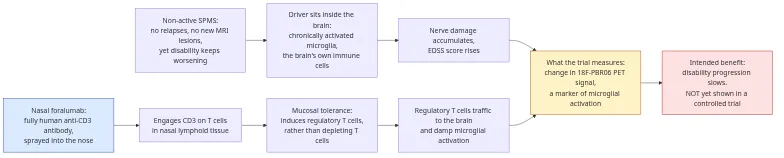
How well is the target validated? In three parts, and they are not equally strong.
The molecular target is validated. An anti-CD3 antibody, teplizumab (Tzield), is approved by the
FDA for delaying the onset of type 1 diabetes, which establishes that engaging CD3 with an antibody
changes human autoimmune disease [VERIFIED — teplizumab is an approved anti-CD3 monoclonal antibody; class mechanism reviewed in Kuhn and Weiner, "Therapeutic anti-CD3 monoclonal antibodies: from bench to bedside", Immunotherapy 2016, DOI 10.2217/imt-2016-0049]. The limit of that verification matters:
it validates CD3 as a druggable immune target, in a different disease, by a different route. It says
nothing about whether nasal dosing produces a useful effect in the brain.
The endpoint’s disease relevance is validated, and by a source with no connection to this company.
Independent work from the Turku PET Centre shows that TSPO binding in normal-appearing white matter
and perilesional tissue is significantly higher in MS patients who go on to worsen than in those who
stay stable, and predicts one-year EDSS worsening with an area under the curve of 0.76 to 0.78
[VERIFIED — Radford-Smith, Airas et al., BMJ Neurology Open 2025, DOI 10.1136/bmjno-2025-001026, n=87 with an independent 37-patient validation cohort, retrieved in full via PubMed 2026-08-07].
The limit of that verification also matters, and it is the important one: it establishes that the
signal this trial measures tracks the disease, not that a twelve-week drug course can move it, and
not that moving it changes what happens to a patient. See A.5b.
Independent human genetic validation of CD3 in multiple sclerosis could not be checked this session
either. Open Targets, the connector that answers that question, was BLOCKED with Rate limit exceeded for client: global on three attempts, for the fourth consecutive sweep. That claim is
therefore [UNVERIFIED].
The route — nasal mucosal tolerance producing a measurable central nervous system effect — is the novel and unproven half. It has produced consistent uncontrolled observations and has never been tested against placebo in this disease.
The exact scientific step this readout must prove. That twelve weeks of nasal foralumab produces a fall in [18F]PBR06 PET signal — the imaging marker of microglial activation — that is statistically larger than what the placebo group shows over the same twelve weeks. Not that patients felt better, not that disability stabilised, and not that the drug was well tolerated. Those are either secondary endpoints or, in the case of tolerability, near-certain to pass and therefore uninformative.
The honest scientific risk. Four things, in order of how much they matter.
First, this is a biomarker, and biomarkers separate from placebo less reliably than their proponents
expect once blinding is applied. TSPO PET quantification carries substantial measurement variability
between subjects, and the trial excludes only the lowest-affinity binders of the tracer — patients
with a Thr/Thr polymorphism in the TSPO gene — leaving mixed-affinity heterozygotes in the analysis
[VERIFIED — ClinicalTrials.gov NCT06292923 exclusion criterion 14, 2026-08-10]. The independent
Turku group states plainly that TSPO-PET’s “broader clinical application faces feasibility
challenges due to high technical demands and costs” [VERIFIED — BMJ Neurology Open 2025, DOI 10.1136/bmjno-2025-001026].
Second, the sample is small. Fifty-four patients randomised one-to-one-to-one is about eighteen per
arm [VERIFIED — ClinicalTrials.gov NCT06292923, 2026-08-10]. Worse, the registry record contradicts
itself about who is scanned: the primary outcome timeframe says imaging happens “after Cycle 4 at
the PET sub-study site”, while the same outcome’s description says “Subjects at all sites will
undergo PET imaging”. If PET is in fact a sub-study at one of seven sites, the evaluable sample for
the primary efficacy comparison could be a fraction of fifty-four, and the trial would be
underpowered by construction. This is flagged rather than resolved, because the record does not
resolve it, and it is unchanged across four sweeps.
Third, every efficacy observation so far is open-label and comes from essentially one research
group, and that group’s relationship with both the sponsor and the mechanism is now documented from
two independent directions. The senior author on essentially every foralumab clinical paper is the
chair of Tiziana’s scientific advisory board, who has received consulting fees and stock options
from the company; the principal investigator on both sibling na-SPMS studies sits on the same board
and consults for the company [VERIFIED — conflict-of-interest statement, Frontiers in Immunology 2022, DOI 10.3389/fimmu.2022.956907, read in full 2026-08-07]. New this refresh: the same senior
author holds an active National Institute on Aging grant titled “Mechanisms underlying the
neuroprotective effect of nasal administration of anti-CD3,” $805,654 in FY2026 [VERIFIED — NIH RePORTER, project 5R01AG084596-03, read 2026-08-10]. That is a federal, peer-reviewed grant rather
than sponsor money, and it cuts two ways: it is independent scientific endorsement of the mechanism,
and it is a second reason the same laboratory’s own scientific standing rises and falls with this
drug. Both readings are recorded; neither is collapsed into the other. That combination is the
situation in which regression to the mean is largest and in which an open-label prior deserves the
steepest discount. See A.5b for the full disclosure.
Fourth, the tracer used here is not the tracer the independent literature is built on. Almost all
published MS TSPO work uses [11C]PK11195; INFORM-MS uses [18F]PBR06, a second-generation tracer
[VERIFIED — ClinicalTrials.gov NCT06292923; BMJ Neurology Open 2025 states "the majority of TSPO-PET imaging studies in the context of MS have used the [11C]PK11195 radioligand"]. Second-generation
tracers are expected to have a better signal-to-noise ratio, which cuts in this trial’s favour, but
it also means the external prior about effect sizes and variability does not transfer cleanly.
A.2 Clinical development plan, timeline, feasibility, resourcing
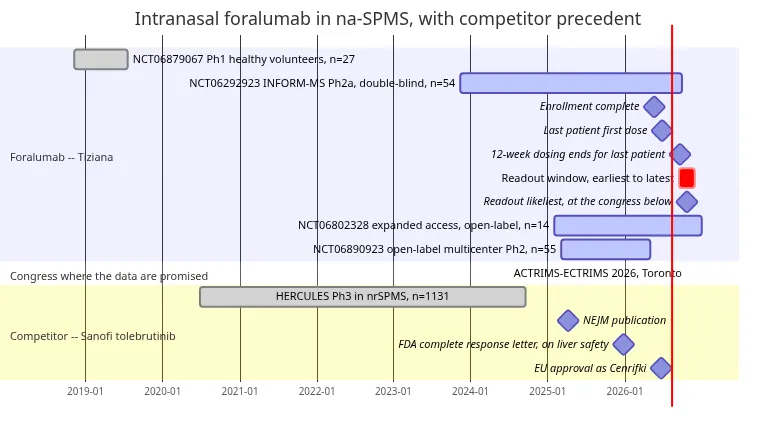
The arithmetic of the topline window is tight, and that is the timing finding. The last patient
received their first dose on 2026-06-25 [VERIFIED — company PR 2026-06-25]. The treatment period is
four three-week cycles, so twelve weeks [VERIFIED — ClinicalTrials.gov NCT06292923]. That puts the
last patient’s final dose around 2026-09-17, with the post-treatment PET scan after that. Getting
from there to a topline release by 2026-09-30 — the end of “late Q3” — leaves under two weeks for the
final scan, image reconstruction, quantification, database lock, unblinding and analysis. It is not
impossible, but it is aggressive, and the company itself widened its guidance from “Late Q3 2026” to
“late Q3/early Q4 2026” on the very day it announced last-patient dosing. Expect the early-Q4 half
of that window rather than the late-Q3 half, which is why the Readout section below puts the
likeliest date at the congress in late October rather than at the end of September. Five weeks now
separate this analysis from the earliest edge of that window.
Trials
| Trial | Sponsor / whose drug | Design (arms, blinding, n) | Population | Status / key result | Link |
|---|---|---|---|---|---|
| INFORM-MS (NCT06292923) — the readout | Tiziana Life Sciences; its own drug | Phase 2a randomised, double-blind, placebo-controlled, multicentre, parallel-group, dose-ranging. Three arms 1:1:1 — nasal foralumab 50 µg, 100 µg, placebo (acetate buffer). n=54. Dosing Mon/Wed/Fri for two weeks then one week off, ×4 cycles = 12 weeks. Seven US sites. | Non-active SPMS, 2017 McDonald criteria, age 18–75, EDSS 2.5–6.5, failed a disease-modifying therapy for ≥2 years with continued disability accumulation | ACTIVE_NOT_RECRUITING. Enrolment complete 2026-05-21; last patient first dose 2026-06-25. Primary completion 2026-09, study completion 2026-10. No results posted. CT.gov lists no overall official and no site contact. | NCT06292923 |
| Expanded access (NCT06802328) | Tiziana; its own drug | Open-label, single site, no placebo, no blinding, 50 µg. Principal investigator Tanuja Chitnis, Brigham and Women’s Hospital | Non-active SPMS | 14 patients reported stable or improved within six months through March 2026, with improved fatigue and no new safety signals. Uncontrolled. Status AVAILABLE. | NCT06802328 |
| Open-label multicentre Phase 2 (NCT06890923) | Tiziana; its own drug | Open-label, multicentre, 100 µg, n=55. Principal investigator Tanuja Chitnis | Non-active SPMS | RECRUITING; primary completion 2026-04-30, which has now passed by more than three months with no readout announced and no registry update. A second, larger uncontrolled dataset running alongside the blinded trial. | NCT06890923 |
| Phase 1 healthy volunteers (NCT06879067) | Tiziana; its own drug | Randomised, placebo-controlled, n=27 | Healthy adults | COMPLETED 2019-07-23. Established nasal safety and tolerability. Published as Chitnis et al., Front Immunol 2022. | NCT06879067 |
| Phase 2 Alzheimer’s disease (NCT06489548) | Brigham and Women’s Hospital, not Tiziana | n=16 | Early symptomatic Alzheimer’s disease | RECRUITING; start 2025-09-16, primary completion 2026-06 — which has also now passed without an announcement. Academic-sponsored, which is part of why company burn is low relative to trial count (see ../company.md C.3). This is bpiq_drug_id 17171, the row that puts this program’s Attribution at INDETERMINATE. | NCT06489548 |
| Phase 2a multiple system atrophy (NCT06868628) | Tiziana; its own drug | Open-label, n=5 | Multiple system atrophy | RECRUITING; primary completion 2027-04-01. Reported PET reductions of up to 34% SUV and 26% SUVR in a third patient on 2026-07-31, reproducing the first two. | NCT06868628 |
| Phase 2a amyotrophic lateral sclerosis (NCT07688239) | Tiziana; its own drug | Randomised, double-blind, placebo-controlled, n=44 | Amyotrophic lateral sclerosis | NOT_YET_RECRUITING; start 2026-07-25, primary completion 2027-07. Still not recruiting two weeks after its own registered start date. | NCT07688239 |
| Four withdrawn studies | Tiziana; its own drug | NASH Phase 2a (NCT03291249), Crohn’s Phase 1b (NCT05028946), progressive MS Phase 1b (NCT05029609), COVID-19 Phase 2 (NCT04983446) | Various | All four WITHDRAWN with zero enrolment. A track record of registering trials that never start. | ClinicalTrials.gov, retrieved 2026-08-10 |
| HERCULES (competitor) — tolebrutinib | Sanofi; Sanofi’s drug, a BTK inhibitor, not an anti-CD3 | Phase 3 randomised, double-blind, placebo-controlled, n=1,131 | Non-relapsing SPMS, EDSS 3.0–6.5, no relapse in 24 months, documented disability accumulation in 12 months | Positive: 31% delay in six-month confirmed disability progression versus placebo. Published in the New England Journal of Medicine, April 2025. FDA issued a complete response letter in December 2025, citing a “substantial and unusually high” risk of severe, sometimes fatal drug-induced liver injury. Approved in the European Union in June 2026 as Cenrifki. Sanofi has said it will work with the FDA on a path forward; no US approval and no announced resubmission decision date as of 2026-08-10. | [WEB ESTIMATE — Sanofi press releases 2025-04-08, 2025-12-24 and 2026-06-23; Multiple Sclerosis News Today and Pharmacy Times coverage, re-checked 2026-08-10] |
Feasibility matrix
| Factor | High probability | Medium probability | Low probability | This asset (assessment) | Source |
|---|---|---|---|---|---|
| Recruitment feasibility | >50 sites, 3:1 patient:site | 20–50 sites, established investigators | <20 sites, novel sites | Low on the template’s scale, but the risk is already retired. Seven US sites for 54 patients, so about eight patients per site — yet all seven are established academic MS centres (Brigham and Women’s, Yale, Johns Hopkins, UMass, Buffalo, Weill Cornell, Thomas Jefferson) and enrolment is complete. | [VERIFIED — ClinicalTrials.gov NCT06292923 site list; company PR 2026-05-21] |
| Endpoint clarity | Regulatory precedent exists | Novel endpoint with FDA alignment | Unvalidated surrogate | Low. This is the weakest cell in the analysis. TSPO PET microglial activation is not an accepted regulatory endpoint in multiple sclerosis and no drug has ever been approved on it. It is independently validated as prognostic (A.1, A.5b) and not at all as a treatment-effect measure. Fast Track designation was granted for the indication, which implies FDA engagement, but no special protocol assessment or endpoint agreement has been disclosed. | [VERIFIED — ClinicalTrials.gov primary outcome measures; Fast Track from company PR 2024-07-24]; prognostic validation [VERIFIED — BMJ Neurol Open 2025, DOI 10.1136/bmjno-2025-001026] |
| Trial-design robustness | Pivotal Phase III with SPA | Adaptive with interim analysis | Single-arm, no control | Medium. Genuinely randomised, double-blind and placebo-controlled with two dose arms, which is a real design and a large step up from everything preceding it. It is not pivotal, it runs twelve weeks, and it has roughly eighteen patients per arm. | [VERIFIED — ClinicalTrials.gov NCT06292923] |
| Operational / execution | Enrollment complete, standard timeline | Some timeline risk | Enrollment behind | Medium, and one notch worse than it reads. Enrolment is complete and dosing is finished, which is the good news. Against it: the topline date has slipped twice in four months; under two weeks separate last-patient-out from the end of the company’s own first-named window; and two sibling studies have now passed their own primary completion dates with nothing announced (NCT06890923 on 2026-04-30, the academic Alzheimer’s study on 2026-06). A sponsor that lets registry milestones pass silently is a sponsor whose next date is worth discounting. | [VERIFIED — BPIQ note field on drug id 13497, dated entries 2026-02-25 through 2026-06-25; ClinicalTrials.gov 2026-08-10] |
Resourcing sufficiency. For this readout, yes — the trial is fully dosed and the remaining cost
is analysis. For anything after it, no. The company carries a going-concern qualification and a
$2.7M working-capital deficit, and cannot fund a registrational Phase 3 from its balance sheet; see
../company.md C.3, which this refresh extended with the shelf capacity read
directly from the F-3 ($250M base, $100M at-the-market with Jefferies). Part of the reason reported
burn is low relative to seven registered programs is that some trials are run and funded by academic
sponsors — the Alzheimer’s Phase 2 is sponsored by Brigham and Women’s Hospital rather than by
Tiziana [VERIFIED — ClinicalTrials.gov NCT06489548, 2026-08-10], a US Department of Defense grant
supports the spinal-cord-injury work [VERIFIED — company PR 2025-09-15 via BPIQ press feed], and
the mechanism itself carries an NIA R01 in the senior author’s own laboratory [VERIFIED — NIH RePORTER 5R01AG084596-03, 2026-08-10]. That structure is genuinely capital-efficient, and it also
means the company controls less of its own timeline than the program count suggests.
A.3 Target label, target product profile, strategic questions, designations
A.3a Target label. Adults with non-active secondary progressive multiple sclerosis — no relapses and no new MRI lesions for at least two years, with documented continued disability accumulation despite prior disease-modifying therapy, EDSS 2.5–6.5.
A.3b Target product profile
| Attribute | Standard of care & key competitor(s) — data | Foralumab target profile (goal) | Supporting evidence (+ link) |
|---|---|---|---|
| Indication / target label | There is no approved therapy for non-active SPMS in the United States. Siponimod (Mayzent) is approved for active SPMS; ocrelizumab for primary progressive MS. Tolebrutinib (Cenrifki) was approved in the European Union in June 2026 for SPMS without relapses, and received an FDA complete response letter in December 2025 on liver-safety grounds, with no US approval as of 2026-08-10. | First disease-directed therapy approved for non-active SPMS in the US | [WEB ESTIMATE — Sanofi PR 2026-06-23 and 2025-12-24; MS News Today and Pharmacy Times, re-checked 2026-08-10] |
| Efficacy (endpoints, regimen) | Tolebrutinib HERCULES: 31% delay in six-month confirmed disability progression versus placebo, n=1,131, on a clinical disability endpoint | Currently: a reduction in PET microglial activation at twelve weeks, with disability as a secondary. A registrational trial would have to convert this into a disability endpoint. | [WEB ESTIMATE — Sanofi PR 2025-04-08 / NEJM]; [VERIFIED — ClinicalTrials.gov NCT06292923] |
| Safety / tolerability | Tolebrutinib carries liver-enzyme elevations requiring monitoring, and the FDA’s rejection turned on exactly that: a “substantial and unusually high” risk of severe, sometimes fatal drug-induced liver injury | Clean. 37.4 patient-years of exposure reported with no serious treatment-related adverse events, and an annual safety report filed with the FDA. This is a genuine differentiator, it is the most solid claim in the profile, and eight months after the tolebrutinib complete response letter the FDA has still not approved that drug, which keeps the differentiation live rather than theoretical. | [VERIFIED — company PR 2025-12-29 via BPIQ press feed]; competitor safety [WEB ESTIMATE — Pharmacy Times, re-checked 2026-08-10] |
| Biomarker / companion diagnostic | None used commercially | TSPO PET is used as a trial endpoint, not as a companion diagnostic. Patients with a Thr/Thr TSPO polymorphism cannot be imaged with this tracer, so if PET ever became a selection tool it would exclude a genetic subgroup. | [VERIFIED — ClinicalTrials.gov NCT06292923 exclusion criterion 14] |
| Formulation / administration | Oral tablet (tolebrutinib, siponimod); intravenous infusion (ocrelizumab) | Nasal spray taken at home, three days a week, two weeks on and one week off. No infusion centre, no injection. | [VERIFIED — ClinicalTrials.gov NCT06292923 arm descriptions] |
| Payer value | Payers already regard SPMS therapy as poor value: siponimod was assessed at roughly $1.15M per quality-adjusted life year | Would need to show disability benefit, not imaging benefit, to price like a disease-modifying therapy | [WEB ESTIMATE — ICER evidence report on MS treatments, icer.org] |
A.3c Strategic Go/No-Go questions. The set below is the Go-to-Phase-III set, because that is the decision this readout feeds: whether to commit to a registrational trial with a clinical disability endpoint. Several answers are honestly “not answerable until the readout”, and that concentration of unanswered questions is itself the finding.
Pre-Phase-III (Go-to-Phase-III / registration):
| Group | Question | Answer (tagged) |
|---|---|---|
| Target | Target revalidated as in prior phases? | Partly. CD3 engagement is validated by an approved anti-CD3 drug in another disease [VERIFIED — teplizumab approval]. The endpoint’s disease relevance is independently validated [VERIFIED — BMJ Neurol Open 2025, DOI 10.1136/bmjno-2025-001026]. Independent genetic validation of CD3 in MS is [UNVERIFIED] because Open Targets was BLOCKED for a fourth sweep. The nasal-tolerance route has never been revalidated under blinding. |
| Dose & Drug | Exposure–response for the intended commercial regimen and route? | Not established. This trial is the dose-ranging study — 50 µg versus 100 µg is exactly the question it exists to answer [VERIFIED — ClinicalTrials.gov NCT06292923]. A dose-ordered separation would strengthen a positive result considerably; its absence would weaken one. The published Phase 1 found immune effects were “primarily observed at the 50 µg dose”, which is a reason to expect the dose-response not to be monotonic [VERIFIED — Front Immunol 2022, DOI 10.3389/fimmu.2022.956907]. |
| Dose & Drug | Commercial formulation available or feasible? | Yes. The nasal spray used in the trial is the intended commercial presentation, and a home-administered spray is commercially straightforward [VERIFIED — trial arm descriptions]. |
| Dose & Drug | Dose range compatible with clinical and non-clinical safety? | Yes on the evidence available: 37.4 patient-years with no serious treatment-related adverse events [VERIFIED — company PR 2025-12-29], though that exposure is largely open-label. |
| Dose & Drug | Therapeutic window given the clinical response? | [UNVERIFIED] — no controlled clinical response has been measured, so there is nothing to set a window against. |
| Dose & Drug | Intrinsic and extrinsic factors influencing exposure and patient response? | Partly known. TSPO genotype affects measurement rather than drug exposure; nasal pathology (deviated septum, polyps, chronic rhinitis) is an exclusion, implying nasal anatomy affects delivery [VERIFIED — ClinicalTrials.gov exclusion criteria 7, 8 and 18]. |
| Patient | Proof of concept and positive benefit/risk in the intended population? Combination evidence? | This is the open question. Uncontrolled proof of concept exists in ten published and fourteen expanded-access patients [VERIFIED — Neurology Neuroimmunology & Neuroinflammation, DOI 10.1212/NXI.0000000000200543, open-label, n=10; full record retrieved via Europe PMC PMC12815464, 2026-08-10]. Controlled proof of concept is what reads out. Combination evidence exists only in the Alzheimer’s program (with lecanemab or donanemab), not here. |
| Patient | Phase III design and outcome criteria — accepted, compelling, competitive for market access? | No Phase 3 design has been disclosed. A registrational trial here would need a confirmed disability progression endpoint over 24–36 months in roughly a thousand patients, on the HERCULES precedent. Neither the design nor the money for it exists today, and the EDGAR full-text search found no partner filing of any kind naming this drug [UNVERIFIED — inference from the competitor's registrational trial; the absence of a partner filing is [VERIFIED — EDGAR full-text search, 2026-08-10]]. |
| Patient | Rationale for the patient population(s)? | Strong. Non-active SPMS has no approved US therapy, and the mechanism specifically targets the smouldering inflammation that defines it [VERIFIED — ClinicalTrials.gov detailed description; approved-therapy landscape from web search 2026-08-10]. |
| Patient | Likelihood of the expected outcome? | Modelled at 35%, band 20–52% [UNVERIFIED — modelled]. See the locked prediction. |
| Patient | Companion-diagnostic strategy, including pricing and market? | None disclosed, and none obviously needed for a therapy with no biomarker-selected population [UNVERIFIED]. |
A.3d Regulatory designations.
- Fast Track designation, granted by the FDA on 2024-07-24 for intranasal foralumab in non-active
SPMS. Fast Track means more frequent meetings with the FDA and eligibility for rolling review of a
future application. It does not lower the evidence bar and it is not an opinion on efficacy
[VERIFIED — company PR 2024-07-24 via BPIQ press feed and BPIQ historical catalysts]. - Orphan Drug Designation — filed May 2024, still not confirmed granted. If granted, and if the
product were ultimately approved for the designated indication, it would carry up to seven years
of US market exclusivity. The filing is documented; a grant is not, and a repeat search on
2026-08-10 — twenty-seven months after a filing the FDA reviews within ninety days — still found
no announcement of one. A grant would ordinarily be announced by a company that announced the
filing, so the silence is weak evidence against
[WEB ESTIMATE — Tiziana press release "Tiziana Life Sciences Files for Orphan Drug Designation for Intranasal Foralumab", May 2024, via BioSpace and the company's own site, re-checked 2026-08-10].
A.4 Target product profile valuation matrix
| Stakeholder | Value driver | Minimum threshold | Competitive | Premium | Benchmark / source |
|---|---|---|---|---|---|
| Patient / caregiver | Stopping or slowing the slide into needing a walking aid, without an infusion centre | Any measurable slowing of EDSS worsening versus placebo | Slowing comparable to tolebrutinib’s 31% delay in confirmed disability progression, plus home dosing | Measurable improvement rather than stabilisation, plus the fatigue benefit reported in the expanded-access program | Tolebrutinib HERCULES [WEB ESTIMATE — Sanofi PR 2025-04-08] |
| Regulator | A clinical endpoint the agency accepts, with a safety profile it will tolerate | Confirmed disability progression over 24 months | The same endpoint that supported the EU approval of tolebrutinib | The same, with a safety profile requiring no routine monitoring | HERCULES design [WEB ESTIMATE]; the FDA’s December 2025 complete response letter shows the US bar includes a hard safety gate — it rejected a positive Phase 3 on liver toxicity, not on the endpoint [WEB ESTIMATE — Pharmacy Times, re-checked 2026-08-10] |
| Payer / HTA | Cost per quality-adjusted life year within thresholds | Below the roughly $1.15M/QALY at which siponimod was assessed in SPMS — a very low bar | Priced in the $40,000–$85,000 net range where MS therapies sit | Priced within the $16,500–$34,900 range ICER identified as cost-effective for MS antibodies | [WEB ESTIMATE — ICER MS evidence report; Neurology Clinical Practice 2013–2021 net price series, DOI 10.1212/CPJ.0000000000200597] |
| Provider | No infusion chair, no laboratory monitoring burden | Home administration | Home administration with no routine monitoring | The same, plus no drug–drug interaction management | Tolebrutinib requires liver-enzyme monitoring [WEB ESTIMATE — Sanofi labelling coverage, 2025-2026] |
Calibration examples from the framework, not claims about this asset: in oncology each incremental month of overall survival is worth roughly $150–300M in peak-sales potential; oral formulations command roughly 15–25% price premiums over injectables.
A.5 Evidence quality and endpoints
| Criterion | Score (High / Medium / Low) | Basis (one line) | Link |
|---|---|---|---|
| Target validation | Medium | CD3 is validated by an approved anti-CD3 antibody in a different disease; independent genetics could not be checked because Open Targets was BLOCKED for a fourth consecutive sweep | [VERIFIED — teplizumab approval] / [UNVERIFIED — Open Targets blocked] |
| Mechanism clarity | Medium-High | The proposed chain from nasal dosing to regulatory T cells to microglial damping is specific, published, each step observed separately in humans, and independently funded by an NIA R01 in the originating laboratory | Front Immunol 2022; NIH RePORTER 5R01AG084596 |
| Biomarker availability | Medium | TSPO PET with [18F]PBR06 exists, is quantitative, is independently validated as prognostic in MS — but it is not a validated regulatory surrogate, its treatment-effect sensitivity is untested by anyone, and a genetic subgroup cannot be imaged with it at all | [VERIFIED — ClinicalTrials.gov NCT06292923]; BMJ Neurol Open 2025 |
| Publication quality (peer-reviewed? independent authors?) | Low | The na-SPMS clinical results are published, peer-reviewed and open-label in ten patients. Authorship is concentrated in one group (Chitnis, Singhal, Weiner at Brigham and Women’s / Harvard), who appear as first or last author on essentially every foralumab clinical paper — and whose sponsor relationships are documented rather than inferred (A.5b). The Europe PMC row added this refresh returns the peer-reviewed paper the PubMed connector has never surfaced and confirms its 26-author list is the same Brigham group. The larger na-SPMS dataset also exists as a medRxiv preprint. | NXI 2026, DOI 10.1212/NXI.0000000000200543 via Europe PMC PMC12815464; medRxiv preprint |
| Clinical / expert sentiment | — | Moved to A.5b, below. | — |
Endpoints
| Endpoint (full name) | What it measures | Scale / range | Better direction | MCID / note |
|---|---|---|---|---|
| PRIMARY — Change from baseline in [18F]PBR06 positron emission tomography signal for microglial activation at 12 weeks | How much tracer binds to translocator protein on activated microglia in the brain, used as a stand-in for how inflamed the brain tissue is | Standardised uptake value (SUV) or its ratio to a reference region (SUVR); a continuous change from baseline, usually expressed as a percentage | Lower is better | No established minimal clinically important difference exists. No drug has been approved on this endpoint in multiple sclerosis. For scale, the company’s own multiple system atrophy program reported reductions of up to 34% SUV and 26% SUVR in individual patients [VERIFIED — company PR 2026-07-31], but those are uncontrolled single-patient figures and are not a benchmark. Independent work quantifies the same protein as a distribution volume ratio (DVR) rather than SUVR, so published effect sizes do not transfer directly. |
| PRIMARY — Number of patients with adverse event reports | Safety | Count of patients over 12 weeks | Fewer is better | Near-certain to pass on 37.4 patient-years of clean prior exposure. Passing it is not evidence that the drug works. |
| PRIMARY — Change in Total Nasal Symptom Score (TNSS) | Whether the nasal spray irritates the nose: congestion, runny nose, itching, sneezing, difficulty sleeping | Five items scored 0 (none) to 3 (severe), summed | Lower is better | A tolerability measure. Like the safety co-primary, near-certain to pass and uninformative about efficacy. |
| SECONDARY — Expanded Disability Status Scale (EDSS) | Overall MS disability, weighted towards walking ability | 0 to 10 in half-point steps | Lower is better | A change of 0.5 to 1.0 point is the conventional threshold for meaningful worsening, and the trial’s own entry criteria use exactly that (1.0 point if baseline EDSS 1.0–5.5, 0.5 if above 6.0) [VERIFIED — ClinicalTrials.gov inclusion criterion 6]. Twelve weeks is far too short to expect a difference here, and the trial is not powered for one. |
| SECONDARY — Multiple Sclerosis Functional Composite-4 (MSFC-4) | Walking speed, hand function, processing speed and low-contrast vision, averaged | Composite z-score | Higher is better | No established MCID for the four-component version [UNVERIFIED]. |
| SECONDARY — Modified Fatigue Impact Scale (MFIS) | How much fatigue interferes with daily life | 21 items scored 0–4, total 0 to 84 | Lower is better | A change of roughly 4 points is commonly treated as clinically meaningful in MS, though this is a convention rather than a regulatory standard [UNVERIFIED]. The expanded-access program reported 64% of patients with less fatigue, uncontrolled [VERIFIED — company PR 2026-05-19]. |
| OTHER — Gadolinium-enhancing lesions, percent brain volume change, paramagnetic rim lesions on 3T MRI | Structural and inflammatory imaging | Various | Fewer lesions, less volume loss | Exploratory. Note that by definition this population has no new lesion activity, so the gadolinium endpoint should be near zero in both arms. |
A.5b Key opinion leaders.
Panel as of. 2026-08-10 — the date the investigator, conflict and funding searches below were
run. The funding column is new: 02-connectors.md § KOL sources added NIH RePORTER as an optional
source at v5.6.0, and this is its first use in this corpus.
Investigators
The pivotal trial itself still yields no investigator row. CT.gov get_trial_details on
NCT06292923 returns no overall officials and contacts: null on all seven sites, and
search_investigators on the condition returns nobody attached to that NCT — re-checked 2026-08-10,
unchanged. The three people below are therefore named from the two sibling na-SPMS foralumab
studies run by the same sponsor and from the program’s own publication record, and each row says
which. Two of them hold disclosed relationships with Tiziana beyond any trial payment; the third has
none on record, which is a different fact from having none.
| Name | Role / affiliation | Trial (NCT) | Conflicts (party, kind, disclosed in, as of) | Conflicts checked (source, date) | Source | Tag |
|---|---|---|---|---|---|---|
| Tanuja Chitnis | Principal investigator, Brigham and Women’s Hospital. PI on both sibling na-SPMS studies; first author on the mechanism paper, on the peer-reviewed na-SPMS paper and on the preprint. Not listed by CT.gov on NCT06292923 itself. | NCT06802328, NCT06890923 | sponsor — “member of the scientific advisory board and serves as a consultant to Tiziana Life Sciences”, disclosed in the conflict-of-interest statement of Front Immunol 2022 (DOI 10.3389/fimmu.2022.956907), as of 2022-11-23. Federal funding: none found — NIH RePORTER returns zero awards on her name for FY2024–FY2026. | PubMed get_full_text_article PMC9727230, 2026-08-07 — conflict-of-interest statement read verbatim and names her; PubMed search_articles “foralumab” (15 hits, all retrieved) 2026-08-10; NIH RePORTER POST v2/projects/search, pi_names “Tanuja Chitnis”, FY2024–2026, 2026-08-10 — zero projects | CT.gov search_investigators 2026-08-10; PubMed 2026-08-07/10; NIH RePORTER 2026-08-10 | [VERIFIED — CT.gov search_investigators 2026-08-10; conflict from PubMed PMC9727230; funding from NIH RePORTER 2026-08-10] |
| Howard L. Weiner | Ann Romney Center for Neurologic Diseases, Brigham and Women’s Hospital / Harvard Medical School. Senior author on essentially every foralumab clinical publication, including the peer-reviewed na-SPMS paper, the preprint and the Alzheimer’s case report. Not listed as an investigator on any of these trials by CT.gov, and recorded here rather than as an independent voice because a disclosed sponsor relationship disqualifies him from that table by construction. | — (publication record, not a CT.gov listing) | sponsor — “chair of the scientific advisory board of Tiziana Life Sciences and received consulting fees and stock options from the company”, disclosed in Front Immunol 2022 (DOI 10.3389/fimmu.2022.956907), as of 2022-11-23. federal funder (NIA) — new this refresh: principal investigator on 5R01AG084596-03, “Mechanisms underlying the neuroprotective effect of nasal administration of anti-CD3,” $805,654 in FY2026, plus seven further NIH awards FY2024–FY2026 including R01NS115951 (microbiota in ALS) and R01AG065270 (microbiota in ageing and Alzheimer’s), as of 2026 fiscal year | PubMed get_full_text_article PMC9727230, 2026-08-07 — statement read verbatim; PubMed search_articles “foralumab” (15 hits, all retrieved) 2026-08-10 — author on 5 of them; Europe PMC search “foralumab” (88 hits) 2026-08-10; NIH RePORTER POST v2/projects/search, pi_names “Howard Weiner”, FY2024–2026, 2026-08-10 — 8 projects returned | PubMed 2026-08-07; Europe PMC and NIH RePORTER 2026-08-10 | [VERIFIED — PubMed PMC9727230 conflict statement 2026-08-07; NIH RePORTER 5R01AG084596-03, 2026-08-10] |
| Tarun Singhal | PET Imaging Program in Neurologic Diseases, Brigham and Women’s Hospital / Harvard Medical School. Second author on the peer-reviewed na-SPMS paper and first author on the Alzheimer’s [18F]PBR06 case report — that is, the person whose group reads the imaging endpoint this prediction settles on. Not listed by CT.gov on NCT06292923. | — (publication record, not a CT.gov listing) | None found. He is not an author on the paper carrying the sponsor disclosure above and is not named in it. NIH RePORTER was not queried on his name this refresh, so his federal-funding status is unchecked rather than clear. An absent disclosure is not evidence of no relationship (02-connectors.md § KOL sources). | PubMed get_full_text_article PMC9727230, 2026-08-07 — not an author, not named; PubMed get_article_metadata 40359013 (Clin Nucl Med 2025, DOI 10.1097/RLU.0000000000005955), 2026-08-10 — metadata only, no conflict statement in the retrieved record; Europe PMC 2026-08-10 confirms his authorship position on PMC12815464. NIH RePORTER: not queried | PubMed 2026-08-07/10; Europe PMC 2026-08-10 | [VERIFIED — PubMed and Europe PMC 2026-08-10 for identity and role; conflict status UNVERIFIED, funding status UNCHECKED, see Conflicts checked] |
Independent voices
| Name | Affiliation | View (close enough to quote) | As of | Conflicts checked (source, date) | Source | Tag |
|---|---|---|---|---|---|---|
| Laura Airas | Turku PET Centre, University of Turku and Turku University Hospital, Finland | Elevated TSPO binding “has been shown to be highly predictive of disease progression”: greater availability in normal-appearing white matter and perilesional regions correlated with higher EDSS, and distinguished 1-year progressors with an area under the curve of 0.76–0.78 in 87 patients, validated in an independent 37-patient cohort. She also states that TSPO-PET’s “broader clinical application faces feasibility challenges due to high technical demands and costs”, and that the signal-to-noise ratio of the tracer most MS studies use is “somewhat limited”. | 2025-04-16 | PubMed get_full_text_article PMC12004482 (BMJ Neurol Open 2025, DOI 10.1136/bmjno-2025-001026), 2026-08-07 — full text retrieved; no competing-interests section appeared in the retrieved text and Tiziana is named nowhere in it. PubMed search_articles “foralumab” (15 hits) and Europe PMC search “foralumab” (88 hits), 2026-08-10 — she authors none of them. PubMed get_full_text_article PMC9727230 Tiziana conflict statement, 2026-08-07 — she is not named. | BMJ Neurol Open 2025, DOI 10.1136/bmjno-2025-001026; J Neurol Neurosurg Psychiatry 2023, DOI 10.1136/jnnp-2023-331051 | [VERIFIED — PubMed 2026-08-07, Europe PMC 2026-08-10] |
| Maria Anagnostouli | Research Immunogenetics Laboratory and MS Unit, First Department of Neurology, National and Kapodistrian University of Athens, Greece | Places foralumab among “novel agents under investigation” that “modulate T and B cell interactions and regulatory immunity” in multiple sclerosis, listed alongside frexalimab and separately from the approved anti-CD20, anti-CD52 and anti-α4-integrin antibodies. The review comments on the drug class and does not comment on TSPO-PET as an endpoint. | 2025-09-26 | PubMed get_article_metadata 41096667 (Int J Mol Sci 2025, DOI 10.3390/ijms26199398), 2026-08-10 — no conflict statement in the retrieved metadata and full text was not read. PubMed and Europe PMC “foralumab” searches, 2026-08-10 — this review is the only foralumab-mentioning paper her group authors, and it is not sponsor-affiliated work. PubMed get_full_text_article PMC9727230 Tiziana conflict statement, 2026-08-07 — she is not named. | Int J Mol Sci 2025, DOI 10.3390/ijms26199398 | [VERIFIED — PubMed 2026-08-07, re-confirmed 2026-08-10] |
Judgement
| Endpoint supported | Basis (one or two sentences) | Tag |
|---|---|---|
MIXED | The endpoint has two halves and the independent panel answers only one of them. On whether TSPO-PET measures something real in this disease, Airas’s published data in two cohorts are clearly supportive: it predicts one-year EDSS worsening. On whether a twelve-week drug course can move that signal, and whether moving it means anything for a patient, no independent voice speaks at all — and the same independent source flags the modality as technically demanding with limited signal-to-noise on the tracer most MS work uses. The Europe PMC row added this refresh surfaced two further 2026 reviews of PET imaging in MS that PubMed’s own foralumab query does not reach, and neither adds an attributable view on this program’s endpoint, so the reading is unchanged. Support on the prognostic half, silence plus a measurement caveat on the treatment-effect half, is a genuinely mixed reading rather than a thin one. | [UNVERIFIED — judgement] |
Dissent
Empty. No named voice disagrees with the MIXED reading above, and inventing one would be worse
than recording none. Dissent is required to be non-empty only for SUPPORTIVE_CONTESTED.
| Name | View (close enough to quote) | Source |
|---|---|---|
| — | — | — |
B. Commercial assessment
B.0 Current treatment algorithm
A patient who reaches non-active secondary progressive MS has usually been through relapsing disease first and has been treated with one or more disease-modifying therapies — interferons, glatiramer acetate, an oral such as fingolimod or dimethyl fumarate, or a B-cell antibody such as ocrelizumab or ofatumumab. Those drugs work by suppressing inflammatory attacks. When the patient stops having attacks and stops forming new MRI lesions but keeps getting worse anyway, those drugs have nothing left to act on.
At that point, in the United States, there is no approved disease-directed option. Siponimod is approved for active SPMS, meaning patients still having relapses or new lesions — precisely the population this trial excludes. Ocrelizumab is approved for primary progressive MS, a different course. What remains is symptomatic care: physical therapy, walking aids, and treatment for spasticity, fatigue and bladder dysfunction.
Where foralumab would fit: first-line in a line of therapy that currently does not exist. It would not displace anything; it would be added into an empty space. That is the strongest single element of the commercial case, and it is why a technically modest Phase 2a matters more here than the same trial would in a crowded indication.
The European picture changed in June 2026. Tolebrutinib was approved in the EU as Cenrifki for SPMS
without relapses, so the European white space is now partly occupied [WEB ESTIMATE — Sanofi PR 2026-06-23]. The US white space is not, because the FDA issued a complete response letter for the
same indication in December 2025 and, as of 2026-08-10, has still not approved the drug [WEB ESTIMATE — Sanofi PR 2025-12-24; MS News Today and Pharmacy Times coverage, re-checked 2026-08-10].
B.1 Competitive landscape and positioning
| Metric | High value | Medium value | Low value | This asset (assessment) | Source |
|---|---|---|---|---|---|
| Mechanism differentiation | First-in-class or novel target | Next-generation improvement | Me-too | High. The only fully human anti-CD3 antibody given as an at-home nasal spray, working by inducing regulatory T cells rather than by suppressing or depleting immune cells. No competitor uses this route or this mechanism in MS. | [VERIFIED — ChEMBL CHEMBL1743020; ClinicalTrials.gov intervention descriptions] |
| Development-timeline advantage | >12 months ahead | Within 6–12 months | Lagging >12 months | Lagging, badly. Tolebrutinib finished a 1,131-patient Phase 3 in 2024, published in the NEJM in 2025 and is approved in the EU. Foralumab is reading out a 54-patient Phase 2a. It is several years and one full registrational program behind. | [WEB ESTIMATE — Sanofi PRs] versus [VERIFIED — ClinicalTrials.gov] |
| Clinical proof-of-concept evidence | Positive Phase IIb (n>100) | Phase IIa signals (n=20–50) | Preclinical only | Medium at best, and only if this readout lands. Today the evidence is ten published open-label patients plus fourteen expanded-access patients. Nothing controlled, and every observation from a group with disclosed sponsor ties (A.5b). | NXI 2026 |
| IP protection | Composition-of-matter, long-dated | Method-of-use | Pending or none | Method-of-use and pending. Nasal-administration and method-of-use applications are filed across indications, and the company states it holds an exclusive licence for nasal administration of foralumab and other anti-CD3 antibodies in neurodegenerative disease. Composition-of-matter status and expiry could not be verified this session. Orphan designation was filed in May 2024 and no grant has been announced in the twenty-seven months since. | [WEB ESTIMATE — Tiziana pipeline page and press releases, re-checked 2026-08-10]; expiry [UNVERIFIED] |
Where this asset wins, in plain sentences. It wins on route and on tolerability. A nasal spray taken at home three days a week, with 37.4 patient-years of exposure and no serious treatment-related adverse events, is a genuinely different product from a daily oral BTK inhibitor requiring liver-enzyme monitoring. The FDA’s rejection of tolebrutinib in December 2025 was a safety rejection — a “substantial and unusually high” risk of severe, sometimes fatal liver injury, with no subgroup showing a clearly favourable benefit-risk — rather than a rejection of the indication or of the disability endpoint. Eight months later that drug is still not approved in the United States and no resubmission decision date has been announced, which means the US white space has now been empty for longer than the previous version of this analysis could observe. That distinction matters both ways. It means the US white space is durable for a safety reason a clean drug is well placed to exploit. It also means there is no competitor precedent bearing on what efficacy package the FDA would accept in this indication.
The single fact the thesis rests on. That a placebo-controlled reduction in PET microglial activation is real and translates into disability benefit. Every other element — the empty market, the clean safety, the convenient route, the insider buying — is worth nothing if that link does not hold, and this trial tests only the first half of it. The independent literature validates that the signal tracks the disease and is silent on whether a drug can move it (A.5b).
Calibration example from the framework, not a claim about this asset: oncology first-movers in novel mechanisms have shown roughly 3.2× higher peak-sales potential but about 1.8× higher development risk.
B.2 Addressable market
The launch market would be the United States first, because that is where the trial ran, where Fast
Track applies and where the competitor was rejected. Europe second, and now against an approved
competitor — and with no EU trial of this drug registered at all, confirmed this refresh by a
CTIS search returning zero records [VERIFIED — CTIS search, containAll "foralumab", 2026-08-10],
which means any European path starts from nothing.
| Component | How it is estimated | Premium threshold | This asset (assessment) | Source |
|---|---|---|---|---|
| Drug-treated patients | Epidemiology × diagnosis rate × treatment rate | >100,000 (US/EU5/Japan) | US SPMS prevalence is 27–45 per 100,000 in the source this analysis has used since it was written, giving roughly 90,000–150,000 US SPMS patients; a repeat search this refresh surfaced the same meta-analysis reporting a pooled prevalence of 22.42 per 100,000 (99% CI 18.30–26.95), which is below the range used here and would imply roughly 75,000 patients. The non-active subset is smaller, and no verified activity split has been found on any of four sweeps; assuming 50–70% gives roughly 45,000–105,000 US patients on the figures retained below. The trial’s own entry criteria (EDSS 2.5–6.5, prior DMT failure over ≥2 years) narrow the label-eligible pool further. [UNVERIFIED — modelled from a prevalence range whose own source now reads lower than the figure used, and an unverified activity split] | Prevalence: [WEB ESTIMATE — systematic review and meta-analysis of SPMS prevalence in the USA, Europe, Canada, Australia and Brazil, BMC Neurology 2022, DOI 10.1186/s12883-022-02820-0, pooled 22.42 per 100,000, re-checked 2026-08-10]. A repeat search on 2026-08-10 for a non-active split again returned only commercial market-sizing reports with no patient-level split, so the gap is unchanged for a fourth sweep. |
| Market exclusivity | Patent term + regulatory exclusivity | >10 years combined | Cannot be established. Method-of-use and nasal-administration applications are filed; composition-of-matter expiry was not verifiable this session. Orphan designation would add up to seven years of US exclusivity if granted and if approved — both conditional, and no grant has been announced twenty-seven months after filing. As a biologic it would also carry twelve years of US reference-product exclusivity from approval as a statutory matter, which is the practical floor. | [UNVERIFIED — grant and expiry] |
| Reimbursement precedent | Approvals in ≥2 major markets | Positive NICE/CADTH guidance | Poor. MS therapies in the progressive setting are already viewed sceptically by health-technology bodies; siponimod was assessed at roughly $1.15M per quality-adjusted life year in SPMS. A drug whose evidence is an imaging endpoint would face a harder assessment still. | [WEB ESTIMATE — ICER MS evidence report] |
| Patient-journey impact | Fewer hospital days, less caregiver burden | >30% quality-of-life gain | Plausible but unmeasured in a controlled setting. The expanded-access program reported 64% of patients with reduced fatigue, uncontrolled. Home nasal dosing avoids infusion visits entirely. | [VERIFIED — company PR 2026-05-19], uncontrolled |
B.3 Value and feasibility
B.3a Expected peak sales. Built bottom-up as eligible patients × annual net price × peak penetration. Every figure below is conditional on a chain of events that has not happened: a positive controlled readout, then a registrational Phase 3 with a clinical disability endpoint, then approval, then pricing, then uptake. It is not risk-adjusted, and it excludes the Alzheimer’s, multiple system atrophy and amyotrophic lateral sclerosis programs entirely.
| Scenario | Assumptions (patients × price × share) | Estimate (USD/year at peak) | Basis / tag |
|---|---|---|---|
| Low | 45,000 US patients × $40,000 net × 3% peak share | ~$54M/year | [UNVERIFIED — modelled]. The patient floor assumes 50% of the low end of the SPMS prevalence range is non-active; the price floor reflects heavy payer pressure on an imaging-endpoint approval. |
| Base | 75,000 US patients × $60,000 net × 7% peak share | ~$315M/year | [UNVERIFIED — modelled]. The price sits between the ICER cost-effective range ($16,500–$34,900) and observed MS oral net prices (about $82,000 in 2021), reflecting that this indication should price below relapsing MS. |
| High | 105,000 US patients × $85,000 net × 12% peak share | ~$1.07B/year | [UNVERIFIED — modelled]. Requires the non-active share of SPMS to sit at the top of the assumed range, DMT-level pricing, and double-digit penetration against an eventual approved competitor. |
Price anchors: US MS oral disease-modifying therapy net prices averaged about $82,000 per year in
2021, against list prices of about $104,000 [WEB ESTIMATE — Neurology Clinical Practice, "Changes in List and Net Prices for Multiple Sclerosis Disease-Modifying Therapy, 2013 to 2021", DOI 10.1212/CPJ.0000000000200597]. Ocrelizumab’s list price is about $68,000 per year [WEB ESTIMATE — WebMD, undated]. ICER identified $16,500–$34,900 per year as the cost-effective range for MS
antibodies [WEB ESTIMATE — ICER MS evidence report].
These figures are carried forward unchanged, and this refresh records a reason to treat the patient column as the weakest of the three inputs rather than the firmest: the prevalence meta-analysis this build rests on reports a pooled figure of 22.42 per 100,000, below the 27–45 range the patient counts above were built from. Correcting for that alone would cut every scenario by roughly a fifth. The figures are not restated here, because doing so on one re-read of a secondary summary would substitute one unverified number for another; the discrepancy is recorded as the finding.
B.3b Feasibility
| Question | Answer (tagged) |
|---|---|
| Expected net present value (eNPV) | No single figure, per rule 10. Both required inputs are unverified: the probability of success from Phase 2a to approval in this indication, and the achievable net price. A defensible statement is only this — base-case peak sales of about $315M/year, discounted for a probability of eventual approval well under one in five from here and for the dilution required to fund a Phase 3, neither obviously supports the current ~$127M market capitalisation nor obviously fails to. [UNVERIFIED — modelled] |
| Capital to the next decision point | Effectively already spent. The trial is fully dosed; what remains is analysis. |
| Capital to approval, and the funding plan | Not fundable from the balance sheet. A registrational trial here looks like HERCULES: roughly 1,100 patients over 24–36 months, a multi-hundred-million-dollar program. The company has a going-concern qualification, a $2.7M working-capital deficit and an at-the-market facility with Jefferies LLC carrying $100M of remaining shelf capacity (see ../company.md C.3, quantified from the F-3 this refresh). The realistic paths are a partnership, a licensing deal, or very large dilution. [UNVERIFIED — inference from the competitor's registrational program] |
| Launch capability — alone, or must partner? | Must partner. No commercial infrastructure of any kind. |
| Commercialisation rights — retained, split, or out-licensed? | Retained, as far as the disclosures show, under an exclusive in-licence for nasal administration of anti-CD3 antibodies in neurodegenerative disease. An EDGAR full-text search across all filers found no partnership or licensing document naming foralumab: of 491 filings mentioning the drug, 476 are Tiziana’s own and the remaining 15 are competitive-landscape prose in three unrelated companies’ annual reports [VERIFIED — EDGAR full-text search, 2026-08-10]. That is stronger than the previous “none found in this sweep”: it is a search of every SEC filing since 2001. |
B.4 Product-development risk
Framing questions.
- Does the development plan support the target product profile claims? Only partly. The profile claims a therapy that slows disability in non-active SPMS. The trial reading out measures brain imaging over twelve weeks, with disability as an underpowered secondary. A win here supports the mechanism claim, not the benefit claim, and no plan for the trial that would support the benefit claim has been disclosed or funded.
- Will the identified risks affect the target product profile? Yes, one of them decisively. If the PET endpoint does not separate from placebo, there is no profile left to defend, because nothing else in the program is controlled evidence.
- If a risk cannot be mitigated, is the asset still differentiated from competitors? On route and tolerability, yes — a home nasal spray with a clean safety record remains differentiated whatever this trial shows, and the competitor’s still-unresolved liver-safety rejection makes that differentiation more commercially relevant than it was. But differentiation without efficacy is not a product.
| Category | Time risk | Quality risk | Cost risk | Note |
|---|---|---|---|---|
| Project management | Medium | Low | Low | The topline date has slipped twice in four months, the remaining window is under two weeks wide at its early end, and two sibling studies have passed their own primary completion dates with nothing announced |
| Research | High | The link from a PET signal to disability benefit is assumed, not demonstrated. Independent work validates the signal as prognostic and says nothing about treatment-effect sensitivity (A.5b) | ||
| IP | Medium | Method-of-use and pending applications; composition-of-matter expiry unverified; orphan designation filed May 2024 with no grant announced twenty-seven months later | ||
| Legal | No litigation found. One disclosure worth naming: the F-3 states that shares sold under the at-the-market facility after the prior registration statement had expired “may have been sold in violation of federal and state securities laws and may be subject to rescission rights” (../company.md C.3) | |||
| DMPK | Low | An antibody delivered mucosally; no small-molecule metabolism or interaction profile to manage. ChEMBL returns molecule_properties: null, as expected for an antibody | ||
| Safety pharmacology | Low | No signal in 37.4 patient-years | ||
| Toxicology | Low | No signal disclosed | ||
| Drug safety (clinical) | Low | 37.4 patient-years with no serious treatment-related adverse events, annual safety report filed with the FDA. The strongest cell in this grid, and made more valuable by the competitor’s unresolved liver-safety rejection | ||
| Biomarker | High | TSPO PET is an unvalidated regulatory surrogate, it is the registered primary efficacy measure, its measurement variability is substantial, the tracer differs from the one the independent literature uses, and the registry record is internally contradictory about how many patients are scanned | ||
| Clinical pharmacology | Medium | Dose–response between 50 µg and 100 µg is unknown, and the published Phase 1 found immune effects “primarily observed at the 50 µg dose”, so a monotonic dose-response should not be assumed | ||
| Clinical (efficacy) | High | First controlled test, about eighteen patients per arm, twelve weeks, disability only secondary | ||
| Clinical operations | Medium | Medium | Enrolment complete, which retires the largest operational risk; four foralumab trials were historically withdrawn with zero enrolment, and two sibling studies have now passed their primary completion dates silently | |
| CMC / manufacturing | Medium | Medium | Antibody manufacturing at commercial scale has not been demonstrated by this company; no issues disclosed | |
| Regulatory | Medium | High | A biomarker package would not support registration, and no endpoint agreement is disclosed. The tolebrutinib complete response letter is not evidence about the FDA’s efficacy bar here — it was a liver-safety rejection — so this risk rests on the absence of a disability endpoint in this trial, not on a competitor precedent | |
| Global evidence & value | High | Medium | Payer scepticism towards progressive-MS therapy is documented; an imaging-endpoint dossier would fare worse. No EU trial exists at all (CTIS, zero records), so the European path starts from nothing | |
| Commercial | High | High | No commercial infrastructure; must partner, and an all-filer EDGAR search finds no partner; EU white space now occupied by an approved competitor |
Readout
Sources
| Kind | Where it comes from | What it is worth | Value (or null) | Tag | Note |
|---|---|---|---|---|---|
bpiq | fetch_company_drugs — catalyst_date, catalyst_date_text | The current single source. Synthesized from period text on most rows, so alone it is a ceiling, not an estimate. | 2026-09-30 | [VERIFIED — BPIQ fetch_company_drugs 2026-08-10] | Text “Late Q3 2026”. A period-end placeholder, not a disclosed day. The same row’s note dated 2026-06-25 says “late Q3/early Q4 2026”, so the structured field disagrees with its own row and has done for four consecutive sweeps. |
ctgov | CT.gov get_trial_details — primary_completion_date | Independent of the company’s own messaging, month-precision, and it moves when the trial moves. | 2026-09 | [VERIFIED — CT.gov get_trial_details NCT06292923, field primary_completion_date, read 2026-08-10] | Unchanged from 2026-08-07. Study completion is separately given as 2026-10. Primary completion is when the last patient’s primary-endpoint measurement is taken, not when results are announced, so it is an input to the modelled row below rather than a readout date itself. |
company | fetch_company_press_releases | The company’s own most recent dated wording. Also where the slip sequence below comes from. | 2026-09/2026-10 | [VERIFIED — company PR 2026-06-25, GlobeNewswire, via BPIQ press feed] | Verbatim: “Topline data is expected in late Q3/early Q4 of 2026”, with presentation “planned to be presented at the 10th joint Americas Committee for Treatment and Research in Multiple Sclerosis (ACTRIMS) and ECTRIMS meeting in Toronto, Canada in October 2026”. Mandatory here because the catalyst is inside twelve months. The feed was re-read on 2026-08-10 to its most recent item (2026-08-08) and nothing since 2026-06-25 changes this wording; the six most recent items all concern insider purchases. |
congress | data/congresses.json — ACTRIMS-ECTRIMS 2026, Toronto | Answers “where will they say it.” | 2026-10-21/2026-10-23 | [VERIFIED — data/congresses.json, dates confirmed against mstoronto2026.org, as_of 2026-08-06; presentation intent from company PR 2026-06-25; meeting dates re-confirmed by web search 2026-08-10] | Admissible. 02-connectors.md § Data limits allows a congress row to become a source only where the company has said it intends to present there, and this company has, in writing, naming the meeting. A targeted search on 2026-08-10 found the abstract portal open and a late-breaking round advertised, but no published programme and no abstract titles yet, so the congress still pins where and constrains when without disclosing a topline release day. |
modelled | Trial arithmetic — see below | The only estimate independent of anyone’s guidance. | 2026-11/2027-01 | [UNVERIFIED — modelled, default lag] | The arithmetic is below. data/benchmarks/readout-lag.json still holds no observation, so rule 34’s stated default of primary completion plus two to four months applies and the tag says so. This is the latest of the five readings, and it is the one the window’s latest edge leans on. |
The modelled estimate. The registry’s primary_completion_date is 2026-09. Rule 34’s default,
absent a benchmark entry, is primary completion plus two to four months to database lock and
analysis. Taking the end of September as the anchor gives 2026-11-30 to 2027-01-31. A second,
tighter arithmetic runs off the dosing schedule rather than the registry: the last patient’s first
dose was 2026-06-25 [VERIFIED — company PR 2026-06-25], the treatment period is four three-week
cycles [VERIFIED — CT.gov NCT06292923], so the last dose falls around 2026-09-17 and the
post-treatment PET after that; adding four to eight weeks for reconstruction, quantification,
database lock, unblinding and analysis gives 2026-10-15 to 2026-11-12. Both are stated because
they disagree, and the disagreement is the point: the registry-based default is more conservative
than the dosing-based one by about six weeks, and the window below spans them rather than choosing.
Window
| Earliest | Likeliest | Latest | Precision | Confidence |
|---|---|---|---|---|
| 2026-09-15 | 2026-10-21 | 2026-11-30 | PERIOD | MEDIUM |
Basis. Unchanged from the 2026-08-07 analysis, because every source behind it is unchanged.
Earliest is the first day of the company’s own “late Q3”, which is the earliest date any source
supports and is the conservative edge a run-up exit must be timed against — even though the dosing
arithmetic makes a release that early close to impossible. Likeliest is 2026-10-21, the opening
day of the joint ACTRIMS-ECTRIMS meeting the company has said in writing it will present at: it sits
inside “early Q4”, inside the dosing-based modelled range, and is the one date on the calendar the
company has committed to in public. Latest is 2026-11-30, the near end of the registry-based
modelled range, which also absorbs a third slip of the kind this program has already made twice.
Precision is PERIOD because no source names a month for the readout itself — the tightest
company wording straddles two quarters, and the congress commitment fixes a venue rather than a
release date. Confidence is MEDIUM rather than LOW because four independent sources bracket the
same three-month span, and rather than HIGH because two documented slips and a self-contradicting
BPIQ row are on the record.
Disagreement. UNRESOLVED. The BPIQ structured field and the CT.gov primary completion date both
point at September; the company’s own most recent wording, its congress commitment and both
modelled arithmetics point at October or later. The gap is roughly six weeks and it is reported,
not averaged and not resolved by picking one (rule 24). The direction of the disagreement is
consistent — every source that is newer than the BPIQ structured field points later than it does —
which is why the window’s likeliest sits in October rather than at the midpoint.
Date slippage. Two slips across four dated statements, parsed from the BPIQ note field on drug
id 13497 and corroborated by the company’s own releases, oldest first. Four statements produce three
transitions and two of those three were an actual slip; the 2026-05-14 entry restated the previous
guidance unchanged. No new statement has been added since 2026-06-25, so the count is unchanged
at two.
| As of | Guidance text |
|---|---|
| 2026-02-25 | ”Ph2a trial NCT06292923 topline expected H1 2026” |
| 2026-05-14 | ”Ph2a topline H1 2026” — unchanged, a reiteration rather than a slip |
| 2026-05-21 | ”topline Late Q3 2026; ACTRIMS/ECTRIMS Oct 2026” — slip 1, roughly a full quarter |
| 2026-06-25 | ”Topline late Q3/early Q4 2026; ACTRIMS/ECTRIMS Oct 2026” — slip 2, a widening rather than a move, announced on the same day as a positive execution milestone |
Attribution
Status.
| Status | Means |
|---|---|
INDETERMINATE | conflicts is non-empty, but every entry is a guess on both sides — PERIOD precision against PERIOD precision. Evidence of not knowing, not a finding. No per-conflict note is required, but the stock-direction call below must still say plainly that attribution could not be determined for this program (01-rules.md rule 36). |
Computed by lib/clustering.mjs’s attributionFor over this ticker’s pipeline
(../company.md C.2) for bpiq_drug_id 13497, with
CATALYST_CLUSTER_MIN_MONTHS = 6, re-run 2026-08-10. Transcribed, not estimated.
Conflicts
| bpiq_drug_id | Label | Date | Analysed? | Gap (days) | Confirmed? |
|---|---|---|---|---|---|
| 17171 | Intranasal Foralumab | 2026-12-31 | No | 0 | No |
The Alzheimer’s row is the only other has_catalyst: true row on this ticker. Its catalyst_date of
2026-12-31 is BPIQ’s period-end placeholder for the bare text “2026”, so the clustering pass widens
it to the whole of 2026-07-01 to 2026-12-31 — which swallows this program’s entire readout window,
giving a gap of zero days. Neither side rests on a disclosed date: this program’s own window carries
PERIOD precision and the Alzheimer’s row carries catalyst_date_is_exact: false, so the conflict
is not confirmed and the status is INDETERMINATE rather than CONTAMINATED. Two placeholders
touching is evidence of not knowing where either event lands, not evidence that they collide. One
thing did change underneath it this refresh without changing the computed status: the Alzheimer’s
trial’s own registry primary completion date of 2026-06 has now passed with no announcement, so the
event that row stands for is arguably nearer than its placeholder says. That is not a disclosed date
either, so it cannot confirm the conflict — it is a reason to expect this status to be revisited
rather than a reason to change it now. The five has_catalyst: false rows — MSA, ALS, Crohn’s,
COVID-19 and milciclib — do not enter the computation at all.
Note. Not required for INDETERMINATE, and deliberately not written.
Market and timing for this event
Company-level figures — price, market capitalisation, the 52-week range, ownership and the options
chain — are in ../company.md and are cited rather than repeated here.
- Plain takeaway. The market is still not positioned for this event in either direction, but for
the first time there is something to report on the positioning side. The shares moved $0.97 →
$1.00 across the two sessions before this analysis, on roughly 2.7× the trailing average dollar
volume (
../company.mdC.1, C.4), and the disclosed cause is the chief executive buying 988,423 shares for about $986,000 in three consecutive open-market sessions, coded P on Forms 4 (../company.mdC.5). Everything else still says nobody is crowded in: 7.8% of the 52-week range, no strike within 2.5× of spot on either options vendor (../company.mdC.6), zero hedge-fund holders, and short interest that fell 20.4% at the 2026-07-15 settlement to 1,245,738 shares, 4.62 days to cover. - Months to this catalyst. About 1.2 months to
readout.window.earliest(2026-09-15), 2.4 months tolikeliest(2026-10-21) and 3.7 months tolatest(2026-11-30), from 2026-08-10. Every one of those is measured from the Readout window above, never fromcatalyst_date(rule 23).readout.precisionisPERIOD, so treat all three as the edges of a judgement rather than as dates anyone has disclosed: no source names a month for the readout itself. - Expected move around this event. Not computable.
../company.mdC.6 records the chain as unusable on two independent vendors this refresh — no strike within 2.5× of spot, and implied-volatility sentinel values on both BPIQ (0.01488 floor) and Yahoo (0.500005 on calls, 0.00001 on puts). A bracket rather than a point estimate: this name has printed single-day moves between −9.3% and +27.4% on uncontrolled news (../company.mdC.7), and a first controlled readout should produce a larger move than any row in that table. No percentage is quoted. - Nearest comparable past reaction. There is no true analogue, and that is the finding. Every
row in
../company.mdC.7 is an uncontrolled result, a site opening, a regulatory filing or a preclinical study. The company has never reported a placebo-controlled result. The closest in kind is 2026-05-19 — one-year expanded-access clinical data plus a sell-side target raise on the same day — which moved the stock +0.7%. That row is good evidence that uncontrolled clinical data no longer move this stock, and it is not evidence about how a controlled one would. - Materiality. Dominant, as recorded in
../company.mdC.2. This is the only program whose timing is pinned by more than a placeholder, the only placebo-controlled study the company has ever run to completion, and the company carries a going-concern qualification. The stock-direction call below is consistent with that: a dominant program means the reaction should approximate a full re-rating in either direction, which is why the two scenario ranges are far apart and why no direction is claimed between them. - Date slippage. Two slips in four months, unchanged this refresh — see
readout.slipsin the Readout section above for the dated sequence. The cumulative drift is roughly four to six months, and the second slip was announced on the same day as a positive execution milestone.
Spot. $1.00, read 2026-08-10, cited from ../company.md C.1 and C.4.
Scenario prices
| Scenario | Low | High | Anchors (each named and tagged) | Basis |
|---|---|---|---|---|
| Positive | $1.80 | $3.00 | (1) 52-week high $2.53 [VERIFIED — derived from data/prices/TLSA.json with lib/prices.mjs range52w, asOf 2026-08-10], from ../company.md C.4. (2) Published analyst target $9, raised from $8 with a Buy rating by Lucid Capital Markets on 2026-05-19 [WEB ESTIMATE — Proactive Investors 2026-05-19, re-confirmed by web search 2026-08-10; it remains the only published target and the consensus is that single figure]. (3) This ticker’s own largest single-day catalyst move, +27.4% on the ALS investigational new drug filing of 2025-03-04 [VERIFIED — BPIQ fetch_company_historical_catalysts], from ../company.md C.7. | A first-ever placebo-controlled win, in a disease with no approved US therapy and a competitor whose FDA rejection on safety grounds is still unresolved eight months later, should at minimum reclaim the 52-week high — which is where the low end of this range sits, just below $2.53. The ceiling stops well short of the $9 analyst target, because that is a twelve-month target assuming a path to approval rather than an event-day price, and because a biomarker win still leaves an unfunded registrational Phase 3 in front of a company with a going-concern qualification. The +27.4% precedent is a floor on the move, not on the price: the largest reaction in this ticker’s history was to a regulatory filing, and a controlled readout is a bigger event than that. |
| Miss | $0.30 | $0.55 | (1) 52-week low $0.87 [VERIFIED — derived from data/prices/TLSA.json with lib/prices.mjs range52w, asOf 2026-08-10], from ../company.md C.4. (2) Modelled cash per share of at most about $0.06 [UNVERIFIED — modelled; the remaining-cash range is derived, though the share count behind it is now anchored to the EDGAR-filed 120,507,401 at 2025-12-31 plus the January offering], from ../company.md C.4. (3) A dilution mechanism that fires on the event: the going-concern qualification and $2.7M working-capital deficit together with $100M of remaining at-the-market capacity with Jefferies LLC under the F-3 shelf, read from the filing itself this refresh [VERIFIED — SEC EDGAR F-3 333-286064, read 2026-08-10], from ../company.md C.3. | A miss takes the shares far below the $0.87 low, because that low was set with the readout still ahead of the market. Cash per share of at most six cents provides no floor whatsoever — there is essentially no asset backing under this equity. The at-the-market facility means dilution can proceed into weakness without an announcement, and its capacity is now known to be large relative to the company: $100M against a ~$127M market capitalisation. A company with a going-concern qualification and a failed lead program has very little negotiating power. One further mechanism sits inside this range: at $1.00 the shares sit exactly on the Nasdaq minimum bid price, a rule this company breached and regained compliance with in March 2025 [VERIFIED — company PR 2025-03-14 via BPIQ press feed], so a miss puts a compliance process and a possible reverse split directly in play. |
Expected value. Applying the 35% probability below to the midpoint of each range: 0.35 × $2.40 + 0.65 × $0.425 = $1.12, which is +11.6% against the $1.00 spot. This is arithmetic, not advice, and it is not a price target. It is positive only because the two ranges are asymmetric — about +140% against about −58% — and not because the outcome is judged more likely good than bad. The modal outcome in this record is a miss. The percentage is four points lower than the 2026-08-07 lock for one reason and one only: the spot it is measured against rose 3%, while the scenario ranges did not move.
Run-up
Entry and exit
| Entry date | Entry price | Entry basis | Exit rule |
|---|---|---|---|
| 2026-08-10 | $1.00 | The prediction’s own lock date and spot. There is no better entry date available to a pre-registered call: the position has to exist before the window opens, and readout.window.earliest is 2026-09-15, five weeks away. Entering now means entering with the shares at 7.8% of their 52-week range, which is why the priced_in driver scores 92 — and three cents above the previous lock’s entry, because the chief executive’s three sessions of open-market buying have already taken part of the move this call is trying to catch. | T-5 — five trading days before readout.window.earliest. Trading days, not months: a cadence T-5 is five months and an entirely different thing. |
Predicted move and peak
| Low | High | Estimated date | Basis | |
|---|---|---|---|---|
| Predicted move, entry to exit | −10% | +22% | — | The band is wide and straddles zero because the two forces on it point opposite ways and neither dominates. Upward: the ACTRIMS-ECTRIMS programme and abstract titles have still not published and would be the first public confirmation that the placebo-controlled PET comparison is being presented at all; the chief executive has bought about $986,000 of stock in the open market in the three sessions before this lock, and short interest fell 20.4% at the latest settlement. Downward: the going-concern qualification plus $100M of at-the-market capacity with Jefferies means a raise can land, without warning, at any point in this window, and this ticker’s own recent history shows an offering overhang taking 9.3% out of the stock on a day of good clinical news. The high end is three points below the previous lock’s +25% for a purely mechanical reason: the entry is 3% higher, so the same target price is a smaller move. |
| Predicted peak, from entry | 0% | +32% | 2026-09 | The peak, if there is one, is expected in the second half of September rather than at the exit: that is when the ACTRIMS-ECTRIMS programme becomes public and when the company’s own “late Q3” half of the window opens, so it is the point of maximum anticipation before any data exist. The low end is zero because a run-up that never happens is still the base case — the reaction function documented in ../company.md C.7 has decayed monotonically to near zero, and the only move this stock has made in three months came from an insider’s own buying rather than from the market repricing the event. date_est is stated to a month while readout.precision is PERIOD, so read it as indicative, not as a disclosed date. |
Priority score drivers
| Driver | Reads | Score (0–100) | Basis |
|---|---|---|---|
| Unmet-need relevance | program README A.4 and B.0 — judgement, no formula | 90 | README B.0: non-active SPMS has NO approved disease-directed therapy in the United States — patients who stop relapsing but keep declining receive symptomatic care only. A.4: the thresholds are set by an indication where the one competitor that reached the FDA with a positive 1,131-patient Phase 3 was rejected and, eight months on, is still not approved there, so the gap is not merely unfilled but unfilled after an attempt. Judgement, no formula. |
| Value-uplift potential | Program README B.3a peak sales vs. enterprise value, C.2 materiality — judgement, no formula | 70 | README B.3a base-case peak sales ~$315M/yr against a ~$125–127M enterprise value (../company.md C.4) is a ~2.5× ratio, and C.2 records this program as dominant. Discounted from a higher score because every dollar of that peak is conditional on a chain that has not happened (controlled readout → registrational Phase 3 on a clinical endpoint → approval), because the prevalence input behind the peak now looks optimistic against its own source (B.2), and because dilution the going-concern qualification makes near-certain. Judgement, no formula. |
| Probability of a positive outcome | This record’s own outcome_prediction.probability_pct — computed | 35 | outcome_prediction.probability_pct = 35. Reused, not re-derived. |
| Date confidence | readout.precision + readout.confidence — computed; the gate the other six hang off (rule 39) | 20 | readout.precision=PERIOD, readout.confidence=MEDIUM. This is the binding constraint on the whole score. Rule 39 does not forbid a run-up call here, because it forbids one only when precision is UNKNOWN; a PERIOD window is a poor date, not an absent one. |
| Squeeze mechanics | Float, short interest as % of float, average dollar volume — computed | 47 | float 66,600,000 shares (modelled: implied shares outstanding less 47.6% insider ownership), short_float_pct 1.87 — computed this refresh from the FINRA share count (1,245,738) rather than from BPIQ’s unconfirmed field, so its units are known for the first time, average dollar volume $363,948 over the last 60 bars of data/prices/TLSA.json. Thinner liquidity and a tighter, more-shorted float amplify a positive surprise. The very thin dollar volume pulls this up; the near-absent and falling short interest pulls it down. One point below the previous lock, on the units correction. |
| Priced-in-ness | 52-week position, drift since the last catalyst, ownership crowding, analyst-target dispersion — computed; a HIGH score means room LEFT to run, not how far the stock has already run | 92 | price 1.00 sits at 8% of its 52-week range (low 0.87, high 2.53, as of 2026-08-10) — closer to the 52-week low, so there is room left to run. This driver reads in the opposite direction from its name: 92 means the move is not priced in and pushes the program up, the same direction as the other attractive drivers. One point below the previous lock because the stock rose 3%. Only the 52-week-position leg is computed; the other three legs the design names are read qualitatively and mostly agree — zero hedge-fund holders and a single published analyst target so there is no dispersion to measure, though “no drift since the last catalyst” is now marginally less true than it was. |
| Financing and clustering risk | Runway against the catalyst, attribution.status / attribution.conflicts — computed; the one NEGATIVE driver, a HIGH score means HIGH risk and sinks the total | 90 | runway_vs_catalyst=SHORT is the larger of the two independent risks (financing). This driver reads in the opposite direction from the other five: 90 means high risk and it pushes the score down, entering the formula inverted as a safety term. The runway leg dominates — the auditors’ going-concern qualification against a catalyst 1.2 to 3.7 months away, with $100M of at-the-market capacity sitting ready, is scored SHORT — while the clustering leg (attribution.status=INDETERMINATE, 45) is the smaller of the two and does not bind. |
Priority score. Transcribed from lib/runup.mjs’s priorityScore, never hand-computed.
Priority score 10 · formula_version 1.0.0
Ten out of a hundred is a low rank, and it is low for one reason: the date. Six of the seven drivers
read well — a genuinely unmet indication, a dominant program, a stock at the bottom of its range
with nobody positioned but its own chief executive — and the seventh, date_confidence at 20,
multiplies all of that down. That is the formula working as designed rather than a verdict on the
science. A run-up you cannot time is a run-up you should not size. The score is unchanged from the
2026-08-07 lock, and the two one-point driver moves (squeeze 48 → 47, priced-in 93 → 92) are too
small to shift it.
Settlement. Left null at lock time. exit is also null, and this refresh can record why
without the hand-written workaround the last one needed: resolveExit("T-5", window, bars) now
returns null correctly when the price cache ends before the window opens, where on 2026-08-07 it
returned a wrong date five bars back from the end of the series. The library was fixed after that
run and names it in its own comment. Settled only on an explicit user request, from a confirmed
primary source, against the committed price cache.
Verdict
What I would do. Watch.
Why. The mechanism is genuinely novel and the market it targets is genuinely empty in the United States, which is a rare combination, and the FDA’s rejection of tolebrutinib — still unresolved eight months later — keeps that emptiness durable for a reason a drug with 37.4 clean patient-years is well placed to exploit. But the trial reading out measures brain imaging in roughly eighteen patients per arm over twelve weeks, the registry record does not agree with itself about how many of those patients are even scanned, and every efficacy observation to date is open-label work from a group whose two most senior members sit on the sponsor’s scientific advisory board, one of them as its chair with stock options, and whose senior author also holds a federal grant on this drug’s own mechanism. Underneath that sits a balance sheet whose own auditors say it cannot meet its liabilities for twelve months without more money, with $100M of at-the-market capacity now quantified from the shelf rather than assumed. A real thesis, a weak test of it, a conflicted evidence base and a forced financing is a combination to watch closely and to size very small if at all. The one genuinely new fact on the positioning side — the chief executive buying about $986,000 of stock in three consecutive sessions immediately before this lock — is worth reading, and it is not evidence about the data.
What would change this. A topline release that reports a statistically significant, dose-ordered separation from placebo on PET microglial activation and a directionally consistent EDSS or MFIS movement, together with a disclosed plan and a partner or financing for a registrational trial with a clinical disability endpoint. Any one of those without the others is not enough. On the other side, a release that claims the trial “met its primary endpoint” while describing only safety and nasal tolerability would be a negative disguised as a positive, and should be read as one.
What to watch.
- Now to the readout: any 6-K or press release announcing a financing, an at-the-market drawdown or a partnership. Under the going-concern qualification this can come at any time, the shelf has $100M of at-the-market capacity available, and it would say a great deal about management’s own confidence. It is also the single most likely event to end the run-up call above before its exit rule fires. Watch the filing feed rather than the press feed: an ATM drawdown need not be announced.
- From mid-August 2026: publication of the ACTRIMS-ECTRIMS 2026 programme and abstract titles. The main abstract deadline has passed and a late-breaking round was advertised, but as of 2026-08-10 no programme is public. Whether a title names the placebo-controlled PET comparison is the first checkable signal about what will actually be presented.
- From 2026-09-15: whether topline arrives inside the “late Q3” half of the window. It probably will not — the dosing arithmetic in A.2 leaves under two weeks — and a third slip would make three in six months.
- 2026-10-21 to 2026-10-23: the joint ACTRIMS-ECTRIMS meeting in Toronto, where the data are
planned for presentation. This is the
readout.window.likeliestdate. - At the readout: whether the release reports the placebo-controlled PET comparison with a p-value, or reports within-arm change from baseline only. The second would be an evasion.
- At the readout: how many patients contributed evaluable PET scans. If that number is far below fifty-four, the sub-study ambiguity in the registry record was real.
- Any time: a ClinicalTrials.gov update to NCT06292923 resolving the “all sites” versus “PET sub-study site” contradiction, naming an overall official, or posting results.
- Any time: a readout from NCT06890923, the open-label multicentre sibling whose primary completion date of 2026-04-30 passed more than three months ago with nothing announced — and from the academic Alzheimer’s study NCT06489548, whose own 2026-06 primary completion has now passed too. Two silent registry milestones on one molecule is a pattern, not a coincidence.
- Any time: further Form 4 filings. The chief executive’s buying is now the only positioning signal on this ticker with a date and a price on it, and whether it continues into the window is checkable weekly on EDGAR.
Locked prediction
- Outcome-direction (will the readout succeed on its primary endpoint?): miss — probability
35%, band 20–52%
[UNVERIFIED — modelled]. The probability is that the settlement definition below is met, which requires a statistically significant placebo-controlled separation on the PET primary — not that the company describes the trial as successful. It is held exactly where the 2026-08-07 lock put it, and that is deliberate. Nothing this refresh found bears on whether the drug separates from placebo: the registry record is unchanged, no new clinical data exist, the peer-reviewed publication Europe PMC surfaced is the same open-label ten-patient study already counted, and the NIH grant found on the senior author is a fact about funding rather than about efficacy. Where a refresh finds nothing on the outcome side, the honest move is to leave the number alone rather than manufacture movement from connector novelty. - Stock-direction (which way do the shares move?): no-edge — confidence none — window
2026-09-15 to 2026-11-30, basis:
readout.window.earliesttoreadout.window.latestfrom the Readout section, nevercatalyst_date. Materiality is dominant (../company.mdC.2), so the move should approximate a full re-rating in either direction. Attribution could not be determined for this program: the Alzheimer’s row on the same ticker (bpiq_drug_id17171) carries a period-end placeholder whose widened half-year swallows this entire window, and two placeholders touching is evidence of not knowing rather than a measured collision (rule 36). - Scenario prices: positive $1.80–$3.00 · miss $0.30–$0.55
- Expected value: $1.12, +11.6% against spot $1.00 (arithmetic, not advice)
- Run-up: entry $1.00 on 2026-08-10, exit rule T-5 trading days before
readout.window.earliest— predicted move −10% to +22%, predicted peak 0% to +32% around 2026-09 — priority score 10,formula_version1.0.0 - Settles on the INFORM-MS (NCT06292923) topline release reporting a statistically significant reduction versus placebo, at the trial’s pre-specified alpha, in change from baseline in [18F]PBR06 PET microglial activation at Week 12, for at least one of the 50 µg and 100 µg doses. A release meeting only the safety or Total Nasal Symptom Score co-primaries, or hitting only a secondary clinical endpoint, scores as a miss.
- Locked: yes · Settled: no
Why no-edge sits beside an expected value 11.6% above spot: the two answer different questions,
and here they genuinely diverge. The expected value is positive because the payoff is asymmetric —
roughly +140% against roughly −58% — which is a consequence of the shares still sitting at 7.8% of
their 52-week range. The direction question is answered by where the probability mass sits, and 65%
of it is on a fall. Calling this “up” would report a lottery ticket with positive expected value as
though it were a forecast. The honest statement is that this is a bimodal event with a positive
expected value and a modal outcome of a large loss, that attribution could not be determined for it,
and that no direction is claimed.
This record supersedes TLSA-13497-2026-08-07, which was locked under framework v5.5.0 at a $0.97
spot. The earlier record is kept exactly as it was locked.
Program data-quality flags
- Open Targets
search_entitiesBLOCKED on three attempts, verbatim:Rate limit exceeded for client: global. Fourth consecutive sweep. Independent genetic validation of CD3 in multiple sclerosis is[UNVERIFIED]in this analysis, and target validation rests instead on the approval of a different anti-CD3 antibody in a different disease. - The PubMed connector still does not return the peer-reviewed na-SPMS paper, and Europe PMC does. The Neurology Neuroimmunology & Neuroinflammation article (DOI 10.1212/NXI.0000000000200543) is absent from PubMed’s 15 “foralumab” hits on a fourth consecutive sweep, while Europe PMC returns it as PMC12815464 with its full 26-author list and a 2026-01-16 first-publication date. The optional Europe PMC row added at v5.6.0 closed a gap three previous sweeps could only flag. Its full text was still not read this session.
- Europe PMC returns 88 hits where PubMed returns 15, on the identical query. The extra hits are mostly reviews and preprints, including two 2026 reviews of PET imaging in MS that bear on this program’s endpoint and that PubMed’s foralumab query does not reach. The two indexes are not interchangeable and this analysis now uses both.
- CT.gov discloses no investigator for the pivotal trial, re-checked 2026-08-10.
get_trial_detailson NCT06292923 returns no overall officials andcontacts: nullon all seven sites, andsearch_investigatorsfinds nobody attached to that NCT. Every name in A.5b’s Investigators table therefore comes from a sibling trial or from the publication record, and each row says which. This is an absence in the registry, not an absence of investigators. lib/runup.mjs’sresolveExitbug reported by the 2026-08-07 analysis has been fixed. It now returnsnullwhen the last cached bar predatesreadout.window.earliest, where it previously returned a date five bars back from the end of the series; the library names the 2026-08-07 refreshes in its own comment as the case that prompted the fix.runup.exitis null here because the function says so, not because it was overridden by hand.- The ClinicalTrials.gov record for NCT06292923 contradicts itself on PET coverage. The primary outcome timeframe says imaging occurs “after Cycle 4 at the PET sub-study site”; the same outcome’s description says “Subjects at all sites will undergo PET imaging with the radiotracer [18F]PBR06”. The evaluable sample for the primary efficacy comparison is therefore unknown, and could be far below 54. Reported, not resolved, and unchanged across four sweeps.
- The enrolment figure disagrees between sources, and the disagreement has persisted. ClinicalTrials.gov records enrolment of 54; the company’s own release of 2026-06-25 says “up to 48 patients”, and the 2026-05-21 release said 48 enrolled. The registry figure of 54 is used here because it is the protocol figure, and the discrepancy is flagged rather than averaged.
- The trial’s primary endpoint is described differently by the registry and by the company. ClinicalTrials.gov lists three primary outcome measures — adverse event count, Total Nasal Symptom Score, and the PET microglial change. The company’s release of 2026-06-25 says “The primary endpoint of the trial is the change in microglial activation as measured by positron emission tomography (PET) scans”. This gap is why the settlement definition above keys explicitly on the PET comparison: a company could truthfully say the trial “met its primary endpoint” on the safety co-primary alone.
- The catalyst date disagrees across four sources and the disagreement is
UNRESOLVED. See the Readout section’s Disagreement row for which source points which way. It is reported, not resolved and not averaged (rule 24). - BPIQ
catalyst_date(2026-09-30) is a period-end placeholder, not a disclosed day (rule 23), and is used for no timing decision in this document. It survives only as thebpiqrow ofreadout.sources[]. - The BPIQ drug name for this program is dirty and must never be used as a key. The same molecule
appears across rows as
"Intranasal Foralumab (anti-CD3 mAb)","Intranasal Foralumab "(trailing space),"Foralumab"and"Foralumab (anti-CD3 mAb) ". This analysis keys onbpiq_drug_id13497 throughout. - The SPMS prevalence input behind B.3a reads lower in its own source than in this analysis. The BMC Neurology 2022 meta-analysis is quoted here as 27–45 per 100,000; a repeat search on 2026-08-10 returns its pooled estimate as 22.42 per 100,000 (99% CI 18.30–26.95). The peak-sales scenarios are not restated on one re-read of a secondary summary, and the discrepancy is recorded as the finding. The non-active share of SPMS remains unverified on a fourth sweep.
- A conflict disclosure is only as good as the journal’s own practice, and the funding search does
not cover everyone named. Tarun Singhal’s and Maria Anagnostouli’s conflict entries rest on
searches that returned nothing, not on statements saying there is nothing; NIH RePORTER was queried
on Weiner and Chitnis but not on Singhal, so his federal-funding status is unchecked rather
than clear.
conflicts_checkedrecords where each search was made; it does not certify what it did not find (02-connectors.md§ KOL sources). - The Front Immunol 2022 conflict statement is nearly four years old. The disclosures it carries
for Weiner and Chitnis were current at 2022-11-23, and it also discloses a third consultant, Clare
M. Baecher-Allan, who is not recorded in A.5b because she is neither an investigator on any of
these trials nor a commentator on the endpoint. A board seat or a consulting relationship can end,
and a newer one can begin, so those
as_ofdates are recorded rather than treated as current. - No third party has published a probability on this specific event that this sweep found. The available third-party views are a price target ($9, Lucid Capital Markets, Buy, 2026-05-19, still the only published target and therefore also the consensus) and a ratings action (Wall Street Zen, downgrade to Sell, 2026-04-18), which point in opposite directions and neither of which is expressed as a probability.
- The committed price cache is three trading days stale relative to the spot this prediction locks
at.
data/prices/TLSA.jsonends at 2026-08-05 ($0.99) while the lock reads $1.00 from BPIQ on 2026-08-10. Every price-history-derived figure here (the 52-week range, the position within it, average dollar volume, thepriced_indriver) is computed from the committed cache per the framework’s own discipline; the spot is not. Refreshing the cache is outside this analysis’s lane.