RARE / gtx-102-angelman-syndrome — GTX-102 (apazunersen) for Angelman syndrome
Program analysis ·
bpiq_drug_id17188 · prepared 2026-08 · USD · framework v5.5.0 · Coverage: CLEAREDCompany context, financials, ownership, options and the full pipeline:
../company.md.How to read this. Written for a reader who has not studied pharmacology or finance. Terms specific to this program are in the Glossary below; general terms are defined once in
framework/04-glossary.md. Tags:[VERIFIED — source]/[UNVERIFIED]/[WEB ESTIMATE — source, date].
Row resolution. fetch_company_drugs for RARE returned nine rows on 2026-08-07, every one of
them reproduced in ../company.md C.2. This document analyses row id 17188:
drug_name “GTX-102”, indications_text “Angelman Syndrome”, stage_event_label “Phase 3 Data
readout”, catalyst_date 2026-12-31, catalyst_date_text “H2 2026”, has_catalyst true,
is_high_mgmt_interest true — still the only row in the nine carrying that flag. It is the only row
matching this molecule; the name was not used to resolve it, the integer id was.
This is a refresh. The previous analysis was stamped framework v3.7.0 and dated 2026-08-05, two
days before this one. It carried no readout, no attribution and no kol block, because none of
the three existed then. Writing those three, and the run-up call that hangs off the first of them,
is what this refresh exists to do. The prediction it locks supersedes RARE-17188-2026-08-05;
that record stays exactly as it was written.
Glossary
| Term | Plain-language meaning |
|---|---|
| Angelman syndrome (AS) | A severe inherited brain disorder. Children have profound developmental delay, almost never speak, walk unsteadily, have epilepsy in 80–90% of cases, and are typically cheerful and easily excitable. It is lifelong and there is no treatment for the cause. |
| UBE3A | The gene that causes it. It makes a protein that tags other proteins for disposal inside nerve cells. Without it, nerve cells do not develop normally. |
| Genomic imprinting | A biological quirk in which a gene is switched on or off depending on which parent it came from. Everybody has two copies of UBE3A, but in brain cells only the mother’s copy is used; the father’s copy is deliberately silenced. |
| Deletion-type Angelman syndrome | The commonest and most severe form: the mother’s whole chromosome region containing UBE3A is missing. These patients express no UBE3A protein at all in neurons. This is the only population ASPIRE enrolled. |
| Non-deletion Angelman syndrome | Forms caused by point mutations, uniparental disomy or imprinting defects. Generally milder and more variable. Studied in the separate Aurora trial, not in ASPIRE. |
| UBE3A-ATS | ”UBE3A antisense transcript.” A long RNA molecule produced from the father’s chromosome that runs across the UBE3A gene and switches it off. It is the lock on the spare copy. |
| Antisense oligonucleotide (ASO) | A short, chemically modified strand of synthetic genetic material designed to stick to one specific RNA and cause the cell to destroy it. GTX-102 is an ASO aimed at UBE3A-ATS. |
| GTX-102 (apazunersen) | The drug. Injected into the fluid around the spinal cord, currently every three months at a 14 mg maintenance dose. |
| Intrathecal | Injected into the cerebrospinal fluid via a lumbar puncture — a needle into the lower back. In young children it requires sedation. |
| Bayley-4 Cognitive raw score | ASPIRE’s primary endpoint. The Bayley Scales of Infant and Toddler Development, fourth edition, is a standard test where an examiner presents tasks and scores what the child can do. The raw score is the plain count of items passed rather than an age-adjusted number. It rises as a child develops. Higher is better. |
| Bayley-4 Expressive Communication raw score | A different subtest of the same instrument: how much the child can produce — sounds, gestures, words. It is the endpoint Ionis chose as REVEAL’s primary, with cognition demoted to secondary. Knowing that the two subtests are separable is what makes the competitors’ endpoint choices readable. |
| ”Without caregiver input” | ASPIRE scores the Bayley-4 on what the examiner directly observes, not on what a parent reports. It removes a parent’s hope from the measurement and makes the test harder to move. All three Phase 3 programmes now use this qualifier. |
| MDRI (Multidomain Responder Index) | A composite endpoint. Each patient is scored as improved, unchanged or worse on five developmental domains — cognition, communication, behaviour, sleep and gross motor — using clinically meaningful thresholds, and the results are combined into a single net response per patient. Ultragenyx says it agreed with the FDA that this is a second, independent way for ASPIRE to succeed. |
| Sham-controlled | The comparison group receives a fake procedure that looks and feels like the real one — here, a simulated lumbar puncture — rather than a placebo injection. It is used when the real procedure is invasive enough that a true placebo injection would be unethical. |
| ASPIRE | The pivotal Phase 3 trial of GTX-102, NCT06617429. |
| Aurora | The companion Phase 2 basket trial of GTX-102, NCT07157254, extending it to other ages and non-deletion genotypes. |
| REVEAL | Ionis’s Phase 3 trial of ION582, NCT06914609. The direct competitor. |
| BEACON | The Phase 3 trial of rugonersen, NCT07605429, sponsored by OHB Pediatrics Ltd. The third Phase 3 in this disease, and it did not exist when the previous version of this document was written. |
| Lower extremity weakness | Temporary weakness in the legs, seen in early GTX-102 dosing and the reason the trial was placed on clinical hold in 2020. It is attributed to local swelling around the spinal cord from a high local ASO concentration. Resolved with lower, slower dosing. |
| Clinical hold | An FDA order stopping a trial. GTX-102’s United States hold was imposed in 2020 and lifted on 2021-09-27. |
| EEG delta power | The amount of slow (2–4 Hz) electrical activity in a brain recording. It is abnormally high in Angelman syndrome, and reducing it is the class’s one measurable biological signal in a living patient. |
Executive summary
- What it is (one sentence): A synthetic genetic medicine injected into spinal fluid every three months, designed to un-silence the healthy spare copy of the UBE3A gene that every Angelman patient already has but cannot use, so that nerve cells start making the missing protein again.
- The event and when (as disclosed): Topline results from the Phase 3 ASPIRE study. The company
said on 2026-08-04 that “data from this study are expected in the September or October
timeframe”. BPIQ still carries “H2 2026” with a placeholder date of 2026-12-31, which is two
months later than the sponsor’s own guidance. The judged window is 2026-09-01 to 2026-11-10,
precision
MONTH, confidenceMEDIUM— see Readout, below. - The main reason it could work: The disease has a spare part sitting in the cell, unused, and the drug’s only job is to unlock it. In the 74-patient open-label Phase 1/2, patients approached a mean 10-point gain on the Bayley-4 Cognitive raw score at 12 months against a stated meaningful threshold of 6 points. The mechanism now has a peer-reviewed clinical publication in the class — Roche’s rugonersen Phase 1 in Nature Medicine — and three separate sponsors running pivotal trials against the same transcript.
- The main risk, and it has sharpened since the last version: Two of the three Phase 3 programmes did not choose cognition as their primary endpoint. Ionis, holding its own Phase 1/2 dataset on the same mechanism, made Bayley-4 expressive communication REVEAL’s primary and demoted cognition to a secondary. Rugonersen’s BEACON hedges with “cognition and/or expressive communication”. ASPIRE is the only one of the three betting on cognition alone. That is a checkable fact about what sophisticated competitors think is most likely to move, and it sits on top of the older risk: the open-label 10-point gain was measured with no concurrent control, on a raw score that rises with age and with repeated testing, and this company converted a large significant biomarker gain into two Phase 3 clinical misses nine months ago.
- What it means for the stock: This is the event. The October options are pricing a 41–70% move, Baker Bros. exited entirely last quarter, and the shares are 23% off their 2026-07-01 level. The call is up, with low confidence, and it comes with a caveat the clustering pass now states formally rather than in prose: attribution is CONTAMINATED. Two exact FDA decision dates — DTX401 on 2026-08-23 and UX111 on 2026-09-19 — sit inside or immediately before this readout window, so a price move around the Angelman topline cannot be attributed to it alone.
0. Program-tier coverage — CLEARED
Company-tier coverage is in ../company.md C.0 and is not repeated here.
| Tool | State | Note / verbatim error |
|---|---|---|
CT.gov search_trials + get_trial_details on the pivotal NCT | CALLED | search_trials on the intervention returned five studies, four of them this program’s: NCT06617429 (ASPIRE Phase 3), NCT04259281 (Phase 1/2), NCT06415344 (long-term extension) and NCT07157254 (Aurora). get_trial_details returned NCT06617429 in full and now shows a day-precise primary completion date of 2026-07-10, where the previous sweep saw only “2026-07”. Competitor trials were pulled the same way: NCT06914609 (REVEAL) and NCT07605429 (BEACON) in full. One unrelated trial, NCT05531890, still carries the string “GTX-102” and is a Grace Therapeutics betamethasone study in ataxia telangiectasia — a name collision, excluded. |
PubMed search_articles + get_article_metadata | CALLED | The narrow GTX-102[All Fields] OR apazunersen[All Fields] search now returns two records, up from one at the previous sweep, and metadata was retrieved on both. The broad mechanism query returned 30 records, above the ≤15 threshold at which the rule requires metadata on every hit, so metadata was retrieved on six of them, chosen for relevance. The narrowing is disclosed here rather than presented as full coverage. |
Open Targets search_entities | BLOCKED | Verbatim, on all four attempts across roughly forty minutes: Rate limit exceeded for client: global. The retry policy in 02-connectors.md was exhausted (attempt, immediate retry, wait, retry). This is the standing platform throttle that file already documents. What is therefore unverified this session: the catalogued UBE3A ↔ Angelman gene-disease association. The previous sweep obtained it on a second attempt (UBE3A ENSG00000114062, Angelman syndrome MONDO_0007113); that reading is two days old and is cited below as history, not as a live check. |
ChEMBL compound_search | CALLED | Legitimately empty, which counts as CALLED per 02-connectors.md. Both “apazunersen” and “GTX-102” return zero compounds, exactly as at the previous sweep. ChEMBL has no record of this molecule under either name. |
| web_search ×4 (peak sales · competitive · exclusivity and royalty · analyst) | CALLED | All four run. Competitive and analyst returned strong material; exclusivity and royalty returned the acquisition structure, the $91.2M total consideration and a designation list, but still not the royalty rate; peak sales returned the same two irreconcilable third-party figures as before, recorded and not used. |
No mandatory program-tier row reads NOT CALLED, so this program clears the gate. One row is
BLOCKED and its cost is named above. Two qualifications carry over: the PubMed narrowing, which is
a disclosed deviation in method rather than a missing call, and the fact that
ir.ultragenyx.com remains unreachable (see ../company.md C.8).
A. Scientific & clinical assessment
A.1 Mechanism of action and scientific rationale
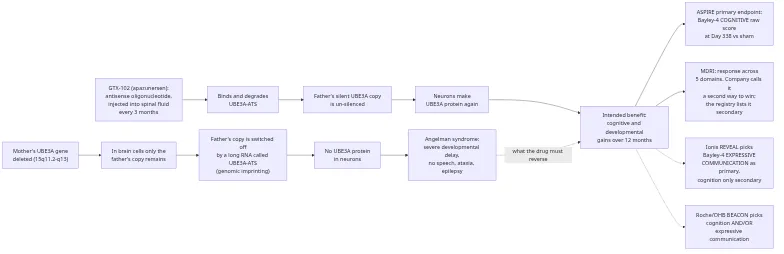
Angelman syndrome is caused by losing the use of one gene, UBE3A, in brain cells. The unusual part is why the loss is total. Everybody inherits two copies of UBE3A, one from each parent, but in neurons the body deliberately switches off the father’s copy — a phenomenon called genomic imprinting. It does so by transcribing a long RNA molecule from the paternal chromosome, called the UBE3A antisense transcript (UBE3A-ATS), which runs across the gene and silences it. So in a normal brain, one copy works and one is locked. In Angelman syndrome the mother’s copy is deleted or broken, and the only remaining copy is the locked one [VERIFIED — according to PubMed, CNS Drugs review, DOI 10.1007/s40263-026-01313-9, retrieved 2026-08-07].
That is the whole therapeutic idea. The healthy gene is already in the cell. It just needs unlocking. GTX-102 is an antisense oligonucleotide — a short synthetic strand of modified genetic material — designed to bind the UBE3A-ATS transcript and trigger its destruction. Remove the lock, and the paternal UBE3A copy is read again and the neuron starts making the protein it has never made.
The drug is given by lumbar puncture into the cerebrospinal fluid, because an oligonucleotide of
this kind cannot cross from the bloodstream into the brain. The maintenance dose in the extension
studies is 14 mg every three months, and management states the great majority of patients sit at
that dose [VERIFIED — BPIQ fetch_company_earnings_transcript, Q1 2026 call 2026-05-05].
How well the target is validated. Very well, and by an unusual route: genetics rather than
pharmacology. For a monogenic deletion syndrome named after the gene, the association is not in
serious doubt. What can be said this session is weaker than what the previous sweep could say,
because Open Targets is BLOCKED: the previous sweep resolved UBE3A to ENSG00000114062 and
Angelman syndrome to MONDO_0007113 and returned the gene as a target hit against the disease query
[VERIFIED — Open Targets search_entities, 2026-08-05], and that reading is two days old and was
not re-obtained today — four attempts each returned Rate limit exceeded for client: global. The
stronger validation does not depend on that platform at all: three separate sponsors have
independently arrived at the same mechanism — Ultragenyx’s GTX-102, Ionis’s ION582 and
rugonersen — and all three now have a pivotal Phase 3 trial running [VERIFIED — CT.gov
NCT06617429, NCT06914609, NCT07605429, read 2026-08-07].
What is new in the science since the previous version, and it cuts both ways. Roche’s rugonersen Phase 1 trial (TANGELO, n=61, children aged 1–12) has been published in Nature Medicine: the primary safety endpoint was met, and exploratory analysis showed “a dose-dependent partial normalization of the AS-associated electroencephalogram abnormality” and “signals of clinical improvement in core AS symptom domains beyond expectation from natural history data” [VERIFIED — according to PubMed, DOI 10.1038/s41591-025-03784-7, published 2025-07-11, retrieved 2026-08-07]. That is the first peer-reviewed clinical evidence for the class, and the previous version of this document specifically recorded its absence. It supports the mechanism. It does not support this trial’s endpoint, and the phrase “beyond expectation from natural history data” is exactly the comparison ASPIRE’s sham arm exists to replace.
The exact scientific step the next readout must prove. Not that the drug un-silences UBE3A — the molecular biology is established in patient-derived neurons and in animals. It must prove that un-silencing UBE3A in children who have already developed without it for four to seventeen years produces a measurable cognitive gain over and above what a matched child receiving a fake procedure achieves in the same twelve months. That is a much narrower question than “does the mechanism work”, and it is the question every prior open-label dataset has been unable to answer.
The honest scientific risk. Four things now, where the previous version had three. The second and the fourth are the ones that matter.
- Timing. Angelman syndrome is a neurodevelopmental disorder and the brain is built early. It is genuinely unknown how much can be recovered in a child of ten. The field’s own reviews say outcomes are “dependent on their age or genotype” and argue for newborn screening precisely because early intervention is expected to work better [VERIFIED — according to PubMed, DOI 10.1007/s40263-026-01313-9].
- The comparator gets the same tailwinds. The Phase 1/2 gain of about 10 points on the Bayley-4
Cognitive raw score was measured open-label, against natural history. A raw score counts
items passed and rises with age; and repeatedly administering the same test to the same child
produces a practice effect. A sham arm in ASPIRE experiences both. The entire trial rests on
management’s assertion that deletion patients gain “less than 1 point a year” untreated
[VERIFIED — BPIQ
fetch_company_earnings_transcript, Q1 2026 call]. If that assertion is even modestly wrong, a 10-point drug effect becomes a much smaller delta. This has still never been shown in a control group. - The measurement changed. ASPIRE scores the Bayley-4 “without caregiver input”, administered by an outside firm sent to each site. That is a deliberate hardening of the endpoint and it makes the Phase 1/2 number an imperfect predictor of the Phase 3 number.
- Two competitors with data on the same mechanism did not pick this endpoint. REVEAL’s primary is Bayley-4 expressive communication without caregiver input at Week 52, with cognition listed as the first secondary — and Ionis amended REVEAL in December 2025 “following additional review of data from the ongoing Phase 1/2 trial”, so the design reflects data in hand [VERIFIED — CT.gov NCT06914609, read 2026-08-07]. BEACON’s primary is “cognition and/or expressive communication” [VERIFIED — CT.gov NCT07605429]. Three pivotal trials, three different primary endpoints, and ASPIRE is the only one whose primary is cognition alone. This is not proof that cognition will miss. It is evidence about where two informed parties thought the signal was most reliable, and it did not exist as a checkable fact when this document was last written.
A.2 Clinical development plan, timeline, feasibility, resourcing
Trials
| Trial | Sponsor / whose drug | Design (arms, blinding, n) | Population | Status / key result | Link |
|---|---|---|---|---|---|
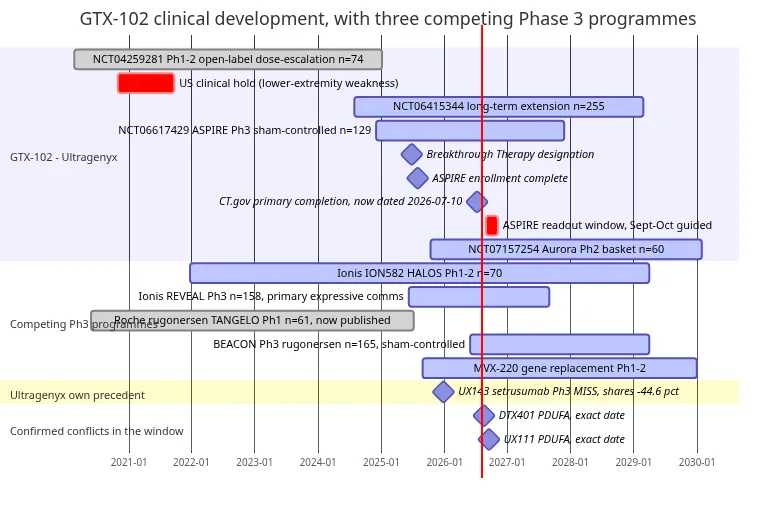
| ASPIRE, NCT06617429 | Ultragenyx / its own drug | Phase 3, randomised, double-blind, sham-controlled. Two arms: GTX-102 and Sham-LP (a simulated lumbar puncture). n=129 across 28 sites in the United States, Canada, Germany, Japan, Poland and Spain. Randomisation is stratified by age and by baseline Bayley-4 Cognitive raw score. Primary endpoint at Day 338. | Deletion-type only: genetically confirmed full maternal UBE3A deletion at 15q11.2-q13. Ages 4–17. Must be able to walk independently or with assistance — wheelchair-dependent children are excluded. Must tolerate lumbar puncture, MRI and anaesthesia without intubation. Excluded: any prior gene therapy or ASO, any change in symptom medications or diet in the month before screening, anything increasing bleeding or lumbar-puncture risk. | ACTIVE_NOT_RECRUITING. Enrolment complete 2025-07-31. has_results false. Primary completion 2026-07-10 — a day-precise date, and already past. Topline guided to the September or October timeframe. | NCT06617429 |
| Phase 1/2, NCT04259281 | GeneTx and Ultragenyx / its own drug | Phase 1/2, open-label, multiple-dose, dose-escalating, no control arm. n=74 across 25 sites, in cohorts A, B, C and D. | Paediatric Angelman syndrome | COMPLETED 2025-01-08. Mean Bayley-4 Cognitive raw score change approaching 10 points at month 12 in the 53 patients with a month-12 score, against a stated meaningful difference of 6 points. MDRI response versus baseline at months 12, 24 and 36 all at p<0.0001. Placed on United States clinical hold in 2020 after transient lower-extremity weakness; hold lifted 2021-09-27. | NCT04259281 |
| Long-term extension, NCT06415344 | Ultragenyx / its own drug | Phase 3 long-term extension, enrolling by invitation, no control. n=255 across 23 sites. | Angelman patients from prior GTX-102 studies | ACTIVE. 66 patients have averaged three years on therapy with some in a fifth year, showing continuing multi-domain gains, no new cases of transient lower-extremity weakness, and discontinuations attributed entirely to study burden rather than safety. ASPIRE patients roll into it after Day 338. Runs to 2029-02. | NCT06415344 |
| Aurora, NCT07157254 | Ultragenyx / its own drug | Phase 2, open-label, basket design. n=60 across 21 sites. The registry says Phase 2 where the company says “Phase 2/3” — reported, not reconciled. | Adult and paediatric patients with deletion- or non-deletion-type Angelman syndrome — the genotypes and ages ASPIRE excludes | RECRUITING, started 2025-10-13, first patient dosed 2025-10-30. Enrolment now guided to complete in the second half of 2026 (2026-08-04 release). Primary completion 2030-01. This is the label-expansion vehicle and it is five years from finishing. | NCT07157254 |
| REVEAL, NCT06914609 (competitor) | Ionis / its own drug ION582 | Phase 3, global, randomised, double-blind, placebo-controlled. n=158 across 42 sites in 15 countries. Randomised 1:1 to 80 mg ION582 or placebo over a 60-week treatment period, then a 25-month extension. Two cohorts: paediatric 2 to <18, which carries the primary and secondary endpoints, and adult 18–50. Amended in December 2025 from three arms (40 mg, 80 mg, placebo) to two, “following additional review of data from the ongoing Phase 1/2 trial”. | Angelman syndrome with maternal UBE3A deletion or mutation, ages 2–50 — materially broader than ASPIRE’s. Uniparental disomy, imprinting-centre defects and mosaics are excluded. | RECRUITING, first participant dosed 2025-06-10. Primary completion 2027-08. Primary endpoint: Bayley-4 EXPRESSIVE COMMUNICATION raw score without caregiver input at Week 52. Cognition is the first secondary. | NCT06914609 |
| BEACON, NCT07605429 (competitor) | OHB Pediatrics Ltd. / rugonersen (RO7248824), with Medpace as collaborator | Phase 3, randomised, multi-centre, double-blind, sham-controlled, n up to 165, followed by a ~116-week open-label extension. | Angelman syndrome, deletion or UBE3A mutation, ages 1–50, body weight >7.5 kg. Uniparental disomy and imprinting-centre defects excluded. | RECRUITING, started 2026-06. Primary completion 2029-03. Primary endpoint: Bayley-4 cognition AND/OR expressive communication raw scores without caregiver input at Week 56. Secondaries include the SAS-CGI-C clinician global impression and EEG delta-band power. | NCT07605429 |
| TANGELO, NCT04428281 (competitor, completed) | Roche / rugonersen | Phase 1, multicentre, open-label, multiple ascending dose with long-term extension. n=61 (28 female / 33 male), ages 1–12. | Angelman syndrome | Primary safety and tolerability endpoint MET. Dose-dependent partial normalisation of EEG delta power; “signals of clinical improvement in core AS symptom domains beyond expectation from natural history data”. Published in Nature Medicine, 2025-07-11. | DOI 10.1038/s41591-025-03784-7 |
| MVX-220 Phase 1/2, NCT07181837 (competitor) | Gene replacement | Registry lists Phase 1/2. Sites include Cedars-Sinai, Rush and Boston Children’s — three of them also ASPIRE or REVEAL sites. | Angelman syndrome | RECRUITING. Source conflict: 2026 peer-reviewed reviews describe MVX-220 as the first gene replacement to enter pivotal testing and call it Phase 2/3; the registry says Phase 1/2. Reported, not reconciled. | NCT07181837 |
Feasibility matrix
| Factor | High probability | Medium probability | Low probability | This asset (assessment) | Source |
|---|---|---|---|---|---|
| Recruitment feasibility | >50 sites, 3:1 patient:site | 20–50 sites, established investigators | <20 sites, novel sites | High, and this risk is now fully retired. 28 sites for 129 patients is 4.6 per site, above the 3:1 bar, at named academic centres (Boston Children’s, UCSF, Columbia, Rady, Children’s Colorado, UNC, McGill, Hamburg-Eppendorf, Sant Joan de Déu). Enrolment ran from 2024-12-03 to 2025-07-31 — eight months for a rare paediatric trial requiring repeated lumbar punctures under anaesthesia. Dosing is complete and the registry primary completion date of 2026-07-10 has passed. | CT.gov NCT06617429 |
| Endpoint clarity | Regulatory precedent exists | Novel endpoint with FDA alignment | Unvalidated surrogate | Medium, and this cell has got weaker, not stronger. The Bayley-4 is a long-established instrument, but a raw cognitive score change as a registrational primary in Angelman syndrome has no approval precedent, because nothing has ever been approved in Angelman syndrome. MDRI is explicitly novel and explicitly FDA-aligned. What is new is that the other two Phase 3 sponsors selected different primaries, which means the field has no settled view on which subtest is registrationally safest. Aligned is not the same as precedented, and now it is not the same as consensus either. | CT.gov NCT06617429, NCT06914609, NCT07605429; BPIQ earnings transcript Q1 2026 |
| Trial-design robustness | Pivotal Phase III with SPA | Adaptive with interim analysis | Single-arm, no control | High. Randomised, double-blind, sham-controlled, stratified on age and on the primary endpoint’s own baseline, in a genetically homogeneous population, n=129. Sham control for an invasive intrathecal drug is the strongest ethical design available, and BEACON’s independent choice of the same sham design corroborates that judgement. No special protocol assessment was found, so it is not the top box on the literal wording. | CT.gov NCT06617429, NCT07605429 |
| Operational / execution | Enrolment complete, standard timeline | Some timeline risk | Enrolment behind | High. Enrolment complete a month early on the company’s own account, registry primary completion 2026-07-10 reached, guidance reiterated four times unchanged and then narrowed rather than slipped. Zero date slips across roughly ten months of dated BPIQ note entries. | BPIQ note for id 17188; GlobeNewswire release 2026-08-04 |
Resourcing sufficiency. Yes, without qualification for this readout. The trial is enrolled,
dosed and complete — the registry primary completion date of 2026-07-10 has passed. What remains is
database lock, unblinding and analysis, and management has said the delay between last patient out
and topline is closing out an international study with sham procedures and EEG collection rather
than anything unresolved. Company cash of $436M at 2026-06-30 against recomputed burn of $32.3M a
month runs to roughly August 2027 (see ../company.md C.3), so the readout is
funded many times over. Resourcing risk sits on what comes after a positive result — a filing, a
launch and the Aurora study running to 2030 — not on the readout.
A.3 Target label, target product profile, strategic questions, designations
A.3a Target label. GTX-102 for the treatment of Angelman syndrome caused by full maternal UBE3A deletion, in patients aged 4 to 17, administered by intrathecal injection. Aurora is the vehicle for extending that label to other ages and other genotypes.
A.3b Target product profile
| Attribute | Standard of care & key competitor(s) — data | GTX-102 target profile (goal) | Supporting evidence (+ link) |
|---|---|---|---|
| Indication / target label | There is no approved treatment for Angelman syndrome. Care is entirely symptomatic: levetiracetam and clobazam first-line for seizures, sleep aids, behavioural and physical therapy, ketogenic or low-glycaemic-index diets in refractory cases. Competitors, all now in Phase 3 or later: ION582 (Ionis, REVEAL, deletion and mutation, ages 2–50, n=158), rugonersen (BEACON, deletion and mutation, ages 1–50, n=165), MVX-220 (gene replacement). | Deletion-type, ages 4–17 first; other genotypes and ages via Aurora | DOI 10.1080/14656566.2026.2685074 |
| Efficacy (endpoints, regimen) | Nothing changes the trajectory. Untreated deletion patients gain “less than 1 point a year” on Bayley-4 cognition per management. Rugonersen’s published Phase 1 reports improvement “beyond expectation from natural history data” but against no concurrent control. | Statistically significant Bayley-4 Cognitive gain at Day 338 versus sham, or a positive MDRI; sustained and growing with continued dosing | Phase 1/2: ~10 points at 12 months against a 6-point meaningful threshold; MDRI p<0.0001 at 12, 24 and 36 months [VERIFIED — BPIQ earnings transcript Q1 2026] |
| Safety / tolerability | Antiseizure drugs carry their own burden. Rugonersen’s Phase 1 met its safety primary in 61 children [VERIFIED — DOI 10.1038/s41591-025-03784-7], which is the class’s first published safety dataset. | No transient lower-extremity weakness at the current dose and regimen; discontinuations driven by travel burden rather than safety | 66 patients averaging 3 years, no new cases of lower-extremity weakness; all discontinuations attributed to study burden [VERIFIED — BPIQ earnings transcript Q1 2026] |
| Biomarker / companion diagnostic | Genetic confirmation of the UBE3A deletion is already routine diagnostic practice. EEG delta power is the class’s one in-patient signal and is a secondary in both BEACON and rugonersen’s Phase 1 — but is not an ASPIRE endpoint. | No new companion diagnostic needed — genotype is established at diagnosis. The eligible population is already identified. | CT.gov inclusion criteria; NCT07605429 secondary outcomes |
| Formulation / administration | Oral daily medicines | Intrathecal injection every three months, requiring sedation in children. | BPIQ earnings transcript for the 14 mg quarterly dose |
| Payer value | Lifetime cost of an Angelman patient falls almost entirely on caregivers and on special education, not on drug budgets | Developmental gains that reduce dependency across cognition, communication, behaviour, sleep and motor function | MDRI is designed for exactly this argument. No published cost-effectiveness analysis for GTX-102 was found [UNVERIFIED] |
A.3c Strategic Go/No-Go questions. The asset is completing a pivotal Phase 3 and heading for a filing, so the pre-Phase-III / registration set applies.
| Group | Question | Answer (tagged) |
|---|---|---|
| Target | Target revalidated as in prior phases? | Yes, and now by three sponsors all in Phase 3. UBE3A-ATS is targeted by GTX-102, ION582 and rugonersen; the last of these has a peer-reviewed Phase 1 showing dose-dependent EEG normalisation. [VERIFIED — CT.gov NCT06617429 / NCT06914609 / NCT07605429; DOI 10.1038/s41591-025-03784-7] |
| Dose & Drug | Exposure–response for the intended commercial regimen and route(s)? | Partially. The Phase 1/2 was designed to inform dose, regimen and endpoints, and 14 mg quarterly intrathecal was carried forward. The class’s published work establishes a steep knockdown–upregulation relationship, so the regimen has little margin for under-dosing. No GTX-102 exposure–response curve has been published. [VERIFIED — DOI 10.1093/nar/gkaf851 for the class; UNVERIFIED for GTX-102 itself] |
| Dose & Drug | Commercial formulation available or feasible? | Yes. Synthetic oligonucleotide manufacturing is mature and is not the risk here — unlike the AAV manufacturing that produced a Complete Response Letter for the company’s UX111. [UNVERIFIED] as to specifics; no CMC issue was found in any source |
| Dose & Drug | Dose range compatible with clinical and non-clinical safety? | Yes at the current dose and regimen. The programme’s defining safety event — transient lower-extremity weakness, which caused a 2020 United States clinical hold lifted 2021-09-27 — was addressed by lower, slower dosing, and 66 patients averaging three years have produced no new cases. [VERIFIED — BPIQ earnings transcript Q1 2026; BPIQ press feed for the hold and its lifting] |
| Dose & Drug | Therapeutic window given the clinical response? | Adequate but not wide. The class’s steep knockdown–upregulation curve sits against a dose-limiting local toxicity that has already halted this programme once. [VERIFIED — DOI 10.1093/nar/gkaf851], interpretation [UNVERIFIED] |
| Dose & Drug | Intrinsic and extrinsic factors influencing exposure and patient response? | Genotype is the dominant one and is controlled by design: ASPIRE takes full-deletion patients only. Age is the second and is stratified. Prior ASO or gene-therapy exposure is an exclusion — and note that all three Phase 3 trials exclude prior ASO exposure, so the three programmes are competing for the same treatment-naive children. [VERIFIED — CT.gov NCT06617429, NCT06914609, NCT07605429] |
| Patient | Proof of concept and positive benefit/risk in the intended population? Combination evidence? | Proof of concept yes, in 74 open-label patients with 66 in extension. Benefit/risk favourable at the current regimen. No combination is pursued. The concept has never been demonstrated against a concurrent control by anyone in this disease, which is what ASPIRE is for. [VERIFIED — BPIQ earnings transcript; CT.gov] |
| Patient | Phase III design and outcome criteria — accepted, compelling, competitive for market access? | Design is strong: double-blind, sham-controlled, genetically homogeneous, stratified, n=129. Outcome criteria are FDA-aligned but unprecedented, there is a source conflict about their structure (see the data-quality flags), and the two competing Phase 3 trials chose different primaries. [VERIFIED — CT.gov; BPIQ earnings transcript] |
| Patient | Rationale for the patient population(s)? | Deliberate and well argued. Full-deletion patients express no UBE3A at all, so the biological target is unambiguous and the untreated trajectory is flat; the harder genotypes were pushed into Aurora. It maximises the chance of a clean answer at the cost of a narrower first label — and both competitors took the opposite trade. [VERIFIED — BPIQ earnings transcript Q1 2026, chief medical officer Eric Crombez; CT.gov] |
| Patient | Likelihood of the expected outcome? | Modelled at 50%, band 35–65%. Reasoning is in the Locked prediction below. This is down from 55% at the previous version, and the reason is the competitors’ endpoint choices. [UNVERIFIED — modelled] |
| Patient | Companion-diagnostic strategy, including pricing and market? | Not required. Genetic confirmation of the UBE3A deletion is already routine at diagnosis, so the eligible population identifies itself. [VERIFIED — CT.gov inclusion criteria] |
A.3d Regulatory designations.
- Breakthrough Therapy designation, granted 2025-06-27. It grants intensive FDA guidance on an
efficient development programme, organisational commitment involving senior managers, and
eligibility for rolling review and priority review. It does not lower the evidentiary bar.
[VERIFIED — BPIQ fetch_company_press_releases, 2025-06-27] - Fast Track designation, granted to GTX-102 while it was a GeneTx asset. It grants more
frequent FDA meetings and eligibility for rolling review.
[VERIFIED — BPIQ fetch_company_press_releases] - Orphan Drug designation. Grants seven years of United States market exclusivity on approval
for the designated indication, tax credits on qualifying trial costs and a waived application fee.
The previous version of this document recorded this as unconfirmed; it is now corroborated but
not primary-sourced — Ultragenyx’s own investor-relations boilerplate lists Orphan Drug
designation for GTX-102, read through a web-search rendering because
ir.ultragenyx.comitself timed out.[WEB ESTIMATE — Ultragenyx investor-relations release text surfaced by web search, read 2026-08-07] - Rare Pediatric Disease designation. The designation that makes a priority review voucher
possible on approval. Same source and same limit as the line above.
[WEB ESTIMATE — Ultragenyx investor-relations release text surfaced by web search, read 2026-08-07] - European Medicines Agency: Orphan Designation and PRIME. PRIME is the EMA’s enhanced-support
scheme for medicines addressing an unmet need. Same source and same limit.
[WEB ESTIMATE — Ultragenyx investor-relations release text surfaced by web search, read 2026-08-07] - A priority review voucher is therefore a plausible outcome if approved — the chief financial
officer named it explicitly as upside not in the model, alongside the two vouchers already
expected from UX111 and DTX401 — but it is contingent, not granted.
[VERIFIED — BPIQ fetch_company_earnings_transcript Q1 2026]
A.4 Target product profile valuation matrix
| Stakeholder | Value driver | Minimum threshold | Competitive | Premium | Benchmark / source |
|---|---|---|---|---|---|
| Patient / caregiver | Any recovery of cognition, communication, sleep or mobility in a child who has none | A statistically detectable gain on one domain | Gains across several domains that a family can see day to day | Speech, or independent living becoming conceivable | MDRI exists precisely because families judge across domains, not on one test. Phase 1/2 MDRI p<0.0001 at 12, 24 and 36 months [VERIFIED — BPIQ earnings transcript Q1 2026] |
| Regulator | A pre-specified, statistically significant, clinically meaningful effect against a concurrent control | Significance on Bayley-4 Cognitive at Day 338 | Above, with MDRI concordant | Above, sustained in the extension study | No approval precedent exists in Angelman syndrome, so the regulator’s bar is being set by ASPIRE, REVEAL and BEACON together rather than read off one |
| Payer / HTA | Reduced lifelong dependency and caregiver burden | Demonstrated developmental gain | Above, with durability | Above, plus reduced special-education and care costs | No published cost-effectiveness analysis for GTX-102. Angelman’s economic burden has been characterised in the literature but not tied to this drug [UNVERIFIED] |
| Provider | A treatment where none exists | Deliverable quarterly at a paediatric neurology centre | Above, with manageable sedation burden | Above, without long-term specialist monitoring | Quarterly intrathecal dosing under sedation is a real infrastructure requirement. Discontinuations in Phase 1/2 were entirely attributed to travel and participation burden [VERIFIED — BPIQ earnings transcript Q1 2026, chief medical officer] |
A.5 Evidence quality and endpoints
| Criterion | Score (High / Medium / Low) | Basis (one line) | Link |
|---|---|---|---|
| Target validation | High | A monogenic deletion syndrome named after the gene, with three sponsors now running pivotal trials against the same transcript. Open Targets could not be re-queried this session (BLOCKED, four attempts); the 2026-08-05 reading catalogued UBE3A ENSG00000114062 against Angelman MONDO_0007113 and is cited as history. | DOI 10.1016/j.braindev.2026.104527 |
| Mechanism clarity | High | Un-silencing an imprinted allele is a completely specified molecular event, demonstrated in patient-derived neurons, in a human-neuron xenotransplantation model in mice, and in cynomolgus monkeys. Note on independence: the xenotransplantation paper’s own Methods state “ASOs used in this study were kindly provided by Roche” — so it is corroboration by a group funded in kind by a competitor, not by a wholly disinterested one. | DOI 10.1038/s41598-026-41197-9 |
| Biomarker availability | Medium | UBE3A protein and mRNA are measurable in preclinical systems, and EEG delta power is now a published, dose-responsive class biomarker in rugonersen’s Phase 1 — but there is still no way to measure neuronal UBE3A in a living child, and ASPIRE does not carry EEG as an endpoint at all, where BEACON does. | DOI 10.1038/s41591-025-03784-7 |
| Publication quality (peer-reviewed? independent authors?) | Low for this asset, and the gap has widened. | A GTX-102[All Fields] OR apazunersen[All Fields] PubMed search returns two records, both reviews that mention the drug in passing. Every efficacy number in this document (10 points, 6-point threshold, 53 patients, MDRI p<0.0001, 66 in extension, 3-year average) still comes from an earnings-call script and a press release, and management said on 2026-05-05 that detailed Phase 1/2 data would probably not be shown before the Phase 3 topline. Meanwhile the competing rugonersen programme has moved from a discovery paper to a full Phase 1 clinical publication in Nature Medicine. | DOI 10.1055/a-2399-0191 and DOI 10.1016/j.braindev.2026.104527 (the two hits); DOI 10.1038/s41591-025-03784-7 (the competitor’s) |
| Clinical / expert sentiment | — | Moved to A.5b, below. | — |
Endpoints
| Endpoint (full name) | What it measures | Scale / range | Better direction | MCID / note |
|---|---|---|---|---|
| Change from baseline in Bayley-4 Cognitive raw score without caregiver input at Day 338 — the sole registry-listed primary endpoint | The Bayley Scales of Infant and Toddler Development, fourth edition, cognitive subtest. An examiner presents standard tasks and counts how many the child completes. The raw score is that count, not adjusted for age. “Without caregiver input” means it rests on what the examiner observes, not what a parent reports. | Continuous count of items passed. The Bayley-4 cognitive subtest has 91 items, so the raw score runs roughly 0–91; Angelman patients score at the low end. | Higher is better | Minimal clinically important difference: 6 points, as stated by the company. The Phase 1/2 result approached 10 points at month 12 in 53 patients. Two cautions: a raw score rises with age in any developing child, and repeated administration of the same test produces a practice effect — both of which the sham arm also gets. Management states untreated deletion patients change “less than 1 point a year”. A third caution is new: neither competing Phase 3 trial made this subtest its sole primary. |
| Net response in Multidomain Responder Index (MDRI) at Day 338 — listed on the registry as secondary, described by the company as a second independent way to succeed | Each patient is scored improved / unchanged / worse on five domains — cognition, communication, behaviour, sleep and gross motor — using clinically meaningful thresholds consistent with FDA guidance rather than statistically derived ones, then combined into one net response per patient. | Net count across five domains, so roughly −5 to +5 per patient | Higher is better | No established MCID — the index is built out of per-domain clinically meaningful thresholds instead. Phase 1/2 gave p<0.0001 against baseline at months 12, 24 and 36. This endpoint is the subject of a documented source conflict: see the data-quality flags. |
| Change from baseline in ABC-C Hyperactivity/Noncompliance subscale score at Day 338 — secondary | Aberrant Behavior Checklist – Community, hyperactivity and non-compliance subscale. A caregiver-rated questionnaire. | Subscale score; the hyperactivity subscale runs 0–48 | Lower is better | No MCID established for Angelman syndrome specifically [UNVERIFIED] |
| Change from baseline in Bayley-4 Receptive Communication raw score at Day 338 — secondary | How much language the child understands, examiner-observed | Raw count of items passed | Higher is better | One of the five MDRI domains, also reported on its own. Note ASPIRE lists receptive communication and not expressive, where REVEAL’s primary is expressive. |
| Change from baseline in Angelman Severity Assessment (ASA) Sleep Rating raw score at Day 338 — secondary | A disease-specific severity instrument’s sleep component. Sleep disturbance is one of the heaviest caregiver burdens in Angelman syndrome. | Raw rating | Direction depends on the scale’s polarity, which is not stated on the registry [UNVERIFIED] | An MDRI domain |
| Change from baseline in Vineland-3 Receptive and Expressive Communication raw scores at Day 338 — secondary | Vineland Adaptive Behavior Scales, third edition: everyday functional communication, caregiver-reported | Raw scores | Higher is better | Two separate listed endpoints |
| Change from baseline in Bayley-4 Gross Motor raw score and ASA Gross Motor Rating at Day 338 — secondary | Movement and mobility | Raw scores | Higher is better | The fifth MDRI domain, measured two ways |
| Treatment-emergent adverse events and serious adverse events over 2 years — secondary | Safety | Counts, severity, relationship to drug, to procedure and to premedication | Fewer is better | The registry separates drug-related from procedure-related events, which matters when the procedure is a lumbar puncture under anaesthesia every three months. |
A.5b Key opinion leaders.
Panel as of. 2026-08-07 — the date the investigator and independent-voice searches below were run.
Investigators
ASPIRE names no investigators anywhere this framework can reach, and that is the finding.
get_trial_details on NCT06617429 returns all 28 sites with contacts: null and no overall
official, which is normal for a trial that has stopped recruiting. search_investigators on
Angelman syndrome analysed 55 trials and returned 66 named people, none of them attached to
NCT06617429. The table is therefore empty, and it is empty because the registry discloses nothing,
not because nobody looked.
| Name | Role / affiliation | Trial (NCT) | Conflicts (party, kind, disclosed in, as of) | Conflicts checked (source, date) | Source | Tag |
|---|---|---|---|---|---|---|
| — | No investigator is disclosed for NCT06617429 by CT.gov | NCT06617429 | — | CT.gov get_trial_details NCT06617429, 2026-08-07 (28 sites, every one contacts: null, no overall official); CT.gov search_investigators condition “Angelman syndrome”, 2026-08-07 (55 trials analysed, 66 investigators returned, none on NCT06617429) | CT.gov, 2026-08-07 | [VERIFIED — CT.gov, 2026-08-07] |
Independent voices
Finding one took more exclusions than inclusions, and the exclusions are the more useful half. Three obvious candidates were checked and rejected as not independent, each for a named, disclosed reason:
- Laurent Servais (University of Oxford), senior author of the 2026 CNS Drugs review of
emerging Angelman therapies, is principal investigator on NCT05100810, the FAST UK Angelman
natural-history study [VERIFIED — CT.gov
search_investigators, 2026-08-07]. The Foundation for Angelman Syndrome Therapeutics founded GeneTx and is the party the GTX-102 royalty ultimately flows toward (B.1). That is a relationship with this program’s economics, so he cannot be recorded as independent of it. - Elizabeth Berry-Kravis (Rush) and Lynne M. Bird (Rady Children’s / UCSD) are both authors on the rugonersen Phase 1 publication and Bird is a named principal investigator on the rugonersen BEACON Phase 3 [VERIFIED — DOI 10.1038/s41591-025-03784-7; CT.gov NCT07605429, 2026-08-07]. Both institutions are also ASPIRE sites. A disclosed relationship with a direct competitor is exactly as disqualifying as one with the sponsor.
- The Erasmus MC / Columbia group behind the independent mechanism-corroboration paper the previous version of this document leaned on states in its own Methods that “ASOs used in this study were kindly provided by Roche” [VERIFIED — according to PubMed, full text of DOI 10.1038/s41598-026-41197-9, retrieved 2026-08-07]. That is a competitor relationship disclosed in the paper itself. The corroboration still stands as science; the authors are not a disinterested voice on this program’s endpoint.
| Name | Affiliation | View (close enough to quote) | As of | Conflicts checked (source, date) | Source | Tag |
|---|---|---|---|---|---|---|
| Debopam Samanta, MD | Division of Child Neurology, University of Arkansas for Medical Sciences | Sole author of two 2026 reviews covering this exact competitive field. Names GTX-102/apazunersen among three ASO programmes “showing proof-of-concept efficacy in Phase 1/2 studies”, and states that “critical challenges include outcome measurement limitations, genotype stratification, long-term safety monitoring, and ensuring equitable access”. On the treatment side he places the emerging class against a standard of care that is “guided by retrospective cohort data, caregiver surveys, and expert opinion in the absence of randomized controlled trials”. | 2026-03-20 (Brain & Development) and 2026-06-05 (Expert Opinion on Pharmacotherapy) | PubMed search_articles + get_article_metadata on both PMIDs (41864145, 42234576), 2026-08-07 — neither record exposes a conflict-of-interest statement through this connector, and neither article is in PubMed Central, so no full text could be searched for one; CT.gov search_investigators condition “Angelman syndrome”, 2026-08-07 — he appears on none of the 55 trials analysed, including all four GTX-102 trials, REVEAL and BEACON | According to PubMed, DOI 10.1016/j.braindev.2026.104527 and DOI 10.1080/14656566.2026.2685074 | [VERIFIED — PubMed get_article_metadata, 2026-08-07] |
The limit of that check, stated plainly. An empty conflicts array here means the two searches
named above came back with nothing, not that this person has no relationships. Neither journal’s
disclosure statement was reachable through the connectors available, and 02-connectors.md is
explicit that the absence of a disclosure is not evidence of no conflict.
Judgement
| Endpoint supported | Basis (one or two sentences) | Tag |
|---|---|---|
UNKNOWN | One independent voice is not a panel, and the one voice found names “outcome measurement limitations” as a critical open challenge for exactly this class rather than endorsing any particular instrument. The strongest available reading on the endpoint is not an expert opinion at all but a revealed preference: three pivotal sponsors picked three different Bayley-4 primaries, and ASPIRE is the only one betting on cognition alone. | [UNVERIFIED — judgement] |
Dissent
Empty, and deliberately so. SUPPORTIVE_CONTESTED would require a named voice disagreeing with a
positive reading; there is no positive reading here to disagree with, and inventing a dissenter to
fill a row would be the same failure as inventing a supporter.
| Name | View (close enough to quote) | Source |
|---|---|---|
| — | — | — |
B. Commercial assessment
B.0 Current treatment algorithm
What a child with Angelman syndrome receives today:
- Diagnosis, usually in the first two years, by genetic testing that identifies the maternal UBE3A deletion or mutation. The genotype is therefore known from the start, which is why no companion diagnostic is needed.
- Antiseizure medication for the 80–90% who develop epilepsy. Levetiracetam and clobazam are the favoured first-line agents; valproate and clonazepam work but carry more complex side effects; cannabidiol oil is reported; ketogenic and low-glycaemic-index diets are adjuncts in refractory cases [VERIFIED — according to PubMed, DOI 10.1080/14656566.2026.2685074].
- Symptom management for sleep disturbance, gastrointestinal problems, scoliosis and behaviour.
- Physical, occupational, speech and behavioural therapy, indefinitely.
- Lifelong multidisciplinary care with heavy caregiver burden. Most patients never live independently.
Where GTX-102 would fit. As a new step 2, above everything symptomatic: the first disease-modifying therapy, taken alongside rather than instead of the existing care. It displaces nothing and adds a quarterly hospital procedure. That is a genuinely new line of therapy in a disease that has never had one, and the algorithm above contains no drug that changes the trajectory at all — the review that sets it out says as much, describing seizure management as “guided by retrospective cohort data, caregiver surveys, and expert opinion in the absence of randomized controlled trials”.
B.1 Competitive landscape and positioning
| Metric | High value | Medium value | Low value | This asset (assessment) | Source |
|---|---|---|---|---|---|
| Mechanism differentiation | First-in-class or novel target | Next-generation improvement | Me-too | Medium, and this is the uncomfortable answer. The mechanism is novel in absolute terms — nothing approved works this way — but GTX-102 is one of three antisense oligonucleotides against the same transcript, all three now in Phase 3, plus a gene-replacement approach behind them. Ultragenyx’s own differentiation claim is scientific: Scott Dindot’s laboratory targeted “a separate and distinct region” of the antisense transcript giving more efficient knockdown and greater potency, validated in a large animal model rather than just mice. That is a real claim and it has still not been independently tested against ION582 or rugonersen. | BPIQ earnings transcript Q1 2026; DOI 10.1016/j.braindev.2026.104527 |
| Development-timeline advantage | >12 months ahead | Within 6–12 months | Lagging >12 months | High, and now quantified from registry dates rather than estimated. ASPIRE reads out in September or October 2026. REVEAL’s registry primary completion is 2027-08, eleven months later. BEACON’s is 2029-03, thirty-one months later. GTX-102 will be the first controlled Phase 3 readout in Angelman syndrome by a clear margin. | CT.gov NCT06617429, NCT06914609, NCT07605429, read 2026-08-07 |
| Clinical proof-of-concept evidence | Positive Phase IIb (n>100) | Phase IIa signals (n=20–50) | Preclinical only | Medium-to-high, and relatively weaker than it was. 74 patients dosed in Phase 1/2 with 66 in long-term extension averaging three years is well beyond the “Phase IIa signals” band on numbers, and it sits below the top box because it was open-label with no control arm. What has changed is the comparison: rugonersen’s 61-patient Phase 1 is now peer-reviewed and GTX-102’s 74-patient dataset is still not. | CT.gov NCT04259281; BPIQ earnings transcript; DOI 10.1038/s41591-025-03784-7 |
| IP protection | Composition-of-matter, long-dated | Method-of-use | Pending or none | Partially resolved, better than at the last version. GTX-102 came from Scott Dindot’s laboratory at Texas A&M, was funded by the Foundation for Angelman Syndrome Therapeutics, was placed in GeneTx in 2017, and was acquired outright by Ultragenyx in July 2022. Total consideration was $91.2M — $75.0M option exercise, $15.6M for GeneTx’s cash, $0.6M of working-capital and transaction adjustments — plus milestones and royalties, including a $30M milestone on entering Phase 3. Orphan Drug designation is now corroborated, which grants seven years of United States exclusivity on approval independent of any patent. The royalty rate could still not be confirmed and no patent was verified. | [WEB ESTIMATE — Ultragenyx Form 10-Q text and FierceBiotech / PRNewswire coverage of the 2022 acquisition, read 2026-08-07]; [UNVERIFIED] as to patents and royalty rate |
Where this asset wins, in plain sentences. It wins on time, and by more than the previous version could demonstrate: the registry now dates REVEAL’s primary completion to 2027-08 and BEACON’s to 2029-03, so GTX-102 answers the disease’s central question roughly a year before anyone else can. It wins on population purity: taking deletion-only patients gives the cleanest possible test, where both competitors enrol deletion and mutation patients across much wider age bands and accept more variability in exchange for a broader label. And it would win on the endpoint structure if the company’s account of the FDA agreement holds, because two independent statistical paths are worth more than one.
It loses on breadth, and it may lose on endpoint choice. If all three drugs work, ION582’s label (ages 2–50, deletion and mutation) and rugonersen’s (ages 1–50, deletion and mutation) are both bigger than a deletion-only 4–17 label, and Ultragenyx has to run Aurora until 2030 to catch up. A first-mover advantage measured in months against a label gap measured in years is not obviously the better half of that trade.
The single fact the thesis rests on. That children with full maternal UBE3A deletion, aged 4 to 17, do not improve on the Bayley-4 Cognitive raw score over twelve months without treatment. Everything — the powering, the interpretation of the open-label 10-point gain, the meaning of the sham arm — depends on it. Management asserts it plainly and repeatedly. It has not been shown in a concurrent control group, because no such group has ever been run in this disease. ASPIRE is the first time anyone will see it — and the second-best-informed party in the field looked at the same class of data and put its money on a different subtest.
B.2 Addressable market
Launch markets would be the United States, the European Union and Japan, matching where ASPIRE ran.
| Component | How it is estimated | Premium threshold | This asset (assessment) | Source |
|---|---|---|---|---|
| Drug-treated patients | Epidemiology × diagnosis rate × genotype fraction × age fraction × treatment rate | >100,000 (US/EU5/Japan) | Below the threshold, but by far the largest population Ultragenyx has ever addressed. Birth prevalence is put at roughly 1 in 12,000 to 1 in 20,000 across sources, and the two 2026 peer-reviewed reviews independently give “approximately 1 in 15,000 live births”, which sits inside that band. That gives roughly 15,000–20,000 people in the United States. Deletion-type is the largest genotype subgroup at roughly 65–75% of cases [UNVERIFIED], and the initial label covers ages 4–17 only, so the initially addressable United States pool is in the low thousands with the rest reachable through Aurora. | [VERIFIED — according to PubMed, DOI 10.1016/j.braindev.2026.104527 and DOI 10.1038/s41598-026-41197-9, both giving ~1 in 15,000]; [WEB ESTIMATE — DelveInsight and NORD epidemiology summaries, read 2026-08-05] for the wider band |
| Market exclusivity | Patent term + regulatory exclusivity | >10 years combined | Partially resolved. Orphan Drug designation is now corroborated, which grants seven years of United States market exclusivity on approval, plus an EMA orphan designation carrying ten years in Europe. No patent term was verified. Composition-of-matter on a specific oligonucleotide sequence is the normal form and would be long-dated, but that remains an expectation, not a finding. | [WEB ESTIMATE — Ultragenyx investor-relations release text surfaced by web search, read 2026-08-07]; [UNVERIFIED] as to patents |
| Reimbursement precedent | Approvals in ≥2 major markets | Positive NICE/CADTH guidance | None, in either direction. No disease-modifying drug has ever been approved for Angelman syndrome anywhere. There is no precedent to price against and no precedent to be refused against. | DOI 10.1016/j.braindev.2026.104527 |
| Patient-journey impact | Fewer hospital days, less caregiver burden | >30% quality-of-life gain | Plausibly the strongest cell in this table, and unquantified. Angelman syndrome consumes a family: no speech, epilepsy in 80–90%, severe sleep disturbance, lifelong dependency. MDRI was designed to capture exactly the multi-domain change a payer would need to see. No cost-effectiveness analysis exists to put a number on it. | [UNVERIFIED] |
B.3 Value and feasibility
B.3a Expected peak sales. Built bottom-up: treated patients × annual net price × penetration. Unlike the company’s gene therapies this is a chronic therapy, so peak revenue persists rather than decaying after a prevalent backlog clears — the single biggest structural difference between this asset and DTX301. All scenarios are conditional on approval, assume a first launch no earlier than 2028, and exclude any priority review voucher. The competitive assumption is tightened from the previous version: ION582’s registry primary completion is 2027-08 and rugonersen’s is 2029-03, so meaningful ION582 competition is assumed from roughly 2029 and rugonersen competition from roughly 2031.
| Scenario | Assumptions (patients × price × share) | Estimate (USD/year at peak) | Basis / tag |
|---|---|---|---|
| Low | ~1,200 patients on therapy globally × ~$400k net × sharing the market with two broader-label rivals | ~$0.5B/year | Assumes the label stays at deletion-type ages 4–17, quarterly intrathecal dosing suppresses uptake in families far from a centre, and ION582 and rugonersen take the broader population. [UNVERIFIED — modelled] |
| Base | ~3,000 patients on therapy globally × ~$450k net | ~$1.35B/year | Assumes a clean ASPIRE win, label expansion through Aurora reaching other genotypes and ages by around 2030, and roughly half the treated Angelman market. [UNVERIFIED — modelled] |
| High | ~6,000 patients on therapy globally × ~$500k net | ~$3.0B/year | Assumes ASPIRE wins on both endpoints, GTX-102 establishes itself as the standard of care in the roughly eleven months before REVEAL reads out, and multi-year extension data drives near-universal uptake in diagnosed patients. [UNVERIFIED — modelled] |
On the price assumption, which is the weakest input: no rare-disease chronic intrathecal
antisense oligonucleotide price is quoted here from a verified source. The $400–500k band is a
modelled figure and is [UNVERIFIED — modelled]. It is the input most capable of moving every
number in the table.
What is not passed through, and why the two available third-party figures cannot both be right. One source describes “conservative United States-only modelling” implying $1.5–2.4B peak across Ultragenyx’s late-stage programs; another reports GlobalData’s expiry model putting GTX-102 specifically at $30M of United States revenue by 2036 [WEB ESTIMATE — both re-checked 2026-08-07]. Those differ by a factor of fifty for overlapping subject matter. Neither is used as an input and both are recorded so a reader can see the dispersion. Per rule 6, the $30M figure in particular is not passed through: a $30M peak for the only disease-modifying therapy in a 15,000-patient United States indication is not a credible output whatever model produced it.
B.3b Feasibility
| Question | Answer (tagged) |
|---|---|
| Expected net present value (eNPV) | No point estimate (rule 10). Conditional on ASPIRE succeeding, and assuming 85–90% approval probability given Breakthrough Therapy designation and a met primary endpoint in a disease with no alternative, a 2028 launch, the $1.35B base-case peak, a 12% discount rate, and roughly $300–500M of remaining development and launch cost including Aurora to 2030, the conditional value is roughly $2.5–5.0B. Applying the 50% modelled probability gives an unconditional ~$1.25–2.5B. Against a recomputed enterprise value floor of at least $2,203M (see ../company.md C.4), this single program still plausibly accounts for most or all of the enterprise value on its own — which is the arithmetic behind calling it dominant among the catalysts. Every input is [UNVERIFIED — modelled]. |
| Capital to the next decision point | Effectively nil. Enrolment is complete, dosing is complete, and the registry primary completion date of 2026-07-10 has passed. What remains is database lock and analysis. |
| Capital to approval, and the funding plan | Modest for the filing itself; substantial for Aurora, which runs to 2030 and is the label-expansion vehicle. Company cash runs to roughly 2027-08 on recomputed burn, and a positive ASPIRE result would make an equity raise cheap. See ../company.md C.3. |
| Launch capability — alone, or must partner? | Alone. Ultragenyx sells four rare-disease products through its own organisation across North America, Latin America, Europe and Asia-Pacific. A quarterly intrathecal product delivered through paediatric neurology centres is well within that capability. |
| Commercialisation rights — retained, split, or out-licensed? | Retained, with an upstream obligation. Ultragenyx acquired GeneTx outright in July 2022 for total consideration of $91.2M — a $75.0M option exercise, $15.6M for GeneTx’s cash and $0.6M of adjustments — plus milestones and royalties, including a $30M milestone on entering Phase 3. The royalty ultimately flows toward the Foundation for Angelman Syndrome Therapeutics, which founded GeneTx. The royalty rate could not be confirmed on this sweep either and no figure is asserted. [UNVERIFIED] as to rate |
B.4 Product-development risk
Framing questions.
- Does the development plan support the target product profile claims? Yes, for the narrow label. ASPIRE is properly designed to prove a cognitive benefit in deletion-type patients aged 4–17, and that is exactly the claim it is built for. It does not support the broader claim — other genotypes, other ages — which is Aurora’s job and Aurora finishes in 2030, by which time both competitors will have read out.
- Will the identified risks affect the target product profile? One would, decisively. If the sham arm improves materially over twelve months, the measured drug effect shrinks and the trial’s powering assumption breaks. Nothing about the drug changes; the demonstrable claim does.
- If a risk cannot be mitigated, is the asset still differentiated from competitors? No, and this is worse than it was. A failed ASPIRE would leave GTX-102 behind two live Phase 3 programmes in a mechanism the failure had not disproven, rather than one. The downside is not merely a lost year.
| Category | Time risk | Quality risk | Cost risk | Note |
|---|---|---|---|---|
| Project management | Low | Low | Low | Enrolment complete a month early, guidance reiterated four times and then narrowed rather than slipped, zero date slips, registry primary completion reached on 2026-07-10. |
| Research | Low | The mechanism is reproduced in patient-derived neurons, in a human-neuron xenotransplant model and in monkeys. Note the xenotransplant work was performed with ASOs supplied by Roche, so “independent of Ultragenyx” is accurate and “independent of the field’s commercial interests” is not. | ||
| IP | Medium | Royalty obligation to the GeneTx sellers at an unconfirmed rate; no patent verified. Orphan Drug designation is now corroborated, which improves the exclusivity picture materially. | ||
| Legal | Low | Nothing program-specific found. Company-level law-firm investigation notices are recorded in ../company.md C.5 and are not attributed to this program. | ||
| DMPK | Medium | No GTX-102 exposure–response curve is published. The class’s published knockdown–upregulation relationship is steep, which leaves little margin. | ||
| Safety pharmacology | Low | Nothing found. | ||
| Toxicology | Medium | Local intrathecal toxicity is the class’s dose-limiting issue and it stopped this programme once. | ||
| Drug safety (clinical) | Medium, with a historical near-veto | Transient lower-extremity weakness caused a United States clinical hold in 2020, lifted 2021-09-27, and Canadian enrolment was separately paused. Attributed to local swelling from a high local ASO concentration and addressed by lower, slower dosing. No new cases in 66 patients averaging three years, and rugonersen’s published Phase 1 met its own safety primary in 61 children, which is mild class reassurance. A recurrence in a 129-patient paediatric Phase 3 would still be a near-veto regardless of efficacy. | ||
| Biomarker | Medium | There is no accessible pharmacodynamic biomarker in a living patient for UBE3A itself. EEG delta power is now a published, dose-responsive class marker — but ASPIRE does not measure it, where BEACON does. So this trial still cannot distinguish “the drug did not reach the target” from “the target did not matter”. | ||
| Clinical pharmacology | Medium | Quarterly dosing is inferred from the extension experience rather than from a published pharmacokinetic model for GTX-102. | ||
| Clinical (efficacy) | HIGH — this is the readout, and the endpoint choice is now part of the bear case | The open-label 10-point Bayley-4 gain is measured without a concurrent control, on a raw score that rises with age, on a test repeatedly administered to the same child. A sham arm gets maturation and practice effect too. Nine months ago this company took a large, highly significant biomarker gain into two Phase 3 trials and missed the clinical endpoint in both. And the two competing Phase 3 sponsors, each holding their own data on the same mechanism, declined to make cognition their sole primary. | ||
| Clinical operations | Low | Low | Medium | 28 sites, six countries, repeated lumbar punctures under anaesthesia in children, and sham procedures on top. Management explicitly cited closing out sham and EEG procedures as the reason for not narrowing the readout date sooner. Phase 1/2 discontinuations were entirely for participation burden. |
| CMC / manufacturing | Low, and it is a genuine advantage | Synthetic oligonucleotide manufacturing is mature. This program does not carry the AAV manufacturing risk that produced a Complete Response Letter for the company’s UX111. | ||
| Regulatory | Medium | Breakthrough Therapy and Fast Track help with process, not evidence. There is no approval precedent in this indication, and the MDRI-as-second-primary structure rests on a management account of an FDA agreement that the registry does not corroborate — see the flags. | ||
| Global evidence & value | Medium | No cost-effectiveness analysis, no reimbursement precedent, and a price assumption that is entirely modelled. | ||
| Commercial | Medium | Quarterly intrathecal dosing under sedation is a real adherence barrier for families far from a centre, and it is the stated reason patients left the Phase 1/2. Two broader competitor labels are the competitive risk if all three drugs work. |
Readout
Sources
| Kind | Where it comes from | What it is worth | Value (or null) | Tag | Note |
|---|---|---|---|---|---|
bpiq | fetch_company_drugs — catalyst_date, catalyst_date_text | The current single source. Synthesized from period text on most rows, so alone it is a ceiling, not an estimate. | 2026-12-31 (text “H2 2026”) | [VERIFIED — BPIQ fetch_company_drugs, read 2026-08-07] | The period-end placeholder documented in 02-connectors.md, not a disclosed day. It is now two months behind the company’s own guidance and is used for nothing in this document except as this row. |
ctgov | CT.gov get_trial_details — primary_completion_date | Independent of the company’s own messaging, and it moves when the trial moves. | 2026-07-10 | [VERIFIED — CT.gov get_trial_details NCT06617429, read 2026-08-07] | Now day-precise where the previous sweep saw only “2026-07”, and already in the past. It marks when the last patient completed Day 338, not when topline is announced — topline follows database lock and analysis. |
company | fetch_company_press_releases | The company’s own most recent dated wording. | 2026-09/2026-10 | [VERIFIED — GlobeNewswire, Ultragenyx Q2 2026 results release, 2026-08-04, read via newswire syndication 2026-08-07] | Text: “Data from this study are expected in the September or October timeframe.” Two months named, not a day. Upgraded from the previous version’s third-party rendering to the newswire text itself; ir.ultragenyx.com still timed out. |
congress | data/congresses.json, only when the company has said it intends to present there | Answers “where will they say it.” | null | [UNVERIFIED] | data/congresses.json holds four meetings — ACTRIMS-ECTRIMS, ESMO, CTAD and AASLD — and none is an Angelman or general paediatric-neurology meeting. Ultragenyx has named no congress for the ASPIRE topline; management said on 2026-05-05 that detailed Phase 1/2 data would probably not be presented before the Phase 3 topline. Matching on therapeutic area alone would be a guess, and a guess is not a source. |
modelled | Trial arithmetic — see below | The only estimate independent of anyone’s guidance. | 2026-09/2026-11 | [UNVERIFIED — modelled, default lag] | Registry primary completion 2026-07-10 plus the stated default lag of two to four months. data/benchmarks/readout-lag.json holds no observations, so the default applies and the tag says so. |
The modelled estimate. ClinicalTrials.gov gives NCT06617429 a primary_completion_date of
2026-07-10 — the day the last enrolled child completed the Day 338 visit. Topline follows
database lock, unblinding and analysis. 01-rules.md rule 34 sets the default lag at two to four
months where no benchmark exists, and data/benchmarks/readout-lag.json is empty, so: 2026-07-10 +
2 months = 2026-09-10, and 2026-07-10 + 4 months = 2026-11-10. That is the arithmetic, and it
can be argued with by disputing either input.
Window
| Earliest | Likeliest | Latest | Precision | Confidence |
|---|---|---|---|---|
| 2026-09-01 | 2026-10-15 | 2026-11-10 | MONTH | MEDIUM |
Basis. The earliest and likeliest edges come from the company’s own 2026-08-04 guidance, which
names two specific months rather than a quarter or a half — that is why precision is MONTH and not
PERIOD, and it is the only reason this program can carry a run-up call at all. The latest edge
extends past the company’s own wording to 2026-11-10, the top of the modelled lag band, because a
sponsor guiding “September or October” one month before September has room to slip a few weeks and
the conservative direction to be wrong in is late, not early. Confidence is MEDIUM rather than
HIGH because the guidance is still a two-month range from a sponsor that has not committed to a
day, and rather than LOW because the registry primary completion has actually passed, enrolment
finished early, and ten months of BPIQ note entries show the guidance narrowing rather than
slipping.
Disagreement. CONSISTENT. The three dated sources point at the same event through different
instruments: the registry marks the last Day 338 visit (2026-07-10), the modelled estimate adds the
standard two-to-four-month analysis lag to it (2026-09/2026-11), and the company names the months
inside that band (September or October). The one apparent outlier, BPIQ’s 2026-12-31, is the
documented period-end placeholder rather than a fourth opinion — it is what “H2 2026” is stored as,
and 01-rules.md rule 23 is explicit that it must not be read as a December date.
Date slippage. Zero slips, and one narrowing.
| As of | Guidance text |
|---|---|
| 2025-10-30 | ”Data from Aspire study in H2 2026” |
| 2025-11-04 | ”Reiterated ASPIRE Ph3 fully enrolled; Aspire Ph3 data expected H2 2026” |
| 2026-01-12 | ”Reiterated ASPIRE Ph3 fully enrolled; Aspire Ph3 pivotal data expected H2 2026; Aurora Ph2/3 ongoing” |
| 2026-05-05 | ”ASPIRE Ph3 data and Aurora enrollment expected H2 2026” |
| 2026-08-04 | ”Data from this study are expected in the September or October timeframe” |
Five dated statements, four transitions, zero slips: the first four reiterate the same H2 2026
guidance across roughly nine months, and the fifth tightens it rather than pushing it out.
Earlier note entries track execution rather than dates — 2024-07-17 FDA alignment on Phase 3
endpoints, 2024-12-19 first patient dosed, 2025-07-31 enrolment completed, 2025-10-30 first patient
dosed in Aurora.
Attribution
Status. CONTAMINATED
| Status | Means |
|---|---|
CLEAN | conflicts is empty — nothing else has_catalyst on this ticker’s pipeline lands within the window. |
CONTAMINATED | At least one conflict is confirmed: a real disclosed date on one side. The stock-direction call below must not be presented as attributable to this program alone; the Note below says why. |
INDETERMINATE | conflicts is non-empty, but every entry is still a guess on both sides. |
WAIVED | An analyst’s own override, never computed. Not used here. |
Conflicts
Transcribed verbatim from lib/clustering.mjs’s attributionFor, run over RARE’s full pipeline and
both sibling programs for bpiq_drug_id 17188 at CATALYST_CLUSTER_MIN_MONTHS = 6.
| bpiq_drug_id | Label | Date | Analysed? | Gap (days) | Confirmed? |
|---|---|---|---|---|---|
| 17189 | DTX401 | 2026-08-23 | No | 9 | Yes |
| 17190 | DTX301 | 2027-06-30 | Yes | 52 | Yes |
| 17191 | UX701 | 2026-12-31 | No | 0 | Yes |
| 18004 | UX111 (ABO-102) | 2026-09-19 | No | 0 | Yes |
Note. Four other has_catalyst rows on this ticker land inside or beside this program’s readout
window, and two of them carry exact, publicly disclosed FDA decision dates: the DTX401 PDUFA on
2026-08-23, nine days before the window opens, and the UX111 PDUFA on 2026-09-19, squarely inside
it. Neither has a program document of its own, so neither would be visible to a check that read only
program.json files. Both are approval decisions on gene therapies carrying saleable priority review
vouchers, and on this company’s own record an approval is worth 4–9% and a Complete Response Letter
would be worth considerably more in the other direction (../company.md C.7). The
scenario ranges below therefore cannot be read as the market’s verdict on Angelman alone. The
options chain says the same thing independently: the 2026-10-16 expiry that spans this readout also
spans both PDUFA dates, so the 41–70% implied move it brackets is pricing three answers together
(../company.md C.6).
Two of the four conflicts deserve a sentence of their own, because they changed character in this
refresh. DTX301 (52 days) and UX701 (0 days) are both period-end placeholders on their own side —
the pair GTX-102 × DTX301 was this corpus’s worked example of an INDETERMINATE finding, two
independent placeholders 181 days apart that happened to touch. They are now confirmed: true
because this program’s side of each pair stopped being a guess: writing a MONTH-precision
readout.window here means one side of every pair it enters now rests on a disclosed date. That is
the mechanism working as designed, not a change in what DTX301 or UX701 disclosed. It is also a
reminder that confirmed is a property of the pair, not of the other row.
Market and timing for this event
- Plain takeaway. This is the event the whole equity is waiting for, it lands within about four
to fourteen weeks, and it is formally impossible to isolate — the clustering pass now records that
as
CONTAMINATEDrather than leaving it as prose. The market is positioned for a large move either way: the October options are pricing 41–70%, the put open interest is heavily concentrated in deep out-of-the-money strikes, and the shares have already fallen 23% from their 2026-07-01 level with no company-specific news to explain it. - Months to this catalyst. 0.8 months to the earliest edge of the readout window
(2026-09-01) from 2026-08-07, and 2.2 months to the likeliest (2026-10-15). Read from
readout.window, never fromcatalyst_date— BPIQ’s 2026-12-31 would say 4.8 months and would be wrong by the sponsor’s own guidance.readout.precisionisMONTH, so these are month-level figures and not day-level ones. - Expected move around this event. Bracketed at 41% to 70%, from
../company.mdC.6: the 2026-10-16 $25.00 straddle sums to $10.60 on the bids and $18.10 on the asks against a $25.82 spot. The mid of 55.6% is the centre of a band, not a price, because the spread is now 52% of the mid — the chain has become less readable than at the previous version, not more, even as volume rose. Read it with the attribution caveat above: that expiry spans both PDUFA dates as well as this readout. Even so, the narrow end of the bracket is enormous by this company’s own history — C.7 records no positive clinical or regulatory day worth more than about 9% ever. - Nearest comparable past reaction. The honest answer is still there is no good analogue on
the upside and an excellent one on the downside. The only GTX-102 row in
../company.mdC.7 is 2024-12-19, the first patient dosed in ASPIRE, +5.94% — a dosing milestone that says nothing about a readout. The closest genuine analogue is 2025-12-29: a Phase 3 miss in the company’s then-lead asset, −44.6% close to close, which also printed the current 52-week low days later. It is comparable in kind (lead-asset Phase 3, binary, clinical endpoint after positive earlier data) and differs in one respect that cuts toward the bull case: setrusumab’s failure arrived with no offsetting approvals, whereas a failed ASPIRE would land beside two possible gene-therapy approvals. - Materiality. Dominant among the catalysts, as recorded in
../company.mdC.2. The B.3b arithmetic supports it: the unconditional modelled value of this program alone, roughly $1.25–2.5B, brackets most or all of the recomputed enterprise value floor of $2,203M. The directionalupcall below is consistent with that materiality (rule 27), as is the asymmetric scenario spread. - Date slippage. Zero slips and one narrowing — see Readout, above, for the five dated statements the count is derived from.
Spot. $25.82, the 2026-08-06 close, cited from ../company.md C.4. Unlike
the previous version’s $25.81, this price is after the 2026-08-04 second-quarter release, so it
has absorbed the revenue beat, the halved burn rate and the narrowed readout guidance. Note the
committed price cache ends one trading day earlier, at $24.93 on 2026-08-05; both figures and both
dates are recorded in C.4, and no price fetch was run for this analysis.
Scenario prices
| Scenario | Low | High | Anchors (each named and tagged) | Basis |
|---|---|---|---|---|
| Positive | $34 | $42 | (1) The options-implied move, 2026-10-16 $25.00 straddle bracketing 41.1%–70.1% of spot [VERIFIED — ../company.md C.6]. (2) 52-week high $39.89 [VERIFIED — ../company.md C.4, derived from data/prices/RARE.json]. (3) Published analyst targets: Wells Fargo $45, 2026-08-05 (cut from higher); Guggenheim $35, Buy, 2026-08-04 (cut from $43); RBC Capital $40, Outperform, 2026-07-07 [WEB ESTIMATE — Defense World / Investing.com / Moomoo coverage, read 2026-08-07]. | Applying the lower half of the options bracket to the upside gives $36.4. The 52-week high of $39.89 was set when setrusumab was still a live Phase 3 asset and is the natural first stop for a re-rating; RBC’s $40 sits on it and Guggenheim’s post-cut $35 marks the low end. The range spans them: $34–$42, or +32% to +63%, sitting inside the market’s own bracket rather than beyond it. |
| Miss | $16 | $21 | (1) This ticker’s own past catalyst move: 2025-12-29 setrusumab Phase 3 miss, −44.6% close to close [VERIFIED — ../company.md C.7]. (2) 52-week low $18.29 [VERIFIED — ../company.md C.4], printed in the days after that failure. (3) Cash per economic share $4.27 — $436M at 2026-06-30 over roughly 102.22M economic shares [VERIFIED — ../company.md C.3 and C.4], which is where the range would have to be measured against if the equity were only its balance sheet, and is far below it. | Applying the setrusumab precedent literally gives $14.3. The range is set above that at $16–$21, or −38% to −19%, for two reasons the anchors themselves supply: the shares are already 35% below the 52-week high so some disappointment is pre-loaded, and unlike December 2025 a failed readout would land beside two possible approvals. The 52-week low of $18.29 sits inside the range, which is the correct place for it — a level the stock has reached once on a comparable event. The cash anchor is included to show what the range is not: four marketed products and $730–760M of guided revenue mean this equity does not trade to cash on a single failed readout. |
Expected value. Applying the 50% modelled probability to the midpoint of each range — $38.00 positive, $18.50 miss — gives $28.25, which is +9.4% against the $25.82 spot. This is arithmetic, not advice, and it is not a price target. Two things are worth stating plainly about what the arithmetic contains. The ranges imply a $19.50 spread between the two midpoints, so a 5-point change in the probability moves the expected value by about $0.98 — the number is not robust and should not be treated as one. And the +9.4% is smaller than the previous version’s +13.2% entirely because the probability moved from 55% to 50%; the two ranges are unchanged.
Run-up
Entry and exit
| Entry date | Entry price | Entry basis | Exit rule |
|---|---|---|---|
| 2026-08-07 | $25.82 | The prediction’s own lock date, at the last close available on it (2026-08-06). This is the honest entry for a call that could not have been placed before the analysis existed. Note the committed price cache ends 2026-08-05 at $24.93, so a settlement run today would read a price about 3.6% below the entry recorded here; lib/runup-settlement.mjs looks every price up fresh from the cache by date rather than trusting this field, so the gap closes on its own once the cache next updates. | T-5 trading days before readout.window.earliest |
exit is left null, deliberately. readout.window.earliest is 2026-09-01 and the committed
price cache ends 2026-08-05, so there is no bar at or before the anchor to count back from.
resolveExit does not detect that condition and would return 2026-07-29 — a date before the
entry — which is not an exit, it is an artifact of counting back from the end of a short series.
Recording null is what the schema asks for until the rule is genuinely resolvable, and it is the
honest answer today.
Predicted move and peak
| Low | High | Estimated date | Basis | |
|---|---|---|---|---|
| Predicted move, entry to exit | −5% | +20% | — | The span from 2026-08-07 to about five trading days before 2026-09-01 is roughly thirteen trading days and it contains the DTX401 approval decision on 2026-08-23. On this company’s own record an approval is worth +4% to +9% (../company.md C.7) and a Complete Response Letter would be worth considerably more the other way. Add pre-readout positioning into a binary with 14.2% short interest and a stock 23% off its five-week-ago level, and the band has to be wide and has to include a negative outcome. |
| Predicted peak, from entry | +5% | +30% | 2026-09 | The highest print is most likely between a positive DTX401 decision on 2026-08-23 and the readout itself in the first half of September — approval reaction plus positioning, compounding into the event. The peak can print after the exit and is measured that way at settlement, which is why the top of this band sits above the top of the move band. The estimate is dated to a month, matching readout.precision, rather than claiming a day nothing discloses. |
Priority score drivers
Transcribed from lib/runup.mjs’s scoreDriver; the two judgement drivers are the analyst’s own
reading of this document.
| Driver | Reads | Score (0–100) | Basis |
|---|---|---|---|
| Unmet-need relevance | README A.4 and B.0 — judgement, no formula | 92 | A.4 and B.0: no disease-modifying therapy is approved for Angelman syndrome anywhere in the world, so every cell of the treatment algorithm is symptomatic. Care is antiseizure medication for the 80–90% with epilepsy plus lifelong therapy, and most patients never live independently. A first therapy that changes the trajectory is the highest-unmet-need category this framework scores. |
| Value-uplift potential | README B.3a peak sales vs. enterprise value, C.2 materiality — judgement, no formula | 85 | B.3a base-case peak sales of about $1.35B/year against a recomputed enterprise value floor of about $2.2B, with C.2 recording this program as dominant among the catalysts. The unconditional modelled value of this one program brackets most of the enterprise value; it is held below the top of the range only because four marketed products and $730–760M of guided revenue survive a miss. |
| Probability of a positive outcome | This record’s own outcome_prediction.probability_pct — computed | 50 | outcome_prediction.probability_pct = 50 |
| Date confidence | readout.precision + readout.confidence — computed; the gate the other six hang off (rule 39) | 48 | readout.precision=MONTH, readout.confidence=MEDIUM. Above the untradeable threshold of 30, so the run-up call is permitted and merely discounted — but the gate still cuts the combined score of the other six roughly in half. |
| Squeeze mechanics | Float, short interest as % of float, average dollar volume — computed | 41 | Float ~98,700,000 shares (estimated: ~102.22M outstanding less the 3.44% insider holding), short_float_pct 14.201, 20-day average dollar volume $50,085,731 — thinner liquidity and a tighter, more-shorted float amplify a positive surprise. Held down by the dollar volume, which is comfortably in the liquid bucket for a name this size. |
| Priced-in-ness | 52-week position, drift since the last catalyst, ownership crowding, analyst-target dispersion — computed; a HIGH score means room LEFT to run, not how far the stock has already run | 65 | Price $25.82 sits at 35% of its 52-week range (low $18.29, high $39.89, as of 2026-08-07) — closer to the 52-week low, so there is room left. Only the 52-week-position leg of the four the design names is computed; drift, crowding and target dispersion are not, and this score does not pretend to answer for them. |
| Financing and clustering risk | Runway against the catalyst, attribution.status / attribution.conflicts — computed; the one NEGATIVE driver, a HIGH score means HIGH risk and sinks the total | 100 | attribution.status=CONTAMINATED is the larger of the two independent risks (clustering). Financing risk on its own is OK — the runway to roughly 2027-08 clears the readout window by about eleven months — but the two combine as a maximum rather than an average, and a contaminated window is the worst reading this driver has. This is the single largest drag on the score below. |
Priority score. Priority score 24 · formula_version 1.0.0
Two things about that number, because a bare 24 is not informative on its own. It is low mostly for
two reasons that are both real and both stated above: the MONTH-precision date gate cuts the
combined score of the other six roughly in half, and the CONTAMINATED attribution status pushes the
one negative driver to its maximum. A program with an identical scientific case, a disclosed day
and a clean window would score far higher on the same evidence. And the score is a ranking number
for comparing run-up candidates, not a verdict on the program — the outcome and stock calls are
scored separately and neither is affected by it.
Settlement. Null at lock time. It will be settled only on an explicit request, from a confirmed primary source, against the committed price cache.
Verdict
What I would do. Watch, and treat any position as a lottery ticket sized for a total loss.
Why. The expected value sits about 9% above spot and the asymmetry is real: the mechanism now has
three sponsors in Phase 3 and a peer-reviewed clinical publication behind it, the trial is well
designed and cleanly executed, the population is the purest available, and the shares have already
fallen 23% into the print. Against that, the central scientific assumption — that deletion-type
children do not improve on a repeatedly administered raw cognitive score over twelve months without
treatment — has still never been observed in a control group, this company took a large significant
biomarker gain into two Phase 3 trials nine months ago and missed both clinical endpoints, and the
two competing Phase 3 sponsors, each holding their own data on the same mechanism, declined to make
cognition their sole primary. The miss case costs roughly three-quarters of what the positive case
gains, it arrives within four to fourteen weeks, and it cannot be hedged cleanly because two exact
FDA decision dates sit inside the same window — which is why attribution reads CONTAMINATED rather
than clean. The direction is up; the confidence in it is low, and those two statements belong
together.
What would change this. Upward: publication or conference presentation of the detailed Phase 1/2 dataset before the topline, particularly any natural-history or untreated comparison showing what deletion-type children actually do on Bayley-4 Cognitive over twelve months. That single dataset is the load-bearing assumption and it is currently an assertion on an earnings call. A clean DTX401 approval on 2026-08-23 would also help by removing one of the three answers compressed into the same window. Downward: any report of transient lower-extremity weakness in an ASPIRE patient, which would be a near-veto in a paediatric trial; a Complete Response Letter on 2026-08-23 or 2026-09-19, which would take the offsetting cushion out of the miss case; or any Ionis disclosure explaining why REVEAL demoted cognition to a secondary after reviewing its own Phase 1/2 data.
What to watch.
- 2026-08-23 — the DTX401 approval decision. It sits nine days before the readout window opens, it is one of the two confirmed conflicts in the Attribution block, and it will move the shares independently of Angelman.
- 2026-09-19 — the UX111 approval decision, which already carries one Complete Response Letter on manufacturing observations. It is inside the window, not merely near it.
- 2026-09-01 to 2026-11-10 — the ASPIRE topline itself, on the judged readout window. Read the release for three things in this order: whether Bayley-4 Cognitive hit; whether MDRI hit; and whether the company presents an MDRI-only outcome as a success. Management said explicitly on 2026-05-05 that a missed Bayley-4 with a positive MDRI would still be “a demonstration of efficacy” and that a negative Bayley-4 with a positive MDRI would not be. That distinction is where the argument will be.
- Any date before the topline — the Foundation for Angelman Syndrome Therapeutics summit or any
scientific meeting where the detailed Phase 1/2 data could appear. Management said on 2026-05-05
it would probably not come before the Phase 3 topline, so its appearance would itself be a
signal, and
data/congresses.jsoncarries no meeting the company has named. - 2026Q3 13F filings, from mid-November — whether Baker Bros. Advisors, which exited a
2,772,692-share position entirely in 2026Q2, re-enters, and whether Sofinnova holds the
3,145,888 shares it built in the same quarter. Recorded in
../company.mdC.5. - Throughout — Ionis news flow on REVEAL, and any BEACON enrolment update. REVEAL’s registry primary completion is 2027-08 and BEACON’s is 2029-03, so neither threatens the 2026 readout — but a strong ION582 result compresses GTX-102’s commercial case even if ASPIRE succeeds, because Ionis’s label would be broader.
Locked prediction
- Outcome-direction (will the readout succeed on its primary endpoint?): uncertain —
probability 50%, band 35–65%
[UNVERIFIED — modelled]. This is down from 55% (band 40–70%) at the superseded record, and the reason is specific. For: the Phase 1/2 effect size is large relative to the stated 6-point meaningful threshold (about 10 points at 12 months in 53 patients); n=129 is well sized for this disease; the deletion-only population removes the largest source of variance; randomisation is stratified on the primary endpoint’s own baseline; the mechanism now carries a peer-reviewed Phase 1 publication and three sponsors in pivotal trials; and enrolment finished early with guidance narrowed rather than slipped. Against: the open-label comparator was natural history, not a concurrent sham; a Bayley-4 raw score rises with age and with repeated administration, and the sham arm gets both; the endpoint was hardened to exclude caregiver input after Phase 1/2; this company converted a highly significant biomarker gain into two Phase 3 clinical misses nine months ago; and — the new fact — Ionis, holding its own Phase 1/2 dataset on the same mechanism, made expressive communication REVEAL’s primary and demoted cognition to a secondary, while rugonersen’s BEACON hedged with “cognition and/or expressive communication”. Three pivotal trials, three different primaries, and ASPIRE is the only one betting on cognition alone. The band spans 50 because the load-bearing assumption — that untreated deletion patients gain under one point a year — still rests on a management assertion no control group has tested. Where a third party has published a view: Morgan Stanley raised its target to $67 from $50 on a probability-of-success approach to this trial and described a favourable asymmetric setup [WEB ESTIMATE — TipRanks, read 2026-08-05], but the more recent sell-side flow is the other way — Guggenheim cut to $35 from $43 on 2026-08-04 “on trial uncertainty” and Wells Fargo cut to $45 on 2026-08-05 [WEB ESTIMATE — Investing.com and Defense World, read 2026-08-07]. - Stock-direction (which way do the shares move?): up — confidence low — window
2026-09-01 to 2026-11-15, basis: the readout window judged above (earliest 2026-09-01, latest
2026-11-10) plus five days of digestion. Attribution is
CONTAMINATEDand this call must not be read as attributable to ASPIRE alone: the UX111 PDUFA (2026-09-19) falls inside this window and the DTX401 PDUFA (2026-08-23) falls nine days before it, both on exact disclosed dates. The call is directional because../company.mdC.2 records this program as dominant among the catalysts and because the B.3b arithmetic puts its unconditional modelled value at most of the enterprise value. Confidence is low because the outcome call is nowuncertainat 50%, because the miss case costs about 28% against a positive case worth about 47%, and because three events share one window. - Scenario prices: positive $34–$42 · miss $16–$21
- Expected value: $28.25, +9.4% against spot $25.82 (arithmetic, not advice)
- Run-up: entry $25.82 on 2026-08-07, exit rule T-5 trading days before
readout.window.earliest— predicted move −5% to +20%, predicted peak +5% to +30% around 2026-09 — priority score 24,formula_version1.0.0 - Settles on — Ultragenyx publicly reporting topline results from the Phase 3 ASPIRE study (NCT06617429). Positive means the topline release states that ASPIRE achieved statistical significance versus sham on its primary endpoint, change from baseline in Bayley-4 Cognitive raw score without caregiver input at Day 338. Miss means the release reports that endpoint as not statistically significant, or the study is terminated without reporting it. This definition is deliberately narrow and scores an MDRI-only success as a miss, even though management has said on the record that it would still regard such a study as a demonstration of efficacy. The narrowness is the point: it is the only version of the question a third party can score the same way, and it is the endpoint ClinicalTrials.gov lists as the sole primary. The stock-direction call is scored separately and would very likely diverge in that scenario. Primary source: the Ultragenyx press release and the ClinicalTrials.gov record for NCT06617429.
- Supersedes
RARE-17188-2026-08-05 - Locked: yes · Settled: no
Program data-quality flags
- Open Targets is
BLOCKEDon this analysis. Four attempts, each returning the verbatimRate limit exceeded for client: global. The catalogued UBE3A–Angelman association was therefore not re-verified today; the 2026-08-05 reading is cited as history. Nothing in this document depends on it — three sponsors running Phase 3 trials against the same transcript is stronger evidence of target validity than a database entry — but the gap is named rather than smoothed over. - The primary-endpoint structure is a source conflict and is reported rather than resolved. ClinicalTrials.gov NCT06617429 lists one primary outcome — change from baseline in Bayley-4 Cognitive raw score without caregiver input at Day 338 — and lists MDRI net response as the first secondary outcome. Ultragenyx’s chief executive said on the 2026-05-05 earnings call that “we have essentially two ways to succeed”, that “we negotiated this position with the FDA”, and that a missed Bayley-4 with a positive MDRI “is still a demonstration of efficacy”. The registry does not corroborate that. Both accounts are reported. The locked prediction settles on the registry-listed primary endpoint because that is the version a third party can score.
- Three Phase 3 trials, three different primary endpoints — reported, not reconciled. ASPIRE: Bayley-4 cognitive raw score at Day 338. REVEAL: Bayley-4 expressive communication raw score at Week 52, cognition first secondary. BEACON: Bayley-4 cognition and/or expressive communication at Week 56. This is not a data error; it is three sponsors disagreeing about which subtest is the most reliable registrational endpoint, and it is treated here as evidence rather than resolved.
- There is still effectively no peer-reviewed publication of GTX-102. The narrow PubMed search now returns two records — one German review of Angelman precision medicine and one 2026 paediatric-neurology review — and both mention the drug in passing. Every efficacy figure in this document comes from an earnings-call script and a press release. Management said on 2026-05-05 that detailed Phase 1/2 data would probably not be presented before the Phase 3 topline. The competing rugonersen programme now has a full Phase 1 clinical publication in Nature Medicine.
- The PubMed sweep was narrowed and that is disclosed. The broad mechanism query returned 30 records, above the ≤15 threshold at which the connector rule requires metadata on every hit. Metadata was retrieved on six, plus both hits from the narrow query. A documented deviation in method, not full coverage of the 30.
- The “independent” mechanism corroboration is not independent of the field’s commercial interests. The Erasmus MC / Columbia xenotransplantation paper the previous version cited as independent states in its own Methods: “ASOs used in this study were kindly provided by Roche”. The science stands; the independence claim needed correcting, and this document corrects it.
- ASPIRE discloses no investigators. CT.gov returns all 28 sites with
contacts: nulland names no overall official, and a 55-trial investigator search across Angelman syndrome returned nobody attached to NCT06617429. The KOL investigator table is therefore empty. That is a disclosure gap in the registry, not an omission here. - The one independent voice recorded carries no reachable conflict statement. Neither of Debopam
Samanta’s two 2026 reviews is in PubMed Central, so no full text could be searched for a
conflict-of-interest declaration, and
get_article_metadatadoes not expose one. The emptyconflictsarray records what two named searches found, and02-connectors.mdis explicit that the absence of a disclosure is not evidence of no conflict. - A drug-name collision exists in ClinicalTrials.gov. NCT05531890 is a Grace Therapeutics
betamethasone bioavailability study in ataxia telangiectasia whose intervention arms are also
labelled “GTX-102”. Entirely unrelated compound, excluded. This is the CT.gov analogue of the
dirty-drug-name problem
02-connectors.mddocuments for BPIQ. - Aurora’s phase disagrees between sources. ClinicalTrials.gov NCT07157254 lists it as
Phase 2; Ultragenyx describes it as “Aurora Ph2/3” in the BPIQ
noteand on the earnings call. Reported, not reconciled. It matters because a Phase 2 basket study cannot by itself support a label expansion on the timeline the company implies. - MVX-220’s phase disagrees between sources too. ClinicalTrials.gov NCT07181837 lists Phase 1/2; 2026 peer-reviewed reviews describe it as the first gene replacement in pivotal (Phase 2/3) testing. Reported, not reconciled. It affects only how quickly a fourth competitor could arrive.
- BPIQ’s catalyst date is two months behind the company’s own guidance. BPIQ carries
catalyst_date_text“H2 2026” withcatalyst_date2026-12-31; the company guides to September or October. Treating 2026-12-31 as a disclosed date would put the event two months late, and rule 23 forbids using it for timing at all. It survives in this document only as one row ofreadout.sources[]. - Every peak-sales figure in B.3a is modelled and the price input is the weakest link. No verified price for a chronic intrathecal rare-disease oligonucleotide was found; the $400–500k band is modelled. The two available third-party figures — roughly $1.5–2.4B across Ultragenyx’s late-stage programs, and GlobalData’s $30M for GTX-102 by 2036 — differ by a factor of fifty, neither is used as an input, and the $30M figure is explicitly rejected under rule 6.
- The deletion-genotype fraction is unverified. The roughly 65–75% figure used to size the
initially addressable population in B.2 was not confirmed against a primary epidemiology source
and is tagged
[UNVERIFIED]. It is a direct multiplier on the low and base peak-sales scenarios. - The regulatory-designation list is corroborated but not primary-sourced. Orphan Drug, Rare
Pediatric Disease, EMA Orphan and EMA PRIME designations for GTX-102 are recorded from Ultragenyx’s
own investor-relations boilerplate read through a web-search rendering, because
ir.ultragenyx.comtimed out after 60 seconds. They are tagged[WEB ESTIMATE]for that reason, not because the underlying facts are doubted. - The run-up
exitcould not be resolved and is null.readout.window.earliestis 2026-09-01 and the committed price cache ends 2026-08-05, soresolveExithas no bar at or before the anchor to count back from and would return a date before the entry. Null is the honest record until the cache reaches the window.