RARE / dtx301-otc-deficiency — DTX301 (avalotcagene ontaparvovec) for late-onset ornithine transcarbamylase (OTC) deficiency
Program analysis ·
bpiq_drug_id17190 · prepared 2026-08 · USD · framework v5.6.1 · Coverage: CLEAREDCompany context, financials, ownership, options and the full pipeline:
../company.md.How to read this. Written for a reader who has not studied pharmacology or finance. Terms specific to this program are in the Glossary below; general terms are defined once in
framework/04-glossary.md. Tags:[VERIFIED — source]/[UNVERIFIED]/[WEB ESTIMATE — source, date].This document supersedes the v3.7.0 analysis of 2026-08-05. The prediction it locks supersedes
RARE-17190-2026-08-05.
Row resolution. fetch_company_drugs for RARE returned nine rows on 2026-08-12, every one of
them listed in ../company.md C.2. This document analyses row id 17190:
drug_name “DTX301 ” (with a trailing space), indications_text “Ornithine transcarbmylase
deficiency” (the source’s own misspelling), stage_event_label “Phase 3 Data readout”,
catalyst_date 2027-06-30, catalyst_date_text “H1 2027”, has_catalyst true. It is the only row
matching this molecule; the name was not used to resolve it, the integer id was. The other eight
rows: 18004 UX111 (PDUFA 2026-09-19, has_catalyst true), 17189 DTX401 (PDUFA 2026-08-23, true),
17188 GTX-102 (Phase 3 readout H2 2026, true), 17191 UX701 (Phase 1/2 readout “2026”, true), 17187
UX143 setrusumab (failed, false), 17192 UX053 (TBA, false), 20225 and 20222 UX016 (duplicate rows,
Phase 1/2 initiation H2 2026, false).
Glossary
| Term | Plain-language meaning |
|---|---|
| Ornithine transcarbamylase (OTC) | An enzyme made in liver cells. It performs one step of the urea cycle, the chemical assembly line that turns waste nitrogen into urea so the body can pass it in urine. |
| OTC deficiency (OTCD) | The inherited disease caused by a faulty OTC gene. It is carried on the X chromosome, so it usually hits males harder. It is the most common of the urea cycle disorders. |
| Late-onset OTC deficiency | The milder form, where enough enzyme survives that the disease shows up after the newborn period — sometimes in adulthood. This is the population DTX301 is developed for. The severe newborn-onset form is a different, and much more urgent, disease. |
| Urea cycle | Five enzyme steps in the liver that convert ammonia into urea. If any step fails, ammonia backs up. |
| Ammonia | A waste product of protein breakdown. It is a nerve poison at high concentration. |
| Hyperammonaemia | Too much ammonia in the blood. |
| Hyperammonaemic crisis (HAC) | An acute episode of dangerously high ammonia. It causes vomiting, confusion, seizures, coma and can kill. It is what patients and families fear, and what emergency treatment exists to prevent. |
| Ammonia scavenger | A drug (sodium phenylbutyrate, glycerol phenylbutyrate, sodium benzoate) that gives the body a second route to dump nitrogen when the urea cycle cannot. Taken several times a day, for life, and unpleasant to take. |
| Protein-restricted diet | The other half of standard care. Patients limit how much protein they eat, because protein is where the nitrogen comes from. It is restrictive and hard to sustain, particularly in children. |
| AUC0-24 | ”Area under the curve over 24 hours.” Instead of one blood ammonia reading, ammonia is measured repeatedly over a full day and the total exposure is added up. It is a fairer measure than a single reading because ammonia swings with meals and sleep. |
| DTX301 (avalotcagene ontaparvovec) | The drug. A single intravenous infusion of a modified adeno-associated virus type 8 (AAV8) carrying a working copy of the human OTC gene. |
| AAV8 | Adeno-associated virus serotype 8: a small, harmless virus used as a delivery van. It naturally homes to liver cells. The gene it delivers sits in the cell as a free loop of DNA rather than being spliced into the patient’s chromosomes. |
| Episomal | Describes DNA that sits loose inside the cell nucleus rather than being inserted into a chromosome. It is safer (no risk of disrupting another gene) but it is diluted away when the cell divides, which is why liver gene therapy works better in adults than in growing children. |
| Complete responder | In this program, a patient who has come off both ammonia scavengers and the protein-restricted diet while keeping ammonia normal. It is the endpoint that measures whether the drug replaces the burden of treatment rather than merely adding to it. |
| Enh3ance | The name of the Phase 3 trial, NCT05345171. |
| Prophylactic corticosteroid regimen | A course of steroids started before the immune system can react to the virus, given to protect the newly delivered gene from being attacked. It is a standard part of AAV liver gene therapy and is written into the Enh3ance protocol. |
| Anti-AAV8 neutralising antibodies | Antibodies many people already carry from a natural AAV8 infection. They destroy the delivery van before it reaches the liver, so patients who have them are excluded from the trial and would be excluded from treatment. |
Executive summary
- What it is (one sentence): A one-time intravenous gene therapy that puts a working copy of the OTC gene into liver cells, so that people with a mild inherited urea-cycle disease can control blood ammonia without lifelong scavenger drugs and a protein-restricted diet.
- The event and when (as disclosed): The 64-week follow-up data from the Phase 3 Enh3ance study, guided to “H1 2027” — a six-month window, not a day, now stated three times without change (2026-03-12, 2026-05-05, 2026-08-04). This is the trial’s second primary endpoint. The first primary endpoint already read out positive on 2026-03-12.
- The main reason it could work: The hard part is already done. At Week 36 the trial hit its first primary endpoint with an 18% reduction in 24-hour plasma ammonia against placebo at p=0.018, and eight of nine patients who had abnormal ammonia at baseline despite optimal drug and diet were pushed into the normal range. The 64-week endpoint asks the same patients a follow-on question, and the Week 36 secondary data — a 27% mean cut in scavenger medication and a 13% rise in protein intake — already point the right way.
- The main risk: The 64-week endpoint is a binary one. “Complete responder” means off scavengers and off protein restriction, not merely on less of both. A 27% mean reduction at Week 36 is a long way from zero, and the tapering decision rests with treating physicians who have every reason to be cautious with a disease that kills through crises. There is no published success threshold for the endpoint, which also makes it harder to settle cleanly.
- What it means for the stock: Very little, and that is the finding. On 2026-03-12 this exact trial reported a statistically significant win on its first primary endpoint and the shares fell 1.0% on the day. The attribution computation now confirms what the prose said last time: three sibling catalysts with disclosed dates — two PDUFA decisions and the Angelman readout — land within six months of this program’s window, so no move around it can be read as this program’s alone. The stock call is no-edge.
0. Program-tier coverage — CLEARED
Company-tier coverage is in ../company.md C.0 and is not repeated here. The
company tier was swept 2026-08-07 and is reused under 02-connectors.md § Company-sweep currency:
within 30 days, and the press feed to 2026-08-12 carries no intervening earnings release or
financing (the new items since 2026-08-07 are rating notes, Schedule 13G updates, an institutional
sale and a 2026-08-11 DOJOLVI generic-litigation settlement licensing Esjay from 2033).
| Tool | State | Note / verbatim error |
|---|---|---|
CT.gov search_trials + get_trial_details on the pivotal NCT | CALLED | search_trials on the intervention returned three studies, all this program’s: NCT05345171 (Enh3ance Phase 3), NCT02991144 (Phase 1/2) and NCT03636438 (long-term follow-up). get_trial_details returned NCT05345171 in full: design, n=37, 16 sites, both primary endpoints, eleven secondary endpoints, full eligibility criteria, primary completion 2027-09 (unchanged since the 2026-08-05 sweep), has_results false. |
PubMed search_articles + get_article_metadata on every hit | CALLED | The name-keyed search (“DTX301” OR “avalotcagene ontaparvovec” OR “scAAV8OTC”) returned two records and metadata was retrieved on both. The previous sweep’s nine-record count came from broader disease-and-modality queries; the finding is unchanged either way: no peer-reviewed publication of DTX301 human data exists (A.5). A supplementary disease-level query (OTCD AND gene therapy/AAV8, 213 hits) was run to confirm nothing new had appeared under another name; its hits were not individually pulled, per the ≤15 rule. |
Open Targets search_entities | BLOCKED | Four attempts across the session (two immediate, two spaced minutes apart) all returned the verbatim Rate limit exceeded for client: global — the standing platform throttle documented in 02-connectors.md. The claim it would corroborate — the OTC gene–OTCD association — is tagged accordingly in A.1. The 2026-08-05 sweep did obtain it (OTC → ENSG00000036473, OTCD → MONDO_0010703); that reading is cited as the prior sweep’s, not this one’s. |
ChEMBL compound_search | CALLED | One record: CHEMBL4650252, preferred name AVALOTCAGENE ONTAPARVOVEC, molecule_type “Gene”, structure_type “NONE”, max_phase 1 (stale against a completed Phase 3), USAN year 2020, synonyms DTX-301 / DTX301 / Scaav8otc. Identity only; no selectivity data exists for a gene therapy. |
| web_search ×4 (peak sales · competitive · exclusivity and royalty · analyst) | CALLED | All four run 2026-08-12. Peak sales: no DTX301-specific forecast found; the company’s own >10,000-patient figure surfaced. Competitive: iECURE’s 2026-05-18 update found. Exclusivity and royalty: the REGENXBIO licence structure re-confirmed ($7M upfront, fees, milestones, royalties on net sales), rate still not disclosed. Analyst: company-level targets only, with a very wide and partly stale dispersion ($34–$140). |
No mandatory program-tier row reads NOT CALLED, so this program clears the gate. One row is
BLOCKED; the claim it would have supported is tagged [UNVERIFIED] rather than asserted, and the
block is named where it bites.
A. Scientific & clinical assessment
A.1 Mechanism of action and scientific rationale
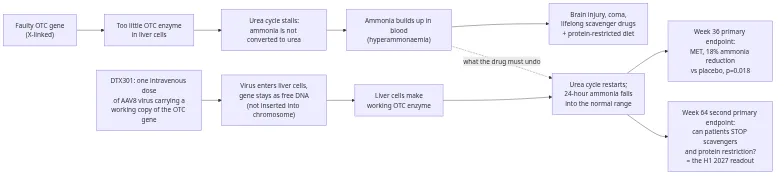
The body breaks protein down into ammonia. Ammonia is poisonous to the brain, so the liver runs a five-step chemical assembly line called the urea cycle that converts it into urea, which the kidneys pass out in urine. Ornithine transcarbamylase (OTC) is the enzyme that performs the second step. If the gene for it is faulty, the assembly line stalls and ammonia builds up in the blood. According to PubMed, the disease and its neurological burden are reviewed in Metabolic Brain Disease [VERIFIED — PubMed, DOI 10.1007/s11011-026-01812-0, metadata re-retrieved 2026-08-12].
Because the OTC gene sits on the X chromosome, males — who have only one copy — are usually affected more severely. The severe form appears within days of birth. The late-onset form, which is the population DTX301 treats, leaves enough residual enzyme that patients get through infancy and present later, sometimes as adults, with episodes of confusion, vomiting or seizures that are frequently mistaken for something else [VERIFIED — same review]. Standard care is not a treatment for the cause. It is ammonia scavenger drugs taken several times daily for life, plus a protein-restricted diet, and the two together are the burden the patient actually lives with.
What DTX301 does. It is a single intravenous infusion of a modified adeno-associated virus
serotype 8 (AAV8) carrying a working copy of the human OTC gene. AAV8 naturally homes to liver
cells. Once inside, the delivered gene sits in the nucleus as a free loop of DNA — episomally,
without being spliced into the patient’s own chromosomes — and the cell reads it and starts making
working OTC enzyme [VERIFIED — ChEMBL CHEMBL4650252 records the molecule as molecule_type “Gene”
with synonym “Scaav8otc”, called 2026-08-12; mechanism described in the Ultragenyx 2026-03-12
release]. Because the gene is episomal, it is diluted away every time a liver cell divides. That is
why liver gene therapy is more durable in adults than in growing children, and it is a live
question for how long a single dose lasts.
How well the target is validated. As well as any target in medicine, in the ordinary sense that
the causal chain is completely understood: a specific enzyme is missing, the consequence is
measurable in the blood, and supplying the enzyme’s gene fixes the measurement — demonstrated in
this program’s own randomised Phase 3 at p=0.018. The independent-platform corroboration could
not be re-run this session: Open Targets search_entities returned the verbatim
Rate limit exceeded for client: global on all four attempts, so the platform’s gene–disease
assertion is cited from the 2026-08-05 sweep (OTC → ENSG00000036473, OTCD → MONDO_0010703)
rather than re-verified, and this session’s state is [UNVERIFIED — Open Targets BLOCKED 2026-08-12]. The limit of that check is unchanged: for a monogenic enzyme deficiency the causality
is not in dispute, and the association’s numeric evidence score has never been retrieved in either
sweep.
The exact scientific step the next readout must prove. Not that the drug lowers ammonia — that
is settled. It must prove that lowering ammonia is enough for patients to come off the
scavenger drugs and off the protein-restricted diet and stay well. The trial calls that a
complete responder, and the complete responder rate through 64 weeks is its second primary
endpoint [VERIFIED — ClinicalTrials.gov NCT05345171, get_trial_details 2026-08-12].
The honest scientific risk. Three things.
- Enzyme replacement is graded, not binary. A partial restoration of OTC activity lowers ammonia without necessarily giving enough headroom to abandon both safety nets. The Week 36 secondary data are consistent with exactly this: scavenger use fell 27% on average and protein intake rose about 13%, which is real improvement and is not discontinuation.
- The immune system fights the vector. AAV liver gene therapy provokes hepatic inflammation and a T-cell response to the capsid, which is why the protocol includes a corticosteroid regimen. One treatment-related acute hepatitis occurred in the DTX301 arm and resolved with steroids. If steroids fail to protect the transduced cells, expression falls and a Week 36 responder can stop being one by Week 64.
- Durability is unproven at this timescale in this trial. Episomal DNA does not replicate. The Phase 1/2 long-term follow-up study NCT03636438 exists precisely to answer this and runs to 2029-12; it has 11 participants.
A.2 Clinical development plan, timeline, feasibility, resourcing
Trials
| Trial | Sponsor / whose drug | Design (arms, blinding, n) | Population | Status / key result | Link |
|---|---|---|---|---|---|
| Enh3ance, NCT05345171 | Ultragenyx / its own drug | Phase 3, randomised 1:1, double-blind, placebo-controlled. n=37 (18 DTX301, 19 placebo) across 16 sites in 10 countries. Followed 36–64 weeks; between Week 36 and Week 64 eligible placebo patients cross over to DTX301 and some DTX301 patients receive placebo. Planned duration up to 324 weeks, then an optional five-year Disease Monitoring Program. Arms include oral corticosteroids and matching placebo, and sodium acetate. | Late-onset OTC deficiency, age 12 and over. Must be free of symptomatic hyperammonaemia for 4 weeks before screening, on stable scavenger dose and stable protein intake (±20%). Excluded: significant hepatic inflammation or cirrhosis, eGFR below 60, active hepatitis B or C, detectable pre-existing antibodies to the AAV8 capsid, any previous gene-transfer study. | ACTIVE_NOT_RECRUITING. First primary endpoint MET at Week 36: 18% reduction in 24-hour plasma ammonia versus placebo, p=0.018. has_results is false on the registry. Primary completion listed as 2027-09. | NCT05345171 |
| Phase 1/2, NCT02991144 | Ultragenyx / its own drug | Phase 1/2, open-label, dose-finding, no control arm. n=16. Compared a reactive corticosteroid taper against a prophylactic one. | Adults with late-onset OTC deficiency | COMPLETED 2021-12-16. Longer-term durability data reported 2022-05-19. | NCT02991144 |
| Long-term follow-up, NCT03636438 | Ultragenyx / its own drug | Observational, no intervention. n=11. | Adults previously dosed with DTX301 | ACTIVE_NOT_RECRUITING, running to 2029-12. This is the only source of multi-year durability evidence and it has eleven people in it. | NCT03636438 |
| OTC-HOPE (competitor), NCT06255782 | iECURE / its own drug ECUR-506, using Precision BioSciences’ ARCUS nuclease under licence | Phase 1/2, open-label, dose-escalating. n=7 across three cohorts as of the 2026-04-20 cut. | Neonatal-onset OTC deficiency, male infants under 9 months — a different and more severe population | 71% of participants free of hyperammonaemic crises after treatment; ~52% reduction in the annualised crisis rate across cohorts; the completed low-dose cohort (n=3) showed statistically significant reductions in annualised event rates (57% events, 65% crises, p=0.011); the first infant dosed remains off standard-of-care therapies with no hyperammonaemic events through 18 months [WEB ESTIMATE — iECURE releases 2026-05-13 and 2026-05-18 via BusinessWire/BioSpace, read 2026-08-12] | — |
| GlucoGene (sister program) | Ultragenyx / DTX401 in glycogen storage disease type Ia | Phase 3, randomised, placebo-controlled. n=44 (20 DTX401, 24 placebo). | GSDIa | MET at 48 weeks: 41.3% mean reduction in daily cornstarch intake versus 10.3% on placebo, p<0.0001. PDUFA date 2026-08-23 — eleven days from this analysis. | — |
Feasibility matrix
| Factor | High probability | Medium probability | Low probability | This asset (assessment) | Source |
|---|---|---|---|---|---|
| Recruitment feasibility | >50 sites, 3:1 patient:site | 20–50 sites, established investigators | <20 sites, novel sites | Low on the stated scale, and the scale does not fit. 16 sites for 37 patients is 2.3 patients per site. But this is an ultra-rare disease where 37 randomised patients is a large trial, the sites are named academic metabolic centres (UCLA, Colorado, Lurie, Necker-Enfants Malades, Heidelberg, Sick Kids Toronto, Vall d’Hebron, Kumamoto, Fujita, Erasmus MC, São João, Hospital Italiano), and enrolment is complete since 2025-02. Execution risk on recruitment is zero, because it has happened. | CT.gov NCT05345171, read 2026-08-12; BPIQ note history |
| Endpoint clarity | Regulatory precedent exists | Novel endpoint with FDA alignment | Unvalidated surrogate | Medium. Plasma ammonia AUC0-24 is the accepted disease measure and the Week 36 endpoint built on it already succeeded. The Week 64 endpoint — complete responder rate — has no published success threshold and no named regulatory precedent that could be verified. That is the specific ambiguity in this readout. The Phase 3 design followed a successful End-of-Phase-2 meeting with the FDA, so the agency has seen the endpoint; what it agreed to accept is not public. | CT.gov NCT05345171; Ultragenyx End-of-Phase-2 release (ir.ultragenyx.com, surfaced 2026-08-12); [UNVERIFIED] as to threshold |
| Trial-design robustness | Pivotal Phase III with SPA | Adaptive with interim analysis | Single-arm, no control | High-to-medium. Randomised, double-blind, placebo-controlled with two pre-specified primary endpoints in an ultra-rare disease — that is the strong form. It is weakened for the second endpoint by the crossover: after Week 36 placebo patients receive DTX301, so the Week 64 complete-responder analysis is described as “after DTX301 exposure” and is not a comparison against a contemporaneous placebo arm. | CT.gov NCT05345171 detailed description |
| Operational / execution | Enrolment complete, standard timeline | Some timeline risk | Enrolment behind | High. Enrolment complete since February 2025, first primary endpoint delivered on schedule, and the H1 2027 guidance for the 64-week data has now been stated three times without change: 2026-03-12, 2026-05-05 and 2026-08-04. Zero date slips. | BPIQ fetch_company_drugs note for id 17190, 2026-08-12; Q2 2026 release 2026-08-04 |
Resourcing sufficiency. Yes, comfortably, for this program. The trial is fully enrolled and
dosed; the incremental cost to the Week 64 readout is follow-up visits and analysis, not
manufacturing or recruitment. The company’s cash runs to roughly August 2027 on recomputed burn
(see ../company.md C.3), which covers the guided H1 2027 readout — though only
just if the readout lands late in the window, and the runway question there is a company-level
question about the next financing, not about whether this readout happens. Two saleable priority
review vouchers (if the August and September approvals land) and growing product revenue are the
company’s stated cushions.
A.3 Target label, target product profile, strategic questions, designations
A.3a Target label. A single intravenous dose for the treatment of adults and adolescents aged 12 and over with late-onset ornithine transcarbamylase deficiency, to maintain safe plasma ammonia and reduce or remove the need for ammonia scavenger drugs and protein restriction.
A.3b Target product profile
| Attribute | Standard of care & key competitor(s) — data | DTX301 target profile (goal) | Supporting evidence (+ link) |
|---|---|---|---|
| Indication / target label | Standard care: ammonia scavengers (glycerol phenylbutyrate, sodium phenylbutyrate, sodium benzoate) plus protein restriction, in all ages. Liver transplant is the only curative option and carries operative mortality and lifelong immunosuppression. Competitor ECUR-506 (iECURE) is in Phase 1/2 in neonatal-onset disease — an adjacent population, not the same one. | Late-onset OTCD, age 12+, one dose | NCT05345171 |
| Efficacy (endpoints, regimen) | Scavengers reduce ammonia but do not restore the urea cycle; patients still have crises. Five hyperammonaemic crises requiring hospitalisation occurred in the 19-patient placebo arm of Enh3ance, including one death. | One infusion; 24-hour ammonia held in the normal range; scavengers and protein restriction discontinued | Ultragenyx release 2026-03-12, re-read via StockTitan rendering 2026-08-12 |
| Safety / tolerability | Scavengers are safe but unpleasant, taken several times daily, with a taste that drives non-adherence. | One treatment-related serious acute hepatitis, resolved with steroids. Mild-to-moderate transient hepatic reactions managed with steroids. No serious events of thrombotic microangiopathy, dorsal-root-ganglion toxicity, malignancy or complex immune reaction. One hyperammonaemic crisis in the treated arm, no deaths. | Same release |
| Biomarker / companion diagnostic | Diagnosis is by enzyme assay, biochemical pattern or molecular OTC testing. | No companion diagnostic. But an eligibility test is mandatory: patients with detectable pre-existing anti-AAV8 antibodies are excluded, which removes a material fraction of the population. The fraction was not quantified in this sweep either. | CT.gov exclusion criteria; [UNVERIFIED] as to fraction excluded |
| Formulation / administration | Oral powder or liquid, several times a day, lifelong | Single intravenous infusion, with a corticosteroid course around it | CT.gov NCT05345171 interventions |
| Payer value | Scavenger therapy costs are recurring and lifelong; crisis hospitalisations are expensive and unpredictable | A one-time price offset against a lifetime of drug cost and avoided crises. The one placebo-arm death is the single most powerful payer argument in the dataset. | Ultragenyx release 2026-03-12 |
A.3c Strategic Go/No-Go questions. The asset’s next decision is a registration filing, so the pre-Phase-III / registration set is the one that applies.
| Group | Question | Answer (tagged) |
|---|---|---|
| Target | Target revalidated as in prior phases? | Yes. The Week 36 result is target revalidation in the pivotal setting: supplying the OTC gene lowered 24-hour ammonia against placebo at p=0.018 and normalised eight of nine patients who were abnormal despite optimal care. [VERIFIED — Ultragenyx release 2026-03-12] |
| Dose & Drug | Exposure–response for the intended commercial regimen and route(s)? | The Phase 1/2 was explicitly a dose-finding study across cohorts and a single dose was carried into Phase 3. The exposure–response relationship itself has not been published. [UNVERIFIED] |
| Dose & Drug | Commercial formulation available or feasible? | Yes, and this is unusually well de-risked: Ultragenyx manufactures its gene therapy products in its own facility in Bedford, Massachusetts, and a sister AAV product from the same platform (DTX401) has a BLA under priority review with a decision due 2026-08-23, eleven days from this analysis. [VERIFIED — BPIQ earnings transcript Q1 2026; BPIQ fetch_company_drugs id 17189, 2026-08-12] |
| Dose & Drug | Dose range compatible with clinical and non-clinical safety? | Broadly yes at the dose taken forward. One treatment-related serious acute hepatitis in 18 treated patients, resolved with steroids; transient hepatic reactions were the common finding. [VERIFIED — Ultragenyx release 2026-03-12] |
| Dose & Drug | Therapeutic window given the clinical response? | Narrow on the dimension that matters for Week 64. The response is graded — 27% mean scavenger reduction, 13% protein increase — and the endpoint is binary. [VERIFIED — Ultragenyx release 2026-03-12], interpretation [UNVERIFIED] |
| Dose & Drug | Intrinsic and extrinsic factors influencing exposure and patient response? | Two are written into the protocol. Pre-existing anti-AAV8 antibodies exclude a patient entirely. Significant hepatic inflammation or cirrhosis excludes them too. Neither fraction was quantified. [UNVERIFIED] as to magnitude |
| Patient | Proof of concept and positive benefit/risk in the intended population? Combination evidence? | Yes on proof of concept. Benefit/risk is favourable on the reported data: one drug-related hepatitis that resolved, against five crisis hospitalisations and one death in the placebo arm. No combination is pursued; the drug is intended to replace combination therapy. [VERIFIED — Ultragenyx release 2026-03-12] |
| Patient | Phase III design and outcome criteria — accepted, compelling, competitive for market access? | Design yes, and the design followed a successful End-of-Phase-2 meeting with the FDA. Outcome criteria for the second primary endpoint are the weak point: complete responder rate has no published threshold, and after Week 36 the crossover removes the contemporaneous control. [VERIFIED — CT.gov NCT05345171] |
| Patient | Rationale for the patient population(s)? | Strong and deliberate. Late-onset patients aged 12+ have mature, non-dividing livers, which is exactly where episomal AAV gene therapy is most durable. It is the easiest version of this disease to treat with this modality, and the competitor is attacking the hard version. [VERIFIED — CT.gov eligibility; mechanism per PubMed DOI [10.1016/j.omtm.2022.01.007](https://doi.org/10.1016/j.omtm.2022.01.007) and the 2026-03-12 release] |
| Patient | Likelihood of the expected outcome? | Modelled at 62%, band 48–75%. Reasoning is in the Locked prediction below. [UNVERIFIED — modelled] |
| Patient | Companion-diagnostic strategy, including pricing and market? | No companion diagnostic. An anti-AAV8 antibody screen is a gating eligibility test rather than a companion diagnostic and no commercial strategy for it was found. [UNVERIFIED] |
A.3d Regulatory designations.
- Orphan drug designation, United States and European Union. It grants seven years of United
States market exclusivity from approval for the designated indication, ten years in the European
Union, plus fee waivers and protocol assistance.
[VERIFIED — Ultragenyx's own "About DTX301" boilerplate in the 2026-03-12 release, re-read 2026-08-12] - Fast Track designation, United States. It grants more frequent FDA interaction, and
eligibility for rolling review of a filing and — if criteria are met — priority review. This
corrects the previous version of this analysis, which reported that no Fast Track designation
had been found: the company’s own release boilerplate states “Orphan Drug Designation in the
United States and EU and Fast Track Designation in the United States.” The designation is stated
by the sponsor; no FDA-side confirmation was pulled.
[VERIFIED — Ultragenyx 2026-03-12 release boilerplate, read via StockTitan rendering 2026-08-12] - No Breakthrough Therapy, RMAT or priority-review designation for DTX301 was found. Sibling assets
DTX401 (priority review) and UX111 and GTX-102 (Breakthrough Therapy) do carry stronger
designations, so the absence of those here remains informative.
[VERIFIED — BPIQ press feed, 414 items, scanned 2026-08-12]
A.4 Target product profile valuation matrix
| Stakeholder | Value driver | Minimum threshold | Competitive | Premium | Benchmark / source |
|---|---|---|---|---|---|
| Patient / caregiver | Freedom from lifelong scavengers, protein restriction and the fear of a crisis | Fewer crises; measurable cut in scavenger dose | Scavengers stopped, diet liberalised, ammonia normal | Above, plus durability past five years so a second dose is never needed | Enh3ance Week 36: 27% mean scavenger reduction, ~13% protein increase; 71% of 15 reporting patients rated overall symptoms “much improved” against 0% on placebo [VERIFIED — Ultragenyx release 2026-03-12] |
| Regulator | A pre-specified, statistically significant effect on a measure that tracks the disease | Significance on ammonia AUC0-24 | Above, plus a clinical-burden endpoint moving the same way | Above, plus a reduction in hyperammonaemic crises | Week 36 primary met at p=0.018. Crisis counts favour treatment (1 versus 5 with one death) but n=37 cannot power a crisis endpoint [VERIFIED — same release] |
| Payer / HTA | Lifetime cost offset against a one-time price | Displaces scavenger cost | Above, plus avoided crisis hospitalisations | Above, plus avoided liver transplants | No published cost-effectiveness analysis for DTX301 was found this sweep either. Analysts model roughly a $2M United States price for the sister asset DTX401 [WEB ESTIMATE — analyst commentary surfaced 2026-08-05, not re-found 2026-08-12], the nearest available anchor and not a DTX301 figure |
| Provider | A single infusion replacing chronic management | Infusion deliverable at a metabolic centre | Above, with manageable steroid protocol | Above, with no need for long-term specialist monitoring | 16 named academic metabolic centres already deliver it in trial. Long-term monitoring will still be required — the follow-up study runs to 2029 and the protocol adds a five-year Disease Monitoring Program [VERIFIED — CT.gov NCT03636438, NCT05345171] |
A.5 Evidence quality and endpoints
| Criterion | Score | Basis (one line) | Link |
|---|---|---|---|
| Target validation | High | The causal chain is textbook: a named enzyme is missing, the consequence is measurable in blood, and supplying the gene moved the measurement at p=0.018 in a randomised Phase 3. The Open Targets corroboration is carried from the 2026-08-05 sweep; this session’s re-check was BLOCKED (section 0). | DOI 10.1007/s11011-026-01812-0 |
| Mechanism clarity | High | AAV8 to hepatocyte, episomal expression, enzyme restored. Confirmed in mouse and in non-human primate; the macaque immunosuppression work is published. | DOI 10.1016/j.omtm.2022.01.007 |
| Biomarker availability | High | 24-hour plasma ammonia AUC0-24 is a direct, quantitative, repeatable measure of the disease process and the trial’s own first primary endpoint was built on it. | NCT05345171 |
| Publication quality (peer-reviewed? independent authors?) | Low, and this is the sharpest finding in this section. | According to PubMed, the name-keyed search returns two records for this drug and neither is a clinical publication of DTX301 human data: a cynomolgus-macaque immunosuppression study co-authored by Ultragenyx and the University of Pennsylvania (DOI 10.1016/j.omtm.2022.01.007) and a disease review co-authored by two Ultragenyx employees (DOI 10.1007/s11011-026-01812-0). Everything known about DTX301 in humans comes from company press releases. The sister asset DTX401 has a peer-reviewed Phase 1/2 paper; DTX301 does not, and nothing new has appeared since the 2026-08-05 sweep. | DOI 10.1016/j.omtm.2022.01.007 |
| Clinical / expert sentiment | — | Moved to A.5b, below. | — |
Endpoints
| Endpoint (full name) | What it measures | Scale / range | Better direction | MCID / note |
|---|---|---|---|---|
| Plasma ammonia as measured by 24-hour ammonia (AUC0-24), at Week 36 — first primary endpoint | Total ammonia exposure across a full day, from repeated blood draws, rather than a single spot reading | Continuous, in µmol·h/L. The normal reference range for plasma ammonia is roughly 15–45 µmol/L; the AUC is that concentration integrated over 24 hours | Lower is better | No established minimal clinically important difference. The trial delivered an 18% reduction versus placebo at p=0.018 and kept the treated group’s mean inside the normal range. The absence of an MCID means the 18% figure has to be read against the fact that treated patients were held in the normal range, which is the clinically meaningful statement. This endpoint has already read out and is not what settles in H1 2027. |
| Complete responder rate at the final study visit after DTX301 exposure, up to 64 weeks — second primary endpoint, and the one this analysis is about | The proportion of treated patients who have discontinued both ammonia scavengers and protein restriction while maintaining normal ammonia | A percentage, 0–100% | Higher is better | No published success threshold and no named regulatory precedent. This is the specific ambiguity in the readout: without a pre-registered bar, “met” is a judgement rather than an arithmetic test. The definition of complete responder given here is the one Ultragenyx has used consistently across this program [UNVERIFIED] as to its exact protocol wording. |
| Percentage of complete responders or responders after DTX301 exposure, up to 64 weeks — secondary | A softer version of the above, adding partial responders | Percentage | Higher is better | A partial “responder” presumably means a reduction in scavengers or protein restriction without full discontinuation. The threshold is not published. [UNVERIFIED] |
| Annualised event rate of hyperammonaemic crises, pre- versus post-exposure — secondary | How often patients have dangerous ammonia episodes | Events per patient-year | Lower is better | The endpoint patients care about most. n=37 cannot power it, but the raw Week 36 counts already favour treatment: one crisis in the treated arm with no deaths, five crisis hospitalisations in the placebo arm with one death. |
| Change in baseline disease management (dietary protein and total scavenger medication use), up to 64 weeks — secondary | The treatment-burden measure, on a continuous rather than binary scale | Percentage change | Scavengers lower, protein higher | At Week 36: −27% mean scavenger use and +13% protein intake. This is the single best forward indicator for the Week 64 primary, and it points the right way while sitting a long way from zero. |
| Long-term durability of response, up to 64 weeks — secondary | Whether a responder stays a responder across at least two consecutive visits without dropping back for more than one visit | Count of patients meeting the rule | Higher is better | Directly addresses the episomal-dilution concern. |
A.5b Key opinion leaders.
Panel as of. 2026-08-12. The panel below is thin, and its thinness is the recorded finding rather than a gap left silent.
Investigators
No investigator rows could be recorded. ClinicalTrials.gov lists no overall officials and no
investigator or contact names for NCT05345171 — all sixteen site rows carry facility and address
only — and CT.gov search_investigators over ornithine transcarbamylase deficiency trials
(30 trials analysed, 65 names returned, 2026-08-12) returned no name attached to this NCT. The
names it did return for this disease belong to the competitor’s trial (iECURE’s NCT06255782) and to
an NIH hyperammonaemia biomarker study. An empty table over a fully-enrolled pivotal trial is a
registry-disclosure artifact, not evidence that the trial has no investigators; the sixteen named
academic centres in A.2 are the closest available proxy.
| Name | Role / affiliation | Trial (NCT) | Conflicts (party, kind, disclosed in, as of) | Conflicts checked (source, date) | Source | Tag |
|---|
Independent voices
No independent voice could be recorded. The only named clinical commentary on this program’s endpoint found in either sweep is the Metabolic Brain Disease disease review, whose author panel (Konczal — University Hospitals Cleveland, an Enh3ance site; Enns — Stanford; Gropman — St. Jude; Wilkening — Colorado, another Enh3ance site) includes two Ultragenyx employees as co-authors (Garcia, Merritt) [VERIFIED — PubMed, DOI 10.1007/s11011-026-01812-0, author affiliations, 2026-08-12], so none of its clinician authors can be held out as independent of the sponsor, and a trade-press piece (NeurologyLive, 2026-03) could not be re-opened this session (HTTP 403). In an ultra-rare disease whose trial sites are the field’s main academic centres, genuinely independent expert commentary may simply not exist — which is itself worth knowing.
| Name | Affiliation | View (close enough to quote) | As of | Conflicts checked (source, date) | Source | Tag |
|---|
Judgement
| Endpoint supported | Basis (one or two sentences) | Tag |
|---|---|---|
UNKNOWN | The panel is too thin to judge: the registry discloses no investigator names, and the only named clinical commentary found is sponsor-co-authored. No independent view on the complete-responder endpoint — for or against — is on record anywhere this sweep looked. | UNVERIFIED — judgement |
Dissent
| Name | View (close enough to quote) | Source |
|---|
B. Commercial assessment
B.0 Current treatment algorithm
What a patient with late-onset OTC deficiency receives today, in order:
- Diagnosis, often late and often after an emergency-department presentation for confusion, vomiting or seizures. Confirmed by enzyme assay on liver biopsy, by a biochemical pattern (high ammonia with high glutamine, low citrulline, high urinary orotic acid) or by molecular OTC testing. Diagnostic delay is the field’s own stated problem [VERIFIED — PubMed, DOI 10.1007/s11011-026-01812-0].
- Protein-restricted diet, for life, with essential amino acid supplementation. Restrictive and hard to sustain.
- Ammonia scavenger drugs — glycerol phenylbutyrate, sodium phenylbutyrate or sodium benzoate — several times daily, for life. They give nitrogen a second exit route. They work and they are unpleasant.
- Emergency management of hyperammonaemic crises: hospitalisation, intravenous scavengers, sometimes dialysis. This is where the deaths happen.
- Liver transplant, the only curative option today. It works, and it costs an operation, a donor organ and lifelong immunosuppression.
Where DTX301 fits. At step 2–3, replacing them. It is the first therapy that would address the cause rather than route around it, short of transplant. It does not open a new line of therapy; it removes two existing ones. It creates no new patient pool — the patients already exist and are already treated.
B.1 Competitive landscape and positioning
| Metric | High value | Medium value | Low value | This asset (assessment) | Source |
|---|---|---|---|---|---|
| Mechanism differentiation | First-in-class or novel target | Next-generation improvement | Me-too | High. First-in-class in this indication if approved: no gene therapy is approved for any urea cycle disorder. The only clinical competitor, iECURE’s ECUR-506, uses gene editing (ARCUS nuclease insertion) rather than gene addition, and targets neonatal-onset disease. A third modality — Arcturus’s ARCT-810 mRNA therapy — is in early clinical work (NCT06488313, surfaced in the investigator search) and is chronic redosing rather than one-time. | CT.gov; iECURE releases |
| Development-timeline advantage | >12 months ahead | Within 6–12 months | Lagging >12 months | High, >12 months ahead. DTX301 is Phase 3 with one primary endpoint already met. ECUR-506 is Phase 1/2 with seven patients dosed across three cohorts. That is a multi-year gap, and it did not narrow this quarter. | CT.gov NCT05345171; iECURE releases 2026-05-13/18 |
| Clinical proof-of-concept evidence | Positive Phase IIb (n>100) | Phase IIa signals (n=20–50) | Preclinical only | Medium on the stated scale, and the scale mis-fits an ultra-rare disease. n=37 randomised is small in absolute terms and large for late-onset OTCD. The evidence is a met Phase 3 primary endpoint, which is stronger than anything the scale contemplates, delivered in a population smaller than the scale’s medium band. | CT.gov; Ultragenyx release 2026-03-12 |
| IP protection | Composition-of-matter, long-dated | Method-of-use | Pending or none | Not resolved, again. The vector is licensed from REGENXBIO (the NAV AAV8 platform) under an exclusive worldwide licence with rights to sublicense, originally granted to Dimension Therapeutics in 2015; REGENXBIO receives an upfront ($7M on the related 2020 agreement), fees, milestones and royalties on net sales. The royalty rate is not disclosed in any source found. Orphan exclusivity — seven years United States, ten years European Union — is the protection that is verified. | [WEB ESTIMATE — REGENXBIO/Ultragenyx license releases via PRNewswire/GlobeNewswire, read 2026-08-12]; [UNVERIFIED] as to patent estate and rate |
Where this asset wins, in plain sentences. It wins on being years ahead in the population it targets, on being a single infusion against a lifetime of thrice-daily drugs, and on having already produced a statistically significant randomised result — which nobody else in urea cycle gene therapy has. It does not win on size: this is an ultra-rare disease and the late-onset subset of it is smaller still.
The single fact the thesis rests on. That a graded improvement in enzyme activity is enough for patients to be taken off both scavengers and protein restriction, not merely put on less of them. Everything commercial about a one-time gene therapy — the price, the payer argument, the differentiation from a cheap generic scavenger — depends on that binary.
B.2 Addressable market
Launch markets would be the United States, the European Union, and the countries where Enh3ance ran: Argentina, Brazil, Canada, France, Germany, Japan, the Netherlands, Portugal and Spain.
| Component | How it is estimated | Premium threshold | This asset (assessment) | Source |
|---|---|---|---|---|
| Drug-treated patients | Epidemiology × diagnosis rate × treatment rate × eligibility | >100,000 (US/EU5/Japan) | Far below the threshold, and the number is genuinely uncertain. The company’s own boilerplate now supplies a figure the previous sweep lacked: OTC deficiency affects “more than 10,000 people in commercially accessible geographies”, of which roughly 80% are classified late-onset — so ~8,000 late-onset patients before diagnosis, age and anti-AAV8 attrition [WEB ESTIMATE — Ultragenyx “About DTX301” boilerplate and pipeline page rendering, read 2026-08-12]. Published birth prevalence still spans 1 in 14,000 to 1 in 70,000 in one source set and 1 in 56,500 to 1 in 113,000 in another — a five-fold disagreement no source resolves. A defensible single treatable-patient number does not exist and is not invented here. The order of magnitude remains hundreds to low thousands of treatable patients across all launch markets. | [WEB ESTIMATE — company figure and aggregators]; [UNVERIFIED] as to any point figure |
| Market exclusivity | Patent term + regulatory exclusivity | >10 years combined | Below threshold on what is verified. Orphan exclusivity gives seven years in the United States and ten in the European Union from approval. The patent position is not resolved. Ten years combined is plausible; it is not established. | REGENXBIO/Ultragenyx license coverage; [UNVERIFIED] as to patents |
| Reimbursement precedent | Approvals in ≥2 major markets | Positive NICE/CADTH guidance | None yet — and the first read arrives in eleven days. No gene therapy is approved for any urea cycle disorder anywhere. Ultragenyx’s own DTX401 decision on 2026-08-23 is a direct precedent from the same platform, the same manufacturing site and the same company. | BPIQ fetch_company_drugs id 17189, 2026-08-12 |
| Patient-journey impact | Fewer hospital days, less caregiver burden | >30% quality-of-life gain | Plausibly above threshold, on patient-reported data with small numbers. 71% of the 15 patients reporting rated their overall OTC symptoms “much improved” against 0% on placebo; 64% of 30 reporting rated symptoms and daily-living impact improved against 19% on placebo. Patient Global Impression scales are subjective and this trial is open to the criticism that patients who felt an effect knew they had it. | Ultragenyx release 2026-03-12 |
B.3 Value and feasibility
B.3a Expected peak sales. Built bottom-up: eligible patients × one-time price × penetration. This is a one-time therapy, so “peak sales” means the annual revenue in the years when the prevalent backlog of diagnosed patients is being treated, and it declines toward the incidence rate afterwards. That decay is a feature of gene therapy economics and is stated rather than buried. All three scenarios are conditional on approval, assume a first launch no earlier than 2028, and exclude any European or Japanese pricing differential, any priority review voucher, and any value from the platform. They are unchanged from the 2026-08-05 analysis because no input changed: the company’s ~10,000-patient figure is consistent with the patient-pool arithmetic already used.
| Scenario | Assumptions (patients × price × share) | Estimate (USD/year at peak) | Basis / tag |
|---|---|---|---|
| Low | ~40 patients treated a year × ~$1.5M net × sole supplier | ~$60M/year | Assumes a narrow label restricted to complete responders, a slow start typical of gene therapy launches, and heavy attrition from anti-AAV8 seropositivity. [UNVERIFIED — modelled]; price anchored to the ~$2M United States figure analysts model for sister asset DTX401 [WEB ESTIMATE — analyst commentary, 2026-08-05], discounted for a weaker endpoint |
| Base | ~100 patients treated a year × ~$2.0M net × sole supplier | ~$200M/year | Assumes a label covering late-onset patients aged 12+, a three-to-four-year run through the diagnosed prevalent pool in the launch markets, then decline. [UNVERIFIED — modelled] |
| High | ~180 patients treated a year × ~$2.5M net × sole supplier | ~$450M/year | Assumes a strong Week 64 result driving rapid uptake, plus a diagnosis push that surfaces undiagnosed late-onset patients — which the disease-review literature says exist in numbers. [UNVERIFIED — modelled] |
What is not passed through. Market-research aggregators put the whole “OTC deficiency treatment market” at $0.69–0.85 billion today rising to $1.0–1.08 billion by 2031–2035, with roughly $0.33 billion by 2031 attributable to gene replacement [WEB ESTIMATE — Mordor Intelligence, GMInsights, Verified Market Research and others, read 2026-08-05]. Those figures are not used as inputs. They aggregate several vendors’ incompatible definitions, they include existing scavenger sales, and their patient-count basis contradicts itself five-fold. The $0.33 billion gene-therapy line is roughly consistent with the base case above, which is noted as a coincidence rather than as corroboration.
B.3b Feasibility
| Question | Answer (tagged) |
|---|---|
| Expected net present value (eNPV) | No point estimate (rule 10). Conditional on the Week 64 endpoint reading out positive, and assuming 85–95% approval probability given a met first primary endpoint and an orphan indication, a 2028 launch, $200M base-case peak declining after four years, a 12% discount rate and modest remaining development and launch cost, the conditional value is roughly $350–800M. Applying the 62% modelled probability of a positive Week 64 result gives an unconditional ~$220–500M. Against a recomputed enterprise value of at least $2,203M (see ../company.md C.4), that is roughly 10–23% of the company. Every input is [UNVERIFIED — modelled]. |
| Capital to the next decision point | Effectively nil. The trial is enrolled, dosed and paid for. What remains is follow-up visits and analysis. |
| Capital to approval, and the funding plan | Modest and already funded. The Week 64 data is intended to support a filing; no new pivotal trial is planned. Company runway to roughly 2027-08 covers the guided window, with the two priority review vouchers as the stated cushion. See ../company.md C.3 for the runway and its caveats. |
| Launch capability — alone, or must partner? | Alone. Ultragenyx already sells four rare-disease products through its own commercial organisation in North America, Latin America, Europe and Asia-Pacific, and manufactures gene therapy in Bedford, Massachusetts for exactly this. It has no need of a partner for an ultra-rare metabolic launch. |
| Commercialisation rights — retained, split, or out-licensed? | Retained, but the vector is in-licensed. DTX301 came to Ultragenyx through the 2017 acquisition of Dimension Therapeutics for about $151M, and the AAV8 vector is used under an exclusive worldwide licence originally granted to Dimension by REGENXBIO in 2015, carrying fees, milestones and royalties on net sales. The royalty rate could not be confirmed in this sweep either and no figure is asserted. [UNVERIFIED] |
B.4 Product-development risk
Framing questions.
- Does the development plan support the target product profile claims? Partly. The plan proves ammonia control — and has already done so. The target product profile’s central claim is freedom from scavengers and protein restriction, and the endpoint that tests it is the one that has not read out yet and has no published success bar.
- Will the identified risks affect the target product profile? Yes, one of them decisively. If the complete responder rate is low, the label becomes “reduces ammonia and reduces scavenger burden” rather than “replaces treatment”, and the price a payer will accept for a one-time therapy falls with it.
- If a risk cannot be mitigated, is the asset still differentiated from competitors? Yes. Even a partial result leaves DTX301 the only randomised, statistically significant, Phase 3 result in urea-cycle gene therapy, years ahead of ECUR-506, in a disease with no approved disease-modifying option.
| Category | Time risk | Quality risk | Cost risk | Note |
|---|---|---|---|---|
| Project management | Low | Low | Low | Enrolment complete since 2025-02, first endpoint delivered, guidance now reiterated unchanged three times. |
| Research | Low | Mechanism is settled. | ||
| IP | Medium | Vector in-licensed from REGENXBIO; the patent estate and the royalty rate are both unresolved. Orphan exclusivity is the verified protection. | ||
| Legal | Low | Nothing program-specific found. Company-level law-firm investigation notices are recorded in ../company.md C.5 and are not attributed to this program. | ||
| DMPK | Medium | Exposure–response for the commercial dose has not been published. | ||
| Safety pharmacology | Low | Nothing found. | ||
| Toxicology | Low | Nothing found beyond the class hepatic signal. | ||
| Drug safety (clinical) | Medium | One treatment-related serious acute hepatitis in 18 treated patients, resolved with steroids; transient hepatic reactions are the expected class effect. A hepatic safety event in the crossover patients before Week 64 would be a near-veto. | ||
| Biomarker | Low | Ammonia AUC0-24 is direct, quantitative and already validated by the Week 36 result. | ||
| Clinical pharmacology | Medium | Durability at the episomal level is unproven past the follow-up study’s eleven patients. | ||
| Clinical (efficacy) | High — this is the readout | The Week 64 endpoint is binary (off both scavengers and protein restriction) where the Week 36 evidence is graded (−27% and +13%). No published success threshold. After Week 36 the crossover removes the contemporaneous placebo comparison. | ||
| Clinical operations | Low | Low | Low | Sixteen established academic metabolic centres, trial fully enrolled. |
| CMC / manufacturing | Medium, resolving within weeks | AAV manufacturing is the class’s recurring failure mode, and Ultragenyx has felt it: UX111 received a Complete Response Letter in 2025 on chemistry, manufacturing and controls observations. The DTX401 decision on 2026-08-23 and the UX111 decision on 2026-09-19 are the first external reads on whether Ultragenyx’s AAV manufacturing satisfies the FDA, and both land before this program’s window opens. | ||
| Regulatory | Medium | Medium | Fast Track and orphan designations, but no Breakthrough Therapy unlike two siblings. A single Phase 3 with 37 patients in an ultra-rare disease is a defensible filing package, but the second primary endpoint’s lack of a pre-published bar gives the agency room to disagree about whether it was met. | |
| Global evidence & value | Medium | No published cost-effectiveness analysis. A one-time price in the low millions against a small patient pool means every reimbursement negotiation is bespoke. | ||
| Commercial | Medium | Small pool, one-time therapy, revenue declines after the prevalent backlog clears. The commercial ceiling is structural, not executional. |
Readout
Sources
| Kind | Where it comes from | What it is worth | Value (or null) | Tag | Note |
|---|---|---|---|---|---|
bpiq | fetch_company_drugs — catalyst_date, catalyst_date_text | The current single source. Synthesized from period text on most rows, so alone it is a ceiling, not an estimate. | 2027-06-30 (“H1 2027”) | [VERIFIED — BPIQ fetch_company_drugs id 17190, read 2026-08-12] | The period-end placeholder documented in 02-connectors.md, not a disclosed day. Recorded here and used for nothing else. |
ctgov | CT.gov get_trial_details — primary_completion_date | Independent of the company’s own messaging, month-precision, and it moves when the trial moves. | 2027-09 | [VERIFIED — CT.gov get_trial_details NCT05345171, read 2026-08-12] | Unchanged since the 2026-08-05 sweep. It sits a quarter after the guided window closes — the standing disagreement below. |
company | fetch_company_press_releases — Q2 2026 results release | The company’s own most recent dated wording. Also where the slip sequence below comes from. | 2027-01/2027-06 (“expected in the first half of 2027”) | [VERIFIED — GlobeNewswire, Ultragenyx Q2 2026 results release 2026-08-04, read via Manila Times syndication 2026-08-12] | The third dated statement of the same guidance (2026-03-12, 2026-05-05, 2026-08-04). The primary ir.ultragenyx.com page was not reachable this session either; the newswire syndication text is what was read. |
congress | data/congresses.json | Answers “where will they say it.” | null | [UNVERIFIED] | Attempted and found nothing. The calendar holds four meetings (ACTRIMS-ECTRIMS, ESMO, CTAD, AASLD), none a metabolic-disease meeting, and Ultragenyx has named no congress for this readout. Matching on therapeutic area alone would be a guess, and a guess is not a source. |
modelled | Trial arithmetic — see below | The only estimate independent of anyone’s guidance. | 2027-11/2028-01 | [UNVERIFIED — modelled, default lag] | The registry-anchored estimate lands wholly after the guided half — the disagreement below reports it rather than resolving it. data/benchmarks/readout-lag.json holds no matching entry, so the rule 34 default lag applies. |
The modelled estimate. CT.gov primary_completion_date 2027-09 plus the 01-rules.md rule 34
default lag of two to four months to database lock and analysis: 2027-09 + 2 months = 2027-11;
2027-09 + 4 months = 2028-01. The caveat that matters: the registry field very likely tracks the
last crossover patient’s final study visit rather than the Week 64 dataset the company will
actually analyse — enrolment completed 2025-02, so the last originally-randomised patient’s Week 64
and the crossover cohort’s 64-weeks-post-infusion visits complete in roughly early 2027, which is
consistent with the company’s H1 2027 guidance. That reconciliation is an [UNVERIFIED] inference,
which is exactly why the modelled row above is reported at face value rather than adjusted to fit
it.
Window
| Earliest | Likeliest | Latest | Precision | Confidence |
|---|---|---|---|---|
| 2027-01-01 | 2027-06-15 | 2027-09-30 | PERIOD | MEDIUM |
Basis. The earliest edge is the opening of the guided half-year, stated three times without
change by a sponsor whose last guidance for this same trial (the Week 36 readout) was delivered on
schedule. The likeliest date sits late in the guided half because the crossover arithmetic puts the
last 64-week visits in early-to-mid 2027 and analysis follows them, and because a sponsor guiding a
half tends to land in its back part. The latest edge extends past the guided half to the registry’s
own primary completion month-end (2027-09-30), because the plainer reading of that field — that the
readout can slip into H2 2027 — is not excluded; the full modelled top (2028-01) is not adopted as
the edge because the endpoint’s own 64-week clock most plausibly completes well before the registry
date, but the UNRESOLVED disagreement below is the honest record that it could run later.
Precision is PERIOD: no source names a month or a day. Confidence is MEDIUM rather than HIGH
because the two independent sources genuinely disagree, and rather than LOW because the guidance is
dated, thrice-repeated, and mechanically plausible against a fully-enrolled trial with all dosing
done.
Disagreement. UNRESOLVED. The company guides H1 2027 (three dated statements). The registry’s
primary completion is 2027-09, a quarter after the guided window closes, and the rule 34 modelled
estimate built on it lands 2027-11 to 2028-01, wholly after the guided half. Neither side is picked
and they are not averaged (rule 24); the window above leans on the company’s dated guidance for its
open and stretches its close to the registry’s own month.
Date slippage. Zero slips across three dated statements — and a zero-slip record spanning five
months is stronger than the two-statement record the previous analysis called “merely young”,
though still short of the multi-year clean records elsewhere in this corpus. One caveat: the BPIQ
note field now carries only the latest entry rather than the dated changelog it carried at
the 2026-08-05 sweep, so the first two rows below are carried from that sweep’s own verified
reading of the then-fuller field.
| As of | Guidance text |
|---|---|
| 2026-03-12 | ”Enh3ance Ph3 Week36 met primary endpoint; 64-week follow-up data expected H1 2027” [VERIFIED — BPIQ note, read at the 2026-08-05 sweep] |
| 2026-05-05 | ”64-week follow-up data still expected H1 2027” [VERIFIED — BPIQ note, read at the 2026-08-05 sweep] |
| 2026-08-04 | ”Data from the second primary endpoint … are expected in the first half of 2027” [VERIFIED — Q2 2026 release, read 2026-08-12; BPIQ note 08/04/26 agrees] |
Attribution
Status. CONTAMINATED
Computed by lib/clustering.mjs’s attributionFor over this ticker’s full pipeline (every
has_catalyst: true row, analysed or not) with this program’s own readout window above,
2026-08-12. Transcribed, not estimated.
Conflicts
| bpiq_drug_id | Label | Date | Analysed? | Gap (days) | Confirmed? |
|---|---|---|---|---|---|
| 17188 | GTX-102 | 2026-12-31 | Yes | 52 | Yes |
| 17189 | DTX401 | 2026-08-23 | No | 131 | Yes |
| 17191 | UX701 | 2026-12-31 | No | 1 | No |
| 18004 | UX111 (ABO-102) | 2026-09-19 | No | 104 | Yes |
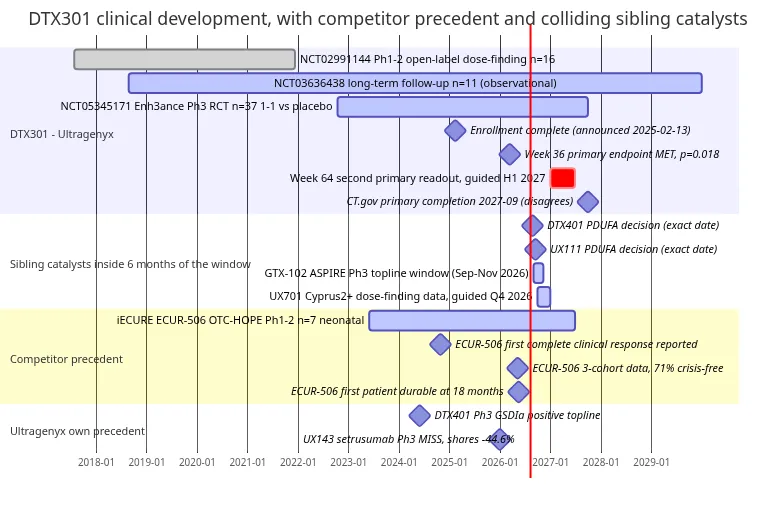
Note. Three of the four conflicts are confirmed on disclosed dates: the DTX401 PDUFA (2026-08-23, exact) and the UX111 PDUFA (2026-09-19, exact) land 131 and 104 days before this program’s window opens, and GTX-102’s MONTH-precision ASPIRE window closes 52 days before it. Neither PDUFA program has a document of its own — only the pipeline table carries them, which is what this computation exists to catch. The consequence for this program is about the baseline, not simultaneous news: the price level the shares hold when the H1 2027 window opens will have been set by three larger events in the preceding four months, so no scenario range or move around this program’s readout can be attributed to DTX301 alone, and the stock call below is written under that constraint. The fourth conflict (UX701, gap 1 day) is two period placeholders touching and confirms nothing.
Market and timing for this event
Company-level figures — price, market capitalisation, the 52-week range, ownership and the options
chain — live in ../company.md and are cited by section rather than restated.
- Plain takeaway. The market has already been shown this program’s best card and did not clap. On 2026-03-12 the identical trial reported a statistically significant win on its first primary endpoint and the shares closed down 1.0%. Nothing in the intervening five months has changed that read, and before this program’s window opens the equity will have been repriced by the two 2026 approval decisions and the Angelman readout — the attribution block above now states that as a computed finding rather than prose.
- Months to this catalyst. 4.7 to 13.6 months from 2026-08-12, reading
readout.windowabove (earliest 2027-01-01, latest 2027-09-30) — nevercatalyst_date(rule 23). The precision is PERIOD: “H1 2027” is a six-month disclosure, not a date. - Expected move around this event. Not readable from the chain. The options chain in
../company.mdC.6 has eight expiries and the last one before H1 2027 ends is 2027-02-19; the next is 2028-01-21. No listed expiry brackets a mid-2027 event. The honest answer remains a bracket built from this ticker’s own reaction function rather than from the chain: 0% to −15% on a positive result and −5% to −25% on a miss, from C.7. - Nearest comparable past reaction.
../company.mdC.7, the 2026-03-12 row: DTX301 Phase 3 Enh3ance Week 36 primary endpoint met at p=0.018, shares −1.00% intraday on a −1.26% gap, with nothing else in the same-day press feed. It is comparable in almost every respect that matters — same drug, same trial, same disease, same kind of endpoint, clean attribution — and that is exactly why it is the anchor. It is not comparable in one respect: the Week 36 result was the first randomised evidence and the Week 64 result will land alongside a filing decision, which could give it slightly more weight. - Materiality. Meaningful, not dominant, as recorded in
../company.mdC.2. The first primary endpoint is already banked; this is the second, in an ultra-rare indication, at a company with $730–760M of guided revenue and a recomputed enterprise value of at least $2,203M. The no-edge stock call below is consistent with that materiality (rule 27). - Date slippage. Zero slips across three dated statements — see Readout above.
Spot. $26.67, the latest BPIQ-quoted price read 2026-08-12 (previous close $26.96 on
2026-08-11). The committed price cache ends 2026-08-05 at $24.93; both are recorded with their own
dates and the fresher quote is the one the scenarios are measured against. Company-level valuation
context is in ../company.md C.4, whose own spot ($25.82) is the 2026-08-06 close
from the reused 2026-08-07 sweep.
Scenario prices
The event is roughly five to thirteen months away, so the absolute level the shares trade at in H1 2027 will be set overwhelmingly by the DTX401 and UX111 approval decisions and by the Angelman readout, none of which is this program — the attribution block above is the computed statement of the same fact. The ranges below are honest about that: they are narrow, they straddle spot, and the DTX301-attributable component of each is small.
| Scenario | Low | High | Anchors (each named and tagged) | Basis |
|---|---|---|---|---|
| Positive | $27 | $33 | (1) This ticker’s own past catalyst move on this exact program: 2026-03-12, Week 36 primary endpoint met at p=0.018, shares −1.00% intraday [VERIFIED — ../company.md C.7]. (2) 52-week high $39.89 [VERIFIED — ../company.md C.4, identical in data/prices/RARE.json]. | The own-program precedent says a positive result on this trial is worth approximately nothing on the day. The 52-week high belongs to a period when setrusumab was still alive and is not reachable on this event alone. A positive Week 64 result therefore lands modestly above spot at best: $27–$33, or +1% to +24%, and most of that would be other programs’ repricing rather than this one. |
| Miss | $22 | $27 | (1) 52-week low $18.29 [VERIFIED — ../company.md C.4], the level printed after a Phase 3 miss in the lead asset. (2) This ticker’s own past catalyst move on this exact program: −1.00% intraday on a win [VERIFIED — ../company.md C.7], which cuts both ways — a market that pays nothing for the win should not charge much for the loss. | A second-primary-endpoint miss is a far smaller event than the setrusumab failure that produced the $18.29 low, so that low is a floor this event should not reach on its own. A miss costs the filing timeline and some of the price a payer would accept, not the company: $22–$27, or −18% to +1%. |
Expected value. Applying the 62% modelled probability to the midpoint of each range — $30.00
positive, $24.50 miss — gives $27.91, which is +4.6% against the $26.67 spot. This is
arithmetic, not advice, and it is not a price target. A +4.6% expected value five-to-thirteen
months out is inside any reasonable noise band, which is precisely why the direction call below is
no-edge.
Run-up
Rule 39 does not withhold this call — readout.precision is PERIOD, not UNKNOWN — but the
date-confidence gate prices its coarseness: the priority score below is capped by the formula’s
untradeable ceiling, which is the mechanism telling a reader this run-up is close to untradeable
without anyone having to remember the caveat.
Entry and exit
| Entry date | Entry price | Entry basis | Exit rule |
|---|---|---|---|
| 2026-08-12 | $26.67 | The prediction’s own lock date and spot — the first day this window judgement exists to trade against, 4.7 months before the window opens. | T-5 trading days before readout.window.earliest |
The exit the rule resolves to is a later fact: the committed price cache ends 2026-08-05, well
before the window opens, so lib/runup.mjs’s resolveExit returns null today and exit is
recorded as null on the prediction.
Predicted move and peak
| Low | High | Estimated date | Basis | |
|---|---|---|---|---|
| Predicted move, entry to exit | −35% | +45% | — | This band is dominated by events that are not this program: between entry and the ~2026-12 exit sit the DTX401 PDUFA (2026-08-23), the UX111 PDUFA (2026-09-19) and the ASPIRE topline (September–October guidance), for which the 2026-10-16 options chain brackets a 41–70% move (C.6). The DTX301-specific run-up component is approximately zero on the own-program precedent (−1.0% on the Week 36 win, −14.4% over the following two weeks). Attribution above is the computed version of this sentence. |
| Predicted peak, from entry | 0% | +55% | 2026-10 | Any peak before this program’s own window will be printed by the sibling catalysts, most plausibly around a positive ASPIRE topline in the September–October guidance window, and can fade entirely before the exit if those events disappoint. A DTX301-specific crest is not predicted at all. |
Priority score drivers
The five computed rows are transcribed from lib/runup.mjs’s scoreDriver output, 2026-08-12.
| Driver | Reads | Score (0–100) | Basis |
|---|---|---|---|
| Unmet-need relevance | README A.4 and B.0 — judgement, no formula | 60 | Real unmet need — no approved disease-modifying therapy, crises kill (one placebo-arm death in this very trial), and standard care is a lifelong burden — but scavengers and diet do manage most late-onset patients, transplant exists as a cure, and the population is ultra-rare. High need per patient, small absolute footprint. |
| Value-uplift potential | README B.3a peak sales vs. enterprise value, C.2 materiality — judgement, no formula | 25 | Base-case peak sales ~$200M against a recomputed enterprise value of at least $2,203M, materiality “meaningful, not dominant” (C.2), and an own-program precedent of −1.0% on a Phase 3 win. A positive readout re-rates the filing timeline, not the company. |
| Probability of a positive outcome | This record’s own outcome_prediction.probability_pct — computed | 62 | outcome_prediction.probability_pct = 62 |
| Date confidence | readout.precision + readout.confidence — computed; the gate the other six hang off (rule 39) | 20 | readout.precision=PERIOD, readout.confidence=MEDIUM |
| Squeeze mechanics | Float, short interest as % of float, average dollar volume — computed | 44 | float unknown shares, short_float_pct 16.263, average dollar volume 61,972,465 — thinner liquidity and a tighter, more-shorted float amplify a positive surprise. (Short interest 16.26% stamped 2026-07-31, units unconfirmed per 02-connectors.md; average dollar volume computed from data/prices/RARE.json, last 60 trading days; no float figure from any connector, read neutral.) |
| Priced-in-ness | 52-week position, drift since the last catalyst, ownership crowding, analyst-target dispersion — computed; a HIGH score means room LEFT to run, not how far the stock has already run | 61 | price 26.67 sits at 39% of its 52-week range (low 18.29, high 39.89, as of 2026-08-12) — closer to the 52-week low — room left to run. Only the 52-week-position leg is computed; drift, crowding and target dispersion are not in the formula’s inputs today. |
| Financing and clustering risk | Runway against the catalyst, attribution.status / attribution.conflicts — computed; the one NEGATIVE driver, a HIGH score means HIGH risk and sinks the total | 100 | attribution.status=CONTAMINATED is the larger of the two independent risks (clustering). Runway itself is TIGHT — cash to ~2027-08 against a window whose latest edge is 2027-09-30 — but the clustering risk saturates the max() regardless. |
Priority score. Priority score 8 · formula_version 1.0.0
The arithmetic is worth one sentence: the weighted base lands near 39, the PERIOD×MEDIUM gate multiplies it by 0.20, and the financing-and-clustering driver at 100 contributes zero safety — this is among the least attractive run-up setups the formula can describe short of an UNKNOWN window, and that is the correct reading of a coarse-dated, heavily-contaminated, low-materiality event.
Settlement. Left null at lock time, per 05-prediction-protocol.md § Run-up settlement.
Verdict
What I would do. Watch — and watch it as a company story, not as this program’s story.
Why. The science here is in good shape and the trade is not. The first primary endpoint is already met, the mechanism is textbook, the trial is fully enrolled with zero date slips across three dated statements, and the placebo arm produced five crisis hospitalisations and a death against one crisis and no deaths on drug, which is about as clean a benefit/risk picture as an ultra-rare trial produces. But the market has already run the experiment on how it prices this program: on 2026-03-12 the same trial reported a significant win and the shares fell 1%. Before this program’s window opens, the equity will have been set by two approval decisions and the Angelman readout — the attribution computation now records that as three confirmed conflicts rather than a caveat sentence. There is a real scientific question in the Week 64 endpoint — graded improvement versus a binary bar, with no published threshold — and it is worth following on the merits. It is not worth positioning for.
What would change this. Upward: disclosure, at any point before the readout, of the complete responder rate observed so far in the crossover patients, or a pre-specified success threshold for the endpoint appearing in a protocol amendment or a filing. Either would convert an unscoreable judgement into an arithmetic test and would move the probability materially in whichever direction it pointed. Downward: a hepatic safety event in the crossover cohort, or a movement of the ClinicalTrials.gov primary completion date later than 2027-09, which would mean the guided window has broken.
What to watch.
- 2026-08-23 — the DTX401 approval decision, eleven days away. Same company, same AAV platform, same manufacturing site. It is the first external verdict on whether Ultragenyx’s gene-therapy chemistry, manufacturing and controls satisfy the FDA, and a Complete Response Letter there would read across directly to DTX301’s eventual filing.
- 2026-09-19 — the UX111 approval decision, which already carries one Complete Response Letter on manufacturing observations. Same read-across, sharper.
- September or October 2026 — the ASPIRE Angelman topline. It will set the price level against which this program’s H1 2027 event is eventually measured.
- Any date — the appearance of a peer-reviewed publication of DTX301 human data. There is none today, which is the weakest point in the evidence base (A.5), and nothing has appeared since the previous sweep.
- The Q3 2026 release (~2026-11) — whether “H1 2027” is stated a fourth time unchanged. Three reiterations make the zero-slip record meaningful; a fourth makes it strong.
- 2027-09 — the ClinicalTrials.gov primary completion date for NCT05345171. If it moves later, the guided window has broken. It did not move between 2026-08-05 and 2026-08-12.
Locked prediction
- Outcome-direction (will the readout succeed on its primary endpoint?): positive —
probability 62%, band 48–75%
[UNVERIFIED — modelled]. The reasoning is unchanged from the superseded record because the evidence base is unchanged: the pharmacology is already demonstrated in this exact trial at p=0.018, the Week 36 treatment-burden secondaries move the right way (−27% scavengers, +13% protein), and the crossover adds nineteen more exposed patients to the denominator by Week 64. Against that, the endpoint is binary where the evidence so far is graded, a 27% mean scavenger reduction is a long way from discontinuation, and physicians tapering therapy in a disease that kills through crises will be cautious. The band spans 50 deliberately: no published success threshold for the complete responder rate could be found in either sweep, so part of the uncertainty is about how “met” will be judged rather than about the biology. No third-party published probability for this specific endpoint was found. - Stock-direction (which way do the shares move?): no-edge — confidence low — window
2027-01-01 to 2027-10-31, basis:
readout.windowabove (earliest 2027-01-01, latest 2027-09-30, the registry’s own primary completion month) plus four weeks for the market to digest a print that could land on the window’s last day. The call is no-edge because../company.mdC.2 records this program as meaningful, not dominant, and because C.7 records that the identical trial’s first primary-endpoint win moved the shares −1.0%. Attribution is CONTAMINATED: the DTX401 and UX111 PDUFAs and the ASPIRE window all sit within six months of this window’s open on disclosed dates, so the level and direction of the shares around this event cannot be attributed to it alone. The +4.6% expected value is not a contradiction ofno-edge: it is small, it sits well inside the dispersion the two ranges imply, and essentially all of it is other programs’ repricing. - Scenario prices: positive $27–$33 · miss $22–$27
- Expected value: $27.91, +4.6% against spot $26.67 (arithmetic, not advice)
- Run-up: entry $26.67 on 2026-08-12, exit rule T-5 trading days before
readout.window.earliest — predicted move −35% to +45%, predicted peak 0% to +55% around
2026-10 — priority score 8,
formula_version1.0.0. The bands are dominated by sibling catalysts, not by this program; the score’s own gate and the contaminated attribution are why it is nearly the formula’s floor. - Settles on — Ultragenyx publicly reporting the 64-week results of the Phase 3 Enh3ance study (NCT05345171). Positive means the company’s topline release states that the second primary endpoint, complete responder rate at the final study visit after DTX301 exposure through 64 weeks, was met or achieved, or reports a complete responder rate that it characterises as supporting a regulatory filing. Miss means the release reports the endpoint as not met, reports a complete responder rate without characterising it as supportive of a filing, or the readout is abandoned. Primary source: the Ultragenyx press release and the ClinicalTrials.gov record for NCT05345171.
- Locked: yes · Settled: no
Program data-quality flags
- Open Targets
search_entitieswas BLOCKED for this entire session. Four attempts — two immediate, two spaced minutes apart across the session — all returned the verbatimRate limit exceeded for client: global, the standing platform throttle documented in02-connectors.md. The previous sweep (2026-08-05) succeeded on its fourth attempt; this one did not, which is consistent with an intermittent shared throttle rather than a permission gate. The gene–disease corroboration is cited from the previous sweep and tagged as such. - The BPIQ
notefield no longer carries its dated changelog. At the 2026-08-05 sweep the field for id 17190 held multiple dated entries; on 2026-08-12 it holds only the newest (“08/04/26:- Enh3ance Ph3 64-week treatment-burden endpoint data expected H1 2027”). The date-slip sequence in Readout therefore carries its first two rows from the previous sweep’s verified reading. A slip count parsed from today’s field alone would silently under-count. - There is still no peer-reviewed publication of DTX301 human data. According to PubMed, the name-keyed search returns two records (DOI 10.1016/j.omtm.2022.01.007, macaque; DOI 10.1007/s11011-026-01812-0, disease review with two Ultragenyx co-authors) and neither reports Phase 1/2 or Phase 3 clinical results. The previous sweep’s nine-record count came from broader disease-level queries; the finding is identical. Everything known about this drug in people comes from company press releases.
- The previous version of this analysis wrongly reported that DTX301 carries no Fast Track designation. The company’s own “About DTX301” boilerplate in the 2026-03-12 release states Fast Track designation in the United States. Corrected in A.3d this version; the designation is sponsor-stated, with no FDA-side confirmation pulled.
- The 64-week endpoint has no published success threshold. ClinicalTrials.gov names the
endpoint (“Complete Responder Rate at the Final Study Visit After DTX301 Exposure”) and gives no
definition, no bar and no statistical plan. The definition of “complete responder” used
throughout this document — off both scavengers and protein restriction with normal ammonia — is
the one Ultragenyx has used consistently in this program and is
[UNVERIFIED]as to its exact protocol wording. - The catalyst date disagrees between sources and is reported rather than reconciled. Company
guidance H1 2027 (three dated statements) against a ClinicalTrials.gov primary completion of
2027-09, with the rule 34 modelled estimate (2027-11 to 2028-01) landing wholly after the guided
half. Recorded as
UNRESOLVEDin the Readout block per rule 24. - After Week 36 the trial loses its contemporaneous control. Eligible placebo patients cross over to DTX301 between Week 36 and Week 64, and the registry describes the second primary endpoint as measured “after DTX301 exposure”. The Week 64 complete-responder analysis is therefore a single-arm proportion, not a randomised comparison.
- The Week 36 efficacy figures come from the company’s own release, not from the registry or a
publication.
has_resultsis false on NCT05345171. The 18% reduction, the p=0.018, the 8-of-9 normalisation, the −27% scavenger and +13% protein figures, the Patient Global Impression percentages and the safety summary were all read from the 2026-03-12 release (re-read via a StockTitan rendering this session after the GlobeNewswire page timed out). A sponsor’s own statement, not peer reviewed or independently audited; that is the limit of the check. - The Patient Global Impression figures rest on different denominators in the same release — 15 patients reporting on overall OTC symptoms, 30 on symptoms and daily-living impact, out of 37 randomised. The release does not explain the difference. The percentages are reported with their denominators rather than presented as if they covered the trial.
- ClinicalTrials.gov discloses no investigator names for NCT05345171. No overall officials, no
site contacts — the reason the A.5b investigator table is empty over a fully-enrolled pivotal
trial. The KOL panel judgement is
UNKNOWNfor this reason and for the absence of any independent voice on the endpoint. - ChEMBL returns no selectivity data, and cannot. CHEMBL4650252 is typed
molecule_type“Gene” withstructure_type“NONE”: no SMILES, no molecular properties, no bioactivity. The call confirms molecular identity and USAN status (avalotcagene ontaparvovec, 2020) and says nothing about off-target effects. Itsmax_phaseof 1 remains stale against a completed Phase 3. - The royalty rate on the REGENXBIO AAV8 vector licence could not be confirmed in this sweep either. The licence structure is verified — exclusive worldwide with rights to sublicense, originally granted to Dimension Therapeutics in 2015, fees, milestones and royalties on net sales — and no rate is asserted.
- Anti-AAV8 seroprevalence, which gates eligibility, was not quantified. The protocol excludes
patients with detectable pre-existing antibodies to the AAV8 capsid. What fraction of the
late-onset OTCD population that removes is
[UNVERIFIED]and it is a direct multiplier on every market figure in B.2 and B.3. - Every peak-sales figure in B.3a is modelled and every input is unverified. No third-party peak-sales forecast specific to DTX301 was found in either sweep. The aggregator figures for the “OTC deficiency treatment market” are recorded in B.3a and explicitly not used as inputs, per rule 6.
- Analyst-target dispersion is extreme and partly stale. Aggregators show consensus targets of $85–94 with a $34–$140 range [WEB ESTIMATE — stockanalysis.com and MarketScreener, read 2026-08-12], but the top of that range predates the 2025-12-29 setrusumab failure, while the freshest post-Q2 actions are far lower (Guggenheim $35, 2026-08-04; Wells Fargo $45, 2026-08-05). No aggregate target is used anywhere in this analysis.
- The committed price cache lags the quote by five trading days.
data/prices/RARE.jsonends 2026-08-05 ($24.93); the BPIQ quote read 2026-08-12 is $26.67 (previous close $26.96). Both are recorded with their own dates; the run-up entry uses the fresher quote and the exit resolves later against the cache. No price fetch was run in this analysis, per02-connectors.md.