RAPP / rap-219-bipolar-mania — RAP-219 for acute manic episodes in bipolar I disorder
Program analysis ·
bpiq_drug_id18871 · prepared 2026-08 · USD · framework v5.10.3 · Coverage: CLEAREDCompany context, financials, ownership, options and the full pipeline:
../company.md.How to read this. Written for a reader who has not studied pharmacology or finance. Terms specific to this program are in the Glossary below; general terms are defined once in
framework/04-glossary.md. Tags:[VERIFIED — source]/[UNVERIFIED]/[WEB ESTIMATE — source, date].
Glossary
| Term | Plain-language meaning |
|---|---|
| Bipolar I disorder | A long-term psychiatric illness defined by at least one manic episode — a period of at least a week of abnormally elevated or irritable mood with increased energy — usually alternating over a lifetime with periods of depression. About 1% of adults have it. |
| Manic episode (mania) | The high phase. Elevated or irritable mood, greatly reduced need for sleep, racing thoughts and speech, grandiosity, and impulsive behaviour that damages work, money and relationships. Severe episodes usually require hospital admission. This trial treats the episode itself, not the long-term illness. |
| Mixed features | A manic episode that carries depressive symptoms at the same time. Harder to treat than pure mania. This trial allows patients with or without them. |
| RAP-219 | Rapport Therapeutics’ drug. A small-molecule tablet, taken by mouth once a day. It has a long half-life of roughly 22 days, meaning the body clears it slowly. |
| AMPA receptor | The main fast “on switch” on brain nerve cells. Glutamate, the brain’s principal excitatory messenger, lands on it and makes the cell fire. Too much AMPA activity is one proposed driver of both seizures and mania. |
| TARP γ-8 (transmembrane AMPA receptor regulatory protein gamma-8) | A helper protein that sits beside AMPA receptors, but only in some parts of the brain — chiefly the forebrain (hippocampus and cortex), and hardly at all in the cerebellum and brainstem. It is what makes RAP-219 regionally selective. |
| Negative allosteric modulator (NAM) | A drug that binds somewhere other than the receptor’s main switch and turns the receptor’s response down rather than blocking it outright. Damping rather than switching off. |
| Receptor occupancy | What fraction of the target protein a drug is actually sitting on in a living human brain, measured by a brain scan. RAP-219 reached its intended occupancy in Phase 1, which is direct evidence the drug reaches the target in people. |
| Young Mania Rating Scale (YMRS) | This trial’s primary endpoint. An eleven-item scale a clinician fills in after interviewing the patient, scoring mood, energy, sleep, speech, thought, irritability, aggression, appearance and insight. Total runs 0 to 60. Lower is better. Patients typically enter an acute mania trial at 25–30. |
| YMRS response | The convention used across this field: a fall of 50% or more in the total score from where the patient started. Not this trial’s primary endpoint, but the number every reader of the topline will look for. |
| YMRS remission | A total score of 12 or below. |
| Clinical Global Impression — Bipolar version, Severity of Illness Mania score (CGI-BP-S mania) | This trial’s main secondary endpoint. A single clinician judgement of how ill the patient is, 1 (not ill) to 7 (very severely ill). Lower is better. |
| Montgomery-Åsberg Depression Rating Scale (MADRS) | A ten-item clinician scale for depression, 0 to 60, lower is better. Used here to confirm which patients have mixed features, not as an efficacy endpoint. |
| Columbia-Suicide Severity Rating Scale (C-SSRS) | A structured interview for suicidal thinking and behaviour, used as a safety measure. |
| Statistical analysis plan (SAP) | The document, written and locked before anyone sees the results, that fixes exactly how the data will be analysed. Changing it mid-trial is permitted while the trial is still blinded, and is disclosed. Rapport changed this trial’s SAP and increased enrolment; see A.2. |
| Confirmatory evidence | A regulatory term. An approval normally needs two adequate and well-controlled trials. Rapport has said this Phase 2 could potentially count as one of them, which would save a trial and years. |
| NCT07046494 | This program’s trial. 253 patients, three weeks, inpatient, drug against placebo. |
| BHV-7000 | Biohaven’s drug, a potassium-channel opener. The closest precedent in this document: a non-dopaminergic drug tested in acute mania on an almost identical trial design, which failed its YMRS endpoint. |
| Milsaperidone (Bysanti) | Vanda Pharmaceuticals’ dopamine-blocking drug, approved by the US regulator on 2026-02-20 for acute manic or mixed episodes in bipolar I disorder and for schizophrenia. The most recent competitor to arrive. |
| Tenacia Biotechnology | The company that holds exclusive rights to RAP-219 in mainland China, Hong Kong, Macau and Taiwan. Rapport keeps every other market. |
| FOCUS 1 / FOCUS 2 | The two large confirmatory epilepsy trials of the same molecule, NCT07563881 (333 patients) and NCT07594119 (312 patients), both reading out in 2029. They are where most of this company’s value sits, and they are not what this document analyses. |
Executive summary
- What it is (one sentence): A once-daily tablet that damps down a specific subset of the brain’s main excitatory switches — the ones found in the forebrain and not in the balance and breathing centres — tested against placebo in 253 hospitalised patients having a manic episode, to see whether their mania scores fall further than on a dummy tablet over three weeks.
- The event and when (as disclosed): Topline results from the Phase 2 bipolar mania study
NCT07046494. The company said on 2026-08-05 that topline results are “expected in October 2026”
[VERIFIED — Rapport second-quarter 2026 release, 2026-08-05]. No source names a day. The readout window used throughout this document is 2026-10-01 to 2026-11-30, most likely the second half of October. - The main reason it could work: The drug is proven to reach its target in the living human brain
and to do something clinically real with it. In focal epilepsy it produced a 77.8% median reduction
in clinical seizures against baseline over eight weeks, with 24% of patients becoming seizure-free
[VERIFIED — Rapport topline release, 2025-09-08]. Acute mania is also one of the more tractable psychiatric endpoints: approved drugs beat placebo on the YMRS reliably and by margins that are not subtle. And this trial is large for a proof of concept — 253 patients, double-blind, placebo- controlled — so it is not underpowered for a moderate effect. - The main risk: Every drug approved for acute mania either blocks dopamine or is a classical
mood stabiliser. No novel non-dopaminergic mechanism has ever succeeded here. The one recent
attempt — Biohaven’s BHV-7000, a potassium-channel opener, 274 patients, 21 days, inpatient, the
same YMRS endpoint at the same timepoint — missed outright, and Biohaven abandoned psychiatry
[VERIFIED — Psychiatric Times and Clinical Trials Arena, 2026-03]. Thirteen of RAP-219’s twenty trial sites also ran that failed study[VERIFIED — ClinicalTrials.gov location lists for NCT07046494 and NCT06419582, read 2026-08-19]. High placebo response at professional psychiatric research sites is the single commonest cause of failure in this indication, and this trial is running at the same sites where it has just been demonstrated. - What it means for the stock: Less than the price action suggests. The shares sit at 98.4% of
their 52-week range and at an all-time high, up 3.5× from the low
(
../company.mdC.4), and most of that value is a bet on the epilepsy Phase 3 program that reports in 2029, not on this readout. The honest call is no-edge: the expected value of the two scenarios lands within about one percent of the current price. The run-up call is more informative than the direction call, and even it scores a low priority.
0. Program-tier coverage — CLEARED
Every mandatory program-tier row was called. Two are recorded as failures with their verbatim errors,
and both are named again where the missing data would have been used. Company-tier coverage is in
../company.md C.0 — it is not repeated here.
| Tool | State | Note / verbatim error |
|---|---|---|
CT.gov search_trials + get_trial_details on this program’s pivotal NCT | CALLED | search_trials on intervention RAP-219 returned all five trials of the molecule. get_trial_details on NCT07046494 returned the full protocol: 253 patients (actual), randomised, quadruple-masked, two arms, 21 days inpatient, primary completion 2026-08-05, last updated 2026-08-10. A supplementary direct call to the ClinicalTrials.gov v2 API returned the arm groups and the overall official, which get_trial_details does not carry. get_trial_details was also run on NCT06419582, the failed BHV-7000 comparator, to establish the site overlap in A.2. |
PubMed search_articles + get_article_metadata on every hit | CALLED | Three hits total, all three retrieved. Two are conference-summary reviews in Epilepsia that name RAP-219 as an epilepsy candidate; one is unrelated. Not one publication concerns bipolar disorder, and no primary trial report of RAP-219 exists in the peer-reviewed literature at all. Authors returned correctly, so the authors-null bug 02-connectors.md records did not fire here. |
Open Targets search_entities | BLOCKED | Four attempts across the sweep, all identical. Verbatim: Rate limit exceeded for client: global. This is the standing platform throttle 02-connectors.md records. What it costs: the independent genetic evidence that would have said whether CACNG8 (the gene for TARP γ-8) or AMPA-receptor genes are implicated in bipolar disorder by human genetics rather than by pharmacology. Target validation in A.5 is therefore scored on the sponsor’s own preclinical rationale and one clinical result in a different disease, and is tagged [UNVERIFIED] accordingly. |
ChEMBL compound_search (selectivity only) | CALLED | Returned a legitimate empty result: {"count":0,"total":0,"compounds":[]}. RAP-219 has no ChEMBL record, which is ordinary for an unapproved small molecule whose structure the sponsor has not published. What it costs: no independent off-target profile. The selectivity claim in A.1 rests entirely on the sponsor’s own account of TARP γ-8 binding and on the human receptor-occupancy imaging, with no third-party bioactivity table behind it. |
| web_search ×4: peak sales · competitive · exclusivity + royalty · analyst | CALLED | Five searches run. Peak sales: only aggregate market-size reports, no program-specific forecast — B.3a is built bottom-up instead. Competitive: located the milsaperidone approval and the BHV-7000 failure. Exclusivity and royalty: returned the Tenacia licence terms in full but nothing on patents — see the IP row in B.1. Analyst: six named price targets, all dated, all recorded as [WEB ESTIMATE]. |
| optional EDGAR full-text search on the drug’s names | NOT CALLED | Optional row. The company-tier EDGAR sweep already read the filing feed and the two prospectus supplements directly. |
optional Europe PMC search | NOT CALLED | Optional row. PubMed returned a complete and unambiguous three-hit answer, so a second scholarly index would have added nothing. |
optional CTIS search | NOT CALLED | Optional row. All twenty sites for this trial are in the United States, so an EU registry search would be a search for something the registry record already says does not exist. |
CT.gov search_investigators (KOL sourcing) | CALLED | Returned zero trials analysed and zero investigators for condition “Bipolar 1 Disorder” with the sponsor name. The overall official was recovered from the trial record itself instead — see A.5b. Not a mandatory-sweep row; 02-connectors.md § KOL sources. |
| PubMed conflict search on the named investigator (KOL sourcing) | CALLED | Five hits, every one published between 1978 and 1990 — a different author of the same surname and initials. No conflict-of-interest statement was located. Recorded in A.5b as a search made, never as a certification of no conflict. |
A. Scientific & clinical assessment
A.1 Mechanism of action and scientific rationale
What the drug is. RAP-219 is a small molecule taken as a tablet once a day. It works on the
AMPA receptor, which is the brain’s main fast excitatory switch: the messenger glutamate lands on
it and the nerve cell fires [VERIFIED — Bialer et al., *Epilepsia* 2024, [doi:10.1111/epi.18056](https://doi.org/10.1111/epi.18056), via PubMed]. Drugs that block AMPA
receptors everywhere in the brain do stop seizures — perampanel is an approved example — but they
also cause dizziness, unsteadiness and psychiatric side effects, because the same receptors run the
cerebellum and the brainstem.
The selectivity idea. RAP-219 does not target the AMPA receptor itself. It targets TARP γ-8,
a helper protein that sits alongside AMPA receptors but is concentrated in the forebrain — the
hippocampus and cortex — and is scarce in the cerebellum and brainstem
[VERIFIED — Bialer et al., *Epilepsia* 2024, [doi:10.1111/epi.18056](https://doi.org/10.1111/epi.18056)].
By binding TARP γ-8 rather than the receptor, the drug damps down forebrain AMPA signalling and
largely leaves the rest alone. It is a negative allosteric modulator: it turns the response down
rather than switching it off. The company describes it as potentially first-in-class
[VERIFIED — Rapport press release, 2026-03-09].
How well the target is validated — and this is where the two diseases part company.
For epilepsy, validation is real and human. RAP-219 reached its intended receptor occupancy in
living human brains, measured by brain imaging in Phase 1
[VERIFIED — BPIQ historical catalyst row, 2025-01-09], and then produced a 77.8% median reduction
in clinical seizures against each patient’s own baseline over eight weeks, with 24% becoming
seizure-free, in the Phase 2a study
[VERIFIED — Rapport topline release, 2025-09-08; the trial also met its pre-specified primary endpoint on device-recorded long episodes]. Independent academics reviewing the epilepsy pipeline
list it among treatments with reported seizure-outcome data
[VERIFIED — Bialer et al., *Epilepsia* 2026, [doi:10.1002/epi.70346](https://doi.org/10.1002/epi.70346), via PubMed].
For bipolar mania, validation is inferential. The argument runs: excess glutamate signalling in
forebrain circuits contributes to mania; damping forebrain AMPA receptors should therefore reduce
manic symptoms. That is a plausible hypothesis and it is not a demonstrated one. There is no human
efficacy data for RAP-219 in any psychiatric condition, no publication on the subject, and — because
Open Targets was BLOCKED (section 0) — no independent human genetic evidence in this document either
way. [UNVERIFIED]
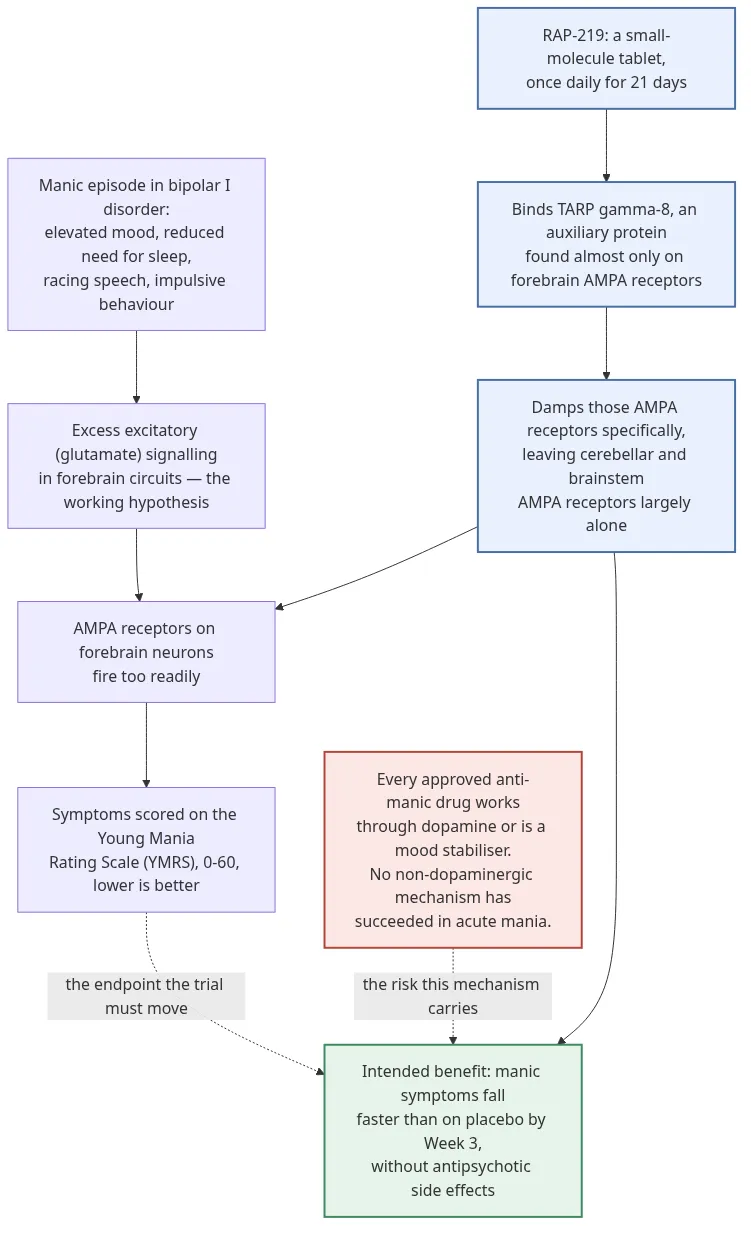
The exact scientific step this readout must prove. That damping forebrain AMPA receptors reduces manic symptoms more than placebo does, measured on the YMRS at three weeks, in patients selected by clinical diagnosis alone. Every fact supporting the molecule so far is about stopping seizures in an epileptic brain, measured against each patient’s own untreated baseline in an open-label study where everyone knew they were taking the drug. This readout asks a different question in a different disease against a different comparator.
The honest scientific risk. It is not that the drug does nothing. It is that every approved
treatment for acute mania works through dopamine blockade or is a classical mood stabiliser —
lithium, valproate, carbamazepine — and no novel mechanism has ever displaced them. Acute mania has
consumed a long series of mechanistically interesting drugs. The most recent, and the closest to this
one in design, is Biohaven’s BHV-7000: a potassium-channel opener, 274 patients, 21 days, inpatient,
YMRS at day 21 — the same trial in all but the molecule — which missed its primary endpoint, after
which Biohaven stopped running psychiatric trials altogether
[VERIFIED — Psychiatric Times and Clinical Trials Arena reports of the 2026-03-03 announcement; trial design from ClinicalTrials.gov NCT06419582].
There is a second, more technical risk that deserves naming. RAP-219 has a half-life of about 22
days [VERIFIED — Rapport press release, 2026-04-21]. A drug that slow reaches steady
concentrations over months, not weeks. In a 21-day trial, that means blood levels may still be
climbing when the primary endpoint is measured — unless a loading regimen is used. No source read
this sweep discloses the dose or the regimen. The registry says only “RAP-219 tablets administered
orally, once daily for 21 days”
[VERIFIED — ClinicalTrials.gov API v2, NCT07046494 arms and interventions, read 2026-08-19]. This
cuts both ways and it is honest to say so: the same long half-life is why the epilepsy effect
persisted for weeks after dosing stopped, which suggests exposure builds usefully fast. But the
question cannot be settled from what is public.
A.2 Clinical development plan, timeline, feasibility, resourcing
Trials
| Trial | Sponsor / whose drug | Design (arms, blinding, n) | Population | Status / key result | Link |
|---|---|---|---|---|---|
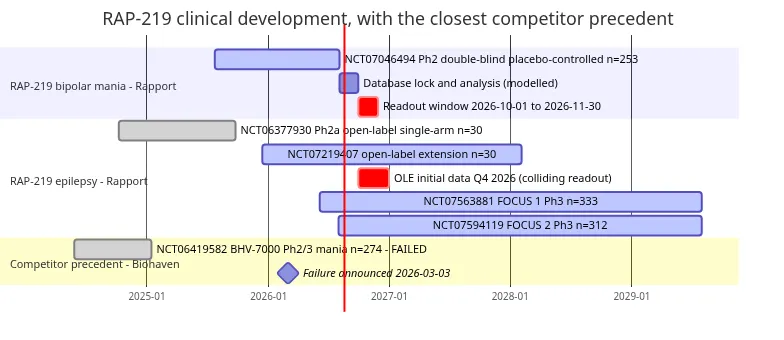
| NCT07046494 — the pivotal trial for this readout | Rapport Therapeutics / its own drug | Phase 2 proof of concept. Two arms — RAP-219 tablets once daily, or matching placebo — randomised, quadruple-masked (participants, care providers, investigators and outcome assessors all blinded), multicentre, inpatient for the full three weeks. n = 253 actual. 20 sites, all in the United States. Dose not disclosed. | Adults 18–65 meeting DSM-5 criteria for bipolar I disorder in a manic episode, with or without mixed features, with at least one prior documented manic episode requiring treatment within five years. Rapid cyclers, schizophrenia, schizoaffective disorder, major depressive disorder and moderate-or-severe substance use disorder all excluded. | ACTIVE, NOT RECRUITING. Started 2025-07-25; primary completion 2026-08-05 — already passed; study completion listed as 2026-10. No results posted. | NCT07046494 |
| NCT06377930 — the epilepsy proof of concept | Rapport Therapeutics / its own drug | Phase 2a, open-label, single-arm, no placebo, multicentre. n = 30. Eight-week treatment period with an eight-week follow-up. 12 sites. | Adults with refractory focal epilepsy carrying an implanted responsive neurostimulation device, which records electrical “long episodes” objectively. | COMPLETED 2025-09-26. Met its primary endpoint. 77.8% median reduction in clinical seizures against baseline (p=0.01); 24% seizure-free; up to 80% median reduction in device-recorded long episodes; 10% discontinuation rate. | NCT06377930 |
| NCT07219407 — the open-label extension | Rapport Therapeutics / its own drug | Open-label, long-term, single-arm. n = 30. | Adults with refractory focal onset seizures continuing from the study above. | RECRUITING. Started 2025-12-15, primary completion 2028-02-03. Initial data expected in the fourth quarter of 2026 — this is the readout that collides with the bipolar window (see Attribution). | NCT07219407 |
| NCT07563881 — FOCUS 1 | Rapport Therapeutics / its own drug | Phase 3, randomised, double-blind, placebo-controlled, two RAP-219 doses plus placebo. n = 333. 10 sites listed so far. | Adults with focal seizures. | RECRUITING. Started 2026-06-05, primary completion 2029-07. | NCT07563881 |
| NCT07594119 — FOCUS 2 | Rapport Therapeutics / its own drug | Phase 3, randomised, double-blind, placebo-controlled, two RAP-219 doses plus placebo. n = 312. 6 sites listed so far. | Adults with focal seizures. | RECRUITING. Started 2026-08, primary completion 2029-07. | NCT07594119 |
| NCT06419582 — BHV-7000, the comparator precedent | Biohaven Therapeutics / not Rapport’s drug | Phase 2/3, multicentre, inpatient, placebo-controlled, double-blind. n = 274. 32 sites. Primary endpoint: change in YMRS total score from baseline to day 21 — the same endpoint at the same timepoint as NCT07046494. | Adults 18–75 hospitalised for a current manic episode, DSM-5 bipolar I, required to stop all other psychotropic medication. | COMPLETED 2025-01-15. FAILED — no statistical significance on the YMRS. Announced 2026-03-03; Biohaven’s shares fell 13.77% from the 2026-02-28 close of $37.18 to the 2026-03-03 close of $32.06, and the company stopped running psychiatric trials. | NCT06419582 |
The site overlap, which is the most specific fact in this document. Comparing the two location
lists directly, 13 of RAP-219’s 20 sites are the same research organisation in the same city as a
site that ran the failed BHV-7000 trial: Rogers (Arkansas), Lemon Grove and Orange (California),
Hollywood, Miami Lakes and West Palm Beach (Florida), Decatur (Georgia), Chicago (Illinois),
Gaithersburg (Maryland), St Louis (Missouri), Staten Island (New York), and Austin and Richardson
(Texas) [VERIFIED — ClinicalTrials.gov location lists for NCT07046494 and NCT06419582, both read 2026-08-19].
Why this matters rather than being a curiosity: acute mania trials do not usually fail because the
drug is inert, they fail because the placebo arm improves too much. Hospitalised patients are
removed from stress, sleep, eat and are watched around the clock, and all of that improves a YMRS
score on its own. Specialist psychiatric research sites that recruit for study after study are where
that effect is largest. Whatever placebo response sank BHV-7000 was generated substantially at these
same thirteen sites, and it is a property of the sites and the population as much as of the drug.
[UNVERIFIED — the causal reading is the analyst's own; the site overlap itself is verified]
The enrolment increase and the changed analysis plan. On 2026-05-07 the company moved topline
guidance from the first half of 2027 to the fourth quarter of 2026 and said it had “increased target
enrolment” and modified the trial’s statistical analysis plan, adding that the higher enrolment might
let the study serve as confirmatory evidence of effectiveness for a future approval application.
It repeated all of this on 2026-08-05 [VERIFIED — BPIQ note field on drug id 18871, and the second-quarter 2026 release]. Two readings are available and both are legitimate. The generous one:
the sponsor saw blinded aggregate data suggesting the trial could carry a regulatory burden and
invested to make it do so. The cautious one: a mid-trial power increase is what a sponsor does when a
blinded look shows the variance is higher, or the placebo arm better, than the original plan assumed.
Nothing public separates them. [UNVERIFIED]
Feasibility matrix
| Factor | High probability | Medium probability | Low probability | This asset (assessment) | Source |
|---|---|---|---|---|---|
| Recruitment feasibility | >50 sites, 3:1 patient:site | 20–50 sites, established investigators | <20 sites, novel sites | High, and already delivered. 20 sites, 253 patients — 12.7 per site, far above 3:1 — and enrolment finished ahead of the original schedule, twice. The sites are established: thirteen of them ran the comparable BHV-7000 study. Recruitment is not a risk here; it is done. | [VERIFIED — ClinicalTrials.gov NCT07046494, enrolment type ACTUAL] |
| Endpoint clarity | Regulatory precedent exists | Novel endpoint with FDA alignment | Unvalidated surrogate | High. Change in YMRS total score at three weeks is the endpoint on which every modern acute-mania approval rests, including milsaperidone in February 2026. There is no ambiguity about what the trial has to show. | [VERIFIED — ClinicalTrials.gov NCT07046494 primary outcome; corroborated by the published trial literature in A.3b] |
| Trial-design robustness | Pivotal Phase III with SPA | Adaptive with interim analysis | Single-arm, no control | Medium-to-high for a Phase 2. Randomised, quadruple-masked, placebo-controlled, inpatient, 253 patients. No special protocol assessment is disclosed and none would be expected at Phase 2. The mid-trial statistical analysis plan change is the one blemish on an otherwise clean design. | [VERIFIED — ClinicalTrials.gov API v2 design module; SAP change from the company's own releases] |
| Operational / execution | Enrolment complete, standard timeline | Some timeline risk | Enrolment behind | High. Enrolment complete, primary completion date reached on 2026-08-05, and guidance moved earlier twice rather than later. Execution on this program has been notably clean. | [VERIFIED — ClinicalTrials.gov NCT07046494; BPIQ note field slip sequence] |
Resourcing sufficiency. Comfortable, and not the binding constraint. The company held $436.1M of
cash and short-term investments at 2026-06-30 against a recomputed burn of $13.57M a month, with no
debt — see ../company.md C.3. The trial this readout comes from is already fully
enrolled and dosed, so its remaining cost is analysis. The real resourcing question sits elsewhere:
two Phase 3 epilepsy trials totalling 645 patients began in 2026 and run to 2029, which is what will
consume the balance sheet, and the recomputed runway (to about 2029-03) already falls short of the
company’s stated one (into the second half of 2029) before that ramp is accounted for. A positive
bipolar readout would add a third development program to fund, not relieve the pressure.
A.3 Target label, target product profile, strategic questions, designations
A.3a Target label. Acute treatment of manic episodes, with or without mixed features, associated
with bipolar I disorder, in adults [VERIFIED — ClinicalTrials.gov NCT07046494 title].
A.3b Target product profile
| Attribute | Standard of care & key competitor(s) — data | RAP-219 target profile (goal) | Supporting evidence (+ link) |
|---|---|---|---|
| Indication / target label | Acute manic or mixed episodes in bipolar I. Held by a crowded field of dopamine-blocking drugs — olanzapine, risperidone, quetiapine, aripiprazole, asenapine, cariprazine, ziprasidone — plus lithium and valproate. The newest entrant is milsaperidone (Bysanti, Vanda), approved 2026-02-20 for this exact label and for schizophrenia. | The same label, reached through a mechanism that is not dopamine blockade. | [VERIFIED — Psychiatric Times, FDA approval of Bysanti, 2026-02] |
| Efficacy (endpoints, regimen) | Placebo-adjusted YMRS improvement at three weeks of roughly 5 to 7 points for approved agents. Asenapine −10.8 and olanzapine −12.6 against placebo −5.5 at day 21, i.e. −5.3 and −7.1 adjusted. Response (≥50% YMRS fall): asenapine 42.5%, olanzapine 52.4%, placebo 29.4%. Olanzapine’s effect size rises with baseline severity: 0.35 at YMRS 20–25, 0.58 at 25–35, 0.70 at 35–60. | Beat placebo on YMRS change at Week 3, once daily, orally. To be competitive rather than merely positive it needs a placebo-adjusted difference in the 5-point region. | [WEB ESTIMATE — published 3-week placebo-controlled trial literature located by web search, 2026-08-19; the asenapine/olanzapine comparison is a 3-week randomised trial and the olanzapine effect sizes come from a five-study individual-participant meta-analysis in *The Lancet Psychiatry*, 2017] |
| Safety / tolerability | This is the whole opportunity. Dopamine-blocking drugs cause weight gain and metabolic disease (olanzapine and quetiapine worst), sedation, restlessness (akathisia), Parkinson-like stiffness, raised prolactin, and — with long exposure — tardive dyskinesia, a movement disorder that can be permanent. Lithium requires blood-level monitoring and damages kidneys and thyroid over time; valproate causes birth defects. | Efficacy without dopamine blockade: no weight gain, no movement disorders, no prolactin effect. In epilepsy the drug was “generally well tolerated” with mostly mild adverse events and a 10% discontinuation rate. | [VERIFIED — Rapport Phase 2a topline release, 2025-09-08, for the epilepsy tolerability figures; the side-effect profile of the approved comparators is standard clinical knowledge and is [UNVERIFIED] here in the sense that no single primary source was read for it this sweep] |
| Biomarker / companion diagnostic | None in this field. Patients are selected by clinical interview. | None planned, and none possible on what is public. Entry to this trial is DSM-5 diagnosis confirmed by structured interview, plus one prior documented manic episode. | [VERIFIED — ClinicalTrials.gov NCT07046494 eligibility criteria] |
| Formulation / administration | Oral tablets, oral dissolving films, and injections including long-acting depots. | Oral tablet, once daily. A long-acting injectable version of RAP-219 exists in pre-human development for epilepsy (bpiq_drug_id 20353) and would be directly relevant here if the mania result is positive, because adherence is the central problem in bipolar disorder. | [VERIFIED — ClinicalTrials.gov API v2 intervention description; [../company.md](/analysis/RAPP) C.2 row 20353] |
| Payer value | Generic atypical antipsychotics cost very little. A branded acute-mania agent has to justify its price against a $4 generic. | Justify a branded price on tolerability and on adherence, not on superior symptom reduction. This is a hard commercial argument and B.3a treats it as the least defensible input in the whole valuation. | [UNVERIFIED — the analyst's own reading] |
A.3c Strategic Go/No-Go questions. This asset’s next decision on this indication is whether to take bipolar mania into a registration program, so the pre-Phase-III set is the one that applies.
Pre-Phase-III (Go-to-Phase-III / registration):
| Group | Question | Answer (tagged) |
|---|---|---|
| Target | Target revalidated as in prior phases? | Not in this disease. TARP γ-8 engagement is confirmed in living human brain by imaging, and the target is clinically validated for epilepsy by this molecule’s own Phase 2a. For mania the target rests on preclinical rationale only, and the independent genetic check was BLOCKED (section 0). [UNVERIFIED] |
| Dose & Drug | Exposure–response for the intended commercial regimen and route(s)? | No. No dose is disclosed for this trial, and no exposure–response relationship for manic symptoms exists anywhere public. The epilepsy dose was selected on receptor occupancy for seizure control; whether the same occupancy is the right target for mania is unknown. [UNVERIFIED] |
| Dose & Drug | Commercial formulation available or feasible? | Yes. An oral once-daily tablet is already what is being tested. [VERIFIED — ClinicalTrials.gov API v2 intervention description] |
| Dose & Drug | Dose range compatible with clinical and non-clinical safety? | Provisionally yes, from a different disease. Eight weeks of dosing in epilepsy produced mostly mild adverse events and a 10% discontinuation rate. Three weeks in a manic population is a shorter exposure in a different and more agitated group. [VERIFIED for the epilepsy data; [UNVERIFIED] for the read-across] |
| Dose & Drug | Therapeutic window given the clinical response? | Unknown for this indication. [UNVERIFIED] |
| Dose & Drug | Intrinsic and extrinsic factors influencing exposure and patient response? | The half-life is the one that matters and it is not resolved. ~22 days against a 21-day endpoint (A.1). Whether a loading regimen is used is not disclosed. [UNVERIFIED] |
| Patient | Proof of concept and positive benefit/risk in the intended population? Combination evidence? | That is precisely what this readout will answer. There is none today. The trial is monotherapy; no combination evidence exists or is planned. [UNVERIFIED] |
| Patient | Phase III design and outcome criteria — accepted, compelling, competitive for market access? | Endpoint and design are wholly conventional and would transfer to Phase 3 unchanged. Whether the result is competitive depends on the size of the placebo-adjusted difference, not on whether p < 0.05 — see A.3b. [VERIFIED for the design; [UNVERIFIED] for competitiveness] |
| Patient | Rationale for the patient population(s)? | Sound and conventional: DSM-5 bipolar I in a manic episode, one prior treated episode within five years, rapid cyclers and psychotic-spectrum diagnoses excluded. Restricting to 18–65 (BHV-7000 allowed up to 75) narrows the label slightly but reduces confounding. [VERIFIED — ClinicalTrials.gov NCT07046494 eligibility criteria] |
| Patient | Likelihood of the expected outcome? | 35%, band 22–48%, modelled — see the locked prediction. [UNVERIFIED — modelled] |
| Patient | Companion-diagnostic strategy, including pricing and market? | None, and none needed. [VERIFIED — no biomarker in the eligibility criteria] |
A.3d Regulatory designations. None disclosed for this indication. No breakthrough therapy,
fast track, orphan or priority designation is named in any source read this sweep for RAP-219 in
bipolar disorder. The one regulatory fact on record is a negative one from a different indication:
the application to begin human testing in diabetic peripheral neuropathic pain was placed on clinical
hold, the hold was later lifted, and the company has deferred the program
[VERIFIED — BPIQ note field on drug id 19422]. The nearest thing to a designation here is the
company’s statement that this Phase 2 could potentially count as confirmatory evidence of
effectiveness — that is a claim about how the trial might be used, not a designation granted by
anyone [VERIFIED — Rapport second-quarter 2026 release, 2026-08-05].
A.4 Target product profile valuation matrix
| Stakeholder | Value driver | Minimum threshold | Competitive | Premium | Benchmark / source |
|---|---|---|---|---|---|
| Patient / caregiver | Control of the manic episode without the side effects that make people stop taking their medication | Mania resolves as fast as on an existing drug | Same speed, plus no weight gain and no restlessness | Same speed, no metabolic or movement side effects at all, and a formulation that survives the patient losing insight and stopping treatment | [UNVERIFIED — the analyst's own reading]. Adherence is the defining problem of bipolar disorder, which is why the long-acting injectable in the pipeline is strategically relevant. |
| Regulator | A statistically significant YMRS advantage over placebo at three weeks, in an adequately controlled trial, with acceptable safety | p < 0.05 on YMRS change at Week 3 | The same result plus supportive secondary endpoints (CGI-BP-S mania, response rate) pointing the same way | Two such trials, letting an application proceed — which is exactly what the company’s confirmatory-evidence claim is reaching for | [VERIFIED — ClinicalTrials.gov NCT07046494 primary and secondary outcomes; the two-trial convention is standard regulatory practice] |
| Payer / HTA | A reason to pay a branded price when generic antipsychotics cost almost nothing | Non-inferior symptom control | Documented reduction in metabolic side effects, which cost payers money in their own right | Demonstrated reduction in relapse and re-hospitalisation — the expensive event in bipolar disorder | [UNVERIFIED — the analyst's own reading]. This row is the hardest of the four and B.3a treats price as the least defensible input. |
| Provider | Something to give the patient who cannot tolerate dopamine blockade | Works in the acute setting | Simple once-daily oral dosing with no blood-level monitoring, unlike lithium | Usable as both acute and maintenance treatment, so the patient is not switched at discharge | [VERIFIED — once-daily oral dosing from ClinicalTrials.gov; the rest is [UNVERIFIED]] |
Calibration examples, not asset claims: in oncology each incremental month of overall survival is worth roughly $150–300M in peak-sales potential; oral formulations command roughly 15–25% price premiums over injectables. Neither transfers to acute mania, where the comparators are oral generics and there is no survival endpoint — recorded because the template carries them, and flagged as inapplicable here rather than silently borrowed.
A.5 Evidence quality and endpoints
| Criterion | Score (High / Medium / Low) | Basis (one line) | Link |
|---|---|---|---|
| Target validation | Low for this indication (High for epilepsy) | Human receptor-occupancy imaging plus a positive open-label Phase 2a — both in epilepsy. For mania the case is preclinical rationale only, and the independent genetic check was BLOCKED. | NCT06377930 |
| Mechanism clarity | High | The mechanism is precisely specified — negative allosteric modulation at TARP γ-8-containing forebrain AMPA receptors — and confirmed to engage in living human brain. Independent reviewers describe it in the same terms the sponsor does. | doi:10.1111/epi.18056 |
| Biomarker availability | Low | No biomarker selects patients or predicts response in mania, and none is used. Receptor occupancy imaging exists but is a pharmacology tool, not a patient-selection one. | NCT07046494 |
| Publication quality (peer-reviewed? independent authors?) | Low | Three PubMed hits in total. Two are conference-summary reviews in Epilepsia by an independent academic group; both concern epilepsy. The third is unrelated 2017 screening work. No primary trial report of RAP-219 has been published anywhere, and nothing at all on bipolar disorder. Every efficacy figure in this document comes from a company press release. | doi:10.1002/epi.70346 |
| Clinical / expert sentiment | — | Moved to A.5b, below. | — |
Endpoints
| Endpoint (full name) | What it measures | Scale / range | Better direction | MCID / note |
|---|---|---|---|---|
| Young Mania Rating Scale (YMRS) total score, change from baseline to end of treatment at Week 3 — the primary endpoint | Severity of manic symptoms, across eleven clinician-rated items covering elevated mood, increased activity, sexual interest, sleep, irritability, speech, thought disorder, thought content, disruptive behaviour, appearance and insight | 0 to 60 | Lower | No formally established minimal clinically important difference exists. The field’s working conventions are a ≥50% fall from baseline (response) and a total ≤12 (remission). Approved drugs achieve a placebo-adjusted improvement of roughly 5 to 7 points at three weeks, which is the number this readout should be judged against rather than against p < 0.05 alone. [VERIFIED — endpoint definition from ClinicalTrials.gov; the conventions and the 5–7 point benchmark are [WEB ESTIMATE — published 3-week trial literature, retrieved 2026-08-19]] |
| Clinical Global Impression — Bipolar version, Severity of Illness Mania score, change from baseline to Week 3 | A single clinician judgement of overall manic illness severity | 1 (not ill) to 7 (very severely ill) | Lower | No MCID. Its value is as a consistency check: a real drug effect should move this and the YMRS in the same direction. |
| Treatment-emergent adverse events, to eight weeks after the last dose | Safety. Count and severity of new or worsened medical problems | Counts | Lower | The eight-week follow-up window is longer than the three-week treatment period, which is appropriate for a drug with a ~22-day half-life. |
| Suicidality on the Columbia-Suicide Severity Rating Scale | Suicidal thinking and behaviour, by structured interview | Categorical | Lower | Standard in psychiatric trials. A signal here would be serious regardless of the efficacy result. |
| Heart rate, respiratory rate, body temperature, blood pressure, laboratory analytes, ECG QTc interval and abnormal ECG findings | Routine physiological safety | Various | Toward normal | QTc prolongation — a delay in the heart’s electrical recovery that can cause dangerous rhythms — is measured explicitly. Several dopamine-blocking comparators carry QTc warnings, so a clean result here would be a differentiating point rather than merely a safety box. |
A.5b Key opinion leaders.
Panel as of. 2026-08-19 — the date both searches below were run.
Investigators
Exactly one person is disclosed. search_investigators returned nothing (section 0); the overall
official was recovered from the trial record itself. Twenty sites are listed and no site
investigator is named for any of them, which is ordinary for a registry record but means this table
is one row where a fuller disclosure would have given twenty.
| Name | Role / affiliation | Trial (NCT) | Conflicts (party, kind, disclosed in, as of) | Conflicts checked (source, date) | Source | Tag |
|---|---|---|---|---|---|---|
| Edwin A. Gomez, MD | Principal investigator (overall official) / CenExel Research Centers of America | NCT07046494 | None found. Being the overall official on a Rapport-sponsored trial is a relationship with the sponsor by construction and is not listed here; no relationship beyond that one was located. | PubMed search_articles, Gomez EA[Author] AND (bipolar OR mania OR schizophrenia), 2026-08-19 — five hits, every one published between 1978 and 1990, evidently a different author of the same surname and initials. No conflict-of-interest statement was located, which is not the same as none existing. | ClinicalTrials.gov API v2 overallOfficials for NCT07046494, read 2026-08-19 | [VERIFIED — for the identification and role; the conflict search is recorded as a search made, never as a certification] |
Independent voices
Empty, and the emptiness is the finding. Two searches were run. PubMed on RAP-219 returned three
articles; the two relevant ones are conference-summary reviews in Epilepsia whose authors — Bialer,
Johannessen Landmark, Koepp, Perucca, Perucca, Tomson, White and Wirrell — are independent academics
with no disclosed Rapport relationship. But they write about RAP-219 as a drug-resistant focal
epilepsy candidate and say nothing whatever about bipolar disorder or the YMRS. They are therefore
not commentators on this program’s endpoint and recording them here would misrepresent what they
said. search_investigators returned nothing.
Not one named independent voice has commented publicly on whether damping forebrain AMPA receptors should reduce manic symptoms. No row is written rather than a weak one being manufactured.
| Name | Affiliation | View (close enough to quote) | As of | Conflicts checked (source, date) | Source | Tag |
|---|---|---|---|---|---|---|
| (none) | — | — | — | — | — | — |
Judgement
| Endpoint supported | Basis (one or two sentences) | Tag |
|---|---|---|
| UNKNOWN | No independent voice has commented on this program’s endpoint at all, so there is nothing to weigh in either direction. The two Epilepsia reviews that name RAP-219 discuss it only as an epilepsy candidate, and treating an independent academic’s description of the epilepsy program as support for the mania endpoint would be exactly the blend 01-rules.md rule 3 forbids. | [UNVERIFIED — the analyst's own reading of the two searches recorded above] |
Dissent
Empty. Endpoint supported is UNKNOWN rather than SUPPORTIVE_CONTESTED, so no dissent row is
required and none is invented.
| Name | View (close enough to quote) | Source |
|---|---|---|
| (none) | — | — |
B. Commercial assessment
B.0 Current treatment algorithm
What a patient in a manic episode receives today, in order:
- Admission. A severe manic episode is usually treated in hospital, because insight is lost and the behaviour is dangerous. Admission itself improves symptoms — regular sleep, no stress, constant supervision — which is the reason placebo arms in these trials improve as much as they do.
- First line: one drug, started immediately. Either a dopamine-blocking antipsychotic (olanzapine, risperidone, quetiapine, aripiprazole, asenapine, cariprazine, ziprasidone, and since February 2026 milsaperidone), or lithium, or valproate. All work. The choice is made mostly on side effects, speed and what the patient has tolerated before.
- Second line: combine. An antipsychotic plus lithium or valproate, if one drug is not enough.
- Third line: electroconvulsive therapy, or clozapine, for episodes that resist everything else.
- After the episode: maintenance, to stop the next one. This is where most of the money in bipolar disorder is spent, and it is a different — and much larger — commercial question than the one this trial answers.
Where RAP-219 would fit: step 2, as an alternative first-line agent, for the patient who cannot tolerate dopamine blockade. It is not competing on how fast mania resolves; the existing drugs are already good at that. It is competing on what the patient has to accept in exchange — weight gain, metabolic disease, restlessness, stiffness, raised prolactin, and the risk of a permanent movement disorder. That is a real clinical gap and it is also a narrower commercial position than “a new treatment for mania” sounds, because it starts as a second choice for a subset of patients.
The commercial consequence cuts both ways, and it decides the valuation in B.3a. An acute-mania label alone is worth very little: a three-week course of any drug, however good, generates a few hundred dollars per patient per episode. The value lies entirely in whether an acute approval opens the door to maintenance use, where patients take the drug for years. Every peak-sales figure in B.3a is built on that assumption, and it is the assumption most likely to be wrong.
B.1 Competitive landscape and positioning
| Metric | High value | Medium value | Low value | This asset (assessment) | Source |
|---|---|---|---|---|---|
| Mechanism differentiation | First-in-class or novel target | Next-generation improvement | Me-too | High on the molecule, and that is not automatically good news. RAP-219 is a genuinely novel target in this disease — potentially first-in-class TARP γ-8-selective. But first-in-class in acute mania is a category with no members: every approved drug blocks dopamine or is a classical mood stabiliser. Novelty here means no precedent to lean on, not a moat around a proven idea. | [VERIFIED — Rapport press release 2026-03-09 for the first-in-class claim; the absence of a non-dopaminergic precedent is [UNVERIFIED — the analyst's own reading of the approved-drug list]] |
| Development-timeline advantage | >12 months ahead | Within 6–12 months | Lagging >12 months | More than 12 months ahead, with no one behind. No other TARP γ-8 program in bipolar disorder was found. The one other TARP γ-8 drug in clinical development, ES-481, is in drug-resistant epilepsy only. The nearest non-dopaminergic competitor, BHV-7000, has been discontinued for psychiatry. | [VERIFIED — Bialer et al., *Epilepsia* 2026, [doi:10.1002/epi.70346](https://doi.org/10.1002/epi.70346), which lists ES-481 as an epilepsy candidate; BHV-7000 discontinuation from the 2026-03-03 announcement] |
| Clinical proof-of-concept evidence | Positive Phase IIb (n>100) | Phase IIa signals (n=20–50) | Preclinical only | Preclinical only, in this disease. This readout is the proof of concept. The n=30 open-label epilepsy signal is genuine evidence about the molecule and no evidence at all about mania. Scoring this row “medium” on the strength of the epilepsy data would be exactly the blend rule 3 forbids. | [VERIFIED — the trial list in A.2 contains no completed psychiatric study] |
| IP protection | Composition-of-matter, long-dated | Method-of-use | Pending or none | UNKNOWN, and stated as unknown. The dedicated exclusivity web search returned the Tenacia licence terms in full and nothing on patents. No patent number, no composition-of-matter claim and no expiry date was located this sweep. 01-rules.md rule 5 applies: this is not filled with a plausible guess. | [UNVERIFIED — searched, not found] |
Named competitors
| Name | Sponsor | Mechanism | Position |
|---|---|---|---|
| Milsaperidone (Bysanti) | Vanda Pharmaceuticals | Atypical antipsychotic (dopamine and serotonin receptor activity) | Approved 2026-02-20 for acute manic or mixed episodes in bipolar I and for schizophrenia. The newest branded entrant, and the direct commercial competitor if RAP-219 ever launches. [VERIFIED — Psychiatric Times, 2026-02] |
| Olanzapine, risperidone, quetiapine, aripiprazole, asenapine, cariprazine, ziprasidone | Various, most now generic | Dopamine blockade | The incumbent standard. Effective, cheap, and burdened with the side effects RAP-219 aims to avoid. |
| Lithium, valproate, carbamazepine | Generic | Classical mood stabilisers, mechanisms incompletely understood | Decades of use. Lithium requires blood monitoring; valproate causes birth defects. |
| BHV-7000 | Biohaven | Kv7.2/7.3 potassium-channel opener | Failed. n=274, 21 days, inpatient, YMRS at day 21. Missed the primary endpoint; announced 2026-03-03; Biohaven fell 13.77% and left psychiatry. The closest precedent in this document, and the reason A.1’s risk paragraph reads as it does. [VERIFIED — ClinicalTrials.gov NCT06419582; Psychiatric Times and Clinical Trials Arena, 2026-03] |
| ES-481 | Not established this sweep | AMPA receptor antagonist at TARP γ-8-containing receptors | The nearest thing to a mechanistic competitor, but in drug-resistant epilepsy, not mania. [VERIFIED — Bialer et al., *Epilepsia* 2026] |
Where this asset wins, and the single fact the thesis rests on. It wins on tolerability, and only on tolerability. Nobody needs a drug that resolves mania faster than olanzapine does; people need one that resolves it without the weight gain, the akathisia and the long-term movement risk. If RAP-219 separates from placebo on the YMRS with a clean tolerability profile, it becomes the first credible option for a large group of patients who currently choose between an unbearable illness and unbearable side effects.
The single fact the thesis rests on is this: that damping forebrain AMPA signalling is enough, on its own, to bring a manic episode down — without touching dopamine. Everything else follows if that is true and nothing follows if it is not. There is no partial credit here: a numerically favourable miss is a miss, and the field has no history of second chances for a non-dopaminergic mechanism.
Calibration example, not an asset claim: oncology first-movers in novel mechanisms have shown roughly 3.2× higher peak-sales potential but about 1.8× higher development risk. The direction transfers to psychiatry; the multiples do not, and are not used in B.3a.
B.2 Addressable market
The launch markets would be the United States first — all twenty trial sites are American — then the five largest European markets and Japan. Bipolar I disorder is diagnosed and treated everywhere, so market access is a pricing question rather than an infrastructure one.
| Component | How it is estimated | Premium threshold | This asset (assessment) | Source |
|---|---|---|---|---|
| Drug-treated patients | Epidemiology × diagnosis rate × treatment rate | >100,000 (US/EU5/Japan) | Threshold comfortably cleared, but the relevant number is smaller than it looks. Bipolar I affects roughly 1% of adults, so on the order of 2.6 million US adults. The number in an acute manic episode requiring treatment in any given year is a fraction of that, and the number who would be given a branded, novel agent rather than a $4 generic is a fraction again. B.3a builds from the branded-treated subset, not from prevalence. | [UNVERIFIED — modelled; the ~1% prevalence figure is standard epidemiology and no primary source was read for it this sweep] |
| Market exclusivity | Patent term + regulatory exclusivity | >10 years combined | UNKNOWN. No patent information was located (B.1’s IP row). US new-chemical-entity regulatory exclusivity would give five years from first approval, which is a floor rather than the answer. The 10-year threshold cannot be assessed. | [UNVERIFIED — searched, not found] |
| Reimbursement precedent | Approvals in ≥2 major markets | Positive NICE/CADTH guidance | Strong precedent for the indication, unknown for the price. Acute mania has many approved treatments reimbursed across the US, Europe and Japan, so no payer needs persuading that the disease is worth treating. They need persuading to pay a branded price when generics work. That is the harder half and it is unresolved. | [UNVERIFIED — the analyst's own reading] |
| Patient-journey impact | Fewer hospital days, less caregiver burden | >30% quality-of-life gain | Potentially large, and unquantifiable on what is public. Avoiding weight gain, restlessness and tardive dyskinesia would materially change a patient’s life, and better tolerability drives better adherence, which drives fewer relapses and fewer admissions. No quality-of-life instrument is in this trial’s endpoint list at all, so the trial itself will produce no evidence on this row. | [VERIFIED — ClinicalTrials.gov NCT07046494 outcome measures contain no quality-of-life or functioning scale] |
B.3 Value and feasibility
B.3a Expected peak sales.
Scope. These figures are for bipolar disorder only and exclude epilepsy entirely, which is
where most of this company’s value sits. They exclude Greater China, which is licensed to Tenacia in
exchange for mid-single-digit to mid-teens tiered royalties
[VERIFIED — Rapport press release, 2026-03-09]. All three scenarios are conditional on eventual
approval, which requires this readout to succeed and then a full registration program to succeed
after it.
The structural assumption, stated first because it drives everything. An acute-mania label on its
own is nearly worthless commercially: three weeks of tablets per episode, a few hundred dollars.
Every figure below assumes that an acute approval leads to chronic maintenance use, where patients
take the drug for years, exactly as the approved antipsychotics are used today. If that does not
happen, divide every number below by roughly twenty. [UNVERIFIED — modelled]
No third-party forecast was found for this program. The peak-sales web search returned only
aggregate bipolar market-size reports — the market as a whole is put at roughly $5.0–5.4 billion in
2026 growing at about 2% a year [WEB ESTIMATE — Mordor Intelligence and Coherent Market Insights market reports, retrieved 2026-08-19]. That is a ceiling on the whole category, dominated by
generics, and is not a forecast for this asset. It is recorded rather than converted into one.
| Scenario | Assumptions (patients × price × share) | Estimate (USD/year at peak) | Basis / tag |
|---|---|---|---|
| Low | US: 300,000 patients on branded bipolar maintenance × 3% peak share = 9,000 × $11,000 net per year = $99M. Ex-US at 60% of the US figure = $60M. | ~$0.16B | [UNVERIFIED — modelled]. The case where the drug works but is confined to patients who have failed or cannot tolerate two generics first. |
| Base | US: 325,000 × 8% = 26,000 × $14,000 = $364M. Ex-US = $218M. | ~$0.58B | [UNVERIFIED — modelled]. The case where tolerability earns it a genuine place in the first-line choice for a meaningful minority. |
| High | US: 400,000 × 15% = 60,000 × $18,000 = $1.08B. Ex-US = $650M. | ~$1.73B | [UNVERIFIED — modelled]. The case where the tolerability advantage is large and documented, the long-acting injectable arrives, and the drug becomes a default for patients who cannot take antipsychotics. |
The least defensible input is the peak share, and the second least is the price. Patient numbers
can at least be bounded by epidemiology. The share depends entirely on how large and how visible the
tolerability advantage turns out to be — a question this three-week trial will barely touch, since
metabolic and movement side effects take months to years to appear. The price depends on a payer
negotiation against generics that cost almost nothing. Neither is verifiable today and neither is
presented as a point estimate. 01-rules.md rule 10 is why the whole table is a range.
Against market value. Enterprise value is $1,911.77M, recomputed from 47,978,286 filed shares
at $48.94 less $436.077M of cash and short-term investments
(../company.md C.4). Even the high case for bipolar is roughly 90% of the entire
enterprise value; the base case is about 30% of it, before discounting for probability, time and the
cost of the registration program that would be needed. Most of this company’s value is not this
program, which is the same conclusion the pipeline table reaches from the other direction.
B.3b Feasibility
| Question | Answer (tagged) |
|---|---|
| Expected net present value (eNPV) | A range, and deliberately not a figure: plausibly $50M to $500M for this indication. The construction: a 35% probability that this readout is positive (see the locked prediction), multiplied by roughly a 25–35% probability of getting from a positive psychiatric Phase 2 to approval, gives an unconditional probability of approval on the order of 9–12%. Applied to the $0.16–1.73B peak range above, with a launch no earlier than 2032 and a discount rate in the 12–15% region, and net of the several hundred million dollars a registration program would cost. Every one of those inputs is unverified, so 01-rules.md rule 10 forbids collapsing them into one number. [UNVERIFIED — modelled] |
| Capital to the next decision point | Already spent. The trial is fully enrolled and dosed; the primary completion date passed on 2026-08-05. What remains before topline is database lock and statistical analysis. [VERIFIED — ClinicalTrials.gov NCT07046494] |
| Capital to approval, and the funding plan | Not funded, and not close, on this indication alone. A registration program in acute mania means at least one further large placebo-controlled trial, plus long-term safety exposure — several hundred million dollars over several years, on top of the two epilepsy Phase 3 trials already running. The current $436.1M does not cover both. The funding plan is visible in the filings rather than stated: an unlimited automatic shelf and an undrawn $110M at-the-market facility, and a demonstrated pattern of raising on good news — the September 2025 offering was announced the same day as the epilepsy topline (../company.md C.3). [VERIFIED — for the facilities and the 2025 pattern; [UNVERIFIED] for the trial cost estimate] |
| Launch capability — alone, or must partner? | Must partner, or be acquired, for bipolar. Selling into psychiatry means a large primary-care and community-psychiatry salesforce, which is a fundamentally different and more expensive commercial build than the specialist epilepsy centres the lead indication needs. The company has no commercial infrastructure of any kind. [UNVERIFIED — the analyst's own reading] |
| Commercialisation rights — retained, split, or out-licensed? | Retained everywhere except Greater China. Tenacia Biotechnology holds exclusive rights in mainland China, Hong Kong, Macau and Taiwan for $20M upfront, up to $308M in development and commercial milestones, and mid-single-digit to mid-teens tiered royalties. Every other market is Rapport’s. [VERIFIED — Rapport press release, 2026-03-09] |
B.4 Product-development risk
Framing questions.
- Does the development plan support the target product profile claims? Partly. The trial will answer the efficacy claim cleanly — a randomised, quadruple-masked, placebo-controlled study of 253 patients on the field’s standard endpoint is exactly the right instrument for that question. It will not answer the tolerability claim that the whole commercial thesis rests on, because weight gain, metabolic disease and tardive dyskinesia take months to years to appear and this trial runs for three weeks. A positive readout proves the half of the profile that matters least commercially.
- Will the identified risks affect the target product profile? The largest one destroys it. If the placebo arm improves as much as the drug arm — the risk the BHV-7000 precedent and the shared sites make concrete — there is no product profile to discuss for this indication. The dose and half-life risk is more survivable: an under-dosed 21-day study could be repeated with a loading regimen, at the cost of a year or more.
- If a risk cannot be mitigated, is the asset still differentiated from competitors? In epilepsy, yes, entirely. A bipolar failure would not touch the focal-epilepsy Phase 2a result, the two running Phase 3 trials, or the differentiation argument in that disease. This is the single most important structural fact about the downside here and it is why the miss scenario below is shallower than the class benchmark for a Phase 2 miss would suggest.
| Category | Time risk | Quality risk | Cost risk | Note |
|---|---|---|---|---|
| Project management | Low | Low | Low | Guidance moved earlier twice — H1 2027 to Q4 2026 to October 2026 — and never later. Execution on this program has been clean. |
| Research | High | The mechanistic hypothesis for mania is preclinical. No human psychiatric data for this molecule exists, and the independent genetic check was BLOCKED. | ||
| IP | Unknown | No patent information was located this sweep (B.1). An unknown is recorded as an unknown; it is not scored low or high. | ||
| Legal | Low | Low | Low | No litigation, no dispute and no partnering conflict was found in 227 press items or 219 EDGAR filings. |
| DMPK | Medium | Medium | The ~22-day half-life against a 21-day endpoint is the specific concern (A.1). Whether a loading regimen closes it is not disclosed. | |
| Safety pharmacology | Low | ECG QTc and vital signs are measured explicitly and no signal is known. | ||
| Toxicology | Low | Eight weeks of dosing in epilepsy produced mostly mild adverse events. | ||
| Drug safety (clinical) | Medium | AMPA-antagonist drugs as a class carry psychiatric adverse effects including irritability and aggression — perampanel’s label is the cautionary example. In a manic population, where irritability and aggression are the illness, a class effect of that kind would be both dangerous and hard to distinguish from inadequate efficacy. Regional selectivity is the reason to expect it will not appear; that expectation is untested in this population. | ||
| Biomarker | High | None exists. Patients are selected by clinical interview alone, so there is no way to enrich the trial for likely responders and no way to explain a failure afterwards. | ||
| Clinical pharmacology | Medium | Medium | No dose is disclosed and no exposure–response relationship for manic symptoms exists. | |
| Clinical (efficacy) | HIGH — the dominant risk in this table | High placebo response is the commonest cause of failure in acute mania. Thirteen of twenty sites also ran the BHV-7000 trial that failed on the identical endpoint (A.2). This is the risk that decides the readout. | ||
| Clinical operations | Low | Low | Low | Enrolment complete and ahead of schedule at 12.7 patients per site. |
| CMC / manufacturing | Low | Low | An oral tablet already made at clinical scale. | |
| Regulatory | Medium | No designation of any kind for this indication (A.3d). The confirmatory-evidence claim is the company’s own characterisation and has not been confirmed by any regulator in a public document. A prior clinical hold on a different indication shows the regulator has engaged critically with this molecule before. | ||
| Global evidence & value | Medium | Medium | No quality-of-life or functioning instrument is in the trial at all, so the evidence a payer would want to see is not being collected here and would have to be generated later. | |
| Commercial | Medium | High | No commercial infrastructure. Psychiatry needs a broad salesforce this company has no plan to build alone, so the commercial route runs through a partner or an acquirer. |
Readout
Sources
| Kind | Where it comes from | What it is worth | Value (or null) | Tag | Note |
|---|---|---|---|---|---|
bpiq | fetch_company_drugs — catalyst_date, catalyst_date_text | The current single source. Synthesized from period text on most rows, so alone it is a ceiling, not an estimate. | catalyst_date 2026-10-31; catalyst_date_text “October 2026” | [VERIFIED — BPIQ fetch_company_drugs, drug id 18871, read 2026-08-19] | The text names a month, not a day, so rule 23 applies and 2026-10-31 is a period-end placeholder: the last day of the month named. It is used nowhere in this document for timing. Field: catalyst_date. |
ctgov | CT.gov get_trial_details — primary_completion_date | Independent of the company’s own messaging, month-precision, and it moves when the trial moves. | 2026-08-05 | [VERIFIED — ClinicalTrials.gov NCT07046494, record last updated 2026-08-10, read 2026-08-19] | Already passed. The registry also lists study completion as 2026-10 and enrolment type ACTUAL at 253, so the trial has finished dosing and the remaining work is analysis. The primary endpoint’s time frame is “Baseline to End of Treatment at Week 3”. This is the strongest single piece of evidence that the October guidance is real. NCT: NCT07046494. |
company | fetch_company_press_releases | The company’s own most recent dated wording. Also where the slip sequence below comes from. | ”topline results expected in October 2026” | [VERIFIED — Rapport second-quarter 2026 financial results and business update, 2026-08-05] | Mandatory under rule 32 because the catalyst is inside twelve months. Read 2026-08-19; the statement is 14 days old at the lock date. The same release also puts the focal-epilepsy open-label extension’s initial data in the fourth quarter of 2026 — the collision the Attribution section computes. |
congress | data/congresses.json, only when the company has said it intends to present there | Answers “where will they say it.” | null | [VERIFIED — data/congresses.json read 2026-08-19] | Looked for and not found, which is different from not looking. data/congresses.json carries four meetings (ACTRIMS-ECTRIMS, ESMO, CTAD, AASLD) and none is a psychiatry meeting. More decisively, the company has not said it intends to present this data at any meeting — it has said “topline results”, which is a press release. Matching on therapeutic area alone would be a guess, and 02-connectors.md says a guess is not a source. |
modelled | Trial arithmetic — see below | The only estimate independent of anyone’s guidance. | 2026-10-05 to 2026-12-05 | [UNVERIFIED — modelled, default lag] | Method: registry primary completion date plus the default lag to database lock and analysis. See below. |
The modelled estimate. The arithmetic, stated so it can be argued with: the ClinicalTrials.gov
primary completion date is 2026-08-05, and 01-rules.md rule 34’s stated default lag from primary
completion to topline is two to four months. That gives 2026-10-05 to 2026-12-05.
data/benchmarks/readout-lag.json holds no entry matching a three-week inpatient psychiatric trial,
so the default is used and the estimate is tagged [UNVERIFIED — modelled, default lag] rather than
benchmarked. Two things are worth noting about how this lands. First, the company’s own guidance
(October) sits at the early edge of the modelled band, not outside it — the two agree rather than
conflict. Second, this trial’s endpoint is a clinician-rated scale collected at a fixed day in an
inpatient setting, with no imaging to read centrally and no long-term follow-up to clean, so the fast
end of the default range is the reasonable expectation here.
Window
| Earliest | Likeliest | Latest | Precision | Confidence |
|---|---|---|---|---|
| 2026-10-01 | 2026-10-22 | 2026-11-30 | MONTH | HIGH |
Basis. The earliest edge is the first day of the month the company itself named in a release 14 days before the lock date, and no source suggests anything earlier is possible. The likeliest date sits in the second half of October: the company named the month, and the modelled arithmetic (primary completion 2026-08-05 plus a two-month lag) lands on 2026-10-05, so the two together point at October rather than at its first days. The latest edge extends one month past the guidance, which is the ordinary allowance for a database lock running long — deliberately not further, because the trial’s primary completion date has already passed with actual enrolment posted, which removes the usual source of slippage. Precision is MONTH because a month was named and no day was.
Confidence is HIGH, which is unusual in this corpus and is earned rather than assumed: three independent sources agree (company guidance, the BPIQ text field, and the registry’s own completion date plus the default lag), the trial has finished dosing, and the guidance has moved earlier twice and later never.
Disagreement. CONSISTENT. Every source points at October or at a band containing it. The BPIQ
placeholder (2026-10-31) is the last day of the named month rather than a conflicting claim, and the
modelled band’s early edge (2026-10-05) sits inside the company’s own month.
Date slippage. Two changes across five dated statements — and both moved the date earlier, which is the opposite of what this field usually records.
| As of | Guidance text |
|---|---|
| 2025-08-07 | ”Trial initiated and enrollment is ongoing. Topline results in H1 2027.” |
| 2025-11-06 | ”Ph2 bipolar mania proof-of-concept trial continues enrolling and remains on track for topline results in H1 2027.” |
| 2026-03-10 | ”Phase 2 bipolar mania trial continues enrolling, remains on track for topline H1 2027; Tenacia licenses Greater China rights.” |
| 2026-05-07 | ”Bipolar mania Ph2 topline now Q4 2026; enrollment strong, SAP updated, higher enrollment may provide confirmatory evidence.” |
| 2026-08-05 | ”Ph2 topline results now expected October 2026; enrollment increased and SAP modified.” |
[VERIFIED — BPIQ fetch_company_drugs note field on drug id 18871, read 2026-08-19; the last entry corroborated directly against the company's 2026-08-05 release]
Read plainly: guidance was pulled forward by roughly six months over three months of reporting. That is an execution signal in the company’s favour and it is not a signal about the result. A trial that enrols fast reads out early whether the drug works or not.
Attribution
Status.
CONTAMINATED
| Status | Means |
|---|---|
CLEAN | conflicts is empty — nothing else has_catalyst on this ticker’s pipeline lands within the window. |
CONTAMINATED | At least one conflict is confirmed: a real disclosed date on one side — a readout.window naming DAY or MONTH precision, or (when there is no readout yet) an exact catalyst_date — never two guesses touching. The stock-direction call below must not be presented as attributable to this program alone; say why in Note. |
INDETERMINATE | conflicts is non-empty, but every entry is still a guess on both sides — PERIOD or UNKNOWN precision against PERIOD or UNKNOWN precision. Evidence of not knowing, not a finding. |
WAIVED | An analyst’s own override of a computed CONTAMINATED or INDETERMINATE, judged in prose not to contaminate this call. Never computed. |
Conflicts
| bpiq_drug_id | Label | Date | Analysed? | Gap (days) | Confirmed? |
|---|---|---|---|---|---|
| 18870 | RAP-219 | 2026-12-31 | No | 0 | Yes |
Computed, not authored: lib/clustering.mjs’s attributionFor('RAPP', companyRecord, programs, 6, 18871) run over this ticker’s full pipeline on 2026-08-19. The third has_catalyst row
(bpiq_drug_id 20353, the long-acting injectable, “2027”) widens to 2027-07-01 to 2027-12-31 and sits
213 days clear of this window, so it does not conflict.
Note. The conflicting row is the same molecule in the lead disease. bpiq_drug_id 18870
covers the initial data from the focal-epilepsy open-label extension study (NCT07219407), which the
company said on 2026-08-05 it expects in the fourth quarter of 2026 — a period that fully contains
this program’s own 2026-10-01 to 2026-11-30 window. The conflict is confirmed because one side of it
rests on a disclosed date: this program’s readout.window carries MONTH precision.
What that means for the stock call below, stated plainly: a share-price move anywhere in October or
November 2026 cannot be attributed to the bipolar readout alone. Two RAP-219 datasets are expected
inside the same window, and they interact rather than merely coinciding. A positive bipolar result
alongside durable extension data would compound; a bipolar miss alongside strong extension data would
be partly cushioned, because the extension speaks to the epilepsy program that carries most of the
equity; and a bipolar miss alongside disappointing extension data would be read as a verdict on the
molecule rather than on one indication, which is much worse than either alone. The scenario ranges in
the next section are written for the bipolar readout in isolation, and this is the caveat that has to
travel with them. It is also why the run-up priority score’s financing_clustering_risk driver reads
100 — its worst possible value — and drags the whole score down.
Market and timing for this event
- Plain takeaway. Six weeks to the opening of a two-month window, on a stock that is already at an all-time high having tripled from its low, in front of a readout this document puts at 35% odds. The price already contains a great deal of optimism and very little insurance.
- Months to this catalyst. 1.4 months — 43 days from 2026-08-19 to
readout.window.earliestof 2026-10-01, measured from the earliest edge as rule 35 requires, never from the BPIQ placeholder.readout.precisionis MONTH, so the readout could land anywhere within October and the window allows into November; a reader should treat “1.4 months” as the start of a two-month period rather than a countdown to a date. - Expected move around this event. A bracket of 32.7% to 51.3%, not a point estimate.
../company.mdC.6 records the chain as low-confidence: at the 2026-11-20 $50 strike — the first expiry covering the likeliest readout date, since no October expiry exists — the call is bid $8.00 / ask $12.50 and the put bid $8.00 / ask $12.60, so buying both costs anywhere from 32.7% to 51.3% of the share price depending on where in that spread you trade. Open interest at that strike is ten contracts on one side and none on the other. This bracket sits far above the class prior and the gap is worth naming.framework/07-benchmarks.mdputs a Phase 2 readout at +12% positive and −16% negative on average, a CNS readout at +16% / −25% across all phases, and a placebo-controlled design at a 29% amplitude between the two — and it records that companies under $1B in market capitalisation react 9.5× more strongly at Phase 2 than those at or above it. At $2.35 billion this ticker sits on the less sensitive side of that line. A chain implying 42% at the midpoint against a class prior in the 25–30% region is what an illiquid chain does, not a market signal.[WEB ESTIMATE — IQVIA 2024]for the class figures. One line in the chain does carry information: 1,500 contracts of open interest on the 2026-11-20 $40 put, 18% below spot, expiring three weeks after the window opens — by far the largest single line anywhere in the chain, and a real position in downside protection across this event. - Nearest comparable past reaction.
../company.mdC.7’s 2025-09-08, +39.6% intraday on the epilepsy Phase 2a topline. It is the nearest analogue by type — a proof-of-concept readout on this molecule — and it is not comparable in magnitude, for three reasons stated rather than glossed: it was the lead indication rather than a secondary one; the company had no other value driver at the time, where it now has a funded Phase 3 program; and the share count was 25% smaller against a share price around $9 before the gap, so the same dollar re-rating was a far larger percentage. The 2025-12-05 row (+1.7% on a secondary data presentation) is the closer analogue for a non-transformative release. C.7 contains no negative row at all; the nearest observations of how this equity trades bad news cluster at −7% to −8% and are all dilution or expectation-reset events rather than clinical failures. - Materiality. MEANINGFUL, NOT DOMINANT, exactly as recorded in
../company.mdC.2. A 253-patient placebo-controlled study in a second disease: success opens a large new market and validates the molecule beyond epilepsy, failure removes an option but leaves the epilepsy program untouched. The stock-direction call below is consistent with that: it isno-edge, not a directional bet, and both scenario ranges are narrower than a dominant-program readout would justify. - Date slippage. Two changes across five dated statements, both pulling the date earlier (Readout, above). Zero delays. That is an execution finding, not a result finding.
Spot. $48.94, read 2026-08-19, cited from ../company.md C.1 and C.4. Note
that the same record’s previous_close is $49.01 and that BPIQ’s own market_cap and
max_52_week_position fields are both computed off that previous close rather than off this price —
C.8 rows 1 and 4. Every figure below uses $48.94.
Scenario prices
| Scenario | Low | High | Anchors (each named and tagged) | Basis |
|---|---|---|---|---|
| Positive | $56 | $68 | 1. Truist Securities price target $56, raised from $44 with a buy rating [WEB ESTIMATE — Truist via Moomoo, 2026-05-20]. 2. Goldman Sachs price target $58, buy rating maintained and target raised [WEB ESTIMATE — Goldman Sachs via Moomoo, 2026-07-22]. 3. This ticker’s own largest clean catalyst move: +39.6% intraday on 2025-09-08, which applied to the $48.94 spot gives $68.31 [VERIFIED — BPIQ fetch_company_historical_catalysts, intra_day_price_change_percent 0.39610, read 2026-08-19; cross-checked against the press feed in ../company.md C.7]. 4. 52-week high $49.50 [VERIFIED — BPIQ fetch_company_info, 2026-08-19], which any positive outcome must clear. | The low edge is the bottom of the published analyst-target cluster, which is where a confirmatory-but-unsurprising positive would settle. The high edge applies this ticker’s own largest observed catalyst move to today’s price, and is treated as a ceiling rather than a forecast because that move was the lead indication’s proof of concept at a quarter of today’s market capitalisation. The range is set above the class average deliberately: framework/07-benchmarks.md puts a Phase 2 positive at +12% and a CNS positive at +16%, and this range is +14% to +39%. The named reason is the expectation gap that file’s own § Surprise section identifies — given that the one comparable non-dopaminergic attempt failed outright, a clean win here would land in the “significantly exceeded expectations” bucket where the outsized moves live. Working against that, and why the range is not wider still: at $2.35 billion this company sits on the less reactive side of the $1B size line, and the shares have already run 3.5× off their low. [WEB ESTIMATE — IQVIA 2024] |
| Miss | $37 | $45 | 1. A named peer precedent with its move: Biohaven fell 13.77% — from a $37.18 close on 2026-02-28 to $32.06 on 2026-03-03 — when BHV-7000 missed the identical YMRS endpoint in acute mania [VERIFIED — Clinical Trials Arena and Psychiatric Times reports of the 2026-03-03 announcement]. Applied to spot that gives $42.20. 2. Cash per economic share $9.09, on the EDGAR-filed 47,978,286 shares rather than a reported figure [VERIFIED — EDGAR XBRL dei:EntityCommonStockSharesOutstanding 2026-08-03 and us-gaap cash plus short-term investments at 2026-06-30] — a floor far below any plausible outcome, which bounds the downside rather than setting it. 3. This ticker’s own reaction to unwelcome news: −6.9% to −7.9% on five separate days in January and March 2026, all dilution or expectation-reset events [VERIFIED — BPIQ press feed, ../company.md C.7]. | The peer precedent does most of the work here, and it is unusually close: same disease, same endpoint, same timepoint, same trial design, a company that also had other programs. The range is set deeper than that precedent at its low edge and shallower at its high edge, bracketing it. The asymmetry runs the opposite way to the class prior and that needs the program-specific reason framework/07-benchmarks.md demands. The reason is structural: this is a secondary indication on a company whose dominant value driver is a separate, fully funded Phase 3 program in a different disease, with $9.09 per share of cash underneath. A bipolar miss removes an option; it does not touch the epilepsy thesis that carries most of the $1.91 billion enterprise value. The class averages (−16% at Phase 2, −25% for CNS) are measured over programs where the readout is the company’s main event, and this one is not. Working the other way, and why the low edge reaches −24%: the shares are at an all-time high with the bipolar option partly priced in, and a miss would also raise the question of whether the molecule generalises beyond epilepsy at all. [WEB ESTIMATE — IQVIA 2024] |
Expected value. Method: the modelled 35% probability applied to the midpoint of each range —
$62.00 for positive, $41.00 for miss. $0.35 × 62.00 + 0.65 × 41.00 = $48.35, which is −1.2%
against the $48.94 spot. This is arithmetic, not advice, and it is not a price target. It is the
direct reason the stock-direction call below is no-edge rather than down: on this document’s own
probability and its own two ranges, the event is close to fairly priced.
Run-up
readout.precision is MONTH and date_confidence scores 60, so it has not floored and rule 39 does
not withhold this call.
Entry and exit
| Entry date | Entry price | Entry basis | Exit rule |
|---|---|---|---|
| 2026-08-19 | $48.94 | The prediction’s own lock date and the spot price recorded in Market and timing, above. This is the day the evidence in this document was assembled and the day the call becomes scoreable; no earlier date can be entered without hindsight. | T-5 trading days before readout.window.earliest (lib/runup.mjs EXIT_RULES “T-5”), i.e. five trading days before 2026-10-01. Stated as a rule rather than a date so that it keeps resolving correctly if the window moves. The point of exiting before the window opens rather than before the likeliest date is that the position must never be held through the binary event itself. |
exit is left null on the prediction record. Resolving the rule to a concrete date and price needs
price history, and data/prices/RAPP.json does not exist — this is the ticker’s first analysis
and the price connector runs on its own cadence outside an analysis run
(../company.md C.0). It will resolve when the cache covers this ticker.
Predicted move and peak
| Low | High | Estimated date | Basis | |
|---|---|---|---|---|
| Predicted move, entry to exit | −5% | +18% | — | Six weeks from entry to the exit rule’s date. Two forces pull against each other. For: the run-up premise itself has independent peer-reviewed support — oncology stocks rise before positive announcements (Rothenstein et al., JNCI 2011, doi:10.1093/jnci/djr338) — and this ticker has in fact ground higher into every 2026 catalyst, from around $26 in January to $48.94 now, helped by mechanical index buying on 2026-06-29 (../company.md C.5). Against: the shares sit at 98.4% of their 52-week range and at an all-time high, which is why the priced_in driver below scores 2 out of 100; a ten-percent holder has been distributing all year; and officers have sold in the sweep week itself with no offsetting purchases anywhere. The band is deliberately asymmetric to the upside but starts below zero, because “already run” is a real reason for a drift lower. Band width is calibrated against framework/07-benchmarks.md’s finding that CNS is the most sensitive therapy area in both directions (+16% / −25%) [WEB ESTIMATE — IQVIA 2024]; this ticker’s own C.7 history, which contains no clean negative at all, outranks the class average where the two disagree and is the reason the low edge is only −5%. |
| Predicted peak, from entry | +4% | +30% | 2026-10-15 | The peak is estimated after the exit rule’s date and above the move band’s high, and both are deliberate. Positioning into a psychiatric readout typically crests in the final days before the result rather than five trading days before the window opens, and the likeliest readout date is 2026-10-22 rather than 2026-10-01. A T-5-before-earliest exit is therefore expected to leave value on the table — which is exactly the exit-timing error the settlement rule measures, and pre-registering the expectation is more honest than discovering it afterwards. The +30% high edge is bounded by the positive scenario’s own low edge ($56, +14%) plus the overshoot a crowded pre-readout trade can produce, and stays well below the +39.6% this ticker printed on actual positive data in 2025. |
Priority score drivers
| Driver | Reads | Score (0–100) | Basis |
|---|---|---|---|
| Unmet-need relevance | program README A.4 and B.0 — judgement, no formula | 55 | Moderate, and the number is deliberately not higher. Acute mania is not an untreated disease: a dozen approved drugs bring a manic episode down reliably and most are cheap generics (B.0). The unmet need is entirely about tolerability — weight gain, metabolic disease, akathisia, tardive dyskinesia — which is real, affects a large group, and drives the non-adherence that causes relapse (A.4). But an unmet need in side effects commands less urgency than an unmet need in efficacy, and this trial will not even measure the side effects in question. |
| Value-uplift potential | Program README B.3a peak sales vs. enterprise value, C.2 materiality — judgement, no formula | 50 | B.3a’s base case of ../company.md C.2 records materiality as meaningful, not dominant, and 50 is the honest midpoint of a spread that wide. The confirmatory-evidence claim (A.2) is what stops this scoring lower: if the study can serve as one of two registration trials, a win saves a trial and years. |
| Probability of a positive outcome | This record’s own outcome_prediction.probability_pct — computed | 35 | outcome_prediction.probability_pct = 35 |
| Date confidence | readout.precision + readout.confidence — computed; the gate the other six hang off (rule 39) | 60 | readout.precision=MONTH, readout.confidence=HIGH |
| Squeeze mechanics | Float, short interest as % of float, average dollar volume — computed | 44 | float 45832000 shares, short_float_pct 4.91, average dollar volume 14640000 — thinner liquidity and a tighter, more-shorted float amplify a positive surprise. Inputs: float estimated as the EDGAR-filed 47,978,286 shares less the 4.473% insider holding; short interest 2,248,235 shares at the FINRA 2026-07-31 settlement over that float; average dollar volume as FINRA’s 299,167-share average daily volume at $48.94. The score is middling and the reason is the short leg: at under 5% of float this is not a crowded short, so there is little squeeze fuel here (../company.md C.5). |
| Priced-in-ness | 52-week position, drift since the last catalyst, ownership crowding, analyst-target dispersion — computed; a HIGH score means room LEFT to run, not how far the stock has already run | 2 | price 48.94 sits at 98% of its 52-week range (low 13.9, high 49.5, as of 2026-08-19) — closer to the 52-week high — less room left to run. Read the direction carefully: a score of 2 out of 100 means almost no room left, which is bad for this trade, not good. One qualification on the input: with no committed price cache for this ticker, the 52-week high and low were taken from BPIQ’s own fifty_two_week_high and fifty_two_week_low fields rather than derived from daily bars with lib/prices.mjs (../company.md C.4). Only the 52-week-position leg of the four this driver names is computed; drift, ownership crowding and target dispersion are not. |
| Financing and clustering risk | Runway against the catalyst, attribution.status / attribution.conflicts — computed; the one NEGATIVE driver, a HIGH score means HIGH risk and sinks the total | 100 | attribution.status=CONTAMINATED is the larger of the two independent risks (clustering). Read the direction carefully: 100 is the worst possible value on this driver and it is what sinks the score below. Financing is not the problem — runway_vs_catalyst is OK (scoring 10) on $436.1M of cash reaching into 2029 against an October 2026 event. The clustering is: the focal-epilepsy open-label extension’s initial data is expected in the same window on the same molecule (Attribution, above), and the two risks combine as a maximum rather than an average, so a comfortable balance sheet does not offset a contaminated window. |
Priority score. Computed by lib/runup.mjs’s priorityScore over the seven rows above, never
hand-computed.
Priority score 16 · formula_version 1.0.0
Sixteen out of a hundred is a low score and the two reasons are visible in the table: the window is contaminated by a second readout on the same molecule, and the shares have already run to the top of their range. Neither is a statement about whether the drug works. This score ranks the trade, not the science.
Settlement. Null at lock time. Settled only on an explicit user request, from a confirmed primary source, against the committed price cache — which does not yet exist for this ticker.
Verdict
What I would do. Watch.
Why. The science question is genuinely open and the price question is not. RAP-219 is a real drug with proven target engagement in living human brains and a real clinical result in epilepsy, and this is a large, well-designed, fully enrolled placebo-controlled trial on the field’s standard endpoint — none of which is true of most proof-of-concept readouts in this corpus. But no non-dopaminergic mechanism has ever succeeded in acute mania, the one recent attempt failed on the identical endpoint, and thirteen of the twenty sites running this trial also ran that failed one. Set against a 35% probability, the two scenario ranges produce an expected value within about one percent of the current price, on a stock sitting at 98.4% of its 52-week range with insiders selling and a founding holder distributing. There is no edge to take here — and the window is shared with a second RAP-219 readout, so even a correct call on the science may not be a correct call on the shares.
What would change this. Three specific observables, in descending order of weight.
First, the dose and regimen. If the company discloses that a loading regimen was used — or if the
topline release reports drug concentrations at Week 3 near steady state — the largest technical
objection in A.1 disappears and the probability should rise. Second, a lower entry. The
arithmetic above is a statement about $48.94, not about the asset. A pullback into the low forties on
no news would move the expected value materially positive without changing a single fact in this
document. Third, separation of the two readouts. If the focal-epilepsy extension data lands
clearly before or after the bipolar topline rather than inside the same window, attribution.status
would move toward CLEAN, the run-up priority score would roughly double, and a clean read on the
bipolar result would become possible.
What to watch.
- Now to 2026-10-01: whether the company names a day for the topline, or schedules a
conference call. Either would move
readout.precisionfrom MONTH to DAY and liftdate_confidencefrom 60 to 100. - Now to 2026-10-01: whether the focal-epilepsy open-label extension data is scheduled separately. The American Epilepsy Society annual meeting usually falls in early December, which would be outside this window — but the company has not said it will present there, so this is a thing to watch rather than a thing to assume.
- Any Form 4 showing an open-market purchase by an officer or director. Across 227 press items and 85 Form 4 filings this sweep found none. One would be the first genuine conviction signal on this ticker.
- The 2026-11-20 $40 put line. 1,500 contracts of open interest today. Whether that position grows or is closed out ahead of the readout is the one thing in this options chain worth tracking.
- At the topline itself: not the p-value, the size. A placebo-adjusted YMRS difference near the 5-to-7-point range approved drugs achieve (A.3b) is a competitive drug. A statistically significant 2-point difference is a press release, and the market should — and probably will — distinguish the two.
- Immediately after a positive topline: an offering. This company announced its last equity raise
on the same day as its last positive topline (
../company.mdC.3), and both an unlimited automatic shelf and an undrawn $110M at-the-market facility are live.
Locked prediction
- Outcome-direction (will the readout succeed on its primary endpoint?): miss — probability
35%, band 22–48%
[UNVERIFIED — modelled]. The reasoning, since rule 31 requires it: the base rate for a psychiatric Phase 2 proof of concept meeting its primary endpoint sits in the 30–40% region, and acute mania is more tractable than most psychiatric endpoints because approved drugs separate from placebo reliably and by clear margins. Three factors push this specific trial below even. No novel non-dopaminergic mechanism has ever succeeded in acute mania, and the one recent attempt — BHV-7000, 274 patients, 21 days, inpatient, the same YMRS endpoint at the same timepoint — missed outright. Thirteen of the twenty sites running this trial also ran that failed trial, and high placebo response at professional psychiatric research sites is the commonest cause of failure in this indication. And RAP-219 has no human efficacy data in any psychiatric condition; everything supporting it comes from seizure counts in an open-label epilepsy study. Three factors push the other way and are why the band reaches 48% rather than stopping in the thirties: the trial is large and quadruple-masked, so it is not underpowered for a moderate effect; target engagement in living human brain is confirmed rather than assumed; and the sponsor increased enrolment and modified the analysis plan while blinded, which is at least consistent with having seen aggregate data worth investing in. The ~22-day half-life against a 21-day endpoint is a genuine additional risk that no public source resolves. No third-party probability on this event was found. - Stock-direction (which way do the shares move?): no-edge — confidence low — window
2026-10-01 to 2026-12-15, basis: the readout window (2026-10-01 to 2026-11-30) plus two weeks
for the reaction to complete. Materiality is meaningful, not dominant, per
../company.mdC.2, and this call is consistent with it — a secondary-indication readout on a company whose dominant value driver reports in 2029 does not warrant a directional bet.attribution.statusis CONTAMINATED: the focal-epilepsy open-label extension’s initial data is expected in the same window on the same molecule, so a move inside this window cannot be attributed to the bipolar readout alone. - Scenario prices: positive $56–$68 · miss $37–$45
- Expected value: $48.35, −1.2% against spot $48.94 (arithmetic, not advice). The
no-edgecall and this number agree: on this document’s own probability and ranges the event is close to fairly priced, which is why no direction is claimed. - Run-up: entry $48.94 on 2026-08-19, exit rule T-5 trading days before
readout.window.earliest— predicted move −5% to +18%, predicted peak +4% to +30% around 2026-10 — priority score 16,formula_version1.0.0 - Settles on: the company’s own topline announcement of Phase 2 results from NCT07046494. Positive is defined as: a statistically significant advantage for RAP-219 over placebo (p < 0.05) on the pre-specified primary endpoint, change from baseline in Young Mania Rating Scale total score at Week 3, in the trial’s pre-specified primary analysis population. Anything else — including a numerically favourable result that misses significance, a result significant only on a secondary endpoint or a subgroup, or an unblinded analysis substituted for the pre-specified one — is a miss. Source: Rapport Therapeutics’ own press release or Form 8-K reporting the topline, cross-checked against the ClinicalTrials.gov record for NCT07046494.
- Locked: yes · Settled: no
Program data-quality flags
- Open Targets
search_entitiesis BLOCKED, four attempts, verbatimRate limit exceeded for client: globalevery time — the standing platform throttle02-connectors.mdrecords. The cost is specific: no independent human genetic evidence on whether CACNG8 or AMPA-receptor genes are implicated in bipolar disorder. A.5’s target-validation row is scored on the sponsor’s own preclinical rationale plus one clinical result in a different disease, and is tagged accordingly. - ChEMBL
compound_searchreturned a legitimate empty result for RAP-219 —{"count":0, "total":0,"compounds":[]}, a CALLED state, not a block. Ordinary for an unapproved small molecule whose structure is unpublished, but it means the selectivity claim that the entire mechanism rests on has no independent bioactivity data behind it in this document. Unlike the antibody programs elsewhere in this corpus, where a missing ChEMBL record costs little, this is a small molecule whose whole thesis is regional selectivity — so the gap is more expensive here than the tool’s usual caveat suggests. - The dose and regimen are not disclosed by any source read this sweep. The registry says only “RAP-219 tablets administered orally, once daily for 21 days”. Against a ~22-day half-life and a 21-day endpoint this is the single most consequential missing fact in the document (A.1), and it cannot be resolved from anything public.
search_investigatorsreturned zero investigators, so A.5b names one person — the trial’s overall official, recovered from the registry record itself — where twenty sites are listed. The conflict search on that one name returned only pre-1990 articles by a different author of the same surname and initials, soconflicts_checkedrecords a search made, never a certification that none exists.- No peer-reviewed primary publication of any RAP-219 trial exists. PubMed returned three hits in total; two are conference-summary reviews about epilepsy and one is unrelated. Every efficacy figure in this document comes from a company press release, including the 77.8% seizure reduction and the 24% seizure-free rate that carry A.1’s target-validation argument. That is a materially weaker evidence base than a peer-reviewed report and is the reason A.5 scores publication quality Low.
- The YMRS benchmark figures in A.3b are
[WEB ESTIMATE], not read from primary papers. The asenapine/olanzapine comparison (−10.8 and −12.6 against placebo −5.5 at day 21) and the response rates (42.5%, 52.4%, 29.4%) come from a web search over the published 3-week trial literature rather than from the papers themselves. They set the bar this readout should be judged against, so the limit of that verification is worth stating: the direction and rough magnitude are well established across many trials, but no individual figure here was confirmed against its own source document this sweep. - No patent or exclusivity information was located. The dedicated exclusivity search returned the Tenacia licence terms in full and nothing on composition-of-matter claims or expiry dates. B.1’s IP row and B.2’s exclusivity row both record UNKNOWN rather than a guess.
- The site-overlap finding is verified; the causal reading of it is not. That 13 of 20 sites also ran NCT06419582 is read directly off two ClinicalTrials.gov location lists. That this raises the placebo-response risk is the analyst’s own inference from the general behaviour of acute-mania trials, and it is tagged as such in A.2 rather than presented as a finding.
- BPIQ row 18870’s
catalyst_date_textreads “Q4 2026” while the event behind it is the open-label extension’s initial data. The row’s ownindications_textstill says “Refractory focal epilepsy (drug-resistant focal onset seizures)” and itsstage_event_labelstill says “Phase 2 Data readout”, both of which described the completed Phase 2a until that trial read out in September 2025. The identification of what the row now covers rests on the company’s 2026-08-05 release naming the extension data for the fourth quarter, not on the row itself. The Attribution computation is unaffected — it uses the row’s date, whatever the row is about — but a reader comparing the pipeline table against the trial list should know the row’s label lags its content. - No committed price cache exists for this ticker, so the run-up
exitis null, thepriced_indriver reads a hand-computed 52-week position rather than one derived from daily bars, and the spot in this document comes from BPIQ rather than from a cache.../company.mdC.4 and C.8 row 10 carry the same limitation at the company tier.