MNOV / mn-001-nafld-hypertriglyceridemia — MN-001 (tipelukast) for high blood triglycerides and fatty liver in people with type 2 diabetes
Program analysis ·
bpiq_drug_id16136 · prepared 2026-08 · USD · framework v5.6.1 · Coverage: CLEAREDCompany context, financials, ownership, options and the full pipeline:
../company.md.How to read this. Written for a reader who has not studied pharmacology or finance. Terms specific to this program are in the Glossary below; general terms are defined once in
framework/04-glossary.md. Tags:[VERIFIED — source]/[UNVERIFIED]/[WEB ESTIMATE — source, date].
Glossary
Only terms specific to this program. Generic terms are in
framework/04-glossary.md.
| Term | Plain-language meaning |
|---|---|
| MN-001 (tipelukast) | The drug being tested. A small molecule taken by mouth, licensed by MediciNova from Kyorin Pharmaceutical of Japan in 2002. It is not a new invention: it was originally developed for asthma. |
| MN-002 | The chemical MN-001 turns into inside the body. Much of the effect on fats in the blood is attributed to MN-002 rather than to MN-001 itself. |
| Triglycerides | The main form in which fat travels in the blood and is stored in the body. Measured in milligrams per decilitre (mg/dL). A normal fasting level is below 150 mg/dL. |
| Hypertriglyceridemia (HTG) | Simply “triglycerides that are too high”. Above 150 mg/dL is raised; above 500 mg/dL is called severe. |
| Non-alcoholic fatty liver disease (NAFLD) | Fat building up inside liver cells in someone who does not drink heavily. Common in type 2 diabetes. Now often renamed metabolic dysfunction-associated steatotic liver disease (MASLD) in the medical literature; this document keeps NAFLD because that is the word the trial and the company use. |
| Non-alcoholic steatohepatitis (NASH) | The more advanced form of NAFLD, in which the fatty liver is also inflamed and scarring. Now often renamed MASH. NASH is what regulators have approved drugs for; plain NAFLD is not. |
| Type 2 diabetes mellitus (T2DM) | The common form of diabetes, in which the body stops responding properly to insulin. |
| Controlled attenuation parameter (CAP) score | A number produced by a FibroScan machine that estimates how much fat is in the liver, without a biopsy. Measured in decibels per metre (dB/m). Lower is better. It is one of the two things this trial is measuring. |
| FibroScan | The ultrasound-based bedside device that produces the CAP score. Quick, painless and repeatable, which is why small trials use it. |
| Cholesterol efflux capacity (CEC) | A laboratory measure of how well a person’s blood can pull cholesterol out of cells. It was one of the two main endpoints of the previous MN-001 trial, and it failed. |
| ABCA1 / ABCG1 | Two proteins that pump cholesterol out of cells. MN-002 increases how much of them cells make, which is the proposed reason the drug improves blood fats. |
| CD36 | A protein that pulls fatty acids into cells, including liver cells. MN-001 has been reported to reduce it, which is the proposed reason the drug might reduce liver fat. |
| Cysteinyl leukotriene receptor | A receptor for inflammatory signalling molecules called leukotrienes. Blocking it is how asthma drugs such as montelukast work, and it is one of several mechanisms attributed to MN-001. |
| Phosphodiesterase 3 and 4 (PDE3, PDE4) | Enzymes that break down cell signalling molecules. Inhibiting them raises those signals and reduces inflammation. Another of MN-001’s several attributed mechanisms. |
| 5-lipoxygenase (5-LOX) | The enzyme that makes leukotrienes in the first place. A third attributed mechanism. |
| MN-001-NATG-201 (NCT02681055) | The earlier MN-001 study in this disease area. Open-label, no placebo, 19 patients, 12 weeks. Its results are the entire evidence base for the trial now reading out. |
| MN-001-NATG-202 (NCT05464784) | The trial reading out now. Randomised, double-blind, placebo-controlled, 40 patients, 24 weeks. |
| Co-primary endpoint | Two main measures, both of which the trial is formally judged on. Hitting only one is, strictly, not a success. |
| Last patient last visit (LPLV) | The day the final participant attends their final study visit. It marks the end of the clinical part of a trial, after which the data are cleaned, the blind is broken and the analysis is run. |
| HbA1c | A blood test giving average blood-sugar control over roughly three months, as a percentage. This trial required 6.5% to 10%. |
| Kyorin Pharmaceutical | The Japanese company that owns the underlying MN-001 patents and licensed the drug to MediciNova outside Japan, China, South Korea and Taiwan. |
| Resmetirom (Rezdiffra) | Madrigal Pharmaceuticals’ drug, the first approved specifically for NASH/MASH (March 2024). A benchmark competitor. |
| Icosapent ethyl (Vascepa) | Amarin’s purified fish-oil drug, approved for severe hypertriglyceridemia. A benchmark competitor on the triglyceride side. |
Executive summary
- What it is (one sentence): An old oral anti-inflammatory molecule, repurposed to lower blood triglycerides and liver fat at the same time in people who have both problems alongside type 2 diabetes.
- The event and when (as disclosed): Topline results from the 40-patient placebo-controlled
Phase 2 trial MN-001-NATG-202, guided by the company to “the third quarter of 2026” — a
quarter, not a day.
[VERIFIED — company release 2026-05-26]Last patient last visit was completed on 2026-05-26, so the clinical work is finished and only the analysis remains. - The main reason it could work: In the company’s own earlier open-label study, the ten patients
who had type 2 diabetes showed a 50.8% fall in triglycerides by Week 8, against 17.8% in the nine
who did not.
[VERIFIED — MediciNova poster, IDF World Diabetes Congress 2022, abstract LI2022-1192]If even part of that survives a placebo control, the triglyceride half of the readout should hit. - The main risk: There are two co-primary endpoints, and the second one — liver fat — has no
supporting human evidence at all. In that same earlier trial, liver fat measured by MRI went up
by 0.64 percentage points over twelve weeks.
[VERIFIED — ClinicalTrials.gov posted results, NCT02681055]And the trial’s other registered main endpoint, cholesterol efflux capacity, failed outright.[VERIFIED — same source, and J Atheroscler Thromb 2025, p = 0.6507] - What it means for the stock: Less than the excitement would suggest. This is a 40-patient Phase 2 on a molecule whose composition-of-matter patent expired in 2009, and the company’s larger claim on the equity is the 234-patient ALS readout guided for year-end. The honest position is watch: the strict both-endpoints definition is unlikely to be met, but this ticker has historically risen on partial and even failed readouts, and the expected value sits within 3% of spot. There is no directional edge to take.
0. Program-tier coverage — CLEARED
One row per mandatory tool in the program-tier table in
framework/02-connectors.md, in the order that file lists
them. Company-tier coverage is in ../company.md C.0 — see there, not repeated.
| Tool | State | Note / verbatim error |
|---|---|---|
CT.gov search_trials | CALLED | intervention: "tipelukast OR MN-001", read 2026-08-13. Four trials total, all MediciNova-sponsored: NCT05464784 (this program), NCT02681055 (its predecessor), NCT02503657 (idiopathic pulmonary fibrosis), NCT00295854 (interstitial cystitis). The whole registered history of the molecule is four trials. |
CT.gov get_trial_details | CALLED | On both NCT05464784 (the pivotal) and NCT02681055 (its predecessor). Gave the full design, both co-primary endpoints with their time frames, the eligibility criteria, the two sites, and — critically — the predecessor’s posted results, participant flow, baseline characteristics and adverse events. |
PubMed search_articles | CALLED | "tipelukast OR MN-001", read 2026-08-13. Seven records total. |
PubMed get_article_metadata | CALLED | All seven records retrieved (well under the ≤15 threshold). Only four are genuinely about this drug: PMIDs 40850750, 17963431, 17805439 and 16879690, plus 16082422 as a bibliography listing. Three (22989203, 12633385) are physics papers about manganese Mn(001) crystal surfaces, matched on the string. The real, non-bibliography evidence base for this molecule is three papers across twenty years. |
Open Targets search_entities | BLOCKED | Verbatim error, on three separate attempts across roughly twenty minutes: Rate limit exceeded for client: global. This is the standing platform block 02-connectors.md § Other platforms already records. The claim this leaves unverified: there is no independent human-genetic validation in this document for any of MN-001’s targets against either endpoint. Every target-validation statement in A.1 and A.5 is tagged accordingly. |
ChEMBL compound_search | BLOCKED | Verbatim error, on four separate attempts across roughly twenty minutes: Internal error: Error calling tool 'compound_search': HTTP error in tool compound_search: 500 from upstream API. The claim this leaves unverified: the molecule’s formal identity, structure and off-target selectivity profile are not independently confirmed. A.1’s mechanism description therefore rests on the published literature and the sponsor’s own statements, not on a structural database. |
| web_search — peak sales | CALLED | Hypertriglyceridemia and MASLD market sizing. One figure is rejected under rule 6 — see B.3a. |
| web_search — competitive | CALLED | MASLD/MASH pipeline and approved agents as of 2026. Used in B.1 and B.2. |
| web_search — exclusivity + royalty | CALLED | Kyorin licence terms. The territory and milestone terms were then confirmed from the primary source (10-K FY2025); the royalty rate is not disclosed anywhere — see B.3b. |
| web_search — analyst | CALLED | Four covering analysts and their published targets. Used as a scenario anchor, tagged as a web estimate. |
| optional EDGAR full-text search | NOT CALLED | Optional. The 10-K itself was read directly for every MN-001 mention, which is the material subset. |
| optional Europe PMC | NOT CALLED | Optional, and its stated purpose is a fallback when a scholarly connector is blocked. PubMed was not blocked; it returned a complete and very small result set. |
| optional CTIS | NOT CALLED | Optional. Both MN-001 trials in this indication are US-only (two US sites on the pivotal, three on the predecessor), so an EU registry has nothing to add. |
| Regulatory tier | NOT APPLICABLE | Correctly not called at all: 02-connectors.md binds that tier only to a regulatory event, and this catalyst is a trial readout. |
Verdict: CLEARED. No mandatory row reads NOT CALLED. Two mandatory rows read BLOCKED, both
after the full retry policy, both with the verbatim error recorded and the dependent claims tagged
[UNVERIFIED]. Per 02-connectors.md § Three states, a BLOCKED tool does not make a program
PROVISIONAL; it makes specific claims unverified, and those claims are named above.
A. Scientific & clinical assessment
A.1 Mechanism of action and scientific rationale
What the drug is. MN-001 (tipelukast) is a small molecule taken by mouth. It is not new. It was
originated by Kyorin Pharmaceutical of Japan and licensed to MediciNova on 2002-03-14, and its
first development programme was in asthma and interstitial cystitis, not in liver or lipid disease.
[VERIFIED — MediciNova 10-K FY2025, filed 2026-03-10; and Drugs R&D 2007, PMID 17963431, [DOI 10.2165/00126839-200708060-00008](https://doi.org/10.2165/00126839-200708060-00008)] A Phase 3
programme in asthma was started in the United States in November 2006, in which 705 patients with
mild to moderate asthma were to be randomised. [VERIFIED — same Drugs R&D record] No approved
asthma product resulted, and no asthma indication appears anywhere in the company’s current
pipeline. [VERIFIED — BPIQ fetch_company_drugs, read 2026-08-13, ten rows, none in asthma]
That is a twenty-year record of the molecule not reaching a market, and it is context a reader is
entitled to before anything below.
How it is said to work — and why “said to” is the right phrasing. The published pharmacology
attributes an unusually long list of mechanisms to this one molecule: antagonism of leukotriene
receptors, inhibition of phosphodiesterase 3 and phosphodiesterase 4, inhibition of
5-lipoxygenase, and inhibition of eosinophil migration. Older descriptions add phospholipase C and
thromboxane A2. [VERIFIED — Drugs R&D 2007, PMID 17963431, [DOI 10.2165/00126839-200708060-00008](https://doi.org/10.2165/00126839-200708060-00008); and the MediciNova IDF 2022 poster, which states "leukotriene receptor antagonism, phosphodiesterase 3 and 4 inhibition, and 5 lipoxygenase inhibition"]
None of those is the mechanism the metabolic effect is attributed to. The metabolic story is a different one, and it belongs to the metabolite:
- MN-002, the active metabolite of MN-001, increases how much ABCA1 and ABCG1 protein cells make,
and increases ApoA-I-mediated cholesterol efflux, independently of protein kinase A. Molecular
docking simulations in the same paper suggest MN-002 may bind PPAR-alpha, a nuclear receptor
central to fat metabolism.
[VERIFIED — J Atheroscler Thromb 2025, PMID 40850750, [DOI 10.5551/jat.65669](https://doi.org/10.5551/jat.65669)] - In vitro work reported by the sponsor states that MN-001 downregulates CD36 and upregulates ABCG1
messenger RNA, both described as highly associated with type 2 diabetes.
[VERIFIED — MediciNova IDF 2022 poster, abstract LI2022-1192, citing Ogura, The Liver Meeting 2021 and the 19th International Symposium on Atherosclerosis 2021]
A drug with five described mechanisms and no established primary one is not mechanistically clear. That is a statement about the evidence, not a criticism of the chemistry. It matters here because the two co-primary endpoints of the pending trial rest on two different proposed mechanisms — cholesterol/lipid handling for triglycerides, fatty-acid uptake for liver fat — and neither has been isolated as the operative one in a human being.
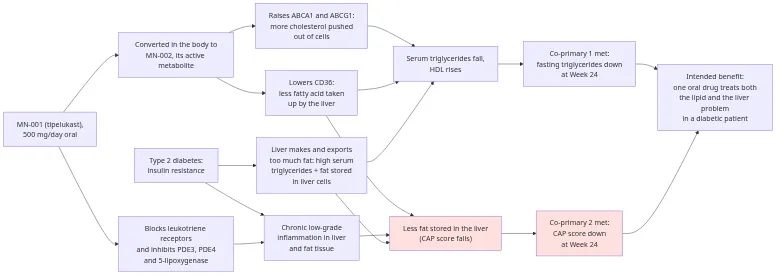
How well the target is validated. Weakly, and this document cannot do better than say so.
Open Targets was BLOCKED on three attempts (section 0), so no independent human-genetic evidence
for any of these targets against either endpoint could be obtained. ChEMBL was BLOCKED on four
attempts, so the molecule’s off-target selectivity profile is not independently confirmed either.
What remains is: an approved drug class exists for one named mechanism (leukotriene receptor
antagonists such as montelukast are marketed asthma drugs, which validates the target as
druggable but says nothing about liver fat or triglycerides); and the metabolic mechanism rests on
the sponsor’s own in vitro experiments plus a docking simulation. [UNVERIFIED — no independent target-validation source was obtainable this session]
The exact scientific step the next readout must prove. That 500 mg/day of MN-001 for 24 weeks,
against placebo, in adults who have all three of NAFLD, type 2 diabetes and raised triglycerides,
produces both (1) a fall in liver fat as measured by CAP score at Week 24 and (2) a fall in
fasting serum triglycerides at Week 24. [VERIFIED — ClinicalTrials.gov NCT05464784, primary outcome measures, read 2026-08-13]
The honest scientific risk, stated plainly. The sponsor has already run this drug in this disease area once, and the results of that trial are public in three places that do not fully agree with each other. Taking the registry — the source the sponsor filed with the government — at face value:
- Liver fat went up. Liver fat by MRI, baseline to Week 12, changed by +0.64 percentage
points (standard deviation 5.54) in 19 patients.
[VERIFIED — ClinicalTrials.gov posted results, NCT02681055, secondary outcome "Measure the Effect of MN-001/002 on Percentage of Fat in the Liver"]That is the direct conceptual predecessor of the CAP-score co-primary now pending. It is not a signal; it is slightly the wrong direction. - The other main endpoint failed. Cholesterol efflux capacity, baseline to Week 12, changed by
−0.013 (standard deviation 0.1022) — essentially nothing.
[VERIFIED — same posted results, primary outcome]The 2025 paper puts a p-value on the same question in diabetic patients: p = 0.6507, described in the abstract as “no significant improvement”.[VERIFIED — J Atheroscler Thromb 2025, PMID 40850750, [DOI 10.5551/jat.65669](https://doi.org/10.5551/jat.65669)]
The comparator for both statements is the drug’s own earlier data, which is the strongest available comparator and the one rule 17 asks for. The scientific risk is therefore specific rather than generic: the triglyceride half of this readout has a real prior signal and the liver-fat half has a prior result pointing the wrong way, and the trial is formally judged on both.
A.2 Clinical development plan, timeline, feasibility, resourcing
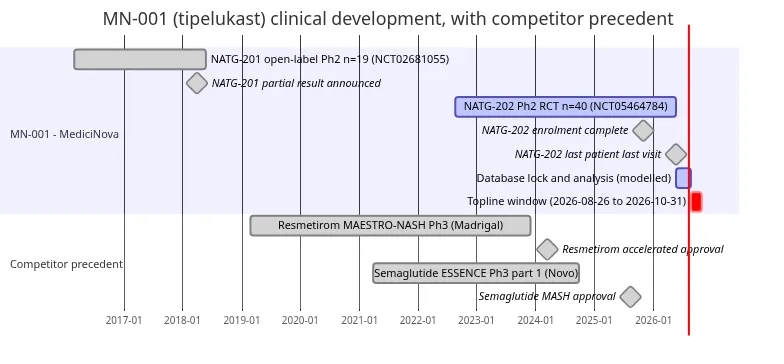
Trials
| Trial | Sponsor / whose drug | Design (arms, blinding, n) | Population | Status / key result | Link |
|---|---|---|---|---|---|
| MN-001-NATG-202 — the trial reading out | MediciNova, its own drug | Multi-centre, two-arm, randomised, double-blind, placebo-controlled, 1:1, n = 40, 500 mg/day MN-001 or matching placebo, 24 weeks, 2 US sites (Jubilee Clinical Research, Las Vegas NV; Pinnacle Clinical Research at South Texas Research Institute, Edinburg TX) | Adults aged 21–75 with FibroScan CAP score ≥248 dB/m within 8 weeks of randomisation, diagnosed or historical type 2 diabetes with HbA1c >6.5% and ≤10%, fasting triglycerides >150 mg/dL, on a stable dose of oral antidiabetic therapy for ≥3 months. Cirrhosis, advanced fibrosis, type 1 diabetes, other chronic liver disease and >5% weight change in 3 months all excluded. | ACTIVE_NOT_RECRUITING. First patient in 2022-08-22. Enrolment complete 2025-11-04. Last patient last visit 2026-05-26. Topline guided to Q3 2026. has_results: false. | NCT05464784 |
| MN-001-NATG-201 — the entire prior evidence base | MediciNova, its own drug | Open-label, single arm, no placebo, n = 19 (40 planned, 19 enrolled), 250 mg/day for weeks 1–4 then 250 mg twice daily for weeks 5–12, 12 weeks, 3 US sites (Southern California Research Center, Coronado; Scripps Research, La Jolla; Harborview Medical Center, Seattle) | Adults ≥18 with histologically proven NASH or ultrasound-confirmed NAFLD and fasting triglycerides >150 mg/dL. Concurrent stable fibrates, statins, niacin, ezetimibe and Vitamin E were permitted. | COMPLETED, results posted. Co-primary 1 (cholesterol efflux capacity, Week 12): −0.013 (SD 0.1022) — failed. Co-primary 2 (triglycerides, Week 8): −21.67 mg/dL (SD 27.89) per the registry, but −138.8 mg/dL / −40.2% per the sponsor’s own poster — see the conflict below. Liver fat by MRI (secondary, Week 12): +0.64 percentage points (SD 5.54). Safety: zero serious adverse events, 18 non-serious events across 19 subjects, 1 discontinuation for an adverse event. | NCT02681055 |
| MAESTRO-NASH — competitor precedent | Madrigal Pharmaceuticals, its own drug resmetirom | Randomised, double-blind, placebo-controlled Phase 3, biopsy-confirmed histological endpoints, n in the high hundreds per arm | Adults with biopsy-confirmed non-cirrhotic NASH with F2–F3 fibrosis | Positive; supported accelerated approval of resmetirom (Rezdiffra) on 2024-03-14, the first drug approved for NASH/MASH | [WEB ESTIMATE — MDPI and PMC reviews of the MASLD pipeline, read 2026-08-13] |
| ESSENCE — competitor precedent | Novo Nordisk, its own drug semaglutide 2.4 mg | Randomised, double-blind, placebo-controlled Phase 3, histological endpoints | Adults with MASH | Positive; semaglutide 2.4 mg weekly approved for MASH, and incorporated into AASLD practice guidance in November 2025 | [WEB ESTIMATE — AASLD practice-guidance update, PMID 41201884, and PMC reviews, read 2026-08-13] |
First and last patient in, last patient out, database lock and topline. First patient in
2022-08-22 [VERIFIED — NCT05464784 start date]. Last patient in on or before 2025-11-04, the date
the company announced enrolment complete [VERIFIED — company release 2025-11-04]. Last patient
last visit 2026-05-26 [VERIFIED — company release 2026-05-26]. Database lock is not disclosed
[UNVERIFIED]. Topline is guided to Q3 2026 and is modelled in the Readout section below.
A source conflict that is not smoothed over. The predecessor trial’s triglyceride result is reported two different ways by the same sponsor, in the same units, for the same 19 patients, at the same Week-8 timepoint:
| Source | Reported Week-8 triglyceride change, all 19 subjects | Tag |
|---|---|---|
| ClinicalTrials.gov posted results, NCT02681055, primary outcome | −21.67 mg/dL (SD 27.89), n = 19, units “mg/dL”, dispersion “Standard Deviation” | [VERIFIED — ClinicalTrials.gov posted results, read 2026-08-13] |
| MediciNova poster, IDF World Diabetes Congress 2022, abstract LI2022-1192 | Baseline 345.7 mg/dL → Week 8 206.9 mg/dL, i.e. −138.8 mg/dL / −40.2%, n = 19 | [VERIFIED — the poster itself, read 2026-08-13] |
The two differ by a factor of 6.4. Both are sponsor-supplied. The registry entry names the same
denominator (19 participants), the same unit (mg/dL) and the same timepoint, so the obvious
reconciliations — a different population, a different visit, a percentage misread as an absolute —
do not survive inspection. This conflict is reported, not resolved and not averaged
(01-rules.md rule 24). It matters because the poster figure is the number the entire investment
case rests on, and the registry figure — the one filed with the government — is six times smaller.
Worth noting in fairness: the registry figure is still statistically meaningful. A mean of
−21.67 with a standard deviation of 27.89 on n = 19 gives a standard error of 6.40 and t ≈ −3.4.
[UNVERIFIED — arithmetic on the two verified registry figures] So the smaller number is a real
effect; it is just a far more modest one.
Feasibility matrix
| Factor | High probability | Medium probability | Low probability | This asset (assessment) | Source |
|---|---|---|---|---|---|
| Recruitment feasibility | >50 sites, 3:1 patient:site | 20–50 sites, established investigators | <20 sites, novel sites | Low on the stated criterion — 2 sites for 40 patients — but the criterion is now moot. Enrolment closed 2025-11-04 and last patient last visit was 2026-05-26, so recruitment risk has been fully retired. Two sites did take 39 months to enrol 40 patients, which is slow and is a fact about how hard this population is to find. | [VERIFIED — NCT05464784 locations and start date; company releases 2025-11-04 and 2026-05-26] |
| Endpoint clarity | Regulatory precedent exists | Novel endpoint with FDA alignment | Unvalidated surrogate | Split, and the weaker half governs. The triglyceride endpoint has regulatory precedent: icosapent ethyl and the fibrates were approved on triglyceride lowering. The CAP-score endpoint does not: every drug approved in this disease area — resmetirom, semaglutide — was approved on biopsy histology, not on a FibroScan reading. CAP is a proof-of-concept measure for a Phase 2, and no FDA alignment on it is disclosed. Low for the co-primary that carries the liver claim. | [VERIFIED — NCT05464784 primary outcomes] / [WEB ESTIMATE — MASLD approval reviews, read 2026-08-13] / [UNVERIFIED — no disclosed FDA alignment on CAP] |
| Trial-design robustness | Pivotal Phase III with SPA | Adaptive with interim analysis | Single-arm, no control | Medium. Randomised, double-blind and placebo-controlled, which is a real step up from the open-label predecessor and the single most credible feature of the program. Against that: 20 patients per arm, two co-primary endpoints with no disclosed multiplicity or alpha-allocation plan, no Special Protocol Assessment, and it is a Phase 2 rather than a pivotal trial. | [VERIFIED — NCT05464784 design] / [UNVERIFIED — no statistical analysis plan is public] |
| Operational / execution | Enrolment complete, standard timeline | Some timeline risk | Enrolment behind | Medium-high. Enrolment complete, clinical phase complete, and only one timing slip on record: “top-line data by summer 2026” (2025-11-04) became “Q3 2026” (2026-05-26). One slip of roughly a month, on a program whose remaining work is data analysis, is good execution by the standards of this corpus. | [VERIFIED — BPIQ fetch_company_drugs note field and the two company releases] |
Resourcing sufficiency. Not a constraint for this readout, and a severe one immediately after
it. The company holds $27.3 million with a runway to roughly 2027-12 on its own guided spend
(see ../company.md C.3), and the remaining work on NATG-202 is analysis of a
completed dataset, which costs very little. So the readout itself is fully funded.
What is not funded is anything that follows it. A registration-quality trial in this disease area
means biopsy histology in hundreds of patients per arm, which is what MAESTRO-NASH and ESSENCE both
did. MediciNova’s entire guided operating spend for 2026 is $16.2 million across ten pipeline rows
(../company.md C.3). It cannot run that trial. The company has said as much about its other
Phase 3-ready asset, in as many words: the BPIQ note on the progressive multiple sclerosis row reads
“plan to find partner to help fund Ph3 trial”. [VERIFIED — BPIQ fetch_company_drugs, row 15141, read 2026-08-13] A positive readout here is therefore a partnering event, not a development
event, and that is the correct frame for everything in section B.
A.3 Target label, target product profile, strategic questions, designations
A.3a Target label. Adults with non-alcoholic fatty liver disease and raised fasting
triglycerides in the setting of type 2 diabetes mellitus, already established on stable oral
antidiabetic therapy. [VERIFIED — NCT05464784 title and eligibility criteria]
A.3b Target product profile
| Attribute | Standard of care & key competitor(s) — data | MN-001 target profile (goal) | Supporting evidence (+ link) |
|---|---|---|---|
| Indication / target label | No drug is approved for plain NAFLD. Resmetirom is approved (accelerated, 2024-03-14) for non-cirrhotic MASH with F2–F3 fibrosis; semaglutide 2.4 mg is approved for MASH and in AASLD guidance from November 2025. For triglycerides, icosapent ethyl is approved for severe hypertriglyceridemia (≥500 mg/dL) and fibrates are generic. | Both problems in one oral pill, in the plain-NAFLD-plus-diabetes population that neither approved liver drug is labelled for. | [WEB ESTIMATE — MASLD/MASH pipeline reviews and AASLD guidance, read 2026-08-13] |
| Efficacy (endpoints, regimen) | Resmetirom and semaglutide were approved on biopsy histology (NASH resolution and/or fibrosis improvement). Icosapent ethyl’s triglyceride effect is described in the literature as modest. Pemafibrate reduced investigator-reported MASLD events in PROMINENT with a hazard ratio of 0.78. | 500 mg/day for 24 weeks, and a statistically significant fall in both CAP score and fasting triglycerides against placebo. | [VERIFIED — NCT05464784] / [WEB ESTIMATE — Cardiovascular Diabetology review of PROMINENT, and market reviews, read 2026-08-13] |
| Safety / tolerability | Resmetirom carries diarrhoea and nausea; GLP-1 agonists carry substantial gastrointestinal intolerance and discontinuation. Icosapent ethyl is associated with atrial fibrillation and bleeding risk. | Clean oral tolerability. The predecessor trial supports this: zero serious adverse events in 19 patients over 13 weeks, 18 non-serious events, most commonly diarrhoea (2/19), and one discontinuation for an adverse event. One left bundle branch block, one ALT rise and one AST rise were each reported once. | [VERIFIED — ClinicalTrials.gov posted results, NCT02681055, adverse events module] / [WEB ESTIMATE — competitor labels via pipeline reviews, read 2026-08-13] |
| Biomarker / companion diagnostic | None required for any approved agent. FibroScan is widely available and used routinely for staging. | No companion diagnostic. CAP score by FibroScan is the entry criterion (≥248 dB/m) and the endpoint, which is cheap and repeatable. | [VERIFIED — NCT05464784 eligibility and primary outcomes] |
| Formulation / administration | Resmetirom oral daily; semaglutide weekly subcutaneous injection; icosapent ethyl oral; fibrates oral. | Oral, once daily, 500 mg. An oral pill is a genuine advantage over a weekly injection, and none over the oral competitors. | [VERIFIED — NCT05464784] |
| Payer value | Resmetirom and semaglutide are reimbursed in MASH on histological and outcome evidence. Fibrates and generic omega-3s cost very little. | An inexpensive oral adjunct for a patient already on antidiabetic therapy. This is the weak column: the payer’s obvious alternative is to escalate the existing antidiabetic to a GLP-1 agonist, which addresses glycaemia, weight, liver fat and cardiovascular risk at once and is already approved. | [UNVERIFIED — no payer or HTA assessment of this asset exists] |
A.3c Strategic Go/No-Go questions. The asset’s next decision is Go-to-Phase-III, so the second table is the live one. The first is answered retrospectively, because the Phase 2 decision was taken in 2022 and how it was taken is informative.
Pre-Phase-II (Go-to-Phase-II) — answered retrospectively, as of the 2022 decision:
| Group | Question | Answer (tagged) |
|---|---|---|
| Target | Clinical proof of principle established in the Phase I population? | Partially, and in a Phase 2 rather than a Phase 1. NATG-201 showed a triglyceride fall; its other co-primary failed and liver fat did not improve. [VERIFIED — ClinicalTrials.gov posted results, NCT02681055] |
| Target | If the proof-of-concept population differs, how does the evidence translate? | It differs, and this is the crux of the design. NATG-201 enrolled NASH or NAFLD with triglycerides >150 mg/dL and did not require diabetes; the T2DM finding is a post-hoc subgroup of 10 of 19 patients. NATG-202 makes that subgroup the whole trial. Translating a 10-patient post-hoc subgroup into an entry criterion is a legitimate hypothesis-generating move and is not evidence. [VERIFIED — both registry records; MediciNova IDF 2022 poster, which describes itself as "a sub-group analysis"] |
| Target | Evidence or rationale for combination therapy, and is it pursued? | Yes, implicitly, and it is pursued. NATG-202 requires stable oral antidiabetic therapy, so every patient is on combination therapy by design. NATG-201 also permitted concurrent fibrates, statins, niacin and ezetimibe, which complicates attribution of its lipid findings. [VERIFIED — both registry records' eligibility criteria] |
| Dose & Drug | Refined exposure–response relationship (Phase I + non-clinical)? | No exposure–response relationship is public. NATG-201 measured mean plasma concentration of MN-001 (0.434 mcg/mL, SD 0.205) and MN-002 (3.44 mcg/mL, SD 2.40) after a single 250 mg dose in six subjects, which establishes that the metabolite circulates at roughly eight times the parent but is not an exposure–response analysis. [VERIFIED — ClinicalTrials.gov posted results, NCT02681055, secondary outcome] |
| Dose & Drug | Dose range and regimen compatible with observed safety? | Yes. 500 mg/day was reached in NATG-201 with zero serious adverse events across 19 patients. [VERIFIED — same source] |
| Dose & Drug | Formulation delivers a therapeutic exposure? | Assumed rather than shown, since no therapeutic exposure threshold has been defined. [UNVERIFIED] |
| Dose & Drug | Formulation suitable for commercialisation? | Probably. An oral small molecule with a 20-year manufacturing history. Note that the immediate-release formulation was discontinued in the asthma era and an extended-release formulation was carried forward; which formulation NATG-202 uses is not disclosed. [VERIFIED — Drugs R&D 2007, PMID 17963431] / [UNVERIFIED — formulation in NATG-202] |
| Patient | Proposed trial design and outcome criteria to show proof of concept? | Yes, and they are a real improvement: randomised, double-blind, placebo-controlled, with the two co-primaries pre-registered. [VERIFIED — NCT05464784] |
| Patient | Are those criteria clinically accepted, compelling and competitive? | Triglycerides yes; CAP score no. See the Endpoint clarity row of the feasibility matrix. |
| Patient | Likelihood of hitting the expected outcome? | Modelled in the Locked prediction below at 15% for the strict both-endpoints definition. [UNVERIFIED — modelled] |
| Patient | Rationale for the patient population(s)? | A 10-patient post-hoc subgroup, promoted to an entry criterion. See the second row of this table. |
| Patient | If a stratification biomarker is used, which validated method identifies patients? | CAP score ≥248 dB/m by FibroScan, plus HbA1c 6.5–10% and triglycerides >150 mg/dL. All three are routine clinical measurements. The 248 dB/m threshold is a commonly used steatosis cut-off; this document did not independently verify its provenance. [VERIFIED — NCT05464784 eligibility] / [UNVERIFIED — provenance of the 248 dB/m cut-off] |
| Patient | Companion-diagnostic strategy included? | No, and none is needed. FibroScan is already installed in hepatology practice. |
| Patient | Candidate for Breakthrough Therapy or another early regulatory route? | No designation has been granted or applied for in this indication, as far as this sweep could establish. See A.3d. |
Pre-Phase-III (Go-to-Phase-III / registration) — the live decision, which the pending readout is the input to:
| Group | Question | Answer (tagged) |
|---|---|---|
| Target | Target revalidated as in prior phases? | No — this is the open question the readout answers. The metabolic mechanism has never been isolated in a human, Open Targets was BLOCKED so no independent genetic validation was obtainable, and the prior trial’s liver-fat result pointed the wrong way. [UNVERIFIED — see section 0 and A.1] |
| Dose & Drug | Exposure–response for the intended commercial regimen and route(s)? | No. 500 mg/day oral is carried forward from the prior study’s top dose without a dose-ranging exercise; NATG-202 tests one dose against placebo. [VERIFIED — NCT05464784 design] |
| Dose & Drug | Commercial formulation available or feasible? | Feasible. Oral small molecule, long manufacturing history. [UNVERIFIED — commercial formulation not disclosed] |
| Dose & Drug | Dose range compatible with clinical and non-clinical safety? | Yes, on 19 patients over 12 weeks at up to 500 mg/day with zero serious adverse events. 24 weeks of continuous 500 mg/day is new exposure and its safety is exactly what NATG-202’s secondary endpoint measures. [VERIFIED — NCT02681055 posted results; NCT05464784 secondary outcomes] |
| Dose & Drug | Therapeutic window given the clinical response? | Not established. No dose-response curve exists, so there is no window to describe. [UNVERIFIED] |
| Dose & Drug | Intrinsic and extrinsic factors influencing exposure and patient response? | Partly characterised. The protocol prohibits CYP2C8 and CYP2C9 substrates with narrow therapeutic indices, and macrolide and quinolone antibiotics, which implies known metabolic interactions. No formal drug-interaction analysis is public. [VERIFIED — NCT02681055 exclusion criteria] / [UNVERIFIED — no interaction study published] |
| Patient | Proof of concept and positive benefit/risk in the intended population? Combination evidence? | This is what the readout decides. Today: an uncontrolled 10-patient subgroup signal on one endpoint, a failed second endpoint, and a liver-fat result pointing the wrong way. Combination evidence is structural — every patient is on antidiabetic therapy. [VERIFIED — as cited above] |
| Patient | Phase III design and outcome criteria — accepted, compelling, competitive for market access? | No Phase 3 design is public, and the endpoint problem is unsolved. A registrational trial in this disease area has meant biopsy histology for every approved agent; a CAP-score-based registration path is not established. [UNVERIFIED — no Phase 3 plan disclosed] |
| Patient | Rationale for the patient population(s)? | Type 2 diabetes as an enrichment strategy, from the NATG-201 subgroup. Coherent as a hypothesis; unproven. |
| Patient | Likelihood of the expected outcome? | 15% on the strict both-endpoints definition, band 8–28%. See the Locked prediction. [UNVERIFIED — modelled] |
| Patient | Companion-diagnostic strategy, including pricing and market? | Not applicable; FibroScan is existing infrastructure. |
A.3d Regulatory designations. None, for this program. No Fast Track, Breakthrough Therapy,
Orphan Drug or other designation for MN-001 in NAFLD or hypertriglyceridemia was found in the
company’s 168-item press feed, in the FY2025 10-K, or in the ClinicalTrials.gov records for either
trial. [VERIFIED — absence checked across BPIQ fetch_company_press_releases, the 10-K FY2025 and both registry records, 2026-08-13]
For contrast, and to show the absence is meaningful rather than an artefact of not looking: the
company’s other molecule has such designations, and announces them. MN-166 (ibudilast) holds
Orphan Drug designation in glioblastoma (October 2018) and received FDA Fast Track designation for
methamphetamine dependence. [VERIFIED — BPIQ fetch_company_press_releases, items dated 2018-10-06 and one undated ADVFN archive item, read 2026-08-13] MN-001 in this indication has
nothing comparable, which is consistent with a Phase 2 asset in a non-orphan metabolic indication.
A.4 Target product profile valuation matrix
| Stakeholder | Value driver | Minimum threshold | Competitive | Premium | Benchmark / source |
|---|---|---|---|---|---|
| Patient / caregiver | One extra oral pill that lowers both blood fats and liver fat, avoiding an injection | Any statistically significant triglyceride fall with no new side effects | Triglyceride fall large enough to avoid adding a fibrate, plus measurable liver-fat reduction | Enough liver-fat reduction to change staging on FibroScan, in a pill taken alongside existing diabetes therapy | [UNVERIFIED — no patient-reported outcome is measured in NATG-202; the trial's endpoints are laboratory and imaging measures only, per NCT05464784] |
| Regulator | Evidence that a change in CAP score and triglycerides predicts clinical benefit | Placebo-controlled statistical significance on a pre-registered endpoint | A consistent effect across both co-primaries with clean safety | Histological confirmation, which is what every approved agent in this area has | Resmetirom and semaglutide were both approved on biopsy histology, not on FibroScan. [WEB ESTIMATE — MASLD approval reviews, read 2026-08-13] |
| Payer / HTA | Cost per patient against escalating the existing antidiabetic to a GLP-1 agonist | Cheaper than the alternative, with no added monitoring | Demonstrated liver-fat benefit at a generic-adjacent price | Outcome data — fewer cardiovascular or liver events | [UNVERIFIED — no payer assessment of this asset exists. The comparator is real and approved, which is the difficulty.] |
| Provider | Fits existing practice without new equipment or training | Oral, once daily, no new monitoring | Uses the FibroScan already in the clinic to demonstrate benefit | Replaces a drug rather than adding one | [UNVERIFIED — no provider survey exists for this asset] |
Calibration examples, not asset claims: in oncology each incremental month of overall survival is worth roughly $150–300M in peak-sales potential; oral formulations command roughly 15–25% price premiums over injectables. The second of those is the only one that bears on this asset at all, and it is a reason MN-001 has some positioning against weekly injectable semaglutide.
A.5 Evidence quality and endpoints
| Criterion | Score (High / Medium / Low) | Basis (one line) | Link |
|---|---|---|---|
| Target validation | Low | No independent human-genetic validation was obtainable — Open Targets BLOCKED on three attempts — and the metabolic mechanism rests on the sponsor’s own in vitro work plus a docking simulation. | DOI 10.5551/jat.65669 |
| Mechanism clarity | Low | Five distinct mechanisms are attributed to the molecule and none is established as the operative one; the two co-primary endpoints rest on two different proposed mechanisms, neither isolated in a human. ChEMBL BLOCKED, so selectivity is unconfirmed. | DOI 10.2165/00126839-200708060-00008 |
| Biomarker availability | Medium | Both endpoints are cheap, non-invasive and repeatable — a blood test and a FibroScan — but CAP score is not validated as a surrogate for clinical outcomes and no approval in this area has rested on it. | NCT05464784 |
| Publication quality (peer-reviewed? independent authors?) | Low | Three non-bibliography papers about this molecule in twenty years. There is no peer-reviewed publication of NATG-201 at all — the trial that is the whole prior evidence base exists publicly only as registry entries and a conference poster. The one metabolic paper (2025) carries MediciNova employees as first and third author. The 2022 poster declares all three authors to be MediciNova employees. | DOI 10.5551/jat.65669 |
| Clinical / expert sentiment | — | Moved to A.5b, below. | — |
Endpoints
| Endpoint (full name) | What it measures | Scale / range | Better direction | MCID / note |
|---|---|---|---|---|
| Controlled attenuation parameter (CAP) score, mean change at Week 24 — co-primary 1 | How much ultrasound energy is absorbed as it passes through the liver, which rises with the amount of fat stored in liver cells. Measured by a FibroScan device at the bedside. | Decibels per metre (dB/m), typically reported in the range of roughly 100–400 dB/m. The trial requires ≥248 dB/m to enter. | Lower is better — less fat in the liver. | No minimal clinically important difference is established for a treatment effect on CAP score. No approved drug in this disease area was approved on it; every one was approved on biopsy histology. [UNVERIFIED — no MCID exists to cite; searched and not found] The predecessor trial’s conceptual equivalent, liver fat by MRI, moved +0.64 percentage points over 12 weeks — the wrong way. |
| Fasting serum triglyceride level, mean change at Week 24 — co-primary 2 | The amount of the main circulating fat in the blood, measured after an overnight fast. | Milligrams per decilitre (mg/dL). Below 150 is normal; the trial requires >150 to enter; above 500 is called severe. | Lower is better. | No MCID is established in the 150–500 mg/dL band this trial enrols. Regulatory precedent for triglyceride lowering rests on severe hypertriglyceridemia (≥500 mg/dL) populations, which this trial is not. [UNVERIFIED — no MCID for this band] For scale, the predecessor’s T2DM subgroup fell from a baseline of 444.7 mg/dL, i.e. near-severe, whereas this trial admits patients from 151 mg/dL upward — so the effect has more room to show in the prior study than it will here. |
| Safety and tolerability — secondary | Incidence of adverse events and abnormal laboratory results. | Counts of events and of affected patients. | Fewer is better. | The predecessor recorded zero serious adverse events in 19 patients over 13 weeks. [VERIFIED — NCT02681055 posted results] |
| Mean change from baseline in lipids (HDL-C, LDL-C, total cholesterol) — secondary | Other fats in the blood. HDL-C is the “good” cholesterol; LDL-C is the one statins lower. | mg/dL. | Higher for HDL-C; lower for LDL-C and total cholesterol. | No MCID applies to a Phase 2 lipid secondary. The predecessor’s T2DM subgroup showed HDL +15.8% against +1.0% in non-diabetics, p<0.0002 — the only between-group comparison in the whole prior dataset that reached conventional significance. [VERIFIED — MediciNova IDF 2022 poster] |
A.5b Key opinion leaders.
Panel as of. 2026-08-13 — the date the investigator and independent-voice searches below were run.
Investigators
No investigators were returned for this program’s pivotal trial, and that is a finding rather
than an omission. get_trial_details on NCT05464784 returns two facilities with no contacts, no
overall officials and no responsible-party investigator named — an unusually bare registry record
for a trial that has completed its clinical phase. search_investigators across the condition
returned exactly one person, Junbo Ge of Zhongshan Hospital, Shanghai, and he is the contact on
NCT07693777, an unrelated Phase 3 of a different company’s drug (DR10624) in severe
hypertriglyceridemia — not this program, and not recorded here.
| Name | Role / affiliation | Trial (NCT) | Conflicts (party, kind, disclosed in, as of) | Conflicts checked (source, date) | Source | Tag |
|---|---|---|---|---|---|---|
| (empty — see the paragraph above) |
Independent voices
None found, and the search that failed to find one is worth describing. Every named person
attached to this program’s data is a MediciNova employee. The IDF 2022 poster carrying the pivotal
prior result names three authors — Kazuko Matsuda, Malath Makhay and Yuichi Iwaki — and its own
disclosure section states “Matsuda K, Makhay M, and Iwaki Y are employees of MediciNova, Inc.”
[VERIFIED — the poster itself, read 2026-08-13] Matsuda is the Chief Medical Officer and Iwaki
the President and Chief Executive Officer. [VERIFIED — BPIQ fetch_company_insider_transactions, executive titles, read 2026-08-13]
Two academic candidates were considered and excluded: Masatsune Ogura and Takashi Miida of the
Department of Clinical Laboratory Technology, Juntendo University, co-authors on the 2025
cholesterol-efflux paper. [VERIFIED — PubMed PMID 40850750, author affiliations] They are
excluded because MediciNova announced a formal MN-001 research collaboration with Juntendo
University School of Medicine on 2022-06-22 [VERIFIED — company release 2022-06-22], which is a
disclosed relationship with the sponsor. 03b-program-spec.md is explicit that a person with a
disclosed relationship belongs in the Investigators table rather than among voices held out as
independent; they are not investigators on this trial either, so they appear in neither table and
are named here instead.
| Name | Affiliation | View (close enough to quote) | As of | Conflicts checked (source, date) | Source | Tag |
|---|---|---|---|---|---|---|
| (empty — see the paragraph above) |
Judgement
| Endpoint supported | Basis (one or two sentences) | Tag |
|---|---|---|
| UNKNOWN | No independent voice on either co-primary endpoint was found, so there is nothing to weigh: the only attributed views on this program’s endpoints come from the sponsor’s own officers, and the sponsor’s own registry filing disagrees with the sponsor’s own poster about the headline result (A.2). An honest reading of a panel this thin is that it cannot support or contest the endpoint, not that silence is assent. | UNVERIFIED — judgement |
Dissent
Empty. Endpoint supported is UNKNOWN rather than SUPPORTIVE_CONTESTED, so no dissent is owed,
and inventing a disagreement nobody has expressed would be worse than an empty table.
| Name | View (close enough to quote) | Source |
|---|---|---|
| (empty) |
B. Commercial assessment
B.0 Current treatment algorithm
What a patient with type 2 diabetes, fatty liver and raised triglycerides actually receives today, in order:
- Lifestyle first, for both problems. Weight loss, diet and exercise are guideline-recommended
first-line therapy for NAFLD and for raised triglycerides alike. Adherence is poor, which is why
the drug market exists at all.
[WEB ESTIMATE — MASLD treatment reviews, read 2026-08-13] - Glycaemic control, which now doubles as liver therapy. Metformin first, then — and this is the
commercially decisive fact — GLP-1 receptor agonists (semaglutide, now approved for MASH),
dual GIP/GLP-1 agonists (tirzepatide), SGLT2 inhibitors and pioglitazone. All of these reduce
liver fat, and several improve steatohepatitis.
[WEB ESTIMATE — AASLD practice guidance November 2025 update, PMID 41201884, and Current Diabetes Reports 2026, read 2026-08-13] - Lipid management. A statin for cardiovascular risk regardless of triglycerides. For
triglycerides in the 150–499 mg/dL band, the primary lever is treating the diabetes itself; for
≥500 mg/dL, a fibrate, icosapent ethyl or prescription omega-3.
[WEB ESTIMATE — hypertriglyceridemia treatment reviews, read 2026-08-13] - Liver-specific drug therapy. Resmetirom for non-cirrhotic MASH with F2–F3 fibrosis;
semaglutide 2.4 mg for MASH. Neither is labelled for plain NAFLD without steatohepatitis, which
is the population NATG-202 enrols.
[WEB ESTIMATE — MASLD approval reviews, read 2026-08-13]
Exactly where MN-001 would fit, and the problem with that spot. It would be an add-on oral to a patient already on stable oral antidiabetic therapy — which is not an inference, it is the trial’s own entry criterion. So the comparator is not “nothing”; the comparator is escalating the existing antidiabetic to a GLP-1 receptor agonist, which addresses blood sugar, weight, liver fat and cardiovascular risk simultaneously, is already approved for MASH, and is already in the prescriber’s hand. MN-001 would add a pill and address two laboratory numbers. That is the commercial problem in one sentence, and no readout can fix it — only a partner with a strategic reason could.
B.1 Competitive landscape and positioning
| Metric | High value | Medium value | Low value | This asset (assessment) | Source |
|---|---|---|---|---|---|
| Mechanism differentiation | First-in-class or novel target | Next-generation improvement | Me-too | Low. Not first-in-class in any of its named mechanisms: leukotriene receptor antagonists (montelukast, zafirlukast) and PDE4 inhibitors (roflumilast, apremilast) are marketed drug classes. The differentiated part of the story — ABCA1/ABCG1 upregulation and CD36 downregulation by the metabolite — is a proposed mechanism resting on the sponsor’s own in vitro work, not a validated novel target. | [VERIFIED — PMID 17963431; PMID 40850750] / [UNVERIFIED — target validation, Open Targets BLOCKED] |
| Development-timeline advantage | >12 months ahead | Within 6–12 months | Lagging >12 months | Low, and badly so. Resmetirom was approved 2024-03-14 and semaglutide for MASH in 2025. MN-001 is finishing a 40-patient Phase 2 with no Phase 3 designed or funded. It is lagging by years, not months. | [WEB ESTIMATE — approval reviews, read 2026-08-13] / [VERIFIED — NCT05464784 status] |
| Clinical proof-of-concept evidence | Positive Phase IIb (n>100) | Phase IIa signals (n=20–50) | Preclinical only | Medium at best, and contested. A Phase 2a-scale signal (n=19, open-label, no placebo) on one of two registered co-primaries, whose magnitude the sponsor reports two ways differing by 6.4× (A.2), with the other co-primary failed and liver fat moving the wrong way. | [VERIFIED — NCT02681055 posted results; MediciNova IDF 2022 poster] |
| IP protection | Composition-of-matter, long-dated | Method-of-use | Pending or none | Method-of-use only, and the composition-of-matter position is long gone. The US composition-of-matter patent for MN-001 expired on 2009-02-23 and the foreign equivalents have expired too. What remains is 15 issued US patents and 65 foreign patents covering compositions, uses and manufacturing processes, with uses including NAFLD, NASH, steatosis, hypertriglyceridemia, hypercholesterolemia and hyperlipoproteinemia — plus a notice of allowance on 2026-01-11 for a new patent covering MN-001 for triglyceride synthesis in the liver. Method-of-use protection on a 2002-vintage small molecule with no composition-of-matter cover is genuinely weak: it does not stop a generic manufacturer from selling the molecule for another use. | [VERIFIED — 10-K FY2025, filed 2026-03-10, MN-001 intellectual property section; BPIQ press feed item dated 2026-01-11] |
Where this asset wins, and the single fact the thesis rests on. The genuine differentiation is positional rather than mechanistic: MN-001 is aimed squarely at the intersection of raised triglycerides and fatty liver in a diabetic patient, as a single cheap oral add-on, and no approved drug is labelled for that intersection. If the poster’s numbers are the right ones, the triglyceride effect in diabetics (−50.8% at Week 8) is far larger than icosapent ethyl’s, which the literature describes as modest.
The single fact the thesis rests on is that the 50.8% Week-8 triglyceride reduction seen
open-label in ten diabetic patients survives a placebo control. That fact carries three specific
problems, all of them checkable. First, the sponsor’s own registry filing reports the all-patient
version of the same endpoint as −21.67 mg/dL rather than −138.8 mg/dL (A.2). Second, the subgroup’s
baseline was 444.7 mg/dL — near-severe hypertriglyceridemia — and an uncontrolled fall from a high
baseline in ten people is the textbook setting for regression to the mean, with no placebo arm to
separate the two. Third, the between-group difference the poster reports for triglycerides was
p = 0.098, which is not statistically significant; the only comparison in the entire prior
dataset that reached significance was HDL, at p<0.0002. [VERIFIED — MediciNova IDF 2022 poster, read 2026-08-13]
Calibration example, not an asset claim: oncology first-movers in novel mechanisms have shown roughly 3.2× higher peak-sales potential but about 1.8× higher development risk. Not applicable here — this asset is neither first-mover nor novel-mechanism.
B.2 Addressable market
Launch markets would be the United States first, then Europe. Japan, China, South Korea and Taiwan
are outside MediciNova’s territory entirely under the Kyorin licence, which removes the largest
non-US diabetes market from the opportunity before any commercial modelling starts. [VERIFIED — 10-K FY2025, MN-001 licence terms]
| Component | How it is estimated | Premium threshold | This asset (assessment) | Source |
|---|---|---|---|---|
| Drug-treated patients | Epidemiology × diagnosis rate × treatment rate | >100,000 (US/EU5/Japan) | The epidemiological population clears the threshold easily; the drug-treated population is the unanswerable part. Between 39% and 60% of MASLD patients also have diabetes, so the overlap population is large in absolute terms. But this analysis could not obtain a verified count of the triple overlap — NAFLD and type 2 diabetes and triglycerides >150 mg/dL — and does not invent one. The treated fraction at a branded price, against a GLP-1 comparator, is the number that actually matters and it is not estimable from anything found here. | [WEB ESTIMATE — Current Diabetes Reports / AJMC MASLD-in-T2DM reviews, read 2026-08-13] / [UNVERIFIED — no defensible count of the triple overlap] |
| Market exclusivity | Patent term + regulatory exclusivity | >10 years combined | Well below the threshold. Composition of matter expired 2009-02-23; only method-of-use patents remain. New chemical entity exclusivity is unavailable to a molecule this old. Whatever term the method-of-use estate provides, it does not resemble ten years of composition-of-matter protection. | [VERIFIED — 10-K FY2025] |
| Reimbursement precedent | Approvals in ≥2 major markets | Positive NICE/CADTH guidance | Precedent exists for the disease but not for the evidence type. Resmetirom and semaglutide are approved and reimbursed in MASH, so payers do pay for liver drugs — but both were approved on biopsy histology or outcome data, not on a FibroScan reading, and neither is labelled for plain NAFLD. No NICE or CADTH assessment of MN-001 exists. | [WEB ESTIMATE — approval reviews, read 2026-08-13] / [UNVERIFIED — no HTA of this asset] |
| Patient-journey impact | Fewer hospital days, less caregiver burden | >30% quality-of-life gain | Minimal, and unmeasured. NATG-202 measures no patient-reported outcome at all — its endpoints are a blood test, an ultrasound reading and adverse-event counts. Adding an oral pill to a patient already taking several does not reduce hospital days or caregiver burden on any evidence available here. | [VERIFIED — NCT05464784 outcome measures, all laboratory or imaging] / [UNVERIFIED — no quality-of-life data] |
B.3 Value and feasibility
B.3a Expected peak sales. Built bottom-up as eligible patients × annual net price × peak penetration, with every input tagged and the undefensible ones named. All figures are conditional on approval, which requires a Phase 3 that has not been designed or funded. All figures exclude Japan, China, South Korea and Taiwan (outside MediciNova’s territory) and exclude the royalty owed to Kyorin, whose rate is not disclosed anywhere (see B.3b).
One third-party figure is rejected rather than passed through, under 01-rules.md rule 6. A
market-research source gives the hypertriglyceridemia therapeutics market as $12.82 billion in 2026
rising to $18.29 billion by 2033. [WEB ESTIMATE — Coherent Market Insights via web search, read 2026-08-13] That aggregate necessarily includes generic fibrates, statins and over-the-counter
omega-3s, none of which is an addressable branded opportunity for this asset, and quoting it beside
a Phase 2 asset would imply a scale that does not exist. The narrower figure — a severe
hypertriglyceridemia market of roughly $1.4 billion across the seven major markets in 2023
[WEB ESTIMATE — DelveInsight via web search, read 2026-08-13] — is more usable but still does not
fit: NATG-202 enrols patients from 151 mg/dL, and severe means ≥500 mg/dL.
| Scenario | Assumptions (patients × price × share) | Estimate (USD/year at peak) | Basis / tag |
|---|---|---|---|
| Low | The program does not reach a market: either the readout misses, or a positive readout finds no partner willing to fund a histology-based Phase 3 in a field where two drugs are already approved. Revenue would be milestone and royalty income from an out-licence, not product sales. | $0 – $50 million cumulative, not annual | [UNVERIFIED — modelled]. The undefensible input is the probability of finding a partner, which this analysis cannot estimate. |
| Base | 150,000 – 250,000 treated US patients (a low-single-digit share of a triple-overlap population whose size this analysis could not verify) × $1,500 – $2,000 annual net price (positioned as a cheap oral adjunct, not a branded MASH agent, because method-of-use-only protection cannot defend a branded price) | $225 million – $500 million/year | [UNVERIFIED — modelled]. The undefensible input is the patient count: no verified epidemiological figure for NAFLD + T2DM + triglycerides >150 mg/dL was obtainable, so the 150,000–250,000 range is an assumption, not an estimate. |
| High | 400,000 – 600,000 treated US patients × $2,000 – $2,500 annual net price, requiring a liver-fat effect strong enough to position MN-001 alongside resmetirom rather than beneath it, and a partner with a commercial organisation | $800 million – $1.5 billion/year | [UNVERIFIED — modelled]. Requires the co-primary with the weakest prior evidence (CAP score) to be the one that reads out strongly, which A.1 argues against. |
A range this wide is the honest output. Rule 10 forbids a point estimate on unverified inputs,
and the two inputs that would narrow it — a verified patient count and a defensible net price for a
method-of-use-only oral — are both missing. What the range does establish is a useful comparison:
MediciNova’s entire enterprise value is $38.1 million (../company.md C.4),
which is below the low end of even the pessimistic scenario. The market is pricing close to zero
probability on all of this, across all ten pipeline rows.
B.3b Feasibility
| Question | Answer (tagged) |
|---|---|
| Expected net present value (eNPV) | Cannot be built, and a figure is not supplied. Three inputs are missing and one of them is structurally unobtainable: the royalty rate owed to Kyorin is not disclosed — the 10-K says only “We are also obligated to pay a royalty on net sales of the licensed products”, with no percentage [VERIFIED — 10-K FY2025]; there is no verified patient count (B.3a); and no probability of technical and regulatory success for a CAP-score-based registration path can be sourced, because no such path has precedent. Rule 10 forbids a single figure on unverified inputs and 01-rules.md rule 5 permits saying so. What can be said instead: the enterprise value of $38.1 million sits below the low end of the base-case annual peak-sales range, so the market’s implied probability across the whole pipeline is very low. [UNVERIFIED — the comparison, not an eNPV] |
| Capital to the next decision point | Essentially already spent. Last patient last visit was 2026-05-26; what remains is data cleaning, unblinding and statistical analysis of a 40-patient dataset. [VERIFIED — company release 2026-05-26] |
| Capital to approval, and the funding plan | Not fundable by this company, and there is no disclosed plan. A registration trial in this disease area has meant biopsy histology in hundreds of patients per arm for every approved agent. MediciNova’s guided operating spend for all of 2026 is $16.2 million across ten pipeline rows (../company.md C.3). No Phase 3 plan for MN-001 is public. The company’s stated approach on its other Phase 3-ready asset is to “find partner to help fund Ph3 trial”. [VERIFIED — 10-K FY2025; BPIQ fetch_company_drugs row 15141] |
| Launch capability — alone, or must partner? | Must partner, without qualification. No commercial organisation, no approved product, no sales force, and a total annual spend smaller than a single Phase 3’s enrolment costs. [VERIFIED — 10-K FY2025] |
| Commercialisation rights — retained, split, or out-licensed? | Retained but geographically split, and royalty-bearing. Under the exclusive licence from Kyorin dated 2002-03-14, MediciNova holds worldwide rights excluding Japan, China, South Korea and Taiwan, in all indications except ophthalmic solution formulations, and the licence is sub-licensable. MediciNova has paid Kyorin $4.0 million to date and owes up to $5.0 million more on clinical and regulatory milestones, plus an undisclosed royalty on net sales. Kyorin holds a reciprocal royalty-free licence to the databases for ophthalmic products worldwide and for non-ophthalmic products outside MediciNova’s territory. [VERIFIED — 10-K FY2025, MN-001 licence section] |
B.4 Product-development risk
Framing questions.
- Does the development plan support the target product profile claims? Partly, and it stops short. NATG-202 is a well-shaped test of the two laboratory claims — randomised, blinded, placebo-controlled — so it can support or refute “lowers triglycerides and liver fat”. It cannot support the claims that matter commercially, which are in the payer row of A.3b: nothing in the plan compares MN-001 against a GLP-1 agonist, measures a patient-reported outcome, or generates the histological evidence every approved agent in this area was approved on.
- Will the identified risks affect the target product profile? Yes, and one of them is decisive. The endpoint risk is not a delay risk, it is a profile risk: if CAP score does not move, the target profile collapses from “one pill for both problems” to “another triglyceride drug”, and the triglyceride market is served by generics. The IP risk compounds it — a method-of-use-only position cannot defend a branded price for a plain lipid indication.
- If a risk cannot be mitigated, is the asset still differentiated from competitors? On the triglyceride claim alone, barely. A large triglyceride effect in diabetics would still be interesting and would still be positionally distinct from the approved MASH drugs. But without a liver-fat effect it is competing with generic fibrates and icosapent ethyl on price, with no composition-of-matter protection. That is differentiation without defensibility.
| Category | Time risk | Quality risk | Cost risk | Note |
|---|---|---|---|---|
| Project management | Low | Low | Low | The clinical phase completed with one guidance slip of about a month. |
| Research | High | The mechanism supporting the liver-fat co-primary rests on the sponsor’s own in vitro CD36 work; no independent target validation was obtainable (Open Targets BLOCKED). | ||
| IP | High | Composition-of-matter expired 2009-02-23. Method-of-use only. This is the risk least capable of being mitigated by any trial result. | ||
| Legal | Low | Low | Low | No litigation identified in the 10-K or the press feed. |
| DMPK | Medium | The metabolite MN-002 circulates at roughly 8× the parent after a single 250 mg dose (3.44 vs 0.434 mcg/mL) and much of the effect is attributed to it, yet no exposure–response analysis is public. CYP2C8 and CYP2C9 interactions are implied by the protocol’s prohibitions. | ||
| Safety pharmacology | Medium | One left bundle branch block and one increased heart rate among 19 patients in the predecessor; the exclusion criteria bar QTcF >450 ms, resting pulse <50 bpm and SA/AV block, which implies a known cardiac-conduction concern. [VERIFIED — NCT02681055 posted results and exclusion criteria] | ||
| Toxicology | Low | No signal identified. Twenty-plus years of clinical exposure across several indications. | ||
| Drug safety (clinical) | Low | Zero serious adverse events in 19 patients over 13 weeks, 18 non-serious events, most commonly diarrhoea (2/19), one discontinuation for an adverse event. Safety is this program’s strongest column. [VERIFIED — NCT02681055 posted results] | ||
| Biomarker | High | CAP score is not a validated surrogate and has no established MCID for a treatment effect. FibroScan CAP readings carry meaningful measurement variability, which at 20 patients per arm is a real risk of a null result independent of whether the drug works. | ||
| Clinical pharmacology | Medium | One dose tested against placebo, carried forward from the predecessor’s top dose with no dose-ranging. | ||
| Clinical (efficacy) | High | The near-veto factor for this program. Two co-primary endpoints, of which the liver-fat one has a prior result pointing the wrong way (+0.64 percentage points by MRI) and the triglyceride one has a headline magnitude the sponsor reports two ways differing by 6.4×. No multiplicity plan is public for the two co-primaries at n=20 per arm. | ||
| Clinical operations | Low | Low | Low | Completed. |
| CMC / manufacturing | Low | Low | Low | Oral small molecule, long history. Which formulation NATG-202 uses is not disclosed, which is a small gap rather than a risk. |
| Regulatory | High | High | No approved agent in this area was approved on a FibroScan endpoint, no FDA alignment on a CAP-based path is disclosed, no designation has been granted, and the population — plain NAFLD rather than NASH — is not one either approved drug is labelled for. | |
| Global evidence & value | High | No HTA assessment, no patient-reported outcome, no head-to-head against the obvious comparator, and the largest ex-US market is outside the licence territory. | ||
| Commercial | High | The comparator is escalating the existing antidiabetic to an approved GLP-1 agonist that does more, and the company has no commercial capability, so any value must be realised through a partner. |
Readout
Sources
| Kind | Where it comes from | What it is worth | Value (or null) | Tag | Note |
|---|---|---|---|---|---|
bpiq | fetch_company_drugs — catalyst_date, catalyst_date_text | The current single source. Synthesized from period text on most rows, so alone it is a ceiling, not an estimate. | 2026-07/2026-09 (text: “Q3 2026”) | VERIFIED — BPIQ fetch_company_drugs, read 2026-08-13 | catalyst_date reads 2026-09-30, which is the period-end placeholder for “Q3 2026” and not a disclosed day (01-rules.md rule 23). The disclosed unit is the quarter. Not used for any timing decision. |
ctgov | CT.gov get_trial_details — primary_completion_date | Independent of the company’s own messaging, month-precision, and it moves when the trial moves. | 2026-12 | VERIFIED — ClinicalTrials.gov NCT05464784, read 2026-08-13 | Stale and contradicted, and that is the finding. The registry still carries primary_completion_date and completion_date of 2026-12-31 even though the sponsor announced last patient last visit on 2026-05-26 — the record has not been updated in the eleven weeks since. Taken literally with rule 34’s default lag it would put topline at 2027-02 to 2027-04, which the LPLV announcement rules out. Recorded because “we looked and it disagrees” is a fact; not used to set the window below. has_results: false. |
company | fetch_company_press_releases | The company’s own most recent dated wording. Also where the slip sequence below comes from. | 2026-07/2026-09 (text: “Top-line data are expected in the third quarter of 2026”) | VERIFIED — company release 2026-05-26, read via Stock Titan 2026-08-13 | Mandatory here, because the catalyst is inside twelve months (01-rules.md rule 32). Source URL: https://www.stocktitan.net/news/MNOV/medici-nova-announces-completion-of-last-patient-last-visit-in-the-zy76gibtzida.html — the same release is carried by GlobeNewswire on 2026-05-26. Reiterated 2026-06-30 in the CEO shareholder update, which the press feed summarises as “MediciNova awaits Q3 data”. No release since has changed the guidance. |
congress | data/congresses.json, only when the company has said it intends to present there | Answers “where will they say it.” | null | VERIFIED — absence checked, 2026-08-13 | AASLD The Liver Meeting 2026 (Denver, 2026-11-05 to 2026-11-09) is in data/congresses.json and is the obvious venue for liver data, and MediciNova has presented MN-001 lipid data at congresses before (IDF World Diabetes Congress 2022; EASL’s International Liver Congress 2018, cited on the IDF poster). But no company or investigator statement names any meeting for this topline — checked against the 168-item press feed and a targeted web search. Matching on therapeutic area alone is a guess, and a guess is not a source. One argument against AASLD as the venue is checkable: its abstract deadline was 2026-05-28, two days after last patient last visit, so a results-bearing abstract could not have been submitted in time; only a late-breaker slot would work. |
modelled | Trial arithmetic — see below | The only estimate independent of anyone’s guidance. | 2026-07/2026-09 | UNVERIFIED — modelled, default lag | See the paragraph below for the arithmetic and for why the registry field was not the input. |
The modelled estimate. 01-rules.md rule 34 asks for the registry’s primary_completion_date
plus the lag to database lock and analysis. That input cannot be used here and the substitution is
stated rather than hidden: the registry’s primary_completion_date of 2026-12-31 is contradicted
by the sponsor’s own announcement that the last patient’s last visit occurred on 2026-05-26, so
adding a lag to it would model a readout after an event that has already happened. The arithmetic
used instead takes the same conceptual input from the primary source that supersedes the registry:
Last patient last visit 2026-05-26 + 2 to 4 months to database lock, unblinding and topline
analysis = 2026-07-26 to 2026-09-26. data/benchmarks/readout-lag.json holds no observation for a
comparable trial (its observations array is empty by design), so the stated default lag of two to
four months applies and the tag is [UNVERIFIED — modelled, default lag] rather than
benchmarked n=N.
Note what this arithmetic already tells us: the front edge of the modelled range, 2026-07-26,
has already passed without an announcement. That is why earliest below sits at the three-month
mark rather than the two-month mark.
Window
| Earliest | Likeliest | Latest | Precision | Confidence |
|---|---|---|---|---|
| 2026-08-26 | 2026-09-24 | 2026-10-31 | PERIOD | MEDIUM |
Basis. earliest is last patient last visit plus three months, because the two-month edge of
the modelled range (2026-07-26) has already elapsed with no announcement, so the earliest still-live
date is the next round point in the same arithmetic. likeliest sits in the last week of September:
inside the company’s guided quarter, consistent with the modelled range’s back half, and consistent
with this sponsor’s habit of announcing at the end of a guided period rather than the start.
latest extends five weeks past the guided quarter end to allow one further slip of the size
already on record — the one documented slip moved guidance by about a month — while stopping short
of AASLD (2026-11-05), which the abstract-deadline argument above makes an unlikely venue. Precision
is PERIOD because no source names a day or a month for the topline: the company names a quarter
and BPIQ synthesizes that quarter’s last day. Confidence is MEDIUM because three of the four
obtainable sources agree on the quarter and the clinical phase is verifiably finished, but the
window rests on an undisclosed database-lock date and one source contradicts the rest outright.
Disagreement. URESOLVED. bpiq, company and modelled all point to the third quarter of
2026; ctgov points to 2026-12-31 and, with the default lag applied, to 2027-02 through 2027-04.
The disagreement is not averaged and is not resolved by picking one (01-rules.md rule 24): the
registry is reported as it reads, and the window above is built from the three sources that agree
while the fourth is recorded as contradicting them. The reason to believe the three over the one is
stated rather than assumed — a company announcement that the last patient completed their last
visit is a statement about an event that has occurred, whereas a registry completion date is a
sponsor-maintained projection that this sponsor has not updated.
Date slippage. One slip.
| As of | Guidance text |
|---|---|
| 2025-11-04 | ”Patient enrollment completed. Top-line data by summer 2026” |
| 2026-05-26 | ”LPLV completed; topline data expected in Q3 2026” |
[VERIFIED — BPIQ fetch_company_drugs note field, row 16136, read 2026-08-13] Two dated
statements, one transition, and that transition is a genuine slip rather than a reiteration:
“summer 2026” ends in August in the northern hemisphere and “Q3 2026” ends on 2026-09-30, so
guidance moved back by roughly a month. One slip is a good record by the standards of this
corpus, and it is worth saying so plainly rather than only reporting the count.
Attribution
Status.
| Status | Means |
|---|---|
CLEAN | conflicts is empty — nothing else has_catalyst on this ticker’s pipeline lands within the window. |
CONTAMINATED | At least one conflict is confirmed: a real disclosed date on one side — a readout.window naming DAY or MONTH precision, or (when there is no readout yet) an exact catalyst_date — never two guesses touching. The stock-direction call below must not be presented as attributable to this program alone; say why in Note. |
INDETERMINATE ← this program | conflicts is non-empty, but every entry is still a guess on both sides — PERIOD or UNKNOWN precision against PERIOD or UNKNOWN precision. Evidence of not knowing, not a finding. No per-conflict note is required, but the stock-direction call below must still say plainly that attribution could not be determined (01-rules.md rule 36). |
WAIVED | An analyst’s own override of a computed CONTAMINATED or INDETERMINATE, judged in prose not to contaminate this call. Never computed — only ever written by hand, and only once the status it overrides has been recorded honestly first. Say why in Note. |
Conflicts
Transcribed from lib/clustering.mjs’s attributionFor("MNOV", <MNOV.json>, [this program], CATALYST_CLUSTER_MIN_MONTHS, 16136), run 2026-08-13. Every field below is computed, none typed
from a guess.
| bpiq_drug_id | Label | Date | Analysed? | Gap (days) | Confirmed? |
|---|---|---|---|---|---|
| 14184 | MN-166 (ibudilast) | 2026-12-31 | No | 0 | No |
| 14393 | MN-166 (ibudilast) | 2026-12-31 | No | 0 | No |
Note. Not required for INDETERMINATE, and deliberately not written. What the reader needs
instead is in the stock-direction call below, where rule 36 requires it.
What is actually going on here, for a reader who wants to know. Row 14393 is COMBAT-ALS, the
234-patient Phase 2b/3 in amyotrophic lateral sclerosis guided to year-end 2026, and row 14184 is
the OXTOX Phase 2b in chemotherapy-induced peripheral neuropathy guided to H2 2026. Neither has been
analysed, so the clustering pass widens each to its whole enclosing half-year, 2026-07-01 to
2026-12-31, which swallows this program’s window entirely — hence a gap of zero days on both.
Neither side of either pair rests on a disclosed date: all three catalysts are period placeholders,
so confirmed is false on both and the status is INDETERMINATE rather than CONTAMINATED. That
is the correct reading and it is not reassuring: COMBAT-ALS is by far the larger claim on the equity,
and the reason its collision with this program cannot be confirmed is simply that nobody has
disclosed a date for either.
Market and timing for this event
Company-level figures live in ../company.md and are cited by section here rather
than restated (01-rules.md rule 26).
- Plain takeaway. The market is not positioned for this readout in either direction. The shares
sit at 20.3% of their 52-week range (
../company.mdC.4), no hedge fund holds a position at all and institutions hold 11.2% (C.5), the options chain cannot price the event because its nearest strike is 88% above spot (C.6), and average dollar volume is roughly $52,650 a day (C.4). The one thing that has moved is short interest, which tripled in six weeks to 8.75 days of average volume (C.5). Nothing here says the readout is priced in; nothing says it is priced out either. It says almost nobody is watching. - Months to this catalyst. 0.4 months — 13 days — from 2026-08-13 to
readout.window.earliestof 2026-08-26. Say plainly:readout.precisionisPERIOD, so this is 13 days to the front edge of a nine-week window, not 13 days to a known event. The likeliest date is 1.4 months out and the latest is 2.6 months out. - Expected move around this event. The chain cannot price it, so a bracket is given instead of
a number.
../company.mdC.6 records the whole chain as unusable: the nearest strike to a $1.33 share price is $2.50, no at-the-money straddle can be constructed, and all ten put contracts sit on the documented 0.01488 implied-volatility floor artifact. The expiries nearest this catalyst (2026-09-18 and 2026-10-16) carry 0 and 14 contracts of open interest at the $2.50 strike. The bracket, taken from this ticker’s own eleven-row catalyst history in C.7, is −5% to +10% intraday for an ordinary readout, with an open gap of up to +25% for a headline the company can present as a win.[UNVERIFIED — bracket from C.7's own range, not an options-implied figure] - Nearest comparable past reaction. 2026-05-26 is the closest in subject — the same
program’s own last-patient-last-visit announcement — and it traded −2.14% with a zero open gap
(
../company.mdC.7). But the closest in shape is 2018-04-02, and it is the more instructive of the two: the same molecule, the same trial (NATG-201), the same two-co-primary structure, announced as “achieving one of the two main endpoints (data from the second endpoint has not been disclosed)” — and the stock opened +25.24% and closed +8.98%. It is comparable because the structural set-up is identical and the sponsor’s disclosure behaviour is the thing being predicted. It is not comparable in one important way, which has to be said: the withheld endpoint in 2018 is now public and it failed, so the market paid +25% for a result it could not fully see. Also, the 2022-12-07 announcement of the lipid-panel findings from the same trial — the closest analogue for a triglyceride result specifically — paid a much more modest +5.18%. - Materiality. Meaningful, not dominant, as recorded in
../company.mdC.2: a 40-patient Phase 2 in a crowded metabolic indication on a molecule with no composition-of-matter protection, whose news value is its timing rather than its size, against a 234-patient ALS readout guided for year-end that is the larger claim on the equity. The stock-direction call below is consistent with this and is deliberately not a large one. - Date slippage. One slip, from “top-line data by summer 2026” (2025-11-04) to “Q3 2026”
(2026-05-26). See
readout.slipsabove. One slip on a program whose clinical phase is complete is a good record.
Spot. $1.33, read 2026-08-13, cited from ../company.md C.1 and C.4.
Previous close $1.32. Every figure below is measured against $1.33.
Scenario prices
| Scenario | Low | High | Anchors (each named and tagged) | Basis |
|---|---|---|---|---|
| Positive — both co-primary endpoints met | $1.60 | $2.15 | (1) This ticker’s own 2018-04-02 catalyst move on this same trial: +25.24% open gap, +8.98% intraday. Applied to $1.33 that is $1.45 intraday and $1.67 at the open. [VERIFIED — ../company.md C.7, BPIQ fetch_company_historical_catalysts] (2) The 52-week high, $1.96. [VERIFIED — ../company.md C.4, BPIQ fetch_company_info 2026-08-13] (3) Squeeze mechanics: 346,440 shares short at 8.75 days to cover on $52,650 a day of dollar volume. [VERIFIED — ../company.md C.5, FINRA settlement 2026-07-31] (4) Published analyst targets: H.C. Wainwright $10.00 (maintained Buy, 2026-05-28), D. Boral Capital $9.00, Maxim Group $6.00, four-analyst consensus average $7.50 across a $5.00–$10.00 range. [WEB ESTIMATE — MarketBeat and stockanalysis.com via web search, read 2026-08-13] | The 2018 precedent on this exact trial structure gives $1.67 as the central positive print, so $1.60 is the conservative edge where only the intraday portion holds. $2.15 sits about 10% through the 52-week high, which the squeeze anchor supports: $1.96 traded within the last twelve months on no catalyst at all, so a genuine both-endpoint hit plausibly clears it in a name this thin. The analyst targets are deliberately not used to set the high end. Targets of $9–$10 against a $65 million market capitalisation imply 7×, which anchor 1 — this ticker’s own realised behaviour — flatly contradicts; they are recorded because rule 30 admits them and because their dispersion is itself information, not because they are believed. |
| Miss — the strict definition is not met | $1.05 | $1.50 | (1) The 52-week low, $1.17. [VERIFIED — ../company.md C.4] (2) Cash per economic share, $0.555 on the EDGAR-filed count of 49,221,246 shares — the hard floor, and the stock has never traded near it: the 52-week low is 2.1× it. [VERIFIED — ../company.md C.4; EDGAR XBRL and 10-Q, read 2026-08-13] (3) A dilution mechanism that fires on the event: a $50.0 million at-the-market facility with Lucid Capital Markets, entirely undrawn, plus a $30.0 million standby equity purchase agreement with $0.2 million drawn. [VERIFIED — ../company.md C.3; 10-K FY2025] (4) This ticker’s own reaction to its two prior outright failures: +3.96% (2023-06-29) and +3.74% (2021-08-12). [VERIFIED — ../company.md C.7] | This range is wide on purpose, and the reason is that “miss” is itself bimodal here. Two co-primary endpoints produce three real outcomes, not two: both hit (the Positive row), neither hits, and — the likeliest single outcome — triglycerides hit while CAP score does not. The third case is what anchor 1 and anchor 4 bracket: a headline the company can present as a win, on a ticker whose two outright failures both traded up, plausibly holds $1.45–$1.50. A clean double miss is what anchors 1 and 3 bracket: through the 52-week low, with an undrawn at-the-market facility overhead, to about $1.05. The mass of the distribution sits in the upper half of this range because the triglyceride endpoint has real prior signal and the liver-fat one does not, so the midpoint of $1.275 slightly understates it. [UNVERIFIED — the weighting judgement] |
Expected value. $1.37, +2.6% against spot of $1.33. Method: probability_pct of 15%
applied to the midpoint of each scenario range — 0.15 × $1.875 + 0.85 × $1.275 = $1.365. This is
arithmetic, not advice, and it is not a price target. Read it with the caveat in the Miss row: the
miss range is internally bimodal, so its arithmetic midpoint is a cruder summary than the
positive range’s is.
Run-up
A run-up call is written, and its own priority score of 9 out of 100 is the finding.
01-rules.md rule 39 withholds a run-up call only when date_confidence floors at zero, which
happens exactly when readout.precision is UNKNOWN. Here precision is PERIOD, so the driver
scores 20 rather than 0 and the call is permitted. What the arithmetic then says is that there is
almost nothing left to trade: the exit rule resolves to roughly four trading days after the entry.
Entry and exit
| Entry date | Entry price | Entry basis | Exit rule |
|---|---|---|---|
| 2026-08-13 | $1.33 | The prediction’s own lock date and the spot price read that day from ../company.md C.1. There is no earlier defensible entry: this is the first analysis of this program, and picking a past date would be writing the trade after the fact, which 01-rules.md rule 37 forbids. | T-5 trading days before readout.window.earliest (lib/runup.mjs EXIT_RULES["T-5"]). Against an earliest of 2026-08-26 that resolves to approximately 2026-08-19, which is four trading days after entry. |
exit on the prediction record is null, and for a stated reason rather than an omission:
lib/runup.mjs’s resolveExit requires a committed price series, and data/prices/MNOV.json does
not exist (../company.md C.8). No close can be read for the resolved date, so the
plan is recorded and what it resolved to is left null until the cache covers this ticker.
Predicted move and peak
| Low | High | Estimated date | Basis | |
|---|---|---|---|---|
| Predicted move, entry to exit | −4% | +7% | — | Four trading days on a stock trading roughly $52,650 a day. Any anticipation that was going to build has largely built already: short interest tripled over the six weeks to 2026-07-31, which is positioning against the event, and the shares have drifted down through the year from $1.96 to $1.33. A band this narrow is what four sessions of a $53k-a-day name honestly supports. |
| Predicted peak, from entry | 0% | +12% | 2026-08 | Any crest would print in the last sessions before the guided window opens, which is inside August. The +12% ceiling is the 2018-04-02 intraday precedent (+8.98%) plus a small allowance for the thin float, applied as an anticipation move rather than an event move — the event move itself belongs in the scenario table above, not here. The low end is 0% because a run-up that simply does not happen is the base case on a ticker nobody is watching. |
Priority score drivers
Five of the seven are transcribed from lib/runup.mjs’s scoreDriver, run 2026-08-13; two are the
analyst’s own judgement read from this document.
| Driver | Reads | Score (0–100) | Basis |
|---|---|---|---|
| Unmet-need relevance | program README A.4 and B.0 — judgement, no formula | 35 | Judgement. The disease overlap is real and large, but B.0 establishes that the unmet need in this specific spot is shrinking fast rather than standing open: semaglutide is approved for MASH, resmetirom is approved for MASH with fibrosis, and the obvious clinical move for this patient is escalating the antidiabetic they are already on. Fibrates and icosapent ethyl serve the triglyceride side cheaply. A.4’s payer row is the weak one, and that is what this score reflects. |
| Value-uplift potential | Program README B.3a peak sales vs. enterprise value, C.2 materiality — judgement, no formula | 45 | Judgement. The ratio looks striking — a $225–500 million base-case annual peak against a $38.1 million enterprise value — but three things hold it down: every figure is conditional on a Phase 3 the company cannot fund (B.3b), the patient count underlying it is explicitly undefensible (B.3a), and C.2 records this program as meaningful rather than dominant, with COMBAT-ALS carrying the larger claim. |
| Probability of a positive outcome | This record’s own outcome_prediction.probability_pct — computed | 15 | outcome_prediction.probability_pct = 15 |
| Date confidence | readout.precision + readout.confidence — computed; the gate the other six hang off (rule 39) | 20 | readout.precision=PERIOD, readout.confidence=MEDIUM. This is the gate, and at 20 it sits below lib/runup.mjs’s DATE_CONFIDENCE_UNTRADEABLE_THRESHOLD of 30, so it both multiplies the other six by 0.20 and caps the result at 15. A quarter is not a date you can time an entry against. |
| Squeeze mechanics | Float, short interest as % of float, average dollar volume — computed | 53 | float 47806135 shares, short_float_pct 0.7, average dollar volume 52651 — thinner liquidity and a tighter, more-shorted float amplify a positive surprise. The liquidity component maxes out (dollar volume far under $3 million) and the float component is high, but the short-interest component scores just 2 of 100: 0.7% of shares outstanding is negligible against the scorer’s 30% reference, even though it is 8.75 days of this stock’s own volume. |
| Priced-in-ness | 52-week position, drift since the last catalyst, ownership crowding, analyst-target dispersion — computed; a HIGH score means room LEFT to run, not how far the stock has already run | 80 | price 1.33 sits at 20% of its 52-week range (low 1.17, high 1.96, as of 2026-08-13) — closer to the 52-week low — room left to run. Read the direction carefully: 80 is a high score and it means the move is NOT priced in — room is left. Only the 52-week-position leg of the four the design names is computed; drift, crowding and target dispersion are not. Because no price cache exists for MNOV, the range was supplied to scorePricedIn from BPIQ’s own verified 52-week high and low rather than from a committed series, so the arithmetic is the module’s but the inputs are BPIQ’s. |
| Financing and clustering risk | Runway against the catalyst, attribution.status / attribution.conflicts — computed; the one NEGATIVE driver, a HIGH score means HIGH risk and sinks the total | 45 | attribution.status=INDETERMINATE is the larger of the two independent risks (clustering). Read the direction carefully: this driver is inverted — 45 is a moderate risk score and it pushes the total DOWN, unlike the other six. Financing risk is genuinely low (runway_vs_catalyst=OK: cash to about 2027-12 against a catalyst in weeks, scoring 10), so the whole 45 comes from the clustering side, and the two risks combine as a maximum rather than an average precisely so a comfortable runway cannot hide a contaminated window. |
Priority score. Transcribed from lib/runup.mjs’s priorityScore, run 2026-08-13 — not
hand-computed.
Priority score 9 · formula_version 1.0.0
How 9 comes about, since a single digit deserves an explanation. The six weighted drivers
combine to a base of 46.05, which is unremarkable rather than bad. Then date_confidence’s
structural gate multiplies it by 0.20, giving 9.21. The additional hard ceiling of 15 does not bind,
because 9.21 is already below it. A quarter-precision readout date is what sinks this, not the
science and not the balance sheet — and it is the correct answer: you cannot time an entry and an
exit around a nine-week window, and the exit rule resolving to four trading days after the entry is
the same fact stated a second way.
Settlement. Left null at lock time. Settled only on an explicit user request, from a confirmed
primary source, against the committed price cache — which for this ticker does not yet exist
(../company.md C.8), so a run-up settlement here is blocked until
scripts/fetch-prices.mjs covers MNOV.
Verdict
What I would do. Watch.
Why. The strict test this readout will be scored on is that both co-primary endpoints hit, and the sponsor’s own prior data in this exact population says one of them is unlikely to: liver fat measured by MRI went up 0.64 percentage points over twelve weeks, and the same trial’s other registered main endpoint failed outright. Against that, the triglyceride endpoint has a genuine prior signal — though the sponsor reports its magnitude two ways that differ by a factor of 6.4, which is a serious problem with the one number the whole case rests on. The asset is also structurally hard to own even if it works: composition-of-matter protection expired in 2009, leaving method-of-use patents only; the company cannot fund the histology-based Phase 3 the regulatory precedent requires; and the clinical comparator is escalating a drug the patient is already taking to an approved GLP-1 agonist that does more. Finally, the trade itself has almost no room left — the exit rule resolves four trading days after the entry, and the priority score is 9 out of 100.
What would change this. A CAP-score reduction significant against placebo at Week 24 would change the whole thesis, because it is the endpoint with no supporting evidence and therefore the one carrying all the information. The second thing that would change it is a named partner: this program’s value can only be realised through one, so a licence or co-development deal would matter more than the readout it followed. A third, narrower trigger: the sponsor reconciling its own two triglyceride figures, or publishing NATG-201 in a peer-reviewed journal, would remove the largest single evidence problem in this document.
What to watch.
- Now to 2026-08-26 — the Q2 2026 report, previewed in the press feed on 2026-08-08 and not yet filed at the time of this analysis. Watch for a restatement of the Q3 topline guidance, the cash balance (the newest figure is 2026-03-31), and any drawdown on the $50 million Lucid at-the-market facility, which has never been used.
- 2026-08-26 to 2026-10-31 — the topline window. Read the release for which co-primary is reported first and whether both are reported at all: the 2018-04-02 precedent on this exact trial announced one endpoint and withheld the other for seven years, and that is the specific disclosure behaviour to check against.
- Next FINRA settlements (mid- and end-August, published roughly two weeks late) — short interest tripled to 346,440 shares over the six weeks to 2026-07-31. Whether that continues, stalls or reverses before the window opens is the only positioning signal this illiquid name offers.
- Whether ClinicalTrials.gov NCT05464784 is updated — the record still carries a
primary_completion_dateof 2026-12-31 eleven weeks after last patient last visit. An update to that field, or the posting of results, would be an independent confirmation of the timeline. - 2026-11-05 to 2026-11-09, AASLD The Liver Meeting, Denver — not currently a source for this readout, because no company statement names it. If the company announces a presentation there, the window above needs re-cutting past 2026-10-31.
- Year-end 2026 — COMBAT-ALS topline. It is not this program, but it is the larger claim on the
equity and its window overlaps this one, which is exactly why
attribution.statusisINDETERMINATE.
Locked prediction
Three separate calls, per
framework/05-prediction-protocol.md.
- Outcome-direction (will the readout succeed on its primary endpoint?): miss — probability
15%, band 8–28%
[UNVERIFIED — modelled]. The probability that the settlement definition below is met, and nothing vaguer. Reasoning: the triglyceride co-primary carries a real prior signal and is plausible at roughly 55–65% on its own; the CAP-score co-primary has a prior result pointing the wrong way (+0.64 percentage points liver fat by MRI at Week 12), no established MCID, meaningful measurement variability, and 20 patients per arm, and sits at roughly 20–25%; both together, allowing for modest correlation, land at 15%. No third party has published a probability on this event; the four published analyst targets ($5.00–$10.00) are price views, not probabilities, and are not treated as one. - Stock-direction (which way do the shares move?): no-edge — confidence low — window
2026-08-13 to 2026-11-14, basis: from the lock date to two weeks past
readout.window.latestof 2026-10-31, so the window covers the whole plausible readout period plus the settling of the reaction. Attribution could not be determined for this program (01-rules.mdrule 36): the COMBAT-ALS and OXTOX catalysts both sit in overlapping period placeholders that swallow this window, so a price move inside it cannot be attributed to this program alone — and COMBAT-ALS is the larger claim on the equity. Materiality, per../company.mdC.2, is meaningful but not dominant, and this call is deliberately small to match.no-edgeagrees with the expected value below, which sits +2.6% from spot — a rounding error against a bracket of −5% to +25% for the event itself. The direction is declined because the two live paths point opposite ways and nothing in the evidence separates them: a partial hit spun as a win, which this ticker’s own history says trades up, against a clean double miss, which the sponsor’s own prior data says is a real possibility. - Scenario prices: positive $1.60–$2.15 · miss $1.05–$1.50.
- Expected value: $1.37, +2.6% against spot $1.33. Arithmetic, not advice.
- Run-up: entry $1.33 on 2026-08-13, exit rule T-5 trading days before
readout.window.earliest— predicted move −4% to +7%, predicted peak 0% to +12% around 2026-08 — priority score 9,formula_version1.0.0. The exit rule resolves to roughly 2026-08-19, four trading days after entry;exitis null because no committed price cache exists for MNOV. - Settles on — Positive definition: MediciNova reports, in a dated public release or an SEC filing, that MN-001-NATG-202 (NCT05464784) met both co-primary endpoints at Week 24 with statistical significance versus placebo at the conventional two-sided p<0.05 — that is, (1) mean change from baseline in liver fat by controlled attenuation parameter score and (2) mean change from baseline in fasting serum triglycerides. A result on only one co-primary is a miss, however it is presented, and a release that reports one endpoint while withholding the other is a miss until the withheld endpoint is disclosed and also met. Source: MediciNova’s own press release or SEC filing, cross-checked against ClinicalTrials.gov posted results for NCT05464784. Settles on: the topline announcement of MN-001-NATG-202.
- Locked: yes · Settled: no
Program data-quality flags
- The sponsor reports its own prior primary endpoint two ways, differing by 6.4×. NATG-201’s
Week-8 triglyceride change is −21.67 mg/dL (SD 27.89, n=19) in ClinicalTrials.gov’s posted
results and −138.8 mg/dL / −40.2% (345.7 → 206.9, n=19) on the sponsor’s own IDF 2022 poster.
Same endpoint, same timepoint, same denominator, same units. Reported as an unresolved conflict per
01-rules.mdrule 24; not averaged and not resolved by picking one. This is the most consequential flag in the document, because the poster figure is the number the investment case rests on. - ClinicalTrials.gov NCT05464784 is stale. It still carries
primary_completion_dateandcompletion_dateof 2026-12-31 eleven weeks after the sponsor announced last patient last visit on 2026-05-26. The registry field was therefore not used as the input to the modelled readout estimate, and that substitution is stated in the Readout section rather than made silently. - Open Targets
BLOCKED—Rate limit exceeded for client: global, three attempts. No independent human-genetic target validation appears anywhere in this document; every target-validation claim in A.1 and A.5 is tagged[UNVERIFIED]as a result. - ChEMBL
BLOCKED—Internal error: Error calling tool 'compound_search': HTTP error in tool compound_search: 500 from upstream API, four attempts. The molecule’s formal identity and off-target selectivity profile are not independently confirmed; A.1’s mechanism description rests on published literature and sponsor statements instead. - PubMed’s index conflates
MN-001with the manganese crystal surfaceMn(001). Three of the seven hits (PMIDs 22989203, 12633385 and, in part, the term’s presence elsewhere) are condensed-matter physics papers. A naive hit count of seven would overstate this molecule’s evidence base by more than double; the real figure is three non-bibliography papers in twenty years. - There is no peer-reviewed publication of NATG-201 at all. The trial that constitutes the entire prior evidence base for the pending readout exists publicly only as ClinicalTrials.gov registry entries and a conference poster whose three authors are all declared employees of the sponsor. This is recorded as a data-quality flag and not only as an evidence score, because it means no independent peer reviewer has ever examined the numbers the investment case rests on.
- No investigator is named on the pivotal trial’s registry record.
get_trial_detailson NCT05464784 returns two facilities with no contacts, no overall officials and no responsible-party investigator. Thekol.investigatorsarray is empty as a consequence, and that emptiness is a finding about disclosure rather than about the search. - No exposure–response analysis and no statistical analysis plan are public. The trial carries two co-primary endpoints at 20 patients per arm with no disclosed multiplicity or alpha-allocation approach, which is material to how a partial result should be read.
- The Kyorin royalty rate is not disclosed anywhere. The 10-K states only that MediciNova is “obligated to pay a royalty on net sales of the licensed products”. This is why B.3b writes no eNPV rather than an eNPV built on a guessed rate.
- No price cache exists for this ticker.
data/prices/MNOV.jsonis absent, so the run-upexitis null,scorePricedInwas fed BPIQ’s verified 52-week range rather than a committed series, and a run-up settlement on this program cannot be performed until the cache is populated. Company-tier consequences of the same gap are in../company.mdC.8.