LGVN / laromestrocel-hlhs — Laromestrocel (Lomecel-B) for hypoplastic left heart syndrome
Program analysis ·
bpiq_drug_id14275 · prepared 2026-08 · USD · framework v5.6.1 · Coverage: CLEAREDCompany context, financials, ownership, options and the full pipeline:
../company.md.How to read this. Written for a reader who has not studied pharmacology or finance. Terms specific to this program are in the Glossary below; general terms are defined once in
framework/04-glossary.md. Tags:[VERIFIED — source]/[UNVERIFIED]/[WEB ESTIMATE — source, date].
Glossary
| Term | Plain-language meaning |
|---|---|
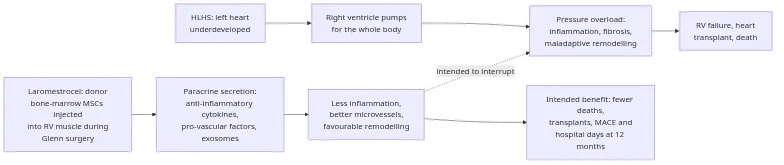
| Hypoplastic left heart syndrome (HLHS) | A birth defect in which the left half of the heart is severely underdeveloped. The baby’s right ventricle has to pump blood to the whole body, a job it was not built for. Untreated it is fatal; treated it needs three open-heart operations in the first years of life. |
| Norwood, Glenn, Fontan | The three staged palliative operations for HLHS. Stage 1 (Norwood) days after birth; stage 2 (Glenn, also called bidirectional cavopulmonary anastomosis) at 4–6 months; stage 3 (Fontan) at 2–4 years. “Palliative” here means re-plumbing, not cure — the child lives with one pumping chamber. |
| Right ventricle (RV) / RVEF | The heart chamber doing all the work in HLHS. RVEF, right ventricular ejection fraction, is the percentage of blood the RV pushes out per beat — the trial’s registered primary measure of pump function, read by cardiac MRI. Higher is better. |
| Laromestrocel (Lomecel-B) | Longeveron’s cell therapy: mesenchymal stem cells (MSCs) taken from the bone marrow of young healthy adult donors, expanded, and in this trial injected directly into the heart muscle during the Glenn operation. “Allogeneic” means donor cells, no matching needed. |
| Mesenchymal stem cell (MSC) | A bone-marrow cell type believed to act mainly by secreting anti-inflammatory and vessel-growth signals rather than by becoming new heart muscle. |
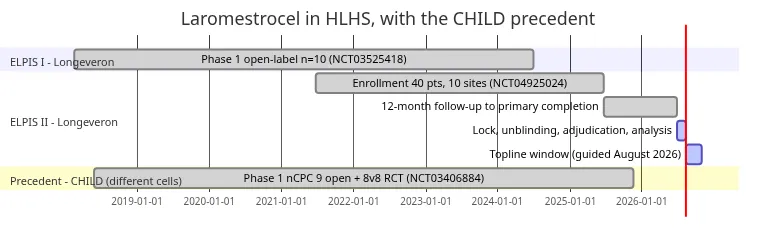
| ELPIS I / ELPIS II | Longeveron’s HLHS trials. ELPIS I: 10 babies, open-label, safety (NCT03525418). ELPIS II: 40 babies, randomized 20:20, double-blind, laromestrocel during Glenn surgery vs standard-of-care surgery alone (NCT04925024). |
| CHILD trial | An independent-of-this-program NIH-supported trial (NCT03406884) of a different cell type (neonatal cardiac progenitor cells) injected at the same Glenn operation. Its 2025 result is the nearest precedent for ELPIS II and is discussed throughout. |
| MACE | Major adverse cardiac events — a composite of cardiovascular death, heart-failure hospitalisation, thromboembolic events and arrhythmia (this trial’s definition, per management). |
| Type C meeting | A routine-category formal meeting with the FDA. The May 2026 one produced this analysis’s central fact: the FDA rejected RVEF as an efficacy endpoint for this trial. |
| SAP | Statistical analysis plan — the pre-specified rulebook for how a trial’s data will be analysed. Longeveron is submitting a revised SAP to the FDA before topline. |
| RMAT | Regenerative Medicine Advanced Therapy, an FDA designation for cell therapies with preliminary evidence in serious disease; grants earlier and more frequent FDA interactions. |
| Rare Pediatric Disease designation / PRV | An FDA designation which, on approval of the drug, can earn a Priority Review Voucher — a sellable ticket entitling its holder to a faster FDA review of any drug. Vouchers have historically sold for on the order of $100M or more [WEB ESTIMATE — historical PRV sales, not re-verified this session]. Longeveron sold investors 50% of any future HLHS PRV proceeds for $0.9M (see ../company.md C.3). |
Executive summary
- What it is (one sentence): Donor bone-marrow stem cells injected into a baby’s overworked right ventricle during the second of HLHS’s three palliative operations, aiming to strengthen the muscle and delay failure or transplant.
- The event and when (as disclosed): ELPIS II Phase 2b topline, guided “August 2026” — this month; the Q2 report and call are 2026-08-12, the day after this analysis.
- The main reason it could work: The registered pump-function endpoint aside, the clinical signal in this exact surgical setting is real: the independent CHILD trial (different cells, same operation) saw far fewer adverse events and hospital days in cell-treated babies, and ELPIS I’s 10 babies were all alive and transplant-free years out.
- The main risk: The FDA has already told the company the trial’s registered primary endpoint (RVEF) cannot demonstrate efficacy, no replacement endpoint is agreed, and the trial has lost its “pivotal” label — so even statistically positive topline may not mean an approvable result, and at n=40 the re-powered clinical composite can easily miss.
- What it means for the stock: A ~$23M market-cap single-asset company whose financing structure literally prices the win (second tranche requires a ≥$1.85 ten-day VWAP); the probability-weighted value sits almost exactly at spot, so this is a lottery-ticket setup, not an edge.
0. Program-tier coverage — CLEARED
Company-tier coverage is in ../company.md C.0.
| Tool | State | Note / verbatim error |
|---|---|---|
CT.gov search_trials + get_trial_details (NCT04925024) | CALLED | Six sponsor trials returned; ELPIS II details, endpoints, dates and all 10 sites read. has_results false. |
PubMed search_articles + get_article_metadata on every hit | CALLED | 8 of 8 records for “laromestrocel OR Lomecel-B” (≤15 rule); plus targeted searches for the CHILD trial, the Mayo UCB-MNC trial and independent commentary. |
Open Targets search_entities | BLOCKED | Three attempts across >30 minutes (immediate retry, delayed retry), verbatim each time: Rate limit exceeded for client: global — the standing platform block recorded in 02-connectors.md. Consequence: no independent genetics read; immaterial here because a donor-cell therapy has no single genetic target to validate, but the claim “target validation: not applicable” is [UNVERIFIED] rather than checked. |
ChEMBL compound_search | CALLED | Legitimate empty ×2 (“laromestrocel”, “Lomecel”): a cell therapy has no ChEMBL molecule record. Identity/selectivity not establishable from ChEMBL; no off-target read exists. |
| web_search ×4 (peak sales · competitive · exclusivity/royalty · analyst) | CALLED | HLHS epidemiology (CDC ~1 in 3,846 births), competitor cell-therapy landscape, PRV program reauthorisation through 2029, Ryoncil pricing precedent, analyst aggregator targets. All tagged WEB ESTIMATE where used. |
| EDGAR full-text search (optional) | NOT CALLED (optional row) | The 10-K and 10-Q were read directly at the company tier, which covers the sponsor’s own filings; competitor/partner filings not searched. |
A. Scientific & clinical assessment
A.1 Mechanism of action and scientific rationale
Laromestrocel is an allogeneic mesenchymal stem cell (MSC) product: bone-marrow cells from
screened young adult donors, culture-expanded, cryopreserved, and — in this program — thawed and
injected at multiple sites directly into the right ventricular muscle while the chest is already
open for the Glenn operation [VERIFIED — ELPIS I publication, DOI 10.1093/ehjopen/oead002; CT.gov NCT04925024].
The scientific idea is not that the donor cells become new heart muscle. MSCs are short-lived
after transplantation; the working model is paracrine: the cells secrete anti-inflammatory
cytokines, pro-vascular growth factors and exosomes that reduce inflammation, promote small-vessel
growth and favourably remodel the pressure-overloaded ventricle. The ELPIS I exosome analysis
identified MSC-derived RNA cargo (miR-215-3p, miR-374b-3p, MAPK-pathway RNAs) whose levels tracked
improvement in tricuspid regurgitation [VERIFIED — DOI 10.1093/ehjopen/oead002]. The same
mechanism story — immunomodulation rather than engraftment — underpins the company’s positive
published trials of the identical cells in Alzheimer’s disease (Nature Medicine 2025, DOI
10.1038/s41591-025-03559-0) and aging frailty (Cell Stem Cell 2026, DOI 10.1016/j.stem.2026.01.017)
[VERIFIED — PubMed].
What the next readout must prove: that this biological help is large enough to move hard
clinical measures — survival, transplant, adverse cardiac events, hospital days — in 20 treated
babies against 20 controls within 12 months. The honest scientific risk: every controlled
attempt to show cell therapy moves imaging measures of RV function in this population has
failed, including the CHILD trial’s primary endpoint (DOI 10.1016/j.jchf.2025.102723) and the Mayo
Clinic’s cord-blood Phase 2b, whose clinical findings were unfavourable (letter, DOI
10.1186/s13287-025-04717-4). The field’s own reviewers argue the delivery mode and timing may not
match the growing infant myocardium (same letter). The claim that MSC paracrine signalling can
alter the clinical course of a surgically palliated single-ventricle heart remains unproven in any
powered trial [VERIFIED — the cited record; the interpretation is the analyst's].
A.2 Clinical development plan, timeline, feasibility, resourcing
Trials
| Trial | Sponsor / whose drug | Design (arms, blinding, n) | Population | Status / key result | Link |
|---|---|---|---|---|---|
| ELPIS I (NCT03525418) | Longeveron (laromestrocel) | Phase 1, open-label, single-arm, n=10, intramyocardial injection during Glenn | HLHS infants at stage-2 palliation | Complete. Safety met: no MACE, no treatment-related infection at 1 month; all 10 alive and transplant-free at 1 year; CHSS-presented 5-year transplant-free survival 100%; suggested TR improvement, no RVEF decline | Paper · CT.gov |
| ELPIS II (NCT04925024) — this catalyst | Longeveron (laromestrocel); collaborators NHLBI, Lurie Children’s, UT Houston | Phase 2b, randomized 20:20, double-blind, controlled: laromestrocel during Glenn vs standard-of-care surgery alone, n=40, 10 US children’s hospitals | HLHS infants ≤12 months at stage-2 palliation | ACTIVE_NOT_RECRUITING. Enrollment complete 2025-06-24; final DMC safety review clean 2026-05-11; primary completion 2026-06-30; registered primary: ΔRVEF baseline→12 months by cardiac MRI | CT.gov |
| CHILD (NCT03406884) | Academic/NIH (neonatal cardiac progenitor cells — not Longeveron’s drug; Kaushal/Hare co-authors) | Phase 1: 9 open-label + randomized double-blind 8:8 vs standard of care, intramyocardial at Glenn | HLHS infants | Published 2025-11: safety met; primary efficacy (RV size/function by CMR+echo) NOT met; secondaries favoured cells: MACE 0.23 vs 0.00 events/100 person-days (p=0.013), cardiac hospital days 15 vs 2 per 100 person-days (p=0.035), death-or-transplant-listing 3 vs 0 (log-rank p=0.005, both cohorts) | Paper |
| Mayo UCB-MNC Phase 2b | Mayo Clinic (autologous umbilical cord blood mononuclear cells — competitor concept) | Non-randomized control trial, intramyocardial at Glenn | HLHS infants | Published 2025-05; clinical findings unfavourable per the published record and subsequent commentary | Commented in |
[VERIFIED — CT.gov and the cited PubMed records, read 2026-08-11]
Timeline detail (ELPIS II): start 2021-06-25 · first patient about mid-2021 · last patient in
2025-06-24 (enrollment ran ~4 years for 40 babies — this is a hard population to enrol) · last
12-month assessment / registry primary completion 2026-06-30 · registry study completion
2026-08-31 · topline guided August 2026 [VERIFIED — CT.gov; company guidance via BPIQ note and Q1 2026 call].
Feasibility matrix
| Factor | High probability | Medium probability | Low probability | This asset (assessment) | Source |
|---|---|---|---|---|---|
| Recruitment feasibility | >50 sites, 3:1 patient:site | 20–50 sites, established investigators | <20 sites, novel sites | Done — enrollment complete at 10 elite pediatric heart centers, but it took ~4 years for 40 patients; any confirmatory trial faces the same scarcity | [VERIFIED — CT.gov] |
| Endpoint clarity | Regulatory precedent exists | Novel endpoint with FDA alignment | Unvalidated surrogate | Low. The registered primary (RVEF) has been ruled uninformative by the FDA; the replacement composite is not yet FDA-agreed; no approval precedent exists in HLHS | [VERIFIED — Q1 2026 call] |
| Trial-design robustness | Pivotal Phase III with SPA | Adaptive with interim analysis | Single-arm, no control | Medium: randomized, double-blind, controlled — genuinely rigorous for this field — but n=20/arm and the FDA no longer calls it pivotal | [VERIFIED — 10-K; call] |
| Operational / execution | Enrollment complete, standard timeline | Some timeline risk | Enrollment behind | High: enrollment done, DMC clean, guidance never slipped (Q3 2026 → “August 2026” is a narrowing) | [VERIFIED — press feed; BPIQ note] |
Resourcing sufficiency. Cash covers the readout ($15.8M at 2026-03-31, runway into Q4 2026)
but not what follows: BLA-enabling work is ramping, the ATM is blocked below $0.80 until
2026-09-07, and the $15M second tranche only arrives on a statistically significant win plus a
≥$1.85 VWAP (or investor waiver). A confirmatory trial, if the FDA demands one, is unfunded. See
../company.md C.3 [VERIFIED — Q1 2026 10-Q].
A.3 Target label, target product profile, strategic questions, designations
A.3a Target label. Adjunct to stage-2 (Glenn) surgical palliation in infants with hypoplastic left heart syndrome: a single intramyocardial administration of allogeneic bone-marrow MSCs during the operation.
A.3b Target product profile
| Attribute | Standard of care & key competitor(s) — data | Laromestrocel target profile (goal) | Supporting evidence (+ link) |
|---|---|---|---|
| Indication / target label | Three-stage surgical palliation alone; no approved drug therapy for HLHS anywhere | Adjunct cell therapy at Glenn; first approved drug in HLHS | [VERIFIED — FDA statements at the Type C meeting as relayed on the Q1 call; web sweep found no approved HLHS drug] |
| Efficacy (endpoints, regimen) | Post-Glenn attrition: death, transplant, heart-failure events; CHILD’s SOC arm showed 0.23 MACE/100 person-days and 15 cardiac hospital days/100 person-days | Fewer deaths/transplants/MACE and fewer hospital days at 12 months; RVEF preserved (secondary) | CHILD; ELPIS I |
| Safety / tolerability | Surgery-only risk profile | No added surgical risk; ELPIS I: no MACE, no treatment-related infection; ELPIS II final DMC review clean | [VERIFIED — papers; DMC release 2026-05-11] |
| Biomarker / companion diagnostic | None | None required (anatomical diagnosis); exosome/cytokine panels exploratory only | [VERIFIED — CT.gov secondary endpoints] |
| Formulation / administration | n/a | Off-the-shelf cryopreserved donor cells, no HLA matching, given during an operation already scheduled — no extra procedure for the patient | [VERIFIED — trial design] |
| Payer value | Transplant ≈ lifetime-million-dollar cost; each HLHS hospital day is ICU-grade | One-time therapy priced against avoided transplant/hospitalisation; Ryoncil (first approved allogeneic BM-MSC product, Dec 2024) set $194K per infusion | [WEB ESTIMATE — BioSpace/Managed Healthcare Executive on Ryoncil pricing, read 2026-08-11] |
A.3c Strategic Go/No-Go questions (pre-Phase-III / registration set — this readout decides whether a registration case exists)
| Group | Question | Answer (tagged) |
|---|---|---|
| Target | Target revalidated as in prior phases? | Partially. The paracrine mechanism is consistent across the company’s AD and frailty RCTs and ELPIS I biomarkers, but no controlled trial has yet validated it clinically in HLHS [VERIFIED — cited papers; judgement] |
| Dose & Drug | Exposure–response for the intended commercial regimen and route? | No dose-ranging in HLHS; single fixed intramyocardial dose carried from ELPIS I [VERIFIED — CT.gov] |
| Dose & Drug | Commercial formulation available or feasible? | Yes — the same cryopreserved allogeneic product across all four programs; company manufactures in-house [VERIFIED — 10-K] |
| Dose & Drug | Dose range compatible with safety? | Yes on all evidence to date: ELPIS I clean, ELPIS II DMC clean [VERIFIED] |
| Dose & Drug | Therapeutic window given clinical response? | Unknown — no efficacy-graded dosing exists [UNVERIFIED] |
| Patient | Proof of concept and positive benefit/risk in the intended population? | Not yet — that is exactly what this readout must supply; ELPIS I is 10 uncontrolled patients [VERIFIED] |
| Patient | Phase III design and outcome criteria accepted, compelling, competitive? | No — the central problem. FDA rejected RVEF, no replacement is agreed, the trial is no longer called pivotal, and FDA says only mortality/transplant/MACE-type measures could be informative [VERIFIED — Q1 2026 call] |
| Patient | Rationale for the patient population? | Strong: uniform lethal anatomy, uniform surgical pathway, highest-unmet-need pediatric cardiology population [VERIFIED — epidemiology sweep] |
| Patient | Likelihood of the expected outcome? | Modelled 30% (band 20–40) for statistical significance on the SAP primary — see the Locked prediction [UNVERIFIED — modelled] |
| Patient | Companion-diagnostic strategy, including pricing and market? | Not applicable — anatomical diagnosis [VERIFIED] |
A.3d Regulatory designations (all five held on this program’s drug) [VERIFIED — Q1 2026 call; AAIC release 2026-07-13 confirms RMAT and Fast Track wording]
- RMAT — earlier, more frequent FDA interactions and potential eligibility for accelerated pathways for a regenerative therapy.
- Fast Track (HLHS, granted 2022) — rolling review eligibility and more FDA contact.
- Orphan Drug (HLHS) — 7 years of US market exclusivity on approval, fee waivers, tax credits.
- Rare Pediatric Disease designation — eligibility for a Priority Review Voucher on approval;
the PRV program was reauthorised through September 2029 in the 2026 appropriations act, so the
eligibility is live again; 50% of any voucher proceeds are already sold (see
../company.mdC.3). - EMA SME status (2026-06-09) — fee reductions for EU procedures; administrative, not evidential.
A.4 Target product profile valuation matrix
| Stakeholder | Value driver | Minimum threshold | Competitive | Premium | Benchmark / source |
|---|---|---|---|---|---|
| Patient / caregiver | Transplant-free survival; fewer ICU days | No added surgical risk | Fewer hospital days | Delayed/avoided transplant and Fontan-era failure | CHILD SOC arm event rates [VERIFIED — DOI 10.1016/j.jchf.2025.102723] |
| Regulator | Hard clinical outcomes at adequate n | Safety (met) | Stat-sig on an FDA-agreed clinical endpoint | Mortality/transplant benefit | FDA’s own Type C list: mortality, transplant-free survival, transplantation, MACE [VERIFIED — Q1 call] |
| Payer / HTA | Avoided cost | Cost-neutral vs one averted transplant | Hospital-day reduction | Durable single-dose benefit | Ryoncil $194K/infusion precedent [WEB ESTIMATE] |
| Provider | Fits existing surgery, no new infrastructure | No workflow change (given intra-op) | Off-the-shelf, no matching | — | Trial design [VERIFIED] |
A.5 Evidence quality and endpoints
| Criterion | Score (High / Medium / Low) | Basis (one line) | Link |
|---|---|---|---|
| Target validation | Low | No genetic or pharmacological validation exists that immunomodulation alters HLHS course; Open Targets BLOCKED this sweep (and a cell therapy has no single target to query) | — |
| Mechanism clarity | Medium | Paracrine/exosome model is coherent and biomarker-supported but not causally proven in heart | ELPIS I |
| Biomarker availability | Low | Exploratory cytokines/exosomes only; nothing selects patients or predicts response | CT.gov |
| Publication quality (peer-reviewed? independent authors?) | Medium | ELPIS I in EHJ Open with strong academic co-authors but Longeveron-employee co-authorship throughout; AD Phase 2a reached Nature Medicine; frailty reached Cell Stem Cell | A.5b |
| Clinical / expert sentiment | — | Moved to A.5b, below. | — |
Endpoints
| Endpoint (full name) | What it measures | Scale / range | Better direction | MCID / note |
|---|---|---|---|---|
| Change in right ventricular ejection fraction (RVEF), baseline→12 months, cardiac MRI | Pump function of the single working ventricle | Percent (typical RV values ~40–60%) | Higher / less decline | No established MCID in HLHS, and the FDA has ruled the measure itself uninformative for efficacy here [VERIFIED — Q1 call]. Registered primary; will be reported but cannot carry approval. |
| All-cause mortality; transplant-free survival; listing for transplant | The hardest outcomes | Events / time-to-event | Fewer / longer | The FDA’s own list of informative measures. Two deaths have occurred on trial (blinded, one pre-Glenn, one post-Glenn) [VERIFIED — Q1 call]. |
| MACE (cardiovascular death, HF hospitalisation, thromboembolic event, arrhythmia) | Clinically meaningful cardiac deterioration | Adjudicated events per follow-up time | Fewer | Adjudication in progress; management says “enough events to demonstrate some difference” [VERIFIED — Q1 call]. |
| Hospital days (cardiac), 12 months post-Glenn | Burden of care | Days | Fewer | Company powering assumption: ~30 days SOC vs 15 treated [VERIFIED — Q1 call]; CHILD observed 15 vs 2 per 100 person-days [VERIFIED — DOI 10.1016/j.jchf.2025.102723]. |
| Somatic growth (weight/length/head circumference), NT-proBNP, PedsQL, TR severity | Supportive secondaries | Various | Various | Registered secondaries; none can carry the result alone. |
A.5b Key opinion leaders.
Panel as of. 2026-08-11 — CT.gov search_investigators (returned no ELPIS II investigators:
the registry lists no overall official and no site contacts on any of the 10 locations) and PubMed
author searches run this day.
Investigators
| Name | Role / affiliation | Trial (NCT) | Conflicts (party, kind, disclosed in, as of) | Conflicts checked (source, date) | Source | Tag |
|---|---|---|---|---|---|---|
| Sunjay Kaushal | First author of ELPIS I and of CHILD; pediatric cardiac surgeon (Lurie Children’s/Northwestern at ELPIS I publication; University of Nevada Las Vegas on CHILD, 2025) | NCT03525418 (ELPIS I); NCT03406884 (CHILD) | Sponsor: co-author with ~8 Longeveron employees on ELPIS I (author list, DOI 10.1093/ehjopen/oead002, as of 2023-01-11); co-author with Hare (Longeveron CSO) again on CHILD (DOI 10.1016/j.jchf.2025.102723, as of 2025-11-19) | PubMed “Kaushal S[Author] AND hypoplastic left heart syndrome”, 2026-08-11 — 18 records, sponsor co-authorship confirmed; full COI statements of both papers not retrieved this sweep (recorded as a limit, not an absence) | PubMed author lists | VERIFIED — PubMed 2026-08-11 |
| Joshua M. Hare | Longeveron co-founder, CSO, Executive Chairman, 10% owner; senior author across the program | NCT03525418; NCT04925024 (sponsor side) | Sponsor by construction: employee, founder, 10% owner; also licensor via JMH MD Holdings (1% royalty on licensed CD271 technology, ../company.md C.3) | Q1 2026 10-Q related-party note, read 2026-08-11; BPIQ insider rows | 10-Q; PubMed | VERIFIED — 10-Q and PubMed 2026-08-11 |
ELPIS II’s own site investigators are not disclosed on CT.gov (every contact field null); the trial’s named collaborators are NHLBI, Lurie Children’s and UT Houston’s biostatistics center. The panel above is built from the program’s publications instead, with each name’s verifiable trial attachment stated.
Independent voices
| Name | Affiliation | View (close enough to quote) | As of | Conflicts checked (source, date) | Source | Tag |
|---|---|---|---|---|---|---|
| Christian P. Brizard & Salvatore Pepe | Royal Children’s Hospital Melbourne / Murdoch Children’s Research Institute (cardiac surgery; heart research) | On the Mayo UCB-MNC Phase 2b’s “unfavourable clinical findings”: cell therapy in congenital heart disease is “notable and highly commended” as an effort, but pathology complexity, surgical strategy and design hurdles “confound the interpretation of cell treatment efficacy and clinical safety”; future trials need “far greater consideration of the mode and timing of cell delivery” congruent with the growing infant heart | 2025-11-06 | Letter’s own authorship and affiliations (no Longeveron relationship named); PubMed author search on both names crossed with “Longeveron”/“laromestrocel”, 2026-08-11 — no co-authorship found | DOI 10.1186/s13287-025-04717-4 via PubMed | VERIFIED — PubMed 2026-08-11 |
Judgement
| Endpoint supported | Basis (one or two sentences) | Tag |
|---|---|---|
| MIXED | The clinical measures the SAP will now lean on (mortality, transplant, MACE, hospital days) are exactly the ones the FDA itself called informative, and the independent CHILD data show they can separate arms even at tiny n — but the only genuinely independent published voices in this field read the neighbouring negative trial as evidence that delivery mode/timing may be wrong for infant myocardium, and no independent voice has endorsed this specific trial’s ability to show efficacy at 20 per arm. | UNVERIFIED — judgement |
Dissent
(empty — the judgement is MIXED, not SUPPORTIVE_CONTESTED, so no named dissent from a majority reading is required; the Brizard/Pepe caution is already recorded above.)
| Name | View (close enough to quote) | Source |
|---|
B. Commercial assessment
B.0 Current treatment algorithm
- Prenatal or newborn diagnosis by echocardiography; prostaglandin keeps the ductus open.
- Stage 1 — Norwood operation, days after birth: the RV becomes the systemic pump. Highest-risk period; interstage mortality remains meaningful.
- Stage 2 — Glenn operation, 4–6 months: superior vena cava routed to the lungs. This is where laromestrocel is given, during the operation already happening — it opens no new line of therapy and adds no separate procedure.
- Stage 3 — Fontan, 2–4 years: full venous rerouting. The child lives with single-ventricle physiology; late RV failure, protein-losing enteropathy and transplant need accumulate for life.
- Heart transplant is the only option when the RV fails — scarce infant donor hearts, lifelong immunosuppression.
There is no approved drug therapy for HLHS at any step; everything pharmacological is
supportive [VERIFIED — web sweep; FDA's Type C framing per Q1 call]. If approved, laromestrocel
would slot inside step 3 as an adjunct for essentially every Glenn candidate — the addressable
population is the treated population.
B.1 Competitive landscape and positioning
| Metric | High value | Medium value | Low value | This asset (assessment) | Source |
|---|---|---|---|---|---|
| Mechanism differentiation | First-in-class or novel target | Next-generation improvement | Me-too | First-in-indication: no approved competitor, and the two nearest clinical programs (Mayo autologous UCB-MNC; academic nCPC/CHILD) are academic, autologous, or pre-commercial | [VERIFIED — PubMed sweep] |
| Development-timeline advantage | >12 months ahead | Within 6–12 months | Lagging >12 months | >12 months ahead of any commercial entrant: Mayo’s Phase 2b read out unfavourably; CHILD is only now planning Phase 2; no other company-sponsored HLHS cell program found | [VERIFIED — PubMed; web sweep] |
| Clinical proof-of-concept evidence | Positive Phase IIb (n>100) | Phase IIa signals (n=20–50) | Preclinical only | Low-medium: open-label n=10 plus a different product’s randomized n=16 clinical signal | cited above |
| IP protection | Composition-of-matter, long-dated | Method-of-use | Pending or none | Medium: 52 issued patents worldwide incl. HLHS administration filings; but the cell product itself is a licensed platform (UM licence) with method-style claims; Orphan + 12-yr biologic exclusivity are the practical moat | [VERIFIED — Q1 call; 10-Q licences] |
Where this asset wins, in plain sentences. It is the only company-sponsored therapeutic anywhere in HLHS, in a population every payer and regulator agrees is desperate, with an off-the-shelf product given during an operation that happens anyway. The single fact the thesis rests on: whether 20-vs-20 babies can show a statistically significant clinical difference at 12 months. The CHILD trial says the event rates in this population are high enough that it is possible; the Mayo readout and the CHILD imaging miss say most ways of measuring it fail.
B.2 Addressable market
| Component | How it is estimated | Premium threshold | This asset (assessment) | Source |
|---|---|---|---|---|
| Drug-treated patients | ~1 in 3,846 US births → ~925–1,025 HLHS births/yr; Glenn candidates (survivors of Norwood) plausibly ~700–850/yr US; EU roughly similar order | >100,000 | Tiny population, ~1,500–2,000/yr US+EU — an ultra-orphan market; premium pricing is the only route to a material number | [VERIFIED — CDC via web sweep]; Glenn attrition [UNVERIFIED — modelled] |
| Market exclusivity | Orphan 7 yr + US biologic 12 yr from approval; patents to ~2040s pending | >10 years | Yes on regulatory exclusivity alone | [VERIFIED — designations; 10-K] |
| Reimbursement precedent | Approvals in ≥2 major markets | Positive NICE/CADTH | None in HLHS; Ryoncil ($194K/infusion, pediatric orphan MSC) is the pricing precedent | [WEB ESTIMATE] |
| Patient-journey impact | Fewer hospital days, less caregiver burden | >30% QoL gain | Potentially large: powering assumes halving hospital days | [VERIFIED — Q1 call powering assumption] |
The company states an HLHS market opportunity of “approximately $1 billion”
[VERIFIED that they say it — Q1 2026 call; the figure itself UNVERIFIED and not used].
B.3 Value and feasibility
B.3a Expected peak sales. Bottom-up, conditional on approval, excluding AD/PDCM/frailty and
any PRV proceeds. Named price anchor: Ryoncil, the first approved allogeneic bone-marrow MSC
therapy, at $194K per infusion [WEB ESTIMATE — BioSpace, read 2026-08-11]; laromestrocel here is
a single intra-operative administration.
| Scenario | Assumptions (patients × price × share) | Estimate (USD/year at peak) | Basis / tag |
|---|---|---|---|
| Low | ~300 US patients/yr × $150K × (uptake limited to a subset of centers) | ~$45M | [UNVERIFIED — modelled] |
| Base | ~600 US patients/yr × $250K | ~$150M | [UNVERIFIED — modelled] |
| High | ~1,200 US+EU patients/yr × $350K | ~$400M+ | [UNVERIFIED — modelled]; still well under the company’s ~$1B claim |
B.3b Feasibility
| Question | Answer (tagged) |
|---|---|
| Expected net present value (eNPV) | Range only (rule 10). Conditional on a statistically positive ELPIS II and the FDA accepting the package (both uncertain; the second is now the bigger hurdle), base-case peak sales of ~$150M at orphan-typical multiples would support a licensed/partnered value in the low hundreds of millions; applying ~30% readout probability × ~40–60% regulatory acceptance gives an unconditional ~$15–60M for the HLHS program against a ~$7–12M recomputed EV. Every input [UNVERIFIED — modelled]. |
| Capital to the next decision point | Effectively spent — the trial is done and paid for; cash covers topline. [VERIFIED — 10-Q] |
| Capital to approval, and the funding plan | Unknown but material: BLA-enabling work is ramping and a confirmatory trial (if required after the pivotal-status loss) is unfunded. The stated plan is partnering; the structured plan is the $15M milestone tranche + $11.2M of $0.85 warrants, both contingent on a win. [VERIFIED — 10-Q; call] |
| Launch capability — alone, or must partner? | Must partner or stay ultra-lean; management explicitly targets an asset-light licensing model. [VERIFIED — call] |
| Commercialisation rights — retained, split, or out-licensed? | Fully retained today. Royalty stack on sales: 3% (University of Miami licence) + 1% (JMH MD Holdings, an entity of the CSO) + up to $50K/yr escalating payments; 50% of any PRV sale proceeds already sold. [VERIFIED — Q1 2026 10-Q] |
B.4 Product-development risk
Framing questions.
- Does the development plan support the target product profile claims? Only partially — the TPP now rests on clinical-outcome claims the trial was not originally powered for, under an SAP the FDA has not yet accepted.
- Will the identified risks affect the TPP? Yes, directly: if only RVEF or soft secondaries move, there is no approvable claim at all.
- If a risk cannot be mitigated, is the asset still differentiated? Yes — sole company-sponsored entrant in the indication; but differentiation without an approvable endpoint is worth little.
| Category | Time risk | Quality risk | Cost risk | Note |
|---|---|---|---|---|
| Project management | Low | — | — | Enrollment done, guidance never slipped. |
| Research | — | Medium | — | Mechanism unproven in controlled cardiac settings. |
| IP | — | Medium | — | Platform licensed from UM; method-style protection; exclusivity carries the moat. |
| Legal | — | Low | — | 2021 securities class action era resolved/aged; nothing current found in the feed. [UNVERIFIED — absence read from the press feed only] |
| DMPK | — | — | — | Not applicable to a cell therapy in this form. |
| Safety pharmacology | — | Low | — | Clean at every review to date. |
| Toxicology | — | Low | — | Allogeneic MSC class safety is well established (Ryoncil precedent). |
| Drug safety (clinical) | — | Medium | — | Two on-trial deaths (blinded arms). If both land in the treatment arm, safety itself becomes the story — a near-veto scenario at n=20/arm. [VERIFIED — deaths disclosed on Q1 call; arm allocation unknown] |
| Biomarker | — | Low | — | None needed for label. |
| Clinical pharmacology | — | Medium | — | No dose–response data in HLHS. |
| Clinical (efficacy) | — | High — the dominant risk | — | FDA-rejected primary; n=20/arm; every controlled imaging endpoint in the field has missed; composite not yet FDA-agreed. |
| Clinical operations | Low | — | — | Ten elite sites, DMC complete. |
| CMC / manufacturing | — | Medium | Medium | In-house allogeneic MSC manufacture; BLA-grade CMC is exactly what the pre-BLA meeting (2027 per CMO) must clear; no red flags disclosed. |
| Regulatory | High | High | — | Pivotal label lost mid-trial; NIH-mandated interim analysis blocked endpoint renegotiation; SAP acceptance pending; approval may require a new trial even on a win. |
| Global evidence & value | — | Medium | — | Single-trial evidence base; EU path not started (SME status only). |
| Commercial | — | Medium | High | No sales organisation; partnering is the stated route; ultra-orphan launch economics depend entirely on price. |
Readout
Sources
| Kind | Where it comes from | What it is worth | Value (or null) | Tag | Note |
|---|---|---|---|---|---|
bpiq | fetch_company_drugs — catalyst_date 2026-08-31, catalyst_date_text “August 2026” | Ceiling, not estimate: the stored day is the month-end placeholder for a month-precision text | 2026-08 | VERIFIED — BPIQ, read 2026-08-11 | note field carries one dated entry: 05/13/26 “ELPIS II topline results remain expected in August 2026”. |
ctgov | get_trial_details NCT04925024, primary_completion_date | Independent of company messaging; the last 12-month assessment | 2026-06-30 | VERIFIED — CT.gov, read 2026-08-11 | Registry study completion 2026-08-31. has_results false. Field: primary_completion_date. |
company | Q1 2026 call and 10-Q (2026-05-13): “Top-line results from the ELPIS II trial are anticipated in August 2026”; Q2 report + call scheduled 2026-08-12 | The company’s most recent dated wording | 2026-08 | VERIFIED — BPIQ earnings transcript; press feed 2026-08-03 | The scheduled 2026-08-12 call is the first plausible venue inside the guided month. |
congress | data/congresses.json | Only a source when the company names the meeting | null | VERIFIED — absence checked 2026-08-11 | No cardiology congress is in the calendar and the company has named none for this topline; nothing to match. |
modelled | Registry primary completion 2026-06-30 + 2–4 months default lag to lock, unblinding, adjudication and analysis (rule 34; data/benchmarks/readout-lag.json holds no comparable entry) | The only estimate independent of guidance | 2026-08/2026-10 | UNVERIFIED — modelled, default lag | MACE adjudication was still in progress in May; the company’s August guidance sits at the front edge of the default-lag range, so slippage into September–October is the modelled tail. |
The modelled estimate. Last 12-month assessments completed by 2026-06-30 (registry); default lag of 2–4 months to database lock, unblinding, event adjudication and topline analysis puts the modelled announcement at 2026-08-30 to 2026-10-31. The company is guiding to the earliest slice of that range and has held the month across two quarters.
Window
| Earliest | Likeliest | Latest | Precision | Confidence |
|---|---|---|---|---|
| 2026-08-12 | 2026-08-26 | 2026-10-31 | MONTH | MEDIUM |
Basis. Earliest is the scheduled Q2 call (2026-08-12), the first dated venue inside the guided month, one day after this analysis. Likeliest is late August: inside the guided “August 2026”, allowing for the SAP submission and event adjudication still running in May. Latest is end-October: the modelled default-lag tail — a sponsor announcing its first pivotal-scale readout under a not-yet-accepted SAP can plausibly slip past its guided month by some weeks, and the modelled range extends there.
Disagreement. CONSISTENT — bpiq and company are the same statement; the ctgov date plus the default lag brackets the guided month rather than contradicting it.
Date slippage.
| As of | Guidance text |
|---|---|
| 2025-06-24 | ”Top-line results expected in Q3 2026 following 12-month follow-up” (enrollment-completion release) |
| 2026-03-17 | ”the anticipated third quarter 2026 data readout of ELPIS II” (FY2025 10-K) |
| 2026-05-13 | ”Top-line results … are anticipated in August 2026” (Q1 call); BPIQ note same day: “remain expected in August 2026” |
Zero slips: Q3 2026 → August 2026 is a narrowing inside the same quarter, never a push.
Attribution
Computed by lib/clustering.mjs attributionFor('LGVN', …, 14275) over every pipeline row,
2026-08-11 — transcribed below.
Status. CLEAN
| Status | Means |
|---|---|
CLEAN | conflicts is empty — nothing else has_catalyst on this ticker’s pipeline lands within the window. |
Conflicts
(empty — exactly as computed: the other four pipeline rows all carry has_catalyst: false.)
| bpiq_drug_id | Label | Date | Analysed? | Gap (days) | Confirmed? |
|---|
Note. (blank — status is CLEAN.)
Market and timing for this event
- Plain takeaway. A ~$23M market-cap company with no options market, thin trading, a financing structure that pays out only on a win, and a readout window that opens tomorrow. Everything is this one event; there is no run-up left to trade, only the binary.
- Months to this catalyst. 0.0 to
readout.window.earliest(2026-08-12) — the window opens the day after this analysis; 2.7 months to the latest edge (2026-10-31). - Expected move around this event. Not computable from options and not bracketable: no listed
chain exists at all (
../company.mdC.6). The scenario table below is the only quantification offered. - Nearest comparable past reaction. None is truly comparable — Longeveron has never reported a
controlled efficacy readout. The closest analogues in
../company.mdC.7 are 2025-06-24 (+13.8% on the ELPIS II clock starting) and 2025-07-08 (+27.2% on the PDCM IND); the +68% close-to-close of 2026-03-10 was financing relief, not data. - Materiality. Dominant, per
../company.mdC.2 — the onlyhas_catalystrow, the contractual trigger of the second tranche and the PRV interest, and the only kind of news the tape has paid for all year. The stock call below is sized to that dominance. - Date slippage. Zero slips (Readout, above) — guidance has only ever narrowed.
Spot. $0.74, read 2026-08-11 (BPIQ; committed cache close $0.736 on 2026-08-10), per
../company.md C.4.
Scenario prices
| Scenario | Low | High | Anchors (each named and tagged) | Basis |
|---|---|---|---|---|
| Positive | 1.20 | 2.20 | (1) 52-week high $1.23 [VERIFIED — price cache]; (2) second-closing Price Threshold: 10-day VWAP ≥ $1.85, the level the placement investors contractually set as the post-win trading test [VERIFIED — Q1 2026 10-Q] (a dilution mechanism that fires on the event); (3) this ticker’s own catalyst moves: +68% close-to-close (2026-03-10) and +27.2% intraday (2025-07-08) [VERIFIED — BPIQ historical + cache]; (4) warrant supply: 13.2M shares exercisable at $0.85 cap the low end of the win range [VERIFIED — 10-Q] | A statistically significant topline in the dominant program should clear the 52-week high; the tranche structure says sophisticated holders priced a durable win at ≥$1.85 VWAP; the top of the range is ~3× spot, consistent with the placement-day move compounding on a real result. The $0.85 warrant wall supplies stock between the low and the threshold. |
| Miss | 0.22 | 0.45 | (1) cash per economic share ≈ $0.21: ~$11.3M modelled 2026-06-30 cash ÷ ~54.0M economic shares (common + preferred-as-converted) [UNVERIFIED — modelled from the filed 3/31 cash and Q1 burn]; (2) 52-week low $0.475 and 2026 pre-financing minimum close $0.484 [VERIFIED — price cache] | A miss re-prices the equity toward cash with going-concern language and a Q4 2026 runway wall; the March lows mark where the market put the company without a win priced in, and a failed readout lands below them because the next raise would come from weakness on ~54M economic shares. |
Expected value. 0.30 × $1.70 (positive midpoint) + 0.70 × $0.335 (miss midpoint) = $0.74,
+0.6% against spot $0.74. Method: probability_pct applied to the midpoint of each scenario
range. This is arithmetic, not advice, and it is not a price target.
Run-up
Entry and exit
| Entry date | Entry price | Entry basis | Exit rule |
|---|---|---|---|
| 2026-08-11 | 0.74 | The prediction’s own lock date and spot. The readout window opens the next day, so this is the last possible pre-window entry — the run-up phase is already essentially spent (the stock ran +19% from the 2026-07-14 close of $0.622 into this print). | T-1 trading days before readout.window.earliest |
T-1 is the only admissible rule that resolves at or after entry: T-5 and T-2 would resolve before
the lock date and pre-register a trade that cannot be taken. resolveExit("T-1", …) returns null
at lock (the committed cache ends 2026-08-10, before the window opens), so exit is null until
settlement, as the schema anticipates.
Predicted move and peak
| Low | High | Estimated date | Basis | |
|---|---|---|---|---|
| Predicted move, entry to exit | −5% | +12% | — | At most a handful of pre-announcement sessions in a thin float (~$0.2M/day traded); pre-event positioning days into a pure binary at a $23M cap can pop, but there is no time for a drift. |
| Predicted peak, from entry | 0% | +20% | 2026-08 | Any peak prints in the last session(s) before the announcement, or not at all — with entry one day before the earliest edge there is no room for a distinct crest and fade. |
Priority score drivers
Five computed rows transcribe lib/runup.mjs scoreDriver output verbatim; the two judgement
rows are the analyst’s, with their reading stated.
| Driver | Reads | Score (0–100) | Basis |
|---|---|---|---|
| Unmet-need relevance | A.4, B.0 — judgement | 85 | HLHS is uniformly lethal untreated and has no approved drug therapy; ~1,000 US births per year face three-stage surgical palliation with meaningful attrition at every stage, and the FDA itself acknowledged at the May 2026 Type C meeting that HLHS carries significant morbidity and mortality with a high unmet need. |
| Value-uplift potential | B.3a vs EV, C.2 materiality — judgement | 85 | company.md C.2 records this program as dominant; recomputed enterprise value is roughly $7M against even the low peak-sales scenario of ~$45M/yr (B.3a) — several times the whole EV — and the company-claimed ~$1B market sits far above that. |
| Probability of a positive outcome | this record’s probability_pct — computed | 30 | outcome_prediction.probability_pct = 30 |
| Date confidence | readout.precision + readout.confidence — computed; the gate | 48 | readout.precision=MONTH, readout.confidence=MEDIUM |
| Squeeze mechanics | float, short %, dollar volume — computed | 59 | float 27000000 shares, short_float_pct 4.9, average dollar volume 223322 — thinner liquidity and a tighter, more-shorted float amplify a positive surprise |
| Priced-in-ness | 52-week position — computed; HIGH = room LEFT to run | 65 | price 0.736 sits at 35% of its 52-week range (low 0.475, high 1.23, as of 2026-08-11) — closer to the 52-week low — room left to run. High score = NOT yet priced in. |
| Financing and clustering risk | runway vs catalyst, attribution — computed; the one NEGATIVE driver, HIGH = HIGH risk | 55 | runway_vs_catalyst=TIGHT is the larger of the two independent risks (financing) — company-stated runway ends inside Q4 2026, one quarter past the window; attribution is CLEAN so clustering contributes nothing. A high score here sinks the total. |
Priority score 28 · formula_version 1.0.0
Settlement. Left null at lock time, per 05-prediction-protocol.md.
Verdict
What I would do. Watch. Do not initiate before the readout.
Why. The expected value sits within a rounding error of spot: a 30% shot at roughly tripling against a 70% chance of losing half to two-thirds. That is a fair lottery ticket, not an edge, and three structural facts argue against paying for it blind. First, the FDA has already told the company its registered primary endpoint cannot show efficacy and has withdrawn the trial’s pivotal label, so even a statistically positive announcement starts a regulatory argument rather than ending one. Second, the readout window opens tomorrow — there is no run-up left to harvest, only the binary. Third, the capital structure meters the upside: 22.8M preferred shares convert at $0.52, 13.2M warrants supply stock at $0.85, and the second tranche prints $15M of new equity precisely when the stock sustains $1.85 — every rally into the win scenario meets contractual sellers and issuance. What makes this genuinely interesting rather than dismissible is the CHILD precedent: in this exact operation, clinical-event endpoints separated cell-treated babies from controls at half this trial’s size, and those are the endpoints the FDA now says matter and the SAP is being rebuilt around.
What would change this. Upward, before the event: FDA acceptance of the revised SAP disclosed publicly (it would restore a scoreable, agreed definition of success and materially raise the approval-conditional value); or topline slipping past August with the ATM unlocking above $0.80 — a financing tell. Upward, at the event: statistical significance on mortality/transplant-free survival specifically, the one result that forces the FDA’s hand. Downward: both blinded on-trial deaths landing in the treatment arm — at 20 per arm that ends the program regardless of the other numbers.
What to watch.
- 2026-08-12 — Q2 2026 results call (scheduled 2026-08-03): topline itself, or the last dated guidance restatement before it; any SAP-status disclosure; the cash figure against the modelled ~$11.3M.
- Through 2026-09-07 — whether the stock holds above $0.80, the contractual level at which the $10.7M ATM unlocks early; usage would appear in an 8-K/prospectus supplement.
- Any day — the topline 8-K/press release: read the endpoint claimed (SAP composite vs registered RVEF), the p-value discipline, and the arm allocation of the two disclosed deaths.
- Within 30 trading days after a positive announcement — the 10-day ≥$1.85 VWAP / 25M-share volume test that triggers (or fails to trigger) the $15M second closing; a waiver announcement instead would itself be informative about investor conviction.
- 2026-10-31 — the latest edge of the modelled window; passing it without topline breaks the zero-slip record and reopens the timing question.
Locked prediction
- Outcome-direction (will the readout succeed on its primary endpoint?): miss — probability
30%, band 20–40%
[UNVERIFIED — modelled]— the probability that the settlement definition below is met. Reasoning: controlled cell-therapy trials in this field have never hit an imaging primary (CHILD missed; Mayo unfavourable), the SAP composite is being re-specified mid-stream and is not FDA-agreed, and n=20/arm gives little power against adjudication noise — against that, CHILD’s clinical-event separation at n=8:8 in this same operation and ELPIS I’s 100% transplant-free survival say the effect, if real, is large enough to show. No published third-party probability on this event was found. - Stock-direction (which way do the shares move?): no-edge — confidence low — window
2026-08-11 to 2026-11-14, basis: the readout window (earliest 2026-08-12, latest 2026-10-31)
plus two weeks of post-announcement settlement; materiality dominant per
../company.mdC.2, so the move in this window belongs to this program alone (attribution CLEAN). The no-edge call agrees with the expected value sitting +0.6% from spot. - Scenario prices: positive $1.20–$2.20 · miss $0.22–$0.45 (anchors in the table above)
- Expected value: $0.74, +0.6% against spot $0.74 (arithmetic, not advice)
- Run-up: entry $0.74 on 2026-08-11, exit rule T-1 trading days before
readout.window.earliest — predicted move −5% to +12%, predicted peak 0% to +20% around
2026-08 — priority score 28,
formula_version1.0.0 - Settles on: Longeveron’s topline announcement of ELPIS II (NCT04925024). Positive = the announcement reports a statistically significant (p<0.05) benefit of laromestrocel over the standard-of-care control arm on the trial’s primary efficacy endpoint as pre-specified in the statistical analysis plan in force at announcement — the registered primary is change in RVEF from baseline to 12 months; the company has stated the SAP it is submitting to the FDA is built on clinical measures (mortality, transplant-free survival, MACE, hospitalisation days). An announcement claiming only numerical trends, only secondary or biomarker wins, or “clinically meaningful” results without statistical significance on the declared primary settles as a miss. Primary source: the company’s topline press release / Form 8-K.
- Locked: yes · Settled: no
Program data-quality flags
- Open Targets BLOCKED across three attempts this sweep, verbatim
Rate limit exceeded for client: global— the standing platform block. No independent target-validation read exists; for a multi-mechanism cell therapy the cost is low, but the absence is recorded rather than papered over. - ChEMBL has no record of a cell therapy: two searches returned zero compounds. Molecular identity and off-target profile are not establishable from ChEMBL for this asset class.
- The trial’s registered primary endpoint and its approvable endpoint have diverged. CT.gov still shows ΔRVEF at 12 months as primary; the FDA has ruled it uninformative and the company is submitting a revised SAP. The settlement definition names both, but which endpoint the topline release leads with is itself unknowable in advance — flagged as the central interpretive risk of scoring this prediction.
- Two on-trial deaths are disclosed but blinded (one pre-Glenn, one post-Glenn, per the Q1 call). Their arm allocation flips the safety story entirely and cannot be known before topline.
- CT.gov discloses no investigators for NCT04925024 — no overall official, no site contacts. The KOL investigator panel is built from the program’s publications instead.
- The COI statements of the ELPIS I and CHILD papers were not retrieved this sweep (metadata
only); sponsor co-authorship is read from author affiliation lists, which understates
consultancy-type conflicts. Recorded in
conflicts_checkedas a limit. - BPIQ’s
catalyst_date2026-08-31 is the month-end placeholder for “August 2026” (rule 23) — used nowhere for timing; every timing decision reads the Readout window above. - Analyst aggregator targets conflict wildly (MarketBeat consensus $10.20 from 5 analysts vs a $1.36 average “forecast” on StockScan; WallStreetZen shows no target). The figures look stale and/or split-distorted; they are excluded from the scenario anchors on rule 6 rather than passed through.