IVA / lanifibranor-mash — lanifibranor for metabolic dysfunction-associated steatohepatitis (MASH)
Program analysis ·
bpiq_drug_id16301 · prepared 2026-08 · USD · framework v5.6.1 · Coverage: CLEAREDCompany context, financials, ownership, options and the full pipeline:
../company.md.How to read this. Written for a reader who has not studied pharmacology or finance. Terms specific to this program are in the Glossary below; general terms are defined once in
framework/04-glossary.md. Tags:[VERIFIED — source]/[UNVERIFIED]/[WEB ESTIMATE — source, date].This document supersedes the 2026-08-04 version (framework v3.5.0). What materially changed is listed in the data-quality section at the end.
Glossary
| Term | Plain-language meaning |
|---|---|
| Metabolic dysfunction-associated steatohepatitis (MASH) | A liver disease in which fat builds up inside liver cells, the cells become inflamed and swollen, and the repeated injury lays down scar tissue. Driven by obesity, insulin resistance and type 2 diabetes. Called non-alcoholic steatohepatitis (NASH) until a 2023 renaming; both names appear in the sources quoted here. |
| Metabolic dysfunction-associated steatotic liver disease (MASLD) | The broader condition: fat in the liver, with or without the inflammation that defines MASH. Most people with MASLD never progress to MASH. |
| Fibrosis | Scar tissue in the liver. Graded F0 (none) to F4 (cirrhosis). F2 and F3 are the population in this trial. Fibrosis stage is the single best predictor of progression to liver failure or death, which is why regulators care about it more than anything else in this disease. |
| Steatosis | Fat accumulation inside liver cells. The first step of the disease. |
| Ballooning | Liver cells that have swollen and lost their normal internal structure. A pathologist scores it 0, 1 or 2 under the microscope. A score of 0 means it is gone. |
| Lobular inflammation | Immune cells infiltrating the liver tissue, scored 0 to 3 under the microscope. |
| Liver biopsy | Taking a small core of liver tissue with a needle so a pathologist can examine it. The only accepted way to prove MASH has resolved. Invasive, unpleasant, and two pathologists reading the same slide often disagree, which adds noise to every trial in this field. |
| NASH CRN score | The Non-Alcoholic Steatohepatitis Clinical Research Network scoring system: steatosis 0–3, lobular inflammation 0–3, ballooning 0–2, fibrosis 0–4, scored separately. The system NATiV3’s primary endpoint is written in. |
| SAF score | The Steatosis–Activity–Fibrosis scoring system, the European alternative. Its Activity component runs 0–4 and combines ballooning and inflammation. The Phase 2b primary endpoint was written in this system, and the Phase 3 entry criteria still use it. |
| MASH resolution | A pathologist reading the end-of-treatment biopsy finds ballooning gone (score 0) and inflammation absent or minimal (score 0 or 1). The disease is judged to have switched off. |
| Peroxisome proliferator-activated receptor (PPAR) | A family of three proteins inside cells — PPAR-alpha, PPAR-gamma and PPAR-delta — that sit on DNA and switch metabolic genes on and off. They control how the body burns fat, handles sugar, and mounts inflammatory and scarring responses. |
| Pan-PPAR agonist | A drug that switches on all three PPARs at once. Lanifibranor is one. The argument for hitting all three is that MASH is three problems at once — fat, inflammation and scarring — and each PPAR addresses a different one. |
| Lanifibranor (IVA337) | The drug. A small-molecule tablet taken once daily, at 800 mg or 1200 mg. |
| NATiV3 | The Phase 3 trial reading out. Defined in full in A.2. |
| NATIVE | The Phase 2b trial NATiV3 rests on, published in the New England Journal of Medicine in 2021. Defined in full in A.2. The two names differ by one character and are constantly confused in the literature — see the data-quality flags. |
| LEGEND | The small Phase 2a trial combining lanifibranor with empagliflozin. Defined in full in A.2. |
| Thiazolidinedione (TZD) | An older class of diabetes tablet, such as pioglitazone, that works purely on PPAR-gamma. It improves liver histology, and also causes weight gain and fluid retention. The reason lanifibranor’s side-effect profile is predictable rather than surprising. |
| SGLT2 inhibitor | A diabetes tablet class, such as empagliflozin (Jardiance), that makes the kidneys excrete glucose. Causes modest weight loss, which is why Inventiva tested it alongside lanifibranor. |
| GLP-1 receptor agonist | An injected drug class, such as semaglutide (Wegovy), that mimics a gut hormone to reduce appetite and produce large weight loss. Approved in MASH since August 2025. |
| FGF21 analogue | An engineered version of the hormone fibroblast growth factor 21, given by injection, which improves fat handling in the liver. Efruxifermin and pegozafermin are the two in Phase 3. |
| Suspected Unexpected Serious Adverse Reaction (SUSAR) | A serious side effect in a trial that was not predicted by the drug’s existing safety information. Reporting one triggers regulatory notification and usually a safety-committee review. |
| Data Monitoring Committee (DMC) | An independent panel of doctors and statisticians that periodically reviews unblinded safety data during a trial and can recommend changes or a halt. |
Executive summary
- What it is (one sentence): A once-daily tablet that switches on all three PPAR proteins at once to attack the fat, the inflammation and the scarring in MASH simultaneously, now finishing a 1,009-patient Phase 3 trial against placebo.
- The event and when (as disclosed): Topline results from Part A of the NATiV3 Phase 3 trial.
BPIQ’s
catalyst_date_textsays “H2 2026”; the company narrowed that to Q4 2026 on 2026-05-26 and independent trial arithmetic agrees. Neither is a day. The readout window judged below is 2026-10-01 to 2026-12-31, precision PERIOD. - The main reason it could work: In the published Phase 2b, on the exact composite endpoint Phase 3 is registered against, 35% of patients on 1200 mg responded against 9% on placebo — a 26-percentage-point gap. That is a very large effect on a hard endpoint, and Phase 3 gives the drug 72 weeks instead of 24 to produce it.
- The main risk: The registered primary is a composite — MASH must resolve and fibrosis must improve, in the same patient. The fibrosis half is the weaker half: in two independent published meta-analyses, lanifibranor’s fibrosis effect did not reach statistical significance. And the one other PPAR agonist taken into Phase 3 in this disease, elafibranor, failed.
- What it means for the stock: The shares sit at 29.6% of their 52-week range, 41% below the 52-week high — but a run-up has started: +25% off the June trough, on real volume, with short interest up 54% in six weeks. The payoff is still asymmetric, just less so than on 2026-08-04.
0. Program-tier coverage — CLEARED
Company-tier coverage is in ../company.md C.0 and is not repeated here.
| Tool | State | Note / verbatim error |
|---|---|---|
CT.gov search_trials + get_trial_details | CALLED | search_trials on intervention “lanifibranor” returned all 7 registered trials, unchanged. get_trial_details on NCT04849728 exceeded the tool output limit and was read from the saved file. The record still carries two primary outcome measures and a null secondary-outcomes array; status ACTIVE_NOT_RECRUITING, has_results: false, primary completion 2027-09-30 — all unchanged since 2026-08-04 |
PubMed search_articles + get_article_metadata | CALLED | 74 hits on “lanifibranor” (unchanged count). Metadata retrieved this sweep for the 12 most recent hits plus 4 from a targeted NATiV3/design search — nothing new bears on this readout; the two newest items are a materials-science paper and a pharmacology review. Combined with the 2026-08-04 sweep, every clinical publication bearing on the readout has metadata on file. The remaining older records were not individually inspected, a stated limit |
Open Targets search_entities | BLOCKED | Verbatim error, three attempts spread across the session: Rate limit exceeded for client: global — the standing platform throttle in 02-connectors.md. Consequence: human-genetic validation of PPARA, PPARG and PPARD in MASH remains unverified, and every target-genetics claim is tagged [UNVERIFIED] |
ChEMBL compound_search | CALLED | Single exact match, CHEMBL4091374, byte-identical to the 2026-08-04 read. Still reports oral: false, contradicting every trial record — a ChEMBL metadata gap, not evidence about the formulation |
| web_search ×4 | CALLED | Peak sales · competitive landscape · exclusivity and royalty · analyst view. All four returned usable results, tagged as web estimates wherever quoted. The exclusivity search located the 20-F patent disclosure that closes the 2026-08-04 IP hole — see B.1 |
A. Scientific & clinical assessment
A.1 Mechanism of action and scientific rationale
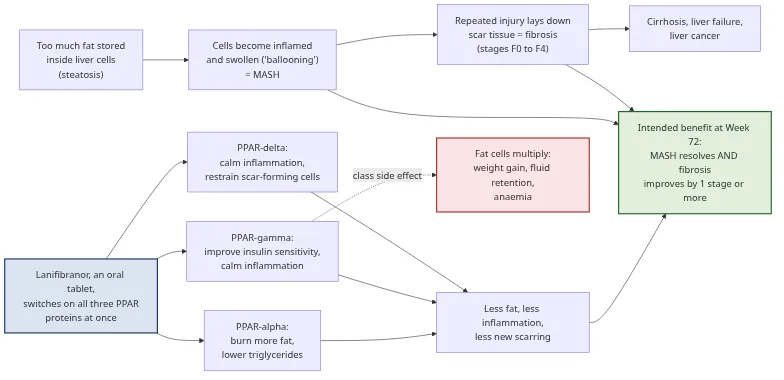
Metabolic dysfunction-associated steatohepatitis is best understood as three problems stacked on top of each other. First, too much fat is stored inside liver cells. Second, the overloaded cells become inflamed and swollen. Third, the repeated injury provokes the liver to lay down scar tissue, and it is the scar tissue that eventually kills people. Most drugs tried in this disease attack one of the three layers.
Lanifibranor attacks all three at once, by switching on a family of three proteins called the peroxisome proliferator-activated receptors. These sit inside cells, bind to DNA, and act as master switches for metabolic genes. There are three of them and they do different jobs.
- PPAR-alpha turns up fat burning and lowers blood triglycerides.
- PPAR-gamma improves the body’s sensitivity to insulin and calms inflammation. This is the target of the old diabetes drugs called thiazolidinediones.
- PPAR-delta also calms inflammation and, importantly, restrains the stellate cells that produce liver scar tissue.
Lanifibranor is a pan-PPAR agonist: one molecule that activates all three. The scientific
argument is that no single PPAR covers the whole disease, and that hitting all three gives one
tablet a shot at the fat, the inflammation and the scarring together. [VERIFIED — NATIVE design paper, Contemporary Clinical Trials 2020, [DOI 10.1016/j.cct.2020.106170](https://doi.org/10.1016/j.cct.2020.106170), per PubMed; and NEJM 2021, [DOI 10.1056/NEJMoa2036205](https://doi.org/10.1056/NEJMoa2036205)]
The molecule itself is unremarkable in a good way: a 434.9-dalton achiral small molecule with no
Rule-of-Five violations, four aromatic rings, and a drug-likeness score of 0.48. Cheap to make,
oral, conventional. [VERIFIED — ChEMBL CHEMBL4091374, re-read 2026-08-12]
How well is the target validated? Pharmacologically, well. Genetically, unverified in this analysis.
The pharmacological case is strong and does not depend on lanifibranor at all. Pioglitazone, a pure
PPAR-gamma agonist marketed for type 2 diabetes since 1999, has repeatedly improved liver histology
in MASH and appears in published network meta-analysis as significantly better than placebo for
MASH resolution. So “switching on a PPAR improves MASH histology in humans” is already established
by a different molecule. [VERIFIED — Hepatology 2025 network meta-analysis, [DOI 10.1097/HEP.0000000000001254](https://doi.org/10.1097/HEP.0000000000001254), per PubMed]
The genetic case could not be checked, again. Open Targets returned Rate limit exceeded for client: global on all three attempts this sweep, as it did on 2026-08-04.
[UNVERIFIED — Open Targets blocked]
The exact scientific step the readout must prove. That after 72 weeks of once-daily lanifibranor at 800 mg or 1200 mg, significantly more patients than on placebo show, on a second liver biopsy, both that their MASH has resolved and that their fibrosis has improved by at least one stage. Both, in the same patient. A single composite endpoint, harder than either half alone. See A.5 for the exact wording.
The honest scientific risk. Four things, in descending order of weight.
- The fibrosis half of the composite is the weak half. Two independent published meta-analyses
reach the same conclusion from the Phase 2b data. The 2025 network meta-analysis in Hepatology
lists lanifibranor among agents significantly better than placebo for MASH resolution, and
does not list it among agents significantly better than placebo for fibrosis regression.
A 2026 meta-analysis in Internal and Emergency Medicine puts a number on it: lanifibranor
“did not achieve a statistically significant improvement in fibrosis (OR 1.26, p = 0.08)”.
[VERIFIED — [DOI 10.1097/HEP.0000000000001254](https://doi.org/10.1097/HEP.0000000000001254) and [DOI 10.1007/s11739-026-04326-w](https://doi.org/10.1007/s11739-026-04326-w), both per PubMed. Limit: both pool the 24-week Phase 2b data, never powered for fibrosis; see the flag about the trial identifier they cite] - A PPAR agonist has already failed a Phase 3 in this disease. Elafibranor, GENFIT’s PPAR-alpha
and PPAR-delta agonist, produced a positive Phase 2 and then failed the Phase 3 RESOLVE-IT trial
in May 2020. Not the same molecule, and it does not hit PPAR-gamma, where much of lanifibranor’s
histological effect is thought to come from — a warning rather than a verdict, but the closest
class precedent that exists and it is a failure.
[UNVERIFIED — stated from general knowledge; no primary source for RESOLVE-IT retrieved in this session either] - The side effects are the class side effects, and they are commercially awkward. Switching on
PPAR-gamma makes fat cells multiply. In Phase 2b, weight gain, peripheral oedema, anaemia,
diarrhoea and nausea were all more frequent on lanifibranor than placebo. A blinded interim look
at Phase 3 in July 2024 reported a weight-gain trend, confirming it carries into the larger
study.
[VERIFIED — NEJM 2021; BPIQ historical catalyst 2024-07-05]A 2026 Nature paper independently describes “anemia, fluid retention, renal dysfunction, [and] adipocyte differentiation” as effects of unconjugated lanifibranor — third-party confirmation these are mechanism-linked.[VERIFIED — [DOI 10.1038/s41586-026-10427-5](https://doi.org/10.1038/s41586-026-10427-5), per PubMed] - Biopsy endpoints are noisy. Two pathologists reading the same slide frequently disagree on
ballooning and fibrosis stage. NATiV3 runs at 459 sites in 24 countries with central biopsy
reading — the correct mitigation, not an elimination — and a composite endpoint compounds the
noise because a misread on either component costs the responder.
[VERIFIED — CT.gov NCT04849728]
A.2 Clinical development plan, timeline, feasibility, resourcing
Trials
| Trial | Sponsor / whose drug | Design (arms, blinding, n) | Population | Status / key result | Link |
|---|---|---|---|---|---|
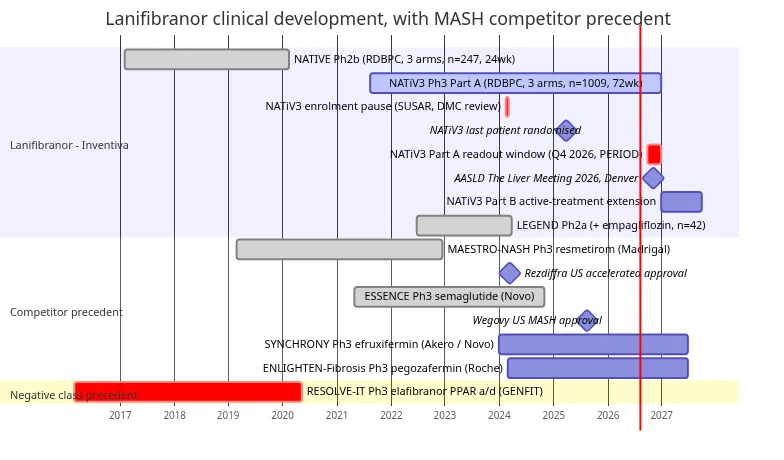
| NATiV3 | Inventiva Pharma / its own drug | Randomised, double-blind, placebo-controlled, two sequential parts. Part A: 72-week double-blind placebo-controlled period, three arms — lanifibranor 800 mg, 1200 mg, or placebo once daily. Part B: double-blind active-treatment extension, safety followed a further 48 weeks. n = 1,000 on the registry; the company reports 1,009 randomised in the main cohort, plus an exploratory cohort of about 410 patients who failed the histology screen. 459 sites in 24 countries; 194 in the United States, 71 in China, 27 in France | Adults 18+ with biopsy-proven MASH on central reading: SAF steatosis ≥1, SAF activity 3 or 4, fibrosis F2 or F3. Cirrhosis (F4) excluded. Patients on an approved MASH or obesity treatment excluded; TZDs within 12 months and concomitant fibrates excluded | Active, not recruiting. Enrolment completed 2025-04-01. No results posted. Part A topline guided to Q4 2026 | NCT04849728 |
| NATIVE | Inventiva Pharma / its own drug | Randomised, double-blind, placebo-controlled, dose-ranging. Three arms: 1200 mg, 800 mg, placebo, 24 weeks. n = 247, 85 sites | Adults with non-cirrhotic, “highly active” NASH: SAF activity 3 or 4. 42% type 2 diabetes; 76% moderate or advanced fibrosis | Met its primary endpoint at 1200 mg: ≥2-point fall in SAF-Activity without worsening fibrosis, 55% vs 33% placebo, p = 0.007. At 800 mg 48% vs 33%, p = 0.07 — not significant. Secondaries all favoured lanifibranor; numbers in A.5 | NCT03008070 · DOI 10.1056/NEJMoa2036205 |
| LEGEND | Inventiva Pharma / its own drug | Randomised, double-blind, placebo-controlled proof-of-concept: lanifibranor alone, plus empagliflozin, or placebo. n = 42 | Adults with MASH and type 2 diabetes | Completed 2024-03-30. Met its main efficacy goal: notable HbA1c fall in both active arms. This is bpiq_drug_id 16579 in ../company.md C.2 and carries no catalyst | NCT05232071 |
| Investigator-initiated Phase 2 in T2D and NAFLD | University of Florida / Inventiva’s drug, independent sponsor | Randomised, double-blind, placebo-controlled. n = 128 | Adults with type 2 diabetes and NAFLD | Completed 2023-04-18. 44% liver-fat reduction at 800 mg by magnetic resonance spectroscopy at 24 weeks. The one genuinely non-company efficacy signal in the file | NCT03459079 |
| Phase 2 in diffuse cutaneous systemic sclerosis | Inventiva Pharma | Randomised, double-blind, placebo-controlled. n = 145 | Diffuse cutaneous systemic sclerosis | Completed 2018-10; did not advance in this indication | NCT02503644 |
| Thorough QT / supra-therapeutic dose Phase 1 | Inventiva Pharma | Double-blind, placebo-controlled, moxifloxacin control. n = 36 | Healthy male volunteers | Completed 2019-08. Cardiac-safety groundwork | NCT03866369 |
| Chinese Phase 1 pharmacokinetics | Chia Tai Tianqing (CTTQ) / licensed rights | Single and multiple ascending dose. n = 24 | Healthy adult Chinese subjects | Completed 2023-11. Supports the CTTQ Greater China programme (B.3b) | NCT06126562 |
| MAESTRO-NASH (competitor precedent) | Madrigal Pharmaceuticals / resmetirom, not Inventiva’s drug | Randomised, double-blind, placebo-controlled Phase 3, 52-week serial biopsy, n > 950 | Non-cirrhotic MASH with fibrosis | Both primaries met, 2022-12-19: MASH resolution 26% / 30% vs 10% placebo. Supported the March 2024 US accelerated approval of Rezdiffra | [WEB ESTIMATE — Madrigal topline coverage, 2022-12-19] |
The registry date, decomposed. ClinicalTrials.gov’s primary completion date of 2027-09-30
is not the readout date and not a slip. The record carries two primary outcome measures: the
Week 72 histology endpoint for Part A, and a Part B safety analysis measured “48 weeks after
completion of DBPC period”. A registry primary completion date is the date of the last measurement
of the last primary outcome, so 2027-09-30 is the Part B safety date. The full source table and the
window judged from it are in the Readout section below. [VERIFIED — CT.gov NCT04849728 primary outcome list, re-read 2026-08-12]
Feasibility matrix
| Factor | High probability | Medium probability | Low probability | This asset (assessment) | Source |
|---|---|---|---|---|---|
| Recruitment feasibility | >50 sites, 3:1 patient:site | 20–50 sites, established investigators | <20 sites, novel sites | High, and no longer a risk. 459 sites for 1,009 randomised — thin per site, reflecting how hard biopsy-confirmed MASH is to enrol. Enrolment completed 2025-04-01; risk closed | CT.gov NCT04849728; company PR 2025-04-01 [VERIFIED] |
| Endpoint clarity | Regulatory precedent exists | Novel endpoint with FDA alignment | Unvalidated surrogate | Medium-to-high. The components have full regulatory precedent — Rezdiffra was approved on MASH resolution and fibrosis improvement as two separate endpoints. The composite has no approval precedent; it is a higher bar than the precedent was cleared at | Rezdiffra approval 2024-03 [WEB ESTIMATE]; CT.gov primary outcome [VERIFIED] |
| Trial-design robustness | Pivotal Phase III with SPA | Adaptive with interim analysis | Single-arm, no control | High. Randomised, double-blind, placebo-controlled, two active doses, central biopsy reading, n ≈ 1,009 — the strongest design available in the disease. No Special Protocol Assessment is disclosed, and none was found in either sweep | CT.gov [VERIFIED]; absence of an SPA [UNVERIFIED] |
| Operational / execution | Enrolment complete, standard timeline | Some timeline risk | Enrolment behind | High now, with one scar. Guidance has narrowed rather than slipped. But in February 2024 the company voluntarily paused screening and randomisation after a SUSAR of elevated liver enzymes in one patient, following DMC review, and resumed in early March 2024 under an amended liver-monitoring protocol with 913 already randomised | Company PRs 2024-02-15 and 2024-03-07 [WEB ESTIMATE — Fierce Biotech / Clinical Trials Arena coverage] |
Resourcing sufficiency. Adequate through this readout, deliberately. €233.9M of liquidity at
2026-06-30 against about €8.1M of monthly operating outflow, with a stated base runway to the end
of Q2 2027 — past the readout with margin — after the company front-ran its own catalyst in June
2026 with a $120M offering and a €130M debt facility. See ../company.md C.3.
What is not funded is everything after the readout: the extended runway to the start of Q1 2028
depends on Tranche C (€55M) and warrant exercises (€116M). Funding the filing and launch is
treated in B.3b.
A.3 Target label, target product profile, strategic questions, designations
A.3a Target label. Lanifibranor, taken once daily by mouth, for adults with non-cirrhotic
metabolic dysfunction-associated steatohepatitis and liver fibrosis at stage F2 or F3.
[VERIFIED — CT.gov NCT04849728 inclusion criteria]
A.3b Target product profile
| Attribute | Standard of care & key competitor(s) — data | Lanifibranor target profile (goal) | Supporting evidence (+ link) |
|---|---|---|---|
| Indication / target label | Two drugs approved for this exact population. Resmetirom (Rezdiffra, Madrigal), oral THR-beta agonist: US accelerated approval March 2024 for MASH with F2–F3 fibrosis, EU approval 2026, $958.4M net sales 2025 and $311M in Q1 2026 alone. Semaglutide 2.4 mg (Wegovy, Novo Nordisk), weekly injection: US MASH approval August 2025. Behind them, two injected FGF21 analogues in Phase 3 — efruxifermin (Akero, acquired by Novo Nordisk) and pegozafermin (89bio, acquired by Roche) — plus earlier-stage incretins (tirzepatide; DD01, a GLP-1/glucagon dual agonist with strong 12-week Phase 2 liver-fat data published July 2026) | Identical label to Rezdiffra’s. Lanifibranor would be the second oral and the third or fourth entrant overall | Competitor figures [WEB ESTIMATE — Fierce Pharma, BioSpace, PharmaVoice, DataLookout, 2025–2026]; DD01 [VERIFIED — [DOI 10.1016/S2468-1253(26)00130-5](https://doi.org/10.1016/S2468-1253(26)00130-5), per PubMed] |
| Efficacy (endpoints, regimen) | Resmetirom, 52 weeks: MASH resolution 26% / 30% vs 10% placebo. Semaglutide (ESSENCE): 28.7-point placebo-adjusted advantage on MASH resolution. Efruxifermin (SYMMETRY 36-week): fibrosis improvement 22% / 24% vs 14% — missed | On the 24-week Phase 2b composite, 35% vs 9% placebo. The Phase 3 goal is a double-digit placebo-adjusted advantage on the composite over 72 weeks at two doses | NEJM 2021 [VERIFIED]; competitor figures [WEB ESTIMATE] |
| Safety / tolerability | Resmetirom: diarrhoea, nausea, drug-interaction-heavy label. Semaglutide: gastrointestinal effects and weight loss, which patients and payers regard as a benefit | The weak column. Weight gain, peripheral oedema, anaemia, diarrhoea, nausea all more frequent than placebo in Phase 2b; blinded weight-gain trend confirmed in Phase 3. Mitigating fact: dropout for adverse events under 5% and similar across arms | NEJM 2021 [VERIFIED — [DOI 10.1056/NEJMoa2036205](https://doi.org/10.1056/NEJMoa2036205)] |
| Biomarker / companion diagnostic | None used in this class; entry is by biopsy | None used in NATiV3. The company’s serum-biomarker signature (AUC ~0.81, developed on Phase 2b data) is a research asset, not a companion diagnostic | Clin Gastroenterol Hepatol 2025, DOI 10.1016/j.cgh.2024.12.039 [VERIFIED — per PubMed; eight of twelve authors are Inventiva employees] |
| Formulation / administration | Rezdiffra: once-daily tablet. Wegovy: weekly self-injection. FGF21s: injection | Once-daily tablet, 800 or 1200 mg. Conventional achiral small molecule, cheap to make | ChEMBL CHEMBL4091374 [VERIFIED] |
| Payer value | Rezdiffra’s 2025 net sales establish both that payers will fund a MASH drug and roughly what they will fund | Must justify a price against an entrenched oral incumbent and a GLP-1 that also treats the driving obesity/diabetes. Realistically a combination and second-line argument | [WEB ESTIMATE — Madrigal FY2025 / Q1 2026 results coverage, 2026] |
A.3c Strategic Go/No-Go questions. The asset is in Phase 3 and reading out, so the pre-Phase-III / registration set applies.
| Group | Question | Answer (tagged) |
|---|---|---|
| Target | Target revalidated as in prior phases? | Partly. Pharmacological validation via pioglitazone is solid and independent of this molecule. Human genetic validation still unchecked — Open Targets blocked in both sweeps. [VERIFIED — Hepatology 2025 NMA] / [UNVERIFIED — genetics] |
| Dose & Drug | Exposure–response for the intended commercial regimen? | Yes, and it is why two doses are carried. Phase 2b dose separation: 1200 mg hit at p = 0.007, 800 mg missed at p = 0.07. Carrying both protects against the higher dose proving intolerable over 72 weeks. [VERIFIED — NEJM 2021] |
| Dose & Drug | Commercial formulation available or feasible? | Yes. Conventional oral small molecule, no chirality, no formulation challenge disclosed. [VERIFIED — ChEMBL] |
| Dose & Drug | Dose range compatible with clinical and non-clinical safety? | Yes, with a caveat. Dedicated supra-therapeutic cardiac safety study completed 2019. The 2024 SUSAR of elevated aminotransferases produced a stricter liver-monitoring schedule, not a dose change. [VERIFIED — NCT03866369] / [WEB ESTIMATE — 2024 pause coverage] |
| Dose & Drug | Therapeutic window given the clinical response? | Narrow on tolerability, not toxicity. The dose-limiting issues are weight gain and oedema — mechanism-linked and dose-related, not organ toxicity. [VERIFIED — NEJM 2021] |
| Dose & Drug | Intrinsic and extrinsic factors influencing exposure and response? | Partially characterised. Population pharmacokinetic modelling is a stated Part A secondary objective, so the answer arrives with the readout. A dedicated Chinese Phase 1 supports the CTTQ programme. [VERIFIED — CT.gov; NCT06126562] |
| Patient | Proof of concept and positive benefit/risk in the intended population? Combination evidence? | Yes on proof of concept; combination evidence is early. Phase 2b enrolled the same SAF-activity 3–4 population and hit. Combination evidence is one 42-patient Phase 2a with an HbA1c endpoint — real, far too small for a claim. [VERIFIED — NEJM 2021; NCT05232071] |
| Patient | Phase III design and outcome criteria — accepted, compelling, competitive? | Accepted and compelling; competitive is the open question. The composite is more demanding than the two separate endpoints Rezdiffra was approved on, so a win supports a stronger claim. Market access is where the profile is weakest, because of weight gain against weight-losing competitors. [VERIFIED — CT.gov] / [UNVERIFIED — access judgement] |
| Patient | Rationale for the patient population(s)? | Strong. F2–F3 non-cirrhotic MASH is where fibrosis still reverses and where both approved drugs are labelled. [VERIFIED — CT.gov inclusion criteria] |
| Patient | Likelihood of the expected outcome? | Modelled at 55%, band 40–70%, tied to the settlement definition below. [UNVERIFIED — modelled; reasoning in the locked prediction] |
| Patient | Companion-diagnostic strategy? | None. The serum signature is response-prediction research, not patient selection; nothing in the label depends on it. [VERIFIED — CT.gov; CGH 2025] |
A.3d Regulatory designations.
- FDA Fast Track, granted September 2019 for lanifibranor in NASH. Grants more frequent FDA
meetings and eligibility for rolling review.
[VERIFIED — company press feed, 2019-09-26] - FDA Breakthrough Therapy, granted October 2020. Grants everything Fast Track does plus
intensive senior-reviewer guidance and organisational commitment. Awarded on preliminary clinical
evidence of substantial improvement, so also a signal of how the FDA read the Phase 2b data at
the time.
[VERIFIED — company press feed, 2020-10-12] - No Special Protocol Assessment is disclosed for NATiV3, and none was found in either sweep.
Worth stating explicitly: an SPA would be the strongest available evidence that the FDA has
pre-agreed the composite endpoint supports approval.
[UNVERIFIED — absence of evidence, not evidence of absence] - No orphan designation, and none would be expected: MASH is a mass-market disease.
A.4 Target product profile valuation matrix
| Stakeholder | Value driver | Minimum threshold | Competitive | Premium | Benchmark / source |
|---|---|---|---|---|---|
| Patient / caregiver | An oral tablet that reverses liver scarring without an injection or gastrointestinal upset | Any statistically significant histological benefit over placebo | Matches Rezdiffra’s ~10–16-point placebo-adjusted benefit, in a tablet | Beats it on the composite and avoids meaningful weight gain | Rezdiffra MAESTRO-NASH [WEB ESTIMATE]. Assessment: plausibly reaches Competitive on efficacy; falls short of Premium on tolerability |
| Regulator | A histological endpoint reasonably likely to predict clinical benefit, well controlled | One primary met with a clean safety database | Composite met at one dose, consistent direction at the other | Composite met at both doses with dose-ordering, plus a stand-alone fibrosis effect | FDA’s accelerated-approval framework as applied to Rezdiffra [WEB ESTIMATE] |
| Payer / HTA | Slowing progression to cirrhosis, transplant and liver cancer | Approval, price at or below the incumbent | Fibrosis benefit at least matching Rezdiffra’s, combinable oral profile | Outcome data, or a demonstrated diabetic-subgroup advantage | Rezdiffra’s 2025–2026 sales establish payer willingness [WEB ESTIMATE] |
| Provider | A tablet prescribable by hepatologists and endocrinologists without new workflow | Oral, once daily, no new monitoring burden | Plus straightforward combination with a GLP-1 or SGLT2 inhibitor | An advantage specifically in type 2 diabetes — one tablet, two problems | LEGEND Phase 2a HbA1c result [VERIFIED — BPIQ historical catalyst 2025-01-22] |
The framework’s calibration examples — $150–300M of peak-sales potential per incremental month of overall survival in oncology; 15–25% oral-over-injectable price premiums — are calibration only. The second is directionally relevant: the oral route is a genuine advantage over three injected competitors, partly offset by the weight-gain profile.
A.5 Evidence quality and endpoints
| Criterion | Score (High / Medium / Low) | Basis (one line) | Link |
|---|---|---|---|
| Target validation | Medium-high | Pharmacologically validated in humans by a different molecule (pioglitazone); genetics unchecked (Open Targets blocked, both sweeps) | DOI 10.1097/HEP.0000000000001254 |
| Mechanism clarity | High | Three named nuclear receptors with separately published functions; activity at each established; the side-effect profile follows predictably from PPAR-gamma | DOI 10.1016/j.cct.2020.106170 |
| Biomarker availability | Low | No qualified biomarker replaces biopsy. The company’s serum signature (AUC ~0.81) is research-grade, nowhere near a regulatory endpoint | DOI 10.1016/j.cgh.2024.12.039 |
| Publication quality (peer-reviewed? independent authors?) | High | Pivotal Phase 2b in the NEJM, first author from Antwerp University Hospital, academic co-authors across countries. Independent groups keep working on the molecule (2026 Nature conjugate paper) | DOI 10.1056/NEJMoa2036205 · DOI 10.1038/s41586-026-10427-5 |
| Clinical / expert sentiment | — | Moved to A.5b, below. | — |
Endpoints
| Endpoint (full name) | What it measures | Scale / range | Better direction | MCID / note |
|---|---|---|---|---|
| Primary, Part A — Resolution of MASH and improvement of fibrosis at Week 72 | A single composite per patient on the end-of-treatment biopsy vs baseline. Requires all three: NASH CRN ballooning = 0; lobular inflammation 0 or 1; fibrosis decreased ≥1 stage | Binary per patient; % responders per arm | Higher is better | No established MCID for a histological composite in MASH. Usable benchmark: resmetirom’s ~16–20-point placebo-adjusted delta on MASH resolution and ~10–12 on fibrosis, each as a separate endpoint. Lanifibranor’s 24-week Phase 2b composite delta was 26 points at 1200 mg |
| Primary, Part B — Safety analyses | Adverse events, adjudicated liver events, drug-induced liver injury, major adverse cardiac events, 48 weeks after the double-blind period | Event counts and rates | Lower is better | Sets the registry primary completion date of 2027-09-30. Not the event this prediction settles on |
| Key secondary — MASH resolution without worsening of fibrosis | Ballooning 0, inflammation 0–1, fibrosis not worse | Binary, % | Higher is better | Lanifibranor’s strongest endpoint. Phase 2b: 49% (1200 mg) / 39% (800 mg) vs 22% placebo. One of the two endpoints Rezdiffra was approved on. A trial that hits this and misses the composite is the most likely messy outcome — and scores as a miss under the settlement definition below |
| Key secondary — Improvement of fibrosis ≥1 stage without worsening of MASH | Fibrosis falls ≥1 stage, activity not worse | Binary, % | Higher is better | The weak half. Phase 2b: 48% / 34% vs 29% placebo — favourable but unpowered; pooled analyses put it at OR 1.26, p = 0.08 |
| Supporting secondaries | Liver enzymes; glycaemic and lipid parameters; elastography; quality of life | Continuous, various | Depends | Phase 2b: enzymes fell, most blood markers improved. HDL +9.87%, triglycerides −26.90% in pooled analysis |
A.5b Key opinion leaders.
The registry lists no overall officials for NCT04849728 and all 459 site contact fields are null, so the investigator table below is built from the pivotal publications instead; the independent voices are the meta-analysts who have published on this exact endpoint. No aggregate score is computed (rule 41).
Panel as of. 2026-08-12.
Investigators
| Name | Role / affiliation | Trial (NCT) | Conflicts (party, kind, disclosed in, as of) | Conflicts checked (source, date) | Source | Tag |
|---|---|---|---|---|---|---|
| Sven M. Francque | First author of the pivotal Phase 2b publication; Antwerp University Hospital | NCT03008070 | — (the trial relationship itself is the disclosed one) | PubMed get_article_metadata PMID 34670042, 2026-08-12 — the metadata carries no conflict-of-interest field; NEJM disclosure forms not retrieved. CT.gov NCT04849728 read 2026-08-12 — lists no officials | PubMed, DOI 10.1056/NEJMoa2036205 | VERIFIED — PubMed author record; role beyond authorship UNVERIFIED |
| Pierre Bedossa | Co-author, pivotal Phase 2b (pathology) | NCT03008070 | — | Same two searches as above | Same | VERIFIED — PubMed author record |
| Vlad Ratziu | Co-author, pivotal Phase 2b | NCT03008070 | — | Same two searches as above | Same | VERIFIED — PubMed author record |
| Quentin M. Anstee | Co-author, pivotal Phase 2b | NCT03008070 | — | Same two searches as above | Same | VERIFIED — PubMed author record |
Independent voices
| Name | Affiliation | View (close enough to quote) | As of | Conflicts checked (source, date) | Source | Tag |
|---|---|---|---|---|---|---|
| Matheus Souza (first author, network meta-analysis) | Federal University of Rio de Janeiro | Lanifibranor is among agents significantly better than placebo for MASH resolution, and is not among agents significantly better than placebo for fibrosis regression | 2025-02-04 | PubMed get_article_metadata PMID 39903735, 2026-08-12 — no COI field in metadata; no sponsor relationship found. Caveat: the paper’s own author list includes Rohit Loomba, a NATIVE co-author, so the paper is not wholly sponsor-independent even though its first author appears to be | PubMed, DOI 10.1097/HEP.0000000000001254 | VERIFIED — published analysis; independence UNVERIFIED beyond the searches named |
| Shuai Zhao (first author, meta-analysis) | Hebei North University | Lanifibranor “did not achieve a statistically significant improvement in fibrosis (OR 1.26, p = 0.08)” while improving lipid profiles | 2026-03-31 | PubMed get_article_metadata PMID 41917519, 2026-08-12 — no COI field in metadata; no sponsor relationship found; all-China academic affiliations | PubMed, DOI 10.1007/s11739-026-04326-w | VERIFIED — published analysis; independence UNVERIFIED beyond the searches named |
Judgement
| Endpoint supported | Basis (one or two sentences) | Tag |
|---|---|---|
| MIXED | The independent analyses support the MASH-resolution half of the composite and consistently find the fibrosis half non-significant at Phase 2b scale. No independent voice was found endorsing the composite itself, and none was found calling the trial futile either. | UNVERIFIED — judgement |
Dissent
None recorded — MIXED carries no contest to name.
| Name | View (close enough to quote) | Source |
|---|
B. Commercial assessment
B.0 Current treatment algorithm
What a patient with MASH and F2–F3 fibrosis receives today, in order:
- Weight loss and metabolic management, for everyone. Diet, exercise, control of diabetes, blood pressure and lipids. A 10% body-weight reduction improves MASH histology on its own — which is why any drug that causes weight gain starts at a disadvantage.
- A drug for the metabolic driver, where indicated. Semaglutide 2.4 mg (Wegovy), FDA-approved for MASH since August 2025, treats the liver disease and the driver together. Pioglitazone and vitamin E are used off-label in subgroups.
- A liver-directed oral. Resmetirom (Rezdiffra), approved March 2024 for exactly this population: $958.4M of 2025 net sales and $311M in Q1 2026. The incumbent oral.
- Coming: injected FGF21 analogues. Efruxifermin (Novo Nordisk, via the Akero acquisition) and pegozafermin (Roche, via 89bio), with pegozafermin’s ENLIGHTEN-Fibrosis topline guided to H1 2027, and Phase 3 intensity building through 2027–2028 (SYNCHRONY, ENLIGHTEN, ZENITH). Earlier, incretins keep encroaching: tirzepatide, and DD01’s strong 12-week Phase 2 liver-fat data published July 2026.
[WEB ESTIMATE — Fierce Pharma, BioSpace, PharmaVoice, Clinical Trials Arena, DataLookout coverage 2025–2026] [VERIFIED — DD01: [DOI 10.1016/S2468-1253(26)00130-5](https://doi.org/10.1016/S2468-1253(26)00130-5), per PubMed]
Where lanifibranor would fit. Not at the front. On the profile it is likely to have, it fits as
a second oral, used after or alongside a metabolic drug, with two plausible niches: patients
with type 2 diabetes, where PPAR-gamma activation does two jobs at once (what LEGEND was built to
explore), and combination with an SGLT2 inhibitor or GLP-1 whose weight loss offsets lanifibranor’s
weight gain. Both niches are real and both are narrower than the label the trial is designed to
win. [UNVERIFIED — positioning judgement on the verified mechanism and landscape]
B.1 Competitive landscape and positioning
| Metric | High value | Medium value | Low value | This asset (assessment) | Source |
|---|---|---|---|---|---|
| Mechanism differentiation | First-in-class or novel target | Next-generation improvement | Me-too | High. No pan-PPAR agonist is approved in any indication; nothing else in MASH works this way; no overlap with the thyroid-receptor, GLP-1 or FGF21 agents. Genuinely first-in-class — and genuinely unproven at Phase 3 | ChEMBL; landscape [VERIFIED / WEB ESTIMATE] |
| Development-timeline advantage | >12 months ahead | Within 6–12 months | Lagging >12 months | Low. Roughly four years behind Rezdiffra and one behind Wegovy; the ~6-month readout lead over the FGF21s converts to little because those are owned by Novo Nordisk and Roche | Approval dates, competitor guidance [WEB ESTIMATE] |
| Clinical proof-of-concept evidence | Positive Phase IIb (n>100) | Phase IIa signals | Preclinical only | High. Positive randomised Phase 2b, n = 247, NEJM, primary met at p = 0.007, 26-point delta on the exact composite Phase 3 registers | NEJM 2021 [VERIFIED] |
| IP protection | Composition-of-matter, long-dated | Method-of-use | Pending or none | Partially established — improved from “not established” on 2026-08-04. The 20-F discloses six US patents expiring by December 2026, September 2027, June 2035, November 2039 and December 2041 (excluding any patent-term extension), plus ~150 patents in ~55 jurisdictions, covering the molecule, methods of making and using it, polymorphic forms, combinations and diagnostics. Which expiry attaches to the composition-of-matter claim is not stated in the excerpt read, so the effective wall is bounded (2035–2041 for the long-dated families) rather than pinned | [WEB ESTIMATE — Inventiva 20-F patent disclosure (SEC), read via web-search excerpt, 2026-08-12. Limit: the filing section was not read directly and the claim-type mapping is unverified] |
Where this asset wins, and the single fact the thesis rests on.
It wins on mechanism and on the size of the Phase 2b effect, and nowhere else. Everything else about the competitive position is unfavourable: third or fourth into a market with an entrenched oral, an approved GLP-1 that also treats the underlying obesity, two injectables owned by Novo Nordisk and Roche, and incretin data improving behind them. Its defining side effect — weight gain — is the exact opposite of what this market has learned to value.
The single fact the thesis rests on: on the exact composite endpoint NATiV3 is registered
against, Phase 2b produced 35% responders on lanifibranor 1200 mg against 9% on placebo, in 247
randomised patients, over 24 weeks, in the New England Journal of Medicine.
[VERIFIED — [DOI 10.1056/NEJMoa2036205](https://doi.org/10.1056/NEJMoa2036205)] A 26-point
absolute separation on a hard composite is not a marginal signal, and Phase 3 gives the drug three
times as long to produce it. If that effect is even half real, the Phase 3 arithmetic works
comfortably. The entire bull case is that this number is real; the entire bear case is that it is
not.
Calibration note, not an asset claim: the framework records that oncology first-movers in novel mechanisms show roughly 3.2× higher peak-sales potential and 1.8× higher development risk. Lanifibranor is a first-in-class mechanism arriving late — the unfavourable half of that trade-off without the favourable half.
B.2 Addressable market
Launch markets: the United States first, then the EU5 and Japan. Greater China is licensed to Chia Tai Tianqing and returns royalties rather than sales — see B.3b.
| Component | How it is estimated | Premium threshold | This asset (assessment) | Source |
|---|---|---|---|---|
| Drug-treated patients | Epidemiology × diagnosis rate × treatment rate | >100,000 (US/EU5/Japan) | Threshold cleared on epidemiology; the binding constraint is diagnosis. Millions have F2–F3 MASH across these markets but most are undiagnosed. Rezdiffra’s realised sales ($958.4M in 2025, $311M in Q1 2026) are the only hard datapoint on reachable, treated patients, and are what this analysis anchors on | Rezdiffra sales [WEB ESTIMATE — StockTitan 2026-02; PharmaVoice 2026]; prevalence [UNVERIFIED — no epidemiology source retrieved] |
| Market exclusivity | Patent term + regulatory exclusivity | >10 years combined | Likely cleared, imprecisely. US new-chemical-entity exclusivity gives five years from approval (ten in the EU); the 20-F’s long-dated patent families run to 2035–2041, but which covers composition of matter is unverified | [WEB ESTIMATE — 20-F patent disclosure via web-search excerpt, 2026-08-12] |
| Reimbursement precedent | Approvals in ≥2 major markets | Positive NICE/CADTH guidance | Established by the incumbent. Resmetirom is approved in the US and EU and reimbursed at scale in the US, replacing “can a MASH drug be funded” with “what can a third entrant charge” | [WEB ESTIMATE — Pharmaceutical Technology, 2026] |
| Patient-journey impact | Fewer hospital days, less caregiver burden | >30% quality-of-life gain | Unquantified, and will stay so at this readout. Health-related quality of life is a Part A secondary, so a number will exist; no MASH trial has yet shown a histological improvement translating into fewer hospital days | CT.gov detailed description [VERIFIED] |
B.3 Value and feasibility
B.3a Expected peak sales. Built bottom-up as patients × annual net price × peak share, anchored on the one observed commercial datapoint in this disease rather than on prevalence. Every figure is conditional on Phase 3 success and approval, and excludes Greater China (CTTQ royalty instead). The weakest input is the treated-patient count; no defensible forward number exists.
| Scenario | Assumptions (patients × price × share) | Estimate (USD/year at peak) | Basis / tag |
|---|---|---|---|
| Low | ~15,000 treated patients across US/EU5/Japan × $28,000 net | ~$0.4B | Niche third-line oral used mainly in type 2 diabetes; weight-gain profile keeps it off preferred tiers [UNVERIFIED — modelled; patient count is the unverified input] |
| Base | ~40,000 × $30,000 | ~$1.2B | A meaningful minority share of the oral segment, comparable to Rezdiffra’s second year, in a market grown by better diagnosis [UNVERIFIED — modelled; anchored on verified Rezdiffra sales] |
| High | ~80,000 × $32,000 | ~$2.6B | Composite hit convincingly at both doses; combination use becomes standard; non-invasive diagnosis expands the market [UNVERIFIED — modelled] |
How this compares with the published estimates. Truist supports $2.3B of worldwide peak
adjusted revenue on base-case third-line use; Jefferies raised its estimate to $2.6B after the
Phase 2b result; UBS models peak adjusted sales of only about €700M and holds off the stock
[WEB ESTIMATE — Truist via Investing.com 2026-03-18; Jefferies via pharmaphorum; UBS via Investing.com, 2026]. The spread — roughly €0.7B to $2.6B — is itself information: the sell side
does not agree on what a third entrant with a weight-gain label can earn. The Jefferies figure
predates the Rezdiffra and Wegovy approvals and describes a market that no longer exists. Named
per rule 1; none adopted.
B.3b Feasibility
| Question | Answer (tagged) |
|---|---|
| Expected net present value (eNPV) | A range, not a figure (rule 10). Conditional on a positive readout, assuming 70–85% approval probability given success, peak sales $0.4–2.6B, a 2029 launch, 10–12% discount rate: roughly $1.5–3.5B for the ex-China rights at full economics, about half if partnered away. Applying the 55% outcome probability gives an unconditional $0.6–1.6B against a recomputed enterprise value of about $930M (../company.md C.4). The market prices the middle of that band, which is a coherent place to be [UNVERIFIED — modelled; approval probability, discount rate and patient counts all unverified] |
| Capital to the next decision point | Already in hand. €233.9M at 2026-06-30, base runway to end Q2 2027 — past the readout. See ../company.md C.3 |
| Capital to approval, and the funding plan | Not fully funded. NDA filing guided to H1 2027, approval decision 2028. The extended runway to start Q1 2028 depends on Tranche C (€55M) and Tranche 3 warrant exercises (€116M); realistically an equity raise into a positive readout follows [VERIFIED — 6-K/A 2026-07-30 via StockTitan summary] / [WEB ESTIMATE — H1 2027 filing guidance from analyst coverage] |
| Launch capability — alone, or must partner? | Must partner, or raise very heavily. No commercial infrastructure, against Madrigal’s established hepatology salesforce and against Novo Nordisk and Roche. A partnership or outright sale is the base case on a positive readout, which itself caps upside relative to the peak-sales figures [UNVERIFIED — judgement on the verified financial position] |
| Commercialisation rights — retained, split, or out-licensed? | Retained worldwide except Greater China. September 2022: exclusive CTTQ (Sino Biopharm) licence — $12M upfront, up to $290M milestones, tiered royalties high-single-digit to mid-teens of Greater China net sales; a $10M milestone was received July 2025 [WEB ESTIMATE — 2022-09-21 agreement coverage] / [VERIFIED — the $10M receipt, company press feed 2025-07-07] |
B.4 Product-development risk
Framing questions.
- Does the development plan support the target product profile claims? Yes, and more than necessary: the composite primary is a harder bar than either endpoint the incumbent was approved on, so a win supports a stronger claim. The risk created by that choice runs the other way — the plan can succeed clinically on the endpoints doctors care about and still fail the endpoint it registered.
- Will the identified risks affect the target product profile? Yes, one badly. Weight gain and fluid retention are mechanism-linked, dose-related and already demonstrated, and they attack the payer-value and provider-preference rows directly. They cannot be designed away because they are what PPAR-gamma activation does.
- If a risk cannot be mitigated, is the asset still differentiated? Yes, narrowly. A first-in-class oral pan-PPAR agonist with a strong composite histological result stays differentiated even with a weight-gain label, because nothing else works this way and combination with a weight-losing agent is a coherent answer. Differentiation into a niche, not the front line.
| Category | Time risk | Quality risk | Cost risk | Note |
|---|---|---|---|---|
| Project management | Low | Low | Low | Enrolment closed on schedule April 2025; guidance narrowed from H2 to Q4 2026 rather than slipping |
| Research | Medium | Mechanism clear; target genetics unverifiable (Open Targets blocked, both sweeps) | ||
| IP | Medium | Improved from High on 2026-08-04: the 20-F discloses the patent estate (long-dated families to 2035–2041), but the claim-type mapping is unverified | ||
| Legal | No litigation found in the press feed | |||
| DMPK | Low | Low | Low | Conventional oral small molecule; population PK is a Part A secondary |
| Safety pharmacology | Low | Dedicated supra-therapeutic cardiac safety study completed 2019 | ||
| Toxicology | Low | No preclinical toxicology signal disclosed | ||
| Drug safety (clinical) | Medium | High | The near-veto category. A single SUSAR of elevated aminotransferases halted screening in February 2024, with DMC review and a protocol amendment. Drug-induced liver injury is separately adjudicated as a Part B primary safety measure. In a liver drug, a liver-safety signal in the 1,009-patient dataset would dominate any efficacy result. Mitigant: Phase 2b dropout for adverse events under 5%, similar across arms | |
| Biomarker | Medium | No qualified biomarker; biopsy unavoidable — noisy endpoint, expensive trial | ||
| Clinical pharmacology | Low | Two doses carried with a demonstrated Phase 2b dose separation | ||
| Clinical (efficacy) | High | The composite is harder than either component and the fibrosis component has the weakest published support. The single largest risk in the table | ||
| Clinical operations | Low | Medium | Medium | 459 sites, 24 countries, central biopsy reading — the correct mitigation for the variability broad geography adds |
| CMC / manufacturing | Low | Low | Low | Conventional achiral small molecule |
| Regulatory | Medium | Medium | Breakthrough Therapy and Fast Track granted. No SPA disclosed, so no public evidence the FDA pre-agreed the composite endpoint | |
| Global evidence & value | Medium | High | No outcome data or quality-of-life precedent in the class; ex-US HTA bodies will press a third entrant hard | |
| Commercial | High | High | Third or fourth entrant, no commercial infrastructure, weight-gain profile against an oral incumbent and weight-losing competitors |
Readout
Sources
| Kind | Where it comes from | What it is worth | Value (or null) | Tag | Note |
|---|---|---|---|---|---|
bpiq | fetch_company_drugs — catalyst_date, catalyst_date_text | The current single source. Synthesized from period text, so alone it is a ceiling, not an estimate. | 2026-12-31 (text “H2 2026”) | VERIFIED — BPIQ fetch_company_drugs 2026-08-12 | Period-end placeholder, not a disclosed day (rule 23). The row’s own note (2026-05-26) narrows it: “NATiV3 Ph3 topline results now expected in Q4 2026” |
ctgov | CT.gov get_trial_details — primary_completion_date | Independent of company messaging, month-precision, moves when the trial moves. | 2027-09-30 | VERIFIED — CT.gov NCT04849728, read 2026-08-12 | Dates a different measurement. The record carries two primary outcomes; this date tracks the Part B safety analysis (48 weeks after the double-blind period), not the Part A topline this prediction settles on. Unchanged since 2026-08-04. Not read as a slip |
company | fetch_company_press_releases / company releases | The company’s own most recent dated wording. | 2026-10-01/2026-12-31 (text “Q4 2026”) | VERIFIED — Inventiva Q1 2026 financial release, 2026-05-26, via the BPIQ note and catalyst_source URL | Mandatory — the catalyst is inside twelve months. Reiterated in third-party coverage dated 2026-08-06 (“eyeing key Phase 3 results in Q4 2026”). The H1 2026 results 6-K/A (2026-07-30) does not restate a timing figure in the summary read |
congress | data/congresses.json | Answers “where will they say it” — only when the company has said it will present there. | null | VERIFIED — data/congresses.json checked 2026-08-12; no statement of intent found | AASLD The Liver Meeting 2026 (2026-11-05/09, Denver) sits inside the window and Inventiva has presented at every recent edition, but no source says the NATiV3 topline will be presented there. Venue habit is not a source (02-connectors.md § Data limits). Watch item, not a source |
modelled | Trial arithmetic — see below | The only estimate independent of anyone’s guidance. | 2026-10/2026-12 | UNVERIFIED — modelled, default lag | Agrees with the company’s Q4 2026 guidance from independent inputs |
The modelled estimate. Last patient randomised 2025-04-01, so the last Week-72 biopsy falls
around 2026-08-18. Adding rule 34’s stated default of two to four months to database lock,
analysis and topline gives mid-October to mid-December 2026. data/benchmarks/readout-lag.json
holds no comparable observation, so the default applies and the tag says so.
Window
| Earliest | Likeliest | Latest | Precision | Confidence |
|---|---|---|---|---|
| 2026-10-01 | 2026-11-15 | 2026-12-31 | PERIOD | MEDIUM |
Basis. The company’s own guidance (“Q4 2026”, 2026-05-26, never walked back) and the independent trial arithmetic (last biopsy ~2026-08-18 plus the default lag) agree on the quarter, and nothing narrows it to a month. Likeliest sits mid-window: AASLD (2026-11-05/09) is a natural communication focal point the company has used every recent year, but it is not a source, and the modelled arithmetic is centred there anyway. Precision is PERIOD because a quarter is all any source names; confidence is MEDIUM because guidance has only ever tightened, enrolment completed on schedule, and the arithmetic corroborates it — but no interim look or dated announcement pins it.
Disagreement. CONSISTENT. The sources that speak to the Part A topline — bpiq (“H2 2026”,
containing Q4), company (“Q4 2026”) and modelled (mid-Oct to mid-Dec) — agree. The registry’s
2027-09-30 dates the Part B safety outcome, a different measurement, and stops being a conflict
once decomposed (explained in A.2 and in the ctgov row’s own note).
Date slippage.
| As of | Guidance text |
|---|---|
| 2026-05-26 | ”NATiV3 Ph3 topline results now expected in Q4 2026” |
Zero slips. The BPIQ note holds one dated entry, and the transition it records — “H2 2026” to
“Q4 2026” — is a narrowing, not a push-back. There is no record in this feed of the date ever
moving later. That remains a genuinely favourable execution signal. (The catalyst_date_text
field still reads “H2 2026” against the note’s “Q4 2026” — an internal inconsistency in the BPIQ
record, flagged in ../company.md C.8 since 2026-08-04.)
Attribution
Status. CLEAN
Computed by lib/clustering.mjs’s attributionFor over every has_catalyst row on the IVA
pipeline, 2026-08-12: {"status": "CLEAN", "conflicts": []}. Lanifibranor is the only row with a
catalyst — the other three rows are a no-catalyst Phase 2a and two discontinued programs — so no
other event on this ticker can land inside the window, and a price move around this readout is
attributable to it alone.
Conflicts
Empty — Status is CLEAN.
| bpiq_drug_id | Label | Date | Analysed? | Gap (days) | Confirmed? |
|---|
Note. Not required for CLEAN.
Market and timing for this event
- Plain takeaway. The setup is still favourable but no longer pristine: the shares have begun to move toward the event. Up 25% off the 2026-06-15 trough of $3.76, at $4.72 they still sit at only 29.6% of the 52-week range, 41% below the high, 7% above the June offering price — while short interest builds and daily volume runs $2–6M.
- Months to this catalyst. From 2026-08-12 to
readout.window.earliest(2026-10-01): seven weeks; to the latest edge (2026-12-31): about 4.6 months. The window’s precision is PERIOD — a quarter, not a month or a day. - Expected move around this event.
../company.mdC.6 records the options chain as unusable — $2.50 strike spacing on a $4.72 share, spreads wider than mids, floor artifacts. No point estimate exists. The honest bracket, from peer precedent rather than the chain, is 50% to 200% up on a clean win and 50% to 75% down on a miss — see the scenario table. - Nearest comparable past reaction. None in
../company.mdC.7 is comparable, and that is the finding. The closest analogue (a blinded NATiV3 interim, 2024-07-05) moved the stock 5.0%; the largest recorded move is 8.1%. External peers bracket the event instead: Madrigal +250–300% intraday on positive MAESTRO-NASH Phase 3 topline (2022-12-19) and Akero −63% on a mixed Phase 2b readout (2023-10-10)[WEB ESTIMATE — 2022–2023 coverage]. Neither is perfect — Madrigal was first into an empty market; Akero was Phase 2b — but they bracket the plausible reaction better than anything in this company’s history. - Materiality. Dominant, per
../company.mdC.2. The only program with a disclosed catalyst; every financing since October 2024 was raised to reach it. The stock-direction call below is scaled accordingly (rule 27). - Date slippage. Zero slips; one narrowing (Readout, above). Still the one clean execution signal this program has.
Spot. $4.72 — the 2026-08-11 close, read 2026-08-12, cited from
../company.md C.4 (which also documents the one-session lag in the BPIQ quote).
Scenario prices
| Scenario | Low | High | Anchors (each named and tagged) | Basis |
|---|---|---|---|---|
| Positive | $7.00 | $13.00 | (1) 52-week high $7.983 [VERIFIED — data/prices/IVA.json via ../company.md C.4]. (2) Published analyst consensus price target $15.13 across 13 analysts, individual targets $8.80–$26 [WEB ESTIMATE — stockanalysis.com consensus and Investing.com, read 2026-08-12]. (3) Peer precedent: Madrigal +250–300% intraday on positive Phase 3 MASH topline, 2022-12-19 [WEB ESTIMATE — Motley Fool / proactiveinvestors, 2022-12-19] | A clean composite win should at minimum reclaim the 52-week high, which sets the floor just below $7.98. The ceiling stops short of the $15.13 consensus because that is a twelve-month target assuming approval and a ramp, not an event-day price. The Madrigal precedent would imply far more and is discounted heavily: Madrigal was first into an empty market at a smaller market capitalisation, whereas Inventiva would be a third entrant still needing to fund a filing and launch |
| Miss | $1.00 | $2.00 | (1) 52-week low $3.35 [VERIFIED — data/prices/IVA.json via ../company.md C.4]. (2) Cash per share $1.15, on the company-reported €233.9M at 2026-06-30 and the filed 236,280,202-share count [UNVERIFIED — modelled; inputs verified, conversion rate is a June 2026 company rate]. (3) Dilution mechanism that fires on the event: ~€75M of drawn senior debt ranks ahead of equity, and the remaining Tranche C plus 15.7M EIB warrants are what the company’s extended runway depends on [VERIFIED — company releases 2026-06-12 / 2026-07-09 and 6-K/A 2026-07-30, via ../company.md C.3]. (4) Peer precedent: Akero −63% on a mixed Phase 2b MASH readout, 2023-10-10 [WEB ESTIMATE — Nasdaq / InvestorPlace, 2023-10] | A miss takes the shares well below the 52-week low, because the low was set while the readout was still ahead. The Akero −63% would give $1.75 from this spot, and this should be worse: Akero had a second Phase 3 shot and no meaningful debt, whereas Inventiva would have a failed single asset, senior debt ahead of equity, and a stated dependence on further financing. Cash per share of $1.15 is a reference point, not a floor — the debt ranks ahead of it |
Expected value. Applying the 55% probability below to the midpoint of each range: 0.55 × $10.00 + 0.45 × $1.50 = $6.18, which is +30.9% against the $4.72 spot. Method: the modelled probability applied to the midpoint of each scenario range. Arithmetic, not advice, and not a price target. It is positive mainly because the payoff is asymmetric — about +112% against about −68% — and the asymmetry has narrowed since 2026-08-04 (+45.1% then), because the shares have risen 11% while the scenario ranges are unchanged.
Run-up
Entry and exit
| Entry date | Entry price | Entry basis | Exit rule |
|---|---|---|---|
| 2026-08-12 | $4.72 | The prediction’s own lock date; the price is the latest close (2026-08-11). Seven weeks before the window’s earliest edge — the position exists before the window opens, which is the point of anchoring on earliest | T-5 trading days before readout.window.earliest |
What the rule resolves to is a later fact: the committed price cache ends 2026-08-11, before the
window opens, so resolveExit correctly returns null today and exit is recorded as null on the
prediction.
Predicted move and peak
| Low | High | Estimated date | Basis | |
|---|---|---|---|---|
| Predicted move, entry to exit | 0% | 30% | — | The drift is already running — +25% off the June trough on rising volume with short interest up 54% in six weeks — and seven more weeks of approach remain. The low end is 0 because a stall is a live case: the stock sold off to $4.25 as recently as 2026-08-03, the date is only PERIOD-precision, and this market has repeatedly faded MASH names between catalysts |
| Predicted peak, from entry | 10% | 45% | 2026-11 | A pre-readout run-up should crest close to the event itself, which sits after the T-5 exit (the exit is anchored on the window’s earliest edge precisely so the position is out before any possible early readout). AASLD (2026-11-05/09) is the natural attention peak inside the window. date_est is a month while readout.precision is PERIOD — indicative, not disclosed |
Priority score drivers
| Driver | Reads | Score (0–100) | Basis |
|---|---|---|---|
| Unmet-need relevance | README A.4 and B.0 — judgement | 55 | MASH F2–F3 has two approved drugs since 2024–2025 (resmetirom oral, semaglutide injection), so the population is no longer unserved; the residual need is for an oral usable in type 2 diabetes and in combination — real but narrower |
| Value-uplift potential | README B.3a vs EV, C.2 materiality — judgement | 75 | Peak sales modelled $0.4–2.6B against a recomputed enterprise value of about $0.93B, on a program whose materiality is dominant — the whole equity re-rates on this one readout |
| Probability of a positive outcome | This record’s outcome_prediction.probability_pct — computed | 55 | outcome_prediction.probability_pct = 55 |
| Date confidence | readout.precision + readout.confidence — computed; the gate | 20 | readout.precision=PERIOD, readout.confidence=MEDIUM |
| Squeeze mechanics | Float, short %, dollar volume — computed | 32 | float 236,280,202 shares, short_float_pct 1.13, average dollar volume $3.72M/day — thinner liquidity and a tighter, more-shorted float amplify a positive surprise; here the float is large and the short base small, so the amplifier is weak |
| Priced-in-ness | 52-week position — computed; HIGH = room LEFT to run | 70 | price 4.72 sits at 30% of its 52-week range (low 3.35, high 7.983, as of 2026-08-12) — closer to the 52-week low — room left to run |
| Financing and clustering risk | Runway vs catalyst, attribution — computed; the one NEGATIVE driver, HIGH sinks the total | 10 | runway_vs_catalyst=OK (base runway to end Q2 2027, past the Q4 2026 window) is the larger of the two independent risks; attribution is CLEAN |
Priority score. Priority score 13 · formula_version 1.0.0 — computed by
lib/runup.mjs’s priorityScore, never by hand. The score is capped by the date-confidence gate:
a PERIOD-precision window scores 20, under the untradeable threshold, so the strong
priced-in/value-uplift/clean-attribution profile cannot lift the ranking until a month or day is
disclosed. That is the gate working as designed, and it is also the single thing most likely to
change: a dated topline announcement would re-score this program sharply upward.
Settlement. Null at lock. Settled only on an explicit user request, from a confirmed primary
source, against the committed price cache (05-prediction-protocol.md § Run-up settlement).
Verdict
What I would do. Watch, with a small position sized to survive the miss case — and note the window for cheap entry is narrowing.
Why. The Phase 2b result on the exact composite endpoint Phase 3 registers — 35% against 9% placebo, in the NEJM — is a genuinely large effect, and Phase 3 has three times the treatment duration and four times the patients. Against that, the registered primary is a composite whose fibrosis half is the half two independent meta-analyses found non-significant, and the only other PPAR agonist taken into Phase 3 in this disease failed. What tilted the balance on 2026-08-04 was the price, and that edge is eroding on schedule: the shares are up 11% since, short interest is up 54% in six weeks, and the run-up phase this framework exists to catch has visibly begun. The commercial case remains much weaker than the clinical one — a positive readout buys a partnership negotiation, not a launch.
What would change this. Upward: disclosure of a Special Protocol Assessment or FDA agreement that the composite supports approval; a partnership signed before the readout (a partner’s diligence expressed in cash); or a dated topline announcement, which would also re-score the run-up ranking sharply upward via the date-confidence gate. Downward: any further DMC action or liver-safety communication, which in a liver drug would dominate the efficacy result; or guidance widening back out from Q4 2026, which would break the one clean execution signal this program has.
What to watch.
- Now to 2026-10-01 — any narrowing of “Q4 2026” to a named month or day. A dated topline announcement is the normal precursor; Madrigal pre-announced by several weeks. This is also the single trigger that flips the run-up score.
- ~2026-08-15 — 13F filings holding 2026-06-30 positions, the first look at whether the eight
disclosed funds added into the event (
../company.mdC.5 — there is no 13F visibility past 2026-03-31 today). - 2026-09 to 2026-11 — the Q3 2026 financial release: cash, any Tranche C drawdown, and whether the runway scenarios from the 6-K/A are repeated or improved.
- 2026-11-05 to 2026-11-09 — AASLD The Liver Meeting 2026, Denver. Inventiva has presented at every recent edition. Watch what is not presented as much as what is.
- Semi-monthly — FINRA short-interest settlements (next: 2026-08-14 publication of the 2026-07-31 data is already in; then mid-August settlement ~2026-08-28): whether the pre-event short build extends.
- Q4 2026 — the readout. The first thing to check is which endpoint the headline is about: the composite primary, or one of the two key secondaries.
Locked prediction
- Outcome-direction (will the readout succeed on its primary endpoint?): positive —
probability 55%, band 40–70%
[UNVERIFIED — modelled]. Unchanged from 2026-08-04, on purpose: nothing clinical has changed. Upward: the Phase 2b composite delta of 26 points at 1200 mg is large enough that even halving it leaves Phase 3 comfortably powered at ~336 patients per arm, and 72 weeks should help a fibrosis endpoint rather than hurt it. Downward: the composite’s fibrosis component did not reach significance in either published meta-analysis (OR 1.26, p = 0.08), MASH Phase 3 trials have a poor record of replicating Phase 2 histology, and elafibranor failed. The band spans 50 because these are close to balanced and no interim efficacy look exists. No third party has published a probability on this event; the analyst view is expressed as price targets ($8.80–$26, consensus $15.13), which imply materially more confidence than 55%. - Stock-direction (which way do the shares move?): up — confidence low — window
2026-10-01 to 2027-01-31, basis: the guided Q4 2026 topline window (=
readout.windowearliest to latest), extended one month to absorb a slip into January; 2027-01-15 is also the first listed options expiry that reliably spans the event. The call cites the dominant materiality in../company.mdC.2 (rule 27): this program is the whole equity, so the reaction should approximate the full re-rating either way. Attribution is CLEAN, so the move is attributable to this event alone. Confidence is low because the direction is driven by an asymmetric payoff, not a confident outcome view: treat it as positive expected value on a bimodal event with a ~45% chance of losing about two-thirds of the position. - Scenario prices: positive $7.00–$13.00 · miss $1.00–$2.00 (from the table above)
- Expected value: $6.18, +30.9% against spot $4.72 (arithmetic, not advice)
- Run-up: entry $4.72 on 2026-08-12, exit rule T-5 trading days before
readout.window.earliest — predicted move 0–30%, predicted peak 10–45% around 2026-11 —
priority score 13,
formula_version1.0.0 (from the Run-up section above) - Settles on the NATiV3 Part A topline announcement, guided to Q4 2026. Positive is defined as: Inventiva’s topline release states that NATiV3 (NCT04849728) Part A met its registered primary endpoint — resolution of MASH and improvement of fibrosis of at least one stage at Week 72, per NASH CRN ballooning 0 and lobular inflammation 0 or 1 together with a fibrosis-stage decrease of at least 1 — with statistical significance against placebo at the trial’s pre-specified alpha, for at least one of the 800 mg and 1200 mg doses. A readout that misses that composite primary but hits a key secondary — MASH resolution without worsening of fibrosis, or fibrosis improvement without worsening of MASH — scores as a MISS. Settling source: Inventiva’s topline press release, cross-checked against the ClinicalTrials.gov NCT04849728 results posting when it appears.
- Locked: yes · Settled: no
- Supersedes: IVA-16301-2026-08-04.
Program data-quality flags
- What materially changed since the 2026-08-04 version: (1) a run-up has started — +25% off
the June trough, +11% since the last lock, on real volume; (2) short interest is building —
+54% in six weeks to 2.20M ADSs (FINRA, units confirmed against the filed share count); (3) the
share count is settled — 236,280,202 at 2026-07-31 from the company’s monthly statement; (4) the
runway is now scenario-stated — base to end Q2 2027, extended to start Q1 2028 (6-K/A
2026-07-30, which corrected Tranche C to €55M); (5) the patent hole is partially closed — the
20-F discloses the estate (long-dated families to 2035–2041), claim-type mapping still
unverified; (6) the 13F reading was corrected one quarter backward per the confirmed
filing-quarter bug; (7) this version adds the
readout,attribution, KOL andrunupblocks the current framework requires. Nothing clinical changed: no new trial data, no registry change, no guidance change. - The published literature confuses NATIVE with NATiV3, and the confusion has propagated into
meta-analyses. The 2026 Internal and Emergency Medicine meta-analysis
(DOI 10.1007/s11739-026-04326-w) attributes its
lanifibranor arm to NCT04849728 — NATiV3, which has posted no results (
has_results: falsere-confirmed 2026-08-12) — so its pooled figures must come from NATIVE (NCT03008070). The company’s own biomarker paper makes the mirror-image error (“NATiV3, NCT03008070”). Every trial here is cited by NCT number read from ClinicalTrials.gov directly. - The two BPIQ date fields on this row still disagree:
catalyst_date_text“H2 2026” vs thenote’s “Q4 2026” (2026-05-26). Both reported; the narrower is the company’s more recent statement. - ClinicalTrials.gov’s primary completion date (2027-09-30) is not the efficacy readout date — it tracks the Part B safety primary outcome. Decomposed in A.2 and the Readout section rather than read as a nine-month slip.
- The registry returns a
nullsecondary-outcomes array for NCT04849728 (re-confirmed 2026-08-12). The key secondaries in A.5 come from the registry’s own detailed description — a weaker source than a structured outcome list. - Enrolment figures disagree by nine patients: registry 1,000 vs company 1,009 randomised. Immaterial, recorded rather than smoothed. The ~410-patient exploratory cohort is absent from the registry figure entirely.
- Open Targets was BLOCKED on all three attempts with the verbatim error
Rate limit exceeded for client: global— the same standing throttle as 2026-08-04. No independent human-genetics validation of PPARA, PPARG or PPARD is carried; every genetic claim is tagged[UNVERIFIED]. - ChEMBL reports
oral: falsefor CHEMBL4091374, contradicting every trial record for an orally dosed tablet. A ChEMBL metadata gap, not evidence. - The patent disclosure was read via a web-search excerpt of the 20-F, not from the filing
itself. The expiry list (by December 2026, September 2027, June 2035, November 2039, December
2041, ex-PTE) is therefore a
WEB ESTIMATEand the mapping of expiries to claim types is unverified. - The RESOLVE-IT elafibranor failure is still stated from general knowledge — no primary source retrieved in this session either. Qualitative class context only.
- Peer-reaction percentages (Madrigal, Akero) remain web estimates — both predate the price cache’s coverage of those tickers in this repo.
- The KOL panel’s conflict searches are limited: PubMed metadata carries no
conflict-of-interest field, so
conflicts_checkedrecords where the search was made, not a certification of independence. The registry lists no investigators for NCT04849728 at all — itself a finding, recorded in A.5b.