IRON / disc-3405-polycythemia-vera — DISC-3405 for polycythemia vera
Program analysis ·
bpiq_drug_id18007 · prepared 2026-08 · USD · framework v5.11.0 · Coverage: CLEAREDCompany context, financials, ownership, options and the full pipeline:
../company.md.How to read this. Written for a reader who has not studied pharmacology or finance. Terms specific to this program are in the Glossary below; general terms are defined once in
framework/04-glossary.md. Tags:[VERIFIED — source]/[UNVERIFIED]/[WEB ESTIMATE — source, date].This is a full refresh, replacing the 2026-08-13 analysis and the 2026-08-15 re-lock. Both tiers of the sweep were re-run in full on 2026-08-20; the delta window reported throughout is 2026-08-13 → 2026-08-20. The re-lock stamp the previous version carried is gone because one sweep now produces both facts again (
CHANGELOG.mdv5.10.3).
Glossary
| Term | Plain-language meaning |
|---|---|
| Polycythemia vera (PV) | A slow-growing blood cancer in which the bone marrow makes far too many red blood cells. It is one of a family called myeloproliferative neoplasms. Thick blood is the problem: it raises the risk of clots, strokes and heart attacks. |
| Haematocrit (HCT) | The percentage of blood volume made up of red cells. Normal is roughly 40–50% in men and 36–46% in women. In polycythemia vera the goal of treatment is to hold it below 45%, because that threshold was shown in a randomised trial to reduce clotting events. Lower is better only down to that target — this is a “hold it under a line” endpoint, not a “make it as low as possible” one. |
| Phlebotomy | Deliberately removing blood, roughly a pint at a time, to force the haematocrit down. It is the oldest treatment for polycythemia vera and still the backbone of care. It works, but it has to be repeated indefinitely, it strips the body of iron, and the resulting iron deficiency causes fatigue, difficulty concentrating and restless legs. |
| Phlebotomy-dependent | Needing frequent phlebotomies to stay under the haematocrit target. The RESTORE-PV trial defines it as at least 3 phlebotomies in the 26 weeks before screening, or at least 5 in the 52 weeks before, with at least one in the last 12 weeks. |
| JAK2 V617F | The single genetic typo, in a blood stem cell, that causes most cases of polycythemia vera. It jams a growth switch permanently on, so the marrow makes red cells whether or not the body is asking for them. |
| Hepcidin | A small hormone made by the liver that acts as the body’s iron gatekeeper. When hepcidin is high, iron is locked away inside gut and spleen cells and little reaches the bone marrow. When it is low, iron flows freely. In polycythemia vera hepcidin is abnormally low, which is part of why red-cell production runs unchecked. |
| Ferroportin | The only door through which iron leaves a cell. Hepcidin’s job is to close that door. |
| TMPRSS6 | Short for transmembrane serine protease 6, also called matriptase-2. A protein on the liver-cell surface that suppresses hepcidin. It does this by cutting up hemojuvelin (below). Blocking TMPRSS6 therefore raises hepcidin. This is DISC-3405’s target. |
| Hemojuvelin (HJV) | A helper protein on the liver cell that switches on hepcidin production. TMPRSS6 cuts it to switch hepcidin down; if TMPRSS6 is blocked, hemojuvelin survives and hepcidin stays up. |
| BMP/SMAD pathway | The internal signalling chain, running from hemojuvelin to the cell nucleus, that tells the liver cell how much hepcidin to make. |
| Hepcidin agonist / hepcidin inducer | Two ways to achieve the same end. A mimetic (rusfertide) is a synthetic copy of hepcidin, injected directly. An inducer (DISC-3405, divesiran, sapablursen) makes the patient’s own liver produce more of it. DISC-3405 is an inducer. |
| Iron-refractory iron-deficiency anaemia (IRIDA) | The inherited disease caused by loss-of-function mutations in TMPRSS6. Patients have permanently high hepcidin and permanently low iron — the lifelong human version of exactly what DISC-3405 does on purpose. |
| Transferrin saturation (TSAT) | The percentage of the blood’s iron-carrying protein that is actually carrying iron. A direct measure of how much iron is available for making red cells. It falls when hepcidin rises. |
| Reticulocyte haemoglobin | How much haemoglobin is inside the newest red cells. It falls within days when iron becomes scarce, so it is the earliest readable sign that iron restriction is working. |
| Cytoreductive therapy | Drugs that suppress the marrow’s output directly — hydroxyurea, interferon, ruxolitinib. Used when phlebotomy alone is not enough or the patient is at high risk. Each carries its own toxicity burden. |
| RESTORE-PV | The Phase 2 trial of DISC-3405 in polycythemia vera. NCT06985147. Open-label, single-arm, 60 patients, 15 US sites, within-participant dose escalation across up to two dose levels. This is the trial that reads out. |
| VERIFY | Rusfertide’s Phase 3 trial in polycythemia vera. 293 patients, randomised against placebo on top of standard care. The competitor benchmark this program will be read against. |
| SANRECO | Divesiran’s Phase 2 trial in polycythemia vera. 48 phlebotomy-dependent patients, randomised against placebo. Reported 2026-08-10. |
| MPN-SAF TSS | Myeloproliferative Neoplasm Symptom Assessment Form Total Symptom Score. A patient questionnaire scoring ten symptoms (fatigue, itching, night sweats and others) from 0 to 10 each, so the total runs 0–100. Lower is better. Used to show a drug makes patients feel better, not just look better on a blood test. |
| Within-participant dose escalation | A trial design in which each patient starts at a low dose and is moved up if needed, rather than being randomly assigned to one dose. It is efficient with small numbers, but it means every patient’s dose history is different, which makes a single headline response rate harder to interpret. |
| Open-label | Everyone — patient, doctor, sponsor — knows who is getting the drug. There is no placebo group. It is faster and cheaper, and it systematically flatters results on any endpoint a clinician influences, which includes the decision to perform a phlebotomy. |
Executive summary
- What it is (one sentence): DISC-3405 is an antibody, injected under the skin, that blocks a liver protein called TMPRSS6 so the patient’s own body makes more hepcidin, which locks iron away and starves the runaway red-cell production that defines polycythemia vera.
- The event and when (as disclosed): Initial data from the Phase 2 RESTORE-PV trial, guided to
“Q3 2026” — a quarter, not a month and not a day. The company said on 2026-07-30 that
enrolment is complete and the data are “coming ahead of schedule in Q3”
[VERIFIED — exhibit 99.1 to Form 8-K filed 2026-07-30, re-read in full 2026-08-20]. Nothing has printed in the twenty-one days since, and the company has issued no release of any kind in that period. - The main reason it could work: The pharmacology is already demonstrated in humans and the
target is already clinically validated by others. DISC-3405’s published Phase 1 in 56 healthy
volunteers raised hepcidin and lowered serum iron, transferrin saturation, reticulocyte
haemoglobin, haemoglobin and haematocrit — exactly the chain of effects polycythemia vera
needs
[VERIFIED — J Clin Pharmacol 2026;66(5):e70199, via PubMed]. And in the last twelve months two other drugs working on the same hepcidin pathway have succeeded in this indication in placebo-controlled trials. - The main risk: Not that the drug fails to work — that it works and arrives third. Rusfertide holds an FDA decision in the same quarter as this readout, still undecided as of 2026-08-20, and divesiran, which silences the identical target, posted an 88% versus 19% placebo-controlled Phase 2 result on 2026-08-10 and has now set a Phase 3 start for the first half of 2027. RESTORE-PV is open-label, single-arm, 60 patients, and its own registered primary endpoint is safety, not efficacy — so a good number here will be read against two better-controlled numbers that already exist.
- What it means for the stock: Less than its science deserves, and slightly less than a week
ago. This is the second-most-important program on a ticker whose equity trades on bitopertin,
whose Phase 3 APOLLO readout lands one quarter later. The options market prices the December
expiry at roughly double the implied volatility of the September one
(
../company.mdC.6), and the September expected move has itself come in from 12.0% to 10.4% in seven days. In ten years of catalyst history only bitopertin has ever moved these shares more than 10% — with one exception, and that exception is this molecule.
0. Program-tier coverage — CLEARED
One row per mandatory tool in the program-tier table in framework/02-connectors.md, in the order
that file lists them, followed by its optional rows. Company-tier coverage is in
../company.md C.0. Every row below was re-run in full on 2026-08-20; a refresh
that reuses the program-tier sweep is a document edit, not an analysis.
| Tool | State | Note / verbatim error |
|---|---|---|
CT.gov search_trials + get_trial_details on the pivotal NCT | CALLED | search_trials on intervention “DISC-3405 OR MWTX-003” returned exactly 3 trials, total 3 — the complete registered footprint of this molecule, unchanged. get_trial_details run in full on NCT06985147 (RESTORE-PV): still ACTIVE_NOT_RECRUITING, 60 enrolled, 15 sites, primary completion 2027-02, study completion 2029-02, all 5 primary and all 14 secondary outcome measures unchanged, has_results false. No registry field moved in seven days. |
PubMed search_articles + get_article_metadata on every hit | CALLED | 8 hits on the same query as the previous sweep, all 8 retrieved (≤15, so all were fetched). Same 8 PMIDs — no new literature on this molecule or on hepcidin agonists in this indication in a week. The authors field came back populated on every article, so this program’s evidence base could again be assessed for independence, and it was. |
Open Targets search_entities | CALLED | A change from the previous sweep, which recorded this row BLOCKED. search_entities(["TMPRSS6","polycythemia vera","HAMP"]) answered normally and resolved all three: TMPRSS6 → ENSG00000187045 (target), polycythemia vera → MONDO_0009891 (disease), HAMP → ENSG00000105697 (target). The mandatory row is therefore CALLED. The follow-up is not. Three attempts at the association query that would supply the actual genetic evidence — target(ensemblId:"ENSG00000187045"){associatedDiseases{...}} — each returned verbatim Rate limit exceeded for client: global. So the platform’s search layer is answering and its GraphQL layer is throttled, which is a narrower and more useful finding than “Open Targets is blocked”. What it costs is unchanged: resolving an Ensembl identifier is not genetic validation, so there is still no independent human-genetics association evidence for TMPRSS6 in this document, and the A.1 claim that rests on it is still tagged [UNVERIFIED]. |
ChEMBL compound_search | CALLED | count: 0, total: 0 on both “DISC-3405” and “MWTX-003”, identical to the previous sweep. A legitimate empty, not a failure: ChEMBL indexes small molecules and their bioactivity, and DISC-3405 is a humanized monoclonal antibody. Selectivity for an antibody is answered by its binding target and its immunogenicity data, both of which the Phase 1 publication reports, not by small-molecule off-target panels. No HTTP 500 on either call, so the failure mode recorded on CNTB and MNOV on 2026-08-13 did not recur here. |
| web_search ×4: peak sales · competitive · exclusivity + royalty · analyst | CALLED | (1) polycythemia vera market size and rusfertide forecasts; (2) rusfertide FDA status and a second search on divesiran’s SANRECO follow-through; (3) the Mabwell licence terms, confirmed directly against the Form 10-Q filed 2026-07-30 rather than left as a web figure; (4) IRON analyst price targets, which moved this week and are named with analyst, firm and date in Market and timing below. |
| optional EDGAR full-text search on the drug’s names | NOT CALLED | Optional row, and superseded by something better: the Form 10-Q filed 2026-07-30 was fetched from EDGAR and read directly for the Mabwell licence terms, the equity history and the legal-proceedings note, alongside the FY2025 10-K carried from the previous sweep for the patent estate. Full-text search would have pointed at documents that were read in full. |
optional Europe PMC search | NOT CALLED | Optional row. Its stated purpose is preprints beyond PubMed’s index and a fallback when a scholarly connector is BLOCKED; PubMed answered normally and returned complete metadata including authors. |
optional CTIS search | NOT CALLED | Optional row. RESTORE-PV’s 15 sites are all in the United States and the registered footprint of this molecule is 3 trials, all US-sponsored, so an EU registry search had nothing to add. |
No mandatory row reads NOT CALLED, and this sweep has no BLOCKED mandatory row at all — an
improvement on the previous version, which carried Open Targets as its one block. The program is
CLEARED and the prediction can be locked (02-connectors.md § The gate).
A. Scientific & clinical assessment
A.1 Mechanism of action and scientific rationale
What the drug is. DISC-3405 is a recombinant humanized monoclonal antibody — a laboratory-made
protein, engineered to look like a human antibody so the immune system tolerates it, that sticks to
one specific target and blocks it. It is given as an injection under the skin. Its elimination
half-life is about 11 days at clinically relevant doses, so dosing is measured in weeks rather than
days [VERIFIED — J Clin Pharmacol 2026;66(5):e70199, [DOI 10.1002/jcph.70199](https://doi.org/10.1002/jcph.70199), via PubMed]. It was originally
Mabwell Therapeutics’ MWTX-003 and was in-licensed by Disc Medicine in January 2023
[VERIFIED — Disc Medicine FY2025 Form 10-K, filed 2026-02-26].
How it works, in order. In polycythemia vera a single mutation (usually JAK2 V617F) leaves the bone marrow making red blood cells without the usual brake. The haematocrit climbs above 45%, the blood thickens, and the risk of clots and strokes rises. The standard answer is to remove blood repeatedly, which works but strips out iron and leaves patients chronically iron-deficient and tired.
Red-cell production needs iron. The body controls how much iron is available with a liver hormone
called hepcidin: high hepcidin closes ferroportin, the only exit door for iron, so iron stays locked
inside gut and spleen cells and never reaches the marrow. In polycythemia vera hepcidin is
abnormally low, which is part of why production runs unchecked
[VERIFIED — Blood 2026;147(12):1278-1288, [DOI 10.1182/blood.2025028643](https://doi.org/10.1182/blood.2025028643), via PubMed: "Because hepcidin levels are relatively low in patients with PV, hepcidin agonists ... are undergoing clinical development to control PV-associated erythrocytosis"].
TMPRSS6 is the protein that keeps hepcidin low. It sits on the liver-cell surface and cuts up hemojuvelin, the helper protein that switches hepcidin production on. DISC-3405 blocks TMPRSS6. Hemojuvelin survives, the BMP/SMAD signal stays switched on, the liver makes more hepcidin, iron is locked away, less iron reaches the marrow, and red-cell production slows for want of raw material. The intended result is a haematocrit held below 45% without taking blood out of the patient — what the field calls a “chemical phlebotomy”.
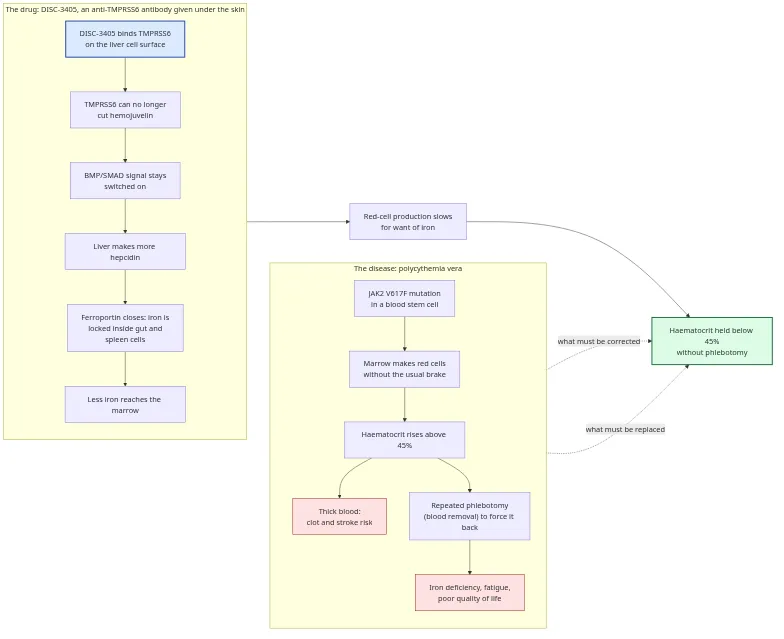
How well is the target validated? Strongly, and by three independent routes.
- Human genetics. People born with loss-of-function mutations in TMPRSS6 have a recognised
inherited condition, iron-refractory iron-deficiency anaemia, in which hepcidin is permanently
high and iron permanently low. That is the human phenotype of the exact intervention DISC-3405
makes, running for a lifetime
[UNVERIFIED — established in the clinical genetics literature and consistent with the mechanism described in the tagged sources above]. This sweep narrowed why it is still unverified rather than removing the gap. Open Targets’ search layer now answers and resolves TMPRSS6 toENSG00000187045and polycythemia vera toMONDO_0009891, but its GraphQL layer refused the association query three times withRate limit exceeded for client: global(section 0). Resolving an identifier is not evidence of an association, so the tag stands. - Animal proof of concept in this exact disease. Hepcidin agonists normalised haematocrit and
reduced splenomegaly in mice carrying the orthologous JAK2 mutation that causes human
polycythemia vera
[VERIFIED — Blood 2016;128(2):265-76, [DOI 10.1182/blood-2015-10-676742](https://doi.org/10.1182/blood-2015-10-676742), via PubMed]. - Clinical validation of the pathway in patients, by competitors. Rusfertide, a hepcidin
mimetic, met its Phase 3 primary endpoint in polycythemia vera. Divesiran, an siRNA that
silences the same TMPRSS6 target DISC-3405 blocks, met its Phase 2 primary endpoint on
2026-08-10 and is going to Phase 3
[VERIFIED — see B.1 for both, with numbers]. The pathway is no longer a hypothesis in this indication.
The exact scientific step the next readout must prove. Not that raising hepcidin restricts iron
— DISC-3405’s own Phase 1 already showed that in humans, with dose-dependent rises in hepcidin-25
and falls in serum iron, transferrin saturation, reticulocyte haemoglobin, haemoglobin and
haematocrit in 56 healthy volunteers [VERIFIED — J Clin Pharmacol 2026;66(5):e70199]. What
RESTORE-PV must prove is the step after that: that in actual polycythemia vera patients, whose
marrow is being driven by a mutation rather than by normal physiology, the iron restriction is
strong enough and durable enough to keep haematocrit under 45% and stop the phlebotomies — and that
it can be done without pushing patients into the symptomatic iron deficiency that phlebotomy itself
causes.
The honest scientific risk. Two, and neither is about whether the mechanism works.
The first is dose control with a long-acting antibody. DISC-3405’s clinically relevant half-life
is about 11 days [VERIFIED — Phase 1 publication]. That is an advantage for convenience and a
liability for titration: if a patient’s haematocrit is driven too low, or iron restriction becomes
symptomatic, the drug cannot be withdrawn quickly. Rusfertide is a short-acting peptide and
divesiran is dosed every 6 to 12 weeks with a titratable effect; DISC-3405 is the least reversible
of the three. RESTORE-PV’s within-participant dose escalation across two dose levels is the design
response to exactly this problem, and whether it worked is part of what the readout answers.
The second is immunogenicity — the risk that patients form antibodies against the antibody,
blunting it over time. The Phase 1 measured this in healthy volunteers over weeks; polycythemia vera
is a lifelong disease and the relevant question is years. Nothing available this session answers it
[UNVERIFIED — no immunogenicity data in patients has been disclosed].
A.2 Clinical development plan, timeline, feasibility, resourcing
Trials
| Trial | Sponsor / whose drug | Design (arms, blinding, n) | Population | Status / key result | Link |
|---|---|---|---|---|---|
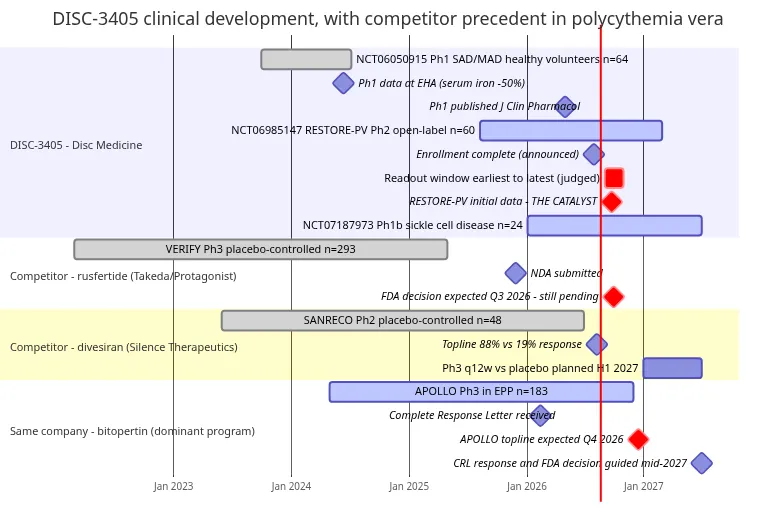
| NCT06985147 — RESTORE-PV | Disc Medicine / DISC-3405 | Phase 2, open-label, single-arm, within-participant dose escalation across up to 2 dose levels, n=60, 15 US sites | Adults meeting 2022 WHO criteria for polycythemia vera, phlebotomy-dependent (≥3 phlebotomies in 26 weeks or ≥5 in 52 weeks, ≥1 in the last 12 weeks), haematocrit <45% at screening (or <48% if followed by a phlebotomy within 2 weeks), white cells 4,000–20,000/µL, platelets 100,000–1,000,000/µL, ECOG 0–1. Patients on stable hydroxyurea, interferon or ruxolitinib for ≥6 months are allowed; prior hepcidin-inducing agents are excluded and prior hepcidin mimetics need sponsor approval | ACTIVE, NOT RECRUITING. Started 2025-08-12. Enrolment completed, announced 2026-07-30. Primary completion 2027-02; study completion 2029-02. Initial data guided to Q3 2026 — this is the catalyst. No results posted. Every field re-read 2026-08-20 and unchanged | NCT06985147 |
| NCT06050915 | Disc Medicine / DISC-3405 | Phase 1, randomised, double-blind, placebo-controlled, single and multiple ascending dose, subcutaneous and intravenous, n=64 registered (56 dosed in the publication), 1 site | Healthy adult male and female volunteers | COMPLETED 2024-07-09. Well tolerated: no deaths, no serious adverse events, no discontinuations; most events Grade 1, two participants with Grade 2 after single dosing, none Grade 3 or 4. Half-life ~11 days, bioavailability 39.7% subcutaneous versus intravenous, greater-than-dose-proportional pharmacokinetics. Raised hepcidin-25; lowered serum iron, transferrin saturation, reticulocyte haemoglobin, haemoglobin and haematocrit across dose levels. Published | NCT06050915 · DOI 10.1002/jcph.70199 |
| NCT07187973 | Disc Medicine / DISC-3405 | Phase 1b, n=24, 8 sites | Sickle cell disease | RECRUITING. Started 2026-01-06, primary completion 2027-06. Initial data guided Q4 2026. A different indication for the same molecule; it is bpiq_drug_id 19469 in ../company.md C.2 and is not this program | NCT07187973 |
| VERIFY — competitor | Takeda / Protagonist Therapeutics; rusfertide (not Disc’s drug) | Phase 3, randomised, double-blind, placebo-controlled, 3-part, n=293 | Polycythemia vera with uncontrolled haematocrit, phlebotomy-dependent despite standard of care | Primary and key secondary endpoints met. 32-week primary analysis: 76.9% clinical response on rusfertide versus 32.9% on placebo, with haematocrit control below 45% and phlebotomy ineligibility sustained through week 52. NDA accepted with Priority Review; rusfertide also holds Breakthrough Therapy, Fast Track and Orphan Drug designations. FDA decision expected Q3 2026 and still pending as of 2026-08-20 | [WEB ESTIMATE — Takeda newsroom, OncLive, HCPLive and CancerNetwork coverage, read 2026-08-20] |
| SANRECO — competitor | Silence Therapeutics; divesiran (not Disc’s drug) | Phase 2, randomised, placebo-controlled, two dosing schedules (6 mg/kg every 6 weeks and every 12 weeks), n=48 | Phlebotomy-dependent polycythemia vera | Primary endpoint met, reported 2026-08-10. 88% clinical response versus 19% placebo (placebo-adjusted 69%, p<0.0001); 93.8% at the 6-weekly schedule, 81.3% at 12-weekly. Phlebotomies per patient weeks 0–36: 0.2 versus 2.1 (p<0.0001). Improvements in haematocrit control, ferritin and MPN-SAF TSS; injection-site reactions infrequent and self-limiting, no new safety findings. New this week: a Phase 3 of the every-12-week schedule against placebo is anticipated to start in H1 2027, and Silence has raised $175M in an upsized ADS offering to fund it | [WEB ESTIMATE — Silence Therapeutics press release, plus OncLive, BioPharm International, CURE and Patient Worthy coverage, read 2026-08-20] |
The single most consequential fact in this table, stated plainly and re-verified this sweep.
RESTORE-PV’s registered primary outcome measures are all safety — treatment-emergent adverse
events by CTCAE grading, abnormal vital signs, abnormal physical examination, abnormal
electrocardiograms, and abnormal laboratory results, all over up to 365 days. Every efficacy
measure is a secondary outcome, including the one that matters commercially, “proportion of
participants achieving therapeutic response, defined as absence of phlebotomy eligibility, during
the maintenance period” [VERIFIED — CT.gov get_trial_details NCT06985147, read 2026-08-20]. This
is a normal and honest design for a first trial of a long-acting antibody in a chronic disease. But
it means that “did the trial hit its primary endpoint?” and “did the drug work?” are two different
questions here, and the settlement definition below is written against the second one because that
is what the market will price.
Feasibility matrix
| Factor | High probability | Medium probability | Low probability | This asset (assessment) | Source |
|---|---|---|---|---|---|
| Recruitment feasibility | >50 sites, 3:1 patient:site | 20–50 sites, established investigators | <20 sites, novel sites | High, on evidence rather than on the site count. 15 sites is below the “low” threshold by count, but 60 patients across 15 sites is a 4:1 ratio, the sites are the top US myeloproliferative-neoplasm centres (Mayo in Arizona, Florida and Minnesota; MD Anderson; Fred Hutchinson; Cleveland Clinic; Duke; Ohio State; Washington University; UCLA; USC; OHSU; Atrium Health and Wake Forest), and — decisively — enrolment finished early enough for the company to pull the readout forward a quarter. The count criterion is the wrong test for a rare disease treated at referral centres | CT.gov get_trial_details NCT06985147, re-read 2026-08-20; exhibit 99.1 to the 2026-07-30 Form 8-K |
| Endpoint clarity | Regulatory precedent exists | Novel endpoint with FDA alignment | Unvalidated surrogate | High. “Absence of phlebotomy eligibility” is the endpoint rusfertide took through a successful Phase 3 and into an accepted NDA under Priority Review, and the one divesiran used in SANRECO and will use in its 2027 Phase 3. The regulatory precedent is not merely arguable, it is about to be adjudicated by the FDA in the same quarter as this readout | VERIFY and SANRECO, above |
| Trial-design robustness | Pivotal Phase III with SPA | Adaptive with interim analysis | Single-arm, no control | Low, unambiguously. Open-label, single-arm, 60 patients, within-participant dose escalation, with efficacy relegated to secondary endpoints. There is no placebo group, and the endpoint — whether a patient meets criteria for a phlebotomy — is one an unblinded clinician participates in. Both competitor trials that read out on this endpoint were placebo-controlled, and both measured a placebo response rate that was not zero: 32.9% in VERIFY and 19% in SANRECO | CT.gov get_trial_details NCT06985147 |
| Operational / execution | Enrollment complete, standard timeline | Some timeline risk | Enrollment behind | High. Enrolment complete and confirmed in a filed exhibit; the readout was moved earlier, not later; and this program still has zero recorded date slips (see Readout, below) after another week in which the BPIQ note field did not change. Among the programs in this corpus that is unusual | Exhibit 99.1 to the Form 8-K filed 2026-07-30; BPIQ note field history, re-read 2026-08-20 |
Resourcing sufficiency. Not a constraint, and unusually clearly so. The company held $717.7M in
cash, cash equivalents and marketable securities at 2026-06-30 against a stated runway “into 2029”
and a monthly cash burn of $14.7M (../company.md C.3). Every catalyst in the
pipeline is cleared by years on any of the three runway readings, and no registration statement of
any kind was filed in 2026. This program will not be starved and the company will not be forced to
raise into the readout — which removes the risk that most often converts a good Phase 2 into a
flat share price in this corpus. The one thing money cannot buy back is time, and time is exactly
what this program is short of relative to its competitors.
A.3 Target label, target product profile, strategic questions, designations
A.3a Target label. Adults with polycythemia vera who require frequent phlebotomy to maintain haematocrit below 45%, with or without concurrent cytoreductive therapy.
A.3b Target product profile
| Attribute | Standard of care & key competitor(s) — data | DISC-3405 target profile (goal) | Supporting evidence (+ link) |
|---|---|---|---|
| Indication / target label | Phlebotomy alone, or phlebotomy plus hydroxyurea / ropeginterferon alfa-2b / ruxolitinib. Rusfertide: NDA under Priority Review for phlebotomy-dependent polycythemia vera, FDA decision expected Q3 2026 and still pending | The same population rusfertide is about to be approved for | VERIFY NDA status [WEB ESTIMATE — Takeda newsroom and OncLive, read 2026-08-20] |
| Efficacy (endpoints, regimen) | Rusfertide: 76.9% clinical response vs 32.9% placebo at 32 weeks (Phase 3, n=293). Divesiran: 88% vs 19% placebo, phlebotomies 0.2 vs 2.1 over weeks 0–36 (Phase 2, n=48) | Response rate at or above rusfertide’s active arm, with less frequent dosing than a short-acting peptide. Not yet demonstrated in any patient | Competitor data, B.1 |
| Safety / tolerability | Rusfertide: injection-site reactions; a hepcidin mimetic given subcutaneously. Divesiran: well tolerated, injection-site reactions infrequent and self-limiting, no new safety findings | Clean iron-restriction profile without symptomatic iron deficiency, and no immunogenicity that blunts effect over years | Phase 1 in healthy volunteers: no deaths, no serious adverse events, no discontinuations, most events Grade 1 [VERIFIED — [DOI 10.1002/jcph.70199](https://doi.org/10.1002/jcph.70199)] |
| Biomarker / companion diagnostic | None required. Haematocrit is measured in every routine blood count | None needed. Hepcidin-25, serum iron and transferrin saturation serve as pharmacodynamic markers, not as patient-selection tools | RESTORE-PV secondary outcomes [VERIFIED — CT.gov, re-read 2026-08-20] |
| Formulation / administration | Rusfertide: subcutaneous, short-acting peptide. Divesiran: subcutaneous siRNA, every 6 or 12 weeks — and the 12-week schedule is the one going to Phase 3 | Subcutaneous antibody with an ~11-day half-life, plausibly supporting monthly or less frequent dosing. The dosing interval RESTORE-PV actually used has not been disclosed | Phase 1 pharmacokinetics [VERIFIED — [DOI 10.1002/jcph.70199](https://doi.org/10.1002/jcph.70199)]; divesiran Phase 3 design [WEB ESTIMATE — Silence Therapeutics, read 2026-08-20] |
| Payer value | Phlebotomy is very cheap. Any drug here must justify itself against a procedure costing a few hundred dollars | Fewer clinic visits, fewer procedures, better symptom scores. Rusfertide will set the price and the reimbursement precedent before DISC-3405 arrives | B.2, B.3a |
A.3c Strategic Go/No-Go questions. The pre-Phase-III set is the one that matches this asset’s
next decision: RESTORE-PV’s initial data are what the company will use to decide whether to take
DISC-3405 into pivotal development in 2027, which is exactly how its chief executive framed it on
2026-07-30 — “we will potentially be positioned to advance two more programs into pivotal-stage
development in 2027” [VERIFIED — exhibit 99.1 to the Form 8-K filed 2026-07-30].
| Group | Question | Answer (tagged) |
|---|---|---|
| Target | Target revalidated as in prior phases? | Yes, and by third parties as well as by the sponsor. Phase 1 showed the full hepcidin → iron → haematocrit chain in humans [VERIFIED — [DOI 10.1002/jcph.70199](https://doi.org/10.1002/jcph.70199)]. Divesiran silences the identical TMPRSS6 target, met its Phase 2 primary endpoint in this indication and is now going to Phase 3 [WEB ESTIMATE — Silence Therapeutics, 2026-08-10 and follow-through read 2026-08-20]. Independent human-genetics association evidence was still not obtainable this session — Open Targets’ search layer answered but its GraphQL layer was throttled (section 0) |
| Dose & Drug | Exposure–response for the intended commercial regimen and route(s)? | Partially. Phase 1 established subcutaneous bioavailability of 39.7%, greater-than-dose-proportional pharmacokinetics and a ~11-day half-life across 37.5–300 mg, with dose-dependent pharmacodynamics [VERIFIED — Phase 1 publication]. The exposure–response relationship in patients is one of the things RESTORE-PV is running to establish, which is why it escalates dose within each participant [VERIFIED — CT.gov] |
| Dose & Drug | Commercial formulation available or feasible? | Yes. A subcutaneous monoclonal antibody is among the best-established commercial formats in biologics [UNVERIFIED — general industry knowledge; no disclosure specific to this program's commercial presentation was found] |
| Dose & Drug | Dose range compatible with clinical and non-clinical safety? | Supported so far, in volunteers only. Across 37.5–300 mg there were no deaths, no serious adverse events and no discontinuations; two participants had Grade 2 events after single dosing and none had Grade 3 or 4 [VERIFIED — Phase 1 publication]. Nothing is known about the safety profile in polycythemia vera patients, and that is a registered primary endpoint of the readout |
| Dose & Drug | Therapeutic window given the clinical response? | The open question, and the sharpest one. The therapeutic effect is iron restriction, and the principal toxicity of the existing treatment (phlebotomy) is also iron restriction. The window is therefore between “enough iron restriction to hold haematocrit under 45%” and “so much that the patient feels as bad as phlebotomy makes them feel.” An ~11-day half-life narrows the practical window because the dose cannot be backed out quickly [UNVERIFIED — analyst judgement from the mechanism and the published pharmacokinetics] |
| Dose & Drug | Intrinsic and extrinsic factors influencing exposure and patient response? | Partly addressed by design. RESTORE-PV admits patients on stable hydroxyurea, interferon or ruxolitinib as well as phlebotomy-only patients, and excludes anyone with prior hepcidin-inducing agents or recent busulfan, pipobroman or phosphorus-32; it excludes estimated glomerular filtration rate below 30 mL/min/1.73m², clinically significant thrombosis within 2 months and clinically significant bleeding within 6 months [VERIFIED — CT.gov eligibility criteria, re-read 2026-08-20]. No dedicated intrinsic/extrinsic factor analysis has been disclosed |
| Patient | Proof of concept and positive benefit/risk in the intended population? Combination evidence? | No — this is precisely what is missing, and precisely what the readout supplies. There is no efficacy data for DISC-3405 in any patient with any disease. Combination evidence will come from the subgroup already on cytoreductive therapy, which the trial permits but does not stratify on [VERIFIED — CT.gov] |
| Patient | Phase III design and outcome criteria — accepted, compelling, competitive for market access? | Accepted and compelling: yes. Competitive: that is the whole question, and it got harder this week. The endpoint has a Phase 3 precedent under active FDA review. But market access for a third entrant depends on beating, not matching, two drugs that will already be there — and divesiran has now named its Phase 3 design (every-12-week dosing against placebo, H1 2027), which is both a controlled trial and a longer dosing interval than DISC-3405’s pharmacokinetics plausibly support [WEB ESTIMATE — competitor status, read 2026-08-20] |
| Patient | Rationale for the patient population(s)? | Strong and specific. The eligibility criteria select patients who are demonstrably failing on the current approach — at least 3 phlebotomies in 26 weeks, one within 12 weeks — so every enrolled patient has a documented need and a documented personal baseline [VERIFIED — CT.gov eligibility criteria] |
| Patient | Likelihood of hitting the expected outcome? | Modelled at 78%, band 65–87% that the pre-registered positive definition below is met [UNVERIFIED — modelled; the reasoning is in the Locked prediction section] |
| Patient | Companion-diagnostic strategy, including pricing and market? | Not applicable. Polycythemia vera is diagnosed by WHO criteria using standard blood counts and JAK2 testing already in routine use; no companion diagnostic is required and none is planned [VERIFIED — CT.gov eligibility criteria reference 2022 WHO criteria] |
A.3d Regulatory designations.
- Orphan Drug Designation (FDA), for DISC-3405 in polycythemia vera, granted 2024-02-09. Grants
seven years of US marketing exclusivity for the designated indication from approval, tax credits
on qualifying clinical trial costs, and a waiver of the substantial application user fee. It does
not speed up review and does not imply any view on efficacy
[VERIFIED — company announcement, 2024-02-09, in the BPIQ press feed]. - No other designation. No Breakthrough Therapy, Fast Track, Priority Review or Commissioner’s
National Priority Voucher has been announced for this program, and none appeared in the delta
window. That is worth noting twice over. This company has obtained a Commissioner’s National
Priority Voucher for a different program (bitopertin, October 2025), so the absence here is not
for want of familiarity with the route — and the competitor holds Breakthrough Therapy, Fast
Track and Orphan Drug designations on the same endpoint in the same disease
[VERIFIED — BPIQ press feed and EDGAR filing feed, read 2026-08-20; competitor designations [WEB ESTIMATE — CancerNetwork and OncLive coverage of the rusfertide NDA acceptance, read 2026-08-20]; recorded as an absence rather than as a negative finding].
A.4 Target product profile valuation matrix
| Stakeholder | Value driver | Minimum threshold | Competitive | Premium | Benchmark / source |
|---|---|---|---|---|---|
| Patient / caregiver | Freedom from repeated blood removal, and relief from iron-deficiency symptoms | Fewer phlebotomies than on current care | Zero phlebotomies over the maintenance period, plus a measurable improvement in symptom score | Zero phlebotomies with dosing every 4 weeks or less often, and no new symptom burden | Divesiran: 0.2 phlebotomies per patient over weeks 0–36 versus 2.1 on placebo, with MPN-SAF TSS improvement [WEB ESTIMATE — Silence Therapeutics, 2026-08-10] |
| Regulator | Haematocrit control without unacceptable harm | Haematocrit held <45% with an acceptable safety profile | Response rate clearly above the placebo rate measured in controlled trials of the same class | Response demonstrated in a randomised controlled setting, with symptom benefit | The placebo rate is the benchmark, and it is known: 32.9% (VERIFY, n=293) and 19% (SANRECO, n=48). An open-label single-arm result must be read against these |
| Payer / HTA | Cost displaced versus cost added | Reduces phlebotomy visits and downstream thrombotic events | Reduces cytoreductive drug use as well as phlebotomy | Documented reduction in thrombotic events, the outcome that actually drives cost in this disease | Phlebotomy costs a few hundred dollars per procedure; no drug in this class has published a thrombosis-outcome benefit [UNVERIFIED — no pharmacoeconomic source found this session either] |
| Provider | Clinic burden and scheduling | Fewer procedure slots consumed | Dosing interval long enough to align with routine monitoring visits | Home or self-administration | RESTORE-PV’s dosing interval has not been disclosed; the ~11-day half-life makes a monthly or longer interval plausible, but divesiran’s Phase 3 will run at twelve weeks [UNVERIFIED — inference from published pharmacokinetics; competitor schedule WEB ESTIMATE — Silence Therapeutics, read 2026-08-20] |
Calibration examples, not asset claims: in oncology each incremental month of overall survival is worth roughly $150–300M in peak-sales potential; oral formulations command roughly 15–25% price premiums over injectables. Neither applies directly here — polycythemia vera is a chronic disease managed to a laboratory target rather than a survival endpoint, and every agent in this class is injectable.
A.5 Evidence quality and endpoints
| Criterion | Score (High / Medium / Low) | Basis (one line) | Link |
|---|---|---|---|
| Target validation | High | A named Mendelian disease (iron-refractory iron-deficiency anaemia) is the human loss-of-function phenotype; a mouse model of the orthologous JAK2 mutation responds; and a second drug against the identical target met its Phase 2 primary endpoint in this indication and is now going to Phase 3 | DOI 10.1182/blood-2015-10-676742 · SANRECO |
| Mechanism clarity | High | Every step from antibody binding to haematocrit is individually measurable, and all of them were measured in the Phase 1: hepcidin-25 up, serum iron down, transferrin saturation down, reticulocyte haemoglobin down, haemoglobin down, haematocrit down | DOI 10.1002/jcph.70199 |
| Biomarker availability | High | Haematocrit is in every routine blood count; hepcidin-25, serum iron and transferrin saturation are all standard assays and all are registered secondary endpoints of RESTORE-PV | NCT06985147 |
| Publication quality (peer-reviewed? independent authors?) | Medium | Peer-reviewed: yes, in Journal of Clinical Pharmacology, a legitimate specialist journal. Independent: no. All five authors — Liu, Howell, Carden, Yang and Savage — give their affiliation as “Disc Medicine, Watertown, MA, USA”, re-confirmed from the metadata this sweep. There is not one external academic co-author on the only publication this molecule has. And in the independent literature the molecule is largely absent: the 2026 Blood review of hepcidin-pathway modulators in polycythemia vera names rusfertide, divesiran and sapablursen as the hepcidin agonists in clinical development for this indication, and does not name DISC-3405 — while naming Disc’s other antibody, DISC-0974, in its myelofibrosis section. That sentence was read directly from the abstract this sweep, not inferred | DOI 10.1002/jcph.70199 · DOI 10.1182/blood.2025028643 |
| Clinical / expert sentiment | — | Moved to A.5b, below. | — |
Endpoints
RESTORE-PV’s five primary outcome measures are listed first because they are the trial’s registered
primary endpoints, and every efficacy measure below them is a secondary
[VERIFIED — CT.gov get_trial_details NCT06985147, read 2026-08-20].
| Endpoint (full name) | What it measures | Scale / range | Better direction | MCID / note |
|---|---|---|---|---|
| PRIMARY — Number of participants with treatment-related adverse events, assessed by CTCAE (Common Terminology Criteria for Adverse Events) | The proportion of patients experiencing any side effect attributed to the drug, graded 1 (mild) to 5 (fatal) on a standard scale used across oncology | Proportion, 0–100%; each event graded 1–5 | Lower | No minimal clinically important difference exists for a safety count. Assessed over up to 365 days |
| PRIMARY — Incidence of clinically abnormal vital signs | Blood pressure, heart rate, temperature, respiratory rate outside normal limits | Proportion of patients | Lower | No established threshold |
| PRIMARY — Incidence of clinically abnormal physical examination | Findings on examination that were not present at baseline | Proportion of patients | Lower | No established threshold |
| PRIMARY — Incidence of clinically abnormal electrocardiograms | Changes in the electrical tracing of the heart | Proportion of patients | Lower | Standard safety monitoring for any new systemic agent |
| PRIMARY — Incidence of abnormal laboratory test results | Changes in blood chemistry, liver enzymes, blood counts | Proportion of patients | Lower | Note the tension: in this drug, falling haematocrit and falling iron are the intended effect, so the safety read has to distinguish therapeutic iron restriction from harm |
| SECONDARY (the commercially decisive one) — Proportion of participants achieving therapeutic response, defined as absence of phlebotomy eligibility, during the maintenance period | Whether a patient goes through the maintenance period without ever meeting the criteria that would trigger a phlebotomy — in practice, whether haematocrit stayed under control without taking blood out | Proportion, 0–100% | Higher | This is the endpoint with a named external benchmark, and it is the one to read first. Rusfertide’s Phase 3 achieved 76.9% against a 32.9% placebo rate; divesiran’s Phase 2 achieved 88% against 19%. Those two placebo rates are the yardstick an open-label single-arm number must be held against |
| SECONDARY — Number of phlebotomies during the maintenance and optimization periods | A direct count of procedures avoided | Count per patient | Lower | Divesiran benchmark: 0.2 per patient over weeks 0–36 versus 2.1 on placebo |
| SECONDARY — Proportion achieving therapeutic response during the optimization period | The same response definition, measured while doses are still being adjusted | Proportion, 0–100% | Higher | Expect this to be lower than the maintenance figure by construction — patients are still being titrated. If the initial data cut reports only this, it is a less favourable comparison than it looks |
| SECONDARY — Proportion of participants with haematocrit <45% throughout the study | Whether the clinical target was held continuously | Proportion, 0–100% | Higher | 45% is the threshold established by randomised evidence as the level below which thrombotic risk falls |
| SECONDARY — Change from baseline in serum hepcidin-25 | Did the drug do the thing it is designed to do | ng/mL | Higher (this is the drug’s direct effect) | Pharmacodynamic confirmation. Already demonstrated in healthy volunteers, so a positive result here is expected and is not evidence of clinical benefit |
| SECONDARY — Change from baseline in serum iron | Iron available in circulation | µg/dL | Lower | As above: mechanism confirmation, not clinical benefit |
| SECONDARY — Change from baseline in haematocrit | The clinical variable itself | Percentage points | Lower, toward and below 45% | Not “as low as possible” — over-suppression is a harm |
| SECONDARY — Pharmacokinetic parameters (AUC, Cmax, elimination half-life, apparent clearance, steady-state Cmax, pre-dose trough, apparent volume of distribution) | How the drug is absorbed, distributed and cleared in patients rather than volunteers | Standard units | n/a | Informs the pivotal-trial dosing regimen |
A.5b Key opinion leaders.
Panel as of. 2026-08-20 — the date the investigator and independent-voice searches below were re-run in full.
Investigators
No investigator on this program’s pivotal trial could be named this session either, and that is a
finding with a specific cause rather than an omission. get_trial_details on NCT06985147 returns
all 15 facilities with contacts: null and carries no overall-official record — the normal state
once a trial closes to recruitment, and RESTORE-PV is ACTIVE_NOT_RECRUITING. This was confirmed as
a real empty rather than a tool failure by a second, independent call, re-run this sweep with a
different result set and the same conclusion: search_investigators on the condition “Polycythemia
Vera” across 40 analysed trials returned 72 named investigators and contacts, and not one of them
on a Disc Medicine trial. The names returned this time belong to a Phase 3 pelabresib
myelofibrosis study (NCT07357727), an ASTX727/iadademstat myeloproliferative-neoplasm study
(NCT06661915), a German myelofibrosis research platform and an Egyptian observational study — a
completely different set from the 35 returned on 2026-08-13, which is itself informative: the
connector is sampling live trials, not failing.
| Name | Role / affiliation | Trial (NCT) | Conflicts (party, kind, disclosed in, as of) | Conflicts checked (source, date) | Source | Tag |
|---|---|---|---|---|---|---|
| (none returned) | — | NCT06985147 | — | — | — | — |
Independent voices
No independent voice is recorded, and the reason is a positive finding rather than a failure to look. The one named panel in the literature that takes a substantive position on this exact endpoint in this exact disease is Marina Kremyanskaya, Yelena Ginzburg and Ronald Hoffman of the Icahn School of Medicine at Mount Sinai, who authored the 2026 Blood review of hepcidin-pathway modulators in polycythemia vera and myelofibrosis (DOI 10.1182/blood.2025028643) and, with Shivani Handa, the 2022 Current Opinion in Hematology review “Hepcidin mimetics in polycythemia vera” (DOI 10.1097/MOH.0000000000000747), whose stated conclusion is that “hepcidin agonists essentially serve as a ‘chemical phlebotomy’ and are poised to vastly improve the quality of life for phlebotomy requiring polycythemia vera patients.”
They are not recorded as independent voices, for two reasons that both point the same way and
both survived re-checking this sweep. First, the 2022 review is explicitly a review of rusfertide,
describing its global Phase 3 as “currently underway” and advocating for it by name — a published
position on a direct competitor to this program, which is a competitor relationship in substance
whatever the formal disclosures say. Second, and decisively under rule 40, their
conflict-of-interest statements could not be obtained: get_article_metadata returns no conflict
field on any of the eight articles retrieved, and both journals are paywalled. Recording them as
independent with an empty conflicts array would produce exactly the clean-looking record
02-connectors.md § KOL sources warns against — “the absence of a disclosure is not evidence of no
conflict.”
| Name | Affiliation | View (close enough to quote) | As of | Conflicts checked (source, date) | Source | Tag |
|---|---|---|---|---|---|---|
| (none recorded — see the paragraph above) | — | — | — | — | — | — |
Judgement
| Endpoint supported | Basis (one or two sentences) | Tag |
|---|---|---|
| UNKNOWN | No independent voice could be recorded, so there is no panel to judge, and the honest answer is that this analysis does not know what independent experts think of this asset. What can be said without attributing a view to anyone is narrower and is stated in A.5 and B.1 instead as a sourced fact: the 2026 Blood review of hepcidin-pathway modulators in polycythemia vera names rusfertide, divesiran and sapablursen and does not name DISC-3405, while naming Disc’s other antibody in its myelofibrosis section. That is evidence about this program’s visibility in the independent literature, not about any individual’s opinion of it, and it is not converted into one here. | UNVERIFIED — judgement |
Dissent
Empty. Endpoint supported is UNKNOWN rather than SUPPORTIVE_CONTESTED, so there is no
majority reading for anyone to dissent from, and inventing a disagreement nobody has expressed would
be worse than the blank.
| Name | View (close enough to quote) | Source |
|---|---|---|
| (none) | — | — |
B. Commercial assessment
B.0 Current treatment algorithm
Polycythemia vera is managed to a number. The target is haematocrit below 45%, and everything in the algorithm exists to hold it there.
First, for every patient: low-dose aspirin plus phlebotomy. Aspirin reduces clotting risk. Phlebotomy is the mechanical answer — remove blood, the haematocrit falls. It is cheap, universally available and effective, and it is the reason this disease has been survivable for a century. Its cost is borne by the patient rather than the payer: repeated blood removal strips iron, and iron-deficient patients report fatigue, poor concentration, restless legs and reduced quality of life. Some patients need this every few weeks indefinitely.
Second, for patients at higher risk or needing frequent phlebotomy: cytoreductive therapy.
Hydroxyurea is the usual first choice — an oral chemotherapy that suppresses marrow output
generally. Ropeginterferon alfa-2b is an alternative, better tolerated by some and worse by others.
Ruxolitinib, a JAK inhibitor, is used for patients who fail or cannot tolerate hydroxyurea. All
three reduce phlebotomy need by suppressing the marrow, which means they also suppress white cells
and platelets, and each carries its own tolerability burden [UNVERIFIED — standard clinical practice, consistent with the treatment landscape described in [DOI 10.1007/s12672-025-03703-9](https://doi.org/10.1007/s12672-025-03703-9), via PubMed].
Where DISC-3405 would fit. In the same slot as rusfertide and divesiran: added to phlebotomy
and, where used, to cytoreductive therapy, in order to eliminate the phlebotomies. RESTORE-PV is
explicit about this — patients on stable hydroxyurea, interferon or ruxolitinib are eligible, as are
patients on phlebotomy alone [VERIFIED — CT.gov eligibility criteria]. It does not displace
cytoreductive therapy and it does not treat the underlying mutation. It replaces a procedure, not
a drug. That is the commercial proposition and also the commercial constraint: the thing being
displaced costs a few hundred dollars.
B.1 Competitive landscape and positioning
| Metric | High value | Medium value | Low value | This asset (assessment) | Source |
|---|---|---|---|---|---|
| Mechanism differentiation | First-in-class or novel target | Next-generation improvement | Me-too | Medium. Not first-in-class: rusfertide got there. Not first against TMPRSS6 either — sapablursen (antisense) and divesiran (siRNA) both silence it, and Mabwell’s own 9MW3011 is an anti-TMPRSS6 antibody in polycythemia vera in China. The genuine differentiation is modality and duration: an antibody with an ~11-day half-life plausibly dosed monthly or less often, against a short-acting peptide | Phase 1 pharmacokinetics [VERIFIED]; competitor identities [VERIFIED — [DOI 10.1182/blood.2025028643](https://doi.org/10.1182/blood.2025028643)]; 9MW3011 [VERIFIED — CT.gov NCT06752746] |
| Development-timeline advantage | >12 months ahead | Within 6–12 months | Lagging >12 months | Low, and this is the thesis’s central problem — measurably more so than a week ago. Rusfertide has an FDA decision expected this quarter, still pending; divesiran has completed a placebo-controlled Phase 2 and has now named its Phase 3 for H1 2027 and funded it with a $175M raise. DISC-3405 is at initial Phase 2 data with a pivotal trial not yet designed, which the company itself frames as a 2027 decision. That is roughly two to three years behind rusfertide and about a year behind divesiran, and the gap to divesiran is now a scheduled one rather than an estimated one | [WEB ESTIMATE — Takeda newsroom and Silence Therapeutics releases and coverage, read 2026-08-20]; exhibit 99.1 to the 2026-07-30 Form 8-K |
| Clinical proof-of-concept evidence | Positive Phase IIb (n>100) | Phase IIa signals (n=20–50) | Preclinical only | Medium, and pending. The Phase 1 in 56 healthy volunteers is genuine human proof of pharmacology but not of clinical benefit. RESTORE-PV (n=60) is the first patient evidence and it has not reported. Until it does, this asset has zero efficacy data in any patient | DOI 10.1002/jcph.70199; NCT06985147 |
| IP protection | Composition-of-matter, long-dated | Method-of-use | Pending or none | High. Two US patents have been granted from the in-licensed Mabwell family directed to the DISC-3405 antibody itself, expected to expire in 2041 before any term adjustment or extension, with method-of-treatment claims covering diseases of iron metabolism including polycythemia vera, and nine further applications pending in Australia, Canada, Europe, India, Japan, Korea and the United States | [VERIFIED — Disc Medicine FY2025 Form 10-K, filed 2026-02-26, read from EDGAR] |
Where this asset wins, and the single fact the thesis rests on.
DISC-3405 wins on duration and modality, and on nothing else that is presently demonstrated. An antibody with an eleven-day half-life is a different product from a short-acting peptide injected frequently: fewer injections, steadier exposure, and a dosing schedule that can align with the blood counts these patients already come in for. Against divesiran that advantage has now inverted, and this is the single genuine change in the competitive picture this week. Silence has chosen the every-twelve-week schedule for its Phase 3, not the every-six-week one, despite the six-weekly arm producing the higher response rate (93.8% against 81.3%). Twelve weeks is roughly three times the dosing interval an eleven-day half-life plausibly supports. The convenience argument that was DISC-3405’s only demonstrated differentiator is the argument its nearest competitor has just decided to take to a pivotal trial — and to take there in a randomised, placebo-controlled design this program does not have.
The single fact the thesis rests on is this: the readout must produce a phlebotomy-response number that survives comparison with 76.9% and 88%. Those two figures were produced in placebo-controlled trials against placebo rates of 32.9% and 19%. RESTORE-PV has no placebo arm, so its number will be read by every analyst against those two — and an open-label design is understood to inflate exactly this kind of endpoint, because the decision to perform a phlebotomy is made by an unblinded clinician who knows the patient is on the drug. A 70% response rate from RESTORE-PV is a genuinely good result that will nonetheless be reported as “below rusfertide.”
One competitive fact cuts the other way and is worth stating in its own sentence. Two successful placebo-controlled trials in this indication in twelve months have converted the hepcidin pathway from a hypothesis into an established mechanism. A third drug against a validated mechanism has a much higher probability of technical success than a first-in-class one — which is why the outcome probability below sits at 78% while the commercial assessment stays cautious. This program is likely to work and unlikely to be first. Those are not in tension; they are the whole shape of it.
Calibration example, not an asset claim: oncology first-movers in novel mechanisms have shown roughly 3.2× higher peak-sales potential but about 1.8× higher development risk. DISC-3405 sits on the opposite side of that trade — lower development risk, lower peak-sales potential — which is the correct reading of a third entrant against a validated target.
B.2 Addressable market
Launch markets. The United States first, then EU5 and Japan — the territories the Mabwell licence
covers. Greater China and Southeast Asia are explicitly excluded from Disc’s rights and are
retained by Mabwell, which is running its own anti-TMPRSS6 antibody, 9MW3011, in polycythemia vera
in China [VERIFIED — FY2025 10-K; CT.gov NCT06752746].
| Component | How it is estimated | Premium threshold | This asset (assessment) | Source |
|---|---|---|---|---|
| Drug-treated patients | Epidemiology × diagnosis rate × treatment rate | >100,000 (US/EU5/Japan) | Below the premium threshold, and this is the weakest input in the whole analysis. Polycythemia vera is a rare disease and only the phlebotomy-dependent subset is addressable. The scale can be bounded from what competitors did rather than from an epidemiology source: rusfertide’s global Phase 3 enrolled 293 phlebotomy-dependent patients and divesiran’s Phase 2 enrolled 48 [VERIFIED — trial enrolments]. A defensible patient count for the addressable population could not be established this session either and none is invented (rule 9) | — |
| Market exclusivity | Patent term + regulatory exclusivity | >10 years combined | Clears the premium threshold comfortably. Composition-of-matter patents on the antibody run to 2041, and US orphan-drug exclusivity would add seven years from approval. On any plausible approval date the combined position exceeds ten years | [VERIFIED — FY2025 10-K; orphan designation 2024-02-09] |
| Reimbursement precedent | Approvals in ≥2 major markets | Positive NICE/CADTH guidance | None yet, and the precedent will be set by someone else. No hepcidin-pathway agent is approved anywhere. Rusfertide’s Q3 2026 FDA decision — still pending as of 2026-08-20 — will establish the first price and the first coverage terms in this class, and DISC-3405 will inherit whatever they are | [WEB ESTIMATE — Takeda newsroom and OncLive, read 2026-08-20] |
| Patient-journey impact | Fewer hospital days, less caregiver burden | >30% quality-of-life gain | Plausibly clears it, on class evidence rather than this asset’s. Divesiran reduced phlebotomies from 2.1 to 0.2 per patient over 36 weeks and improved MPN-SAF TSS. Each avoided phlebotomy is a clinic visit avoided. No quality-of-life data exists for DISC-3405 | [WEB ESTIMATE — Silence Therapeutics, 2026-08-10] |
Quantified where it can be, and stated plainly where it cannot. Third-party forecasts put the
seven-major-market polycythemia vera market at roughly $1.9B in 2024 and $2,087M in 2025, rising
to $5,257M by 2034, with rusfertide expected to generate the highest revenue among emerging
therapies in EU4 and the UK by 2034 and to reach a probability-adjusted peak share of 5.4% in first
and second line about seven years after launch [WEB ESTIMATE — DelveInsight polycythemia vera market report, read via web search 2026-08-20; the same figures the previous sweep found, re-checked rather than carried]. These are the only market-size figures found and they are third-party
projections, not a bottom-up build; the “5.4% peak share” figure in particular is quoted as it was
found and its denominator is not stated in the source.
B.3 Value and feasibility
B.3a Expected peak sales. Built as a share of the class rather than fully bottom-up, because the patient-count input in B.2 could not be established and rule 9 forbids inventing one. The chain is: total polycythemia vera market → the share hepcidin-pathway agents take of it → DISC-3405’s share of that class. Every link is tagged, and the whole build is conditional on approval, which on the current timeline could not occur before roughly 2030. It excludes the sickle cell indication, any ex-US partnering economics, and Greater China and Southeast Asia entirely, which Disc does not own.
| Scenario | Assumptions (patients × price × share) | Estimate (USD/year at peak) | Basis / tag |
|---|---|---|---|
| Low | 7MM market reaches ~$5.3B by 2034; hepcidin-pathway agents take | $100–150M | [UNVERIFIED — modelled. Market figure [WEB ESTIMATE — DelveInsight, 2026-08-20]; both share assumptions are analyst judgement with no external source] |
| Base | Same market; hepcidin-pathway agents take | $250–550M | [UNVERIFIED — modelled, same tagging as above] |
| High | Hepcidin-pathway agents take | $700M–1.0B | [UNVERIFIED — modelled. Requires DISC-3405 to beat rusfertide and divesiran on a dimension no data yet demonstrates — and divesiran's choice of a twelve-week Phase 3 schedule makes the dosing-interval version of that claim harder, not easier] |
The bands are carried unchanged from the previous version and that is a deliberate decision, not inertia. Nothing in the delta window changed the market size, the class share or this asset’s plausible share of it in a way a number could honestly express. What did change is the direction of pressure on the high case, and that is recorded in its Basis cell rather than by moving a figure without evidence.
Which input is weakest, named rather than buried. It is the patient count, and everything downstream inherits its uncertainty. No defensible epidemiology figure for the phlebotomy-dependent polycythemia vera population in the launch markets was obtained this session, so the build routes around it through a third-party market projection whose own methodology is not published. The share assumptions are analyst judgement with no external anchor at all. These are ranges to reason with, not figures to value on, and no single point estimate is given anywhere (rule 10).
B.3b Feasibility
| Question | Answer (tagged) |
|---|---|
| Expected net present value (eNPV) | Not calculated, and deliberately so. A defensible eNPV needs a probability of technical and regulatory success from approval, a launch date, a price and a patient count. The patient count is the input B.3a names as undefensible and the price will be set by rusfertide’s Q3 2026 FDA decision, which has still not happened. Rule 10 forbids a single figure on unverified inputs; a range built on two invented inputs would be worse than no range. What can be said: the base-case peak-sales band of $250–550M sits at 10–23% of the recomputed $2,394M enterprise value (../company.md C.4), unrisked and undiscounted, which is the honest way to state this program’s weight [UNVERIFIED — arithmetic on B.3a and company.md C.4] |
| Capital to the next decision point | Effectively already spent. RESTORE-PV is fully enrolled and reads out this quarter. The remaining cost to the initial-data decision point is the run-out of a 60-patient trial [UNVERIFIED — no program-level spend is disclosed; R&D was $46.933M company-wide in Q2 2026 across four clinical programs] |
| Capital to approval, and the funding plan | Large, not yet committed, and comfortably fundable. A pivotal program in this indication would plausibly resemble VERIFY’s 293 patients. Disc holds $717.7M with a stated runway into 2029 (../company.md C.3) and has raised $626.9M net through three underwritten offerings over two years. On top of trial cost sit the Mabwell obligations below. The company frames the pivotal decision as a 2027 one |
| Launch capability — alone, or must partner? | Must build or partner, and has neither. Disc has no commercial infrastructure of any kind — it is a clinical-stage company with no revenue (../company.md C.1). Polycythemia vera is treated by haematologists at identifiable centres, which is among the easier fields to cover, but it still requires a sales force that does not exist. Its first commercial build, if it happens, will be for bitopertin |
| Commercialisation rights — retained, split, or out-licensed? | Retained ex-Greater-China and ex-Southeast-Asia, with a real royalty burden. Under the January 2023 Mabwell licence Disc holds exclusive, sublicensable rights in all territories other than Greater China (Mainland China, Hong Kong, Macau, Taiwan) and Southeast Asia (eleven named countries). It paid $10.0M upfront, owes up to $127.5M in development and regulatory milestones across up to three indications and up to $275.0M in commercial milestones, and pays a tiered royalty on annual net sales ranging from low single digits to high single digits, subject to reductions for lack of a valid patent claim, for biosimilar entry above 20% market share, and for third-party royalty stacking. Milestones already paid: $5.0M on first Phase 1 dosing (October 2023), $10.0M on first Phase 2 dosing (September 2025), $5.0M payable on first Phase 1b dosing in a second indication (February 2026) [VERIFIED — Disc Medicine FY2025 Form 10-K, filed 2026-02-26, read from EDGAR; the licence structure re-confirmed against the Form 10-Q filed 2026-07-30] |
B.4 Product-development risk
Framing questions.
- Does the development plan support the target product profile claims? Partly, and less than it did a week ago. RESTORE-PV is well designed to answer whether the drug controls haematocrit and eliminates phlebotomies in patients, and to select a dose. It is not designed to support the differentiation claim the commercial case rests on. The target product profile’s distinguishing feature is dosing convenience versus a short-acting peptide, and an open-label single-arm trial with no comparator cannot demonstrate an advantage over rusfertide on anything. That comparison will have to be made across trials, which payers and prescribers discount heavily — and the competitor now going to Phase 3 will be able to make its own convenience claim inside a randomised design.
- Will the identified risks affect the target product profile? The two that would are the therapeutic window and immunogenicity. If iron restriction has to be dialled back to avoid symptomatic deficiency, the response rate falls and the profile converges on “another option”. If anti-drug antibodies blunt the effect over time, the long-half-life advantage inverts into a durability problem. Neither is answerable from this readout alone.
- If a risk cannot be mitigated, is the asset still differentiated from competitors? On modality, yes — it would remain the only antibody in the ex-China class. On anything a prescriber or payer chooses on, no. Against divesiran’s twelve-weekly siRNA, an antibody’s duration advantage is not merely thin, it is the wrong way round, and the fallback differentiation is a preference for a familiar modality rather than a clinical claim.
| Category | Time risk | Quality risk | Cost risk | Note |
|---|---|---|---|---|
| Project management | Low | Low | Low | Enrolment finished early enough to pull the readout forward a quarter, and this program has zero recorded date slips |
| Research | Low | Low | Low | The mechanism is settled and validated by two independent competitor programs |
| IP | Low | Low | Medium | Composition-of-matter to 2041, but in-licensed: the royalty and milestone stack in B.3b is a permanent cost of goods that a wholly owned asset would not carry |
| Legal | Low | Low | Medium | The Mabwell agreement is terminable by either party on uncured material breach and by Disc for convenience on 60 days’ notice; territory is split with a licensor running a competing asset against the same target in its own territory. Note separately that the company reports no material legal proceedings pending or threatened as of the 10-Q filed 2026-07-30, notwithstanding the recurring plaintiff-firm solicitations in the press feed (../company.md C.8) |
| DMPK | Low | Medium | Low | Subcutaneous bioavailability of 39.7% and greater-than-dose-proportional pharmacokinetics are both established in volunteers; neither has been confirmed in patients, and polycythemia vera patients differ physiologically in exactly the compartment this drug acts on |
| Safety pharmacology | Low | Low | Low | No signal across 37.5–300 mg in 56 volunteers |
| Toxicology | Low | Low | Low | Nothing disclosed suggesting a preclinical concern |
| Drug safety (clinical) | Medium | High | Medium | The near-veto factor. Safety is the registered primary endpoint of the readout, and the drug’s therapeutic effect and its principal expected toxicity are the same physiological change. With an ~11-day half-life the dose cannot be withdrawn quickly. A safety finding that leads to a hold, a cohort-wide dose reduction or program discontinuation would dominate the readout regardless of the response rate |
| Biomarker | Low | Low | Low | Haematocrit, hepcidin-25, serum iron and transferrin saturation are all routine, all registered as endpoints |
| Clinical pharmacology | Low | Medium | Low | The exposure–response relationship in patients is being established by the trial itself |
| Clinical (efficacy) | Medium | High | Medium | Not that the drug fails — that the number is not good enough. An open-label single-arm result will be read against 76.9% (VERIFY) and 88% (SANRECO), both placebo-controlled. A genuinely good 70% would be reported as a shortfall |
| Clinical operations | Low | Low | Low | Fifteen top US myeloproliferative-neoplasm centres; enrolment complete ahead of plan |
| CMC / manufacturing | Low | Low | Medium | A subcutaneous monoclonal antibody is a well-trodden manufacturing route; nothing program-specific was disclosed |
| Regulatory | Medium | Medium | Low | The endpoint’s precedent is being set by rusfertide’s Q3 2026 decision, which is now inside days-to-weeks of being due and has not come. A favourable decision hands DISC-3405 a validated regulatory path; an unfavourable one, or one with restrictive labelling, would reset the requirements for the whole class |
| Global evidence & value | High | Medium | Medium | The structural problem. Third to market against two agents with placebo-controlled data, into a setting where the displaced intervention costs a few hundred dollars. Cross-trial comparison is the only differentiation argument available and payers discount it |
| Commercial | High | Medium | High | No commercial infrastructure of any kind, a price and reimbursement precedent that will be set by a competitor before this asset arrives, and a royalty and milestone stack to the licensor |
Readout
Sources
| Kind | Where it comes from | What it is worth | Value (or null) | Tag | Note |
|---|---|---|---|---|---|
bpiq | fetch_company_drugs — catalyst_date, catalyst_date_text | The current single source. Synthesized from period text on most rows, so alone it is a ceiling, not an estimate. | 2026-09-30, text “Q3 2026” | VERIFIED — BPIQ fetch_company_drugs 2026-08-20 | The text names a quarter, so catalyst_date_is_exact is false and 2026-09-30 is the synthesized last day of it. Never used for timing (rule 23). Unchanged in seven days, note field included. Note this row is the only one of the five has_catalyst rows on this ticker not synthesized to 2026-12-31 or 2027-12-31 |
ctgov | CT.gov get_trial_details — primary_completion_date | Independent of the company’s own messaging, month-precision, and it moves when the trial moves. | 2027-02 | VERIFIED — CT.gov get_trial_details NCT06985147, read 2026-08-20 | This is NOT the readout date and must not be read as one. It is when the last patient completes the 365-day primary safety assessment; the registry’s separate completion_date is 2029-02. The Q3 2026 event is an interim initial-data cut from a trial whose primary completion is eighteen months later. The registry has no field for an interim cut, so it cannot corroborate or contradict the company’s guidance — it constrains the maximum maturity of the data, not its date. Unchanged in seven days |
company | fetch_company_press_releases and the EDGAR filing feed | The company’s own most recent dated wording. Also where the slip sequence below comes from. | 2026 Q3 | VERIFIED — exhibit 99.1 to Form 8-K filed 2026-07-30, re-read in full from EDGAR 2026-08-20 | Mandatory because the catalyst is inside twelve months (rule 32), and still the freshest company source at twenty-one days old. Verbatim, twice in one document: “Completed enrollment for RESTORE-PV Phase 2 study in patients with polycythemia vera with initial data expected in Q3 2026”, and from the chief executive, “which is now fully enrolled with initial data coming ahead of schedule in Q3.” Note the phrase “initial data”, not “topline” — the company is signalling an interim cut. The company has issued no release of any kind since: the EDGAR feed carries no 8-K after 2026-07-30, and the press feed’s only company-originated items in the delta window are insider-transaction reports |
congress | data/congresses.json, only when the company has said it intends to present there | Answers “where will they say it.” | null | VERIFIED — data/congresses.json read 2026-08-20; BPIQ press feed, 314 items, read 2026-08-20 | Looked for and genuinely absent, for two independent reasons that both still hold. First, data/congresses.json contains four meetings (ACTRIMS-ECTRIMS, ESMO, CTAD, AASLD) and no haematology meeting at all. Second and decisively, the company has not said it intends to present this at any congress — the 2026-07-30 release names no venue and nothing since has. This company does present at congresses (ASH 2024 and 2025, ASCO 2026, EHA 2024 and 2026) so a meeting is plausible, but ASH 2026 falls in December, outside the guided quarter, and matching on therapeutic area alone is a guess rather than a source |
modelled | Trial arithmetic — see below | The only estimate independent of anyone’s guidance. | 2026-09/2026-11 | UNVERIFIED — modelled, default lag | See below |
The modelled estimate. The usual arithmetic — registry primary completion plus the default lag —
cannot be applied to this catalyst, and saying so is more useful than forcing it. RESTORE-PV’s
primary_completion_date is 2027-02; primary completion plus two to four months gives 2027-04 to
2027-06, which is seven to nine months after the guided event. That is not a disagreement with the
company, it is the default lag being applied to the wrong endpoint: rule 34’s arithmetic estimates a
final readout from a final completion date, and this catalyst is an interim cut.
The estimate is therefore built from the operational fact the company disclosed instead. Enrolment
completed on or before 2026-07-30 (announced that day). Last patient in plus the default two-to-four
month lag to data cleaning, database snapshot and analysis gives 2026-09-30 to 2026-11-30,
narrowed at the front to 2026-09 because early-enrolled patients have been dosed since August
2025 and an interim cut does not wait for the last patient to mature. Tagged
[UNVERIFIED — modelled, default lag] rather than benchmarked because
data/benchmarks/readout-lag.json still holds zero observations — nothing in this repository has
been confirmed to benchmark against, re-checked this sweep. Note the direction: the modelled range’s
tail runs two months past the guided quarter, which is what pushes the window’s latest edge out
below.
Window
| Earliest | Likeliest | Latest | Precision | Confidence |
|---|---|---|---|---|
| 2026-09-01 | 2026-09-25 | 2026-10-31 | PERIOD | MEDIUM |
Basis. Precision is PERIOD because the only source that discloses anything names a quarter
— “Q3 2026” — and no source names a month or a day; that is the mechanical test in rule 23 and it is
what holds the run-up priority score down to 12 below. The likeliest date sits in the last week
of September because the guided quarter ends 2026-09-30 and a company that says “ahead of schedule”
while still guiding to a quarter most often lands inside its final month. The latest edge runs
one month past the guided quarter, taking the front half of the modelled range’s tail, because an
interim cut can slip without the company having missed anything it promised.
The earliest edge is re-derived rather than carried, and it has got stronger rather than weaker. The 2026-08-13 version flagged 2026-09-01 as the weakest judgement in the document, because it assumed nothing would print in the remaining two and a half weeks of August — an assumption about disclosure habits rather than a fact. Seven days later that assumption covers a much smaller and much better-defended interval: seven trading sessions, 2026-08-21 to 2026-08-31, which are the thinnest disclosure window in the US biotech calendar. The company reaffirmed Q3 on 2026-07-30 without naming a nearer date and has said nothing since. So 2026-09-01 stands, and it stands on a narrower claim than it did. A late-August print remains possible and would resolve the run-up exit rule below to a date already in the past — that risk has not vanished, it has shrunk, and it is stated here rather than hidden inside the entry.
Disagreement. CONSISTENT. The three sources that speak to this catalyst do not conflict; they
answer different questions. BPIQ’s 2026-09-30 is the synthesized end of the quarter the company
named, so it agrees with the company by construction. The CT.gov 2027-02 is the trial’s final
primary completion and is not a competing estimate of this event at all. The modelled 2026-09 to
2026-11 overlaps the guided quarter and extends past it. No source points earlier than any other in
a way that needs resolving. One near-miss is recorded rather than dressed up as a conflict: a
third-party aggregator page surfaced during this sweep’s web searches described DISC-3405’s initial
data as expected in “Q4 2026”. It is not a source — it carries no date of its own, no attribution
and no company quotation, and the same page when fetched directly gives no catalyst date at all. It
is stale copy predating the 2026-07-30 pull-forward, and it is named here so that a later reader who
meets it does not mistake it for a disagreement this analysis failed to notice.
Date slippage. Zero slips, and one move in the opposite direction. The BPIQ note field
carries a single dated entry for this row, re-read this sweep and byte-identical to the previous
one, and the company’s own releases carry no earlier guidance that was abandoned. The one recorded
change is a pull-forward, not a slip.
| As of | Guidance text |
|---|---|
| 2026-07-30 | ”RESTORE-PV enrollment completed; initial data moved up to Q3 2026.” (BPIQ note, matching the company’s own exhibit 99.1 the same day: “initial data coming ahead of schedule in Q3”) |
Zero slips is a finding, and on this ticker it is a distinguishing one: bitopertin’s FDA decision has moved by more than a year over the same period, and the same 2026-07-30 release pushes it again, to “mid-2027”.
Attribution
Status.
| Status | Means |
|---|---|
INDETERMINATE | conflicts is non-empty, but every entry is a guess on both sides — PERIOD precision against PERIOD precision. Evidence of not knowing, not a finding. No per-conflict note is required, but the stock-direction call below must still say plainly that attribution could not be determined (rule 36). |
Conflicts
Computed by lib/clustering.mjs’s attributionFor('IRON', companyRecord, programs, 6, 18007), re-run
over this ticker’s full nine-row pipeline table on 2026-08-20 and transcribed rather than judged by
eye. The result is identical to the previous sweep, because neither the pipeline rows nor this
program’s own window moved.
| bpiq_drug_id | Label | Date | Analysed? | Gap (days) | Confirmed? |
|---|---|---|---|---|---|
| 17196 | Bitopertin | 2026-12-31 | No | 0 | No |
| 17197 | DISC-0974 | 2026-12-31 | No | 0 | No |
| 19469 | DISC-3405 (Hepcidin Induction) | 2026-12-31 | No | 0 | No |
Three of the four other has_catalyst rows on this ticker collide with this program’s window; the
fourth (19456, DISC-0974 in inflammatory bowel disease, guided to 2027) sits outside the six-month
bar. Every gap is zero days — the ranges overlap outright — and not one conflict is
confirmed, because this program’s own window carries PERIOD precision and all three colliding
rows carry catalyst_date_is_exact: false. Two guesses touching is evidence of not knowing.
Note. Not required for INDETERMINATE, and none is given. The stock-direction call below
states the consequence in prose instead, as rule 36 requires.
A reading the computation cannot express, recorded because it matters more than the status does.
INDETERMINATE is the correct computed answer and it understates the real situation. The colliding
rows are unconfirmed only because every date on this ticker is a period-end placeholder — but the
largest of them, bitopertin’s APOLLO topline, is guided to Q4 2026, and the options market has
already priced it: at-the-money implied volatility roughly doubles between the October and November
expiries (../company.md C.6). Any position held past early October is exposed to
an event that the market itself says is roughly twice as large as this one. The stock-call window
below is closed on 2026-10-14 for exactly that reason, and that closure is the honest response to a
collision the clustering computation is structurally unable to confirm.
Market and timing for this event
- Plain takeaway. The market paid for part of this three weeks ago and has been marking it down since. The shares rose 7.5% on 2026-07-30, the session the readout was pulled forward into Q3, and are up 7.9% from $73.67 (2026-07-29) to $79.51 today — but the options market’s own expected move into mid-September has fallen from 12.0% to 10.4% in seven days, at-the-money open interest on the September expiry has not gained a single contract, and average dollar volume is down about a fifth. What is left to price is the result itself, into a chain that says this is the smaller of the two events on this ticker and is saying it slightly more quietly than last week.
- Months to this catalyst. From
readout.window.earliestof 2026-09-01: 0.4 months, twelve calendar days, seven trading sessions.readout.precisionisPERIOD, so that figure is derived from the start of a judged window inside a guided quarter, not from a disclosed date — and per the Readout basis above, a print inside those seven sessions would make it zero. - Expected move around this event.
../company.mdC.6 records the chain as readable but thin. The 2026-09-18 at-the-money straddle divided by spot is 10.4%, down from 12.0% on 2026-08-13, with a liquidity confidence of low-to-medium and a bid-ask spread of roughly 20% of the midpoint on the $80 call. Read it as a bracket of roughly 9–12%, not a point estimate, and note that it covers everything between now and 2026-09-18, not the readout alone. For context rather than as a substitute, the published class average for a Phase 2 readout by an emerging biopharma company is +12% on a positive result and −16% on a negative one[WEB ESTIMATE — IQVIA 2024](framework/07-benchmarks.md). The chain and the class average now disagree on magnitude as well as on symmetry: the chain prices ±10.4%, the class average is asymmetric at +12%/−16%, and the chain is symmetric by construction. - Nearest comparable past reaction. 2026-06-12 is the closest structural analogue — a
hepcidin-pathway data readout on this ticker — and it produced −0.13%
(
../company.mdC.7). But the right analogue is 2024-06-14, the MWTX-003 Phase 1 polycythemia vera data at EHA: +18.16% close to close on six times normal volume, achieved on a session that also absorbed a discounted equity offering. It is the right one because it is the same molecule in the same indication, and it is the only reading in ten years of catalyst history where a non-bitopertin program moved these shares more than 10%. It is also two years old, from a much smaller company at a $1.4B rather than a $3.1B market capitalisation, and from a Phase 1 in healthy volunteers rather than a Phase 2 in patients — so it is the ceiling the positive range stops short of, not its centre. That difference in company size is a calibrated point rather than a rhetorical one:framework/07-benchmarks.mdputs Phase 2 reactions at emerging biopharma companies under $1B market capitalisation at 9.5 times those at or above it[WEB ESTIMATE — IQVIA 2024], and this ticker crossed that line between the two events. - Materiality. Meaningful, not dominant, as recorded in
../company.mdC.2. The stock-direction call below is consistent with that: a modest directional call inside a narrow band, not a doubling or a halving. - Date slippage. Zero slips, per Readout above — and the one recorded change is a pull-forward. Zero slips is a finding, and here it is a favourable one.
Spot. $79.51, the value carried in data/prices/IRON.json for 2026-08-20, read through
lib/prices.mjs [VERIFIED — data/prices/IRON.json via lib/prices.mjs, read 2026-08-20]. It is a
partial intraday bar, not a close, written while the session was open on 106,841 shares against a
typical full-day volume of about 335,000; BPIQ read $78.92 the same day, 0.7% lower, also intraday
(../company.md C.1 and C.8). Every percentage below is measured against $79.51
because that is what a settlement replayed against the committed cache will see, and the 0.7%
uncertainty is disclosed rather than buried.
One correction to the superseded chain, because it changes a figure that was carried forward.
The 2026-08-13 record locked at “$79.50, the closing price on 2026-08-13”. That figure was also an
intraday snapshot: the cache stored it on 66,796 shares, and today’s fetch reported an $80.01 close
on 341,000 shares for the same date and discarded it, because scripts/fetch-prices.mjs never
overwrites a non-null value. The 2026-08-13 lock was therefore struck 0.6% below that day’s real
close, and every percentage anchor in it inherited the error. The 2026-08-15 re-lock’s spot of
$78.84 (the 2026-08-14 close) is not affected — that bar is complete, on 262,500 shares.
How these two ranges are calibrated. The anchor set is the same four per row the previous
version used, but three of the four have moved and are re-read rather than re-based: the
options-implied move has fallen, the named analyst target has risen, and spot itself has changed.
The shape is re-derived under framework/07-benchmarks.md, whose three relevant readings do not all
point the same way:
- Phase 2 asymmetry. Negative readouts move emerging-biopharma shares more than positive ones
at every phase; at Phase 2 the class averages are +12% and −16%, a ratio of 1.3
[WEB ESTIMATE — IQVIA 2024]. The file states plainly that a miss range set no deeper than the positive range is high needs a program-specific reason, and that an expected value computed off symmetric ranges is biased optimistic by exactly that asymmetry. - Therapy area. Polycythemia vera is a myeloproliferative neoplasm, so the applicable row is
oncology — the only near-symmetric therapy area in the table, +9% against −9%, ratio 1.0
[WEB ESTIMATE — IQVIA 2024]. The file attributes that near-symmetry to the high share of single-arm trials in oncology, which is exactly what RESTORE-PV is. - Trial design. The design being priced is this program’s own pivotal-intent trial, and it is
single-arm, whose class impact amplitude is 7% — against 29% for a placebo-controlled trial
and 25% across the whole trial universe
[WEB ESTIMATE — IQVIA 2024]. The file is explicit that the single-arm rows did not reach statistical significance, so this is a direction, not a number: it argues for compression in both directions, not for collapsing the bands to 7%.
Where a specific fact beats the class average, the specific fact wins, which is the file’s own
rule. Two do so here, and one of them changed. The readable options chain now prices a ±10.4%
move rather than ±12%, which pulls both rows in. And this ticker’s own C.7 history keeps the miss
floor off the class asymmetry: the deepest catalyst reaction on this ticker (−21.91%) belongs to
bitopertin, the dominant program, and this program’s materiality is “meaningful, not dominant”. The
net effect against the superseded record is that the positive top comes in (from +16.7% to
+14.5%) and the miss floor comes up (from −17.6% to −15.7%), both driven by the same fact — the
market is pricing a smaller September move than it was. The asymmetry runs at 1.08, essentially
where the re-lock put it, and still short of the all-therapy-area Phase 2 figure of 1.3 for the
oncology and single-arm reasons already recorded. Nothing in framework/07-benchmarks.md is used as
an anchor; rule 30’s two named anchors per range are satisfied four times over in each row.
Scenario prices
| Scenario | Low | High | Anchors (each named and tagged) | Basis |
|---|---|---|---|---|
| Positive | $84 | $91 | (1) This molecule’s own prior catalyst move: +18.16% close-to-close on 2024-06-14, which applied to $79.51 gives $93.95 [VERIFIED — data/prices/IRON.json via lib/prices.mjs; company.md C.7]. (2) Options-implied move: 10.4% on the 2026-09-18 at-the-money straddle, giving $87.78 [VERIFIED — BPIQ fetch_company_options_data 2026-08-20; company.md C.6]. (3) Named analyst targets: Wedbush (David Nierengarten), $88, Buy, 2026-08-11; Morgan Stanley (Sean Laaman), $90, Buy, raised from $85 on 2026-08-17 [WEB ESTIMATE — stockanalysis.com analyst forecast table, last updated 2026-08-17, read 2026-08-20]. (4) 52-week high: $99.50 [VERIFIED — lib/prices.mjs range52w over data/prices/IRON.json, asOf 2026-08-20] | The low end at $84 (+5.6%) is the “met expectations” case in the expectation-gap buckets framework/07-benchmarks.md uses: a phlebotomy-response rate in the 60s that clears the settlement definition below without beating rusfertide’s 76.9%. It sits at roughly half the options-implied move, and comfortably above the lowest of the thirteen published targets, which is $79 — essentially spot, and a reminder that one covering analyst sees no upside at all. The high end at $91 (+14.5%) is the “significantly exceeded” case — the ≥77% response with clean safety that A.3b names as the target profile — and it sits above the options-implied +10.4% ($87.78) and between the two nearest named targets, Wedbush’s $88 and Morgan Stanley’s $90. It stops short of this molecule’s own 2024 precedent ($93.95 re-based) because that print came from a $1.4B company and this one is $3.1B, and the class evidence puts sub-$1B Phase 2 reactions at 9.5× those at or above the line [WEB ESTIMATE — IQVIA 2024]. The row is narrower than the superseded record’s because the chain’s own priced move has come in, and because the design being priced is single-arm, whose class amplitude is 7% against 25% for the whole universe. It stops well short of the $99.50 52-week high for the two reasons already recorded: that level was set by a different program’s data, and company.md C.7 shows this company’s positive prints being sold into on four separate occasions |
| Miss | $67 | $74 | (1) Options-implied move, symmetric: −10.4% gives $71.24 [VERIFIED — BPIQ fetch_company_options_data 2026-08-20]. (2) The pre-announcement level: $73.67, the close on 2026-07-29, the session before the pull-forward was disclosed [VERIFIED — data/prices/IRON.json via lib/prices.mjs]. (3) This ticker’s own worst catalyst reaction: −21.91% on 2026-02-13, which applied to $79.51 would give $62.09 — but that was the dominant program [VERIFIED — data/prices/IRON.json; company.md C.7]. (4) Cash per economic share: $18.48 [VERIFIED — company.md C.4] | The high end at $74 (−6.9%) sits just above the $73.67 pre-announcement close: a miss should at minimum unwind the 7.9% the shares still hold above it. That edge is the “missed expectations” case — including the specific version this document flags, an initial cut reporting only pharmacodynamics. The low end at $67 (−15.7%) sits at 1.08× the positive row’s height above spot, the asymmetry the oncology therapy-area row (1.0) and the single-arm design together support, held short of the all-therapy-area Phase 2 figure of 1.3 because the applicable therapy-area row is the one near-symmetric area in the table and the file attributes that symmetry to single-arm designs — this trial’s own. It has come up from the superseded record’s $65 for one reason and one only: the options chain is pricing a smaller move in both directions than it was seven days ago. It stops short of the −21.9% Complete Response Letter reaction ($62.09) for the reason already recorded: that was bitopertin. The cash anchor is still named to show it does not bind — at $18.48 per share it sits 72% below the miss floor and constrains nothing, which on most tickers in this corpus is the load-bearing downside anchor and here is inert. What actually limits the downside is $717.7M of cash, a runway into 2029, and an intact APOLLO readout one quarter later |
Expected value. $83.76, +5.3% against spot of $79.51. Method: the 78% probability applied to the midpoint of the positive range ($87.50) and the residual 22% to the midpoint of the miss range ($70.50) — 0.78 × $87.50 + 0.22 × $70.50. This is arithmetic, not advice, and it is not a price target. It is what the probability and the two ranges imply and nothing more.
The superseded record put this at $83.93, +6.5% against a spot of $78.84. The dollar figure is almost unchanged and the edge has fallen by 1.2 points, and the two facts have the same single cause: spot rose 0.9% while the option market’s priced move fell 1.6 points, so both scenario rows moved toward spot and the gap between the probability-weighted midpoint and the price narrowed. The call stays up because +5.3% still agrees with the direction, but it is a smaller edge than the record it replaces, for a reason that is readable off a quoted straddle rather than off a judgement.
Run-up
Entry and exit
| Entry date | Entry price | Entry basis | Exit rule |
|---|---|---|---|
| 2026-08-20 | $79.51 | This record’s own lock date, priced at the cache’s most recent value. That value is a partial intraday bar rather than a close (see Spot, above), which is a real and disclosed imperfection in the entry price rather than a rounding matter: BPIQ read the same day 0.7% lower. There is no better date available — the event is guided to a quarter that is more than four-fifths elapsed, so waiting for a narrower disclosure means waiting past the event | T-5 trading days before readout.window.earliest |
This is no longer really a run-up leg, and the honest thing is to say so in the same breath as
locking it. readout.window.earliest is 2026-09-01, so the exit rule resolves to approximately
2026-08-25 — three trading sessions after entry (21, 24 and 25 August), against seven in the
2026-08-15 re-lock and eight in the original 2026-08-13 lock. The leg has shortened on every
successive lock for the same mechanical reason: the window is fixed and the lock date keeps moving
toward it. Three consequences follow and all three are recorded rather than smoothed over.
First, most of the run-up has already happened without this position — the shares gained 7.5% on 2026-07-30 when the readout was pulled forward and are 7.9% above their pre-announcement level, and the option market has been marking the coming move down rather than up for a week.
Second, a print inside the seven remaining August sessions would resolve this exit rule to a date
already past, which is the concrete cost of a PERIOD-precision window and is exactly what the
date_confidence driver below is measuring.
Third, and most simply, three sessions is not enough time for a pre-event drift to express
itself. The call is locked because rule 39 withholds a run-up only when date_confidence floors at
zero — it scores 20 here, not 0 — but a reader should treat the band below as a near-flat
placeholder rather than as a trade thesis. The scored call this document actually stands behind is
the outcome call.
exit itself is null at lock time. lib/runup.mjs’s resolveExit returns null for all three
rules against the committed price cache, because the cache ends on 2026-08-20 and there are no bars
at or after readout.window.earliest to count back from. That is the normal state for a run-up call
at lock and is recorded rather than estimated.
Predicted move and peak
| Low | High | Estimated date | Basis | |
|---|---|---|---|---|
| Predicted move, entry to exit | 0% | +4% | — | Three trading sessions with no scheduled news in them, narrowed from 0–7% over seven sessions for the four sessions the shorter hold removes. The upward pull is mechanical rather than informational: short interest stands at 20.9% of estimated float with days-to-cover of 20.9 and rose 41% between mid-April and the end of July (../company.md C.5), and a short position that size cannot be closed quickly into a binary event. The band’s floor is 0% rather than negative because the identifiable pressures over these three sessions point one way — there is no financing risk, no scheduled competitor event inside the window, and no lock-up or index event found. Two things argue against widening it: average dollar volume has fallen about a fifth in a week, and the September at-the-money option has not taken on a single contract of new open interest. framework/07-benchmarks.md cannot calibrate this band and it is worth saying so rather than borrowing a number that does not fit: its event window is the two days either side of the announcement, and it states outright that run-up drift before the event sits outside that window. The only thing it contributes to this row is the direction — Rothenstein et al., JNCI 2011 (doi:10.1093/jnci/djr338), independent peer-reviewed evidence that oncology stocks rise ahead of positive announcements — and a direction is not a magnitude |
| Predicted peak, from entry | +2% | +14% | 2026-09 | The peak is searched forward from entry through the latest available bar, so it will almost certainly print on the readout itself rather than during the three-session hold — which is why this band, unlike the row above, is inside what framework/07-benchmarks.md measures. It is anchored on the positive scenario rather than on the hold: that range runs +5.6% to +14.5% above spot, with a midpoint of +10.1%. The top comes in from +16% with the positive row, for the same reason — the options chain is pricing a smaller move — reinforced by a Phase 2 class average of +12%, an oncology therapy-area average of +9%, and a single-arm design whose class amplitude is 7% [WEB ESTIMATE — IQVIA 2024], and by this ticker no longer sitting on the sensitive side of the $1B size line. Note the convention: lib/prices.mjs’s peakBetween measures peaks on closes, so the comparable figure from this molecule’s 2024 precedent is its +18.16% close-to-close move, not the 23.7% intraday high. The low end of +2% is unchanged: it is what a peak looks like if the readout disappoints and the pre-event drift is all there ever was |
Priority score drivers
| Driver | Reads | Score (0–100) | Basis |
|---|---|---|---|
| Unmet-need relevance | README A.4 and B.0 — judgement, no formula | 55 | Phlebotomy-dependent polycythemia vera is a genuine unmet need today: repeated venesection is burdensome, drives symptomatic iron deficiency, and every cytoreductive alternative carries a tolerability or long-term-safety objection. Held to the middle rather than pushed high because that need is on a visible path to being served by others before this asset could launch — rusfertide has an FDA decision due this quarter and divesiran, having posted 88% versus 19%, has now scheduled a Phase 3 for H1 2027 and raised $175M to run it. Scored as the need will stand at this asset’s launch, not as it stands today. Unchanged from the previous lock: the argument got slightly stronger this week, not the score |
| Value-uplift potential | README B.3a peak sales vs. enterprise value, C.2 materiality — judgement, no formula | 55 | A base-case $250–550M peak-sales band against a recomputed $2,394M enterprise value is 10–23% — material, neither transformative nor dominant, which is exactly the “meaningful, not dominant” materiality recorded in ../company.md C.2. Bitopertin’s APOLLO readout, not this one, carries the equity. Enterprise value was recomputed this sweep and landed within $0.4M of the previous figure, so the ratio is unmoved |
| Probability of a positive outcome | This record’s own outcome_prediction.probability_pct — computed | 78 | outcome_prediction.probability_pct = 78 |
| Date confidence | readout.precision + readout.confidence — computed; the gate the other six hang off (rule 39) | 20 | readout.precision=PERIOD, readout.confidence=MEDIUM. This is what sinks the score. PERIOD tops out at 25 even at HIGH confidence, and 20 sits below the formula’s untradeable threshold of 30, so the base is capped outright rather than merely multiplied down. The cap is doing its job: a company that will only say “Q3” has not given anyone enough to time an entry and an exit against, and this lock’s three-session leg is what that looks like in practice |
| Squeeze mechanics | Float, short interest as % of float, average dollar volume — computed | 66 | float 35,420,086 shares, short_float_pct 20.9, average dollar volume $25,765,973 — thinner liquidity and a tighter, more-shorted float amplify a positive surprise. The only driver that moved materially this sweep, from 58 to 66, and the cause is entirely the volume leg: average dollar volume fell from $31.5M to $25.8M and crossed lib/runup.mjs’s $30M bucket boundary, taking that component from 25 to 50. The flip is fragile and should be read as such — a fifth of a bucket either way reverses it — and short interest itself is unchanged because FINRA has published no settlement since 2026-07-31. Still the highest of the five computed drivers, and the one genuine tailwind in this table |
| Priced-in-ness | 52-week position, drift since the last catalyst, ownership crowding, analyst-target dispersion — computed; a HIGH score means room LEFT to run, not how far the stock has already run | 34 | price 79.51 sits at 66% of its 52-week range (low 40, high 99.5, as of 2026-08-20) — closer to the 52-week high, so less room left to run. Read the driver name as “room left”: 34 is a below-average score meaning much of the move is already in the price, consistent with the 7.9% the shares have gained since the pull-forward was announced. It fell one point from 35 because spot rose inside an unchanged 52-week range |
| Financing and clustering risk | Runway against the catalyst, attribution.status / attribution.conflicts — computed; the one NEGATIVE driver, a HIGH score means HIGH risk and sinks the total | 45 | attribution.status=INDETERMINATE is the larger of the two independent risks (clustering). A high score here is bad. Financing risk is close to nil — runway_vs_catalyst=OK, scoring 10, because $717.7M, a runway into 2029 and no registration statement filed in 2026 clear this catalyst by years — so the entire 45 comes from clustering: three other has_catalyst rows overlap this window at zero days’ gap, none confirmable because every date on this ticker is a placeholder |
Priority score. Priority score 12 · formula_version 1.0.0
Computed by lib/runup.mjs’s priorityScore over the seven drivers above, never hand-computed, and
re-run in full for this record at the unchanged formula_version 1.0.0. It returns 12, against
11 for the superseded record. The whole of the one-point move is the squeeze driver’s volume-bucket
flip, partly offset by priced_in falling a point: the unrounded score is 11.51 against 11.35,
so the change is 0.16 of a point that rounding happens to expose, not a re-rating. For context on
what a 12 means: date_confidence of 20 both multiplies the weighted base by 0.20 and triggers the
formula’s untradeable cap of 15, so a program with an unusually strong squeeze setup and a 78%
outcome probability still ranks low. That is the intended behaviour, not a defect — the score is
saying that a trade you cannot time is not a good trade however good the asset is. It is worth being
exact about which of the two mechanisms binds: at 11.51 the untradeable ceiling of 15 is not
binding; the 0.20 multiplier is. Note also that framework/07-benchmarks.md is not read by this
formula and no driver here was changed by it — folding a class prior into the seven drivers would be
a formula_version bump, which is a separate decision that has not been taken.
Settlement. Left null at lock time. Settled only on an explicit user request, from a confirmed primary source, against the committed price cache.
Verdict
What I would do. Watch, and treat the run-up leg as effectively closed rather than as a second call worth acting on.
Why. The science here is in better shape than almost anything else in this corpus: the mechanism is fully mapped, every step of it was measured in humans in a peer-reviewed Phase 1, the target has a Mendelian human phenotype, and two independent competitors have now proved the pathway works in this exact disease in placebo-controlled trials. That is why the outcome probability is 78% rather than a coin flip. The problem is not whether the drug works — it is that the same competitor success that de-risks the mechanism also caps what the result is worth, and this week it capped it a little further. Rusfertide holds an FDA decision this quarter, still pending; divesiran posted 88% versus 19% and has now chosen an every-twelve-week schedule for its Phase 3, which takes the dosing-convenience argument that was DISC-3405’s only demonstrated differentiator and puts it inside a randomised design at an interval an eleven-day half-life cannot match. An open-label, single-arm, 60-patient result whose registered primary endpoint is safety will be read against those two numbers. Layered on top, this is the second program on a ticker whose equity trades on bitopertin, whose Phase 3 lands one quarter later and which the options chain prices at roughly double the implied volatility. Attribution could not be determined for this program — three other catalysts on this ticker overlap this window at zero days’ gap, and none of the collisions can be confirmed because every date Disc publishes is a quarter or a year rather than a day.
What would change this. Two observables, in opposite directions. To the upside: a phlebotomy-response rate at or above 77% in the maintenance period with a clean safety profile and a dosing interval of four weeks or longer. That combination would put DISC-3405 level with rusfertide’s active arm on efficacy while beating it on burden, which is the only version of this story that supports the high peak-sales case rather than the base one. To the downside: an initial cut that reports only pharmacodynamics — hepcidin up, iron down, transferrin saturation down — with no phlebotomy or haematocrit outcome in patients. That is not a miss, but it is a non-event dressed as a catalyst, and it would leave the differentiation question open for another year while two competitors move.
What to watch.
- From 2026-08-21, any day. The readout itself. Read the phlebotomy-response rate first, and read which period it covers. “Absence of phlebotomy eligibility during the maintenance period” is the endpoint with the external benchmark; the optimization-period version of the same endpoint is lower by construction because patients are still being titrated, and an initial cut has every reason to report the one that is ready rather than the one that matters.
- On the same day. The evaluable n. Sixty patients enrolled does not mean sixty patients analysed in an interim cut, and a response rate on twelve patients is a different fact from the same rate on forty.
- On the same day. The dosing interval actually used. It is the entire differentiation argument against rusfertide, it has never been disclosed, and divesiran’s Phase 3 has just set the bar at twelve weeks.
- On the same day. Any safety finding involving symptomatic iron deficiency, or any cohort-wide dose reduction. With an eleven-day half-life this is the near-veto risk, and it is the trial’s registered primary endpoint.
- Q3 2026, date not disclosed, now inside weeks. Rusfertide’s FDA decision. An approval sets the price, the label and the reimbursement precedent DISC-3405 will inherit; a Complete Response Letter would reset the regulatory bar for the whole class and would matter more to this program than its own readout does.
- Around 2026-08-26. The FINRA short-interest settlement for 2026-08-14, which will be the
first observation of whether the shorts kept adding through the first half of August. Short
interest is one of the two computed drivers behind this program’s only genuine tailwind
(
../company.mdC.5). - Q4 2026, date not disclosed. Bitopertin’s APOLLO topline, with a Complete Response Letter response and an FDA decision now guided to mid-2027. Not this program’s event, but the one that decides this equity — and the reason the stock-call window below closes on 2026-10-14 rather than running to the end of the readout window.
- An upcoming medical congress, date not announced. Silence Therapeutics said it will present full SANRECO results for divesiran. The topline is already the benchmark; the full dataset will set the bar DISC-3405’s own full dataset has to clear.
- Any date before the readout. An 8-K or 424B5 indicating a financing. None is expected — $717.7M, runway into 2029, no registration statement filed in 2026 — so one would be genuinely informative rather than routine.
- Any date. A first open-market purchase by any Disc insider. Thirty-six Form 4s in 2026 and
not one buy (
../company.mdC.5); a buy would be the first insider signal in the record that is not a scheduled sale. Note that the chief executive’s $2.61M sale on 2026-08-17 is not a signal in the other direction: it ran under a Rule 10b5-1 plan adopted 2026-03-12, five months before the trade and before the readout was pulled forward.
Locked prediction
- What this record is.
IRON-18007-2026-08-20, a full refresh, supersedingIRON-18007-2026-08-15(itself a re-lock ofIRON-18007-2026-08-13). Both tiers of the sweep were re-run in full on 2026-08-20 and a new coverage record was earned, which is what distinguishes this from the record it replaces. - Outcome-direction (will the readout succeed on its primary endpoint?): positive —
probability 78%, band 65–87%
[UNVERIFIED — modelled]. The figure is carried unchanged from the superseded record, and that is a finding rather than an omission: a full re-sweep of both tiers found nothing that moves it. The registry did not change, the literature did not grow, the company said nothing, and the two competitor developments in the delta window (rusfertide’s decision still pending, divesiran’s Phase 3 scheduled) bear on what a positive result is worth, not on how likely it is. The reasoning, tied to the settlement definition below and to nothing vaguer: the drug’s full pharmacological chain is already demonstrated in humans and published; the target is validated by a Mendelian human phenotype, by a JAK2-mutant mouse model, and by a second drug against the identical target meeting its Phase 2 primary endpoint in this indication; the trial is open-label and single-arm against each patient’s own documented phlebotomy history, a design that flatters this endpoint rather than challenging it; and the company pulled the readout forward a quarter, which sponsors do far more often when emerging data are good than when they are not. The 22% that remains is roughly two parts an initial cut too immature to report a maintenance-period response, and one part a safety finding — the drug’s therapeutic effect and its principal expected toxicity are the same physiological change, and an eleven-day half-life makes it slow to reverse. No third-party published probability on this specific event was found this sweep either. - Stock-direction (which way do the shares move?): up — confidence low — window
2026-08-20 to 2026-10-14, basis: from this record’s own lock date through two weeks past the
end of the guided quarter, deliberately stopping short of
readout.window.latestof 2026-10-31 because bitopertin’s APOLLO topline is guided to Q4 2026 and the options chain prices it at roughly double this event’s implied volatility, so any move after early October would not be attributable here. The window now opens on the lock date rather than on 2026-08-13, because a refresh re-opens the call where a re-lock does not. Attribution could not be determined for this program (rule 36): three otherhas_catalystrows overlap this window at zero days’ gap and not one collision is confirmable, because every catalyst date on this ticker is a period-end placeholder rather than a disclosed day. Materiality is meaningful, not dominant (../company.mdC.2), and the call is sized to match — a modest directional view, not a re-rating. - Scenario prices: positive $84–$91 · miss $67–$74 (re-derived on a spot of $79.51 and a 10.4% options-implied move; was positive $84–$92, miss $65–$74 on a spot of $78.84 and a 12.0% move)
- Expected value: $83.76, +5.3% against spot $79.51 (arithmetic, not advice; was $83.93, +6.5%)
- Run-up: entry $79.51 on 2026-08-20, exit rule T-5 trading days before
readout.window.earliest— predicted move 0–4%, predicted peak 2–14% around 2026-09 — priority score 12,formula_version1.0.0. The leg is three trading sessions long and the Run-up section above says plainly that it should not be traded on. - Settles on the first public disclosure of initial data from RESTORE-PV (NCT06985147), by Disc Medicine press release, Form 8-K, or Q3 2026 quarterly results, whichever comes first. Positive is defined as both of the following. (a) An efficacy signal in evaluable polycythemia vera patients: either a therapeutic-response rate (absence of phlebotomy eligibility) of 60% or more — a threshold set against the placebo rates actually measured in the two controlled trials of this class, 32.9% in VERIFY and 19% in SANRECO, so 60% is roughly double the higher of them — or a reported reduction in phlebotomy rate the company characterises as clinically meaningful, or a majority of evaluable patients maintaining haematocrit below 45% without phlebotomy. And (b) no new safety finding leading to a clinical hold, a cohort-wide dose reduction, suspension of dosing or discontinuation of the polycythemia vera program, with the company stating it intends to advance DISC-3405 in polycythemia vera. A disclosure reporting only pharmacodynamic changes (hepcidin, serum iron, transferrin saturation) with no phlebotomy or haematocrit outcome in patients does not meet this definition. (Carried verbatim from the superseded chain on purpose: a settlement definition that drifts between locks destroys the comparability the chain exists to provide, and nothing this sweep found argues the definition was wrong.)
- Locked: yes · Settled: no
Program data-quality flags
- The entry price is a partial intraday bar, and so was the 2026-08-13 lock’s.
scripts/fetch-prices.mjsnever overwrites a non-null value, so a bar first written mid-session stays an intraday snapshot for ever. Today’s $79.51 was written on 106,841 shares against a typical 335,000, and BPIQ read $78.92 the same day. The consequence for the superseded chain is specific: the 2026-08-13 record’s “$79.50 close” was itself an intraday snapshot on 66,796 shares, against a discarded $80.01 close on 341,000 shares, so that lock was struck 0.6% below the real close and every percentage anchor in it inherited the error. The 2026-08-15 re-lock’s $78.84 is unaffected — that bar is complete. Full detail in../company.mdC.8. - Open Targets’ search layer answers and its GraphQL layer does not.
search_entitiesresolved TMPRSS6 toENSG00000187045, polycythemia vera toMONDO_0009891and HAMP toENSG00000105697, so the mandatory row is CALLED — an improvement on the previous sweep, which recorded it BLOCKED. But three attempts at the association query returned verbatimRate limit exceeded for client: global, so there is still no independent human-genetics association evidence for TMPRSS6 in this document. Resolving an identifier is not validating a target, and the A.1 claim stays[UNVERIFIED]. - The registry’s
primary_completion_datedoes not date this catalyst, and using it would be wrong by seven to nine months. RESTORE-PV’s 2027-02 is the final primary-completion date for a 365-day safety endpoint; the guided event is an interim cut. Rule 34’s default-lag arithmetic applied to it gives 2027-04 to 2027-06. The modelled estimate is built from the disclosed enrolment-completion date instead, and the substitution is stated in the Readout section rather than performed silently. - RESTORE-PV’s registered primary endpoints are all safety; every efficacy measure is secondary. “Did the trial hit its primary endpoint?” and “did the drug work?” are therefore different questions on this program. The settlement definition is written against the second because that is what the market will price, and the divergence is flagged here so a later reader does not mistake it for an error.
- No efficacy data exists for DISC-3405 in any patient with any disease. Every efficacy figure in this document belongs to a competitor. The Phase 1 was in healthy volunteers.
- The only publication on this molecule has no independent author. All five authors of the Phase 1 paper give their affiliation as “Disc Medicine, Watertown, MA, USA”, re-confirmed from the metadata this sweep. The independent literature on hepcidin-pathway agents in polycythemia vera — specifically the 2026 Blood review — names rusfertide, divesiran and sapablursen and does not name DISC-3405, while naming Disc’s other antibody in its myelofibrosis section; that sentence was read directly from the abstract rather than inferred.
- No investigator on RESTORE-PV could be named, and no independent voice could be recorded. Both
empty arrays carry their searches on record in A.5b, re-run in full this sweep with a different
72-investigator result set and the same conclusion.
kol.judgement.endpoint_supportedis consequentlyUNKNOWN. - The patient-count input to B.3a could not be established and no figure is invented. The peak-sales build routes around it through a third-party market projection whose methodology is not published, and the share assumptions inside it have no external anchor at all. This is the weakest input in the document and B.3a says so in its own text.
9MW3011may or may not be the same molecule as DISC-3405. Mabwell retains Greater China and Southeast Asia under the licence and is running an anti-TMPRSS6 antibody in polycythemia vera in China (NCT06752746). Whether it is MWTX-003 under a Chinese development code, or a different antibody from the same family (MWTX-001 or MWTX-002 are also licensed), could not be established this session either and remains an open question rather than something resolved by assumption.- A stale third-party page describes this readout as “Q4 2026”. It surfaced in this sweep’s web searches, carries no attribution, no date of its own and no company quotation, and gives no catalyst date at all when fetched directly. It is copy predating the 2026-07-30 pull-forward. It is recorded here, and in the Readout disagreement note, so that a later reader who meets it does not mistake it for a conflict this analysis failed to see.
- Analyst price targets moved inside the delta window and they are company-level, not
program-level. Morgan Stanley raised from $85 to $90 on 2026-08-17 and H.C. Wainwright from $118
to $120 on 2026-08-10; the thirteen-analyst consensus is $101.17 with a $128 high and a $79 low,
essentially spot
[WEB ESTIMATE — stockanalysis.com, last updated 2026-08-17, read 2026-08-20]. Every one of these targets is dominated by bitopertin’s APOLLO readout rather than by this program, which is why the positive scenario row uses them as bounding anchors and not as a valuation. - The company’s cash-runway guidance, BPIQ’s, and the arithmetic disagree (“into 2029”,
2030-06-30, and 2029-07 to 2030-07 respectively). Reported as a disagreement in
../company.mdC.3 rather than averaged; the conservative reading is used throughout. It does not bear on this program’s conclusions because every reading clears this catalyst by years. - The
readout.window.earliestof 2026-09-01 is still the weakest judgement in this document, but it is a smaller claim than it was. It now asserts only that nothing prints in the seven remaining August trading sessions, the thinnest disclosure window in the US biotech calendar, rather than in two and a half weeks including the more active first half of the month. A late-August print would still resolve the run-up exit rule to a date already past. Stated in the Readout basis and again in the Run-up section rather than left for a reader to discover at settlement.