IMUX / vidofludimus-relapsing-ms — Vidofludimus calcium for relapsing multiple sclerosis
Program analysis ·
bpiq_drug_id16219 · prepared 2026-08 · USD · framework v5.6.1 · Coverage: CLEAREDCompany context, financials, ownership, options and the full pipeline:
../company.md.How to read this. Written for a reader who has not studied pharmacology or finance. Terms specific to this program are in the Glossary below; general terms are defined once in
framework/04-glossary.md. Tags:[VERIFIED — source]/[UNVERIFIED]/[WEB ESTIMATE — source, date].
Glossary
| Term | Plain-language meaning |
|---|---|
| Relapsing multiple sclerosis (RMS) | The form of multiple sclerosis in which the immune system attacks nerve insulation in distinct episodes. Symptoms flare (a “relapse”), then partly or fully settle. Covers relapsing-remitting MS and active secondary progressive MS. |
| Relapse | A new or worsening neurological symptom lasting at least 24 hours, in the absence of fever or infection, separated from a previous episode. What ENSURE counts. |
| Time to first relapse | The number of days from a patient’s first dose until their first confirmed relapse. Analysed as a survival curve and stopped (“censored”) at 72 weeks. Longer is better. This is ENSURE’s primary endpoint. |
| Annualised relapse rate (ARR) | The average number of confirmed relapses per patient per year. Lower is better. This is not ENSURE’s primary endpoint, but it is the endpoint teriflunomide and fenebrutinib both report, which is why it appears throughout the comparisons below. |
| DHODH (dihydroorotate dehydrogenase) | An enzyme cells need in order to build pyrimidines — half the letters of the genetic alphabet — from scratch. Rapidly dividing immune cells depend on it; resting cells mostly recycle instead, so blocking the enzyme hits activated cells hardest. |
| Nurr1 (NR4A2) | A protein switch inside nerve cells that turns on protective genes. Vidofludimus calcium also activates it, which is the basis of the company’s claim to protect nerve tissue rather than only calm inflammation. |
| Vidofludimus calcium (IMU-838) | The drug. A small molecule taken as a 30 mg tablet once daily. Also known historically as 4SC-101 and SC12267. |
| ENSURE-1 / ENSURE-2 | The two identical Phase 3 trials that produce the catalyst. Each randomises about 1,100 adults with relapsing MS to vidofludimus calcium 30 mg or placebo for 72 weeks. |
| EMPhASIS | The completed Phase 2 trial in relapsing-remitting MS that the Phase 3 rests on. Tested 10, 30 and 45 mg against placebo. |
| CALLIPER | The completed Phase 2 trial in progressive MS. It missed its primary endpoint. A different disease and a different question, but the most recent large test of this molecule. |
| Gadolinium-enhancing (Gd+) lesion | A patch of active inflammation in the brain that lights up on an MRI scan after a contrast dye is injected. Fewer is better. |
| T2 lesion | A patch of damage in the brain visible on a particular MRI setting. Accumulates over time. Fewer and smaller new ones is better. |
| EDSS (Expanded Disability Status Scale) | The standard disability score in MS, from 0 (no disability) to 10 (death), in half-point steps. Lower is better. |
| SDMT (Symbol Digit Modalities Test) | A 90-second test of mental processing speed: how many symbols a patient can correctly match to digits. Score 0–110. Higher is better. |
| Whole brain atrophy | Shrinkage of the brain, measured as the percentage change in its total volume. Less shrinkage is better. |
| Teriflunomide (Aubagio) | Sanofi’s approved oral MS drug. It blocks the same enzyme, DHODH. Now generic. The direct precedent and the direct competitor. |
| Fenebrutinib | Roche’s oral BTK inhibitor for MS. Not approved yet, but positive in all three of its Phase 3 trials. The main new competitive threat. |
| Pre-funded warrant | A right to buy a share that has already been paid for in full, leaving only a token amount ($0.001 here) due on exercise. Economically a share that already exists. |
| Synthetic royalty | A contractual right to a percentage of a drug’s future sales, sold to investors for something other than cash. Immunic sold 5% of vidofludimus calcium’s future sales in exchange for cancelling warrants. |
Executive summary
- What it is (one sentence): A once-daily tablet that blocks the same enzyme as an approved, now-generic multiple sclerosis drug, and that the company says additionally switches on a nerve-protective gene programme.
- The event and when (as disclosed): Topline results from two identical Phase 3 trials, ENSURE-1 and ENSURE-2, guided as “YE 2026” — a period, not a day. The judged window is 2026-12-01 to 2027-03-31, likeliest 2026-12-15, at
PERIODprecision andMEDIUMconfidence. - The main reason it could work: The mechanism is already proven in this exact disease by an approved drug, the comparator is placebo rather than an active competitor, both trials are large and fully enrolled, the Phase 2 hit its primary endpoint at p=0.0002, and an independent monitoring committee found no futility after roughly half the relapse events.
- The main risk: A win establishes a moderate-efficacy oral entering the market behind a generic on the identical enzyme, with a permanent 5% royalty off the top, and Roche’s fenebrutinib is heading for approval with roughly twice the relapse efficacy and — as of April 2026 — a liver-safety profile no worse than teriflunomide’s, which removes the tolerability niche this asset was counting on.
- What it means for the stock: No edge on direction, low confidence. The shares sit at 84% of their 52-week range, a positive result contractually issues 22.9 million shares at $8.73 within 30 trading days, and this ticker’s own history — corrected this sweep — shows it gapping up on good news and closing below the open, including on the one prior ENSURE event.
0. Program-tier coverage — CLEARED
| Tool | State | Note / verbatim error |
|---|---|---|
CT.gov search_trials + get_trial_details on the pivotal NCTs | CALLED | search_trials on intervention “IMU-838 OR vidofludimus” returned 10 trials, total 10. get_trial_details run on both NCT05134441 (ENSURE-1) and NCT05201638 (ENSURE-2) on 2026-08-11. Both unchanged since the 2026-08-04 sweep: primary completion 2026-11, status ACTIVE_NOT_RECRUITING, has_results false |
PubMed search_articles + get_article_metadata | CALLED | 47 hits on “vidofludimus OR IMU-838”, above the 15-article threshold at which 02-connectors.md requires metadata on every hit. Metadata retrieved for the 20 most recent plus four targeted MS reviews; 27 records not individually inspected. See Program data-quality flags |
Open Targets search_entities | BLOCKED | Verbatim: Rate limit exceeded for client: global. Four attempts across the full retry policy, spanning more than thirty minutes. Reproduces the standing block recorded in framework/02-connectors.md § Other platforms. Claim left unverified: independent human-genetics validation of DHODH and NR4A2 as targets in multiple sclerosis. Target validation rests on teriflunomide’s approval on the same enzyme instead, so nothing in this analysis depends on the call |
ChEMBL compound_search | BLOCKED | Verbatim, on the first three attempts: Tool 'compound_search' exceeded 30.0s server timeout. Verbatim, on the last three: Internal error: Error calling tool 'compound_search': HTTP error in tool compound_search: 500 from upstream API. Six attempts across the full retry policy. Claim left unverified this session: the molecule’s identity, physicochemical profile and off-target selectivity. The 2026-08-04 sweep obtained these from a live call and they are carried forward in A.1 with that provenance stated on each figure |
web_search ×4 (peak sales · competitive · exclusivity and royalty · analyst) | CALLED | Five searches run: analyst targets; fenebrutinib regulatory status; fenebrutinib clinical-hold history; MS market size and oral-DMT net pricing; vidofludimus patent and royalty terms. The fifth resolved a competitor safety question that changes the commercial read |
| EDGAR full-text search (optional) | CALLED | Used to establish that an at-the-market facility exists; the Q1 2026 Form 10-Q was then read directly for its terms. Recorded in ../company.md C.3 |
Europe PMC search (optional) | NOT CALLED | Optional row. PubMed returned 47 hits including every clinical publication on this asset, so the preprint-and-full-text fallback was not needed |
CTIS search (optional) | NOT CALLED | Optional row. Both pivotal trials are on ClinicalTrials.gov with full site lists, and neither is EU-run — the union of the two site lists contains one German, one Lithuanian, one Estonian and one Polish-plus-Romanian cluster, all already visible |
Two mandatory program-tier rows read BLOCKED and none reads NOT CALLED, so the program is
CLEARED rather than PROVISIONAL (framework/02-connectors.md § Three states). Both blocks are
named above with the claim each one leaves unverified. Company-tier coverage is in
../company.md C.0.
A. Scientific & clinical assessment
A.1 Mechanism of action and scientific rationale
Multiple sclerosis is a disease in which a person’s own immune cells attack the fatty insulation around nerve fibres in the brain and spinal cord. When a patch of insulation is stripped, the nerve underneath stops carrying signals properly, and the patient gets a new neurological symptom — a relapse. Over years the repeated attacks, plus a slower background process of nerve loss, produce permanent disability.
Vidofludimus calcium blocks an enzyme called dihydroorotate dehydrogenase, or DHODH. Cells need that enzyme to build pyrimidines — half the chemical letters of DNA and RNA — from raw materials. A resting immune cell mostly recycles pyrimidines it already has, so it barely notices the block. An immune cell that has just been activated has to divide fast, cannot meet that demand from recycling, and depends on the from-scratch route. Blocking the enzyme therefore starves the activated attacking cells of building blocks while largely sparing the resting immune system. That is the whole mechanism, and it is why a DHODH inhibitor is not a broad immunosuppressant.
flowchart LR
  A["Multiple sclerosis:<br/>immune cells attack<br/>the myelin sheath"] --> B["Relapses:<br/>new neurological<br/>symptoms"]
  C["Activated T and B cells<br/>divide fast, so they must<br/>build pyrimidines from scratch"] --> A
  D["Vidofludimus calcium<br/>blocks DHODH,<br/>the rate-limiting enzyme<br/>of that build-from-scratch route"] --> E["Activated immune cells<br/>run out of building blocks<br/>and stop expanding"]
  C --> E
  F["Resting immune cells<br/>recycle pyrimidines instead,<br/>so they are largely spared"] -.-> E
  E --> G["Fewer relapses<br/>= ENSURE primary endpoint"]
  B --> G
  H["Vidofludimus calcium<br/>also activates Nurr1,<br/>a protective gene switch<br/>in nerve tissue"] --> I["Claimed protection of<br/>nerve tissue itself<br/>(not yet demonstrated<br/>on a primary endpoint)"]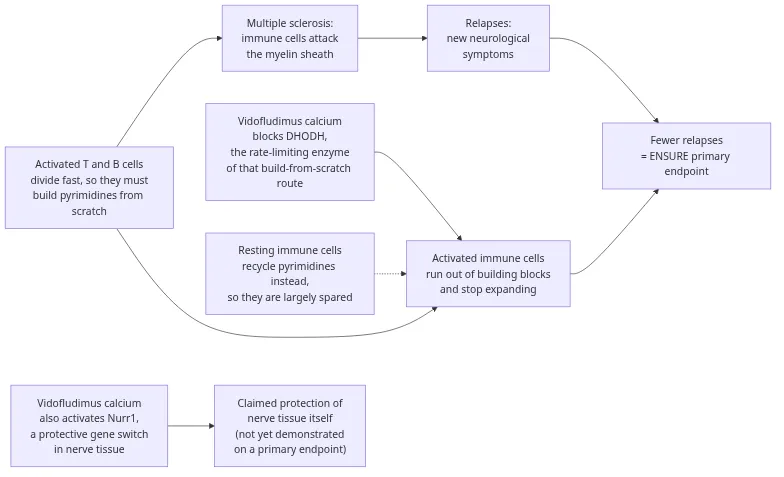
How well is the target validated? As well as a target in this disease can be. Sanofi’s
teriflunomide (Aubagio) blocks the same enzyme, was approved in the United States in September 2012
for relapsing MS, and is now generic. That is not a surrogate or an animal model; it is a regulator
accepting that inhibiting this enzyme reduces relapses in this exact population. [VERIFIED — teriflunomide's US approval and mechanism; the 31–36% relative reduction in annualised relapse rate against placebo comes from the TEMSO and TOWER registrational trials, PMID 24461574 and PMC3573676, carried from the 2026-08-04 sweep and not re-fetched this session]
Independent genetic validation could not be obtained: Open Targets search_entities is BLOCKED
(section 0). The analysis does not lean on it, because an approved drug on the same enzyme is
stronger evidence than a genetic association would be.
The second mechanism, and what it is worth. The company’s differentiation claim is that
vidofludimus calcium is also a direct activator of Nurr1 (NR4A2), a transcription factor — a protein
that switches genes on — implicated in protecting nerve cells. This is not a marketing assertion:
four independent academic groups have published structural and medicinal-chemistry work on how
vidofludimus binds and activates Nurr1, including a structural study locating its binding site in an
allosteric surface pocket, and three papers building selective Nurr1 tool compounds on the
vidofludimus scaffold. [VERIFIED — PubMed, DOIs 10.1038/s42004-025-01553-8 (Commun Chem 2025), 10.1021/acs.jmedchem.5c01140 (J Med Chem 2025), 10.1021/acs.jmedchem.5c03217 (J Med Chem 2026) and 10.1002/cmdc.70296 (ChemMedChem 2026), all read 2026-08-11]
But the molecular story and the clinical story diverge, and that gap is the honest scientific risk. The one trial designed to demonstrate the neuroprotective claim on a clinical primary endpoint — CALLIPER, in progressive MS, with annualised percent brain volume change as its primary — missed. A 5% relative improvement over placebo, not statistically significant. The mechanism is real at the level of protein structure and gene expression; it has not yet been shown to change an outcome a regulator cares about.
The exact scientific step ENSURE must prove. That 30 mg of vidofludimus calcium once daily lengthens the time to a patient’s first relapse over 72 weeks compared with placebo, at conventional statistical significance, in each of two trials independently. Nothing about Nurr1 is being tested. The endpoint is an anti-inflammatory endpoint, and it is the endpoint the same enzyme’s approved inhibitor already hits.
Molecule properties. The 2026-08-04 sweep obtained these from a live ChEMBL call; that connector
is BLOCKED today (section 0), so they are carried forward with their original provenance rather than
re-confirmed. CHEMBL197194, preferred name VIDOFLUDIMUS, max phase 3, molecular formula
C20H18FNO4, molecular weight 355.37, ALogP 4, polar surface area 75.63, QED 0.85, zero Rule-of-Five
violations, achiral, USAN stem -imus (immunosuppressives), synonyms 4SC-101, IMU-838, SC-12267,
NSC-717824. [VERIFIED — ChEMBL compound_search, 2026-08-04 sweep; not re-confirmable today, connector BLOCKED] The read is unchanged: a conventional, cheap-to-make oral small molecule with no
formulation obstacle identified. The same record carries oral: false, which contradicts the drug
being a once-daily tablet and is treated as a missing-data artefact.
A.2 Clinical development plan, timeline, feasibility, resourcing
gantt
  title Vidofludimus calcium development, with precedent and competition
  dateFormat YYYY-MM-DD
  axisFormat %Y-%m
  section Vidofludimus calcium - Immunic
    EMPhASIS Ph2 RRMS, randomised placebo-controlled, n=210 CT.gov :done, 2019-01-28, 2020-04-24
    CALLIPER Ph2 progressive MS, randomised placebo-controlled, n=450, MISSED :done, 2021-09-30, 2025-01-07
    ENSURE-1 Ph3 RMS, randomised placebo-controlled, n=1121 :active, 2021-11-18, 2026-11-30
    ENSURE-2 Ph3 RMS, randomised placebo-controlled, n=1100 :active, 2022-01-12, 2026-11-30
    ENSURE interim futility analysis, not futile :milestone, done, 2024-10-22, 1d
    Readout window, earliest to latest, precision PERIOD :crit, 2026-12-01, 2027-03-31
    Readout window, likeliest :milestone, crit, 2026-12-15, 1d
    Common warrants expire, 30 trading days after topline :milestone, 2027-01-29, 1d
    NDA submission as guided, mid-2027 :milestone, 2027-06-30, 1d
  section Approved precedent - teriflunomide, Sanofi
    TEMSO Ph3 RMS, randomised placebo-controlled, n=1088 :done, 2004-09-01, 2010-07-01
    TOWER Ph3 RMS, randomised placebo-controlled, n=1169 :done, 2008-06-01, 2011-12-01
    Aubagio US approval :milestone, done, 2012-09-12, 1d
  section Emerging competition - fenebrutinib, Roche
    FENtrepid Ph3 PPMS vs ocrelizumab, n=985 :done, 2020-10-26, 2025-09-17
    FENhance 2 Ph3 RMS vs teriflunomide, n=751 :done, 2021-03-24, 2025-09-05
    FENhance 1 Ph3 RMS vs teriflunomide, n=746 :done, 2021-03-17, 2026-01-27
    Roche reports a third positive Ph3, all three to be filed :milestone, done, 2026-03-02, 1d
    Detailed FENhance results, ARR -51.1% and -58.5% vs teriflunomide :milestone, done, 2026-04-22, 1d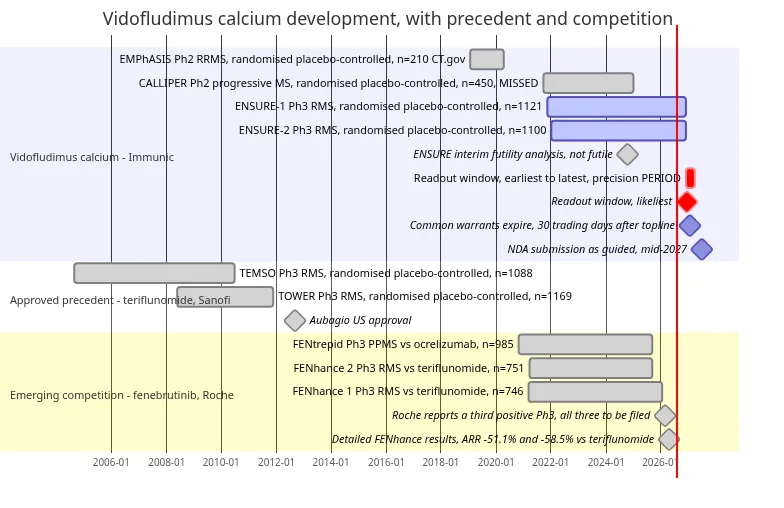
Trials
| Trial | Sponsor / whose drug | Design (arms, blinding, n) | Population | Status / key result | Link |
|---|---|---|---|---|---|
| ENSURE-1 | Immunic AG / its own | Randomised, double-blind, placebo-controlled. Vidofludimus calcium 30 mg once daily versus matching placebo. 72-week blinded main treatment period, then an open-label extension of up to about 8 years. n=1,121 across 91 registry site records in 16 countries, 6 of them in the United States | Adults 18–55 with MS by the 2017 McDonald criteria and active relapsing disease by Lublin 2014. Non-active secondary progressive and primary progressive MS excluded | ACTIVE_NOT_RECRUITING, enrolment complete. Primary completion 2026-11. Overall completion 2033-09. No results posted | NCT05134441 |
| ENSURE-2 | Immunic AG / its own | Identical twin of ENSURE-1. n=1,100 across 76 registry site records in 13 countries, 2 of them in the United States | Identical | ACTIVE_NOT_RECRUITING, enrolment complete. Primary completion 2026-11. Overall completion 2033-10. No results posted | NCT05201638 |
| EMPhASIS | Immunic AG / its own | Randomised, double-blind, placebo-controlled. 10, 30 and 45 mg once daily versus placebo. n=210 on CT.gov, n=268 in the company’s own reporting and its peer-reviewed publication, across 38 sites | Relapsing-remitting MS | Met its primary endpoint at 45 mg: cumulative combined unique active lesions at week 24, rate ratio 0.38 (95% CI 0.22–0.64), p=0.0002, a 62% reduction versus placebo. Peer-reviewed with independent academic co-authors | NCT03846219 · DOI 10.1212/NXI.0000000000200208 |
| CALLIPER | Immunic AG / its own | Randomised, double-blind, placebo-controlled. n=450 across 73 sites | Progressive MS | MISSED. Primary endpoint was annualised rate of percent brain volume change; a 5% relative improvement versus placebo, not statistically significant. The company emphasises a secondary showing a 20% lower likelihood of 24-week confirmed disability worsening. Registry status reads UNKNOWN | NCT05054140 |
| FENhance 1 | Hoffmann-La Roche / fenebrutinib | Phase 3, randomised, double-blind, double-dummy, versus teriflunomide. n=746, 160 sites. Start 2021-03-17, primary completion 2026-01-27 | Relapsing MS | Positive. Annualised relapse rate reduced 51.1% (p<0.001) versus teriflunomide over 96 weeks. 12-week composite confirmed disability progression reduced 20% numerically (HR 0.80; 95% CI 0.63–1.02) | NCT04586010 |
| FENhance 2 | Hoffmann-La Roche / fenebrutinib | Identical design. n=751, 106 sites. Start 2021-03-24, primary completion 2025-09-05 | Relapsing MS | Positive. Annualised relapse rate reduced 58.5% (p<0.0001) versus teriflunomide. Disability progression reduced 13% numerically (HR 0.87; 95% CI 0.69–1.11) | NCT04586023 |
| FENtrepid | Hoffmann-La Roche / fenebrutinib | Phase 3 versus ocrelizumab. n=985, 190 sites. Start 2020-10-26, primary completion 2025-09-17 | Primary progressive MS | Positive, reported 2026-02-07. Threatens Immunic’s own primary-progressive follow-on, bpiq_drug_id 19833 | NCT04544449 |
| TEMSO / TOWER | Sanofi / teriflunomide | Phase 3, randomised, placebo-controlled. n=1,088 and n=1,169 | Relapsing MS | Positive. 31–36% relative reduction in annualised relapse rate versus placebo. The registrational precedent for this mechanism | PMID 24461574 · PMC3573676 |
[VERIFIED — CT.gov search_trials and get_trial_details, read 2026-08-11, for every design, size, site count, date and status above] [VERIFIED — Roche media release of 2026-04-21, read 2026-08-11, for the FENhance 1 and 2 effect sizes, p-values, hazard ratios and confidence intervals] [VERIFIED — PubMed DOI 10.1212/NXI.0000000000200208 for the EMPhASIS result]
[WEB ESTIMATE — Roche media releases 2026-02-07 and 2026-03-02 for the FENtrepid outcome]
Dose. The registrational dose is 30 mg once daily. That is one step below the 45 mg that produced
the published EMPhASIS primary result. The company’s stated basis is that 30 mg and 45 mg were
comparable on several Phase 2 endpoints. This remains the clearest single reason the Phase 3 could
fail while the mechanism is sound. [UNVERIFIED — the comparability claim is the company's; the published primary result is at 45 mg]
Interim analysis. On 2024-10-22 an independent data monitoring committee completed a non-binding
futility analysis after approximately half the planned first-relapse events. The futility criteria
were not met, the trials continued unchanged, and no sample-size increase was required. That is a
genuine de-risking event, but it is a “not obviously hopeless” signal from a blinded committee, not
an efficacy result, and it carries no effect size. [VERIFIED — BPIQ pipeline note on bpiq_drug_id 16219 and the company release of 2024-10-22]
Feasibility matrix
| Factor | High probability | Medium probability | Low probability | This asset (assessment) | Source |
|---|---|---|---|---|---|
| Recruitment feasibility | >50 sites, 3:1 patient:site | 20–50 sites, established investigators | <20 sites, novel sites | High. 167 registry site records across 24 distinct countries, 2,221 patients randomised, both trials fully enrolled since June 2025. Roughly 13 patients per site record | CT.gov, both NCTs, read 2026-08-11 |
| Endpoint clarity | Regulatory precedent exists | Novel endpoint with FDA alignment | Unvalidated surrogate | High, with one caveat. Relapse endpoints in relapsing MS are the established registrational route. The caveat is that ENSURE’s primary is time to first relapse, while teriflunomide’s own registrational trials and Roche’s FENhance trials all report annualised relapse rate — the endpoint is accepted, but its headline number will not be directly comparable to the numbers the market anchors on | CT.gov primary outcome text for both NCTs; Roche release 2026-04-21 |
| Trial-design robustness | Pivotal Phase III with SPA | Adaptive with interim analysis | Single-arm, no control | High. Two independent, identically designed, randomised, double-blind, placebo-controlled Phase 3 trials with a pre-specified non-binding futility interim. No special protocol assessment is disclosed | CT.gov, both NCTs |
| Operational / execution | Enrollment complete, standard timeline | Some timeline risk | Enrollment behind | High. Enrolment complete in both trials since 2025-06-05; topline guidance unchanged for fourteen months with zero slips | BPIQ note on 16219; company releases |
Resourcing sufficiency. Yes, comfortably, for the readout itself. The company held $186.6M at
2026-03-31 against a recomputed burn of $11.08M a month, which is roughly 16.8 months of runway from
that date and reaches into approximately 2027-08 — well past the readout window and past the guided
mid-2027 NDA submission. It also holds $80.0M of undrawn at-the-market capacity it has not used. See
../company.md C.3. The resourcing question that is not settled is the one after
the readout: the burn rose 29% between FY2025 and Q1 2026 as launch preparation began, and a
commercial build for a first launch is a materially larger number than a trial completion.
A.3 Target label, target product profile, strategic questions, designations
A.3a Target label. Vidofludimus calcium 30 mg once daily, orally, for the treatment of adults with relapsing forms of multiple sclerosis, including relapsing-remitting disease and active secondary progressive disease.
A.3b Target product profile
| Attribute | Standard of care & key competitor(s) — data | Vidofludimus calcium target profile (goal) | Supporting evidence (+ link) |
|---|---|---|---|
| Indication / target label | Relapsing MS. Teriflunomide (generic, same enzyme) approved 2012; anti-CD20 antibodies ocrelizumab, ofatumumab, ublituximab take most new starts in active disease; fenebrutinib filed and not yet approved | Identical label to teriflunomide, in the moderate-efficacy oral tier | [Aubagio label precedent]; FENhance 1/2 |
| Efficacy (endpoints, regimen) | Teriflunomide: 31–36% relative reduction in annualised relapse rate versus placebo. Fenebrutinib: 51.1% and 58.5% reductions versus teriflunomide — a far harder comparison to win | Statistically significant lengthening of time to first relapse versus placebo in both twins. No public numerical powering assumption | DOI 10.1212/NXI.0000000000200208; Roche release 2026-04-21 |
| Safety / tolerability | Teriflunomide carries a boxed warning for liver injury and for harm to a foetus, needs an accelerated elimination procedure, and commonly causes hair thinning and diarrhoea. Fenebrutinib’s liver-enzyme elevation rates were 7.3% vs 5.7% (FENhance 1) and 5.6% vs 5.6% (FENhance 2) against teriflunomide, with one Hy’s Law case in each arm of FENhance 1, both resolving on discontinuation | No increase in liver events, low white-cell counts or broad immunosuppression versus placebo; no boxed warning | Roche release 2026-04-21, read 2026-08-11 |
| Biomarker / companion diagnostic | None used in this indication | None planned; none needed | — |
| Formulation / administration | Teriflunomide: one tablet daily. Anti-CD20s: infusion or injection. Fenebrutinib: oral | One 30 mg tablet daily. No advantage over teriflunomide on route or frequency | CT.gov intervention text |
| Payer value | Generic teriflunomide is cheap. Branded orals net well below their list prices; the oral-DMT class averaged $82,181 net in 2021 | A branded price a payer will accept against a generic on the identical enzyme, with no head-to-head evidence to justify it | DOI 10.1212/CPJ.0000000000200597 |
A.3c Strategic Go/No-Go questions. The asset’s next decision is registration, so the pre-Phase-III / registration set applies.
| Group | Question | Answer (tagged) |
|---|---|---|
| Target | Target revalidated as in prior phases? | Yes. DHODH inhibition is validated in this exact indication by an approved drug, and EMPhASIS met its own primary endpoint on this molecule at p=0.0002 [VERIFIED — DOI 10.1212/NXI.0000000000200208] |
| Dose & Drug | Exposure–response for the intended commercial regimen and route(s)? | Partially. EMPhASIS tested 10, 30 and 45 mg; the published primary result is at 45 mg and the registrational dose is 30 mg. The company’s stated basis for stepping down is comparability across several Phase 2 endpoints, which has not been published as a formal exposure–response model [UNVERIFIED — company statement] |
| Dose & Drug | Commercial formulation available or feasible? | Yes. A conventional small-molecule tablet with no Rule-of-Five violations and no disclosed formulation obstacle [VERIFIED — ChEMBL, 2026-08-04 sweep; connector BLOCKED today] |
| Dose & Drug | Dose range compatible with clinical and non-clinical safety? | Yes on the evidence so far. No increase in liver events, neutropenia or broad immunosuppression versus placebo has been reported across a long human safety database going back to 4SC AG trials in 2009 [UNVERIFIED — no blinded Phase 3 safety data exists yet] |
| Dose & Drug | Therapeutic window given the clinical response? | Unknown, and this is the crux. The gap between the 45 mg that produced the published effect and the 30 mg being registered is exactly a therapeutic-window question that ENSURE will answer one way or the other [UNVERIFIED] |
| Dose & Drug | Intrinsic and extrinsic factors influencing exposure and patient response? | Not established publicly for the 30 mg dose in this population [UNVERIFIED] |
| Patient | Proof of concept and positive benefit/risk in the intended population? Combination evidence? | Yes for proof of concept: EMPhASIS in relapsing-remitting MS. No combination evidence, and none is planned — this is a monotherapy [VERIFIED — DOI 10.1212/NXI.0000000000200208] |
| Patient | Phase III design and outcome criteria — accepted, compelling, competitive for market access? | Accepted, yes; compelling and competitive, no. Placebo-controlled twins in relapsing MS are an accepted route, but a placebo comparison in 2026 is the easiest available and produces no evidence a health-technology assessment body can use against generic teriflunomide [VERIFIED — CT.gov design; UNVERIFIED — the market-access judgement] |
| Patient | Rationale for the patient population(s)? | Sound and conventional: adults 18–55, active relapsing disease by Lublin 2014, progressive forms excluded [VERIFIED — CT.gov eligibility criteria, both NCTs] |
| Patient | Likelihood of the expected outcome? | Modelled at 60%, band 50–70%, for the strict both-twins definition in the locked prediction below [UNVERIFIED — modelled] |
| Patient | Companion-diagnostic strategy, including pricing and market? | Not applicable. No biomarker selection is used in this indication [VERIFIED — CT.gov eligibility criteria] |
A.3d Regulatory designations. None disclosed for this program. Vidofludimus calcium carries no
Breakthrough Therapy, Fast Track, Orphan Drug or Priority Review designation that this sweep could
find, and none appears in the company’s own pipeline messaging. [UNVERIFIED — an absence found by searching, not a confirmed negative from a regulator] The practical consequence is that the review
after submission will be a standard one, on a standard clock, with no accelerated route available.
A.4 Target product profile valuation matrix
| Stakeholder | Value driver | Minimum threshold | Competitive | Premium | Benchmark / source |
|---|---|---|---|---|---|
| Patient / caregiver | Fewer relapses without daily monitoring burden or a boxed warning | Statistically fewer relapses than placebo | Relapse reduction in teriflunomide’s range (31–36% ARR) with a cleaner label | Relapse reduction approaching the anti-CD20 / BTK tier while staying oral and monitoring-light | Teriflunomide label; Roche release 2026-04-21 |
| Regulator | Two independent, adequately powered, well-controlled trials on an accepted endpoint | Both twins significant on the primary at p<0.05 | Consistent direction across the MRI and disability secondaries | A safety profile that is clearly better than the approved drug on the same enzyme | FDA precedent set by Aubagio’s approval, 2012-09 |
| Payer / HTA | A reason to pay a brand price when a generic on the identical enzyme exists | Non-inferiority argued indirectly | Demonstrably lower rate of liver events or discontinuations than teriflunomide | A head-to-head win against teriflunomide — which this programme will not have, and Roche will | DOI 10.1212/CPJ.0000000000200597 |
| Provider | A drug that is simple to start and does not need frequent laboratory checks | Fewer scheduled liver-function tests than teriflunomide | No accelerated elimination procedure required | No boxed warning at all | Teriflunomide label |
Calibration examples, not asset claims: in oncology each incremental month of overall survival is worth roughly $150–300M in peak-sales potential; oral formulations command roughly 15–25% price premiums over injectables. Neither applies directly here — this asset is oral against an oral generic, so the formulation premium is already competed away.
A.5 Evidence quality and endpoints
| Criterion | Score (High / Medium / Low) | Basis (one line) | Link |
|---|---|---|---|
| Target validation | High | An approved drug on the identical enzyme in the identical indication; no surrogate reasoning required | Aubagio US approval 2012-09 |
| Mechanism clarity | High for DHODH, Medium for Nurr1 | The DHODH mechanism is textbook. The Nurr1 mechanism is confirmed structurally by four independent academic groups but has failed the one clinical test designed for it | DOI 10.1038/s42004-025-01553-8 |
| Biomarker availability | Medium | MRI lesion counts and neurofilament light chain are usable pharmacodynamic readouts and have moved on this molecule, but neither selects patients nor predicts the primary endpoint | DOI 10.1212/NXI.0000000000200208 |
| Publication quality (peer-reviewed? independent authors?) | High for the pivotal Phase 2, Low for the most recent review | EMPhASIS is peer-reviewed in Neurol Neuroimmunol Neuroinflamm with eight independent academic co-authors against six company authors. The July 2026 review of the asset in Expert Opin Investig Drugs has fourteen of its fifteen authors employed by Immunic AG and is not an independent source | DOI 10.1212/NXI.0000000000200208 · DOI 10.1080/13543784.2026.2705509 |
| Clinical / expert sentiment | — | Moved to A.5b, below. | — |
Endpoints
| Endpoint (full name) | What it measures | Scale / range | Better direction | MCID / note |
|---|---|---|---|---|
| Time to first relapse (ENSURE primary) | Days from first dose to a patient’s first confirmed relapse, analysed as a survival curve and censored at 72 weeks | Time, in days, to an event that either happens or does not within 72 weeks. Reported as a hazard ratio | Longer time / lower hazard ratio | No established minimal clinically important difference exists for this endpoint as such. This is the crux of the comparability problem: teriflunomide’s 31–36% and fenebrutinib’s 51.1%/58.5% are annualised relapse rate reductions, a different quantity. A hazard ratio on time to first relapse and a rate ratio on relapses per year are not interchangeable, and the market will be tempted to treat them as though they were |
| Volume of new T2 lesions (secondary) | The total volume of new inflammatory patches appearing in the brain on MRI over 24 weeks of treatment inside the blinded period | Volume, in cubic millimetres. Reported as a mean difference | Smaller | No established MCID. Standard supportive MRI endpoint |
| Time to 12-week confirmed disability progression on EDSS (secondary) | How long until a patient’s disability score worsens and stays worse for at least 12 weeks | EDSS runs 0 (normal) to 10 (death) in half-point steps. Progression is conventionally a ≥1.0-point increase from a baseline of ≤5.5, or ≥0.5 from a higher baseline | Longer time | A 1.0-point EDSS change is the conventional threshold; the trial’s own definition is not published numerically |
| Time to confirmed clinically relevant change on the Symbol Digit Modalities Test (secondary) | How long until mental processing speed changes by a clinically relevant amount | SDMT scores 0–110 correct substitutions in 90 seconds | Longer time to worsening | A change of ≥4 points, or ≥10% relative, is the usual threshold in MS |
| Whole brain atrophy, percent change over 72 weeks (secondary) | How much the brain shrinks over the blinded period | Percentage change in whole brain volume | Less negative | Healthy ageing loses roughly 0.1–0.3% per year; untreated MS roughly 0.5–1.0%. This is the family of endpoint CALLIPER missed |
| Safety and tolerability (secondary) | Treatment-emergent adverse events, adverse events of special interest, serious adverse events, laboratory values, vital signs, ECG, discontinuations | Rates and counts | Lower | The axis on which this asset is claimed to differentiate |
| Cumulative combined unique active lesions at week 24 (EMPhASIS primary — for context only) | The total count of distinct actively inflamed brain lesions over 24 weeks | Count. Reported as a rate ratio | Fewer | Met at 45 mg: rate ratio 0.38 (95% CI 0.22–0.64), p=0.0002. Not an ENSURE endpoint |
[VERIFIED — CT.gov get_trial_details primary and secondary outcome text for NCT05134441 and NCT05201638, read 2026-08-11]
A.5b Key opinion leaders.
Panel as of. 2026-08-11.
Investigators
The ClinicalTrials.gov records for ENSURE-1 and ENSURE-2 list no overall officials and no named
site contacts — Immunic does not populate those fields — so search_investigators returns nothing
for this program, and a direct name query returned zero trials. That is a finding, not an omission.
The paid-by-trial panel below is therefore identified from the programme’s own pivotal Phase 2
publication, where authorship on the trial’s dataset is the sponsor relationship, cross-referenced
against the ENSURE site lists to show which of those academics also host an ENSURE site.
| Name | Role / affiliation | Trial (NCT) | Conflicts (party, kind, disclosed in, as of) | Conflicts checked (source, date) | Source | Tag |
|---|---|---|---|---|---|---|
| Robert J. Fox | First author, EMPhASIS pivotal publication. Mellen Center for Multiple Sclerosis, Cleveland Clinic | NCT03846219 | Sponsor — co-author of a company-authored review of this asset in which 14 of the 15 authors are Immunic AG employees, disclosed in the authorship of DOI 10.1080/13543784.2026.2705509, as of 2026-07-21 | PubMed get_article_metadata, 2026-08-11 — the connector’s metadata carries no conflict-of-interest section for either DOI, and journal disclosure appendices were not opened this sweep | DOI 10.1212/NXI.0000000000200208 | VERIFIED — authorship; conflicts beyond authorship UNVERIFIED |
| Heinz Wiendl | EMPhASIS co-author. Department of Neurology with Institute of Translational Neurology, University of Münster | NCT03846219; the Münster institute is a registry site on both ENSURE-1 and ENSURE-2 | None disclosed beyond the trial relationship | PubMed get_article_metadata, 2026-08-11 — same limit | DOI 10.1212/NXI.0000000000200208 | VERIFIED — authorship and CT.gov site list; conflicts UNVERIFIED |
| Konrad Rejdak | EMPhASIS co-author. Department of Neurology, Medical University of Lublin | NCT03846219; “Indywidualna Praktyka Lekarska prof. Konrad Rejdak”, Lublin, is a registry site on ENSURE-2 | None disclosed beyond the trial relationship | PubMed get_article_metadata, 2026-08-11 — same limit | DOI 10.1212/NXI.0000000000200208 | VERIFIED — authorship and a direct name match on the CT.gov site list; conflicts UNVERIFIED |
| Victoriya Gryb | EMPhASIS co-author. Regional Clinical Hospital, Department of Vascular Neurology, Ivano-Frankivsk, Ukraine | NCT03846219; Ivano-Frankivsk Regional Clinical Hospital is a registry site on ENSURE-1 | None disclosed beyond the trial relationship | PubMed get_article_metadata, 2026-08-11 — same limit | DOI 10.1212/NXI.0000000000200208 | VERIFIED — authorship and CT.gov site list; conflicts UNVERIFIED |
| Plamen S. Bozhinov | EMPhASIS co-author. Medical University of Pleven, Bulgaria | NCT03846219; five registry sites in Pleven appear on ENSURE-1 | None disclosed beyond the trial relationship | PubMed get_article_metadata, 2026-08-11 — same limit | DOI 10.1212/NXI.0000000000200208 | VERIFIED — authorship and CT.gov site list; conflicts UNVERIFIED |
| Nicola De Stefano | EMPhASIS co-author. Department of Medicine, Surgery and Neuroscience, University of Siena | NCT03846219; no Italian ENSURE site | None disclosed beyond the trial relationship | PubMed get_article_metadata, 2026-08-11 — same limit | DOI 10.1212/NXI.0000000000200208 | VERIFIED — authorship; conflicts UNVERIFIED |
| Johann Sellner | EMPhASIS co-author. Department of Neurology, Landesklinikum Mistelbach-Gänserndorf, Austria | NCT03846219; no Austrian ENSURE site | None disclosed beyond the trial relationship | PubMed get_article_metadata, 2026-08-11 — same limit | DOI 10.1212/NXI.0000000000200208 | VERIFIED — authorship; conflicts UNVERIFIED |
Independent voices
Two named non-sponsor commentators were found who write on this therapeutic area and reference this
asset’s class. Neither addresses ENSURE’s own endpoint. That gap is the finding, and it is what the
Judgement below turns on. Note separately that an Immunic director, Richard A. Rudick, is a
long-standing MS methodologist who continues to publish on MS diagnostic criteria; he is not an
ENSURE investigator and states no view on this program, so he is in neither table here, but the
relationship is recorded in ../company.md C.5 so a reader can weigh whose voice
in this field is independent of Immunic.
| Name | Affiliation | View (close enough to quote) | As of | Conflicts checked (source, date) | Source | Tag |
|---|---|---|---|---|---|---|
| Husna Irfan Thalib (and five co-authors) | Batterjee Medical College, Jeddah | Reviewing emerging MS therapies: “BTK inhibitors and S1P receptor modulators demonstrated anti-inflammatory activity in clinical trials, although some agents failed to show superiority over established therapies”, and many newer approaches “remain investigational” pending large-scale studies | 2026-06-15 | PubMed get_article_metadata, 2026-08-11 — no sponsor affiliation in the author list; the full-text conflict statement was not opened | DOI 10.1007/s00210-026-05579-0 | VERIFIED — publication; independence UNVERIFIED beyond an affiliation check |
| Shitiz Sriwastava (and eight co-authors, including Robert P. Lisak) | Division of Multiple Sclerosis and Neuroimmunology, McGovern Medical School, UT Health Houston | Field review of treatment advances in primary and secondary progressive MS, placing DHODH inhibition among the candidate approaches rather than among established options | 2024-02-17 | PubMed get_article_metadata, 2026-08-11 — no sponsor affiliation in the author list; full-text conflict statement not opened | DOI 10.1016/j.jneuroim.2024.578315 | VERIFIED — publication; independence UNVERIFIED beyond an affiliation check |
Judgement
| Endpoint supported | Basis (one or two sentences) | Tag |
|---|---|---|
UNKNOWN | The panel assembled is too thin to judge: a PubMed search restricted to non-Immunic affiliations returns only four papers on this molecule in multiple sclerosis, and neither named independent voice comments on time to first relapse as the right primary endpoint for this programme, in either direction. The analyst’s own observation — that ENSURE’s primary is a survival endpoint while every comparator the market will judge it against reports annualised relapse rate — is stated in A.5 as a judgement, not attributed to anyone here. | UNVERIFIED — judgement |
Dissent
Empty. Endpoint supported is UNKNOWN rather than SUPPORTIVE_CONTESTED, so no named
disagreement is required, and none was found. Inventing one would be worse than recording the
silence.
B. Commercial assessment
B.0 Current treatment algorithm
A newly diagnosed patient with active relapsing multiple sclerosis in the United States is increasingly started on a high-efficacy therapy straight away rather than escalated to one. In practice that means an anti-CD20 antibody — ocrelizumab (Ocrevus, Roche), ofatumumab (Kesimpta, Novartis) or ublituximab (Briumvi, TG Therapeutics) — which reduce relapses by roughly half against teriflunomide in head-to-head trials and take the majority of new starts in active disease.
Below that tier sits the oral slot, which is now mostly generic: teriflunomide, dimethyl fumarate and fingolimod are all available as generics; ozanimod (Zeposia, Bristol Myers Squibb) and ponesimod (Ponvory) remain branded; cladribine (Mavenclad) is a separate short-course option.
Vidofludimus calcium would enter that oral slot, with the same mechanism, the same route and the same once-daily dosing as generic teriflunomide. It would not displace an anti-CD20 in active disease. Its entire commercial argument is that a patient who wants a tablet can have one without teriflunomide’s boxed warning and monitoring burden.
What changed in 2026 is the tier above the oral slot. If fenebrutinib is approved, the oral slot itself acquires a high-efficacy branded option that beat teriflunomide by 51.1% and 58.5% on annualised relapse rate. A patient who wants a tablet and can access a brand would have a reason to choose fenebrutinib over vidofludimus calcium that has nothing to do with tolerability.
B.1 Competitive landscape and positioning
| Metric | High value | Medium value | Low value | This asset (assessment) | Source |
|---|---|---|---|---|---|
| Mechanism differentiation | First-in-class or novel target | Next-generation improvement | Me-too | Low on the enzyme, Medium on the second mechanism. DHODH inhibition in relapsing MS is fourteen years old and generic. The Nurr1 activation is genuinely novel and structurally confirmed, but it has failed its one clinical test | DOI 10.1038/s42004-025-01553-8; CALLIPER result |
| Development-timeline advantage | >12 months ahead | Within 6–12 months | Lagging >12 months | Low. Roughly 14 years behind the approved competitor on its own mechanism, and now behind fenebrutinib, whose last Phase 3 completed in January 2026 and whose full dataset is being filed while ENSURE has not read out | CT.gov primary completion dates for both programmes |
| Clinical proof-of-concept evidence | Positive Phase IIb (n>100) | Phase IIa signals (n=20–50) | Preclinical only | High. EMPhASIS is a randomised, placebo-controlled Phase 2 with n=210–268 that met its primary endpoint at p=0.0002 and is peer-reviewed with independent academic co-authors | DOI 10.1212/NXI.0000000000200208 |
| IP protection | Composition-of-matter, long-dated | Method-of-use | Pending or none | Medium. Polymorph and method-of-use protection rather than composition-of-matter on a base molecule dating to about 2009. European dosing-regimen patent granted March 2026 protecting into 2038, potentially 2043 with a supplementary protection certificate; a multi-layered US estate reported to run at least into 2041, with pending applications that could extend to 2044 or 2045 if granted | Company release 2026-03-10; [WEB ESTIMATE — PRNewswire and Investing.com coverage, 2026] |
Where this asset wins, in plain sentences. It wins on one axis only: a patient who needs an oral drug and cannot tolerate teriflunomide’s liver-function monitoring, hair thinning and accelerated elimination requirement, or who cannot take it because of the pregnancy warning, currently has to step sideways to a different mechanism. Vidofludimus calcium offers the same mechanism without those liabilities — if the Phase 3 safety data confirm the pattern seen so far.
The single fact the thesis rests on is that DHODH inhibition works in relapsing MS. That is not in doubt. The single fact that undermines it commercially is that the same statement is already true of a generic, and will shortly be true of a better-performing brand.
What changed since the 2026-08-04 version of this document, and why it matters. That version
argued that the FDA’s rejection of Sanofi’s tolebrutinib on severe drug-induced liver injury made
the tolerability niche more valuable, because it suggested the incoming BTK-inhibitor class carried
a hepatic liability that vidofludimus calcium does not. Roche’s detailed FENhance results, released
2026-04-21 and read this sweep, remove that argument: fenebrutinib’s liver-enzyme elevation rates
were 7.3% versus 5.7% in FENhance 1 and 5.6% versus 5.6% in FENhance 2 against teriflunomide, with
one Hy’s Law case in each arm of FENhance 1, both resolving on discontinuation. Fenebrutinib does
not carry tolebrutinib’s problem. The tolerability niche is therefore worth less than the previous
version priced it at, and this is the clearest single change in the commercial case since that
version was written. [VERIFIED — Roche media release 2026-04-21, read 2026-08-11]
Calibration example, not an asset claim: oncology first-movers in novel mechanisms have shown roughly 3.2× higher peak-sales potential but about 1.8× higher development risk. This asset is the opposite case — a late follower on a de-risked mechanism, so the risk is low and so is the ceiling.
Competitor status detail.
- Fenebrutinib (Roche). Positive in all three Phase 3 trials. FENhance 2 and FENtrepid reported
in November 2025; FENhance 1 reported 2026-03-01/02; detailed results 2026-04-21. Roche has stated
the totality of data from all three studies will be submitted to regulators. No FDA filing
acceptance, priority review or PDUFA date could be found in this sweep.
[VERIFIED — Roche media release 2026-04-21 for the results; UNVERIFIED — the regulatory filing status, searched and not found]Historical note: the FDA placed a partial clinical hold on the fenebrutinib MS programme on 2023-11-30 after two cases of transaminase elevation with raised bilirubin; the trials plainly resumed, since all three completed and read out, but no primary source for the date the hold was lifted was located this sweep.[WEB ESTIMATE — NeurologyLive and Genentech statement, 2023-11-30; the lift date is UNVERIFIED] - Tolebrutinib (Sanofi). Received an FDA Complete Response Letter in non-relapsing secondary
progressive MS on the management of severe drug-induced liver injury risk, and separately was not
superior to teriflunomide on annualised relapse rate in relapsing MS (GEMINI 1 and 2). Two
third-party sources date the Complete Response Letter to December 2025 and April 2026
respectively; neither is primary, the fact and the stated grounds are consistent, and the date is
not resolved.
[WEB ESTIMATE — Pharmacy Times, NeurologyLive, 2026] - Remibrutinib (Novartis). Approved as Rhapsido in chronic spontaneous urticaria in September
2025, not in MS. In Phase 3 in MS, including a head-to-head against teriflunomide
(NCT05156281). One third-party source described this as a BTK-inhibitor approval in MS; rejected
under rule 6.
[VERIFIED — CT.gov for NCT05156281; WEB ESTIMATE — trade coverage for the urticaria approval]
Published third-party probability. Leerink has published a 50% probability of success for
ENSURE, after CALLIPER. [WEB ESTIMATE — Leerink via BioSpace, 2025] No newer third-party
probability was found in this sweep.
B.2 Addressable market
The launch market that matters is the United States. Europe is a second market with materially lower
per-patient pricing and a granted dosing-regimen patent running into 2038, and it is excluded from
the quantified build below rather than estimated. The worldwide MS disease-modifying-therapy market
was projected at $25.3 billion by 2026 across the United States, France, Germany, Italy, Spain, the
United Kingdom and Japan. [WEB ESTIMATE — Pharmacy Times, market research summary]
| Component | How it is estimated | Premium threshold | This asset (assessment) | Source |
|---|---|---|---|---|
| Drug-treated patients | Epidemiology × diagnosis rate × treatment rate | >100,000 (US/EU5/Japan) | Clears the threshold, but the treatment rate is the weakest input in this document. Roughly 1,000,000 Americans have MS; roughly 85% present with relapsing disease; an assumed 60% are currently on a disease-modifying therapy, giving roughly 500,000 treated US relapsing patients | [WEB ESTIMATE — National MS Society / CDC / NIH prevalence study] for the first two; [UNVERIFIED] for the treatment rate |
| Market exclusivity | Patent term + regulatory exclusivity | >10 years combined | Clears it on the company’s own account. Europe into 2038, potentially 2043 with a supplementary protection certificate; the United States at least into 2041, with pending applications reaching 2044–2045 if granted. Protection is polymorph and method-of-use, not composition-of-matter | [WEB ESTIMATE — company statements via PRNewswire and Investing.com, 2026] |
| Reimbursement precedent | Approvals in ≥2 major markets | Positive NICE/CADTH guidance | Precedent exists but cuts against a brand price. Teriflunomide is reimbursed everywhere and is generic, so the precedent establishes that the mechanism is fundable and that it is cheap | Teriflunomide reimbursement status |
| Patient-journey impact | Fewer hospital days, less caregiver burden | >30% quality-of-life gain | Below the premium threshold. Removing routine liver-function monitoring and an accelerated elimination procedure is a real convenience gain, but it is not a 30% quality-of-life improvement and no such claim is made | Teriflunomide label; no quality-of-life data published for this asset |
B.3 Value and feasibility
B.3a Expected peak sales. Built bottom-up as eligible patients × annual net price × peak penetration, United States only, conditional on approval, before the 5% synthetic royalty.
Patient base: ~1,000,000 Americans with MS [WEB ESTIMATE — National MS Society / CDC / NIH prevalence study] × ~85% relapsing at onset [WEB ESTIMATE — same] × an assumed 60% currently
treated [UNVERIFIED] = ~500,000 treated US relapsing MS patients.
Net price: $30,000 per patient-year, used identically across all three scenarios. The verified
anchor is the oral disease-modifying-therapy class net price, which rose from $69,187 in 2013 to
$82,181 in 2021 as manufacturer discounts widened from 6.4% to 21.2% [VERIFIED — DOI 10.1212/CPJ.0000000000200597]. The modelled figure sits well below that anchor because this is a
2028 branded launch into an oral tier where the identical mechanism is already generic and where a
higher-efficacy brand is likely to be present. [UNVERIFIED — modelled]
| Scenario | Assumptions (patients × price × share) | Estimate (USD/year at peak) | Basis / tag |
|---|---|---|---|
| Low | 500,000 × $30,000 × 1% = 5,000 patients | ~$150M | The drug is approved and used almost exclusively by teriflunomide-intolerant patients [UNVERIFIED — modelled] |
| Base | 500,000 × $30,000 × 2.5% = 12,500 patients | ~$375M | Approved, promoted, and taking a modest share of the branded oral slot against generic teriflunomide and an approved fenebrutinib [UNVERIFIED — modelled] |
| High | 500,000 × $30,000 × 5% = 25,000 patients | ~$750M | A clean safety differentiation that neurologists actually act on, plus fenebrutinib’s approval delayed or restricted [UNVERIFIED — modelled] |
What changed against the 2026-08-04 version, and why. That version reported $150M / $563M / $1,500M on shares of 1% / 2.5% / 5%. Those figures were internally inconsistent: they implied three different net prices for the same drug ($30,000, $45,040 and $60,000) with no stated reason. This build fixes that by holding one stated net price across all three scenarios and varying only the share, which is the input the scenarios are meant to vary. The base case falls from ~$563M to ~$375M as a result, and the high case from ~$1.5B to ~$750M. Roche’s April 2026 liver-safety data is a second, independent reason to be less generous with the top end, because it removes the differentiation argument the previous high case rested on. Both reasons are stated so a reader can disagree with either separately.
Excluded from the build: progressive MS entirely, all ex-US geographies, and the 5% royalty, which comes off the top of whatever is realised.
The company’s own figure, reported as a market anchor and not used as an input: $3–7 billion in
peak sales for relapsing and progressive MS combined, worldwide, from Immunic internal market
research with no disclosed assumptions. [WEB ESTIMATE — company overview presentation, June 2026, refreshed under Regulation FD 2026-07-14] It is worldwide rather than US-only, combines two
indications one of whose supporting trial missed, and discloses no assumptions, so it is not
reconcilable with the build above and is not reconciled.
B.3b Feasibility
| Question | Answer (tagged) |
|---|---|
| Expected net present value (eNPV) | No single figure (01-rules.md rule 10: the probability of technical success and the peak-sales base case are both unverified). For scale rather than as a valuation: at $14.10 the shares carry roughly $377M of enterprise value on economic shares — see ../company.md C.4 — against a US-only base case of about $375M in peak revenue conditional on approval. The market is currently paying about one times an unrisked, undiscounted, US-only peak-revenue base case [UNVERIFIED — modelled] |
| Capital to the next decision point | Roughly $50M, being about 4.5 months of burn at the recomputed $11.08M per month from today to the likeliest readout date. Fully covered by the ~$138M on hand [UNVERIFIED — modelled from [../company.md](/analysis/IMUX) C.3] |
| Capital to approval, and the funding plan | Guided NDA submission mid-2027 and potential approval in 2028. On a flat burn that is roughly $250M from today to approval, against ~$138M on hand, $80.0M of undrawn at-the-market capacity and up to ~$188M net from the warrants that fire on a positive readout. The funding plan is the warrants: a positive readout funds the path to approval, a negative one leaves the company with cash and no programme [UNVERIFIED — modelled from [../company.md](/analysis/IMUX) C.3] |
| Launch capability — alone, or must partner? | No commercial infrastructure exists. The company has never launched a product, and the February 2026 financing was raised explicitly to “accelerate transformation into a commercial-stage company”. Building a US MS salesforce against Roche, Novartis and Sanofi from a standing start is the largest unpriced execution risk in this document [UNVERIFIED] |
| Commercialisation rights — retained, split, or out-licensed? | Retained worldwide, encumbered by a permanent 5% synthetic royalty on future net sales of the vidofludimus calcium programme in any country, sold in February 2026 in exchange for cancelling 5,108,700 Series B warrants [VERIFIED — Q1 2026 Form 10-Q, royalty exchange note] |
B.4 Product-development risk
Framing questions.
- Does the development plan support the target product profile claims? Partly. The plan proves the efficacy claim — that the drug reduces relapses against placebo — and it proves the safety claim as far as a placebo comparison can. It does not support the claim that most matters commercially, which is that the drug is better tolerated than teriflunomide, because no head-to-head against teriflunomide exists anywhere in this programme. And it does not test the neuroprotection claim at all; the trial that did, CALLIPER, missed.
- Will the identified risks affect the target product profile? Yes, on two rows. The 30 mg registrational dose against a 45 mg published result puts the efficacy row at risk. The absence of any active comparator puts the payer-value row at risk regardless of how the trial reads out.
- If a risk cannot be mitigated, is the asset still differentiated from competitors? Marginally. Strip out the unproven neuroprotection and the un-evidenced tolerability advantage and what remains is an oral DHODH inhibitor with a cleaner label than a generic. That is a real product. It is not a differentiated one.
| Category | Time risk | Quality risk | Cost risk | Note |
|---|---|---|---|---|
| Project management | Low | Low | Low | Fourteen months of unchanged topline guidance with zero slips, and enrolment completed on schedule in both twins |
| Research | Medium | The Nurr1 differentiation thesis is confirmed at the level of protein structure and has failed its one clinical test | ||
| IP | Medium | Polymorph and method-of-use rather than composition-of-matter on a molecule dating to about 2009 | ||
| Legal | No litigation or dispute identified in this sweep | |||
| DMPK | Low | Low | Low | Conventional oral small molecule, no Rule-of-Five violations, long human pharmacokinetic history since 2009 |
| Safety pharmacology | Low | Nothing identified | ||
| Toxicology | Low | Nothing identified | ||
| Drug safety (clinical) | Low — and this is the asset’s strength | No increase in liver events, neutropenia or broad immunosuppression versus placebo has been reported. No near-veto safety factor identified anywhere in this programme | ||
| Biomarker | Medium | MRI and neurofilament light chain move on this drug but neither predicts the primary endpoint nor selects patients | ||
| Clinical pharmacology | Medium | Medium | The registrational dose is 30 mg, one step below the 45 mg that produced the published Phase 2 primary result | |
| Clinical (efficacy) | High | A binary twin Phase 3. The molecule’s most recent large trial, CALLIPER, missed its primary endpoint, and one twin significant and the other not scores as a miss under the settlement definition below | ||
| Clinical operations | Low | Medium | 167 registry site records across 24 countries with only 8 in the United States, at 4.8%. Execution has been clean; the composition is the risk, not the execution | |
| CMC / manufacturing | Low | Low | Low | Conventional tablet. No manufacturing hold or supply issue identified |
| Regulatory | Medium | Medium-High | The trial geography is the live question: a 72-week placebo-controlled design in active relapsing MS is realistically only runnable where high-efficacy therapies are not routinely accessible, which is why the site list is dominated by Bulgaria, Ukraine, Georgia, Serbia, Turkey and India. US applicability of the data is a real question at review. No expedited designation exists to shorten or soften that review | |
| Global evidence & value | High | High | No head-to-head against teriflunomide, so health-technology-assessment bodies will have no direct comparative evidence for a branded price against a generic on the identical enzyme — while Roche will have exactly that evidence for fenebrutinib | |
| Commercial | High | High | A moderate-efficacy oral entering behind a generic on the identical mechanism, with a 5% royalty off the top, no proven launch capability, and an oral BTK inhibitor with roughly twice the relapse efficacy and no hepatic liability heading for approval in the same window |
Readout
Sources
| Kind | Where it comes from | What it is worth | Value (or null) | Tag | Note |
|---|---|---|---|---|---|
bpiq | fetch_company_drugs — catalyst_date, catalyst_date_text | The current single source. Synthesized from period text, so alone it is a ceiling, not an estimate | 2026-12-31, text “YE 2026” | VERIFIED — BPIQ fetch_company_drugs, read 2026-08-11 | Period-end placeholder, not a disclosed day. The row’s own note field was last updated 2026-05-13 and reads “ENSURE-1/-2 Ph3 RMS topline data, NDA mid-2027, and potential 2028 approval timelines reiterated” |
ctgov | CT.gov get_trial_details — primary_completion_date | Independent of the company’s messaging, month-precision, and it moves when the trial moves | 2026-11 for both trials | VERIFIED — CT.gov get_trial_details NCT05134441 and NCT05201638, read 2026-08-11 | Unchanged since the 2026-08-04 sweep and since before it. Both records read ACTIVE_NOT_RECRUITING with has_results false. Two independent trials sharing one primary completion month is itself informative: the company has aligned them |
company | fetch_company_press_releases | The company’s own most recent dated wording | 2026-01-01/2026-12-31, text “topline data by year-end 2026” | VERIFIED — Immunic Q1 2026 results release, 2026-05-13, via the BPIQ press feed re-read 2026-08-11 | Mandatory — the catalyst is inside twelve months. This is now three months old and is the oldest company source in this corpus. The Q2 2026 results release, which would refresh it, had not appeared as of 2026-08-11; EDGAR carries no Q2 2026 Form 10-Q and the filing deadline is approximately 2026-08-14 |
congress | data/congresses.json | Answers “where will they say it” | null | VERIFIED — data/congresses.json checked 2026-08-11; no company statement of intent found | ACTRIMS-ECTRIMS 2026 runs 2026-10-21 to 2026-10-23 in Toronto and is the obvious venue, but its abstract deadline was 2026-05-07, months before topline, and no company statement says ENSURE topline will be presented there. Immunic’s own practice is to announce topline by press release — every one of the eight rows in ../company.md C.7 traces to a release — and matching on venue habit alone is a guess, not a source (02-connectors.md § Data limits) |
modelled | Trial arithmetic — see below | The only estimate independent of anyone’s guidance | 2027-01/2027-03 | UNVERIFIED — modelled, default lag | Points past the company’s guided window, which is the disagreement recorded below |
The modelled estimate. Both trials record a primary_completion_date of 2026-11 — the month the
last patient completes the last visit of the 72-week blinded period. 01-rules.md rule 34’s stated
default lag from primary completion to topline is two to four months. Taking the end of the recorded
month, 2026-11-30, plus that default gives 2027-01-30 to 2027-03-30.
data/benchmarks/readout-lag.json holds no observation at all, so the default applies and the tag
says so. Note what this arithmetic does and does not cover: it assumes a conventional database lock
and analysis period for two 1,100-patient trials with MRI endpoints, and it takes no account of the
company having pre-planned an accelerated lock, which fourteen months of unchanged “YE 2026”
guidance implies it has.
Window
| Earliest | Likeliest | Latest | Precision | Confidence |
|---|---|---|---|---|
| 2026-12-01 | 2026-12-15 | 2027-03-31 | PERIOD | MEDIUM |
Basis. Earliest is set at 2026-12-01 because the registry records primary completion only to the
month, so the last visit could fall as early as 2026-11-01, and roughly four weeks is the shortest
defensible database-lock-and-analysis period for two 1,100-patient trials — a topline inside
November itself is not credible. Likeliest sits at 2026-12-15 because the guidance is
deadline-shaped (“by year-end 2026”, repeated identically four times over fourteen months) and a
company holding a deadline tends to land just inside it rather than in the holiday week. Latest is
2027-03-31, which absorbs the whole of the modelled default-lag estimate’s late tail and one quarter
of slip past the guided deadline. Precision is PERIOD because no source names a month for the
topline — the registry names a month for a different event, primary completion. Confidence is
MEDIUM: fourteen months of identical guidance with zero slips, both twins fully enrolled since
June 2025 and a passed futility interim argue for the guidance, while the modelled arithmetic points
past it and the source that would refresh the guidance is days from publication and had not appeared
when this was written.
Disagreement. UNRESOLVED. The company guides topline by 2026-12-31 and has done so unchanged
since 2025-06-05. The registry’s primary completion of 2026-11 plus rule 34’s default two-to-four
month lag gives 2027-01-30 to 2027-03-30, one to three months later. The likeliest reconciliation is
that Immunic has pre-planned an accelerated lock for a survival endpoint whose adjudicated events
accrue continuously and whose MRI secondary was collected at week 24 — but that is an inference, not
a source, and the plainer reading that a year-end topline is tight and slips into Q1 2027 is not
excluded. It is what the window’s latest edge absorbs. Neither source is averaged and neither is
picked (01-rules.md rule 24).
Date slippage. Four dated statements of topline timing, three transitions between them, zero slips. The guidance has not moved in fourteen months.
| As of | Guidance text |
|---|---|
| 2025-06-05 | ”Enrollment complete in both trials; topline data in YE 2026” |
| 2025-11-13 | ”ENSURE-1/-2 Ph3 RMS topline data remains expected by YE 2026” |
| 2026-02-26 | ”ENSURE-1/-2 Ph3 RMS topline data reiterated for YE 2026; NDA mid-2027, potential approval 2028” |
| 2026-05-13 | ”ENSURE-1/-2 Ph3 RMS topline data, NDA mid-2027, and potential 2028 approval timelines reiterated” |
A fifth, earlier entry dated 2025-03-31 reads “Completion of first trials in Q2 2026 and the second trial in H2 2026”. It refers to trial completion rather than to topline, so it is not counted as a slip in a topline series. Zero slips across fourteen months is a genuine finding and a good one, with one caveat worth stating: an unchanged deadline is weaker evidence than a narrowing one, because “by year-end” costs nothing to repeat until the year ends.
Attribution
Status.
| Status | Means |
|---|---|
CLEAN | conflicts is empty — nothing else has_catalyst on this ticker’s pipeline lands within the window. |
Conflicts
| bpiq_drug_id | Label | Date | Analysed? | Gap (days) | Confirmed? |
|---|
Empty, exactly as CLEAN requires.
Note. Not required for CLEAN. Recorded anyway because the reason is unusual and worth one
line: of the eight rows on this ticker’s pipeline table, exactly one carries has_catalyst: true — this one. lib/clustering.mjs’s attributionFor, run over
../company.md’s pipeline for bpiq_drug_id 16219 with
CATALYST_CLUSTER_MIN_MONTHS = 6 on 2026-08-11, has nothing to pair this program against and
returns an empty conflict list. That result is unchanged whether this program’s own readout.window
is used or the derived range from catalyst_date, which was checked both ways. On this ticker, a
price move inside the readout window is attributable to the readout, because there is nothing else on
the pipeline that could be causing it. That is the opposite of the corpus’s multi-programme tickers
and it is a genuine, if narrow, advantage in reading this event.
Market and timing for this event
- Plain takeaway. The market has already moved this stock a long way in anticipation. It sits at 84% of its 52-week range and 2.79× its low, on an economic share count most published figures understate by two thirds. A positive result contractually creates 22.9 million new shares at $8.73 within 30 trading days. A miss leaves a company with cash and nothing to spend it on.
- Months to this catalyst. About 3.6 months to
readout.window.earliest(2026-12-01) and about 4.1 months tolikeliest(2026-12-15), from 2026-08-11.readout.precisionisPERIOD, so say this plainly: no source discloses a month for the topline itself, let alone a day. The registry’s 2026-11 is a primary completion month, which is a different event. - Expected move around this event. Not computable from the options chain.
../company.mdC.6 records the chain as unusable: there is no listed expiry inside the readout window at all, and the January 2027 expiry that spans it carries 581 open contracts in total, about 0.4% of the common stock. The at-the-money straddle brackets 46% to 85% of spot depending which side of a 40%-wide spread you take, which is a bracket rather than an estimate and is not used as an anchor. - Nearest comparable past reaction. 2024-10-22, the positive outcome of the ENSURE interim
futility analysis — the only prior event on this exact programme. This sweep corrected it, and
the correction reverses its meaning.
../company.mdC.7 now records, from the committed price cache, that the stock gapped up 9.7% at the open on that news and closed down 9.7% from the prior close, a 17.7% round trip from the open on roughly seven times its recent average volume. The previous version of this document reported it as +21.2% from BPIQ’sintra_day_price_change_percentfield, which does not reconcile with the cache on any row. It is comparable in that it is the same programme and the same shareholder base; it is not comparable in that a futility interim carries no effect size and a registrational topline does. - Materiality. Dominant, per
../company.mdC.2 — the only one of eight pipeline rows carrying a disclosed catalyst, and the only row that enters the clustering computation at all. The stock-direction call below is consistent with that: it declines the direction of a large move, not its size (01-rules.mdrule 27). - Date slippage. Zero slips across four dated statements and fourteen months. See Readout, above.
Spot. $14.10, read 2026-08-11, cited from ../company.md C.4. Note that the
committed price cache’s own most recent close is $14.01 dated 2026-08-05; the live quote is used for
the spot and the cache for the 52-week range, and both are stated rather than blended.
Scenario prices
| Scenario | Low | High | Anchors (each named and tagged) | Basis |
|---|---|---|---|---|
| Positive | $17.00 | $27.00 | (1) 52-week high $15.84 [VERIFIED — ../company.md C.4, derived from the price cache]. (2) This ticker’s largest close-to-close data-driven move, +11.2% on 2024-09-18, which is $15.68 applied to the $14.10 spot [VERIFIED — ../company.md C.7, recomputed from data/prices/IMUX.json]. (3) This ticker’s largest intraday excursion on data, +29.9% above the prior close on the same day, which is $18.31 applied to spot [VERIFIED — same source]. (4) The warrant exercise that fires on the event: 22,907,600 shares at $8.73 within 30 trading days of topline, taking the economic share count from 36,529,126 to 59,436,726, up 62.7%, and bringing in about $188M net [VERIFIED — ../company.md C.3 dilution table and Q1 2026 Form 10-Q]. (5) Published analyst price targets, named and dated, all struck after the 2026-04-27 reverse split: H.C. Wainwright $22 (2026-05-01), Stifel $25 (2026-05-29), Roth MKM $26 (2026-05-06), B. Riley $27 (2026-05-22) [WEB ESTIMATE — named brokers via the BPIQ press feed, May 2026] | The floor sits above the 52-week high and above the largest move this ticker has ever closed on data, and just below the largest it has ever traded to intraday, on the reasoning that a registrational win on the company’s only programme is a larger event than anything in C.7 — none of which was a Phase 3 primary readout — but that the corrected C.7 shows this ticker consistently giving back its opening print. The floor moves down from the $18.00 of the superseded record for one reason: the anchor that justified $18.00 was a “+25.1% largest data-driven move” taken from a BPIQ field that this sweep found does not reconcile with the price cache. The corrected figures are $15.68 close-to-close and $18.31 intraday. The ceiling is unchanged at the highest published post-split analyst target, and is deliberately not set above every target: those are twelve-month risk-adjusted numbers published while the readout was still ahead, which argues an undiscounted positive case sits higher, but that argument is an inference and rule 30 wants anchors. Pre-split targets — Guggenheim $7.00 on 2026-03-24 and H.C. Wainwright $8.00 on 2026-02-09, or $70 and $80 converted — are named and excluded in ../company.md C.8, because H.C. Wainwright’s own share-count-driven cut is the evidence that they were struck on a share count that ignored the pre-funded warrants. At the $27 ceiling the post-exercise 59.44M shares carry a $1.60B capitalisation, roughly $1.32B of enterprise value after warrant proceeds and residual cash, about 3.5× the United States-only base case of ~$375M in peak revenue conditional on approval |
| Miss | $2.40 | $3.80 | (1) Cash per economic share today, ~$3.78 ([UNVERIFIED — modelled from ../company.md C.3 and C.4]. (2) Cash per economic share at a year-end readout, ~$2.38 ([UNVERIFIED — modelled from the same sections]. (3) 52-week low $5.06 [VERIFIED — ../company.md C.4]. (4) The same warrants fail to fire: at $8.73 they are far out of the money on a miss and expire 30 trading days after the announcement, so no $200M arrives and the economic share count stays at 36,529,126 [VERIFIED — ../company.md C.3 dilution table and Q1 2026 Form 10-Q] | On a miss there is no second programme: materiality is dominant and the other seven pipeline rows are failed, shelved or downstream of this result, so the shares converge on cash. The range brackets the cash line at both ends of the wait, about $3.78 per economic share today and about $2.38 at a year-end readout, and sits entirely below the 52-week low of $5.06, which was printed while this readout was still ahead. No defensible figure exists in these documents for how far below net cash a failed single-asset company trades, so the range is not extended below the cash line; the $2.40 floor is a floor on the arithmetic, not on the price. The top edge moves down a cent-level amount from the superseded record’s $3.90 only because the cash-per-economic-share figure is computed a week later and off the filed share count |
Expected value. Applying the 60% probability to the midpoint of each range: 0.60 × $22.00 + 0.40 × $3.10 = $14.44, or +2.4% against the $14.10 spot. This is arithmetic, not advice, and it is not a price target. The sign is not stable inside the probability band: at the 50% floor the expected value is $12.55 (−11.0% against spot) and at the 70% ceiling it is $16.33 (+15.8%). That instability is the strongest single argument for the no-edge stock call below.
Run-up
Entry and exit
| Entry date | Entry price | Entry basis | Exit rule |
|---|---|---|---|
| 2026-08-11 | $14.10 | The prediction’s own lock date and the spot price it is measured against. There is no better-motivated entry available: readout.precision is PERIOD, so no disclosed date exists to time an entry against more precisely, and the position has to exist before the window opens | T-5 trading days before readout.window.earliest (lib/runup.mjs EXIT_RULES) |
What that rule resolves to is not known at lock time and is recorded as exit: null.
lib/runup.mjs’s resolveExit returns null here for the reason it is designed to: the committed
price cache ends on 2026-08-05, months before readout.window.earliest of 2026-12-01, so there is
no trading history to count back through yet.
Predicted move and peak
| Low | High | Estimated date | Basis | |
|---|---|---|---|---|
| Predicted move, entry to exit | −5% | +20% | — | Roughly 3.6 months from entry to a T-5 exit around 2026-11-24. The upside comes from a genuinely tight setup: 13.6 million tradeable common shares, 10.4% of them sold short with 9.5 days to cover, about $2.5M of daily dollar volume, and three new institutional holders disclosing 19.3% of the common stock in the four weeks to 2026-08-06. The downside allowance exists because 84% of the 52-week range is already behind the stock, and because the position is exited before the event, so the exit price is whatever anticipation alone has produced |
| Predicted peak, from entry | +5% | +30% | 2026-11 | The peak is expected in the final weeks before the window opens, when event-driven money is fully positioned and the risk is not yet immediate. The top of the band is set at the largest intraday excursion this ticker has ever produced on data, +29.9% on 2024-09-18, because a tight float on thin volume is exactly what produced that print. The peak need not fall on the exit date and, on this ticker’s record, is more likely to precede it |
Priority score drivers
| Driver | Reads | Score (0–100) | Basis |
|---|---|---|---|
| Unmet-need relevance | Program README A.4 and B.0 — judgement, no formula | 25 | Relapsing MS already has more than a dozen approved disease-modifying therapies across three efficacy tiers, several of them generic orals on this exact mechanism. The unmet need this asset addresses is tolerability and monitoring burden inside an already-served moderate-efficacy oral slot, not an untreated population |
| Value-uplift potential | B.3a peak sales vs. enterprise value, C.2 materiality — judgement, no formula | 40 | B.3a base case ~$375M United States peak revenue conditional on approval against ~$377M of enterprise value on economic shares, and C.2 materiality DOMINANT. Uplift is real but structurally damped: a positive readout contractually issues 22,907,600 shares at $8.73 within 30 trading days, taking the economic share count up 62.7%, and a permanent 5% synthetic royalty sits off the top of every future sale |
| Probability of a positive outcome | This record’s own outcome_prediction.probability_pct — computed | 60 | outcome_prediction.probability_pct = 60 |
| Date confidence | readout.precision + readout.confidence — computed; the gate the other six hang off | 20 | readout.precision=PERIOD, readout.confidence=MEDIUM. Above rule 39’s floor — a run-up call is permitted — but below lib/runup.mjs’s untradeable threshold of 30, so the combined score is both multiplied by 0.20 and capped at 15 |
| Squeeze mechanics | Float, short interest as % of float, average dollar volume — computed | 74 | Float 13,621,526 shares, short interest 10.4% of it, average dollar volume $2,458,415 — thinner liquidity and a tighter, more-shorted float amplify a positive surprise. The strongest driver in the set, and the reason a run-up thesis exists here at all |
| Priced-in-ness | 52-week position, drift since the last catalyst, ownership crowding, analyst-target dispersion — computed; a HIGH score means room LEFT to run, not how far the stock has already run | 16 | Price $14.10 sits at 84% of its 52-week range (low $5.06, high $15.84, as of 2026-08-11) — closer to the 52-week high, so little room left to run. Only the 52-week-position leg of the four the design names is computed; the other three are not |
| Financing and clustering risk | Runway against the catalyst, attribution.status / attribution.conflicts — computed; the one NEGATIVE driver, a HIGH score means HIGH risk and sinks the total | 10 | runway_vs_catalyst=OK is the larger of the two independent risks. Runway reaches into approximately 2027-08, well past the readout window, and attribution.status=CLEAN contributes zero clustering risk because only one row on this pipeline carries a catalyst at all. A low score here is good, and this is the most favourable driver in the set |
Priority score. The date-confidence gate is what dominates this number. Six drivers combine to a
weighted base of 54.8, which is a middling but real run-up case; multiplying by the 0.20 gate that a
PERIOD-precision, MEDIUM-confidence readout earns takes it to 11.0, below the ceiling of 15 that
the same gate would otherwise impose. You cannot time an entry and an exit well against a date
nobody has disclosed, and the formula says so.
Priority score 11 · formula_version 1.0.0
Settlement. Left null at lock time. Settled only on an explicit user request, from a confirmed primary source, against the committed price cache — never on this document’s own initiative.
Verdict
What I would do. Watch.
Why. The science is better than the price, the commercial case is worse than it was, and the one piece of evidence about how this stock trades its own news turns out to have been backwards. DHODH inhibition is proven in this exact disease by an approved drug, the Phase 2 met its primary endpoint at p=0.0002 with independent academic co-authors, both twins are fully enrolled, and the independent committee found no futility after roughly half the relapse events. Against that: the shares sit at 84% of their 52-week range on an economic share count most published figures understate by two thirds; a positive result contractually creates 22.9 million shares at $8.73 within 30 trading days; Roche’s fenebrutinib went three-for-three in Phase 3 and, on April 2026 detail, carries no worse a liver profile than teriflunomide, which removes the tolerability niche this asset was counting on; and the corrected record of 2024-10-22 shows this stock gapping up on positive ENSURE news and closing down 9.7%. The upside is damped by contract, the downside is not, and the prize at the end of a win is smaller than it looked a week ago.
What would change this. A pullback toward the high single digits per share would restore the asymmetry the current price has removed. In the other direction: disclosure that the ENSURE analysis plan is powered on a hazard ratio implying an effect materially below teriflunomide’s relapse benefit, or any sign that the FDA has questioned the applicability of a trial run with 4.8% of its sites in the United States, moves this from watch to avoid. A fenebrutinib approval before the ENSURE readout would not change the outcome call at all, but it would take the top off the positive scenario.
What to watch.
- Now to roughly 2026-08-14 — the Q2 2026 results release and Form 10-Q, which had not appeared as of 2026-08-11 and are due on the filing deadline. This is the nearest checkable item in this document. Read it for any change to the “topline by year-end 2026” language, for the first balance sheet since 2026-03-31, and for whether the $80.0M at-the-market facility has been touched.
- 2026-11 — the ClinicalTrials.gov primary completion month for NCT05134441 and NCT05201638. If
it moves past November, a year-end topline is not achievable and
readout.windowmoves with it. - Any time from now — Roche’s regulatory filing acceptance for fenebrutinib and any FDA action date it carries. That sets how much of the branded oral slot is left by 2028.
- Around 2026-11-24 — the T-5 trading day exit the run-up call above is pre-registered against.
- At the announcement — whether both twins hit the primary endpoint, and, critically, what quantity is reported. ENSURE’s primary is a hazard ratio on time to first relapse; the 31–36% and 51.1%/58.5% figures the market will reach for are annualised relapse rate reductions from other trials. They are not the same quantity and should not be compared as though they were.
- Within 30 trading days of the announcement — warrant exercise. About $188M net in, 22.9M shares out. Contractual if the stock is above $8.73.
- Mid-2027 — NDA submission, the first real test of whether the trial geography creates a regulatory problem.
Locked prediction
- Outcome-direction (will the readout succeed on its primary endpoint?): positive —
probability 60%, band 50–70%
[UNVERIFIED — modelled] - Stock-direction (which way do the shares move?): no-edge — confidence low — window
2026-12-01 to 2027-02-28, basis: opens at
readout.window.earliestand closes about 30 trading days after the likeliest announcement date, which is when the warrant exercise the announcement contractually triggers completes. Materiality is dominant per../company.mdC.2 - Scenario prices: positive $17.00–$27.00 · miss $2.40–$3.80
- Expected value: $14.44, +2.4% against spot $14.10 (arithmetic, not advice)
- Run-up: entry $14.10 on 2026-08-11, exit rule T-5 trading days before
readout.window.earliest— predicted move −5% to +20%, predicted peak +5% to +30% around 2026-11 — priority score 11,formula_version1.0.0 - Settles on the public announcement of topline results for both ENSURE-1 and ENSURE-2, at
the later of the two if announced separately. Positive requires both trials to report a
statistically significant benefit of vidofludimus calcium 30 mg over placebo on their own
pre-specified primary endpoint — time to first relapse over the 72-week double-blind main
treatment period — each at two-sided p < 0.05 in that trial alone. The full scoring rules, which
are unchanged from the superseded record, are in
data/predictions.json - Locked: yes · Settled: no
Program data-quality flags
- BPIQ’s
intra_day_price_change_percentdoes not reconcile with the committed price cache on any row, and on 2024-10-22 it reverses the sign of the day. This is the largest finding of the refresh and it changed the analysis: the previous version’s “nearest comparable past reaction” and one of its scenario anchors both rested on it. Recomputed throughout fromdata/prices/IMUX.json; see../company.mdC.7 and C.8 for the full working. catalyst_date2026-12-31 is a synthesized period-end placeholder generated from “YE 2026”. Not a scheduled date, and used for nothing in this document (rule 23). All timing readsreadout.window.- Readout sources disagree and the disagreement is left
UNRESOLVED(rule 24): the company guides topline by 2026-12-31, while the registry’s 2026-11 primary completion plus rule 34’s default two-to-four-month lag gives 2027-01-30 to 2027-03-30. - Open Targets
search_entitiesis BLOCKED, verbatimRate limit exceeded for client: global, on four attempts across the full retry policy. This reproduces the standing block inframework/02-connectors.md. The claim left unverified is independent genetic target validation for DHODH and NR4A2; the analysis rests target validation on teriflunomide’s approval instead. - ChEMBL
compound_searchis BLOCKED, verbatimTool 'compound_search' exceeded 30.0s server timeouton three attempts andInternal error: Error calling tool 'compound_search': HTTP error in tool compound_search: 500 from upstream APIon three more. The molecule-identity figures in A.1 are carried from the 2026-08-04 sweep’s live call with that provenance stated, not re-confirmed. - ENSURE’s primary endpoint is not the endpoint its comparators report. ENSURE reports a hazard ratio on time to first relapse; TEMSO, TOWER, FENhance 1 and FENhance 2 all report annualised relapse rate. The two are not interchangeable, and cross-trial comparison of the headline numbers will be invalid. Flagged rather than resolved, because no conversion between them is defensible without patient-level data.
- EMPhASIS enrolment conflict: CT.gov records n=210, the company and its peer-reviewed publication report n=268. Most likely the later-added low-dose cohort. Both carried, neither chosen.
- Trial-geography conflict: the company states 2,221 patients randomised “across 15 countries”; the two registry records between them list sites in 24. Likeliest reconciliation is countries that randomised versus countries with a registered site, but that is a guess and is not asserted.
- CALLIPER’s registry record (NCT05054140) still reads status UNKNOWN, so its result is taken from company reporting rather than from the registry.
- PubMed returned 47 hits, above the 15-article threshold. Metadata retrieved for the 20 most recent plus four targeted MS reviews; every clinical publication that matters was captured; 27 records were not individually inspected and no claim rests on them.
- No conflict-of-interest statement is available through the PubMed connector. Every
conflicts_checkedentry in A.5b records an author-list and affiliation check only. Journal disclosure appendices were not opened, so an absent conflict in that table means “not found by this method”, never “none exists” (02-connectors.md§ KOL sources). - The fenebrutinib effect sizes are now primary-sourced, from Roche’s own 2026-04-21 release, which is an improvement on the superseded record’s third-party reports. The regulatory filing status is not: no filing acceptance, priority review or action date could be found, and the date the 2023 partial clinical hold was lifted could not be sourced at all.
- The tolebrutinib Complete Response Letter is dated December 2025 by one third-party source and April 2026 by another. Neither is primary. The fact and the stated grounds are consistent; the date is not, and is not resolved.
- The company’s $3–7B peak-sales figure is company-internal market research with no disclosed assumptions, is worldwide rather than US-only, and includes a progressive MS indication whose supporting trial missed. Reported as an anchor, not used as an input.
- The 60% treatment rate underlying the peak-sales build was not verified in this sweep and is the weakest input; all three scenarios inherit it. The single $30,000 net price is a modelling judgement anchored on a verified 2021 class figure, not a verified input.
- The ENSURE powering assumptions have never been disclosed numerically. No public document states the hazard ratio the trials are powered to detect, so P(both twins significant | a real effect) cannot be computed from anything on disk. This is what sets the width of the probability band.
- No regulatory designation could be confirmed either way. The absence recorded in A.3d is the result of a search, not a confirmed negative from a regulator.