IMMP / efti-pembrolizumab-soft-tissue-sarcoma — Eftilagimod alfa with pembrolizumab and radiotherapy, given before surgery for soft tissue sarcoma
Program analysis ·
bpiq_drug_id17452 · prepared 2026-08 · USD · framework v5.10.3 · Coverage: CLEAREDCompany context, financials, ownership, options and the full pipeline:
../company.md.How to read this. Written for a reader who has not studied pharmacology or finance. Terms specific to this program are in the Glossary below; general terms are defined once in
framework/04-glossary.md. Tags:[VERIFIED — source]/[UNVERIFIED]/[WEB ESTIMATE — source, date].
Glossary
| Term | Plain-language meaning |
|---|---|
| Eftilagimod alfa (efti; earlier IMP321; also written “eftilagimod alpha”) | The drug. A manufactured, soluble copy of part of a human immune protein called LAG-3, given as an injection under the skin. It is not an antibody and it does not block anything: it switches immune cells on. |
| LAG-3 (lymphocyte activation gene-3) | A protein found on the surface of activated immune T cells. On the cell it acts as a brake. As a free-floating manufactured protein it does something different: it binds to other immune cells and wakes them up. |
| MHC class II | A molecule on the surface of antigen-presenting cells that holds up fragments of proteins for T cells to inspect. It is what eftilagimod alfa physically attaches to. |
| Antigen-presenting cell (APC) | An immune cell — a dendritic cell or a monocyte — whose job is to show T cells what a threat looks like so the T cells can attack it. |
| MHC class II agonist | A drug that switches MHC class II on rather than blocking it. Eftilagimod alfa is the only one in clinical development. |
| Soft tissue sarcoma (STS) | A rare cancer that begins in muscle, fat, nerve or connective tissue rather than in an organ lining. Most often found in an arm, a leg or the trunk. |
| Neoadjuvant | Treatment given before the operation that removes the tumour, to shrink it or kill it in place. The opposite is adjuvant, meaning after surgery. |
| Resectable | The tumour can be removed by surgery. |
| FNCLCC grade | The standard French three-level grading system for sarcomas, from 1 (least aggressive) to 3 (most). This trial enrolled grade 2 and 3 only. |
| Tumour hyalinization / fibrosis | What a treated tumour turns into when it dies in place: glassy scar tissue instead of living cancer. A pathologist measures what percentage of the removed specimen has become scar. |
| Pathologic response | Judging whether treatment worked by looking at the removed tumour under a microscope, rather than by measuring it on a scan or waiting to see if the patient relapses. |
| Health-related quality of life (HRQoL) | What patients report about how they feel and function — pain, fatigue, physical ability, overall wellbeing — collected on a standard questionnaire. This is what the October 2026 catalyst reports. |
| EORTC QLQ-C30 | The most widely used cancer quality-of-life questionnaire in Europe. Its “global health status” score runs 0–100; higher is better. A change of roughly 10 points is conventionally treated as one patients actually notice. |
| ePoster | An electronic poster at a medical congress. The lowest-visibility presentation format: no podium, no discussant, no live talk. |
| EFTISARC-NEO | The trial. A 40-patient, single-arm, single-site Phase 2 study run in Warsaw, testing eftilagimod alfa added to pembrolizumab and radiotherapy before surgery. |
| SARC032 | The competitor precedent. A randomised trial of pembrolizumab added to radiotherapy before surgery in the same disease, which met its primary endpoint and is now recognised in US treatment guidelines. |
| Pembrolizumab (KEYTRUDA) | Merck’s approved anti-PD-1 antibody. It is not Immutep’s drug; it is the partner drug in this combination. |
Executive summary
- What it is (one sentence): Eftilagimod alfa is a manufactured soluble immune protein that switches on antigen-presenting cells, tested here as a third agent added to radiotherapy and pembrolizumab before surgery in soft tissue sarcoma.
- The event and when (as disclosed): The full abstract publishes on the ESMO Congress 2026
website on Monday 19 October 2026, and an ePoster is presented at the congress in Madrid,
23–27 October 2026.
[VERIFIED — Immutep press release 2026-07-24; ESMO congress dates confirmed in data/congresses.json against esmo.org] - The main reason it could work: The trial already met its primary endpoint — a median 51.5%
of the removed tumour turned to scar tissue, against roughly 15% historically with radiotherapy
alone — with no grade 3 or higher toxicity attributed to either eftilagimod alfa or pembrolizumab.
[VERIFIED — Immutep press release 2025-11-13, CTOS 2025 oral presentation] - The main risk: This catalyst is not a test of whether the drug works. It is a
quality-of-life analysis of a trial whose efficacy result was reported fifteen months ago, and
the quality-of-life endpoint is not registered among the trial’s primary, secondary or other
outcome measures on ClinicalTrials.gov.
[VERIFIED — CT.gov get_trial_details NCT06128863, 2026-08-19] - What it means for the stock: Very little on its own merits, and the window is not clean. The Nasdaq minimum-bid-price cure period expires on 26 October 2026, three days inside the congress, and a separate Phase 1 readout for a different drug is guided to the same half-year. This program’s attribution is CONTAMINATED.
0. Program-tier coverage — CLEARED
| Tool | State | Note / verbatim error |
|---|---|---|
CT.gov search_trials + get_trial_details on the pivotal NCT | CALLED | search_trials on intervention “eftilagimod” returned 11 of 11 trials. get_trial_details on NCT06128863 returned the full design, all eight outcome measures with time frames, eligibility criteria and dates. |
PubMed search_articles + get_article_metadata on every hit | CALLED | 10 of 10 hits on “eftilagimod”, metadata retrieved for all ten. Authors returned correctly on every article — the null-authors bug 02-connectors.md records on CNTB did not fire here. No EFTISARC-NEO publication exists in the index. |
Open Targets search_entities | BLOCKED | Verbatim: Rate limit exceeded for client: global. Three attempts, on ["LAG3","soft tissue sarcoma"], ["LAG3"] and ["LAG3","eftilagimod alfa"]. The standing platform throttle. Cost: no independent human-genetics validation of LAG-3 as a target, so the target-validation row in A.5 rests on clinical precedent alone and is tagged [UNVERIFIED] for the genetics leg. |
ChEMBL compound_search | CALLED | One record, CHEMBL4594557 EFTILAGIMOD ALFA, max_phase 2, structure_type NONE, molecule_properties null. See the note in A.1 on what this does and does not establish. |
| web_search ×4 — peak sales · competitive · exclusivity + royalty · analyst | CALLED | Eight searches run in total, covering the four mandatory subjects plus the ESMO abstract, the cash position, sarcoma epidemiology and the Nasdaq compliance deadline. |
| optional EDGAR full-text search on the drug’s names | NOT CALLED | Optional row. The EDGAR submissions feed was read at the company tier. |
optional Europe PMC search | NOT CALLED | Optional row. PubMed returned cleanly, including authors, so no fallback was needed. |
optional CTIS search | NOT CALLED | Optional row. |
Company-tier coverage is in ../company.md C.0 — CLEARED, with the optional Yahoo
options cross-check BLOCKED.
What the one block costs, stated rather than waved past. Open Targets is the only mandatory program-tier row that did not return. What it would have supplied is human genetic evidence that LAG-3 is causally involved in disease. Its absence matters less here than it would for most programs, for a specific reason: eftilagimod alfa is not a LAG-3 blocker, so the genetics of LAG-3 loss-of-function would not validate what this drug does anyway. The target-validation judgement in A.5 therefore rests on clinical precedent — including a 756-patient randomised Phase 3 of this exact hypothesis that was stopped for futility — which is a harder test than genetics would have been.
A. Scientific & clinical assessment
A.1 Mechanism of action and scientific rationale
What the drug is. Eftilagimod alfa is not an antibody. It is a manufactured, soluble, dimeric
copy of the outer part of the human LAG-3 protein, fused to an antibody tail to keep it in
circulation, and given as a 30 mg injection under the skin every two weeks. [VERIFIED — ChEMBL CHEMBL4594557, USAN stem "ef-; -imod" = Fc fusion protein, immunomodulator; dosing from Krebs et al., JTO Clin Res Rep 2024, [DOI](https://doi.org/10.1016/j.jtocrr.2024.100725)]
How it works. On the surface of a T cell, LAG-3 is a brake — which is why most drug companies
build antibodies to block it, and why one such drug (relatlimab, with nivolumab) is approved in
melanoma. Eftilagimod alfa does the opposite. Because the manufactured protein floats free rather
than sitting on a T cell, its natural binding partner is what it goes looking for: MHC class II,
a molecule on the surface of antigen-presenting cells. Binding there switches those cells on.
The activated antigen-presenting cells mature, display tumour fragments to T cells, and recruit both
CD4 and CD8 T cells into the fight, with measurable rises in interferon-gamma and CXCL10 in the
blood. [VERIFIED — Atkinson et al., J Immunother Cancer 2020, [DOI](https://doi.org/10.1136/jitc-2020-001681); Forster et al., Clin Cancer Res 2024, [DOI](https://doi.org/10.1158/1078-0432.CCR-24-0473). According to PubMed.]
Why combine it with radiotherapy and pembrolizumab in this disease. Soft tissue sarcomas are
“immune-cold”: they carry few mutations and attract few T cells, which is why checkpoint drugs alone
work poorly in them. The combination attacks that from three directions at once. Radiotherapy kills
tumour cells and spills their contents, supplying the antigen. Eftilagimod alfa switches on the
cells whose job is to pick that antigen up and show it to T cells. Pembrolizumab then removes the
PD-1 brake so the T cells that arrive can act. [VERIFIED — trial design, CT.gov NCT06128863; mechanism rationale, Wiśniewska et al., Autoimmun Rev 2026, [DOI](https://doi.org/10.1016/j.autrev.2026.103992)]

How well the target is validated — and the honest answer is: contested by the sponsor’s own data.
The pharmacology is reproducible. Across five trials, patients given eftilagimod alfa showed
statistically significant rises in absolute lymphocyte count, and the patients whose counts rose
lived longer. [VERIFIED — Immutep press release 2026-05-28] But that is a retrospective
association across single-arm and open-label studies, not proof that the drug caused the survival.
The one properly controlled test of the hypothesis — TACTI-004, 756 patients planned, randomised,
double-blind, placebo-controlled, in first-line lung cancer — was stopped for futility on
2026-03-13. [VERIFIED — Immutep press release 2026-03-13; CT.gov NCT06726265] The company’s own
explanation, four months later, was that preliminary immune monitoring in TACTI-004 “showed a
markedly different immune activation profile versus prior studies”. [VERIFIED — Immutep press release 2026-07-13] That is the sponsor saying its drug did not do in the Phase 3 what it had done
everywhere else. It is the single most important scientific fact about this molecule and it is not
explained.
The exact scientific step the October 2026 readout must prove. None, in efficacy terms — and this is the point a reader most needs to be given plainly. The primary endpoint of EFTISARC-NEO was met and announced on 2025-05-27, presented in full at ESMO Congress 2025 on 2025-10-20 and again as an oral presentation at CTOS 2025 on 2025-11-13. The October 2026 catalyst is a health-related quality-of-life analysis of the same 40 patients. What it must show is that patients receiving nine weeks of injections on top of five weeks of radiotherapy, before major surgery, did not feel materially worse for it.
The honest scientific risk, in three parts.
- A single-arm trial cannot separate the drug from the backbone. Every one of the 40 patients received radiotherapy and pembrolizumab as well as eftilagimod alfa. The 51.5% median hyalinization is compared against a historical figure of roughly 15% for radiotherapy alone — but pembrolizumab plus radiotherapy is itself an active regimen with a randomised Phase 3 behind it. Nothing in EFTISARC-NEO isolates eftilagimod alfa’s contribution.
- The endpoint is a surrogate. Percent tumour hyalinization is a pathologist’s measure of dead tissue, not a measure of whether patients live longer or relapse less. In sarcoma it is not an established regulatory surrogate.
- The quality-of-life endpoint being presented is unregistered. It appears nowhere among the
one primary and seven secondary outcome measures on the trial’s ClinicalTrials.gov record, and
the record lists no “other” outcomes at all.
[VERIFIED — CT.gov get_trial_details NCT06128863, 2026-08-19]There is therefore no pre-specified analysis plan a reader can hold the result against.
What ChEMBL does and does not establish. compound_search returned exactly one record —
CHEMBL4594557, EFTILAGIMOD ALFA, synonyms IMP321 and Immufact, maximum clinical phase 2 — which
confirms the molecule’s identity and that ChEMBL knows of no approval. It supplies no
selectivity or off-target data: structure_type is NONE, molecule_properties is null and there is
no SMILES string, because ChEMBL’s bioactivity data are built around small molecules and this is a
recombinant fusion protein. That is the same limitation 02-connectors.md records for an antibody,
and the cost is small for the same reason. [VERIFIED — ChEMBL compound_search, 2026-08-19]
A.2 Clinical development plan, timeline, feasibility, resourcing
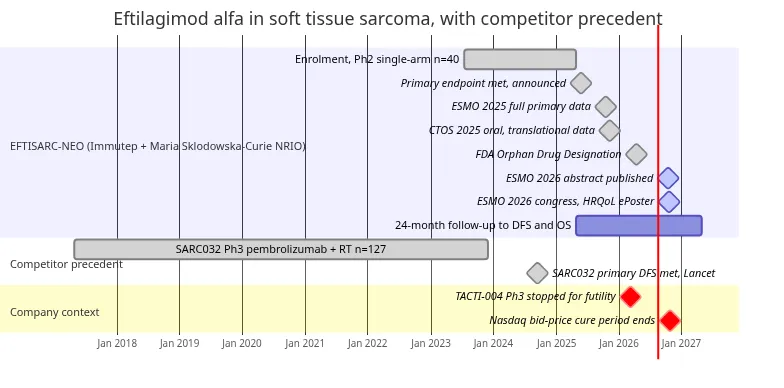
Milestone dates as far as they are known. First patient in 2023-07-17. Last patient out for the
primary endpoint is not separately disclosed; the registry’s primary completion date is 2025-04-30
and topline was announced 27 days later on 2025-05-27. Database lock is not disclosed. Overall study
completion, which covers the 24-month post-surgical follow-up for disease-free and overall survival,
is 2027-04-30. [VERIFIED — CT.gov get_trial_details NCT06128863, 2026-08-19; announcement date from the Immutep press feed]
Trials
| Trial | Sponsor / whose drug | Design (arms, blinding, n) | Population | Status / key result | Link |
|---|---|---|---|---|---|
| EFTISARC-NEO | Maria Skłodowska-Curie National Research Institute of Oncology, Warsaw, with Immutep S.A.S. as collaborator. Investigator-initiated. Efti is Immutep’s; pembrolizumab is Merck’s. | Phase 2, single-arm, single-stage, open-label, one site, n=40 | Adults with primary or locally recurrent, non-metastatic, deep-seated soft tissue sarcoma of the limbs, girdles or superficial trunk; FNCLCC grade 2–3; primary tumour >5 cm or any size if recurrent. Ewing sarcoma and rhabdomyosarcoma excluded, as is prior anti-PD-(L)1 or prior radiotherapy to the site. | Primary endpoint met. Median 51.5% tumour hyalinization/fibrosis in 38 evaluable patients, p<0.001. At an earlier cut-off, 71.4% achieved ≥35% hyalinization, pathologic complete response 9.5%, RECIST objective response rate 19.0%. No grade ≥3 toxicity attributed to efti or pembrolizumab. Active, not recruiting. No results posted to the registry. | NCT06128863 |
| SARC032 — the competitor precedent | Sarcoma Alliance for Research through Collaboration (academic). Pembrolizumab is Merck’s. Immutep is not involved. | Randomised, open-label, n≈127: neoadjuvant radiotherapy + surgery with or without pembrolizumab | Stage III soft tissue sarcoma of the extremity — substantially the same patients EFTISARC-NEO enrolled | Primary endpoint met on disease-free survival, published in The Lancet. Now recognised in NCCN guidelines for the relevant histologies. This is the regimen EFTISARC-NEO adds a third drug to. | NCT03092323 |
| TACTI-004 | Immutep S.A.S. | Phase 3, randomised, double-blind, placebo-controlled, n=756 planned, 147 sites | First-line advanced/metastatic non-small cell lung cancer, any PD-L1 level | Discontinued for futility 2026-03-13 on IDMC recommendation. The only randomised, controlled test of eftilagimod alfa ever run to an interim analysis. | NCT06726265 |
| AIPAC | Immutep S.A.S. | Phase 2b, randomised, double-blind, placebo-controlled, n=242 | Hormone-receptor-positive, HER2-negative metastatic breast cancer, on weekly paclitaxel | Primary endpoint (progression-free survival) NOT met — median 7.3 months in both arms. Overall survival 20.4 vs 17.5 months, hazard ratio 0.88, p=0.197, not significant. Relevant here for a different reason: quality of life on the EORTC QLQ-C30/-B23 global health status was sustained under efti and deteriorated under placebo. | NCT02614833 · DOI |
| TACTI-002 | Immutep S.A.S. | Phase 2, open-label, single-arm parts, n=187 | Non-small cell lung cancer and head and neck cancer | Part C in second-line head and neck: objective response rate 29.7%, complete responses 13.5%. Second-line PD-(L)1-refractory lung: objective response rate 8.3%, median overall survival 9.9 months. Completed. | NCT03625323 · DOI |
| TACTI-003 | Immutep S.A.S. | Phase 2b, randomised, open-label, n=171 | First-line recurrent/metastatic head and neck squamous cell carcinoma | Completed March 2024. Positive FDA feedback on a late-stage path in low-PD-L1 disease as recently as 2025-08-05 — and the programme is now marked Failed/Discontinued in the pipeline table. | NCT04811027 |
| AIPAC-003 | Immutep S.A.S. | Phase 2/3, randomised, double-blind, placebo-controlled after an open-label dose optimisation, n=72 against a planned Phase 3 | HER2-negative/low metastatic breast cancer | TERMINATED. Closed 2026-06-30. | NCT05747794 |
| TACTI-mel | Immutep Australia Pty Ltd | Phase 1, open-label, dose escalation, n=24 | Unresectable or metastatic melanoma | Objective response rate 33% in pembrolizumab-refractory patients, 50% in PD-1-naive. Completed. | NCT02676869 · DOI |
Feasibility matrix
| Factor | High probability | Medium probability | Low probability | This asset (assessment) | Source |
|---|---|---|---|---|---|
| Recruitment feasibility | >50 sites, 3:1 patient:site | 20–50 sites, established investigators | <20 sites, novel sites | LOW on the matrix’s own wording, but the question is already answered. One site, one country, 40 patients. Enrolment is complete, so this row scores what a future registrational trial would face, not this one — and a randomised neoadjuvant sarcoma trial run by a sponsor rather than a cooperative group would face exactly the recruitment problem the matrix’s low box describes. | CT.gov NCT06128863: locations_count 1, Warsaw |
| Endpoint clarity | Regulatory precedent exists | Novel endpoint with FDA alignment | Unvalidated surrogate | LOW for the trial’s own endpoint, and lower still for this catalyst’s. Percent tumour hyalinization has no regulatory precedent as an approval endpoint in sarcoma, and no FDA alignment on it has been disclosed. The health-related quality-of-life endpoint being presented in October is not a registered outcome measure at all. | CT.gov NCT06128863 outcome measures, read 2026-08-19 |
| Trial-design robustness | Pivotal Phase III with SPA | Adaptive with interim analysis | Single-arm, no control | LOW. Single-arm, single-stage, no control, no blinding, n=40. | CT.gov NCT06128863 |
| Operational / execution | Enrolment complete, standard timeline | Some timeline risk | Enrolment behind | HIGH. Enrolment complete, primary endpoint delivered 27 days after the registry’s primary completion date, and the October presentation has been reaffirmed twice in six days. Zero date slips. | CT.gov; Immutep releases 2026-07-24 and 2026-07-30 |
Resourcing sufficiency. For this catalyst, entirely sufficient and essentially free: the trial
is run and funded by an academic institution in Warsaw, enrolment is closed, and what remains is an
ePoster and a 24-month follow-up the sponsor institution carries. Immutep does not need to spend to
reach 19 October 2026. For anything beyond this catalyst the answer inverts. A randomised
registrational trial in this indication would cost a multiple of the company’s entire cash balance
(A$68.87M at 2026-06-30 — see ../company.md C.3), no such trial has been
announced, and the company has just cut headcount and wound down its only Phase 3. There is no
funded path from this result to an approval.
A.3 Target label, target product profile, strategic questions, designations
A.3a Target label. Eftilagimod alfa, added to neoadjuvant radiotherapy and pembrolizumab, for adults with resectable, non-metastatic, FNCLCC grade 2–3 soft tissue sarcoma of the extremities, girdles or superficial trunk, with a primary tumour larger than 5 cm or any locally recurrent tumour.
A.3b Target product profile
| Attribute | Standard of care & key competitor(s) — data | Eftilagimod alfa target profile (goal) | Supporting evidence (+ link) |
|---|---|---|---|
| Indication / target label | Neoadjuvant radiotherapy (typically 50 Gy over 5 weeks) then wide surgical excision. For selected histologies, pembrolizumab added to that radiotherapy — SARC032, primary endpoint met on disease-free survival, NCCN-recognised. | The same population, with efti added as a third agent on top of the SARC032 regimen. | SARC032 NCT03092323; [WEB ESTIMATE — Lancet 2024 publication and NCCN recognition via web search, 2026-08-19] |
| Efficacy (endpoints, regimen) | SARC032: improved disease-free survival, with the benefit concentrated in distant rather than local recurrence. Radiotherapy alone gives roughly 15% median tumour hyalinization. | Median 51.5% hyalinization, ≥35% response in 71.4%, pathologic complete response 9.5%, RECIST response 19.0%. Regimen: 9 weeks of systemic therapy, radiotherapy in weeks 2–6, surgery in weeks 11–12. Not yet translated into any survival endpoint. | [VERIFIED — Immutep press release 2025-11-13]; regimen from CT.gov NCT06128863 |
| Safety / tolerability | Neoadjuvant radiotherapy carries a well-known wound-complication burden. Pembrolizumab carries immune-related adverse events. | No grade 3 or higher toxicity attributed to efti or pembrolizumab in EFTISARC-NEO. Efti’s broader safety record across five trials is unusually clean; AIPAC’s authors described “an excellent safety profile”, with injection-site reactions the main issue. | [VERIFIED — Immutep press release 2025-11-13; Wildiers et al., Clin Cancer Res 2024, [DOI](https://doi.org/10.1158/1078-0432.CCR-23-1173)] |
| Biomarker / companion diagnostic | PD-L1 expression is not used to select sarcoma patients. | None required, and none proposed. Interferon-gamma correlated with pathologic response in the EFTISARC-NEO translational data, but as an observation, not a selection tool. | [VERIFIED — Immutep press release 2025-11-13] |
| Formulation / administration | Pembrolizumab is an intravenous infusion every 3 weeks. | 30 mg subcutaneous injection every 2 weeks — added to an infusion the patient already attends for, so no new visit. A genuine, if modest, convenience advantage. | [VERIFIED — Krebs et al., JTO Clin Res Rep 2024, [DOI](https://doi.org/10.1016/j.jtocrr.2024.100725)] |
| Payer value | Pembrolizumab is broadly reimbursed. | The weakest column. A third drug added to an already-expensive two-drug neoadjuvant regimen, justified so far only by a pathological surrogate from a 40-patient uncontrolled study. No health technology assessment anywhere, no NICE or CADTH guidance, no price. This is the column the October quality-of-life data speaks to — and the only commercially meaningful argument that data can make. | [UNVERIFIED — no reimbursement precedent for efti was found in any market] |
A.3c Strategic Go/No-Go questions. The set that matches this asset’s next decision is Pre-Phase-III: EFTISARC-NEO is a completed Phase 2 whose result either does or does not justify a registrational trial.
| Group | Question | Answer (tagged) |
|---|---|---|
| Target | Target revalidated as in prior phases? | No — and this is the central problem. TACTI-004, the only randomised controlled test of the target hypothesis, was stopped for futility, and the sponsor’s own explanation is that immune activation in that trial differed markedly from every prior study. [VERIFIED — Immutep press releases 2026-03-13 and 2026-07-13] |
| Dose & Drug | Exposure–response for the intended commercial regimen and route? | Partially. 30 mg subcutaneous every 2 weeks was established as the recommended Phase 2 dose in a Phase 1 combination study and confirmed through an FDA Project Optimus dose-optimisation exercise in AIPAC-003. No exposure–response has been shown in sarcoma specifically. [VERIFIED — Al-Batran et al., ESMO Open 2023, [DOI](https://doi.org/10.1016/j.esmoop.2023.101623); Immutep press release 2025-12-03] |
| Dose & Drug | Commercial formulation available or feasible? | Yes. A subcutaneous 30 mg presentation has been used across the whole clinical programme, and Immutep holds global manufacturing rights. [VERIFIED — Immutep / Dr. Reddy's release 2025-12-08] |
| Dose & Drug | Dose range compatible with clinical and non-clinical safety? | Yes, on an unusually large safety database for a drug at this stage — several hundred patients across seven company-sponsored trials with no dose-limiting toxicity reported at 30 mg. [VERIFIED — the trial publications listed in A.2] |
| Dose & Drug | Therapeutic window given the clinical response? | Wide, in the sense that toxicity is not what limits the dose. Whether there is a response to have a window around is the open question. [UNVERIFIED] |
| Dose & Drug | Intrinsic and extrinsic factors influencing exposure and response? | Not established in this indication. [UNVERIFIED] |
| Patient | Proof of concept and positive benefit/risk in the intended population? Combination evidence? | Proof of concept yes, benefit/risk not established. The pathological response is real and statistically significant against a historical control, and the safety is clean. But the comparison is historical, and the combination evidence cannot separate efti’s contribution from the pembrolizumab-plus-radiotherapy backbone that SARC032 already validated without it. [VERIFIED — Immutep press release 2025-11-13; SARC032 via web search 2026-08-19] |
| Patient | Phase III design and outcome criteria — accepted, compelling, competitive for market access? | No Phase 3 design has been disclosed, and none is funded. [VERIFIED — press feed and Q4 FY26 report read 2026-08-19] |
| Patient | Rationale for the patient population(s)? | Strong. High-grade, large, deep, resectable extremity and trunk sarcomas are the group with the worst relapse risk and the group SARC032 enrolled, so the neoadjuvant window is the right place to test an immune combination. [VERIFIED — CT.gov NCT06128863 eligibility criteria] |
| Patient | Likelihood of the expected outcome? | For the October quality-of-life presentation: high. For a registrational programme: unfunded, and therefore not a probability this analysis can put a number on. [UNVERIFIED — modelled; see the Locked prediction] |
| Patient | Companion-diagnostic strategy, including pricing and market? | None. No biomarker selection is proposed. [VERIFIED — CT.gov NCT06128863] |
A.3d Regulatory designations.
- FDA Orphan Drug Designation, granted 2026-04-15 for eftilagimod alfa in soft tissue sarcoma.
What it grants: seven years of US market exclusivity for the designated indication if the drug is
approved, exemption from the FDA application fee, and tax credits on qualifying US clinical
trial costs. It grants nothing about approvability and involves no efficacy judgement.
[VERIFIED — Immutep press release 2026-04-15] - No Breakthrough Therapy, Fast Track, Priority Review or Special Protocol Assessment was found
for this indication in the press feed or the EDGAR filings feed.
[UNVERIFIED — derived from absence in two searches, not from a confirmed empty register]
A.4 Target product profile valuation matrix
| Stakeholder | Value driver | Minimum threshold | Competitive | Premium | Benchmark / source |
|---|---|---|---|---|---|
| Patient / caregiver | Avoiding relapse after surgery for a limb sarcoma, and keeping the limb | Any improvement in disease-free survival | Improvement without added toxicity | Improvement without added toxicity and without a worse experience during treatment — which is precisely the claim the October data would support | SARC032 established that a disease-free survival benefit is achievable here; the quality-of-life leg is what this catalyst adds [VERIFIED — Immutep press release 2026-07-24] |
| Regulator | An endpoint that supports approval | A survival or disease-free-survival endpoint from a randomised trial | The same, with a pathological response supporting it | A randomised trial with both, plus patient-reported outcomes | Not met and not currently achievable: no randomised trial of efti in this disease exists or is funded [VERIFIED — CT.gov search_trials on "eftilagimod", 11 of 11 trials, 2026-08-19] |
| Payer / HTA | Value for money as a third agent on an expensive backbone | Evidence of fewer relapses | The above, plus fewer downstream costs | The above, plus demonstrated quality-of-life preservation | No HTA assessment of efti exists in any market [UNVERIFIED — no reimbursement precedent found] |
| Provider | Fits the existing neoadjuvant workflow | Can be given alongside radiotherapy without extra visits | The above, with manageable toxicity | The above, with no added wound-healing risk before surgery | Subcutaneous dosing on the same schedule as an infusion already attended; no grade ≥3 efti-attributed toxicity reported [VERIFIED — CT.gov NCT06128863; Immutep press release 2025-11-13] |
Calibration examples, not asset claims: in oncology each incremental month of overall survival is worth roughly $150–300M in peak-sales potential; oral formulations command roughly 15–25% price premiums over injectables.
A.5 Evidence quality and endpoints
| Criterion | Score (High / Medium / Low) | Basis (one line) | Link |
|---|---|---|---|
| Target validation | Low | LAG-3 is a validated checkpoint target — relatlimab plus nivolumab is approved in melanoma — but that validates blockade, not the agonism eftilagimod alfa performs, and the one randomised test of the agonist hypothesis was stopped for futility. Open Targets was BLOCKED, so there is no independent human-genetics leg. | [VERIFIED — Immutep 2026-03-13; Giri et al., Cancer 2025, [DOI](https://doi.org/10.1002/cncr.35892)]; genetics leg [UNVERIFIED — Open Targets BLOCKED] |
| Mechanism clarity | Medium | The pharmacodynamics reproduce across five trials — lymphocyte, CD4/CD8, interferon-gamma and CXCL10 rises — and interferon-gamma correlated with pathologic response in this trial’s own translational data. Against that, the sponsor states the immune activation profile in TACTI-004 differed markedly from all prior studies, which is a clarity problem it raised itself. | [VERIFIED — Immutep 2026-05-28, 2025-11-13, 2026-07-13] |
| Biomarker availability | Medium | Absolute lymphocyte count response is a candidate, and interferon-gamma correlated with response here, but both are retrospective observations. No prospective biomarker selection is used or proposed. | [VERIFIED — Immutep 2026-05-28 and 2025-11-13] |
| Publication quality (peer-reviewed? independent authors?) | Low for this program, Medium for the molecule | Six peer-reviewed papers cover eftilagimod alfa in other indications, in Clinical Cancer Research, JITC, ESMO Open and JTO Clinical and Research Reports. Not one covers EFTISARC-NEO — a PubMed search returning 10 of 10 hits found no publication of this trial at all, fifteen months after the primary endpoint was announced. Author independence is mixed throughout: every efti clinical paper carries Immutep employees (Triebel, Brignone, Mueller) among its authors. | PubMed search_articles “eftilagimod”, 10 of 10 hits, 2026-08-19. According to PubMed. |
| Clinical / expert sentiment | — | Moved to A.5b, below. | — |
Endpoints
| Endpoint (full name) | What it measures | Scale / range | Better direction | MCID / note |
|---|---|---|---|---|
| Pathologic response, measured as percent tumour hyalinization/fibrosis (the trial’s registered primary endpoint) | How much of the surgically removed tumour has been replaced by dead, glassy scar tissue rather than living cancer, assessed by a pathologist at the time of the operation | 0–100% of the specimen | Higher | No formally established minimal clinically important difference. The sarcoma literature conventionally treats ≥35% as a pathologic response, and the historical median with radiotherapy alone is about 15%. Result: median 51.5% (n=38, p<0.001). [VERIFIED — CT.gov NCT06128863; Immutep press release 2025-11-13] |
| Health-related quality of life (what the October 2026 catalyst reports) | What patients themselves report about pain, fatigue, physical function and overall wellbeing while receiving the treatment | Instrument not disclosed. If it is the EORTC QLQ-C30, global health status runs 0–100 | Higher | NOT a registered outcome measure on this trial — it appears among neither the primary, the seven secondary, nor any “other” outcomes on ClinicalTrials.gov. If the EORTC QLQ-C30 is used, a change of roughly 10 points on the 0–100 global health status scale is conventionally treated as clinically meaningful. [VERIFIED — CT.gov get_trial_details NCT06128863, 2026-08-19, for the absence]; instrument and threshold [UNVERIFIED — not disclosed in the abstract-acceptance release] |
| Disease-free survival (DFS) (registered secondary) | Time from curative surgery to the first recurrence — local, nodal or distant — or death from any cause | Time, in months | Longer | Follow-up continues to 2027-04-30. The endpoint that would actually matter, and it is not this catalyst. [VERIFIED — CT.gov NCT06128863] |
| Local recurrence-free survival (LRFS) (registered secondary) | Time from surgery to the cancer returning at the original site | Time, in months | Longer | SARC032’s benefit was concentrated in distant, not local, recurrence — so this is the endpoint least likely to separate. [VERIFIED — CT.gov NCT06128863] |
| Distant metastasis-free survival (DMFS) (registered secondary) | Time from surgery to the cancer appearing elsewhere in the body | Time, in months | Longer | The endpoint the immune hypothesis actually predicts, on the SARC032 reading that immunotherapy in sarcoma acts on micrometastatic disease. [VERIFIED — CT.gov NCT06128863] |
| Objective response rate by RECIST 1.1 (registered secondary) | Share of patients whose tumour shrank by at least 30% on imaging before surgery | 0–100% | Higher | Reported as 19.0%. Low relative to the 71.4% pathologic response rate — which is expected: sarcomas often turn to scar without shrinking, so imaging understates the effect. [VERIFIED — Immutep press release 2025-11-13] |
| Number of participants experiencing adverse events (registered secondary) | Safety, graded on CTCAE version 5.0 | Counts by grade | Fewer | No grade ≥3 events attributed to efti or pembrolizumab. [VERIFIED — Immutep press release 2025-11-13] |
A.5b Key opinion leaders.
Panel as of. 2026-08-19.
Investigators
The registry record for NCT06128863 lists no overall officials, no principal investigator and no
site contacts — its single location entry carries contacts: null. A search_investigators call
against the sponsor institution returned 51 investigators across 18 other sarcoma trials and none on
this one. The two people named below are therefore recorded on inference from published authorship
at the sponsoring department rather than from the trial record itself, and are tagged accordingly.
This is thinner than a normal investigator table and the thinness is the finding.
| Name | Role / affiliation | Trial (NCT) | Conflicts (party, kind, disclosed in, as of) | Conflicts checked (source, date) | Source | Tag |
|---|---|---|---|---|---|---|
| Piotr Rutkowski | Head, Department of Soft Tissue/Bone Sarcoma and Melanoma, Maria Skłodowska-Curie National Research Institute of Oncology, Warsaw — the trial’s sponsoring department. Not confirmed as an investigator on this trial by the registry. | NCT06128863 (institution only); named as a contact on NCT05518526 and NCT03838718 at the same institution | Sponsor (Immutep) — institutional: his department is the sponsor of a trial for which Immutep is the collaborator and drug supplier. Disclosed in: author affiliation, Autoimmun Rev 2026, DOI, as of 2026-01-24. | PubMed get_article_metadata PMID 41587647, 2026-08-19 — the returned record carries affiliations but no conflict-of-interest statement field; absence of a disclosure is not evidence of no conflict. CT.gov search_investigators institution “Maria Sklodowska-Curie”, 2026-08-19 — 51 investigators returned across 18 trials, none on NCT06128863. | PubMed 41587647 author list; CT.gov NCT06128863 sponsor field | [UNVERIFIED — inferred from institutional authorship, not from the trial record] |
| Paweł Sobczuk | Department of Soft Tissue/Bone Sarcoma and Melanoma, Maria Skłodowska-Curie NRIO, Warsaw, and Sarcoma Translational Research Group, Vall d’Hebron Institute of Oncology, Barcelona. Corresponding author of the LAG-3 review below. Not confirmed as an investigator on this trial by the registry. | NCT06128863 (institution only) | Sponsor (Immutep) — institutional, as above. Disclosed in: author affiliation, Autoimmun Rev 2026, as of 2026-01-24. | PubMed get_article_metadata PMID 41587647, 2026-08-19 — no conflict-of-interest statement returned. | PubMed 41587647 | [UNVERIFIED — inferred from institutional authorship, not from the trial record] |
Independent voices
One voice was found, and it comments on the drug class rather than on this trial’s endpoint. That distinction is stated rather than blurred: nobody outside the sponsoring institution was found commenting on neoadjuvant pathologic response or on quality of life in soft tissue sarcoma with this combination.
| Name | Affiliation | View (close enough to quote) | As of | Conflicts checked (source, date) | Source | Tag |
|---|---|---|---|---|---|---|
| Vinay K. Giri, David F. McDermott and Jacob Zaemes | Division of Medical Oncology, Harvard Medical School / Beth Israel Deaconess Medical Center, Boston | In a review of LAG-3 targeting across solid tumours that names eftilagimod among the agents surveyed: “To date, the most significant demonstration of efficacy in targeting LAG-3 has been the use of relatlimab with the PD-1 inhibitor nivolumab in the treatment of advanced melanoma.” Read plainly, that places eftilagimod alfa below the LAG-3 blocking antibody on demonstrated efficacy, and it says nothing at all about sarcoma or about quality of life. | 2025-05-15 | PubMed get_article_metadata PMID 40344213, 2026-08-19 — the returned record carries affiliations but no conflict-of-interest statement field, so no relationship with Immutep or with a competitor was found and none can be certified absent. No NIH RePORTER funding search was run. | PubMed 40344213, Cancer 2025, DOI. According to PubMed. | [VERIFIED — PubMed get_article_metadata, 2026-08-19] |
Judgement
| Endpoint supported | Basis (one or two sentences) | Tag |
|---|---|---|
| UNKNOWN | No independent voice was found who has commented on either of the two endpoints that matter here — the pathologic-response endpoint EFTISARC-NEO reported, or the quality-of-life endpoint ESMO 2026 will report. The one independent voice located comments on the LAG-3 class and places eftilagimod alfa behind relatlimab on demonstrated efficacy, which is relevant background and not a reading of this endpoint. With no EFTISARC-NEO publication in PubMed to attract commentary, and the trial’s own registry record naming no investigators, the panel is too thin to support any answer other than UNKNOWN. | [UNVERIFIED — judgement] |
Dissent
Empty. Endpoint supported is UNKNOWN rather than SUPPORTIVE_CONTESTED, so there is no claimed
support for anyone to contest. Inventing a disagreement nobody holds would be worse than an empty
table.
| Name | View (close enough to quote) | Source |
|---|
B. Commercial assessment
B.0 Current treatment algorithm
What a patient with a large, high-grade, resectable soft tissue sarcoma of the arm, leg or trunk receives today, in order:
- Diagnosis and staging. Imaging, biopsy, and grading on the FNCLCC 1–3 scale. Patients whose tumour is small, superficial or low-grade go straight to surgery and never reach this trial’s population.
- Neoadjuvant radiotherapy. For large, deep, grade 2–3 tumours, roughly five weeks of radiotherapy before the operation. This is standard, long-established, and it is what the historical 15% hyalinization figure comes from.
- Neoadjuvant chemotherapy, for selected histologies. An anthracycline with ifosfamide, in some centres and some tumour types. Contested, and not universal.
- Pembrolizumab added to the radiotherapy — the new step, and the one that matters here.
Following SARC032, adding pembrolizumab to neoadjuvant radiotherapy improved disease-free
survival and is now recognised in NCCN guidance for the relevant histologies.
[WEB ESTIMATE — SARC032 Lancet publication and NCCN recognition via web search, 2026-08-19] - Wide surgical excision, five to six weeks after radiotherapy ends.
- Relapse, if it comes, is treated systemically — doxorubicin-based regimens, then later lines. Roughly half of high-risk patients relapse, and most relapses are distant rather than local.
Where eftilagimod alfa would fit: step 4, as a third drug. It displaces nothing. It is added on top of a two-drug regimen that itself only recently became standard — and it is added on top of the specific regimen whose benefit was demonstrated without it. That is the commercial position in one sentence, and it is a harder position than “first in a setting where nothing works”: the incumbent here is not an absence, it is a randomised Phase 3 with a met endpoint.
B.1 Competitive landscape and positioning
| Metric | High value | Medium value | Low value | This asset (assessment) | Source |
|---|---|---|---|---|---|
| Mechanism differentiation | First-in-class or novel target | Next-generation improvement | Me-too | HIGH on novelty, and it is genuine. Eftilagimod alfa is the only soluble MHC class II agonist in clinical development anywhere. Every other LAG-3 drug — relatlimab, tebotelimab, favezelimab — blocks the pathway; this one activates it from the other end. It is not a variation on a competitor, it is the only member of its class. | [VERIFIED — Giri et al., Cancer 2025, [DOI](https://doi.org/10.1002/cncr.35892); Ibrahim et al., Biomedicines 2023, [DOI](https://doi.org/10.3390/biomedicines11071878). According to PubMed.] |
| Development-timeline advantage | >12 months ahead | Within 6–12 months | Lagging >12 months | LOW — lagging, and by more than 12 months. SARC032 is a completed randomised trial with a met primary endpoint, a Lancet publication and NCCN recognition. EFTISARC-NEO is a 40-patient single-arm study at one site with no randomised comparator, no publication and no funded registrational trial. Efti is not ahead of the competition here; it is trying to add to it. | [WEB ESTIMATE — SARC032 status via web search, 2026-08-19]; EFTISARC-NEO from CT.gov NCT06128863 |
| Clinical proof-of-concept evidence | Positive Phase IIb (n>100) | Phase IIa signals (n=20–50) | Preclinical only | MEDIUM. n=38 evaluable, squarely in the middle box. The result is statistically significant and the effect size against the historical control is large, but the trial is uncontrolled. | [VERIFIED — Immutep press release 2025-11-13] |
| IP protection | Composition-of-matter, long-dated | Method-of-use | Pending or none | MEDIUM. Composition-of-matter on the molecule itself would be old — IMP321 dates to the mid-2000s — and no expiry was confirmed. What was confirmed is a fourth US patent granted 2026-07-14 covering the treatment of cancer with eftilagimod alfa in combination with a PD-1 pathway inhibitor, running to 2036: method-of-use, but squarely over the combination this program uses. Orphan Drug Designation would add seven years of US market exclusivity on approval. | [VERIFIED — Immutep press release 2026-07-14 for the patent and its 2036 term; Immutep press release 2026-04-15 for the designation]; composition-of-matter position [UNVERIFIED — not established] |
Where this asset wins, and the single fact the thesis rests on. It wins on being the only drug of its kind, in a disease where the immune approach has just been shown to work and where the obvious next question is how to make it work better. It also wins, uniquely among efti’s indications, on having a regulatory designation. The thesis rests on one fact: that a 51.5% median hyalinization in 38 uncontrolled patients reflects something eftilagimod alfa added, rather than what pembrolizumab plus radiotherapy does on its own. Nothing in the evidence base separates those two readings, and no trial that could separate them is funded.
Calibration example, not an asset claim: oncology first-movers in novel mechanisms have shown roughly 3.2× higher peak-sales potential but about 1.8× higher development risk.
B.2 Addressable market
Launch markets would be the United States and the EU5, in that order — the markets Immutep
retained when it licensed the rest of the world to Dr. Reddy’s and Greater China to EOC Pharma.
[VERIFIED — Immutep / Dr. Reddy's release 2025-12-08]
| Component | How it is estimated | Premium threshold | This asset (assessment) | Source |
|---|---|---|---|---|
| Drug-treated patients | Epidemiology × diagnosis rate × treatment rate | >100,000 (US/EU5/Japan) | Roughly 5,000–7,000 patients a year across the US and EU5 — far below the premium threshold, and that is the honest answer for an orphan indication. Build: about 13,000 new soft tissue sarcomas a year in the US, of which roughly 60% are localised, of which perhaps half arise in the extremities or trunk, of which perhaps half to 60% are grade 2–3 and larger than 5 cm — around 2,000–2,300 US patients a year. Europe carries roughly 23,400 soft tissue sarcomas a year across the EU27; the same fractions give roughly 3,500–4,000 in the EU5 alone. Each of the three fractions after the first is an assumption, not a measured figure. | US incidence and 60% localised share, and EU sarcoma totals [WEB ESTIMATE — SEER-derived and RARECARE epidemiology via web search, 2026-08-19]; the extremity, grade and size fractions [UNVERIFIED — modelled, from the trial's own eligibility criteria applied to the epidemiology] |
| Market exclusivity | Patent term + regulatory exclusivity | >10 years combined | At the threshold, on the confirmed pieces alone. Orphan Drug Designation gives seven years of US market exclusivity from approval; the combination patent granted 2026-07-14 runs to 2036. If approval landed in, say, 2031, the two together would cover roughly to 2038. Composition-of-matter protection is not established and is assumed to be expired or expiring. | [VERIFIED — Immutep releases 2026-04-15 and 2026-07-14]; the arithmetic [UNVERIFIED — modelled on an assumed approval year] |
| Reimbursement precedent | Approvals in ≥2 major markets | Positive NICE/CADTH guidance | None. Eftilagimod alfa is not approved anywhere, has no HTA assessment in any market, and no price has ever been set for it. | [UNVERIFIED — no reimbursement precedent found in any search] |
| Patient-journey impact | Fewer hospital days, less caregiver burden | >30% quality-of-life gain | The one row where this catalyst speaks directly. The regimen adds five subcutaneous injections to a course of treatment the patient is already attending for, requiring no extra visit. Whether that translates into preserved quality of life is exactly what the October 2026 ePoster reports — and it is the only place in this whole table where the October data changes a cell. | Regimen from CT.gov NCT06128863; the quality-of-life claim is what is pending [UNVERIFIED — the catalyst under analysis] |
B.3 Value and feasibility
B.3a Expected peak sales. Built bottom-up for the soft tissue sarcoma indication only — the indication this catalyst is about — and conditional on an approval that is not currently funded to be pursued. It excludes every other efti indication, all Dr. Reddy’s and EOC Pharma territories, and any value from IMP761.
| Scenario | Assumptions (patients × price × share) | Estimate (USD/year at peak) | Basis / tag |
|---|---|---|---|
| Low | 6,000 eligible US + EU5 patients/year × 10% peak penetration × US$30,000 per neoadjuvant course | ~US$18M | 10% penetration assumes use only at high-volume sarcoma centres already giving neoadjuvant pembrolizumab. Price at the bottom of a plausible biologic add-on range. [UNVERIFIED — modelled; the price has no external basis because eftilagimod alfa has never been priced] |
| Base | 6,000 × 25% × US$50,000 per course | ~US$75M | 25% penetration assumes adoption at the sarcoma referral centres that treat most of this population, but not universal use. US$50,000 for a nine-week, five-dose course sits well below a year of pembrolizumab at US list and above a generic-supported regimen, on the argument that it is priced as an add-on to an already-expensive backbone. [UNVERIFIED — modelled] |
| High | 6,000 × 40% × US$80,000 per course | ~US$192M | 40% penetration assumes guideline inclusion alongside pembrolizumab. [UNVERIFIED — modelled] |
Two things must be said about that table at once, because either alone misleads. First, these are
small numbers by oncology standards — an orphan neoadjuvant indication is a fraction of what
first-line lung cancer would have been, and the loss of that indication is not made up here. Second,
they are enormous relative to what this equity currently costs: the enterprise value in
../company.md C.4 is about US$9.6M, so even the low scenario is roughly twice
the entire enterprise value in annual peak revenue. Both facts are true. Which one dominates depends
entirely on whether a registrational trial is ever funded, and today it is not.
No third-party peak-sales figure is passed through. The dedicated peak-sales web search returned
none for eftilagimod alfa in any indication. It did return a “consensus price target is AU$1.30”
figure — roughly 23× the current ordinary-share price — which is rejected under 01-rules.md rule 6
as a stale pre-discontinuation number no source dated or stood behind. The current, dated analyst
figures are recorded in the Market and timing section below instead.
B.3b Feasibility
| Question | Answer (tagged) |
|---|---|
| Expected net present value (eNPV) | No figure, and no range either — stated as a refusal rather than a wide band. Two of the three inputs an eNPV needs are unavailable in a form that would make even a range honest: the probability of approval from a 40-patient uncontrolled Phase 2 with no funded successor trial is not something this analysis can defensibly bound, and the cost of the registrational programme that would have to be run first has never been disclosed or estimated by the company. Multiplying two unbounded quantities by a modelled price produces a number with the appearance of analysis and none of the substance. [UNVERIFIED — declined; the peak-sales range in B.3a is the furthest this evidence supports] |
| Capital to the next decision point | Essentially nil. The trial is run and funded by the Warsaw institution, enrolment is closed, and the October catalyst is an ePoster. [VERIFIED — CT.gov NCT06128863 sponsor and collaborator fields] |
| Capital to approval, and the funding plan | A randomised registrational neoadjuvant sarcoma trial is a multi-year, multi-hundred-patient undertaking — SARC032 ran roughly seven years to enrol about 127 patients, and it had cooperative-group infrastructure behind it. No such trial has been announced, none is budgeted, and there is no funding plan. The company holds A$68.87M and has just cut headcount. [VERIFIED — Q4 FY26 Quarterly Activities Report 2026-07-30] |
| Launch capability — alone, or must partner? | Must partner, without qualification. Immutep has no commercial infrastructure of any kind and has never sold a product. [VERIFIED — BPIQ fetch_company_info full description; no revenue in the Q4 FY26 report other than research material sales and tax incentives] |
| Commercialisation rights — retained, split, or out-licensed? | Split three ways. Immutep retains North America, Europe and Japan — which includes both launch markets named in B.2. Dr. Reddy’s Laboratories SA holds an exclusive licence everywhere outside North America, Europe, Japan and Greater China; EOC Pharma holds Greater China. Immutep keeps global manufacturing rights and supplies its partners. Note the direction of travel: Immutep repaid US$10M of the US$20M Dr. Reddy’s upfront in June 2026 following the TACTI-004 discontinuation. [VERIFIED — Immutep / Dr. Reddy's release 2025-12-08]; the repayment [WEB ESTIMATE — Q4 FY26 reporting coverage via web search, 2026-08-19] |
B.4 Product-development risk
Framing questions.
- Does the development plan support the target product profile claims? No, because there is no development plan. The target product profile in A.3b describes a third agent added to the SARC032 backbone, and supporting that claim requires a randomised trial against that backbone. No such trial exists, is registered, or is funded. What exists is a completed single-arm study, a 24-month follow-up that runs to 2027-04-30, and an ePoster.
- Will the identified risks affect the target product profile? The dominant risk — that the pathological response reflects the backbone rather than the added drug — attacks the target product profile’s efficacy row directly and cannot be mitigated by anything other than the trial that is not funded. The financing and listing risks in the grid below do not touch the profile; they touch whether there is a company left to pursue it.
- If a risk cannot be mitigated, is the asset still differentiated from competitors? Yes, on mechanism — it remains the only MHC class II agonist in the clinic, and that is not contingent on this trial. But differentiation on mechanism without a controlled efficacy result is a scientific distinction, not a commercial one.
| Category | Time risk | Quality risk | Cost risk | Note |
|---|---|---|---|---|
| Project management | High | Medium | Low | No registrational programme exists to manage. The company is simultaneously winding down a Phase 3, reducing headcount and running a root-cause analysis. |
| Research | Medium | High | Low | The sponsor’s own statement that TACTI-004’s immune activation profile differed markedly from all prior studies is an unresolved research question about the drug itself. |
| IP | Low | Medium | Low | Combination method-of-use patent to 2036 confirmed; composition-of-matter position not established. |
| Legal | Medium | Low | Medium | Rosen Law Firm issued three investor-notice releases between 2026-03-25 and 2026-05-06 following the TACTI-004 discontinuation. No filed complaint was found in the EDGAR feed. [VERIFIED — press feed 2026-08-19 for the notices; the absence of a complaint is derived from absence] |
| DMPK | Low | Low | Low | 30 mg subcutaneous exposure characterised across the programme; sustained systemic exposure demonstrated. |
| Safety pharmacology | Low | Low | Low | No signal across several hundred patients. |
| Toxicology | Low | Low | Low | No dose-limiting toxicity at any dose tested up to 30 mg. |
| Drug safety (clinical) | Low | Low | Low | The strongest row in the grid. No grade ≥3 events attributed to efti or pembrolizumab in this trial; injection-site reactions are the main issue across the programme. This is also what makes the October quality-of-life readout likely to be favourable. |
| Biomarker | Medium | Medium | Low | Lymphocyte-count and interferon-gamma associations are retrospective; no prospective selection strategy. |
| Clinical pharmacology | Low | Medium | Low | Dose confirmed through an FDA Project Optimus exercise, but not in this indication. |
| Clinical (efficacy) | High | High | High | Single-arm, n=38 evaluable, surrogate endpoint, historical control, and a backbone that works without the drug. The near-veto factor in this grid. |
| Clinical operations | Low | Low | Low | Enrolment complete, one site, zero date slips, topline delivered 27 days after primary completion. |
| CMC / manufacturing | Low | Low | Medium | Global manufacturing rights retained and a subcutaneous presentation used throughout; scale-up for a partner supply obligation is the open cost question. |
| Regulatory | High | High | Medium | Orphan Drug Designation granted, but no agreed registrational endpoint, no Special Protocol Assessment, and a pathological surrogate with no approval precedent in sarcoma. |
| Global evidence & value | High | High | Medium | No HTA assessment anywhere, no price, no reimbursement precedent. |
| Commercial | High | High | High | No commercial infrastructure; must partner; a small orphan population; and a partner has just taken US$10M back. |
Readout
Sources
| Kind | Where it comes from | What it is worth | Value (or null) | Tag | Note |
|---|---|---|---|---|---|
bpiq | fetch_company_drugs — catalyst_date, catalyst_date_text | The current single source. Synthesized from period text on most rows, so alone it is a ceiling, not an estimate. | 2026-10-19 | [VERIFIED — BPIQ fetch_company_drugs, 2026-08-19] | This row is the exception to rule 23’s usual reading. catalyst_date_text is “October 19, 2026” — it names a day, so catalyst_date_is_exact is true and the value is a real disclosed date rather than a period-end placeholder. It is not the congress date; see the company row for what 19 October actually is. |
ctgov | CT.gov get_trial_details — primary_completion_date | Independent of the company’s own messaging, month-precision, and it moves when the trial moves. | 2025-04-30 | [VERIFIED — CT.gov get_trial_details NCT06128863, 2026-08-19] | Fifteen months in the past, and therefore bounds nothing about this catalyst. The registry dates the primary readout, which happened in May 2025. The registry’s overall completion_date of 2027-04-30 covers the 24-month survival follow-up, which is a different, later event. The registry has no field that dates a congress presentation of a secondary analysis. |
company | fetch_company_press_releases | The company’s own most recent dated wording. Also where the slip sequence below comes from. | 2026-10-19 | [VERIFIED — Immutep press release 2026-07-24, "Immutep Announces Abstract Accepted for Presentation at the European Society for Medical Oncology (ESMO) Congress 2026"] | The release states the abstract reports health-related quality-of-life data from EFTISARC-NEO, that it will be presented as an ePoster, and that the full abstract will be published on the ESMO Congress 2026 website on Monday, 19 October 2026. That single sentence is what reconciles BPIQ’s 19 October against the congress’s 23–27 October: they are two moments of one event, not two competing claims. Reaffirmed six days later in the Q4 FY26 report of 2026-07-30. |
congress | data/congresses.json, only when the company has said it intends to present there | Answers “where will they say it.” | 2026-10-23/2026-10-27 | [VERIFIED — data/congresses.json "ESMO Congress 2026", confirmed against esmo.org and corroborated via esmadrid.com] | A legitimate congress source rather than a therapeutic-area guess, because the company itself has said it intends to present there. ESMO Congress 2026 runs 23–27 October 2026 at IFEMA Madrid. The specific day and session of the ePoster within that window is not disclosed. |
modelled | Trial arithmetic — see below | The only estimate independent of anyone’s guidance. | 2025-06-30/2025-08-31 | [UNVERIFIED — modelled, default lag] | Produced, and then found uninformative — which is itself worth recording rather than omitting. See below. |
The modelled estimate. The arithmetic, stated so it can be argued with: the registry’s
primary_completion_date for NCT06128863 is 2025-04-30, plus the stated default lag of two to four
months to database lock and analysis (01-rules.md rule 34; data/benchmarks/readout-lag.json holds
no observations, so the default applies and the tag is [UNVERIFIED — modelled, default lag]), gives
2025-06-30 to 2025-08-31. That window closed a year ago. The modelled method dates the trial’s
primary readout, and the primary readout already happened — 27 days after primary completion, on
2025-05-27, which is faster than the default lag predicts. The method has nothing to say about when
a congress will publish a secondary analysis of a trial that finished last year, and pretending
otherwise would be worse than saying so.
One observation this analysis produced but may not write down, recorded here instead. EFTISARC-NEO
gives a confirmed lag: registry primary completion 2025-04-30 against a topline announcement of
2025-05-27, 27 days, both dates from primary sources. data/benchmarks/readout-lag.json is empty
and sits outside this analysis’s lane, so nothing was added to it; the observation is left here for
whoever maintains that file.
Window
| Earliest | Likeliest | Latest | Precision | Confidence |
|---|---|---|---|---|
| 2026-10-19 | 2026-10-19 | 2026-10-19 | DAY | HIGH |
Basis. All three edges are the same date, because only one moment discloses the numbers. Immutep stated on 2026-07-24 that the full abstract publishes on the ESMO Congress 2026 website on Monday 19 October 2026 — “full” is the company’s own word, so the data is readable that day rather than held back for the podium. The ePoster displayed during the congress on 23–27 October shows that same content, and an ePoster is not a second readout: nothing is disclosed by hanging the same numbers on a board four days later. The congress tail is a market-attention window rather than a readout window, and it already has its own home in this document — the stock-direction window below runs 2026-10-19 to 2026-11-03 precisely to cover the abstract drop, the poster and any release accompanying it. Precision is DAY because a source names that specific day. Confidence is HIGH for the unusual reason that there is almost nothing left to go wrong: the trial is complete, the data exist, the abstract is accepted, and the date is a publisher’s calendar rather than a sponsor’s forecast.
Corrected after the first lock. This block was written with latest at 2026-10-27, which
double-counted the congress tail into a second place and claimed DAY precision over an eight-day
spread. The window was wrong, not the label: a named calendar Monday from the company is a disclosed
day, not a half-year, so the fix narrows the window rather than relabelling precision to PERIOD.
Nothing downstream moves — date_confidence still reads DAY plus HIGH, and the priority score is
unchanged at 55.
Disagreement. CONSISTENT. BPIQ’s 2026-10-19 and the congress’s 23–27 October look like a
conflict and are not one: the company’s own release of 2026-07-24 states both, as the abstract
publication date and the congress dates respectively. Both are carried, neither is averaged, and the
window spans them.
Date slippage. Two dated statements, one transition, zero slips. The catalyst has never moved.
| As of | Guidance text |
|---|---|
| 2026-07-24 | ”Abstract accepted for presentation at ESMO Congress 2026 … the full abstract will be published on the ESMO Congress 2026 website on Monday, 19 October 2026” |
| 2026-07-30 | ”EFTISARC-NEO HRQoL ESMO 2026 presentation reiterated; disease-free survival follow-up continues” |
Attribution
Status.
| Status | Means |
|---|---|
CONTAMINATED | At least one conflict is confirmed: a real disclosed date on one side. The stock-direction call below is not presented as attributable to this program alone; the Note says why. |
Conflicts
| bpiq_drug_id | Label | Date | Analysed? | Gap (days) | Confirmed? |
|---|---|---|---|---|---|
| 18203 | IMP761 (LAG-3 agonist) | 2026-12-31 | No | 0 | Yes |
Computed with lib/clustering.mjs’s attributionFor over this ticker’s pipeline at
CATALYST_CLUSTER_MIN_MONTHS = 6, for bpiq_drug_id 17452, and transcribed rather than estimated.
Note. The conflicting row is IMP761, Immutep’s Phase 1 LAG-3 agonist antibody in autoimmune
disease, guided to “H2 2026”. Because that text names no day, the clustering computation widens it to
the whole enclosing half-year, 2026-07-01 to 2026-12-31 — which contains this program’s entire
readout window, so the gap is zero. The conflict is confirmed because this side rests on a
disclosed date: readout.precision is DAY.
The contamination is not merely arithmetic, and this is the part that matters for the stock call.
IMP761 is the only asset at this company that is not eftilagimod alfa; it is the only programme whose
Phase 1 has met a primary endpoint since the Phase 3 failure; and it is the only pipeline row BPIQ
flags is_high_mgmt_interest. ../company.md C.2 records it as dominant, against meaningful
for this program. If both land inside the same weeks, the larger of the two moves will not be this
one — and on ../company.md C.7’s evidence, IMP761 news has moved this stock more than efti news
has, in both directions (−4.64% on positive EULAR data, +0.73% on a positive December update).
A third event sits in the same window that the clustering computation cannot see at all, because it
is not a drug catalyst: the Nasdaq minimum-bid-price cure period expires on 2026-10-26, three
days inside the ESMO congress (../company.md C.4). At US$0.40 the shares would have to more than
double and hold for ten consecutive sessions to cure it, which this catalyst cannot deliver. A
change to the ADS ratio — the ordinary remedy for a dual-listed Australian issuer — would multiply
the quoted US dollar price without changing what anyone owns, and would land squarely on top of the
readout. None has been announced. The scenario prices below are written in today’s ADS terms and
would need re-basing if one is.
Market and timing for this event
- Plain takeaway. A two-month wait for a secondary quality-of-life poster on a trial whose real result came out fifteen months ago, in a stock trading at 1.20× its own net cash with an options chain that cannot price anything, no short interest to squeeze, no insider buying, and a listing deadline landing inside the event window. The date is one of the best-known in this corpus and the event behind it is one of the least informative.
- Months to this catalyst. 2.0 months — 61 days from 2026-08-19 to
readout.window.earliestof 2026-10-19, measured from the earliest edge and never fromcatalyst_date(rule 23; here the two happen to coincide, because BPIQ’s date is a real disclosed day rather than a placeholder).readout.precisionis DAY and all three window edges are that same day, so this is a distance to a known date, not to the opening of a window, and there is no later edge to quote. The congress runs 23–27 October and the ePoster shows the data the abstract already carries, which is why the congress sits in the stock-direction window below rather than in the readout window. - Expected move around this event. A bracket, not a point estimate, because
../company.mdC.6 records the chain as unusable — there is no strike at or below spot on any expiry, and the nearest expiry to the catalyst (2026-10-16) expires three days before the abstract publishes. Bracket: roughly ±5% to ±15%. That sits well below the +12% / −16% Phase 2 class averages inframework/07-benchmarks.md[WEB ESTIMATE — IQVIA 2024], deliberately: those averages are measured on primary-endpoint reported dates, and this is not one. Where the class prior and a program-specific fact disagree the specific fact wins, and the specific facts here are three clean, positive, non-registrational data events on this ticker that produced +0.73%, −0.65% and −4.64% (../company.mdC.7). - Nearest comparable past reaction.
../company.mdC.7’s 2026-05-28, −0.65% — the pooled five-trial lymphocyte-and-survival analysis on a clean press feed. It is the closest analogue because it has the same information structure: a secondary analysis of data already reported, presented favourably by the sponsor, with nothing new about whether the drug works. The 2026-06-04, −4.64% IMP761 EULAR row is the second-closest and carries the sell-the-news warning. The row a reader would want — 2025-05-26, EFTISARC-NEO meeting its primary endpoint — returns null for both move fields in BPIQ, and with no price cache for this ticker its size cannot be established at all. That is a real gap in the evidence behind the stock call and it is stated rather than filled. - Materiality.
../company.mdC.2 records this program as meaningful at the programme level, immaterial at the event level. The stock-direction call below is made consistent with the event, not the programme (rule 27): ano-edgecall on a company whose strongest remaining asset this is, precisely because this catalyst does not test it. - Date slippage. Zero slips (see Readout, above). The catalyst has never moved.
Spot. US$0.40 per ADS, read 2026-08-19, cited from ../company.md C.1 and
C.4.
Scenario prices
| Scenario | Low | High | Anchors (each named and tagged) | Basis |
|---|---|---|---|---|
| Positive — quality of life maintained or improved, presented supportively | $0.36 | $0.46 | 1. Cash per ADS, US$0.334 — A$68.87M at 2026-06-30 converted at 0.7083 and divided by 146,038,958 ADS from the EDGAR-filed share count [VERIFIED — Immutep Q4 FY26 report 2026-07-30; EDGAR XBRL 2026-08-19], FX [WEB ESTIMATE — TradingEconomics, 2026-08-18]. 2. This ticker’s own past catalyst moves — +0.73%, −0.65% and −4.64% on three clean positive data events [VERIFIED — ../company.md C.7]. 3. Published analyst target, Jefferies, Hold, A$0.04 per ordinary share = US$0.28 per ADS [WEB ESTIMATE — Immutep investor-relations analyst-reports page via web search, 2026-08-19; issued after the March 2026 discontinuation, exact date not disclosed]. | The positive range is centred barely above spot because a favourable quality-of-life poster carries almost no new information: the efficacy result it accompanies is fifteen months old and the safety profile it would confirm is already published. The upper edge allows for the congress-attention effect a thinly traded $0.40 stock can produce on almost nothing. Calibration: framework/07-benchmarks.md’s +12% Phase 2 positive average [WEB ESTIMATE — IQVIA 2024] is deliberately not applied at full weight, because it is measured on primary-endpoint reported dates and this is a secondary analysis; the ticker’s own C.7 history of near-zero moves on comparable events outranks it. |
| Miss — a clinically meaningful deterioration reported, or the presentation withdrawn | $0.28 | $0.36 | 1. 52-week low, US$0.29 [VERIFIED — BPIQ fetch_company_info, 2026-08-19]. 2. Cash per ADS, US$0.334 — as above [VERIFIED — Immutep Q4 FY26 report; EDGAR XBRL]. 3. Published analyst target, Jefferies, Hold, A$0.04 = US$0.28 per ADS [WEB ESTIMATE — as above]. | The miss range straddles the 52-week low and sits mostly below cash per ADS, which needs the program-specific reason framework/07-benchmarks.md asks for: a pre-revenue company with no approved product, an expiring listing cure period and no funded registrational trial routinely trades below net cash, and this one printed $0.29 on exactly that reading in March. The asymmetry is deeper than the 1.3 negative-to-positive ratio the Phase 2 class average implies [WEB ESTIMATE — IQVIA 2024], and deliberately so: the positive here carries almost no information while a bad tolerability signal would be genuinely new negative information about a regimen whose entire remaining case rests on being well tolerated. |
Expected value. Method: the 85% probability below applied to the midpoint of each range —
0.85 × $0.41 + 0.15 × $0.32 = $0.3965, which is −0.88% against spot $0.40.
This is arithmetic, not advice, and it is not a price target. It agrees with the no-edge
stock-direction call rather than quietly contradicting it, which is the point of computing it.
Run-up
Entry and exit
| Entry date | Entry price | Entry basis | Exit rule |
|---|---|---|---|
| 2026-08-19 | US$0.40 | The prediction’s own lock date and spot. There is no better-argued entry available: this is a DAY-precision catalyst 61 days out with zero slips, so there is no date-resolution event to wait for, and with no price cache for this ticker there is no technical level to time against either. | T-5 trading days before readout.window.earliest (lib/runup.mjs EXIT_RULES) — which resolves to on or about 2026-10-12, one week before the abstract publishes and two weeks before the Nasdaq cure period expires. Chosen at T-5 rather than T-1 deliberately: the exit clears the event and clears the listing deadline, and on this ticker’s C.7 record the risk of holding into a data event is sell-the-news, not a missed melt-up. |
Predicted move and peak
| Low | High | Estimated date | Basis | |
|---|---|---|---|---|
| Predicted move, entry to exit | −10% | +15% | — | Wide relative to the information at stake, and narrow relative to the class. framework/07-benchmarks.md puts single-arm trial designs at an impact amplitude of 7% — the narrowest of any design — and this ticker’s own C.7 history of ±5% on clean data events points the same way [WEB ESTIMATE — IQVIA 2024]. Both are outranked here by a mechanical fact the class average cannot see: at US$0.40 with roughly US$88,000 of daily volume (../company.md C.5), a few hundred thousand dollars of buying or selling moves this stock 10% for reasons having nothing to do with sarcoma. The band is therefore set by liquidity, not by the readout. |
| Predicted peak, from entry | 0% | +25% | 2026-10 | The peak is expected after the exit rather than before it, and the band is asymmetric upward for that reason: any attention this program attracts arrives when the abstract publishes on 19 October, a week past the T-5 exit. The low edge is 0% because there is a real chance no peak above entry ever prints — three of this ticker’s last four clean data events closed negative on the day. The high edge allows for a congress-week retail bid on a sub-dollar stock that also has a listing deadline in the news that week. |
Priority score drivers
| Driver | Reads | Score (0–100) | Basis |
|---|---|---|---|
| Unmet-need relevance | Program README A.4 and B.0 — judgement, no formula | 62 | Real but partly served. Roughly half of high-risk resectable sarcoma patients relapse after radiotherapy and surgery (B.0), which is a genuine unmet need — but SARC032 has already put an immunotherapy answer into NCCN guidance without this drug, so efti is improving an addressed problem rather than addressing an unmet one. A.4’s regulator and payer rows are both unmet at the minimum threshold. |
| Value-uplift potential | Program README B.3a peak sales vs. enterprise value, C.2 materiality — judgement, no formula | 66 | The ratio is extreme and the path is not funded, and the score sits between those two facts. B.3a’s base case of ~US$75M/year in peak sales stands against an enterprise value of about US$9.6M (../company.md C.4) — roughly eight times the entire enterprise value in annual revenue. But ../company.md C.2 records this program as meaningful rather than dominant, and B.3b records that no registrational trial is announced, budgeted or funded, so the uplift is a statement about how depressed the base is rather than about this catalyst’s power to unlock it. |
| Probability of a positive outcome | This record’s own outcome_prediction.probability_pct — computed | 85 | outcome_prediction.probability_pct = 85 |
| Date confidence | readout.precision + readout.confidence — computed; the gate the other six hang off (rule 39) | 100 | readout.precision=DAY, readout.confidence=HIGH — the maximum. A publisher’s calendar date on a completed trial with zero slips is about as well known as a catalyst date gets. |
| Squeeze mechanics | Float, short interest as % of float, average dollar volume — computed | 46 | float 146038958 shares, short_float_pct 0.82, average dollar volume 87836 — thinner liquidity and a tighter, more-shorted float amplify a positive surprise. Read in the ordinary direction — higher is more attractive. The middling score is two opposite facts cancelling: liquidity is about as thin as this scorer’s buckets go (US$88,000 a day scores 100 on its own), while short interest of 0.82% is close to the bottom of the range and short interest is the most heavily weighted of the three. There is no squeeze here, only illiquidity. |
| Priced-in-ness | 52-week position, drift since the last catalyst, ownership crowding, analyst-target dispersion — computed; a HIGH score means room LEFT to run | 97 | price 0.4 sits at 3% of its 52-week range (low 0.29, high 3.53, as of 2026-08-19) — closer to the 52-week low — room left to run. Read in the direction opposite to its name: 97 means the move is NOT priced in, and it pushes the ranking UP. One caveat on the input: data/prices/IMMP.json does not exist and the Yahoo cross-check was throttled, so the bars fed to scorePricedIn were a synthetic stand-in carrying BPIQ’s own reported 52-week high and low rather than a real series. The high and low are the only values that function reads, so the score is the one the real range implies — but it is not derived from a committed cache and should not be read as though it were. |
| Financing and clustering risk | Runway against the catalyst, attribution.status / attribution.conflicts — computed; the one NEGATIVE driver, a HIGH score means HIGH risk and sinks the total | 100 | attribution.status=CONTAMINATED is the larger of the two independent risks (clustering). Read in the direction opposite to the other five and to its neighbour above: 100 is the worst possible score and it pushes the total DOWN. Financing risk alone is low — runway_vs_catalyst is OK, with cash guided well into H1 CY28 against an October 2026 event — but the two risks combine as a maximum rather than an average, and CONTAMINATED pins this at the ceiling on its own. The Nasdaq cure period expiring inside the window (Attribution, above) is not visible to this scorer and would not lower the score if it were. |
Priority score. Priority score 55 · formula_version 1.0.0
Transcribed from lib/runup.mjs’s priorityScore over the seven drivers above, never hand-computed.
Read it against its own composition: a perfect date-confidence gate and a near-perfect priced-in
score are doing the lifting, and a maximal clustering risk is doing the sinking. It is not a score
that says the trade is good; it is a score that says the date is knowable and the price is low.
Settlement. Null at lock time. Settled only on an explicit user request, from a confirmed primary
source, against the committed price cache — which for this ticker does not yet exist, so a settlement
will require scripts/fetch-prices.mjs to be run for IMMP first.
Verdict
What I would do. Watch.
Why. The date is excellent and the event is not. This is one of the best-specified catalysts in the corpus — a publisher’s calendar date, two independent sources, zero slips, DAY precision — and what it delivers is a quality-of-life ePoster on a 40-patient single-arm trial whose efficacy result was reported fifteen months ago, on an endpoint that is not even registered among the trial’s outcome measures. Meanwhile the interesting question about this company is not sarcoma at all: it is whether IMP761, the only asset here that is not eftilagimod alfa, is worth more than the US$9.6M enterprise value the market is assigning to everything. That programme’s own readout is guided to the same half-year, which is what makes this one CONTAMINATED, and the Nasdaq cure period expires three days into the congress. Buying a $0.40 stock at 1.20× net cash is not an absurd thing to do — but if you do it, you are buying IMP761 and an option on a restructuring, and you should say so rather than telling yourself you bought a sarcoma catalyst.
What would change this. Two observables, in opposite directions. To the upside: any disclosure of a funded, randomised registrational trial in soft tissue sarcoma — a partner, a cooperative-group collaboration, a registered protocol. That is the missing piece between a real Phase 2 result and any commercial value at all, and its absence is what holds this at watch rather than buy. To the downside: an announced change to the ADS ratio, or any other corporate action taken to cure the Nasdaq deficiency before 2026-10-26. It would not destroy value by itself, but it would re-base every dollar figure in this document and would mean the market’s attention in the catalyst window is on the listing, not on the data.
What to watch.
- 2026-10-12 (approximately) — the T-5 exit rule resolves here, one week ahead of the abstract.
- 2026-10-19 — the full ESMO abstract publishes on esmo.org. This is the catalyst; read the actual quality-of-life instrument and the questionnaire completion rate, not the headline.
- 2026-10-23 to 2026-10-27 — ESMO Congress 2026, Madrid; the ePoster is displayed and Immutep’s practice is to issue a release on the day.
- 2026-10-26 — the Nasdaq 180-day cure period expires. Watch for an ADS-ratio announcement at any point before this.
- Between now and then — any IMP761 Phase 1 update, guided to H2 2026 and the reason this program’s attribution is CONTAMINATED.
- By roughly 2026-10-24 — the FY2026 Form 20-F is due; last year’s was filed 2025-10-24 and it is the first place a current share count and a debt position will appear.
- Open-ended — an EFTISARC-NEO publication. Fifteen months after the primary endpoint there is still none in PubMed, and its appearance would be a stronger signal about this programme’s future than the poster is.
Locked prediction
- Outcome-direction (will the readout succeed on its primary endpoint?): positive —
probability 85%, band 72–92%
[UNVERIFIED — modelled]. The probability is that the pre-registered settlement definition below is met — that the ESMO 2026 abstract and ePoster report quality of life maintained or improved rather than clinically meaningfully worse. It is high for four reasons and capped below 90 for three. High because: the trial’s safety record shows no grade ≥3 toxicity attributed to either study drug; efti has a direct favourable precedent on the same class of endpoint, with AIPAC reporting EORTC QLQ-C30 global health status sustained under efti and deteriorated under placebo in a far sicker population; the treatment adds five subcutaneous injections to visits the patient already attends; and there is a selection effect — the sponsor chose to submit this abstract and to announce its acceptance in July, which is not what a company does with a deteriorating result. Capped below 90 because: the endpoint is not a registered outcome measure on NCT06128863, so there is no pre-specified analysis plan to hold it to; the instrument is not disclosed; and nine weeks of therapy around five weeks of radiotherapy and major surgery is genuinely burdensome, so an honest report of a transient dip at one timepoint is a real possibility. No third party has published a probability on this event. - Stock-direction (which way do the shares move?): no-edge — confidence medium — window
2026-10-19 to 2026-11-03, basis: opens on the day the abstract publishes and closes one week
after the congress ends, covering both the abstract drop and the ePoster presentation with any
accompanying release. Materiality, per rule 27:
../company.mdC.2 records this program as meaningful at the programme level and immaterial at the event level, and the call is made consistent with the event. Attribution, per rule 36: this program is CONTAMINATED — the IMP761 Phase 1 readout is guided to a half-year window that contains this one entirely, and the Nasdaq cure period expires on 2026-10-26, three days inside the congress. No move in this window can be presented as attributable to the sarcoma data alone. - Scenario prices: positive $0.36–$0.46 · miss $0.28–$0.36
- Expected value: $0.3965, −0.88% against spot $0.40 (arithmetic, not advice)
- Run-up: entry $0.40 on 2026-08-19, exit rule T-5 trading days before
readout.window.earliest— predicted move −10% to +15%, predicted peak 0% to +25% around 2026-10 — priority score 55,formula_version1.0.0 - Settles on the publication of the EFTISARC-NEO health-related quality-of-life abstract on the ESMO Congress 2026 website on 2026-10-19 and the accompanying ePoster presentation at the congress. Positive is defined as: the abstract, ePoster or accompanying Immutep release reports health-related quality of life maintained or improved from baseline through the neoadjuvant period — that is, no statistically significant or clinically meaningful deterioration (≥10 points on a 0–100 EORTC QLQ-C30-type global health status scale, or the stated equivalent on whichever instrument is used) in the primary quality-of-life measure reported. A result presented as mixed, or one reporting a clinically meaningful deterioration on the headline measure, settles as a miss; so does a withdrawal of the presentation.
- Locked: yes · Settled: no
Program data-quality flags
- Open Targets
search_entitiesBLOCKED — verbatimRate limit exceeded for client: global, on all three attempts. The standing platform throttle02-connectors.mddocuments, reproduced. Cost: no independent human-genetics validation of LAG-3, so the target-validation row in A.5 rests on clinical precedent alone. Smaller than usual here because eftilagimod alfa is an MHC class II agonist rather than a LAG-3 blocker, so LAG-3 genetics would not have validated what this drug does. - PubMed’s null-authors bug did NOT fire on this ticker. All ten articles returned complete
author lists with affiliations, which is what made the A.5b investigator and independent-voice
tables possible at all. Recorded because
02-connectors.mddescribes that bug as the most expensive one on its page and a reader should know when it did not occur. - No EFTISARC-NEO publication exists in PubMed fifteen months after the primary endpoint was
announced.
search_articleson “eftilagimod” returned 10 of 10 hits and none is this trial. Not a connector failure — a real absence, and a finding about the programme. - The catalyst’s own endpoint is not registered. Health-related quality of life appears among
neither the primary, the seven secondary, nor any “other” outcome measures on NCT06128863, and the
registry lists
other_outcomes: null. The instrument is not disclosed in the abstract-acceptance release either. The settlement definition above therefore has to name a threshold generically rather than against a pre-specified analysis. - CT.gov lists no investigators for NCT06128863. No overall officials, no principal investigator,
and the single Warsaw location carries
contacts: null.search_investigatorsagainst the sponsor institution returned 51 investigators across 18 other sarcoma trials and none on this one. The two names in A.5b’s investigator table are inferred from institutional authorship and tagged[UNVERIFIED]for that reason. - No conflict-of-interest statements were retrievable. PubMed
get_article_metadatareturns affiliations but no COI field on either article used in A.5b, so everyconflicts_checkedentry records where the search was made and what it could not establish. Per02-connectors.md§ KOL sources, the absence of a disclosure is not evidence of no conflict. - Source conflict recorded rather than resolved, then reconciled by a third source. BPIQ’s
catalyst_dateof 2026-10-19 does not fall inside the ESMO Congress 2026 dates indata/congresses.json(2026-10-23 to 2026-10-27). Neither was picked and neither was averaged; the company’s own release of 2026-07-24 states both, as the abstract-publication date and the congress dates, and the readout window spans them. Recorded because a reader comparing the two files without that release will think one of them is wrong. - The modelled readout estimate is uninformative and is recorded anyway. Primary completion
2025-04-30 plus the default two-to-four-month lag gives a window that closed in August 2025. The
method dates the trial’s primary readout, which already happened; it cannot date a congress
presentation of a secondary analysis.
data/benchmarks/readout-lag.jsonis empty, so the tag is[UNVERIFIED — modelled, default lag]. - A confirmed readout-lag observation was produced and not written down. EFTISARC-NEO’s registry
primary completion of 2025-04-30 against its topline announcement of 2025-05-27 is a confirmed
27-day lag from two primary sources — exactly what
data/benchmarks/readout-lag.jsonexists to collect. That file sits outside this analysis’s lane and was not touched. - No price cache for this ticker.
data/prices/IMMP.jsondoes not exist and a read-only Yahoo chart cross-check returned the bodyToo Many Requests. Consequences, each stated at its point of use: the 52-week range in../company.mdC.4 comes from BPIQ fields rather than a derived series; thepriced_inrun-up driver was scored on a synthetic two-bar stand-in carrying those same high and low values; two rows of../company.mdC.7 cannot be sized at all; and a future settlement of this prediction will require the cache to be fetched first.