GNLX / olvi-vec-platinum-resistant-ovarian — Olvi-Vec (olvimulogene nanivacirepvec) for platinum-resistant or platinum-refractory ovarian cancer
Program analysis ·
bpiq_drug_id17406 · prepared 2026-08 · USD · framework v5.6.1 · Coverage: CLEAREDCompany context, financials, ownership, options and the full pipeline:
../company.md.How to read this. Written for a reader who has not studied pharmacology or finance. Terms specific to this program are in the Glossary below; general terms are defined once in
framework/04-glossary.md. Tags:[VERIFIED — source]/[UNVERIFIED]/[WEB ESTIMATE — source, date].
Glossary
Only terms specific to this program. General terms — progression-free survival, overall survival,
objective response rate, single-arm trial, open-label, Fast Track and so on — are defined once in
framework/04-glossary.md.
| Term | Plain-language meaning |
|---|---|
| Oncolytic virus | A virus deliberately used as a cancer drug. It is engineered so that it grows inside tumour cells and bursts them, while leaving healthy cells largely alone. |
| Vaccinia virus | The virus used for a century as the smallpox vaccine. It is well understood in humans, which is why it is a common starting point for building an oncolytic virus. |
| Olvi-Vec (olvimulogene nanivacirepvec) | Genelux’s engineered vaccinia virus. Earlier names for the identical agent are GL-ONC1 and the laboratory name GLV-1h68. All three appear in the literature and refer to one product. |
| Oncolysis | The bursting of a tumour cell by a virus growing inside it. |
| Intraperitoneal (IP) | Given directly into the abdominal cavity — the space that holds the bowel, ovaries and peritoneum — rather than into a vein. Olvi-Vec is delivered this way through a catheter placed by keyhole surgery and removed afterwards. |
| Plaque-forming unit (pfu) | The unit that counts infectious virus particles. Olvi-Vec is dosed at 3 × 10⁹ pfu per day for two consecutive days. |
| Platinum chemotherapy | Carboplatin or cisplatin. The backbone of first-line ovarian cancer treatment for forty years. |
| Platinum doublet | Platinum given together with a second, non-platinum chemotherapy drug. Two drugs rather than one. |
| Platinum-free interval (PFI) | The gap between the last dose of platinum and the disease starting to grow again. It is the number that defines the categories below. |
| Platinum-resistant | Disease that regrows within 1 to 6 months of the last platinum dose. Platinum is considered to have stopped working. |
| Platinum-refractory | Disease that regrows within 1 month, or that grew while platinum was still being given. Worse than resistant. |
| Reversal of platinum resistance | The central claim of this programme: that treating with Olvi-Vec makes a tumour respond to platinum again after it had stopped responding. |
| Bevacizumab | An approved antibody that blocks the tumour’s blood-vessel growth signal. Given in both arms of this trial, so it is not what distinguishes them. |
| Peritoneal carcinomatosis | Ovarian cancer that has spread as many small deposits across the lining of the abdominal cavity. This is the pattern that makes intraperitoneal delivery sensible. |
| High-grade serous | The commonest and most aggressive subtype of ovarian cancer under the microscope. Most patients in this trial have it. |
| RECIST 1.1 | The standard rulebook for deciding from a scan whether a tumour has shrunk, stayed the same or grown. Version 1.1 is the current one. |
| iRECIST | A variant of the rulebook for immune-based treatments, which allows for tumours that appear to grow briefly before shrinking. Used as a secondary measure here. |
| Blinded independent central review (BICR) | Scans read by radiologists at a central facility who do not know which treatment the patient received. It is the main defence against bias in an open-label trial. |
| CA-125 | A protein measured in blood that tends to rise and fall with ovarian cancer burden. A supporting measure, not a regulatory endpoint on its own. |
| Tumour microenvironment (TME) | Everything in and around a tumour that is not the cancer cell itself: immune cells, blood vessels, connective tissue and signalling molecules. |
| CD8+ tumour-infiltrating lymphocyte | A killer T cell that has moved inside the tumour. More of them is generally taken as evidence the immune system is engaging. |
| Neutralising antibody | An antibody the patient’s own immune system makes against the virus, which stops it infecting cells. Every patient makes these against vaccinia, which is why the virus gets one dosing cycle only. |
| ECOG performance status | A 0-to-5 scale of how well a patient functions day to day. 0 is fully active, 1 is restricted but ambulatory. This trial requires 0 or 1. |
| Independent Data Monitoring Committee (IDMC) | An outside group of doctors and statisticians who look at the unblinded safety and efficacy data while a trial is running and advise whether it should continue, change or stop. |
| Type D meeting | A short, focused meeting with the US Food and Drug Administration on a narrow set of questions. Genelux held one on this programme in early 2025. |
| GOG Foundation | A long-established American co-operative research group in gynaecologic cancer. Its involvement is why the trial carries the second name GOG-3076. |
| Folate receptor alpha (FRα) | A protein on the surface of some ovarian cancer cells. It is the target of the approved competitor Elahere, and it is the biomarker that decides who can receive that drug. Olvi-Vec requires no biomarker. |
| Antibody-drug conjugate (ADC) | An antibody that carries a chemotherapy payload directly to cells displaying a chosen surface protein. Elahere is one. ADCs are the class independent reviewers currently name as the leading advance in this disease. |
| Database lock | The moment a trial’s collected data is frozen so it can be analysed. Topline results follow it by weeks to months. Genelux has never disclosed this date for OnPrime. |
Executive summary
- What it is (one sentence): A genetically engineered smallpox-vaccine virus, poured into the abdominal cavity through a temporary catheter over two days, intended to make an ovarian tumour that has stopped responding to platinum chemotherapy respond to it again.
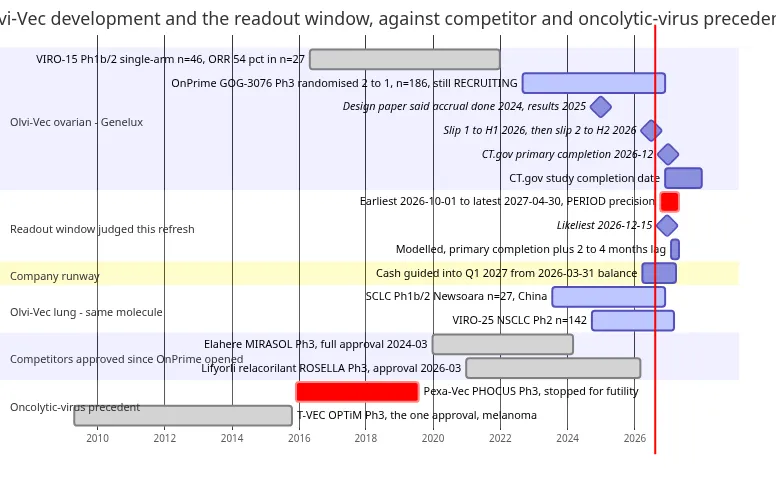
- The event and when (as disclosed): Topline progression-free survival from the randomised Phase 3 OnPrime / GOG-3076 trial (NCT05281471), disclosed only as “H2 2026” — a six-month period, not a day. This refresh judges the readout window as 2026-10-01 to 2027-04-30, likeliest 2026-12-15, at PERIOD precision and LOW confidence. See Readout, below, for how that was built and why it extends past the company’s own guidance.
- The main reason it could work: The single-arm Phase 2 that preceded it produced a 54% response rate and a median progression-free survival of 11.0 months in women who had already had a median of four lines of treatment, which is far beyond anything that population normally achieves. An independent Phase 1 study at a different institution confirmed, with a blinded pathologist, that the virus does infect tumour cells and does pull immune cells in.
- The main risk: The trial gives platinum chemotherapy to patients whose disease is defined by not responding to platinum. If the virus does not reverse that resistance, the treatment arm receives a drug that cannot work plus its toxicity, and can finish worse than the control arm. That is exactly what happened to the closest comparable oncolytic virus, Pexa-Vec, which was stopped for futility in its Phase 3 with overall survival numerically worse than control.
- What it means for the stock: The arithmetic below puts the probability-weighted value about 50%
above the current share price, but the single most likely outcome is a fall of 52% to 83%. Those two
statements disagree because the payoff is lopsided, not because the result is likely to be good.
The company is a one-molecule company with roughly one to two quarters of cash left at the readout
and a $100M at-the-market facility that this refresh confirms is still essentially undrawn and
therefore still fully available to be issued into a positive result. See
../company.mdC.3 and C.4.
0. Program-tier coverage — CLEARED
Company-tier coverage is in ../company.md C.0. It is not repeated here.
| Tool | State | Note / verbatim error |
|---|---|---|
CT.gov search_trials + get_trial_details on the pivotal NCT | CALLED | search_trials on the intervention returned 10 records, covering every trial this molecule has ever entered under all three of its names. get_trial_details was run on the pivotal record NCT05281471, returning the full protocol, eligibility criteria, all seven outcome measures and all 32 sites with their named site investigators. Status still RECRUITING, primary completion 2026-12, study completion 2027-12, has_results false |
PubMed search_articles + get_article_metadata on every hit | CALLED | The broad query (Olvi-Vec OR olvimulogene OR GL-ONC1 OR GLV-1h68) returns 57 hits, above the 15 threshold, because GLV-1h68 carries a long preclinical literature. Metadata was pulled on the clinically relevant set: the pivotal design paper and its correction, the Phase 2 primary publication, the Phase 1b publication, the independent intrapleural mechanistic study, and the newly published 2026 translational analysis. A second, narrower query (oncolytic virus / vaccinia × ovarian × platinum resistance, 2025 onward, 24 hits) supplied the independent voices in A.5b |
Open Targets search_entities | CALLED | Changed from BLOCKED at the last sweep. olvimulogene nanivacirepvec resolved to CHEMBL4594308, type drug; vaccinia oncolytic virus and platinum-resistant ovarian cancer each returned a legitimate empty. A control query (ovarian cancer) returned three disease entities, confirming the connector is genuinely live rather than degraded. The finding is stronger than last time: we looked, and there is no target-validation evidence to have — see A.1 |
ChEMBL compound_search | CALLED | Recovered only under the full retry policy: three consecutive Tool 'compound_search' exceeded 30.0s server timeout errors and one HTTP error in tool compound_search: 500 from upstream API before the fourth attempt returned. It then returned exactly one record, CHEMBL4594308, pref_name OLVIMULOGENE NANIVACIREPVEC, molecule_type “Gene”, max_phase 3, structure_type NONE, orphan 0, synonyms GL-ONC1 and GLV-1h68, with a USAN cross-reference. No molecular properties, no SMILES, no InChI, no bioactivity records, because the agent is a virus rather than a small molecule, so no selectivity claim can be made from it |
| web_search ×4: peak sales · competitive · exclusivity + royalty · analyst | CALLED | All four run. Peak sales and competitive both materially updated this refresh (Elahere’s 2025 actual revenue; the ASCO 2026 Elahere result; a usable epidemiology anchor). The exclusivity and royalty search again failed to find a composition-of-matter expiry or the Newsoara royalty rate; both stay unverified rather than guessed |
Verdict: CLEARED. No mandatory row reads NOT CALLED, and — unlike the previous version — no
row reads BLOCKED either. The Open Targets block that shaped the last analysis has cleared, and
ChEMBL returned after the full retry policy rather than before it.
A. Scientific & clinical assessment
A.1 Mechanism of action and scientific rationale
Olvi-Vec is a live virus used as a drug. It is a modified strain of vaccinia, the virus that was used
for a century as the smallpox vaccine, so its behaviour in humans was already well characterised
before anyone tried to treat cancer with it [VERIFIED — BPIQ fetch_company_info company description; ChEMBL CHEMBL4594308, which records the laboratory name GLV-1h68 and the earlier clinical name GL-ONC1 as synonyms of the same agent, read 2026-08-11].
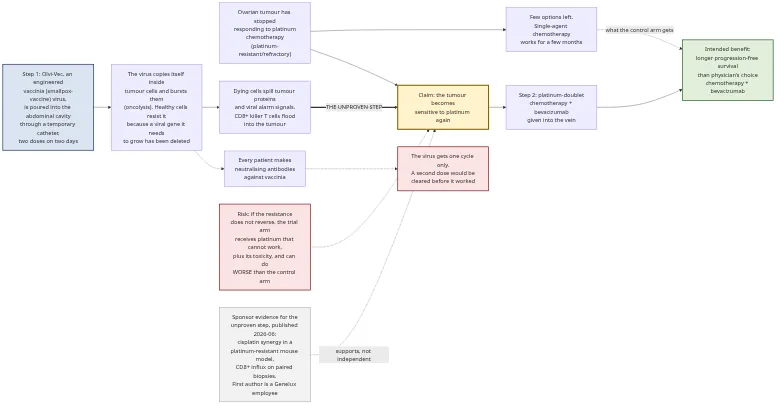
The virus has been engineered so that it grows much better inside tumour cells than inside healthy ones. When it grows inside a tumour cell, it bursts it. That is the first half of the idea and it is the straightforward half.
The second half is the reason this trial exists. When tumour cells burst, they spill their own
proteins into the surrounding tissue at the same moment as the virus is setting off the body’s alarm
signals for an infection. The immune system, which had been ignoring the tumour, arrives to deal with
the infection and finds the tumour proteins while it is there. Killer T cells move in. The company’s
claim is that this changes the tumour so much that platinum chemotherapy starts working again in
patients whose disease had stopped responding to it [VERIFIED — the hypothesis as stated in the trial's own detailed description, ClinicalTrials.gov NCT05281471 read 2026-08-11, and in the design paper, Holloway et al., Int J Gynecol Cancer 2023;33(9):1458-1463, [DOI 10.1136/ijgc-2023-004812](https://doi.org/10.1136/ijgc-2023-004812), according to PubMed].
Delivery is unusual and matters commercially as well as scientifically. The virus is not injected
into a vein. A catheter is placed into the abdominal cavity by keyhole surgery, the virus is poured
in on two consecutive days at 3 × 10⁹ plaque-forming units per day, and the catheter is then removed
[VERIFIED — NCT05281471 detailed description]. This makes sense for ovarian cancer specifically,
because the disease typically spreads as many small deposits across the lining of the abdominal
cavity, so a drug delivered into that cavity reaches the tumour directly rather than having to
survive the bloodstream.
How well is the target validated? This refresh can finally answer the question rather than record
a blocked connector. At the last sweep, Open Targets was BLOCKED across four attempts, so nothing
was asserted either way. This sweep it answered. Searching olvimulogene nanivacirepvec returns
exactly one entity — CHEMBL4594308, typed drug — and no target entity of any kind, while a
control query returns three disease entities normally [VERIFIED — Open Targets search_entities, 2026-08-11].
That is a real finding, and it is not the same as the previous version’s silence. Olvi-Vec has no molecular target in the ordinary sense — there is no receptor it binds and no enzyme it blocks — so the genetic-validation evidence that Open Targets exists to supply does not exist for this agent, and now that has been checked rather than assumed. A.5 still scores target validation Low, but for a stated reason rather than a missing call.
What does exist is direct human tissue evidence, and one piece of it is genuinely independent:
- In a Memorial Sloan Kettering-sponsored Phase 1 study of the same virus given into the chest cavity
(n=18), vaccinia was detectable in tumour cells two to five days after treatment, and a
pathologist who did not know which patients had been treated recorded a fall in tumour-cell density
and a rise in immune-cell density. Killer T cells, natural killer cells, dendritic cells and
neutrophils all increased — and so did regulatory T cells, which suppress immune responses
[VERIFIED — Chintala et al., Front Immunol 2023;14:1112960, [DOI 10.3389/fimmu.2023.1112960](https://doi.org/10.3389/fimmu.2023.1112960), according to PubMed]. The authors are from Memorial Sloan Kettering and NYU, not from Genelux. This is the single most trustworthy piece of mechanistic evidence in the file. - A German academic Phase 1 study of intraperitoneal delivery (n=9) confirmed infection, replication
and oncolysis in eight of nine patients — but only in cycle 1. Every patient developed
neutralising antibodies against the virus
[VERIFIED — Lauer et al., Clin Cancer Res 2018;24(18):4388-4398, [DOI 10.1158/1078-0432.CCR-18-0244](https://doi.org/10.1158/1078-0432.CCR-18-0244), according to PubMed]. - New since the last version, and now formally published: Genelux’s own translational analysis of
the Phase 2 appeared in print on 2026-06-19 and is indexed in PubMed Central. It reports
preclinical synergy between Olvi-Vec and cisplatin in a mouse model of platinum-resistant ovarian
cancer, viral infection and eradication of tumour cells in patients’ ascitic fluid, a large
influx of CD8+ tumour-infiltrating lymphocytes on multiplex staining of paired biopsies, and RNA
profiling identifying four expression patterns the authors associate with immune activation, viral
infection, chemotherapy sensitisation and anticancer activity
[VERIFIED — Yu et al., Gynecol Oncol Rep 2026;66:102145, [DOI 10.1016/j.gore.2026.102145](https://doi.org/10.1016/j.gore.2026.102145), PMID 42383154, according to PubMed]. This paper is not independent: its first author is a Genelux employee in Clinical Research & Development, and the second author is the trial’s national principal investigator. It is the most direct published support the unproven step has, and it comes from the sponsor.
The single-cycle limit is not a flaw in the design; the trial gives exactly one cycle, which is consistent with the biology. But it does mean the entire therapeutic effect has to come from one hit.
The exact scientific step the next readout must prove. Not that the virus infects tumours — that is already shown by a blinded independent pathologist. Not that immune cells arrive — that is shown too. The step under test is the arrow marked in yellow on the diagram above: that the immune activation translates into the tumour becoming sensitive to platinum again, enough to extend progression-free survival against physician’s choice of chemotherapy plus bevacizumab. Everything between the virus entering the abdomen and a longer time to progression is established; that one link is not. The 2026 translational paper argues for that link from mouse pharmacology and human biopsies — but the argument runs from mechanism to plausibility, not from randomised evidence to benefit, and its authors are the sponsor.
The honest scientific risk, stated plainly. The trial gives platinum to patients who are defined by not responding to platinum. Outside a trial, re-challenging a platinum-resistant patient with platinum is regarded as futile and is avoided. So this design is not a free ride: the experimental arm is not simply “control arm plus an extra drug”. If the virus does not do what is claimed, those patients receive a chemotherapy that cannot work, together with its toxicity, instead of a chemotherapy that can. The arm can finish worse than control, not merely no better.
That is not a hypothetical failure mode. Pexa-Vec (pexastimogene devacirepvec) is also an engineered
vaccinia oncolytic virus, and was also tested in a sequential design alongside a standard therapy. Its
Phase 3 PHOCUS trial in liver cancer was stopped on the advice of its own monitoring committee after
a planned futility analysis, with median overall survival of 12.7 months in the virus arm against
14.0 months in the control arm, and time to progression of 2.0 months against 4.2 months — the virus
arm was worse on both [VERIFIED — PHOCUS results as reported, Liver Cancer 2024;13(3):256, PubMed PMID 38756145] [WEB ESTIMATE — GEN, "Pexa-Vec/Nexavar Combination Fails Phase III Trial in Liver Cancer"].
In the entire history of the field, one oncolytic virus has been approved in the United States and
Europe: talimogene laherparepvec, a herpes virus injected directly into skin lesions in melanoma,
approved on a durable-response endpoint [VERIFIED — OPTiM Phase 3, PMC5129499]. That is the base
rate this programme is arguing against.
A.2 Clinical development plan, timeline, feasibility, resourcing
Trials
| Trial | Sponsor / whose drug | Design (arms, blinding, n) | Population | Status / key result | Link |
|---|---|---|---|---|---|
| OnPrime / GOG-3076 — the pivotal trial | Genelux Corporation, with the GOG Foundation as collaborator. Genelux’s own drug | Randomised 2:1, open-label, multicentre, active-controlled Phase 3. Target n=186 (about 124 experimental, 62 control), powered to capture 127 progression-free-survival events. Experimental arm: one cycle of intraperitoneal Olvi-Vec on two consecutive days, then platinum-doublet chemotherapy plus bevacizumab. Control arm: physician’s choice of single-agent gemcitabine, a taxane or pegylated liposomal doxorubicin, plus bevacizumab. Scans read by blinded independent central review under RECIST 1.1 and iRECIST. 32 US sites | Non-resectable platinum-resistant or platinum-refractory high-grade serous, endometrioid or clear-cell ovarian, fallopian tube or primary peritoneal cancer. At least three prior lines of systemic therapy, no upper limit. Prior bevacizumab required. ECOG 0 or 1. Life expectancy at least 6 months. Measurable disease and evidence of peritoneal carcinomatosis | Still RECRUITING on 2026-08-11, with every one of the 32 sites individually listed as RECRUITING. Started 2022-08-31. Primary completion 2026-12, study completion 2027-12. No results posted. An IDMC review in February 2026 recommended continuation without modification | NCT05281471 · design paper DOI 10.1136/ijgc-2023-004812 |
| VIRO-15 — the study the pivotal is built on | Genelux Corporation. Genelux’s own drug | Single-arm, open-label, non-randomised, two sites. Registered n=46; the Phase 2 portion reported n=27 | Platinum-resistant (n=14) or platinum-refractory (n=13) ovarian cancer. Median age 62 (range 35–78). Median 4 prior lines (range 2–9) | Completed. Objective response rate 54% (95% CI 33–74%), disease control rate 88% (21/24), response rate by CA-125 85% (95% CI 65–96%), median duration of response 7.6 months, median progression-free survival 11.0 months (95% CI 6.7–13.0), 6-month PFS rate 77%, median overall survival 15.7 months. Median follow-up 47.0 months. Most frequent treatment-related adverse events were pyrexia (63.0% any grade, 3.7% grade 3) and abdominal pain (51.9%, 7.4%). No grade 4 events, no treatment-related discontinuations, no treatment-related deaths | NCT02759588 · DOI 10.1001/jamaoncol.2023.1007 |
| VIRO-15 Phase 1b — the dose-finding study | Genelux Corporation | Open-label 3+3 dose escalation, n=12, Olvi-Vec as monotherapy across three dose levels | Platinum-resistant or refractory ovarian cancer. Median age 69 (45–77), median 5 prior therapies (2–10) | Completed. As monotherapy, objective response rate 9% (1/11), stable disease 64%, median progression-free survival 15.7 weeks. No grade 4 events, no dose-limiting toxicity, no deaths attributed to the virus | DOI 10.1016/j.ygyno.2021.10.069 |
| Intrapleural Phase 1 — the independent mechanistic study | Memorial Sloan Kettering Cancer Center. Genelux’s drug, someone else’s trial | Open-label dose escalation, n=18, virus given into the chest cavity at 1.00E+07 to 6.00E+09 pfu | Malignant pleural effusion from mesothelioma, non-small cell lung cancer or breast cancer | Completed. No treatment-related deaths, no dose-limiting toxicity. Virus detectable in tumour cells at days 2–5; a blinded pathologist recorded falling tumour-cell density and rising immune-cell density | NCT01766739 · DOI 10.3389/fimmu.2023.1112960 |
| Intraperitoneal Phase 1/2 — the delivery-route study | Genelux GmbH, run in Tübingen | Open-label 3+3, n=9, up to four monthly cycles | Advanced peritoneal carcinomatosis and peritoneal mesothelioma | Completed. Adverse events limited to grades 1–3, no dose-limiting toxicity, no viral shedding. Infection and oncolysis confirmed in 8 of 9 — limited to cycle 1. All patients developed neutralising antibodies | NCT01443260 · DOI 10.1158/1078-0432.CCR-18-0244 |
| Head and neck Phase 1 | Genelux Corporation, run at UC San Diego | Open-label dose and cycle escalation, n=19, virus given intravenously with cisplatin and radiotherapy | Locoregionally advanced head and neck carcinoma | Completed. Maximum tolerated dose not reached. Live virus confirmed in a tongue tumour seven days after the first dose | NCT01584284 · DOI 10.1158/1078-0432.CCR-16-3232 |
| Pre-surgical Phase 1b | Andrew Lowy (investigator-sponsored) | Open-label, non-randomised | Solid organ cancers undergoing surgery | TERMINATED at n=5. No reason is recorded in the registry record | NCT02714374 |
| VIRO-25 (NSCLC) — same molecule, different disease | Genelux Corporation | Randomised Phase 2, n=142 at 15 sites, Olvi-Vec then platinum-doublet plus a checkpoint inhibitor against docetaxel | Non-small cell lung cancer after front-line checkpoint-inhibitor maintenance | Recruiting. Started 2024-09-26, primary completion 2027-02. January 2026 interim: 60% disease control in three of five patients | NCT06463665 |
| OLVI-VEC-SCLC-202 — same molecule, partner’s trial | Newsoara HYK Biopharmaceutical (Shanghai) | Open-label Phase 1b/2, n=27, two sites in China, Olvi-Vec with platinum plus etoposide | Platinum-recurrent or refractory extensive-stage small cell lung cancer | Recruiting. Started 2023-07-24, primary completion 2026-12. January 2026 interim: 33% partial response in three of nine patients | NCT07136285 |
Comparator for the pivotal trial’s claims. The comparison that matters is Olvi-Vec’s own Phase 2
against the two agents approved in this disease since OnPrime opened. VIRO-15 reported a median
progression-free survival of 11.0 months in a single arm of 27 patients. Relacorilant plus
nab-paclitaxel reported 6.5 months against 5.5 months in a randomised trial of 381 patients, and
was approved on it [VERIFIED — ROSELLA results as reported; see B.1]. An 11.0-month single-arm
figure sitting at nearly double a randomised winner’s result is the shape that most often does not
replicate.
First and last patient in, last patient out, database lock and topline. First patient in was
2022-08-31 [VERIFIED — ClinicalTrials.gov]. Last patient in has never been disclosed, and this
remains the most important gap in the whole document. The database lock date has never been disclosed
either — it appears in no ClinicalTrials.gov field, in none of the PubMed records read, and in none
of the 137 press items read for ../company.md C.0. Topline is guided to “H2 2026”;
the window this analysis judges is in Readout, below.
Feasibility matrix
| Factor | High probability | Medium probability | Low probability | This asset (assessment) | Source |
|---|---|---|---|---|---|
| Recruitment feasibility | >50 sites, 3:1 patient:site | 20–50 sites, established investigators | <20 sites, novel sites | Medium on structure, Low on delivered pace, and the pace has got worse. 32 US sites, all established academic and community gynaecologic-oncology centres, with the GOG Foundation as collaborator — that is the right infrastructure. But 186 patients across 32 sites over the 48 months to this sweep is about 1.45 patients per site per year, and the registry still reads RECRUITING with all 32 sites individually recruiting | [VERIFIED — ClinicalTrials.gov NCT05281471, 32 locations, status RECRUITING, read 2026-08-11] |
| Endpoint clarity | Regulatory precedent exists | Novel endpoint with FDA alignment | Unvalidated surrogate | High. Progression-free survival by RECIST 1.1 with blinded independent central review is the standard registration endpoint in this disease, and both agents approved here since 2024 were approved with it as a primary or co-primary measure. The FDA confirmed in a Type D meeting that a clinically meaningful PFS advantage without an overall-survival decrement could support traditional approval | [VERIFIED — company release 2025-03-25 as reported by GlobeNewswire and BioSpace] |
| Trial-design robustness | Pivotal Phase III with SPA | Adaptive with interim analysis | Single-arm, no control | Medium. Randomised, active-controlled, 2:1, with blinded independent central review and a functioning IDMC that reviewed in February 2026 and recommended continuation without modification. Against that: open-label, and no Special Protocol Assessment is disclosed anywhere | [VERIFIED — NCT05281471; Q1 2026 results release 2026-05-07] |
| Operational / execution | Enrollment complete, standard timeline | Some timeline risk | Enrollment behind | Low. This is the weakest cell in the table, and it is weaker than at the last refresh. The trial’s own design paper, published September 2023, stated: “Expected complete accrual in 2024 with presentation of primary endpoint results in 2025.” Accrual was not complete in 2024, results were not presented in 2025, guidance moved from H1 2026 to H2 2026, and the registry still read RECRUITING on 2026-08-11 — more than halfway through the guided readout half-year. Completion of enrollment has still never been announced | [VERIFIED — Holloway et al., Int J Gynecol Cancer 2023;33(9):1458-1463; BPIQ note field; ClinicalTrials.gov status read 2026-08-11] |
The timeline does not obviously close, and the case has weakened since the last version. A trial
that is still enrolling in August 2026 needs its last patient to be followed long enough to contribute
a progression event before the database can lock. Progression-free survival in the control arm of this
population runs roughly 3.5 to 5.5 months on the two randomised precedents in B.1, so events do accrue
quickly once patients are in — which is the argument that a H2 2026 topline is still achievable, and
it is a real argument: the 127 events the trial is powered for come mostly from patients enrolled
years ago, not from the last one in. The counter-argument has strengthened. At the 2026-08-05
analysis the trial was 47 months old and recruiting; it is now 48 months old and still recruiting,
six weeks into the guided half-year, with no enrollment-completion announcement and no Q2 update to
explain it (see ../company.md C.3 on the overdue results release).
[UNVERIFIED — judgement, built on the verified enrollment history, the verified registry status and the verified control-arm PFS benchmarks]
Resourcing sufficiency. Genelux does not have the cash to reach approval and does not claim to.
Cash was $26.209M at 2026-03-31, guided to last “into the first quarter of 2027”, against the readout
window judged below that runs to 2027-04-30 — see ../company.md C.3. It has 32
sites running, which it can plainly fund to the readout on either burn route, and a $100M
at-the-market facility live since 2026-03-19 which is how anything after the readout will be paid
for. This refresh establishes that the facility is essentially undrawn through 2026-05-03, so the
company has not been funding the trial by quietly selling stock — the whole $100M is still ahead of
shareholders rather than behind them. A new chief medical officer started in January 2026, five
months into the final year of a pivotal trial [VERIFIED — company release 2026-01-05]. The company
has the people and sites to finish the trial; it does not have the money to file and launch without
raising several times what it is currently worth.
A.3 Target label, target product profile, strategic questions, designations
A.3a Target label. Adult women with platinum-resistant or platinum-refractory, non-resectable
high-grade serous, endometrioid or clear-cell ovarian, fallopian tube or primary peritoneal cancer
who have received at least three prior lines of systemic therapy including bevacizumab, treated with
one cycle of intraperitoneal Olvi-Vec followed by platinum-doublet chemotherapy and bevacizumab
[VERIFIED — NCT05281471 eligibility criteria and arm descriptions, read 2026-08-11].
A.3b Target product profile
| Attribute | Standard of care & key competitor(s) — data | Olvi-Vec target profile (goal) | Supporting evidence (+ link) |
|---|---|---|---|
| Indication / target label | Elahere (mirvetuximab soravtansine): FRα-positive platinum-resistant disease after 1–3 prior regimens. Lifyorli (relacorilant) + nab-paclitaxel: platinum-resistant disease after 1–3 prior regimens including bevacizumab, no biomarker required, approved March 2026. Beyond those, physician’s choice single-agent chemotherapy | Fourth line and beyond, no biomarker. A slot behind both approved agents rather than against them | [VERIFIED — FDA approval of relacorilant, March 2026] [WEB ESTIMATE — OncLive, CancerNetwork, 2026] · NCT05281471 |
| Efficacy (endpoints, regimen) | Relacorilant + nab-paclitaxel: median PFS 6.5 vs 5.5 months (HR 0.70), median OS 16.0 vs 11.9 months (HR 0.65), n=381. Elahere: median OS 16.5 vs 12.7 months (HR 0.67) in MIRASOL | A statistically significant PFS advantage over physician’s choice chemotherapy plus bevacizumab with no overall-survival decrement. The Phase 2 suggested 11.0 months median PFS; no such figure should be expected in a randomised trial | [WEB ESTIMATE — ROSELLA and MIRASOL results as reported by OncLive and CancerNetwork, 2026] · DOI 10.1001/jamaoncol.2023.1007 |
| Safety / tolerability | Elahere carries ocular toxicity requiring eye monitoring. Chemotherapy comparators carry the usual myelosuppression and neuropathy | Pyrexia and abdominal pain, mostly grades 1–2, plus the risks of a laparoscopic catheter procedure. The Phase 2 recorded no grade 4 treatment-related events and no treatment-related deaths in 27 patients | [VERIFIED — JAMA Oncol 2023, [DOI 10.1001/jamaoncol.2023.1007](https://doi.org/10.1001/jamaoncol.2023.1007), according to PubMed] |
| Biomarker / companion diagnostic | Elahere requires an FRα immunohistochemistry test. Relacorilant requires none. Pembrolizumab combinations use PD-L1 CPS | None. No companion diagnostic is in development and none is required by the protocol. This is a genuine commercial advantage against Elahere and a wash against relacorilant | [VERIFIED — NCT05281471 has no biomarker inclusion criterion] |
| Formulation / administration | All competitors are intravenous infusions given in an ordinary infusion suite | A live virus delivered by laparoscopic intraperitoneal catheter over two consecutive days, with the catheter then removed. This is the profile’s biggest weakness and it is structural, not fixable | [VERIFIED — NCT05281471 detailed description] |
| Payer value | Elahere and relacorilant are both reimbursed in major markets; NICE has recommended mirvetuximab, and Canada’s Drug Agency issued a positive reimbursement recommendation | Unknown and not modelled here. A one-time two-day treatment could in principle be priced as a course rather than per cycle, which payers often prefer, but no pricing intention has ever been disclosed | [WEB ESTIMATE — OncLive, 2026] [UNVERIFIED — Olvi-Vec pricing] |
A.3c Strategic Go/No-Go questions.
Pre-Phase-II (Go-to-Phase-II) — answered retrospectively, because this decision was taken in 2022:
| Group | Question | Answer (tagged) |
|---|---|---|
| Target | Clinical proof of principle established in the Phase I population? | Partly. The Phase 1b established safety and a 9% monotherapy response rate; proof of principle for the combination came from the Phase 2, not the Phase 1 [VERIFIED — [DOI 10.1016/j.ygyno.2021.10.069](https://doi.org/10.1016/j.ygyno.2021.10.069)] |
| Target | If the proof-of-concept population differs, how does the evidence translate? | It does not differ. Phase 1b and Phase 2 were the same trial (VIRO-15) in the same population [VERIFIED — NCT02759588] |
| Target | Evidence or rationale for combination therapy, and is it pursued? | Yes, and it is the whole thesis. Preclinical synergy between Olvi-Vec and cisplatin was shown in a mouse model of platinum-resistant ovarian cancer, now formally published [VERIFIED — [DOI 10.1016/j.gore.2026.102145](https://doi.org/10.1016/j.gore.2026.102145)] |
| Dose & Drug | Refined exposure–response relationship (Phase I + non-clinical)? | No. The Phase 1b found no dose relationship to adverse events and did not reach a maximum tolerated dose, so 3 × 10⁹ pfu × 2 days was chosen without a demonstrated exposure–response curve [VERIFIED — [DOI 10.1016/j.ygyno.2021.10.069](https://doi.org/10.1016/j.ygyno.2021.10.069)] |
| Dose & Drug | Dose range and regimen compatible with observed safety? | Yes. No grade 4 treatment-related events across every study read [VERIFIED — the four published safety datasets in A.2] |
| Dose & Drug | Formulation delivers a therapeutic exposure? | Yes at the tumour, by direct measurement: virus found in tumour cells at days 2–5 by an independent group [VERIFIED — [DOI 10.3389/fimmu.2023.1112960](https://doi.org/10.3389/fimmu.2023.1112960)] |
| Dose & Drug | Formulation suitable for commercialisation? | This is the weak answer. A live virus requiring laparoscopic catheter placement and biosafety handling is deliverable in academic centres and difficult everywhere else. See B.2 [UNVERIFIED — judgement on the verified delivery method] |
| Patient | Proposed trial design and outcome criteria to show proof of concept? | Yes — randomised 2:1, PFS primary, BICR-adjudicated [VERIFIED — NCT05281471] |
| Patient | Are those criteria clinically accepted, compelling and competitive? | Yes. PFS by RECIST 1.1 is the accepted registration endpoint here [VERIFIED — the two 2024–2026 approvals in B.1] |
| Patient | Likelihood of hitting the expected outcome? | See the modelled probability in the locked prediction. Below a coin flip [UNVERIFIED — modelled] |
| Patient | Rationale for the patient population(s)? | Strong. Peritoneal carcinomatosis is the disease pattern that makes intraperitoneal delivery rational, and it is required by the protocol at screening [VERIFIED — NCT05281471 inclusion criteria] |
| Patient | If a stratification biomarker is used, which validated method identifies patients? | None is used [VERIFIED — NCT05281471] |
| Patient | Companion-diagnostic strategy included? | No, and none is needed [VERIFIED — NCT05281471] |
| Patient | Candidate for Breakthrough Therapy or another early regulatory route? | Fast Track was granted on 2023-11-27. Breakthrough Therapy has never been announced [VERIFIED — company release 2023-11-27; BPIQ historical catalyst id 1079] |
Pre-Phase-III (Go-to-Phase-III / registration) — this is the live set, because the next decision is a regulatory filing:
| Group | Question | Answer (tagged) |
|---|---|---|
| Target | Target revalidated as in prior phases? | Not applicable in the usual sense, since there is no molecular target — and this refresh confirmed that rather than assuming it, because Open Targets returned a drug entity and no target entity [VERIFIED — Open Targets search_entities 2026-08-11]. The mechanism was revalidated in human tissue by an independent group [VERIFIED — [DOI 10.3389/fimmu.2023.1112960](https://doi.org/10.3389/fimmu.2023.1112960)] |
| Dose & Drug | Exposure–response for the intended commercial regimen and route(s)? | No. The commercial regimen is one cycle intraperitoneally, and there is no established dose–response for it. Every patient develops neutralising antibodies, so a second cycle is not available as a lever [VERIFIED — [DOI 10.1158/1078-0432.CCR-18-0244](https://doi.org/10.1158/1078-0432.CCR-18-0244)] |
| Dose & Drug | Commercial formulation available or feasible? | The clinical formulation is the commercial formulation. Manufacturing readiness has been publicly cited by at least one analyst as a supporting argument [WEB ESTIMATE — TipRanks summary of a Maxim Group note, 2026-03-20], but no manufacturing facility, capacity figure or contract manufacturer was verified in this sweep either [UNVERIFIED] |
| Dose & Drug | Dose range compatible with clinical and non-clinical safety? | Yes. No maximum tolerated dose was reached in any Phase 1, at doses up to 6 × 10⁹ pfu [VERIFIED — [DOI 10.3389/fimmu.2023.1112960](https://doi.org/10.3389/fimmu.2023.1112960)] |
| Dose & Drug | Therapeutic window given the clinical response? | Appears wide on safety and unproven on efficacy. That is an unusual combination and it means the risk sits almost entirely on the efficacy side [VERIFIED — the safety datasets; UNVERIFIED — the efficacy] |
| Dose & Drug | Intrinsic and extrinsic factors influencing exposure and patient response? | Prior smallpox vaccination and pre-existing anti-vaccinia immunity are the obvious candidates and were not addressed in any source read, this sweep included. Intraperitoneal delivery partly bypasses circulating antibody, which is the stated rationale for the route [UNVERIFIED — not disclosed] |
| Patient | Proof of concept and positive benefit/risk in the intended population? Combination evidence? | Yes on a single arm of 27 patients, with preclinical combination synergy now published in full. No randomised evidence of any kind exists yet — that is what the readout is [VERIFIED — [DOI 10.1001/jamaoncol.2023.1007](https://doi.org/10.1001/jamaoncol.2023.1007) and [DOI 10.1016/j.gore.2026.102145](https://doi.org/10.1016/j.gore.2026.102145)] |
| Patient | Phase III design and outcome criteria — accepted, compelling, competitive for market access? | Accepted, and FDA-aligned. Less competitive than it was in 2022: the control arm is physician’s choice single-agent chemotherapy plus bevacizumab, which two 2024–2026 approvals have since displaced for many patients. See B.1 [VERIFIED — NCT05281471; WEB ESTIMATE — the 2026 approvals] |
| Patient | Rationale for the patient population(s)? | Strong and unchanged [VERIFIED — NCT05281471] |
| Patient | Likelihood of the expected outcome? | Modelled below at 35%, band 20–55% [UNVERIFIED — modelled] |
| Patient | Companion-diagnostic strategy, including pricing and market? | None, by design. No pricing intention has ever been disclosed [UNVERIFIED] |
A.3d Regulatory designations.
- Fast Track designation, granted 2023-11-27 for Olvi-Vec in platinum-resistant/refractory ovarian
cancer. It grants more frequent meetings and written communication with the FDA, eligibility for
accelerated approval and priority review if the criteria are met, and the ability to submit a
marketing application in sections as they are completed rather than all at once. It does not
imply any view on whether the drug works
[VERIFIED — company release 2023-11-27; BPIQ historical catalyst id 1079]. - FDA alignment on the approval pathway, announced 2025-03-25 following a Type D meeting. The FDA
stated that an interim analysis of overall survival should be planned at the time of the primary
progression-free-survival analysis, and that a clinically meaningful PFS advantage in the absence
of a decrement in overall survival could potentially support traditional approval. This is not a
designation and grants nothing, but it is the clearest public statement of what the trial has to
produce, and it puts an explicit overall-survival tripwire on the result
[VERIFIED — company release 2025-03-25, GlobeNewswire and BioSpace]. - Orphan Drug designation: not confirmed, and now corroborated as absent by a second source. The
exclusivity web search again found no orphan designation, none appears in the press feed, and
ChEMBL’s record for CHEMBL4594308 carries
orphan: 0[VERIFIED — ChEMBL 2026-08-11, for the field value only][UNVERIFIED — the underlying regulatory fact]. Still not claimed here. - Breakthrough Therapy designation: none announced
[VERIFIED — absent from 137 press items].
A.4 Target product profile valuation matrix
| Stakeholder | Value driver | Minimum threshold | Competitive | Premium | Benchmark / source |
|---|---|---|---|---|---|
| Patient / caregiver | More time before the disease grows, without losing quality of life to a harder treatment | Any statistically significant PFS gain with no overall-survival decrement | A PFS gain of about 1 month or more, matching what relacorilant delivered and was approved on | A PFS gain of 3 months or more, plus an overall-survival signal, in a group that has already had three or more treatments | Relacorilant + nab-paclitaxel: PFS 6.5 vs 5.5 months, OS 16.0 vs 11.9 months [WEB ESTIMATE — ROSELLA as reported by CancerNetwork, 2026] |
| Regulator | A clinically meaningful PFS advantage with no overall-survival decrement | Statistical significance on the primary endpoint | The FDA’s own stated bar: meaningful PFS and no OS decrement at the interim | The same plus a favourable OS trend, which would remove any question of a confirmatory requirement | The Type D meeting outcome [VERIFIED — company release 2025-03-25] |
| Payer / HTA | Cost per additional month without progression, against a generic chemotherapy comparator | Demonstrated benefit over physician’s choice chemotherapy | Comparable value to relacorilant, which is reimbursed | A one-time two-day course rather than continuous therapy, which caps total cost per patient | NICE has recommended mirvetuximab in this setting, and Canada’s Drug Agency has issued a positive reimbursement recommendation [WEB ESTIMATE — Medscape and OncLive, 2026] |
| Provider | Whether the centre can actually deliver it | Access to a gynaecologic oncologist who can place a laparoscopic catheter | The above plus institutional biosafety approval for handling a live virus | Neither applies. There is no premium tier for this attribute — it is a constraint at every level | [VERIFIED — NCT05281471 delivery method; UNVERIFIED — the judgement about site capability] |
Calibration examples, not asset claims: in oncology each incremental month of overall survival is worth roughly $150–300M in peak-sales potential; oral formulations command roughly 15–25% price premiums over injectables. The second of those cuts against this asset harder than usual, because Olvi-Vec is not merely injectable but surgically delivered.
A.5 Evidence quality and endpoints
| Criterion | Score (High / Medium / Low) | Basis (one line) | Link |
|---|---|---|---|
| Target validation | Low | There is no molecular target to validate, and this sweep confirmed that rather than inferring it from a blocked connector: Open Targets returns a drug entity for this agent and no target entity at all | [VERIFIED — Open Targets search_entities, 2026-08-11] |
| Mechanism clarity | High | Infection, replication, oncolysis and immune infiltration are all directly demonstrated in human tumour tissue, once by a blinded pathologist in an independently sponsored study | DOI 10.3389/fimmu.2023.1112960 |
| Biomarker availability | Low, and by design | No predictive biomarker exists or is sought. CA-125 is used as a supporting response measure only | DOI 10.1001/jamaoncol.2023.1007 |
| Publication quality (peer-reviewed? independent authors?) | Medium | The pivotal efficacy dataset is in JAMA Oncology, which is first-rank, and the design paper is in the International Journal of Gynecological Cancer. But every ovarian efficacy and translational paper is written by the sponsor and its own trial investigators, and the design paper carries a correction whose content could not be retrieved | DOI 10.1001/jamaoncol.2023.1007 · correction DOI 10.1136/ijgc-2023-004812corr1 |
| Clinical / expert sentiment | — | Moved to A.5b, below. | — |
Endpoints
| Endpoint (full name) | What it measures | Scale / range | Better direction | MCID / note |
|---|---|---|---|---|
| Progression-free survival (PFS) by RECIST 1.1 in the intention-to-treat population — the primary endpoint | Time from the day a patient is randomised until the day a scan first shows the tumour growing, or the patient dies of any cause | Time, in months, from 0 upward. Measured over the 12 months after randomisation | Longer is better | No formally established minimal clinically important difference exists in this disease. The practical regulatory benchmark is what has actually been approved: relacorilant was approved on a 1.0-month median PFS gain (6.5 vs 5.5) accompanied by a 4.1-month overall-survival gain [WEB ESTIMATE — ROSELLA, 2026]. “Intention-to-treat” means every randomised patient is counted in the arm they were assigned to, whether or not they received the drug — the stricter and less flattering way to count |
| Overall survival (OS) in the intention-to-treat population — secondary, but decisive | Time from randomisation until death from any cause | Time, in months, from 0 upward. Assessed up to 36 months | Longer is better | Formally a secondary endpoint, but the FDA asked for an interim analysis at the time of the primary PFS analysis, and said a PFS win only supports traditional approval in the absence of an OS decrement. In practice this is a second primary endpoint with a one-sided bar [VERIFIED — company release 2025-03-25] |
| Overall response rate (ORR) by RECIST 1.1 — secondary | The proportion of patients whose tumours shrink by at least 30% in the sum of their measured diameters, or disappear entirely | A percentage, 0% to 100% | Higher is better | The Phase 2 figure to beat is its own 54%. In a randomised setting, an ORR far below that would undercut the PFS result even if the PFS result were positive |
| Duration of response (DOR) by RECIST 1.1 — secondary | Among patients who responded, how long the response lasted before the tumour grew again | Time, in months | Longer is better | Phase 2 reported 7.6 months (95% CI 3.7–9.6) [VERIFIED — [DOI 10.1001/jamaoncol.2023.1007](https://doi.org/10.1001/jamaoncol.2023.1007)] |
| Progression-free survival by iRECIST — secondary | The same measurement under immune-adjusted rules, which require a confirmatory scan 4–8 weeks after apparent growth before calling it progression | Time, in months | Longer is better | Included because immune treatments can cause a tumour to swell before it shrinks. A result that is positive on iRECIST but not on RECIST 1.1 would not meet the primary endpoint |
| Progression-free survival in the modified intention-to-treat population — secondary | The same measurement restricted to patients who received at least one dose | Time, in months | Longer is better | Systematically more flattering than the intention-to-treat figure. Watch for a topline that leads with this number instead of the primary one |
| Incidence of treatment-emergent adverse events — secondary | How often side effects occur, graded 1 (mild) to 5 (fatal) under the standard CTCAE version 5.0 scale | Counts and percentages by grade | Fewer and milder is better | The Phase 2 recorded no grade 4 treatment-related events in 27 patients. A grade 4 or grade 5 signal in the Phase 3 would be a near-veto regardless of the efficacy result |
A.5b Key opinion leaders.
Panel as of. 2026-08-11 — the date the investigator and independent-voice searches below were run.
Investigators
From the OnPrime registry record and the programme’s own publications. The registry lists no overall official, so the national principal investigator is taken from the trial’s own detailed description, which names him explicitly. Being paid by the trial is a relationship with the sponsor by construction; Conflicts below records relationships beyond that one.
| Name | Role / affiliation | Trial (NCT) | Conflicts (party, kind, disclosed in, as of) | Conflicts checked (source, date) | Source | Tag |
|---|---|---|---|---|---|---|
| Robert W. Holloway | National Principal Investigator, AdventHealth Cancer Institute, Orlando FL. Also site investigator, and an author on the Phase 1b, Phase 2, Phase 3 design and 2026 translational papers | NCT05281471 | Verastem Oncology — co-authorship of the RAMP 201 avutometinib/defactinib publication in low-grade serous ovarian cancer, a competitor programme in ovarian cancer, disclosed in authorship of DOI 10.1080/14796694.2025.2595130, as of 2025-12-12. GSK — co-authorship of the RUBY/ENGOT-EN6 dostarlimab publication, disclosed in authorship of DOI 10.1016/j.ijgc.2026.104774, as of 2026-06-06 | PubMed search_articles author search “Holloway RW” and get_article_metadata, 2026-08-11 — the two relationships above are visible in authorship; journal disclosure appendices were not opened, so relationships they might carry are neither established nor excluded | NCT05281471 detailed description | VERIFIED — registry and authorship; conflicts beyond authorship UNVERIFIED |
| Premal H. Thaker | Site investigator, Washington University School of Medicine / Siteman Cancer Center, St Louis MO. Also a co-author on the OnPrime design paper | NCT05281471 | Verastem Oncology — co-authorship of the RAMP 201 publication in low-grade serous ovarian cancer, disclosed in authorship of DOI 10.1080/14796694.2025.2595130, as of 2025-12-12 | PubMed search_articles author search “Thaker P” and get_article_metadata, 2026-08-11 — same limit as above | NCT05281471 locations · design paper | VERIFIED — registry and authorship; conflicts beyond authorship UNVERIFIED |
| Alberto A. Mendivil | Site investigator, Hoag Gynecologic Oncology, Newport Beach CA. Co-author on the Phase 2 and the 2026 translational paper | NCT05281471 | None found beyond the sponsor relationship itself | PubMed get_article_metadata on DOI 10.1016/j.gore.2026.102145 and DOI 10.1001/jamaoncol.2023.1007, 2026-08-11 — no conflict-of-interest statement in metadata; full texts not opened | NCT05281471 locations | VERIFIED — registry and authorship; conflicts UNVERIFIED |
| Krishnansu S. Tewari | Site investigator, UCI Health Chao Family Comprehensive Cancer Center, Orange CA | NCT05281471 | None found | CT.gov get_trial_details locations, 2026-08-11 — registry record only; no publication-level conflict search performed for this person | NCT05281471 locations | VERIFIED — registry |
| Debra Richardson | Site investigator, Oklahoma University Health Stephenson Cancer Center, Oklahoma City OK | NCT05281471 | None found | CT.gov get_trial_details locations, 2026-08-11 — registry record only | NCT05281471 locations | VERIFIED — registry |
| Peter G. Rose | Site investigator, Cleveland Clinic, Cleveland OH | NCT05281471 | None found | CT.gov get_trial_details locations, 2026-08-11 — registry record only | NCT05281471 locations | VERIFIED — registry |
The registry lists named contacts at all 32 sites; six are recorded here — the national principal investigator, the two site investigators who are also authors on the programme’s own publications, and three further named site principal investigators. The remaining site contacts were not individually conflict-checked, and this table does not imply they are clean.
Independent voices
Named commentators on this program’s endpoint who are not investigators on its trial and hold no disclosed relationship with the sponsor.
| Name | Affiliation | View (close enough to quote) | As of | Conflicts checked (source, date) | Source | Tag |
|---|---|---|---|---|---|---|
| Tibor A. Zwimpfer, Martin Heidinger and co-authors | Gynaecological Cancer Centre, University Hospital Basel; European Institute of Oncology, Milan; Peter MacCallum Cancer Centre, Melbourne | In a review of immunotherapy in high-grade serous ovarian cancer: “While checkpoint blockade has demonstrated modest efficacy in unselected populations, ADCs targeting folate receptor alpha (FRα) and trophoblast cell-surface antigen 2 (TROP2) have shown the most encouraging clinical results.” Oncolytic viruses are surveyed among the therapeutic strategies; the authors conclude “ADCs are leading current clinical advances” | 2026-04-01 | PubMed get_article_metadata PMID 41933852, 2026-08-11 — no sponsor affiliation in the author list; the journal’s own conflict statement was not in metadata and the full text was not opened | DOI 10.1016/j.critrevonc.2026.105312 | VERIFIED — publication; independence UNVERIFIED beyond affiliation check |
| Helen J. MacKay, Anna V. Tinker and the Canadian Cancer Trials Group | Odette Cancer Centre / Sunnybrook, Toronto; BC Cancer, Vancouver; Canadian Cancer Trials Group, Queen’s University | Reporting the IPROC platform trial in platinum-resistant high-grade serous ovarian cancer: durvalumab combined with two different conditionally active ADCs produced “no response” in either sub-study, and “neither sub-study proceeded to second stage accrual.” Digital cytometry found “no differences in inferred immune cell frequencies between pre- and on-treatment samples” | 2026-05-28 | PubMed get_article_metadata PMID 42225005, 2026-08-11 — academic and co-operative-group affiliations only, no Genelux relationship in the author list; full-text disclosure not opened | DOI 10.1016/j.ctarc.2026.101260 | VERIFIED — publication; independence UNVERIFIED beyond affiliation check |
| Dimitrios Papageorgiou and co-authors | Athens Naval and Veterans Hospital; General Oncology Hospital of Kifissia; National and Kapodistrian University of Athens | In a review of advanced ovarian cancer management: the future “may change because of innovative approaches that include adoptive cell therapy, cytokine therapy, and oncolytic viruses,” while naming ADCs such as mirvetuximab as the current demonstrated advance | 2025-06-22 | PubMed get_article_metadata PMID 40722601, 2026-08-11 — no sponsor affiliation in the author list; full text not opened | DOI 10.3390/biomedicines13071525 | VERIFIED — publication; independence UNVERIFIED beyond affiliation check |
One prominent voice was found and deliberately not recorded as independent. The most directly
on-point recent commentary on oncolytic viruses in platinum-resistant ovarian cancer is an editorial
by Akseli Hemminki and colleagues, “Oncolytic adenoviruses in platinum-resistant ovarian cancer: a
new era in immunotherapy?” [VERIFIED — Expert Opin Biol Ther 2025;25(6):561-564, [DOI 10.1080/14712598.2025.2501731](https://doi.org/10.1080/14712598.2025.2501731), according to PubMed]. Four of its six authors give TILT Biotherapeutics Ltd as an affiliation — a company
developing competing oncolytic viruses. Under rule 40 that is a disclosed competitor relationship, so
the piece cannot be presented as an independent read on this endpoint, and under 03b’s own rule a
voice carrying a conflict does not belong in the table above. It is named here rather than dropped,
because “the loudest advocate for this mechanism in this indication works for a competitor” is itself
a finding about how thin genuinely independent enthusiasm is.
Judgement
| Endpoint supported | Basis (one or two sentences) | Tag |
|---|---|---|
| SUPPORTIVE_CONTESTED | The endpoint itself is not in dispute: progression-free survival by RECIST 1.1 with blinded independent central review is the measure both agents approved in this disease since 2024 were approved on, and no independent voice questions its validity or the FDA’s stated bar. What the independent literature contests is this mechanism’s place — the two 2025–2026 reviews found both name antibody-drug conjugates, not oncolytic viruses, as the class actually delivering results in high-grade serous ovarian cancer, and the one contemporaneous randomised-ish dataset in exactly this population (IPROC) returned zero responses from an immunotherapy combination. | UNVERIFIED — judgement |
Dissent
| Name | View (close enough to quote) | Source |
|---|---|---|
| Tibor A. Zwimpfer, Martin Heidinger et al. | ”ADCs targeting folate receptor alpha (FRα) and trophoblast cell-surface antigen 2 (TROP2) have shown the most encouraging clinical results” and “ADCs are leading current clinical advances” — placing oncolytic viruses behind the ADC class rather than alongside it | DOI 10.1016/j.critrevonc.2026.105312 |
| Helen J. MacKay et al. (IPROC) | In platinum-resistant high-grade serous ovarian cancer, durvalumab plus either of two ADCs produced “no response,” neither arm proceeded past stage 1, and there were “no differences in inferred immune cell frequencies between pre- and on-treatment samples” — direct contemporaneous evidence that immune activation in this population does not reliably translate into benefit | DOI 10.1016/j.ctarc.2026.101260 |
B. Commercial assessment
B.0 Current treatment algorithm
Ovarian cancer is usually found late and is usually treated first with surgery and a platinum-based chemotherapy, often with bevacizumab and sometimes followed by a PARP inhibitor as maintenance. Most patients respond well the first time.
The disease then comes back, and each time it comes back the interval before it returns gets shorter. When it returns within six months of the last platinum dose, the patient is called platinum-resistant, and platinum is no longer used. This is the point at which options narrow sharply, and it is where this drug is aimed.
What a platinum-resistant patient receives today, in order:
- If the tumour is folate-receptor-alpha positive: Elahere (mirvetuximab soravtansine), an
antibody-drug conjugate approved for patients who have had one to three prior regimens. Median
overall survival 16.5 months against 12.7 months for chemotherapy in the MIRASOL trial
[WEB ESTIMATE — MIRASOL as reported by Targeted Oncology and OncLive, 2026]. - Regardless of biomarker, since March 2026: Lifyorli (relacorilant) plus nab-paclitaxel,
approved for one to three prior regimens including bevacizumab, on the ROSELLA Phase 3
[WEB ESTIMATE — FDA approval as reported by OncLive and CancerNetwork, March 2026]. - Emerging: pembrolizumab plus weekly paclitaxel with or without bevacizumab, which reported
significant progression-free and overall survival benefit in ENGOT-ov65/KEYNOTE-B96 in both the
PD-L1-selected and all-comer populations
[WEB ESTIMATE — ASCO 2026 reporting]. - After all of the above: single-agent chemotherapy — gemcitabine, a taxane, or pegylated liposomal doxorubicin — with or without bevacizumab. This is where response rates fall into the low teens and progression-free survival is measured in weeks.
Where Olvi-Vec would fit: at step 4, displacing single-agent chemotherapy. Its trial requires at least three prior lines, which is deeper than the one-to-three-regimen labels of both approved competitors. It would be a fourth-line-or-later option, given once, in patients with peritoneal disease who are still well enough for a laparoscopic procedure and platinum chemotherapy. That positioning is a genuine advantage in one respect — it is not competing head-on with Elahere or relacorilant for the same patient at the same moment — and a genuine disadvantage in another: the population is smaller, sicker and harder to enrol commercially.
B.1 Competitive landscape and positioning
| Metric | High value | Medium value | Low value | This asset (assessment) | Source |
|---|---|---|---|---|---|
| Mechanism differentiation | First-in-class or novel target | Next-generation improvement | Me-too | High. There is no other oncolytic virus in Phase 3 in ovarian cancer and no other agent of any kind whose claim is the reversal of platinum resistance. Whether that novelty is an asset or a warning depends entirely on the readout | [VERIFIED — ClinicalTrials.gov: the intervention search returns 10 records and every one is this molecule, read 2026-08-11] |
| Development-timeline advantage | >12 months ahead | Within 6–12 months | Lagging >12 months | Low. The trial opened in August 2022 planning to report in 2025. Two competitors have been approved in this indication in the interval, a third has read out positively, and OnPrime is still recruiting | [VERIFIED — NCT05281471 start date and status; design paper timeline] [WEB ESTIMATE — the 2024 and 2026 approvals] |
| Clinical proof-of-concept evidence | Positive Phase IIb (n>100) | Phase IIa signals (n=20–50) | Preclinical only | Medium. A single-arm Phase 2 of n=27 with an unusually strong result, published in JAMA Oncology, now supported by a published translational analysis. That sits squarely in the middle band, and 27 is at the lower end of it | DOI 10.1001/jamaoncol.2023.1007 |
| IP protection | Composition-of-matter, long-dated | Method-of-use | Pending or none | Not established, and a second search has not moved it. No composition-of-matter expiry for Olvi-Vec itself could be found. One third-party database reports a 2036 expiry for a combination patent covering a different, out-licensed product (V2ACT Immunotherapy). As a biologic, the more relevant protection would be 12 years of US regulatory exclusivity, which is not a patent and depends on approval happening | [WEB ESTIMATE — Synapse/PatSnap organisation page, undated] [UNVERIFIED — composition-of-matter expiry] |
Where this asset wins, and the single fact the thesis rests on.
It wins on line of therapy and on the absence of a biomarker. A patient who has failed Elahere and relacorilant has essentially nothing left, and Olvi-Vec is aimed exactly there, with no test to pass first. It wins on treatment burden in one narrow sense: a single two-day course, rather than indefinite infusions until progression.
The single fact the whole thesis rests on is the VIRO-15 result: a 54% objective response rate and 11.0 months median progression-free survival in 27 women with a median of four prior lines of therapy. If that number is real, this drug is transformative in a setting where nothing works. If it is the product of a small, unrandomised, two-site cohort selected by investigators who then went on to lead the Phase 3, it is the most ordinary kind of illusion in oncology.
The landscape moved underneath this trial while it was running, and that cuts two ways. The control arm — physician’s choice single-agent chemotherapy plus bevacizumab — was the correct comparator in 2022. It is now a weaker comparator than what many patients would actually receive, because relacorilant plus nab-paclitaxel and Elahere have both taken patients out of that pool. Mechanically that makes the trial easier to win, because the control arm’s expected performance is what it always was. Commercially it makes a win worth less, because approval would arrive into a setting with three recent entrants rather than none, and because payers and clinicians will ask whether a control arm from 2022 still describes practice in 2027.
One competitive fact moved in Genelux’s favour since the last version, and it is small. At ASCO
2026 Elahere failed to extend its franchise into platinum-sensitive disease
[WEB ESTIMATE — Pharmaceutical Technology / Yahoo Finance, ASCO 2026 coverage]. That does not touch
Elahere’s platinum-resistant label, which is the part of the market Olvi-Vec sits behind, so it
changes the ceiling on the competitor rather than the floor under this asset. It is recorded because
it is the only competitive development of the period that does not cut against this programme.
Calibration example, not an asset claim: oncology first-movers in novel mechanisms have shown roughly 3.2× higher peak-sales potential but about 1.8× higher development risk.
B.2 Addressable market
Launch markets. The United States first — the trial is entirely US-based, at 32 sites, and the
FDA pathway is the one that has been discussed publicly. Europe would follow and is not addressed
here. China, Taiwan, Hong Kong and Macau are out-licensed to Newsoara BioPharma and are not
Genelux’s market [VERIFIED — BPIQ fetch_company_info company description].
| Component | How it is estimated | Premium threshold | This asset (assessment) | Source |
|---|---|---|---|---|
| Drug-treated patients | Epidemiology × diagnosis rate × treatment rate | >100,000 (US/EU5/Japan) | Far below the premium threshold. A usable top-of-funnel anchor was found this refresh where none was available last time: roughly 20,000 incident ovarian cancer cases a year in the US and about 61,000 across the 7MM in 2024, with roughly 80% of advanced patients recurring after first-line therapy. The fourth-line-and-beyond platinum-resistant subset who are ECOG 0–1, have peritoneal carcinomatosis and are fit for laparoscopy is a fraction of that; B.3a carries the attrition chain and names which links are not defensible | [WEB ESTIMATE — DelveInsight via PR Newswire, 2025-10-09] |
| Market exclusivity | Patent term + regulatory exclusivity | >10 years combined | Probably above the threshold if approved, but not verified. A biologic approved in the US receives 12 years of regulatory exclusivity. The composition-of-matter patent position could not be established on a second attempt | [UNVERIFIED] |
| Reimbursement precedent | Approvals in ≥2 major markets | Positive NICE/CADTH guidance | Good precedent exists, for competitors. Mirvetuximab has NICE and Canadian Drug Agency recommendations in this exact setting, and further approvals in the UK, Canada, Singapore and Russia during 2025–2026, so the disease is one payers have already agreed to fund novel agents in | [WEB ESTIMATE — OncLive, BioPharm International and AbbVie releases, 2025–2026] |
| Patient-journey impact | Fewer hospital days, less caregiver burden | >30% quality-of-life gain | Ambiguous, and probably negative on burden. A single two-day course compares well with infusions continuing until progression. But it requires a laparoscopic procedure and two days of supervised intraperitoneal administration of a live virus, which is more hospital contact up front, not less. No quality-of-life data has ever been published for this agent | [UNVERIFIED] |
The delivery method is the binding commercial constraint, and it is independent of whether the drug
works. To give Olvi-Vec, a centre needs a gynaecologic oncologist who can place an intraperitoneal
catheter laparoscopically, an institutional biosafety committee that has approved handling a live
replicating virus, and staff trained in that handling. Community oncology practices, which treat most
American cancer patients, have none of those things. Penetration is therefore capped by the number of
capable centres long before it is capped by efficacy. The 32 trial sites are a reasonable first
approximation of how many US centres could deliver it on day one [UNVERIFIED — judgement, built on the verified delivery method and the verified site list].
B.3 Value and feasibility
B.3a Expected peak sales.
This refresh can attempt the bottom-up build the previous version abandoned, and it is still the weaker of the two routes. Last time no verified eligible-patient count was obtained at all, so the estimate was anchored purely to a comparator’s revenue. A top-of-funnel epidemiology anchor now exists, so the chain is written out — with every link tagged, and the links that are not defensible named as such rather than smoothed over.
The attrition chain, US only:
| Step | Figure | Tag |
|---|---|---|
| US incident ovarian cancer, 2024 | ~20,000 per year | [WEB ESTIMATE — DelveInsight via PR Newswire, 2025-10-09] |
| Advanced at diagnosis, recurring after first line | ~80% of advanced patients recur | [WEB ESTIMATE — same source] |
| Reaching platinum-resistant disease | Not separately sourced. Most recurrent patients eventually become platinum-resistant, but no verified fraction was obtained | [UNVERIFIED — the first undefendable link] |
| Reaching a fourth line and still ECOG 0–1 | Not sourced at all. Attrition between third and fourth line in this disease is steep and no figure was found | [UNVERIFIED — the second and larger undefendable link] |
| With peritoneal carcinomatosis and fit for laparoscopy | Not sourced | [UNVERIFIED] |
| Treatable at a centre able to handle a live virus | Capped near the 32 trial sites on day one | [UNVERIFIED — judgement] |
Two of the four links that matter carry no source, so no bottom-up point estimate is produced from this chain, and rule 9 forbids inventing one. What the chain does establish is a ceiling: a US funnel that starts at 20,000 patients a year cannot support a fourth-line, procedure-limited product at blockbuster scale, whatever the response rate is. That is worth having, and it corroborates the comparator route below rather than replacing it.
The comparator route, updated:
The anchor is now an actual figure rather than a forecast. Elahere’s global sales reached
approximately $750M in full-year 2025, with $182M in the fourth quarter alone, up from about $480M
in 2024 [WEB ESTIMATE — AbbVie results as reported by pharmaphorum and Pharmaceutical Technology, 2026]. The previous version of this document used ”>$470M in 2024 actual, ~$750M modelled for 2025”;
the 2025 figure has since printed at that level, so the anchor is firmer than it was. Elahere serves
platinum-resistant patients at one to three prior regimens who are folate-receptor-alpha positive.
The adjustment, argued: Olvi-Vec’s population is later (at least three prior lines, so a smaller pool after attrition) but unselected by biomarker (so a larger share of the patients who are in that pool). The two effects push in opposite directions and the later-line effect is the stronger of them. Against that, delivery through a laparoscopic catheter caps site penetration in a way Elahere’s intravenous infusion does not.
| Scenario | Assumptions (patients × price × share) | Estimate (USD/year at peak) | Basis / tag |
|---|---|---|---|
| Low | Reaches roughly 10% of Elahere’s observed global run-rate. Assumes approval, uptake confined to large academic gynaecologic-oncology centres, and no European launch | ≈ $75M | [UNVERIFIED — modelled from the WEB ESTIMATE Elahere anchor; the patient count underlying it is not verified] |
| Base | Reaches roughly 19% of Elahere’s observed global run-rate. Assumes approval, adoption across most centres capable of intraperitoneal delivery, and pricing broadly in line with other novel agents in this setting | ≈ $140M | [UNVERIFIED — modelled; same anchor and same caveat] |
| High | Reaches roughly 37% of Elahere’s observed global run-rate. Assumes approval on a strong result, movement to earlier lines through a follow-on trial, and a European launch | ≈ $280M | [UNVERIFIED — modelled; same anchor and same caveat] |
The dollar figures are unchanged from the previous version; the percentages behind them fell, because the anchor grew. Last time the same $70M/$140M/$280M were 15%/30%/60% of a $470M anchor. Against a $750M anchor the identical dollar outcomes are 10%/19%/37%. Nothing about Olvi-Vec’s own prospects improved — the comparator got bigger. Holding the dollars and letting the percentages fall is the honest way to record that, because the dollars were never derived from the percentage in the first place: they were derived from a fourth-line, procedure-limited addressable population that has not changed.
Every figure above is conditional on approval, which has not happened and which requires a successful readout first. All three exclude China, Taiwan, Hong Kong and Macau, which are out-licensed. All three exclude the two lung programmes entirely. The input that is not defensible remains the patient count, and the attrition chain above shows exactly which two links break.
B.3b Feasibility
| Question | Answer (tagged) |
|---|---|
| Expected net present value (eNPV) | No point estimate is given, and the reason is still the share count rather than the science. On the base-case $140M peak, a 35% modelled probability of the readout succeeding, a further discount for approval and launch execution, and a first launch no earlier than 2029, the risk-adjusted enterprise value of the ovarian programme lands somewhere in the region of $130M to $360M [UNVERIFIED — modelled, and highly sensitive to inputs none of which are verified]. That range is above today’s roughly $96M enterprise value. eNPV per share still cannot be derived, because the number of shares that will exist at launch is unknown — but this refresh narrows the uncertainty at one end: the $100M at-the-market facility was essentially undrawn through 2026-05-03, so today’s share count is close to the 44,840,416 filed, and the dilution is ahead rather than behind. See ../company.md C.3. A programme can be worth more than the company and still leave today’s shareholder with less |
| Capital to the next decision point | Approximately $25M to $35M — the cost of running 32 sites through to database lock and topline, from a $26.209M cash balance at 2026-03-31 guided to last into Q1 2027 [UNVERIFIED — modelled from the verified cash and burn in [../company.md](/analysis/GNLX) C.3] |
| Capital to approval, and the funding plan | Not disclosed, and it is a large multiple of the company’s cash. A biologics licence application, the manufacturing and comparability package for a live virus, and a commercial build would be a nine-figure programme. The funding plan that exists is the $100M at-the-market facility with TD Cowen, established 2026-03-19 and confirmed essentially undrawn through 2026-05-03 [VERIFIED — [../company.md](/analysis/GNLX) C.3, EDGAR share count] |
| Launch capability — alone, or must partner? | Must partner, or must raise several times its current market capitalisation. Genelux has no commercial organisation, no sales force and no disclosed manufacturing capacity. The delivery method additionally requires site-by-site training and biosafety qualification, which is a field-medical effort a company of this size cannot self-fund [UNVERIFIED — judgement on verified facts] |
| Commercialisation rights — retained, split, or out-licensed? | Retained everywhere except Greater China. Olvi-Vec is out-licensed to Newsoara BioPharma for Mainland China, Taiwan, Hong Kong and Macau [VERIFIED — BPIQ fetch_company_info company description]. The royalty rate on that licence is not disclosed anywhere this sweep could read either, on a second attempt, and is not estimated here [UNVERIFIED] |
B.4 Product-development risk
Framing questions.
- Does the development plan support the target product profile claims? Yes, for the claim that matters. The trial is randomised, active-controlled, adjudicated by blinded independent central review, uses the endpoint the FDA agreed to, and is powered for it. A positive result would support a label in the population described in A.3a. What the plan does not support is any claim about the virus’s contribution as distinct from the regimen’s, because there is no arm that receives platinum-doublet chemotherapy without the virus.
- Will the identified risks affect the target product profile? Yes, one of them decisively. The overall-survival tripwire the FDA described means a safety or tolerability problem that shortens survival would remove the approval path even if progression-free survival were positive. Every other identified risk affects the size of the opportunity rather than its existence.
- If a risk cannot be mitigated, is the asset still differentiated from competitors? The unmitigable risk is the delivery method, and yes — the asset remains differentiated, because no competitor treats fourth-line patients with a single two-day course and none claims to restore platinum sensitivity. It is differentiated into a smaller market than an intravenous version of the same drug would reach.
| Category | Time risk | Quality risk | Cost risk | Note |
|---|---|---|---|---|
| Project management | High | Medium | Medium | The trial’s own design paper projected complete accrual in 2024 and results in 2025. Neither happened, guidance moved once more, and completion of enrollment has still never been announced — now six weeks into the guided readout half-year |
| Research | Low | High | Low | The entire efficacy case rests on a single-arm cohort of 27 patients at two sites |
| IP | Low | High | Low | No composition-of-matter expiry could be verified on a second attempt. For a biologic the practical protection is 12 years of regulatory exclusivity, which does not exist until approval does |
| Legal | Low | Low | Low | No litigation appears in 137 press items |
| DMPK | Medium | Medium | Low | Not applicable in the small-molecule sense, but the biologic equivalent is unresolved: there is no established exposure–response relationship for the commercial regimen, and neutralising antibodies limit dosing to one cycle |
| Safety pharmacology | Low | Low | Low | No maximum tolerated dose reached in any Phase 1, at doses up to 6 × 10⁹ pfu |
| Toxicology | Low | Low | Low | No grade 4 treatment-related events in any published dataset |
| Drug safety (clinical) | Medium | High | Medium | The near-veto cell. Pyrexia in 63% and abdominal pain in 52% of Phase 2 patients were mostly mild, but this is a frail fourth-line population receiving a laparoscopic procedure plus platinum. Any treatment-related death, or an overall-survival decrement at the interim, ends the programme regardless of the PFS result |
| Biomarker | Low | Medium | Low | No predictive biomarker exists, so responders cannot be enriched for if the overall result is marginal |
| Clinical pharmacology | Medium | Medium | Low | Pre-existing anti-vaccinia immunity from prior smallpox vaccination was not addressed in any source read, this sweep included |
| Clinical (efficacy) | Medium | High | Medium | The central risk. The closest mechanistic precedent, Pexa-Vec, was stopped for futility with the virus arm numerically worse than control, and the most recent immunotherapy platform trial in this exact population (IPROC) returned zero responses |
| Clinical operations | High | Medium | Medium | 1.45 patients per site per year over 48 months, and the registry still reads RECRUITING with all 32 sites individually recruiting |
| CMC / manufacturing | Medium | Medium | High | Live replicating virus manufactured at commercial scale under biosafety containment. No facility, capacity figure or contract manufacturer was verified in this sweep |
| Regulatory | Low | Medium | Low | The lowest-risk row. Fast Track granted, endpoint agreed at a Type D meeting, and an explicit FDA statement on what would support traditional approval |
| Global evidence & value | Medium | Medium | Medium | Reimbursement precedent for novel agents in this exact setting is good and has broadened. No health-economic or quality-of-life data exists for this agent |
| Commercial | High | High | High | No commercial organisation, no partner outside Greater China, a delivery method that caps site penetration, and three competitive entrants arriving between trial start and readout |
Readout
The judgement every timing call below reads instead of the BPIQ placeholder.
Sources
| Kind | Where it comes from | What it is worth | Value (or null) | Tag | Note |
|---|---|---|---|---|---|
bpiq | fetch_company_drugs — catalyst_date, catalyst_date_text | The current single source. Synthesized from period text, so alone it is a ceiling, not an estimate. | 2026-12-31, text “H2 2026” | VERIFIED — BPIQ fetch_company_drugs 2026-08-11 | Period-end placeholder, not a disclosed day. The row’s own note is unchanged from the last sweep and ends at the 2026-05-07 statement |
ctgov | CT.gov get_trial_details — primary_completion_date | Independent of the company’s own messaging, month-precision, and it moves when the trial moves. | 2026-12 | VERIFIED — CT.gov get_trial_details NCT05281471, read 2026-08-11 | Unchanged since before the 2026-08-05 analysis. Status RECRUITING, has_results false, study completion 2027-12. Note this is the last primary-endpoint data collection date, not the announcement date — the readout must follow it |
company | fetch_company_press_releases | The company’s own most recent dated wording. | 2026-07-01/2026-12-31, text “topline ovarian cancer data expected in H2 2026” | VERIFIED — Genelux Q1 2026 results release, 2026-05-07, via the BPIQ press feed re-read 2026-08-11 | Mandatory — the catalyst is inside twelve months. This statement is now three months old and there is no newer one: Q2 2026 results had not been published on EDGAR or the press feed as of 2026-08-11 (see ../company.md C.3). The guidance has been repeated unchanged three times since the November 2025 revision |
congress | data/congresses.json, only when the company has said it intends to present there | Answers “where will they say it.” | null | VERIFIED — data/congresses.json checked 2026-08-11; no company statement of intent found | ESMO 2026 (2026-10-23/27, Madrid) sits inside the window and is the obvious venue for an ovarian Phase 3, but no source says Genelux intends to present the OnPrime topline there. Matching on therapeutic area alone is a guess, not a source. congresses.json’s own note already records this program’s ESMO reference as speculative |
modelled | Trial arithmetic — see below | The only estimate independent of anyone’s guidance. | 2027-02/2027-04 | UNVERIFIED — modelled, default lag | Bounds the late tail rather than centring the estimate — see below |
The modelled estimate. The registry’s primary_completion_date is 2026-12. data/benchmarks/readout-lag.json
holds no observation for a comparable trial, so rule 34’s stated default applies: primary completion
plus two to four months to database lock and analysis gives 2027-02 to 2027-04, tagged
[UNVERIFIED — modelled, default lag]. The arithmetic is stated so it can be argued with, and the
argument against it is real: the primary analysis is event-driven (127 progression-free-survival
events), and an event count can be reached before the last patient’s last primary-endpoint
assessment, so the lock could precede primary completion rather than follow it. No event count is
public, so no independent event-side arithmetic is possible. This row therefore sets the window’s
latest edge and nothing else.
Window
| Earliest | Likeliest | Latest | Precision | Confidence |
|---|---|---|---|---|
| 2026-10-01 | 2026-12-15 | 2027-04-30 | PERIOD | LOW |
Basis. Earliest is 2026-10-01 because the registry still read RECRUITING on 2026-08-11 with all 32 sites individually recruiting, and a database cannot lock while a trial is still enrolling — a September topline is not credible, while an October one is if the event count is already near target from patients enrolled years ago. Likeliest sits at 2026-12-15 because the guidance is deadline-shaped (“H2 2026”, reiterated three times without ever narrowing) and a deadline-shaped guidance tends to land near its deadline; the registry’s own 2026-12 primary completion agrees with that end of the range. Latest is 2027-04-30, taken from the modelled row: it absorbs the plain reading that a trial whose primary-endpoint data collection ends in December cannot announce in December. Precision is PERIOD because no source names a month for the readout itself — “H2 2026” is a half-year, and the registry’s 2026-12 dates a different event (last data collection), not the announcement. Confidence is LOW, one notch below where a thrice-repeated guidance would otherwise sit, because this catalyst has already slipped twice, enrollment completion has never been announced, last patient in and database lock have never been disclosed, and the most recent company statement is three months old with the quarterly update overdue.
Disagreement. UNRESOLVED.
Which sources conflict and which way each points. The company and BPIQ both say H2 2026, ending
2026-12-31. The registry says primary-endpoint data collection runs to 2026-12, and the modelled
arithmetic on top of it points to 2027-02 to 2027-04. These are not compatible on their face: a
topline announced inside H2 2026 would have to be announced essentially simultaneously with the last
primary-endpoint assessment, with no time for database lock or analysis. The reconciliation that
would make them agree — that the event-driven analysis triggers well before primary completion, so
the registry field is tracking a last-visit date the analysis does not wait for — is plausible and is
an inference, not a disclosure; no source states it. The opposite reading, that the readout slips
into 2027, is equally available and is what the window’s latest edge absorbs. Neither is picked and
neither is averaged (rule 24). The previous version of this analysis recorded these same sources as
agreeing (“all three sources agree; none names a day”); that reading looked only at whether the dates
overlapped, not at whether the sequence they imply is physically possible, and it is corrected here.
Date slippage. Two slips across five dated statements, oldest first.
| As of | Guidance text |
|---|---|
| 2023-09-04 | ”Expected complete accrual in 2024 with presentation of primary endpoint results in 2025” (design paper) |
| 2025-08-07 | ”Topline data in H1 2026” — slip 1 |
| 2025-11-05 | ”Enrollment in the Phase 3 OnPrime ovarian cancer trial remains active; topline data timeline revised with data now expected in H2 2026” — slip 2 |
| 2026-03-19 | ”OnPrime Phase 3 IDMC review Feb 2026 recommended continuation without changes; topline H2 2026 reiterated” — no slip |
| 2026-05-07 | ”OnPrime/GOG-3076 Phase 3 trial remains on track; topline ovarian cancer data expected in H2 2026” — no slip |
The previous version recorded one slip, counting only the transition captured inside the BPIQ note
field. Counting the peer-reviewed design paper’s own 2025 projection as the first dated statement
gives two. The two most recent statements have held the date unchanged for nine months, which is
the mildly reassuring part; that no sixth statement exists, because the quarterly update is overdue,
is not.
Attribution
Status. INDETERMINATE
Conflicts
| bpiq_drug_id | Label | Date | Analysed? | Gap (days) | Confirmed? |
|---|---|---|---|---|---|
| 17596 | Olvi-Vec (Olvimulogene nanivacirepvec) — small cell lung cancer | 2026-12-31 | No | 0 | No |
| 18162 | Olvi-Vec (Olvimulogene nanivacirepvec) — non-small cell lung carcinoma | 2026-12-31 | No | 0 | No |
Computed 2026-08-11 with lib/clustering.mjs’s attributionFor over this ticker’s pipeline for
bpiq_drug_id 17406, CATALYST_CLUSTER_MIN_MONTHS = 6, using this program’s own readout window;
transcribed, not estimated.
Note. Not required for INDETERMINATE, and not written. The status is what it is for the
reason 02-connectors.md gives: both colliding rows carry only the period-end placeholder
2026-12-31 derived from the bare text “2026”, so neither side rests on a disclosed date and no
conflict between them can be confirmed. This is evidence of not knowing rather than a finding. What
the reader does need is stated in the stock-direction call below, as rule 36 requires.
One thing about this particular INDETERMINATE is worth saying plainly, because it is unusual. On most tickers a placeholder collision is an artifact. Here the two colliding rows are the same molecule as this program, in two other cancers. If the readout is negative in a way that impugns Olvi-Vec itself rather than this indication, the two lung rows do not merely fail to cushion the result — they are re-priced by it. The clustering pass cannot see that, because it measures date proximity and not mechanistic correlation. It is recorded here so the stock call below is read with it in view.
Market and timing for this event
- Plain takeaway. The stock is sitting near the bottom of its 52-week range going into the most important event in the company’s history, with no fast money positioned either way, an options market that cannot express a view, and a treasury that runs out around the same time as the result arrives. Nothing has been priced in, in either direction, because there is nobody there to price it. It made a new recent low of $2.51 six days before this analysis on three times normal volume, with no explanation in any source.
- Months to this catalyst. Between 1.7 and 8.6 months, measured from
readout.window.earliest(2026-10-01) andlatest(2027-04-30) against the 2026-08-11 lock date; 4.1 months to the likeliest date of 2026-12-15.readout.precisionisPERIOD, so none of these is a disclosed date: they are the edges of a judged window, and the BPIQcatalyst_dateof 2026-12-31 is a period-end placeholder that is not used for timing anywhere in this document (rule 23). - Expected move around this event.
../company.mdC.6 records the options chain as unusable, and more so than at the last analysis: no at-the-money strike exists at any expiry, total open interest across the whole chain is 527 contracts, day volume was zero, and all four expiries now carry the documented implied-volatility floor or ceiling artifact where one contract still produced a real number last time. No market-implied move can be quoted. On the scenario ranges below, the implied one-way move is at least 50% and plausibly far more in either direction[UNVERIFIED — judgement, built on the anchors in the scenario table; the chain can neither confirm nor contradict it]. The chain also still has no expiry between 2026-10-16 and 2027-01-15, which brackets the likeliest readout date. - Nearest comparable past reaction. There is no comparable row, and that is the finding. The
four events in
../company.mdC.7 are a Fast Track designation (+14.4%), a first-patient-dosed milestone (+11.5%), a bundled data-plus-regulatory-plus-offering day (+16.0% intraday against a −10.0% opening gap) and an interim lung release whose recorded −24.8% is attributable to an equity offering priced three days later rather than to the data. Not one is a randomised efficacy readout. The closest in kind — the January 2026 lung interim — is exactly the row that C.7 shows to be contaminated. C.7 establishes that this stock pays low double digits for secondary news and says essentially nothing about what it does on a pivotal one. - Materiality. Dominant, as recorded for
bpiq_drug_id17406 in../company.mdC.2. This is the only randomised trial in the company, the only registration-intended readout, and the reason Fast Track was granted. The other two pipeline rows are early-stage studies of the same molecule, so a failure here would re-price them rather than cushion it. Essentially all of the roughly $96M recomputed enterprise value sits on this result. - Date slippage. Two slips across five dated statements — see Readout, above.
Spot. $2.72, cited from ../company.md C.1 and C.4, as of 2026-08-10.
The BPIQ price feed carries no date; C.4 establishes by cross-check against the committed price cache
that BPIQ’s last_price is the previous session’s close, which makes this the 2026-08-10 close.
Previous close $2.66 (2026-08-07).
Scenario prices
| Scenario | Low | High | Anchors (each named and tagged) | Basis |
|---|---|---|---|---|
| Positive | $6.00 | $14.00 | (1) 52-week high, $8.535, printed 2025-11-05 [VERIFIED — derived from data/prices/GNLX.json with lib/prices.mjs; [../company.md](/analysis/GNLX) C.4]. (2) Published analyst price targets, now a wider set than at the last analysis: Lake Street Buy at $16; Benchmark Speculative Buy at $20, cut from $23; Maxim Buy at $20, raised from $10; H.C. Wainwright Buy at $31, raised from $30; consensus 12-month target $17.25 across four analysts [WEB ESTIMATE — Investing.com, TipRanks, MarketBeat and stockanalysis.com, 2025-11 to 2026-03]. (3) A dilution mechanism that fires on the event: the $100M at-the-market facility with TD Cowen, live since 2026-03-19 and confirmed essentially undrawn through 2026-05-03 by the EDGAR share count [VERIFIED — EDGAR XBRL companyconcept; [../company.md](/analysis/GNLX) C.3]. (4) This ticker’s own past catalyst moves: +14.4% for Fast Track and +11.5% for a first-patient-dosed milestone, the two uncontaminated rows [VERIFIED — [../company.md](/analysis/GNLX) C.7] | The low end returns the stock roughly to where it traded on anticipation within the last year, discounted for dilution — a positive result that merely undoes the decline. The high end sits below every published target, because those targets do not net off the raise. A $100M facility against a $122M recomputed market capitalisation is an authorisation to issue roughly four-fifths of the company, and this refresh confirms the whole of it is still available rather than partly spent, which makes the overhang larger than the previous analysis assumed. On the twice-repeated pattern in C.7 this management sells stock within 72 hours of good news. Approval is also still years away: study completion is 2027-12 and no application has been filed |
| Miss | $0.45 | $1.30 | (1) Cash per economic share: $26.209M ÷ 44,840,416 filed shares = $0.584 at 2026-03-31, projected to $0.18 by 2026-12-31 on the connector’s burn and to approximately $0.00 on the Q1 2026 net-loss rate [VERIFIED — cash and burn, BPIQ; share count, EDGAR XBRL companyconcept] [UNVERIFIED — the projection]. (2) 52-week low, $2.29, printed 2026-03-30 [VERIFIED — derived from the price cache; [../company.md](/analysis/GNLX) C.4]. (3) A named precedent readout: Pexa-Vec / PHOCUS, an engineered vaccinia oncolytic in a sequential Phase 3, stopped for futility with the virus arm worse on both overall survival (12.7 vs 14.0 months) and time to progression (2.0 vs 4.2 months) [VERIFIED — Liver Cancer 2024;13(3):256, PMID 38756145] | The high end is a miss the company survives, on a heavily discounted raise, retaining the two lung programmes as residual optionality — a fall of about 52%, which is a normal small-cap reaction to a failed pivotal. The low end is a miss with an overall-survival decrement or a safety signal, which under the PHOCUS precedent would impair the molecule and therefore all three pipeline rows at once — the correlation the Attribution section above flags and the clustering pass cannot see. In that case the residual is roughly cash, and cash per share at the event is between zero and $0.18. The 52-week low of $2.29 is not a floor here: it is a price set before the result was known, and the stock has already traded below $2.55 intraday since |
The share count underlying the miss-scenario cash-per-share anchor is now the EDGAR-filed figure rather than a figure implied from the connector’s market capitalisation. The two agree to two shares, so the range is unchanged; the anchor is simply better sourced than it was.
Expected value. The modelled probability below (35%) applied to the midpoint of each range:
0.35 × $10.00 + 0.65 × $0.875 = $4.07, which is +49.6% against the spot of $2.72. Method:
probability_pct applied to the midpoint of each scenario range, rounded to the cent.
This is arithmetic, not advice, and it is not a price target. It is positive only because the positive range is wide, not because the positive outcome is likely. The single most probable outcome in this table is a fall of 52% to 83%.
Run-up
A run-up call is permitted here — readout.precision is PERIOD, not UNKNOWN, so the
date_confidence driver does not floor at zero and rule 39 does not withhold the block. It is
permitted, not attractive: the priority score below is 9 out of 100.
Entry and exit
| Entry date | Entry price | Entry basis | Exit rule |
|---|---|---|---|
| 2026-08-11 | $2.72 | This prediction’s own lock date and spot. There is no better-motivated entry date available: no source discloses a readout day to time an approach against, and the position has to exist before readout.window.earliest on 2026-10-01, which is 1.7 months away | T-5 trading days before readout.window.earliest |
Predicted move and peak
| Low | High | Estimated date | Basis | |
|---|---|---|---|---|
| Predicted move, entry to exit | −10% | +35% | — | The exit lands around late September 2026, before the readout window even opens, so this band prices anticipation only, not the event. Two things argue for a positive drift: the stock sits at 6.9% of its 52-week range with the whole $100M facility confirmed unused, and a Q2 results release is days overdue and will restate both the runway and the timeline. Two argue against: this stock has produced no run-up at all in the twelve months into its own pivotal — it has roughly halved — and it printed a new low of $2.51 six days before entry on three times normal volume with no explanation. The band is wide and slightly skewed up because a floor near cash limits the downside over eight weeks more than the absence of buyers limits the upside |
| Predicted peak, from entry | 0% | +45% | 2026-09 | The most likely trigger for a peak inside the holding period is not the readout — it is an enrollment-completion announcement, which has never been made, is the single highest-value signal in the What-to-watch list below, and would convert a guided half-year into a countdown. If it lands, it lands in this window or not at all. The peak need not sit inside the move band and need not fall on the exit date; on this program the more likely shape is a print-and-fade on a news day rather than a sustained climb |
Priority score drivers
| Driver | Reads | Score (0–100) | Basis |
|---|---|---|---|
| Unmet-need relevance | program README A.4 and B.0 — judgement, no formula | 90 | Fourth-line-and-beyond platinum-resistant ovarian cancer after Elahere and relacorilant have both been used: response rates in the low teens, progression-free survival measured in weeks, and no approved option at that line. B.0 step 4 is the definition of an unserved population, and A.4’s own minimum threshold for the patient stakeholder is “any statistically significant PFS gain” |
| Value-uplift potential | Program README B.3a peak sales vs. enterprise value, C.2 materiality — judgement, no formula | 70 | Base-case peak sales of about $140M against a recomputed enterprise value of about $96M is roughly 1.5×, with materiality recorded as dominant in ../company.md C.2. Real uplift, but not the 5–10× multiple that would score higher, and every dollar of it is conditional on an approval no earlier than 2029 through a share count that will grow |
| Probability of a positive outcome | This record’s own outcome_prediction.probability_pct — computed | 35 | outcome_prediction.probability_pct = 35 |
| Date confidence | readout.precision + readout.confidence — computed; the gate the other six hang off (rule 39) | 15 | readout.precision=PERIOD, readout.confidence=LOW. This is the driver that sinks the score. 15 sits below the untradeable threshold of 30, so the combined score is capped at 15 outright rather than merely discounted — you cannot time an entry and an exit against a half-year |
| Squeeze mechanics | Float, short interest as % of float, average dollar volume — computed | 64 | float 38,962,286 shares, short_float_pct 8.623, average dollar volume $574,660 — thinner liquidity and a tighter, more-shorted float amplify a positive surprise. The FINRA days-to-cover figure of 17.89 says the same thing from the other side |
| Priced-in-ness | 52-week position, drift since the last catalyst, ownership crowding, analyst-target dispersion — computed; a HIGH score means room LEFT to run, not how far the stock has already run | 93 | price 2.72 sits at 7% of its 52-week range (low 2.29, high 8.535, as of 2026-08-11) — closer to the 52-week low, so there is room left to run. Read this driver as “room left”, not “amount already priced in”: 93 means almost nothing is priced in, which pushes the program up, the same direction as the other attractive drivers |
| Financing and clustering risk | Runway against the catalyst, attribution.status / attribution.conflicts — computed; the one NEGATIVE driver, a HIGH score means HIGH risk and sinks the total | 55 | runway_vs_catalyst=TIGHT is the larger of the two independent risks (financing), against attribution.status=INDETERMINATE at 45. Cash guided into Q1 2027 covers the likeliest readout on two of three burn routes but not the window’s late edge of 2027-04-30. 55 here is a penalty, not a merit: it enters the formula inverted, as safety of 45, and drags the score down |
Priority score. Priority score 9 · formula_version 1.0.0
Nine out of a hundred. Six of the seven drivers are unremarkable-to-good — unmet need 90, priced-in
93, squeeze 64 — and the seventh overrides all of them, because date_confidence at 15 falls below
the formula’s untradeable threshold and caps the result at 15 regardless of what the rest say. That
is the machinery working as designed: a readout that could land anywhere in a seven-month window
cannot be traded on a run-up, however cheap and however unloved the stock is.
Settlement. Left null at lock time. exit is also null: resolveExit cannot resolve T-5
trading days before 2026-10-01 yet, because the committed price cache ends 2026-08-05 and the series
has not reached the window. It resolves once the cache carries bars through October 2026.
Verdict
What I would do. Avoid.
Why. The expected value sits about 50% above the share price, and the most likely single outcome
is still a loss of more than half. Both are true because the payoff is lopsided, and a lopsided payoff
is worth owning only through an instrument that limits the downside — which
../company.md C.6 shows does not exist here, and is now less available than at
the last analysis: the chain traded zero contracts on the sweep date and all four expiries carry
implied-volatility artifacts. That leaves common stock, and common stock in a one-molecule company
whose pivotal trial is still recruiting six weeks into its own guided readout half-year, with a
quarterly update overdue, roughly one to two quarters of cash at the readout, a $100M at-the-market
facility now confirmed fully loaded rather than partly spent, no open-market insider purchase in three
years, and a twice-repeated habit of selling equity within 72 hours of good news, is the wrong
instrument for this bet. The science is more interesting than the setup, and the setup is what
determines the outcome for a shareholder.
What would change this. A financing that funds the company through the readout with a year of
runway on the far side of it — announced before the topline. That single fact would remove the
forced-raise dynamic that caps the positive scenario and deepens the negative one, and would make the
asymmetry ownable. A partnership that puts a third party’s capital and commercial organisation behind
the ovarian programme would do the same thing more decisively. An enrollment-completion
announcement with a last-patient-in date would not change the verdict on its own, but it would
convert readout.precision from PERIOD toward MONTH, which is the single change that would most
raise the run-up priority score above.
What to watch.
- On or before 2026-08-14, and now overdue against the company’s own precedent — second-quarter 2026 results. The 2025 equivalent came 2025-08-07; nothing had appeared on EDGAR or the press feed as of 2026-08-11, and the statutory 10-Q deadline is 2026-08-14. Four things to read: the cash balance, the share count on the cover (which extends the at-the-market answer past 2026-05-03), whether the runway guidance still says “into the first quarter of 2027”, and whether the enrollment language changes from “remains active”.
- Any date, and still the highest-value single signal — a release or 8-K announcing completion of enrollment in OnPrime, with a last-patient-in date. It has never been announced. Until it is, a H2 2026 topline is a guide rather than a countdown.
- Any date — the ClinicalTrials.gov status for NCT05281471 changing from RECRUITING to ACTIVE_NOT_RECRUITING. Same signal, independently sourced, updated without a press release. It had not changed as of 2026-08-11, with all 32 sites still individually listed as recruiting.
- Ongoing — Form 4 filings. Any open-market purchase by an officer or director would be the first in the entire recorded history of the company and would be genuinely new information.
- 2026-10-23 to 2026-10-27 — ESMO Congress 2026, Madrid. Watch the abstract titles for an Olvi-Vec ovarian entry, which would date the readout precisely. Genelux has not said it intends to present there, so this is a watch item and not a readout source (see Readout, above).
- Through the window — any equity offering, and specifically any at-the-market drawdown visible in the next 10-Q share count. On the C.7 pattern, one arriving within 72 hours of a positive topline should be treated as the base case rather than as a surprise.
Locked prediction
- Outcome-direction (will the readout succeed on its primary endpoint?): uncertain, leaning to
a miss — probability 35%, band 20–55%
[UNVERIFIED — modelled]. The probability is that OnPrime reports a statistically significant progression-free-survival advantage in the intention-to-treat population without a disclosed overall-survival decrement. Lowered from 40% at the 2026-08-05 analysis. Reasoning for the move: no new independent evidence supports the efficacy claim, while two things cut against it. The trial was still recruiting on 2026-08-11, 48 months in and six weeks into its own guided readout half-year, with enrollment completion never announced and the quarterly update overdue. And the most recent immunotherapy platform trial in exactly this population, IPROC, reported zero responses across two sub-studies with no change in inferred immune-cell frequencies on treatment. The standing reasons are unchanged: the entire efficacy case is a single-arm cohort of 27 patients at two sites led by the same investigators who now run the Phase 3; the design gives platinum to platinum-resistant patients, so a null virus effect produces a worse arm rather than an equal one; and Pexa-Vec in PHOCUS was stopped for futility with the virus arm worse on both survival measures. Against that, the February 2026 IDMC review recommended continuation without modification, the endpoint is FDA-agreed for traditional approval, the control arm’s expected performance is genuinely poor, scans are adjudicated by blinded independent central review, and the sponsor’s translational analysis is now formally published with preclinical platinum synergy. No third party has published a probability on this event; the published analyst views are price targets ($16–$31, Buy or Speculative Buy) that implicitly assume success rather than quantify it, and this view sits well below what those targets imply. - Stock-direction (which way do the shares move?): no-edge — confidence low — window
2026-08-11 to 2027-05-31, basis: the readout window judged above runs 2026-10-01 to 2027-04-30
at PERIOD precision, and the stock window extends one month past its late edge to cover the reaction
to a readout landing at the end of it. Materiality is dominant per
../company.mdC.2, so the move will be large in whichever direction it goes. Attribution isINDETERMINATE: it could not be determined whether a price move in this window is attributable to this program alone. Two otherhas_catalystrows on this ticker — the same molecule in non-small cell and small cell lung cancer — collide with this window, but both carry only period-end placeholder dates, so the collision is two guesses touching rather than a measured one. Direction is declined deliberately: the expected value below sits 49.6% above spot while the single most likely outcome is a 52% to 83% fall, and those two answers to the same question point opposite ways. What follows from that is an asymmetric, limited-downside position rather than a directional one — and../company.mdC.6 records that the options chain cannot express it. - Scenario prices: positive $6.00–$14.00 · miss $0.45–$1.30
- Expected value: $4.07, +49.6% against spot $2.72 (arithmetic, not advice)
- Run-up: entry $2.72 on 2026-08-11, exit rule T-5 trading days before
readout.window.earliest— predicted move −10% to +35%, predicted peak 0% to +45% around 2026-09 — priority score 9,formula_version1.0.0 - Settles on the public disclosure of OnPrime / GOG-3076 topline progression-free survival. The pre-registered positive definition: NCT05281471 reports topline progression-free survival by RECIST 1.1 in the intention-to-treat population that is statistically significant in favour of the Olvi-Vec arm at the trial’s prespecified alpha, as stated in Genelux’s own topline release or the ClinicalTrials.gov results record. A result that is not statistically significant, a trial stopped for futility, or a statistically significant progression-free survival accompanied by a disclosed overall-survival decrement in the Olvi-Vec arm all count as a miss. The overall-survival condition is part of the definition because the FDA stated that a progression-free-survival advantage supports traditional approval only in the absence of an overall-survival decrement, so a win on one and a loss on the other is not a positive outcome in any economically meaningful sense.
- Locked: yes · Settled: no
Program data-quality flags
- ChEMBL
compound_searchrequired the full retry policy to answer. Three consecutiveTool 'compound_search' exceeded 30.0s server timeouterrors and oneHTTP error in tool compound_search: 500 from upstream APIpreceded a successful fourth attempt. A fifth call, on the name variant “Olvi-Vec”, returned a legitimate empty (count 0), so that alias is simply not indexed. The row is recorded CALLED because it ultimately returned; the instability is recorded here because a shorter retry policy would have recorded it BLOCKED and lost nothing but would have looked like a different finding. - Open Targets has moved from BLOCKED to CALLED since the last analysis, and this changes a claim.
The previous version recorded four consecutive
Rate limit exceeded for client: globalerrors and asserted no genetic validation either way. This sweep the connector answered:olvimulogene nanivacirepvecresolves to CHEMBL4594308 typeddrug, with no target entity, and a control query returns disease entities normally. A.5’s “Low” target-validation score is now backed by a positive finding rather than by a missing call. One follow-up probe during this sweep did hit the global throttle again, so the connector remains intermittent. - ChEMBL returns no usable characterisation for this agent. CHEMBL4594308 carries
molecule_type“Gene”,structure_typeNONE, no molecular properties, no SMILES, no InChI and no bioactivity records, because Olvi-Vec is a live virus. The call confirms identity, the three-name synonym problem,max_phase3 andorphan0, and nothing else. No selectivity or off-target claim is made anywhere in this document. - The PubMed hit count is not comparable to the previous version’s. That analysis recorded 9 hits; the broad query used here returns 57, because it includes the laboratory name GLV-1h68 and its long preclinical literature. Metadata was pulled on the clinically relevant subset rather than on all 57, which is a departure from the “≤15, pull all” rule and is disclosed rather than glossed.
- The pivotal design paper carries a correction whose content still could not be retrieved. Int J Gynecol Cancer 2023;33(10):1672, DOI 10.1136/ijgc-2023-004812corr1, is indexed in PubMed with the title “Correction:” and no abstract, confirmed again this sweep. What was corrected in the OnPrime design publication is unknown. Every design figure quoted here — 2:1 randomisation, n=186, 127 events, PFS primary — is taken from the original abstract and independently corroborated against the ClinicalTrials.gov record, which agrees on enrollment, randomisation and the primary endpoint.
- Last patient in and database lock have never been disclosed. Neither appears in the
ClinicalTrials.gov record, in any PubMed record read, or in the 137 press items read for
../company.mdC.0. The H2 2026 guidance therefore cannot be checked against the trial’s own arithmetic, only against the 2026-12 primary completion date — which is what makes the readoutdisagreementUNRESOLVED. - The registered status and the guidance are now in open tension, not merely in tension “in spirit”. The record read RECRUITING on 2026-08-11 with all 32 sites individually recruiting, six weeks into the half-year the company has guided topline for. Both facts are carried; neither is chosen. The previous version recorded these sources as agreeing, which this refresh corrects.
- The ovarian efficacy literature is not independent, and the newest paper does not change that. The Phase 2 primary publication, the Phase 1b publication and the 2026 translational analysis are all authored by Genelux personnel and the trial’s own site investigators. Robert Holloway is an author on all four and is the Phase 3 national principal investigator; the translational paper’s first author is a Genelux employee. The one genuinely independent mechanistic study remains the Memorial Sloan Kettering intrapleural Phase 1, and it addresses the virus’s behaviour in tissue rather than its efficacy.
- The most on-point independent commentary on this mechanism in this indication comes from a competitor. The Hemminki editorial on oncolytic viruses in platinum-resistant ovarian cancer carries four TILT Biotherapeutics affiliations. Named in A.5b and excluded from the independent panel rather than counted in it.
- Investigator conflict checks are authorship-level only. Journal disclosure appendices were not opened for any named investigator, and 26 of the 32 named site contacts were not conflict-checked at all. An empty Conflicts cell in A.5b means the recorded search found nothing, never that the person is clean.
- The 60% and 33% lung figures in
../company.mdC.2 are quoted on three of five and three of nine patients respectively. They are recorded because the company press-released them, not because they support a conclusion. - The Newsoara royalty rate is not disclosed anywhere this sweep could read, on a second attempt, so the value of the Greater China rights is not estimated. B.3b records the rights split and stops there.
- No composition-of-matter patent expiry could be verified for Olvi-Vec, on a second attempt. A third-party database reports a 2036 expiry for a combination patent covering a different, out-licensed product (V2ACT Immunotherapy), which is not the same thing and is not used.
- No orphan-drug designation was found, and ChEMBL’s
orphan: 0corroborates the absence in one more database. Absence of evidence in a web search and a chemistry database is still not evidence of absence, so this remains unverified rather than a negative finding. - Competitor efficacy figures are taken as reported and the primary publications were not opened.
The ROSELLA numbers (PFS 6.5 vs 5.5, OS 16.0 vs 11.9), the MIRASOL numbers (OS 16.5 vs 12.7), the
KEYNOTE-B96 description and the ASCO 2026 Elahere platinum-sensitive result all come from secondary
oncology-press reporting and are tagged
[WEB ESTIMATE]throughout. The Elahere revenue anchor underlying B.3a carries the same caveat. - The B.2 epidemiology anchor is a market-research figure, and two links in the chain it feeds have no source at all. The ~20,000 US and ~61,000 7MM incident-case figures come from a DelveInsight press release, not from a registry. B.3a states plainly which links break and produces no bottom-up point estimate from them.
- No quality-of-life or health-economic data exists for this agent in any source read. B.2 records the patient-journey row as unverified rather than inferring it from the two-day dosing schedule.