EVMN / evo756-atopic-dermatitis — EVO756 for moderate-to-severe atopic dermatitis (eczema)
Program analysis ·
bpiq_drug_id20071 · prepared 2026-08 · USD · framework v5.8.0 · Coverage: CLEAREDCompany context, financials, ownership, options and the full pipeline:
../company.md.How to read this. Written for a reader who has not studied pharmacology or finance. Terms specific to this program are in the Glossary below; general terms are defined once in
framework/04-glossary.md. Tags:[VERIFIED — source]/[UNVERIFIED]/[WEB ESTIMATE — source, date].
Glossary
| Term | Plain-language meaning |
|---|---|
| Atopic dermatitis (AD) | The medical name for eczema: an itchy, inflamed, chronically relapsing skin disease. “Moderate-to-severe” means it covers a lot of the body or is bad enough to need medicines taken by mouth or injection rather than creams alone. |
| Mast cell | An immune cell that sits in the skin, packed with granules of histamine and other irritant chemicals. When it is triggered it dumps those granules into the surrounding tissue. |
| Degranulation | The act of a mast cell dumping its granules. This is what produces the immediate itch, redness and swelling. |
| IgE (immunoglobulin E) | The antibody behind classic allergy. When IgE on a mast cell meets its allergen the cell degranulates. This is the familiar route, and it is not the route this drug blocks. |
| MRGPRX2 (Mas-related G protein-coupled receptor X2) | A second switch on the mast cell, discovered recently, that triggers degranulation without any IgE involved. It responds to a broad set of positively charged molecules — nerve-signalling peptides such as substance P, antimicrobial peptides made by skin cells, and some drugs. |
| Non-IgE (or “pseudo-allergic”) activation | Mast-cell degranulation through MRGPRX2 rather than through IgE. It looks like an allergic reaction but no allergy is involved. |
| Type-2 inflammation | The immune pattern that dominates atopic dermatitis, driven mainly by the signalling proteins interleukin-4, interleukin-13 and interleukin-31. Every approved biologic for the disease targets this pattern. MRGPRX2 sits outside it. |
| EASI (Eczema Area and Severity Index) | The standard yardstick for how bad eczema is. A doctor scores redness, thickness, scratching and skin thickening across four body regions, weighted by how much area is affected. Range 0–72. Lower is better. |
| EASI-75 | The regulatory shorthand for a responder: a patient whose EASI score has fallen by at least 75% from where it started. |
| vIGA-AD (validated Investigator’s Global Assessment for Atopic Dermatitis) | A single 0–4 judgement of overall severity — 0 clear, 1 almost clear, 4 severe. Lower is better. “vIGA 0/1” means clear or almost clear. |
| Pruritus NRS (Numerical Rating Scale) | The patient’s own rating of their worst itch in the last 24 hours, 0 to 10. Lower is better. |
| CSU (chronic spontaneous urticaria) | Chronic hives with no identifiable trigger. A mast-cell disease. This is the indication EVO756 failed in on 2026-06-29. |
| CIndU (chronic inducible urticaria) | Hives brought on by a physical trigger such as cold, pressure or scratching. EVO756 has positive data here, but from a small open-label study. |
| UAS7 (Urticaria Activity Score over 7 days) | The yardstick for hives, summing daily itch and hive counts over a week. Range 0–42. Lower is better. This was the endpoint EVO756 missed in CSU. |
| Dose-ranging trial | A trial that tests several doses at once against placebo, to find out both whether the drug works and how much of it to use. |
| EVO301 | Evommune’s other molecule: an injected antibody blocking interleukin-18. A different mechanism in the same disease, with positive Phase 2a data. Not this program. |
| EP262 / INCB000262 | The only other oral MRGPRX2 blocker to reach the clinic, from Escient Pharmaceuticals, bought by Incyte in 2024. The direct competitor. |
Executive summary
- What it is (one sentence): EVO756 is a pill that blocks MRGPRX2, a switch on mast cells that makes them release histamine and other irritants without any allergic antibody being involved, and it is being tested to see whether shutting that switch off reduces eczema.
- The event and when (as disclosed): Top-line data from a fully enrolled Phase 2b dose-ranging
trial in 120 adults with moderate-to-severe atopic dermatitis. The company said on 2026-08-06
that it expects to report in September 2026
[VERIFIED — Evommune Q2 2026 release]. BPIQ carries the vaguer “Q3 2026”. Neither names a day. - The main reason it could work: MRGPRX2 is a genuinely well-validated driver of non-allergic mast-cell activation and of itch that antihistamines do not touch, the target is supported by independent structural and genetic work, and blocking it improved eczema-like disease in animal models. EVO756 has shown it engages the target in humans.
- The main risk, and it is the whole analysis: the same molecule already failed the same kind of trial, at every dose, in the disease where this mechanism is strongest. On 2026-06-29 the Phase 2b in chronic spontaneous urticaria missed its primary endpoint at all three doses and the indication was discontinued. Urticaria is the flagship mast-cell disease. Atopic dermatitis is a barrier-and-type-2-inflammation disease in which mast cells are a contributor rather than the engine. Succeeding here after failing there requires the mechanism to matter more in the disease where it plausibly matters less.
- What it means for the stock: The shares have already fallen 57% from their 52-week high and trade at 1.36× cash per share, so a lot of bad news is in the price. The probability-weighted arithmetic lands within 2% of spot. No edge on direction — but a wide two-sided outcome, and a company that survives either result.
0. Program-tier coverage — CLEARED
Company-tier coverage is in ../company.md C.0.
| Tool | State | Note / verbatim error |
|---|---|---|
CT.gov search_trials | CALLED | intervention=EVO756 returned all four trials of this molecule, total 4 — the pivotal AD trial, the failed CSU trial, the CIndU trial and the migraine trial. |
CT.gov get_trial_details | CALLED | NCT07150845 (this program’s pivotal trial) and NCT06873516 (the failed CSU trial, read as the comparator) both returned in full: design, arms, n, sites, dates, eligibility and every endpoint definition. |
PubMed search_articles | CALLED | Three searches: EVO756 (2 hits), EVO756 OR (MRGPRX2 AND antagonist) (114), MRGPRX2 AND (atopic dermatitis OR eczema OR pruritus OR itch) (106). |
PubMed get_article_metadata | CALLED | Called on all 8 articles that matter: both EVO756 hits (≤15, so the rule requires every one) plus six key MRGPRX2 papers. The authors field came back populated on all eight, so the documented null-authors bug did not fire this sweep and the independence assessment in A.5b was possible. |
Open Targets search_entities | CALLED | Only on the third attempt. The first two returned the standing platform throttle, verbatim: Rate limit exceeded for client: global. The third succeeded and returned MRGPRX2 → ENSG00000183695. Recorded as CALLED, not BLOCKED, because the retry policy resolved it. |
ChEMBL compound_search | CALLED | name=EVO756 returned {"count": 0, "total": 0, "compounds": []} — a legitimate empty result, not an error, and not the HTTP 500 recorded against this tool elsewhere. EVO756 is not in ChEMBL v34. See “What this costs” below. |
| web_search — peak sales | CALLED | Atopic dermatitis market size and oral-segment growth. Feeds B.2 and B.3a. |
| web_search — competitive | CALLED | Escient/Incyte EP262, the only rival oral MRGPRX2 antagonist, and its development status. Feeds B.1. |
| web_search — exclusivity + royalty | CALLED | The Dermira in-licence and the two Maruho out-licences. Feeds B.1 (IP) and B.3b. |
| web_search — analyst | CALLED | Price targets and rating changes through 2026-08-11. Feeds the scenario anchors. |
optional CT.gov search_investigators | CALLED | Returned {"count": 0, "trials_analyzed": 0, "investigators": []}. Corroborated by get_trial_details: NCT07150845 lists 29 sites with no named overall officials and no site contacts. See A.5b. |
What the ChEMBL empty costs. ChEMBL would have given EVO756’s structure and its off-target
binding profile, which is the usual way to ask “does this molecule hit anything besides MRGPRX2?”.
Without it, every selectivity claim in this document rests on the company’s own description of
EVO756 as “highly selective” [UNVERIFIED — company website, not independently confirmed]. The
practical cost is low, because the safety record from three completed human trials is the better
evidence on that question and it is clean; the cost is real for the question of whether the CSU
failure could reflect insufficient target coverage rather than a wrong target, which no source
this sweep reached can answer.
A. Scientific & clinical assessment
A.1 Mechanism of action and scientific rationale
What the drug is. EVO756 is a small molecule taken by mouth. It blocks a receptor called
MRGPRX2 [VERIFIED — Evommune corporate materials; ClinicalTrials.gov NCT07150845].
How it works, plainly. Mast cells are immune cells stationed throughout the skin, sitting
right next to the endings of sensory nerves. They are loaded with granules of histamine, tryptase
and other irritants. Everyone knows one way to set them off: an allergen binds to IgE antibodies on
the cell surface and the cell empties its granules. MRGPRX2 is a second, separate switch, on the
same cells, that does the same thing without any antibody involved. It is triggered by a broad set
of positively charged molecules, including substance P and other peptides that nerves release when
skin is inflamed, and antimicrobial peptides that skin cells themselves make
[VERIFIED — Roy et al., J Allergy Clin Immunol 2021, [DOI](https://doi.org/10.1016/j.jaci.2021.03.049); Cao et al., Nature 2021, [DOI](https://doi.org/10.1038/s41586-021-04126-6). According to PubMed.].
That gives a plausible vicious circle in eczema: inflamed skin makes nerves release peptides → peptides switch on MRGPRX2 → mast cells degranulate → itch → scratching → more barrier damage and more inflammation. EVO756 is intended to break the circle at the MRGPRX2 step.
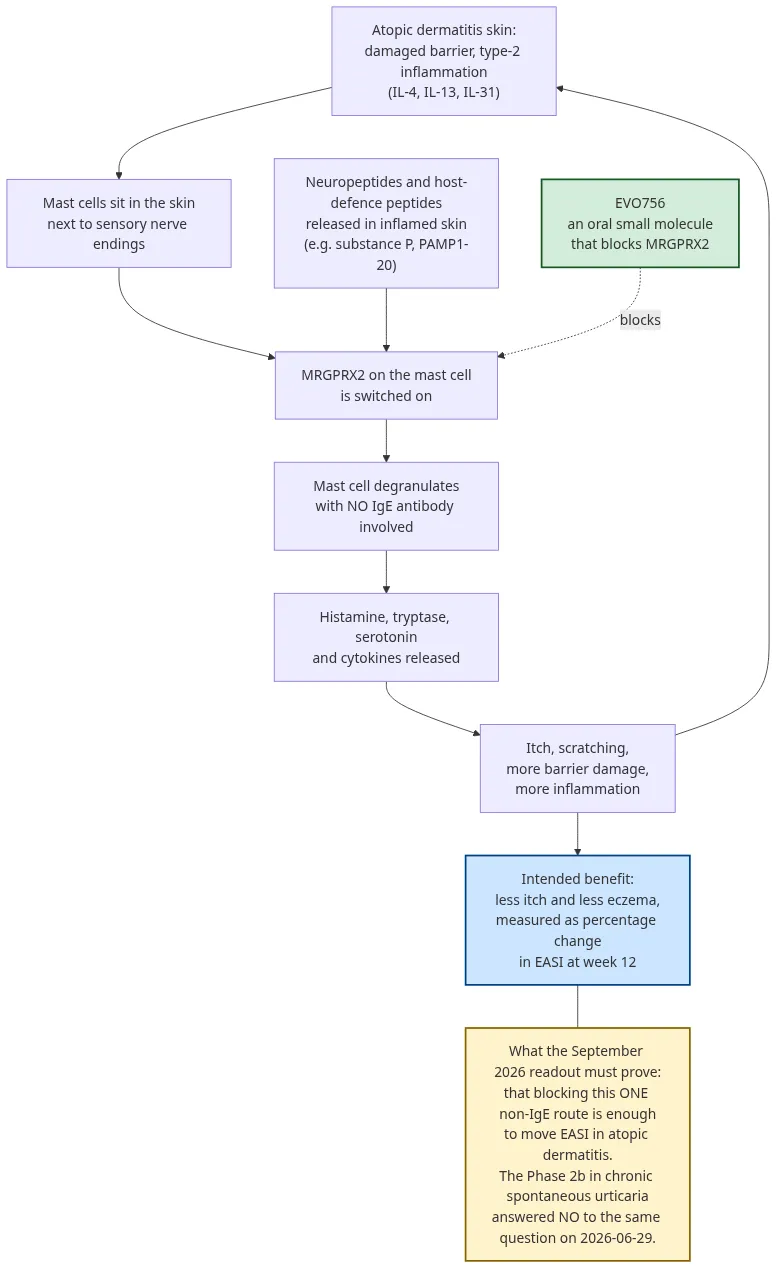
How well the target is validated — and what kind of validation it is. Strongly, but almost entirely in the laboratory and in animals, and almost none of it in atopic dermatitis in people.
- MRGPRX2’s structure has been solved and potent antagonists designed against it by an independent
academic group
[VERIFIED — Cao et al., Nature 2021, [DOI](https://doi.org/10.1038/s41586-021-04126-6). According to PubMed.] - The mouse equivalent of the receptor drives itch that is genuinely independent of histamine and
IgE, and deleting it reduces itch in models of allergic contact dermatitis
[VERIFIED — Meixiong et al., Immunity 2019, [DOI](https://doi.org/10.1016/j.immuni.2019.03.013). According to PubMed.] - A different small-molecule MRGPRX2 antagonist, GE1111, improved eczema-like skin disease in
mice, reduced the relevant inflammatory signals and preserved skin-barrier proteins
[VERIFIED — Wong et al., Front Immunol 2024, [DOI](https://doi.org/10.3389/fimmu.2024.1406438). According to PubMed.]This is the single closest published support for this exact program, and it is a mouse study run by a rival academic group on a rival compound. - The competitor’s own antagonists blocked mast-cell degranulation in human skin tested outside the
body
[VERIFIED — Wollam et al., J Allergy Clin Immunol 2024, [DOI](https://doi.org/10.1016/j.jaci.2024.07.002). According to PubMed. Note: every senior author is an Escient Pharmaceuticals employee — the competitor.] - Open Targets confirms MRGPRX2 as a recognised human target,
ENSG00000183695[VERIFIED — Open Targets search_entities 2026-08-13].
The exact scientific step the next readout must prove. That blocking this one non-IgE mast-cell route produces a statistically significant reduction in the percentage change in EASI at week 12 in moderate-to-severe atopic dermatitis. Not that MRGPRX2 exists, not that EVO756 blocks it, not that mast cells matter in eczema — all three are established. The open question is whether this lever is big enough to move this disease.
The honest scientific risk, stated in full. Two things point the wrong way and they compound.
First, the disease biology is a poor fit for the mechanism’s strongest case. Atopic dermatitis is driven by a defective skin barrier and by type-2 inflammation — interleukin-4, interleukin-13 and interleukin-31. Every approved biologic for the disease targets that axis, and does so successfully. Mast cells contribute to the itch and to the inflammatory tone, but they are not the engine. Chronic spontaneous urticaria is the opposite: it is a mast-cell disease more or less by definition, which is why MRGPRX2 programs are aimed there first.
Second, and decisively, the molecule has already been tested against that stronger case and lost.
The Phase 2b in chronic spontaneous urticaria enrolled 182 patients across 53 sites in four
territories, ran three dose regimens against placebo for twelve weeks, and failed to separate from
placebo on UAS7 at any dose [VERIFIED — Evommune press release 2026-06-29; ClinicalTrials.gov NCT06873516]. The company’s own Chief Medical Officer said the lack of efficacy “does not support
further development of EVO756 for CSU,” while noting that the trial had shown safe, tolerated doses
and demonstrated target engagement [VERIFIED — Evommune press release 2026-06-29, quoted].
Read that carefully, because it narrows the possibilities. The drug reached the target and did nothing useful in the disease where the target’s case is strongest. That leaves three live explanations, and only one of them is good for September:
- The mechanism does not carry enough weight clinically, anywhere. Then AD fails too.
- CSU was the wrong disease — its dominant driver is autoimmune IgE biology, not MRGPRX2, and AD’s neuropeptide-driven itch is genuinely the better target. Then AD can succeed. This is the company’s implicit position and it is not unreasonable, but it was also not the prior anyone held before the CSU result.
- Target coverage was insufficient at the doses tested. The company says target engagement was demonstrated, which argues against this — and the AD trial uses the same molecule, so a coverage problem would not be fixed by changing indication.
There is a fourth consideration that is not about biology at all. This trial randomises 120 patients across four arms — about 30 per arm. That is small for EASI percentage change, where placebo responses in atopic dermatitis routinely run 20–35%. A trial that size can only detect a large effect. A real but modest benefit would very likely miss. This is a design risk sitting on top of the biological one, and it points the same way.
A.2 Clinical development plan, timeline, feasibility, resourcing
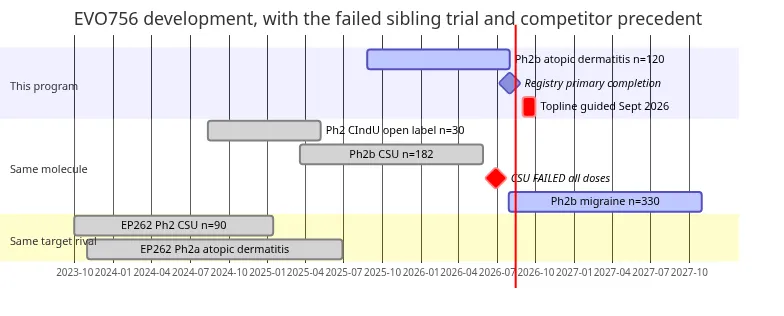
Trials
| Trial | Sponsor / whose drug | Design (arms, blinding, n) | Population | Status / key result | Link |
|---|---|---|---|---|---|
| NCT07150845 — the pivotal trial for this program. Phase 2b. | Evommune / EVO756 | Randomised, double-blind, placebo-controlled, dose-ranging. Four arms: three EVO756 dose regimens and placebo. n=120, 29 sites (24 United States, 5 New Zealand). | Adults 18+, chronic AD for ≥6 months, vIGA-AD ≥3, EASI ≥16, ≥10% body surface area affected. | ACTIVE, NOT RECRUITING — fully enrolled. Started 2025-08-26. Registry primary completion 2026-07. Topline guided to September 2026. Primary endpoint: percentage change in EASI from baseline at week 12. | NCT07150845 |
| NCT06873516 — the failed sibling. Phase 2b. | Evommune / EVO756 | Randomised, double-blind, placebo-controlled, dose-ranging. Four arms: three EVO756 dose regimens and placebo. n=182, 53 sites (US, Canada, Japan). | Adults with CSU ≥3 months inadequately responsive to H1-antihistamines, UAS7 ≥16. | COMPLETED and FAILED. Started 2025-03-20, primary completion 2026-05-29. Missed the primary endpoint — mean change in UAS7 at week 12 — at every dose. Indication discontinued 2026-06-29. | NCT06873516 |
| NCT06603220 — the supportive data. Phase 2. | Evommune / EVO756 | Open-label, no placebo, no randomisation. Two dose regimens (300 mg once daily; 50 mg twice daily). n=30, 18 sites. | Adults with chronic inducible urticaria. | COMPLETED 2025-05-08. Reported positive; full data presented as a late-breaker at the EADV 2025 congress. An uncontrolled study of 30 patients is weak evidence and is treated as such throughout this document. | NCT06603220 |
| NCT07616128 — the next EVO756 bet. Phase 2b. | Evommune / EVO756 | Randomised, double-blind, placebo-controlled. Three arms: two EVO756 doses and placebo. n=330, 20 sites. | Adults with refractory migraine (≥6 monthly migraine days). Primary measure: change in monthly migraine days over 12 weeks. | RECRUITING. First patient dosed 2026-07-29. Primary completion 2027-10. Topline guided to 2027. | NCT07616128 |
| Comparator, for the mechanism: EP262 Phase 2 (CALM-CSU) and Phase 2a (EASE) in AD. | Escient Pharmaceuticals, then Incyte / EP262 (INCB000262) | Randomised, double-blind, placebo-controlled. n≈90 in CSU. | CSU and, separately, atopic dermatitis. | See B.1. Enrolment in the key CSU trial was paused by Incyte over in vivo preclinical toxicology findings, and the program has been reported as halted on safety grounds [WEB ESTIMATE — Fierce Biotech via search summary, 2026-08-13; the article itself returned HTTP 403 and could not be read directly, so this is recorded as an estimate and not as verified]. | NCT06077773 |
Feasibility matrix
| Factor | High probability | Medium probability | Low probability | This asset (assessment) | Source |
|---|---|---|---|---|---|
| Recruitment feasibility | >50 sites, 3:1 patient:site | 20–50 sites, established investigators | <20 sites, novel sites | Already resolved — HIGH, and no longer a risk. 29 sites for 120 patients (4.1:1) and the trial is fully enrolled. Recruitment risk is behind it; only the result is ahead. | CT.gov NCT07150845 |
| Endpoint clarity | Regulatory precedent exists | Novel endpoint with FDA alignment | Unvalidated surrogate | HIGH. EASI is the standard atopic-dermatitis efficacy measure and underpins every approval in the disease. There is no argument to be had about whether the yardstick is the right one. | CT.gov NCT07150845; A.5 endpoints |
| Trial-design robustness | Pivotal Phase III with SPA | Adaptive with interim analysis | Single-arm, no control | MEDIUM, and the weakest row here. Randomised, double-blind and placebo-controlled — genuinely robust in kind. But n=120 across four arms is about 30 per arm, which is small against typical AD placebo responses. Well designed, and underpowered for anything but a large effect. | CT.gov NCT07150845 |
| Operational / execution | Enrollment complete, standard timeline | Some timeline risk | Enrollment behind | HIGH. Enrolment complete, and the guided date has tightened rather than slipped — see Readout, Date slippage: “H2 2026” → “Q3 2026” → “September 2026”, zero slips. | BPIQ note field; company releases |
Resourcing sufficiency. Not a constraint on this readout, and not a constraint on the next
decision either. The company holds $288.0M of cash, equivalents and investments and says it has
“cash through 2028” (../company.md C.3). The trial is fully enrolled and the
database is closing. Every cost between here and the September readout is already sunk. Whether the
company can fund a Phase 3 in atopic dermatitis alone is a different and much harder question,
answered in B.3b: probably not, without either a partner or a raise.
A.3 Target label, target product profile, strategic questions, designations
A.3a Target label. An oral treatment for adults with moderate-to-severe atopic dermatitis whose disease is not adequately controlled by topical therapies.
A.3b Target product profile
| Attribute | Standard of care & key competitor(s) — data | EVO756 target profile (goal) | Supporting evidence (+ link) |
|---|---|---|---|
| Indication / target label | Dupilumab (injected, anti-IL-4Rα) is the anchor of care; lebrikizumab, tralokinumab and nemolizumab follow; upadacitinib and abrocitinib are the approved orals. All are for moderate-to-severe AD after topicals fail. | Same population, positioned as an oral option that is neither a biologic injection nor an immunosuppressant. | B.0 treatment algorithm |
| Efficacy (endpoints, regimen) | The bar is high and set by trial data, not by opinion. Dupilumab Phase 2b: mean EASI improvement 74% at the highest dose versus 18% for placebo at week 16. Lebrikizumab Phase 2 week 12: EASI-75 in 54.9% versus 34.0% placebo. [WEB ESTIMATE — Regeneron/Sanofi Phase 2b release and lebrikizumab Phase 2 data via search, 2026-08-13] | Oral, once or twice daily. A statistically significant separation from placebo on EASI percentage change at week 12 — the goal at this stage is separation, not parity with dupilumab. | A.5 endpoints; CT.gov NCT07150845 |
| Safety / tolerability | Dupilumab: clean, with conjunctivitis the main issue. The oral JAK inhibitors carry boxed warnings for serious infection, mortality, malignancy, major cardiovascular events and thrombosis — the single biggest weakness in the oral segment today. | This is EVO756’s clearest genuine advantage. Three completed human trials with no reported safety signal; the CSU release states the trial “confirmed safe and well tolerated doses that warrant these further studies.” A non-immunosuppressive oral with no boxed warning would be differentiated on safety even at modest efficacy. | Evommune press release 2026-06-29, quoted |
| Biomarker / companion diagnostic | None used in AD. Treatment is by clinical severity. | None planned or needed. A weakness in a different sense: with no biomarker to enrich for MRGPRX2-driven patients, the trial cannot rescue a diluted signal by selecting a responder subgroup. | CT.gov NCT07150845 eligibility criteria — no biomarker inclusion |
| Formulation / administration | Injection every two weeks (biologics) or a daily pill (JAKs). | Oral. Oral formulations command roughly 15–25% price premiums over injectables as a general calibration, and the oral segment is the fastest-growing route in this market [WEB ESTIMATE — Grand View Research / Precedence Research via search, 2026-08-13]. | B.2 |
| Payer value | Biologics are expensive and prior-authorisation heavy; the orals are cheaper to administer but carry the boxed-warning burden. | A safe oral could sit ahead of JAK inhibitors in sequence rather than behind biologics — but only if the efficacy is real. Payer value is entirely contingent on the September result. | B.0, B.2 |
A.3c Strategic Go/No-Go questions. The asset’s next decision, if this readout is positive, is whether to run a registrational Phase 3, so the pre-Phase-III set is the one filled.
| Group | Question | Answer (tagged) |
|---|---|---|
| Target | Target revalidated as in prior phases? | No — the opposite happened, and this is the central finding of this analysis. The one completed placebo-controlled human test of this target, in the disease with the strongest mast-cell rationale, failed at every dose (NCT06873516). Preclinical validation remains strong [VERIFIED — Cao et al. Nature 2021, Meixiong et al. Immunity 2019, Wong et al. Front Immunol 2024. According to PubMed.], but preclinical validation is what existed before the failure too. |
| Dose & Drug | Exposure–response for the intended commercial regimen and route(s)? | Not established in atopic dermatitis — that is precisely what this dose-ranging trial exists to produce. Three regimens are being tested against placebo. [UNVERIFIED — no exposure-response data for EVO756 in AD is public] |
| Dose & Drug | Commercial formulation available or feasible? | Yes. An oral small molecule already dosed in four trials including one of 182 patients across four territories. [VERIFIED — CT.gov NCT06873516, NCT07150845] |
| Dose & Drug | Dose range compatible with clinical and non-clinical safety? | Yes, and this is the strongest answer in the table. The failed CSU trial nonetheless “confirmed safe and well tolerated doses that warrant these further studies” [VERIFIED — Evommune press release 2026-06-29, quoted]. Worth contrasting with the competitor: Incyte paused EP262 over preclinical toxicology findings [WEB ESTIMATE — search summary, 2026-08-13], so on the safety axis EVO756 is currently the better-placed molecule in its class. |
| Dose & Drug | Therapeutic window given the clinical response? | Unknown, and it is the wrong shape of unknown. The window looks wide on the safety side and unproven on the efficacy side. A drug with no ceiling from toxicity and no demonstrated floor of efficacy has an undefined window, not a favourable one. [UNVERIFIED] |
| Dose & Drug | Intrinsic and extrinsic factors influencing exposure and patient response? | Not established publicly. No published pharmacokinetic data on EVO756 exists — PubMed returns no primary publication on the molecule at all (see A.5). [UNVERIFIED] |
| Patient | Proof of concept and positive benefit/risk in the intended population? Combination evidence? | No — this readout IS the proof of concept in this population. The only positive human efficacy data on EVO756 is the open-label, uncontrolled, n=30 CIndU study, which is a different disease and a design that cannot separate drug effect from placebo effect. No combination work. [VERIFIED — CT.gov NCT06603220 lists no control arm] |
| Patient | Phase III design and outcome criteria — accepted, compelling, competitive for market access? | The criteria are accepted; whether they are competitive is the open question. EASI-75 and vIGA 0/1 at week 16 are the settled regulatory package in AD, so a Phase 3 design would be uncontroversial. Being competitive means landing near dupilumab’s efficacy, which nothing in the record suggests EVO756 will do. [UNVERIFIED — modelled] |
| Patient | Rationale for the patient population(s)? | Sound and conventional. vIGA-AD ≥3, EASI ≥16, ≥10% body surface area is the standard moderate-to-severe enrolment gate used across the disease, which makes the result comparable to precedent. [VERIFIED — CT.gov NCT07150845] |
| Patient | Likelihood of the expected outcome? | Modelled at 30%, band 20–45%. See the Locked prediction. [UNVERIFIED — modelled] |
| Patient | Companion-diagnostic strategy, including pricing and market? | None, and none planned. See A.3b — the absence removes any route to rescue a diluted signal through patient selection. [VERIFIED — CT.gov NCT07150845 eligibility criteria carry no biomarker requirement] |
A.3d Regulatory designations. None disclosed for EVO756 in atopic dermatitis. No Fast Track,
Breakthrough Therapy, Orphan Drug or other designation appears in the company’s press feed, in the
trial registry, or in any source this sweep reached [VERIFIED — search of BPIQ fetch_company_press_releases 2026-08-13 (141 items) and ClinicalTrials.gov NCT07150845 found none].
This is unsurprising rather than alarming: atopic dermatitis is a large, well-served indication, so
none of the expedited routes would be expected to apply.
A.4 Target product profile valuation matrix
| Stakeholder | Value driver | Minimum threshold | Competitive | Premium | Benchmark / source |
|---|---|---|---|---|---|
| Patient / caregiver | Less itch, clearer skin, no injection, no immunosuppression | A statistically significant EASI improvement over placebo, and a tolerable pill | EASI-75 in 40%+ at week 16, itch relief within 2–4 weeks | EASI-75 approaching dupilumab’s level with no boxed warning and no injection | Dupilumab Phase 3 and the JAK labels [WEB ESTIMATE — via search, 2026-08-13] |
| Regulator | Replicated, clinically meaningful benefit against placebo | Two adequate, well-controlled Phase 3 trials on EASI-75 and vIGA 0/1 | Consistent effect across doses and geographies | A safety profile that avoids the JAK class warnings entirely | The settled AD approval package |
| Payer / HTA | Cost per responder against existing options | Cheaper per responder than a biologic, or safer than a JAK at similar cost | Oral convenience plus a clean label, placed before JAKs in sequence | Displaces a biologic in a meaningful share of patients | B.2 reimbursement row |
| Provider | A simple option for patients who refuse injections or cannot take immunosuppressants | Works well enough to be worth trying before escalating | No monitoring bloodwork required | A genuinely new mechanism to reach for after type-2 blockade fails | B.0 |
Calibration examples, not asset claims: in oncology each incremental month of overall survival is worth roughly $150–300M in peak-sales potential; oral formulations command roughly 15–25% price premiums over injectables.
The honest read of this matrix. EVO756’s plausible path to value runs through the safety and convenience rows, not the efficacy row. Nothing in the evidence base suggests it will match dupilumab on skin clearance. What it could offer is a pill with no boxed warning and no injection — which is worth real money, but only once the efficacy row clears its minimum threshold. Everything above the minimum-threshold column is currently unearned.
A.5 Evidence quality and endpoints
| Criterion | Score (High / Medium / Low) | Basis (one line) | Link |
|---|---|---|---|
| Target validation | Medium — and falling, not rising | Strong, independent preclinical and structural validation; contradicted by the only completed placebo-controlled human test of the target, which failed. Preclinical strength cannot outrank a negative human trial. | Nature 2021 · Immunity 2019 · CT.gov NCT06873516 |
| Mechanism clarity | High | The receptor is structurally solved, its ligands are catalogued, and the pathway from MRGPRX2 to non-IgE degranulation to non-histaminergic itch is well described. There is no ambiguity about what the drug does — only about whether it matters. | Nature 2021 · J Allergy Clin Immunol 2021 |
| Biomarker availability | Low | No biomarker exists to identify MRGPRX2-driven patients, none is used in this trial, and none is planned. No route to enrich a diluted signal. | CT.gov NCT07150845 |
| Publication quality (peer-reviewed? independent authors?) | Low — and this is a specific, checkable finding, not an impression | There is no peer-reviewed publication of EVO756 clinical data at all. A PubMed search for EVO756 returns exactly two records: a 2026 review of MRGPRX2 in chronic urticaria that does not report EVO756 data, and a 2009 paper on hybrid speciation in butterflies that matches only because its publisher item identifier is literally the string EVO756 — the documented PubMed short-code collision, caught here in its purest form. Every efficacy and safety claim about this molecule traces to a company press release. The independent literature that does exist is about the target, not the drug, and its most relevant paper is from a group developing a rival compound. | PubMed search EVO756, 2 hits, 2026-08-13 · false hit DOI |
| Clinical / expert sentiment | — | Moved to A.5b, below. | — |
Endpoints
| Endpoint (full name) | What it measures | Scale / range | Better direction | MCID / note |
|---|---|---|---|---|
| Eczema Area and Severity Index (EASI) — percentage change from baseline at week 12. THE PRIMARY ENDPOINT. | Redness, thickness, scratch marks and skin thickening, scored across head/neck, trunk, upper limbs and lower limbs, each weighted by the area affected. | 0–72 | Lower is better | An absolute reduction of about 6.6 points is the commonly cited minimal clinically important difference. Note the endpoint here is percentage change, not absolute — which flatters a trial that enrolled severe patients and is the standard Phase 2 dose-ranging measure. [VERIFIED — CT.gov NCT07150845 primary outcome] |
| EASI-50 / EASI-75 / EASI-90 (secondary) | The proportion of patients whose EASI has fallen by at least 50%, 75% or 90%. | 0–100% of patients | Higher is better | EASI-75 is the regulatory responder definition and is what a Phase 3 would be built on. Measured at weeks 2, 4, 8 and 12. |
| validated Investigator’s Global Assessment for AD (vIGA-AD) (secondary) | A single physician judgement of overall severity. | 0–4 (0 clear, 4 severe) | Lower is better | The co-primary in registrational AD trials is usually “vIGA 0 or 1 with at least a 2-point reduction”. Entry required ≥3. |
| Pruritus Numerical Rating Scale (secondary) | The patient’s own worst itch over the last 24 hours. | 0–10 | Lower is better | A ≥4-point reduction is the accepted responder threshold. Watch this one closely: if MRGPRX2 blockade does anything in AD, itch is where it should show up first, because non-histaminergic itch is the mechanism’s best-established function. |
| Body Surface Area affected (secondary) | The percentage of the body showing AD. | 0–100% | Lower is better | Entry required ≥10%. |
| Treatment-emergent and serious adverse events (secondary) | Safety, through week 14. | Counts | Fewer is better | The axis on which EVO756 has consistently performed well. |
| Comparator, for the failed trial: Urticaria Activity Score over 7 days (UAS7), mean change at week 12 | Daily itch severity plus hive count, summed over a week. | 0–42 | Lower is better | UAS7 ≤6 is “well controlled”. This is the endpoint EVO756 missed at every dose on 2026-06-29. [VERIFIED — CT.gov NCT06873516 primary outcome; Evommune press release 2026-06-29] |
A.5b Key opinion leaders.
Panel as of. 2026-08-13.
Investigators
No investigators were returned, and the absence is itself sourced rather than assumed. CT.gov
search_investigators returned {"count": 0, "trials_analyzed": 0, "investigators": []}, and
get_trial_details on NCT07150845 confirms it: the record lists 29 sites — mostly private
dermatology research practices such as Saguaro Dermatology, Skin Care Research and Metropolis
Dermatology — with no overall officials and no site contacts named. This is normal for a
commercially run dermatology Phase 2 at private research sites, and it means there is no named
principal investigator on this program to assess.
| Name | Role / affiliation | Trial (NCT) | Conflicts (party, kind, disclosed in, as of) | Conflicts checked (source, date) | Source | Tag |
|---|---|---|---|---|---|---|
| (none returned) | — | NCT07150845 | — | CT.gov search_investigators and get_trial_details, 2026-08-13 | ClinicalTrials.gov | [VERIFIED — CT.gov, empty result] |
Independent voices
No qualifying independent voice was found, and the search that failed to find one is on record. The MRGPRX2 field has plenty of named, published commentators, and every one this sweep identified was disqualified for a stated reason:
- Joshua Wollam, Veena Viswanath, Marcus Boehm and colleagues — the most directly relevant
clinical-stage commentary on MRGPRX2 antagonism, but all are Escient Pharmaceuticals
employees, i.e. the direct competitor
[VERIFIED — author affiliations, J Allergy Clin Immunol 2024, [DOI](https://doi.org/10.1016/j.jaci.2024.07.002). According to PubMed.] - Martin Metz and Stefan Frischbutter (Charité, Berlin) and Nicolas Gaudenzio (Toulouse;
also Genoskin SAS) — academic co-authors on that same competitor-sponsored paper, so they carry
a disclosed relationship with a rival sponsor
[VERIFIED — same paper. According to PubMed.] - Mukesh Kumar, Billy K C Chow and colleagues (University of Hong Kong) — authors of the
closest published support for MRGPRX2 blockade in atopic dermatitis, and they hold no disclosed
relationship with Evommune. They are excluded on a different ground: they are developing their
own MRGPRX2 antagonist, GE1111, which is a competing academic interest, and their commentary is
on mouse data rather than on this program’s clinical endpoint
[VERIFIED — Front Immunol 2024, [DOI](https://doi.org/10.3389/fimmu.2024.1406438). According to PubMed.] - Bryan L Roth, Xinzhong Dong, Brian S Kim, Hydar Ali — leading independent academics on the target, none of whom has commented on this program or on this endpoint at all.
Recording an empty table rather than promoting one of these people to “independent” is the point of the exercise. The absence of a disclosure is not evidence of no conflict, and a commentator on the target is not a commentator on this program’s endpoint.
| Name | Affiliation | View (close enough to quote) | As of | Conflicts checked (source, date) | Source | Tag |
|---|---|---|---|---|---|---|
| (none qualifying — see the prose above) | — | — | — | PubMed get_article_metadata on 8 articles, author affiliations read in full, 2026-08-13 | PubMed | [VERIFIED — search performed, no qualifying voice found] |
Judgement
| Endpoint supported | Basis (one or two sentences) | Tag |
|---|---|---|
| UNKNOWN | No independent voice free of a relationship with a sponsor in this class has commented on whether MRGPRX2 blockade will move EASI in atopic dermatitis, so there is no independent view to weigh. The one piece of directly supportive published work is a mouse study from a group with its own competing compound, which is not nothing but is not an independent endorsement of this endpoint either. | [UNVERIFIED — judgement over an empty independent panel] |
Dissent
(Empty. Endpoint supported is UNKNOWN rather than SUPPORTIVE_CONTESTED, so no dissent row is
owed, and inventing a disagreement nobody has voiced would be worse than an empty table.)
| Name | View (close enough to quote) | Source |
|---|---|---|
| — | — | — |
B. Commercial assessment
B.0 Current treatment algorithm
What an adult with moderate-to-severe atopic dermatitis receives today, in order:
- Emollients and topical corticosteroids. Moisturisers plus steroid creams. Most patients never go further. Topical calcineurin inhibitors and topical JAK inhibitors sit alongside.
- Phototherapy, where it is available and the patient can attend.
- Biologic injections — the current anchor of care. Dupilumab, which blocks the shared receptor for interleukin-4 and interleukin-13, is the dominant agent. Tralokinumab and lebrikizumab block interleukin-13; nemolizumab blocks interleukin-31, the itch cytokine.
- Oral JAK inhibitors. Upadacitinib and abrocitinib. Highly effective and fast, and carrying boxed warnings for serious infection, mortality, malignancy, major cardiovascular events and thrombosis. Many patients and prescribers avoid them for exactly that reason.
- Older systemic immunosuppressants — ciclosporin, methotrexate — still used where access to the above is limited.
Where EVO756 would fit. As an oral option at step 4, positioned ahead of the JAK inhibitors on safety rather than behind the biologics on efficacy. That placement only works if it is meaningfully effective; a weak oral in a market with dupilumab in it has no natural home. It is additive rather than displacing at first — a thing to try before escalating to an injection or a JAK.
B.1 Competitive landscape and positioning
| Metric | High value | Medium value | Low value | This asset (assessment) | Source |
|---|---|---|---|---|---|
| Mechanism differentiation | First-in-class or novel target | Next-generation improvement | Me-too | HIGH — genuinely first-in-class, and now nearly unopposed. MRGPRX2 blockade is mechanistically unlike anything approved in AD. Only one other oral MRGPRX2 antagonist ever reached the clinic (EP262/INCB000262), and Incyte paused it over preclinical toxicology findings. Note the double edge: being alone in a class means no competitor has validated it either. | Search, 2026-08-13; PubMed |
| Development-timeline advantage | >12 months ahead | Within 6–12 months | Lagging >12 months | HIGH. With EP262 paused, EVO756 is effectively the only oral MRGPRX2 antagonist in active clinical development in atopic dermatitis, and it reads out in weeks. | Search, 2026-08-13 |
| Clinical proof-of-concept evidence | Positive Phase IIb (n>100) | Phase IIa signals (n=20–50) | Preclinical only | LOW, and this row is the thesis. In atopic dermatitis specifically there is no human efficacy evidence for EVO756 — not Phase 2a, not a signal, nothing. The only completed placebo-controlled Phase 2b on this molecule, in a different disease, failed. The only positive human data is an open-label n=30 study in a third disease. | CT.gov NCT06873516, NCT06603220 |
| IP protection | Composition-of-matter, long-dated | Method-of-use | Pending or none | MEDIUM, with a real gap in what was verifiable. EVO756 is in-licensed, not owned: Evommune took an exclusive worldwide licence from Dermira in December 2020 (Dermira was acquired by Eli Lilly in 2020). The specific composition-of-matter patent numbers and expiry dates could not be established this sweep and are recorded as a gap rather than guessed. | Search of S-1 disclosures, 2026-08-13 |
Where this asset wins, and the single fact the thesis rests on.
It wins on being alone. First-in-class mechanism, no clinical competitor left standing in the class, a clean safety record across three human trials, and an oral route into a market whose fastest- growing segment is oral. If EVO756 works even moderately in atopic dermatitis, it has a market largely to itself in a way very few Phase 2b assets do.
The single fact the thesis rests on is not any of that. It is whether blocking MRGPRX2 does enough, in a disease where mast cells are a contributor rather than the driver, to move EASI — after the same molecule failed to do so in the disease where mast cells are the driver. Every competitive advantage listed above is worth nothing if that answer is no, and every one of them is worth a great deal if it is yes. That is what makes this a genuinely binary event rather than a gradual re-rating.
Calibration example, not an asset claim: oncology first-movers in novel mechanisms have shown roughly 3.2× higher peak-sales potential but about 1.8× higher development risk. Both halves apply here, and the second half is the one currently being tested.
One more competitive note that cuts the other way. Incyte paid roughly $750M for Escient in
April 2024 substantially for this target class [WEB ESTIMATE — Incyte investor release via search, 2026-08-13]. That is evidence a large, sophisticated buyer believed in MRGPRX2 blockade. It is also
now evidence of how that bet has gone: the lead asset is paused on toxicology and there has been no
positive clinical validation of the class from either sponsor.
B.2 Addressable market
Launch markets: the United States and the EU5. Japan, Greater China and several other Asian countries are already out-licensed to Maruho and are not Evommune’s to sell (see B.3b), so they are excluded from every figure below. Ignoring that exclusion would overstate the opportunity by a large margin, which is why it is stated here rather than buried.
| Component | How it is estimated | Premium threshold | This asset (assessment) | Source |
|---|---|---|---|---|
| Drug-treated patients | Epidemiology × diagnosis rate × treatment rate | >100,000 (US/EU5/Japan) | Threshold cleared comfortably. The systemically treated moderate-to-severe adult AD population in the US and EU5 is on the order of 600,000–900,000 patients [UNVERIFIED — modelled from published prevalence and systemic-treatment rates; the sweep found no single verifiable figure for this exact population, so a range is given rather than a point]. The broader eligible pool is several million. | Modelled; B.3a |
| Market exclusivity | Patent term + regulatory exclusivity | >10 years combined | Could not be established. The composition-of-matter patent term for EVO756 was not found in any source this sweep reached. Recorded as a gap. Note what this does not affect: the September readout is unaffected by patent life, so nothing in the prediction depends on this hole. | Gap — see B.1 IP row |
| Reimbursement precedent | Approvals in ≥2 major markets | Positive NICE/CADTH guidance | Excellent precedent, for the disease. Dupilumab, tralokinumab, lebrikizumab, upadacitinib and abrocitinib are all reimbursed across major markets for this exact population, so the reimbursement pathway is well trodden and the payer questions are known. Nothing precedent-setting would be required. | B.0 |
| Patient-journey impact | Fewer hospital days, less caregiver burden | >30% quality-of-life gain | Plausible but unquantified for this asset. Atopic dermatitis carries a heavy sleep, mood and productivity burden, and itch relief is what patients rank highest. Whether EVO756 delivers it is the readout’s question; the trial measures it as the pruritus NRS secondary. | A.5 endpoints |
The overall market is large and growing: roughly $29–30 billion globally by 2030 across several
independent forecasts, with the oral route the fastest-growing segment [WEB ESTIMATE — Grand View Research, Precedence Research and Spherical Insights via search, 2026-08-13. Market-sizing reports of this kind are consistent with each other partly because they cite each other; treated as an order of magnitude, not a figure.]
B.3 Value and feasibility
B.3a Expected peak sales. Built bottom-up as eligible patients × annual net price × peak penetration. Every figure below is conditional on approval, excludes Japan and Greater Asia (out-licensed to Maruho), and excludes the migraine indication entirely.
The base of the calculation is the systemically treated moderate-to-severe adult AD population in
the US and EU5, taken as 750,000 patients [UNVERIFIED — modelled, the midpoint of the 600,000–900,000 range in B.2]. Net price is taken at $18,000–25,000 a year, below the
oral JAK inhibitors’ list prices to reflect gross-to-net and a positioning that competes on safety
rather than on efficacy [UNVERIFIED — modelled; no net price for any AD oral was verifiable this sweep].
| Scenario | Assumptions (patients × price × share) | Estimate (USD/year at peak) | Basis / tag |
|---|---|---|---|
| Low | 750,000 × $18,000 × 1% peak share | ~$135M | Efficacy clears statistical significance but lands well below the biologics; use is confined to patients who refuse both injections and JAK inhibitors. [UNVERIFIED — modelled] |
| Base | 750,000 × $22,000 × 2.5% peak share | ~$410M | A safe oral with real but modest efficacy, placed ahead of JAK inhibitors for the safety-averse and after biologics for everyone else. [UNVERIFIED — modelled] |
| High | 750,000 × $25,000 × 5% peak share | ~$940M | Efficacy strong enough to compete with the oral JAK inhibitors head-on, where the clean label becomes a decisive advantage. [UNVERIFIED — modelled] |
Which input is weakest, named explicitly: peak penetration. The patient base and the price are both anchored to observable market structure and vary by less than a factor of two across the scenarios. Penetration varies by five times and rests entirely on an efficacy result that does not yet exist. A reader who disagrees with this table should disagree with the share column.
What this is worth against the company. Enterprise value is about $229M
(../company.md C.4). The base case is roughly 1.8× enterprise value in annual
peak sales, and the high case roughly 4×. That is a genuinely attractive ratio — and it is the ratio
you would expect on an asset the market has assigned a low probability of working.
B.3b Feasibility
| Question | Answer (tagged) |
|---|---|
| Expected net present value (eNPV) | No point estimate is given, and none is defensible. Two of the three required inputs are unverified: the probability of technical success past this readout, and peak penetration (above). A range with its assumptions stated: taking the modelled 30% probability of a positive Phase 2b, a further 40–55% chance of surviving Phase 3 and approval given a positive Phase 2b [UNVERIFIED — modelled from general Phase 2b-to-approval base rates in dermatology, not from a benchmark specific to this mechanism], and the $135M–$940M peak range discounted for time and launch costs, risk-adjusted value sits somewhere in the low hundreds of millions — i.e. of the same order as the current enterprise value, with an enormous band around it. The honest summary is that the market is pricing this asset roughly where a coin-weighted-against-you bet on a large market belongs. |
| Capital to the next decision point | Effectively zero. The trial is fully enrolled, the database is closing, and the readout is weeks away. Every dollar to this decision point is already spent. |
| Capital to approval, and the funding plan | Well beyond current resources for this indication alone. Two registrational Phase 3 trials in moderate-to-severe AD, at the scale the approved competitors ran, is a multi-hundred-million-dollar program over several years. Against $288.0M of cash that must also fund the Phase 2b migraine trial (n=330) and EVO301’s Phase 2b from mid-2027, a positive readout would be followed by a raise, a partnership, or both. That is a real dilution risk on the good outcome and it is factored into the positive scenario range. |
| Launch capability — alone, or must partner? | Must partner, or build from nothing. Evommune has no commercial organisation. Dermatology is one of the more approachable specialties to launch into — a concentrated prescriber base — but a first-in-class oral competing against Sanofi/Regeneron and AbbVie would need a partner with weight. |
| Commercialisation rights — retained, split, or out-licensed? | Split, and the split matters. Evommune holds an exclusive worldwide licence to EVO756 from Dermira, agreed December 2020 (Dermira was acquired by Eli Lilly in 2020), so the asset is in-licensed and carries an upstream royalty obligation whose rate was not verifiable this sweep. Evommune has then out-licensed Japan to Maruho (September 2023; up to $60.0M in upfront and milestone payments plus royalties on Japanese sales; $18.0M received through 2025-12-31) and Greater China and certain other Asian countries to Maruho (March 2024; up to $61.5M; $7.0M received through 2025-12-31) [WEB ESTIMATE — Evommune S-1 disclosures and Maruho collaboration releases via search, 2026-08-13]. The US and Europe are retained, which is where all the value in B.3a sits. |
B.4 Product-development risk
Framing questions.
- Does the development plan support the target product profile claims? Partly. The trial is well designed in kind — randomised, double-blind, placebo-controlled, dose-ranging, on the standard endpoint in the standard population — so a positive result would genuinely support the efficacy claim. It does not support the claims that matter most commercially, because at n≈30 per arm it cannot reliably characterise the dose-response the Phase 3 would need, and it runs only to week 12 when the registrational timepoint is week 16.
- Will the identified risks affect the target product profile? The dominant risk — that the mechanism does not carry enough clinical weight — does not affect the profile, it deletes it. There is no version of EVO756 in atopic dermatitis that survives a second failed Phase 2b. The secondary risk, underpowering, threatens a different failure: a real but modest drug being discarded on a trial too small to see it.
- If a risk cannot be mitigated, is the asset still differentiated from competitors? On safety and on mechanism, yes — and uniquely so, with the only rival paused on toxicology. But differentiation without demonstrated efficacy is not a commercial asset. The migraine program and EVO301 are what would remain.
| Category | Time risk | Quality risk | Cost risk | Note |
|---|---|---|---|---|
| Project management | Low | Low | Low | Enrolment complete, guidance tightened rather than slipped across three updates. Zero date slips. |
| Research | High | The central risk. The target’s clinical relevance is unproven in humans and was contradicted in the one disease that tested it. | ||
| IP | Medium | Medium | In-licensed from Dermira with an unverified upstream royalty; composition-of-matter term not established. | |
| Legal | Low | Nothing found. Two clean Maruho collaborations; no litigation in the filing feed. | ||
| DMPK | Medium | No published pharmacokinetic data on EVO756 exists. The company reports demonstrated target engagement, which is reassuring but is not a substitute. | ||
| Safety pharmacology | Low | Clean across three completed human trials. | ||
| Toxicology | Low | Notably clean, and the contrast is informative: the competing MRGPRX2 antagonist was paused over preclinical toxicology findings while EVO756 has none reported across 330+ dosed patients. Whatever is wrong with this program, it is not this. | ||
| Drug safety (clinical) | Low | The CSU release states the trial “confirmed safe and well tolerated doses”. No treatment-related deaths, no clinical hold, no manufacturing hold — none of the near-veto factors is present. | ||
| Biomarker | High | No biomarker exists, none is used, and none is planned. No route to identify responders or rescue a diluted signal. | ||
| Clinical pharmacology | Medium | Dose selection for AD rests on doses that did not work in CSU. Whether the right exposure for eczema differs is unknown. | ||
| Clinical (efficacy) | High | n≈30 per arm against typical AD placebo responses of 20–35% on EASI. Underpowered for anything but a large effect. | ||
| Clinical operations | Low | Low | Low | Fully enrolled, 29 sites, database closing. Execution risk is behind the program. |
| CMC / manufacturing | Low | Low | An oral small molecule already supplied to four trials across four territories. | |
| Regulatory | Medium | No designations, so no expedited route. A standard two-trial Phase 3 package would be required. | ||
| Global evidence & value | Medium | Medium | The payer case depends on efficacy that does not yet exist. Precedent for the disease is excellent. | |
| Commercial | High | High | No commercial organisation; Japan and Greater Asia already out-licensed; a partner or a raise required to reach launch. |
Readout
Sources
| Kind | Where it comes from | What it is worth | Value (or null) | Tag | Note |
|---|---|---|---|---|---|
bpiq | fetch_company_drugs — catalyst_date, catalyst_date_text | The current single source. Synthesized from period text on most rows, so alone it is a ceiling, not an estimate. | catalyst_date_text “Q3 2026”; catalyst_date 2026-09-30 | [VERIFIED — BPIQ fetch_company_drugs 2026-08-13, id 20071] | The stored date is a period-end placeholder and is not used for any timing decision (rule 23). Note that BPIQ’s own note field is more current than its catalyst_date_text: it records “08/06/26:- Ph2b AD top-line data expected in September 2026.” |
ctgov | CT.gov get_trial_details — primary_completion_date | Independent of the company’s own messaging, month-precision, and it moves when the trial moves. | 2026-07 (month precision) | [VERIFIED — ClinicalTrials.gov NCT07150845, read 2026-08-13] | Study status ACTIVE, NOT RECRUITING; completion date also 2026-07. The primary endpoint’s own time frame is week 12, and the trial is fully enrolled, so this date is a real constraint rather than an aspiration. |
company | fetch_company_press_releases | The company’s own most recent dated wording. Also where the slip sequence below comes from. | ”The Company expects to report top-line data in September 2026 for the fully-enrolled Phase 2b” | [VERIFIED — Evommune Q2 2026 release, 2026-08-06, quoted verbatim] | Mandatory here and obtained: the catalyst is inside twelve months (rule 32). This is the tightest and most recent statement from any source, and it is what the window below is built on. |
congress | data/congresses.json, only when the company has said it intends to present there | Answers “where will they say it.” | null | [VERIFIED — no source found] | Looked for and not found. The company has form here — it took EVO756 CIndU data to EADV as a late-breaker in September 2025 — but it has made no statement of intent to present these AD data at any named meeting, and matching on therapeutic area alone is a guess rather than a source. Recorded as null with the search on record. |
modelled | Trial arithmetic — see below | The only estimate independent of anyone’s guidance. | 2026-09 to 2026-11 | [UNVERIFIED — modelled, default lag] | See below. |
The modelled estimate. The registry’s primary completion date is 2026-07. Adding the stated
default lag to database lock and analysis of two to four months gives a topline window of
2026-09 to 2026-11. data/benchmarks/readout-lag.json holds no matching entry for a
dermatology Phase 2b, so the default lag is used and the estimate is tagged
[UNVERIFIED — modelled, default lag] rather than benchmarked. The company’s September guidance
sits at the earliest edge of this modelled range, which is a mild caution rather than a
contradiction: guidance at the optimistic end of what the arithmetic allows is guidance with no
slack in it.
Window
| Earliest | Likeliest | Latest | Precision | Confidence |
|---|---|---|---|---|
| 2026-09-01 | 2026-09-15 | 2026-09-30 | MONTH | HIGH |
Basis. The company named a specific month, September 2026, on 2026-08-06, for a trial it describes as fully enrolled, whose registry primary completion has already passed (2026-07). Precision is MONTH because no source names a day — not “Q3 2026”, and not “September 2026” either. Confidence is HIGH because three independent sources agree in direction and the guidance has tightened rather than slipped at every update, which is the pattern of a company that knows its own database-lock date.
Disagreement. CONSISTENT. No source contradicts another. BPIQ’s “Q3 2026” is simply coarser than the company’s “September 2026” and contains it; the registry’s 2026-07 primary completion sits correctly before both; the modelled 2026-09 to 2026-11 range contains the guided month at its early edge. Nothing here needed to be reconciled or chosen between.
Date slippage. Zero slips, and the guidance has tightened at every update. This is a finding in its own right and it is unusual in this corpus.
| As of | Guidance text |
|---|---|
| 2026-03-05 | ”Ph2b AD dose-ranging trial enrolling; topline data expected H2 2026” |
| 2026-05-07 | ”Ph2b AD trial enrollment complete; topline data on track for Q3 2026” |
| 2026-06-29 | ”on track to report top-line Phase 2b data for EVO756 in atopic dermatitis in the third quarter of 2026” — restated on the day of the CSU failure |
| 2026-08-06 | ”Ph2b AD top-line data expected in September 2026” |
H2 2026 → Q3 2026 → September 2026 is a monotonic narrowing across five months, including a restatement on the worst day the company has had. Nothing was pushed out.
Attribution
Status. CLEAN — computed, not authored, by lib/clustering.mjs’s attributionFor over
this ticker’s full pipeline for bpiq_drug_id 20071, with CATALYST_CLUSTER_MIN_MONTHS = 6.
| Status | Means |
|---|---|
CLEAN | conflicts is empty — nothing else has_catalyst on this ticker’s pipeline lands within the window. |
Conflicts
(Empty, exactly as CLEAN requires.)
| bpiq_drug_id | Label | Date | Analysed? | Gap (days) | Confirmed? |
|---|---|---|---|---|---|
| — | — | — | — | — | — |
Why it comes out clean, for a reader who wants to check the arithmetic. Only two rows on this
ticker carry has_catalyst: true: this program (20071) and EVO756 in migraine (20081). This
program contributes its own readout.window of 2026-09-01 to 2026-09-30. The migraine row carries
catalyst_date 2027-12-31 with catalyst_date_text “2027” and catalyst_date_is_exact: false,
so it is widened to a whole half-year, 2027-07-01 to 2027-12-31. The gap between the two windows is
about nine months, comfortably beyond the six-month bar. The other two pipeline rows — EVO301
(19737) and the discontinued CSU program (20079) — both carry has_catalyst: false and contribute
no window at all.
Note. (Not required. CLEAN and INDETERMINATE owe no note, and this is CLEAN.)
Market and timing for this event
- Plain takeaway. The market has already marked this down hard — the shares are 57% below their 52-week high and sit at 16.6% of their 52-week range, having fallen 40% in a session on the sister trial’s failure. Short interest has rebuilt to 12.35% of shares outstanding into the readout, and two insiders bought in the open market below today’s price after the failure. This is a contested, two-sided setup rather than a crowded one.
- Months to this catalyst. 0.6 months to
readout.window.earliest(2026-09-01), and 1.6 months toreadout.window.latest(2026-09-30). Precision is MONTH, so the event is known to within a month but not to a day. - Expected move around this event. Not readable from the options chain, and no point estimate
is offered.
../company.mdC.6 records the chain as unusable: at the $15.00 strike on the 2026-09-18 expiry — the strike nearest the $14.25 spot — both the call and the put are bid $0.00 with zero open interest, so no at-the-money straddle can be constructed at all. The bracket this document works with comes instead from this ticker’s own history (C.7): a positive dermatology Phase 2 readout was worth about +71% in a session, and a failed Phase 2b on this molecule about −40% close to close. - Nearest comparable past reaction. Two rows of
../company.mdC.7 are relevant and they are comparable in different ways, so both are named rather than one chosen. For the downside, 2026-06-29 is the closest analogue of any kind: the same molecule, the same Phase 2b dose-ranging design, a genuinely blind binary, −40.2% close to close. For the upside, 2026-02-10 is closest by disease: a positive placebo-controlled Phase 2 readout in atopic dermatitis on this ticker, +70.9% close to close. The upside analogue is the weaker of the two — it was a different molecule (EVO301), and it landed while the urticaria program was still alive and still the lead story, so the company it re-rated was a different company from today’s. - Materiality. Dominant, near-term, as recorded in
../company.mdC.2. This is the next binary event on the calendar and it is on the lead molecule; after the CSU failure, EVO756’s entire remaining dermatology value rests here. The stock-direction call below is consistent with that in the sense that matters: both scenario ranges are wide and far apart. What keeps the miss scenario off zero is that “dominant” is not “sole” — $288.0M of cash, the migraine program and EVO301’s positive Phase 2a all survive a failure. - Date slippage. Zero slips, and the guidance tightened at every one of four updates (Readout, above). Worth stating plainly because zero is a finding, not an absence of one: this is a company that has told the market the same thing, more precisely each time, including on the day it announced a failure.
Spot. $14.25, the price cache’s close on 2026-08-13, cited from
../company.md C.4. BPIQ’s intraday last price the same day was $14.32. The cache
close is used because a run-up settlement must read the committed cache rather than a fresh fetch,
and entry and settlement measured from two different sources would not be comparable.
Scenario prices
| Scenario | Low | High | Anchors (each named and tagged) | Basis |
|---|---|---|---|---|
| Positive | $21.00 | $30.00 | (1) This ticker’s own past catalyst move: +70.9% close to close on 2026-02-10, the EVO301 positive Phase 2a atopic-dermatitis readout [VERIFIED — data/prices/EVMN.json, $16.99 → $29.03; BPIQ fetch_company_historical_catalysts 2026-08-13]. (2) Published analyst targets, named and dated: consensus 12-month target cut to $30.11 on 2026-08-08; RBC Capital $29 on 2026-08-07; Stifel $54 and Oppenheimer $50, both from before the CSU failure [WEB ESTIMATE — TradingView and Investing.com, 2026-08-07 to 2026-08-08]. (3) The 52-week high, $33.20 [VERIFIED — lib/prices.mjs range52w over data/prices/EVMN.json, as of 2026-08-13]. | A clean positive would restore the case that MRGPRX2 blockade works clinically, revive the migraine program’s read-through, and land on a de-rated, heavily shorted stock. The +47% to +111% range brackets a move of the order the EVO301 readout produced, capped near the post-failure consensus target of $30.11 rather than at the $33.20 high — because a positive Phase 2b still leaves an unfunded Phase 3 and a probable raise, which is a real drag on the good outcome. |
| Miss | $8.50 | $11.00 | (1) Cash per economic share, $7.94 — $288.007M of cash, equivalents and investments divided by the EDGAR-filed 36,292,113 shares [VERIFIED — Evommune Q2 2026 release and EDGAR XBRL, both 2026-08-06; ../company.md C.4]. (2) The 52-week low, $10.47 [VERIFIED — lib/prices.mjs range52w over data/prices/EVMN.json, as of 2026-08-13], and the post-failure trough close of $11.05 on 2026-07-29 [VERIFIED — data/prices/EVMN.json]. (3) This ticker’s own past catalyst move: −40.2% close to close on the 2026-06-29 CSU failure [VERIFIED — data/prices/EVMN.json, $25.18 → $15.05]. | A second Phase 2b failure on the same molecule would effectively end EVO756 in dermatology and cast doubt on the migraine program that shares it. But the fall has less room than the first one did: the stock already trades at 1.36× cash per share, and $288.0M of cash, the migraine trial and EVO301’s positive Phase 2a all survive. The −40% to −23% range breaks the 52-week low without approaching the $7.94 cash floor, which is where a company with two remaining programs and a 2028 runway should find support. |
Expected value. Applying the modelled 30% probability to the midpoint of each range: 0.30 × $25.50 + 0.70 × $9.75 = $14.48, which is +1.6% against the $14.25 spot. Method: the probability applied to the midpoint of each scenario range. This is arithmetic, not advice, and it is not a price target. What it says is worth stating plainly: at a 30% probability, today’s price is very close to fair for the two outcomes described. The market and this analysis disagree about almost nothing on level — the disagreement, if any, would be about the width of the distribution.
Run-up
date_confidence scores 60, well clear of the zero floor that rule 39 would use to withhold this
call, so a run-up call is made.
Entry and exit
| Entry date | Entry price | Entry basis | Exit rule |
|---|---|---|---|
| 2026-08-13 | $14.25 | The prediction’s own lock date and the spot it is measured against, read from the committed price cache so that entry and any later settlement come from the same series. | T-5 trading days before readout.window.earliest (2026-09-01). |
exit is null at lock time and is recorded as such rather than guessed: the price cache ends
2026-08-13 and the window does not open until 2026-09-01, so lib/runup.mjs’s resolveExit has no
trading history to count back from and correctly returns null. It resolves once the cache reaches
the window.
Note the shortness of this trade. Entry to exit is roughly eight trading days. This is not a long accumulation into a distant catalyst; it is a brief position taken because the readout is already almost here. The predicted move is small for exactly that reason.
Predicted move and peak
| Low | High | Estimated date | Basis | |
|---|---|---|---|---|
| Predicted move, entry to exit | +2% | +15% | — | Eight trading days into a dated, well-telegraphed binary on a stock that has already recovered 29% off its post-failure low of $11.05. Anticipation into a known date on a heavily shorted, thin name usually produces a modest positive drift; the low end allows for the drift being essentially absent, which is the honest floor given how short the window is. |
| Predicted peak, from entry | +5% | +20% | 2026-09 | The peak should print in the last days of August or the first days of September as positioning completes and short covering runs ahead of the date, and it may fade before the exit rule fires. It is placed above the move band because the crest can print and be given back inside eight sessions. The month, not a day, matches readout.precision. |
Priority score drivers
Transcribed from lib/runup.mjs’s scoreDriver, not hand-computed.
| Driver | Reads | Score (0–100) | Basis |
|---|---|---|---|
| Unmet-need relevance | README A.4 and B.0 — judgement, no formula | 55 | Moderate-to-severe atopic dermatitis is large, symptomatic and under-controlled, but it is not untreated: dupilumab, tralokinumab, lebrikizumab, nemolizumab, upadacitinib and abrocitinib are all approved (B.0). The real gap EVO756 would fill is a well-tolerated oral with no boxed warning (A.4) — a convenience-and-safety gap, not an efficacy vacuum. Mid-range for that reason. |
| Value-uplift potential | README B.3a peak sales vs. enterprise value, C.2 materiality — judgement, no formula | 70 | Enterprise value about $229M against a base case of ~$410M in annual peak sales — roughly 1.8×, and ~4× in the high case — before the migraine program. C.2 records this program as the dominant near-term driver. Discounted from the top of the range because Japan and Greater Asia are already out-licensed and the probability of reaching peak is low. |
| Probability of a positive outcome | This record’s own outcome_prediction.probability_pct — computed | 30 | outcome_prediction.probability_pct = 30. |
| Date confidence | readout.precision + readout.confidence — computed; the gate the other six hang off | 60 | readout.precision=MONTH, readout.confidence=HIGH. Well above the zero floor, so rule 39 does not bite; short of the 100 a disclosed day would earn. |
| Squeeze mechanics | Float, short interest as % of float, average dollar volume — computed | 61 | float 35,100,000 shares, short_float_pct 12.35, average dollar volume $6,936,620 — thinner liquidity and a tighter, more-shorted float amplify a positive surprise. The float input is shares outstanding less the 3.15% insider stake and is an upper bound: BPIQ’s own short_float would imply a float nearer 19.3M, which would score this driver higher. The conservative input was used. |
| Priced-in-ness | 52-week position, drift since the last catalyst, ownership crowding, analyst-target dispersion — computed; a HIGH score means room LEFT to run | 83 | price 14.25 sits at 17% of its 52-week range (low 10.47, high 33.20, as of 2026-08-13) — closer to the 52-week low, so room left to run. Read this in the direction the schema states, not the one the label suggests: a high score here means the move is NOT yet priced in and pushes the program up, the same direction as the other five attractive drivers. Only the 52-week-position leg is computed; drift, crowding and target dispersion are not. |
| Financing and clustering risk | Runway against the catalyst, attribution.status / attribution.conflicts — computed; the one NEGATIVE driver, a HIGH score means HIGH risk and sinks the total | 10 | runway_vs_catalyst=OK is the larger of the two independent risks (financing). This driver reads opposite to every other row in this table: 10 is a good number here. It is low because $288.0M of cash against a September readout is no financing risk at all, and because attribution.status is CLEAN, which contributes zero clustering risk. |
Priority score. Priority score 39 · formula_version 1.0.0
A middling score, and the shape of it is worth reading rather than the number alone: the two drivers doing the work are priced-in-ness (83) and value uplift (70), and the one holding it back is the 30% probability of a positive outcome. This is the profile of a cheap lottery ticket on a well-dated event, not of a high-conviction run-up.
Settlement. Null at lock time. Settled only on an explicit user request, from a confirmed primary source, against the committed price cache.
Verdict
What I would do. Watch. No position on direction; if anything, a small, short, explicitly speculative run-up position sized to be lost.
Why. The evidence points one way and the price already reflects a good deal of it. The same molecule failed the same kind of trial, at every dose, in the disease where its mechanism has the strongest case, and this trial asks the mechanism to do more in a disease where it plausibly matters less — with about 30 patients per arm against placebo responses that routinely run 20–35%. Against that, the shares are 57% off their high at 1.36× cash per share, two insiders bought in the open market below today’s price after the failure, funds added through July and August, and the probability-weighted arithmetic lands within 2% of spot. There is no edge on direction here, which is a more honest answer than a view dressed up from the same facts.
What would change this. A single observable: the September topline. A statistically significant separation from placebo on EASI percentage change at week 12 at any dose reverses the central argument of this document outright, because it would be the first clinical evidence that blocking MRGPRX2 does something useful in any disease. Short of the readout, the thing that would move the view most is a clean readout of the pruritus NRS secondary — non-histaminergic itch is where this mechanism should show up first, so a large itch effect alongside a marginal EASI result would suggest a real drug in an underpowered trial rather than an inert one.
What to watch.
- Now through 2026-08-31 — any company statement narrowing “September 2026” to a day, or naming
a congress. Neither exists today, and either would raise
readout.precisionfrom MONTH. - 2026-08-14 and 2026-08-31 — the next two FINRA short-interest settlements (published roughly two weeks late). Short interest has grown 45% in three months; whether it keeps building into the print or starts covering is the cleanest read on positioning available.
- Ongoing — EDGAR Form 4 filings. The two July open-market purchases are the only discretionary insider trades on the record; a third, or a discretionary sale, would be genuinely informative. Note that the BPIQ insider connector will not show these — it returned zero rows across three attempts against 64 filings in EDGAR.
- 2026-09-01 to 2026-09-30 — the topline release itself, expected as a Business Wire release and a Form 8-K on the same day.
- On the day — read the pruritus NRS and EASI-75 secondaries, not just the primary. A trial this small can miss its primary and still carry a signal, and the company’s next decision will be made on the whole package.
Locked prediction
- Outcome-direction (will the readout succeed on its primary endpoint?): miss — probability
30%, band 20–45%
[UNVERIFIED — modelled]. The probability that the settlement definition below is met. Built from: the same molecule’s failure at every dose in the mechanistically stronger indication (the dominant term); a disease whose established drivers sit outside this mechanism; ~30 patients per arm against AD placebo responses of 20–35%; no human efficacy evidence for EVO756 in AD of any kind; and no peer-reviewed publication of this molecule’s clinical data anywhere. Set against those: genuine preclinical validation of MRGPRX2 in AD models, demonstrated target engagement, a clean safety record, and a company that saw the unblinded CSU result and chose to keep this trial running. No third party has published a probability on this specific event that this sweep could find. - Stock-direction (which way do the shares move?): no-edge — confidence medium — window
2026-09-01 to 2026-10-15, basis:
readout.window(2026-09-01 to 2026-09-30) plus a fortnight for the move to settle. Cites the dominant, near-term materiality recorded in../company.mdC.2, and is consistent with it: both scenario ranges are wide and far apart, as a dominant catalyst requires, and the call declines direction rather than magnitude. - Scenario prices: positive $21.00–$30.00 · miss $8.50–$11.00
- Expected value: $14.48, +1.6% against spot $14.25. The
no-edgecall and this number agree: +1.6% is immaterial, so no explanatory note is owed. - Run-up: entry $14.25 on 2026-08-13, exit rule T-5 trading days before
readout.window.earliest— predicted move +2–15%, predicted peak +5–20% around 2026-09 — priority score 39,formula_version1.0.0 - Settles on the publication of top-line Phase 2b results for EVO756 in moderate-to-severe atopic dermatitis (NCT07150845), by Evommune press release or Form 8-K. Positive means the company reports a statistically significant improvement versus placebo (p < 0.05) in the percentage change from baseline in EASI at week 12, at one or more of the three EVO756 dose regimens. A company statement that the trial did not meet its primary endpoint at any dose, or that discontinues or deprioritises EVO756 in atopic dermatitis without claiming the primary endpoint was met, settles as a miss.
- Locked: yes · Settled: no
Program data-quality flags
- PubMed’s short-code collision fired on this program in its purest observed form. A search for
EVO756returns two records, one of which is a 2009 paper on hybrid speciation in butterflies whose publisher item identifier is literally the stringEVO756[DOI](https://doi.org/10.1111/j.1558-5646.2009.00756.x). A hit count taken at face value would have doubled this molecule’s apparent literature. The real count of primary publications on EVO756 is zero, and that zero is a finding in A.5, not an absence. - The PubMed null-
authorsbug did NOT fire this sweep. All eight articles returned complete author lists with affiliations, which is what made the A.5b independence assessment possible at all. Recorded because the bug is documented as expensive precisely when it does fire. - Open Targets
search_entitiesrequired three attempts. The first two returned the standing platform throttle, verbatim:Rate limit exceeded for client: global. The third succeeded. Recorded CALLED rather than BLOCKED because the documented retry policy resolved it — but the block is transient rather than gone, and a sweep that stopped after two attempts would have recorded a false BLOCKED. - ChEMBL returned a legitimate empty, not the HTTP 500 recorded elsewhere.
compound_searchwithname=EVO756returned{"count": 0, "total": 0, "compounds": []}. EVO756 is simply not in ChEMBL v34. The cost is stated in section 0: no independent selectivity data, so the “highly selective” claim rests on the company alone, and the question of whether the CSU failure could reflect insufficient target coverage cannot be answered from this sweep. - One competitor fact is a WEB ESTIMATE where a primary source was wanted. The report that Incyte paused and then halted EP262/INCB000262 over preclinical toxicology findings comes from a search summary; the Fierce Biotech article itself returned HTTP 403 Forbidden to a direct fetch and could not be read. It is tagged as an estimate throughout B.1 and A.2 rather than promoted to verified. Nothing in the prediction depends on it — it strengthens EVO756’s relative safety position and weakens the class’s clinical validation, and those roughly cancel.
- The composition-of-matter patent term for EVO756 could not be established. Recorded as an open gap in B.1 and B.2 rather than estimated. It does not touch the September readout or any figure in the locked prediction.
- The upstream royalty rate owed to Dermira (now Eli Lilly) is not public. The existence and exclusivity of the December 2020 worldwide licence are established; the economics are not. This makes every eNPV figure in B.3b a range rather than a point, which rule 10 would require in any case.
- One BPIQ field on this row is stale relative to BPIQ’s own
note.catalyst_date_textreads “Q3 2026” while the same row’snotefield records the company’s 2026-08-06 update to “September 2026”. Thereadoutblock is built on the company’s own release rather than on either BPIQ field, so nothing downstream inherits the staleness — but a reader takingcatalyst_date_textat face value would carry a coarser date than the company has actually given. - No source conflict was left unresolved at the program tier. All five readout sources agree in
direction;
disagreementisCONSISTENTrather thanUNRESOLVED. The one open conflict on this ticker is the company-level runway disagreement, recorded in../company.mdC.3 and C.8.