DWTX / halneuron-cinp — Halneuron (purified tetrodotoxin) for chemotherapy-induced neuropathic pain
Program analysis ·
bpiq_drug_id18554 · prepared 2026-08 · USD · framework v5.8.0 · Coverage: CLEAREDCompany context, financials, ownership, options and the full pipeline:
../company.md.How to read this. Written for a reader who has not studied pharmacology or finance. Terms specific to this program are in the Glossary below; general terms are defined once in
framework/04-glossary.md. Tags:[VERIFIED — source]/[UNVERIFIED]/[WEB ESTIMATE — source, date].
Glossary
| Term | Plain-language meaning |
|---|---|
| Tetrodotoxin (TTX) | A small natural poison found in pufferfish and some other marine animals. In tiny, purified, carefully measured doses it is being used as a painkiller. Halneuron is purified tetrodotoxin. |
| Halneuron | Dogwood’s brand name for its purified tetrodotoxin injection. The same molecule was called Tectin by the previous owner, Wex Pharmaceuticals. |
| Chemotherapy-induced neuropathic pain (CINP) | Long-lasting burning, tingling or shooting pain in the hands and feet caused by nerve damage from cancer chemotherapy. Also written CIPN when the emphasis is on the nerve damage (neuropathy) rather than the pain. |
| Voltage-gated sodium channel (Nav) | A tiny protein gate in the wall of a nerve cell. When it opens, sodium rushes in and the nerve fires an electrical signal. There are nine kinds in humans, numbered Nav1.1 to Nav1.9. |
| TTX-sensitive / TTX-resistant | Six of the nine sodium channels (Nav1.1, 1.2, 1.3, 1.4, 1.6, 1.7) are blocked by tetrodotoxin at very low concentrations and are called TTX-sensitive. Three (Nav1.5 in the heart, Nav1.8 and Nav1.9 in pain nerves) are barely blocked at all and are called TTX-resistant. |
| Ectopic firing | A damaged nerve sending pain signals when nothing is actually hurting it. This is what makes neuropathic pain feel like an injury that is not there. |
| NPRS / NRS (Numeric Pain Rating Scale) | The pain score used in these trials. The patient rates pain from 0 (no pain) to 10 (extreme pain), every day. Lower is better. |
| Responder analysis | Instead of asking “did average pain fall more on the drug?”, a responder analysis asks “did more individual patients improve by a set amount on the drug?” — usually a 30% or 50% drop in their own pain score. The two questions can give different answers on the same data, which matters a great deal here. |
| Cumulative responder analysis | A variant that counts a patient as a responder if they hit the threshold at any point, or across a rolling window of several days, rather than at one fixed visit. It is more forgiving than a single-timepoint test. |
| Open-label extension (OLE) | A follow-on phase where everyone knows what they are getting and everyone gets the drug. Useful for spotting long-term side effects; almost useless for proving the drug works, because there is nothing to compare against. |
| Oral paraesthesia / hypoaesthesia | Tingling and numbness around the mouth. The characteristic, expected effect of tetrodotoxin, and the reason patients on this drug may be able to guess they are on it. |
| Contingent value right (CVR) | A contract issued to old shareholders in the 2024 merger promising them a share of specific future payments. Money that flows to CVR holders does not flow to current shareholders. |
| Baby shelf (Form S-3 General Instruction I.B.6) | A rule that caps how much stock a small company may sell from a shelf registration in twelve months at one-third of the market value of the shares its insiders do not own. See ../company.md C.3. |
Executive summary
- What it is (one sentence): Halneuron is purified pufferfish toxin, given as ten small injections under the skin over four days, which blocks the sodium channels that damaged nerves use to fire spurious pain signals after chemotherapy.
- The event and when (as disclosed): Topline results from the Phase 2b HAL-CINP trial
(NCT06848348, 240 patients planned, 217 enrolled). The company said on 2026-08-13 that the
readout is expected “in the fall of 2026” and, in the same document, that its cash reaches “the
Phase 2b readout in the fourth quarter of 2026.” BPIQ still carries
Q3 2026. No source names a day or even a month; the window used throughout this document is 2026-10-01 to 2026-12-31. - The main reason it could work: There is no approved treatment for this condition anywhere, the mechanism is real and well understood, and two independent unblinded interim reviews — at 97 and at 200 patients — reported that the drug arm separated from placebo.
- The main risk: Four controlled trials of this molecule in pain have now been run, and not one of them has met its pre-specified primary endpoint. The immediate predecessor in this exact indication (n=125) missed outright: average pain fell 1.339 points on placebo and 1.529 points on the dose that was carried forward — placebo beat two of the four drug arms. The signal that survived came from cumulative responder analyses, only one of four definitions of which cleared p<0.05, unadjusted for multiple comparisons. The current trial’s primary endpoint is a responder analysis.
- What it means for the stock: Halneuron is the whole company
(
../company.mdC.2 records it as dominant). The modal outcome is a decline, the expected value is positive, and those two statements are not in conflict — the payoff is extremely asymmetric on a $55M enterprise value with $9.6M of cash. This is a lottery ticket with honest odds printed on it, not a directional view.
0. Program-tier coverage — CLEARED
Company-tier coverage is in ../company.md C.0.
| Tool | State | Note / verbatim error |
|---|---|---|
CT.gov search_trials + get_trial_details on the pivotal NCT | CALLED | search_trials on tetrodotoxin OR halneuron OR tectin returned all seven registered trials of this molecule, count_total 7 — the complete registered history. get_trial_details run on NCT06848348 (pivotal), NCT01655823 (the immediate predecessor) and NCT05359133. The posted results section of NCT01655823 was read directly from the ClinicalTrials.gov v2 API, which is where the predecessor’s actual numbers came from. |
PubMed search_articles + get_article_metadata on every hit | CALLED | The broad query returned 213 hits, too many to fetch under the ≤15 rule, so it was narrowed to tetrodotoxin[Title] AND (pain OR neuropathy) AND (Clinical Trial[Publication Type] OR Randomized Controlled Trial[Publication Type]), which returned exactly 7. Metadata fetched on all 7. The authors field came back complete on every one, so the CNTB null-authors bug did not fire here and the independence assessment in A.5b could actually be made. |
Open Targets search_entities | CALLED, after two blocks | First two attempts returned the verbatim error Rate limit exceeded for client: global — the documented standing throttle. The third attempt, narrowed to a single query string, succeeded and returned SCN9A → ENSG00000169432 (target). Recorded as CALLED because data was returned, with the two prior refusals noted. |
ChEMBL compound_search (selectivity only) | CALLED | tetrodotoxin → CHEMBL507974, a single exact hit. max_phase 3, natural product, molecular weight 319.27, 2 Lipinski violations, QED 0.23, synonym list including Tectin — which independently confirms Halneuron and Wex’s Tectin are one molecule. Did not return the bioactivity/selectivity panel across the nine Nav subtypes; that gap is stated in A.1 rather than filled. The HTTP 500 that blocked this tool on both tickers swept earlier today did not recur. |
| web_search ×4: peak sales · competitive · exclusivity + royalty · analyst | CALLED | Peak sales: CIPN market forecasts. Competitive: the ASCO guideline position on established painful CIPN. Exclusivity: the December 2025 synthetic-Halneuron IP filing. Analyst: two named, dated sell-side targets. All four tagged WEB ESTIMATE where used. |
| optional EDGAR full-text search on the drug’s names | NOT CALLED | Optional row. The sponsor’s own filings were read directly from the submissions index instead (../company.md C.0), which covers the same ground for a single-asset company with no partner and no competitor filing about this molecule. |
| optional Europe PMC | NOT CALLED | Optional. PubMed returned the complete clinical-trial literature for this molecule (7 papers, all fetched), so there was no gap for a preprint server to fill. |
| optional CTIS | NOT CALLED | Optional. Every registered trial of this molecule is US or Canadian; there is no EU trial for CTIS to carry. |
Regulatory tier: not called at all, correctly. The catalyst is a trial readout, not a
regulatory decision, and 02-connectors.md makes that tier conditional.
A. Scientific & clinical assessment
A.1 Mechanism of action and scientific rationale
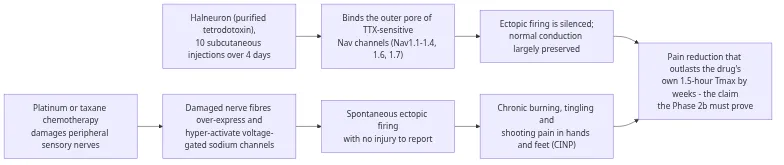
Nerves carry signals as electrical pulses. Each pulse starts when tiny gates in the nerve’s outer wall — voltage-gated sodium channels — snap open and let sodium ions rush in. Platinum-based and taxane-based chemotherapy drugs damage the longest, thinnest sensory nerves first, which is why the symptoms appear in the hands and feet. Damaged nerve fibres do not simply go quiet. They over-produce and hyper-activate these sodium channel gates, and begin firing pain signals with nothing to report — a phenomenon called ectopic firing. The patient feels burning, tingling and shooting pain in a part of the body that is not being injured. That is chemotherapy-induced neuropathic pain.
Halneuron is purified tetrodotoxin, the pufferfish toxin, given at doses roughly a thousand times
below the poisonous range [VERIFIED — ChEMBL CHEMBL507974, molecular weight 319.27, natural product; NCT06848348 intervention record]. It works by plugging the outer mouth of the sodium
channel so the gate cannot pass sodium. The dose studied is small — 30 micrograms twice daily as a
subcutaneous injection for four consecutive days, ten injections in total across a treatment cycle
[VERIFIED — NCT01655823 arm descriptions; Goldlust et al., Toxins 2021, [DOI 10.3390/toxins13040235](https://doi.org/10.3390/toxins13040235)].
One correction to the company’s own description, stated plainly. Dogwood describes Halneuron
as “a non-opioid, NaV 1.7 analgesic which is a highly specific voltage-gated sodium channel
modulator” [VERIFIED — Form 8-K exhibit 99.1, 2026-08-13]. Tetrodotoxin is not selective for
Nav1.7. It blocks six of the nine human sodium channel subtypes — Nav1.1, 1.2, 1.3, 1.4, 1.6 and
1.7 — at low nanomolar concentrations, and is largely inactive against the other three: Nav1.5 in
the heart, and Nav1.8 and Nav1.9, which are themselves important pain channels [UNVERIFIED — textbook pharmacology; the ChEMBL selectivity panel across the nine subtypes was not returned by this session's compound_search call, so this is stated as established background rather than as a verified measurement]. The honest framing is that tetrodotoxin is selective for a family of
channels, not for one member of it. Nav1.7 is simply the member with the strongest human genetic
link to pain: people born without working Nav1.7 feel no pain at all, and Open Targets confirms
SCN9A (the gene for Nav1.7) as a well-populated target record [VERIFIED — Open Targets search_entities, SCN9A → ENSG00000169432, 2026-08-13].
That distinction has two practical consequences. In the drug’s favour: sparing Nav1.5 is why a
sodium-channel blocker given systemically does not stop the heart, and a dedicated thorough-QT
study in 25 healthy adults found no QT prolongation at 15, 30 and 45 micrograms — a formally
negative QT study [VERIFIED — Kavoosi et al., Toxins 2020, [DOI 10.3390/toxins12080511](https://doi.org/10.3390/toxins12080511)]. Against it: blocking
Nav1.6 and Nav1.7 in undamaged nerves is what produces the tingling and numbness around the mouth
that roughly a third of treated patients report, and that side effect is the same mechanism as the
intended one, not a separate off-target liability.
The most interesting thing about this drug is also the least explained. Tetrodotoxin reaches
peak blood concentration about 1.5 hours after injection and is cleared quickly [VERIFIED — Kavoosi et al., Toxins 2020, DOI 10.3390/toxins12080511]. Yet across every trial the analgesic
effect is reported to last for weeks after a four-day course — a mean duration of analgesic
response of 56.7 days on drug versus 9.9 days on placebo in the largest cancer-pain trial
[VERIFIED — Hagen et al., Pain Res Manag 2017, [DOI 10.1155/2017/7212713](https://doi.org/10.1155/2017/7212713)]. A drug that is gone in a day
and works for two months is either genuinely resetting something in the pain pathway, or is being
measured against a natural history that improves on its own. Nobody has published a mechanism for
the durability, and the 2007 open-label study said as much: “It may have a novel mechanism of
analgesic effect” [VERIFIED — Hagen et al., J Pain Symptom Manage 2007, [DOI 10.1016/j.jpainsymman.2006.11.008](https://doi.org/10.1016/j.jpainsymman.2006.11.008)].
The exact scientific step this readout must prove. Not that sodium-channel blockade relieves neuropathic pain — lidocaine and carbamazepine settled that decades ago. Not that tetrodotoxin reaches the nerve — the pharmacokinetics are published. The step is narrower and harder: that the proportion of patients whose daily pain score falls by a clinically meaningful amount over four weeks is significantly greater on Halneuron than on placebo, in a trial where that comparison is the pre-specified primary endpoint rather than one of several analyses run afterwards. That specific thing has never been demonstrated for this molecule.
The honest scientific risk is not that the drug does nothing. It is that the effect is real but
small, and smaller than the placebo response in a subjective daily pain diary. The predecessor
trial’s own authors identified exactly this: mean pain scores were “not statistically different
between cohorts, due to small trial size and influence of a few robust placebo responders”
[VERIFIED — Goldlust et al., Toxins 2021, DOI 10.3390/toxins13040235]. A four-week self-reported
pain diary in patients who have finished chemotherapy and are slowly recovering is one of the
noisiest measurements in clinical medicine.
A.2 Clinical development plan, timeline, feasibility, resourcing
Trials
| Trial | Sponsor / whose drug | Design (arms, blinding, n) | Population | Status / key result | Link |
|---|---|---|---|---|---|
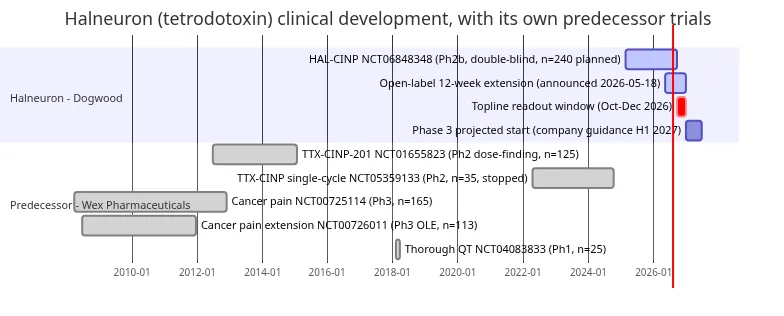
| HAL-CINP (NCT06848348) — the pivotal trial for this catalyst | Dogwood Therapeutics; its own drug | Phase 2 on the registry, called “Phase 2b” by the company. Randomised, parallel, quadruple-masked (participant, care provider, investigator, outcomes assessor). Two randomised arms, Halneuron and matching placebo, plus a non-randomised open-label extension arm. 240 planned, 217 enrolled as of 2026-08-13. 25 US sites | Adults ≥18 with neuropathic pain attributed to platinum and/or taxane chemotherapy, no active or discernible disease progression, no prior Halneuron exposure | RECRUITING. Started 2025-02-21. Registry primary completion 2026-07 (ESTIMATED, record last updated 2026-05-29) — that date has already passed without a readout. Two unblinded interim reviews reported separation from placebo, at 97 and at 200 patients | NCT06848348 |
| TTX-CINP-201 (NCT01655823) — the immediate predecessor, same indication | Wex Pharmaceuticals; the same molecule | Phase 2, randomised, double-blind, dose-finding. Five arms, n=125: placebo BID, 7.5 µg BID, 15 µg BID, 30 µg QD, 30 µg BID, each for four consecutive days | Taxane- or platinum-related CINP, stable moderate-to-severe pain, ECOG 0–1 | TERMINATED with results posted. Registry reason: “Interim analysis completed and decided to terminate and proceed to Phase 3 trial.” Primary endpoint missed — see the numbers below | NCT01655823 · DOI 10.3390/toxins13040235 |
| Single-cycle CINP (NCT05359133) | Wex Pharmaceuticals; the same molecule | Phase 2, randomised, quadruple-masked, parallel. 4-day treatment, 12-week follow-up. n=35 actual against a much larger plan | Same CINP population, ≥21 years, DN4 score ≥4, stable pain ≥14 days | TERMINATED. Registry reason, verbatim: “Study was terminated due to lack of funding to continue the study.” Ran 2022-04-19 to 2024-10-14. No results posted | NCT05359133 |
| Cancer pain (NCT00725114) | Wex Pharmaceuticals; the same molecule | Phase 3, multicentre, randomised, double-blind, placebo-controlled, parallel. n=165 enrolled, 149 in the ITT analysis, 19 sites in Canada, Australia and New Zealand | Moderate-to-severe cancer-related pain inadequately controlled despite best available treatment — a different population from CINP | COMPLETED, primary endpoint not met at the pre-specified level. Effect size 16.2%, p=0.0460: “nominally statistically significant after prespecified (Bonferroni Holm) adjustment for the two primary endpoints but not at the prespecified two-sided 5% level”. Mean duration of analgesic response 56.7 days versus 9.9 | NCT00725114 · DOI 10.1155/2017/7212713 |
| Cancer pain extension (NCT00726011) | Wex Pharmaceuticals; the same molecule | Phase 3, open-label, long-term continuation, n=113 | Continuation population from the trial above | COMPLETED 2011-12. Open-label, so it carries safety information and no efficacy comparison | NCT00726011 |
| Cancer pain (earlier) | Wex Pharmaceuticals; the same molecule | Randomised, double-blind, parallel, multicentre, 22 Canadian centres. n=82 randomised, 77 analysed | Moderate or severe unrelieved cancer pain | COMPLETED, primary endpoint not met. “A nonstatistically significant trend toward more responders in the active treatment arm based on the primary endpoint.” One serious adverse event of truncal and gait ataxia | DOI 10.1016/j.jpainsymman.2007.05.011 |
| Thorough QT (NCT04083833) | Wex Pharmaceuticals; the same molecule | Phase 1, single ascending dose, randomised, double-blind, placebo- and moxifloxacin-controlled, n=25 healthy adults | Healthy volunteers | COMPLETED, formally negative QT study. No dose met the 10 ms threshold. Tmax ~1.5 h, dose-proportional exposure | NCT04083833 · DOI 10.3390/toxins12080511 |
The predecessor’s actual numbers, because they are the single most important evidence in this
document. NCT01655823 posted its results to ClinicalTrials.gov. On the pre-specified primary
endpoint — change from baseline in the weekly average NPRS score at days 22 to 28, on an
intention-to-treat basis — the five arms produced [VERIFIED — ClinicalTrials.gov results section, NCT01655823, read 2026-08-13]:
| Arm | n | Baseline NPRS | NPRS days 22–28 | Change from baseline |
|---|---|---|---|---|
| Placebo, twice daily | 25 | 6.662 ± 1.483 | 5.323 ± 2.277 | −1.339 ± 2.068 |
| Tetrodotoxin 7.5 µg twice daily | 25 | 6.285 ± 1.331 | 5.005 ± 2.045 | −1.269 ± 1.396 |
| Tetrodotoxin 15 µg twice daily | 24 | 7.012 ± 1.371 | 5.987 ± 2.253 | −1.052 ± 1.574 |
| Tetrodotoxin 30 µg once daily | 25 | 6.240 ± 1.174 | 4.566 ± 2.493 | −1.682 ± 2.323 |
| Tetrodotoxin 30 µg twice daily | 26 | 6.255 ± 1.356 | 4.749 ± 1.770 | −1.529 ± 1.820 |
Read the last column. Placebo produced a larger average pain reduction than two of the four tetrodotoxin arms. The best arm beat placebo by 0.343 points on an 11-point scale, against a standard deviation above 1.8 and a commonly used threshold for a meaningful individual improvement of roughly 2 points. No statistical analyses were posted with these results, and the publication states the mean-change comparison was not significant.
What the publication reports instead is a cumulative responder analysis, in which the 30 µg
twice-daily arm differed from placebo using “the maximum response at any timepoint (p=0.072),
5-day (p=0.059), 10-day (p=0.027), and 20-day (p=0.071) rolling averages” [VERIFIED — Goldlust et al., Toxins 2021, DOI 10.3390/toxins13040235]. One of those four definitions clears p<0.05, and
none is adjusted for having tried four. That is the entire quantitative basis on which this
program advanced.
Feasibility matrix
| Factor | High probability | Medium probability | Low probability | This asset (assessment) | Source |
|---|---|---|---|---|---|
| Recruitment feasibility | >50 sites, 3:1 patient:site | 20–50 sites, established investigators | <20 sites, novel sites | MEDIUM, and demonstrated rather than projected. 25 sites, 217 patients — a ratio of 8.7 patients per site, comfortably above the 3:1 benchmark, achieved over 18 months. Recruitment is not the risk here; it has already happened. The one oddity is that all 25 sites are registered as “Central Recruiting Site” with no named investigator, which is unusual and is what leaves A.5b’s investigator table empty | CT.gov NCT06848348 locations; company release 2026-08-13 |
| Endpoint clarity | Regulatory precedent exists | Novel endpoint with FDA alignment | Unvalidated surrogate | MEDIUM. The 11-point daily pain rating scale is the standard, regulatorily accepted endpoint in analgesia. What is not established is this particular responder formulation of it as a primary endpoint in CINP — no drug has ever been approved in this indication, so there is no precedent readout to point at. FDA Fast Track was granted, which implies a dialogue, but Fast Track is not endpoint agreement | CT.gov primary outcome; company 8-K exhibit 99.1 2026-08-13 |
| Trial-design robustness | Pivotal Phase III with SPA | Adaptive with interim analysis | Single-arm, no control | MEDIUM-HIGH on design, MEDIUM on discipline. Randomised, placebo-controlled and quadruple-masked is the strongest available design, and the trial used a pre-specified interim to resize itself, which is proper adaptive practice. The discipline question is that the primary endpoint moved between the predecessor trial and this one, from a mean-change test that failed to a responder test that had worked post hoc | CT.gov NCT06848348 design module vs NCT01655823 |
| Operational / execution | Enrollment complete, standard timeline | Some timeline risk | Enrollment behind | MEDIUM. 217 of a target the company now describes as “over 220”, so enrollment is essentially finished. But the registry primary completion date of 2026-07 has already passed, the registry record has not been updated since 2026-05-29, and the guided readout has drifted from “Q3 2026” to “fall” to “the fourth quarter” | CT.gov status module; readout section below |
Resourcing sufficiency. The trial itself is funded and effectively finished: 217 patients are
enrolled and the endpoint is measured four weeks after each patient’s own dosing, so the remaining
cost is database lock, unblinding and statistics. Beyond that the company is not resourced.
../company.md C.3 records $9,610,033 of cash at 2026-06-30 against a recomputed
burn of $1.624M a month — a runway to roughly 2026-12-24, which the company itself describes as
reaching “the Phase 2b readout in the fourth quarter of 2026” and no further. A Phase 3 in this
indication, which the company projects for the first half of 2027, is not funded and is not close
to funded. C.3 also sets out why the ordinary financing route is closed until January 2027: the
baby-shelf capacity was consumed in full by the January 2026 offering.
A.3 Target label, target product profile, strategic questions, designations
A.3a Target label. Treatment of moderate-to-severe chronic neuropathic pain in adults that is attributable to prior platinum-based and/or taxane-based chemotherapy, in patients with no actively progressing cancer.
A.3b Target product profile
| Attribute | Standard of care & key competitor(s) — data | Halneuron target profile (goal) | Supporting evidence (+ link) |
|---|---|---|---|
| Indication / target label | There is no approved drug for this indication anywhere. ASCO’s guideline recommends duloxetine alone for established painful CIPN, at moderate strength, and states plainly that the amount of benefit is limited. No agent at all is recommended for prevention | First approved therapy for CINP | [VERIFIED — ASCO Guideline Update, J Clin Oncol 2020, [DOI 10.1200/JCO.20.01399](https://doi.org/10.1200/JCO.20.01399)] |
| Efficacy (endpoints, regimen) | Duloxetine: daily oral dosing, indefinitely, with a limited effect. Off-guideline options — tricyclic antidepressants, gabapentin, a compounded baclofen/amitriptyline/ketamine gel — are explicitly not recommended for routine use for want of evidence | A four-day course producing a ≥30% pain reduction in significantly more patients than placebo, with benefit persisting for weeks after dosing stops | [VERIFIED — ASCO 2020, DOI 10.1200/JCO.20.01399; Hagen 2017 for the durability claim in a different population, DOI 10.1155/2017/7212713] |
| Safety / tolerability | Duloxetine: nausea, somnolence, discontinuation effects; a daily systemic antidepressant in a population already carrying treatment burden | Transient, expected perioral tingling and numbness; no cardiac liability; no opioid dependence risk | [VERIFIED — Goldlust 2021: oral paraesthesia 29.6%, oral hypoaesthesia 24.8%, most events mild or moderate. Kavoosi 2020: formally negative thorough-QT study] |
| Biomarker / companion diagnostic | None exists or is in development for CINP | None planned. Patient selection is clinical: prior platinum/taxane exposure plus a stable moderate-to-severe pain score | [VERIFIED — NCT06848348 eligibility criteria] |
| Formulation / administration | Oral daily capsule (duloxetine) | Subcutaneous injection, twice daily for four days, repeatable in cycles. This is a real commercial disadvantage against a pill and the reason the penetration assumptions in B.3a are held down | [VERIFIED — NCT06848348; NCT01655823 arm descriptions] |
| Payer value | Duloxetine is generic and costs almost nothing | Must justify a specialty price against a generic incumbent by delivering an effect the generic demonstrably does not. Fewer opioid prescriptions and fewer chemotherapy dose reductions are the arguments available | [UNVERIFIED — the payer case has not been made publicly by the company] |
A.3c Strategic Go/No-Go questions. The next decision for this asset is whether to start Phase 3, so the pre-Phase-III set applies.
Pre-Phase-III (Go-to-Phase-III / registration):
| Group | Question | Answer (tagged) |
|---|---|---|
| Target | Target revalidated as in prior phases? | Partly. The target class is validated by human genetics — loss-of-function in SCN9A abolishes pain perception — and by approved sodium-channel-blocking analgesics [VERIFIED — Open Targets SCN9A ENSG00000169432]. What has not been revalidated is that blocking this family with tetrodotoxin produces a measurable clinical effect on a pre-specified endpoint, which is the whole question [VERIFIED — NCT01655823 posted results]. |
| Dose & Drug | Exposure–response for the intended commercial regimen and route(s)? | Weak. The dose-finding study was the one that failed its primary endpoint, and the dose selected — 30 µg twice daily — was chosen on a post-hoc responder analysis rather than a clean dose–response curve. On mean pain change, 30 µg once daily outperformed 30 µg twice daily (−1.682 vs −1.529), which is the wrong shape for a dose–response relationship [VERIFIED — NCT01655823 posted results]. |
| Dose & Drug | Commercial formulation available or feasible? | Yes, with an upgrade in progress. The current product is purified from natural source material. In December 2025 the company filed intellectual property on a fully synthetic manufacturing process, which would remove supply dependence on a marine natural product [VERIFIED — company press release 2025-12-02]. |
| Dose & Drug | Dose range compatible with clinical and non-clinical safety? | Yes. Doses of 15, 30 and 45 µg were characterised in healthy volunteers with no QT signal and no withdrawals for adverse events [VERIFIED — Kavoosi 2020, DOI 10.3390/toxins12080511]. |
| Dose & Drug | Therapeutic window given the clinical response? | The genuine unknown. The therapeutic window looks adequate on paper, but if the true effect is the ~0.3-point mean difference the predecessor measured, then no window is wide enough — the constraint is efficacy, not tolerability [UNVERIFIED — inference from the predecessor's numbers]. |
| Dose & Drug | Intrinsic and extrinsic factors influencing exposure and patient response? | Partly characterised. Both CINP trials excluded impaired renal function, and the current trial excludes concurrent antiarrhythmics and other sodium-channel drugs, which implies known interaction concerns [VERIFIED — NCT01655823 and NCT05359133 exclusion criteria]. |
| Patient | Proof of concept and positive benefit/risk in the intended population? Combination evidence? | Not established on a pre-specified endpoint, in any population, in four controlled trials. No combination evidence exists or is being generated [VERIFIED — the four trial records and publications above]. |
| Patient | Phase III design and outcome criteria — accepted, compelling, competitive for market access? | Unknown and unstated. No Phase 3 protocol, endpoint or FDA alignment has been disclosed. The company projects a start in H1 2027 [VERIFIED — BPIQ note field, 2026-05-18 entry]. |
| Patient | Rationale for the patient population(s)? | Strong and specific. Platinum/taxane-attributable CINP with no active disease progression is a clean, identifiable population that removes the confound of pain from advancing cancer — the flaw that made the earlier cancer-pain trials hard to read [VERIFIED — NCT06848348 eligibility]. |
| Patient | Likelihood of the expected outcome? | Modelled at 38%, band 26–49% — see the locked prediction [UNVERIFIED — modelled]. |
| Patient | Companion-diagnostic strategy, including pricing and market? | None, and none needed. Patient identification is clinical. |
A.3d Regulatory designations.
- FDA Fast Track designation, granted for Halneuron in CINP
[VERIFIED — Form 8-K exhibit 99.1, 2026-08-13]. Fast Track means the FDA has agreed the drug addresses an unmet need in a serious condition, which buys more frequent meetings and the ability to submit a marketing application in pieces as they are ready. It does not lower the evidence bar and it is not an agreement about the endpoint. - FDA Fast Track designation is also held by IMC-1 for fibromyalgia
[VERIFIED — BPIQ note field, row 18553]. That belongs to a different program and is listed here only to prevent it being read as a second designation for Halneuron. - No Breakthrough Therapy, no Orphan Drug, no Priority Review, no RMAT designation has been disclosed for this program.
A.4 Target product profile valuation matrix
| Stakeholder | Value driver | Minimum threshold | Competitive | Premium | Benchmark / source |
|---|---|---|---|---|---|
| Patient / caregiver | Relief from constant burning and tingling in the hands and feet, without a daily pill or an opioid | Any reproducible pain reduction beyond placebo | ≥30% pain reduction in a meaningfully larger share of patients than placebo | ≥50% reduction lasting weeks after a four-day course, with no dependence risk | [VERIFIED — IMMPACT-derived 30%/50% responder conventions used as the thresholds in NCT05359133's own outcome definitions] |
| Regulator | A first therapy in a condition with none | Statistical significance on one pre-specified primary endpoint, replicated | Significance plus a consistent responder curve across thresholds | Significance plus durability plus a patient-reported global improvement | [VERIFIED — ASCO 2020 confirms no approved agent, DOI 10.1200/JCO.20.01399] |
| Payer / HTA | Displacing generic duloxetine, and reducing opioid use and chemotherapy dose reductions | Non-inferiority to duloxetine at a defensible price | Superiority to duloxetine on pain, with fewer daily-medication side effects | Documented reduction in opioid prescribing or in chemotherapy dose reduction | [UNVERIFIED — no health-economic evidence has been generated for this asset] |
| Provider | Something to offer a patient who is already out of options | An option that does not require daily titration | A four-day course an infusion suite can administer alongside oncology follow-up | A treatment that lets a patient stay on full-dose chemotherapy | [VERIFIED — NCT01655823 brief summary: CIPN causes chemotherapy dose reduction or discontinuation, "potentially affecting tumor responsiveness, prognosis, and survival"] |
Calibration examples, not asset claims: in oncology each incremental month of overall survival is worth roughly $150–300M in peak-sales potential; oral formulations command roughly 15–25% price premiums over injectables. The second of those runs against this asset, which is an injectable competing with a generic pill.
A.5 Evidence quality and endpoints
| Criterion | Score (High / Medium / Low) | Basis (one line) | Link |
|---|---|---|---|
| Target validation | High | Voltage-gated sodium channels are among the best-validated pain targets in human biology, with SCN9A loss-of-function producing congenital insensitivity to pain | Open Targets SCN9A |
| Mechanism clarity | Medium | The blockade mechanism is clear and the pharmacokinetics are published, but the weeks-long durability after a one-day exposure has no published mechanism at all | DOI 10.3390/toxins12080511 |
| Biomarker availability | Low | No biomarker, no companion diagnostic, no objective measure of the endpoint. Everything rests on a self-reported daily pain diary | CT.gov NCT06848348 outcome measures |
| Publication quality (peer-reviewed? independent authors?) | Medium on the journal, Low on independence | The pivotal predecessor is peer-reviewed in Toxins (2021) with full results also posted to the registry — genuinely good practice. But four of its six authors were employees of the sponsor or its CRO: Mojgan Kavoosi, Mehran Kavoosi and Walter Korz at WEX Pharmaceuticals, Jennifer Nezzer at Premier Research. Only Samuel A. Goldlust and Kenneth Deck were site investigators outside the sponsor | DOI 10.3390/toxins13040235 |
| Clinical / expert sentiment | — | Moved to A.5b, below. | — |
Endpoints
| Endpoint (full name) | What it measures | Scale / range | Better direction | MCID / note |
|---|---|---|---|---|
| Numeric Pain Rating Scale (NRS/NPRS), analysed as percentage of responders — the primary efficacy endpoint | Each patient records their pain intensity over the past 24 hours, every day. The daily scores are averaged into a weekly figure. The endpoint is the proportion of patients whose weekly average fell by a set amount from baseline, compared between the Halneuron and placebo arms at week 4 | 0 = no pain to 10 = extreme pain; 11 integer points | Lower pain score is better; a higher responder proportion is better | The conventional thresholds are a 30% reduction (“moderately important improvement”) and a 50% reduction (“substantial”), used explicitly as responder definitions in this program’s own sibling trial NCT05359133. On the raw scale, a 2-point drop is the usual rule of thumb. The predecessor trial’s best arm beat placebo by 0.343 points on mean change |
| Safety assessments — co-primary | Incidence of serious adverse events, adverse events, and adverse events of special interest, over the same four weeks | Counts and proportions | Lower is better | The predecessor’s safety profile was benign: serious adverse events were 1/25 on placebo and 1/26 on the top dose, all cancer progression or infection rather than drug-attributed. The characteristic events were oral paraesthesia (29.6%) and oral hypoaesthesia (24.8%) |
| Patient Global Impression of Change (PGIC) — secondary | The patient’s own single-question verdict on whether they are better or worse since starting treatment | 7 points, 1 = very much improved to 7 = very much worse | Lower is better | No formal MCID; typically read as the proportion reporting “much improved” or better. Useful precisely because it is not the same measurement as the diary |
| PROMIS Fatigue — secondary | Standardised patient-reported fatigue over the past week | T-score, calibrated so the US general population has a mean of 50 and a standard deviation of 10 | Lower is better | Commonly cited MCID 2–3 T-score points |
| PROMIS Sleep — secondary | Standardised patient-reported sleep disturbance | T-score, same calibration | Lower is better | Commonly cited MCID 2–3 T-score points |
| PROMIS-29 Quality of Life domains — secondary | Seven health domains plus a pain intensity item, in one short instrument | T-scores per domain, same calibration | Depends on domain; lower is better for symptom domains | The predecessor reported significant differences from placebo on several SF-36 and CIPN20 subscales for the 30 µg twice-daily arm — different instruments, same idea |
An unblinding problem worth stating in its own paragraph. Tetrodotoxin produces tingling and
numbness around the mouth in roughly a third of treated patients. In the predecessor trial the
imbalance was large: oral paraesthesia in 11 of 26 patients on 30 µg twice daily against 3 of 25 on
placebo, and oral hypoaesthesia in 10 of 26 against 3 of 25 [VERIFIED — ClinicalTrials.gov adverse-events section, NCT01655823]. A patient whose mouth goes numb within an hour of the first
injection has a strong clue about which arm they are in, and the primary endpoint is that same
patient’s self-reported pain diary. Quadruple masking is procedurally correct and cannot fix this:
it is the drug that unblinds, not the protocol. The effect runs in the drug’s favour on the
measured endpoint and against it in any regulatory review, and it is a reason to want the
objective-ish secondary measures — sleep, fatigue, global impression — to move in the same
direction as the diary.
A.5b Key opinion leaders.
Panel as of. 2026-08-13 — the date the CT.gov investigator search and the PubMed authorship and conflict searches below were run.
Investigators
No investigator could be named for this program’s pivotal trial, and that is itself the finding.
All 25 sites on NCT06848348 are registered as “Central Recruiting Site” with no facility name, no
principal investigator and no site contact; the record lists no overall officials at all, and its
only central contact is a company email address (Mehran@dwtx.com, which corresponds to Mehran
Kavoosi, an author on the predecessor publication while at WEX Pharmaceuticals). CT.gov
search_investigators on the condition returned zero investigators across the trial. This is
unusual — the predecessor trial NCT01655823 named all 23 of its sites, including academic centres
such as UT Southwestern and the John Theurer Cancer Center — and it means a reader cannot check who
is running this trial.
| Name | Role / affiliation | Trial (NCT) | Conflicts (party, kind, disclosed in, as of) | Conflicts checked (source, date) | Source | Tag |
|---|---|---|---|---|---|---|
| (none returned) | — | NCT06848348 | — | CT.gov search_investigators and get_trial_details contacts/locations module, 2026-08-13 | NCT06848348 | [VERIFIED — the absence is registry-confirmed, not assumed] |
Independent voices
No independent voice on this program’s endpoint could be named this session, and the reason is structural rather than a gap in the search. The complete clinical literature on this molecule in pain is seven papers, and every one of them was generated by the sponsor’s own program: five carry a WEX Pharmaceuticals author, and the two Hagen-led cancer-pain papers are reports of WEX-sponsored trials with Walter Korz of WEX as a co-author. There is no commentary, editorial or independent replication in the indexed literature to draw a voice from. Samuel A. Goldlust (Hackensack University Medical Center) and Kenneth Deck (Alliance Research Centers) are the two non-sponsor authors on the pivotal predecessor publication, but both were site investigators on the trial they are reporting, so neither is independent and neither is recorded here — per the template’s own instruction, a person with a disclosed relationship belongs above, not in this table.
| Name | Affiliation | View (close enough to quote) | As of | Conflicts checked (source, date) | Source | Tag |
|---|---|---|---|---|---|---|
| (none found) | — | — | — | PubMed search_articles and get_article_metadata on all 7 clinical-trial hits for this molecule, author affiliations read in full, 2026-08-13 | DOI 10.3390/toxins13040235 | [VERIFIED — the search is on record; the emptiness is a finding, not a default] |
Judgement
| Endpoint supported | Basis (one or two sentences) | Tag |
|---|---|---|
| UNKNOWN | No independent voice could be named, so there is no independent view to weigh — the entire published literature on tetrodotoxin in pain is the sponsor’s own program, and its two non-employee authors were investigators on the trial they reported. The one genuinely independent statement bearing on this endpoint is not about the drug at all: ASCO’s 2020 guideline confirms that no agent is approved and that duloxetine’s benefit is limited, which establishes the need this endpoint is aimed at without saying anything about whether Halneuron meets it. | [UNVERIFIED — judgement] |
Dissent
Empty, because Endpoint supported is UNKNOWN rather than SUPPORTIVE_CONTESTED. Recording a disagreement would require someone to be disagreeing, and no named voice on either side exists.
| Name | View (close enough to quote) | Source |
|---|---|---|
| (none) | — | — |
B. Commercial assessment
B.0 Current treatment algorithm
A patient finishes chemotherapy that included a platinum drug (cisplatin, carboplatin, oxaliplatin) or a taxane (paclitaxel, docetaxel). Weeks or months later the burning and tingling in the hands and feet has not gone away. What happens next, today:
- During chemotherapy — dose reduction or discontinuation. This is not a treatment, it is the
absence of one, and it is the most consequential step in the whole pathway. The predecessor
trial’s own registry summary puts it plainly: “To improve the peripheral neuropathy, the
chemotherapy dosing is often either decreased or discontinued potentially affecting tumor
responsiveness, prognosis, and survival”
[VERIFIED — NCT01655823 brief summary]. - Prevention — nothing. ASCO’s guideline recommends no agent for the prevention of CIPN
[VERIFIED — ASCO 2020, DOI 10.1200/JCO.20.01399]. - First and only recommended treatment — duloxetine, an oral antidepressant of the
serotonin-norepinephrine reuptake inhibitor class, taken daily. ASCO gives it a moderate-strength
recommendation on intermediate-strength evidence and notes that the amount of benefit is limited
[VERIFIED — ASCO 2020]. - Everything else — tried, not recommended. Tricyclic antidepressants, gabapentin, and a
compounded topical gel of baclofen, amitriptyline and ketamine may be tried, but routine use is
explicitly not recommended for inadequate evidence. Exercise, acupuncture and scrambler therapy
are classified as unproven but reasonable to consider
[VERIFIED — ASCO 2020]. - Opioids. Not guideline-recommended for this indication and carrying their own well-known harms, but used in practice when nothing else works.
Where Halneuron would fit. At step 3, as an alternative or an addition to duloxetine, for the patient whose pain is moderate to severe and persistent. It is a four-day injected course rather than an indefinite daily pill, which is a genuine differentiator on treatment burden and a genuine disadvantage on convenience. It does not compete with anything at steps 1 or 2, because nothing is there.
B.1 Competitive landscape and positioning
| Metric | High value | Medium value | Low value | This asset (assessment) | Source |
|---|---|---|---|---|---|
| Mechanism differentiation | First-in-class or novel target | Next-generation improvement | Me-too | HIGH as a product, MEDIUM as a mechanism. Nothing is approved in CINP, so any approval is first-in-class in this indication. But sodium-channel blockade for pain is a very old idea, and tetrodotoxin itself has been in clinical development since at least 2007 | [VERIFIED — ASCO 2020; CT.gov trial history back to NCT00725114, started 2008] |
| Development-timeline advantage | >12 months ahead | Within 6–12 months | Lagging >12 months | HIGH. The named clinical-stage CIPN candidates — capsaicin 8% patch (Qutenza), ATX01 (topical amitriptyline 15%), ART-123/Recomodulin, TAR-0520, pirenzepine (WST-057) — are a mix of topicals and repositioned agents, and none has a Phase 3 readout dated ahead of this one | [WEB ESTIMATE — DelveInsight CIPN pipeline coverage via press release, 2026] |
| Clinical proof-of-concept evidence | Positive Phase IIb (n>100) | Phase IIa signals (n=20–50) | Preclinical only | LOW, and this is the honest answer. There is a Phase 2 with n=125 in exactly this indication and it missed its primary endpoint. What exists is a post-hoc responder signal at one of four analysis definitions. The matrix’s “Positive Phase IIb (n>100)” box is precisely what this readout is trying to fill and has not filled yet | [VERIFIED — NCT01655823 posted results; Goldlust 2021, DOI 10.3390/toxins13040235] |
| IP protection | Composition-of-matter, long-dated | Method-of-use | Pending or none | PENDING. In December 2025 the company filed intellectual property on a fully synthetic manufacturing route, which it says would extend exclusivity “up to 2045” before any patent-term restoration, if granted. A filing is not a grant, no application number was disclosed, and the underlying molecule is a natural product known for decades | [VERIFIED — company press release 2025-12-02; the 2045 figure is the company's own projection] |
Where this asset wins, and the single fact the thesis rests on. It wins on the emptiness of the field. In an indication where the best available medicine is a generic antidepressant that the guideline itself describes as limited, a drug that reproducibly relieves pain would face almost no competition and would set its own price. That is a real and unusual advantage.
The single fact the whole thesis rests on is that the responder analysis is measuring something real rather than something that appeared because four analysis definitions were tried on a trial that had already missed. Everything else — the unmet need, the mechanism, the durability, the tolerability, the IP — is downstream of that one question, and this readout answers it.
B.2 Addressable market
The launch market is the United States, where the trial was run entirely (25 US sites) and where the pricing environment could support a specialty analgesic. The EU5 and Japan would follow an approval, and no EU trial has ever been run for this molecule.
| Component | How it is estimated | Premium threshold | This asset (assessment) | Source |
|---|---|---|---|---|
| Drug-treated patients | Epidemiology × diagnosis rate × treatment rate | >100,000 (US/EU5/Japan) | Threshold met, but the number itself is the weakest input in this document. CIPN occurs in more than 40% of patients receiving neurotoxic chemotherapy; a minority of those progress to chronic moderate-to-severe painful neuropathy. Modelled US pool: 150,000–350,000 patients at any time. No primary epidemiological source for this figure was verified this session, and it should be read as a bracket, not a count | [VERIFIED — the >40% incidence figure, NCT01655823 brief summary] / [UNVERIFIED — modelled, the pool size] |
| Market exclusivity | Patent term + regulatory exclusivity | >10 years combined | Unresolved. The company projects exclusivity to 2045 from the December 2025 synthetic-process filing. If granted as described that clears the threshold comfortably; if not, a natural-product molecule in the public domain for decades has little composition-of-matter protection and would rely on five years of new chemical entity regulatory exclusivity | [VERIFIED — company press release 2025-12-02] / [UNVERIFIED — whether it is granted] |
| Reimbursement precedent | Approvals in ≥2 major markets | Positive NICE/CADTH guidance | None exists. No drug has been approved for CINP in any market, so there is no reimbursement precedent to point at — the flip side of the unmet-need argument. The nearest analogue is the capsaicin 8% patch, reimbursed for painful diabetic peripheral neuropathy and post-herpetic neuralgia | [VERIFIED — ASCO 2020 confirms no approved agent] |
| Patient-journey impact | Fewer hospital days, less caregiver burden | >30% quality-of-life gain | Plausible and unquantified. The strongest version of the argument is not pain relief at all but keeping patients on full-dose chemotherapy. Nobody has generated that evidence for this asset, and the current trial does not measure it | [VERIFIED — NCT01655823 brief summary describes the dose-reduction problem] / [UNVERIFIED — the impact] |
B.3 Value and feasibility
B.3a Expected peak sales. Built bottom-up as eligible patients × annual net price × peak
penetration, US only, and conditional on approval, which on the evidence in A.2 is far from
assured. Every figure excludes ex-US sales, excludes SP16, and excludes any IMC-1/IMC-2 partnership
proceeds — the last of which would in any case be shared with CVR holders rather than accruing
wholly to shareholders [VERIFIED — Form 8-K exhibit 99.1, 2026-08-13].
| Scenario | Assumptions (patients × price × share) | Estimate (USD/year at peak) | Basis / tag |
|---|---|---|---|
| Low | 150,000 US patients × $15,000/year × 4% peak penetration | ~$90M | [UNVERIFIED — modelled]. Injectable four-day cycles against a generic pill, in a specialty that has never prescribed anything for this |
| Base | 250,000 × $20,000/year × 8% | ~$400M | [UNVERIFIED — modelled]. Assumes a clear label, a supportive guideline update, and oncology-clinic administration alongside existing follow-up visits |
| High | 350,000 × $28,000/year × 14% | ~$1.37B | [UNVERIFIED — modelled]. Requires the durability claim to hold in the real world, so that a small number of cycles a year controls the condition |
Sanity check against third-party figures, and one rejection. Independent forecasts put the
entire CIPN treatment market — every product, including generic duloxetine and supportive care —
at roughly $1.4–2.1 billion by 2030 [WEB ESTIMATE — Strategic Market Research and Astute Analytica summaries, 2026]. The high case above therefore implies a single branded drug capturing
most of a market it would have to create, which is why it is a ceiling rather than a forecast. The
base case of ~$400M sits at roughly a fifth of that whole-market figure, which is demanding but not
absurd for the only approved product in an indication.
The least defensible input is the patient count, and it is named here rather than buried. The incidence figure (>40% of patients on neurotoxic chemotherapy develop CIPN) is verified from the trial registry, but converting that into a prevalent pool of patients with chronic moderate-to- severe painful neuropathy required assumptions that no primary source in this session supports. The price is the second-weakest: there is no approved comparator in this indication to anchor to, and the $15,000–28,000 range is inferred from office-administered specialty analgesics generally.
B.3b Feasibility
| Question | Answer (tagged) |
|---|---|
| Expected net present value (eNPV) | A range, deliberately not a figure. With a modelled 38% probability of a positive Phase 2b, a further conditional probability of Phase 3 success and approval that no defensible number exists for, and peak sales spanning $90M to $1.37B, a single eNPV would be a fabrication with four unverified inputs in it. The honest statement is that the market is currently pricing the whole company at a $55.45M enterprise value (../company.md C.4), which is roughly 14% of the base-case peak-sales figure — a level that implies the market assigns a low probability to the whole chain, and is not obviously wrong to do so [UNVERIFIED — modelled] |
| Capital to the next decision point | Already committed and nearly spent. 217 patients are enrolled and the four-week endpoint is measured; what remains is database lock, unblinding and statistics. The company holds $9.61M against a $1.624M monthly burn (../company.md C.3) |
| Capital to approval, and the funding plan | Not funded, and there is no disclosed plan. A Phase 3 in chronic pain requires hundreds of patients and, plausibly, two trials. The company projects a Phase 3 start in H1 2027 with a runway that ends around 2026-12-24. ../company.md C.3 sets out why the ordinary financing route is closed: the baby-shelf capacity was consumed in full in January 2026 and does not reset until January 2027. The realistic sources are a private placement into a strong tape after a positive readout, a partner, or the 4,386,037 warrants at $3.28 becoming exercisable — all three of which require the readout to be good first |
| Launch capability — alone, or must partner? | Must partner. Dogwood has no commercial organisation of any kind and $9.6M of cash. It has already demonstrated its preference under pressure by out-licensing IMC-1 and IMC-2 rather than funding them |
| Commercialisation rights — retained, split, or out-licensed? | Retained, for now. Halneuron came with the Wex combination and is wholly owned. The April 2026 partnership covers the legacy antiviral assets only, and its proceeds are shared with CVR holders — Halneuron is not part of it [VERIFIED — Form 8-K exhibit 99.1, 2026-08-13] |
B.4 Product-development risk
Framing questions.
- Does the development plan support the target product profile claims? Partly. The trial is correctly designed to test the pain claim and is adequately sized for the effect the company assumes. It does not support two claims the profile leans on: durability beyond four weeks (the controlled period ends at week 4; the 12-week extension is open-label and therefore cannot demonstrate it), and any payer-facing claim about opioid use or chemotherapy dose maintenance, which is not measured at all.
- Will the identified risks affect the target product profile? The dominant risk — that the effect is real but too small to separate from placebo on a self-reported diary — does not modify the profile, it eliminates it. There is no reduced version of this product that survives a failed pain endpoint.
- If a risk cannot be mitigated, is the asset still differentiated from competitors? Only if the endpoint is met. Differentiation here is entirely a function of efficacy, because the field is empty: an injectable that does not reliably work is worse than a generic pill that works a little.
| Category | Time risk | Quality risk | Cost risk | Note |
|---|---|---|---|---|
| Project management | Medium | Low | Low | Guided timing has drifted from “Q3 2026” to “fall” to “the fourth quarter”, and the registry record has not been updated since 2026-05-29 with a primary completion date that has already passed |
| Research | Low | High | Low | The durability observation, the most commercially valuable feature of the asset, has no published mechanism |
| IP | High | Medium | Low | The synthetic-process filing that carries the 2045 exclusivity claim is pending, with no application number disclosed. Without it, a decades-old natural product has weak composition-of-matter protection |
| Legal | Low | Low | Low | No litigation disclosed. CVR obligations attach to the legacy antiviral assets, not to Halneuron |
| DMPK | Low | Low | Low | Absorption, exposure and dose-proportionality characterised in healthy volunteers |
| Safety pharmacology | Low | Low | Low | A formally negative thorough-QT study is a strong result for a systemic sodium-channel blocker |
| Toxicology | Low | Low | Low | Nothing outstanding disclosed; the molecule has been dosed in humans since at least 2007 |
| Drug safety (clinical) | Low | Medium | Low | No treatment-related deaths and no manufacturing hold. The recorded serious events were cancer progression and infection. Two cases of truncal and gait ataxia in the 2007 open-label study, resolving over days, are the only drug-attributed serious events on record |
| Biomarker | — | High | — | No biomarker exists. Everything depends on patient self-report |
| Clinical pharmacology | Low | Medium | Low | The dose–response relationship is not clean: 30 µg once daily beat 30 µg twice daily on mean pain change in the dose-finding study |
| Clinical (efficacy) | Medium | Very high — the dominant risk | Medium | Four controlled trials, zero pre-specified primary endpoints met. The current primary endpoint is the analysis type that worked post hoc on the trial that failed |
| Clinical operations | Low | Medium | Low | Enrollment is essentially complete. The registry lists no named investigator at any of the 25 sites, which is unusual and unexplained |
| CMC / manufacturing | Medium | Medium | Medium | Currently purified from natural source material, with a synthetic route filed but not yet established at scale |
| Regulatory | Medium | High | Low | Fast Track is held, but no endpoint agreement or Phase 3 design has been disclosed, and a regulator reviewing a responder analysis on a partly self-unblinding drug will look hard at it |
| Global evidence & value | High | High | Medium | No health-economic evidence, no EU trial, no reimbursement precedent in the indication |
| Commercial | High | Medium | High | No commercial organisation, no partner for this asset, and $9.6M of cash |
Readout
Sources
| Kind | Where it comes from | What it is worth | Value (or null) | Tag | Note |
|---|---|---|---|---|---|
bpiq | fetch_company_drugs — catalyst_date, catalyst_date_text | The current single source. Synthesized from period text on most rows, so alone it is a ceiling, not an estimate. | 2026-09-30 / text Q3 2026 | [VERIFIED — BPIQ fetch_company_drugs, 2026-08-13] | A quarter-end placeholder; the text names a quarter, not a day, so catalyst_date_is_exact is false and this value is never used for timing (rule 23). The row contradicts itself: the note field on the same record carries the company’s 2026-07-20 wording as “Topline data still expected Fall 2026”, which is not Q3. Recorded as a data-quality flag. |
ctgov | CT.gov get_trial_details — primary_completion_date | Independent of the company’s own messaging, month-precision, and it moves when the trial moves. | 2026-07 | [VERIFIED — ClinicalTrials.gov NCT06848348, read 2026-08-13] | Type ESTIMATED, not actual, and the record was last updated 2026-05-29. This date has already passed with no readout, which makes it evidence that the registry entry is stale rather than evidence about the readout. Completion date 2026-08, also ESTIMATED, also passing now. |
company | fetch_company_press_releases and the SEC filing feed | The company’s own most recent dated wording. Also where the slip sequence below comes from. | Fall 2026 and, in the same document, fourth quarter of 2026 | [VERIFIED — Form 8-K exhibit 99.1, filed 2026-08-13] | Mandatory, because the catalyst is inside twelve months. The document says both: the highlights bullet reads “top-line results readout expected in the fall of 2026”, and the cash bullet reads “operational runway through the Phase 2b readout in the fourth quarter of 2026”. The runway sentence is the more informative of the two — a company sizing its own cash against an event states the date it is actually planning around. Note the BPIQ press feed’s newest item is 2026-07-20 and misses this release entirely; it was read from EDGAR. |
congress | data/congresses.json, only when the company has said it intends to present there | Answers “where will they say it.” | null | [VERIFIED — search made, nothing qualifies] | The company has named no congress for this readout. It sent its chief medical officer to present a Halneuron overview at the 19th Annual Pain Therapeutics Summit in October 2025, but that was a programme overview, not a stated intention to present these topline data. Matching on therapeutic area alone is a guess and a guess is not a source, so this row is null rather than filled with a pain meeting. |
modelled | Trial arithmetic — see below | The only estimate independent of anyone’s guidance. | 2026-09 to 2026-11 | [UNVERIFIED — modelled, default lag] | Registry primary completion of 2026-07 plus the stated default lag of two to four months. data/benchmarks/readout-lag.json holds no observations, so the default applies and the tag says so. |
The modelled estimate. The registry’s primary completion date is 2026-07, and
01-rules.md rule 34’s default lag from primary completion to a topline announcement is two to
four months, giving 2026-09 to 2026-11. That arithmetic is weakened here by the registry date
being stale, so a second, independent construction is offered and is the one the window actually
leans on: enrollment arithmetic. 200 patients were enrolled by 2026-07-20 and 217 by
2026-08-13, a rate of roughly 17 per month; the company wants “over 220”, which arrives around
2026-08-20. The primary endpoint is measured four weeks after each patient’s own dosing, so
last patient out lands around 2026-09-17. Database lock, unblinding and statistical analysis on
a 240-patient trial with a single four-week endpoint conventionally takes four to eight weeks,
giving 2026-10-15 to 2026-11-12 [UNVERIFIED — modelled on verified enrollment figures]. The
two constructions overlap in October and November, which is where the window’s likeliest edge sits.
Window
| Earliest | Likeliest | Latest | Precision | Confidence |
|---|---|---|---|---|
| 2026-10-01 | 2026-11-15 | 2026-12-31 | PERIOD | MEDIUM |
Basis. No source names a day or a month — “fall”, “Q4” and “Q3” are all periods, so the precision is PERIOD and not MONTH, however tempting the registry’s month-precision 2026-07 looks. The earliest edge is 2026-10-01 rather than a September date because both independent constructions point past September: the company’s own runway sentence says the fourth quarter, and the enrollment arithmetic cannot produce a readout before mid-October unless enrollment finished weeks earlier than the company said it had. The latest edge is 2026-12-31, the end of the fourth quarter the company named and, not coincidentally, the approximate end of its cash. Confidence is MEDIUM rather than HIGH because the same document offers two different answers, and rather than LOW because three independent constructions — company guidance, registry arithmetic and enrollment arithmetic — all land inside October–December.
Disagreement. UNRESOLVED. Three sources point three ways and none is averaged or discarded.
BPIQ says Q3 2026, which ends 2026-09-30. The company says “fall of 2026” in one sentence of its
2026-08-13 release and “the fourth quarter of 2026” in another. ClinicalTrials.gov says primary
completion 2026-07, a date that has already passed with no readout and no registry update since
2026-05-29. The disagreement is not cosmetic: the difference between Q3 and Q4 is the difference
between a readout that arrives before the cash gets tight and one that arrives as it does.
Date slippage. Two slips across five dated statements, oldest first, parsed from the BPIQ note
field and the company’s own releases.
| As of | Guidance text |
|---|---|
| 2025-12-22 | Positive interim results announced; sample size increased. No public topline date attached to the interim itself |
| 2026-02-02 | ”Top Line Results Anticipated in Q3 2026” (press release headline) — the first dated guidance |
| 2026-05-14 | ”Ph2b top-line results remain expected Fall 2026” — SLIP 1. Fall begins 2026-09-22, so this moves all but nine days of the guidance out of Q3 |
| 2026-05-18 | ”Topline results still expected Fall 2026. Ph3 start projected H1 2027” (reiteration) |
| 2026-07-20 | ”HAL-CINP (NCT06848348) enrolled 200; unblinded review showed placebo separation. Topline data still expected Fall 2026” (reiteration) |
| 2026-08-13 | ”top-line results readout expected in the fall of 2026” and “operational runway through the Phase 2b readout in the fourth quarter of 2026” — SLIP 2, in the second sentence: the first appearance of Q4 in the company’s own words |
Attribution
Status. CLEAN.
Conflicts
Empty, exactly as CLEAN requires.
| bpiq_drug_id | Label | Date | Analysed? | Gap (days) | Confirmed? |
|---|---|---|---|---|---|
| (none) | — | — | — | — | — |
Computed, not authored: lib/clustering.mjs’s attributionFor('DWTX', companyRecord, programs, 6, 18554) over this ticker’s full four-row pipeline table and this program’s own readout.window,
run 2026-08-13, returned {"status": "CLEAN", "conflicts": []}.
The reason is simple enough to state without the computation, and it is worth stating because it is
rare in this corpus: Halneuron is the only row on this ticker’s pipeline with has_catalyst: true. IMC-1 and IMC-2 carry TBA and no catalyst; the SP16 row carries a 2026-08-15
catalyst_date but has_catalyst: false, correctly, because a Phase 1b enrollment start is not a
market-moving event. There is no second event for a price move around this readout to be confused
with. A move in the window belongs to this program.
Note. (Not required — Status is CLEAN.)
Market and timing for this event
- Plain takeaway. A single-asset company with about five months of cash is about to report the only trial that matters, into a market that has already watched this ticker fall 80% and has watched it fall 22.6% on the last piece of good news it delivered.
- Months to this catalyst. 1.6 months to
readout.window.earliest(2026-08-13 to 2026-10-01), and 3.1 months to the likeliest edge.readout.precisionis PERIOD, so these figures are the edges of a bracket and not a countdown — the event could land anywhere in a three-month span, and the difference between its ends is material because the company’s cash runs out at the far end. - Expected move around this event. A bracket, not a point estimate.
../company.mdC.6 records the options chain as unreadable from two independent directions — BPIQ returned nothing across three attempts and the Yahoo cross-check was throttled — so no implied move is available. Built instead from this ticker’s own history in C.7, where the largest catalyst-day moves are −22.56%, +12.83% and −13.71%: a ±20% to ±45% single-day move on a binary efficacy topline is the honest bracket, wider than the historical moves because those were interim and operational news rather than a definitive readout, and on a float of roughly 5.1 million shares trading $95,000 a day. - Nearest comparable past reaction.
../company.mdC.7’s 2025-12-22, −22.56% — the positive interim Phase 2b result in this same trial. It is the closest analogue by subject and the most instructive row in the table, and it is comparable in one direction only: it shows what this market does with good Halneuron news when a raise is visible on the horizon, which is sell it. It is not comparable in magnitude, because an interim sample-size analysis is not a topline efficacy result, and the topline is the larger event. - Materiality. DOMINANT — the exact wording recorded for this program in
../company.mdC.2. This is the company: the only funded clinical readout, the destination of $3.2M of the $3.25M of Q2 research spending, and the event the company’s own cash runway is sized against. - Date slippage. Two slips across five dated statements (see Readout, above): Q3 2026 → Fall 2026 in May, and the first appearance of “fourth quarter” in the company’s own words today. Both moves are in the same direction — later — and the second one lands the readout on top of the end of the runway.
Spot. $1.9346, the closing price on 2026-08-13, cited from
../company.md C.4.
Scenario prices
| Scenario | Low | High | Anchors (each named and tagged) | Basis |
|---|---|---|---|---|
| Positive | $3.28 | $9.50 | (1) Warrant exercise price $3.28 — 4,386,037 warrants from the 2026-01-13 concurrent private placement, a dilution mechanism that fires on exactly this event [VERIFIED — 424B5 filed 2026-01-13]. (2) 52-week high $9.50, printed 2025-09-29 [VERIFIED — data/prices/DWTX.json via lib/prices.mjs range52w]. (3) Published analyst target $12, Sean Lee, H.C. Wainwright, reiterated Buy 2026-07-01 [WEB ESTIMATE — stockanalysis.com, 2026-08-13] | The low end is the warrant strike, which is where meaningful dilution re-enters and which acts as a magnet: 4.39M warrants at $3.28 raise $14.4M — most of a Phase 3 down-payment — and issue 13% more shares. The high end is the 52-week high, and it is deliberately a ceiling rather than a target: that price printed when 2.29M shares were outstanding, so $9.50 today is a $319M market capitalisation against $22M of equity value then (../company.md C.4). The two named analyst targets, $12 and $15, sit above this range and are not used to set it — both firms are conflicted (Maxim Group placed the January offering; H.C. Wainwright hosted the company in September 2025) and both targets predate today’s Q2 numbers. The upper half of this range should be read as requiring a financing to be announced with the data rather than after it |
| Miss | $0.28 | $1.28 | (1) Cash per economic share $0.28 — $9,610,033 at 2026-06-30 divided by the 34,129,553 Q2 weighted average basic share count [VERIFIED — Form 8-K exhibit 99.1, 2026-08-13]. (2) 52-week low $1.28, printed 2026-04-29 [VERIFIED — data/prices/DWTX.json via lib/prices.mjs range52w] | The high end is the price the stock already found in April on nothing worse than drift, and is where a miss would start rather than end. The low end is the arithmetic cash floor and is stated as a bound, not as a central expectation: a company whose only asset has just failed, with $9.6M of cash, a $1.6M monthly burn, no shelf capacity until January 2027 and a Phase 3 it cannot fund, trades toward cash. The 2025-12-22 precedent (../company.md C.7) is the warning that this equity can lose 40% in two sessions on news that was not even bad |
Expected value. Applying the 38% probability to the midpoint of each range: 0.38 × $6.39 + 0.62 × $0.78 = $2.91, or +50.5% against the $1.9346 spot. Method: probability-weighted midpoints of the two scenario ranges above, nothing else. This is arithmetic, not advice, and it is not a price target. It is positive while the modal outcome is a decline, because the payoff is asymmetric — see the stock-direction call below, which declines a direction for exactly that reason.
Run-up
Entry and exit
| Entry date | Entry price | Entry basis | Exit rule |
|---|---|---|---|
| 2026-08-13 | $1.9346 | The prediction’s own lock date and spot. There is no better-informed entry date available: today is the day the Q2 cash position, the 217-patient enrollment figure and the first “fourth quarter” wording all became public, so it is the first day on which the run-up thesis can be stated with the facts it rests on | T-5 trading days before readout.window.earliest (lib/runup.mjs EXIT_RULES["T-5"]), i.e. five trading days before 2026-10-01, resolving to roughly 2026-09-24. Stated as a rule rather than a date so it keeps resolving correctly if the window moves — which, on a program with two slips already, it may |
Predicted move and peak
| Low | High | Estimated date | Basis | |
|---|---|---|---|---|
| Predicted move, entry to exit | 0% | +30% | — | The entry is taken after a run that has already happened: the stock closed at $1.38 on 2026-07-20 and $1.9346 today, up 40% in seventeen sessions on an average of $95,000 a day. Part of the run-up this call is trying to capture is behind us, which is why the low end of the band is zero rather than positive. The upside case is mechanical rather than narrative — on a 5.1M-share non-affiliate float (../company.md C.5) with zero hedge-fund holders and 73,790 shares short, modest incremental buying into a well-telegraphed binary moves the price a long way |
| Predicted peak, from entry | +5% | +40% | 2026-09 | The peak is expected to print before the exit rather than at it, in the second half of September as the window’s earliest edge approaches. The band’s top sits above the move band’s top because a thin, low-float stock into a binary event characteristically spikes and fades. The counter-evidence is this ticker’s own history and it is not weak: into its last catalyst the stock faded, from $7.91 on 2025-09-29 to $6.45 on 2025-12-19, rather than running. That is the main reason the low end of this band is only +5% |
Priority score drivers
Transcribed from lib/runup.mjs’s scoreDriver, run 2026-08-13. The two judgement drivers are
read from this document; the other five are computed.
| Driver | Reads | Score (0–100) | Basis |
|---|---|---|---|
| Unmet-need relevance | README A.4 and B.0 — judgement, no formula | 90 | CINP has no approved therapy anywhere; the ASCO 2020 guideline recommends duloxetine alone for established painful CIPN and calls its benefit limited (README A.4, B.0) |
| Value-uplift potential | README B.3a peak sales vs. enterprise value, C.2 materiality — judgement, no formula | 80 | README B.3a base-case peak sales of ~$400M/yr, range $90M–$1.37B, against a recomputed $55.45M enterprise value (../company.md C.4); C.2 records Halneuron as dominant |
| Probability of a positive outcome | This record’s own outcome_prediction.probability_pct — computed | 38 | outcome_prediction.probability_pct = 38 |
| Date confidence | readout.precision + readout.confidence — computed; the gate the other six hang off (rule 39) | 20 | readout.precision=PERIOD, readout.confidence=MEDIUM. Below the untradeable threshold of 30, so the priority score is capped at 15 whatever the other six say. Not zero, so rule 39 does not withhold this call |
| Squeeze mechanics | Float, short interest as % of float, average dollar volume — computed | 62 | float 5,075,387 shares, short_float_pct 1.45, average dollar volume $94,762 — thinner liquidity and a tighter, more-shorted float amplify a positive surprise. The float and volume legs score at their maximum; the short-interest leg contributes almost nothing, because nobody is short |
| Priced-in-ness | 52-week position, drift since the last catalyst, ownership crowding, analyst-target dispersion — computed; a HIGH score means room LEFT to run, not how far the stock has already run | 92 | price 1.9346 sits at 8% of its 52-week range (low 1.28, high 9.50, as of 2026-08-13) — closer to the 52-week low, room left to run. Read this one with C.4’s caveat in hand: the $9.50 high was set on a share count one fourteenth of today’s, so the range overstates the room |
| Financing and clustering risk | Runway against the catalyst, attribution.status / attribution.conflicts — computed; the one NEGATIVE driver, a HIGH score means HIGH risk and sinks the total | 55 | runway_vs_catalyst=TIGHT is the larger of the two independent risks (financing). Clustering contributes zero because attribution is CLEAN; the entire 55 is the cash position — $9.61M reaching roughly 2026-12-24 against a window whose latest edge is 2026-12-31 |
Priority score. Priority score 13 · formula_version 1.0.0
The score is low, and the reason is legible: date_confidence at 20 falls below the formula’s
untradeable threshold of 30, so a hard ceiling of 15 applies over the multiplier. A run-up you
cannot time to better than “sometime in the fourth quarter” is not a good run-up, whatever the
float mechanics say — which is precisely what the ceiling is there to express.
Settlement. Left null at lock time. Settled only on an explicit user request, from a confirmed primary source, against the committed price cache.
Verdict
What I would do. Watch — and size any position as a lottery ticket, not as an investment.
Why. Four controlled trials of this molecule in pain have now been run and not one has met its pre-specified primary endpoint, including the n=125 predecessor in this exact indication where placebo produced a larger average pain reduction than two of the four drug arms. The signal carrying this program forward is a cumulative responder analysis in which one of four rolling-average definitions cleared p<0.05, unadjusted for multiplicity — and the current trial’s primary endpoint is that same analysis type. Against that, the unmet need is genuine and total, the company is priced at a $55M enterprise value, and the float is 5.1 million shares, so a win is worth multiples. The expected value is +50% against spot while the modal outcome is a large decline; both statements are true, and confusing the second for a reason to skip the first, or the first for a reason to ignore the second, are the two ways to get this wrong.
What would change this. To the upside: any disclosed number from either interim review. The
company has twice said an independent committee saw separation from placebo and has never released
an effect size, a responder rate or a p-value. A quantified interim, or a pre-specified statistical
analysis plan showing a single primary responder definition fixed before unblinding, would move the
38% probability materially upward. To the downside: a financing announced before the readout.
Given the baby-shelf constraint in ../company.md C.3, a pre-readout raise could
only be done at a discount into weakness and would signal that management does not expect the data
to fund the company — which is precisely the sequence December 2025 taught this ticker’s holders.
What to watch.
- From now to 2026-10-01 — any 8-K disclosing a securities purchase agreement, private placement or registered direct. This is the single most informative near-term observable, and it points down.
- Around 2026-08-20 — the enrollment-complete announcement. 217 patients on 2026-08-13 against a stated target of “over 220” means this is days away, and the date it lands sets the four-week clock that fixes the readout window. If it slips past August, the window’s earliest edge moves with it.
- Any time — a ClinicalTrials.gov record update on NCT06848348. The record has not been touched
since 2026-05-29 and carries a primary completion date that has already passed. An update to an
ACTUAL primary completion date would convert
readout.precisionfrom PERIOD toward MONTH and, with it, the run-up call’s whole tradeability. - 2026-10-01 to 2026-12-31 — the topline itself. Read three things before the share price: whether the primary responder endpoint was met at a single pre-specified threshold, what the placebo responder rate was, and whether PGIC and the PROMIS instruments moved in the same direction as the pain diary. If the pain diary separates and the global impression does not, the unblinding problem in A.5 is the likeliest explanation.
- With the topline — whether a financing is announced alongside it. On this ticker, good news without a funded next step has already been sold once.
Locked prediction
- Outcome-direction (will the readout succeed on its primary endpoint?): miss — probability
38%, band 26–49%
[UNVERIFIED — modelled]. The band sits below 50 because four controlled trials of this molecule have produced zero pre-specified primary endpoint wins, and the one signal that survived the predecessor came from a four-definition responder analysis with no multiplicity adjustment. It is as high as 38% because the trial is genuinely better powered than its predecessor (~220 versus 125), uses the dose that separated, is enriched to a clean platinum/taxane population, and has had two unblinded interim reviews report separation. - Stock-direction (which way do the shares move?): no-edge — confidence low — window
2026-10-01 to 2026-12-31, basis: the
readout.window, from its earliest to its latest edge, which is the whole period in which the topline could land and be attributed to this program. Attribution is CLEAN, so a move inside that window belongs to this readout and to nothing else on the pipeline. Materiality is DOMINANT (../company.mdC.2), and the call is consistent with it in the sense that matters: a dominant program with a 38% success probability produces a large move in one direction or the other, not a small one.no-edgesits beside an expected value of $2.91, +50.5% against spot, and the two do not quietly disagree — the direction is declined because the payoff is asymmetric, not despite it. The modal outcome is a decline of 35% to 85%; the 38% case is a gain of 70% to 390%. A direction word would have to pick one and would misdescribe the distribution either way. - Scenario prices: positive $3.28–$9.50 · miss $0.28–$1.28
- Expected value: $2.91, +50.5% against spot $1.9346 (arithmetic, not advice)
- Run-up: entry $1.9346 on 2026-08-13, exit rule T-5 trading days before
readout.window.earliest— predicted move 0–30%, predicted peak +5–40% around 2026-09 — priority score 13,formula_version1.0.0 - Settles on the company’s own topline announcement for the Phase 2b HAL-CINP trial (NCT06848348). Positive definition: the company reports that the trial met its primary efficacy endpoint — a statistically significant (p<0.05, two-sided) greater proportion of responders on Halneuron than on placebo, on the change from baseline in the weekly average of daily 24-hour pain intensity scores at week 4, on the pre-specified primary analysis population. A result described as positive on the strength of a secondary endpoint, a subgroup, a post-hoc or alternative responder threshold, an unadjusted analysis of multiple thresholds, or the open-label extension does not count as positive. Source: the company’s own press release and the corresponding Form 8-K, cross-checked against the ClinicalTrials.gov results posting when available.
- Locked: yes · Settled: no
Program data-quality flags
- ClinicalTrials.gov NCT06848348 is stale. Last updated 2026-05-29, carrying an ESTIMATED primary completion date of 2026-07 and an ESTIMATED completion date of 2026-08, both of which have passed or are passing. The registry cannot be used as a live timing source for this readout; it is used here as one of three constructions and weighted accordingly.
- The trial’s registered phase disagrees with the company’s. ClinicalTrials.gov records
NCT06848348 as
PHASE2; the company, BPIQ and every press release call it Phase 2b. Cosmetic for the readout, but it means a phase-based screen would not find this trial where a reader expects it. - Enrollment figures disagree between sources on the same day. BPIQ’s row and the 2026-07-20 release say 200; the 2026-08-13 8-K says 217; the registry says 240 ESTIMATED. All three are correct for what they measure (a milestone, a current count, a target), and none was averaged.
- Open Targets returned
Rate limit exceeded for client: globalon two of three attempts, the documented standing throttle. The third, narrowed to a single query string, succeeded. Recorded because a run that gave up after two attempts would have recorded a BLOCKED where data was actually available. - ChEMBL
compound_searchreturned the molecule but not a selectivity panel. The record for CHEMBL507974 carries molecular properties and synonyms but no cross-subtype bioactivity, so the claim in A.1 that tetrodotoxin blocks six of nine sodium-channel subtypes is tagged as established background rather than as a verified measurement from this session. The HTTP 500 that blocked this tool on both tickers swept earlier the same day did not recur. - PubMed’s author field was complete here. Recorded as a negative finding against the CNTB bug from the same day, where all 14 articles returned null authors. The author lists are what made A.5b’s independence assessment possible at all, and a run that assumed the bug would recur would have skipped the check.
- The pivotal trial names no investigator at any of its 25 sites. Every location is registered
as “Central Recruiting Site” with no facility name and no contact, there are no overall
officials, and the only listed contact is a company email.
search_investigatorsreturned zero. The predecessor trial named all 23 of its sites. This is unexplained, and it is why A.5b’s investigator table is empty. - The company’s description of its own prior data conflicts with the published record, and this is a judgement flag rather than a connector flag. The 2026-08-13 release states that “Halneuron has demonstrated statistically significant and durable pain reduction in the clinical data developed to date.” The published pivotal predecessor states that changes in mean NPRS score “were not statistically different between cohorts”, and the largest cancer-pain trial reported a p-value that was “not [significant] at the prespecified two-sided 5% level”. Both statements can be reconciled only by counting post-hoc and secondary analyses as the demonstration. That reconciliation is available to the reader; it is not available silently, and it is one of the reasons the modelled probability sits at 38% rather than higher.
- The company describes Halneuron as a “NaV 1.7 analgesic”. Tetrodotoxin is selective for the TTX-sensitive sodium-channel family, not for Nav1.7 within it. Recorded in A.1 rather than smoothed over, because the distinction is load-bearing for both the safety story (Nav1.5 sparing) and the side-effect story (Nav1.6/1.7 blockade in healthy nerve).