CUE / cue-221-csu — CUE-221 for chronic spontaneous urticaria (long-lasting hives with no identifiable trigger)
Program analysis ·
bpiq_drug_id20405 · prepared 2026-08 · USD · framework v5.10.3 · Coverage: CLEAREDCompany context, financials, ownership, options and the full pipeline:
../company.md.How to read this. Written for a reader who has not studied pharmacology or finance. Terms specific to this program are in the Glossary below; general terms are defined once in
framework/04-glossary.md. Tags:[VERIFIED — source]/[UNVERIFIED]/[WEB ESTIMATE — source, date].
Glossary
| Term | Plain-language meaning |
|---|---|
| Chronic spontaneous urticaria (CSU) | Hives — raised, itchy welts — that keep appearing for more than six weeks with no identifiable trigger such as a food, a drug or cold. Around half of patients also get deeper swelling of the lips, eyelids or throat, called angioedema. |
| Immunoglobulin E (IgE) | One of five classes of antibody. It evolved to fight parasites and is the antibody that drives allergy. In chronic spontaneous urticaria many patients carry IgE directed at their own tissues, which is why the disease behaves like an allergy to nothing in particular. |
| Mast cell | An immune cell that sits in skin and other tissues, packed with granules of histamine and other irritants. Releasing those granules — “degranulation” — is what makes a hive. |
| FcεRI (high-affinity IgE receptor) | The docking site on a mast cell or basophil that holds IgE. Once IgE is docked and something cross-links two IgE molecules together, the cell degranulates. |
| CD23 (FcεRII, low-affinity IgE receptor) | A different IgE docking site, found mainly on B cells. Cross-linking it acts as a brake: the B cell makes less new IgE. This is the receptor CUE-221 is designed to exploit and omalizumab does not touch. |
| Anti-IgE antibody | A laboratory-made antibody that grabs IgE out of the blood so it cannot arm mast cells. Omalizumab (Xolair) is the approved example. |
| Cε3 domain | The specific stretch of the IgE molecule that anti-IgE antibodies bind. CUE-221 binds here [VERIFIED — J Clin Invest 2022, doi:10.1172/JCI157765]. |
| CUE-221 | Cue Biopharma’s name for the antibody. Previously Ascendant-221, and before that UB-221, developed by United BioPharma of Hsinchu, Taiwan. The three names are the same molecule and this document uses CUE-221 throughout [VERIFIED — Cue Biopharma 10-Q, 2026-08-14: “the anti-IgE monoclonal antibody known as Ascendant-221, which was formerly known as UB-221”]. |
| UAS7 (Urticaria Activity Score over 7 days) | The standard way of measuring how bad hives are. The patient scores hives 0–3 and itch 0–3 every day, giving 0–6 a day and 0–42 over a week. Lower is better. UAS7 = 0 means complete response — no hives, no itch. UAS7 ≤ 6 counts as well controlled. |
| HSS7 / ISS7 | The two halves of UAS7 taken on their own: Hives Severity Score and Itch Severity Score over seven days, each 0–21. Lower is better. |
| Free IgE | The IgE in the blood that is not stuck to the drug. Anti-IgE antibodies are expected to drive it down fast; it is a laboratory readout of whether the drug is engaging its target, not a measure of how the patient feels. |
| Dose-ranging study | A trial that tests several doses at once to find out which is worth carrying forward. It is designed to compare doses, not usually to prove a single dose works beyond doubt. |
| Active comparator | A trial arm given an existing approved drug rather than a placebo, so the new drug can be measured against real treatment and not only against nothing. |
| Ascendant Health Sciences Ltd. | The Cayman Islands company that owned CUE-221 and licensed it to Cue. Its related company Genesis Life Sciences is running the China Phase 2 study that produces this catalyst [VERIFIED — Cue Biopharma press release 2026-04-30; 10-Q Note 8]. |
| Top-Up Obligation | A term of the Ascendant licence: on hitting specified milestones, Cue must issue Ascendant enough extra shares or pre-funded warrants to bring it to no less than 7.5% of shares outstanding [VERIFIED — 10-Q Note 8]. |
| Omalizumab (Xolair) | The only anti-IgE antibody approved for chronic spontaneous urticaria, cleared by the FDA in 2014. The benchmark CUE-221 has to beat [VERIFIED — ChEMBL compound_search CHEMBL1201589, first approval 2003, ATC R03DX05]. |
| Ligelizumab | Novartis’s next-generation anti-IgE. It beat omalizumab in a Phase 2b trial and then failed to beat it in Phase 3, after which Novartis stopped the programme. The single most important cautionary precedent for this readout [VERIFIED — ClinicalTrials.gov NCT03580356 (n=1,078) and NCT03580369 (n=1,072), both COMPLETED; NCT04210843 extension TERMINATED]. |
Executive summary
- What it is (one sentence): CUE-221 is a laboratory-made antibody that mops up IgE — the antibody that drives allergy — and, unusually, also switches off the B cells that make new IgE, as a treatment for long-lasting hives that antihistamines do not control.
- The event and when (as disclosed): Topline results from a Phase 2 dose-ranging study in China run by Genesis Life Sciences, comparing CUE-221 against both placebo and an active comparator. The company’s own most recent wording, on 2026-08-14, is “Phase 2 data readout in Chronic Spontaneous Urticaria anticipated by the end of the third quarter of 2026” [VERIFIED — 8-K Exhibit 99.1, 2026-08-14]. BPIQ stores this as
catalyst_date2026-09-30 withcatalyst_date_text“Q3 2026”; that is a quarter-end placeholder and not a disclosed day (rule 23). - The main reason it could work: The mechanism is about as de-risked as an unapproved mechanism gets. Omalizumab, a weaker anti-IgE, is already approved for exactly this disease. CUE-221 binds IgE far more tightly and, in the one peer-reviewed paper on it, achieved rapid and durable free-IgE suppression lasting more than twelve weeks from a single dose, with symptom relief, in first-in-human chronic spontaneous urticaria patients [VERIFIED — J Clin Invest 2022, doi:10.1172/JCI157765].
- The main risk: Beating placebo is the easy half. The trial also carries an active comparator, and the field has already watched a better-binding anti-IgE — ligelizumab — beat omalizumab in Phase 2 and fail to in Phase 3. A result that clears placebo but merely ties the comparator is a technically positive readout that could still take the shares down. Layered on top: the trial is not registered on ClinicalTrials.gov, so its size, design and endpoints cannot be checked before the data lands, and Cue itself flags “potential challenges associated with clinical trials conducted in China and the company’s access to, and acceptability of, the data therefrom” as a risk factor [VERIFIED — 8-K Exhibit 99.1, 2026-08-14].
- What it means for the stock: This is the whole company. It is the only pipeline row with a pending catalyst, and the shares are 5.2× their own 52-week low on the strength of the in-licensing rather than on any data (
../company.mdC.2, C.4).
0. Program-tier coverage — CLEARED
| Tool | State | Note / verbatim error |
|---|---|---|
CT.gov search_trials + get_trial_details on this program’s pivotal NCT | CALLED | The pivotal trial has no NCT number. search_trials on chronic spontaneous urticaria with the intervention names returned 15 trials and none is it; search_by_sponsor “Ascendant” returned 0; a Phase 2 chronic-spontaneous-urticaria search filtered to China returned 14 trials, none of them CUE-221. get_trial_details was instead run on the three registered UB-221 trials — NCT03632291, NCT04175704 and NCT05298215 — which are the molecule’s earlier Taiwan studies and are reported in A.2. The call succeeded; the registry simply does not carry the study that produces this catalyst. This is the single largest evidence gap in this document and every judgement below is written around it. |
CT.gov analyze_endpoints | CALLED | Covered by get_trial_details on the three registered trials, whose primary and secondary outcome measures are transcribed in A.5. Not run separately in aggregate mode: the endpoint that matters is the unregistered China study’s, which no aggregate query can reach. |
PubMed search_articles + get_article_metadata on every hit | CALLED | "UB-221" returned 9 hits, and all nine were retrieved. Read by title rather than counted: exactly one is a primary research article (Kuo et al., J Clin Invest 2022), one is a letter proposing the molecule for a different disease, and the remaining seven are review articles that mention it in passing. The authors-returns-nulls bug recorded in 02-connectors.md did not fire here; complete author lists came back on all nine. |
Open Targets search_entities | BLOCKED | Verbatim, on all three attempts (immediate, retried, and again later in the sweep): Rate limit exceeded for client: global. This is the standing platform-wide throttle 02-connectors.md already records. What it costs: no independent genetic validation of the IgE / FcεRI / CD23 axis. The cost is small here, because target validation for this program does not rest on genetics at all — it rests on an approved drug (omalizumab) hitting the same target in the same disease, which is stronger evidence than any genetic association would be. Every target-validation claim below is sourced to that approval and to the peer-reviewed literature, not to Open Targets. |
ChEMBL compound_search | CALLED | UB-221 returned a legitimate empty result: {"count":0,"total":0,"compounds":[]}. The tool was confirmed working on the same sweep — omalizumab returned CHEMBL1201589 with full records — so this is an absence in ChEMBL’s coverage, not a failure. What it costs: almost nothing. ChEMBL’s value is small-molecule selectivity and off-target bioactivity; CUE-221 is a monoclonal antibody, whose selectivity question that data answers poorly in any case. |
| web_search ×4 (peak sales · competitive · exclusivity + royalty · analyst) | CALLED | All four run. The analyst search returned figures that cannot be used and are reported as unusable rather than passed through — see Market and timing. |
| EDGAR full-text search (optional) | NOT CALLED | Optional row. The EDGAR submissions feed at the company tier already delivered the 10-Q and both 8-K exhibits, which carry the licence terms, the milestone schedule and the readout guidance in full. |
| Europe PMC (optional) | NOT CALLED | Optional row. PubMed returned all nine hits without a block, so the REST fallback this row exists to provide was not needed. |
| CTIS (optional) | NOT CALLED | Optional row. The trial in question runs in China, which CTIS does not cover. |
Company-tier coverage is in ../company.md C.0 (CLEARED).
Why this is CLEARED and not PROVISIONAL. No mandatory row reads NOT CALLED. Open Targets reads
BLOCKED with its verbatim error recorded and the dependent claim named, which 02-connectors.md
permits. The unregistered pivotal trial is a data gap, not a coverage gap: the connector was called
and answered honestly that the registry has no such record.
A. Scientific & clinical assessment
A.1 Mechanism of action and scientific rationale
What the drug is. CUE-221 is a humanised monoclonal antibody of the IgG1 class — a single, laboratory-made antibody protein, mass-produced from one cell line, engineered so the human immune system treats it as its own [VERIFIED — J Clin Invest 2022, doi:10.1172/JCI157765]. It binds to a specific stretch of the IgE molecule called the Cε3 domain, with a binding strength reported at 5.9 × 10⁻¹¹ (picomolar) [WEB ESTIMATE — Synapse/PatSnap compound record, read 2026-08-19].
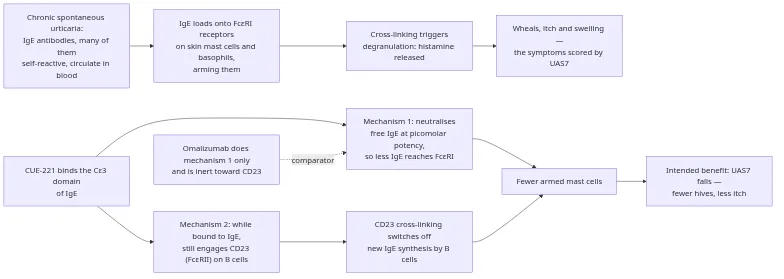
How the disease works. In chronic spontaneous urticaria, IgE antibodies — a large share of them pointed at the patient’s own tissues rather than at anything external — load onto FcεRI receptors on mast cells sitting in the skin. When two of those loaded IgE molecules are cross-linked, the mast cell dumps its granules of histamine and other irritants into the surrounding tissue. That is a hive. Do it repeatedly for more than six weeks with no identifiable trigger and it is chronic spontaneous urticaria.
How the drug is meant to work. Two mechanisms, and the second is the entire commercial argument for this molecule:
- Neutralising free IgE. CUE-221 grabs IgE out of the circulation before it can reach FcεRI, so fewer mast cells end up armed. This is what omalizumab does, and CUE-221 does it harder: the peer-reviewed characterisation reports it neutralises IgE and prevents FcεRI-mediated basophil activation and degranulation with “superior IgE-neutralizing activity to that of omalizumab” [VERIFIED — J Clin Invest 2022]. Third-party material puts the potency gap at roughly eightfold [WEB ESTIMATE — Synapse/PatSnap, read 2026-08-19; this figure was not confirmed in the primary paper and is reported as the third-party claim it is].
- Switching off new IgE production. This is the differentiated half. CD23 is a second, lower-affinity IgE receptor found mainly on B cells, and cross-linking it tells the B cell to make less IgE. Every previous anti-IgE antibody had to avoid CD23 or was simply inert toward it. The paper’s central finding is that CUE-221 in free form “bound abundantly to CD23-occupied IgE and, in oligomeric mAb-IgE complex forms, freely engaged CD23, while ligelizumab reacted limitedly and omalizumab stayed inert toward CD23” — and that this translated into CUE-221 outperforming both in CD23-mediated downregulation of IgE production [VERIFIED — J Clin Invest 2022].
How well is the target validated? As well as any target in this document could be, and not by genetics. Omalizumab — a weaker antibody against the same molecule — has been approved for this exact disease since 2014 and generates roughly $1.2 billion a year in chronic-spontaneous-urticaria revenue [WEB ESTIMATE — search summary of Novartis fiscal-year 2024 disclosure, read 2026-08-19]. “Reducing IgE relieves chronic spontaneous urticaria” is not a hypothesis; it is the standard of care. The Open Targets block noted in section 0 therefore costs this analysis very little.
The exact scientific step this readout must prove. Not that anti-IgE works — that is settled. The readout must show that CUE-221’s extra potency and its CD23 mechanism convert into a clinically larger effect than the approved comparator, in patients, at a tolerable dose. Everything published on the CD23 mechanism to date is laboratory work plus animal models plus a single-dose first-in-human study; nothing has yet shown that suppressing new IgE synthesis produces a deeper or more durable clinical response than simply mopping up the IgE already there.
The honest scientific risk. Three, in order of size:
- Superior binding has already failed to convert once, in this exact disease. Ligelizumab binds IgE more tightly than omalizumab, beat omalizumab in a 2b, and then did not beat it across two Phase 3 trials enrolling over 2,000 patients between them, after which Novartis stopped the programme [VERIFIED — ClinicalTrials.gov NCT03580356, NCT03580369, NCT04210843]. The reason is believed to be a ceiling effect: once free IgE is suppressed far enough, suppressing it further adds nothing. If that ceiling is real, CUE-221’s eightfold potency edge buys nothing either, and only the CD23 mechanism can differentiate it.
- The CD23 mechanism is unproven in humans as a clinical benefit. It is well characterised biochemically and it is genuinely novel. It has never been shown to change a UAS7 score.
- The evidence base is one primary paper, written by the sponsor. Of nine PubMed hits, exactly
one is primary research, and 27 of its 29 authors are employees of United BioPharma or its
affiliates [VERIFIED — PubMed
get_article_metadataPMID 35912861, 2026-08-19]. There is no independent replication of the CD23 finding.
A.2 Clinical development plan, timeline, feasibility, resourcing
Trials
| Trial | Sponsor / whose drug | Design (arms, blinding, n) | Population | Status / key result | Link |
|---|---|---|---|---|---|
| China Phase 2 dose-ranging — the trial that produces this catalyst | Genesis Life Sciences, a related company of Ascendant Health Sciences. CUE-221 is licensed to Cue outside mainland China, Hong Kong, Macau and Taiwan | Not disclosed. Described only as “a Phase 2 placebo and active comparator-controlled dose-ranging study in chronic spontaneous urticaria (CSU) in China”. Number of arms, number of patients, which comparator, the primary endpoint and the analysis timepoint are all undisclosed | Chronic spontaneous urticaria, China. Not otherwise specified | Ongoing. Topline “anticipated by the end of the third quarter of 2026” | No ClinicalTrials.gov record exists [VERIFIED — CT.gov search_trials and search_by_sponsor, 2026-08-19]. Description: Cue Biopharma press release 2026-04-30 |
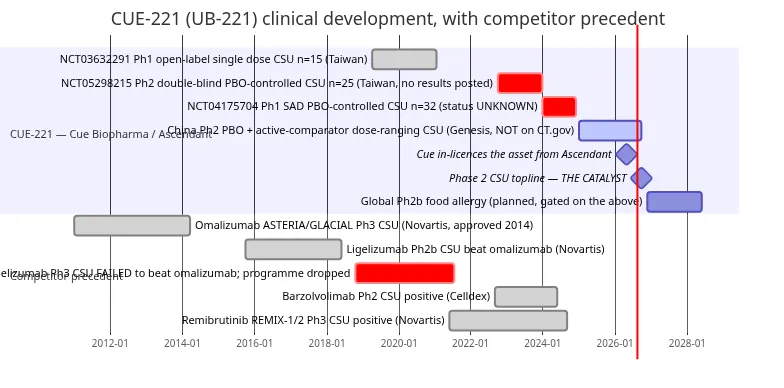
| NCT03632291 | United BioPharma / its own drug | Phase 1, open-label, dose-escalation, single dose, n = 15, no control arm | Chronic spontaneous urticaria, aged 20–65, Taiwan (National Taiwan University Hospital; Kaohsiung Chang Gung Memorial Hospital) | COMPLETED 2021-01-19. Primary outcome was adverse-event incidence over 15 days. No results posted to the registry. This is the first-in-human study whose findings appear in the J Clin Invest paper | NCT03632291 |
| NCT05298215 | United BioPharma / its own drug | Phase 2, double-blind, randomised, parallel-group, placebo-controlled. Two CUE-221 arms (5 mg/kg and 10 mg/kg intravenous) and one saline arm, randomised 2:2:1, n = 25 | Moderate-to-severe chronic spontaneous urticaria refractory to H1-antihistamines, aged 20–75, entry UAS7 ≥ 16 and HSS7 ≥ 8. Multiple centres in Taiwan | Status UNKNOWN on the registry. Primary completion date 2023-12-31 has passed by more than two and a half years with no results posted and no status update. Primary endpoint was change in serum free IgE, a laboratory measure — not a symptom score | NCT05298215 |
| NCT04175704 | United BioPharma / its own drug | Phase 1, randomised, single-blind, placebo-controlled, single ascending dose, n = 32. Starting dose 0.2 mg/kg | Chronic spontaneous urticaria, aged ≥ 18, diagnosed more than six weeks | Status UNKNOWN. Primary completion date 2024-11-30 has passed with no results posted. Primary outcome was adverse-event incidence over 99 days | NCT04175704 |
| ASTERIA I / ASTERIA II / GLACIAL — competitor precedent, omalizumab | Novartis / Genentech, their own drug | Phase 3, randomised, double-blind, placebo-controlled | H1-antihistamine-refractory chronic spontaneous urticaria | Led to FDA approval in 2014. 34–44% of omalizumab 300 mg patients reached complete control (UAS7 = 0) at week 12 [WEB ESTIMATE — search summary, read 2026-08-19] | Approval basis for the comparator |
| NCT03580356 / NCT03580369 — competitor precedent, ligelizumab | Novartis / their own drug | Phase 3, multicentre, randomised, double-blind, active- and placebo-controlled (omalizumab as the active comparator), n = 1,078 and n = 1,072 | Adolescents and adults with chronic spontaneous urticaria inadequately controlled on H1-antihistamines | COMPLETED. Ligelizumab did not demonstrate superiority to omalizumab; the extension study NCT04210843 was TERMINATED and the programme was dropped | NCT03580356 · NCT03580369 |
| NCT04833855 — competitor precedent, tezepelumab | Amgen / their own drug | Phase 2b, randomised, double-blind, placebo-controlled with an omalizumab arm, n = 183 | Chronic spontaneous urticaria | COMPLETED 2022-12-20 | NCT04833855 |
Two things in that table deserve to be said plainly. First, every registered CUE-221 trial that started after 2022 sits at status UNKNOWN with no results posted, years past its primary completion date. NCT05298215 — the only registered Phase 2, and the only one with a clinical efficacy measure anywhere in it — reached its primary completion date on 2023-12-31 and has published nothing in the thirty-two months since. Neither has NCT04175704. That is not proof of a bad result; registries are frequently left un-updated by small sponsors, especially outside the United States. It is, however, the opposite of a clean development record, and it means there is no public efficacy number for this molecule anywhere except the single-dose findings summarised in the 2022 paper.
Second, the trial that reads out cannot be inspected. Its size, its randomisation, its comparator, its primary endpoint and its analysis timepoint are all undisclosed, in a study run by a private related party of the licensor, in a jurisdiction whose data Cue’s own risk factors flag as a concern. A reader cannot check whether it is powered to show what a positive headline would claim.
Feasibility matrix
| Factor | High probability | Medium probability | Low probability | This asset (assessment) | Source |
|---|---|---|---|---|---|
| Recruitment feasibility | >50 sites, 3:1 patient:site | 20–50 sites, established investigators | <20 sites, novel sites | Not assessable, and that is the finding. The China trial’s site count is undisclosed. What is known: enrolment is complete or nearly so, since topline is six weeks away. Chronic spontaneous urticaria recruits readily in China — fourteen other Phase 2 trials in the indication are running there [VERIFIED — CT.gov, 2026-08-19] | CT.gov; Cue press release 2026-04-30 |
| Endpoint clarity | Regulatory precedent exists | Novel endpoint with FDA alignment | Unvalidated surrogate | High on the science, unknown on this trial. UAS7 is the endpoint that approved omalizumab and remibrutinib, so the regulatory precedent could not be firmer. But this study’s primary endpoint has not been disclosed, and the one registered CUE-221 Phase 2 used serum free IgE — a laboratory measure — as its primary endpoint, which would be a much weaker headline | CT.gov NCT05298215; FDA omalizumab approval 2014 |
| Trial-design robustness | Pivotal Phase III with SPA | Adaptive with interim analysis | Single-arm, no control | Medium. Randomised, placebo-controlled and active-comparator-controlled is a strong Phase 2 design — better than most. Against that: it is explicitly a dose-ranging study, which is built to compare doses rather than to prove one, and no sample size is public | Cue press release 2026-04-30 |
| Operational / execution | Enrolment complete, standard timeline | Some timeline risk | Enrolment behind | High on this trial; poor on the programme’s record. Guidance has tightened rather than slipped — “H2 2026” on 2026-05-14 became “by end of Q3 2026” on 2026-08-03 and was reaffirmed on 2026-08-14. But two earlier CUE-221 trials sit years past their completion dates with nothing posted | BPIQ note field; 8-K exhibits 2026-05-14 and 2026-08-14; CT.gov |
Resourcing sufficiency. Yes, comfortably, for this event. Cue holds roughly $67 million pro
forma and states a runway of at least twelve months from 2026-08-14; the catalyst lands about six
weeks out (../company.md C.3). Cue is not even paying for this trial — Genesis
Life Sciences is running it in the territory Cue does not own. Cue’s cost is the $15.0 million
upfront it has already paid, plus milestones, plus whatever the global Phase 2b in food allergy
costs once it starts. The resourcing question that matters is the next one: funding a global
Phase 2b, and then a Phase 3 programme against a comparator, on roughly $67 million and a $36.8
million unused at-the-market facility. That will require another raise, but not before this readout.
A.3 Target label, target product profile, strategic questions, designations
A.3a Target label. Adults and adolescents with chronic spontaneous urticaria who remain symptomatic despite H1-antihistamine therapy — the same population omalizumab is approved in — pursued outside mainland China, Hong Kong, Macau and Taiwan, which Cue’s licence excludes [VERIFIED — 10-Q Note 8]. The company’s own stated commercial priority for the molecule is food allergy rather than urticaria; chronic spontaneous urticaria is where the data comes from [VERIFIED — 8-K Exhibit 99.1, 2026-05-14].
A.3b Target product profile
| Attribute | Standard of care & key competitor(s) — data | CUE-221 target profile (goal) | Supporting evidence (+ link) |
|---|---|---|---|
| Indication / target label | Omalizumab (Xolair): approved 2014 for chronic spontaneous urticaria inadequately controlled by H1-antihistamines, aged ≥12 | Same label, positioned as a better anti-IgE; then food allergy, where omalizumab was also approved in 2024 | ChEMBL CHEMBL1201589 |
| Efficacy (endpoints, regimen) | Omalizumab 300 mg every 4 weeks: 34–44% reach UAS7 = 0 at week 12. Remibrutinib (oral, twice daily): UAS7 change −20.0 vs −13.8 placebo, 31.1% reach UAS7 = 0 vs 10.5%. Barzolvolimab 150 mg every 4 weeks: UAS7 change −23.02 vs −10.47 placebo, 51.1% reach UAS7 = 0 vs 6.4% | Beat omalizumab on UAS7 at week 12 — the bar ligelizumab failed — and hold the response longer between doses | Omalizumab, remibrutinib and barzolvolimab figures all [WEB ESTIMATE — search summaries of the ASTERIA/GLACIAL programme, the REMIX-1/REMIX-2 NEJM report (doi:10.1056/NEJMoa2408792) and the barzolvolimab dose-finding report, read 2026-08-19] |
| Safety / tolerability | Omalizumab carries a boxed warning for anaphylaxis [VERIFIED — ChEMBL black_box_warning: true]. Barzolvolimab causes hair-colour change and neutropenia through KIT inhibition [WEB ESTIMATE — search summary] | Clean anti-IgE safety, no KIT-related effects, no oral-drug systemic exposure | ChEMBL; J Clin Invest 2022 reports “a favorable safety and tolerability profile” from single-dose exposure |
| Biomarker / companion diagnostic | None used or required for omalizumab in this indication | None planned. Free IgE is used as a pharmacodynamic readout, not a patient-selection test | CT.gov NCT05298215 primary endpoint |
| Formulation / administration | Omalizumab: subcutaneous injection every 4 weeks. Remibrutinib: oral tablet, twice daily | Unresolved, and it matters. Every registered CUE-221 trial dosed intravenously — NCT05298215 is explicitly “UB-221 IV Infusion”. An intravenous infusion competing against a home subcutaneous injection and an oral tablet is a serious commercial handicap. Whether a subcutaneous formulation exists is not disclosed | NCT05298215 |
| Payer value | Omalizumab is reimbursed for antihistamine-refractory disease across major markets; biosimilars (Omlyclo, CT-P39) are now entering and will compress price | Must justify a premium over a biosimilar anti-IgE — the hardest payer conversation in this table | ChEMBL synonym list, which already carries three omalizumab biosimilar codes |
A.3c Strategic Go/No-Go questions. The asset’s next decision is whether to commit to a global Phase 2b, so the pre-Phase-II set below is the one that matches.
Pre-Phase-II (Go-to-Phase-II):
| Group | Question | Answer (tagged) |
|---|---|---|
| Target | Clinical proof of principle established in the Phase I population? | Partly. A single dose produced rapid, durable free-IgE suppression beyond twelve weeks and “durable disease symptom relief” in chronic spontaneous urticaria patients — but in an open-label, uncontrolled study of 15 people [VERIFIED — J Clin Invest 2022; CT.gov NCT03632291]. |
| Target | If the proof-of-concept population differs, how does the evidence translate? | It does not differ for this readout — both are antihistamine-refractory chronic spontaneous urticaria. It differs sharply for the company’s actual commercial target, food allergy, where no CUE-221 patient has yet been dosed [VERIFIED — CT.gov; the food-allergy IND was submitted 2026-08-03]. |
| Target | Evidence or rationale for combination therapy, and is it pursued? | Not pursued. Every trial dosed CUE-221 as an add-on to continuing antihistamines, which is the standard design, not a combination strategy [VERIFIED — CT.gov NCT03632291, NCT04175704, NCT05298215]. |
| Dose & Drug | Refined exposure–response relationship (Phase I + non-clinical)? | Weakly. Doses ranged from 0.2 mg/kg in the ascending-dose study to 5 and 10 mg/kg in the Taiwan Phase 2, but neither posted results, so no public exposure–response curve exists. The China study is dose-ranging precisely because this is unsettled [VERIFIED — CT.gov]. |
| Dose & Drug | Dose range and regimen compatible with observed safety? | [UNVERIFIED] No safety database has been published beyond the 2022 paper’s single-dose findings. |
| Dose & Drug | Formulation delivers a therapeutic exposure? | Yes, intravenously [VERIFIED — CT.gov NCT05298215]. |
| Dose & Drug | Formulation suitable for commercialisation? | [UNVERIFIED], and this is a live concern. See A.3b. An intravenous anti-IgE is not commercially viable against a subcutaneous incumbent and an oral competitor; no subcutaneous formulation has been disclosed. |
| Patient | Proposed trial design and outcome criteria to show proof of concept? | Placebo- and active-comparator-controlled dose-ranging. Strong in principle; the outcome criteria are undisclosed [VERIFIED — Cue press release 2026-04-30 for the design language; the criteria are not public]. |
| Patient | Are those criteria clinically accepted, compelling and competitive? | UAS7 is universally accepted and is what approved both omalizumab and remibrutinib. Whether this trial uses it as its primary endpoint is [UNVERIFIED]. |
| Patient | Likelihood of hitting the expected outcome? | Modelled at 72% for beating placebo, with a band of 58–83% [UNVERIFIED — modelled; the reasoning is in the Locked prediction]. Materially lower for beating the active comparator. |
| Patient | Rationale for the patient population(s)? | Sound. Antihistamine-refractory chronic spontaneous urticaria is the population omalizumab is approved in, so a win here reads directly onto an existing commercial market [VERIFIED — FDA omalizumab approval 2014]. |
| Patient | If a stratification biomarker is used, which validated method identifies patients? | None used [VERIFIED — CT.gov: no biomarker selection in any registered CUE-221 trial]. |
| Patient | Companion-diagnostic strategy included? | No, and none is needed — omalizumab has none in this indication [VERIFIED — CT.gov; ChEMBL]. |
| Patient | Candidate for Breakthrough Therapy or another early regulatory route? | [UNVERIFIED] No designation has been announced. Unlikely on the current evidence: Breakthrough Therapy requires preliminary clinical evidence of substantial improvement over available therapy, and the only public clinical evidence is an uncontrolled 15-patient study. |
A.3d Regulatory designations. None disclosed [VERIFIED — Cue Biopharma press releases
2026-04-30 through 2026-08-18, and the 10-Q filed 2026-08-14, none of which announces or references
any designation]. No Fast Track, no Breakthrough Therapy, no Orphan Drug, no Priority Review
voucher. That is unsurprising: chronic spontaneous urticaria has an approved therapy, which rules
out orphan status and raises the bar for the accelerated routes. The one regulatory step that has
happened is an Investigational New Drug application submitted to the FDA on 2026-08-03 for the
food-allergy indication — permission to begin a US trial, not a designation and not an approval
[VERIFIED — BPIQ fetch_company_historical_catalysts; 8-K Exhibit 99.1, 2026-08-14].
A.4 Target product profile valuation matrix
| Stakeholder | Value driver | Minimum threshold | Competitive | Premium | Benchmark / source |
|---|---|---|---|---|---|
| Patient / caregiver | Freedom from hives and itch, and how often an injection is needed | Statistically better than placebo on UAS7 | Matches omalizumab’s 34–44% complete-response rate at week 12, at monthly dosing | Beats omalizumab’s complete-response rate, and holds it on quarterly rather than monthly dosing — the 12-week free-IgE suppression from one dose is the only reason to think this is reachable | Omalizumab ASTERIA/GLACIAL [WEB ESTIMATE — search summary, 2026-08-19]; J Clin Invest 2022 for the duration claim |
| Regulator | Evidence of a clinically meaningful effect on a validated endpoint | UAS7 superiority to placebo, adequately powered | Superiority to placebo confirmed in two Phase 3 trials | Superiority to omalizumab, the ligelizumab bar | FDA omalizumab approval 2014; CT.gov NCT03580356/NCT03580369 |
| Payer / HTA | Cost per patient reaching complete response, against a biosimilar comparator | Non-inferior to omalizumab at a lower or equal price | Better complete-response rate at parity price | Better response and fewer administrations, so total cost of care falls even at a per-dose premium | Omalizumab biosimilars already listed (Omlyclo, CT-P39, GBR-310) [VERIFIED — ChEMBL CHEMBL1201589 synonyms] |
| Provider | Ease of administration and monitoring burden | Any route that works | Subcutaneous, monthly, at home | Subcutaneous, quarterly, at home, no boxed warning | Omalizumab carries a boxed anaphylaxis warning [VERIFIED — ChEMBL black_box_warning: true]; remibrutinib is oral twice daily |
Calibration examples, not asset claims: in oncology each incremental month of overall survival is worth roughly $150–300M in peak-sales potential; oral formulations command roughly 15–25% price premiums over injectables. The second of those cuts against this asset rather than for it — the principal oral competitor in this indication is remibrutinib.
A.5 Evidence quality and endpoints
| Criterion | Score (High / Medium / Low) | Basis (one line) | Link |
|---|---|---|---|
| Target validation | High | An approved drug against the same target in the same disease since 2014, generating roughly $1.2 billion a year — this is the strongest form of validation available, and it does not depend on the blocked Open Targets call | ChEMBL CHEMBL1201589 |
| Mechanism clarity | High | Both mechanisms are precisely specified at the molecular level — Cε3-domain binding and CD23 engagement — and were measured directly by surface plasmon resonance and cell assays | doi:10.1172/JCI157765 |
| Biomarker availability | Medium | Serum free IgE is an excellent target-engagement readout and is available same-day; it is not a validated surrogate for symptom relief, which is exactly the gap ligelizumab fell into | NCT05298215 |
| Publication quality (peer-reviewed? independent authors?) | Low | One primary paper in twenty years of the molecule’s existence, in a strong journal (J Clin Invest, 2022) — but 27 of its 29 authors are employees of United BioPharma or its affiliates, the CD23 finding has never been independently replicated, and no efficacy result from any of the three registered trials has ever been published | PubMed 35912861 |
| Clinical / expert sentiment | — | Moved to A.5b, below. | — |
Endpoints
| Endpoint (full name) | What it measures | Scale / range | Better direction | MCID / note |
|---|---|---|---|---|
| Urticaria Activity Score over 7 days (UAS7) | Daily patient-scored hive count (0–3) plus itch severity (0–3), summed over seven days | 0–42 | Lower | A change of roughly 9.5–11 points is generally taken as the minimal clinically important difference [WEB ESTIMATE — CSU literature summary, read 2026-08-19]. UAS7 = 0 is complete response; UAS7 ≤ 6 is well controlled. The endpoint that approved omalizumab and remibrutinib |
| Hives Severity Score over 7 days (HSS7) | The hive half of UAS7 on its own | 0–21 | Lower | Used as an entry criterion in NCT05298215 (HSS7 ≥ 8) rather than as a primary outcome [VERIFIED — CT.gov] |
| Itch Severity Score over 7 days (ISS7) | The itch half of UAS7 on its own | 0–21 | Lower | Often the endpoint patients care about most; not a primary outcome in any registered CUE-221 trial |
| Change in serum free IgE from baseline | Concentration of IgE not bound to drug, measured in blood | Continuous, ng/mL; typically driven down by >90% by an effective anti-IgE | Lower | No established MCID, because it is a pharmacodynamic measure and not a clinical one. This was the primary endpoint of the only registered CUE-221 Phase 2 [VERIFIED — CT.gov NCT05298215], and if the China study repeats that choice, a “met its primary endpoint” headline would say nothing about symptoms |
| Time to complete response (UAS7 = 0) | How long from first dose until hives and itch stop entirely | Days | Lower | A secondary endpoint of NCT05298215 [VERIFIED — CT.gov] |
| Adverse event / serious adverse event incidence | Count and severity of unwanted effects | Count | Lower | The primary endpoint of both registered Phase 1 trials [VERIFIED — CT.gov NCT03632291, NCT04175704] |
A.5b Key opinion leaders.
Panel as of. 2026-08-19.
Investigators
The pivotal China study is not on ClinicalTrials.gov, so no investigator on the trial that
produces this catalyst could be identified. search_investigators was instead run against the
registered Taiwan trials. It returned one name in an administrative contact role, not an
investigator role. The two people below are the clinical co-authors of the first-in-human report —
the only individuals publicly identifiable as having run a CUE-221 trial. Both are recorded with the
sponsor relationship their own byline discloses.
| Name | Role / affiliation | Trial (NCT) | Conflicts (party, kind, disclosed in, as of) | Conflicts checked (source, date) | Source | Tag |
|---|---|---|---|---|---|---|
| Chia-Yu Chu | Department of Dermatology, National Taiwan University Hospital and National Taiwan University College of Medicine | NCT03632291 (a listed site; role not stated in the registry record) | United BioPharma, the molecule’s originator (now licensed to Cue Biopharma) — co-authorship on the sponsor’s own characterisation and first-in-human report alongside 27 sponsor employees; disclosed in the author list of J Clin Invest 2022;132(15); as of 2022-08-01 | PubMed get_article_metadata PMID 35912861, 2026-08-19 — complete author list and affiliations retrieved; the article’s own declaration-of-interest section is not carried by this connector, so no formal disclosure statement was read. CT.gov get_trial_details NCT03632291, NCT04175704, NCT05298215 and search_investigators (Taiwan, chronic spontaneous urticaria), 2026-08-19 — no further relationship recorded | PubMed 35912861; NCT03632291 | VERIFIED — PubMed get_article_metadata 2026-08-19 |
| Chih-Hung Lee | Department of Dermatology, Kaohsiung Chang Gung Memorial Hospital and Chang Gung University College of Medicine | NCT03632291 (a listed site; role not stated in the registry record) | United BioPharma, the molecule’s originator (now licensed to Cue Biopharma) — co-authorship on the sponsor’s own characterisation and first-in-human report; disclosed in the author list of J Clin Invest 2022;132(15); as of 2022-08-01 | Same searches as the row above, 2026-08-19 — no further relationship recorded | PubMed 35912861; NCT03632291 | VERIFIED — PubMed get_article_metadata 2026-08-19 |
Independent voices
One voice qualified. It is a thin panel and the reason is worth stating: nobody outside the sponsor has published on CUE-221’s clinical performance, because no efficacy result has ever been published for anyone to comment on.
One notable omission, recorded deliberately. Marcus Maurer (Institute of Allergology, Charité — Universitätsmedizin Berlin) is the most-cited commentator in this indication and appears as senior author on two of the nine retrieved papers that mention CUE-221. He is not listed below, because he holds well-known relationships across competing chronic-spontaneous-urticaria sponsors and this sweep did not verify that disclosure set. Recording him as “independent” without having read his conflicts would be exactly the unevidenced claim rule 40 forbids.
| Name | Affiliation | View (close enough to quote) | As of | Conflicts checked (source, date) | Source | Tag |
|---|---|---|---|---|---|---|
| Bettina Wedi | Department of Dermatology and Allergy, Comprehensive Allergy Center, Hannover Medical School | Surveying the whole chronic-urticaria pipeline, she places CUE-221 behind its rivals on development pace: “the assumed early approval of ligelizumab will expand the effective and safe anti-IgE approach observed with omalizumab. For other anti-IgEs like UB-221, the development is behind.” An earlier review by the same author lists CUE-221 among approaches “under investigation” without endorsing its endpoint | 2022-02-18 (the later review; the earlier is 2021-02-17) | PubMed get_article_metadata PMIDs 35166638 and 33628747, 2026-08-19 — full metadata and abstracts retrieved; this connector does not carry either journal’s declaration-of-interest section, so no formal disclosure was read, and this column certifies the search rather than the absence. CT.gov get_trial_details on all three registered CUE-221 trials and search_investigators, 2026-08-19 — she is not an investigator on any of them, and no United BioPharma, Ascendant Health, Genesis Life Sciences or Cue Biopharma relationship was found | doi:10.1080/13543784.2022.2042513; doi:10.2147/ITT.S261416 | VERIFIED — PubMed get_article_metadata 2026-08-19 |
Judgement
| Endpoint supported | Basis (one or two sentences) | Tag |
|---|---|---|
| UNKNOWN | The panel is too thin to judge. One independent voice qualified, and her published view is about development pace rather than about whether CUE-221 will move UAS7 — nobody independent has commented on the endpoint, because no efficacy result has ever been published for anyone to comment on. The two identifiable investigators both carry a disclosed sponsor relationship, so their views cannot stand in for independent support. | UNVERIFIED — judgement |
Dissent
Empty. endpoint_supported is UNKNOWN rather than SUPPORTIVE_CONTESTED, so no named
disagreement is required, and inventing one nobody holds would be worse than leaving this blank.
B. Commercial assessment
B.0 Current treatment algorithm
What a patient with chronic spontaneous urticaria receives today, in order:
- A second-generation H1-antihistamine at the standard dose — cetirizine, fexofenadine, bilastine and similar. Cheap, oral, safe, and enough for roughly half of patients.
- The same antihistamine at up to four times the standard dose. This is the guideline-endorsed second step. Even after it, 40–60% of patients still do not achieve adequate control [WEB ESTIMATE — CSU treatment literature summary, read 2026-08-19].
- Omalizumab, 300 mg subcutaneously every four weeks. The only approved biologic in this indication, and the only one recommended by international guidelines. Roughly a third to a half of these patients reach complete response; the rest do not [WEB ESTIMATE — ASTERIA/GLACIAL summary, read 2026-08-19].
- Ciclosporin or another immunosuppressant, off-label, for omalizumab non-responders. Effective but poorly tolerated, with kidney and blood-pressure monitoring.
Where CUE-221 would fit: step 3, displacing omalizumab, or step 3b, taking the patients omalizumab fails. Those are two very different commercial propositions. Displacing omalizumab means beating it head-to-head — the bar ligelizumab could not clear — into a market where biosimilars are already arriving. Serving omalizumab failures is a smaller, better-defended niche, but it is also precisely where two non-anti-IgE mechanisms are heading: remibrutinib, an oral BTK inhibitor Novartis has taken through positive Phase 3, and barzolvolimab, Celldex’s anti-KIT antibody that depletes mast cells outright. Neither depends on IgE, so neither has the ceiling problem that sank ligelizumab.
B.1 Competitive landscape and positioning
| Metric | High value | Medium value | Low value | This asset (assessment) | Source |
|---|---|---|---|---|---|
| Mechanism differentiation | First-in-class or novel target | Next-generation improvement | Me-too | Medium, and the honest word is “next-generation”. The target is the same one omalizumab has hit since 2014. The genuinely novel element is the CD23 engagement, which no other anti-IgE achieves — but a novel feature on an established target is a next-generation improvement, not a first-in-class asset | doi:10.1172/JCI157765 |
| Development-timeline advantage | >12 months ahead | Within 6–12 months | Lagging >12 months | Low — lagging badly. Remibrutinib has completed positive Phase 3 (REMIX-1 and REMIX-2). Barzolvolimab is in Phase 3. CUE-221 is finishing a Phase 2 dose-ranging study and has not started a trial in Cue’s own territory. It is at least three to four years behind both | doi:10.1056/NEJMoa2408792; CT.gov |
| Clinical proof-of-concept evidence | Positive Phase IIb (n>100) | Phase IIa signals (n=20–50) | Preclinical only | Medium at best. The only registered Phase 2 enrolled 25 patients and never posted a result; the published clinical evidence is a 15-patient open-label single-dose study | NCT05298215; NCT03632291 |
| IP protection | Composition-of-matter, long-dated | Method-of-use | Pending or none | Medium. A composition-of-matter patent exists — US 10,047,166 B2, “Humanized anti-IgE antibodies that crosslink CD23 on B lymphocytes but do not sensitize mast cells” — but it granted in 2018, so a 20-year term from a filing in the mid-2010s runs to roughly the mid-2030s. A drug approved around 2031 would have a short protected commercial life on that patent alone, though biologics also carry 12 years of US regulatory exclusivity from approval, which would matter more | [WEB ESTIMATE — Google Patents / Synapse patent record, read 2026-08-19] |
Where this asset wins, and the single fact the thesis rests on. It wins in one place only: if suppressing new IgE synthesis through CD23 produces a deeper or longer-lasting response than mopping up existing IgE, and if that shows up as a bigger UAS7 improvement than omalizumab delivers. The single fact the thesis rests on is the CD23 engagement demonstrated in J Clin Invest 2022 — a real, precisely characterised, laboratory finding that has never been shown to change a patient outcome. Everything else about this asset is worse than its competitors: it is later, it is intravenous, its evidence base is one sponsor-authored paper, and it has no data in the territory its licensee actually owns.
Calibration example, not an asset claim: oncology first-movers in novel mechanisms have shown roughly 3.2× higher peak-sales potential but about 1.8× higher development risk. CUE-221 is not a first-mover on its mechanism; it is a fourth entrant on a target opened in 2014.
B.2 Addressable market
Launch markets. The United States first, then EU5 and Japan — the territory Cue’s licence covers. Mainland China, Hong Kong, Macau and Taiwan are excluded and belong to Ascendant, which is also where the only trial is running [VERIFIED — 10-Q Note 8].
| Component | How it is estimated | Premium threshold | This asset (assessment) | Source |
|---|---|---|---|---|
| Drug-treated patients | Epidemiology × diagnosis rate × treatment rate | >100,000 (US/EU5/Japan) | Roughly 40,000–60,000 today, growing. The honest anchor is not epidemiology but the observed market: omalizumab’s chronic-spontaneous-urticaria revenue of about $1.2 billion a year, at a plausible $20,000–$30,000 net per patient per year, implies 40,000–60,000 treated patients globally. Epidemiology suggests a far larger theoretical pool — 0.5–1.0% point prevalence across roughly 780 million people in these markets, of whom 40–60% are antihistamine-refractory, giving 1.6–4.7 million — but the gap between that and 50,000 is the diagnosis-and-referral funnel, and it is enormous | [WEB ESTIMATE — Novartis FY2024 CSU revenue and CSU prevalence literature, both read 2026-08-19] |
| Market exclusivity | Patent term + regulatory exclusivity | >10 years combined | Borderline. US biologics carry 12 years of regulatory exclusivity from approval, which on a ~2031 launch would run to ~2043 and clears the threshold. The composition-of-matter patent granted 2018 does not, on its own | [WEB ESTIMATE — patent record read 2026-08-19] |
| Reimbursement precedent | Approvals in ≥2 major markets | Positive NICE/CADTH guidance | Strong, and it belongs to the competitor. Omalizumab is reimbursed for this indication across the US, EU5 and Japan, so the pathway is proven — but that same precedent now includes biosimilars, which set the price a newcomer must justify a premium against | [VERIFIED — ChEMBL CHEMBL1201589: EMA records for both Xolair and the Omlyclo biosimilar] |
| Patient-journey impact | Fewer hospital days, less caregiver burden | >30% quality-of-life gain | Potentially high, if quarterly dosing is real. Chronic spontaneous urticaria is not a hospitalising disease; the burden is relentless itch, sleep loss and work absence. Going from monthly to quarterly injections is a genuine patient-journey gain — but it depends on a subcutaneous formulation that has not been disclosed | J Clin Invest 2022 for the >12-week suppression; A.3b for the formulation gap |
B.3 Value and feasibility
B.3a Expected peak sales. Built bottom-up, in the Cue territory only (world excluding mainland China, Hong Kong, Macau and Taiwan), conditional on approval, and excluding food allergy entirely — food allergy is the larger prize the company is actually chasing, but no patient has been dosed and no estimate for it would be defensible.
| Scenario | Assumptions (patients × price × share) | Estimate (USD/year at peak) | Basis / tag |
|---|---|---|---|
| Low | 6,000–10,000 treated patients × $14,000–$16,000 net per year | $85–160 million | The result if CUE-221 clears approval but never beats omalizumab: a third-line option for biosimilar failures, roughly 15% of a niche. [UNVERIFIED — modelled. Patient pool from the omalizumab-revenue anchor in B.2; price from biosimilar-compressed anti-IgE pricing] |
| Base | 25,000–35,000 treated patients × $16,000–$20,000 net per year | $400–700 million | Approval on a modest efficacy edge, taking meaningful share of the anti-IgE segment while remibrutinib and barzolvolimab take the rest of the growth. [UNVERIFIED — modelled, same inputs] |
| High | 45,000–60,000 treated patients × $20,000–$24,000 net per year | $900 million–$1.4 billion | Requires CUE-221 to beat omalizumab clearly, on quarterly subcutaneous dosing, and to hold that position against two mechanisms that do not depend on IgE at all. This is the scenario the whole thesis is priced for and it needs several unproven things to be true at once. [UNVERIFIED — modelled, same inputs] |
No single figure is given, and none should be, because two of the three inputs — the price a differentiated anti-IgE can hold against a biosimilar, and the share it takes from two better-placed competitors — are unverified (rule 10). Every figure above is a global-territory-excluding-Greater-China number, at peak, conditional on approval, before the high single-digit to low double-digit royalty owed to Ascendant.
B.3b Feasibility
| Question | Answer (tagged) |
|---|---|
| Expected net present value (eNPV) | $100–450 million, risk-adjusted [UNVERIFIED — modelled, with assumptions stated so they can be argued with]. Built from: the $400–700 million base peak above; a probability of reaching approval from Phase 2 in immunology of 15–25%; a net-present-value multiple of roughly 2.5× peak sales for a specialty biologic; a launch around 2031; a 12% discount rate; and the 8–12% royalty owed back to Ascendant. The range is wide because every one of those six inputs is unverified. Against a recomputed enterprise value of roughly $212 million on economic shares (../company.md C.4), the midpoint of this range sits close to where the market already has it — which is the single most useful thing this row says. |
| Capital to the next decision point | Effectively nil. Genesis Life Sciences is paying for the trial that reads out; Cue’s cost was the $15.0 million upfront it has already paid [VERIFIED — 10-Q Note 8]. Cue holds roughly $67 million (../company.md C.3). |
| Capital to approval, and the funding plan | Far more than the company has, and no plan is disclosed. A global Phase 2b in food allergy followed by a Phase 3 programme against an active comparator in chronic spontaneous urticaria — the ligelizumab trials enrolled over 1,000 patients each — is a several-hundred-million-dollar undertaking. Cue has roughly $67 million and $36.8 million of unused at-the-market capacity. The gap is closed by partnering, by repeated equity raises, or not at all. [UNVERIFIED — no capital plan beyond the next twelve months has been disclosed] |
| Launch capability — alone, or must partner? | Must partner. Cue has no commercial organisation of any kind, and chronic spontaneous urticaria is a large primary-care-adjacent specialty market. [UNVERIFIED — the company has not addressed this publicly] |
| Commercialisation rights — retained, split, or out-licensed? | Retained, with a large economic burden attached. Cue holds exclusive worldwide rights excluding mainland China, Hong Kong, Macau and Taiwan, and owes Ascendant up to $676.5 million in milestones plus high single-digit to low double-digit royalties, plus the Top-Up Obligation taking Ascendant to no less than 7.5% of shares outstanding. A sublicence granted within 18 months of 2026-04-30 shares 20–40% of its proceeds with Ascendant, and a change of control in that window accelerates up to $215.0 million of milestones — a real disincentive to being acquired before 2027-10 [VERIFIED — 10-Q Notes 8 and 11]. |
B.4 Product-development risk
Framing questions.
- Does the development plan support the target product profile claims? Only partly. The target product profile claims superiority over omalizumab and, implicitly, less frequent dosing. A dose-ranging Phase 2 with an active comparator can suggest the first; nothing in the disclosed plan addresses the second, because no subcutaneous formulation has been disclosed, and the registered trials all dosed intravenously.
- Will the identified risks affect the target product profile? Yes, two of them directly. The formulation gap attacks the “payer value” and “provider” rows outright. The unregistered, unspecified trial design means the efficacy row cannot be checked against the evidence that will be used to claim it.
- If a risk cannot be mitigated, is the asset still differentiated from competitors? If the CD23 mechanism does not convert into a clinical benefit, then no. What remains is an intravenous anti-IgE arriving seven or more years after omalizumab’s biosimilars, against an oral competitor with completed positive Phase 3 data. Differentiation in that world is zero.
| Category | Time risk | Quality risk | Cost risk | Note |
|---|---|---|---|---|
| Project management | Medium | Medium | Low | The trial is run by a related party of the licensor, in a territory Cue does not own, on a timeline Cue does not control. Cue’s own guidance has held firm, but the execution is not Cue’s |
| Research | Low | High | Low | One primary paper, sponsor-authored, no independent replication of the differentiating CD23 finding |
| IP | Low | Medium | Low | Composition-of-matter patent exists and granted in 2018; the effective protected commercial life on a ~2031 launch depends more on biologic regulatory exclusivity than on that patent |
| Legal | Low | Low | Medium | The Ascendant sublicence-sharing and change-of-control acceleration terms materially constrain strategic options until roughly 2027-10 |
| DMPK | Low | Medium | Low | Single-dose free-IgE suppression beyond twelve weeks is a genuinely good pharmacokinetic result; multiple-dose data has never been published |
| Safety pharmacology | Low | Medium | Low | No published signal. Also no published database beyond the 2022 paper |
| Toxicology | Low | Low | Low | Non-human primate work reported in J Clin Invest 2022 with no reported concern |
| Drug safety (clinical) | Low | Medium | Low | ”Favorable safety and tolerability profile” reported from single-dose exposure in 15 patients. Anti-IgE class carries an anaphylaxis risk — omalizumab has a boxed warning — and 15 patients cannot exclude it |
| Biomarker | Low | Low | Low | Free IgE works well as a target-engagement readout; nothing depends on a patient-selection biomarker |
| Clinical pharmacology | Medium | High | Medium | No public exposure–response curve. Doses across the registered programme span 0.2 mg/kg to 10 mg/kg with no published result at any of them. This dose-ranging study is meant to fix that, which is also why a “positive” headline may be about dose selection rather than efficacy |
| Clinical (efficacy) | Medium | High | High | The central risk. Beating placebo is likely; beating the active comparator is the bar ligelizumab failed on the same target in the same disease with over 2,000 patients |
| Clinical operations | Medium | High | Low | Two registered trials sit years past their primary completion dates with no results posted and status UNKNOWN. Whatever the reason, it is not a record that builds confidence in the reporting of the trial now reading out |
| CMC / manufacturing | Medium | High | Medium | The formulation gap. Every registered trial dosed intravenously. A commercially viable product needs subcutaneous delivery, which is a real chemistry-and-manufacturing programme, not a formality — high-concentration antibody formulation is where such programmes commonly stall. The licence’s first two milestones are $5.0 million for manufacturing technology transfer and $6.5 million for data and know-how transfer, which tells you the technology has not moved yet [VERIFIED — 10-Q Note 8] |
| Regulatory | Medium | High | Medium | Cue’s own risk factors name “potential challenges associated with clinical trials conducted in China and the company’s access to, and acceptability of, the data therefrom” [VERIFIED — 8-K Exhibit 99.1, 2026-08-14]. The FDA’s willingness to accept a China-only dataset as pivotal evidence has tightened considerably; this trial is not pivotal, but it is the basis for the Phase 2b design |
| Global evidence & value | Medium | Medium | Medium | No health-economic work disclosed. The comparator is about to be a biosimilar |
| Commercial | Medium | High | High | No commercial organisation, an intravenous formulation, two better-placed competitors, and a royalty and milestone stack owed to the licensor |
Readout
Sources
| Kind | Where it comes from | What it is worth | Value (or null) | Tag | Note |
|---|---|---|---|---|---|
bpiq | fetch_company_drugs — catalyst_date, catalyst_date_text | The current single source. Synthesized from period text on most rows, so alone it is a ceiling, not an estimate. | 2026-09-30 | VERIFIED — BPIQ fetch_company_drugs 2026-08-19 | catalyst_date_text reads “Q3 2026”. A quarter-end placeholder, exactly the pattern rule 23 describes: the last day of the named period. Not a disclosed day, and not used for any timing decision below |
ctgov | CT.gov get_trial_details — primary_completion_date | Independent of the company’s own messaging, month-precision, and it moves when the trial moves. | null | VERIFIED — CT.gov search_trials, search_by_sponsor and a China-filtered Phase 2 search, all 2026-08-19 | The trial is not registered on ClinicalTrials.gov. Searched by condition and intervention (15 hits, none it), by sponsor “Ascendant” (0 hits), and by condition + China + Phase 2 (14 hits, none it). The three registered CUE-221 trials are all earlier Taiwan studies and none of them produces this catalyst. So the one source that would be independent of the company’s messaging does not exist, and the whole window below rests on the company’s own guidance |
company | fetch_company_press_releases | The company’s own most recent dated wording. Also where the slip sequence below comes from. | 2026-09-30 | VERIFIED — Cue Biopharma 8-K Exhibit 99.1, filed 2026-08-14 | Mandatory, because the catalyst is inside twelve months. Verbatim: “Phase 2 data readout in Chronic Spontaneous Urticaria anticipated by the end of the third quarter of 2026”, and in the chief executive’s quote, “We look forward to anticipated CUE-221 Phase 2 data by the end of this quarter.” Read from the SEC filing rather than from a secondary report |
congress | data/congresses.json | Answers “where will they say it.” | null | VERIFIED — Cue Biopharma press releases 2026-04-30 to 2026-08-18, read 2026-08-19 | The company has never said it intends to present these data at any meeting. Matching on therapeutic area alone would be a guess, and a guess is not a source (02-connectors.md § Data limits). The data will most likely arrive as a press release |
modelled | Trial arithmetic — see below | The only estimate independent of anyone’s guidance. | 2026-09/2026-12 | UNVERIFIED — modelled, default lag | See below. The usual arithmetic cannot be run because there is no registry primary completion date to run it from |
The modelled estimate. The standard arithmetic — a registry primary completion date plus the
lag to database lock and analysis — cannot be computed here, because the ctgov row above is
null. The arithmetic actually used is stated instead so it can be argued with: take the company’s
own stated ceiling of 2026-09-30, and add the lag between a trial finishing and a licensee being
able to announce it, which here includes a data-and-know-how transfer from Genesis Life Sciences to
Cue that the licence prices as a separate $6.5 million milestone and that has not yet been paid
[VERIFIED — 10-Q Note 8]. Applying the stated default lag of two to four months to that transfer
step, rather than to a database lock, gives a plausible band of 2026-09 to 2026-12, and this is
tagged [UNVERIFIED — modelled, default lag] because data/benchmarks/readout-lag.json holds no
observation for a comparable trial (its observations array is empty). The tag is doing real work
here: this is a stated default applied to a step it was not written for, on a trial nobody outside
the sponsor can inspect.
Window
| Earliest | Likeliest | Latest | Precision | Confidence |
|---|---|---|---|---|
| 2026-09-15 | 2026-09-30 | 2026-12-15 | PERIOD | MEDIUM |
Basis. The only substantive source is the company’s own guidance, which names a quarter-end
ceiling rather than a day or a month, so the precision is PERIOD and no amount of confidence in
the company can raise it — that is a fact about what was disclosed, not about who disclosed it.
Earliest is set at 2026-09-15 because on 2026-08-14 the chief executive said the data was expected
“by the end of this quarter”, which admits a landing in the second half of September but effectively
rules out the days immediately after that statement. Likeliest is 2026-09-30, the guided ceiling,
because a company that reaffirms an end-of-quarter date twice in twelve days usually delivers at the
edge of it. Latest is 2026-12-15 rather than 2026-09-30, because Cue does not run this trial and
cannot announce data it has not received: the licensor’s data-and-know-how transfer is a separately
priced, unpaid milestone, and a one-quarter slip is the ordinary consequence if it is slow.
Confidence is MEDIUM and not HIGH because the guidance has been reaffirmed three times without
slipping, which is genuinely reassuring, but the corroborating registry source that would normally
support it does not exist.
Disagreement. CONSISTENT. The two sources that returned a value — BPIQ’s placeholder and the
company’s own statement — both resolve to 2026-09-30, and they do so because BPIQ synthesized its
placeholder from that same guidance. Note what that means: they agree because they are the same
source read twice, not because two independent sources converged. The genuinely independent
check — the registry — returned nothing.
Date slippage. Parsed from the BPIQ note field and the company’s own releases, oldest first.
| As of | Guidance text |
|---|---|
| 2026-05-14 | ”China Phase 2 CSU study data expected in H2 2026” |
| 2026-08-03 | ”Phase 2 CSU data readout expected by end of Q3 2026” |
| 2026-08-14 | ”Phase 2 CSU data is expected by the end of Q3 2026” |
Zero slips, and one tightening. Three dated statements, two transitions, and neither is a slip:
“H2 2026” narrowed to “end of Q3 2026”, and “end of Q3 2026” was then reaffirmed unchanged. Guidance
moving earlier is the opposite of the pattern 02-connectors.md warns about, and it is the single
most encouraging fact in this section.
Attribution
Status. CLEAN
| Status | Means |
|---|---|
CLEAN | conflicts is empty — nothing else has_catalyst on this ticker’s pipeline lands within the window. |
Conflicts
Empty, as CLEAN requires.
| bpiq_drug_id | Label | Date | Analysed? | Gap (days) | Confirmed? |
|---|
Computed, not authored: lib/clustering.mjs’s attributionFor was run over this ticker’s pipeline
for bpiq_drug_id 20405 at CATALYST_CLUSTER_MIN_MONTHS = 6 and returned
{"status":"CLEAN","conflicts":[]}. The reason is structural rather than lucky: bpiq_drug_id
20405 is the only row on CUE’s entire pipeline with has_catalyst: true (../company.md
C.2). The other four rows carry no pending catalyst, so there is nothing on this ticker for this
window to collide with. A price move around this readout is attributable to this program alone.
Note. Not required — CLEAN.
Market and timing for this event
- Plain takeaway. The whole company rides on this. The shares are 5.2× their 52-week low with no data behind that move, then 43% below the high they reached in June, and two specialist investors paid $33.21 six weeks ago for stock now at $26.10. The market has walked the price back from the licensing euphoria without waiting for the result.
- Months to this catalyst. About 0.9 months — roughly four weeks — from 2026-08-19 to
readout.window.earliestof 2026-09-15. Said plainly:readout.precisionisPERIOD, so this is the earliest edge of a window that could extend to 2026-12-15, not a countdown to a known date. - Expected move around this event.
../company.mdC.6 records the options chain as structurally unusable — no listed strike within $21 of spot — so no market-implied move can be read, and a bracket is given instead of a point estimate. Calibrated againstframework/07-benchmarks.md: the Phase 2 class averages are +12% on a positive and −16% on a negative; immunology runs +8% / −16%; a placebo-controlled design carries a 29% amplitude and a head-to-head design 72%, and this trial is both placebo- and active-comparator-controlled, so it sits between the two; and a company under $1 billion in market capitalisation reacts about 9.5× more strongly at Phase 2 than one above it, which CUE is at roughly $190 million. Bracket: a move of 25% to 55% in absolute terms, in either direction [WEB ESTIMATE — IQVIA 2024]. This ticker’s own history supports the wide end rather than the class average: it moved +12.85% intraday on a Phase 1 poster (../company.mdC.7). - Nearest comparable past reaction. The 2024-11-08 row of
../company.mdC.7 — Phase 1 CUE-101 data at SITC, +12.85% intraday. It is the closest analogue because it is the only row in that table that is a clinical data event with a clean press-feed check. It is not a good analogue in three ways, all of which point the same direction: it was a Phase 1 poster rather than a controlled Phase 2 readout, it was on an asset that carried a fraction of the company’s value rather than nearly all of it, and it predates the 1-for-30 reverse split and the entire change of business. A readout on the dominant asset of a single-asset company should move the shares considerably more than 12.85%. - Materiality. Dominant — the word recorded for this program in
../company.mdC.2. It is the only pipeline row with a pending catalyst, on the asset the company itself calls its lead, and the entire re-rating of the shares traces to its in-licensing. The stock-direction call below is sized on that: this is not a program that nudges the shares, it is the program that sets them. - Date slippage. Zero slips across three dated statements, with one tightening from “H2 2026” to “end of Q3 2026”. See Readout, above.
Spot. $26.10, read 2026-08-19, cited from ../company.md C.1 and C.4.
On the published analyst targets: they are unusable and are not carried into any figure below. A search returned a $3.00 average from two analysts, a $115.00 target from one, and a $5.13 consensus from eight with a $10.00 high dated 2024 [WEB ESTIMATE — aggregator summaries, read 2026-08-19]. Those cannot all be about the same security, and they are not: CUE did a 1-for-30 reverse split on 2026-04-23, and the aggregators are mixing pre-split and post-split targets without adjustment. $5.13 pre-split is $153.90 post-split; $3.00 pre-split is $90.00. Rule 6 requires rejecting a broken third-party figure rather than passing it through, so no analyst target appears among the anchors below.
Scenario prices
| Scenario | Low | High | Anchors (each named and tagged) | Basis |
|---|---|---|---|---|
| Positive | $24 | $46 | (1) 52-week high, $45.50 [VERIFIED — BPIQ fetch_company_info 2026-08-19] — what the market paid for this asset in June 2026 on the licensing story with no data at all. (2) July 2026 private placement clearing price, $33.21 [VERIFIED — 10-Q Note 14] — where Cormorant Asset Management and Columbia Threadneedle bought 1,418,071 shares six weeks before the readout. (3) Dilution mechanism firing on the event: the Ascendant Top-Up Obligation, which issues Ascendant enough shares or pre-funded warrants to reach no less than 7.5% of shares outstanding on milestone achievement, alongside a development-and-regulatory milestone tranche of up to $205.0 million that explicitly includes a payment “upon receipt of threshold data from a specified Phase 2 clinical trial” [VERIFIED — 10-Q Note 8] | The range is wide on purpose, because the pre-registered positive definition below is “beats placebo”, and that definition spans two very different worlds. At the low end sits the technically-positive-but-comparator-tying result: placebo cleared, omalizumab matched, the ligelizumab outcome. In that world the shares do not rise at all and could sit at or just below today’s price, so the low edge is set at $24 rather than above spot. At the high end sits a clear comparator win, which should at minimum restore the $45.50 the market paid on hope and could exceed it, capped by the top-up dilution and the milestone cash the same event triggers. Calibrated against framework/07-benchmarks.md [WEB ESTIMATE — IQVIA 2024]: the +12% Phase 2 and +8% immunology class averages sit far below the top of this range, and the reason is program-specific rather than optimism — the class averages blend companies above and below $1 billion, while the same source puts sub-$1-billion companies at 9.5× the Phase 2 reaction, and this ticker’s own C.7 history shows a 12.85% move on a Phase 1 poster |
| Miss | $9 | $16 | (1) Cash per economic share, $6.28 [UNVERIFIED — derived in ../company.md C.4 from $67.2 million pro-forma cash over roughly 10.7 million economic shares, on the economic share count rather than the reported one]. (2) 52-week low, $4.98 [VERIFIED — BPIQ fetch_company_info 2026-08-19] — where this stock traded before CUE-221 existed for it. (3) At-the-market facility with $36.8 million of unused capacity, being the $80 million Jefferies programme less $43.2 million drawn since inception [VERIFIED — 10-Q] — the standing mechanism that would be tapped into weakness and that caps any recovery | A miss removes the entire reason the shares are at $26.10, and the floor is not cash: a residual value survives in CUE-401, which has an IND and a Phase 1 start guided to year-end 2026, and in the Boehringer Ingelheim collaboration, which paid a $7.5 million milestone in April 2026. So the range sits above the $6.28 cash-per-economic-share floor and above the $4.98 pre-CUE-221 low, not at them. framework/07-benchmarks.md [WEB ESTIMATE — IQVIA 2024] calibrates the asymmetry rather than the level: it puts the Phase 2 negative-to-positive ratio at 1.3 and immunology at 2.0, and this pair sits at about 1.5 — between the two, which is where a single-asset sub-$1-billion company with a comparator-controlled design belongs. The absolute depth exceeds the −16% class average, and the program-specific reason is stated rather than assumed: the class average is drawn from companies where a failed Phase 2 removes one asset among several, and here it removes the only one |
Expected value. $28.70, or +10.0% against the $26.10 spot. Method: the 72% probability applied to the midpoint of each range — 0.72 × $35.00 + 0.28 × $12.50. This is arithmetic, not advice, and it is not a price target. It is worth reading alongside the ranges rather than instead of them: a +10% expected value assembled from a +34% positive midpoint and a −52% miss midpoint describes a position with a small positive edge and very large variance, not a comfortable one.
Run-up
Entry and exit
| Entry date | Entry price | Entry basis | Exit rule |
|---|---|---|---|
| 2026-08-19 | $26.10 | The prediction’s own lock date and spot. There is no better-argued entry date available: the readout window opens in about four weeks, the company reaffirmed its guidance five days ago, and the shares have already fallen 43% from the June high and 21% from the July placement price, so the post-financing drawdown that would otherwise argue for waiting has largely happened | T-5 trading days before readout.window.earliest |
Predicted move and peak
| Low | High | Estimated date | Basis | |
|---|---|---|---|---|
| Predicted move, entry to exit | +3% | +22% | — | A four-week hold into a widely-flagged binary on a thinly-traded name. Two forces pull opposite ways. For: the run-up premise itself is independently evidenced — Rothenstein et al., JNCI 2011 (doi:10.1093/jnci/djr338) found stocks rise before positive announcements — and at $4.8 million average daily dollar volume (../company.md C.5) it takes little buying to move this price. Against: the shares are in an active downtrend from $45.50 through $33.21 to $26.10, and short interest rose 13.6% into the 2026-07-31 settlement. Band width calibrated against framework/07-benchmarks.md [WEB ESTIMATE — IQVIA 2024], then widened at the top because this ticker’s own C.7 history outranks the class average and shows double-digit single-day moves on far smaller news. The low edge is +3% rather than negative because a run-up call that predicts a fall is not a run-up call; the risk that the drift stays negative is real and is what the band’s narrow low edge represents |
| Predicted peak, from entry | +8% | +30% | 2026-09 | The peak should print close to the readout itself rather than at the T-5 exit, because the buying that produces a run-up concentrates in the last days before a known date. That means the peak is expected to fall after the exit this rule produces, which is a stated prediction rather than an oversight: the exit rule is anchored on the conservative earliest edge of a PERIOD-precision window, and the cost of anchoring there is exactly this — leaving some of the move on the table in exchange for not holding through a result. The band sits above the move band for the same reason |
Priority score drivers
| Driver | Reads | Score (0–100) | Basis |
|---|---|---|---|
| Unmet-need relevance | README A.4 and B.0 — judgement, no formula | 62 | Program README B.0: omalizumab is the only approved biologic for antihistamine-refractory chronic spontaneous urticaria, and 40–60% of antihistamine patients need one; but roughly a third to a half of omalizumab patients still do not reach complete response, and remibrutinib and barzolvolimab are both arriving to serve exactly that gap. Real unmet need, but no longer an empty field — scored above the midpoint rather than near the top |
| Value-uplift potential | README B.3a peak sales vs. enterprise value, C.2 materiality — judgement, no formula | 74 | Program README B.3a puts a base peak-sales case of roughly $400–700M against a recomputed enterprise value of ~$212M on economic shares (../company.md C.4), a multiple of about 2–3×. C.2 records materiality as dominant — this is the only pending catalyst on the ticker. Held below the top band because the peak-sales range is conditional on approval, carries high single-digit to low double-digit royalties back to Ascendant, and excludes mainland China, Hong Kong, Macau and Taiwan |
| Probability of a positive outcome | This record’s own outcome_prediction.probability_pct — computed | 72 | outcome_prediction.probability_pct = 72 |
| Date confidence | readout.precision + readout.confidence — computed; the gate the other six hang off (rule 39) | 20 | readout.precision=PERIOD, readout.confidence=MEDIUM |
| Squeeze mechanics | Float, short interest as % of float, average dollar volume — computed | 61 | float 5834000 shares, short_float_pct 6, average dollar volume 4819208 — thinner liquidity and a tighter, more-shorted float amplify a positive surprise |
| Priced-in-ness | 52-week position, drift since the last catalyst, ownership crowding, analyst-target dispersion — computed; a HIGH score means room LEFT to run, not how far the stock has already run | 50 | no price history available; treated as neutral |
| Financing and clustering risk | Runway against the catalyst, attribution.status / attribution.conflicts — computed; the one NEGATIVE driver, a HIGH score means HIGH risk and sinks the total | 10 | runway_vs_catalyst=OK is the larger of the two independent risks (financing) |
Two of those rows need a sentence each. Priced-in-ness fell back to its neutral default of 50
because data/prices/CUE.json does not exist — lib/prices.mjs had nothing to compute a 52-week
position from. The hand computation in ../company.md C.4 puts the price at 52.1%
of its 52-week range, which would have scored 48; the difference is immaterial to the total, but the
gap is recorded rather than papered over. Financing and clustering risk scored 10, the lowest
value the OK runway bucket allows, because the company holds roughly $67 million against a
catalyst four weeks away and the attribution reading is CLEAN — the two independent risks this
driver combines are both close to absent here.
Priority score. Priority score 14 · formula_version 1.0.0
That is a low score, and the reason is entirely the date. Six of the seven drivers are
respectable — a 72% outcome probability, a 74 on value uplift, a 61 on squeeze mechanics and a 10
on the negative driver. date_confidence scored 20, and lib/runup.mjs applies it as a
multiplicative gate over the other six rather than as a seventh averaged term, precisely so that a
program whose readout date is known only to a quarter cannot out-rank one whose date is known to a
day. The score is therefore a statement about tradeability, not about the asset: as a
scientific and commercial proposition CUE-221 ranks well, and as a timed run-up entry it does not,
because nobody outside the sponsor knows what day the data lands. Read the 14 as the honest
consequence of a PERIOD-precision window, not as a verdict on the program.
Settlement. Left null at lock time. Note additionally that no run-up settlement can be
resolved for this ticker yet: runup.exit requires resolving the exit rule against
data/prices/CUE.json, which does not exist, so exit is null and stays null until
scripts/fetch-prices.mjs covers CUE.
Verdict
What I would do. Watch.
Why. The science is real and the setup is not. CUE-221’s CD23 mechanism is a genuine, precisely characterised advance on the only anti-IgE approved for this disease, and beating placebo is likely — modelled at 72%. But the trial that reads out has no ClinicalTrials.gov record at all, so its size, its design, its comparator and its primary endpoint cannot be checked before the number arrives; the only registered Phase 2 of this molecule used a laboratory measure rather than a symptom score as its primary endpoint, and never posted a result; and the bar that actually matters is beating the active comparator, which is exactly the bar ligelizumab cleared in Phase 2 and failed in Phase 3 on the same target in the same disease. A +10% expected value assembled from a +34% positive midpoint and a −52% miss midpoint is a small edge with very large variance, on a company where this readout is the only thing holding the price.
What would change this. Publication or disclosure of the China study’s protocol — its sample size, its randomisation, its comparator and its primary endpoint — before the topline lands. If the primary endpoint turns out to be UAS7 at week 12 in an adequately powered trial against omalizumab, this becomes a buy at these levels. If it turns out to be free IgE or another pharmacodynamic measure, a “met its primary endpoint” headline would carry almost no information about the asset’s commercial future, and the trade becomes a coin flip dressed as a result. Disclosure of a subcutaneous formulation would independently raise the whole case.
What to watch.
- Now to 2026-09-30 — any 8-K, press release or investor-conference remark that describes the China study’s design, size, comparator or primary endpoint. This is the single highest-value observable between now and the event.
- Now to 2026-09-30 — a ClinicalTrials.gov or Chinese-registry record appearing for the study, or results finally posting for NCT05298215 (primary completion 2023-12-31) or NCT04175704 (primary completion 2024-11-30). Either would materially change the clinical-operations risk reading in B.4.
- 2026-09-15 to 2026-12-15 — the topline itself. Read the comparator arm before the placebo arm.
- On the day of the topline — whether the release names a UAS7 figure at a stated timepoint with a p-value against both placebo and the active comparator, or only against placebo. The absence of a comparator number in a trial that has a comparator arm would be the tell.
- Within roughly 30 days of a positive topline — an 8-K recording the Ascendant Top-Up Obligation firing and a milestone payment from the $205.0 million development-and-regulatory tranche. Both are contractual consequences of “threshold data” and both dilute or spend.
- 2026-12-31 — the CUE-401 Investigational New Drug submission and Phase 1 start, guided to year-end. Not this program, but it is the residual value the miss scenario’s floor rests on.
Locked prediction
- Outcome-direction (will the readout succeed on its primary endpoint?): positive —
probability 72%, band 58–83%
[UNVERIFIED — modelled]. The reasoning: anti-IgE in antihistamine-refractory chronic spontaneous urticaria is not a mechanism that needs proving — omalizumab, a weaker antibody against the same target, was approved for this exact indication in 2014, and ligelizumab also beat placebo comfortably before failing against omalizumab. CUE-221 binds IgE more tightly than either and produced free-IgE suppression beyond twelve weeks from a single dose. Against that: the trial’s size and powering are undisclosed and cannot be checked; it is a dose-ranging study, which is designed to compare doses rather than to prove one; the only registered Phase 2 of this molecule enrolled 25 patients and never reported; and Cue’s own risk factors flag the acceptability of China-generated data. The band is 25 points wide because the design is unverifiable, which is a wider band than a comparably de-risked mechanism would usually carry. No third party has published a probability on this event — the analyst targets that exist mix pre- and post-reverse-split conventions and are rejected under rule 6, so there is no published figure to position against. - Stock-direction (which way do the shares move?): up — confidence low — window
2026-09-15 to 2026-12-31, basis: opens at
readout.window.earliestand closes two weeks afterreadout.window.latest, so the window covers the readout wherever inside itsPERIODprecision it lands, plus the settling period after it. Materiality is dominant (../company.mdC.2), and this call is sized on that: the only pending catalyst on the ticker, on the asset the company calls its lead, with the entire re-rating from a $4.98 52-week low traceable to its in-licensing. The call isupbecause the expected value is +10% against spot and the two agree. Confidence islowand notmediumbecause the variance dominates the edge: the positive definition being scored spans both a clear comparator win and a comparator tie, and those two produce opposite share-price outcomes. - Scenario prices: positive $24–$46 · miss $9–$16
- Expected value: $28.70, +10.0% against spot $26.10 (arithmetic, not advice)
- Run-up: entry $26.10 on 2026-08-19, exit rule T-5 trading days before
readout.window.earliest— predicted move +3% to +22%, predicted peak +8% to +30% around 2026-09 — priority score 14,formula_version1.0.0. The score is low becausedate_confidencegates it; see the Run-up section for why that is a statement about tradeability rather than about the asset. - Settles on: Cue Biopharma, Ascendant Health Sciences or Genesis Life Sciences publicly reporting topline results from the China Phase 2 dose-ranging study of CUE-221 in chronic spontaneous urticaria. Positive means at least one CUE-221 dose arm is reported statistically superior to placebo (p < 0.05) on the study’s pre-specified primary efficacy endpoint, with no new dose-limiting safety signal disclosed and no statement that the programme is being discontinued. Primary source: a Cue Biopharma press release or SEC filing (8-K), or an Ascendant Health / Genesis Life Sciences release, whichever comes first.
- Locked: yes · Settled: no
Program data-quality flags
- The pivotal trial has no ClinicalTrials.gov record. Three separate search strategies confirmed
it (by condition and intervention; by sponsor; by condition, country and phase). The
readoutblock’sctgovrow is thereforenullwith a note, the modelled estimate cannot use the standard primary-completion-plus-lag arithmetic, and the trial’s size, arms, comparator, primary endpoint and analysis timepoint are all unverifiable before the result lands. This is the largest single gap in this document. - Both
readoutsources that returned a value are the same source read twice. BPIQ synthesized its 2026-09-30 placeholder from the company’s own guidance, sodisagreement: CONSISTENTrecords agreement between a statement and its own echo, not a convergence of independent sources. - Open Targets is BLOCKED, verbatim
Rate limit exceeded for client: global, on three attempts. No independent genetic target validation. The cost is small because target validation here rests on an approved drug against the same target in the same disease, which is stronger evidence than a genetic association. - ChEMBL has no record of this molecule.
compound_searchonUB-221returned a legitimate empty result while the same tool returned a full record foromalizumabon the same sweep. No selectivity or off-target data — of limited consequence for an antibody. - Two of the three registered CUE-221 trials sit at status UNKNOWN, years past their primary completion dates, with no results posted. NCT05298215 (primary completion 2023-12-31) and NCT04175704 (primary completion 2024-11-30). No efficacy figure for this molecule has ever been published beyond the single-dose findings in the 2022 paper.
- The evidence base is one primary paper with 27 of 29 authors employed by the sponsor. The
differentiating CD23 finding has never been independently replicated. PubMed’s
authors-returns-nulls bug did not fire on this sweep; the author list was fully retrieved and checked. - No conflict-of-interest statement could be read for any named person. The PubMed connector
returns metadata and abstracts but not declaration-of-interest sections. Every
conflicts_checkedentry in A.5b says so explicitly and certifies the search rather than the absence. - The formulation is intravenous in every registered trial and no subcutaneous formulation has been disclosed. This is not a data-quality flag about a connector; it is an unresolved fact about the asset that materially affects B.1, B.2 and B.4 and is recorded here because a reader could otherwise assume a subcutaneous product.
data/prices/CUE.jsondoes not exist, so the priced-in run-up driver fell back to its neutral default, andrunup.exitcannot be resolved and stays null until the cache covers this ticker.- Published analyst targets are unusable and were rejected under rule 6 rather than passed through: aggregators are mixing pre- and post-1-for-30-reverse-split figures, producing a spread from $3.00 to $115.00 that cannot describe one security.