CNTB / rademikibart-acute-asthma-exacerbation — Rademikibart for acute exacerbations of asthma with type 2 inflammation
Program analysis ·
bpiq_drug_id13433 · prepared 2026-08 · USD · framework v5.6.1 · Coverage: CLEAREDCompany context, financials, ownership, options and the full pipeline:
../company.md.How to read this. Written for a reader who has not studied pharmacology or finance. Terms specific to this program are in the Glossary below; general terms are defined once in
framework/04-glossary.md. Tags:[VERIFIED — source]/[UNVERIFIED]/[WEB ESTIMATE — source, date].
Glossary
| Term | Plain-language meaning |
|---|---|
| Asthma exacerbation | An asthma attack: a period of days when breathing gets much worse than the patient’s normal baseline and needs extra treatment beyond their usual inhalers. |
| Acute exacerbation (the setting this trial studies) | The attack itself, at the moment the patient turns up at an emergency department or urgent-care clinic needing help. This is different from preventing future attacks, which is what asthma biologics are used for today. |
| Rademikibart (formerly CBP-201) | The drug. A fully human monoclonal antibody — a laboratory-made copy of a natural immune protein — designed to sit on one specific receptor and block it. |
| Interleukin-4 and interleukin-13 (IL-4, IL-13) | Two signalling proteins the immune system releases in allergic inflammation. Between them they drive mucus production, airway swelling, and the recruitment of inflammatory cells into the lung. |
| Interleukin-4 receptor alpha (IL-4Rα) | The docking point both IL-4 and IL-13 must use to deliver their message into a cell. Blocking this one receptor subunit therefore switches off both proteins at once. It is rademikibart’s target. |
| STAT6 | The internal messenger that carries the IL-4/IL-13 signal from the receptor to the cell’s genes. Measuring how strongly a drug shuts down STAT6 is how the potency of an IL-4Rα blocker is compared in the laboratory. |
| Type 2 inflammation | The specific flavour of immune overreaction that IL-4 and IL-13 drive. Roughly half of asthma is “type 2 high”; the rest is driven by other pathways, and an IL-4Rα blocker is not expected to help those patients. |
| Blood eosinophil count | A white-cell count from an ordinary blood sample, measured in cells per microlitre (cells/µL). It is the practical marker of type 2 inflammation. This trial requires ≥300 cells/µL measured during the attack itself. |
| Fractional exhaled nitric oxide (FeNO) | A breath test, in parts per billion (ppb), that also indicates type 2 airway inflammation. Used in this trial only as an alternative historical entry criterion (≥25 ppb). |
| Treatment failure (this trial’s primary endpoint) | A composite: death from any cause, admission or re-admission to hospital for asthma, an emergency-department revisit or unscheduled medical visit for worsening asthma, or the need to intensify drug treatment — including a second course of systemic steroids — within 28 days of randomisation. Any one of these counts as a failure. Lower is better. |
| Post-bronchodilator FEV₁ | Forced expiratory volume in one second, measured after the patient inhales a fast-acting reliever. It is the volume of air, in millilitres (mL), that a person can blow out in the first second of a hard breath out. Higher is better. Measuring it after the reliever is what makes it a test of underlying airway improvement rather than of the reliever. |
| Systemic corticosteroid | Steroid tablets or injections — prednisone and its relatives. The backbone of acute asthma treatment for decades, given to every patient in this trial as standard care. Powerful, broadly anti-inflammatory, and not something anyone wants repeatedly because of the side effects. |
| Inhaled corticosteroid (ICS) | The everyday steroid inhaler used to keep asthma under control between attacks. All patients in this trial were already on one. |
| Asthma controller medication | Any daily preventive drug, as opposed to a reliever used during an attack. All patients in this trial were on an ICS plus at least one other controller. |
| Dupilumab (Dupixent) | The competitor and the precedent: the first IL-4Rα-blocking antibody, marketed by Sanofi and Regeneron, approved for maintenance treatment of eosinophilic asthma in 2018 and of chronic obstructive pulmonary disease in 2024. Its own label states it is “not for the relief of acute bronchospasm”, which is precisely the gap rademikibart is aiming at. |
| Seabreeze STAT | Connect Biopharma’s name for its acute-exacerbation trial programme. Three studies share the name: Seabreeze STAT Asthma (this program, NCT06940141), Seabreeze STAT COPD (NCT06940154) and Seabreeze STAT IV (NCT07705737, started August 2026). |
| Data monitoring committee (DMC) | An independent panel of doctors and statisticians who look at accumulating trial data while the trial is still blinded to everyone else, and advise whether it should continue, stop, or change size. A “continue as planned” recommendation is deliberately uninformative about the direction of the result. (This is arguably a generic term that belongs in framework/04-glossary.md; it is defined here because adding it there would write outside this analysis’s own folder.) |
| Eczema Area and Severity Index (EASI) and Investigator Global Assessment (IGA) | Two eczema severity scales, referenced only where this document cites rademikibart’s atopic-dermatitis results as evidence about the molecule. EASI-75 means a 75% improvement from baseline; IGA 0/1 means clear or almost-clear skin. |
| Pack-years | Cigarette exposure: packs per day multiplied by years smoked. This trial excludes anyone with ≥10 pack-years (≥5 if under 30), which is how it keeps chronic obstructive pulmonary disease out of an asthma trial. |
Executive summary
- What it is (one sentence): A single subcutaneous injection of rademikibart, an antibody that blocks the IL-4Rα receptor roughly twice as tightly as the marketed drug dupilumab, given on top of standard steroid treatment to patients who have just turned up at urgent care with an asthma attack and who have high blood eosinophil counts.
- The event and when (as disclosed): Topline results from the Phase 2 Seabreeze STAT Asthma
trial (NCT06940141, n=160). The company’s own most recent wording is “September 2026”, stated
2026-08-12; the third-party feed carries “Early September 2026”. No source names a day. This
analysis’s readout window is 2026-09-01 to 2026-10-31, likeliest 2026-09-15, at
MONTHprecision andMEDIUMconfidence. - The main reason it could work: Nothing is approved for this setting, and rademikibart is unusually fast. In its own earlier Phase 2b asthma trial it lifted lung function measurably within the first week and by 420 mL above placebo at Week 24 in exactly the high-eosinophil patients this trial selects for; in a Phase 1 intravenous study it produced 200–400 mL gains starting within 15 minutes. Speed is the property the acute setting needs, and it is the property the class’s existing drug was never developed to have.
- The main risk: Every patient in the trial also gets systemic steroids, which suppress the same inflammation rademikibart blocks, and with 80 patients per arm the trial can only prove a large effect on its 28-day treatment-failure endpoint. The company’s own framing — that the topline “should help determine a potential Phase 3 endpoint and sample size requirements” — reads like a study designed to inform a Phase 3 rather than one expected to deliver a clean statistical win.
- What it means for the stock: This is the dominant program on a $115M enterprise value, so the
result reprices the company — but the COPD half of the same trial programme reads out in the
same month, so no price move in the window is attributable to this result alone. The scored calls
below are
misson the outcome at 38% andupon the shares at low confidence, and those two are not contradictory: the payoff is asymmetric and the market will read the lung-function secondary and the Phase 3 path, not just the strict 28-day composite.
0. Program-tier coverage — CLEARED
One row per mandatory tool in the program-tier table in 02-connectors.md, in that file’s order.
Company-tier coverage is in ../company.md C.0. Two mandatory rows are BLOCKED
after the full retry policy; none is NOT CALLED, so the gate in 02-connectors.md § The gate is
passed and this program is CLEARED. What each block costs is stated in its own row rather than left
for the reader to work out.
The regulatory tier was not called at all, and that is correct rather than a gap: the tier is conditional on a regulatory catalyst, and this catalyst is a trial readout.
| Tool | State | Note / verbatim error |
|---|---|---|
CT.gov search_trials | CALLED | 11 trials on rademikibart OR CBP-201, count_total confirming 11 of 11 returned. Establishes the whole development history including the withdrawn Phase 3 and the terminated rhinosinusitis study. |
CT.gov get_trial_details on NCT06940141 | CALLED | Full record: design, 160 enrolled, 58 sites in 8 countries, all endpoints with time frames, complete eligibility criteria, primary_completion_date 2026-07-17, completion_date 2026-08-10, status ACTIVE_NOT_RECRUITING. This is the single richest source in the sweep. |
PubMed search_articles | CALLED | 14 hits on rademikibart OR CBP-201, total_count 14, so the whole body of literature was retrieved rather than a page of it. |
PubMed get_article_metadata on all 14 hits | CALLED | ≤15 hits, so all 14 were fetched. Titles, journals, DOIs, publication dates and full abstracts all returned. One field did not: every article came back with authors as a list of nulls. Consequence, stated plainly because it changes a section: no investigator or commentator could be named from the literature this session, which is why A.5b’s independent-voices table is empty and its judgement reads UNKNOWN. This is a connector gap, not an absence of authors. |
Open Targets search_entities | BLOCKED | Verbatim, on all three attempts: Rate limit exceeded for client: global. This is the standing platform-wide throttle 02-connectors.md documents. Cost: no independent human-genetics validation of IL-4Rα as an asthma target. The claim in A.1 that the target is validated therefore rests on clinical rather than genetic evidence — dupilumab’s approvals and rademikibart’s own randomised data — and the genetics line in A.5 is tagged [UNVERIFIED] accordingly. On this particular target the loss is small, because an approved drug hitting the same receptor is stronger validation than a genetic association would be. |
ChEMBL compound_search | BLOCKED | Verbatim, on all three attempts (twice on rademikibart, once on CBP-201): Internal error: Error calling tool 'compound_search': HTTP error in tool compound_search: 500 from upstream API. Request ids 10f9b915-2726-46da-aa2a-0f7d8fa642ec, 455107e9-d602-41c7-81cb-05fde9e8442ec and 22e25699-ee50-4c4e-b1ee-a375068d4e24. Cost: no ChEMBL confirmation of molecule identity or off-target profile. Small here for a structural reason: ChEMBL’s selectivity data are built around small molecules, and rademikibart is a monoclonal antibody whose selectivity question is answered better by the peer-reviewed binding work that is in hand — a measured dissociation constant of 20.7 pM against IL-4Rα, no binding to IL-4Rα from other species, and a 2.71 Å crystal structure of the antibody fragment bound to the receptor. |
| web_search — peak sales | CALLED | Returned the company’s own market-research figure and a matching sell-side view. Both are treated critically in B.3a rather than passed through. |
| web_search — competitive | CALLED | Returned the dupilumab competitive picture including the label statement that it is not for acute bronchospasm — the single most load-bearing competitive fact in this document. |
| web_search — exclusivity and royalty | CALLED | Returned the full Simcere licence terms. Returned nothing on patents: the search explicitly reported no information on rademikibart’s composition-of-matter claims or patent expiry, so B.1’s IP row and B.2’s exclusivity row are tagged [UNVERIFIED] rather than filled with an assumption. |
| web_search — analyst | CALLED | Seven named price targets from seven firms, plus two published consensus figures. Used as scenario anchors in Market and timing. |
| supplementary web_search — placebo treatment-failure base rate | CALLED | Not a mandatory row. Run because rule 9 forbids a threshold without a named benchmark, and A.2’s feasibility assessment needed one. Returned the Cochrane relapse literature, used in B.0. |
optional CT.gov search_investigators | CALLED | Ran twice. The first attempt (condition plus a sponsor-shaped name filter) returned 0 of 0 — a bad parameter combination, not a finding. The second, on the condition alone, returned 21 investigators across 40 analysed trials and not one of them on a Connect Biopharma trial, which confirms the mechanism works and that CT.gov simply carries no named investigator for NCT06940141. See A.5b. |
| optional Europe PMC, CTIS, EDGAR full-text search | NOT CALLED | All three optional. Europe PMC and EDGAR full-text search were skipped because PubMed returned the complete literature (14 of 14) and the EDGAR company feed was already read filing by filing at the company tier. CTIS was skipped because the trial’s EU-region sites are in the United Kingdom, Serbia and Georgia — none of them in the CTIS jurisdiction — so a CTIS search would have returned a legitimate empty by construction. An optional row reading NOT CALLED does not gate the verdict. |
A. Scientific & clinical assessment
A.1 Mechanism of action and scientific rationale
What the drug is. Rademikibart is a fully human monoclonal antibody — a laboratory-made protein
built to the same design as a natural human antibody — that binds to a receptor subunit called
interleukin-4 receptor alpha (IL-4Rα) on the surface of cells
[VERIFIED — Scientific Reports 2023, DOI 10.1038/s41598-023-39311-2, via PubMed 37524768]. In this
trial it is given as a single 600 mg injection under the skin
[VERIFIED — exhibit 99.1 to CNTB Form 8-K, 2026-08-12; CT.gov NCT06940141 lists "Rademikibart in prefilled syringe" against a matching placebo].
How it works. During an allergic asthma attack, immune cells release two signalling proteins,
interleukin-4 and interleukin-13. Neither can act on a cell without first docking at IL-4Rα, which
both of them share. Blocking that one subunit therefore switches off both proteins at once, and with
them the mucus production, airway swelling and inflammatory-cell recruitment that narrow the airway.
Internally, the blocked signal is the one that would otherwise have travelled through a messenger
called STAT6 to the cell’s genes
[VERIFIED — Scientific Reports 2023, DOI 10.1038/s41598-023-39311-2].

How well the target is validated. Very well, and by the strongest possible kind of evidence:
another drug hitting the same receptor is already approved. Dupilumab, also an IL-4Rα antibody, has
been approved for maintenance treatment of eosinophilic asthma since 2018 and for chronic obstructive
pulmonary disease since 2024, across eight indications in total
[WEB ESTIMATE — dupilumab competitive-landscape review via web search, 2026-08-13]. Rademikibart
has also produced its own randomised, placebo-controlled, published evidence in asthma — see A.2.
Note what is missing from that validation, because the gap is real: independent human-genetics
support for IL-4Rα could not be obtained this session. The Open Targets connector returned
Rate limit exceeded for client: global on all three attempts (section 0), so the genetic side of
target validation is [UNVERIFIED]. Given that an approved drug already blocks this receptor in this
disease, the genetics would be confirmatory rather than decisive.
Where rademikibart claims to differ from dupilumab. Three published, quantified differences, all in the same direction:
- Tighter binding. Measured dissociation constants of 20.7 picomolar for rademikibart against
45.8 picomolar for dupilumab — a lower number means tighter binding, so rademikibart binds about
2.2× more tightly, at a different epitope on the same receptor
[VERIFIED — Scientific Reports 2023, DOI 10.1038/s41598-023-39311-2]. - More complete signal shutdown. Rademikibart was significantly more potent than dupilumab at
blocking STAT6 signalling driven by IL-4 (p < 0.01) and by IL-13 (p = 0.03), with non-significant
trends in the same direction on two other assays and equal potency on a third
[VERIFIED — same paper]. - A structural explanation for both. A 2.71 Å crystal structure of the rademikibart antibody
fragment bound to IL-4Rα, compared against the 2.82 Å dupilumab structure, shows the two
antibodies bound 54.88° apart. That rotation puts rademikibart’s contact surface closer to the
interface IL-4 and IL-13 themselves use, and adds a direct interaction with a receptor loop
(residues 145–153) that dupilumab does not touch
[UNVERIFIED — bioRxiv preprint 2026-04-13, DOI 10.64898/2026.04.12.718052; a preprint has not been peer-reviewed, which is why this is tagged UNVERIFIED while the two rows above are not].
One further difference matters for safety rather than potency. IL-4Rα blockade is known to raise
blood eosinophil counts as a class effect, which was seen in dupilumab’s Phase 3 programme. In
rademikibart’s own Phase 2b asthma trial, mean eosinophil counts fell rather than rose — by 25
cells/µL at Week 12 and 97 cells/µL at Week 24 in the 300 mg group, against a placebo change of +2
and −23 — and among patients starting above 500 cells/µL, fewer rademikibart patients than placebo
patients exceeded 1,500 cells/µL (10.0% versus 18.8%)
[VERIFIED — Chest 2026, DOI 10.1016/j.chest.2026.04.019, via PubMed 42061700]. The authors’ own
conclusion is appropriately hedged: rademikibart “may not result in hypereosinophilia; however,
larger confirmatory analyses are required.”
The exact scientific step this readout must prove. Not that IL-4Rα blockade works in asthma — that is settled. Not that rademikibart blocks IL-4Rα — that is settled too. The step is narrower and harder: that blocking type 2 inflammation adds measurable benefit in the 28 days after an attack, on top of the systemic steroids every patient already receives. Systemic corticosteroids are powerful and broadly anti-inflammatory, and they suppress much of the same pathway. The question this trial asks is whether there is any room left above them.
The honest scientific risk. There are two, and they are different in kind.
The first is that the biology simply does not have room. If a five-day course of steroids already saturates the anti-inflammatory benefit available in the first 28 days, a targeted antibody adds nothing measurable in that window however well it works in maintenance use, and the drug’s real value lies in a longer horizon this trial does not measure. Nothing in rademikibart’s maintenance data addresses this, because no maintenance trial gives every patient systemic steroids at baseline.
The second is statistical rather than biological, and it is the larger of the two: at roughly 80 patients per arm, the trial can only detect a big effect on a binary 28-day endpoint. That is discussed with numbers in A.2’s feasibility matrix, and it is the main reason this analysis’s probability of hitting the stated primary endpoint sits below 50%.
A.2 Clinical development plan, timeline, feasibility, resourcing
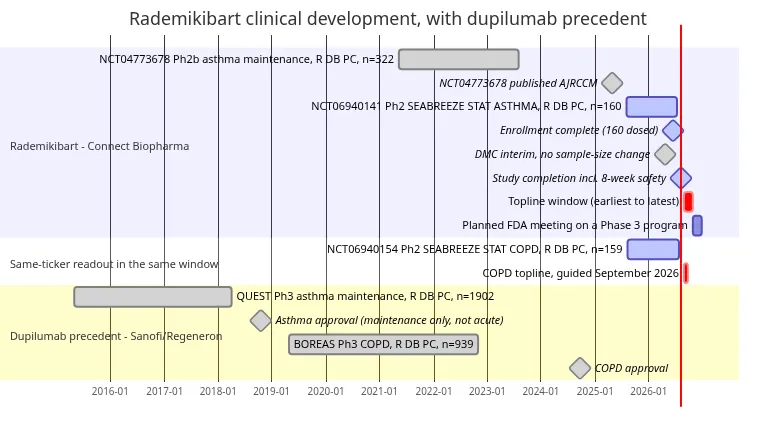
Trials
| Trial | Sponsor / whose drug | Design (arms, blinding, n) | Population | Status / key result | Link |
|---|---|---|---|---|---|
| Seabreeze STAT Asthma — this program | Connect Biopharm LLC / rademikibart | Phase 2, multicentre, randomised, double-blind, parallel-group, placebo-controlled. Single subcutaneous 600 mg dose or matching placebo. n=160, 58 sites, 8 countries (United States, Argentina, Australia, Georgia, Serbia, United Kingdom). | Adults and adolescents aged 12–75 with physician-diagnosed asthma ≥12 months, on an inhaled corticosteroid plus ≥1 other controller, presenting with an acute exacerbation requiring an urgent healthcare visit and systemic steroids, with a blood eosinophil count ≥300 cells/µL measured at that visit and FEV₁ ≥30% predicted. Current and former smokers with ≥10 pack-years excluded. | ACTIVE_NOT_RECRUITING. Started 2025-08-08; enrollment completed June 2026; primary completion 2026-07-17; study completion 2026-08-10. DMC interim efficacy review completed 2026-04-23 with no sample-size change. Topline pending — this is the catalyst. | NCT06940141 |
| Seabreeze STAT COPD | Connect Biopharm LLC / rademikibart | Phase 2, randomised, double-blind, parallel-group, placebo-controlled. Single subcutaneous dose or placebo. n=159 (the company’s figure; CT.gov’s record says 160), 52 sites. | Participants with chronic obstructive pulmonary disease and type 2 inflammation, eosinophils ≥300 cells/µL, presenting with an acute COPD exacerbation. | ACTIVE_NOT_RECRUITING. Started 2025-08-12; primary completion 2026-07-30. Topline guided to the same month as this program’s — the reason Attribution below reads CONTAMINATED. | NCT06940154 |
| Seabreeze STAT IV | Connect Biopharm LLC / rademikibart | Phase 2, open-label, single-arm, n=40. | Asthma or COPD with type 2 inflammation, acute exacerbation requiring an urgent visit. Designed to bridge 600 mg subcutaneous dosing to a 300 mg intravenous push. | NOT_YET_RECRUITING on the registry, but the company states it was initiated in August 2026. Primary completion 2026-12. | NCT07705737 |
| CBP-201-WW002 — the key precedent for this molecule | Connect Biopharm LLC / rademikibart | Phase 2b, global, randomised 1:1:1, double-blind, placebo-controlled. 150 mg or 300 mg every other week after a 600 mg loading dose, subcutaneous, for 24 weeks. n=322, 76 sites. | Adults with moderate-to-severe persistent, uncontrolled asthma with type 2 inflammation. Note: a maintenance population, not an acute one. | COMPLETED 2023-08-05. Met its primary endpoint. Pre-bronchodilator trough FEV₁ at Week 12, above placebo: +140 mL (150 mg, 95% CI 44–236, p = 0.005) and +189 mL (300 mg, 95% CI 92–286, p < 0.001). In patients with ≥300 eosinophils/µL, Week 24 placebo-adjusted FEV₁ was +420 mL (95% CI 239–600) on 300 mg. Improvements appeared during Week 1 and held to Week 24. Exacerbations through Week 24: 7.5% (150 mg) and 9.3% (300 mg) versus 16.7% (placebo). 88% completed treatment; adverse events broadly similar to placebo; no eosinophilia. | NCT04773678 · published AJRCCM May 2025, DOI 10.1164/rccm.202409-1708OC |
| Phase 1 intravenous clinical-pharmacology study | Connect Biopharm LLC / rademikibart | Phase 1, intravenous rademikibart. Design details not published as a peer-reviewed paper; the company reported topline. | Patients with stable asthma or stable COPD. | Topline reported 2026-03-30: FEV₁ improvements as early as 15 minutes, gains of 200–400 mL maintained through Day 29, well tolerated. This is the rapid-onset evidence the acute programme rests on. | [VERIFIED — CNTB press release 2026-03-30 via BPIQ press feed and historical-catalyst row 6979] |
| SEASIDE CHINA | Connect Biopharm LLC / rademikibart | Phase 2, randomised 2:1, double-blind, 16-week stage 1 then re-randomised every-2-week or every-4-week dosing to Week 52. n=330. | Chinese adults and adolescents with moderate-to-severe atopic dermatitis. | COMPLETED. Met primary endpoint: 29.0% achieved IGA 0/1 with ≥2-point reduction at Week 16 versus 5.9% placebo (p < 0.001); EASI-75 58.6% versus 22.6%. Responses maintained or improved to Week 52 on either dosing interval. | NCT05017480 · published BJD Jan 2026, DOI 10.1093/bjd/ljaf347 |
| CBP-201-WW001 | Connect Biopharm LLC / rademikibart | Phase 2, randomised, double-blind, placebo-controlled. n=226. | Adults with moderate-to-severe atopic dermatitis. | COMPLETED 2021-07-28. Met primary endpoint. | NCT04444752 · published JACI Dec 2023, DOI 10.1016/j.jaci.2023.11.924 |
| Phase 3 atopic dermatitis (global) | Connect Biopharm LLC / rademikibart | Phase 3, randomised, double-blind, placebo-controlled monotherapy. | Moderate-to-severe atopic dermatitis, candidates for systemic therapy. | WITHDRAWN, enrollment 0. Registered with a 2022-12 start that never happened. Recorded here because a withdrawn Phase 3 is part of the track record. | NCT05614817 |
| Phase 2 chronic rhinosinusitis with nasal polyps | Connect Biopharm LLC / rademikibart | Phase 2, randomised, double-blind, placebo-controlled. n=40 enrolled against 68 sites. | Adults with chronic rhinosinusitis with nasal polyps. | TERMINATED 2022-04-15, terminated as part of the COVID-19 pandemic. | NCT04783389 |
| Two Phase 1 pharmacokinetic bridging studies | Connect Biopharm LLC and Simcere / rademikibart | Randomised, open-label, parallel-group. n=324 and n=178. | Healthy Chinese adults. | Both COMPLETED. Formulation and presentation bridging. | NCT05917782 · NCT06701149 |
| QUEST — dupilumab precedent | Sanofi and Regeneron / dupilumab | Phase 3, randomised, double-blind, placebo-controlled, n=1,902. | Moderate-to-severe uncontrolled asthma. Maintenance dosing. | Supported the 2018 asthma approval. Dupilumab reduces exacerbation rates by roughly 44–48% in maintenance use, and its label explicitly states it is not for the relief of acute bronchospasm. | [WEB ESTIMATE — dupilumab prescribing information and competitive review via web search, 2026-08-13] |
Timeline specifics. First patient in 2025-08-08 [VERIFIED — CT.gov start_date]. Last patient in
June 2026 — the company announced enrollment complete on 2026-06-17 and had said on the same date
that enrollment was expected to complete that month
[VERIFIED — CNTB press release 2026-06-17]. Last patient out follows from the protocol rather than
from a disclosure: the primary endpoint reads out at Day 28 and the adverse-event window runs 56
days, so the final patient’s last visit falls in August 2026 — which is exactly what CT.gov’s
completion_date of 2026-08-10 records [VERIFIED — CT.gov NCT06940141]. Database lock and
topline are not disclosed as separate dates; the company gives only “September 2026”. The Readout
section below models the gap explicitly rather than assuming it.
Feasibility matrix
| Factor | High probability | Medium probability | Low probability | This asset (assessment) | Source |
|---|---|---|---|---|---|
| Recruitment feasibility | >50 sites, 3:1 patient:site | 20–50 sites, established investigators | <20 sites, novel sites | HIGH, and already delivered. 58 sites for 160 patients is a 2.8:1 patient-to-site ratio — just under the 3:1 bar, and enrollment is complete, so this is history rather than a forecast. Sites include Stanford, Washington University, Ohio State, the Universities of Iowa and Kansas, Guy’s and St Thomas’, and multiple Nemours children’s hospitals. The low ratio is the signature of a hard-to-catch population: the patient has to be enrolled during an attack, in an urgent-care setting, with a same-visit eosinophil count. That the company did it across 8 countries is a genuine operational achievement. | [VERIFIED — CT.gov NCT06940141, 58 locations enumerated; CNTB press release 2026-06-17] |
| Endpoint clarity | Regulatory precedent exists | Novel endpoint with FDA alignment | Unvalidated surrogate | MEDIUM, and this is the row to read twice. The endpoint is not an unvalidated surrogate — treatment failure after an acute exacerbation is a hard clinical composite, and its components are the outcomes that matter. But no regulatory precedent exists for it: no biologic has ever been approved, or to this analysis’s knowledge ever tested to a positive readout, on a 28-day treatment-failure endpoint after an acute asthma attack. The company had a positive Type C meeting with the FDA in April 2025 and plans another after topline “to gain alignment on a Phase 3 program”, which is the language of an endpoint still being negotiated rather than one already agreed. | [VERIFIED — CT.gov NCT06940141 primary outcome; CNTB press releases 2025-04-01 and 2026-08-12] · [UNVERIFIED — the claim that no precedent exists rests on the absence of one in an 11-trial registry search and a 14-paper literature search, which is weaker than a positive finding] |
| Trial-design robustness | Pivotal Phase III with SPA | Adaptive with interim analysis | Single-arm, no control | MEDIUM. Randomised, double-blind, placebo-controlled, parallel-group with a pre-specified DMC interim efficacy review — the middle box almost exactly. It is explicitly not pivotal and carries no Special Protocol Assessment; the company describes the topline as informing “a potential Phase 3 endpoint and sample size requirements”. | [VERIFIED — CT.gov NCT06940141; CNTB press releases 2026-04-23 and 2026-08-12] |
| Operational / execution | Enrollment complete, standard timeline | Some timeline risk | Enrollment behind | HIGH on enrollment, MEDIUM on guidance. Enrollment is complete and study completion is passed, which retires the largest execution risk entirely. Against that, the readout date has slipped twice — “first half of 2026” became “mid-2026” in January 2026, and “mid-2026” became “early September 2026” in June 2026 (see Readout, Date slippage). Both slips happened while enrollment was the constraint, and that constraint is now gone. | [VERIFIED — BPIQ fetch_company_drugs note field for id 13433, eight dated statements; CT.gov status] |
Statistical power — the number the matrix above cannot hold in a box. This deserves its own arithmetic, because it is the single largest driver of the probability locked at the bottom of this document.
The trial randomises 160 patients, so roughly 80 per arm. The endpoint is binary: each patient either
fails treatment within 28 days or does not. Published relapse rates after emergency-department
treatment for acute asthma, despite systemic steroids, are 10–20% within two weeks and 25.3%
within three weeks in one cited study
[WEB ESTIMATE — Cochrane review CD000195 and the acute-asthma corticosteroid literature, via web search 2026-08-13]. This trial’s composite is broader than relapse alone — it also counts death,
hospital admission and any treatment intensification — so a placebo failure rate of roughly 20–30%
at 28 days is the reasonable expectation [UNVERIFIED — derived from the relapse benchmark above by widening for the extra composite components].
With 80 patients per arm and a 25% placebo rate, reaching two-sided p < 0.05 at 80% power requires
the failure rate to fall to roughly 11% — a 56% relative reduction, 14 percentage points
absolute [UNVERIFIED — standard two-proportion sample-size arithmetic on the placebo rate above].
For comparison, dupilumab’s maintenance effect on exacerbation rates is a 44–48% relative reduction
over a year, and rademikibart’s own Phase 2b showed 7.5–9.3% versus 16.7% over 24 weeks in a
maintenance population, which is a 44–55% relative reduction. So the effect size this trial needs is
at the top of, or slightly beyond, what the class has shown in its easier setting — and it needs it in
28 days, on top of steroids.
That is not impossible. It is, however, why a reader should expect the statistical result to be harder than the biological one, and why the company’s own framing points at the secondary endpoint.
Resourcing sufficiency. Sufficient for this readout, and that is the only question that matters
here. The trial is fully enrolled and study completion is passed, so the remaining spend is database
lock, analysis and reporting. On cash, both readings in ../company.md C.3 —
the company’s stated runway of at least one year from 2026-08-12, and this analysis’s recomputed 5.9
months from 2026-06-30 — clear a September 2026 readout with months to spare, so the answer does not
depend on which reading is right. Beyond the readout the two readings diverge materially, and the
Phase 3 the company intends to negotiate with the FDA afterwards is not funded on either of them:
a global Phase 3 in this setting would cost multiples of the $31.5M on hand. That is a financing
question for after the event, and it is priced into the run-up section’s financing driver rather
than into this row.
A.3 Target label, target product profile, strategic questions, designations
A.3a Target label. Rademikibart as an add-on to standard of care for the treatment of an acute
exacerbation in adults and adolescents aged 12 and over with asthma and type 2 inflammation
(blood eosinophils ≥300 cells/µL), administered as a single dose in the urgent-care setting
[VERIFIED — CT.gov NCT06940141 title and eligibility criteria].
A.3b Target product profile
| Attribute | Standard of care & key competitor(s) — data | Rademikibart target profile (goal) | Supporting evidence (+ link) |
|---|---|---|---|
| Indication / target label | Standard of care: systemic corticosteroids plus inhaled bronchodilators at the urgent visit, followed by a short oral steroid course. Decades old and unchanged. Competitor: dupilumab is approved for asthma maintenance only, and its label states it is not for the relief of acute bronchospasm. There is no approved drug for the acute exacerbation setting itself. | A single dose given at the urgent visit, on top of standard care, for the type 2-high subgroup. First-in-setting rather than first-in-class. | [WEB ESTIMATE — dupilumab prescribing information and competitive review via web search, 2026-08-13] |
| Efficacy (endpoints, regimen) | 10–20% of patients relapse within two weeks of emergency-department discharge and 25.3% within three weeks in one cited study, despite steroids. Dupilumab in maintenance: 44–48% relative reduction in exacerbation rate over a year. | Primary: a statistically significant reduction in 28-day treatment failure. Key secondary: a meaningful gain in post-bronchodilator FEV₁ at Week 1. Regimen: one subcutaneous 600 mg dose, no ongoing therapy required. | [WEB ESTIMATE — Cochrane CD000195 and the acute-asthma steroid literature, 2026-08-13] · NCT06940141 |
| Safety / tolerability | Systemic steroids are effective and poorly tolerated on repetition: weight gain, hyperglycaemia, mood disturbance, bone loss. Avoiding a second course is itself a benefit. Dupilumab’s class carries treatment-emergent eosinophil rises. | Placebo-like tolerability from a single dose, and specifically no hypereosinophilia. | Phase 2b: adverse events broadly similar to placebo, injection-site reactions mostly mild, 88% completion, most common events cough / COVID-19 / dyspnoea at 10–12% [VERIFIED — AJRCCM 2025, DOI 10.1164/rccm.202409-1708OC]. Eosinophils fell rather than rose [VERIFIED — Chest 2026, DOI 10.1016/j.chest.2026.04.019]. |
| Biomarker / companion diagnostic | Blood eosinophil count. Already measured as part of an ordinary complete blood count, which every urgent-care patient gets. | Use the ≥300 cells/µL threshold as an enrichment criterion. No companion diagnostic is needed and none is being developed — the test already exists and is already ordered. | [VERIFIED — CT.gov NCT06940141 eligibility: "Peripheral blood eosinophil count of ≥300 cells/µL as part of the assessment of an index acute asthma exacerbation"] |
| Formulation / administration | Steroids: oral tablets or intravenous injection, given in minutes. | Single subcutaneous injection from a prefilled syringe at the urgent visit. A 300 mg intravenous push is being bridged separately in Seabreeze STAT IV, which matters because an intravenous option fits an emergency-department workflow better than a subcutaneous one. | [VERIFIED — CT.gov NCT06940141 interventions; NCT07705737; CNTB press release 2026-08-12] |
| Payer value | An avoided hospital admission for asthma is the expensive event a payer is trying to prevent. Steroids are essentially free. | Justify a per-dose price by avoided admissions and avoided emergency revisits within 28 days — which is precisely what the primary endpoint measures, and is why the endpoint is commercially as well as clinically chosen. | [UNVERIFIED — no health-economic model for this setting was found, and no payer precedent exists because no drug is approved here] |
A.3c Strategic Go/No-Go questions. The set that matches this asset’s next decision is
pre-Phase-III: the company’s stated plan after topline is to “meet with the FDA to gain alignment
on a Phase 3 program” [VERIFIED — exhibit 99.1 to CNTB Form 8-K, 2026-08-12].
Pre-Phase-III (Go-to-Phase-III / registration):
| Group | Question | Answer (tagged) |
|---|---|---|
| Target | Target revalidated as in prior phases? | Yes, for the target; no, for the setting. IL-4Rα is revalidated by dupilumab’s eight approvals and by rademikibart’s own positive Phase 2b in maintenance asthma and two positive Phase 2s in atopic dermatitis. It has never been validated in the acute setting, and this readout is the first randomised test of it there. [VERIFIED — AJRCCM 2025 DOI 10.1164/rccm.202409-1708OC; BJD 2026 DOI 10.1093/bjd/ljaf347; JACI 2023 DOI 10.1016/j.jaci.2023.11.924] |
| Dose & Drug | Exposure–response for the intended commercial regimen and route(s)? | Partly. The 600 mg loading dose used here is the same loading dose the Phase 2b used before its maintenance schedule, and the Phase 2b showed a clean 150 mg versus 300 mg dose separation (+140 mL versus +189 mL at Week 12), so exposure–response exists for the molecule. What does not yet exist is exposure–response for a single dose in an acute setting, which is exactly what this readout begins to establish. [VERIFIED — AJRCCM 2025] |
| Dose & Drug | Commercial formulation available or feasible? | Yes. A prefilled syringe is already in use in this trial, and two completed Phase 1 studies (n=324 and n=178) bridged presentations and strengths. An intravenous push is being bridged in Seabreeze STAT IV. [VERIFIED — CT.gov NCT06940141, NCT05917782, NCT06701149, NCT07705737] |
| Dose & Drug | Dose range compatible with clinical and non-clinical safety? | Yes, on the evidence available. 24 weeks of every-other-week dosing at 150 mg and 300 mg after a 600 mg load was tolerated with placebo-like adverse events and 88% completion. A single 600 mg dose is a much smaller cumulative exposure than that. [VERIFIED — AJRCCM 2025] |
| Dose & Drug | Therapeutic window given the clinical response? | Wide, so far. No dose-limiting toxicity has been reported at any dose tested, and the class’s characteristic eosinophil rise did not appear. [VERIFIED — AJRCCM 2025; Chest 2026] |
| Dose & Drug | Intrinsic and extrinsic factors influencing exposure and patient response? | Partly known. Baseline eosinophil count is a strong response modifier — the Week 24 FEV₁ effect was +420 mL in the ≥300 cells/µL subgroup versus +189 mL overall — and the trial enriches on it. Age (12–75), smoking history (excluded above 10 pack-years) and baseline FEV₁ (≥30% predicted) are handled by eligibility. Ethnic and regional factors are partly addressed by the Chinese Phase 1 and Phase 2 programme. [VERIFIED — AJRCCM 2025; CT.gov NCT06940141] |
| Patient | Proof of concept and positive benefit/risk in the intended population? Combination evidence? | Not yet — this is the question the readout answers. Proof of concept exists in maintenance asthma but not in an acute exacerbation. On combination: the trial is the combination study, since every patient receives systemic steroids as background, and whether benefit survives that background is the central unknown (A.1). [UNVERIFIED — pending topline] |
| Patient | Phase III design and outcome criteria — accepted, compelling, competitive for market access? | Not yet agreed, and openly so. The company states the topline “should help determine a potential Phase 3 endpoint and sample size requirements” and that it will then meet the FDA “to gain alignment”. That is a design not yet settled. A 28-day treatment-failure endpoint would be compelling for market access if it holds, because it maps directly onto avoided admissions. [VERIFIED — exhibit 99.1 to CNTB Form 8-K, 2026-08-12] |
| Patient | Rationale for the patient population(s)? | Strong and specific. Eosinophils ≥300 cells/µL measured at the index attack selects the patients in whom this mechanism worked best in the company’s own prior trial, using a test that is already routine in urgent care. The 12-year lower age limit widens the label into adolescents, where steroid avoidance carries extra weight. [VERIFIED — CT.gov NCT06940141; AJRCCM 2025] |
| Patient | Likelihood of the expected outcome? | Below even. 38%, band 26–52%, on the strict primary endpoint — see Locked prediction. The binding constraint is statistical power at 80 per arm against a large required effect, not the plausibility of the biology. [UNVERIFIED — modelled] |
| Patient | Companion-diagnostic strategy, including pricing and market? | Not applicable, and that is an advantage. The biomarker is a blood eosinophil count from a routine complete blood count. No companion diagnostic to develop, price, or get approved, and no test-availability barrier at launch. [VERIFIED — CT.gov NCT06940141 eligibility] |
A.3d Regulatory designations. None disclosed for this program. No Fast Track, Breakthrough
Therapy, Orphan Drug or other designation appears in the company’s press feed, in the registry
record, or in the filings read at the company tier
[VERIFIED — BPIQ fetch_company_press_releases 2026-08-13, 152 items; CT.gov NCT06940141; EDGAR submissions]. The absence is unsurprising rather than alarming: asthma is not a rare disease, so
Orphan Drug does not apply, and the designations that could apply generally follow a positive
randomised readout rather than precede one.
Two regulatory interactions are on record and are not designations:
- Positive Type C meeting with the FDA, announced 2025-04-01. A Type C meeting is a general
guidance meeting between a sponsor and the FDA. It grants nothing; it means the agency gave
feedback the company considered favourable
[VERIFIED — CNTB press release 2025-04-01]. - Favourable FDA feedback on a potential Phase 3 programme, recorded 2024-09-05 in the
third-party feed against the atopic-dermatitis row
[VERIFIED — BPIQ fetch_company_drugs note, id 16030]. Different indication; noted for completeness.
A.4 Target product profile valuation matrix
| Stakeholder | Value driver | Minimum threshold | Competitive | Premium | Benchmark / source |
|---|---|---|---|---|---|
| Patient / caregiver | Not having to come back. A second attack, a second course of steroid tablets, or a hospital admission in the month after the first attack. | Any statistically credible reduction in 28-day treatment failure. | Failure rate cut by roughly a third, plus a same-week improvement in breathing the patient can feel. | Failure rate roughly halved, breathing better within a week, and no second steroid course — the outcome patients themselves rank highly because of how steroids feel. | [WEB ESTIMATE — Cochrane CD000195 relapse benchmark, 2026-08-13]. Calibration reference from 03b-program-spec.md: oral formulations command roughly 15–25% price premiums over injectables — which cuts against an injectable here and is noted rather than hidden. |
| Regulator | A hard clinical endpoint with a credible effect size, in a population defined by an available test. | Nominal significance on 28-day treatment failure, supportive FEV₁, clean safety. | The above, replicated across the asthma and COPD studies — which is exactly what a simultaneous two-study readout can deliver. | The above plus a consistent effect in adolescents, supporting a 12-and-over label from the start. | [VERIFIED — CT.gov NCT06940141 endpoints and age range] · [UNVERIFIED — no approval precedent exists in this setting to calibrate against] |
| Payer / HTA | Avoided hospital admissions and avoided emergency revisits inside 28 days. This is the one stakeholder whose value driver is the primary endpoint. | Cost per avoided admission below the cost of the admission. | A number that also survives when only the type 2-high subgroup is treated, which is the population anyway. | Enough of an effect to justify protocolised use at every qualifying urgent visit rather than case-by-case approval. | [UNVERIFIED — no health-economic model or payer precedent for this setting was found this session] |
| Provider | Fits the urgent-care workflow, or it will not be used however well it works. | A single dose given during the visit, no follow-up dosing to arrange. | The above, plus a biomarker result available during the same visit — which a routine complete blood count already provides. | An intravenous push, which is what an emergency department is already set up to give, rather than a subcutaneous injection. | [VERIFIED — Seabreeze STAT IV, NCT07705737, is bridging exactly this: 600 mg subcutaneous to 300 mg intravenous push] |
The provider row is the underrated one. A drug for the acute setting has to survive contact with an emergency department at three in the morning. The eosinophil count is already on the chart, so patient selection costs nothing — but a subcutaneous biologic is not something an emergency department stocks or gives. That the company started an intravenous bridging study in August 2026, before this readout, suggests it understands the constraint. It also means a positive readout here is not immediately commercialisable in the form tested.
A.5 Evidence quality and endpoints
| Criterion | Score (High / Medium / Low) | Basis (one line) | Link |
|---|---|---|---|
| Target validation | High | Dupilumab, an antibody against the same receptor subunit, is approved for eosinophilic asthma (2018) and COPD (2024); the mechanism is not in question. Independent human-genetics support could not be obtained — Open Targets returned Rate limit exceeded for client: global on all three attempts — so this score rests on clinical rather than genetic validation, and the genetic leg is [UNVERIFIED]. | [WEB ESTIMATE — dupilumab competitive review, 2026-08-13] |
| Mechanism clarity | High | Measured dissociation constant of 20.7 pM against IL-4Rα, quantified STAT6 inhibition versus dupilumab with p-values, no cross-species binding, and a 2.71 Å crystal structure of the antibody–receptor complex. Unusually well characterised for a Phase 2 asset. The crystal structure is a preprint and tagged accordingly. | DOI 10.1038/s41598-023-39311-2 · DOI 10.64898/2026.04.12.718052 |
| Biomarker availability | High | Blood eosinophil count, from an ordinary complete blood count that every urgent-care patient already receives. No companion diagnostic to develop, no test to get approved, no availability barrier at launch. The ≥300 cells/µL threshold is the same one that identified the largest effect in the company’s own Phase 2b. | NCT06940141 |
| Publication quality (peer-reviewed? independent authors?) | High on peer review, unestablished on independence | 14 publications, and the ones that matter are in serious journals: the pivotal asthma Phase 2b in AJRCCM, the atopic-dermatitis Phase 2 in JACI and the 52-week Phase 2 in the British Journal of Dermatology, plus a Chest paper on the eosinophil safety question. Three independent syntheses that were not written for the company also cover the molecule — meta-analyses in the Australasian Journal of Dermatology, Cureus and Pharmacoepidemiology and Drug Safety — and the first of them ranks rademikibart among the two most promising next-generation IL-4Rα agents on EASI-90 (odds ratio 4.61, 95% CI 1.68–12.65) while noting higher odds of adverse events. Author independence could not be assessed: PubMed’s get_article_metadata returned the authors field as nulls on all 14 articles, so no author of any paper could be named this session. | DOI 10.1164/rccm.202409-1708OC · DOI 10.1111/ajd.70138 |
| Clinical / expert sentiment | — | Moved to A.5b, below. | — |
Endpoints
| Endpoint (full name) | What it measures | Scale / range | Better direction | MCID / note |
|---|---|---|---|---|
| Treatment failure rate within 28 days after randomisation (PRIMARY) | A composite of five events, any one of which counts as a failure: death from any cause; admission or re-admission to hospital for asthma; an emergency-department revisit or unscheduled medical visit for worsening asthma symptoms; or the necessity to intensify pharmacologic treatment, explicitly including a second course of systemic steroids. | Percentage of patients, 0–100% | Lower | No established minimal clinically important difference exists for this composite, because the endpoint has no regulatory precedent in this setting. What can be said with a named benchmark: published relapse rates after emergency-department treatment are 10–20% at two weeks and 25.3% at three weeks despite steroids, so a placebo rate of 20–30% is expected here, and at 80 patients per arm a drop to roughly 11% is what statistical significance would require. Neither figure is an MCID and neither is presented as one. |
| Absolute change from baseline in post-bronchodilator forced expiratory volume in one second (post-BD FEV₁) at Week 1 (KEY SECONDARY) | How much more air the patient can force out in the first second of a hard breath out, measured after a fast-acting reliever, one week after the dose. | Millilitres (mL); changes in this class of trial run from tens to several hundred mL | Higher | A 100 mL change is the commonly used minimal clinically important difference for FEV₁ in asthma [UNVERIFIED — a widely used convention, not confirmed from a primary source this session]. Rademikibart’s own prior Phase 2b cleared it comfortably in a maintenance population: +140 mL and +189 mL above placebo at Week 12, and +420 mL at Week 24 in patients with ≥300 eosinophils/µL. Its Phase 1 intravenous study showed 200–400 mL gains from 15 minutes. This is the endpoint on which the drug has the most evidence and the shortest path to a visible effect, and it is the one a reader should watch on the day. |
| Rate of new asthma exacerbations within 28 days | How many further attacks occur in the month after the index attack. | Count or rate per patient | Lower | A component of the primary composite, reported separately. |
| Time to first new asthma exacerbation within 28 days | How long until the next attack. | Days, 0–28 | Higher (longer) | Time-to-event framing of the same signal; can show separation even where a binary rate does not. |
| Mean change from baseline in morning/evening asthma symptom score | Patient-reported symptom burden, recorded twice daily in an electronic diary. | Score, exact instrument not specified in the registry record | Lower | Time frame Week 1, Week 2 and Week 4. Instrument unspecified, so no MCID can be quoted. |
| Mean change from baseline in nocturnal awakenings | How often asthma wakes the patient at night, from the electronic diary. | Count per night | Lower | Time frame Week 1, Week 2 and Week 4. A symptom patients notice directly. |
| Absolute change from baseline in post-BD FEV₁ at Day 3 and Week 4 | The same lung-function measure at two further timepoints. | Millilitres (mL) | Higher | Day 3 is the interesting one. If rademikibart’s rapid onset is real, a Day 3 separation is where it shows, and no competitor has ever reported one in this setting. |
| Incidence of adverse events, including serious adverse events, adverse events of special interest, and drug-induced liver injury | Safety. | Percentage of patients | Lower | Time frame 56 days, i.e. eight weeks after dosing. |
| Incidence of unanticipated adverse device effects | Safety of the prefilled syringe itself. | Percentage of patients | Lower | Time frame 56 days. |
| Incidence of injection-site reactions | Local tolerability of the injection. | Percentage of patients | Lower | Time frame 56 days. Mostly mild in the Phase 2b. |
[VERIFIED — CT.gov get_trial_details NCT06940141, 2026-08-13, all endpoints and time frames as recorded]
A.5b Key opinion leaders.
Both tables below are empty, and each empty table is a finding rather than a blank section. What was searched, and what came back, is stated in full so a reader can judge the absence.
Panel as of. 2026-08-13 — the date the investigator and independent-voice searches below were run.
Investigators
No investigator is recorded, because ClinicalTrials.gov carries none for this trial.
get_trial_details on NCT06940141 returns all 58 sites with contacts: null and no overall-official
record at all — normal for a trial that has finished recruiting, since contact details are removed
once enrollment closes. search_investigators was then run twice as a cross-check: the first attempt
returned 0 of 0 on a bad parameter combination, and the second, on the condition alone, returned 21
named investigators across 40 analysed trials, none of them on a Connect Biopharma trial. So the
mechanism works and the record is genuinely empty
[VERIFIED — CT.gov get_trial_details and search_investigators, 2026-08-13].
| Name | Role / affiliation | Trial (NCT) | Conflicts (party, kind, disclosed in, as of) | Conflicts checked (source, date) | Source | Tag |
|---|---|---|---|---|---|---|
| (none returned) | — | — | — | — | — | — |
Independent voices
No independent voice is recorded, and the reason is a connector gap rather than an absence of
commentators. Three independent syntheses covering rademikibart exist and were retrieved — the
Australasian Journal of Dermatology meta-analysis (PMID 42117199), the Cureus Bayesian network
meta-analysis (PMID 41884322) and the Pharmacoepidemiology and Drug Safety network meta-analysis
(PMID 41346302) — and the first of them takes a substantive position on the molecule. But PubMed’s
get_article_metadata returned the authors field as nulls on all 14 articles, so not one of
those commentators could be named. Rule 40 requires a name, a date, a source and a conflict
disclosure, or the view is not recorded; without a name, the view is not recorded. It is not
attributed to “the authors of” anything, because that is exactly the unnamed, undated,
unconflict-checked attribution rule 40 exists to forbid.
Two further notes on what was deliberately not put in this table. First, the authors of
rademikibart’s own trial publications would not belong here even if they could be named: they are the
sponsor’s investigators, which is the other table. Second, the seven named sell-side analysts whose
price targets appear under Market and timing below are not independent clinical voices, and
recording them as such would repeat the exact v3.0.0 rule violation that
framework/01-rules.md rule 40 carries as its own worked failure.
They are used only as the published-analyst-target anchor that rule 30 admits, and nowhere else.
| Name | Affiliation | View (close enough to quote) | As of | Conflicts checked (source, date) | Source | Tag |
|---|---|---|---|---|---|---|
| (none nameable this session — see above) | — | — | — | — | — | — |
Judgement
| Endpoint supported | Basis (one or two sentences) | Tag |
|---|---|---|
UNKNOWN | No independent voice could be named this session, so there is no panel to judge. This is the honest answer rather than a reading inferred from the three unattributable meta-analyses: one of them does rank rademikibart among the two most promising next-generation IL-4Rα agents, but that is a statement about atopic dermatitis efficacy, not about a 28-day treatment-failure endpoint in acute asthma, and no source found this session speaks to that endpoint at all. | UNVERIFIED — judgement |
Dissent
Empty, and correctly so: endpoint_supported is UNKNOWN rather than SUPPORTIVE_CONTESTED, so
there is no claimed support for anyone to contest. Inventing a disagreement nobody has voiced would
be worse than an empty table.
| Name | View (close enough to quote) | Source |
|---|---|---|
| (none) | — | — |
B. Commercial assessment
B.0 Current treatment algorithm
What a patient having an asthma attack receives today, line by line, and exactly where this drug would fit:
- At home, first. A short-acting reliever inhaler, or a combination inhaler used as a reliever. If that controls the attack, the patient never reaches this trial’s population.
- At the urgent visit — where this drug would be given. Repeated nebulised or inhaled bronchodilators, oxygen if needed, and systemic corticosteroids — tablets or injection. This is the standard of care and it has not fundamentally changed in decades. Every patient in Seabreeze STAT Asthma receives it, and rademikibart is added on top of it rather than replacing any part of it.
- On discharge. A short course of oral steroids, typically about five days, plus a review of the
patient’s daily controller inhalers. Continuing steroids after discharge measurably reduces
relapse, and the benefit lasts about three weeks
[WEB ESTIMATE — Cochrane review CD000195 via web search, 2026-08-13]. - The 28 days that follow — the gap this drug is aiming at. Despite all of the above,
10–20% of patients relapse within two weeks of emergency-department discharge, and 25.3% within
three weeks in one cited study
[WEB ESTIMATE — Cochrane review CD000195 and the acute-asthma corticosteroid literature via web search, 2026-08-13]. That relapsing fifth to quarter is the entire commercial opportunity, and there is no approved drug that addresses it. - Weeks to months later, for a subset. Patients with frequent attacks may be referred for a maintenance biologic — dupilumab, or an anti-interleukin-5 agent. This is where the class lives today, and it is a different decision made at a different time by a different doctor. Dupilumab’s own label states it is not for the relief of acute bronchospasm.
Where rademikibart would fit: step 2, as a single add-on dose, for the roughly half of patients whose attack is driven by type 2 inflammation. It does not displace anything. It is additive to steroids, which is both its commercial advantage — no prescriber has to stop doing what they already do — and its clinical risk, because it has to prove benefit on top of a therapy that already works (A.1).
B.1 Competitive landscape and positioning
| Metric | High value | Medium value | Low value | This asset (assessment) | Source |
|---|---|---|---|---|---|
| Mechanism differentiation | First-in-class or novel target | Next-generation improvement | Me-too | Medium-to-high, and the box depends on how you frame it. On target, this is next-generation, not novel: dupilumab got to IL-4Rα first. On setting, it is first-in-class — nothing is approved for acute exacerbations and dupilumab’s label expressly excludes acute bronchospasm. Scored Medium on the matrix’s own wording, with the first-in-setting claim recorded as the substantive differentiation. | [VERIFIED — Scientific Reports 2023] · [WEB ESTIMATE — dupilumab label and competitive review, 2026-08-13] |
| Development-timeline advantage | >12 months ahead | Within 6–12 months | Lagging >12 months | High, by default rather than by speed. No competitor programme in the acute-exacerbation setting was found in an 11-trial registry search of this molecule or in the competitive web search. That is a weak form of evidence — absence in two searches, not a confirmed empty field — but on it, rademikibart is not merely ahead, it is unaccompanied. Against that, dupilumab is a decade ahead in the adjacent maintenance market. | [UNVERIFIED — derived from the absence of a competitor in CT.gov search_trials and one competitive web search, 2026-08-13] |
| Clinical proof-of-concept evidence | Positive Phase IIb (n>100) | Phase IIa signals (n=20–50) | Preclinical only | High for the molecule, absent for the setting. A positive, published, peer-reviewed Phase 2b with n=322 in asthma clears the top box for the molecule by a wide margin. In the acute setting the evidence is one open-label Phase 1 intravenous study with no published n and a company-reported topline. The whole thesis turns on whether the first transfers to the second. | [VERIFIED — AJRCCM 2025, DOI 10.1164/rccm.202409-1708OC] |
| IP protection | Composition-of-matter, long-dated | Method-of-use | Pending or none | Could not be established, and is recorded as unknown rather than assumed. The exclusivity web search reported explicitly that it returned no information on rademikibart’s composition-of-matter claims or patent expiry. A monoclonal antibody of this vintage would ordinarily carry composition-of-matter protection plus 12 years of US biologics regulatory exclusivity from first licensure, but neither was confirmed from a filing or a patent record this session. | [UNVERIFIED — the search returned no patent information; no assumption is substituted for it] |
Where this asset wins. In a setting nobody else is in. The competitive landscape for IL-4Rα blockade in maintenance asthma is crowded and dupilumab has a decade of head start, eight approvals and a brand every pulmonologist knows. Rademikibart cannot win there on a 2.2× binding advantage. What it can do is define a new use — a single dose at the moment of the attack — where the incumbent is not merely absent but labelled out.
The single fact the thesis rests on. That rademikibart’s lung-function effect arrives fast enough to matter inside 28 days. Everything else — the tighter binding, the crystal structure, the absent hypereosinophilia, the routine biomarker — is supporting evidence for a drug that is already known to work in this disease over months. Only speed distinguishes an acute drug from a maintenance drug, and the evidence for speed is one Phase 1 study reporting effects from 15 minutes and a Week 1 signal in the Phase 2b. This readout is the first randomised, blinded, placebo-controlled test of that single fact.
Calibration reference from 03b-program-spec.md, not a claim about this asset: oncology first-movers
in novel mechanisms have shown roughly 3.2× higher peak-sales potential but about 1.8× higher
development risk.
B.2 Addressable market
Launch markets. The United States first — 22 of the trial’s 58 sites are American, the company is
headquartered in San Diego, and it has run its regulatory interactions with the FDA. Then the
European Union and the United Kingdom, with UK sites already in the trial. Greater China is not
Connect’s market at all: those rights are exclusively licensed to Simcere, and Connect’s economics
there are milestones and royalties [VERIFIED — CT.gov NCT06940141 locations; exhibit 99.1 to CNTB Form 8-K, 2026-08-12].
| Component | How it is estimated | Premium threshold | This asset (assessment) | Source |
|---|---|---|---|---|
| Drug-treated patients | Epidemiology × diagnosis rate × treatment rate | >100,000 (US/EU5/Japan) | Clears the threshold on eligible events, and the unit matters. This drug treats an event, not a patient-year: roughly 1 million asthma-related emergency-department visits a year in the United States, of which perhaps 30–50% are type 2-high with eosinophils ≥300 cells/µL, gives roughly 300,000–500,000 eligible US events annually, and a broadly similar pool across the EU5 and Japan. Both the visit count and the type 2-high fraction are unverified, which is why B.3a builds a range rather than a figure. Diagnosis rate is not a barrier here — an eosinophil count comes free with the complete blood count every such patient already gets. | [UNVERIFIED — commonly cited US emergency-department visit figure and type 2-high fraction, neither confirmed from a primary source this session] |
| Market exclusivity | Patent term + regulatory exclusivity | >10 years combined | Unknown. No patent record was obtained (B.1). US biologics regulatory exclusivity would give 12 years from first licensure, which would clear the threshold on its own, but first licensure is years away and the figure is not confirmed here. | [UNVERIFIED — exclusivity search returned no patent information] |
| Reimbursement precedent | Approvals in ≥2 major markets | Positive NICE/CADTH guidance | None, and this is a genuine structural gap. There is no approved drug for acute asthma exacerbations anywhere, so there is no reimbursement precedent to point at, no established price point, and no health-technology-assessment appraisal of the concept. The adjacent precedent — dupilumab reimbursed for maintenance asthma across major markets — establishes that payers will fund IL-4Rα blockade in asthma, but at a maintenance price for a maintenance benefit, which is a different transaction. | [UNVERIFIED — no payer precedent for this setting was found] |
| Patient-journey impact | Fewer hospital days, less caregiver burden | >30% quality-of-life gain | Directly measured by the primary endpoint, which is unusual. Hospital admission and emergency revisits are components of the treatment-failure composite, so the trial reports patient-journey impact rather than requiring it to be modelled afterwards. Avoiding a second steroid course is a further, specific quality-of-life gain that patients weigh heavily. No quality-of-life instrument is among the endpoints, so the >30% premium threshold cannot be assessed. | [VERIFIED — CT.gov NCT06940141 primary outcome definition] |
B.3 Value and feasibility
B.3a Expected peak sales.
First, the third-party figure and why this document does not use it. The company’s own market
research forecasts peak sales “upwards of $5 billion” globally, and Northland’s Carl Byrnes
initiated coverage seeing peak-sales potential exceeding $5 billion
[WEB ESTIMATE — Northland initiation and company commentary via web search, 2026-08-13]. That
figure is not passed through here, for a specific reason rather than general scepticism: it is
explicitly for “acute and chronic asthma/COPD indications” — that is, it includes rademikibart
competing head-to-head with dupilumab in the maintenance market, which this readout does not address
and which the company is not currently running a trial in. Presenting a $5 billion number against a
readout about single-dose acute treatment would answer a different question than the one asked. The
build below is for the acute asthma exacerbation indication only — the indication this catalyst
is about.
Every input is tagged. Three of the four are unverified, which is why every row is a range and why none of them should be read as a forecast.
| Scenario | Assumptions (patients × price × share) | Estimate (USD/year at peak) | Basis / tag |
|---|---|---|---|
| Low | US: 300,000 eligible events × 5% peak penetration × $2,000 net per dose = $30M. Ex-US (EU5 + Japan): same event pool × 5% × $1,200 (60% of US net price) = $18M. | ≈ $0.05B | Penetration at 5% assumes the drug is used only where a specialist is involved and the workflow already suits it, which is the realistic floor for an injectable in an emergency setting. [UNVERIFIED — modelled; event pool and penetration both unverified] |
| Base | US: 400,000 × 12% × $4,000 = $192M. Ex-US: 400,000 × 12% × $2,400 = $115M. | ≈ $0.3B | 12% penetration assumes protocolised use at larger centres and specialist clinics but not universal adoption at every urgent visit. Price of $4,000 per single dose is set well below a year of dupilumab (roughly $45,000 at US list) but far above a generic steroid course, on the argument that it is priced against an avoided admission. [UNVERIFIED — modelled; no acute-setting price precedent exists anywhere, so the price input has no benchmark at all] |
| High | US: 500,000 × 25% × $6,000 = $750M. Ex-US: 500,000 × 25% × $3,600 = $450M. | ≈ $1.2B | 25% penetration requires guideline inclusion and an intravenous presentation that fits emergency-department workflow — which is what Seabreeze STAT IV is bridging toward. [UNVERIFIED — modelled] |
Conditional on approval, and this excludes: the COPD acute indication (a separate readout, on a
separate trial, and a separate market roughly comparable in size); any maintenance asthma or COPD
indication (no trial is running); Greater China entirely (licensed to Simcere — Connect’s economics
there are up to approximately $99M of remaining milestones plus tiered royalties to low double-digit
percentages on net sales [VERIFIED — exhibit 99.1 to CNTB Form 8-K, 2026-08-12]); and the existing
atopic-dermatitis franchise.
Which input is least defensible: the price. Patient numbers can at least be bounded by epidemiology, and penetration by analogy to other injectables. There is no drug priced for a single acute dose in this setting anywhere in the world, so the $2,000–$6,000 range is an inference from a maintenance list price and an avoided-admission cost, not a benchmark. A reader who disagrees with the price should scale every row proportionally.
What this means against the market value. Enterprise value is $115.24M
(../company.md C.4). The base case of roughly $0.3B in annual peak sales for one
indication is about 2.7× that enterprise value, and the low case of $0.05B is about 0.4×. For an
asset this early those multiples are ordinary rather than remarkable — which is the honest reading:
the stock is not obviously mispriced against a risked view of this indication alone. What makes the
setup interesting is the optionality stacked behind it (the COPD readout in the same month, the
intravenous presentation, the China royalty stream), not a screaming valuation gap on this program.
B.3b Feasibility
| Question | Answer (tagged) |
|---|---|
| Expected net present value (eNPV) | A range, and deliberately not a figure. Taking the base-case peak sales of ~$0.3B, a 38% probability of a positive readout here, and the conventional further attrition from a positive Phase 2 to approval, a risked value for this indication alone plausibly lands somewhere between $50M and $350M. That is wide because it has to be: 01-rules.md rule 10 forbids a point estimate on unverified inputs, and three of this build’s four inputs are unverified — the eligible event pool, the peak penetration and, worst of all, the price, which has no precedent anywhere. A discount rate, a launch year and a Phase 3 cost would each have to be assumed to narrow it, and none of the three is knowable from anything read this session. [UNVERIFIED — modelled, wide range, three unverified inputs] |
| Capital to the next decision point | Already spent. The trial is fully enrolled and study completion passed 2026-08-10; what remains before topline is database lock, analysis and reporting. Both runway readings in ../company.md C.3 clear September 2026 with months to spare, so the answer does not depend on which is right. |
| Capital to approval, and the funding plan | Not funded, and not close. A global Phase 3 in this setting would cost multiples of the $31.5M on hand at 2026-06-30. The funding plan is not stated beyond a $300M universal shelf on Form F-3 that has been effective since 2025-09-12 (../company.md C.3), plus up to approximately $99M of Simcere milestones that carry no dates. A positive readout would be raised into; a negative one would be raised into anyway, at a worse price. [VERIFIED — EDGAR F-3 filing-fee exhibit accession 0001193125-25-138482; exhibit 99.1 to Form 8-K 2026-08-12] |
| Launch capability — alone, or must partner? | Must partner, or licence. Connect has no commercial infrastructure of any kind. Reaching emergency departments and urgent-care clinics is one of the harder commercial channels in medicine — enormous numbers of sites, no specialist prescriber base to target, and protocol-driven rather than prescription-driven adoption. This is not a channel a company with $31.5M and no salesforce enters alone. [VERIFIED — no commercial operations are described in any filing or release read at the company tier] |
| Commercialisation rights — retained, split, or out-licensed? | Retained everywhere except Greater China. Simcere holds exclusive rights to develop, manufacture and commercialise rademikibart for all indications in mainland China, Hong Kong, Macau and Taiwan; Connect keeps everything else. Connect received an approximately $21M upfront in November 2023, is eligible for up to approximately $99M of remaining milestones from an original $123M total, and receives tiered royalties up to low double-digit percentages on Greater China net sales. [VERIFIED — exhibit 99.1 to CNTB Form 8-K, 2026-08-12] · [WEB ESTIMATE — the $21M upfront and $123M original total, from the 2023 deal announcement via web search 2026-08-13] |
B.4 Product-development risk
Framing questions.
- Does the development plan support the target product profile claims? Only partly, and the gap is specific. The plan tests whether a single subcutaneous dose reduces 28-day treatment failure — which is the efficacy claim and the payer claim in one endpoint, so those are well served. It does not test the presentation the target profile’s premium row actually calls for: an intravenous push that fits an emergency-department workflow. That is a separate 40-patient open-label study (Seabreeze STAT IV) reading out around December 2026, and it is single-arm, so it can bridge pharmacokinetics but cannot establish efficacy of the intravenous form.
- Will the identified risks affect the target product profile? The two that would are the statistical-power risk and the steroid-background risk, and they affect the same row: efficacy. If the primary endpoint misses on power while FEV₁ separates cleanly, the profile survives but needs a larger Phase 3 with a different primary endpoint — which is what the company has all but said the topline is for. If FEV₁ does not separate at Week 1, the rapid-onset claim that differentiates this asset from dupilumab fails, and the profile does not survive that.
- If a risk cannot be mitigated, is the asset still differentiated from competitors? Yes, but on a much thinner basis. Strip out the acute indication and rademikibart is a next-generation IL-4Rα antibody with a 2.2× binding advantage, an apparent absence of the class’s eosinophil rise, a positive maintenance asthma Phase 2b, positive Phase 2 and Phase 3 atopic-dermatitis data and a China partner — a real asset, competing against an entrenched incumbent on modest margins, and worth far less than a first-in-setting drug.
| Category | Time risk | Quality risk | Cost risk | Note |
|---|---|---|---|---|
| Project management | Low | Enrollment complete across 58 sites in 8 countries; study completion passed 2026-08-10. The remaining work is analysis and reporting. | ||
| Research | Medium | The scientific package is unusually complete for Phase 2 — measured binding constants, quantified STAT6 comparisons against dupilumab, a crystal structure, and published randomised data. The quality risk is not the research done but the inference asked of it: transferring a maintenance result to an acute setting. | ||
| IP | Medium | Medium | Not that a problem is known — that nothing is known. The exclusivity search returned no patent information at all (B.1), so neither composition-of-matter coverage nor an expiry date could be confirmed. An unexamined IP position on the company’s only asset is a risk to record, not to dismiss. | |
| Legal | No litigation, dispute or regulatory action was found in the press feed or the EDGAR filing history read at the company tier. Left blank as no risk found. | |||
| DMPK | Low | Low | Two completed Phase 1 bridging studies (n=324 and n=178) across presentations and strengths, plus a dedicated Phase 1 intravenous clinical-pharmacology study. Pharmacokinetics are among the better-characterised parts of this asset. | |
| Safety pharmacology | Low | No signal reported across the programme. | ||
| Toxicology | Low | No dose-limiting toxicity reported at any dose, including 24 weeks of every-other-week 300 mg dosing after a 600 mg load. | ||
| Drug safety (clinical) | Low | Low | Near-veto factors specifically checked and specifically absent. No treatment-related deaths, no serious treatment-emergent adverse events attributed to the drug in the 52-week atopic-dermatitis trial, no manufacturing hold, no clinical hold, and the DMC reported “no safety concerns” at its 2026-04-23 interim review. The class’s expected eosinophil rise did not appear and eosinophils fell instead. A single dose is inherently a lower-exposure proposition than any of the trials that generated this record. | |
| Biomarker | Low | Low | Blood eosinophil count from a routine complete blood count. No companion diagnostic to develop, price or get approved; no availability barrier at launch. | |
| Clinical pharmacology | Low | Medium | Exposure–response is established for repeat dosing (a clean 150 mg versus 300 mg separation in the Phase 2b) but not for a single dose in an acute setting, which is a genuine open question: one 600 mg dose has to hold an effect across 28 days with no re-dosing. | |
| Clinical (efficacy) | HIGH | The dominant risk in this table, and it is two risks wearing one label. (i) Statistical: 80 patients per arm on a binary endpoint requires roughly a halving of a 20–30% placebo failure rate to reach significance, at or beyond the top of what the class has achieved in an easier setting (A.2). (ii) Biological: every patient receives systemic corticosteroids, which suppress much of the same pathway, so the drug must show benefit above a therapy that already works (A.1). Nothing in the maintenance data addresses (ii), because no maintenance trial gives every patient steroids at baseline. | ||
| Clinical operations | Low | Retired. 160 patients enrolled during acute attacks across 58 sites in 8 countries is a hard operational task and it is finished. | ||
| CMC / manufacturing | Low | Low | Medium | Prefilled syringe already in clinical use, presentations bridged in two Phase 1 studies, and the China partner manufactures for its own territory. Cost risk sits at medium only because commercial-scale antibody supply for an event-driven indication with unpredictable demand is a harder planning problem than for a maintenance drug with a predictable patient base. |
| Regulatory | HIGH | Medium | The second-largest risk, and it is about the endpoint rather than the drug. No biologic has been approved on a 28-day treatment-failure endpoint after an acute asthma attack, so there is no precedent to point the FDA at. The company had a positive Type C meeting in April 2025 and will meet the agency again after topline “to gain alignment on a Phase 3 program” — which means the pivotal endpoint and sample size are not yet agreed. A positive Phase 2 that the FDA will not accept an endpoint from is a materially worse outcome than it looks. | |
| Global evidence & value | Medium | Medium | No health-technology-assessment precedent and no established price point anywhere for this setting (B.2). The value story — cost per avoided admission — is coherent and is measured by the primary endpoint itself, but it has never been tested against a payer. | |
| Commercial | HIGH | HIGH | Two compounding problems. Channel: emergency departments and urgent-care clinics are among the hardest channels in medicine, protocol-driven rather than prescription-driven, with no specialist prescriber base to target. Form: the product as tested is a subcutaneous injection, which is not what that channel is set up to give — hence the separate intravenous bridging study. And Connect has no commercial infrastructure of any kind, so all of this has to be someone else’s to execute. |
Readout
Sources
| Kind | Where it comes from | What it is worth | Value (or null) | Tag | Note |
|---|---|---|---|---|---|
bpiq | fetch_company_drugs — catalyst_date, catalyst_date_text | The current single source. Synthesized from period text on most rows, so alone it is a ceiling, not an estimate. | 2026-09-15, text “Early September 2026” | VERIFIED — BPIQ fetch_company_drugs 2026-08-13 | The text names a part of a month, not a day, so catalyst_date_is_exact is false and the day itself is synthesized (rule 23). Curiously the synthesis lands later than the text implies — 2026-09-15 is mid-September, not early — so on this row the placeholder’s bias runs the usual way: toward “hold longer”. Never used for timing. |
ctgov | CT.gov get_trial_details — primary_completion_date | Independent of the company’s own messaging, month-precision, and it moves when the trial moves. | 2026-07-17 | VERIFIED — CT.gov get_trial_details NCT06940141, read 2026-08-13 | Read from primary_completion_date on NCT06940141. This is not a topline date — it is when the last patient completed the primary-endpoint assessment. The registry’s separate completion_date of 2026-08-10 marks the end of the 56-day safety follow-up. Both are inputs to the modelled row below, not readout dates themselves. |
company | fetch_company_press_releases | The company’s own most recent dated wording. Also where the slip sequence below comes from. | 2026-09, text “September 2026” | VERIFIED — exhibit 99.1 to CNTB Form 8-K, filed 2026-08-12, read from EDGAR | Mandatory on this program because the catalyst is inside twelve months, and it is the freshest source in the table — eight days old. Verbatim: “Expect to report topline results from both Phase 2 Seabreeze STAT studies in September 2026”, repeated in the body as “Topline data from both studies are expected in September 2026”. URL: https://www.sec.gov/Archives/edgar/data/1835268/000183526826000027/cntbq22026earningsrelease.htm. Note it is slightly wider than the June wording of “Early September 2026” — a widening, not a slip. |
congress | data/congresses.json, only when the company has said it intends to present there | Answers “where will they say it.” | null | VERIFIED — data/congresses.json read 2026-08-13; CNTB press feed, 152 items, read 2026-08-13 | Looked for, and genuinely not there. Two separate reasons, either of which is sufficient. First, data/congresses.json contains no respiratory meeting at all — its rows are ACTRIMS-ECTRIMS, ESMO and others from the existing corpus, none in this therapeutic area. Second and more decisive, the company has not said it intends to present this topline at a congress: the 2026-08-12 release describes a topline announcement followed by an FDA meeting, with no meeting named. This company does present at congresses (EAACI 2025, ERS 2025, ATS 2025, AAD 2026), so a respiratory meeting in the window is plausible — but matching on therapeutic area alone is a guess and a guess is not a source (02-connectors.md § Data limits). Recorded as null rather than filled with ERS 2026. |
modelled | Trial arithmetic — see below | The only estimate independent of anyone’s guidance. | 2026-09/2026-11 | UNVERIFIED — modelled, default lag | See the paragraph below for the arithmetic. |
The modelled estimate. CT.gov’s primary_completion_date for NCT06940141 is 2026-07-17. Add
the default lag to database lock and analysis, which 01-rules.md rule 34 sets at two to four
months: 2026-09-17 to 2026-11-17. The tag is [UNVERIFIED — modelled, default lag] rather than
benchmarked, because data/benchmarks/readout-lag.json holds zero observations — no comparable
trial’s lag has been confirmed in this repository yet, so there is nothing to benchmark against
[VERIFIED — data/benchmarks/readout-lag.json read 2026-08-13, observations array empty].
Two things are worth noting about how this modelled range sits against the company’s guidance. It starts later than the company’s own month opens, and it runs two months past where the company expects to be finished. That is what a generic default lag does to a trial with an unusually short endpoint: the default is calibrated on trials where database lock follows a long, complex follow-up, whereas here the primary endpoint is a 28-day binary composite in 160 patients and the safety window closed on 2026-08-10. This trial should lock and analyse faster than a default assumes. The window below therefore leans on the company’s guidance for its early edge and borrows from the modelled range only for its tail — and says so, rather than averaging the two.
Window
| Earliest | Likeliest | Latest | Precision | Confidence |
|---|---|---|---|---|
| 2026-09-01 | 2026-09-15 | 2026-10-31 | MONTH | MEDIUM |
Basis. The earliest edge is the first day of the month the company itself named eight days ago,
with the trial’s own safety follow-up already closed on 2026-08-10, so nothing operational stands
between now and a first-week announcement. The likeliest date is mid-September, where three sources
converge from different directions: the third-party feed’s synthesized 2026-09-15, the modelled
range’s own opening at 2026-09-17, and the middle of the company’s stated month. The latest edge sits
one month past the guided month rather than at the modelled range’s 2026-11-17 tail — because the
default lag is calibrated on trials with far longer follow-up than a 28-day endpoint whose safety
window has already closed, while this program’s two prior slips are real and argue against taking the
company’s month as a hard ceiling. Precision is MONTH because a source names a month and none names
a day. Confidence is MEDIUM and not HIGH: enrollment is complete, the endpoint is short and
fixed, and the company reaffirmed eight days ago — all of which argue up — but the date has slipped
twice and the answer is still a month rather than a day.
Disagreement. CONSISTENT. Three sources point at September 2026 from different directions and
none contradicts another: the company says “September 2026”, the feed’s synthesized day falls inside
it, and the modelled range overlaps it and extends past it. The ctgov row is not in disagreement
with any of them because it answers a different question — when the last patient finished the primary
assessment, not when the result is announced. There is no source pointing at a materially different
date, so nothing here is averaged and nothing is resolved by picking one.
Date slippage. Two slips across eight dated statements. Parsed from the BPIQ note field for
id 13433 and from the company’s own releases, oldest first.
| As of | Guidance text |
|---|---|
| 2025-05-13 | ”The Seabreeze STAT Asthma study has been initiated, with topline data expected in the first half of 2026.” |
| 2025-11-12 | ”Seabreeze STAT asthma recruitment ongoing; topline data H1 2026” — reiteration, not a slip |
| 2026-01-12 | ”topline adjunct data now expected in Mid-2026” — SLIP 1 |
| 2026-03-31 | ”Seabreeze STAT asthma Ph2 recruitment ongoing; topline adjunct data expected mid-2026” — reiteration |
| 2026-04-23 | ”DMC interim efficacy review completed; no sample size change. Seabreeze STAT topline data still expected Mid-2026” — reiteration |
| 2026-05-12 | ”DMC review supports Seabreeze STAT asthma; enrollment ongoing; topline adjunct data expected mid-2026” — reiteration |
| 2026-06-17 | ”Seabreeze STAT Asthma enrollment completed; topline data expected in Early September 2026” — SLIP 2 |
| 2026-08-12 | ”Expect to report topline results from both Phase 2 Seabreeze STAT studies in September 2026” — reiteration, slightly widened from “Early September” |
What the pattern says. Both slips happened while enrollment was still the constraint, and the
second one came with the announcement that the constraint had been removed. Six of the eight
statements are reiterations. This is not a programme that has been quietly pushing a date every
quarter; it is one that missed its original guidance by roughly three months for a reason it named
(recruitment in an acute setting is hard) and has held the new date since. That is why confidence is
MEDIUM rather than LOW.
Attribution
Status. CONTAMINATED
Computed by lib/clustering.mjs’s attributionFor("CNTB", companyRecord, programs, 6, 13433) over
this ticker’s full pipeline table on 2026-08-13, and transcribed rather than judged by eye.
| Status | Means |
|---|---|
CLEAN | conflicts is empty — nothing else has_catalyst on this ticker’s pipeline lands within the window. |
CONTAMINATED | This program. At least one conflict is confirmed: a real disclosed date on one side. The stock-direction call below must not be presented as attributable to this program alone; the note says why. |
INDETERMINATE | conflicts is non-empty, but every entry is still a guess on both sides. |
WAIVED | An analyst’s own override. Not used here. |
Conflicts
| bpiq_drug_id | Label | Date | Analysed? | Gap (days) | Confirmed? |
|---|---|---|---|---|---|
| 18937 | Rademikibart /CBP-201 | 2026-09-30 | no | 0 | yes |
Note. Required, because the status is CONTAMINATED.
The conflicting row is the Seabreeze STAT COPD study (NCT06940154, n=159), and it is not a
coincidence of two placeholders touching. The gap is zero days — the ranges overlap outright —
and the conflict is confirmed: true because at least one side rests on a disclosed date: this
program’s own readout.window carries MONTH precision.
The contamination is also not merely arithmetic. The company’s own words, in a filed exhibit, are
that it expects “to report topline results from both Phase 2 Seabreeze STAT studies in September
2026”, and its chief executive frames the pair as one event: “we are approaching a key inflection
point with randomized, controlled data of rademikibart in patients experiencing an acute
exacerbation” [VERIFIED — exhibit 99.1 to CNTB Form 8-K, 2026-08-12]. Both studies share a sponsor,
a molecule, a mechanism, a primary endpoint definition, a key secondary endpoint, an eosinophil
threshold and many of the same clinical sites. It is entirely possible the two toplines are announced
in the same press release.
The consequence for the scenario range and the stock call. Neither can be read as belonging to the asthma result alone, and this document does not pretend otherwise. Concretely:
- A positive asthma result paired with a COPD miss would not deliver the positive scenario range below. COPD is the larger commercial prize and a public failure in it would substantially offset a win in asthma.
- A miss in asthma paired with a positive COPD result would not deliver the miss range either.
- The correlation is high but not perfect, and that is the useful nuance. Same drug, same mechanism, same endpoint definition — so the two results are far from independent, and the most likely outcomes are both-positive or both-negative. But the diseases differ in ways that could separate them: COPD patients are older, are by definition smokers or ex-smokers (whom this asthma trial excludes above 10 pack-years), and type 2 inflammation explains a smaller share of COPD than of asthma.
The scenario ranges below are therefore written as ranges for the two-study package, weighted toward the asthma result because it is the larger of the two trials and the indication with the stronger prior evidence for this molecule. They are not clean per-program ranges, and the low ends of both are set wider than an attributable single-program readout would need, precisely because of the split-outcome cases above.
Market and timing for this event
- Plain takeaway. A 19-day wait into a binary readout on the company’s dominant program, with the stock at 42.5% of its 52-week range, short interest nearly doubled since June, one director buying in the open market at prices above today’s, and an options chain that cannot price anything. The payoff is asymmetric upward — roughly +117% on the positive midpoint against −45% on the miss midpoint — which is why the stock call and the outcome call point different ways.
- Months to this catalyst. 0.6 months — 19 days from 2026-08-13 to
readout.window.earliestof 2026-09-01. Measured from the earliest edge of the readout window and never fromcatalyst_date(rule 23). Said plainly, as the template requires:readout.precisionisMONTH, notDAY, so this is a distance to the opening of a month-wide window, not to a known event date. The likeliest date is 33 days out and the latest edge is 79 days out. - Expected move around this event.
../company.mdC.6 records the chain as unusable, so this is a bracket and not a point estimate: roughly ±35% to ±65%, inferred from the 2026-09-18 $2.50 call quoted at $0.35–$0.60 on a $2.33 stock. Treated as a sanity check on the scenario ranges below and never as an input to them. Note also that the 2026-09-18 expiry does not cover the latest edge of the readout window; the first expiry that does is 2026-12-18. - Nearest comparable past reaction. The closest analogue in
../company.mdC.7 is 2025-06-13, +13.21% — rademikibart asthma data at EAACI 2025, with a clean same-day press feed. Why it is only partly comparable: it was a presentation of data already known to be positive, not a blind binary readout, so it measures the market’s appetite for good news rather than its reaction to news that could go either way. The second-closest, 2024-05-22 at +11.73%, has the same limitation. Nothing in C.7 is a comparable negative reaction at all — the one large decline, −19.89% on 2026-03-30, was bundled with a $20.2M placement — so the downside side of this ticker’s record is unpopulated rather than reassuring. - Materiality. Dominant, but shared — the exact wording recorded for this program in
../company.mdC.2. Dominant because a clear miss reprices a company whose other eight pipeline rows comprise two failed programs, three effectively shelved ones, two stale duplicate catalyst flags and one partnered franchise already read out. Shared because the COPD study reads out in the same month. The stock-direction call below is made consistent with both halves (rule 27): directionup, confidencelow, and the note carries the attribution caveat. - Date slippage. Two slips across eight dated statements — see Readout above,
readout.slips. Both occurred while enrollment was the binding constraint, which it no longer is.
Spot. $2.33, read 2026-08-13, cited from ../company.md C.1
[VERIFIED — BPIQ fetch_company_info 2026-08-13].
Scenario prices
| Scenario | Low | High | Anchors (each named and tagged) | Basis |
|---|---|---|---|---|
| Positive | $3.60 | $6.50 | (1) 52-week high $3.82 [VERIFIED — BPIQ fetch_company_info 2026-08-13], set within the past year on the March 2026 data. (2) Lowest published analyst target, Cantor Fitzgerald $4.00 [WEB ESTIMATE — Cantor Fitzgerald initiation via web search, 2026-08-13], the most conservative of seven sell-side targets. (3) This ticker’s own past clean data reactions, +11.7% to +13.2% [VERIFIED — BPIQ fetch_company_historical_catalysts 2026-08-13, cross-checked against the press feed]. (4) Mid-range published targets, Canaccord $6.00 and H.C. Wainwright / Piper Sandler $7.00 [WEB ESTIMATE — via web search, 2026-08-13]. | The low end sits just below the 52-week high and just below the most bearish published target: a +55% move that only recovers ground the stock held five months ago, which is the least a positive readout on the dominant program should do. The high end sits between the $6.00 and $7.00 mid-range targets — a +179% move requiring the market to treat the middle of the sell-side case as validated. The range deliberately stops short of BTIG’s $10.00, because that target embeds the full “upwards of $5 billion” peak-sales case that B.3a declines to use. Anchor (3) is the floor test rather than the ceiling: a first-in-setting positive result should exceed a congress presentation of known data by a multiple, not by a little. The low end is set wider than a clean single-program readout would need, because of the split-outcome cases in Attribution above. |
| Miss | $0.95 | $1.60 | (1) Cash per economic share $0.50 [VERIFIED — $31.486M ÷ 62,974,309 filed shares; see ../company.md C.3 and C.4], on the EDGAR-filed count rather than a derived one. (2) 52-week low $1.23 [VERIFIED — BPIQ fetch_company_info 2026-08-13], printed within the past year. (3) A live dilution mechanism: a $300M universal shelf on Form F-3 effective since 2025-09-12, plus 6,130,000 shares — 9.7% of shares outstanding — registered for resale and freely tradeable since 2026-06-01 [VERIFIED — EDGAR F-3 filing-fee exhibits, accessions 0001193125-25-138482 and 0001193125-26-225436]. | The high end sits above the 52-week low because a miss does not zero the company: the atopic-dermatitis franchise survives with a partner’s New Drug Application under review in China, up to approximately $99M of remaining milestones and tiered royalties, and $0.50 a share of cash sits underneath. The low end sits below the 52-week low, because anchor (3) makes a break of it the ordinary outcome rather than a tail: a company that has just lost its dominant readout has to fund itself off an already-effective shelf, into a market where 9.7% of the shares are newly free to be sold and daily turnover is roughly $600,000. Anchor (1) is the floor the range approaches and does not reach — a clinical-stage company with a live partnered franchise does not trade to bare cash on one Phase 2 miss. |
Expected value. $2.71, +16.3% against spot of $2.33.
Method: the 38% probability from the outcome call applied to the midpoint of each range — 0.38 × $5.05 + 0.62 × $1.275 = $2.7095, rounded to $2.71, then divided by $2.33 and less one.
This is arithmetic, not advice, and it is not a price target. It is what the probability and the two ranges imply and nothing more. Note where the positive number comes from: not from thinking the trial will succeed — the same arithmetic says it probably will not — but from the payoff being lopsided. The positive midpoint is +117% against spot while the miss midpoint is −45%, so a 38% chance of the first outweighs a 62% chance of the second.
Run-up
A run-up call IS locked on this program. Rule 39 withholds one only where the date_confidence
driver floors at zero, which happens exactly when readout.precision is UNKNOWN. Here precision is
MONTH and confidence is MEDIUM, so the driver scores 48 — above lib/runup.mjs’s untradeable
threshold of 30, and well above the floor. There is a date to time an entry and an exit against.
Entry and exit
| Entry date | Entry price | Entry basis | Exit rule |
|---|---|---|---|
| 2026-08-13 | $2.33 | This prediction’s own lock date and the spot price on it. The entry has to be now rather than later for a structural reason: readout.window.earliest is 2026-09-01, only 19 days away, and a run-up position has to exist before the window opens. Waiting is not a neutral choice when the window is this close. | T-2 trading days before readout.window.earliest — lib/runup.mjs’s EXIT_RULES["T-2"]. Note the unit: trading days, not months. This is deliberately tighter than the T-5 the design spec uses as its example, because readout.precision is MONTH: with a month-wide window, an exit five trading days before the earliest edge gives up roughly a quarter of the remaining hold for very little extra protection, whereas T-2 stays in almost to the edge while still closing before the earliest date anything could be announced. |
exit is null on the locked record, and would be even with more data: resolveExit needs trading
bars before readout.window.earliest, which is a future date. Separately, and worth carrying forward,
there is no committed price cache for this ticker at all — data/prices/CNTB.json does not exist
(../company.md C.8 row 8) — so this run-up call cannot be settled until that
cache exists, because 05-prediction-protocol.md requires settlement to read the committed cache and
never a fresh fetch.
Predicted move and peak
| Low | High | Estimated date | Basis | |
|---|---|---|---|---|
| Predicted move, entry to exit | +8% | +30% | — | A 13-trading-day hold into a well-telegraphed binary on a $115M enterprise value. Four things support a positioning bid: short interest has nearly doubled since June and days-to-cover has risen to 8.02 on a thinning tape, so covering into strength is expensive; two new funds bought and a third added in the most recent block; open interest at the September $2.50 strike is skewed 10.7:1 to calls; and the stock sits at only 42.5% of its 52-week range, leaving room. Against those, the low end is set at +8% rather than higher because the readout date is a month and not a day, which blunts the sharp pre-event bid a dated event produces, and because 9.7% of the shares became freely tradeable in June. |
| Predicted peak, from entry | +15% | +45% | 2026-09 | The peak is expected in the days immediately before or on the announcement, which readout.precision places in September — stated as a month rather than a day, because claiming a day would assert precision no source discloses. The band sits above the move band on purpose: on a month-wide window the peak is likely to print after a T-2 exit anchored on the earliest edge, so the exit is expected to leave something on the table. On this ticker’s own record the cleanest single-day data moves were +11.7% and +13.2% for presentations of already-known data; a pre-event positioning peak on a binary readout of this materiality should exceed those, which is where +15% to +45% comes from. |
Priority score drivers
Five of the seven are transcribed from lib/runup.mjs’s scoreDriver, run on 2026-08-13; two are
the analyst’s own judgement, read from this document.
| Driver | Reads | Score (0–100) | Basis |
|---|---|---|---|
| Unmet-need relevance | program README A.4 and B.0 — judgement, no formula | 85 | Judgement. Standard of care at the urgent visit is systemic corticosteroids, essentially unchanged for decades, and 10–25% of patients still relapse within two to three weeks despite them (B.0, Cochrane CD000195). Nothing is approved for this setting anywhere, and the incumbent in the adjacent maintenance market is labelled out of it — dupilumab’s own label states it is not for the relief of acute bronchospasm. Held below 90 only because the population is a subgroup (type 2-high, eosinophils ≥300 cells/µL) rather than all comers. |
| Value-uplift potential | Program README B.3a peak sales vs. enterprise value, C.2 materiality — judgement, no formula | 85 | Judgement. B.3a’s base case of roughly $0.3B in annual peak sales for this indication alone is about 2.7× the $115.24M enterprise value, and the high case of $1.2B is about 10×. ../company.md C.2 records this program as dominant. Deliberately built on B.3a’s own bottom-up range and not on the “upwards of $5 billion” third-party figure, which covers chronic indications this readout does not address. Held at 85 rather than higher because that base case is risked by nothing here and three of its four inputs are unverified. |
| Probability of a positive outcome | This record’s own outcome_prediction.probability_pct — computed | 38 | outcome_prediction.probability_pct = 38 |
| Date confidence | readout.precision + readout.confidence — computed; the gate the other six hang off (rule 39) | 48 | readout.precision=MONTH, readout.confidence=MEDIUM |
| Squeeze mechanics | Float, short interest as % of float, average dollar volume — computed | 59 | float 42930000 shares, short_float_pct 4.8, average dollar volume 598228 — thinner liquidity and a tighter, more-shorted float amplify a positive surprise. Inputs: float estimated as 62,974,309 filed shares less roughly 31.8% insider ownership; short interest 2,060,037 shares at the 2026-07-31 FINRA settlement over that float; average dollar volume from FINRA’s 256,793-share average daily volume at $2.33. |
| Priced-in-ness | 52-week position, drift since the last catalyst, ownership crowding, analyst-target dispersion — computed; a HIGH score means room LEFT to run, not how far the stock has already run | 58 | price 2.33 sits at 42% of its 52-week range (low 1.23, high 3.82, as of 2026-08-13) — closer to the 52-week low — room left to run. Read this driver as “room left”, not “amount already priced in” — getting it backwards inverts the ranking. Two departures from the standard computation, both stated rather than hidden: (i) range52w could not be used because data/prices/CNTB.json does not exist, so the low and high come from BPIQ’s own 52-week fields under 03a-company-spec.md C.4’s stated exception and only the final positionInRange step is the library’s; (ii) only the 52-week-position leg of the four inputs the driver names is computed. On the other three, read alongside and not folded in: drift since the last catalyst is modest (+3% on the 2026-06-17 date announcement), ownership is not crowded (four funds, 11.5% of shares), and analyst-target dispersion is wide — $4.00 to $10.00, a 2.5× spread — all three of which point the same way as the computed leg. |
| Financing and clustering risk | Runway against the catalyst, attribution.status / attribution.conflicts — computed; the one NEGATIVE driver, a HIGH score means HIGH risk and sinks the total | 100 | attribution.status=CONTAMINATED is the larger of the two independent risks (clustering). This is the negative driver and it is at its maximum, which is what holds the priority score down to 23. The two inputs are independent and combine as a maximum, not an average. attribution_status=CONTAMINATED scores 100 on its own. runway_vs_catalyst was supplied as TIGHT (55) — the conservative of the two disagreeing runway readings in ../company.md C.3, chosen because the recomputed runway ends about three months after the readout even though the company asserts a full year. Since 100 exceeds 55, the clustering side is binding and the runway choice does not move the score; it is recorded anyway so the judgement is auditable. |
Priority score. Transcribed from lib/runup.mjs’s priorityScore, never hand-computed.
Priority score 23 · formula_version 1.0.0
What a 23 means, plainly. Low. Six of the seven drivers are middling-to-strong — unmet need and
value uplift at 85, room left to run at 58, squeeze at 59 — and the score is nonetheless 23, because
financing_clustering_risk is at its maximum and date_confidence of 48 gates everything else
multiplicatively. The single thing sinking this program’s run-up ranking is the simultaneous COPD
readout, not anything about the asthma trade itself. A reader who thought the two toplines would
land months apart would be looking at a materially higher score, and that is the right way round: the
formula is saying you cannot cleanly own this event on its own.
Settlement. Null at lock time. Settled only on an explicit user request, from a confirmed primary
source, against the committed price cache — and, as noted above, not settleable at all on this
ticker until data/prices/CNTB.json exists.
Verdict
What I would do. Watch — with one specific exception, stated below.
Why. The science here is better than the trial design. Rademikibart is genuinely and measurably differentiated from the one approved drug in its class, it works fast, and it is aiming at a setting where nothing is approved and the incumbent is labelled out. But the trial that reads out in September has roughly 80 patients per arm on a binary 28-day endpoint, needs something close to a halving of the placebo failure rate to reach significance, and has to achieve that on top of the systemic steroids every patient receives — and the company’s own framing, that the topline “should help determine a potential Phase 3 endpoint and sample size requirements”, reads like a study built to inform a Phase 3 rather than to win one. On top of that, the COPD study reads out in the same month, so even a correct read on the asthma biology does not give you a clean trade. The exception: the run-up leg is a separate, separately scored call and it is pre-registered above, because a 19-day hold into a well-telegraphed binary with doubled short interest and a call-skewed chain is a different proposition from holding through the event. Holding through the event is what I would not do.
What would change this. Two observables, in opposite directions.
- To the upside: disclosure of the placebo-arm treatment-failure rate assumption, or of the powering assumption, showing the trial was designed against an effect the drug has already shown. The power arithmetic is the main thing holding the probability below 50%, and it is arithmetic done from outside on an assumed placebo rate. A protocol or a statistical-analysis-plan disclosure that makes the assumed effect explicit would move the number materially, either way.
- To the downside: a raise before the readout. Both runway readings clear September, so a placement now would say something about management’s own confidence that the arithmetic cannot.
What to watch. Dated, checkable items between now and the event:
- 2026-09-01 onward — the topline itself. Watch the key secondary before the primary: absolute change from baseline in post-bronchodilator FEV₁ at Week 1. That is where this drug’s evidence is strongest and where a rapid-onset claim either appears or does not. The Day 3 FEV₁ timepoint is the sharper version of the same test.
- On the same day — whether the COPD topline is in the same release, and whether the two agree. A split result is the case neither scenario range above describes cleanly.
- On the same day — the placebo-arm treatment-failure rate. If it lands below about 20%, the trial was fighting a harder fight than this analysis assumed and a miss on the primary carries less information about the drug.
- Any date before the readout — an 8-K or a 424B5 indicating a financing. See “What would change this” above.
- Any date before the readout — further Form 4s from James Huang or any other director. Two open-market purchases at $3.45 and $2.4774 are on record; a third, or a first sale, would be informative.
- Late 2026 — the FDA meeting on a Phase 3 programme, which the company says follows topline. A positive Phase 2 whose endpoint the agency will not accept for a pivotal is a materially worse outcome than it looks.
- Around 2026-12 — Seabreeze STAT IV primary completion (NCT07705737). The intravenous presentation is what makes this drug usable in an emergency department at all.
Locked prediction
- Outcome-direction (will the readout succeed on its primary endpoint?): miss — probability
38%, band 26–52%
[UNVERIFIED — modelled]. The probability that the settlement definition below is met. The point sits below 50 because statistical power at roughly 80 patients per arm is the binding constraint: reaching two-sided p < 0.05 needs the treatment-failure rate to fall from an expected 20–30% to around 11%, at or beyond the top of what IL-4Rα blockade has achieved in its easier maintenance setting, and it has to do so on top of the systemic steroids every patient receives. The band is wide and crosses 50 because a large effect is genuinely plausible — the trial enriches for the eosinophil-high patients in whom this molecule showed +420 mL of placebo-adjusted lung-function gain, the drug acts within days rather than weeks, and the data monitoring committee saw no reason to enlarge the study at its April 2026 interim look. No third-party probability on this event was found, so there is no published figure to position against; the seven sell-side price targets are opinions about value, not about this endpoint. - Stock-direction (which way do the shares move?): up — confidence low — window
2026-08-13 to 2026-11-14, basis: the window opens at the lock date and runs two weeks past
readout.window.latestof 2026-10-31, so the call still resolves if the readout slips a month as it has twice before. Why this points the other way from the outcome call, and why that is not a contradiction: the two are separate calls on separate evidence (05-prediction-protocol.md). The payoff is lopsided — the positive midpoint is +117% against spot and the miss midpoint is −45% — so a below-even probability still produces a positive expected value. And the market will read the Week 1 lung-function secondary and the Phase 3 path, not only the strict 28-day composite. Confidence is low, not medium, for two stated reasons:../company.mdC.2 records this program’s materiality as dominant, but shared, and Attribution above isCONTAMINATED— the COPD readout lands in the same month, so this move is not attributable to the asthma result alone. - Scenario prices: positive $3.60–$6.50 · miss $0.95–$1.60 (from the table above; each side built on at least two named, individually tagged anchors per rule 30)
- Expected value: $2.71, +16.3% against spot $2.33 (arithmetic, not advice)
- Run-up: entry $2.33 on 2026-08-13, exit rule T-2 trading days before
readout.window.earliest— predicted move +8% to +30%, predicted peak +15% to +45% around 2026-09 — priority score 23,formula_version1.0.0 - Settles on the company’s own topline announcement of the Phase 2 Seabreeze STAT Asthma trial (NCT06940141), or the ClinicalTrials.gov results record for that trial, whichever is available first. Positive is defined as: rademikibart plus standard of care shows a statistically significant reduction (two-sided p < 0.05) in the treatment-failure rate within 28 days after randomisation versus placebo plus standard of care, in the trial’s primary analysis population, as reported by the company or the registry. Treatment failure is as the registry defines it: death from any cause, admission or re-admission to hospital for asthma, an emergency-department revisit or unscheduled medical visit for worsening asthma, or the necessity to intensify pharmacologic treatment including a second course of systemic steroids. Explicitly NOT positive under this definition: a numerical reduction that does not reach p < 0.05; a win on the key secondary (post-bronchodilator FEV₁ at Week 1) without one on the primary; or a positive result in a subgroup only.
- Locked: yes · Settled: no
Program data-quality flags
- PubMed
get_article_metadatareturned theauthorsfield as nulls on all 14 articles. Titles, journals, DOIs, dates and full abstracts all came back correctly. This is the single most consequential connector gap in this analysis: it is why A.5b’s independent-voices table is empty and its judgement readsUNKNOWN, and why A.5’s publication-quality row cannot assess author independence. Not previously documented in02-connectors.md. - Open Targets
search_entitiesBLOCKED —Rate limit exceeded for client: globalon all three attempts. The standing platform throttle02-connectors.mddocuments, reproduced. Cost: no independent human-genetics validation of IL-4Rα, so that leg of A.5’s target-validation row is[UNVERIFIED]. - ChEMBL
compound_searchBLOCKED —Internal error: Error calling tool 'compound_search': HTTP error in tool compound_search: 500 from upstream APIon all three attempts, twice onrademikibartand once onCBP-201. A server-side 500, not a rate limit, and not previously documented in02-connectors.md— the only ChEMBL note there concerns unreliable indication search, not a hard failure ofcompound_searchitself. Cost is small: the molecule is an antibody, whose selectivity question is answered better by the published binding and structural work. - A source conflict left open rather than smoothed: enrollment in the COPD study. The company states 159 participants; CT.gov’s record for NCT06940154 says 160. Both are recorded and neither is picked. It does not affect this program.
readout.sources[].congressis null, and the reason is recorded rather than inferred. Two independent sufficient reasons —data/congresses.jsoncontains no respiratory meeting at all, and the company has named no congress for this topline. A respiratory congress in the window is plausible given this company’s presentation history, but matching on therapeutic area alone is a guess, so nothing was filled in.data/benchmarks/readout-lag.jsonis empty, so the modelled readout estimate uses the stated default of primary completion plus two to four months and is tagged[UNVERIFIED — modelled, default lag]rather than benchmarked. On a trial with a 28-day primary endpoint whose safety window is already closed, that default is probably too conservative, and the Basis paragraph under Window says so rather than silently adopting it.- The trial’s own eligibility criteria carry two different eosinophil thresholds, and both are real rather than an error: a historical threshold of ≥250 cells/µL (or FeNO ≥25 ppb) measured when the patient was stable, and ≥300 cells/µL measured at the index acute exacerbation itself. This document uses ≥300, the enrolling threshold at the qualifying visit. Recorded because a reader comparing against the company’s own “≥300 cells/µL” phrasing would otherwise find the registry text confusing.
- CT.gov carries no named investigator for NCT06940141. All 58 sites return
contacts: nulland there is no overall-official record. Normal for a trial that has closed recruitment, and confirmed as a real empty rather than a tool failure by a secondsearch_investigatorscall that returned 21 investigators on other trials in the same condition. See A.5b. - The registry says Seabreeze STAT IV is
NOT_YET_RECRUITINGwhile the company says it initiated the study in August 2026. The registry lags. Recorded as a disagreement; it does not affect this program’s own readout. - No patent or exclusivity information could be obtained. The dedicated web search explicitly
returned none for rademikibart’s composition-of-matter claims or expiry. B.1’s IP row and B.2’s
exclusivity row are
[UNVERIFIED]with no assumption substituted, and B.4’s IP row records the unknown as a risk rather than dismissing it. - Two run-up inputs depart from the standard computation because there is no price cache for this
ticker, and both departures are stated where they are used:
priced_in’s 52-week range comes from BPIQ under03a-company-spec.mdC.4’s stated exception rather than fromlib/prices.mjs’srange52w, and the run-up call cannot be settled at all untildata/prices/CNTB.jsonexists. See../company.mdC.8 row 8.