CMPX / tovecimig-biliary-tract-cancer — Tovecimig (CTX-009) for biliary tract cancer
Program analysis ·
bpiq_drug_id17398 · prepared 2026-08 · USD · framework v5.10.3 · Coverage: CLEAREDCompany context, financials, ownership, options and the full pipeline:
../company.md.How to read this. Written for a reader who has not studied pharmacology or finance. Terms specific to this program are in the Glossary below; general terms are defined once in
framework/04-glossary.md. Tags:[VERIFIED — source]/[UNVERIFIED]/[WEB ESTIMATE — source, date].
Glossary
| Term | Plain-language meaning |
|---|---|
| Tovecimig (also CTX-009, ABL001, NOV1501, TR009) | The drug. One antibody molecule engineered with two different binding arms, one for VEGF-A and one for DLL4. Five names for one molecule; they refer to the same thing. |
| Biliary tract cancer (BTC) | Cancer of the tubes that carry bile from the liver to the gut, and of the gallbladder. Four anatomical subtypes: intrahepatic cholangiocarcinoma (inside the liver), extrahepatic cholangiocarcinoma (outside it), gallbladder cancer, and ampullary cancer (at the point where the bile duct meets the small intestine). |
| Cholangiocarcinoma | Cancer of the bile duct itself — the two duct subtypes above. Often used loosely as a synonym for biliary tract cancer; it is not one. |
| DLL4 (delta-like ligand 4) | A protein on the surface of blood-vessel cells inside a tumour. It switches on the Notch signalling pathway, which controls how new vessels branch and mature. |
| VEGF-A (vascular endothelial growth factor A) | The main protein a tumour releases to make new blood vessels sprout toward it. |
| Bispecific antibody | An antibody built to grip two different targets at once, instead of the one a normal antibody grips. Tovecimig grips VEGF-A with its main body and DLL4 with two small fragments attached to the ends. |
| COMPANION-002 (NCT05506943) | The pivotal trial. Tovecimig plus paclitaxel against paclitaxel alone, in patients whose biliary tract cancer has already progressed on one prior chemotherapy. |
| COMPANION-003 (NCT05513742) | A separate, completed Phase 2 of tovecimig alone in colorectal cancer. It did not advance past its first stage. Not this program. |
| Paclitaxel | An old, cheap chemotherapy that stops cells dividing. Both arms of COMPANION-002 receive it; the trial asks what tovecimig adds on top. |
| Crossover | A trial rule allowing a patient whose cancer worsens on the control arm to switch onto the experimental arm. It is humane and it destroys the survival comparison, because the control group stops being a control group. 54% of COMPANION-002 control patients crossed over. |
| RPSFT (rank-preserving structural failure time) | The standard statistical method for estimating what a control group’s survival would have been if nobody had crossed over. It is the check on whether a crossover explanation for a flat survival result actually holds. |
| ABC-06 | The randomised trial that made FOLFOX chemotherapy the de facto second-line standard in this disease, by showing it beat symptom control alone by 0.9 months of median survival. |
| ESMO Congress | The European Society for Medical Oncology’s annual meeting, the largest cancer conference outside the United States. The 2026 edition runs 23–27 October in Madrid. |
| Proffered Paper / oral presentation | The highest-visibility abstract category at ESMO: a full podium talk with a formal expert discussant who publicly critiques the data immediately afterwards. Distinct from a poster, which nobody critiques out loud. |
| ABL Bio | The South Korean biotechnology company that invented this molecule and licensed it to Compass in 2018. It is owed royalties and milestones on any sales. |
Executive summary
- What it is (one sentence): Tovecimig is a two-armed antibody that blocks both of the signals a bile-duct tumour uses to grow its own blood supply, given on top of ordinary paclitaxel chemotherapy to patients whose cancer has already returned after first-line treatment.
- The event and when (as disclosed): An oral presentation of the complete COMPANION-002 dataset
at the ESMO Congress in Madrid on October 24, 2026, presented by Dr. Nilofer Azad of Johns
Hopkins
[VERIFIED — BPIQ fetch_company_drugs 2026-08-19,catalyst_date_text"October 24, 2026"; Compass press release 2026-07-17]. This is a date disclosed to a day, which is rare in this corpus and is what makes the timing calls below unusually well-anchored. - The main reason it could work: Second-line biliary tract cancer has no approved drug for the
four-fifths of patients without a targetable mutation, and the trial already met its primary
endpoint: 17.1% of patients on tovecimig plus paclitaxel had their tumours shrink, against 5.3%
on paclitaxel alone (p=0.031), with progression delayed from 2.6 to 4.7 months (hazard ratio 0.44,
p<0.0001)
[VERIFIED — Compass press release 2026-04-27]. - The main risk: Patients did not live longer. Median overall survival was 8.9 months on
tovecimig against 9.4 months on paclitaxel alone (hazard ratio 1.05, p=0.78), and the
crossover-adjusted analysis that was supposed to rescue that number made it worse, not better
(hazard ratio 1.13)
[VERIFIED — Compass press release 2026-04-27]. Alongside that, 44% of patients had severe (Grade 3 or higher) high blood pressure. The shares fell about 65% in one session on that readout. - What it means for the stock: The October event presents a dataset whose headline numbers are
already public. The one genuinely unknown figure is how long responses lasted. That is a real but
bounded catalyst, and it lands in the same quarter as two other company readouts, so a move around
it is not cleanly attributable to this program. The expected value below is essentially flat
against spot, and the stock-direction call is
no-edgeaccordingly. The run-up call is separate and is the one with an edge.
0. Program-tier coverage — CLEARED
Every mandatory program-tier row was called. Company-tier coverage is in
../company.md C.0. The regulatory tier was not called, correctly: this
catalyst is a congress data presentation, not a regulatory decision, and no marketing application
has been submitted yet.
| Tool | State | Note / verbatim error |
|---|---|---|
CT.gov search_trials + get_trial_details on the pivotal NCT | CALLED | search_trials on intervention “CTX-009 OR tovecimig” returned 6 trials, total 6 — the complete registry footprint for this molecule. get_trial_details on NCT05506943 (COMPANION-002) returned the full protocol: design, 168 patients, 34 sites, all six outcome measures with their time frames, complete eligibility criteria, primary_completion_date 2026-12-01, has_results false. |
PubMed search_articles + get_article_metadata on every hit | CALLED | 4 hits, all four retrieved with complete metadata including author lists — the null-authors bug 02-connectors.md records on CNTB did not fire. get_full_text_article on PMC11509068 additionally returned the full COMPANION-002 design paper, which is where the trial’s own powering assumption in A.5 comes from. Four papers is a thin evidence base for a registration-stage asset, and that thinness is itself a finding (A.5). |
Open Targets search_entities | CALLED | First attempt returned the standing global throttle verbatim: Rate limit exceeded for client: global. The immediate retry required by 02-connectors.md succeeded. Returned ENSG00000128917 (DLL4), ENSG00000112715 (VEGFA) and MONDO_0019087 (cholangiocarcinoma). |
ChEMBL compound_search | CALLED | Returned CHEMBL6068308 TOVECIMIG: molecule_type “Antibody”, max_phase 2, structure_type “SEQ”, molecule_properties null, USAN stem -mig (“monoclonal antibody, multiple immunoglobulin”), INN registration 131. No small-molecule selectivity data exists and none should: ChEMBL’s bioactivity tables describe small molecules, and an antibody’s selectivity question is answered by its binding data, not by this connector. The absence costs nothing here. |
| web_search ×4 (peak sales · competitive · exclusivity + royalty · analyst) | CALLED | All four run. Peak sales: no published analyst peak-sales figure for tovecimig in second-line biliary tract cancer was found, so B.3a is built bottom-up and says so. Competitive, exclusivity/royalty and analyst searches all returned usable material, cited in place. |
| optional EDGAR full-text search on the drug’s names | NOT CALLED | Optional row. The company-tier EDGAR submissions feed already established the filing history that matters here, and the licence terms were reached through the public summaries cited in B.3b. |
optional Europe PMC search | NOT CALLED | Optional row. PubMed was not blocked and returned complete metadata, so the fallback this row exists to provide was not needed. |
optional CTIS search | NOT CALLED | Optional row. COMPANION-002’s 34 sites are all in the United States (CT.gov get_trial_details), so an EU registry search would return nothing about this trial by construction. |
A. Scientific & clinical assessment
A.1 Mechanism of action and scientific rationale
Tovecimig is a single antibody molecule with two jobs. Its main body binds VEGF-A, the protein a
tumour releases to make blood vessels sprout toward it. Attached to the ends of that body are two
small fragments (single-chain variable fragments) that bind DLL4, a protein sitting on the
surface of the vessel cells inside the tumour
[VERIFIED — COMPANION-002 design paper, Azad et al., Future Oncol 2024, PMID 38861293, DOI 10.1080/14796694.2024.2351351, retrieved from PubMed 2026-08-19].
The reason to block both, rather than VEGF-A alone, is a resistance story. Blocking VEGF-A starves
the tumour of its sprouting signal, and tumours respond by switching on DLL4-Notch signalling
instead, which is a different route to the same result. Preclinical work reports that DLL4-Notch
signalling is part of how tumours become resistant to anti-VEGF drugs, and that blocking both
pathways together shrinks tumours more than blocking either alone in mouse models
[VERIFIED — Yeom et al., Int J Mol Sci 2020, PMID 33383646, DOI 10.3390/ijms22010241, retrieved from PubMed 2026-08-19].
Combining that blockade with chemotherapy adds a second effect: when the disordered tumour vessels
regress and the survivors normalise, chemotherapy reaches more of the tumour
[VERIFIED — same paper].
How well is the target validated? Unevenly, and this is the honest weak point. DLL4 is
independently confirmed as a real human gene and drug target
[VERIFIED — Open Targets search_entities 2026-08-19, ENSG00000128917], as is VEGFA
[VERIFIED — ENSG00000112715], and cholangiocarcinoma is an established disease entity in the same
database [VERIFIED — MONDO_0019087]. But target existence is not target validation for this
disease. The claim that DLL4 is highly expressed in biliary tract cancer and that its
overexpression predicts poor survival comes from the sponsor-authored design paper citing primary
literature this sweep did not read [UNVERIFIED — cited but not independently checked]. More
telling: no anti-DLL4 agent has ever been approved for anything, and the class has a history of
dose-limiting cardiovascular and vascular toxicity. The 44% Grade 3-or-higher hypertension rate in
COMPANION-002 is that class effect showing up on schedule.
flowchart LR
  A["Biliary tract tumour<br/>needs new blood vessels<br/>to keep growing"] --> B["Tumour secretes VEGF-A,<br/>driving vessel sprouting"]
  B --> C["Vessels grow, tumour is fed<br/>chemotherapy reaches it poorly"]
  D["Anti-VEGF drugs alone<br/>block sprouting"] --> E["Tumour switches on<br/>DLL4-Notch signalling<br/>= escape route, resistance"]
  F["Tovecimig CTX-009<br/>one antibody, two arms"] --> G["Arm 1 binds VEGF-A<br/>blocks the sprouting signal"]
  F --> H["Arm 2 binds DLL4<br/>closes the escape route"]
  G --> I["Tumour vessels regress<br/>and normalise"]
  H --> I
  I --> J["Paclitaxel reaches<br/>more tumour cells"]
  J --> K["Intended benefit:<br/>more tumours shrink<br/>= higher response rate"]
  C -.-> I
  E -.-> H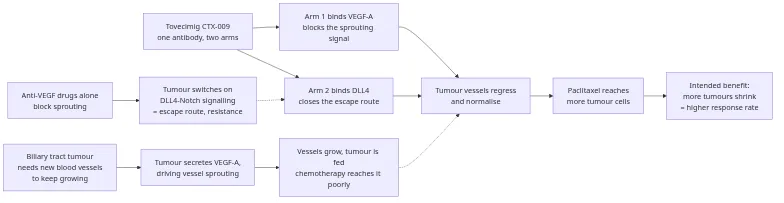
The exact scientific step the next readout must prove. Not that the drug shrinks tumours — that
is already established and statistically significant. The October presentation must show that the
shrinkage lasted. Duration of response is the one pre-specified secondary endpoint from
COMPANION-002 that has never been reported publicly, and the company said on 2026-04-27 that the
complete dataset with duration of response would be presented later in 2026
[VERIFIED — BPIQ fetch_company_drugs 2026-08-19, note field entry dated 04/27/26].
The honest scientific risk. The mechanism produced tumour shrinkage and delayed progression, and produced no survival benefit at all. That combination — a real anti-tumour effect that does not translate into patients living longer — is the classic signature of an agent whose toxicity costs back what its efficacy earns. The company attributes the flat survival to 54% crossover. Its own crossover-adjusted analysis does not support that attribution (A.5, Evidence quality), and that unresolved contradiction is the single most important scientific fact in this document.
A.2 Clinical development plan, timeline, feasibility, resourcing
gantt
  title Tovecimig (CTX-009) clinical development, with competitor precedent
  dateFormat YYYY-MM-DD
  axisFormat %Y-%m
  section Tovecimig - Compass / ABL Bio
    NCT03292783 Ph1 monotherapy dose escalation n=45      :done, 2017-09-01, 2021-06-30
    NCT04492033 Ph1b/2a + paclitaxel or irinotecan n=41   :done, 2020-06-22, 2024-01-08
    NCT05506943 COMPANION-002 Ph2/3 randomised n=168      :active, 2023-01-09, 2026-12-01
    ORR primary endpoint met, reported                    :milestone, 2025-04-01, 0d
    PFS met, OS missed, reported                          :milestone, 2026-04-27, 0d
    ESMO oral, full dataset with duration of response     :milestone, 2026-10-24, 0d
    Planned BLA submission, guided 2026                   :crit, 2026-11-01, 2026-12-31
    NCT05513742 COMPANION-003 Ph2 colorectal n=49         :done, 2022-12-08, 2025-05-15
    NCT06548412 Ph1/2 first-line BTC, MD Anderson n=50    :active, 2025-01-22, 2027-05-01
  section Competitor precedent
    ABC-06 Ph3 FOLFOX vs symptom control, 2L BTC          :done, 2014-03-01, 2019-06-01
    TOPAZ-1 Ph3 durvalumab + gem/cis, 1L BTC              :done, 2019-04-01, 2021-08-01
    HERIZON-BTC-01 zanidatamab, HER2+ BTC, accelerated approval :done, 2019-09-01, 2024-11-20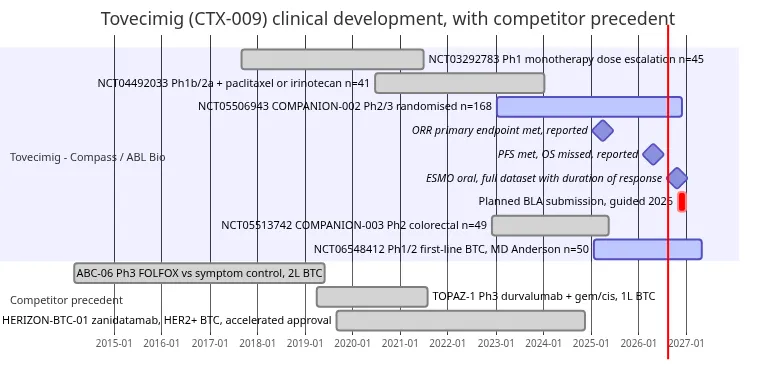
Milestone dates. Last patient in is not separately disclosed; enrollment completion was
announced on 2024-08-06
[VERIFIED — BPIQ fetch_company_drugs 2026-08-19, note entry dated 8/6/24]. The primary-endpoint
database lock produced a readout on 2025-04-01, roughly eight months after enrollment completed
[VERIFIED — Compass press release 2025-04-01]. The secondary-endpoint (progression-free and
overall survival) lock produced a readout on 2026-04-27
[VERIFIED — Compass press release 2026-04-27]. The registry’s primary_completion_date is
2026-12-01 [VERIFIED — CT.gov get_trial_details NCT05506943, retrieved 2026-08-19], which now
postdates the October presentation — see the Readout section for what that disagreement means and
does not mean.
Trials
| Trial | Sponsor / whose drug | Design (arms, blinding, n) | Population | Status / key result | Link |
|---|---|---|---|---|---|
| COMPANION-002 (NCT05506943) — the pivotal trial | Compass Therapeutics; its own drug | Phase 2/3, multicentre, open-label (everyone knows who gets what), randomised 2 : 1 to tovecimig + paclitaxel vs paclitaxel alone; n=168 across 34 US sites; crossover permitted at progression; stratified by stage, anatomical subtype and performance status | Adults with unresectable advanced, metastatic or recurrent biliary tract cancer who progressed after one prior gemcitabine-and-platinum regimen; performance status 0–1; patients eligible for an approved targeted therapy are excluded | ACTIVE_NOT_RECRUITING. Primary endpoint met 2025-04-01. Secondaries 2026-04-27: PFS 4.7 vs 2.6 months (HR 0.44, p<0.0001) met; OS 8.9 vs 9.4 months (HR 1.05, p=0.78) not met. Duration of response not yet reported. has_results false on the registry. | NCT05506943 |
| NCT04492033 — Phase 1b/2a, the study COMPANION-002 was built on | Handok Inc. (the Korean licensee); ABL Bio’s drug | Phase 1b/2a, multicentre, open-label, single-arm; n=41 | Phase 1b: advanced solid tumours. Phase 2: biliary tract cancer after one or two prior therapies | TERMINATED. Phase 2 cohort (n=24) reported ORR 37.5%, median duration of response 6.9 months, median PFS 9.4 months, 1-year survival 53%. Second-line subgroup ORR 63.6% (7/11). | NCT04492033 |
| NCT03292783 — first-in-human | ABL Bio; its own drug | Phase 1 monotherapy dose escalation, nine dose levels 0.3–17.5 mg/kg; n=45 | Heavily pretreated advanced solid tumours (median four prior lines) | Completed. Four partial responses in 40 evaluable; three confirmed, all at ≥10 mg/kg. No dose-limiting toxicities. Most common adverse event hypertension (37.8%). | Registry record not retrieved this sweep; results cited from the design paper [VERIFIED — PMID 38861293] |
| COMPANION-003 (NCT05513742) — a different indication | Compass Therapeutics; its own drug | Phase 2, single-arm; n=49 | Metastatic colorectal cancer after two or three prior regimens | COMPLETED, and it did not advance to its second stage. ORR 5% (2/41), median PFS 3.9 months, disease control 71%. | NCT05513742 |
| NCT06548412 — first-line, investigator-sponsored | MD Anderson Cancer Center; Compass’s drug | Phase 1/2, open-label; n=50; tovecimig + gemcitabine + cisplatin + durvalumab | Untreated unresectable or metastatic biliary tract cancer | RECRUITING. Primary completion 2027-05-01. Not this catalyst. | NCT06548412 |
| NCT07662031 — second-line colorectal, investigator-sponsored | Washington University; Compass’s drug | Phase 2; n=25; tovecimig + FOLFIRI | Second-line metastatic colorectal cancer | NOT_YET_RECRUITING, start 2026-08-31, primary completion 2030-08-31. | NCT07662031 |
| NCT07392957 — glioblastoma, investigator-sponsored | Washington University; Compass’s drugs | Phase 1b/2, open-label; n=54; tovecimig alone or with CTX-471 | Recurrent glioblastoma | RECRUITING since 2026-06-16. Primary completion 2029-06-30. | NCT07392957 |
| ABC-06 — competitor precedent, whose drug is generic chemotherapy | Advanced Biliary Cancer Working Group (academic); not Compass’s drug | Phase 3, randomised, open-label; FOLFOX vs active symptom control | Second-line advanced biliary tract cancer after gemcitabine/cisplatin | Completed. Median overall survival improved by 0.9 months over symptom control alone. This is the trial that made FOLFOX the de facto standard and it is the bar tovecimig is measured against. | [VERIFIED — cited in PMID 38861293] |
Feasibility matrix
| Factor | High probability | Medium probability | Low probability | This asset (assessment) | Source |
|---|---|---|---|---|---|
| Recruitment feasibility | >50 sites, 3:1 patient:site | 20–50 sites, established investigators | <20 sites, novel sites | High-to-medium, and already answered. 34 sites, 168 patients enrolled — 4.9 patients per site — at named academic centres (MD Anderson, Mayo, Johns Hopkins, Memorial, Stanford, UCSF). Enrollment is complete, so this factor no longer carries risk for this readout. | CT.gov get_trial_details NCT05506943 |
| Endpoint clarity | Regulatory precedent exists | Novel endpoint with FDA alignment | Unvalidated surrogate | Medium. Overall response rate by independent central review is a well-established basis for accelerated approval in oncology, and zanidatamab’s November 2024 accelerated approval in HER2-positive biliary tract cancer is a same-disease precedent. But accelerated approval on response rate normally requires the responses to be durable, which is exactly the figure not yet public, and the flat overall survival is a live obstacle a precedent does not remove. | CT.gov primary outcome; competitor precedent per web search 2026-08-19 |
| Trial-design robustness | Pivotal Phase III with special protocol assessment | Adaptive with interim analysis | Single-arm, no control | Medium. Genuinely randomised and controlled, which is the strong part. Weakened by three things: open-label (an unblinded investigator assessing tumour shrinkage is a known source of bias, partially mitigated by independent central review of the primary endpoint), 2:1 randomisation leaving only 57 control patients, and permitted crossover, which by design makes the survival endpoint uninterpretable. No special protocol assessment is disclosed. | CT.gov get_trial_details; PMID 38861293 |
| Operational / execution | Enrollment complete, standard timeline | Some timeline risk | Enrollment behind | High. Enrollment completed 2024-08-06 and both data locks delivered. The programme’s slippage is in reporting dates, not enrolment (see Readout, Date slippage: five slips). | BPIQ note field, 2026-08-19 |
Resourcing sufficiency. Yes for this readout, and it is not really a question: the trial is
enrolled, both analyses are locked, and the presentation is written. The company holds $179.9M of
cash and marketable securities against a $4.9M monthly burn
(../company.md C.3), so there is no scenario where the October presentation fails
to happen for lack of money. The real resourcing question is one step later — whether a company with
18 to 36 months of clinical-rate cash can fund a marketing application, a launch and an ongoing
first-line programme without returning to the $400M shelf that has sat effective and unused since
January (../company.md C.3). That question does not bear on this catalyst; it
bears on what happens after it.
A.3 Target label, target product profile, strategic questions, designations
A.3a Target label. Tovecimig in combination with paclitaxel for adults with unresectable advanced, metastatic or recurrent biliary tract cancer who have progressed after one prior gemcitabine- and platinum-containing regimen.
A.3b Target product profile
| Attribute | Standard of care & key competitor(s) — data | Tovecimig target profile (goal) | Supporting evidence (+ link) |
|---|---|---|---|
| Indication / target label | FOLFOX chemotherapy, used off-label; no agent carries a specific FDA approval for unselected second-line biliary tract cancer. Zanidatamab (Ziihera) has accelerated approval but only for HER2 immunohistochemistry 3+ disease; pemigatinib and futibatinib only for FGFR2 fusions; ivosidenib only for IDH1 mutations. Together those cover perhaps 20–30% of patients. | The first approved regimen for the unselected second-line population — the 70–80% with no actionable alteration | Competitive landscape web search 2026-08-19 [WEB ESTIMATE — Frontiers in Oncology 2026 review and DelveInsight, retrieved 2026-08-19] |
| Efficacy (endpoints, regimen) | FOLFOX in ABC-06: response rate ~5%, median overall survival ~6 months, +0.9 months over symptom control. Paclitaxel alone in COMPANION-002’s own control arm: ORR 5.3%, median PFS 2.6 months, median OS 9.4 months. | ORR meaningfully above 5%, durable responses, and ideally a survival benefit. Achieved on the first two; not achieved on the third. ORR 17.1% (19/111, one complete response) vs 5.3% (3/57), p=0.031; PFS 4.7 vs 2.6 months, HR 0.44, p<0.0001; OS 8.9 vs 9.4 months, HR 1.05, p=0.78. Final ORR later stated as 18%. | [VERIFIED — Compass press release 2026-04-27]; final ORR [VERIFIED — BPIQ fetch_company_drugs 2026-08-19, note entry dated 08/06/26] |
| Safety / tolerability | Paclitaxel alone: predictable neutropenia and neuropathy, no hypertension signal of consequence | A tolerability profile that lets patients stay on treatment. This is the weakest attribute. Hypertension in 69% of patients overall and Grade 3 or higher in 44%; Grade 3+ neutropenia 36%; fatigue 67%. Grade 3+ hypertension in nearly half of patients on a drug that adds two months of progression-free time and no survival is a genuine benefit-risk problem, not a footnote. | [VERIFIED — Compass press release 2026-04-27] |
| Biomarker / companion diagnostic | The approved competitors are all biomarker-gated (HER2, FGFR2, IDH1, MSI) | None, by design. Tovecimig’s commercial argument is that it works in the patients nobody can select for. No predictive biomarker has been proposed or tested. | CT.gov get_trial_details — stratification is by stage, subtype and performance status, none of them molecular |
| Formulation / administration | FOLFOX: intravenous, every two weeks, in an infusion centre | Intravenous, 10 mg/kg on days 1 and 15 of a 28-day cycle, alongside paclitaxel 80 mg/m² on days 1, 8 and 15. Three infusion visits a month either way, so no administration advantage over the comparator. Population pharmacokinetic modelling supports fixed dosing and a three-weekly 15 mg/kg option as equivalent exposure, which would eventually reduce visits. | [VERIFIED — PMID 38861293]; dosing flexibility [VERIFIED — Na et al., Cancer Sci 2024, PMID 39375952, DOI 10.1111/cas.16363, retrieved from PubMed 2026-08-19] |
| Payer value | FOLFOX is generic and costs almost nothing | A branded biologic priced at orphan-oncology rates in a setting where the incumbent is free. With no overall-survival benefit to point at, the payer conversation rests entirely on response rate and progression-free survival. That is a materially harder argument than it would be with an OS win, and it is the main reason B.3a’s penetration assumptions are held below what an unmet-need story alone would suggest. | [UNVERIFIED] — no published payer assessment of tovecimig exists |
A.3c Strategic Go/No-Go questions. The set below is Pre-Phase-III / registration, because COMPANION-002 is complete and the next decision is whether to file.
| Group | Question | Answer (tagged) |
|---|---|---|
| Target | Target revalidated as in prior phases? | Partly. The anti-tumour effect replicated in the randomised setting — response rate and progression-free survival both moved in the right direction with significance. The magnitude did not replicate: the Phase 1b/2 cohort reported 37.5% ORR overall and 63.6% in second line; the randomised trial delivered 17.1%. Roughly half the effect survived randomisation. [VERIFIED — PMID 38861293 for the Phase 2 figures; Compass 2026-04-27 for the randomised figures] |
| Dose & Drug | Exposure–response for the intended commercial regimen and route(s)? | Partly. A published population pharmacokinetic model built on 712 plasma concentrations from 30 patients describes the drug’s behaviour well and shows fixed and weight-based dosing give equivalent exposure. It is a pharmacokinetic model, not an exposure–response model: it does not link concentration to tumour shrinkage. [VERIFIED — PMID 39375952] |
| Dose & Drug | Commercial formulation available or feasible? | Yes. A standard intravenous antibody at 10 mg/kg, manufactured through Phase 3. No formulation change is contemplated. [UNVERIFIED] — no chemistry, manufacturing and controls detail is public |
| Dose & Drug | Dose range compatible with clinical and non-clinical safety? | Yes at the dose used. Nine dose levels to 17.5 mg/kg in Phase 1 with no dose-limiting toxicities; 10 mg/kg selected. [VERIFIED — PMID 38861293] |
| Dose & Drug | Therapeutic window given the clinical response? | This is the problem. 44% Grade 3+ hypertension against a 17.1% response rate and no survival benefit is a narrow window. The Phase 1 monotherapy hypertension rate was 37.8% at all grades; in combination it reached 69% all grades. [VERIFIED — Compass 2026-04-27; PMID 38861293] |
| Dose & Drug | Intrinsic and extrinsic factors influencing exposure and patient response? | Body weight only, identified as a significant covariate on central volume of distribution. No other intrinsic or extrinsic covariate was retained. [VERIFIED — PMID 39375952] |
| Patient | Proof of concept and positive benefit/risk in the intended population? Combination evidence? | Proof of concept yes; benefit/risk contested. The combination evidence is strong on mechanism (chemotherapy synergy replicated in two independent xenograft papers) and on tumour control. Benefit/risk is contested because the survival curve is flat and the severe-hypertension rate is high. [VERIFIED — PMID 33383646, PMID 32580836 for combination preclinical; Compass 2026-04-27 for clinical] |
| Patient | Phase III design and outcome criteria — accepted, compelling, competitive for market access? | Accepted, not compelling. Response rate by independent central review is an accepted accelerated-approval basis and zanidatamab is a same-disease precedent. But permitting crossover destroyed the survival readout the same design needed for full approval and for payers, which is a design decision the company now has to argue around rather than a result it can point at. [UNVERIFIED — judgement] |
| Patient | Rationale for the patient population(s)? | Strong. Second-line biliary tract cancer with no actionable alteration is the largest unserved slice of the disease and the one where the incumbent (FOLFOX, ~5% response rate) is weakest. [VERIFIED — PMID 38861293] |
| Patient | Likelihood of the expected outcome? | For the October presentation specifically, 55% — see the Locked prediction. For approval, materially lower and not scored here. [UNVERIFIED — modelled] |
| Patient | Companion-diagnostic strategy, including pricing and market? | None, deliberately. The commercial thesis is all-comers. This removes diagnostic friction and removes the enrichment that would have made the response rate look better. [VERIFIED — CT.gov get_trial_details, no molecular stratification] |
A.3d Regulatory designations.
- Fast Track designation, granted 2024-04-25. Grants more frequent FDA meetings, eligibility for
accelerated approval and priority review if criteria are met, and rolling review of a marketing
application. It is a process benefit, not a lower evidentiary bar.
[VERIFIED — BPIQ fetch_company_drugs 2026-08-19,noteentry dated 4/25/24] - Orphan Drug designation for biliary tract cancer, granted around 2026-05-05. Grants seven
years of US market exclusivity for the designated indication from approval, tax credits on
qualifying trial costs, and a waiver of the marketing-application user fee. The seven years run
independently of any patent.
[VERIFIED — BPIQ fetch_company_drugs 2026-08-19,noteentry dated 05/05/26; corroborated by CancerNetwork and Targeted Oncology coverage retrieved 2026-08-19] - No Breakthrough Therapy designation has been announced, and none appears in the BPIQ note
history or the press feed. In a disease this poorly served, a drug with a real survival benefit
would normally have one. Its absence is consistent with the flat overall survival.
[UNVERIFIED — absence of evidence; not evidence of refusal]
A.4 Target product profile valuation matrix
| Stakeholder | Value driver | Minimum threshold | Competitive | Premium | Benchmark / source |
|---|---|---|---|---|---|
| Patient / caregiver | Time before the cancer grows again, and how tolerable the treatment is | Any delay in progression over paclitaxel alone | +2 months progression-free survival with manageable toxicity | +2 months progression-free and longer overall survival, with hypertension controllable on oral medication | Achieved: competitive, not premium. +2.1 months progression-free (4.7 vs 2.6); zero months of overall survival; 44% Grade 3+ hypertension. [VERIFIED — Compass 2026-04-27] |
| Regulator | Evidence that the benefit is real and durable | Statistically significant response rate by independent review | Significant response rate plus significant progression-free survival | The above plus overall survival, supporting full rather than accelerated approval | Achieved: competitive. Both response rate and progression-free survival met with independent central review of the primary endpoint. Overall survival not met, which is what separates a plausible accelerated-approval filing from a straightforward one. [VERIFIED — Compass 2026-04-27] |
| Payer / HTA | Cost per unit of benefit against a generic incumbent | Demonstrated superiority over FOLFOX or paclitaxel on any endpoint | Superiority on progression-free survival with acceptable added toxicity | Superiority on overall survival — the endpoint health-technology-assessment bodies weight most heavily | Achieved: minimum-to-competitive. No overall-survival benefit is the hardest possible starting point against an incumbent that is effectively free. [UNVERIFIED — judgement; no published assessment exists] |
| Provider | Fits existing infusion workflow; predictable toxicity management | Standard intravenous administration | Same visit schedule as the comparator | Fewer visits, or oral | Achieved: competitive. Same three-visits-a-month schedule as paclitaxel alone. Three-weekly dosing is modelled as feasible but not approved. [VERIFIED — PMID 39375952] |
Calibration examples, not asset claims: in oncology each incremental month of overall survival is worth roughly $150–300M in peak-sales potential; oral formulations command roughly 15–25% price premiums over injectables. Applied here, the calibration is unflattering and worth stating plainly: the incremental overall survival is zero months, so that particular lever contributes nothing to this asset’s peak-sales potential.
A.5 Evidence quality and endpoints
| Criterion | Score (High / Medium / Low) | Basis (one line) | Link |
|---|---|---|---|
| Target validation | Medium | Both targets independently confirmed as real human drug targets in Open Targets, and the VEGF axis is validated by many approved drugs — but no anti-DLL4 agent has ever been approved for anything, and the disease-specific DLL4 expression claims rest on sponsor-cited literature this sweep did not read. | [VERIFIED — Open Targets search_entities 2026-08-19] |
| Mechanism clarity | High | The dual-blockade rationale is specific, testable and preclinically replicated in two independent papers using different tumour models and different chemotherapy partners. | [VERIFIED — PMID 33383646; PMID 32580836] |
| Biomarker availability | Low | No predictive biomarker exists, none was tested, and none is planned. Every patient is treated and 83% do not respond. | [VERIFIED — CT.gov get_trial_details NCT05506943] |
| Publication quality (peer-reviewed? independent authors?) | Low | The entire PubMed footprint for this molecule is four papers. Two are ABL Bio’s own preclinical work with ABL Bio employees as the majority of authors; one is a population pharmacokinetic model co-authored by four ABL Bio employees; one is the COMPANION-002 design paper, which is a protocol description and not a result. No peer-reviewed publication of any tovecimig clinical result exists. Every efficacy figure in this document comes from a company press release or a congress abstract. | [VERIFIED — PubMed search_articles 2026-08-19, 4 hits, total_count 4] |
| Clinical / expert sentiment | — | Moved to A.5b, below. | — |
The single most important evidence finding in this document. The COMPANION-002 design paper
states the trial “was designed to detect a 23% absolute difference in response rate between the
two arms, with 90% power and a two-sided alpha of 0.05”
[VERIFIED — PMID 38861293, § 3.5 Statistical methods]. The delivered difference was 11.8
percentage points (17.1% minus 5.3%) — roughly half of what the trial was powered to find. It
still cleared significance at p=0.031, because the control arm underperformed the design’s
assumption too, but “significant” and “as large as expected” are different facts and only the first
one was in the press release.
framework/07-benchmarks.md’s Surprise, early stops and hype section is explicit that share-price
moves scale with the expectation gap rather than with the result alone, and that the dramatic moves
live in the outer buckets. This asset has now landed in the missed expectations bucket twice —
once on effect size in April 2025, and once on overall survival in April 2026 — and the second one
produced a 65% single-session decline. That history, not the class average, is what the scenario
ranges below are calibrated against.
And the crossover argument does not survive its own check. The company attributes the flat
survival to 54% of control patients crossing over to tovecimig. The standard way to test that claim
is a rank-preserving structural failure time analysis, which estimates what the control arm’s
survival would have been without crossover. Compass reported it: hazard ratio 1.13, against the
unadjusted 1.05 [VERIFIED — Compass press release 2026-04-27]. Removing the crossover made the
result worse. A crossover explanation that its own adjustment contradicts is not an explanation. A
supportive subset (crossover patients 12.8 months vs non-crossover 6.1 months, hazard ratio 0.54,
p=0.04) was also reported, but comparing patients who crossed over against patients who did not is
comparing patients who lived long enough to cross over against those who did not — a well-known
form of survivorship bias, not evidence.
Endpoints
| Endpoint (full name) | What it measures | Scale / range | Better direction | MCID / note |
|---|---|---|---|---|
| Overall response rate (ORR) — the primary endpoint | The percentage of patients whose tumours shrank enough to count as a complete response (all measurable disease gone) or a partial response (at least a 30% reduction in the sum of target-lesion diameters), assessed by RECIST version 1.1 and confirmed by independent central review | 0–100% | Higher | No formally established minimal clinically important difference in this disease. The trial’s own design set the bar at a 23-percentage-point absolute difference; it delivered 11.8. The comparator, FOLFOX, runs at roughly 5%. |
| Duration of response (DoR) — the figure the October event turns on | Among patients who did respond, the time from the scan that first confirmed the response to the scan that first confirmed the disease growing again | Months, 0 to open-ended | Longer | No established minimal clinically important difference. Two reference points exist: the Phase 1b/2 cohort reported a median of 6.9 months, and this trial’s own median progression-free survival on the tovecimig arm is 4.7 months — a duration of response shorter than that would mean responders relapse no later than the average patient progresses, which would undercut the durability argument entirely. Not yet reported. |
| Progression-free survival (PFS) | Time from randomisation until the cancer measurably grows or the patient dies of any cause, whichever comes first | Months | Longer | 4.7 vs 2.6 months, hazard ratio 0.44 — a 56% reduction in the rate of progression or death. In this disease a 2-month gain is meaningful; it is also the endpoint most vulnerable to bias in an open-label trial. |
| Overall survival (OS) | Time from randomisation until death from any cause | Months | Longer | The endpoint regulators and payers weight most heavily. 8.9 vs 9.4 months, hazard ratio 1.05, p=0.78 — numerically worse on the drug. Rendered formally uninterpretable by 54% crossover, and the crossover adjustment made it worse rather than better. |
| Disease control rate (DCR) | The percentage of patients whose tumours shrank or stayed stable | 0–100% | Higher | Not reported for COMPANION-002. The Phase 2 colorectal study reported 71%, in a different disease. |
| Treatment-emergent adverse events (TEAEs) | Any medical problem arising during treatment, graded 1 (mild) to 5 (fatal) on the National Cancer Institute’s CTCAE version 5.0 scale | Counts and percentages by grade | Fewer, milder | Grade 3 = severe, medically significant, usually requiring intervention. 44% Grade 3+ hypertension is the headline number; for comparison, Grade 3+ neutropenia was 36% and is expected from paclitaxel. |
| EORTC QLQ-C30 (quality of life) | A 30-item patient questionnaire covering physical, role, emotional, cognitive and social functioning plus symptoms | 0–100 per scale | Higher for functioning; lower for symptoms | Listed as a secondary endpoint in the design paper but not in the registry’s outcome-measure list, and never reported. In a trial with no survival benefit and severe hypertension in nearly half of patients, quality-of-life data would be genuinely informative, and its absence from the October abstract would be a finding. |
A.5b Key opinion leaders.
Panel as of. 2026-08-19.
Investigators
CT.gov search_investigators returned zero rows for this trial on two different query shapes
(condition: "biliary tract cancer" with investigator_name: "Javle", and with
institution: "Compass Therapeutics"), and get_trial_details on NCT05506943 returned no
overall-official or contact block — the registry record simply does not carry investigator names.
The investigators below are therefore taken from the COMPANION-002 design paper’s author list, every
one of whom is affiliated to an institution that appears in the trial’s own CT.gov site list, which
is what ties them to this trial rather than to the disease generally. Five of the twenty-five are
listed; they are the ones with a named role in this catalyst or a leading position in the disease.
| Name | Role / affiliation | Trial (NCT) | Conflicts (party, kind, disclosed in, as of) | Conflicts checked (source, date) | Source | Tag |
|---|---|---|---|---|---|---|
| Nilofer Azad | First author of the trial design paper; the named presenter of the 2026-10-24 ESMO oral presentation; Professor of Oncology and Associate Director of Clinical Research, Sidney Kimmel Comprehensive Cancer Center at Johns Hopkins. Johns Hopkins is a COMPANION-002 site. | NCT05506943 | Sponsor — trial investigator and designated presenter of the sponsor’s data, disclosed in Compass’s own press release of 2026-07-17, as of 2026-07-17. No relationship with a named competitor was found. | PubMed get_article_metadata and get_full_text_article on PMID 38861293 / PMC11509068, 2026-08-19 — the PubMed metadata payload and the PubMed Central full-text render carry no financial-disclosure section for this article, so no conflict statement was available to read. The sponsor relationship above comes from the press release, not from a journal disclosure. | Compass press release 2026-07-17; PubMed PMID 38861293 | VERIFIED — Compass press release 2026-07-17 and PubMed 2026-08-19 |
| Milind Javle | Senior (last) author of the design paper; Department of Gastrointestinal Medical Oncology, MD Anderson Cancer Center. MD Anderson is a COMPANION-002 site and separately sponsors the first-line trial NCT06548412. | NCT05506943 | Sponsor — trial investigator, disclosed by authorship of the sponsor’s design paper, as of 2024-06-04. No relationship with a named competitor was found. | Same search as above, 2026-08-19 — no financial-disclosure section in either render. | PubMed PMID 38861293 | VERIFIED — PubMed 2026-08-19 |
| Rachna Shroff | Design-paper author; Division of Hematology and Oncology, University of Arizona Cancer Center, a COMPANION-002 site. | NCT05506943 | Sponsor — trial investigator, disclosed by authorship, as of 2024-06-04. No competitor relationship found. | Same search, 2026-08-19 — no disclosure section available. | PubMed PMID 38861293 | VERIFIED — PubMed 2026-08-19 |
| Lipika Goyal | Design-paper author; Stanford Cancer Center, a COMPANION-002 site. | NCT05506943 | Sponsor — trial investigator, disclosed by authorship, as of 2024-06-04. No competitor relationship found. | Same search, 2026-08-19 — no disclosure section available. | PubMed PMID 38861293 | VERIFIED — PubMed 2026-08-19 |
| Minori Rosales | Design-paper author listed at “Compass Therapeutics, 80 Guest Street, Boston, MA 02135” — an employee of the sponsor, not an independent investigator. | NCT05506943 | Sponsor — employment, disclosed by the affiliation printed on the paper itself, as of 2024-06-04. | PubMed get_article_metadata PMID 38861293, 2026-08-19 — affiliation field read directly. | PubMed PMID 38861293 | VERIFIED — PubMed 2026-08-19 |
A limit worth stating rather than burying. 02-connectors.md § KOL sources is explicit that a
conflict statement is only as good as the journal’s disclosure practice, and that an absent
disclosure is not evidence of no conflict. Here there is no disclosure section at all in either
PubMed render, so the “no competitor relationship found” entries above rest on a search that had
nothing to search. They record that the attempt was made, and nothing more.
Independent voices
None were found, and the reason is structural. An independent voice on this endpoint would be a named commentator on tovecimig’s data who is not an investigator on its trial and holds no disclosed relationship with Compass. The PubMed footprint for this molecule is four papers, of which three are ABL Bio’s own and one is the sponsor’s design paper — there is no independent literature to draw a voice from. COMPANION-002’s own 34 sites enrol most of the US academic centres that specialise in this disease, so the disease’s leading clinicians are largely investigators on it. No independent named critique of the April 2026 dataset was located in the press feed or by web search; the critical coverage that exists (Fierce Biotech, Benzinga) is unattributed reporting rather than a named expert view.
| Name | Affiliation | View (close enough to quote) | As of | Conflicts checked (source, date) | Source | Tag |
|---|
This empty table is itself a finding, and it is the reason the judgement below reads UNKNOWN
rather than anything warmer. It will not stay empty: an ESMO Proffered Paper carries a formal expert
discussant who critiques the data from the podium immediately after the presentation. That
discussant is the first genuinely independent voice this programme will have had, and their verdict
on 2026-10-24 is a specific, dated, checkable item — it is on the “What to watch” list below.
Judgement
| Endpoint supported | Basis (one or two sentences) | Tag |
|---|---|---|
UNKNOWN | No independent voice on this endpoint could be assembled at all: the molecule has four PubMed papers, three of them the originator’s own preclinical work and one the sponsor’s protocol description, and no clinical result has ever been peer-reviewed. A judgement over an empty panel is not a judgement, and recording it as anything other than UNKNOWN would be the exact failure 01-rules.md rule 40 carries its own worked example of. | UNVERIFIED — judgement |
Dissent
| Name | View (close enough to quote) | Source |
|---|
Empty, and correctly so: endpoint_supported is UNKNOWN rather than SUPPORTIVE_CONTESTED, so
there is no claimed support for anyone to contest. Inventing a dissenter would be as wrong as
inventing a supporter.
B. Commercial assessment
B.0 Current treatment algorithm
First line. Gemcitabine plus cisplatin chemotherapy, now routinely with an immunotherapy
antibody added (durvalumab or pembrolizumab) following the TOPAZ-1 and KEYNOTE-966 trials. This is
what essentially every patient with advanced biliary tract cancer receives
[WEB ESTIMATE — Frontiers in Oncology 2026 review, retrieved 2026-08-19].
On progression, the path forks by molecular test result.
- Roughly 10–15% of intrahepatic cholangiocarcinomas carry an FGFR2 fusion → pemigatinib (Pemazyre) or futibatinib (Lytgobi), both accelerated approvals.
- Roughly 10–15% of intrahepatic cholangiocarcinomas carry an IDH1 mutation → ivosidenib (Tibsovo), full approval.
- A minority are HER2 immunohistochemistry 3+ → zanidatamab (Ziihera), accelerated approval November 2024, or tucatinib plus trastuzumab.
- Small fractions carry BRAF V600E (4–5%), NTRK fusions (<1%), RET fusions (<1%) or microsatellite instability (1–2%) → the corresponding tumour-agnostic approvals.
- Everyone else — 70–80% of the second-line population — gets FOLFOX, off-label, on the strength
of ABC-06’s 0.9-month median survival gain over symptom control, at a response rate of about 5%.
[WEB ESTIMATE — Frontiers in Oncology 2026 review and DelveInsight, retrieved 2026-08-19; ABC-06 figures VERIFIED — PMID 38861293]
Where tovecimig would fit. Exactly into that last bullet, and nowhere else. It would be a
second-line regimen for the unselected majority, replacing or competing with FOLFOX. COMPANION-002’s
own eligibility criteria enforce this position: patients eligible for an approved targeted therapy
on a labelled regimen are excluded [VERIFIED — CT.gov get_trial_details NCT05506943, exclusion criterion 1]. It adds to paclitaxel rather than displacing chemotherapy — the regimen is tovecimig
plus paclitaxel, so it is an add-on, not a replacement.
B.1 Competitive landscape and positioning
| Metric | High value | Medium value | Low value | This asset (assessment) | Source |
|---|---|---|---|---|---|
| Mechanism differentiation | First-in-class or novel target | Next-generation improvement | Me-too | High. No DLL4-targeting agent is approved anywhere, and no DLL4 × VEGF-A bispecific is approved. In biliary tract cancer specifically, no anti-angiogenic agent of any kind is approved. It is genuinely first-in-class — which is as much a warning as a boast, since the class has never proved itself. | ChEMBL compound_search 2026-08-19 (max_phase 2, no approval); competitive web search 2026-08-19 |
| Development-timeline advantage | >12 months ahead | Within 6–12 months | Lagging >12 months | High, in this specific slot. No other agent is in a randomised trial for the unselected second-line population. The competitors listed in B.0 all occupy biomarker-defined niches tovecimig’s own trial excludes. Silmitasertib (CX-4945) is the nearest emerging non-biomarker agent and is only in Phase 2. | Competitive web search 2026-08-19 |
| Clinical proof-of-concept evidence | Positive Phase IIb (n>100) | Phase IIa signals (n=20–50) | Preclinical only | High on the letter, medium in substance. A randomised 168-patient trial that met its primary endpoint is well past the “high value” bar as written. It is downgraded in substance because the effect was half the powered size, the survival endpoint was flat, and no result has been peer-reviewed. | CT.gov get_trial_details; Compass 2026-04-27; PubMed 2026-08-19 |
| IP protection | Composition-of-matter, long-dated | Method-of-use | Pending or none | Cannot be verified, and that is a real gap. No patent number, filing date or expiry was located for tovecimig this sweep. What is verified is a seven-year US orphan-drug exclusivity running from approval, which is a regulatory right independent of any patent. Scored no higher than medium on the strength of the orphan exclusivity alone. | Orphan designation [VERIFIED — BPIQ note 05/05/26 and press coverage]; patent search returned nothing [UNVERIFIED] |
Where this asset wins, and the single fact the thesis rests on. It wins on being the only randomised, statistically positive, non-biomarker-gated asset aimed at the largest unserved slice of a disease whose incumbent second-line therapy produces a 5% response rate. That is a real and defensible position.
The single fact the thesis rests on is that the US Food and Drug Administration will accept
response rate and progression-free survival as sufficient, in a disease this poorly served, without
an overall-survival benefit. Everything else — the market size, the price, the penetration, the
share price — follows from that one judgement. It is not a scientific question and this document
cannot resolve it. The company expected FDA feedback on exactly this in the third quarter of 2026
[VERIFIED — Compass second-quarter release, 2026-08-06], which means the answer is likely to
arrive before the October catalyst this analysis is written about.
Calibration example, not an asset claim: oncology first-movers in novel mechanisms have shown roughly 3.2× higher peak-sales potential but about 1.8× higher development risk. Tovecimig is a first-mover in a mechanism that has never produced an approval, so the second half of that calibration applies at least as strongly as the first.
B.2 Addressable market
Launch markets. The United States first and, on the base case, only. Compass holds worldwide rights except Korea and China but has no commercial infrastructure outside the US, and its Chief Commercial Officer was appointed in January 2026. Any ex-US revenue requires a partner that does not exist yet, so ex-US is treated as upside in B.3a rather than as base-case revenue.
| Component | How it is estimated | Premium threshold | This asset (assessment) | Source |
|---|---|---|---|---|
| Drug-treated patients | Epidemiology × diagnosis rate × treatment rate | >100,000 (US/EU5/Japan) | Far below the threshold: roughly 2,000–3,200 US patients a year. The funnel is in B.3a. Two independent incidence figures exist and they disagree: the American Cancer Society estimated ~18,600 US biliary tract cancer diagnoses in 2024, while a SEER-based analysis gives ~12,130 in 2022. Both are used, as the two ends of the range, rather than averaged. | ACS figure [VERIFIED — quoted in PMID 38861293]; SEER figure [WEB ESTIMATE — BMC Cancer / BMC Gastroenterology epidemiology papers, retrieved 2026-08-19] |
| Market exclusivity | Patent term + regulatory exclusivity | >10 years combined | Seven years verified, more likely but unverifiable. Orphan-drug exclusivity gives seven years from approval. A biological product also receives twelve years of US reference-product exclusivity under the Biologics Price Competition and Innovation Act, which would exceed the threshold — but that is a statutory default this sweep did not confirm applies here, and no patent estate was located. Recorded as seven years verified plus an unverified twelve-year statutory expectation. | [VERIFIED — orphan designation, BPIQ note 05/05/26]; the rest [UNVERIFIED] |
| Reimbursement precedent | Approvals in ≥2 major markets | Positive NICE/CADTH guidance | None. No approval anywhere, no health-technology-assessment submission, no published payer assessment. The nearest precedent is zanidatamab’s US accelerated approval in a biomarker-selected subset, which is a materially easier reimbursement case than an all-comers add-on with no survival benefit. | [UNVERIFIED] |
| Patient-journey impact | Fewer hospital days, less caregiver burden | >30% quality-of-life gain | Not demonstrated, and possibly negative. Same three-infusions-a-month schedule as the comparator, so no visit burden is removed. Severe hypertension in 44% of patients adds monitoring and medication. The EORTC QLQ-C30 quality-of-life instrument was a pre-specified secondary endpoint and has never been reported. | [VERIFIED — PMID 38861293 lists QLQ-C30; no result published] |
B.3 Value and feasibility
B.3a Expected peak sales. Built bottom-up. No published analyst peak-sales estimate for tovecimig in second-line biliary tract cancer was found in this sweep’s peak-sales web search, so nothing here is a pass-through of a third-party figure, and nothing here should be read as one. Every figure is conditional on approval. All three scenarios are US-only and gross of the tiered single-digit royalty owed to ABL Bio.
The patient funnel, applied to both ends of the disputed incidence figure:
- US biliary tract cancer diagnoses per year: 12,130 to 18,600
[VERIFIED — 18,600 quoted from the American Cancer Society in PMID 38861293]/[WEB ESTIMATE — 12,130, SEER-based, retrieved 2026-08-19] - × ~68% presenting with or progressing to advanced/unresectable disease
[UNVERIFIED — assumption] - × ~70% who receive first-line gemcitabine/platinum therapy
[UNVERIFIED — assumption] - × ~45% who progress and remain fit enough (performance status 0–1) for second-line treatment
[UNVERIFIED — assumption, consistent with real-world second-line initiation rates in this disease] - × ~80% without an actionable alteration that routes them to an approved targeted agent — the
complement of the 20–30% covered by FGFR2, IDH1, HER2 and MSI-high agents
[WEB ESTIMATE — Frontiers in Oncology 2026 review, retrieved 2026-08-19]
= 2,080 to 3,190 addressable US patients a year.
Price: no US price exists. Annual cost per treated patient is modelled as $20,000–$30,000 a
month of net revenue (the range branded orphan oncology biologics commonly occupy) × 5 months
of average treatment duration, anchored on the tovecimig arm’s own 4.7-month median
progression-free survival = $100,000–$150,000 per treated patient [UNVERIFIED — assumption].
| Scenario | Assumptions (patients × price × share) | Estimate (USD/year at peak) | Basis / tag |
|---|---|---|---|
| Low | 2,000 patients × $100,000 × 25% penetration | ~$50M | Accelerated approval granted but narrowly, oncologists stay with free FOLFOX for most patients given the flat survival curve and the hypertension burden, payers restrict. [UNVERIFIED — modelled] |
| Base | 2,600 patients × $125,000 × 45% penetration | ~$146M | Approval granted; adopted by roughly half of eligible patients in academic and larger community practice, where the 17–18% response rate against FOLFOX’s 5% is the argument. [UNVERIFIED — modelled] |
| High | 3,200 patients × $150,000 × 65% penetration | ~$312M | Approval plus a durable duration of response that reframes the survival result, plus first-line expansion pulling the second-line setting along, plus an ex-US partner. [UNVERIFIED — modelled] |
The weakest input is the price, and the second weakest is penetration. Neither has any verified anchor: no tovecimig price exists, and no analogous all-comers add-on has ever launched in this disease. Patient count is the strongest input, because the funnel’s first step has two independent published sources and its last step has a cited literature range. A reader who disagrees with the price should scale the whole table linearly — it moves the answer proportionally.
These figures sit awkwardly against the published analyst targets, and the gap is worth naming.
The base case, ~$146M of peak annual revenue, is below the company’s current ~$267M enterprise
value (../company.md C.4). The three post-collapse analyst targets — Stifel $6
(2026-08-14), Piper Sandler $6 (2026-08-07), Leerink $7 (2026-08-07) — imply an enterprise value
near $900M at $6 a share, which is roughly six times this base case’s peak revenue and cannot be
reached from second-line biliary tract cancer alone. Either those targets carry substantial value
for first-line expansion, ex-US rights and the three Phase 1 assets, or this bottom-up build is too
conservative. Both are possible and this document cannot settle it; the disagreement is stated
rather than smoothed over.
B.3b Feasibility
| Question | Answer (tagged) |
|---|---|
| Expected net present value (eNPV) | A range, and a wide one: roughly $150M to $700M of risk-adjusted enterprise value attributable to this programme [UNVERIFIED — modelled]. Assumptions, stated so they can be argued with: peak sales $50–312M from B.3a; a peak-sales multiple of 3× applied to a de-risked commercial asset; probability of US approval taken at 40–60%, reflecting a met primary endpoint and a defensible accelerated-approval path set against a flat survival curve and no Breakthrough designation; launch in 2028 with peak around 2033; discounting and the ABL Bio royalty netted into the multiple rather than modelled separately. No single figure is given, per 01-rules.md rule 10: the price and the penetration inputs are unverified and a point estimate on them would be false precision. Today’s ~$267M enterprise value sits inside this range and slightly below its midpoint. |
| Capital to the next decision point | Effectively nil. The trial is enrolled, both analyses are locked, and the October presentation is a conference slot. The next decision point after that — submitting the marketing application — is guided for 2026 and is a regulatory-affairs and manufacturing cost, not a trial cost. [VERIFIED — Compass 2026-08-06] |
| Capital to approval, and the funding plan | Not separately disclosed. The company holds $179.9M of cash and marketable securities and guides to a runway “into 2028” (../company.md C.3), which on its own arithmetic implies planned spending well above the current $4.9M monthly burn — the launch build. A $400M shelf registration has been effective and completely undrawn since January 2026, which is the funding plan whether or not it is described as one. [VERIFIED — EDGAR submissions; Compass 2026-08-06] |
| Launch capability — alone, or must partner? | Alone in the US, on paper. A Chief Commercial Officer (Arjun Prasad) and a Chief Medical Officer (Cynthia Sirard) were both appointed on 2026-01-05, twelve months before a plausible launch — early enough to be credible. A ~2,600-patient second-line oncology market is served by a small specialty salesforce, which is within reach for a company this size. Ex-US requires a partner that does not exist. [VERIFIED — press feed 2026-01-05; BPIQ insider transactions 2026-08-19 confirming both officers' inducement grants] |
| Commercialisation rights — retained, split, or out-licensed? | Retained, encumbered. Compass holds rights worldwide except Korea (Handok) and China. ABL Bio is owed tiered single-digit royalties on net sales plus up to ~$96M of development and regulatory milestones and up to ~$303M of commercial milestones in oncology. [WEB ESTIMATE — public summaries of the November 2018 ABL Bio licence, retrieved 2026-08-19]. The licence itself was not read this sweep, so these terms are not verified; they are consistent across the sources found and are used only to note that peak-sales figures are gross rather than net to Compass. |
B.4 Product-development risk
Framing questions.
- Does the development plan support the target product profile claims? Partly. The plan supports the efficacy claims it makes — response rate and progression-free survival are both demonstrated in a randomised trial with independent central review of the primary endpoint. It does not support the survival claim, because the design permitted crossover and thereby gave that claim away before the first patient was enrolled. A trial cannot demonstrate what its own design makes undemonstrable.
- Will the identified risks affect the target product profile? Yes, two of them directly. The flat overall survival degrades the payer row of A.3b from premium to minimum. The 44% Grade 3+ hypertension rate degrades the safety row, and it is not mitigable by a dose reduction without also reducing the efficacy that the 10 mg/kg dose was selected for.
- If a risk cannot be mitigated, is the asset still differentiated from competitors? Yes. Even with flat survival and severe hypertension in nearly half of patients, a 17–18% response rate against FOLFOX’s 5%, in an all-comers population with no approved option, is a differentiated product. The question is not whether it is differentiated but whether the differentiation is worth what it costs the patient.
| Category | Time risk | Quality risk | Cost risk | Note |
|---|---|---|---|---|
| Project management | Low | Low | Low | Trial enrolled, both locks delivered, congress slot secured. |
| Research | Medium | The mechanism is validated preclinically but no anti-DLL4 agent has ever been approved; the class’s clinical premise remains unproven. | ||
| IP | Medium | Medium | No patent estate could be located this sweep (B.1). Seven years of orphan exclusivity is verified and would carry a launch, but the absence of a verified composition-of-matter patent is a real hole in the analysis, not a finding that no patent exists. | |
| Legal | Medium | Medium | Four law-firm investigation solicitations following the April 2026 decline (../company.md C.5). No complaint has been filed. Solicitations are not litigation, but a securities suit would consume management attention through the filing period. | |
| DMPK | Low | Low | A published population pharmacokinetic model on 712 samples from 30 patients describes exposure well; body weight is the only significant covariate. [VERIFIED — PMID 39375952] | |
| Safety pharmacology | Medium | The hypertension signal is on-mechanism for anti-VEGF and anti-DLL4 agents alike and appeared at 37.8% all-grades in Phase 1 monotherapy before reaching 69% all-grades in combination. It is predictable, which is not the same as acceptable. | ||
| Toxicology | No preclinical toxicology finding was located this sweep; nine dose levels to 17.5 mg/kg produced no dose-limiting toxicity in humans. No risk recorded. | |||
| Drug safety (clinical) | High | Medium | 44% Grade 3 or higher hypertension. 03b-program-spec.md calls a clinical-safety signal a near-veto factor that can dominate the estimate regardless of clinical strength. This one is not a treatment-related death or a manufacturing hold, so it is not a veto — but in a drug with no survival benefit it is the factor most likely to decide the regulatory and payer outcome. No treatment-related deaths have been reported. | |
| Biomarker | High | No predictive biomarker, none tested, none planned. 83% of treated patients do not respond and there is no way to identify them in advance. This caps penetration and is the main reason B.3a’s base-case share is 45% rather than higher. | ||
| Clinical pharmacology | Low | Low | Dose and schedule established; three-weekly dosing modelled as exposure-equivalent, offering a future convenience improvement. | |
| Clinical (efficacy) | High | The delivered response-rate difference (11.8 points) was roughly half the 23-point difference the trial was powered for, and the overall survival hazard ratio was 1.05 unadjusted and 1.13 crossover-adjusted. Duration of response is unreported and is the October event’s whole content. | ||
| Clinical operations | Low | Low | Low | Enrollment complete; 34 sites delivered 168 patients. |
| CMC / manufacturing | Medium | Medium | Medium | Nothing public. A bispecific antibody is harder to manufacture at commercial scale than a conventional one, and no commercial-supply arrangement, contract manufacturer or process-validation status is disclosed. Recorded as unknown-medium across all three rather than as no risk. [UNVERIFIED] |
| Regulatory | High | High | The central risk in this document. A marketing application resting on response rate and progression-free survival, with a numerically unfavourable survival hazard ratio that its own crossover adjustment worsens, is not a routine filing. FDA feedback was expected in the third quarter of 2026 and had not been announced as of this sweep. | |
| Global evidence & value | High | High | No health-technology-assessment strategy, no quality-of-life data reported, no ex-US partner, no published payer assessment. Against a generic incumbent, this is the row that decides whether an approval becomes revenue. | |
| Commercial | Medium | Medium | Medium | A first commercial launch by a company that has never sold anything, into a ~2,600-patient market, against a free incumbent, with a first-in-class mechanism physicians have no prior experience of. The two commercial leadership appointments in January 2026 are the mitigation, and they are twelve months old. |
Readout
Sources
| Kind | Where it comes from | What it is worth | Value (or null) | Tag | Note |
|---|---|---|---|---|---|
bpiq | fetch_company_drugs — catalyst_date, catalyst_date_text | The current single source. Synthesized from period text on most rows, so alone it is a ceiling, not an estimate. | 2026-10-24 | VERIFIED — BPIQ fetch_company_drugs 2026-08-19 | catalyst_date_text is “October 24, 2026”, which names a day, so catalyst_date is not a period-end placeholder here and rule 23’s usual caution does not apply to this row. catalyst_source is the company’s own 2026-08-06 release. This is one of very few rows in this corpus where the BPIQ date is a real disclosed date. |
ctgov | CT.gov get_trial_details — primary_completion_date | Independent of the company’s own messaging, month-precision, and it moves when the trial moves. | 2026-12-01 | VERIFIED — CT.gov get_trial_details NCT05506943, retrieved 2026-08-19 | This dates the trial’s own final completion, six weeks after the presentation. It is not in conflict with the October date: the primary endpoint was analysed and reported in April 2025 and the survival analysis in April 2026, both long before this registry date. The registry field tracks when the last patient finishes, not when data are presented. Recorded, and not used to build the window. |
company | fetch_company_press_releases | The company’s own most recent dated wording. Also where the slip sequence below comes from. | 2026-10-24 | VERIFIED — Compass press release 2026-07-17, "Compass Therapeutics Announces Tovecimig Data Accepted for an Oral Presentation at the ESMO Congress 2026" | Abstract title “A randomized trial of paclitaxel ± tovecimig in previously treated patients with advanced biliary tract cancer”, accepted as an oral Proffered Paper, presenter Dr. Nilofer Azad. Reiterated in the 2026-08-06 second-quarter release as “an oral presentation at the 2026 ESMO Congress in October”. Mandatory on this program because the catalyst is inside twelve months. |
congress | data/congresses.json, only when the company has said it intends to present there | Answers “where will they say it.” | 2026-10-23/2026-10-27 | VERIFIED — data/congresses.json, ESMO Congress 2026, as_of 2026-08-06, source https://www.esmo.org/meeting-calendar/esmo-congress-2026 | ESMO Congress 2026, IFEMA MADRID, Madrid, Spain, 23–27 October 2026. Admissible as a source here because Compass has explicitly said it intends to present at this meeting (the company row above), which is the condition 02-connectors.md § Data limits sets. This row is what supplies the window’s outer edges. |
modelled | Trial arithmetic — see below | The only estimate independent of anyone’s guidance. | 2027-02/2027-04 | UNVERIFIED — modelled, default lag | Registry primary_completion_date 2026-12-01 plus the stated default lag of two to four months to database lock and analysis. This estimate does not date the October event and is not used to build the window; it dates the trial’s final-completion readout, which is a different and later thing. It is recorded because rule 32 requires the attempt, and because it is a useful check that the October presentation cannot be the trial’s final dataset. |
The modelled estimate. Registry primary_completion_date 2026-12-01, plus two to four months to
database lock and analysis, gives 2027-02 to 2027-04. data/benchmarks/readout-lag.json holds no
observations, so the stated default of 01-rules.md rule 34 applies and the tag is
[UNVERIFIED — modelled, default lag] rather than a benchmarked one. As stated in the table, this
arithmetic answers a different question from the one the window answers.
Window
| Earliest | Likeliest | Latest | Precision | Confidence |
|---|---|---|---|---|
| 2026-10-23 | 2026-10-24 | 2026-10-27 | DAY | HIGH |
Basis. The company named a specific day, October 24, 2026, in a dated press release announcing
an accepted ESMO oral presentation, and reiterated it three weeks later in its quarterly release;
likeliest is that day. earliest and latest are the congress’s own opening and closing dates
from data/congresses.json, which bound where the session could move to if ESMO reschedules it, and
earliest additionally covers the possibility that ESMO’s own abstract release makes the headline
numbers public on the opening day rather than at the podium. Precision is DAY because a source
names a day; confidence is HIGH because two independent sources — the company and the society’s
own calendar — agree, and because the underlying data are already generated and locked, so there is
nothing left that could slip.
Disagreement. CONSISTENT. Four of the five sources point at the same week and three name the
same day. The ctgov row’s 2026-12-01 is a different fact (trial completion) rather than a
competing estimate of the same one, and the modelled row is arithmetic over that different fact;
neither is treated as disagreeing with the other three, and the reason is stated in each row’s own
note rather than resolved by picking a winner.
Date slippage. Five slips, parsed from the BPIQ note field and the company’s own releases,
oldest first. Every one of them is a reporting date moving; none is an enrolment delay.
| As of | Guidance text |
|---|---|
| 2025-02-27 | ”Report topline data by the end of Q1 2025” |
| 2025-08-11 | ”Secondary endpoints including OS data expected in Q1 2026” |
| 2025-11-05 | ”OS/PFS secondary endpoint data expected late Q1 2026; potential first BLA filing planned H2 2026” |
| 2026-03-05 | ”PFS/OS secondary endpoint analyses from COMPANION-002 expected in April 2026” |
| 2026-04-27 | ”COMPANION-002 met key PFS endpoint; complete dataset with DoR to present later 2026; FDA meeting planned” |
| 2026-07-17 | ”Oral ESMO 2026 presentation of COMPANION-002 Ph2/3 BTC results on October 24, 2026” |
Six dated statements, five transitions, and every transition moved the date later or made it vaguer
until the last one, which named a day for the first time. The 2025-08-11 statement pushed a
Q1-2025-guided readout to Q1 2026 — a full year — and the Q1 2026 guidance then slipped to April
2026. Against that record, a date that is now pinned to a third party’s conference calendar is
considerably more trustworthy than any of the company-only dates that preceded it, which is the
substantive reason confidence is HIGH despite five slips.
Attribution
Status.
CONTAMINATED
Computed by lib/clustering.mjs’s attributionFor over this ticker’s full pipeline table
(../company.md C.2) with CATALYST_CLUSTER_MIN_MONTHS = 6, for
bpiq_drug_id 17398, and transcribed below rather than estimated by eye.
Conflicts
| bpiq_drug_id | Label | Date | Analysed? | Gap (days) | Confirmed? |
|---|---|---|---|---|---|
| 17481 | CTX-8371 | 2026-12-31 | No | 0 | Yes |
| 18722 | CTX-10726 (PD-1 x VEGF-A bispecific antibody) | 2026-12-31 | No | 0 | Yes |
Note. Both conflicts are confirmed, and the mechanism is worth spelling out because it is
asymmetric. Neither CTX-8371 nor CTX-10726 has a disclosed date — both carry the BPIQ period-end
placeholder 2026-12-31 behind the text “Q4 2026”, which lib/clustering.mjs widens to the whole
half-year 2026-07-01 to 2026-12-31 precisely because a placeholder should over-collide rather than
under-collide. What makes these conflicts confirmed rather than INDETERMINATE is this
program’s own side: a DAY-precision readout window is a real disclosure, and one disclosed side is
all a pair needs. So the finding is not “three vague Q4 dates happen to touch” — it is “a known day
sits inside two half-year windows that could open on top of it.”
The practical consequence is specific. Both colliding programs are early-stage assets that BPIQ
flags is_high_mgmt_interest, and CTX-10726 is a PD-1 × VEGF-A bispecific — the most crowded
fashionable class in oncology at the moment, where even a thin Phase 1 signal can move a small-cap
share price more than a confirmatory presentation of already-public Phase 2/3 data. If either lands
in the days around October 24, a price move in that window is not attributable to tovecimig.
A third event compounds this and is not in the table, because it is not a separate pipeline row:
Compass expected FDA feedback on the COMPANION-002 dataset during the third quarter of 2026,
ahead of a marketing application [VERIFIED — Compass second-quarter release, 2026-08-06]. That is
the same program, so the clustering pass correctly does not count it as a conflict — but it is an
undated, potentially larger catalyst on the same asset landing before the one this document
scores. The scenario ranges and the stock-direction call below are therefore not presented as
attributable to the October presentation alone, and the stock call is no-edge in part for this
reason.
Market and timing for this event
- Plain takeaway. The market already knows this trial’s headline numbers, and it has already repriced them — down 65% in a single session in April. What it does not know is how long the responses lasted, and it does not know what the FDA said. The October presentation delivers the first of those two in front of an expert discussant who will say publicly what the field thinks. That is a real event with a genuinely two-sided outcome, sitting on a stock trading at 16.5% of its 52-week range with roughly a fifth of its shares sold short.
- Months to this catalyst. 2.1 months from the 2026-08-19 lock date to
readout.window.earliestof 2026-10-23.readout.precisionisDAY, so this figure is a real countdown rather than a guess — which is not true of most programs in this corpus. - Expected move around this event.
../company.mdC.6 records the options chain as unusable for this purpose: there is no listed strike at or near the $2.48 spot, so an at-the-money straddle cannot be constructed at all, and the two flanking strikes bracket the implied move anywhere from 43% to 65% of spot at mid prices and from 48% to 81% bid-to-ask. That is not a number. The bracket used instead is ±15% to ±35%, calibrated as follows: the class averages are +11%/−22% at Phase 3 and +9%/−9% for oncology, and the placebo-controlled trial-design amplitude is 29%[WEB ESTIMATE — IQVIA 2024]; those are announcement moves for hypothesis tests, and this event is a presentation of a dataset already reported, which argues for less. Set against that, this ticker’s own C.7 history is far more volatile than any class average (+49.7% and −64.8% on its two tovecimig hypothesis tests), and the specific fact outranks the class average, so the bracket is widened above the class figures rather than narrowed below them. - Nearest comparable past reaction.
../company.mdC.7’s 2024-11-08 row — CTX-471 Phase 1 biomarker data presented at the Society for Immunotherapy of Cancer meeting, +4.28% intraday. It is the closest analogue in kind: a congress presentation of data the company had already described, with no new hypothesis test. It is not a good analogue in magnitude, for three reasons: it was a Phase 1 asset rather than the company’s whole value, the shares were far less crowded then, and the 2024 float carried nothing like today’s 22% short interest. The two dramatic rows (2025-04-01 at +49.7%, 2026-04-27 at −64.8%) are the wrong comparables entirely — both were hypothesis tests — but they set the ceiling and floor of what this ticker is capable of. - Materiality.
../company.mdC.2 records this program as dominant: the only randomised dataset the company owns, the only planned marketing application, and the reason essentially every published analyst target exists. The stock-direction call below must be consistent with that, and it is — but consistency with dominance cuts both ways here. A dominant program presenting known data is not the same event as a dominant program running a test, and theno-edgecall reflects the second half of that sentence, not a disagreement with the first. - Date slippage. Five slips — see Readout above. Every one moved a reporting date, none an enrolment date, and the current date is pinned to a third party’s conference calendar rather than to company guidance.
Spot. $2.48, read 2026-08-19, cited from ../company.md C.4
(last_price, BPIQ fetch_company_info).
Scenario prices
| Scenario | Low | High | Anchors (each named and tagged) | Basis |
|---|---|---|---|---|
| Positive | $2.70 | $3.30 | (1) This ticker’s own 2025-04-01 catalyst move, +49.73% intraday [VERIFIED — BPIQ fetch_company_historical_catalysts 2026-08-19, via ../company.md C.7] — applied to spot that would be $3.71. (2) Stifel price target $6, maintained 2026-08-14 [WEB ESTIMATE — Stifel via press-feed coverage, 2026-08-14], corroborated by Piper Sandler $6 and Leerink $7, both 2026-08-07. (3) 52-week high $6.88 [VERIFIED — BPIQ fetch_company_info 2026-08-19, via ../company.md C.4]. | The range is set well below all three anchors on purpose. The +49.7% anchor came from a primary-endpoint hypothesis test; this event is a presentation of a dataset already reported, and the ticker’s own nearest-in-kind precedent (C.7, 2024-11-08 congress presentation) moved +4.3%. The $6–$7 analyst cluster and the $6.88 high both describe a world in which the marketing application is filed and accepted, which this presentation does not by itself deliver. The high edge of $3.30 (+33%) allows for a strong duration-of-response figure landing on a stock with 22% short interest and 15.7 days to cover, where covering pressure amplifies a modest fundamental move — a squeeze, not a re-rating. framework/07-benchmarks.md puts oncology’s average positive reaction at +9% and Phase 3’s at +11% [WEB ESTIMATE — IQVIA 2024]; the low edge of $2.70 (+9%) is deliberately set at that class average, and the range runs upward from it because the squeeze mechanics are specific to this name and the class average is not. |
| Miss | $1.65 | $2.15 | (1) Cash per economic share $1.00 [VERIFIED — computed from EDGAR-filed 180,087,915 shares and $179.879M cash and marketable securities, via ../company.md C.3 and C.4]. (2) 52-week low $1.61 [VERIFIED — BPIQ fetch_company_info 2026-08-19, via ../company.md C.4]. (3) This ticker’s own 2026-04-27 catalyst move, −64.81% open gap [VERIFIED — BPIQ fetch_company_historical_catalysts 2026-08-19, cross-checked against six same-day press items, via ../company.md C.7]. | The low edge of $1.65 sits just above the 52-week low and well above the $1.00 cash floor: a disappointing duration of response returns the shares to where they traded before this summer’s partial recovery, but it does not take a company with $180M of cash and an intact BLA plan to liquidation value. The range is deliberately far shallower than the −64.8% anchor, because that move priced in the overall-survival failure and that repricing has already happened — the same information cannot be sold twice. framework/07-benchmarks.md gives Phase 3 a −22% average negative reaction against +11% positive, a 2.0 downside-to-upside ratio, while oncology as a therapy area is near-symmetric at 1.0 [WEB ESTIMATE — IQVIA 2024]. This row’s midpoint (−23.4%) against the positive row’s (+21.0%) gives a ratio of 1.1, close to the oncology figure rather than the phase figure — chosen because the oncology row is the more specific of the two class priors, and because the cash floor genuinely limits how deep a data-presentation disappointment can cut. |
Expected value. 55% × the positive midpoint ($3.00) + 45% × the miss midpoint ($1.90) =
$2.51, which is +1.0% against the $2.48 spot. Method: probability_pct applied to the
midpoint of each scenario range. This is arithmetic, not advice, and it is not a price target. Its
flatness is the finding: the two sides of this event, weighted by a modest lean toward a
satisfactory dataset, very nearly cancel, and that is what makes no-edge the honest
stock-direction call rather than a hedge.
Run-up
readout.precision is DAY and readout.confidence is HIGH, so the date_confidence driver
scores 100 and rule 39 does not withhold this call. That is unusual in this corpus and it is the
main reason this program’s priority score is what it is.
Entry and exit
| Entry date | Entry price | Entry basis | Exit rule |
|---|---|---|---|
| 2026-08-19 | $2.48 | The prediction’s own lock date and the spot price recorded in Market and timing above. The date is not chosen for market reasons — it is when this analysis was written, which is what makes the call scoreable rather than fitted. It happens to sit 2.1 months before readout.window.earliest, inside the window where a run-up would normally be established, with the shares at 16.5% of their 52-week range. | T-5 trading days before readout.window.earliest (lib/runup.mjs EXIT_RULES “T-5”), i.e. five trading days before 2026-10-23, which resolves to roughly 2026-10-16. Stated as a rule rather than a date so it keeps resolving correctly if ESMO moves the session. exit is null at lock time: resolveExit returns null because data/prices/CMPX.json does not exist and the window is in the future. |
Predicted move and peak
| Low | High | Estimated date | Basis | |
|---|---|---|---|---|
| Predicted move, entry to exit | +5% | +35% | — | Three specific drivers point the same way over this two-month window and one points against. For: (a) 22% of shares outstanding sold short with 15.7 days to cover, rising across three consecutive FINRA settlements (../company.md C.5), which is a position that has to be reduced ahead of a binary event; (b) FDA feedback on the COMPANION-002 dataset was guided for the third quarter of 2026, so it should land inside this holding period and ahead of the exit; (c) 20,548 contracts of the November $3.00 call traded on the lock date against 2,278 of open interest (../company.md C.6), which is speculative positioning building, not unwinding. Against: the $400M shelf is effective and undrawn, and a raise would land on top of any strength. Band width: framework/07-benchmarks.md measures announcement moves only and explicitly does not calibrate run-up drift [WEB ESTIMATE — IQVIA 2024], so the closest class figure is the placebo-controlled design amplitude of 29%; this ticker’s own C.7 history is wider than that in both directions and outranks it, which is why the band spans 30 points rather than 15. The low edge is +5% rather than 0% because a run-up call that includes “no move” is not a call. |
| Predicted peak, from entry | +10% | +45% | 2026-10 | The peak is expected before the exit rather than at it, and most plausibly on the FDA-feedback disclosure rather than on the presentation itself — that is the event that answers B.1’s single load-bearing question, and it is guided to arrive first. The high edge of +45% is set by the squeeze mechanics rather than by the fundamentals: on a float of ~158M shares with ~39M shorted and average daily volume of 2.5M shares, covering into a positive disclosure has to move through a lot of price. It exceeds the move band’s high edge because a peak can print and fade before the exit resolves, which is exactly what happened to this ticker in reverse in April. date_est is given to the month rather than the day because it is a modelled estimate, not a disclosed date, even though readout.precision is DAY. |
Priority score drivers
Five of the seven are lib/runup.mjs’s scoreDriver output, transcribed. Two — unmet-need and
value-uplift — are this document’s own judgement, read from the sections named.
| Driver | Reads | Score (0–100) | Basis |
|---|---|---|---|
| Unmet-need relevance | README A.4 and B.0 — judgement, no formula | 85 | Second-line biliary tract cancer after gemcitabine/cisplatin has no FDA-approved regimen for the ~80–85% of patients without an actionable alteration; FOLFOX (ABC-06) is the de facto standard at roughly 5% response rate and about six months median overall survival (B.0, A.4). Unmet need is close to the maximum this scale describes; held below 100 because four molecularly-defined subsets (FGFR2, IDH1, HER2, MSI-high) already have approved agents. |
| Value-uplift potential | README B.3a peak sales vs. enterprise value, C.2 materiality — judgement, no formula | 45 | Base-case US peak sales of about $146M/year (B.3a) sit below the recomputed ~$267M enterprise value (../company.md C.4), and are gross of the tiered single-digit royalty and up to ~$399M of oncology milestones owed to ABL Bio. Only the high case ($312M/year) offers real uplift on the lead indication alone. Materiality is dominant (C.2), but the 2026-10-24 event presents a dataset whose headline numbers are already public, so the uplift available on this specific catalyst is a fraction of the programme’s total value. Scored below the midpoint because the base case does not clear today’s enterprise value. |
| Probability of a positive outcome | This record’s own outcome_prediction.probability_pct — computed | 55 | outcome_prediction.probability_pct = 55 |
| Date confidence | readout.precision + readout.confidence — computed; the gate the other six hang off (rule 39) | 100 | readout.precision=DAY, readout.confidence=HIGH. This is the maximum the driver can score, and because it enters priorityScore as a multiplicative gate rather than a weighted term, it is the single largest reason this program ranks where it does. |
| Squeeze mechanics | Float, short interest as % of float, average dollar volume — computed | 63 | float 157657000 shares, short_float_pct 24.9, average dollar volume 6220000 — thinner liquidity and a tighter, more-shorted float amplify a positive surprise. Inputs: float derived as 180,087,915 filed shares less the 12.455% insider holding; short interest as the FINRA 2026-07-15 count of 39,298,468 over that float; average dollar volume as FINRA’s 2,508,245-share average daily volume at the $2.48 spot. All three from ../company.md C.4 and C.5. |
| Priced-in-ness | 52-week position, drift since the last catalyst, ownership crowding, analyst-target dispersion — computed; a HIGH score means room LEFT to run | 83 | price 2.48 sits at 17% of its 52-week range (low 1.61, high 6.88, as of 2026-08-19) — closer to the 52-week low — room left to run. Reads in the opposite direction from its name: 83 means the move is not priced in and pushes the program up, the same direction as the other attractive drivers. One input substitution to declare: the 52-week high and low here come from BPIQ fetch_company_info rather than from data/prices/CMPX.json, which does not cover this ticker (../company.md C.8 row 4); the module’s own three other legs — drift since the last catalyst, ownership crowding and analyst-target dispersion — are not computed by this function on any program and are not computed here either. |
| Financing and clustering risk | Runway against the catalyst, attribution.status / attribution.conflicts — computed; the one NEGATIVE driver, a HIGH score means HIGH risk and sinks the total | 100 | attribution.status=CONTAMINATED is the larger of the two independent risks (clustering). Reads in the opposite direction from the other five: 100 is the worst possible score and it enters the formula inverted, as zero safety, which costs this program 25 points of weighted base outright. Financing risk alone would have scored 10 (runway_vs_catalyst=OK — $179.9M of cash against a catalyst 2.1 months away); the two combine as a maximum rather than an average, so the CONTAMINATED clustering finding sets the whole driver. |
Priority score. Computed by lib/runup.mjs’s priorityScore over the seven rows above, never
hand-computed.
Priority score 49 · formula_version 1.0.0
That figure deserves one sentence of context, because it will look anomalous next to the rest of this
repository. Every other program in the corpus carries a PERIOD- or UNKNOWN-precision readout, so
date_confidence gates their scores down by roughly an order of magnitude. This one has a date
disclosed to a day, so the gate is 1.0 and the score is essentially the weighted average of the other
six drivers. It ranks high because the date is known, not because the thesis is stronger — and it
would rank higher still if the CONTAMINATED clustering finding were not zeroing a quarter of the
weighted base.
Settlement. Null at lock time. Settled only on an explicit user request, from a confirmed primary
source, against the committed price cache — never on this document’s own initiative. See
05-prediction-protocol.md § Run-up settlement. Note that settling the run-up call on this program
will require data/prices/CMPX.json to exist, which it does not today
(../company.md C.8 row 4).
Verdict
What I would do. Watch, and do not hold this through October 24 for the presentation itself.
Why. The stock-direction call and the run-up call point different ways here, and that is the whole verdict. Into the event there is a genuine setup — 22% of the shares sold short and rising across three consecutive settlements, a date disclosed to the day, and FDA feedback on the marketing application guided to arrive inside the holding period. Across the event there is no edge at all: the expected value is +1.0% against spot, because the presentation delivers one unknown number (duration of response) on a dataset whose headline results are already public and already repriced. The underlying asset has a real problem that October will not fix — patients did not live longer, and the crossover explanation the company offers is contradicted by its own crossover-adjusted analysis, which moved the hazard ratio from 1.05 to 1.13. Against that, 44% of patients had severe hypertension.
What would change this. Two specific observables, in order of weight. First, FDA feedback: if Compass discloses that the agency has agreed a marketing application may proceed on response rate and progression-free survival without an overall-survival benefit, the single load-bearing judgement in B.1 resolves in the asset’s favour and the positive scenario range in Market and timing is too low. If the agency asks for a confirmatory survival trial, the programme’s timeline extends by years and the miss range is too high. Second, the duration-of-response figure itself: a median above 6.9 months would match the Phase 1b/2 cohort and reframe the durability argument; a median below the trial’s own 4.7-month progression-free survival would mean responders relapse no later than the average patient progresses, and would make the accelerated-approval case very hard to sustain.
What to watch.
- By 2026-09-30 — FDA feedback on the COMPANION-002 dataset, guided for the third quarter of 2026 in the 2026-08-06 release. Undated, larger than the catalyst this document scores, and expected to land first.
- Around 2026-10-20 — ESMO’s own abstract release ahead of the congress. The headline numbers, including duration of response, typically become public before the podium session.
- 2026-10-24 — the oral Proffered Paper presentation itself, by Dr. Nilofer Azad. Watch the formal expert discussant as closely as the presentation: this will be the first genuinely independent named assessment of this dataset, and A.5b records that no independent voice exists today.
- 2026-10-23 to 2026-12-31 — CTX-8371 and CTX-10726 Phase 1 data, both guided “Q4 2026”, both
flagged
is_high_mgmt_interest. Either could land on top of the tovecimig window; this is what the Attribution section’sCONTAMINATEDstatus is about. - Any date from 2026-10-24 — a drawdown on the $400M shelf registration, effective and undrawn since 2026-01-07. A raise into post-congress strength is the textbook move for a company funding a first launch.
- No fixed date — the first Form 4 filed since 2026-04-30. Four months of no insider buying at a price 64% below the February high is a standing negative; a genuine open-market purchase would be the first insider signal since the collapse.
Locked prediction
- Outcome-direction (will the readout succeed on its primary endpoint?): positive —
probability 55%, band 42–68%
[UNVERIFIED — modelled]. The band spans 50 and the lean is deliberately weak. Reasoning: the definition below has three conditions. The response-rate condition is close to settled — the company stated a final overall response rate of 18% on 2026-08-06, above the 15.0% bar. The safety condition is close to settled too — the safety dataset is essentially complete and already disclosed. The duration-of-response condition is genuinely open: the Phase 1b/2 precedent was 6.9 months in an enriched cohort, but the response rate halved between that study and this one, so a proportional shrinkage would put duration below the bar. What argues upward is that Compass is planning a marketing application, and a company about to file on response rate does not usually do so with a duration figure that undermines it. No third party has published a probability on this event. - Stock-direction (which way do the shares move?): no-edge — confidence low — window
2026-10-19 to 2026-11-07, basis: opens with ESMO’s pre-congress abstract release, covers the
2026-10-24 presentation and the congress close, and runs two weeks past it to capture the digestion
of the discussant’s assessment. Materiality is dominant per
../company.mdC.2, and the call is consistent with that: a dominant program presenting data it has already reported is not the same event as a dominant program running a test. Attribution isCONTAMINATED— two otherhas_catalystrows on this ticker, CTX-8371 and CTX-10726, carry “Q4 2026” windows that both cover this program’s disclosed day, so a move in this window is not attributable to this program alone. A third, undated event on the same program (FDA feedback, guided for the third quarter of 2026) is expected to land before the window opens. - Scenario prices: positive $2.70–$3.30 · miss $1.65–$2.15
- Expected value: $2.51, +1.0% against spot $2.48 (arithmetic, not advice)
- Run-up: entry $2.48 on 2026-08-19, exit rule T-5 trading days before
readout.window.earliest— predicted move +5% to +35%, predicted peak +10% to +45% around 2026-10 — priority score 49,formula_version1.0.0 - Settles on: the ESMO Congress 2026 oral Proffered Paper presentation of COMPANION-002 (2026-10-24, presenter Nilofer Azad), scored against the presented abstract and slides and any same-day Compass press release. Positive definition: the presentation reports a confirmed overall response rate for tovecimig plus paclitaxel of at least 15.0% by independent central review, and a median duration of response of at least 5.0 months, and discloses no new Grade 3-or-higher treatment-emergent adverse-event category at a rate above the 44% Grade 3+ hypertension already reported on 2026-04-27. All three conditions must hold. If the presentation does not report a median duration of response at all, that counts as a miss, because the figure is the event’s entire content.
- Locked: yes · Settled: no
Program data-quality flags
data/prices/CMPX.jsondoes not exist, so three figures thatlib/prices.mjsnormally owns were substituted: the 52-week range feeding thepriced_inrun-up driver (BPIQ’s high and low instead of the cache’s), the drift-since-last-catalyst leg of that same driver (not computed at all), andrunup.exit(null, which is the correct value at lock time regardless but would otherwise become resolvable once the window is reached). Settling this program’s run-up call will require the cache. See../company.mdC.8 row 4.- CT.gov carries no investigator names for NCT05506943.
search_investigatorsreturned zero rows on two query shapes andget_trial_detailsreturned no overall-official block, so A.5b’s investigator table is built from the design paper’s author list cross-checked against the trial’s own CT.gov site list. This is a weaker chain than a registry read and is stated as such in that section. - No conflict-of-interest statement was available for any named investigator. Neither the
PubMed metadata payload nor the PubMed Central full-text render of PMID 38861293 / PMC11509068
carries a financial-disclosure section. Every “no competitor relationship found” entry in A.5b
therefore rests on a search with nothing to search, which
02-connectors.md§ KOL sources is explicit is not evidence of absence. - The registry’s
primary_completion_date(2026-12-01) postdates the catalyst (2026-10-24), and this is not a source conflict. The primary endpoint was analysed in April 2025 and the survival analysis in April 2026; the registry field tracks last-patient completion, not data presentation. Recorded rather than resolved, per rule 24, because a reader comparing the two dates will otherwise assume one of them is wrong. - No peer-reviewed publication of any tovecimig clinical result exists. Every efficacy and
safety figure in this document traces to a company press release or a congress abstract. PubMed
returns four papers for this molecule in total, three of them the originator’s own preclinical or
pharmacokinetic work and one a protocol description. For a registration-stage asset that is a
thin evidence base, and it is the reason A.5’s publication-quality score is Low and A.5b’s
judgement is
UNKNOWN. - The licence terms with ABL Bio are unverified. The royalty and milestone figures used in B.3b come from consistent public summaries of the November 2018 agreement, not from the agreement or an SEC exhibit. They are used only to establish that B.3a’s peak-sales figures are gross rather than net to Compass, which does not depend on the exact rate.
- No patent estate could be located for tovecimig. No composition-of-matter patent number, filing date or expiry was found by the exclusivity web search. B.1’s IP row is scored on the verified seven-year orphan-drug exclusivity alone. This is a gap in the analysis, not a finding that no patent exists.
- The 2026-04-27 BPIQ historical-catalyst row’s
intra_day_price_change_percent(+1.13%) is misleading on its own and theopen_price_gap_percent(−64.81%) is the real move, confirmed against six same-day press items.02-connectors.mdadvises preferring the intraday field over the gap field; that advice is wrong on this row, and the press-feed cross-check is what settles it. Recorded here because the same row is the anchor for the miss scenario above.