ARCT / arct-810-otc-deficiency — ARCT-810 for ornithine transcarbamylase deficiency
Program analysis ·
bpiq_drug_id16237 · prepared 2026-08 · USD · framework v5.8.0 · Coverage: CLEAREDCompany context, financials, ownership, options and the full pipeline:
../company.md.How to read this. Written for a reader who has not studied pharmacology or finance. Terms specific to this program are in the Glossary below; general terms are defined once in
framework/04-glossary.md. Tags:[VERIFIED — source]/[UNVERIFIED]/[WEB ESTIMATE — source, date].
Glossary
Only terms specific to this program. Generic terms live in
framework/04-glossary.md.
| Term | Plain-language meaning |
|---|---|
| Ornithine transcarbamylase (OTC) | An enzyme inside liver-cell mitochondria. It performs the second step of the urea cycle, attaching a nitrogen-carrying group to ornithine. Without enough of it the cycle stalls. |
| Ornithine transcarbamylase deficiency (OTCD) | The inherited disease caused by a faulty OTC gene. It is the most common urea cycle disorder. Because the gene sits on the X chromosome, males are typically affected severely and early, females more variably and later. |
| Urea cycle | The liver’s chemical assembly line that converts ammonia — a toxic waste product of digesting protein — into urea, which is harmlessly passed in urine. |
| Hyperammonaemia | Too much ammonia in the blood. It causes vomiting, confusion, brain swelling, coma and death. A “hyperammonaemic crisis” is an acute episode, usually needing hospital treatment. |
| Ammonia scavenger | A drug (glycerol phenylbutyrate, sold as Ravicti; sodium phenylbutyrate, sold as Buphenyl) that gives nitrogen an alternative escape route out of the body, bypassing the broken urea cycle. It manages the problem; it does not fix the enzyme. |
| Ureagenesis assay | A test of how much urea a patient can actually make. The patient swallows or is infused with a carbon-labelled tracer (here [1-13C] sodium acetate), and the labelled carbon is then measured as it appears in urea. More labelled urea means a better-working cycle. This is the efficacy measurement that matters for ARCT-810. |
| AUC (area under the curve) | The total amount of something measured over a period, rather than at one instant. Used here for both drug exposure and the ureagenesis tracer signal. |
| Plasma glutamine | An amino acid that rises when the body is struggling to dispose of nitrogen. It acts as an early warning sign that ammonia control is deteriorating. |
| LUNAR | Arcturus’s lipid nanoparticle — a microscopic fatty bubble that protects mRNA in the bloodstream and delivers it into liver cells. |
| Lipid nanoparticle (LNP) | The general class of delivery particle LUNAR belongs to; the same technology used in COVID-19 mRNA vaccines. |
| ARCT-810 (LUNAR-OTC) | The asset analysed here: human OTC messenger RNA packaged in a LUNAR particle and infused into a vein every two weeks. |
| MAD / SAD | Multiple ascending dose / single ascending dose. Early-trial designs that give escalating doses either repeatedly (MAD) or once (SAD) to find a safe range. |
| End-of-Phase-2 (EOP2) meeting | A formal meeting with the FDA at which a company presents its Phase 2 results and proposes the design of its registrational (Phase 3) trial. Agreement here is what unlocks a Phase 3 start. |
| Type C meeting | A less formal FDA meeting held to discuss a specific question outside the standard milestone meetings. Arcturus held one in March 2026. |
| Orphan Drug Designation | A US regulatory status for drugs treating conditions affecting fewer than 200,000 Americans. Grants seven years of market exclusivity on approval, tax credits, and fee waivers. |
| DTX301 | Ultragenyx’s competing treatment: a one-time AAV8 gene therapy for late-onset OTCD, in Phase 3. |
| ECUR-506 | iECURE’s competing treatment: a one-time gene-editing therapy aimed at newborn males with severe OTCD. |
| AAV (adeno-associated virus) | A harmless virus used as a delivery vehicle for gene therapy. Its main limitations: it generally cannot be given twice, and patients who already carry antibodies against it are excluded. |
Executive summary
- What it is (one sentence): ARCT-810 is human OTC messenger RNA wrapped in a fatty nanoparticle and infused every two weeks, intended to make a patient’s own liver cells temporarily produce the enzyme their faulty gene cannot.
- The event and when (as disclosed): Results from the Phase 2a study (NCT06488313) and the
regulatory plan that follows from them. Arcturus said on 2026-08-06 that both are “expected to be
communicated later this quarter” — Q3 2026, no month and no day disclosed
[VERIFIED — Arcturus Q2 2026 press release, 2026-08-06]. - The main reason it could work: The enzyme defect is a pure loss of function in a single well-validated liver enzyme, mRNA delivery to liver cells is the best-established application of the whole LNP field, and unlike the two gene therapies ahead of it, ARCT-810 can be re-dosed — which matters most in children, whose growing livers dilute a one-time treatment.
- The main risk: The evidence supporting a Phase 3 decision is thin and got thinner. The randomised, placebo-controlled Phase 2 was terminated after eight patients; what replaced it is a nine-patient, open-label, single-site study whose registered primary endpoint is safety, not efficacy. No ARCT-810 clinical data has ever been peer-reviewed.
- What it means for the stock: Less than the science suggests. Enterprise value is about $34
million against $191.5 million of cash (
../company.mdC.4), so almost nothing is priced in either direction — but the last time this exact programme reported positive interim data, on 2025-06-30, the shares fell 2.4% on the day.
0. Program-tier coverage — CLEARED
One row per mandatory tool in the program-tier table in
framework/02-connectors.md, in the order that file lists
them. Company-tier coverage is in ../company.md C.0 — not repeated here.
| Tool | State | Note / verbatim error |
|---|---|---|
CT.gov search_trials + get_trial_details on this program’s pivotal NCT | CALLED | search_trials on intervention “ARCT-810” returned all four trials of the asset (total 4, no paging). get_trial_details called on both Phase 2 records: NCT06488313 (the current study) and NCT05526066 (its terminated predecessor). Full design, n, sites, dates and endpoint definitions obtained for both. |
PubMed search_articles + get_article_metadata on every hit (≤15) | CALLED | 23 hits total; metadata retrieved for the ten most recent. Not one is an ARCT-810 clinical publication — the finding is in A.5. The authors-as-nulls bug recorded in 02-connectors.md did not fire: complete author lists with affiliations returned on all ten. |
Open Targets search_entities | CALLED | Returned the OTC target ENSG00000036473 and the disease MONDO_0010703. The standing Rate limit exceeded for client: global block recorded in 02-connectors.md did not fire on this sweep. |
ChEMBL compound_search (selectivity only) | CALLED — legitimate empty | Query “ARCT-810” returned {"count": 0, "total": 0, "compounds": []}. Not an error and not a block: ChEMBL indexes small molecules, and ARCT-810 is a messenger RNA in a lipid nanoparticle, which has no ChEMBL entry to find. The HTTP 500 fault seen on CNTB and MNOV on 2026-08-13 did not occur. Cost of the empty: nil — off-target selectivity is not a meaningful question for an mRNA encoding a native human enzyme. |
| web_search ×4: peak sales · competitive · exclusivity + royalty · analyst | CALLED (4 of 4) | Peak sales: no published per-asset forecast found, so B.3a is built bottom-up. Competitive: DTX301, ECUR-506 and CMP-CPS-001 positions confirmed. Exclusivity/royalty: FDA Orphan Drug Designation and the 2019 reassumption of worldwide rights confirmed. Analyst: the aggregator’s figures were rejected under 01-rules.md rule 6 and replaced with named, dated targets from the company press feed — see the Market and timing section. |
| optional EDGAR full-text search on the drug’s names | NOT CALLED | Optional row. The company-tier EDGAR submissions read already covered the filing record, and no partner or competitor filing question was left open. Does not affect the verdict. |
optional Europe PMC search | NOT CALLED | Optional row, and its stated purpose is a fallback when a scholarly connector is BLOCKED. PubMed returned cleanly. Does not affect the verdict. |
optional CTIS search | NOT CALLED | Optional row. The EU trial in question, NCT05526066, is terminated and its fourteen European sites were already read from CT.gov. Does not affect the verdict. |
| Regulatory tier | Not applicable | 02-connectors.md makes this tier conditional: mandatory for a PDUFA, AdComm or other regulatory decision, and “not called at all for a trial readout”. This catalyst is a trial data readout. |
Verdict: CLEARED. Every mandatory program-tier row was called and returned data, including the
two rows (ChEMBL, Open Targets) whose known failure modes were live on other tickers the same
day. The three NOT CALLED rows are all marked optional.
A. Scientific & clinical assessment
A.1 Mechanism of action and scientific rationale
What the drug is. ARCT-810 is a copy of the human instructions for making the ornithine
transcarbamylase enzyme, written as messenger RNA and packaged inside a lipid nanoparticle — a
fatty bubble a few tens of nanometres across. It is given as an infusion into a vein once every two
weeks [VERIFIED — CT.gov NCT06488313 detailed description, read 2026-08-13].
What goes wrong in the disease. Digesting protein releases nitrogen, which the body converts to ammonia. Ammonia is toxic, especially to the brain. The liver disposes of it through the urea cycle, a five-step chemical assembly line that ends by packaging the nitrogen into urea for the kidneys to excrete. Ornithine transcarbamylase performs the second step. When the OTC gene is faulty the cycle stalls there, ammonia accumulates, and the patient suffers vomiting, confusion, brain swelling and — in a severe crisis — coma or death.
How the drug is meant to fix it. The nanoparticle carries its mRNA cargo through the bloodstream to the liver, where liver cells take it up. The cell’s own protein-making machinery reads the message and builds working OTC enzyme, which is then imported into the mitochondria where the urea cycle runs. The cycle restarts, and ammonia is cleared normally.

How well the target is validated. As well as any target in rare disease, and this is the
programme’s genuine strength. OTC is a single gene whose loss causes a single, precisely
understood metabolic block; Open Targets returns it as a first-class target
(ENSG00000036473) with the disease mapped to MONDO_0010703
[VERIFIED — Open Targets search_entities, 2026-08-13]. There is no question of whether restoring
OTC enzyme activity helps — patients who receive a liver transplant, which supplies a healthy copy
of the enzyme, are cured. The question is only whether this delivery method supplies enough
enzyme, reliably enough, safely enough. Delivering mRNA to liver cells is also the single most
established application of lipid nanoparticle technology, and independent groups have shown OTC
mRNA-LNP works in animal models of the disease: according to PubMed, Yamazaki and colleagues at
Eisai showed a single dose of human OTC mRNA-LNP doubled survival in a mouse model
(DOI), and a Moderna group built a conditional
knockout mouse specifically to test the approach in severe disease
(DOI).
The exact scientific step this readout must prove. Not that OTC mRNA works in principle — that
is settled — but that repeated dosing in humans produces a measurable, durable increase in
ureagenesis at a dose that is tolerated, and that the FDA will accept that measurement as the basis
for a registrational trial. The registered secondary endpoints are precisely this: change from
baseline in stable-isotope ureagenesis assay AUC, the proportion of participants maintaining normal
morning fasting plasma ammonia, and change in plasma glutamine, all measured to Day 85
[VERIFIED — CT.gov NCT06488313 outcome measures, read 2026-08-13].
The honest scientific risk. It is not mechanism, it is magnitude and durability. mRNA is transient: the protein it produces decays over days, which is why the drug is dosed every two weeks rather than once. A patient must therefore ride a sawtooth of enzyme activity between infusions, and the trough matters as much as the peak — a crisis does not wait for the next dose. Neither the mechanism diagram nor the animal data answers whether the trough is high enough. On top of that sits a delivery-specific risk: the trial excludes anyone with a history of severe allergic reaction to a liposomal or PEG-containing product, and infusion reactions to lipid nanoparticles are a known class effect that a chronic, life-long, every-two-weeks regimen has far more opportunity to encounter than a vaccine given twice.
A.2 Clinical development plan, timeline, feasibility, resourcing
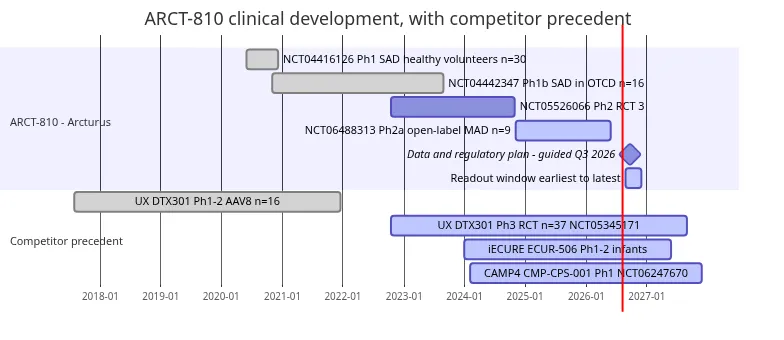
Trials
| Trial | Sponsor / whose drug | Design (arms, blinding, n) | Population | Status / key result | Link |
|---|---|---|---|---|---|
| NCT06488313 | Arcturus Therapeutics, Inc. — its own drug | Phase 2a, open-label (everyone knows who gets the drug), no control arm, multiple ascending dose. n=9 across three dose levels. Dosed every two weeks for up to five doses after ≥4 weeks of diet stabilisation; visits to Day 85 | Adolescents and adults aged ≥12 with a documented clinical diagnosis of OTCD, a history of symptomatic hyperammonaemia or raised ammonia/glutamine, clinically stable ≥1 month, on a stable protein-restricted diet and scavenger regimen ≥28 days | The trial this readout comes from. Started 2024-11-04; registry primary completion 2026-06-01, completion 2026-09-01. Registry status still reads RECRUITING, but the company stated on 2026-08-06 that enrolment and dosing are complete — see the data-quality flags. One site: Uncommon Cures, Chevy Chase, Maryland | NCT06488313 |
| NCT05526066 | Arcturus Therapeutics, Inc. — its own drug | Phase 2, randomised 3:1 drug-to-placebo, double-blind, placebo-controlled, nested single and multiple ascending dose. n=8. Up to six doses 14 days apart, then a 12-week observation period | Adolescents and adults aged 12–65 with documented OTCD, clinically stable (no hyperammonaemia symptoms within 1 month, no metabolic-decompensation hospitalisation within 3 months, ≤2 hospitalisations within 1 year) | TERMINATED. Started 2022-10-17, primary completion and completion both 2024-10-31. Ran at fourteen sites across seven European countries (Belgium, France ×2, Italy ×2, Spain ×4, Sweden, UK ×4). No results posted. This is the study whose interim data Arcturus called “positive” on 2025-06-30 | NCT05526066 |
| NCT04442347 | Arcturus Therapeutics, Inc. — its own drug | Phase 1b, randomised, double-blind, placebo-controlled, single ascending dose. n=16 | Clinically stable patients with OTCD | COMPLETED. Started 2020-11-03, primary completion 2023-08-30. Eight sites. No results posted | NCT04442347 |
| NCT04416126 | Arcturus Therapeutics, Inc. — its own drug | Phase 1, randomised, double-blind, placebo-controlled, single ascending dose. n=30 | Healthy adult volunteers, not patients | COMPLETED. Started 2020-06-01, primary completion 2020-12-09. One site. No results posted | NCT04416126 |
| NCT05345171 | Ultragenyx Pharmaceutical Inc — its own drug, DTX301, not Arcturus’s | Phase 3, randomised, double-blind, placebo-controlled. n=37. One-time AAV8 gene transfer with oral corticosteroid regimen | Late-onset OTCD | ACTIVE, NOT RECRUITING — enrolment complete. Started 2022-10-18, primary completion 2027-09. Sixteen sites | NCT05345171 |
| NCT06247670 | CAMP4 Therapeutics Corporation — its own drug, CMP-CPS-001 | Phase 1, double-blind, placebo-controlled, single and multiple ascending dose. n=120 | Healthy volunteers and participants with an abnormal heterozygous OTC genotype | ACTIVE, NOT RECRUITING. Started 2024-02-05, primary completion 2027-12. Two sites | NCT06247670 |
The single most important fact in this table. Arcturus ran a properly controlled study — 3:1
randomised, double-blind, placebo-controlled, across fourteen European sites — and terminated it
after eight patients. What replaced it is an open-label, uncontrolled, nine-patient study at one
site in Maryland. Whatever the reason (recruitment in an ultra-rare disease across fourteen sites is
genuinely hard, and a placebo arm in a life-threatening metabolic disease is ethically strained),
the evidentiary consequence is not softened by the explanation: the programme has moved away from
the design that could have demonstrated an effect against a control, at exactly the point where it
needs to convince a regulator to authorise Phase 3. [VERIFIED — CT.gov NCT05526066 and NCT06488313, read 2026-08-13]
Feasibility matrix
| Factor | High probability | Medium probability | Low probability | This asset (assessment) | Source |
|---|---|---|---|---|---|
| Recruitment feasibility | >50 sites, 3:1 patient:site | 20–50 sites, established investigators | <20 sites, novel sites | Low. One site, nine patients. The predecessor study had fourteen established European metabolic centres and still terminated at eight patients. Recruitment is the demonstrated binding constraint on this programme | CT.gov NCT06488313, NCT05526066 |
| Endpoint clarity | Regulatory precedent exists | Novel endpoint with FDA alignment | Unvalidated surrogate | Medium. Ureagenesis by stable-isotope assay is the established efficacy measure in this disease and is used as a secondary endpoint by Ultragenyx’s Phase 3 too, so there is precedent. But in this trial the registered primary endpoint is safety (adverse events at Day 85), and ureagenesis is only secondary — so the trial as registered cannot fail or pass on efficacy | CT.gov NCT06488313 outcome measures; NCT05345171 |
| Trial-design robustness | Pivotal Phase III with SPA | Adaptive with interim analysis | Single-arm, no control | Low. Single-arm, open-label, no control, n=9 — the bottom category as written, and a step down from the terminated randomised predecessor | CT.gov NCT06488313 |
| Operational / execution | Enrolment complete, standard timeline | Some timeline risk | Enrolment behind | High. Enrolment and dosing are complete and were confirmed as such on 2026-08-06, and the registry primary completion date of 2026-06-01 has passed. This is the one row where the programme scores well | Arcturus Q2 2026 press release, 2026-08-06; CT.gov NCT06488313 |
Resourcing sufficiency. Cash is not the constraint here, and unusually for a company this size
it is not close. Arcturus held $191.5 million at 2026-06-30 with a stated runway “through year end
2028”, plus a $12 million CSL termination payment and release from about $16 million of liabilities
received after that balance-sheet date (../company.md C.3). Against a monthly burn
of roughly $6.6 million, the company can fund a Phase 3 decision and the first years of the trial
without raising equity, and it has not sold stock since 2023. The binding constraint is patients and
regulatory agreement, not money — which is a comparatively good problem to have, and it is why the
financing-risk driver in the run-up score is low.
A.3 Target label, target product profile, strategic questions, designations
A.3a Target label. Chronic enzyme-restoration therapy for adolescents, adults and — per the strategy broadened in March 2026 — children with ornithine transcarbamylase deficiency who remain inadequately controlled on a protein-restricted diet and ammonia-scavenger therapy.
A.3b Target product profile
| Attribute | Standard of care & key competitor(s) — data | ARCT-810 target profile (goal) | Supporting evidence (+ link) |
|---|---|---|---|
| Indication / target label | Standard of care: protein-restricted diet plus an ammonia scavenger — glycerol phenylbutyrate (Ravicti) or sodium phenylbutyrate (Buphenyl). Neither restores the enzyme. Liver transplant is the only curative option and is supply-limited. Competitor: Ultragenyx DTX301, one-time AAV8 gene therapy, Phase 3, late-onset adults only. Competitor: iECURE ECUR-506, one-time gene editing, aimed at newborn males | All OTCD severities and all ages, including children — the population a one-time AAV therapy serves least well | Ravicti product site [WEB ESTIMATE — ravicti.com, 2026-08-13]; NCT05345171 [VERIFIED] |
| Efficacy (endpoints, regimen) | Scavengers reduce ammonia but do not raise ureagenesis. DTX301 Phase 3 targets cutting 24-hour ammonia exposure and ending chronic scavenger use | A measurable rise in ureagenesis AUC from baseline, normal morning fasting ammonia maintained, and falling glutamine — sustained across a two-weekly dosing interval | CT.gov NCT06488313 secondary outcomes [VERIFIED] |
| Safety / tolerability | Scavengers: unpleasant taste and odour (the main reason patients switch from Buphenyl to Ravicti), gastrointestinal effects. AAV gene therapy: liver enzyme elevations requiring corticosteroid tapers | No dose-limiting toxicity; infusion reactions manageable enough for indefinite two-weekly dosing | CT.gov NCT05345171 (corticosteroid taper arms) [VERIFIED]; NCT06488313 exclusion criteria [VERIFIED] |
| Biomarker / companion diagnostic | Genetic confirmation of an OTC mutation; plasma ammonia and glutamine monitoring | No companion diagnostic needed beyond the existing genetic diagnosis. Ureagenesis assay used as the pharmacodynamic readout | CT.gov NCT06488313 eligibility and outcomes [VERIFIED] |
| Formulation / administration | Scavengers: oral liquid or tablets, taken daily at home. AAV: single infusion, once ever | The weakest column. Intravenous infusion every two weeks, indefinitely, versus a daily oral liquid or a one-time infusion. This is a real disadvantage in a chronic disease and there is no way to argue it away | CT.gov NCT06488313 detailed description [VERIFIED] |
| Payer value | Ravicti is the incumbent standard and is expensive; a chronic ultra-orphan therapy | Justified by crises avoided, hospitalisations avoided, protein-restriction relaxed, and — the strongest argument — transplant deferred or avoided in children | [UNVERIFIED — no health-economic study of ARCT-810 exists] |
A.3c Strategic Go/No-Go questions. The asset’s next decision is whether to enter a registrational trial, so the Pre-Phase-III set applies.
Pre-Phase-III (Go-to-Phase-III / registration):
| Group | Question | Answer (tagged) |
|---|---|---|
| Target | Target revalidated as in prior phases? | Yes, and it never needed revalidating. Loss of OTC enzyme function is the disease; liver transplant, which supplies the enzyme, is curative. [VERIFIED — Open Targets ENSG00000036473 / MONDO_0010703; PubMed reviews, e.g. Seker Yilmaz & Gissen, [DOI](https://doi.org/10.3390/biomedicines11082227)] |
| Dose & Drug | Exposure–response for the intended commercial regimen and route(s)? | Not established publicly. The current study explores three dose levels with dose escalation or cohort expansion after three participants each, which is dose-finding language, not a settled commercial regimen. [UNVERIFIED — CT.gov NCT06488313 detailed description states the escalation rule; no exposure–response data is published] |
| Dose & Drug | Commercial formulation available or feasible? | Feasible. Arcturus manufactures LUNAR-formulated mRNA at commercial scale for KOSTAIVE, an approved product. [VERIFIED — [../company.md](/analysis/ARCT) C.2] |
| Dose & Drug | Dose range compatible with clinical and non-clinical safety? | Apparently, on the evidence available: four trials since 2020 across 63 enrolled subjects with no reported clinical hold, discontinuation for safety, or dose-limiting toxicity disclosed. But no trial has posted results and none has been published, so this rests on the absence of bad news rather than on data. [UNVERIFIED — CT.gov shows has_results false on all four trials] |
| Dose & Drug | Therapeutic window given the clinical response? | Unknown, and this is the central open question. mRNA is transient, so activity peaks and troughs between two-weekly doses; whether the trough clears ammonia adequately is exactly what the ureagenesis and fasting-ammonia secondaries must show. [UNVERIFIED] |
| Dose & Drug | Intrinsic and extrinsic factors influencing exposure and patient response? | Partially. The trial excludes eGFR <60, INR >1.5, uncontrolled diabetes, corticosteroid use and any oligonucleotide within six months — a list that implies known or suspected interaction risks. Notably, corticosteroids are independently known to worsen hyperammonaemia in OTCD by suppressing urea-cycle gene expression, per PubMed (DOI). [VERIFIED — CT.gov NCT06488313 exclusion criteria] |
| Patient | Proof of concept and positive benefit/risk in the intended population? Combination evidence? | Claimed but not demonstrated to a public standard. Arcturus announced “positive interim Phase 2 multiple dose data” on 2025-06-30 and reported that ARCT-810 restored OTC activity and reduced hyperammonaemic episodes. That claim has never been published, presented in a peer-reviewed venue indexed by PubMed, or posted as trial results. [UNVERIFIED — company press release 2025-06-30; zero corroborating publications in 23 PubMed hits] |
| Patient | Phase III design and outcome criteria — accepted, compelling, competitive for market access? | Not yet. This is the substance of the pending catalyst. A Type C meeting was held in March 2026 and an EOP2 meeting is being prepared; no agreed Phase 3 design has been disclosed. [VERIFIED — BPIQ fetch_company_drugs note field, 2026-08-13; Arcturus Q2 2026 release] |
| Patient | Rationale for the patient population(s)? | Sound and deliberately differentiated. Broadening to paediatric patients targets exactly where one-time AAV gene therapy is weakest — a child’s liver grows, diluting a non-integrating transgene, and AAV generally cannot be re-dosed. A re-dosable therapy has a genuine structural argument there. [VERIFIED — strategy broadening recorded in BPIQ note 2026-03-03; AAV re-dosing limitation per PubMed review [DOI](https://doi.org/10.1002/jimd.12609)] |
| Patient | Likelihood of the expected outcome? | Modelled at 38% for the pre-registered positive definition below, band 25–52%. [UNVERIFIED — modelled] |
| Patient | Companion-diagnostic strategy, including pricing and market? | Not required. OTCD is diagnosed genetically and biochemically before any treatment decision; no new diagnostic is needed. [VERIFIED — CT.gov NCT06488313 inclusion criterion 3] |
A.3d Regulatory designations.
- Orphan Drug Designation (US FDA), granted 2019-06-27 for ARCT-810 in OTC deficiency. Grants
seven years of US market exclusivity from approval, tax credits against clinical trial costs, and
a waiver of the marketing application user fee. It does not speed up review or lower the
evidence bar.
[VERIFIED — Arcturus press release, GlobeNewswire, 2019-06-27] - No Breakthrough Therapy, Fast Track, RMAT or Priority Review designation has been disclosed for
ARCT-810. Arcturus does hold Fast Track for a different asset (ARCT-2304, H5N1, granted
2025-04-10), which shows the company pursues such designations when it can get them — making the
absence here more informative than a simple silence.
[VERIFIED — BPIQ fetch_company_drugs and fetch_company_historical_catalysts, 2026-08-13; no ARCT-810 designation in the press feed]
A.4 Target product profile valuation matrix
| Stakeholder | Value driver | Minimum threshold | Competitive | Premium | Benchmark / source |
|---|---|---|---|---|---|
| Patient / caregiver | Freedom from hyperammonaemic crises and from severe protein restriction | Fewer crises than on scavengers alone | Normal fasting ammonia maintained between doses, with relaxed diet | No crises, near-normal diet, transplant avoided | CT.gov NCT06488313 secondary endpoints (fasting ammonia, glutamine) [VERIFIED] |
| Regulator | Demonstrated restoration of ureagenesis with acceptable chronic safety | Safety acceptable and a measurable pharmacodynamic effect | Ureagenesis increase reproducible across dose levels | A controlled trial showing reduced crisis rate | CT.gov NCT06488313 primary (safety) and secondary (ureagenesis) outcomes [VERIFIED] |
| Payer / HTA | Hospitalisations and transplants avoided, offsetting a high chronic price | Costs no more per year than current scavenger therapy plus crisis care | Reduces crisis-driven admissions measurably | Defers or avoids liver transplant, especially in children | [UNVERIFIED — no ARCT-810 health-economic evidence exists] |
| Provider | A treatment option between scavengers and transplant | Administrable in an existing metabolic clinic | Predictable two-weekly infusion schedule | Usable in patients excluded from AAV gene therapy by pre-existing antibodies | Anti-AAV seroprevalence study NCT04909346 confirms this exclusion is real and was studied [VERIFIED] |
Calibration examples, not asset claims: in oncology each incremental month of overall survival is worth roughly $150–300M in peak-sales potential; oral formulations command roughly 15–25% price premiums over injectables. The second is directly relevant in the wrong direction here — ARCT-810 is an infusion competing against a daily oral liquid.
A.5 Evidence quality and endpoints
| Criterion | Score (High / Medium / Low) | Basis (one line) | Link |
|---|---|---|---|
| Target validation | High | Single-gene loss of function; liver transplant is curative; independently indexed target and disease | Open Targets ENSG00000036473 |
| Mechanism clarity | High | Enzyme replacement by mRNA delivery to hepatocytes, shown in multiple independent animal models by groups with no Arcturus involvement | DOI, DOI |
| Biomarker availability | High | Stable-isotope ureagenesis assay, plasma ammonia and glutamine are established, quantitative and used by competitors too | NCT06488313, NCT05345171 |
| Publication quality (peer-reviewed? independent authors?) | Low — and this is the sharpest negative in the analysis | Zero of 23 PubMed hits are ARCT-810 clinical publications. Six years and four trials have produced no peer-reviewed clinical paper, no posted trial results (has_results: false on all four), and no PubMed-indexed conference abstract. The OTC-mRNA literature that exists is other companies’ preclinical work — Eisai, Moderna, Sanofi, Tessera — plus academic reviews | PubMed search_articles + get_article_metadata, 2026-08-13 |
| Clinical / expert sentiment | — | Moved to A.5b, below. | — |
On the publication finding, stated plainly. According to PubMed, a search covering ARCT-810 and
mRNA therapy for ornithine transcarbamylase deficiency returns 23 articles. Reading the titles
rather than counting them — the discipline 02-connectors.md requires after the MNOV “MN-001”
case — none reports ARCT-810 clinical data. The nearest neighbours are a Sanofi paper using OTC
deficiency explicitly as a model system for optimising liver-tropic LNPs
(DOI), an Eisai mouse efficacy study
(DOI), a Moderna knockout-mouse model
(DOI), a Tessera transposon paper
(DOI), and reviews of RNA and gene therapy for urea
cycle disorders (DOI,
DOI, DOI).
The 2024 review by Richard and colleagues notes that LNP-formulated mRNA therapy for OTCD “has
progressed to the clinical trials phase” — which is an accurate description of Arcturus’s programme
and also the extent of what the independent literature can say about it.
The limit of this check: PubMed indexes journals, not company presentations. Arcturus held a KOL presentation of the interim data on 2025-06-30, and material may exist in slide decks or non-indexed abstracts. What can be said is that after six years no ARCT-810 clinical result has entered the peer-reviewed record, and that every efficacy claim about this asset currently traces back to a company press release.
Endpoints
| Endpoint (full name) | What it measures | Scale / range | Better direction | MCID / note |
|---|---|---|---|---|
| Incidence, severity and dose-relationship of adverse events (PRIMARY, NCT06488313) | Whether the drug is safe and tolerated, and whether harm rises with dose. Assessed to Day 85 | Counts and severity grades of adverse events | Fewer and milder is better | No minimal clinically important difference exists for a safety count. Note that this — not efficacy — is the trial’s registered primary endpoint |
| Stable-isotope ureagenesis assay, AUC of first isotope (secondary) | How much urea the patient can actually make, traced with carbon-labelled tracer. The core efficacy measure | Area under the concentration-time curve; change from baseline | Increase is better | No established MCID in OTCD. Arcturus has not disclosed a pre-specified threshold, so what counts as a meaningful rise is currently the company’s to define — a real weakness for a scoreable readout |
| Stable-isotope ureagenesis assay, AUC of second isotope (secondary) | The same measurement using a second tracer, as an internal check | AUC; change from baseline | Increase is better | As above |
| Proportion of participants maintaining normal morning fasting plasma ammonia (secondary) | Whether ammonia stays in the normal range at its daily low point | Percentage of participants | Higher is better | Normal fasting plasma ammonia in adults is roughly <35 µmol/L, laboratory-dependent. With n=9, one participant is 11 percentage points |
| Change from baseline in plasma glutamine (secondary) | An early-warning marker that rises before ammonia does when nitrogen disposal is failing | µmol/L; change from baseline | Decrease is better | Commonly watched above ~1,000 µmol/L as a warning threshold [UNVERIFIED — general clinical practice, not stated in the trial record] |
| Plasma pharmacokinetics of ARCT-810 mRNA and lipid (secondary) | How much drug is in the blood and for how long, to Day 57 | Concentration over time | Interpretive, not directional | Supports the exposure–response question A.3c leaves open |
A.5b Key opinion leaders.
Panel as of. 2026-08-13 — the date the investigator and independent-voice searches below were run.
Investigators
| Name | Role / affiliation | Trial (NCT) | Conflicts (party, kind, disclosed in, as of) | Conflicts checked (source, date) | Source | Tag |
|---|---|---|---|---|---|---|
| Marshall Summar, MD | Site contact / investigator, Uncommon Cures, Chevy Chase, Maryland | NCT06488313 | None found beyond the trial relationship itself. Being paid by the trial is a relationship with the sponsor by construction and is not re-listed here | CT.gov search_investigators by name, 2026-08-13 — returned zero rows, so identity was taken from get_trial_details instead. PubMed search_articles author search Summar ML[Author] with urea cycle / ornithine transcarbamylase, 2026-08-13 — 25 hits, the most recent dated 2019, and no conflict-of-interest statement recoverable from any of them | CT.gov get_trial_details NCT06488313, 2026-08-13 | [VERIFIED — CT.gov get_trial_details 2026-08-13] |
One investigator is what the trial record yields, because the trial has one site. search_investigators
queried by name returned zero rows — the tool searches overall-official and responsible-party fields,
and Dr Summar is listed as a site contact, which is a tool limitation rather than a finding. Queried
by condition it returned him correctly, together with 66 other people almost all of whom are on
unrelated trials that matched “OTC” as an abbreviation for optical coherence tomography, ovarian
tissue cryopreservation and “outside the cage” surgery — a search-index confusion of the same family
02-connectors.md records for PubMed and short drug codes.
On the empty conflicts cell, and why it is not a clean bill of health. The searches behind it are
recorded above, which is what makes the emptiness a finding rather than an assumption. But the
newest paper the author search returned is from 2019, so any relationship formed in the seven years
since would not appear in it, and 02-connectors.md is explicit that the absence of a disclosure is
never evidence of no conflict. Dr Summar is a widely recognised urea-cycle authority and Uncommon
Cures is a dedicated commercial research site; both facts make undisclosed industry relationships
more likely a priori, not less.
Independent voices
None recorded, and the reason is a finding rather than a gap. No named commentator on ARCT-810’s endpoint could be identified who is both independent of Arcturus and on the record about this programme. The nearest candidates were rejected on inspection: the most authoritative independent reviews of gene and RNA therapy for OTCD are by Baruteau, Gissen and Seker Yilmaz at University College London and Great Ormond Street Hospital (DOI, DOI) — and Great Ormond Street Hospital was one of the fourteen sites on Arcturus’s terminated Phase 2, NCT05526066. A sponsor site relationship disqualifies them from this table by definition, which is exactly why the check was made before recording anyone as independent.
| Name | Affiliation | View (close enough to quote) | As of | Conflicts checked (source, date) | Source | Tag |
|---|---|---|---|---|---|---|
| (none) | — | — | — | — | — | — |
Judgement
| Endpoint supported | Basis (one or two sentences) | Tag |
|---|---|---|
| UNKNOWN | No independent voice on this programme’s endpoint could be recorded at all: the field’s leading independent reviewers sit at an institution that was a site on Arcturus’s own terminated Phase 2, and no ARCT-810 clinical result has ever entered the peer-reviewed record for anyone to comment on. A panel of one sponsor-paid investigator and zero independent voices is too thin to support any reading of whether the endpoint is endorsed. | [UNVERIFIED — judgement] |
Dissent
| Name | View (close enough to quote) | Source |
|---|---|---|
| (none — Endpoint supported is UNKNOWN, not SUPPORTIVE_CONTESTED, so no dissent is claimed) | — | — |
B. Commercial assessment
B.0 Current treatment algorithm
What a patient with ornithine transcarbamylase deficiency receives today, in order:
- Diagnosis and acute stabilisation. Severe (usually male, neonatal) cases present with a hyperammonaemic crisis in the first days of life and are stabilised with intravenous nitrogen-scavenging drugs, dialysis to strip ammonia, and the withdrawal of all dietary protein. Late-onset cases — often female carriers — may not present until childhood or adulthood, sometimes triggered by illness, childbirth, or a high-protein meal.
- Chronic maintenance, first line. A lifelong low-protein diet, supplemented with essential amino acids, arginine or citrulline. This is nutritional management, and in children it constrains growth.
- Chronic maintenance, second line. An ammonia scavenger added to the diet: glycerol
phenylbutyrate (Ravicti) or sodium phenylbutyrate (Buphenyl). Ravicti has largely displaced
Buphenyl because Buphenyl’s taste and odour drive patients off it
[WEB ESTIMATE — market summaries via web search, 2026-08-13]. Scavengers open an alternative route for nitrogen; they do not restore the enzyme, and patients on them still have crises. - Rescue. Recurrent crises despite steps 2 and 3 mean hospitalisation, and repeated hyperammonaemia causes cumulative neurological damage.
- Definitive. Liver transplant. It is curative because it supplies working enzyme, and it is limited by donor supply, by the surgery’s own risk, and by lifelong immunosuppression.
Where ARCT-810 would fit. As a new step between 3 and 5: added to, or partly replacing, scavenger therapy in patients whose control remains inadequate — the group currently facing repeated crises with nothing between another scavenger dose and a transplant. It does not displace the diet and it does not displace acute crisis care. Its competitors, DTX301 and ECUR-506, target the same slot from the opposite direction: one-time treatments that would be given once and then, if they work, removed the need for steps 2 and 3 entirely.
B.1 Competitive landscape and positioning
| Metric | High value | Medium value | Low value | This asset (assessment) | Source |
|---|---|---|---|---|---|
| Mechanism differentiation | First-in-class or novel target | Next-generation improvement | Me-too | Medium-high. The target is not novel and is being pursued by at least three others, but the modality is genuinely differentiated: ARCT-810 is the only re-dosable enzyme-restoration approach in clinical development for OTCD. AAV gene therapy is one-shot; gene editing is permanent; mRNA is repeatable, which is the whole argument for its use in children | CT.gov NCT06488313, NCT05345171, NCT06247670 [VERIFIED] |
| Development-timeline advantage | >12 months ahead | Within 6–12 months | Lagging >12 months | Low — it is behind. Ultragenyx’s DTX301 completed Phase 3 enrolment of 37 patients with a primary completion date of 2027-09; ARCT-810 has not yet agreed a Phase 3 design. That is a lag of well over 12 months in the adult late-onset population | CT.gov NCT05345171 [VERIFIED] |
| Clinical proof-of-concept evidence | Positive Phase IIb (n>100) | Phase IIa signals (n=20–50) | Preclinical only | Low-medium. Below even the “Phase IIa signals” band: n=9 open-label, following a terminated n=8 randomised study. The interim signal reported on 2025-06-30 is real but is company-reported and unpublished | CT.gov NCT06488313, NCT05526066; Arcturus press release 2025-06-30 [VERIFIED as to existence, UNVERIFIED as to content] |
| IP protection | Composition-of-matter, long-dated | Method-of-use | Pending or none | Medium, and not directly verified. Orphan Drug Designation supplies seven years of US exclusivity from approval, which is the exclusivity that can be confirmed. Arcturus’s LUNAR delivery platform underpins an approved product (KOSTAIVE), implying meaningful platform IP, but this sweep did not read the patent estate | FDA Orphan Drug Designation 2019-06-27 [VERIFIED]; patent estate [UNVERIFIED — not searched] |
Where this asset wins, and the single fact the thesis rests on. It wins in children, and only
there decisively. A one-time AAV gene therapy delivers a gene that does not integrate into the
chromosome; as a child’s liver grows, the treated cells divide and the effect dilutes — and AAV
generally cannot be given a second time, because the immune system has by then learned to neutralise
the vector. Patients who already carry anti-AAV antibodies are excluded from the outset, an
exclusion real enough that Ultragenyx ran a dedicated seroprevalence study for it (NCT04909346)
[VERIFIED — CT.gov]. A re-dosable therapy has no such ceiling. The single fact the thesis rests
on is therefore this: whether ARCT-810 produces a large enough and durable enough rise in ureagenesis
across a two-week dosing interval that a regulator will authorise a registrational trial in
children. Everything else — the platform, the cash, the orphan designation — is supporting.
Against that, the honest competitive reading in adults is poor. Ultragenyx is years ahead with a
one-and-done treatment in exactly the late-onset adult population ARCT-810’s current trial enrols,
and iECURE has reported a complete clinical response in an infant plus 72% of participants free of
hyperammonaemic crises [WEB ESTIMATE — iECURE ASGCT presentation via web search, dated 2026-05-13].
If both succeed, the commercial space left for a two-weekly lifelong infusion narrows to patients
those therapies cannot serve.
Calibration example, not an asset claim: oncology first-movers in novel mechanisms have shown roughly 3.2× higher peak-sales potential but about 1.8× higher development risk. ARCT-810 is not a first mover in this indication.
B.2 Addressable market
Launch markets would be the United States and EU5 (France, Germany, Italy, Spain, United Kingdom) — the markets with established metabolic-disease centres, newborn screening, and reimbursement precedent for ultra-orphan therapies.
| Component | How it is estimated | Premium threshold | This asset (assessment) | Source |
|---|---|---|---|---|
| Drug-treated patients | Epidemiology × diagnosis rate × treatment rate | >100,000 (US/EU5/Japan) | Far below threshold, by three orders of magnitude — and that is normal for this disease. Urea cycle disorders occur in roughly 1 in 8,200 US births, and OTCD is the most common of them. Diagnosed, medically managed OTCD patients across US and EU5 are estimated at 1,500–2,500, of whom the inadequately-controlled subset is the real target | [WEB ESTIMATE — UCD incidence 1 in 8,200 US births, per market summaries retrieved 2026-08-13; the 1,500–2,500 figure is derived from it and is not itself a published number] |
| Market exclusivity | Patent term + regulatory exclusivity | >10 years combined | Meets the threshold on a reasonable reading, but not confirmed. Orphan Drug Designation alone gives 7 years US exclusivity from approval; platform and composition patents plausibly extend that past 10 years combined, but the estate was not read this sweep | FDA Orphan Drug Designation 2019-06-27 [VERIFIED]; combined term [UNVERIFIED] |
| Reimbursement precedent | Approvals in ≥2 major markets | Positive NICE/CADTH guidance | Good. Ravicti and Buphenyl are reimbursed for this exact indication across the US and EU, so payers already fund chronic OTCD therapy. The precedent is for the disease, not for this price point | [WEB ESTIMATE — ravicti.com and market summaries, 2026-08-13] |
| Patient-journey impact | Fewer hospital days, less caregiver burden | >30% quality-of-life gain | Potentially large but unmeasured. Avoided crises mean avoided admissions and avoided cumulative brain injury; against that, a two-weekly lifelong infusion adds its own burden. No quality-of-life instrument is among this trial’s endpoints at all | CT.gov NCT06488313 outcome measures [VERIFIED — the absence is verified] |
What is not defensible here, said plainly. The third-party market reports returned by web search
quote a “global OTC deficiency treatment market” of $1,284 million in 2025 growing to $2,341.6
million by 2033 [WEB ESTIMATE — cognitivemarketresearch.com, retrieved 2026-08-13]. That figure is
not used anywhere in this analysis. A $1.28 billion market for a disease with a few thousand
diagnosed patients worldwide implies annual per-patient spending that no scavenger regimen reaches,
and the report gives no derivation. Under 01-rules.md rule 6 it is rejected rather than passed
through. B.3a is therefore built bottom-up from patients, price and share.
B.3 Value and feasibility
B.3a Expected peak sales. Built bottom-up. Every figure below is conditional on approval, and
excludes any revenue from a paediatric or neonatal indication where gene editing is currently ahead.
All three inputs are estimates, so all three scenarios are ranges of assumption rather than
forecasts, per 01-rules.md rule 10.
| Scenario | Assumptions (patients × price × share) | Estimate (USD/year at peak) | Basis / tag |
|---|---|---|---|
| Low | 1,500 eligible US+EU5 patients × $400,000 net annual price × 15% peak penetration | ~$90M | [UNVERIFIED — modelled]. Assumes DTX301 and ECUR-506 both succeed and take the adult and neonatal ends, leaving ARCT-810 the patients neither can serve |
| Base | 2,000 × $550,000 × 30% | ~$330M | [UNVERIFIED — modelled]. Assumes ARCT-810 reaches market in adults and adolescents and takes a meaningful minority share against a one-time competitor |
| High | 2,500 × $700,000 × 35% | ~$610M | [UNVERIFIED — modelled]. Assumes a paediatric label where re-dosability is decisive, and that at least one gene-therapy competitor disappoints |
Which input is weakest, named rather than averaged away: the penetration share. The patient count is anchored to a published incidence figure and the price band is anchored to observable ultra-orphan pricing, but the share assumption is a judgement about a competitive outcome that will not be known for years — DTX301’s Phase 3 does not reach primary completion until 2027-09. A reader who disagrees with the share assumption should scale these figures linearly; they do not depend on anything else.
B.3b Feasibility
| Question | Answer (tagged) |
|---|---|
| Expected net present value (eNPV) | Not given as a single figure, per 01-rules.md rule 10. Two inputs are unverified: the probability of technical and regulatory success from this point (modelled here at 38% for the immediate readout, and unmodelled beyond it) and peak penetration. A defensible range on the base case would run from negative — if a Phase 3 is required, funded, and fails — to roughly $150–400M risk-adjusted if the base peak-sales case is reached, discounted from a launch no earlier than the early 2030s. The width of that range is the finding; narrowing it requires the Phase 3 design and its cost, neither of which has been disclosed. [UNVERIFIED — modelled, inputs stated] |
| Capital to the next decision point | Effectively already spent. Enrolment and dosing are complete; what remains before the readout is data analysis and an FDA meeting. [VERIFIED — Arcturus Q2 2026 press release, 2026-08-06] |
| Capital to approval, and the funding plan | Not disclosed, because the Phase 3 design is not agreed. Arcturus has $191.5M and a runway through year-end 2028 (../company.md C.3), which funds a Phase 3 start but almost certainly not a full registrational programme plus launch across two assets. [UNVERIFIED — no Phase 3 budget disclosed] |
| Launch capability — alone, or must partner? | Must partner, or build. Arcturus has never commercialised a product itself: KOSTAIVE was sold through CSL Seqirus and, since 2026-08-06, through Meiji Seika in Japan. An ultra-orphan metabolic launch needs a small specialist field force, which is more achievable than a primary-care launch — but it does not exist today. [VERIFIED — [../company.md](/analysis/ARCT) C.1] |
| Commercialisation rights — retained, split, or out-licensed? | Retained, worldwide, and this is better than the company’s history suggests. Ultragenyx held rights to ARCT-810 under the 2015 research collaboration, and Arcturus reassumed full worldwide rights on 2019-02-11. The collaboration’s economics — up to $156M in milestones per target plus mid-single to low-double-digit royalties — therefore apply to Ultragenyx-selected targets, not to ARCT-810, which carries no disclosed third-party royalty. [VERIFIED — Arcturus press release "Reassumes Full Worldwide Rights to ARCT-810", GlobeNewswire, 2019-02-11] |
B.4 Product-development risk
Framing questions.
- Does the development plan support the target product profile claims? Only partly. The profile’s central claim is chronic, re-dosable enzyme restoration across all ages, and the development plan currently consists of a nine-patient, open-label, 85-day study in patients aged 12 and over. It can support a claim about short-term pharmacodynamics; it cannot support a claim about chronic control, about children, or about crisis reduction, because it measures none of those over any relevant period.
- Will the identified risks affect the target product profile? Yes, in one specific place. The two-weekly infusion schedule is already the weakest row of A.3b, and the risk that ureagenesis troughs between doses would force more frequent dosing attacks exactly that row. A regimen that had to move to weekly would be materially less competitive against a one-time gene therapy.
- If a risk cannot be mitigated, is the asset still differentiated from competitors? Yes — in children and in AAV-antibody-positive patients, where re-dosability has no substitute. That residual differentiation is narrower than the target profile claims but it is real, and it is what survives if the adult opportunity is lost to DTX301.
| Category | Time risk | Quality risk | Cost risk | Note |
|---|---|---|---|---|
| Project management | Medium | One slip of the Phase 3 alignment milestone from H1 2026 to Q3 2026; see the Readout slip table | ||
| Research | Low | Target biology is settled; nothing in the research base is in doubt | ||
| IP | Medium | Orphan exclusivity confirmed; patent estate not read this sweep | ||
| Legal | No litigation or dispute found in the filing feed or press feed | |||
| DMPK | Medium | Medium | Exposure–response for a commercial regimen is not established (A.3c); pharmacokinetics is a secondary endpoint of the pending readout | |
| Safety pharmacology | Low | No signal disclosed across four trials since 2020 | ||
| Toxicology | Low | As above; no clinical hold has been disclosed | ||
| Drug safety (clinical) | Medium | High | High | The near-veto row. The registered primary endpoint is safety, so a treatment-related serious adverse event in a nine-patient study would not merely dent the result — it would end the programme’s registrational path. Chronic lipid-nanoparticle infusion reactions are the specific class concern, and the trial’s own exclusion of PEG/liposomal-reaction histories shows the sponsor shares it |
| Biomarker | Low | Ureagenesis, ammonia and glutamine assays are established and used by competitors | ||
| Clinical pharmacology | Medium | Medium | Dose escalation and cohort expansion are still in progress within the readout trial itself | |
| Clinical (efficacy) | High | High | High | The dominant risk. n=9, open-label, uncontrolled, efficacy relegated to secondary endpoints, after the termination of the randomised study that could have answered the question properly |
| Clinical operations | High | Medium | Recruitment is the demonstrated binding constraint: fourteen European sites yielded eight patients and the study was terminated | |
| CMC / manufacturing | Low | Low | Arcturus manufactures LUNAR-formulated mRNA at commercial scale for an approved product | |
| Regulatory | High | High | No agreed Phase 3 design; the pending EOP2 interaction is the catalyst itself. Absence of any expedited designation on this asset, from a company that obtained Fast Track for another, is a mild negative | |
| Global evidence & value | Medium | Medium | No quality-of-life or health-economic endpoint anywhere in the programme, which will matter at HTA | |
| Commercial | Medium | Medium | High | No commercial infrastructure; competitor one-time therapies are ahead in adults |
Readout
Sources
| Kind | Where it comes from | What it is worth | Value (or null) | Tag | Note |
|---|---|---|---|---|---|
bpiq | fetch_company_drugs — catalyst_date, catalyst_date_text | The current single source. Synthesized from period text on most rows, so alone it is a ceiling, not an estimate | 2026-09-30 | [VERIFIED — BPIQ fetch_company_drugs 2026-08-13] | Text is “Q3 2026”. A period-end placeholder, not a disclosed day (01-rules.md rule 23): BPIQ synthesizes the last day of the named quarter. Used only as this row; never for timing |
ctgov | CT.gov get_trial_details — primary_completion_date | Independent of the company’s own messaging, month-precision, and it moves when the trial moves | 2026-06-01 | [VERIFIED — CT.gov get_trial_details NCT06488313, read 2026-08-13] | Field primary_completion_date on NCT06488313; completion_date is 2026-09-01. The primary completion date has already passed, which is consistent with the company’s statement that dosing is complete |
company | fetch_company_press_releases and the release itself | The company’s own most recent dated wording. Also where the slip sequence comes from | 2026-07-01/2026-09-30 | [VERIFIED — Arcturus Q2 2026 press release, 2026-08-06] | Mandatory here, because the catalyst is inside twelve months. Verbatim: “Data and the regulatory plan for this program is expected to be communicated later this quarter.” Said on 2026-08-06, so “later this quarter” excludes July and means roughly 2026-08-07 to 2026-09-30 |
congress | data/congresses.json | Answers “where will they say it” | null | [VERIFIED — data/congresses.json read 2026-08-13] | Looked for a metabolic or urea-cycle meeting in the curated calendar and for any Arcturus statement of intent to present. The calendar holds four meetings (ACTRIMS-ECTRIMS, ESMO, CTAD, AASLD), none of them a urea-cycle venue, and Arcturus has not said it intends to present these data at any congress. Matching on therapeutic area alone would be a guess, not a source (02-connectors.md § Data limits), so this records nothing |
modelled | Trial arithmetic — see below | The only estimate independent of anyone’s guidance | 2026-08-01/2026-10-01 | [UNVERIFIED — modelled, default lag] | See below |
The modelled estimate. The registry’s primary_completion_date for NCT06488313 is 2026-06-01.
data/benchmarks/readout-lag.json holds no matching entry for a Phase 2a open-label metabolic study,
so the stated default applies: primary completion plus two to four months to database lock and
analysis (01-rules.md rule 34). That gives 2026-08-01 to 2026-10-01, and the estimate is tagged
[UNVERIFIED — modelled, default lag] rather than benchmarked. This arithmetic is independent of
anything Arcturus has said, and it brackets the company’s own “later this quarter” almost exactly —
which is the useful part: the guidance is not obviously optimistic against the trial’s own mechanics.
Window
| Earliest | Likeliest | Latest | Precision | Confidence |
|---|---|---|---|---|
| 2026-09-01 | 2026-09-25 | 2026-11-30 | PERIOD | MEDIUM |
Basis. Every source points into a band running from August to late 2026, and the company’s own 2026-08-06 wording (“later this quarter”) is both the freshest and the tightest. The earliest is set at 2026-09-01 rather than immediately: a company that had data ready would have released it with the Q2 results on 2026-08-06 rather than promising it later, and the release describes work still in progress (“evaluating supplementary data to inform regulatory discussions and preparation for an End-of-Phase 2 meeting”). The likeliest sits in the last full week of September, the usual landing zone for “later this quarter” guidance given at the start of a quarter’s second month. The latest extends to 2026-11-30 rather than stopping at the quarter end, because this milestone has already moved once and the disclosure is coupled to an FDA interaction whose scheduling Arcturus does not control. Precision is PERIOD because no source names a month, let alone a day. Confidence is MEDIUM, not HIGH: the operational precondition is genuinely met (enrolment and dosing complete), but the milestone has slipped before and depends on a regulatory meeting.
Disagreement. CONSISTENT. The BPIQ placeholder (Q3 2026), the company’s own wording (later this quarter, i.e. Aug–Sep 2026) and the modelled estimate (2026-08-01 to 2026-10-01) all point at the same band; the CT.gov primary completion date of 2026-06-01 sits before it, exactly as a completion date should sit before a readout. No source contradicts another.
One inconsistency exists but is about status, not date, so it does not change the reading above: CT.gov still lists NCT06488313 as RECRUITING while the company stated on 2026-08-06 that enrolment and dosing are complete. Recorded in the data-quality flags.
Date slippage. Parsed from the BPIQ note field and the company’s own releases, oldest first.
| As of | Guidance text |
|---|---|
| 2025-07-11 | ”Align Ph3 trial design w/ RA in H1 2026” |
| 2025-11-10 | ”Regulatory alignment on ARCT-810 pivotal trial strategy for adult and pediatric OTC deficiency remains on track for H1 2026” |
| 2026-03-03 | ”Development strategy broadened to adult and pediatric OTC; Type C regulatory meetings remain on track H1 2026” |
| 2026-05-07 | ”FDA Type C meeting in March 2026; preparing exploratory data for pediatric EOP2 meeting in H2 2026” |
| 2026-08-06 | ”Ph2 enrollment and dosing completed. Data and regulatory plan expected Q3 2026” |
Slip count: 1, across five statements and therefore four transitions. Two transitions (2025-11-10 and 2026-03-03) are reiterations of “H1 2026” and are not slips; the fourth (2026-05-07 → 2026-08-06) narrows H2 2026 to Q3 2026, which is a refinement rather than a slip. The one true slip is 2026-03-03 → 2026-05-07, when the Phase 3 alignment milestone moved from H1 2026 to H2 2026.
But read that count alongside what the milestone became. Counting transitions understates the drift here. In July 2025 the promise was to align the Phase 3 trial design with regulators by H1 2026. In August 2026 the promise is to communicate data and a regulatory plan in Q3 2026 — which is a step earlier in the process, not the same milestone delivered late. One counted slip; roughly two quarters of delay; and a milestone that has softened in what it commits to. A reader should weight the softening at least as heavily as the count.
Attribution
Computed by lib/clustering.mjs’s attributionFor over this ticker’s pipeline, for
bpiq_drug_id 16237, with CATALYST_CLUSTER_MIN_MONTHS = 6. Transcribed, not estimated.
Status.
| Status | Means |
|---|---|
CLEAN | conflicts is empty — nothing else has_catalyst on this ticker’s pipeline lands within the window. |
Conflicts
| bpiq_drug_id | Label | Date | Analysed? | Gap (days) | Confirmed? |
|---|---|---|---|---|---|
(none — conflicts is empty, exactly as CLEAN requires) | — | — | — | — | — |
Note. Not required for CLEAN. One caveat is recorded anyway, because it is about the input to
the computation rather than the computation: ARCT-810 is the only row on this ticker’s pipeline
carrying has_catalyst: true, so the conflict set has just one member and CLEAN follows
mechanically. ARCT-032’s Q4 2026 Phase 3 go/no-go carries has_catalyst: false and is therefore
excluded by construction; with that single flag set true the same computation returns
INDETERMINATE at a zero-day gap. The full statement of this is in
../company.md C.2, and the stock-direction call below is written knowing it.
Market and timing for this event
- Plain takeaway. Almost nothing about this event is priced in, in either direction, and that is
the defining fact. The company’s entire pipeline is carried at about $34 million of enterprise
value against $191.5 million of cash (
../company.mdC.4). But the direct precedent argues against expecting much: the last time this exact programme reported positive interim data, the shares fell 2.4% on the day. - Months to this catalyst. About 0.6 months to
readout.window.earliest(2026-09-01) from the 2026-08-13 lock, and about 1.4 months tolikeliest(2026-09-25).readout.precisionisPERIOD, so none of these is a disclosed date — no source names a month, let alone a day, and the window’s edges are a judgement built from the source table above. - Expected move around this event.
../company.mdC.6 records the chain as unusable, so this is a bracket and not a point estimate: an at-the-money straddle on the 2026-09-18 expiry costs between 12% and 31% of the share price depending on whether you transact at the bid or the ask, on 211 open contracts and six traded on the day. Call and put implied volatility at the same strike disagree by 42% relative. The chain contributes nothing to priced-in-ness, and it may expire before the event in any case. - Nearest comparable past reaction. Not in
../company.mdC.7’s table, because BPIQ does not carry the row — but C.7 records it in prose and it is by far the closest analogue: 2025-06-30, ARCT-810’s own positive interim Phase 2 multiple-dose data, which moved the stock −2.4% close-to-close. It is comparable because it is the same asset, the same trial programme and the same kind of announcement. It is not fully comparable in one respect that cuts both ways: that release carried data alone, whereas this one carries data and the regulatory plan, which is the part the market actually needs. The other reference point in C.7 is ARCT-032’s 2025-10-22 interim CF data at −50.2% close-to-close — a reminder of what this company’s clinical data can do to the shares, though that was a larger programme at a much higher price. - Materiality.
../company.mdC.2 records this program as meaningful, not dominant: the nearest catalyst and the lead rare-disease asset, but one of four things carrying the equity alongside ARCT-032, KOSTAIVE and the regained vaccine portfolio. The stock-direction call below is consistent with that — it is not written as though this readout re-rates the whole company. - Date slippage. See Readout above: one counted slip across five dated statements, with the Phase 3 alignment milestone drifting roughly two quarters and softening in what it commits to.
Spot. $7.97, the close on 2026-08-13, read from the committed price cache through
lib/prices.mjs. ../company.md C.4 records BPIQ’s last price the same day as
$7.94; the three-cent difference is immaterial and the cache figure is used throughout because it is
the source a settlement will read back.
Scenario prices
| Scenario | Low | High | Anchors (each named and tagged) | Basis |
|---|---|---|---|---|
| Positive | $9.50 | $13.00 | 1. This ticker’s own past catalyst moves. Clean single-cause positive announcements produced +6.0% to +16.9% single-day moves (2022-01-24 +16.93%, 2025-01-07 +10.37%, 2024-09-30 +9.22%, 2024-07-01 +6.03%) [VERIFIED — ../company.md C.7]. 2. The 52-week high, $24.17 on 2025-10-21 [VERIFIED — ../company.md C.4, derived from the price cache] — the level the shares held before the CF collapse, on substantially the same two rare-disease assets. 3. A named, dated analyst target: H.C. Wainwright, Hold, $9, 2026-08-11 [WEB ESTIMATE — Moomoo via BPIQ press feed, 2026-08-11] — the lowest and most conservative current target, and the only Hold | The low end sits just above the most bearish current analyst target and above the best single-day precedent applied to spot. The high end implies an enterprise value of about $178M — modest for two clinical rare-disease assets plus a marketed vaccine, and still far below the 52-week high. A result that also delivers a credible Phase 3 path is a re-rating of a pipeline currently carried near zero, not a one-day pop, which is why the range extends beyond the single-day precedent |
| Miss | $6.00 | $7.20 | 1. Cash per economic share, $6.74 — $191.483M cash ÷ 28,423,069 EDGAR-filed shares [VERIFIED — ../company.md C.3 and C.4]. 2. The 52-week low, $5.50, printed 2026-07-24 [VERIFIED — ../company.md C.4, derived from the price cache] — three weeks before this lock, which shows the market will trade this equity below cash. 3. This ticker’s own past catalyst moves: the 2025-06-30 ARCT-810 precedent at −2.4% and the 2025-10-22 ARCT-032 precedent at −50.2% close-to-close [VERIFIED — ../company.md C.7] | The range straddles cash per share. It does not extend to the −50% of the CF precedent because materiality differs: that was a larger programme at $23 with far more embedded expectation, whereas this equity has already round-tripped to within 45% of its 52-week low and carries almost no pipeline value to lose. The low end sits between cash per share and the recent 52-week low, acknowledging that this market has already been willing to price the shares below net cash |
Expected value. Applying the 38% outcome probability to the midpoint of each range —
$11.25 positive, $6.60 miss — gives 0.38 × $11.25 + 0.62 × $6.60 = $8.37, which is +5.0%
against the $7.97 spot. Method: probability_pct applied to the midpoint of each scenario range.
This is arithmetic, not advice, and it is not a price target. Note what produces it: the expected
value sits above spot despite a below-even outcome probability, purely because $191.5 million of
cash floors the downside while the upside is unconstrained by a pipeline valued near zero. That
asymmetry is the most interesting number in this document, and it is also small enough — 5% on a
stock that has moved 31% in the last five sessions — to be inside the noise.
Run-up
readout.precision is PERIOD, not UNKNOWN, so the date_confidence driver does not floor at
zero and 01-rules.md rule 39 does not withhold this call. It scores poorly for a related reason,
recorded honestly below.
Entry and exit
| Entry date | Entry price | Entry basis | Exit rule |
|---|---|---|---|
| 2026-08-13 | $7.97 | The prediction’s own lock date and the spot price it is measured against, per 05-prediction-protocol.md. No earlier entry is available to a call being pre-registered today | T-5 trading days before readout.window.earliest (lib/runup.mjs EXIT_RULES) |
readout.window.earliest is 2026-09-01, so this rule currently resolves to late August 2026 — about
eight trading days after entry. exit is left null on the prediction record: resolveExit needs
price history that does not yet exist and returns null today, which is the normal state for a run-up
call at lock time.
A short window, said plainly. Eight trading days is a narrow run to trade, and it is a direct
consequence of a PERIOD-precision window whose earliest edge is close. The exit rule is stated
relative to readout.window.earliest rather than as a calendar date, so if the window moves the rule
keeps resolving correctly — which is exactly the situation a program with one prior slip should
expect.
Predicted move and peak
| Low | High | Estimated date | Basis | |
|---|---|---|---|---|
| Predicted move, entry to exit | −5% | +12% | — | The direct precedent is the four-session +15.2% run into the 2025-06-23 KOL-presentation announcement. Two things temper it here. First, much of a run may already have happened: the stock rose from $6.08 on 2026-08-06 to $7.97 on 2026-08-13, +31% in five sessions, on the CSL settlement rather than on ARCT-810 [VERIFIED — price cache via lib/prices.mjs]. Second, the window is only eight trading days, which is too short for a full anticipation cycle. The band is therefore asymmetric to the upside but includes a real chance of giving back part of the CSL move |
| Predicted peak, from entry | 0% | +18% | 2026-08 | Run-ups on this ticker crest on the announcement that a disclosure is coming rather than on the disclosure itself — the 2025-06 sequence peaked at $14.41 three trading days after the KOL-presentation notice and had fully faded by the data release a week later [VERIFIED — ../company.md C.7]. The peak is placed in August rather than September for that reason, and it need not sit inside the move band above because it can print and fade before the exit resolves |
Priority score drivers
Five of the seven are transcribed from lib/runup.mjs’s scoreDriver output; the two judgement
drivers carry the reading passed into it.
| Driver | Reads | Score (0–100) | Basis |
|---|---|---|---|
| Unmet-need relevance | README A.4 and B.0 — judgement, no formula | 85 | OTC deficiency is a life-threatening inborn urea-cycle defect whose standard of care (protein restriction plus nitrogen-scavengers Ravicti/Buphenyl) manages ammonia but does not restore the missing enzyme; liver transplant is the only curative option and is supply-limited. No disease-modifying therapy is approved |
| Value-uplift potential | README B.3a peak sales vs enterprise value, C.2 materiality — judgement, no formula | 65 | Base-case peak sales of roughly $150–300M/yr against an enterprise value of about $34M is a large multiple, but materiality is recorded as meaningful rather than dominant: ARCT-032, KOSTAIVE and the regained vaccine portfolio also carry the equity, and the asset still needs a Phase 3 and years of capital |
| Probability of a positive outcome | This record’s own outcome_prediction.probability_pct — computed | 38 | outcome_prediction.probability_pct = 38 |
| Date confidence | readout.precision + readout.confidence — computed; the gate the other six hang off | 20 | readout.precision=PERIOD, readout.confidence=MEDIUM. This is the binding constraint on the whole score — see below |
| Squeeze mechanics | Float, short interest as % of float, average dollar volume — computed | 79 | float 26,153,000 shares, short_float_pct 25.36, average dollar volume $3,479,968 — thinner liquidity and a tighter, more-shorted float amplify a positive surprise. The strongest genuinely favourable driver: one in four shares outstanding is sold short at 16.52 days to cover |
| Priced-in-ness | 52-week position, drift since the last catalyst, ownership crowding, analyst-target dispersion — computed. A HIGH score means room LEFT to run, not how far the stock has already run | 87 | price 7.97 sits at 13% of its 52-week range (low 5.50, high 24.17, as of 2026-08-13) — closer to the 52-week low, so room left to run. Only the 52-week-position leg is computed; drift, crowding and target dispersion are not folded in by the module |
| Financing and clustering risk | Runway against the catalyst, attribution.status / attribution.conflicts — computed. The one NEGATIVE driver: a HIGH score means HIGH risk and sinks the total | 10 | runway_vs_catalyst=OK is the larger of the two independent risks (financing), and even it is small: cash runs through year-end 2028 against a Q3 2026 readout, no stock has been sold since 2023, and attribution.status is CLEAN. A low score here is good |
Priority score. Priority score 15 · formula_version 1.0.0
Why 15, when five of the seven drivers read well. The unrounded value is 14.71, and it is not the
weighted average of the drivers — that base is far higher. date_confidence at 20 sits below
lib/runup.mjs’s untradeable threshold of 30, which caps the result outright at 15 regardless of how
strong the other six are. That is the formula working as designed, and the design is right here: a
PERIOD-precision window means nobody knows when this lands to better than “some time in the next
few weeks”, and you cannot time an entry and an exit around a date you do not have. A score of 15
says do not rank this as a run-up trade, and it says so despite genuinely attractive squeeze
mechanics and genuinely low financing risk.
Settlement. Left null at lock time. Settled only on an explicit user request, from a confirmed
primary source, against the committed price cache — never on this document’s own initiative. See
05-prediction-protocol.md § Run-up settlement.
Verdict
What I would do. Watch.
Why. The science is sound and the balance sheet is genuinely strong — $191.5 million of cash against a $34 million enterprise value, runway through year-end 2028, no equity sold since 2023 — so the downside is floored in a way that is rare for a company at this stage. But the evidence arriving in Q3 2026 is thin by design: nine patients, open-label, no control arm, with efficacy relegated to secondary endpoints, following the termination of the randomised study that could have answered the question properly. Six years and four trials have produced no peer-reviewed clinical publication and no posted results, so every efficacy claim about this asset traces back to a company press release. And the closest precedent is discouraging in a specific way: when this exact programme reported positive interim data on 2025-06-30, the shares fell 2.4%.
What would change this. A disclosed, quantified rise in ureagenesis AUC across the two-week dosing interval — reported with the trough as well as the peak — accompanied by an explicit statement that the FDA has agreed a registrational path in the paediatric population. That combination would convert the asset’s one real structural advantage (re-dosability, where AAV cannot go) from an argument into a plan, and it is the only thing that would justify paying more than cash for this equity today. The converse also flips it: any treatment-related serious adverse event in a nine-patient study, or a stated requirement for a further Phase 2, ends the near-term case.
What to watch.
- 2026-08-13 to 2026-09-30: the ARCT-810 data and regulatory plan themselves. Read whether the release quantifies ureagenesis change with a pre-specified threshold, or describes it only as “positive” as the 2025-06-30 release did.
- On the day of that release: whether an 8-K accompanies it, and whether the disclosure names an agreed Phase 3 design or only an intention to meet the FDA.
- 2026-09-18: the nearest option expiry to the catalyst. If the event has not landed by then, the chain gives no coverage at all and the timing read weakens further.
- Q4 2026: ARCT-032’s Phase 3 go/no-go decision, guided for the quarter immediately after. It
carries
has_catalyst: falsein BPIQ and so contributes no clustering conflict, but it is the other lead rare-disease asset and it halved the stock once already. - Ongoing: any 424B5 in the EDGAR feed. None since 2023-08-07, and a takedown from the 2025-12-30 shelf would contradict the low-financing-risk reading this analysis rests on.
- 2027-09: Ultragenyx DTX301’s Phase 3 primary completion — the event that most shapes what commercial space is left in adults.
Locked prediction
- Outcome-direction (will the readout succeed on its primary endpoint?): miss — probability
38%, band 25–52%
[UNVERIFIED — modelled]. The reasoning: the safety half of the settlement definition is likely to hold (roughly 85% — four trials since 2020, 63 subjects, no disclosed hold or dose-limiting toxicity), but the regulatory half is not (roughly 45%). A nine-patient, open-label, uncontrolled study whose own registered primary endpoint is safety, run after the termination of a randomised predecessor, and described by the company itself as “exploratory data” being prepared for an End-of-Phase-2 meeting, is a thin basis on which to obtain agreement to a registrational trial without a further Phase 2. 0.85 × 0.45 ≈ 0.38. No third-party probability on this specific event was found to compare against. - Stock-direction (which way do the shares move?): no-edge — confidence low — window
2026-08-14 to 2026-12-15, basis: from the day after lock through two weeks past
readout.window.latest(2026-11-30), so the window covers the event and its reaction even if the disclosure slips out of Q3. Materiality is meaningful, not dominant (../company.mdC.2), and this call is consistent with that: a positive result re-rates a pipeline currently carried near zero, but it does not re-rate the whole company, and a miss is cushioned by $6.74 of cash per share. - Scenario prices: positive $9.50–$13.00 · miss $6.00–$7.20
- Expected value: $8.37, +5.0% against spot $7.97 (arithmetic, not advice)
- Run-up: entry $7.97 on 2026-08-13, exit rule T-5 trading days before
readout.window.earliest— predicted move −5% to +12%, predicted peak 0% to +18% around 2026-08 — priority score 15,formula_version1.0.0 - Settles on the Arcturus disclosure of the ARCT-810 Phase 2 data and regulatory plan guided for Q3 2026. Positive requires both: (a) no new dose-limiting toxicity or treatment-related serious adverse event attributed to ARCT-810 that halts or restricts dosing; and (b) Arcturus states it will advance ARCT-810 into a registrational or Phase 3 study in OTC deficiency (adult and/or paediatric) following its End-of-Phase-2 interaction, without an FDA clinical hold and without a stated requirement for an additional Phase 2 study first. Source: Arcturus press release or Form 8-K.
- Locked: yes · Settled: no
On no-edge sitting beside a +5.0% expected value. The two are compatible and the divergence is
explained rather than hidden. The expected value is positive because $191.5 million of cash floors
the miss scenario while the positive scenario is unconstrained by a pipeline the market carries near
zero — a structural asymmetry, not a directional view. Five percent is inside the noise for an equity
that moved 31% in the five sessions before this lock, and the direction is declined because the two
forces genuinely offset: a below-even probability of the pre-registered positive definition being
met, against a downside cushioned by cash. no-edge is the honest word for that, and it is more
useful than a coin-flip dressed as a view.
Program data-quality flags
- CT.gov’s registry status for NCT06488313 is stale. The registry lists the trial as
RECRUITING with a primary completion date of 2026-06-01 that has already passed, while
Arcturus stated on 2026-08-06 that enrolment is complete and all enrolled subjects have completed
dosing. The company statement is the more recent and more specific, and is what the readout window
is built on. The registry’s dates are used as recorded; only its status field is treated as out
of date.
[VERIFIED — CT.gov get_trial_details NCT06488313, read 2026-08-13; Arcturus Q2 2026 press release, 2026-08-06] - The BPIQ
catalyst_dateof 2026-09-30 is a synthesized period-end placeholder for the text “Q3 2026” and is never used for timing here, per01-rules.mdrule 23. It survives only as thebpiqrow of the readout source table. - BPIQ’s drug-name field carries a trailing space,
"ARCT-810 ", the dirty-name pattern02-connectors.mdrecords. Resolution was keyed onbpiq_drug_id16237 throughout, never on the name. - BPIQ carries no historical-catalyst row for the 2025-06-30 ARCT-810 interim data release — the
single most relevant precedent for this event. Its only ARCT-810 row is the 2024-07-01 enrolment
milestone. The 2025-06-30 reaction was reconstructed from the press feed and the committed price
cache instead, and is recorded in
../company.mdC.7 in prose. A reader relying on the connector’s historical-catalyst list alone would not know the most informative precedent exists. search_investigatorsqueried by name returned zero rows for an investigator the trial record names. Dr Summar is listed on NCT06488313 as a site contact, and the tool searches overall-official and responsible-party fields. Queried by condition instead it returned him, along with 66 mostly irrelevant people whose trials matched “OTC” as optical coherence tomography, ovarian tissue cryopreservation and “outside the cage” robotic surgery — the same short-code index confusion02-connectors.mdrecords for PubMed and “MN-001”. Identity was therefore taken fromget_trial_details.- No efficacy threshold is pre-specified anywhere in the public record. The trial’s ureagenesis secondary endpoints are stated as “change from baseline” with no target magnitude, and Arcturus has disclosed none. This is why the settlement definition above is written around the regulatory consequence (an agreed registrational path) rather than around a numeric efficacy bar: a bar the sponsor defines after seeing the data is not scoreable by a third party.
- Two connector failure modes recorded in
02-connectors.mddid not fire on this program, which is worth recording so the file is not read as universal. ChEMBL returned a clean empty result rather than the HTTP 500 seen on CNTB and MNOV on this same date, and Open Targets answered normally rather than returning its standingRate limit exceeded for client: global. PubMed’sauthors-as-nulls bug also did not fire: complete author lists with affiliations returned on all ten articles. - Third-party market sizing was rejected rather than passed through, per
01-rules.mdrule 6. A retrieved report quotes a $1,284 million global OTC deficiency treatment market for 2025, which is irreconcilable with a few thousand diagnosed patients and carries no derivation. B.2 records the rejection and B.3a is built bottom-up instead. - Aggregated analyst figures were rejected in favour of named, dated ones. A web search returned a $68 high price target and an H.C. Wainwright cut “to $60 from $63” — figures belonging to this stock’s 2021-era price level, not to a $7.94 share. The analyst anchor used in the scenario table is instead H.C. Wainwright’s Hold at $9 dated 2026-08-11, taken from the company press feed. The current named, dated cluster for context: H.C. Wainwright Hold $9 (2026-08-11), BTIG Buy $23 (2026-08-10), CCORF Buy $20 (2026-08-07), Roth MKM Buy $20 (2026-07-16), Freedom Capital Buy $27 (2026-07-02), Citigroup $8 (2026-03-04), and Wall Street Zen at Sell (2026-08-09) — a dispersion from $8 to $27 that is itself the finding.